Software Development with Codex, ChatGPT, and AI: A Practical Guide for Developers

Software Development with AI

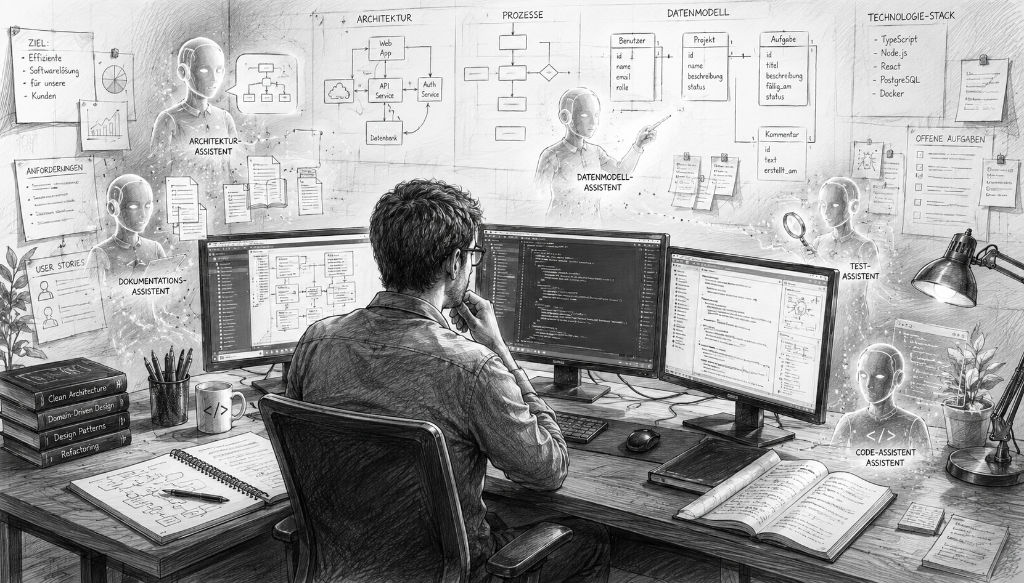
If you had asked me a few years ago what software development would look like in ten years, I would probably have talked about new programming languages, better frameworks, or more powerful development environments. Today, my answer would be completely different. The biggest change isn’t happening with the tools, but in the way we as developers think and work.

As I write these lines, I am working on a new software system myself. For the past few weeks, I have been making extensive use of modern AI tools such as Codex and other language models. At first, I was curious; now, I’m mostly impressed. Not because the AI suddenly does everything on its own, but because it handles certain tasks surprisingly well, thereby enabling new ways of working.

Read more

What is the meaning of life? A comparison of religions, philosophers and Helmut Thielicke

The question of the meaning of life

There are questions that have been with mankind for thousands of years. Questions that never really go away, no matter how modern our world becomes. One of these questions is probably quite simple: What is actually the meaning of life?

Interestingly, the answer „42“ appears again and again today - usually with a little smile. The background comes from „The Hitchhiker's Guide to the Galaxy“ by Douglas Adams. In the story, a highly developed civilization builds a gigantic supercomputer that is supposed to calculate the „answer to the ultimate question about life, the universe and the rest“ over millions of years. In the end, the result is simply: 42. The absurd thing about it is that no one actually knows exactly what the original question was in the end.

That's exactly why this scene became world famous. It is funny, but at the same time surprisingly profound. Because perhaps it describes a basic human problem quite aptly: we often desperately search for answers without even knowing exactly what question we are actually asking.

Read more

How artificial intelligence is changing software development and FileMaker

AI evolution in the development of FileMaker databases

Anyone currently scrolling through news portals, social networks or business platforms will quickly get the impression that artificial intelligence is changing the entire working world practically overnight. New tools, new language models and new promises appear almost daily. Texts are written automatically, images are generated, videos are created and software is sometimes prepared by voice input.

For many companies, this creates a strange mixture of curiosity and pressure. Because, of course, nobody wants to miss the boat. At the same time, many entrepreneurs, freelancers and developers do not yet know exactly which of these technologies will really remain relevant in the long term. This is probably the real peculiarity of the current AI phase: almost everyone senses that something is changing - but hardly anyone can really reliably assess at the moment how quickly and in which direction.

Read more

From ChatGPT data export to your own knowledge AI: step-by-step with Ollama and Qdrant

The path to your own AI memory

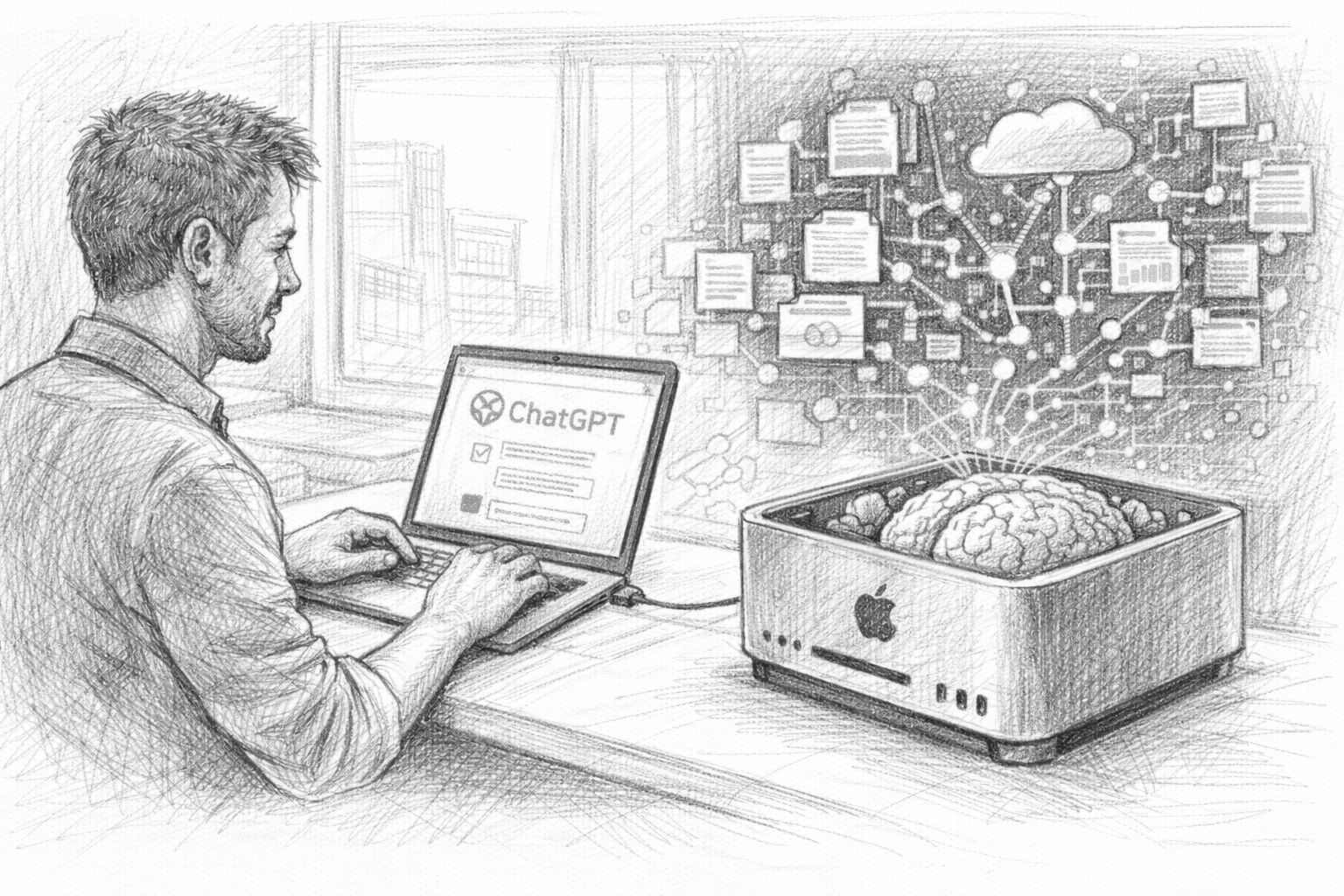
In the first part of this article series, we saw that the ChatGPT data export is much more than just a technical function. Your exported data contains a collection of thoughts, ideas, analyses and conversations that have accumulated over a long period of time. But as long as this data is only stored as an archive on your hard disk, it remains just that: an archive. The crucial step is to make this information usable again. This is exactly where the development of a personal knowledge AI begins.

The idea is actually surprisingly simple: an AI should not only work with general knowledge, but also be able to access your own data. It should search through previous conversations, find suitable content and incorporate this into new answers. This turns an ordinary AI into a kind of digital memory. This is the second part of the article series, which now looks at the practical aspects.

Read more

ChatGPT data export explained: How your AI chats become a personal knowledge system

ChatGPT data export

If you regularly work with an AI, then you probably know this: one thought leads to the next. You ask a question, get an answer, reformulate, develop an idea further. A short question suddenly turns into a longer dialog. Sometimes it even leads to entire projects.

But most of these conversations disappear again. They lie somewhere in the chat list, slide down and are forgotten over time. This is precisely one of the great features of modern AI systems: While previous conversations with colleagues, friends or advisors only existed in our memories, AI dialogs are completely preserved.

This means something crucial: With every conversation, a digital archive of your thinking is created. This is the first part of a small series of articles that will allow you to export your chat history from ChatGPT and use it effectively as a personal treasure trove of knowledge with your local AI system.

Read more

When I was on the phone with a robot - how AI is conquering the phone and how to recognize it

Phone call with an AI robot

There are moments in everyday life that seem completely banal at first. You're sitting at your desk, working on an article, thinking about a new topic - and suddenly the phone rings. A number you don't recognize. In my case, it was an area code from the Ruhr region: 0233 something. As a self-employed person, you occasionally get calls like that. It's usually about advertising, services or advice that you don't actually need.

So I initially answered the call as normal. A friendly female voice answered on the other end. She introduced herself as an employee who works with Facebook and Instagram. It was - unsurprisingly - about advertising. About ads. About reach. Visibility for companies.

Read more

Learning to think dialogically with AI: Why good questions are more important than good models

Learning to think dialogically with AI

The term „AI as a sparring partner“ now appears frequently. It usually means that an AI helps with writing, generates ideas or completes tasks faster. A first basic article on this has already been published in the magazine. This article now aims to show in reality how AI can be used as an effective thinking partner. In practice, it is clear that AI only becomes really interesting when it is not treated as a tool, but as a counterpart. Not in the human sense, but as something that answers, contradicts, leads on - or even mercilessly reveals where your own thinking is flawed.

This is exactly where the real benefit begins. Not where the AI „delivers“, but where it reacts. Where it does not simply process, but makes thought processes visible. This is more inconvenient than a classic tool - but also more sustainable.

Read more

How animals perceive time - and what this means for the future of AI

Animals, AI and time perception

A cat is lying on the carpet. It does not move. It may blink briefly, turn an ear, sigh inwardly at the impositions of existence - and nothing else happens. The human looks at it and thinks: „Typical. Lazy cattle“. But what if the exact opposite is true? What if the cat is not too slow - but we are? This article was written after I watched a video by Gerd Ganteför on this topic and found it so interesting that I would like to present it here.

Humans have been observing animals for centuries and always come to the same wrong conclusions. We interpret their behavior with our speed, our perception, our inner clock. And this clock is, soberly considered, more of a cozy wall calendar than a high-speed processor. Perhaps the cat only seems so disinterested because its environment feels about as dynamic to it as a queue of officials on a Friday afternoon.

Read more