
AI Consulting for Entrepreneurs • AI Consulting for FileMaker Developers
First, check whether your data and processes are even ready. Then decide what makes financial sense.
Many medium-sized companies are currently in a difficult transitional phase when it comes to AI: Employees have long been using ChatGPT and other services in their day-to-day work, but no one knows exactly what company or customer data is being entered in the process. At the same time, it’s not uncommon to receive proposals involving five-figure sums, the technical and economic feasibility of which is difficult to assess internally.
Other companies simply feel increasing pressure to act but do not yet have a clear idea of where artificial intelligence could actually be beneficial in their own operations. In all three cases, it would be risky to simply launch a large-scale AI project. First, it’s important to determine what’s already in place, what’s missing, and what’s truly cost-effective.
Assess AI Readiness: Two days, €2,900 flat rate
Before you invest significant funds in AI, new software, or external service providers, you’ll receive an independent assessment of your company’s current status. In a concise two-day consulting engagement, I’ll analyze your data, selected processes, and potential AI applications. You’ll then receive a written report with specific recommendations and a clear prioritization.
- Data Inventory – what data is available and usable
- Process Evaluation – what can be usefully automated
- Three prioritized use cases in terms of benefits and effort
- Cloud, on-premises AI, or hybrid – well-reasoned technical recommendation
- A clear rejection for projects that are not expected to be profitable
Not sure yet whether the two-day AI assessment is the right starting point for your company? In a no-obligation initial consultation, we’ll work with you to identify your needs. For clearly defined issues, we also offer customized AI consulting on an hourly basis.
Why Many AI Projects in Small and Medium-Sized Businesses Face Problems Even Before They Get Started
The public discussion about artificial intelligence often revolves around models: ChatGPT, Claude, Gemini, local language models, agents, RAG systems, or automation platforms. In business practice, however, the real challenge usually lies one level below. For example, corporate data can simultaneously be found:
- in the ERP system,
- in an older database,
- in Excel files,
- in the email inbox,
- on a file server,
- in an industry-specific solution,
- in individual employees' personal filing systems
- or, in some cases, exist only in the minds of experienced colleagues.
Some information exists in multiple versions and is contradictory. Terminology has changed over the years. Processes have evolved over time but are not fully documented anywhere. One employee knows exactly which exception applies to a particular customer. Another employee is familiar with the specifics of invoicing. A third employee knows why a certain field in a database must never be changed.
For humans, this system often works for a surprisingly long time. For automation and artificial intelligence, however, it quickly becomes problematic. A language model may be excellent at handling language, but it cannot know on its own which of three conflicting pieces of customer data is correct or which informal exception has been part of a specific business process for the past ten years. AI does not automatically improve poor data; in the worst-case scenario, it merely makes incorrect results seem more convincing.
That's why good AI consulting doesn't start with AI
Before discussing models, servers, or automation platforms, we should answer a few much simpler questions:
- What information does the company actually have?
- Where is this data located?
- Which of these are reliable enough to be processed automatically?
- Which processes can be clearly described?
- Where do errors, follow-up questions, or unnecessary manual work occur on a regular basis today?
- Which tasks take a lot of time, even though they could be automated relatively easily?
- And in what situations would the cost of an AI system outweigh its expected benefits?
That last question, in particular, is asked far too rarely in many projects. Not every process needs to be automated. Not every database needs an AI layer. And not every task that could technically be automated should actually be automated.
A reputable consultation must therefore also be able to reach the conclusion: Leave it as it is for now.
What Sets Me Apart from Many Traditional AI Consultants
I am not an AI researcher, and I don't sell language models. My professional background lies where many corporate AI projects actually begin: with data, business processes, and enterprise software.
I have been developing database and business solutions since 1994. Over the decades, I have seen how business systems are created, grow, and expand, eventually reaching a level of complexity that is barely visible from the outside.
Over the past few years, I have extensively integrated artificial intelligence into my own development work and enterprise software. In doing so, I have deliberately chosen not to rely solely on off-the-shelf cloud services, but have instead explored various approaches myself through hands-on experimentation:
- cloud-based and locally run language models,
- different model sizes,
- Model comparisons and benchmarks,
- Agent systems,
- and the integration of AI into existing software architectures.
This work has since evolved into a dedicated development platform with an integrated AI layer. It includes, among other things, custom model definitions in various size classes, an AI adapter, a benchmark interface for directly comparing different models, and an agent runtime.
These aren't presentation slides or theoretical concepts. The systems are actually being used and further developed. As a result, I'm familiar not only with the impressive capabilities of today's AI systems, but also with their limitations, their resource requirements, and the situations where a solution that looks elegant on paper suddenly becomes unnecessarily complicated in day-to-day operations.
So what I don't want to sell you is as much AI as possible. I want to find out how much AI your company actually needs.
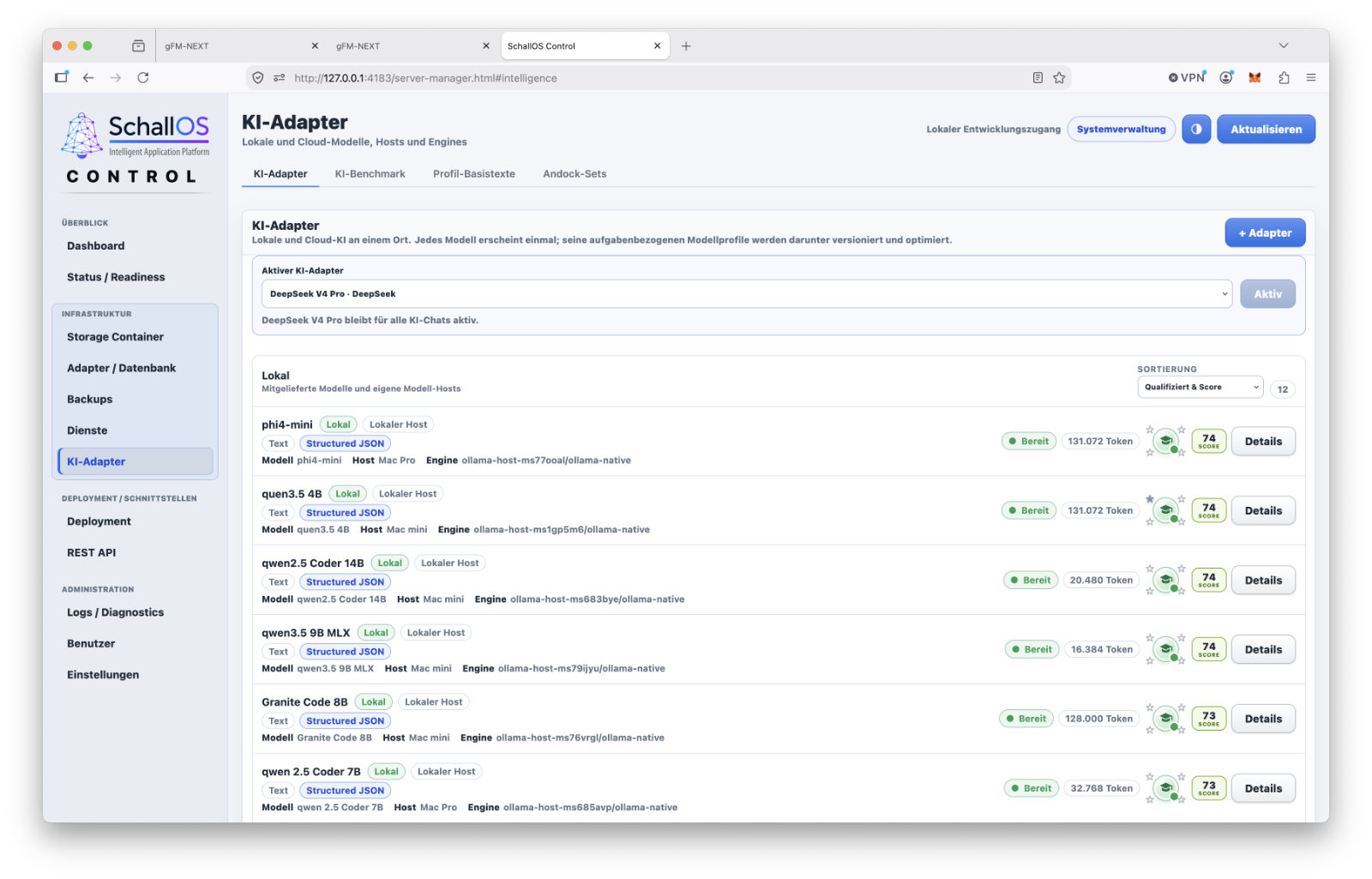
An example from our own development environment: different AI models and technical approaches are compared under real-world conditions, rather than relying solely on manufacturers' specifications.
Assessing AI Readiness: An Independent Assessment
Two days of analysis. Fixed price of 2,900 euros. Written report with specific recommendations.
The AI Assessment is designed for small and medium-sized businesses that need clarity before committing significant budgets to software, consulting, or infrastructure. The goal is explicitly not yet to implement a large-scale AI project. Rather, the goal is to establish a solid basis for decision-making. By the end, you should be able to answer the following questions:
Where in our company is artificial intelligence actually worthwhile?
- What do we need to prepare for this?
- What would be a technically appropriate solution?
- What kind of investment would likely be required?
- And which ideas should we avoid pursuing?
What Is Examined as Part of the Assessment
Data Inventory: First, we examine what relevant company data is available and where it is located.
This is not about a comprehensive technical review of all systems, but rather about determining whether the existing data environment is fundamentally suitable for the planned applications. The following, for example, will be examined:
- Databases,
- ERP and inventory management systems,
- CRM systems,
- Document storage,
- Excel structures,
- File server,
- Interfaces
- and other relevant sources of information.
This also highlights which data should be cleaned, standardized, or better structured before an AI project begins.
Process Evaluation: AI can support processes. However, it cannot magically transform unclear processes into good ones. That is why we examine selected workflows within the company and assess:
- How does the process actually work today?
- What information is required?
- Where do media breaks occur?
- Where is there duplication of effort?
- What kinds of decisions does a person make?
- Which of these follow clear rules?
- Where would AI be useful?
- Where would traditional automation likely be more effective?
This distinction is particularly important. Some tasks do not require a language model, but simply a clean interface or a well-structured workflow.
Three Prioritized AI Use Cases
Based on the analysis, we have identified three use cases that appear to be of particular interest to your company. For each use case, you will receive an assessment of potential benefits, technical effort, organizational effort, data requirements, risks, possible solutions, and recommended priorities.
Not every interesting idea automatically makes it onto this list. What matters is not what sounds technically impressive, but what makes economic sense for your company.
On-premises, in the cloud, or a combination of both?
Many companies today assume that artificial intelligence must necessarily run through large cloud providers. That is not always necessary. Modern on-premises AI models can now handle numerous tasks on their own hardware. Other applications, on the other hand, benefit significantly from powerful cloud models.
A hybrid approach often makes sense. That is why we do not provide an ideological recommendation for or against the cloud, but rather a technical and economic assessment tailored to your specific use case. Among other factors, we take the following into account:
- Privacy,
- Confidentiality,
- Performance,
- Hardware requirements,
- ongoing costs,
- Maintenance costs,
- Availability
- and the desired independence from individual providers.
A clear "no" when something isn't worth it
This point is explicitly part of the consultation. If, in my view, a planned AI application does not appear to offer any reasonable economic benefit, that is exactly what will be stated in the report. If a traditional software solution would make more sense, that will also be noted. If the data structure needs to be improved first—before we even discuss artificial intelligence—that is also a possible conclusion.
Not starting a project can be a highly profitable decision.
What You'll Receive After the Two Days
You will receive a written report that you can use internally as a basis for decision-making. It typically includes:
- a summary of your current situation,
- an assessment of the relevant data landscape,
- identifiable weaknesses,
- an assessment of selected business processes,
- three prioritized AI use cases,
- an assessment of on-premises, cloud, or hybrid operations,
- Technical requirements,
- a rough estimate of the effort required,
- Information on Data Protection and Data Sovereignty,
- Recommended Next Steps
- as well as, specifically, projects that I would currently advise against.
The report should be clear enough for management to understand and, at the same time, detailed enough for subsequent discussions with internal or external IT specialists.
What might happen next—but doesn't have to
The assessment is a standalone consulting service. By engaging in it, you are not committing to any follow-up project.
- Perhaps the conclusion is: Don't implement anything yet. Clean up the data first.
- Maybe a small project will come up that can be completed within a few weeks.
- Perhaps it will become clear that a larger AI project would make economic sense.
And you may be able to implement the recommendations with your existing IT department or an existing service provider. If further collaboration seems appropriate, we can discuss it.
Which companies the AI assessment is intended for
This offering is particularly well-suited for companies with approximately 5 to 100 employees, where digital transformation and business software have long been part of everyday operations, but no one has yet been explicitly assigned responsibility for an AI strategy. Typical situations include, for example:
- Employees are already using ChatGPT or other AI services.
- Management would like to know what risks this poses.
- There is a wealth of data, but no consistent data strategy.
- Processes have evolved organically over the years.
- An external vendor has proposed a major AI project.
- It is difficult for management to assess the benefits and cost of an offer.
- Certain tasks regularly involve a great deal of manual labor.
- The company wants to use artificial intelligence, but it doesn't want to blindly follow every trend.
- Data protection and control over company data play an important role.
- There is interest in local AI solutions or an independent second opinion.
Who this offer is not really intended for
A needs assessment is probably not the right option if it has already been fully determined which system is to be implemented and you are simply looking for a service provider to carry out the implementation. For example, if it has already been decided that:
„We want Product X from Vendor Y and just need someone to implement it.“,
A specialized implementation partner is often the better choice. Consulting is equally pointless if you are simply looking for general AI training or a presentation for employees.
My focus is on corporate data, processes, software architecture, and the question of how artificial intelligence can be meaningfully integrated into real-world business operations.
Why a fixed price?
Especially during an initial analysis, a company should know what financial commitment it is making. That is why the two-day AI assessment has a flat fee of:
2.900 Euro
This includes the agreed-upon analysis, evaluation, and written report. If it becomes clear during our first meeting that a needs assessment would not provide any discernible benefit for your company, I will not recommend that you commission it.
The next step is intentionally small
Before you invest 2,900 euros, let's talk. During a phone call lasting about 20 minutes, we'll go over the following:
- What are you currently thinking about when it comes to AI?
- What systems do you use?
- What problem are you trying to solve?
- What has already been tried?
- And is a structured assessment of the current situation even the right next step?
After that, you’ll know whether the consultation makes sense for you. And if I think it won’t be very helpful for you right now, I’ll tell you that, too. A 20-minute conversation can therefore be enough to avoid an unnecessary five-figure project.
Request AI consulting here
Or simply:
+49 (0) 441-30 43 76 40
E-Mail: **@***********ll.de
AI Consulting and Developer Crash Course as a PDF
This brief brochure provides a concise summary of the two AI consulting services. Companies get an overview of the two-day AI assessment, which includes data analysis, process evaluation, and concrete recommendations for action. FileMaker developers learn how the hands-on AI crash course is structured and which steps we’ll work through together in your own development environment. The information is supplemented by a brief self-assessment that helps you better evaluate your specific needs. This allows you to compare all services, processes, and fixed prices at your leisure. Click on the thumbnail to download or print the full flyer as a PDF.
Frequently Asked Questions About AI Consulting
- What is the total cost of an AI project?
There is no single, definitive answer to this question. A well-defined, small-scale use case can be implemented with manageable effort. Integrating artificial intelligence into multiple business processes or an existing software landscape, on the other hand, can become a significantly larger project. That is precisely why the first step is to assess the current situation. Before investing large sums of money, it’s important to determine which technical approach is actually necessary and what scale makes economic sense. - What exactly do I get for the 2,900 euros?
You will not receive a general presentation on artificial intelligence, but rather a customized analysis of your current situation. This includes, in particular, an examination of relevant data and processes, three prioritized use cases, a technical assessment, and a written final report with specific recommendations. - Does that mean our data has to go into the cloud?
No. Company data does not have to be automatically transferred to an external AI service for analysis. Local models or hybrid approaches may also be worthwhile for future applications. The most appropriate solution depends on the volume of data, the task at hand, security requirements, the desired quality, and the budget. - Is local AI really usable by now?
For certain applications, the answer is definitely yes. Today, local models achieve a level of quality for many tasks that allows for productive work. They offer particular advantages when it comes to confidential data, operating costs, and independence from external platforms. However, they do not replace the most powerful cloud models for every task. Therefore, this decision should be based on technical considerations rather than on assumptions. - We don't have a clean database. Is that a reason for exclusion?
No. That’s actually the norm. That’s precisely why it’s important to assess the data landscape before embarking on a major AI project. The analysis may initially reveal that certain data needs to be standardized or that processes need to be better documented. This isn’t a failure of the AI strategy; rather, it’s often its most important prerequisite. - Do our processes already need to be fully documented?
No. In many medium-sized companies, business processes have evolved over time and are only partially documented. During the assessment phase, therefore, it is also important to gain a sufficient understanding of relevant processes to determine whether and how they could be automated or supported by AI. - Can you also assess whether an existing offer from another provider makes sense?
Yes. If you already have a proposal or a concept for an AI project, it can be taken into consideration. The goal here is not to criticize other providers across the board, but to determine whether the scope of services, technical architecture, and economic benefits are a good fit for your situation. - Do you work exclusively with certain AI providers?
No. I am not tied to any specific model provider or cloud platform. Depending on the task, commercial cloud models, local open-source models, or combinations of the two may be appropriate. - Do you receive commissions from software or AI providers?
No. As part of this consultation, I do not sell third-party licenses, nor do I receive any sales commissions for recommending specific AI providers. Therefore, there is no financial incentive for me to recommend the largest or most expensive third-party solution to you. - Do we need to buy new hardware for this?
Not necessarily. For many initial applications, existing infrastructure is sufficient, or using the cloud makes more economic sense. Local AI systems may require additional hardware. However, an investment in hardware should not be made until it is clear which models and applications will actually be deployed. - Is ChatGPT generally a data protection issue in the workplace?
Not automatically. The key factors are which version and configuration are being used, what data is being entered, and what organizational rules are in place. Problems arise especially when employees enter confidential customer, HR, or company information into external systems without clear guidelines. That’s why assessing the current situation also involves determining how AI is actually being used in the company right now. - Can you also integrate existing databases and ERP systems?
Yes. In fact, that’s a key focus of my work. Existing ERP, CRM, and database systems, in particular, often contain a large portion of the knowledge needed for meaningful AI applications. The first step is to assess the structure, accessibility, and quality of this data. - Does AI automatically mean that employees will be replaced?
No. In many practical applications, the initial goal is to relieve employees of the burden of searching for information, repetitive data entry, document analysis, or other time-consuming routine tasks. Whether entire tasks can actually be automated depends heavily on the specific process. A thorough analysis should therefore not begin with the goal of eliminating as many jobs as possible. - Can artificial intelligence also be integrated into our existing software?
In many cases, yes. Completely replacing existing systems is often neither necessary nor economically feasible. It may be more worthwhile to integrate selected AI functions with existing databases, ERP systems, or business processes in a controlled manner. Determining whether this is technically possible and economically feasible is part of the assessment. - How long does the assessment take?
The actual analysis is designed as a compact, two-day consulting engagement. Depending on the availability of the contacts and the documentation, the interviews, analysis, and completion of the written report may be spread out over several calendar days for organizational purposes. - Who should participate in the discussions?
In small and medium-sized businesses, management is usually the primary point of contact. Depending on the topic, it may be helpful to also involve an employee who is particularly familiar with the existing software, data, or the relevant business process. Large project teams are generally not necessary for this initial analysis. - What happens if you can't find a useful use case for AI?
Then that’s exactly what the report will say. There’s no guarantee that a major AI project will necessarily emerge after two days. The recommendation might be to start by making better use of existing software, cleaning up data, or streamlining processes. This insight, too, can help avoid significant investments. - Could the analysis also show that we shouldn't do anything at all for the time being?
Yes. That is definitely possible. The purpose of the assessment is not necessarily to sell a project afterward. The purpose is to be able to make a sound decision.
Assess AI Readiness: Two days, €2,900 flat rate
Before you invest significant funds in AI, new software, or external service providers, you’ll receive an independent assessment of your company’s current status. In a concise two-day consulting engagement, I’ll analyze your data, selected processes, and potential AI applications. You’ll then receive a written report with specific recommendations and a clear prioritization.
- Data Inventory – what data is available and usable
- Process Evaluation – what can be usefully automated
- Three prioritized use cases in terms of benefits and effort
- Cloud, on-premises AI, or hybrid – well-reasoned technical recommendation
- A clear rejection for projects that are not expected to be profitable
Not sure yet whether the two-day AI assessment is the right starting point for your company? In a no-obligation initial consultation, we’ll work with you to identify your needs. For clearly defined issues, we also offer customized AI consulting on an hourly basis.
First, get a clear picture—then invest
Artificial intelligence will transform enterprise software and business processes in the coming years. However, that does not mean that every company should rush to start just any AI project today.
Small and medium-sized businesses, in particular, often have a significant advantage: they know their customers, their processes, and their products very well. Many systems have evolved over the years and contain valuable business knowledge. This knowledge does not need to be replaced. It must first be understood, structured, and made available where it is needed.
That's exactly where meaningful AI consulting begins—not with the model, but with your company.