When the first reports of an unusual lung disease emerged in Wuhan, most of us thought it was just a side note. A new pathogen, somewhere in China - you heard something like that from time to time. But within a few weeks, the situation changed dramatically. Borders closed, schools shut down, events were canceled. There was uncertainty, and suddenly this virus affected everyone - directly.
With a little distance, you can sense today that there is still a lot going on beneath the surface. Many people have the feeling that not everything was open, not everything was clear and not everything was fully communicated at the time. Anyone who tries to find objective information about the origin of the virus quickly encounters contradictions, gaps and conflicting accounts. For this very reason, it is worth sorting through the topic calmly and clearly - without haste, without polemics, without pigeonholing.


Latest news on SARS-CoV-2
10.01.2026: A current Report in the Berliner Zeitung discusses an open letter from Robert F. Kennedy Jr. in which he directly addresses Nina Warken, Member of the German Bundestag. Among other things, Kennedy calls for an investigation and possible proceedings against medical professionals in connection with the coronavirus pandemic. The article quotes Kennedy's letter and also includes the original tweet with video in which the letter is communicated. This development once again raises fundamental questions about responsibility, the rule of law and medical assessment - and at the same time ties in with our existing Corona article. The background article will therefore now be supplemented by this current case in order to include classifications on legal processes, public expectations and the limits of criticism and legal assessment in the context of the pandemic.
Why I am writing this article - a personal background
I remember well how, in the months before Corona had seen an interview with Karl Lauterbach. At the time, he was talking about mRNA vaccines - before the word „corona“ even had a meaning. In that interview, he seemed optimistic, but also cautious. He said that mRNA technology was promising, but not yet fully developed. The side effects were still too considerable and he expected it would take at least ten years before something like this was ready for the market. Incidentally, this interview was a short time later and can no longer be found in the media library or on YouTube.
Less than six months later, everything suddenly changed. Then came the pandemic, and a few months later these very vaccines were available with emergency authorization. For many people, this was logical: research could accelerate if there was enough pressure, money and resources. For me personally, however, it felt like a break in the narrative - and I decided to distance myself from this vaccination.
The virus got me anyway, probably in one of the later variants. It was unpleasant, but it passed. But what particularly bothered me at the time: My children didn't have the same choice. In many schools, it meant that children could hardly take part in certain activities without being vaccinated. I still remember going to my ex-wife's house and trying to exert influence - not out of spite, but out of concern. Unfortunately, it didn't work because there was too much pressure from the state.
I am telling you this for one simple reason: this topic affects me personally. And I believe it affects many people in a very similar way. The pandemic was not just a medical event - it was an experience that had a profound impact on families, decisions and relationships.
Bearing this in mind, it is understandable that questions about the origin of the virus are so often associated with strong emotions. Nevertheless - or precisely because of this - it is important to talk about it calmly, clearly and respectfully.
Why the origin of a virus is far more than an academic question
One might be tempted to say: „It doesn't matter where it comes from - it happened.“ But it's not that simple. Depending on where SARS-CoV-2 comes from, completely different conclusions can be drawn for the future:
- Natural origin (zoonosis)Then we need to talk about how we deal with wildlife markets, global trade and animal husbandry. What interfaces between humans and animals encourage such leaps? What conditions favor them?
- Laboratory accident: Then we need to talk about biosafety. About transparency in research institutions. About rules, standards and control mechanisms.
- Targeted laboratory generation or manipulationThen there are fundamental ethical questions: How far can research go? Who decides? And what security systems does a modern society need?
Either way, origin is not a minor matter, but a key factor for future decisions.
Trust - and the wounds that remain to this day
What still lingers with many people today is the feeling that not everything was said openly in public communication. People sense when things are blurred. They notice when certain questions are not welcome. And they have a very keen sense of when information is not clearly separated - for example, when opinion and fact merge.
A lot was determined early on, especially with regard to the origin of SARS-CoV-2, although the data situation was incomplete. In some cases, critics were not factually refuted, but simply dismissed. This does not create trust, but distance. And this distance still has an effect today. That is why this article is not about „being right“, but about shedding light on a topic that was highly charged from the outset.
Current survey on trust in politics
Why this article juxtaposes several points of view
There are many texts about the natural origin. It can be found on news portals, in leading media, in official statements. Other points of view, on the other hand, are usually only mentioned in passing - or in a tone that is more pejorative than factual.
But the reality is that there are several serious hypotheses about the origin. With different arguments, strengths and weaknesses. This article therefore presents:
- the traditional view,
- the laboratory accident hypothesis,
- the thesis of targeted laboratory production,
and the politically tinged fringe theories side by side. I am not judging anything and I am not defending anything. I only describe what the respective groups say and why. Every reader can then make their own assessment.
A calm introduction to a difficult topic
The pandemic was a turning point. Many have experienced personal losses, had economic worries or had to make decisions that have torn them apart inside. All of this is part of the history of this virus - and it explains why it is worth taking a particularly careful and respectful approach to the topic of origins.
In the next chapter, we will therefore move gently into the first major view: the assumption of a natural origin, as traditionally represented in virology. From there, we move on step by step - all the way to the laboratory hypotheses, which are often only mentioned in passing in the public debate.
The classic explanations: Natural origin (zoonosis)
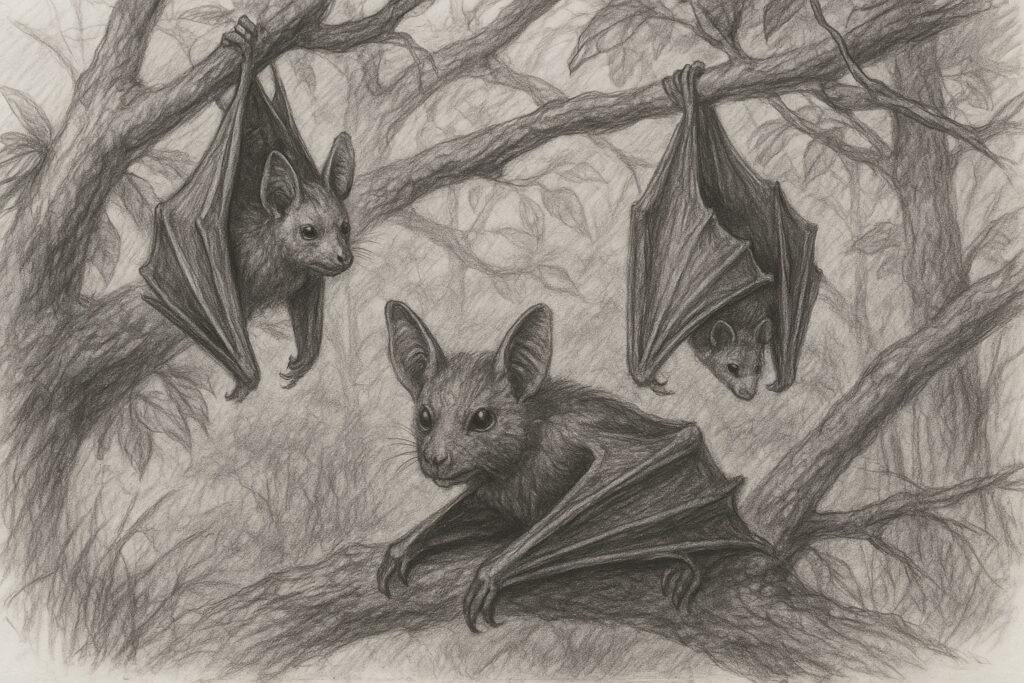
In traditional virology, there is an obvious basic assumption: viruses that first appear in humans usually come from the animal kingdom. This has been the case for many known infectious diseases - and SARS-CoV-2 has also been viewed through this lens from the very beginning. In this chapter, we take a look at how this classic explanation works, which arguments speak in favor of it, but also where this argumentation becomes weak or remains open.
What is meant by „natural origin“
When experts talk about a „natural origin“ or zoonosis, they basically mean the following: A virus initially circulates in an animal population - often unnoticed. Under certain conditions, it reaches humans, for example through:
- Contact with wild animals (hunting, markets, breeding),
- Animal husbandry (fattening farms, fur farms),
- or mixed forms (e.g. live wild animals at markets).
Sometimes this transition is a „dead branch“ - the virus jumps over briefly, but cannot spread well between people. In rare cases, the „jump with a connection“ is successful: the virus can spread from person to person, mutates and adapts - a new human infectious disease emerges.
In the case of SARS-1 (2002/2003), for example, it is likely to have been transmitted via sneaky cats, in the case of MERS via camels and in the case of other pathogens via various wild animal species. For many virologists, it was therefore initially obvious:
„SARS-CoV-2 will probably have taken the same route, just via other animal species.“
Argument 1: The proximity to known bat coronaviruses
A central argument in favor of the natural origin is the genetic relationship. If you compare the genetic material of SARS-CoV-2 with other known coronaviruses, you can see that
There are bat coronaviruses that are very similar, e.g. from regions in China and Southeast Asia. There are differences between these viruses and SARS-CoV-2 - but within a framework that can be understood as the result of natural evolution. From the point of view of many researchers, this suggests that SARS-CoV-2 is not a completely „foreign“ construct, but fits into a known lineage of coronaviruses. So the idea is:
Somewhere in nature there was a bat population with SARS-like viruses. Through mutations and crossbreeding (recombination), a virus was created that - with or without an intermediate host - passed on to humans.
Where this argument is strong:
- We know that bats are a large reservoir for coronaviruses.
- We actually know viruses that have a similar structure.
- There is nothing fundamentally „unnatural“ about the overall structure of the virus - it fits into the coronavirus family.
Where this argument becomes weaker:
Despite an intensive search, no clear „parent virus“ has yet been found that explains SARS-CoV-2 apart from a few nuances. There are gaps: You can only roughly trace the path, but you can't specifically say, „Here, this exact bat, this barn, this market.“ Critics say: „The fact that there are similar viruses does not mean that this exact virus arose naturally. It just shows that the family is large.“
Argument 2: Parallels to previous outbreaks (SARS, MERS & Co.)
Another component of the classic explanation is the A look into the past. During the first SARS outbreak in the early 2000s, animals were later identified (e.g. crawling cats) that presumably carried the virus as an intermediate host. In the case of MERS, much points to dromedaries as an important reservoir. Other viruses (e.g. influenza viruses) have also repeatedly jumped from animal populations to humans throughout history. The logic behind this is simple: we have seen it happen many times before - so it stands to reason that it will be similar this time too.
Strength of this argument:
It is based on historical experience and many documented examples. It shows: Zoonotic jumps are nothing exotic, but rather the norm.
Weakness of the argument:
It is essentially an analogy: „It used to be like this, so it probably is now too“. Whether the parallel is really true depends on whether concrete evidence can be found - and this is still a problem today. Critics say: „Just because something similar happened in the past doesn't automatically mean that it was the same this time - especially as we're talking about a city where high-security laboratories are also working on exactly this kind of virus.“
Argument 3: The early falls and the Huanan market
In many depictions, the Huanan Seafood Market in Wuhan as a possible starting point. The classic argument: many of the early known cases had a connection to this market. In addition to fish, other animals were also traded on the market - including species that could be possible intermediate hosts (e.g. raccoon dogs). Later, samples from the market were found to contain traces of SARS-CoV-2 as well as animal genetic material.
The picture that emerges: A market where different animal species come into close contact with each other, in a big city where lots of people are out and about - an ideal place for a zoonosis jump.
Strength of this argument:
- There is a clear spatial accumulation at the very beginning of the known cases.
- Markets with live animals are considered „hotspots“ for new infections from previous epidemics.
- The mixing of many species in a confined space is problematic from a biological point of view.
Weakness of the argument:
The market may also have been an amplifier - not necessarily the origin. This means that someone infected comes to the market, infects many people there, and then in retrospect it looks as if the market was the starting point. To date, no clearly infected animal has been identified as the source. There are traces, but no „smoking gun“. Critics emphasize: „It is noticeable that there has been a very strong focus on the market, while other possible starting locations - e.g. laboratories - have been examined much less openly.“
Argument 4: „It doesn't look like an obvious laboratory construction“
A rather technical, but often quoted argument reads: Genetically speaking, SARS-CoV-2 has no clear „fingerprints“ that point to an obvious artificial construction. This means:
Artificially created viruses in the past sometimes have certain patterns in their genetic material that can be recognized as evidence of laboratory work - for example, unusual interfaces, markers or signatures. In the case of SARS-CoV-2, the overall structure looks to many researchers as if it could have arisen through natural mutation and recombination without such interventions.
Strength of this argument:
Experts are familiar with typical laboratory constructions and find nothing here that clearly points in this direction. There are models of how the conspicuous sites (e.g. the furin cleavage site) could arise through natural processes - for example through recombination of different viruses in animals.
Weakness of the argument:
Strictly speaking, it only says: „We see no obvious evidence of a laboratory design“. It does not prove that there was no laboratory involvement, because: Modern methods can make changes in such a way that they are no longer clearly recognizable as artificial. Critics object: „If someone deliberately builds a virus and avoids all conspicuous markers, then it would look exactly like a natural virus.“
In other words, this argument is more of a negative finding („we see no clear evidence for X“), not positive evidence for a natural origin.
Where the classic explanation stumbles
In summary, the zoonosis hypothesis has several plausible building blocks:
- known proximity to bat coronaviruses,
- historical parallels to earlier outbreaks,
- conspicuous role of the Huanan market,
- no obvious genetic „fingerprint“ of a laboratory.
Nonetheless, there are still significant unresolved issues:
- Missing intermediate hostNo animal has yet been identified that clearly serves as a „bridge“ between bats and humans - unlike in some previous epidemics.
- Gaps in the early dataEarly infections are difficult to trace. It is unclear whether the market was really the very first focus or just the first conspicuous cluster.
- Parallel laboratory researchThe fact that there are laboratories in the same city that have been researching similar viruses for years cannot be ignored. Critics say that the zoonosis narrative ignores this reality too much.
- Limited transparencyMany primary data - especially from China - are still not fully accessible. This applies to both natural samples and laboratory documents. This weakens every hypothesis - even the classical one.
A plausible but incomplete picture
The classic explanation of a natural origin of SARS-CoV-2 is not illogical in itself. It is based on:
- known mechanisms,
- historical examples,
- genetic relationship,
- and the role of markets and wildlife contact.
However, it remains a model with gaps as long as no specific animal host has been identified, the earliest cases cannot be fully traced and important data is not available. This is why many virologists see this hypothesis as the most likely at present, but even they cannot say with absolute certainty: „It was definitely like that.“
This is precisely where the laboratory hypotheses come in. They use the same gaps, but interpret them differently. While the zoonosis hypothesis says: „We have good reason to believe that it was nature.“ say the laboratory hypotheses:
„These gaps and abnormalities tend to speak in favor of laboratory involvement“. In the next chapter, we will therefore take a closer look at the laboratory accident hypothesis: What is claimed there? What evidence is cited? And where are the gaps in this view?
| Argument of the group | What speaks for it | What speaks against it |
|---|---|---|
| SARS-CoV-2 is similar to known bat coronaviruses | Genetic proximity to RaTG13 and other virus lines; similar properties in structure and composition. | No direct „mother virus“ found; despite intensive search a direct precursor is missing. |
| Zoonoses are historically common | SARS-1, MERS and other pandemics clearly originated from animal populations. | A conclusion by analogy is no substitute for proof; earlier patterns do not necessarily have to apply again. |
| The Huanan market as a possible starting point | Many early clusters there; traces of animal DNA and viral RNA in the same locations. | The market could have been an amplifier, not the source; no infected animals found. |
| No clear genetic evidence of laboratory work | SARS-CoV-2 shows no obvious cut markers that would be typical of artificial construction. | Modern technology could avoid traces; no proof of nature, only lack of proof of manipulation. |
The laboratory accident hypothesis: research, risk and unanswered questions
The laboratory accident hypothesis is somewhere between plausible caution and justified mistrust. It does not make the bold claim that SARS-CoV-2 was „built“. It first asks something much simpler:
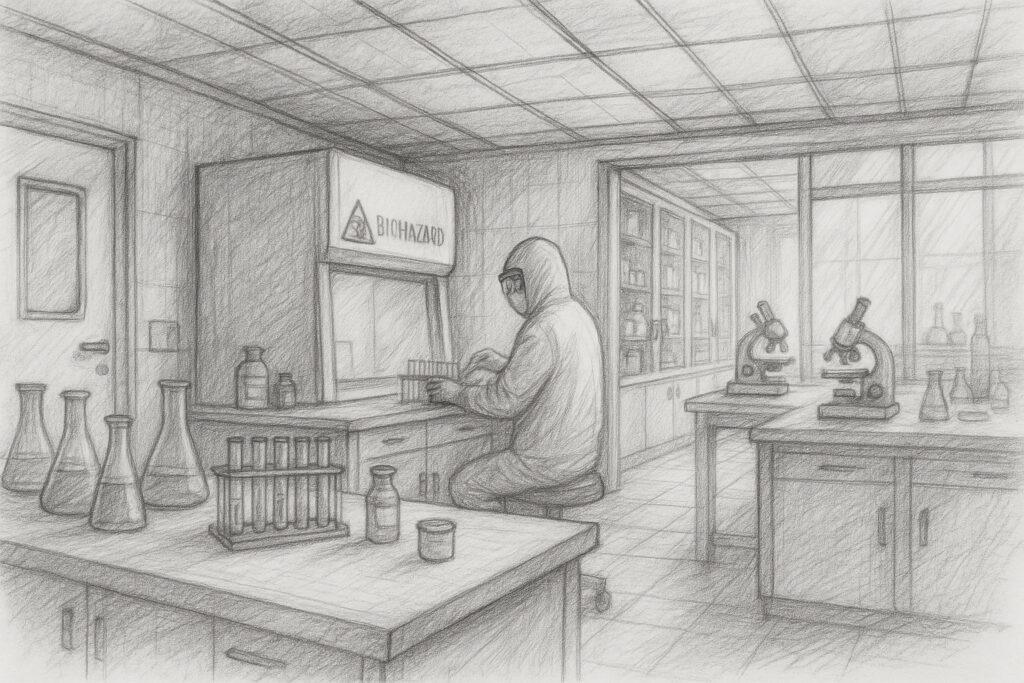
Can a virus that is being researched in a laboratory accidentally escape? There have already been such cases in history, and that is precisely what makes this hypothesis serious for many experts. It is not based on sensation or speculation, but on sober consideration: Wherever people work, mistakes happen - especially where research is carried out with highly infectious pathogens.
Wuhan - a city with modern virus research
Wuhan is not just any city. It is home to a laboratory of the highest security level - the Wuhan Institute of Virology (WIV). This institute has been researching bat coronaviruses for many years, including viruses that are genetically close to SARS-CoV-2.
This research is not unusual. It is carried out worldwide to prepare for possible pandemics. In Wuhan, there were teams collecting new bat viruses, decoding their genetic material and trying to understand how they can evolve.
Some researchers see the fact that the pandemic began in this city of all places as a coincidence - others see it as a statistical signal that at least deserves attention. Such a coincidence of two lines - pandemic and virus research - cannot simply be ignored.
How a laboratory accident can happen
Strict safety regulations apply in laboratories that research viruses. Gloves, airlocks, special suits, pressure chambers - all of these are designed to prevent viruses from escaping. But no system is absolutely safe. Several laboratory accidents have been documented in the past:
After the first outbreak of the old SARS virus, there were cases in which the virus was accidentally released from laboratories in China, Singapore and Taiwan. Other pathogens have also been unintentionally released in various countries - usually without major consequences, but still a warning example. Often all it took was a little carelessness: a torn glove, an incompletely sealed reactor, an unnoticed contamination. In most cases, these are not spectacular disasters, but routine human errors.
For the supporters of this hypothesis, the consequence is obvious: when highly infectious viruses are researched, there is always a residual risk - even if everyone involved works conscientiously. This view does not need a „villain“. All that is needed is what can happen anywhere: an accident.
Evidence cited by proponents of a laboratory accident
Those who consider a laboratory accident to be possible or probable usually refer to four points which, taken together, paint a certain picture. None of them is proof - but together they form a comprehensible chain of reasoning for some.
- First: The start in Wuhan is no neutral coincidence. Wuhan is not a hotspot for bat populations. The nearest known populations of the relevant bat species are hundreds of kilometers away. Yet it is precisely there, in this large city, that research has been carried out for years with similar viruses. For some, this spatial coincidence is at least striking.
- Secondly: The early data is incomplete. It is still not possible to say exactly who the first infected people were or how they became infected. Some early patient files and samples were published late or are no longer available.
It is precisely in such foggy zones that room is created for the question: What has been overlooked - or even covered up? - Thirdly: There have been reports of possible security problems. There is some evidence to suggest that the utmost care was not always taken in Wuhan. Such evidence ranges from internal memos about training deficiencies to statements by Western diplomats who pointed out weaknesses before the pandemic. These reports are controversial, but they do exist - and fuel doubts.
- Fourthly: Intelligence agencies disagree, but some lean towards lab accident. Various US authorities have made assessments. Some consider a natural origin more likely, others lean moderately toward a laboratory accident. No agency speaks of certainty, but the fact that there are different assessments at all shows that this hypothesis has not been plucked out of the air.
Where the laboratory accident hypothesis is convincing
You don't have to be a scientist to realize that there is something fundamental at play here: When a city conducts cutting-edge research on pathogens and at the same time a global pandemic starts right there, a natural question arises that no one can simply wipe away. A laboratory accident is not particularly spectacular either. It would be the inconspicuous version of a catastrophe:
A researcher becomes infected unnoticed, goes home after work, infects a person - and the chain takes its course. Many people can relate to this idea because it seems more realistic than some of the complicated stories about intermediate hosts, market conditions and missing finds from nature. Some therefore simply say:
„The simplest explanation is not always the right one, but it should at least be taken seriously.“
Where the laboratory accident hypothesis falters, however
Despite all its plausibility, there are also critical points at which this theory becomes weaker. The most important are
- There is no direct evidence. To date, no document, no protocol, no laboratory sample has been found that clearly shows: „This virus was in the laboratory and something went wrong there“. There are indications, but no definitive proof.
- Many of the indications mentioned can also be interpreted differently. A missing intermediate host can mean: There was none. Or: It has not yet been found. or: The search was half-hearted. Such ambiguities leave a lot of room for interpretation.
- Laboratory accidents are rare - and usually quickly recognizable. Supporters say: „Mistakes happen everywhere“. Opponents argue against this: In modern high-security laboratories, procedures are so strictly regulated that such an accident is normally noticed and documented. Whether this always works in reality is another question.
- The genetic structure of SARS-CoV-2 does not necessarily have a laboratory background. Many virologists emphasize that the virus has no characteristics that are known as typical laboratory signatures. Proponents counter: „A well-done experiment may not have a signature either“. But in the end, this debate remains open.
A hypothesis between open questions and missing answers
The laboratory accident hypothesis operates in a field of tension: it seems plausible because it fits into a real world of human error. At the same time, it seems incomplete because there is a lack of hard evidence. You could say:
- It is neither proven nor disproven.
- It is neither absurd nor safe.
- It is possible - but not confirmed.
For many people, it is precisely this gray area that is so difficult to endure. In a complex world, you want clear answers. But when it comes to the question of the origin of SARS-CoV-2 in particular, there still doesn't seem to be a clear answer.
This is why some researchers are turning to a third view - the much stronger theory that SARS-CoV-2 could not only have originated in a laboratory, but may have been deliberately modified there.
| Argument of the group | What speaks for it | What speaks against it |
|---|---|---|
| Start of the pandemic in a city with coronavirus research | Wuhan has laboratories researching SARS-like viruses; the close proximity is striking. | Large cities without laboratories can also be the origin; spatial correlation is no substitute for causality. |
| Safety concerns in the laboratories | Reports of inadequate training, earlier warnings from Western diplomats. | Many of these reports are unconfirmed or contradictory; there is a lack of concrete evidence. |
| Lack of transparency and withheld data | Gaps in early case numbers, incomplete laboratory records, late publications. | Data chaos is common in pandemics; missing data does not prove an accident. |
| Laboratory accidents are documented | Earlier SARS variants have escaped from laboratories several times; human error possible. | In BSL-3/BSL-4 laboratories, controls are very strict; an accident would have to leave traces. |
The thesis of targeted laboratory production - the view of Dr. Nehls and others
In the first chapters we looked at two lines: the classic zoonosis narrative and the possibility of a laboratory accident. Dr. Michael Nehls' view goes one step further. He not only considers it likely that SARS-CoV-2 has a laboratory origin, but openly speaks of a deliberately created bioweapon whose properties are not accidental but the result of deliberate manipulation.
This chapter traces his argument - as he presents it himself - and then shows where it meets with unanswered questions or contradiction from experts.

Who is Michael Nehls - and from what perspective does he argue?
Michael Nehls is a German doctor and habilitated molecular geneticist. He has conducted research in immunology and later wrote several popular science books - including on Alzheimer's, mental fatigue and the coronavirus pandemic („Das Corona-Syndrom“, „Herdengesundheit“, „Das indoktrinierte Gehirn“).
During the Corona period, he increasingly appeared as a critical commentator who:
- the pandemic policy,
- the role of WHO, CEPI, pharmaceutical industry
- and in particular the mRNA vaccines
very fundamentally questioned. His texts and interviews mainly appear on alternative platforms and his own website. The important thing is: Nehls does not speak from the position of a virologist researching coronaviruses, but as a molecular geneticist who reinterprets existing studies, patents and political processes from his own perspective.
Center of his thesis: The furin cleavage site as a „signature“ of manipulation
At the center of Nehls’ argument is a detail in the genome of SARS-CoV-2: the so-called furin cleavage site (FCS) in the spike protein. To put it very simply:
This cleavage site ensures that the spike protein is cut into two parts (S1 and S2) by the enzyme furin. This makes it easier for the virus to Penetration into human cells making it particularly efficient.
Nehls bases this on a publication by an international team of researchers (Ambati et al.) in Frontiers in Virology. It describes that a 19-nucleotide sequence in the region of this furin cleavage site exactly matches a sequence in an older, proprietary mRNA patent (MSH3-related sequence, used by Moderna, among others). These researchers indicate an extremely small probability that such a match occurs by chance - about 3.21 × 10-¹¹, i.e. in the order of „one in three trillion“.
Nehls interpreted This is how he explains it: such an exact match can practically no longer be explained as a coincidence. He therefore concludes that the furin cleavage site was deliberately inserted - i.e. a result of molecular genetic manipulation, not natural evolution. At this point, his argument turns from a „laboratory accident“ to a deliberate construction:
If a part of the virus genome is so closely linked to a patented technical sequence, he believes that the virus cannot simply come „from nature“. However, the scientific debate on this is not as clear-cut as he makes it out to be: Technical comments to this work indicate that the calculated probability is problematic and may have methodological weaknesses. Other works show that furin cleavage sites in coronaviruses also arise naturally and have appeared several times independently; they are therefore not in themselves proof of genetic engineering.
Nevertheless, it is clear that for Nehls this point - unique sequence, strong infectivity and the link to a patent - is the keystone of his bioweapon thesis.
From gain-of-function to bioweapon: how Nehls constructs the big picture
Nehls combines the molecular genetic details with a larger framework: Gain-of-function research. He refers to programs such as „Disease X“, to WHO priority lists and to the cooperation between WHO, CEPI and vaccine manufacturers. In his texts, he writes that research is carried out specifically on previously defined „priority pathogens“ and virus families - with the aim of functionally expanding viruses (gain-of-function) in order to make them pathogenic for humans and prepare vaccines in parallel.
Event 201 and pandemic simulation games
He does not see simulation games such as „Event 201“ as a neutral exercise, but as an indication that precisely this type of pandemic was prepared and expected. He sees the fact that a SARS relative with an unusual furin cleavage site appeared shortly afterwards as further evidence that this was not a coincidence.
Bioweapon SARS-CoV-2
In one of his articles he writes explicitly: „SARS-CoV-2 is a bioweapon“, and describes the S1 subunit of the spike protein as the actual „bullet“ that is fired at our organism.
Linking to vaccination programs
Nehls goes on to argue that mRNA vaccines artificially produce the most dangerous component of this supposed bioweapon - the spike protein - in the body without meaningfully building up natural immunity. This is why he uses the term „spiking“ instead of „vaccination“ and sees this as a kind of second wave of attack that is intended to harm people through long-term exposure to spikes.
In his worldview, SARS-CoV-2 is therefore not a random product of evolution or a mere laboratory accident, but a deliberately modified virus embedded in a larger structure of bioweapons research, pharmaceutical interests, WHO policy and social control.
The probability calculation: „practically impossible“ - or not?
Nehls argues with an extremely low probability - „one in 300 billion“ or similar orders of magnitude - that the sequence in question in the furin cleavage site could have arisen by chance. He essentially bases this on:
- the length of the relevant sequence (19 nucleotides),
- the size of the SARS-CoV-2 genome (~30,000 nucleotides),
- the number and length of sequences in a particular patent library,
- and the assumed randomness of such matches.
From his point of view, this follows:
„If the probability is so extremely low, there is only one realistic explanation: deliberate manipulation.“
However, the scientific classification is much more cautious: an official commentary (Dubuy & Lachuer) on this work explicitly points out that the calculated probability could be incorrect or misleading. In particular, the assumption that every possible 19-sequence is equally likely and independently distributed is very simplified.
There is also evidence that similar furin cleavage sites occur naturally in other coronaviruses and have arisen several times independently - in other words, they are not a singular event.
This leaves an area of tension: from Nehls’ perspective, the calculations provide the „smoking gun“. From the perspective of many virologists and evolutionary biologists, this conclusion is exaggerated - the data is not sufficient for proof and the statistics are vulnerable.
Current survey on a possible case of tension in Germany
Nehls’ extended narrative: brain, indoctrination and „mental bioweapon“
In his more recent works, Nehls expands on the pure origin thesis. In „The indoctrinated brain“, he describes a mechanism by which anxiety, constant stress and media narratives disrupt neurogenesis in the hippocampus and thus weaken our mental resilience. He combines several levels:
- Biology of the spike proteinHe describes the spike protein as neurotoxic and brain-damaging in the long term, especially in connection with chronic inflammation.
- Social controlThe pandemic, the measures and the communication about it become part of a larger „perma-crisis model“ that aims to mentally exhaust and frighten people and make them more receptive to technocratic structures.
- Connection to the originIf SARS-CoV-2 is a bioweapon from his point of view anyway, everything fits into a kind of overall narrative: first the „artificial“ virus, then the „spiking“ mRNA injections, then the psychological effects of the measures - all part of an attack on physical and mental health.
This view is highly exaggerated. It goes far beyond what even many critics of official coronavirus policy hold. Accordingly, it is not shared in major media and by official bodies; some classifications explicitly speak of misinformation or conspiracy narratives, especially in connection with his statements on vaccines.
Where Nehls’ argumentation breaks down
Even if one can understand his basic skepticism, there are several points where his argumentation is visibly on shaky ground:
- Lack of direct evidence: There are still no laboratory records, no published gene sequence, no document that proves beyond doubt: „This specific virus was built in laboratory X and then released“. Nehls works with chains of evidence, interpretations and probabilities - but he cannot provide any hard evidence.
- Strong interpretation of a controversial paper: The work on the furin cleavage site and MSH3 homology is discussed among experts - but it is not recognized proof of genetic engineering. The fact that Nehls treats it as such is a very far-reaching interpretation.
- Furin cleavage sites also occur naturally: Several Studies show that similar cleavage sites have arisen in other coronaviruses without laboratory involvement - through recombination and natural selection. This one characteristic alone is therefore not sufficient to conclude that the virus was artificially created.
- Mixing well-documented points of criticism with very speculative parts: It is obvious that the WHO, CEPI, pharmaceutical companies and states have their own interests. That mistakes have been made in pandemic policy is also hardly in dispute. But to directly infer a coordinated „bioweapons conspiracy“ from these real problems is a huge leap that goes beyond what can be proven.
Conclusion: A sharp minority position
Michael Nehls' view can be summarized as follows: SARS-CoV-2 was most likely constructed in the laboratory. The furin cleavage site and its alleged patent relationship are the central genetic clue. The virus is to be understood as a bioweapon, the spike protein as a specifically damaging component.
The mRNA vaccines would extend this bioweapon inwards, so to speak, by allowing the body itself to produce spike protein on a permanent basis. The whole thing is embedded in a larger system of pandemic planning games, pharmaceutical interests and media control.
This position is clearly a minority opinion and is not in line with the current scientific majority view, which continues to consider a natural origin plausible and the existing data to date not as evidence for targeted laboratory production.
| Argument of the group | What speaks for it | What speaks against it |
|---|---|---|
| Furin cleavage site appears „inserted“ | Unusual sequence of 19 appearing in a patent database; statistically low random probability according to some analyses. | Natural recombination can generate these sites; statistical calculations are controversial. |
| Connections to mRNA patents | The same or similar sequences appear in older patents; seems contrived. | Many sequences overlap randomly; no direct link between patent and virus proven. |
| Pandemic exercises like Event 201 | Pandemic processes were simulated in detail; temporal proximity is striking. | Simulation games are common in health authorities; temporal proximity is no proof of intent. |
| Global interests of pharma, WHO, foundations | Major financial and political interests; suspicion of control and influence. | interests exist, but there is no evidence of a coordinated plan to produce the virus. |
| Spike protein as a „targeted harmful component“ | Nehls interprets biological properties as deliberately toxic; connection to vaccines. | Majority of biologists see spike as a biological mechanism, not a weapon; no evidence of intent to manipulate. |
Other authors with similar views to Michael Nehls
There is a whole range of authors, scientists and investigative journalists who - for different reasons - express doubts about the natural origin of the virus or write specifically about laboratory hypotheses, biotechnology, gain-of-function research or structural power interests. To give you an overview, here are the most important names:
- Dr. Richard EbrightMolecular biologist (USA), has been a critical observer of gain-of-function research for years. He argues particularly strongly against risky virology projects and sees laboratory accidents as a realistic source of danger.
- Dr. Alina ChanMolecular biologist at the Broad Institute (MIT/Harvard). Known for work on early pandemic chronology and the thesis that important data is missing. Co-author of „Viral“, a book on the lab-leak hypothesis.
- Dr. Steven Quayphysician and biotech entrepreneur. He has written several analyses in which he argues statistically that SARS-CoV-2 must come from a laboratory. His work is controversial but often cited.
- Nicholas WadeFormer science editor of the New York Times and Science. His long essay from 2021 on the possible laboratory origin was discussed worldwide.
- Dr. Robert MaloneOriginally involved in early mRNA technologies. He is highly critical of both vaccine policy and gain-of-function projects. His positions are pointed, but find broad resonance in critical media.
- Jeffrey SachsEconomist and head of the Lancet COVID Commission (until he publicly distanced himself). He expressed unusually clear doubts about the transparency of Chinese agencies and called for an independent laboratory investigation.
These authors differ in content, but they share a fundamental skepticism towards the „simple“ nature narrative and see structural problems in global research policy, biosecurity and information management.
Also interesting in this context is an interview with Prof. Volker Boehme-Neßler from the University of Oldenburg, which deals with many details about the corona pandemic.

The true corona consequences - Prof. Volker Boehme-Neßler in conversation | Apollo News
What we don't know - and what follows from it
The first four chapters have shown how different the views on the origin of SARS-CoV-2 are today. Each position has its arguments. But each position also has gaps. It is precisely these gaps that lie at the heart of the problem: there is much we do not know - and some things we may never know. This chapter aims to openly identify these uncertainties so that it becomes clear what the debate is actually based on and where the limits of knowledge lie.
The limits of the data situation - why much remains unclear to this day
A major obstacle to any serious analysis is that the initial phase of the pandemic is poorly documented and only partially accessible. This concerns:
- early patient records,
- Environmental samples from Wuhan,
- Laboratory documents,
- Animal samples from wildlife trade and markets,
- internal communication processes between institutions.
A significant part of this data is either:
- never been published,
- later withdrawn,
- has been lost,
- or only known in fragmentary form.
Without this information, every path of origin - whether natural or from the laboratory - remains incomplete in itself. There is no single closed narrative that is truly watertight.
Open question 1: Where did the very first infected person come from?
It is still not clear who the first person to fall ill was - or whether the first cases were even reliably recorded. All we know is that
- that there were several early clusters in Wuhan,
- that the Huanan market could have been an amplifier or an origin,
- that research into similar viruses was being conducted in the same city at the same time.
But no scenario - natural or laboratory - can clearly reconstruct the very first infection.
Open question 2: Why was no intermediate host found?
In previous zoonotic outbreaks, animals were found that served as a bridge. In the case of SARS-CoV-2, the search for an animal that carries the virus and is directly linked to the first cases has been unsuccessful to this day. This could mean
- the intermediate host was never discovered,
- the trail has been blurred,
- or there was no intermediate host because the virus originated in a laboratory.
All three variants are possible - none has been proven.
Open question 3: Why are there no clear laboratory documents?
If a virus had really been created or manipulated in a laboratory, there would have to be traces - at least technical ones. But even a natural origin can only be confirmed when historical samples are revealed.
Neither has happened.
And that is precisely what keeps the debate vague. Some see it as intentional, others as bureaucracy, others simply as chaos in a suddenly escalating situation. The truth could lie anywhere in between.
Open question 4: How reliable are probability calculations?
Whether it is „1 in 300 billion“ or „1 in 3 trillion“ - such figures are impressive. They convey the feeling that something like this cannot be random. But probabilities depend heavily on how you do the math:
- which assumptions are made,
- how to compare sequences,
- which models are used as a basis.
In science, such calculations are never definitive proof, but indications - and often also targets for attack. If the smallest parameter is set differently, the result can be completely overturned.
Open question 5: How neutral was the international communication?
The pandemic has shown how difficult it is when politics, science and the media are in crisis mode at the same time. Faulty communication is not necessarily a sign of malicious intent - but it still has a destructive effect.
- Some experts quickly changed their positions.
- Some institutions have published information late or in fragments.
- Some media have devalued points of view early on, before they have been thoroughly checked.
This not only created uncertainty, but also mistrust.
What all these unanswered questions mean
If you take all areas together, a central pattern emerges: we are operating in a fog of missing data, unclear documents, contradictory information and emotional overload. This makes it almost impossible to find a clear truth. And that is precisely why there is:
- People who strictly believe in natural origins,
- People who think a laboratory accident is most likely,
- and people who, like Michael Nehls, embrace conscious laboratory production.
Each of these camps fills the same space of uncertainty - only with different interpretations.
Why this article is important to me
I didn't write this article to prove a theory or to convert anyone. I wrote it because I - just like everyone else - am in the middle of this uncertainty. I have experienced for myself how contradictory the information was. I have made decisions that have affected me personally - such as the issue of vaccination. I tried to protect my children and ended up having to watch them face decisions at school that no one should have to burden them with. And I have felt how difficult it is to keep a clear head in a time full of rumors, half-truths and political messages.
The reason for this article is simple:
I wanted to write down soberly what points of view exist - without judgment, without volume, without pigeonholing. Because you can only think well if you know what positions there are and why people arrive at these positions.
Perhaps this overview will help other people like me:
Not by providing answers, but by providing orientation. So that you can at least recognize out of this fog where the paths might lead.




Frequently asked questions
- Why is the origin of SARS-CoV-2 so important?
The origin determines what lessons we need to learn for the future. If the virus comes from nature, we need to pay more attention to wildlife trade, breeding conditions and ecological risks. If it comes from a laboratory, we need stricter safety standards, more transparency and clear limits for risky research. And if it was produced artificially, ethical and political questions also arise. The origin is therefore not an academic detail, but the basis for future protection. - Why has the origin of the virus still not been clearly clarified after years?
Because crucial data is missing. This includes early patient files, laboratory documents, genetic samples from Wuhan, reports on safety standards and comparative animal samples. Many of these have never been published or are only fragmentarily accessible. Without these basics, neither a natural nor a laboratory-based origin can be proven beyond doubt. - Do the genetics suggest a natural origin or laboratory involvement?
Both are possible, but neither is clear-cut. The overall structure of the virus basically matches known coronaviruses found in nature. At the same time, there are individual features such as the furin cleavage site that critics regard as suspicious. Most virologists consider the natural mechanisms to be sufficient to explain these features. Critical researchers see this as evidence of manipulation. The available genetics therefore do not allow a clear statement to be made. - Why has no intermediate host been found, as is the case with other zoonoses?
This is one of the biggest unresolved issues. In previous outbreaks, animals that could carry the virus were quickly found. In the case of SARS-CoV-2, despite intensive searches, no such animal has yet been clearly identified. This could mean that the intermediate host was overlooked, that the data search was limited, or that there was none at all because the virus did not develop naturally. All three variants are plausible. - Why do the laboratories in Wuhan play such an important role in the discussion?
Wuhan has been conducting intensive research into bat coronaviruses for many years, including variants that are genetically close to SARS-CoV-2. The fact that the pandemic is starting in this city of all places is seen by many as striking. This makes the laboratory a necessary part of the analysis - without automatically attributing blame. - How realistic is a laboratory accident anyway?
Laboratory accidents are rare, but not impossible. There have also been documented cases of previous SARS variants in which researchers have been infected in laboratories. Even with a high safety level, all it takes is one mistake - such as unnoticed contamination. This does not mean that an accident has actually occurred, but it remains a realistic possibility. - Does a laboratory accident automatically have something to do with intent or „conspiracy“?
No. An accident is an accident - without malice. A researcher could have become infected unnoticed, gone home and spread the virus. The laboratory accident hypothesis is not automatically synonymous with the idea of a deliberate release. - What is the difference between targeted laboratory production and a laboratory accident?
A laboratory accident only describes the accidental release of a virus that may have been under investigation. The thesis of deliberate laboratory production goes much further: it claims that the virus was deliberately altered or engineered to produce certain characteristics. This thesis is far more controversial and is usually based on the interpretation of individual genetic characteristics, statistical arguments and political contexts. - Why does Dr. Michael Nehls think SARS-CoV-2 is an artificially created virus?
Nehls sees the furin cleavage site in the genome as unnatural and refers to a statistical analysis that calculates an extremely low random probability. He also establishes links to mRNA patents, pandemic exercises and global structures. From this, he derives the assumption that SARS-CoV-2 is not only artificial, but intentional. This view is not shared by the majority of scientists, but forms an independent narrative. - What speaks against the theory of an artificial virus?
The genetics of SARS-CoV-2 can be explained by known natural processes, including recombination and evolution. The statistical analyses, which are supposed to suggest an artificial origin, are methodologically questionable. In addition, no laboratory documents were found that would prove targeted manipulation. The theory therefore remains speculative, even if it seems intuitive to many people. - What are the indications that the virus comes from nature?
There are genetic relationships with known bat viruses, and zoonoses have historically been the rule, not the exception. The concentration of early cases around the Huanan market is also seen as an indication. However, these indications are not as strong as in previous outbreaks because the specific animal host is missing. - Why do many people no longer trust the official accounts?
Because communication during the pandemic was often contradictory. Expert statements changed, data was published late, some questions were devalued. Many people felt that certain topics were not allowed to be discussed openly. This feeling of a lack of transparency continues to this day. - Why do the theories differ so widely?
Because the underlying data gaps are large enough to allow multiple interpretations. The zoonosis hypothesis fills these gaps with the assumption of natural evolution. The laboratory accident hypothesis fills them with the picture of human error. The deliberate manipulation hypothesis fills them with intent and planning. All three variants use the same uncertainty - only with different styles of interpretation. - Can we rule out the possibility of political interests influencing the original debate?
No. Both international relations and national authorities have interests - be it to avoid responsibility, protect cooperation or defuse geopolitical conflicts. This does not automatically mean manipulation, but it does create a climate in which information does not always flow as clearly as would be desirable. - Why do many people find it difficult to believe in a purely natural cause?
Because the appearance of the virus took place in exactly the same time and place where extensive coronavirus research was carried out. In addition, some characteristics - such as the furin cleavage site - seem unusual. Added to this is the general uncertainty caused by the pandemic, political measures and contradictory statements. In this environment, natural explanations seem less intuitive to some. - Is it possible to say today which theory is the most likely?
No. All three approaches - zoonosis, laboratory accident, laboratory production - remain possible. None is proven, none can be ruled out. The strongest position of classical science is that zoonoses are historically common. The strongest position of the laboratory hypotheses is that there is a lack of central data and that conspicuous correlations exist. The only certainty is that there is no definitive answer. - What lessons can be learned despite the uncertainty?
Regardless of the origin, we need better transparency standards, better documentation, better international cooperation and clear rules for risky research. At the same time, healthcare systems need to become more resilient and public communication should be more honest about uncertainties. The future will always bring new pathogens - the question is how well prepared we are. - Why did you write this article?
Because I - like many others - was confronted with very different theories and often had the feeling that no one really knows who to believe. The debates are emotional, contradictory and are rarely presented in full. With this article, I wanted to create an overview: calm, understandable, without positioning. Simply a map of thoughts so that you can decide for yourself which path you think is plausible.