It was one of those quiet mornings when the sun shone through the fine curtains of my study and the smell of freshly brewed Darjeeling mingled with that of newspaper ink - a smell that always reminds me of the orderly times when paper was still considered the carrier of thought and not the packaging for bananas.
As usual, I had neatly arranged my breakfast: two slices of gray bread, butter in a geometric arrangement, and a boiled egg with the familiar crack that always appears in the same place - a mystery that even progress cannot explain.
Turning to the third page, between a report on the promotion of sustainable mobility and an advertisement for protein-enriched insect bars, my eyes were caught by a headline:
"With small wheels to the big turnaround."
The article praised the future of urban transportation in those words that always carry the tone of promise, but rarely that of reason. There was talk of climate targets, mobility concepts and a new freedom on two electric wheels.
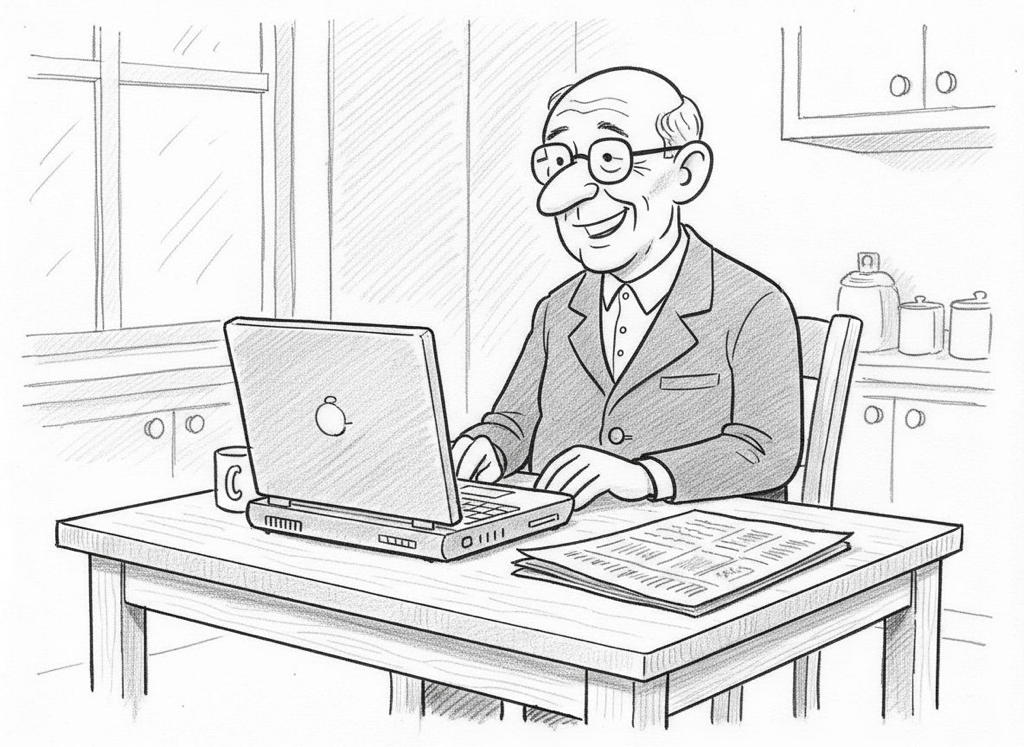
I put the spoon aside, adjusted my glasses and thought:
"A means of transportation with a rechargeable battery... that certainly sounds forward-looking."
A sentence that I uttered quietly and almost solemnly - as if I were extending an invitation to modernity itself.
Act I - The idea for modernization
Scene 1: The decision
It was a clear morning, and the rustling of the newspaper had faded away, when the thought formed in my mind to no longer just watch progress, but to go against it - even if on wheels of modest size.
I decided to cover my daily 750 meters to the bakery on an e-scooter in future. An act of adaptation, so to speak. After all, they say, saving the world always starts on your own doorstep.
The thought flattered me. I imagined how I would glide past the row of parked cars - in a dignified and ecologically correct manner - while the neighbors nodded approvingly.
"Well then"I noted in my diary,
"if mankind is rolling electrically into the future, I don't want to be stuck in neutral."
I opened the catalog that was thrown at me from the Internet like a shiny trade fair of the future:
EcoCruiser Urban 2.1 - in pale green.
The name sounded trustworthy. Pale green - a color that, I thought, was perfect for showing an unobtrusive attitude. The model promised „sustainable materials“, „European production“ and „climate-neutral packaging“.
I ordered. Without hesitation.
I wrote in my diary:
„Ordered on March 14, 11:37 am. Model: EcoCruiser Urban 2.1 - in pale green. You want to set an example.“
Then I folded up the newspaper, opened the window and looked out onto the street. A quiet smile came over me. It was the quiet triumph of joining in - that rare moment when you think the world is moving because you are doing it yourself.
I drank the last sip of tea and thought:
„Well done - let's give the future a spin.“
Act II - The arrival of the future
Scene 2: Delivery & unpacking
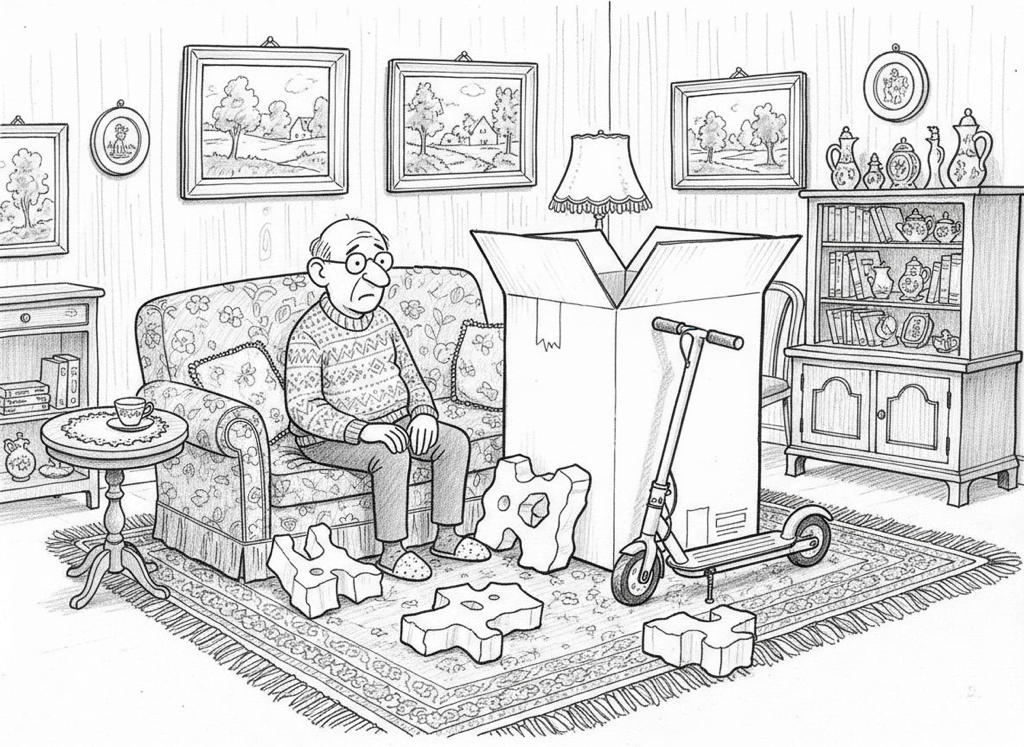
Six weeks later, on one of those unspectacular Tuesdays when even the clock seems to yawn, it arrived - the future. A truck stopped in front of my house, so big that I initially assumed the driver wanted to deliver the new bypass personally.
The man in the orange vest placed a package in the hallway, the size of which was strikingly disproportionate to the announced contents.
"Scooter"he said tersely, as if the word carried enough weight to explain itself. Then he disappeared before I could scribble my signature in the electronic box, which probably consumed more electricity than my new contribution to sustainability would ever save.
I looked at the box in awe. Two layers of polystyrene, carefully wrapped in plastic banderoles, their sheen almost festive in the morning light.
A piece of paper fell to the floor. Operating instructions - in Chinese.
Including an English supplement: "Final Assembly in EU".
I nodded.
„Well - at least it's final“I mumbled.
Unpacking took longer than it had taken mankind to invent the diesel. I found screws, a bell that looked like a medical instrument and a charger that reminded me of old television aerials.
Plus a plug that was obviously designed for another continent.
I looked for the adapter - found it in a small bag, lovingly wrapped in three layers of plastic.
After an hour, I sat on my sofa, the manual in front of me, and tried to make sense of the device.
„Charging process: 8-10 hours before use. Temperature range: ideal between 22 and 24 degrees.“
I put the device in the hallway, next to the umbrella stand. The battery should rest overnight, like a pilgrim before setting off.
I made a note in my diary:
"Day 43 of the future: packaging larger than the contents. Energy consumption: estimated at half a power socket."
Scene 3: First exit
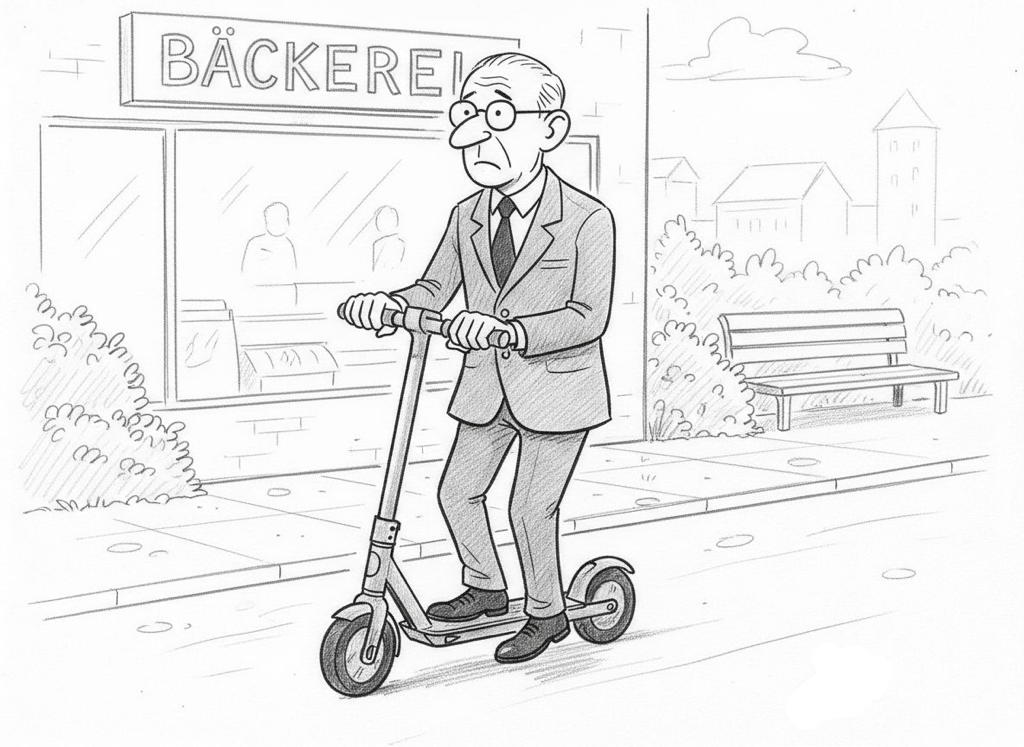
The next morning, the sky was that kind of pale blue that promises nothing but demands nothing. I pushed the scooter out onto the sidewalk - it whirred quietly as if to whisper to me: I'm ready to save the world.
I climbed up, groping, dignified, trying to maintain an attitude between exploratory spirit and balance.
A quick press of the button - and the appliance started moving.
It buzzed, no, it hummed - in the kind of pitch that is otherwise only familiar from electric toothbrushes.
The first few meters were promising. I glided - or rather, I tried to glide - past the front gardens. The neighbor's cat looked after me in astonishment, which I took as a silent sign of social acceptance.
But after just a few minutes, the battery light started to flash. Red. The first indication that progress also needs breaks.
I reached the bakery, rolled onto the sidewalk with a deliberate whir and parked the scooter.
The baker, a woman of that friendly realism that you only find in old trades, looked up.
"Oh, Mr. von L'oreot! I thought you usually walked so beautifully."
I raised my index finger as if to chisel a thought.
"Today"I said, "I wanted to try out the future."
She laughed. It wasn't a mocking laugh, but one of those honest ones that have survived through the generations. I ordered my sandwich, paid in cash - out of old habit - and looked through the shop window at the little green scooter standing there like an exotic bird that had strayed into the wrong climate zone.
Current survey on electromobility
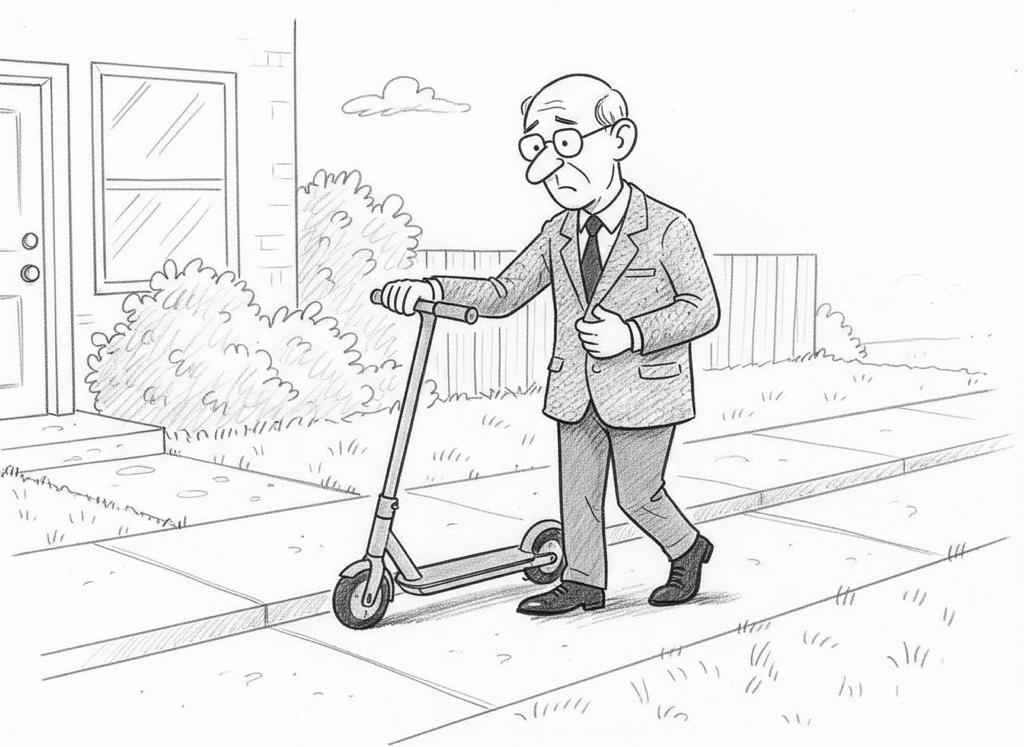
On the way home, I stopped twice to check the display. It was still flashing. Red.
I pushed the scooter the last few meters - it felt like I was comforting him.
At the garden gate, I thought:
"At least I was able to cross the road at the speed of sustainability."
I put the device back in the hallway, where it stood as if exhausted by its own idealism.
And I suspected that the future had arrived - but still needed time to load.
Scene 4: Balance sheet in the evening
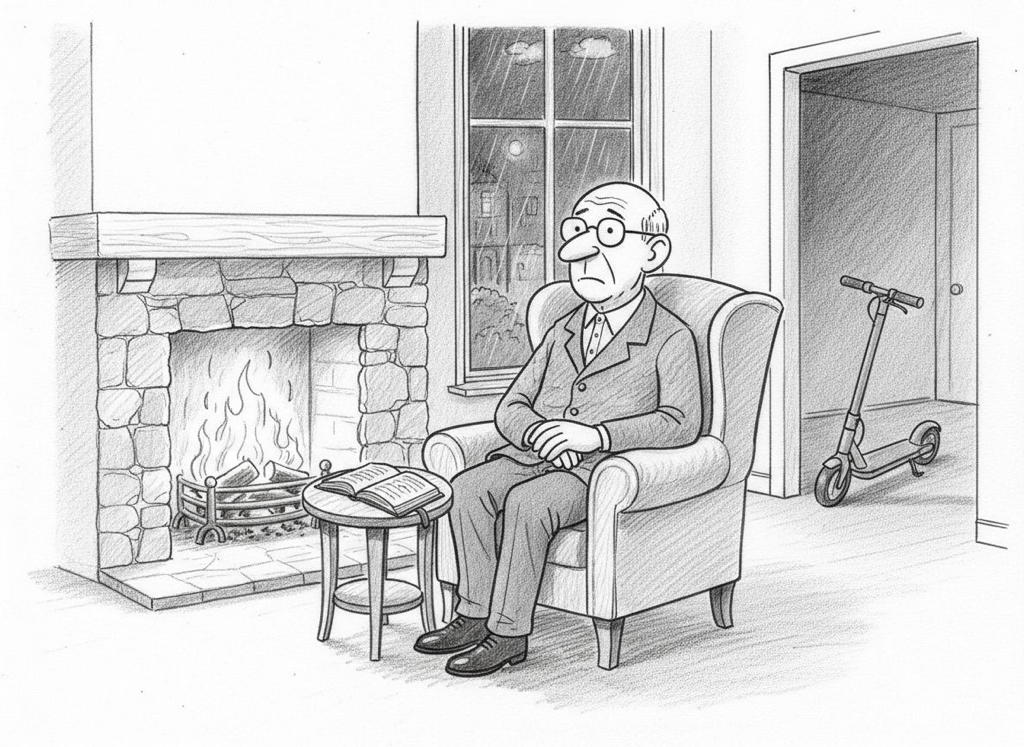
It was late evening, the rain had started, steady and polite, as if to wash away the events of the day. I sat by the fireplace, the fire crackling with the reliability of a bygone era, and on the side table lay my diary. The scooter stood, visibly offended, in the hallway - a monument to goodwill.
I opened the book, took the fountain pen and began to write.
"Progress has made a stop today. With me. And I offered him tea."
I wondered whether I could call it a successful day. The scooter had actually got me to the bakery - halfway. However, I had walked back, pushing the scooter like a stubborn pony that doesn't see the point of the ride.
I leafed through the documents that had come with the device - a kind of documentation of the global slide rule. And there it was, in sober figures, as clear as an official notice:
- Production of the battery: 14 kilograms of CO₂
- Transport from the Far East: 3,000 kilometers
- Packaging: not recyclable
- Range: 750 meters with a system load of 92 kilograms (including rolls)
I sighed. My legs, I wrote, had so far been completely emission-free and had required neither charging time nor adapters.
The fire was reflected in the window pane, and for a moment I didn't see myself in it, but the sum of my little experiments - each of them an attempt to politely take modernity at its word. It promised lightness, and delivered chargers.
I drank the last sip of tea and made a note:
„The future is rolling - but not far.“
Then I got up, picked up the scooter and carried it down the basement stairs. It was surprisingly heavy. I placed it next to the suitcase with the old slide projectors - devices that were once also considered modern and now, in the silence of the cellar, have a certain dignity.
"For future generations"I mumbled.
Upstairs in the living room, I sat down again, lit a candle and leafed through an old Reclam volume - Goethe, Über den Granit. It did me good to occupy myself with something that still holds up.
Outside, the rain was falling softly, the fireplace was crackling, and I thought to myself:
Perhaps true sustainability is not about how we move, but about where we go.
I put the pen aside, closed the book and finished writing:
"My legs were more reliable. And free of charge."
NoteThe company EcoCruiser Urban 2.1 does not exist - but 18 comparable models really do. And 17 of them have similar reviews.
Personal note from Markus Schall
(after Mr. von L'oreot had put his scooter in the cellar)
I am not an opponent of electric mobility. On the contrary - I drive an electric car myself and even own an e-scooter. However, my model is more of the kind that looks like a 125cc scooter - so not quite as pocket-compatible as Mr. von L'oreot's vehicle. In another article, I have summarized my personal Experience with e-scooters and plug-in hybrids and the technology in general.
The idea for this story actually came to me because I really did break down one evening on my own e-scooter. And not even because of the battery - but because a brake had apparently seized up, which was then quietly and secretly dragged along halfway until the motor gave up. I had to push it home for three kilometers in the rain.
That was... let's say: an experience. One that made me smile on the inside while writing this episode - while Mr. von L'oreot kept his composure on the outside.
A master of subtle humor

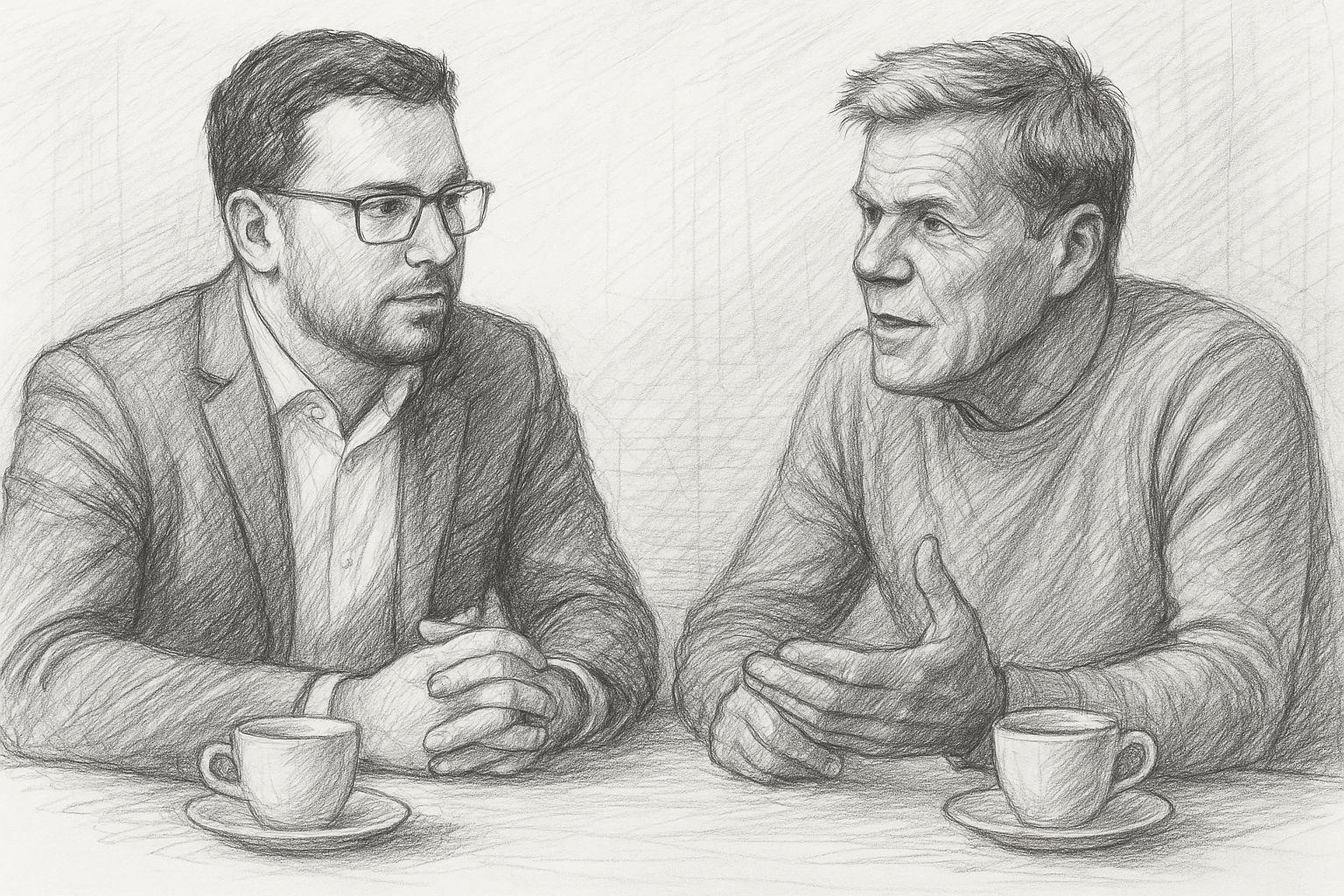
Finally, a special note: On November 12, 2023, Vicco von Bülow, known by his stage name Loriot, would have turned 100 years old. To mark the occasion Mirror TV has made a remarkable interview from 1993 accessible again - conducted by Helmut Karasek on the occasion of Loriot's 70th birthday.
A calm, intelligent conversation about humor, society, powers of observation and the subtle play with the absurd - everything that makes Loriot so timeless. If you want to understand why the character Mr. von L'oreot is not called that by chance, this interview is highly recommended.
A kind of essay by Mr. von L'oreot on the case of tension
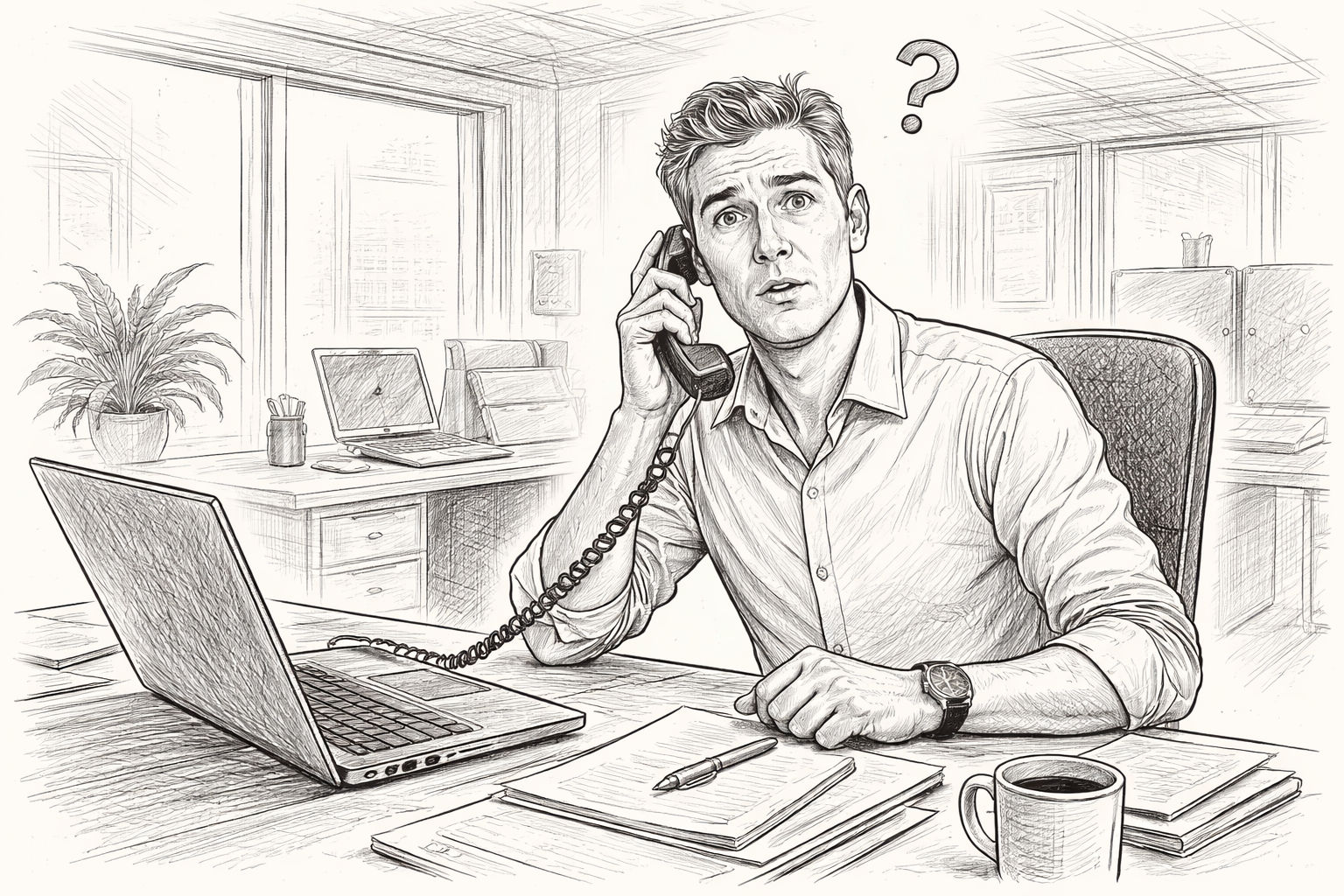
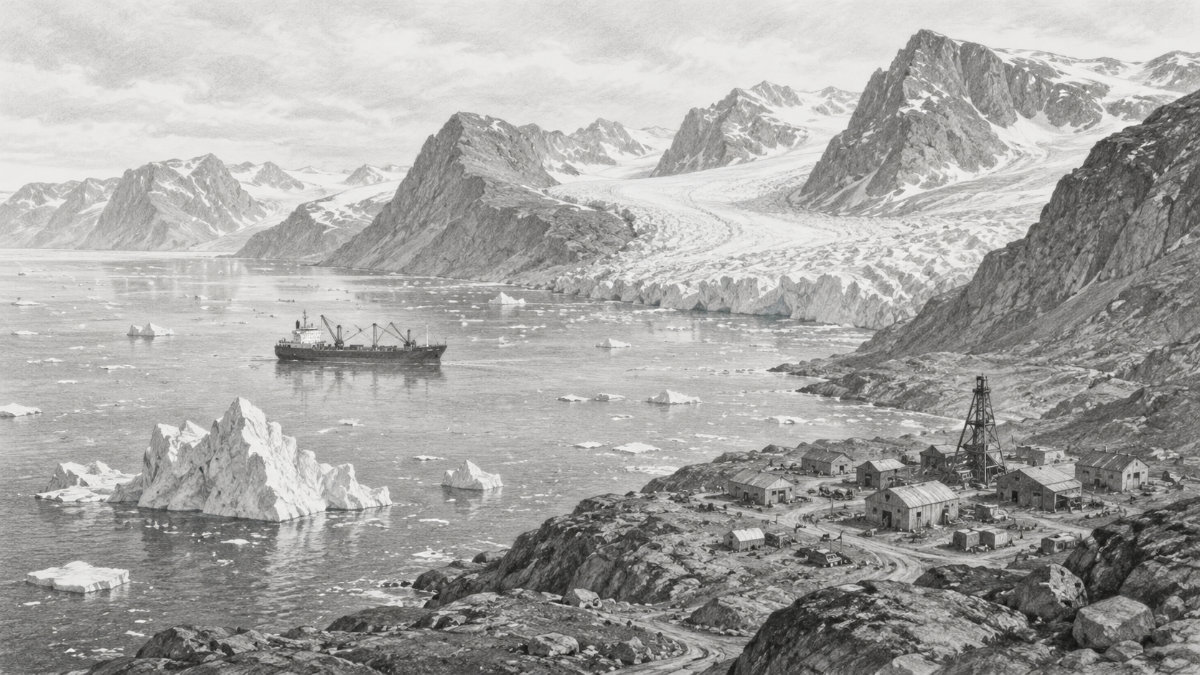
 Humor is one of the most important tools for surviving crises of all kinds. Mr. von L'oreot has therefore written his thoughts on the subject in a kind of essay. Military service and the case of tension in Germany in an illustrated article.

Frequently asked questions about history
- Do I have to buy an e-scooter now to help save the planet?
Not necessarily. Even a walk can contribute to improving the world - especially if it is done with a certain attitude. Of course, everyone is free to set off on an electrified stepping stone towards the future - just make sure that the future also has a functioning battery and a suitable sidewalk. - Is the EcoCruiser Urban 2.1 a real model?
The name - like the color pale green - is fictitious, but the type is definitely real. It is a satirical condensation of those numerous e-scooter models that are equipped with as much plastic as sustainability promises. And yes: at least 17 of these real-life devices have reviews that start with „Never again!“ or „Hasn't charged since Wednesday“. - Why did Mr. von L'oreot order the scooter in pale green?
Pale green is not just a color - it is a social statement in a muted tone. A subtle hint that you are on the side of the solution, but don't want to be loud. Mr. von L'oreot always viewed bold colors with skepticism - not out of cowardice, but out of a firm belief that attitude does not need to be shouted. - How long is the range of an e-scooter, taking into account the bread roll?
According to my observations, the range is exactly 750 meters - as long as the piece of pastry being carried has a normal calorie value. However, the system load can increase critically with cakes, cream slices or bee sting, which has a direct effect on the battery level. If in doubt, we recommend charging first, then driving - or simply coming home from the bakery without a cake. Which, of course, calls the original motivation into question. - Is there an app for charging the battery?
But certainly. There are even fifteen different ones. Most of them were apparently designed for other countries, power grids and rhythms of life. Some apps require Bluetooth pairing, a firmware update and the entry of a sixteen-digit alphanumeric security code before starting. Others do not start at all - which in turn saves battery power. - Does Mr. von L'oreot have a driver's license?
For cars: probably. For bicycles: not necessary for historical reasons. For e-scooters: let's say he had the necessary attitude. Whether this is legally sufficient is another matter - probably in the road traffic regulations. But as Wilhelm Busch already knew: "Not everyone who drives there is in the right place in life." - Is the CO₂ of the return transport greater than that of the cake?
It can be assumed that the return transport - if on foot and with pushing power - is climate-neutral. However, this would not have been necessary if the battery had not failed. In this respect, the overall balance is in a similar ratio to the weight of a raisin bun to the realization of its necessity. In short: yes. - What does the author think about e-mobility?
He stands - very quietly, mostly with one foot on the ground. He drives electrically, charges at home and believes in the idea. What sets him apart from some enthusiasts is that he doesn't believe that more battery automatically means more future. And he thinks it's sensible not to push the weight of a vehicle to absurd levels - especially if the electricity comes from brown coal. - Why was the appliance placed in the cellar?
Because the hallway had to be re-entered at some point. And because the cellar is the most traditional place in Germany where promises of the future await reuse. Alongside slide projectors, bread baking machines and bicycles with underarm sweat sensors. Mr. von L'oreot put the device down with a certain respect - not out of anger, but out of a dignified farewell. - Can I recreate the story with an e-bike?
In principle, yes - but this changes the narrative geometry. An e-bike has more dynamics, less nonsense, but also significantly less humor when stationary. For a realistic re-enactment, we recommend: weak brakes, the wrong charging adapter and a light drizzle on the way back. And a roll with caraway seeds - for authenticity. - Is there a sequel?
But of course. The plans include
- "Mr. von L'oreot orders a WLAN printer"
- "Mr. von L'oreot asks about the purpose of a Smart Mirror"
- "Mr. from L'oreot tries a vegan grilled sausage"
A crossover with the Thermomix is also in preparation, although negotiations with the kitchen have not yet been concluded. - How can I be sure that my own progress is working?
By not blindly trusting him, but politely accompanying him. By garnishing your enthusiasm with a touch of skepticism - like a soft egg with a pinch of salt. And by walking occasionally. Because, as Mr. von L'oreot once noted: "My legs were more reliable. And free of charge."