Software Development with Codex, ChatGPT, and AI: A Practical Guide for Developers

Software Development with AI

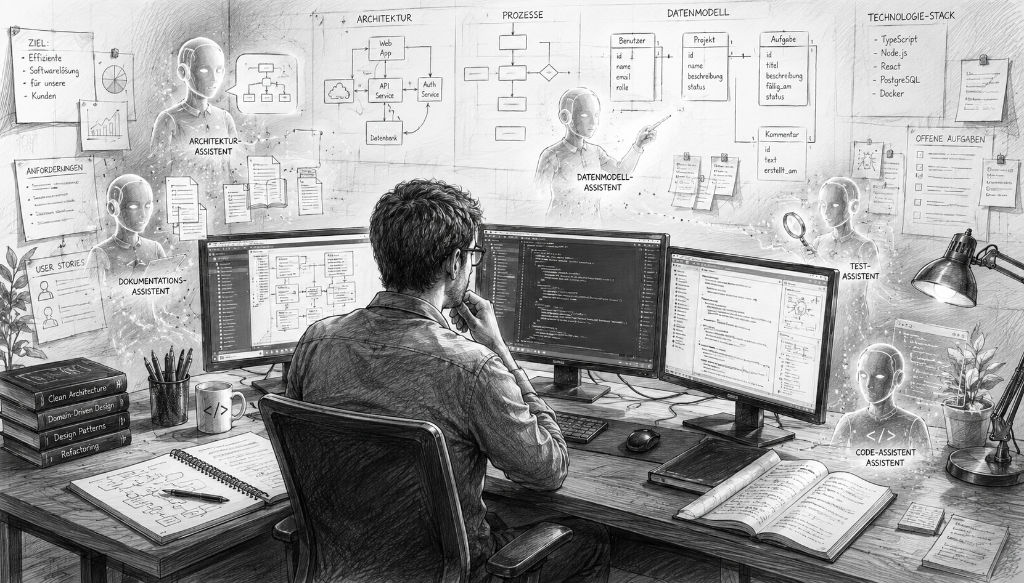
If you had asked me a few years ago what software development would look like in ten years, I would probably have talked about new programming languages, better frameworks, or more powerful development environments. Today, my answer would be completely different. The biggest change isn’t happening with the tools, but in the way we as developers think and work.

As I write these lines, I am working on a new software system myself. For the past few weeks, I have been making extensive use of modern AI tools such as Codex and other language models. At first, I was curious; now, I’m mostly impressed. Not because the AI suddenly does everything on its own, but because it handles certain tasks surprisingly well, thereby enabling new ways of working.

Read more

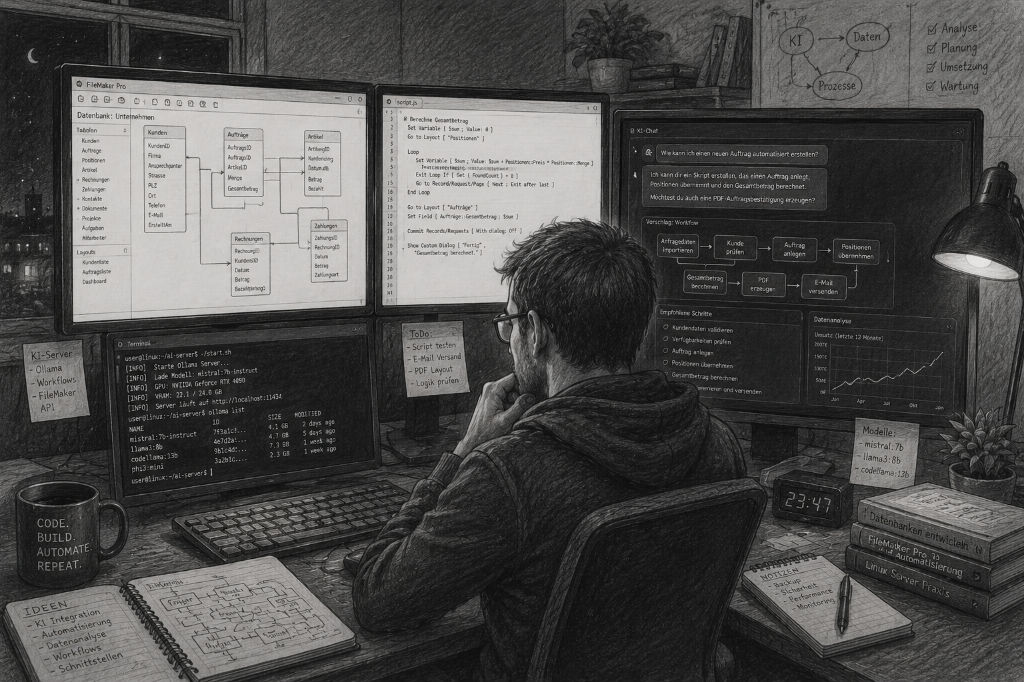
How artificial intelligence is changing software development and FileMaker

AI evolution in the development of FileMaker databases

Anyone currently scrolling through news portals, social networks or business platforms will quickly get the impression that artificial intelligence is changing the entire working world practically overnight. New tools, new language models and new promises appear almost daily. Texts are written automatically, images are generated, videos are created and software is sometimes prepared by voice input.

For many companies, this creates a strange mixture of curiosity and pressure. Because, of course, nobody wants to miss the boat. At the same time, many entrepreneurs, freelancers and developers do not yet know exactly which of these technologies will really remain relevant in the long term. This is probably the real peculiarity of the current AI phase: almost everyone senses that something is changing - but hardly anyone can really reliably assess at the moment how quickly and in which direction.

Read more

From content to substance: how digital systems are created that cannot be copied

System instead of individual content

When you move around in the digital space today, you very quickly get a certain impression: if you are visible, you are successful. If you have reach, you have influence. And if you produce a lot of content, you automatically build up something. This equation seems plausible at first glance - but it is deceptive. Because visibility is not ownership. Reach is not ownership. And content is by no means a foundation.

A post can be read thousands of times and yet practically disappear after a few days. A social media post can go viral - and at the same time have no lasting effect. Even well-placed content in search engines is not automatically stable. They depend on algorithms, platform rules and developments that you have no control over.

Read more

When the Mac listens: What Apple's integrated AI with Gemini and Siri will mean for users in the future

Apple, Siri and Gemini

When you open a Mac today, you expect reliability. Programs start, files are in their place, processes are well practiced. Many have built up a way of working over years - some over decades - that works. You know where to click. You know your tools. And this is precisely where the quiet comfort lies. But for some time now, a change has been brewing in the background that is bigger than new colors, new icons or additional menu items. For the first time, a form of artificial intelligence is moving in not just as a single application, but closer to the heart of the operating system itself. Where daily routines are created.

That sounds abstract at first. Perhaps even a little futuristic. But basically it's about something very down-to-earth: the computer should better understand what is meant. Not just what is clicked on. Many people have so far experienced AI outside of their actual work. In chat windows, on websites, as an experiment or a gimmick. You try something out, perhaps be amazed, close the window again - and return to your normal everyday life.

Read more

Why having your own magazine is more important for companies today than advertising

Magazine as property

When you talk to entrepreneurs about visibility these days, it's almost always about reach. People talk about findability on Google, social media, paid ads on Google or other platforms, click numbers, followers and interactions. Visibility is considered a prerequisite for commercial success, and in many industries this is true.

What is rarely discussed is a quiet but decisive shift: most companies are visible today - but on spaces that do not belong to them. This development has not been dramatic. It was convenient, gradual and seemingly logical. That is precisely why it is hardly questioned.

Read more

Using AI as a sparring partner: How thinking in dialog becomes more productive

AI as a savings partner

I've been using artificial intelligence for almost exactly two years now. In the beginning, it was sober and technical: entering text, typing prompts, reading answers, correcting, retyping. The way many people did it - carefully, in a controlled manner, with a certain distance. It worked, no question. But there was still something mechanical about it. You asked questions, got answers, ticked them off.

I realized relatively early on that I was missing something: flow. Thinking is not a form. Good thoughts don't come from a corset of neatly formulated input, but from talking, trying things out, thinking aloud. So I started to use the AI app on my cell phone more often - and at some point I simply started speaking instead of typing. That was the real turning point.

Read more

Reach is not ownership - Why visibility is no longer enough today

Reach vs. ownership

A good ten years ago, I happened to watch a lecture on the transition from the information society to the knowledge society. At the time, much of it still sounded theoretical, almost academic. It was about concepts such as data sovereignty, ownership of information and the question of who will actually determine what is accessible in the future - and what is not. Today, with a little distance, this lecture seems surprisingly precise. After all, much of what was described as a development back then has now become reality. More and more data has migrated to the cloud. More and more information is no longer stored on in-house systems, but in external infrastructures. And increasingly, it is no longer the user but a provider, a platform or a set of rules that decides what is possible.

To understand this development, it is worth taking a step back. The information society in which many of us grew up was not a normal state. It was a historical exception.

Read more

How AI specialists can be trained today - opportunities for companies and trainees

Train an AI specialist

Just a few years ago, artificial intelligence was a topic for research institutes and large corporations. People talked about neural networks, deep learning and speech recognition - but it hardly played a role in everyday life. Today, AI is no longer a topic for the future, but a reality: it writes texts, creates images, analyzes data and controls production processes. Whether in administration, trade or industry - it can now be found everywhere.

Read more