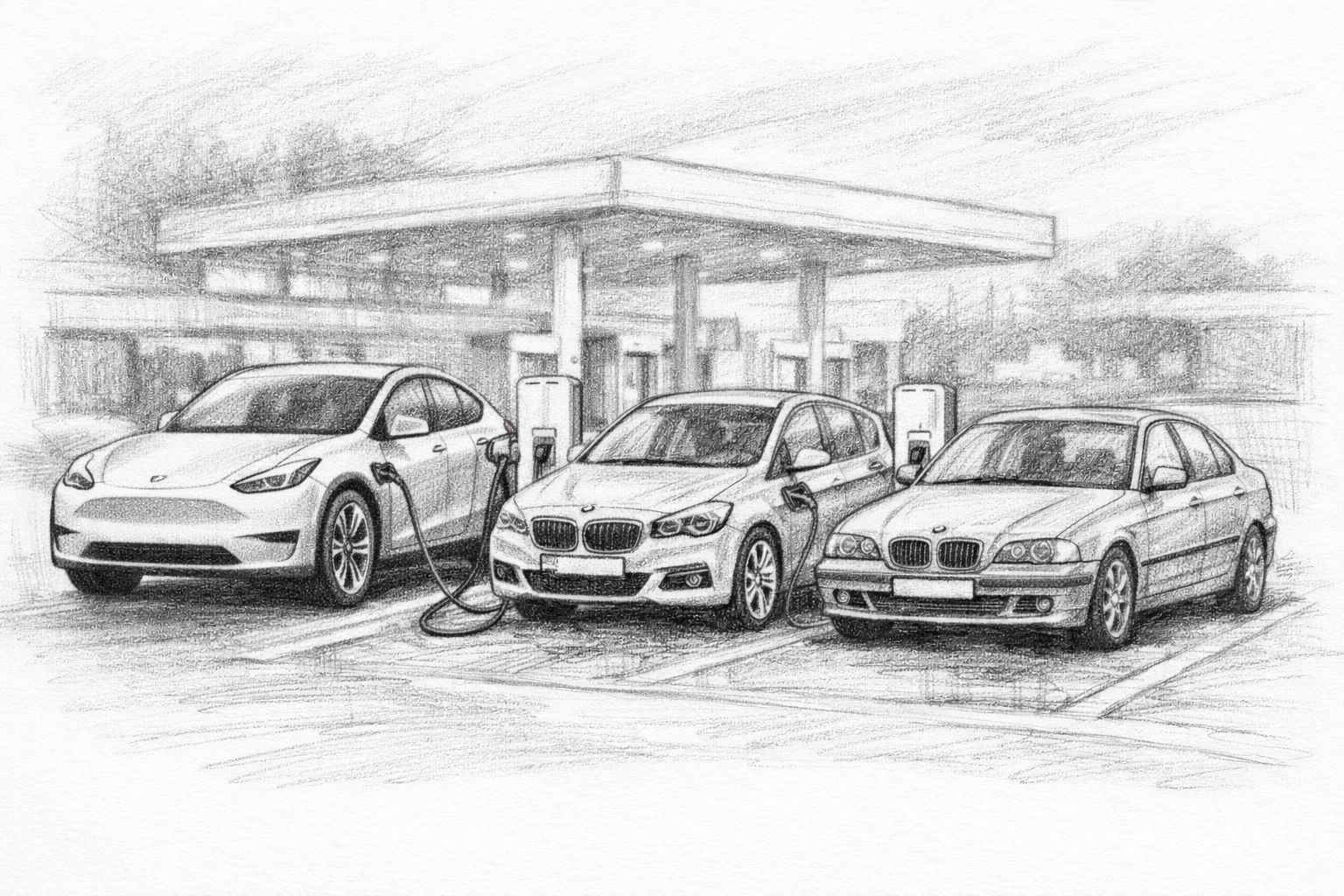
This article is not an indictment of electromobility. Nor is it an attempt to denigrate a technological development that works perfectly well for many people in their everyday lives. I am writing this text because it has become increasingly clear to me in recent years that there is a gap between the political narrative, public perception and physical reality that is hardly ever talked about. And I'm not writing it from the perspective of an outsider. I have been driving a plug-in hybrid myself for years. I know electric driving from my own experience, not from brochures or talk shows. I know how pleasant it is to glide silently through the city, how direct the power delivery is and how relaxed it feels. Anyone who has ever driven an electric car regularly quickly understands why this type of drive is emotionally compelling. There's nothing to belittle about it.
This is precisely why I believe it is necessary to take a step back and ask soberly: What do these vehicles actually achieve - and at what cost, systemically speaking?




Latest news on the topic
28.05.2026A debate between Prof. Dr. Fritz Vahrenholt and journalists in the „Freedom of Opinion“ format on the WELT news channel is currently generating new discussions about German climate policy. The background to this is the decision by the responsible IPCC committee to classify a previously frequently cited extreme warming scenario as „implausible“. The discussion is less about the fundamental existence of climate change and more about the question of how risks, forecasts and political measures are communicated.

FREEDOM OF OPINION: Horror scenario fizzles out? Fritz Vahrenholt calls for a climate turnaround | WELT news channel
While Vahrenholt warns against exaggerated alarmism and economic damage caused by what he sees as an overly radical climate policy, other participants point to real problems such as droughts, forest damage and rising temperatures. At the same time, it was discussed that particularly drastic scenarios were sometimes more widely disseminated in the media and politics than scientifically more probable developments. The debate thus also shows how difficult the relationship between science, politics, the media and social perception has become.
26.03.2026A recent SPIEGEL TV documentary paints a gloomy picture of the German automotive industry - especially Volkswagen. According to the analysis, the company, once a symbol of economic success and engineering skill, is facing profound structural problems. In addition to weak sales, high wage costs, increasing international competition and strategic missteps in electromobility are weighing on development. The consequences for the labor market are particularly serious: tens of thousands of jobs could be lost, while numerous suppliers are also coming under pressure. There are even differences within the Group - while individual brands remain stable, the overall system is beginning to falter.

The VW downfall: total loss for the car giant | SPIEGEL TV
The documentary thus not only presents the situation of a single company, but also raises fundamental questions about the future of German industry. The case of Volkswagen thus becomes an example for an industry that has to reorient itself in the area of conflict between climate policy, global competition and structural change.
11.03.2026: In the wake of the current economic situation, the German automotive industry is increasingly under pressure - and this is now clearly reflected in the sector's job market. According to an analysis by the media research company Index, only 86,105 job advertisements were published last year - around 20 % fewer than in the previous year with around 99,000 advertisements, and significantly fewer than in 2023 with over 136,000 jobs.
This development affects not only simple jobs, but above all positions for academics, while at the same time several groups such as Volkswagen, Mercedes and large suppliers are introducing measures to reduce costs and jobs. Overall, the entire automotive sector is therefore facing far-reaching changes. structural changes - which also reflects the consequences of the energy transition, technological transformation and the global competitive situation, which are often not sufficiently taken into account in political debates.
Personal use and indirect promotion
I myself have benefited from the political promotion of electromobility - albeit indirectly. My current plug-in hybrid is a used car. I no longer received any state subsidies, applied for an environmental bonus or collected a premium. And yet it is absolutely clear: without the earlier subsidy programs, this used car market would not exist in this form.
The government subsidies have pushed down new car prices, generated demand and created volume. This in turn has meant that plug-in hybrids are now comparatively easy and affordable to buy second-hand. So anyone who thinks that subsidies are only an issue for first-time buyers is overlooking the knock-on effects. The secondary market is also politically shaped.
This observation alone shows how deeply political intervention can affect seemingly „free“ markets - often for years and far beyond the actual funding period.
Enthusiasm and doubt are not mutually exclusive
It would be dishonest to minimize the advantages of electric driving. The technology works. Everyday life is uncomplicated. For many driving profiles, a plug-in hybrid or a purely electric car is practical, comfortable and pleasant. Electric drive systems really come into their own on short journeys or in city traffic.
At the same time, as I became more and more involved with the subject, I began to feel a slight unease. Not because of the technology itself, but because of the narrative surrounding it.
The deeper I delved into the figures, weights, production chains and energy flows, the more often the question arose as to whether the constantly repeated assertion of a clearly positive overall balance was really as reliable as it was being sold politically. And the more often I expressed these doubts, the more quickly I was told that skepticism was obviously unwelcome - at least publicly.
That alone should make you wonder.
When weight suddenly no longer plays a role
One moment that particularly stuck in my mind was a look at the technical data of modern electric vehicles. Vehicles that on the outside hardly look any bigger than classic mid-range cars suddenly weigh two, sometimes two and a half tons.
The main reason: battery packs weighing several hundred kilograms. This can be explained technically. Physically too. But systemically, it raises questions. Weight is not an abstract value. It has an influence:
- energy consumption,
- tire abrasion,
- particulate emissions,
- the resource requirements,
- the strain on the infrastructure.
And yet this topic hardly plays a role in the public debate. It is as if people have tacitly decided that weight is suddenly no longer a problem - as long as the vehicle is electric. Such mental shortcuts are rarely harmless.
The energy balance as a question of faith
Another point that has increased my skepticism is the way in which energy balances are discussed. Often very abbreviated. Often very selectively. And surprisingly rarely along the entire life cycle of a vehicle.
Production, raw material extraction, transportation, use, recycling - all this is part of the balance sheet. But in political debates, it is often pretended that the story only begins when the charging cable is plugged in. Everything before that disappears in the background noise of euphonious terms such as „emission-free“ or „sustainable“.
That may be effective in terms of communication. But it is not serious. And it is precisely at this point that my initial approval gradually turned into doubt.
Why this text is necessary
I am not writing this article because I reject electromobility. I am writing it because I have the impression that criticism is increasingly being confused with opinion. Anyone who asks questions is quickly seen as a denier of progress. Those who do the math are seen as obstructionists. Those who demand differentiation are seen as troublemakers.
Technological progress thrives on sober analysis, not on moralizing. And climate protection, if we are serious about it, must not be a question of faith. It must be calculable - in material, energy and social terms.
This article is therefore an attempt to free electromobility from the narrow corset of the political narrative and look at it again where it belongs: in the overall system.
Without ideology. Without demonization. But also without protection.
Why the life cycle counts - and not the good feeling
When people talk about electromobility today, the discussion tends to focus on a single moment: the operation of the vehicle. On what no longer comes out of the back. No exhaust, no exhaust fumes, no visible smoke. That seems clean, logical and reassuring.
But this is where the ecological fallacy begins. A vehicle is not an event, but a process. And if you only look at a single stage of this process, you will inevitably draw the wrong conclusions. What is ecologically relevant is not the moment of driving alone, but the entire life cycle of a car - from the extraction of raw materials and production through to use, maintenance and disposal.
It is no coincidence that this view is so rarely taken. It is uncomfortable. And it doesn't go well with simple political messages.
The greatest damage occurs before the first kilometer
One point is regularly underestimated or deliberately downplayed in the public debate: By far the greatest ecological damage to a car is not caused during its use, but during its manufacture. This applies to both combustion engines and electric vehicles - with one crucial difference:
This production cost is significantly higher for electric cars. The main reason for this is the battery:
- Energy-intensive production
- Complex raw material chains
- High material usage
- Considerable logistical effort
Before an electric car has driven its first meter, it has already accumulated a considerable ecological „rucksack“. This rucksack does not disappear when the vehicle is later driven with zero local emissions. It remains part of the overall balance - no matter how pleasant it feels to drive.
Why existing vehicles are ecologically „valuable“
This is where a thought comes into play that is surprisingly rarely expressed openly:
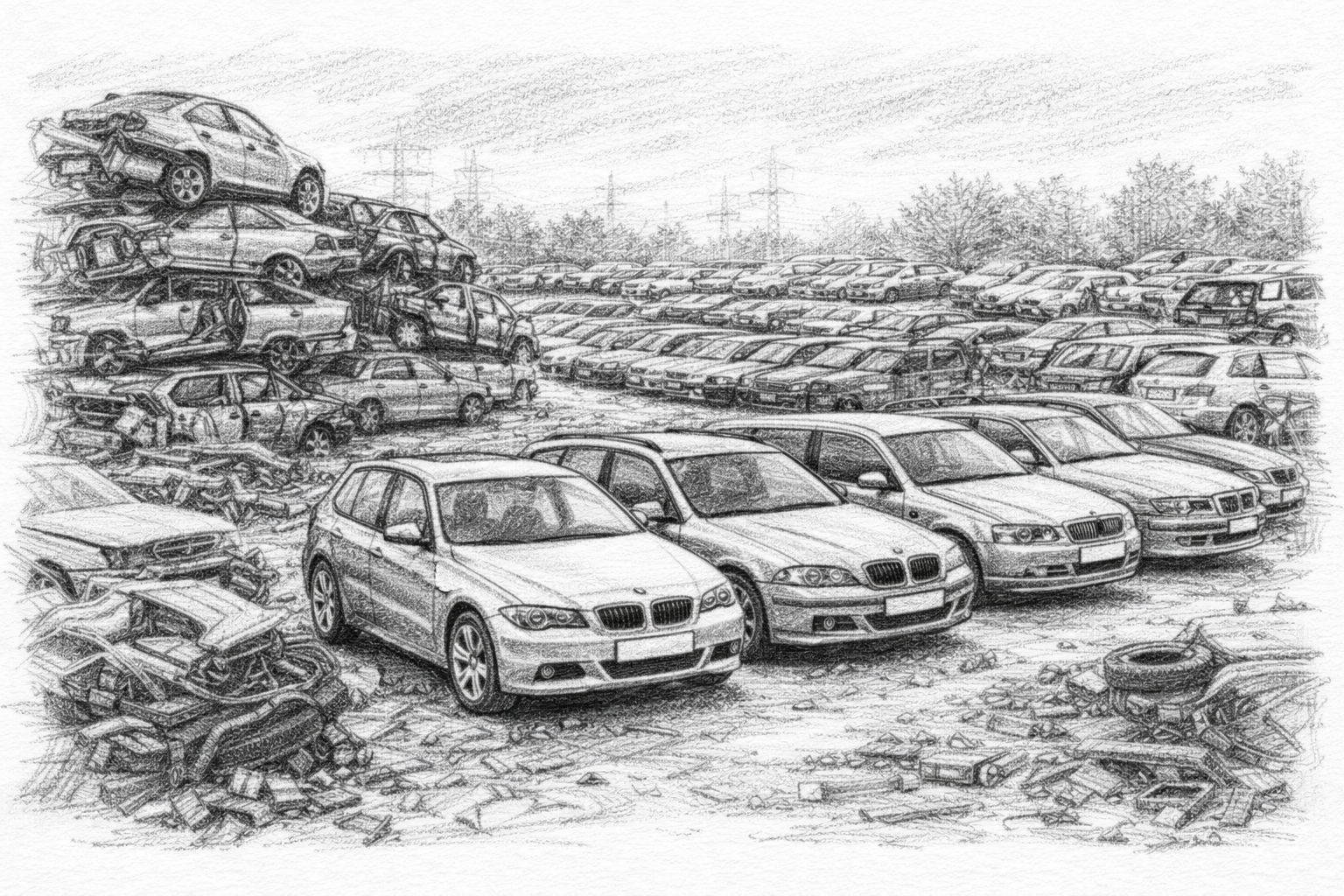
A vehicle that has already been produced has already caused its greatest ecological damage. The resources have flowed. The energy has been used. The emissions have happened. From an ecological point of view, an existing car is therefore initially a depreciated object. Every additional kilometer uses something that already exists. If such a vehicle:
- is technically in order
- is regularly maintained
- would still be usable for several years
then it often makes more ecological sense to continue using it than to replace it prematurely - even if the new vehicle appears more efficient on paper.
This idea contradicts many common climate narratives, but can hardly be refuted systemically.
The scrapping of functioning cars
It is precisely at this point that the problem of short-sighted political decisions becomes particularly clear. The state-sponsored scrapping of functioning vehicles - whether as part of earlier scrappage schemes or indirectly through massive subsidies for new vehicles - was highly problematic from an ecological point of view. A car that:
- could have driven for another eight to ten years
- was used regularly
- had no extraordinary defects
was taken out of circulation to make room for a new vehicle, the production of which in turn consumed considerable resources. In purely mathematical terms, this means
- Additional material consumption
- Additional energy
- additional emissions
All in the name of climate protection. The fact that this calculation was hardly discussed politically shows how far the debate has moved away from physical principles. Visible symbolism - „old out, new in“ - was obviously more important than a sober balance sheet.
Why „new“ is not automatically „better“
The ecological advantage of a new vehicle does not arise automatically. It only arises - if at all - over time. And this is precisely where the next problem lies. For a new, resource-intensive vehicle to perform better ecologically than an existing one, it must:
- be used for a long time
- be operated in a favorable energy mix
- achieve a sufficiently high mileage
Only then will the ecological advance from production slowly begin to pay for itself. Whether this point is reached at all depends on many factors - driving profile, electricity mix, service life, maintenance, battery ageing.
Political communication tends to ignore these uncertainties. Instead, it is suggested that the change itself is already an ecological gain. This is at best abbreviated, often simply wrong.
Life cycle thinking instead of moral shortcuts
A serious climate discourse cannot do without life cycle analyses. Everything else is symbolic politics. And yet it is precisely these analyses that are often only quoted when they fit the desired picture. The problem here is less ideological than structural:
Life cycle thinking is complex. It is difficult to put up posters. It does not lend itself to moral simplifications along the lines of „good“ and „bad“. But it is precisely this complexity that determines whether a measure is actually effective - or just well-intentioned.
The central finding can be soberly summarized:
Anyone who destroys functioning systems in order to create new ones always initially increases the ecological damage. Whether and when this damage is later relativized is not a question of faith, but of calculation. And this calculation is much less clear-cut than political slogans would suggest.
Electromobility can be part of a long-term solution. But it is not an ecological free ride. And it certainly does not justify the systematic destruction of functioning substance.
If you take this life cycle concept seriously, the next question inevitably arises:
Where are the emissions actually generated - and where are they shifted to? This is exactly what the next chapter is about. There we look at the electric car not as an emission-free object, but as part of a global energy and raw materials system - with all its displacement effects.
Electric car ≠ emission-free - shifting instead of avoidance
One of the most powerful images of electromobility is the absence of exhaust fumes. No exhaust, no smoke, no smell. The car is driving - and nothing seems to happen. It is precisely this visual cleanliness that has played a key role in anchoring the electric car in the public consciousness as „emission-free“.
Technically, this statement is not wrong. Systemically, it is incomplete. Emissions do not disappear just because they are no longer visible. They shift - spatially, temporally and structurally. Anyone who wants to seriously evaluate electromobility must therefore look at where these emissions actually occur.
The battery as an ecological center
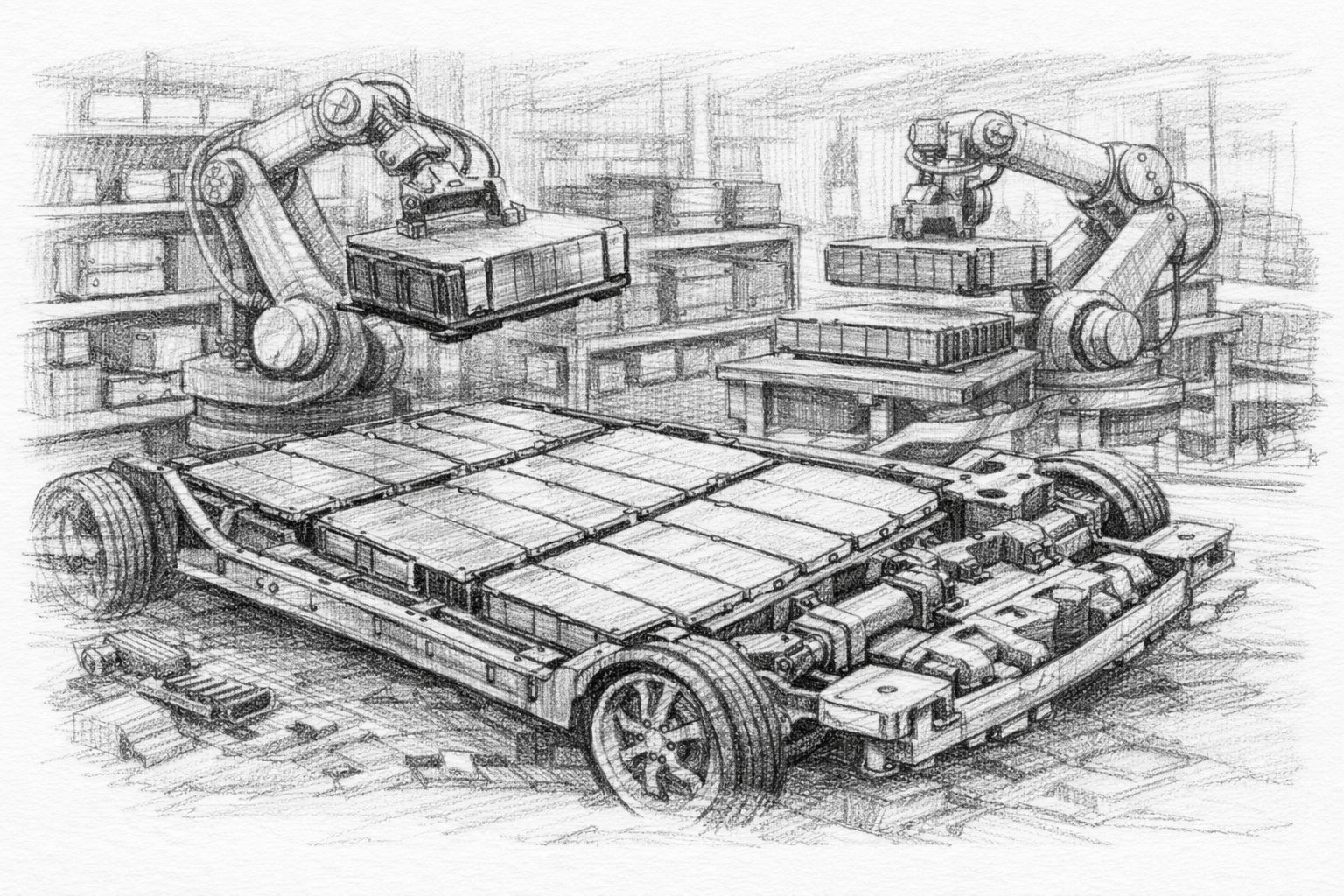
The heart of every electric car is the battery - and at the same time its most ecologically demanding component. Its production is complex, energy-intensive and dependent on raw materials. The key factors include:
- the mining and processing of lithium, nickel, cobalt and graphite
- High energy input in cell production
- Global supply chains with multiple transportation stages
Regardless of political assessments, one thing is clear: Battery production generates significant emissions long before the vehicle is registered. These emissions are not generated in road traffic, but in mining regions, industrial plants and logistics chains - often outside the scope of European debates.
This does not change the functionality of the technology, but it does change the overall balance.
Weight, physics and their side effects
Another aspect that receives surprisingly little attention in the public debate is vehicle weight. Due to their batteries, electric cars are significantly heavier than comparable vehicles with combustion engines. This additional weight has several consequences:
- Higher energy requirement when accelerating
- Increased tire wear
- Increased fine dust emissions due to mechanical wear
- Increased strain on roads and infrastructure
While exhaust gases are regulated and measured, mechanically generated particulate matter often escapes public notice. It is not produced by the exhaust, but by tires, brakes and the road surface - and is physically almost impossible to avoid.
Here, too, the problem does not disappear, it merely shifts.
Recycling: technically possible, systemically complex
It is often argued that batteries can be recycled at the end of their life cycle - and this is basically true. Many things are technically feasible. However, there is a long way between technical feasibility and systemic implementation. Recycling means:
- Energy-intensive separation and treatment processes
- Complex material composites
- Economic considerations that do not always favor the environment
Furthermore, recycling is not retroactive climate protection. It reduces the need for raw materials in the future, but does not cancel out the ecological costs that have already been incurred. Recycled materials also have a history.
The reference to recycling therefore makes sense - but it is no substitute for an honest consideration of the overall balance.
The ecological advance
All these factors lead to a central term that rarely appears in political communication: ecological advance.
Electric vehicles are associated with higher initial costs - both ecologically and in terms of energy. This advance can be partially offset in the course of use. Whether and when this happens depends on many variables:
- Electricity mix
- Mileage
- Useful life
- Charging behavior
- Battery ageing
In practice, this means that the ecological advantage is not automatic, but a bet on time. A bet that only pays off if certain framework conditions are met.
Electricity: the invisible source of emissions
At this point, it is often argued that electric mobility will automatically become cleaner as the share of renewable energies increases. This is basically true - but only in the long term and under idealized assumptions.
In reality, the electricity mix comes from a combination of different sources. And every additional kilowatt hour required for mobility has to be generated somewhere - reliably, available at all times and in sufficient quantities. Until then:
- base load is not completely covered by renewables
- Storage technologies are available to a limited extent
- Reserve power plants remain necessary
additional electricity demand inevitably leads to emissions - even if they are not generated by the vehicle itself. The electric car is therefore not an isolated object, but part of an energy system that is operated under real conditions, not ideal ones.
Emissions without address
A central problem in the current debate is that emissions are becoming increasingly „addressless“. They are generated where raw materials are extracted, batteries are produced or electricity is generated - often far away from where they are used.
Politically, this is convenient. Locally, emission levels fall, statistically the balance improves. From a global perspective, the effect is much less clear. This shift may be politically attractive, but it is not proof of an actual reduction. It merely shows that we have learned to organize emissions spatially.
The central message of this chapter can be clearly formulated: Electric cars do not automatically avoid emissions - they shift them. Whether this shift leads to a real reduction in the long term does not depend on the drive type alone, but on the entire system in which it is embedded.
Electromobility can be part of a solution. But it is not an emission-free space. Anyone who claims this is simplifying a complex reality - often out of convenience, sometimes out of political calculation.
When emissions are shifted, the next question inevitably arises: Where does the energy actually come from - and under what conditions?
The next chapter is therefore not about vehicles, but about electricity. About security of supply, base load, grids and the reality behind the socket. Because one thing is certain: electricity doesn't just come out of the wall.
Overview of narratives and system logics
| Aspect | Frequent narration | Sober system logic |
|---|---|---|
| „Emission-free“ | No exhaust fumes, so clean | emissions are relocated (production, electricity, supply chains) |
| Manufacture | Plays a supporting role | Large emission block, mainly due to battery and material use |
| Existing vs. replacement | New is automatically better | Early replacement of functioning cars initially increases the damage (life cycle) |
| Electricity | Comes „green“ from the socket | Real: Mix + base load/reserve; additional demand creates system stress |
| Infrastructure | Charges everywhere | Grid expansion, peak loads, balancing energy - expensive and resource-intensive |
Classification: How climate-friendly are electric cars really?
In his video, Harald Lesch examines precisely those questions that are often abbreviated or ignored in the public debate. It is not about advertising for or against electromobility, but about a sober consideration of the carbon footprint over the entire life cycle. The current German electricity mix, CO₂ emissions when driving, the high energy requirements for battery production and the question of what happens to the batteries at the end of their useful life are all addressed. The systemic view is also particularly relevant: Is our energy system even designed to reliably supply millions of electric cars in the long term? The video does not provide any easy answers, but it does provide important food for thought.

How climate-friendly are electric cars really? | Terra X Lesch & Co
Electricity doesn't just come out of the socket
In many discussions about electromobility, electricity is treated as if it were a self-evident, readily available resource. You plug in a cable, the car charges and that seems to be the end of the matter. This view is understandable, but it is misleading.
Electricity is not an abstract commodity. It has to be generated, transported, distributed and secured every second. Unlike oil or gas, it can only be stored to a limited extent. The energy system must therefore be kept permanently in balance - regardless of whether the sun is shining or the wind is blowing.
Electromobility significantly increases this demand. Not in theory, but in practice.
The real electricity mix instead of political wishful thinking
It is often argued that electromobility automatically becomes climate-friendly with the expansion of renewable energies. This statement sounds logical, but it ignores a crucial point: We are not driving with the electricity mix of the future, but with that of the present. The current electricity mix is a mixture of:
- renewable energies
- fossil power plants
- Import flow
- Reserve and peak load power plants
Every additional electric vehicle increases the demand for electricity. And this additional demand must be met in the real system - not the idealized one. As long as renewable energies:
- are volatile
- not base load capable
- depending on the weather
conventional power plants must be available. Not as a transition, but as a permanent safeguard.
Base load, peak load and political curtailment
An energy system does not function according to political slogans, but according to physical necessities. Electricity must be available:
- at night
- in winter
- in calm conditions
- in case of high demand
Electromobility in particular increases peak loads. Many vehicles are charged in the evening when people come home. This is exactly when households, industry and infrastructure also need energy. These peaks cannot be absorbed by wind and sun alone. They require:
- Grid expansion
- Storage solutions
- Flexible power plants
- Additional balancing energy
All of this costs money, resources and time. And all of this is part of the real energy balance of electromobility - even if it is rarely referred to as such.
Current survey on electromobility
Networks: the invisible construction site
One aspect that is often underestimated is the infrastructure. Electricity grids cannot cope with unlimited loads. They were designed for specific load profiles - not for nationwide electromobility in combination with heat pumps, decentralized feed-in and growing overall consumption. The necessary grid expansion means:
- Kilometers of new pipelines
- Substations
- Transformers
- Interventions in landscapes and settlements
These measures are technically necessary, politically controversial and by no means ecologically neutral. Here too, emissions are not disappearing, they are shifting - this time into concrete, steel and copper.
Electromobility as additional system stress
In political communication, electromobility is often thought of as a replacement: electric cars instead of combustion engines. From a systemic perspective, however, it is rarely a pure replacement. In many cases, the result is:
- Additional power requirement
- Parallel infrastructure
- Higher overall complexity
Because the combustion engine will not disappear abruptly. Transition periods take decades. During this phase, both systems must be supported at the same time - the old and the new.
This does not make the energy system simpler, but more complex. And complexity is not an end in itself. It increases costs, susceptibility to errors and dependencies.
Energy policy dependencies
Another point that is rarely discussed openly is new dependencies. Electromobility not only shifts emissions, but also geopolitical risks. Power generation requires:
- Fuels
- Technologies
- Raw materials
- international supply chains
Anyone who believes that electromobility automatically makes us more independent is overlooking the fact that dependencies are changing, not disappearing. Away from oil, towards:
- Gas as a bridging technology
- Import flow
- critical materials
- technological monopolies
This is also part of the overall balance - and not a marginal issue.
Stability beats symbolism
Energy supply is an issue of stability. It works well when it is unspectacular. When nobody has to think about whether the lights are on or the car is charging.
Symbolic political decisions - such as the rapid shutdown of functioning power plants in the face of growing electricity demand - may be morally charged, but they are systemically risky. Electromobility increases these risks if it is not embedded in a robust overall concept.
The key finding of this chapter is that electromobility is not one of many electricity consumers - it is a system-relevant factor.
If you want more electromobility, you have to talk about energy generation, grids, storage and security of supply. Everything else is window dressing. The electric car does not drive with ideals, but with kilowatt hours. And these kilowatt hours have an origin, a price and a consequence.
When it becomes clear that electromobility is not just a technical decision, but above all a systemic and political one, the next question inevitably arises:
Why was this path nevertheless pursued so consistently - often against obvious reservations?
The next chapter therefore deals with an area that is rarely discussed transparently, but has enormous influence: Lobbying, long-term interests and political connectivity. Here we look at how decisions are prepared - often long before they become publicly visible.

How lobbying prepares decisions before they are made
When the word „lobby“ is mentioned, an accusation often resonates immediately. Influence, backroom deals, manipulation. This image is understandable, but it falls short. After all, lobbying is nothing more than organized representation of interests. It is legal, commonplace and an integral part of modern politics.
Companies, associations, industry initiatives and non-governmental organizations try to contribute their perspectives, data and goals to political decision-making processes. This is not reprehensible per se. It only becomes problematic when these processes become asymmetrical - when certain interests systematically dominate for years while others are barely heard.
This is where it is worth taking a closer look.
Politicians think in terms of legislative periods - lobbies in decades
One of the key differences between politics and lobbying lies in the time perspective. Political players operate in election cycles, usually four years. Decisions must be communicable, connectable and plausible in the short term.
Lobbying, on the other hand, is a long-term approach. Truly successful influencing does not happen overnight, but over time:
- Continuous presence
- Long-term studies
- Networks
- Staff rotation
- strategic narratives
Many political decisions therefore seem sudden - but are in fact the result of years of preparation. What looks like a quick change of course to the outside world is often just the moment when a previously prepared solution finally „fits“ politically.
The window of opportunity
A key concept for understanding political decisions is the so-called window of opportunity. Certain events - crises, conflicts, technological upheavals - create situations in which previously blocked decisions suddenly become possible. At such moments, politicians like to fall back on concepts that:
- are already worked out
- are presented as „without alternative“
- appear immediately realizable
Those who are prepared then gain influence. This also explains why some projects that were considered unrealistic or unnecessary for years are implemented within a very short space of time - while other alternatives are barely examined.
A look behind the scenes of long-term planning
A particularly revealing pattern can be seen in large infrastructure projects. It often only becomes known in retrospect that locations, concepts or business models were prepared long before the political decision was made. It is not uncommon for companies or consortia to be involved:
- ten or more years of permits
- on site assessments
- political contacts
- in high-profile studies
As long as the political environment is not right, these plans remain in the drawer. If the framework conditions change - due to geopolitical events or strategic realignments, for example - they are suddenly pulled out.
What then appears to be a quick reaction is in fact the result of long preparatory work.
Narratives beat numbers
Another success factor of modern lobbying is the narrative. Complex issues are reduced to a few catchy messages. These messages do not have to be wrong - but they are selective. In the case of electromobility, the central narrative was:
- „emission-free“
- „Future technology“
- „no alternative“
- „those who are against it are slowing down progress“
Such terms have an emotional effect, not an analytical one. They generate agreement without the need for a complete systemic analysis. And they make criticism more difficult because any deviation from the narrative can quickly be interpreted as ideologically backward.
Those who provide figures but do not tell a story almost always lose in political debates.



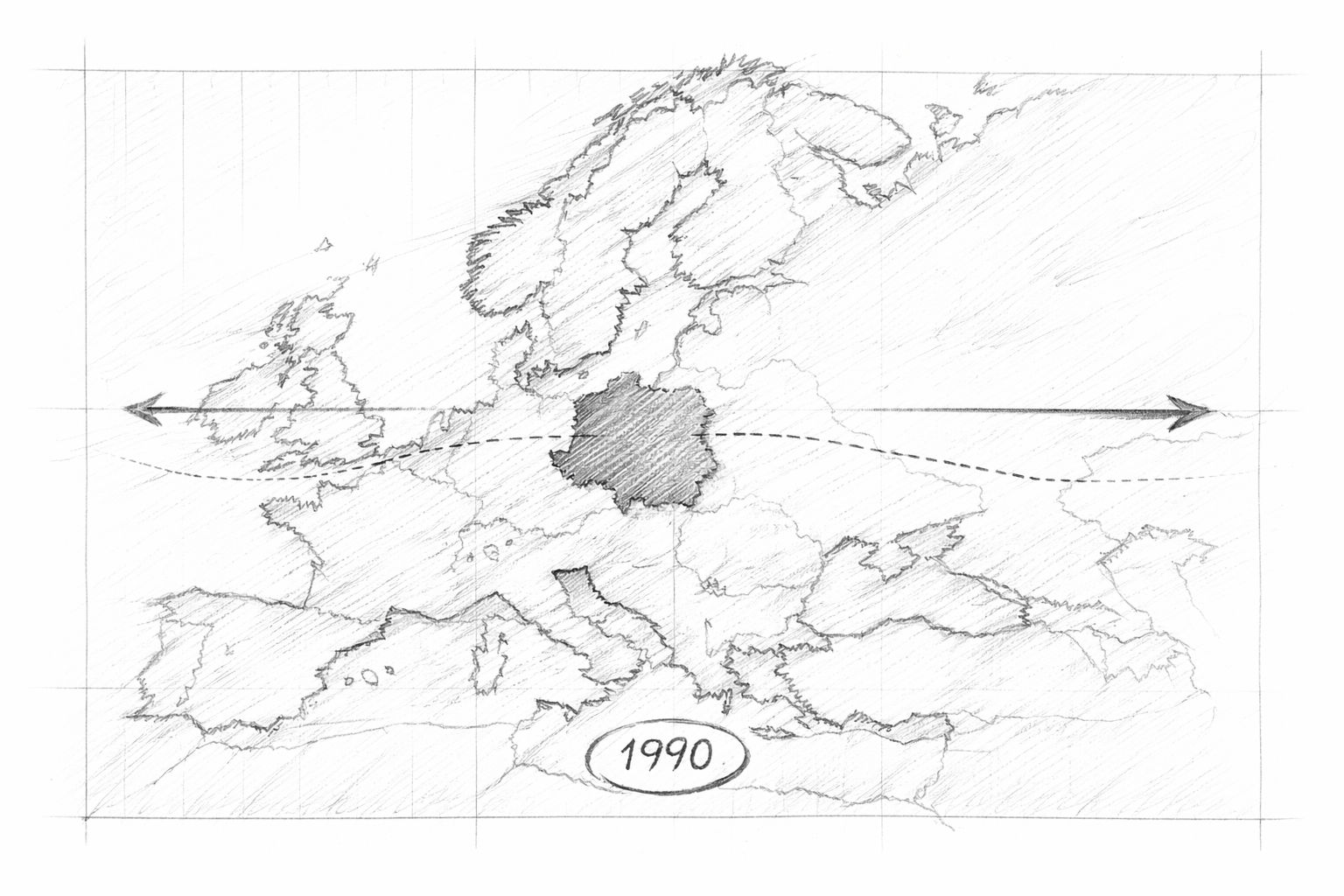
Studies, experts and institutional proximity
Lobbying today is rarely direct, but mediated. About:
- Expert opinion
- Consulting firms
- Think tanks
- Expert panels
- Conferences
The problem is not the existence of such formats, but their one-sidedness. If certain assumptions are reproduced again and again over the years, they become entrenched as apparent certainties.
This creates an expert consensus that is based less on open debate than on structural proximity. Critical voices are not refuted - they are simply no longer invited. The result is a political self-confirmation loop.
Electromobility as the perfect political solution
From a political perspective, electromobility combines several advantages:
- It is visible
- It is customizable
- It creates moral connectivity
- It can be promoted, measured and regulated
Above all, however, it shifts responsibility. Climate protection is shifted from the system to the individual: purchasing decisions instead of structural issues. This is politically attractive - and easy to use for lobbying purposes.
Industry, politics and public communication find a common intersection here, even if their motives are different.
Why systemic alternatives are going under
What is conspicuously missing in this mixed situation are open comparisons with alternative approaches:
- Longer service life of existing vehicles
- Openness to technology
- Increasing efficiency instead of replacing
- Combination of different drive types
These options are less spectacular, more difficult to communicate and politically less grateful. They do not produce clear winners or simple funding programs.
In an environment that is strongly characterized by prepared solutions, such approaches hardly have a lobby.
The central insight of this chapter is that political decisions rarely arise from neutral consideration - they arise from prepared options.
Electromobility became dominant not because it is superior in every respect, but because it was politically narrative, industrially connectable and prepared for the long term. This is not a conspiracy. It is system logic.
Once you understand these mechanisms, the next question inevitably arises: what consequences did this one-sided focus have for industry, the economy and society?
The next chapter therefore deals with subsidies, structural breaks and strategic damage - and the question of whether speed has been confused with progress. There it becomes clear that political decisions are not without consequences - even if they are well-intentioned.

Industrial policy, subsidies and strategic damage
In the political debate, subsidies are often seen as a mild remedy. They appear friendly, supportive and future-oriented. In fact, they are one of the strongest instruments of state control - precisely because they reward rather than prohibit. Those who subsidize make decisions implicitly:
- Which technologies are growing
- which business models pay off
- which investments are worthwhile
- which competencies are retained
Subsidies profoundly change markets. And they do not do so neutrally, but in a targeted manner. This is not a secret, but their purpose. It becomes problematic when this steering is one-sided, permanent and narratively secured.
This is exactly what has happened in the context of electromobility.
From promotion to dependency
Initially, purchase premiums and subsidy programs were seen as start-up financing. A temporary boost to bring a new technology onto the market. However, the impetus became routine, the transition became permanent. This led to a silent shift:
- Manufacturers began to align prices with conveyor logics
- Buyers calculate fixed premiums
- Business models only work with state support
In such an environment, there is no robust market structure, but rather a dependency. The market no longer reacts primarily to demand, but to political signals. This is risky in terms of industrial policy.
The loss of technological breadth
One of the most serious consequences of this development is the gradual loss of technological diversity. Those who focus on a single solution early and massively suppress alternatives - not because they are worse, but because they no longer appear politically desirable. In the mobility sector, this means
- Less investment in increasing the efficiency of existing systems
- Less openness to hybrid or alternative approaches
- Declining willingness to seriously develop transition technologies further
Technological openness is not an ideological buzzword, but a strategic safeguard against undesirable developments. Those who give it up are putting all their eggs in one basket.
Industrial expertise cannot be shifted at will
Industry consists not only of factories, but also of knowledge, experience, supply chains and people. These structures develop over decades. They cannot be redirected at will without creating frictional losses. The forced restructuring of drive technology has led to the fact that:
- existing competencies were devalued
- supply structures have come under pressure
- entire value chains lose their basis
This not only affects individual companies, but also regions, training paths and long-term innovative capacity. Industrial policy that ignores such effects will pay a high price later on.
Speed is no substitute for strategy
A recurring theme in recent years has been speed. Faster transformation, faster market penetration, faster target achievement. Speed has been declared a quality feature. But speed is no substitute for strategy. Too fast a transformation:
- Increases investment risks
- Increases disincentives
- Reduces correction options
- exacerbates social and economic disruptions
Industrial systems react sluggishly - not out of unwillingness, but due to physical and organizational reality. Those who ignore this inertia provoke instability.
New dependencies instead of old problems
A central promise of electromobility was the reduction of dependencies. Less oil, less dependence on imports, more autonomy. In practice, however, many dependencies have merely shifted. Today there are new dependencies:
- from raw materials
- of battery technologies
- of international supply chains
- of geopolitically sensitive regions
These dependencies are not necessarily better or worse than the old ones - but they are real. Anyone who ignores them is not pursuing a forward-looking industrial policy, but wishful thinking.
Subsidized markets are prone to disruption
Another structural risk lies in the fragility of subsidized markets. As soon as subsidies are reduced, suspended or politically reassessed, entire market segments begin to falter. This leads to:
- Investment freezes
- Job losses
- Loss of trust among companies and consumers
A stable market should be able to survive subsidies. If it can't, it has never been stable.
The social dimension
Industrial policy not only has an economic impact, but also a social one. When transformation is communicated as a moral duty, while its costs are unequally distributed, tensions arise. Not everyone can:
- buy a new vehicle
- Create charging infrastructure
- Bear technological risks
An industrial policy that ignores these realities will lose acceptance - even if its goals are well-intentioned.
The key finding of this chapter is that industrial policy that relies on one-sided promotion causes structural damage that only becomes visible when corrective action is no longer possible.
Electromobility has not only been overhyped technologically, but also in terms of industrial policy. The consequences are dependencies, loss of expertise and fragile markets - problems that cannot be solved with further funding programs.
After all these findings, a crucial question arises: What could a different path look like?
The final chapter is therefore not about criticism, but about perspective. It is about differentiation, openness to technology and the question of how climate protection can work without ignoring system logic. Because progress is not achieved through speed - but through direction.
Levers and effects at a glance
| Lever | How it works | Typical side effect |
|---|---|---|
| Subsidies | Steer demand and prices, create market volume | Dependencies, fragile markets in the event of a funding freeze |
| Narrative | Reduce complexity („emission-free“, „no alternative“) | Criticism is treated morally instead of objectively |
| Opportunity window | Crises make prepared solutions suddenly feasible | Unilateral decisions, little examination of alternatives |
| Studies/expert committees | Stabilize political decisions via „consensus“ | Self-confirmation loops, few real competing hypotheses |
Insight: How lobbying works in everyday politics
This research takes a rare look behind the scenes of political influence. It shows how lobbyists establish contacts with MPs, use access to discussions and try to influence political decisions in their favor with professionally prepared argumentation aids. An undercover experiment is used to test how easy it is to gain attention and establish proximity to politicians on behalf of a fictitious company. The focus is less on scandalization and more on transparency: where does legitimate representation of interests end, and at what point does influence become problematic? The research shows how professionally this business is organized - and how important clear rules and public control are.

Self-experiment: How influential is the business lobby? | ZDF The trail
Progress needs direction, not volume
To conclude this article, it is important for me to make one thing clear: I believe that electromobility is fundamentally a viable technology for the future. It is technically fascinating, pleasant in everyday life and makes sense in many applications. Electric driving is fun, works reliably and will play an important role in certain areas in the long term. I have no doubt about that.
My criticism is not directed against the technology itself, but against the path that has been taken politically and in terms of industrial policy. Against the assumption that complex systems can be accelerated through massive interventions without causing side effects. Against the idea that moral pressure can replace physical and economic realities.
Technology would have taken time - no exaggeration
Electromobility should have been allowed to develop. Step by step. Driven by:
- technological progress
- falling costs
- better batteries
- increasing suitability for everyday use
A moderate, targeted boost - yes. Research, infrastructure, pilot projects - of course. But what happened instead was a huge act: massive subsidies, political targets, moralizing and a public discourse that barely allowed for differentiation.
Technologies normally mature through use, not by decree. They become established when they are convincing, not when they are decreed.
Climate protection without measurable gain
When you bring all the aspects together - life cycle, emissions shift, electricity mix, infrastructure, subsidies - an uncomfortable question arises: What have we actually gained at the end of the day?
My personal assessment is clear: very little. It is quite possible that in the end we will have generated even more emissions than if we had used the existing fleet for longer, made it more efficient and implemented the change more slowly. The premature scrapping of functioning vehicles, the enormous production costs, the additional electricity requirements and the infrastructure conversion leave a balance sheet that is questionable to say the least.
Climate protection depends on impact, not intention. And impact can be calculated.
A lot of money, few system benefits
Regardless of the emissions issue, another point remains: the financial outlay. The sums that have flowed into purchase premiums, subsidy programs and industrial policy measures are enormous. This money is missing elsewhere - in:
- Research
- Increased efficiency
- Inventory optimization
- Infrastructure beyond symbolic projects
What has worked very well, however, is the redistribution: subsidies flowed reliably to industry, manufacturers, suppliers and those players who were strategically positioned early on. The transformation was lucrative for them. It was less so for the system as a whole.
The price of simplification
Simplification has been a key problem in recent years. Complex issues were reduced to simple messages. Good and bad, right and wrong, future and past. In such a climate, sober criticism is hardly possible without immediately being put in a corner.
Yet this criticism would have been necessary. Not to block, but to adjust. Systems react sensitively to overdriving. If you pull too hard, you risk cracks.
What could have been done differently
Looking back, many things seem avoidable:
- Longer use of existing vehicles
- Open-technology funding or no funding at all
- Greater emphasis on efficiency instead of exchange
- Realistic timelines
- honest life cycle calculations
All that would have been less spectacular. It wouldn't have made the headlines. But it would probably have achieved more - both ecologically and economically.
Reading tip: A practical view of electromobility
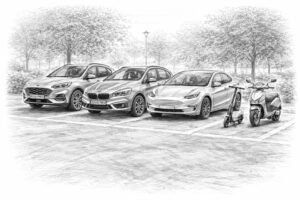 Anyone interested in electromobility will find a further articles I have deliberately broadened the scope of this series. I will present the various drive technologies - from classic combustion engines to hybrids and plug-in hybrids through to purely electric cars - and describe my own experiences from several years of practical experience. I drive two plug-in hybrid vehicles myself and am very familiar with the advantages, limitations and everyday effects of this technology. The article is less critical, more explanatory and practical - a good basis for categorizing the debate before dealing with the systemic issues.
Electromobility as a part, not a promise of salvation
Perhaps the most important lesson is to put electromobility back where it belongs: as part of a larger whole. Not as the sole solution, not as a moral standard, not as a political symbol.
Mobility is diverse. Energy is complex. Industry is sluggish. Those who accept these realities make better decisions - even if they are less brilliant.
Personal closing
I am not writing this text out of rejection, but out of disappointment. Disappointment that a good technology has been damaged by exaggeration and coercion. That people did not trust the system, but wanted to control it - with all the known side effects.
Electromobility will find its place. I am convinced of that. The only question is at what price and how. Perhaps it should simply have been given more time. Not every well-told solution is a good solution. But every good solution stands up to scrutiny.
If this article is intended to do one thing, it is to reopen the space for this calculation. Without ideology. Without apportioning blame. But with respect for reality.
Because in the end, it's not the narrative that counts - it's the balance sheet.
Interesting sources on the topic
- Life cycle assessment of battery electric vehicles (PMC)This study conducts a life cycle analysis of battery electric vehicles, including battery efficiency, charging electricity mix and recycling aspects, as well as their impact on the environmental impact over the entire life cycle.
- Total CO2-equivalent life-cycle emissions from electric and hybrid vehicles (ScienceDirect)Compares over 790 vehicle variants and shows that although battery-powered vehicles have higher production emissions, they have significantly lower greenhouse gas emissions than combustion engines over their life cycle under certain conditions.
- Life-cycle greenhouse gas emissions of passenger cars (ICCT)Analysis of the total emissions of electric cars in the EU context: BEVs have significantly lower emissions at life cycle level than conventional combustion engines, especially with a cleaner electricity mix.
- Life Cycle Assessment of Electric Vehicles (Tunley Environmental)Introductory overview of the methodological importance of life cycle assessments (LCA) in evaluating the environmental impact of products, including electric vehicles.
- Evaluating Carbon Emissions: A Lifecycle Comparison (MDPI)This study compares the CO₂ emissions of battery electric and combustion engine vehicles over a defined life cycle and takes into account manufacturing, battery production and electricity generation.
- How clean are electric cars? (Transport & Environment)Analysis showing that electric cars in Europe emit on average more than three times less CO₂ than comparable petrol cars when all emission sources are taken into account.
- Life Cycle Emissions: EVs vs. Combustion Engine Vehicles (Visual Capitalist)Graphic-based comparison of the life cycle emissions of electric cars, hybrids and combustion engines, including production and usage emissions.
- Life cycle assessment of battery electric vehicles (PubMed)Additional life cycle analysis of a battery electric vehicle with a focus on system limits and charging electricity mix.
- Battery electric cars produce 73% less emissions - researchA study by the International Council on Clean Transportation (ICCT) shows that battery-powered electric cars in Europe emit around 73 % less greenhouse gas emissions at life cycle level than conventional petrol cars.
- Electric cars in UK last as long as petrol and diesel vehicles, study finds: Report on a study showing that electric cars are now achieving similar lifetimes to combustion engines, which further improves their ecological impact.

Frequently asked questions
- Is this article fundamentally directed against electromobility?
No. The article is expressly not directed against electromobility as a technology. It recognizes its advantages, suitability for everyday use and long-term significance. It does not criticize electric driving per se, but rather the political exaggeration, the one-sided promotion and the abbreviated presentation of the overall balance. Electromobility is seen here as part of a solution - not as the sole savior. - Why is the life cycle of a vehicle so strongly emphasized?
Because the ecological impact of a car does not just start when it is driven. A large proportion of emissions are generated during raw material extraction, production and transportation. If you only look at the operation, you ignore crucial emission blocks and inevitably draw false conclusions about the actual environmental impact. - Aren't electric cars still cleaner than combustion engines?
That depends heavily on the context. They are emission-free locally in operation, but not automatically cleaner systemically. Production, battery production, electricity mix and service life determine the overall balance. Under unfavorable conditions, the ecological advantage can be significantly lower than often claimed. - Why is the scrapping of old vehicles viewed critically?
Because a vehicle that has already been produced has already caused its greatest ecological damage. If it is scrapped prematurely, additional emissions are caused by the production of a replacement vehicle. It often makes ecological sense to use existing vehicles for as long as possible. - Does the high weight of electric cars really matter?
Yes, the higher weight leads to more tire abrasion, higher mechanical particulate matter and greater strain on the infrastructure. These effects are real, even if they do not come from the exhaust. Physics cannot be overridden by good intentions. - Isn't it enough for electricity to be completely renewable at some point?
In the long term, a renewable electricity mix can improve the balance. However, electric cars currently run on the current electricity mix. In addition, the problem of volatility, base load and grid infrastructure remains. Assumptions about the future are no substitute for a calculation of the present. - Why is the electricity demand caused by electromobility presented as a problem?
Because additional electricity demand must be covered at all times - even at night, in winter and when there is a lull. Electromobility increases peak loads and requires grid expansion, storage and reserve power plants. This infrastructure is expensive, resource-intensive and part of the overall balance. - What about the argument that batteries can be recycled?
Recycling is technically possible and sensible, but costly and energy-intensive. It reduces the need for raw materials in the future, but does not offset the ecological costs already incurred. Recycling is not retroactive climate protection. - Why are we talking about emission shifting instead of emission avoidance?
Because many emissions do not disappear, but are shifted to other locations - to extraction regions, production facilities or power plants. Emissions fall locally, but the global balance is often much more complex. - Isn't lobbying fundamentally problematic?
Lobbying is first and foremost the organized representation of interests and a component of political processes. It becomes problematic when certain interests dominate for years and systematically suppress alternative perspectives. The article criticizes structures, not the existence of lobbying per se. - Why do long-term timelines play such an important role in lobbying?
Because political decisions are often only the end point of years of preparation. Studies, narratives and networks are created long before the actual decision is made. Crises then open windows of opportunity in which prepared solutions can be implemented quickly. - Why was electromobility so politically attractive?
It is visible, can be individualized and morally charged. Responsibility can be shifted to the individual („buy the right car“) instead of clarifying structural issues. This makes it easy to communicate politically - regardless of its actual systemic impact. - Have subsidies not helped to advance a new technology?
A moderate boost can be useful. It becomes problematic when subsidies become permanent and markets can no longer function without them. This creates dependencies, distorted prices and fragile structures that quickly collapse when subsidies are stopped. - What damage has been done to industrial policy?
One-sided promotion has reduced technological diversity, devalued existing skills and created new dependencies. Industry cannot be restructured at will without creating frictional losses. These effects often only become apparent with a time lag. - Why is speed viewed critically in remodeling?
Because speed is no substitute for strategy. Transformation that is too fast increases false incentives, reduces opportunities for correction and destabilizes systems. Sustainable progress requires realistic timelines and learning processes. - Were there realistic alternatives to the current policy?
Yes, longer use of existing vehicles, greater efficiency improvements, openness to technology and a slower transition would probably have had fewer ecological and economic side effects - even if they would have been less spectacular. - Did electromobility ultimately help protect the climate?
This is at least questionable. Looking at the overall effort, it is quite possible that hardly any net effects have been achieved or that additional emissions have even been generated. Good intentions do not guarantee a good balance sheet. - What is the central message of the article?
Not rejection, but classification. Electromobility is a valuable technology, but not a panacea. Climate protection requires systems thinking, life cycle calculations and patience. Progress is not achieved through coercion, but through viable solutions that stand up to honest scrutiny.