Crimea has been in the headlines again and again for years. In this context, the name of the Crimean Tatars is often mentioned - usually briefly, often without explanation. However, if you want to understand who the Crimean Tatars are, you have to go much further back than the political conflicts of the present.
It is not about a single event or a clear „hour of birth“, but about a long historical process. This chapter attempts to explain this in detail: where this people comes from, how it was formed and why its identity cannot be pinned down to national borders.


The steppe as a historical habitat
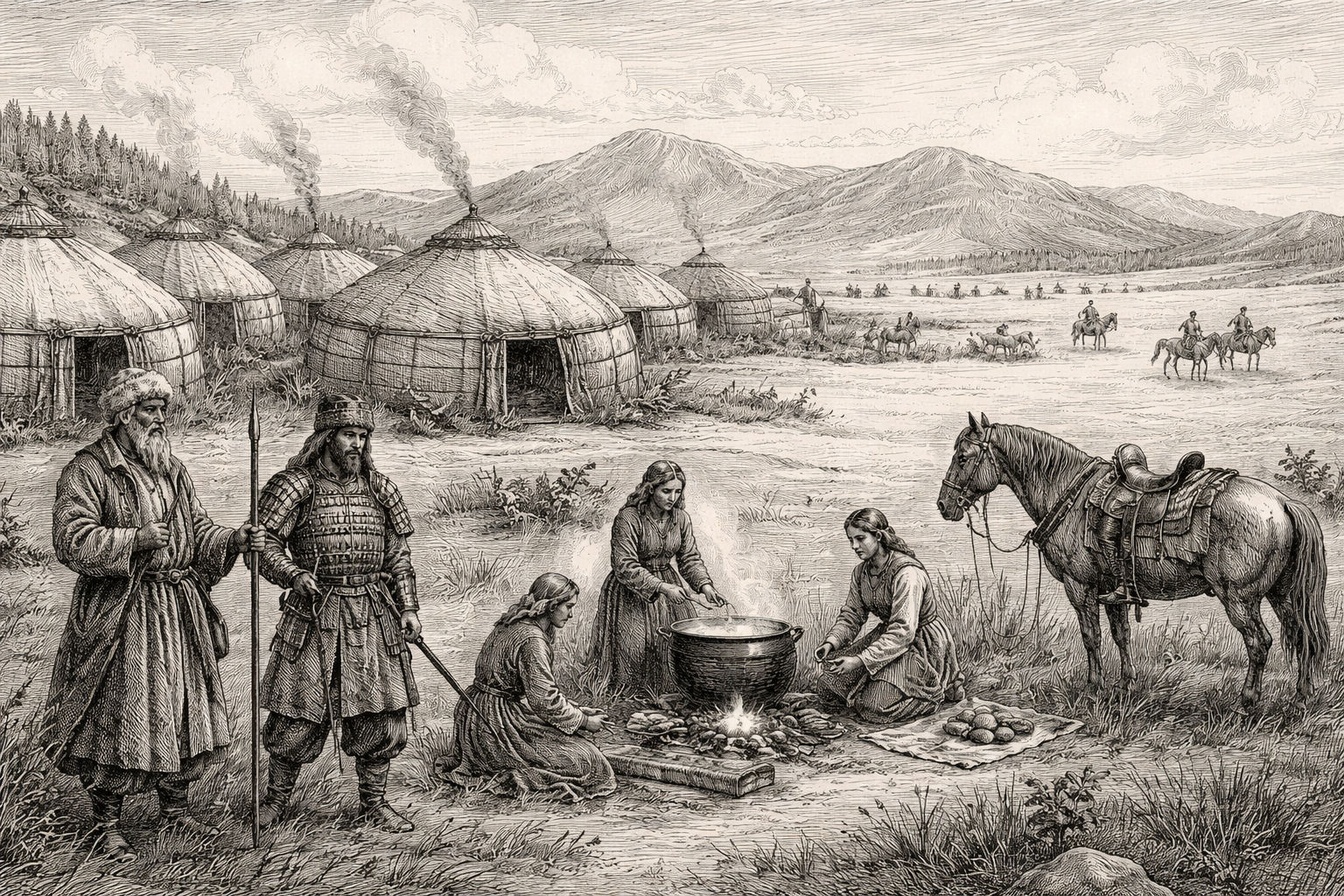
For many centuries, the northern Black Sea region was not a peripheral area of Europe, but a central area of movement. The steppe - flat, wide, open - was not a no man's land, but a habitat with its own rules. Here, mobility, adaptability and social ties counted for more than fixed cities or borders. Those who lived in the steppe were rarely permanently settled, but followed the seasons, grazing areas and trade routes.
Identities are created differently in such spaces than in traditional nation states. They are based less on territory than on language, way of life, tradition and mutual recognition. For centuries, the steppe was a space of contact and passage where peoples met, mixed and changed - not abruptly, but gradually.
Turkic groups and the Kipchak world
Turkic-speaking groups played a central role, especially those often referred to in research as Kipchaks (also known as Cumans). These groups shaped large parts of the steppe north of the Black Sea. Their language formed a common basis on which communication, alliances and political structures could develop.
It is important to note that there was no uniform „Kipchak people“. Rather, they were loose associations, clans and tribes that cooperated, competed or formed new alliances depending on the situation. Language and way of life united them more than ancestry. It was precisely from this network that the cultural basis of the Crimean Tatars later developed.
Influence of the Mongolian empires
From the 13th century onwards, the Mongol conquests fundamentally changed the balance of power in the steppe. Crimea came under the influence of the so-called Golden Horde. This rule was less a complete cultural transformation than a political framework within which existing structures developed further. This phase was decisive for the later Crimean Tatar identity:
- The political order became more stable.
- Trade routes gained in importance.
- Elites emerged who organized the administration, military and diplomacy.
The population of Crimea continued to consist of different groups - Turkic-speaking nomads, sedentary communities in the hinterland and urban populations on the coast. It was precisely this mixture that had a lasting impact on the region.
Religion as a unifying element
Over time, Sunni Islam gained in importance. It was not accepted overnight, but gradually established itself - above all as a cultural and legal framework. Religion created common points of reference: Holidays, legal concepts, educational structures and moral norms.
Islam did not replace local traditions, but rather united them. This was decisive for the later Crimean Tatar identity: common religious practice strengthened the sense of belonging without dissolving the diversity of everyday life.
How diversity becomes identity
The Crimean Tatars did not come into being through a founding act, but through consolidation:
- Language became understanding,
- lifestyle became tradition,
- Political order became belonging.
Identity here did not mean external demarcation, but internal orientation. Anyone who spoke the same language, shared similar values and was part of the same social order belonged - regardless of origin in the narrower sense.
This makes the early history of the Crimean Tatars very different from modern notions of nation or ethnicity. It is the product of an open space, not a closed system.
Transition to statehood
At the end of this process was the prerequisite for something new: their own political order. From the loose network of the steppe, a power structure developed in Crimea that was to last. With the formation of the Crimean Khanate, the next chapter of history begins - the one in which a grown identity became a state of its own for the first time.
The Crimean Khanate - statehood between the steppe and the Black Sea
In the 15th century, developments in Crimea that had been building up over generations began to consolidate. The collapse of the Golden Horde left a power vacuum that local elites knew how to exploit. During this phase, the Crimean Khanate emerged - not as an accidental secession, but as a deliberate step towards statehood.
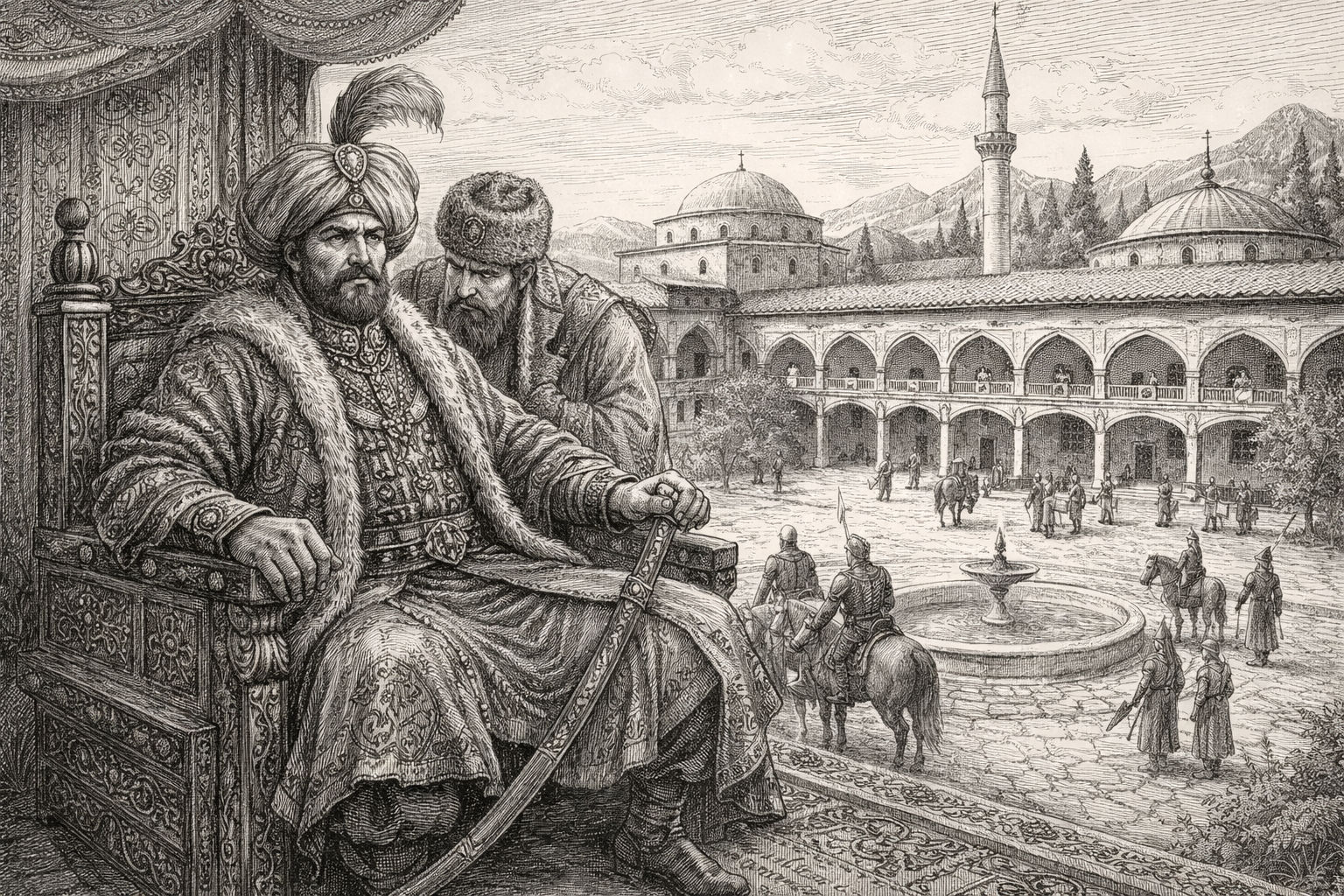
The bearer of this development was the Giray dynasty, whose rulers derived their legitimacy from their descent from Genghis Khan. In the political logic of the steppe, this origin was not a detail, but a central organizing principle.
The khanate was thus more than a loose association: it possessed a recognized line of rulers, fixed centers of power and a political identity that went beyond individual tribes.
Location and significance: A state at the interface of two worlds
Geographically, the Crimean Khanate was located at a special interface. The Crimea itself connected the open steppe in the north with the Black Sea in the south. This location had a lasting impact on the character of the state. On the one hand, the steppe-based way of life with mobility, equestrian troops and far-reaching alliances remained dominant. On the other hand, the coast opened up access to trade, diplomacy and cultural exchange.
The khanate was therefore not an isolated peripheral state, but part of a wide-ranging system of trade routes, power relations and military strategy. Its importance lay less in its territorial size than in its ability to connect spaces.
Power structure and political order
At the top was the khan, whose authority was supported by tradition, religious legitimacy and military power. He was supported by noble families, religious dignitaries and administrative structures that became more differentiated over time. This order was not rigid, but adaptable - an important feature in a region characterized by changing power relations.
Jurisprudence, administration and diplomacy followed both Islamic norms and established local practices. This made the khanate stable enough to survive for centuries without giving up its internal diversity.
Relations with the Ottoman Empire
A decisive turning point was the integration of the Crimean Khanate into the order of the Ottoman Empire from the late 15th century. Following Ottoman control of the important coastal cities, the khanate became a vassal state. However, this relationship was complex: the khanate remained largely autonomous internally, while its foreign policy and strategic orientation were closely coordinated with Istanbul.
This connection brought protection and stability to the khanate. At the same time, it tied Crimea firmly into the power politics of the Black Sea region. The khanate thus became an integral part of an imperial order without completely giving up its own identity.

Podcast: The Crimean Tatars. A brutal history | Deja-vu story
Economy, everyday life and culture
Life in the Crimean Khanate was characterized by contrasts. Livestock farming, mobility and military presence dominated in the steppes. In the cities and on the coast, trade, crafts and administration played a greater role. These different ways of life coexisted and complemented each other.
The cultural development was particularly visible in the capital Bakhchysaraj. The khan's palace there was not only a residence, but also an expression of state continuity, cultural self-image and political representation. Architecture, poetry and courtly traditions formed a cultural framework that is still regarded as a symbol of Crimean Tatar statehood today.
The khanate as an anchor of identity
For several centuries, the Crimean Khanate provided the Crimean Tatars with a fixed point of reference. Statehood not only created order, but also historical memory. Language, religion and traditions were given permanence and visibility through political structures. During this time, a self-image was formed that went far beyond mere steppe origins.
For this very reason, the end of the khanate was more than just a political upheaval. With the loss of statehood, a central anchor of identity was also lost - a caesura whose consequences would be felt for a long time to come.
Transition: From own state to foreign rule
When the Crimean Khanate came under pressure from a new empire in the late 18th century, a phase of relative self-determination that had lasted several centuries came to an end. The incorporation into the Russian Empire meant not only a change of power, but also a profound change in living conditions.
The annexation by the Russian Empire
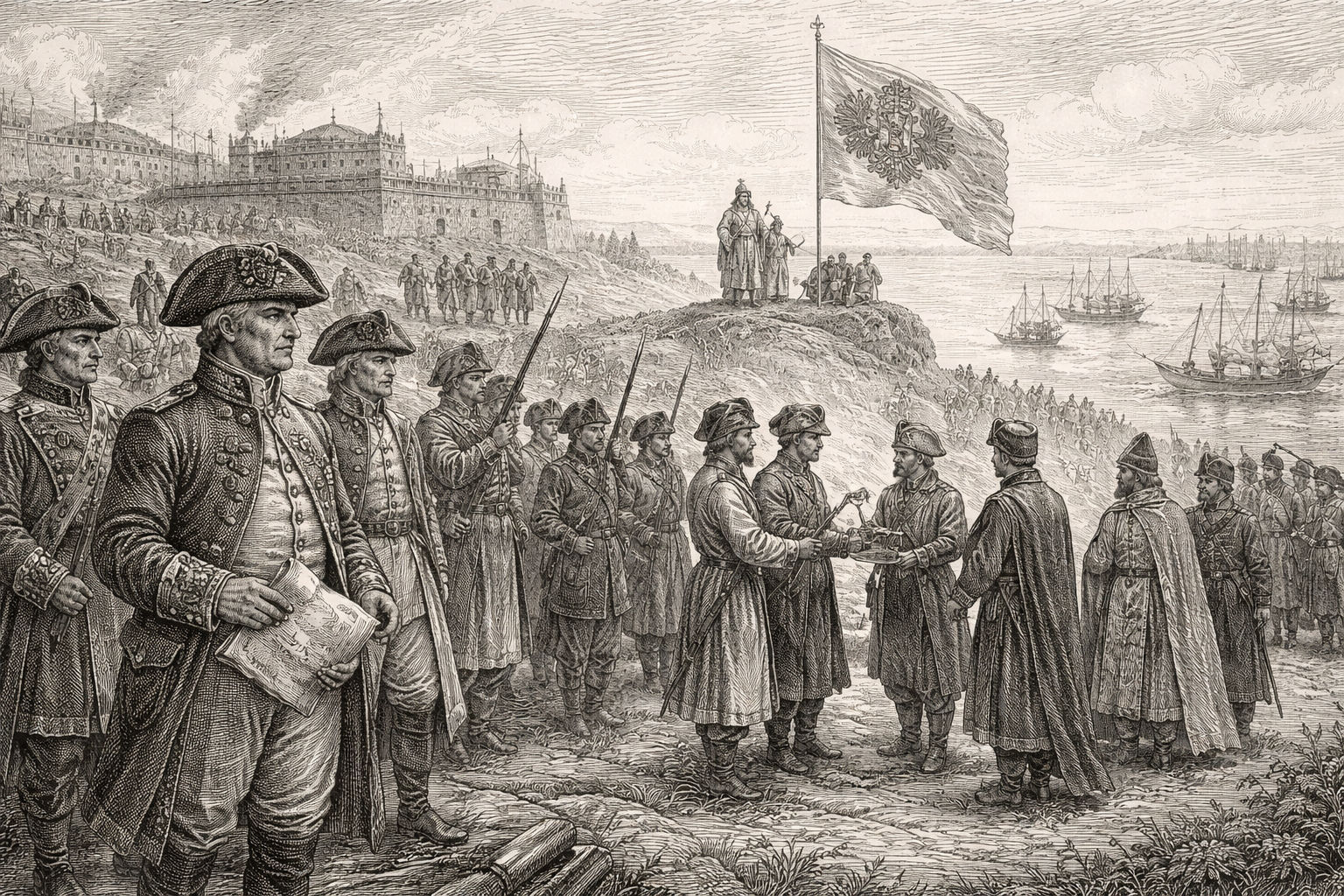
In 1783, Crimea's independence finally came to an end. The Crimean Khanate was formally incorporated into the Russian Empire. This step was not an isolated event, but the result of a longer development. For decades, Russia had been pursuing the goal of securing permanent access to the Black Sea and pushing back the influence of the Ottoman Empire in the region. The politically weakened position of the Crimean Khanate ultimately made annexation possible.
For the Crimean Tatars, this moment meant not only a change of power, but also the end of an order in which they had been the bearers of statehood for centuries.
From autonomy to foreign rule
Immediately after the annexation, some structures initially remained in place. This transitional phase gave the impression of continuity, but it was deceptive. Step by step, the administration was reorganized along Russian lines. Decision-making centers shifted, local elites lost influence, traditional legal and property relations were called into question.
What had previously been an independent state now became a province within an expanding empire. Political participation gave way to administrative subordination.
Changes in everyday life and in society
The new balance of power had an increasing impact on everyday life. Administrative reforms, new taxes and military requirements changed the lives of the Crimean Tatar population. The intervention in religious and social institutions was particularly drastic. Mosques, foundations and educational structures lost their economic basis or came under state control.
At the same time, the social structure changed. Groups that had previously been part of the political and religious elite now found themselves in a defensive position. Adaptation became a necessity, not a free choice.
A central, often underestimated aspect of this phase is the demographic upheaval. Many Crimean Tatars decided to emigrate to areas of the Ottoman Empire in the course of the 19th century. There were many reasons for this:
Political pressure, economic uncertainty, religious restrictions and the fear of further loss of power.
At the same time, the Russian Empire deliberately promoted the settlement of other population groups in Crimea. Russian, Ukrainian, German and other settlers permanently changed the composition of the population. The Crimean Tatars increasingly became a minority in their own historical settlement area.
Cultural marginalization
The political disempowerment was accompanied by a creeping cultural marginalization. Language, traditions and collective memory lost public visibility. Although everyday Crimean Tatar life continued to exist, the institutional framework that could have secured culture in the long term was now missing.
Identity became more and more a private matter. Public representation gave way to family transmission, oral tradition and religious practice. This form of cultural withdrawal was not voluntary, but a reaction to structural repression.
The long shadow of annexation
The incorporation into the Russian Empire was not a short-term turning point, but the beginning of a long-term development. A loss of political significance, demographic shifts and cultural invisibility intensified over generations. The Crimean Tatars remained present on their historical territory, but their role changed fundamentally.
This phase explains why later events - especially the deportations in the 20th century - did not come out of nowhere. They hit a community that was already weakened, fragmented and politically powerless.
When new totalitarian power structures emerged in the 20th century, the Crimean Tatars lacked the political protection mechanisms that they had previously possessed. The developments of the 18th and 19th centuries thus form the historical background for one of the most dramatic turning points in their history.
1944 - The deportation under Stalin and the almost complete extermination
In the spring of 1944, the Soviet Union was on the advance. The German occupation of Crimea had ended and military control had been re-established. During this phase, the Soviet leadership under Josef Stalin made a decision that was existential for the Crimean Tatars: the entire population was accused of collaborating with the German occupiers. Individual biographies, actual behavior or loyalty played no role. Guilt was defined collectively.
This logic was not new, but it was radical in its consequences. From then on, the Crimean Tatars were considered „unreliable“ - a stigma intended to justify their complete removal from their homeland.
The operation in May 1944
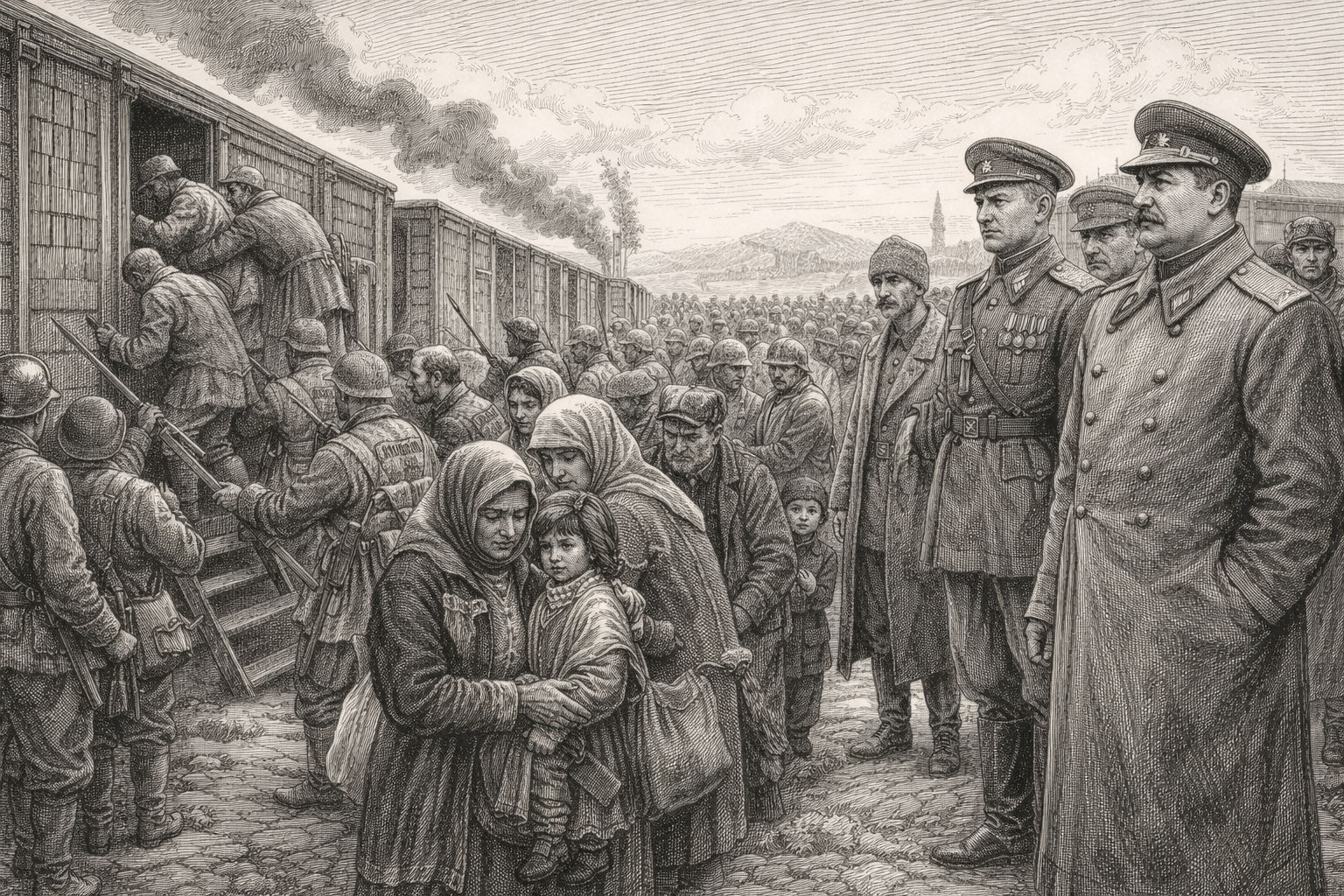
A meticulously planned deportation operation began between May 18 and 20, 1944. Units of the Soviet secret service, the NKVD, combed through villages and towns in Crimea. Families were often only given a few minutes to pack the essentials. Almost all their possessions were left behind: houses, fields, animals, personal mementos.
Within just a few days, almost all Crimean Tatars - estimated at around 190,000 to 200,000 people - were removed from their homes. The speed and completeness of this action leave little doubt as to its systematic nature.
Transportation and direct losses
They were transported in locked goods and cattle wagons. The conditions were catastrophic: hardly any water, hardly any food, no medical care. The transports often took weeks. Diseases spread, especially among children and the elderly.
Many deportees did not survive this first phase. Serious estimates assume that a significant number of those affected died during transportation or in the first few months in exile. Exact figures are difficult to determine, but the loss was massive and traumatizing.
Life in exile: special settlers without rights
The survivors were mainly taken to the Uzbek SSR and other regions of Central Asia. There they were given the status of „special settlers“. This status meant:
- Severely restricted freedom of movement
- Obligation to report regularly to the authorities
- Assignment of hard physical labor
- Hardly any access to medical care or education
A return to Crimea was expressly forbidden. The deportation was not intended as a temporary measure, but as a permanent removal.
Destruction of social and cultural structures
The deportation not only displaced a population, but also destroyed an entire social fabric. Village communities no longer existed, families were torn apart, religious and cultural institutions disappeared. In Crimea itself, a systematic eradication of Crimean Tatar traces began immediately:
- Place names have been changed
- Cemeteries neglected or destroyed
- Crimean Tatar history removed from official representations
The aim was not just resettlement, but erasure from the collective memory.
Decades of silence
After Stalin's death, other deported peoples were rehabilitated and allowed to return. For a long time, this did not apply to the Crimean Tatars. Their deportation remained officially unmentioned or was relativized. It was not until the end of the 1980s that the injustice was publicly acknowledged.
During these decades, the Crimean Tatars lived in a state of permanent provisionality: without a homeland, without a political voice, with a history that could not be told. Identity became something that had to be preserved in private - in families, in language, in memories.
A caesura without a point of return
The events of 1944 mark the deepest turning point in the history of the Crimean Tatars. They meant not only the loss of their homeland, but also the almost complete eradication of Crimean Tatar life in Crimea. What had grown over generations was destroyed in a matter of days.
This chapter is crucial to understanding the present. Without the deportation, neither the difficulties of return nor the ongoing conflicts over identity, language and political participation can be understood.
Return from 1990 - returning home to a country that had become a different one
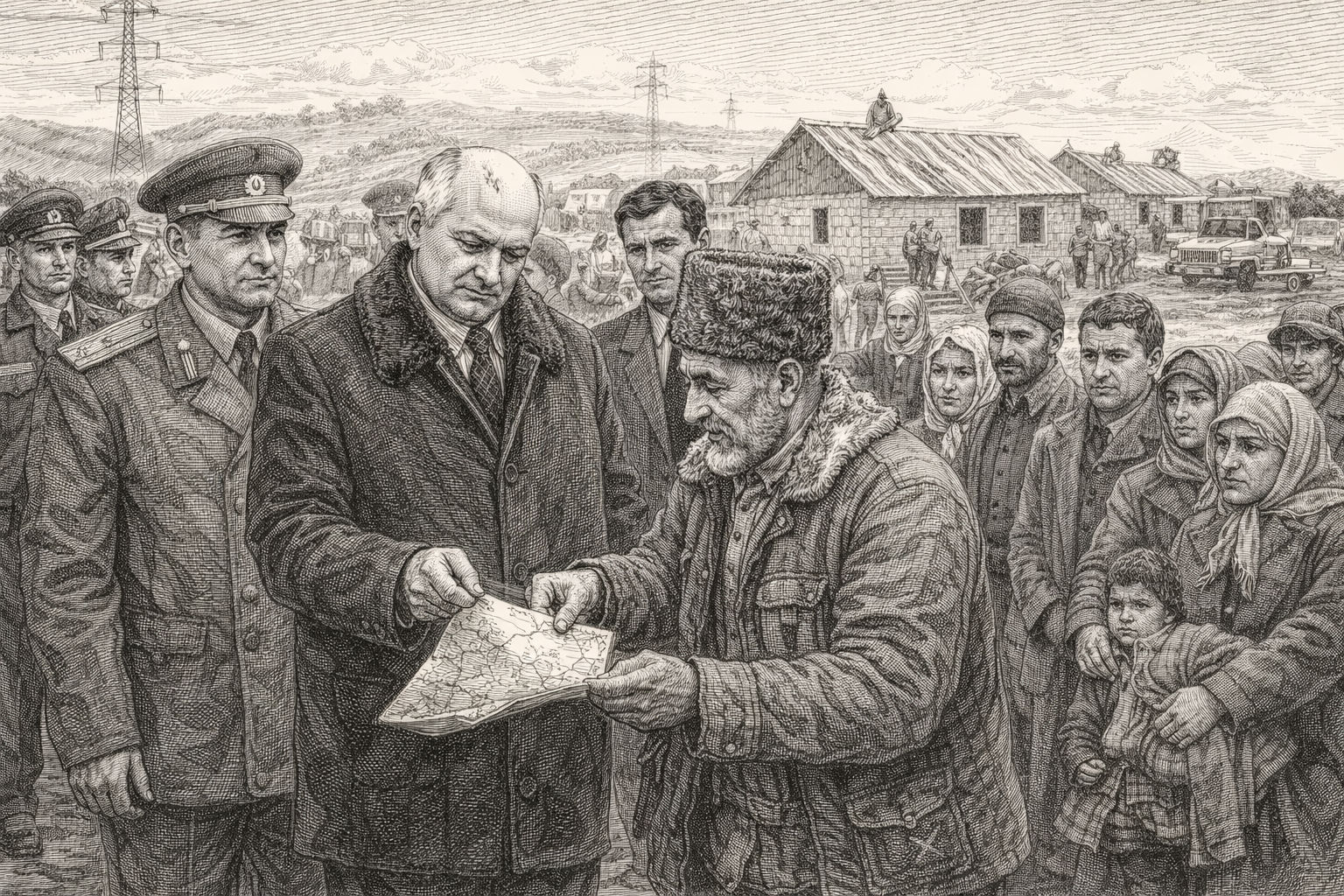
From the mid-1980s, Mikhail Gorbachev ushered in a phase that was historically significant for the Crimean Tatars - albeit contradictory. Under the slogans of glasnost and perestroika, the deportations were openly discussed for the first time. Towards the end of the 1980s, the rigid order of the Soviet Union began to waver. In 1989, the Supreme Soviet of the USSR officially recognized that the forced resettlement of the Crimean Tatars had been unjust.
The decades-long ban on return was thus lifted. When the Soviet Union collapsed in 1991, Crimea became part of the newly founded Ukraine - formally as an autonomous republic. For many Crimean Tatars, this was the moment that generations had been waiting for: the opportunity to return to their historic homeland.
However, this recognition had a crucial catch: it was moral, not practical. There was no clear state strategy for return, no systematic land restitution and no reliable social programs. Responsibility was effectively delegated to those affected themselves. Gorbachev's policy opened the door - the Crimean Tatars had to go through it alone.
The return began quickly, but was largely uncoordinated. There were hardly any government programs, no systematic housing planning and only limited social support. Many families returned from Central Asia without knowing where they would live or work. The will to return home was strong - the structures for this were lacking.
This gap characterized the entire return phase. What could historically be understood as reparation remained practically a private achievement of those affected.
Land, property and temporary solutions
A central problem was the question of ownership. Houses and plots of land belonging to the deported Crimean Tatars had been occupied by other people for decades or had been reassigned. Comprehensive restitution did not take place. As a result, provisional settlements emerged, often on the outskirts of towns or on undeveloped land.
These so-called self-occupations were legally controversial, but for many returnees there was no alternative. They were emblematic of the situation as a whole: legally insecure, socially stressful, but driven by the desire to return permanently.
Social and economic challenges
The returnees were confronted with considerable social problems. Unemployment was high, educational qualifications from the Soviet era were not always recognized and there was a lack of infrastructure. Many families lived for years without stable supplies, roads, schools or medical facilities.
There was also a certain distance to the local population. The return of the Crimean Tatars was not perceived everywhere as a historical correction, but in some cases as competition for scarce resources. Conflicts mostly remained local, but had a long-term impact.
Political self-organization: The Mejlis
In order to pool their interests, the Crimean Tatars founded the Mejlis, a representative body that was to act as the political voice of the community. The Mejlis organized returns, mediated in conflicts and represented Crimean Tatar concerns to the authorities.
Under Ukrainian administration, the Mejlis was tolerated and partially included, but remained legally weak. Its political influence was limited, especially as the Crimean Tatars remained a minority on the peninsula.
Autonomy without self-determination
Crimea's autonomy within Ukraine did not create any real political room for maneuver for the Crimean Tatars. Decisive power lay with regional elites, in which they were underrepresented. Autonomy meant administration, not self-determination.
This meant that a structural tension remained: The Crimean Tatars had returned and were once again living on their historical territory - but the political and social conditions did not meet their expectations or needs.
The return from 1990 was not a conclusion, but the beginning of a new, fragile chapter. It brought hope, but also disappointment. The Crimean Tatars were visible again, present once more - but their position remained precarious. Many of the fundamental issues remained unresolved: property, political participation, cultural security.
This open situation formed the backdrop for the developments of the following years. When the balance of power in Crimea shifted again, it affected a community that had returned but was still on shaky foundations.
The Yeltsin years: return in a political vacuum
After the collapse of the Soviet Union, Boris Yeltsin took over the leadership of the Russian Federation. This phase was characterized by profound upheaval, economic chaos and weak state control. For the Crimean Tatars, this meant one thing above all: uncertainty.
Although there were selective talks, symbolic gestures and a certain openness towards the concerns of the Crimean Tatars under Yeltsin, there was a lack of assertiveness. Crimea was now part of Ukraine and Russia no longer had direct jurisdiction there. This shifted responsibility once again - this time between Moscow and Kiev.
The return of the Crimean Tatars continued, but without clear coordination. Property issues remained unresolved, political representation weak. Yeltsin's Russia was preoccupied with itself; the Crimean Tatars were not a central issue in Russian domestic or foreign policy.
The present between formal recognition, political pressure and new insecurity
For the Crimean Tatars, language has always been more than just a means of communication. It is a carrier of memory, family history and cultural continuity. After decades of deportation and enforced silence, Crimean Tatar became visible again from the 1990s: in schools, the media, religious institutions and in everyday private life. But visibility alone did not mean security.
While the return was physically possible, the linguistic and cultural anchoring remained fragile. There was a lack of teachers, teaching materials and stable institutional structures. The passing on of the language depended heavily on the commitment of individual families and initiatives - a classic pattern for minorities without political backing.
The period under Ukrainian administration: recognition without enforcement
After 1991, Ukrainian was the only state language in Ukraine. In Crimea, however, Russian continued to dominate everyday life - in administration, the media and public life. Crimean Tatar was recognized as a minority language, but received only limited state support. It is important to distinguish between law and reality:
There was no official ban on the Crimean Tatar language. At the same time, however, there were no binding mechanisms to systematically strengthen it. Schools with Crimean Tatar lessons existed, but remained the exception. Media offerings were limited. This created a situation in which recognition existed on paper but had little effect in everyday life.
A language law passed in 2012 allowed regional languages if they were sufficiently widespread. Russian in particular benefited from this. Crimean Tatar remained structurally disadvantaged - not out of open rejection, but due to political prioritization and a shortage of resources.
Putin before 2014: distance and strategic silence
When Vladimir Putin took office, Russia's political style changed fundamentally. Stabilization, consolidation of power and geopolitical thinking came to the fore. With regard to the Crimean Tatars, however, the line initially remained reserved to distant.
Before 2014, the Crimean Tatar issue hardly played a visible role in Putin's policy. Russia recognized Crimea as part of Ukraine and treated the Crimean Tatars primarily as a matter for the Ukrainian state. Contacts existed, but they were not formative.
Support for Crimean Tatar institutions or an active historical reappraisal of the deportation were not among the priorities.
This phase was characterized by strategic silence: The story was known, but was not brought to the fore politically.
2014: Political break and new balance of power
The situation changed fundamentally when Russia annexed Crimea in 2014. The majority of Crimean Tatars rejected this step. Their attitude was based less on geopolitical loyalties than on historical experience: Foreign rule, disenfranchisement and state violence had burned themselves deeply into the collective memory.
Russia formally declared Russian, Ukrainian and Crimean Tatar as the official languages of Crimea. At first glance, this appeared to be an upgrade. In practice, however, a different picture emerged.
Formal recognition, practical restriction
After 2014, Russian became the almost exclusive language of administration. Ukrainian largely disappeared from the public sphere. Crimean Tatar remained officially recognized, but its use was increasingly restricted. Educational opportunities were reduced, independent media were put under pressure and cultural initiatives were hindered.
The ban on the Mejlis, the most important political representation of the Crimean Tatars, was particularly drastic. It was classified as „extremist“ and dissolved. As a result, the community lost its central institutional voice. Political participation was individualized and controlled, and collective representation of interests was made practically impossible.
In the years after 2014, there were increasing reports of house searches, arrests and intimidation - especially against activists, journalists and religious figures. Many Crimean Tatars were once again forced to leave Crimea, this time for political reasons.
This repeated a familiar pattern: insecurity leads to emigration, emigration weakens the community, and weakness increases political vulnerability. History did not seem to be repeating itself, but rather continuing.
Current survey on a possible case of tension in Germany
Living in the present: between adaptation and insistence
Today, the Crimean Tatars live in a field of tension. Some try to combine adaptation and cultural self-assertion in their everyday lives. Language is cultivated in families, religious practice is maintained and traditions are passed on. At the same time, it is clear that public space, political participation and institutional security are limited.
Identity is once again shifted inwards. It exists - but more quietly, more cautiously, more fragmented. What was once statehood, then minority, then exile, is now a community in a mode of permanent caution.
Annexation or secession? Why the dispute over Crimea continues to this day
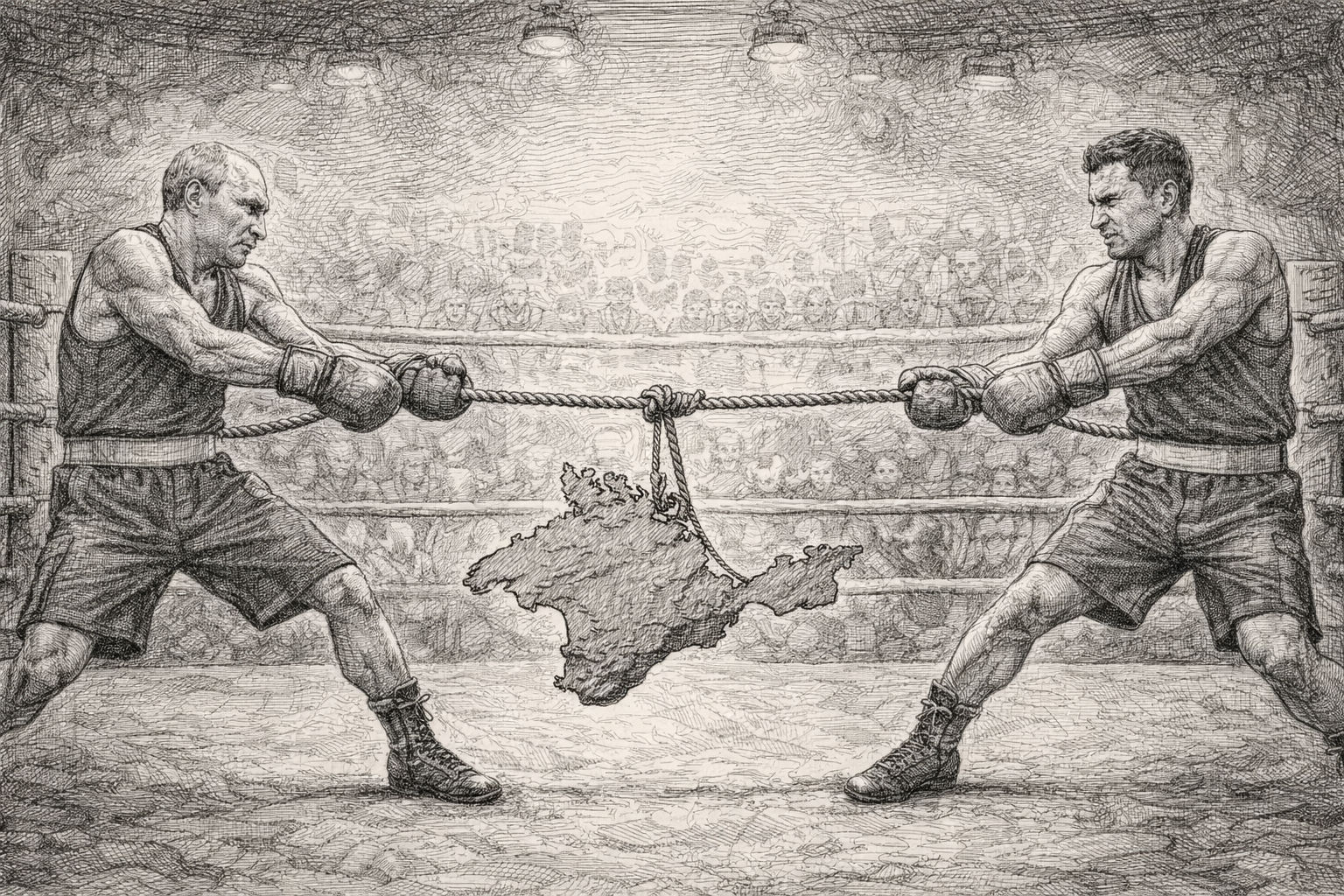
Since 2014, Crimea has not only been politically contested, but also conceptually. In the media, official statements and debates on international law, there are two terms that are more than just semantic subtleties: Annexation on the one hand, secession on the other. Both terms describe the same historical moment - but from fundamentally different perspectives.
The ongoing dispute is explained less by a lack of clarity about the events themselves than by their differing legal and political assessments.
The view of Ukraine and a large part of the international community
From Ukraine's perspective, the events of 2014 constitute an annexation. The central argument is that the territorial integrity of a sovereign state was violated. The referendum held in Crimea took place under conditions that did not allow for free and uninfluenced decision-making. Furthermore, it was neither compatible with the Ukrainian constitution nor internationally recognized.
This position is shared by the vast majority of states and international organizations. In this interpretation, Crimea is still considered part of Ukraine, which is de facto controlled by Russia. This results in a policy of non-recognition, which is still reflected today in sanctions, official declarations and diplomatic formulations.
The Russian argument: self-determination and secession
Russia, on the other hand, is talking about Crimea's secession from Ukraine and subsequent accession to the Russian Federation. The core of this argument is the principle of self-determination of the people. The 2014 referendum is interpreted as an expression of the population's will to break away from Ukraine.
In this context, Russia often refers to other international cases in which territorial changes have taken place without the consent of the original state. The term „reunification“ is used to emphasize historical, cultural and linguistic references. From this perspective, the process is legitimate and lawful.
The handover of Crimea in 1954: an intra-Soviet administrative act
From a Russian perspective, the historical affiliation of Crimea plays a central role. Reference is often made to the year 1954, when Crimea was transferred within the Soviet Union from the Russian Soviet Republic to the Ukrainian Soviet Republic. This step took place under the leadership of Nikita Khrushchev and was officially justified on historical, economic and administrative grounds - including the closer economic ties between Crimea and the Ukrainian mainland.
From today's Russian perspective, this decision is often portrayed as an administrative act without any real democratic legitimacy, as it took place within a one-party state and did not involve a referendum. It is important to note that in 1954 this border shift had no foreign policy significance, as it took place within a common state. It was only with the collapse of the Soviet Union in 1991 that this internal administrative border became an international state border - a circumstance that Russia sees as historically problematic in retrospect. In this argumentation, Crimea appears less as a „Ukrainian core territory“ and more as a region that only became part of Ukraine late and rather formally.
At the same time, it should be noted that Russia recognized Ukraine as a sovereign state, including Crimea, after the collapse of the Soviet Union. This relativizes the argument of the intra-Soviet handover of 1954 from the perspective of international law, even if it remains historically explanatory.
The Black Sea Fleet: treaties, presence and security interests
A second key argument put forward by the Russian side concerns Russia's long-term military presence in Crimea, particularly through the Black Sea Fleet. After the collapse of the Soviet Union, Russia and Ukraine contractually regulated the use of the naval bases in Crimea. These agreements were first comprehensively codified in 1997 and significantly extended in 2010 in the so-called Kharkiv Agreement - the stationing of the Russian Black Sea Fleet in Sevastopol was secured until 2042, with an extension option until 2047.
From a Russian perspective, this meant that Crimea was already a central security anchor point for Russia long before 2014 - regulated under international law and internationally recognized. When Ukraine's political orientation changed after 2013 and voices were raised to review or renegotiate existing agreements, this was perceived in Moscow as a potential threat to strategic interests.
The Russian argument therefore emphasizes that the events of 2014 did not take place in a security policy vacuum, but against the backdrop of existing treaties, military presence and long-term ties. This continuity is used as a further argument for interpreting the process as a secession under existing ties rather than a classic annexation.
The crucial sticking point: voluntariness and external circumstances
The actual point of contention lies less in the abstract principle of self-determination than in the question of the conditions under which it can be effectively exercised. Under international law, a distinction is made between internal self-determination (autonomy, minority rights, political participation within a state) and external self-determination (secession). The latter is considered an exception and is generally only discussed under very narrow conditions.
In the case of Crimea, the debate is sparked in particular by the circumstances of the referendum: the rapid timing, the military presence of Russian forces and the lack of international observation. Critics see this as an impairment of the free formation of will, while supporters emphasize the approval of a large part of the population.
Why there is no „final judgment“
It is often said that the status of Crimea is „not finally clarified under international law“. This is correct in one precise sense - and misleading in another. There is no single court decision that has finally settled the question of sovereignty in a way that is binding for all states. At the same time, however, there is a clear international practice that does not recognize Crimea as legally belonging to Russia.
To date, international courts and institutions have primarily dealt with human rights issues, control relationships and the de facto exercise of power, rather than the final clarification of territorial affiliation. This is also due to the political realities of international institutions in which power relations play a role.
Significance of this debate for the Crimean Tatars
For the Crimean Tatars, the question of „annexation or secession“ is not an academic discussion. Depending on which legal and political framework is taken as a basis, minority rights, protection mechanisms and political scope for action change. Historical experiences with foreign rule, deportation and disenfranchisement continue to shape their attitude towards changes of power to this day.
Regardless of the legal classification, the reality remains: The Crimean Tatars are once again living in a situation of political uncertainty. Institutions that represented their interests have been weakened or banned, and cultural and linguistic freedoms have been restricted. The great geopolitical debate is thus once again affecting a community that has historically often been the object of foreign decisions.

A story without a simple conclusion
The history of the Crimean Tatars does not end with a clear conclusion. It is open, contradictory and characterized by ruptures. From the steppe to their own khanate, from annexation to deportation to the difficult return, there is a common thread: Identity survives even where political security is lacking.
From Gorbachev to Yeltsin to Putin, there is a common thread: The Crimean Tatars were listened to, but rarely really involved. Recognition often remained abstract, responsibility diffuse, solutions incomplete. Each political phase brought new hopes - and new disappointments.
This is precisely why it is worth looking back. Not to apportion blame or simplify current conflicts, but to understand why concepts such as homeland, language and self-determination have a different depth for some people than for others. The Crimean Tatars are not a marginal topic in history - they are part of Europe. And their story is a reminder that stability can never be taken for granted, but is always the result of protection, recognition and responsibility.
An open conflict without a simple conclusion
The dispute over annexation or secession shows how closely law, politics and history are intertwined. It cannot be reduced to a single concept. However, one thing is clear: Crimea is not just a territory, but a space with an evolved history in which different memories, loyalties and violations clash.
To understand the present, it is therefore less important which term one chooses than to recognize why this dispute continues to this day - and why it has far-reaching consequences for local people.
Classification at the end
This article does not claim to speak from personal experience about the Crimean Tatars. My approach is a research-based, historically oriented one: reading sources, organizing contexts, making lines comprehensible. Just like you used to learn when you took a subject seriously.
This makes it all the more important for me to look ahead with an open mind: anyone with factual additions, corrections or further suggestions is expressly invited to submit them in the Comments to share. Meaningful contributions enrich the text.


Frequently asked questions
- Who are the Crimean Tatars?
The Crimean Tatars are an indigenous people of the Crimean Peninsula. Their identity developed over centuries in the northern Black Sea region from Turkic-speaking groups, a steppe nomadic way of life, Islamic culture and later their own statehood in the Crimean Khanate. They are not a modern construct, but have deep historical roots. - Where do the Crimean Tatars originally come from?
The origins do not lie in a single country of origin, but in the Pontic-Caspian steppe. There, Turkic-speaking groups, particularly from the Kipchak world, mixed with local populations from Crimea. Identity was created through language, way of life and shared history, not through „pure descent“. - Did the Crimean Tatars have their own state?
Yes, from the 15th to the late 18th century, the Crimean Khanate existed as an independent state with its own dynasty, administration, capital (Bakhchysaray) and international recognition. It was a political player in the Black Sea region for centuries. - What role did the Ottoman Empire play?
The Crimean Khanate was a vassal state of the Ottoman Empire for a long time. However, it retained extensive internal autonomy. This connection offered protection, but also tied the khanate into Ottoman power politics. - When and why did the Crimean Khanate lose its independence?
Crimea was annexed by the Russian Empire in 1783. Russia wanted permanent access to the Black Sea and took advantage of the weakness of the Khanate and the decline of the Ottoman Empire. - What changed for the Crimean Tatars after the annexation?
With the annexation, the Crimean Tatars lost their political elite, state structures and, in the long term, their demographic majority. Administration, law and property relations were restructured, and many Crimean Tatars emigrated or were socially marginalized. - Why did many Crimean Tatars emigrate in the 19th century?
The causes were political pressure, economic disadvantage, religious restrictions and the loss of land. Many emigrated to areas of the Ottoman Empire, particularly to what is now Turkey. - What happened to the Crimean Tatars in 1944?
In May 1944, almost all Crimean Tatars were forcibly deported on the orders of the Soviet leadership under Joseph Stalin. They were collectively accused of collaboration and removed from their homeland within a few days. - Where were the Crimean Tatars deported to?
Most of the deportees were taken to the Uzbek SSR and other regions of Central Asia. There they lived under the status of „special settlers“ with severely restricted rights. - How many people died as a result of the deportation?
It is estimated that between 10 and 30 percent of the deported Crimean Tatars died in the first months and years - from hunger, disease, exhaustion and lack of medical care. - Were the Crimean Tatars allowed to return after Stalin's death?
No, not at first. While other deported peoples were rehabilitated, the Crimean Tatars were denied their return for a long time. It was not until the end of the 1980s that the injustice was officially recognized. - When did the return to Crimea begin?
From around 1989/1990, in the wake of the collapse of the Soviet Union. The return was largely uncoordinated and without comprehensive state support. - What problems did returnees have?
The main problems were a lack of housing, unresolved property issues, unemployment, a lack of infrastructure and political underrepresentation. Many had to build provisional settlements on undeveloped land. - What is the Majlis?
The Mejlis is the political representative body of the Crimean Tatars. It emerged as a self-organization of the returnees and acted as the central voice of the community - initially tolerated, later banned. - Was Crimea autonomous under Ukraine?
Yes, Crimea was an autonomous republic within Ukraine. However, this autonomy did not mean self-determination for the Crimean Tatars, as they remained a minority. - Was the Crimean Tatar language banned under Ukraine?
No. Although the language was recognized, it was only promoted to a limited extent. There was a lack of systematic support in education, administration and the media. Recognition was more formal than practical. - Which languages dominated Crimea before 2014?
Russian dominated everyday life, although Ukrainian was the only state language. Crimean Tatar remained a minority language with little institutional presence. - What changed after 2014?
Following the annexation of Crimea by Russia, Russian, Ukrainian and Crimean Tatar were formally recognized as official languages. In practice, however, Russian dominates almost completely. - What is the situation of the Crimean Tatars today?
Many live under political pressure, with restricted freedom of expression and limited cultural development. The ban on the Majlis and repression against activists have weakened the community. - Why is the history of the Crimean Tatars still relevant today?
The history of the Crimean Tatars shows how minorities are shaped by geopolitical shifts in power. It makes it clear that questions of language, homeland and identity are not abstract concepts, but have real consequences for people's lives - right up to the present day.



I would like to thank you for this excellent work. You have written a really comprehensive and very helpful article. As a Crimean Tatar, I read it with great interest from start to finish. Thank you very much! I will continue to read your articles with great pleasure. I wish you every success and good health!
(I would like to thank you for this excellent work. You have truly prepared a comprehensive and very useful article. As a Crimean Tatar, I read it with great interest from beginning to end. Thank you! I will continue to read your articles with great pleasure. I wish you success and strong health!)
Thank you very much for your kind words. I am very pleased that the article was perceived as respectful and correct - especially from someone who is personally concerned about this topic.
All the best and good health too!
(Merametli sözleriñiz içün çoq sağ oluñız. Men pek memnünm ki, maqale ürmetli ve doğru qabul etildi - hususan bu mevzunı terenden qayğırğan adam tarafından.
Sizge de bütün yahşılıqlar ve sağlıq!)
Very, very interesting! I've learned a lot of new things. The question of the actual situation of the Crimean Tatar population is extremely complex. There are different perspectives—as there are everywhere!