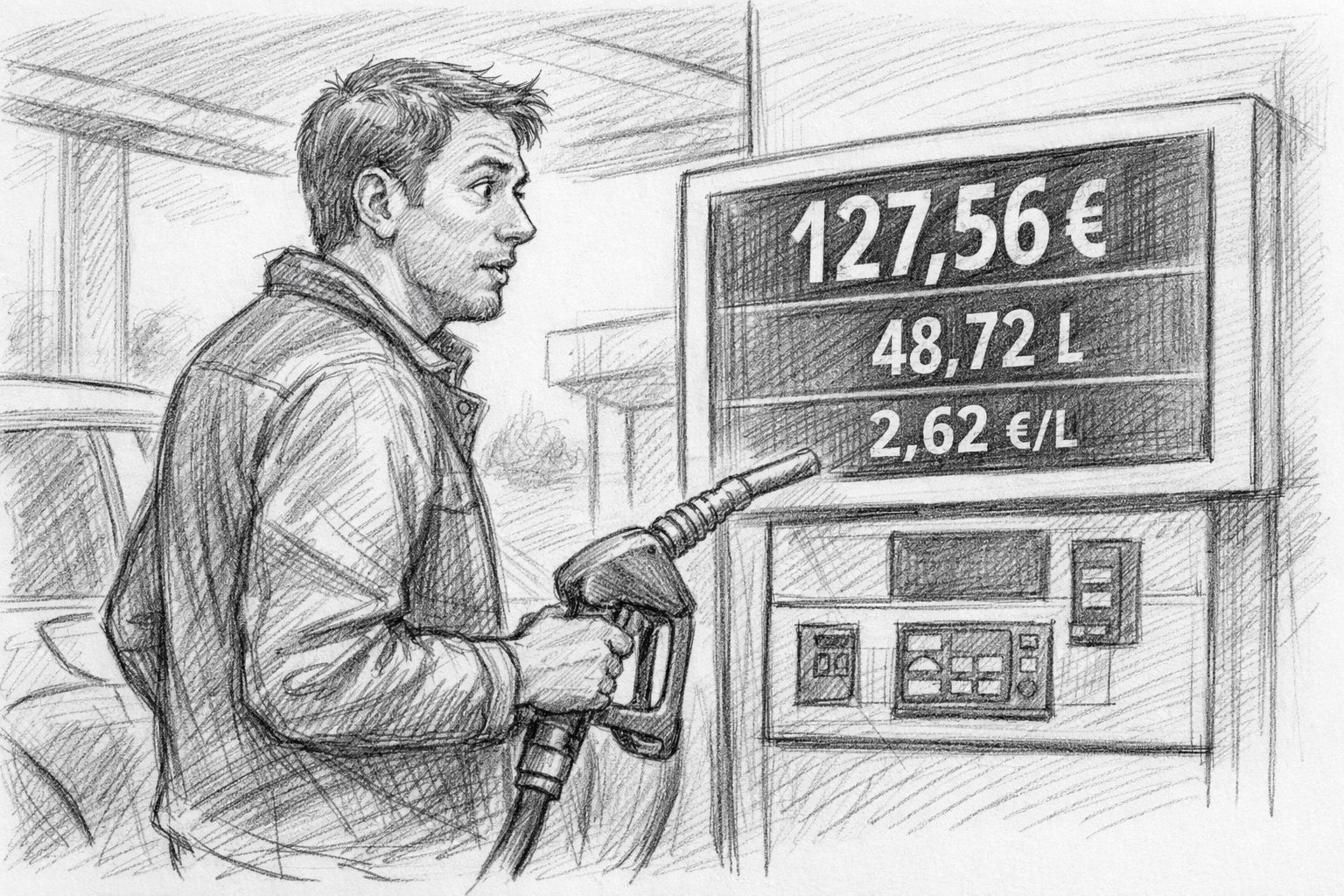
I am comparatively unaffected by high energy prices in my everyday life. I mainly work with Apple computers that have been optimized for efficiency for years and move around the city almost exclusively electrically. Soberly speaking, that doesn't cost the earth. And yet I can't shake off one thought: all around us, companies are coming under pressure, production facilities are closing or relocating. The same phrase keeps cropping up in conversations, reports and side notes:
Energy prices are too high.
If you take a closer look, a strange contradiction emerges. For many private individuals, energy has become noticeably more expensive, but is still manageable. For companies, on the other hand, it seems to be increasingly threatening their existence. This inevitably raises the question: What is the actual reason for this? And why is it so difficult to get a clear, understandable answer?




Latest news on energy prices in Germany
14.03.2026The tense situation in the Persian Gulf is once again becoming the focus of the energy markets. A recent article by the news channel WELT warns of the massive consequences of a possible blockade of the Strait of Hormuz. Around 20 percent of the world's oil and gas exports pass through this strategically crucial strait. If the conflict with Iran continues to escalate, energy prices could rise significantly. Although strategic reserves have already been released, their dampening effect is considered to be limited.

Oil shock in Germany! Expert warns of massive consequences of the Hormuz blockade | WELT news channel
The situation with gas is particularly critical, as global storage facilities only offer a small buffer. A prolonged conflict would therefore not only have an impact on fuel and heating costs, but could also put the global economy as a whole under considerable pressure.
03.03.2026: The ongoing conflict in the Middle East could according to a report by ntv According to chief economist Carsten Brzeski from ING, Germany is threatened with a doubling of energy prices if the situation in the Gulf continues to deteriorate - the price of oil alone could rise to 100 dollars per barrel again. This is hitting industry and consumers at the worst possible time, as the economic recovery has just gained momentum again. Although Germany is now less dependent on individual suppliers than it used to be, price shocks are still possible. Higher gas and electricity costs in particular would have a noticeable impact on inflation and the economy.
A topic that is constantly present - and yet remains unclear
Energy prices have been a constant topic for years. In the news, in political debates, in everyday conversations. Nevertheless, many people are left with a vague feeling: you hear a lot, but understand little. The explanations often seem contradictory or incomplete. Sometimes there is talk of global crises, sometimes of political decisions, sometimes of corporations or external powers.
However, the topic is rarely explained systematically. This is no coincidence. Energy prices are not a single event, but the result of long developments that have built up over decades. If you only look at the current price, you only see the surface - not the mechanics underneath.
Why simple explanations are so tempting
People look for clear causes. This is understandable, especially when it comes to issues that affect our own standard of living or economic future. A sentence like „prices have risen because of X“ has a reassuring effect because it creates order. But this is precisely where the problem lies: such simplifications almost always fall short.
Energy prices are not caused by a single trigger, but by the interplay of market rules, political decisions, technical developments and historical decisions. If you only look at one factor, you miss the big picture - and quickly come to the wrong conclusions.
Energy prices are a process, not a moment
A central idea of this article is therefore simple but crucial: energy prices are the result of processes, not moments. Decisions made ten, fifteen or twenty years ago still have an impact today. Some with a delay, others reinforced by new framework conditions.
This is particularly true for gas, but also for electricity and - in a different form - for fuels. If you want to understand why energy is expensive today, you have to be prepared to take a step back and understand the development step by step.
Why this article was written
For this very reason, this article is not intended to outrage, accuse or present simple culprits. Its aim is a different one: to take the time to unravel how energy prices are made up and why they have developed in the way we see them today.
Not out of theoretical interest, but because understanding is the prerequisite for any meaningful discussion - be it about industry, prosperity, security of supply or political decisions. I have yet to find a truly clear, coherent presentation. So this text is an attempt to do just that.
In the following chapters, we will therefore look at fuel, electricity and gas in turn. Not at the same time, not mixed up, but each separately - with the necessary historical distance. The history of the gas market in particular will play a central role. Because without it, it is difficult to explain why energy prices are what they are today.
Why the price at the pump has little to do with oil
When people talk about „high energy prices“, many first think of the price of petrol. This is understandable: it is visible, it is present every day, and it is written large on the price board. Nevertheless, this very visibility often leads to a misunderstanding: the price at the pump is only partly the price of crude oil. A large part is something completely different - namely a politically set price component.
Crude oil is the raw material, but there are several stages between „oil in the ground“ and „fuel in the tank“: Extraction, transportation, refinery, storage, distribution. And then - often surprisingly for many - comes the biggest block: taxes and duties. If you want to understand fuel prices, you need to look less at the oil price and more at the question: What is being charged extra per liter - and why?
The tax share: historically grown, politically desired
In a liter of gasoline or diesel, several layers act on top of each other - and this is no coincidence, but has grown over decades.
- First: a fixed excise tax per liter. This tax is not a percentage, but is levied per liter. This is a crucial point: even if the price of crude oil falls sharply, this fixed percentage remains constant - the price does fall, but not to the extent that many would expect.
- Secondly, VAT on everything. And here comes an effect that many people do not intuitively have on their radar: VAT is not only levied on the „fuel itself“, but also on the taxes already included. In other words, taxes are taxed again, so to speak. Sounds technical, but it is a real part of the pricing logic.
- Thirdly: CO₂ pricing and climate components. In recent years, a CO₂ component has also been added. Regardless of how you assess this: in terms of price, it looks like a further, politically defined surcharge on fossil fuels. So anyone who believes that fuel has „become more expensive because oil has become more expensive“ is overlooking the fact that part of the movement simply comes from such mechanisms.
The bottom line is that a large part of the fuel price is not decided on the world market, but in the Official Gazette. This makes the fuel price more stable against short-term oil price fluctuations - but also permanently high.
Why fuel prices are so emotional
Fuel prices trigger emotions like hardly any other price. This is not only due to the price, but also to psychology.
- Fuel is a „visible“ price. You see it on the street. You feel it immediately when you pay.
- Fuel is a Mandatory price. Those who commute often cannot avoid it. This creates pressure.
- Fuel acts like a Justice barometer. Many feel: „I'm already paying enough - why is it getting more and more?“
And this is precisely where the next error in thinking arises: people look for a culprit in the commodities market or in „the corporations“, although a significant part of the price is made up of a long chain of government decisions and fiscal logic. This doesn't mean that companies don't play a role - but the core is: if you want to understand the price of fuel, you first have to understand the tax structure.
The practical mnemonic for readers
If you only want to keep one sentence from this chapter, keep this one:
The fuel price is less an „oil price“ than a „tax price with an oil component“.
This is why the topic is so politically charged - and why it is often explained incorrectly.
Petrol prices in the context of the transport transition
The current price levels for petrol are more than just a short-term market phenomenon: they are a reflection of the many structural challenges facing mobility in Germany. This applies not only to pricing at the pump, but also to the general question of how mobility can be organized in a world with scarcer resources, ambitious climate targets and geopolitically unstable energy markets.
With this in mind, it is worth looking at alternative forms of propulsion - not as a matter of ideological belief, but as a realistic supplement and decoupling from volatile commodity prices. This is exactly what the article is about „Electric car, hybrid and e-scooter - a realistic view beyond ideology“. The opportunities and limitations of electromobility are analyzed in a sober manner - for example, in which areas of application electric drives make economic sense today and where they still encounter infrastructural or technological hurdles.
Especially against the backdrop of high petrol prices, it is clear that a diversified mobility landscape can help to cushion price shocks, reduce dependencies and give consumers more freedom of choice in the long term - regardless of whether it is for everyday commuting, family trips or short urban journeys.
Price components for gasoline and diesel
| Price module | What is behind it? | Why is this relevant for the final price? |
|---|---|---|
| Crude oil & product market | World market price for crude oil, supply/demand, exchange rate | Moves the price, but is only part of the overall bill. |
| Refinery & Logistics | Processing into gasoline/diesel, transportation, storage | Cost block that is relatively stable but can increase in the event of bottlenecks. |
| Trade & distribution | Wholesale, service station operations, margin | Fluctuates, but is usually not the main driver compared to taxes. |
| Energy tax (per liter) | Fixed tax amount per liter (not percentage) | Remains high even if crude oil becomes cheaper - „base“ in the price per liter. |
| CO₂ price (fuel CO₂) | Politically set surcharge for CO₂ pricing | Acts as an additional, scheduled increase in costs. |
| Value added tax | 19% on the total amount (incl. other charges) | Increases the final price as a percentage - increases automatically when other shares increase. |
| Mnemonic | Fuel is often less „oil price“ than „tax price with oil content“. | |
Electricity: How cheap energy became a complex pricing system
For decades, electricity was something that was hardly questioned in everyday life. It came out of the socket, it was reliable and - measured against its importance - it was relatively cheap. The logic behind this was straightforward: there were large power plants, there were clear supply structures and the price essentially followed the costs of generation plus grid operation.
Things are different today. Electricity has become noticeably more expensive in many households, and for companies it is often a real location factor. The key point here is that electricity has not simply become „more expensive“, but rather the price of electricity has been broken down into more and more components over time. This is precisely what makes it so difficult for many people to understand.
The electricity price today: three components
When you look at an electricity bill, you don't usually see „a price“, but a system. It becomes understandable if you roughly divide it into three blocks:
- Procurement and distributionThis is the part that most closely corresponds to what many people understand by „electricity price“: the actual purchase of energy on the market plus the supplier's costs for customer service, billing, risk protection and margin.
- Grid chargesElectricity must be transported - via a grid that must remain stable, regardless of whether a lot or little electricity is being produced. Grid charges are essentially the fees for this infrastructure: operation, maintenance, expansion, control technology. This share is not „freely negotiable“, but regulated and structurally determined.
- Taxes, duties and levies: For many readers, this is the aha moment: a significant part of the electricity price is a politically defined surcharge. This includes taxes (such as the electricity tax) and various levies that have been created over the years - often with the aim of financing or steering certain systems.
This three-way split is important because it shows that even if the pure energy price falls, the electricity price can remain high if grid fees and levies rise or remain at a stable level.
Energy transition and grid expansion
A major cost driver lies in a sentence that can be formulated very simply: Decentralized generation needs a different grid than centralized generation. In the past, electricity mainly came from a few large power plants and flowed to the consumer in a relatively directed manner. Today, a growing proportion comes from many sources: Wind farms, solar panels, rooftop systems, biomass - distributed across the country and depending on the weather and time of day. This is technically feasible, but it changes the tasks of the grid:
- Electricity must be diverted more.
- Fluctuations must be balanced out.
- Grids need to be expanded so that electricity gets from where it is generated to where it is needed.
All of this costs money - not just once, but permanently. And these costs ultimately end up in the grid charges and the system price. This is one of the reasons why electricity in Germany often seems more expensive than in countries with a different structure.

Why electricity is so expensive in Germany - WISO | ZDFtoday
Why gas prices also influence the price of electricity
Here is a connection that many people are not aware of, but which is extremely important - especially for understanding the last few years. Electricity is often priced on markets in such a way that the most expensive power plant that is still needed sets the price for everyone. This sounds illogical at first, but there is a simple reason for it: a price rule is needed to determine which power plant will step in when demand is high. In practice, this often means
When wind and sun provide little energy, controllable power plants step in. These are often gas-fired power plants. When gas is expensive, the „last necessary power plant“ becomes expensive - and this increases the overall price of electricity. This is where electricity and gas come together: Expensive gas can generate expensive electricity - even if some of the electricity comes from cheap sources.
And this often gives the reader a feeling of absurdity: „Why am I paying so much for electricity when there are wind turbines and solar panels?“ The answer is: Because the electricity price not only reflects the cheapest source, but the entire system - including the reserve that is needed when cheap sources fail to deliver.
Why electricity acts like a „system price“ today
If you put everything together, electricity is not just energy, but a complete system:
- Generation,
- Transportation,
- Stabilization,
- politically set levies,
- and market design.
This is why the electricity price seems „homemade“ to many. Not in the sense of a simple question of guilt, but because a large part of the price arises from rules and structures that people have created themselves: through expansion decisions, subsidy mechanisms, grid regulation, tax components and market models.
This makes electricity the perfect transition to the gas topic. Because with gas, we can see even more clearly how strongly market rules and political framework conditions can influence prices - and how long the history is.
An overlooked building block: Why nuclear energy is hardly mentioned in the debate anymore
What is striking about German energy policy in recent years is not only what has been done, but also what is hardly talked about. While other countries have broadened their energy systems, Germany has almost completely abandoned nuclear energy in the course of the energy transition - regardless of how technology and safety concepts have developed.
This is remarkable in that Germany is also a country with a high population density, a large proportion of industry and permanently high energy requirements. It is precisely under these conditions that a base load-capable, weather-independent energy source would actually be particularly valuable.
Technical standstill - or political?
In the public perception, nuclear energy often seems like a closed chapter. In reality, however, the technology has evolved. Modern reactor concepts are no longer comparable with the plants that have shaped the image of nuclear energy for decades. There are now reactor types that:
- have significantly lower risks,
- are designed to be passively safe,
- and, above all, be able to do one thing that is rarely mentioned in German discourse: reuse existing nuclear waste as fuel.
This is a point that can hardly be ignored objectively. Germany has been discussing final repositories, interim storage facilities and risks for decades. At the same time, there is already nuclear waste in storage that needs to be secured, monitored and managed for generations to come. This is expensive, politically sensitive and technically challenging.
However, if there are technologies with which some of this material can be used to generate energy and at the same time be reduced, a sober question inevitably arises:
Why is this option not even being seriously considered?
Because the idea is impressively simple:
- Hardly any new fuel would have to be procured for decades.
- This would reduce an existing disposal problem.
- And you would have a stable, low-CO₂ energy source in the system.
Three problems defused at once - at least technically.
Not a demand, but a blank space
This is not about idealizing nuclear energy or downplaying the risks. Every technology has side effects and every decision has costs. But that is precisely why it is astonishing how consistently this option is being left out of the German debate.
In a country that is simultaneously discussing high energy prices, deindustrialization and security of supply, it would actually be logical to soberly compare all available options - instead of ruling out individual issues from the outset.
The fact that this has hardly happened so far at least leaves the impression that the decision here was not only technical, but above all political.
Price components and influencing factors for electricity
| Building block | Typical contents | What causes this proportion to rise/fall? | Practical note |
|---|---|---|---|
| Procurement & Sales | Exchange/wholesale prices, hedging, distribution costs, margin | Market prices, crises/expectations, weather conditions, power plant availability | Tariff selection has the strongest effect here (labor price), but not alone. |
| Grid charges | Transportation, maintenance, expansion, system stability | Grid expansion, modernization, regional structure, regulatory requirements | Largely „fixed“ for end customers; can hardly be influenced directly. |
| Taxes | z. e.g. electricity tax, value added tax | Legal changes, tax policy | Politically set - non-negotiable. |
| Taxes & levies | System financing (depending on design/period) | Funding mechanisms, balancing models, system costs | Structural costs: this block remains relevant even if the exchange price falls. |
| Merit order effect (system logic) | Price is often based on the most expensive power plant still required | When gas/reserve power plants are expensive, the overall electricity price often rises | Explains why cheap renewables do not automatically mean „cheap end price“. |
| Mnemonic | Electricity is often a system price: generation + grid + control + reserve. | ||
Gas: How a stable market gradually became a price driver
Anyone looking at gas prices today often only sees the current price - and automatically thinks of the last few years of crisis. But the story begins much earlier and it starts surprisingly unspectacularly: gas was a planning product for a long time. It was not about „trading“ the cheapest price every day, but about reliable supply - over decades.
In the 1980s and 1990s, the logic in Europe was relatively clear: gas came via pipelines from production regions, was procured by large importers and distributed via national grids. The pricing systems were built in such a way that long-term investments could be made in production technology, pipelines, storage facilities and networks. This infrastructure is expensive and only pays off if you have long-term security. This is precisely why the market was based on long-term supply contracts, often with terms of 15 to 25 years.
An important detail: many of these contracts were linked to oil products. Not because gas was „actually oil“, but because oil products used to serve as an international benchmark. This brought a certain stability. The price did fluctuate, but usually more slowly, more predictably and, above all, not in the nervous „today like this, tomorrow like that“ style that we know from stock markets.
To put it simply: gas was supply. And supply means: reliability beats optimization.
Liberalization: supply becomes competition
Then the spirit of the times changed. From the late 1990s onwards, Europe increasingly pursued the goal of opening up energy markets. The idea behind this sounds plausible at first: competition should lower prices and promote innovation. And in some areas this can be true. But the situation with gas is special because gas is not simply a „commodity“, but an infrastructure product: without networks and supply chains, there is no market. With EU liberalization, a step-by-step process was set in motion:
- The market should be opened up to new providers.
- Networks should no longer function as the „home network“ of a single supplier.
- Customers should theoretically be able to switch providers.
- Transport via pipeline networks should be standardized and accessible to third parties.
This development did not happen overnight, but over several stages and guidelines. The legal details are less important than the basic effect: gas was increasingly treated as if it could be organized via markets like any other commodity. And this shifted the logic:
- In the past: long-term planning, long-term delivery.
- Later: act at short notice, procure at short notice.
The decisive switch: from contract gas to market gas
This is the core issue that many people are unaware of: The price explosion space does not only arise in the crisis, but at the moment when pricing is changed.
The price used to be „trapped“ in long-term structures. It could rise or fall, but it was embedded in contracts and supply logic. Over time, however, more and more mechanisms have emerged that price gas in the short term. This is the moment when gas becomes „market gas“:
- Gas is traded at trading points.
- Spot markets emerge: short-term delivery, short-term price.
- Price references are created that serve as benchmarks.
That sounds like modernization - and to a certain extent it is. But it has a side effect that cannot be ignored: Market prices are not just cost-based, they are sentiment-based. They reflect expectations, risks, fear, uncertainty and political news. And this is precisely why a stable supply product suddenly becomes a product that can react sensitively to shocks.
TTF & the new price logic: A benchmark becomes a clock generator
If you want to understand why gas prices have fluctuated so much in Europe, it is hard to avoid one term: TTF. This is a central European trading point or price anchor, which has increasingly been used to determine market prices.
At this point, the picture often becomes clearer for readers: gas prices used to be set „in contracts“. Later, gas prices were set „on the market“ - and this market needs a reference price. TTF has become just such a reference price over the years. This does not mean that every kilowatt hour of gas „physically“ flows through this point. But in terms of price, a lot is based on it - like a thermometer. And when this thermometer swings, it gets hot everywhere. This is an important distinction that readers should understand:
- Part of the gas market is physical (pipelines, storage facilities, supply chains).
- Another part is price/financial (trading, hedging, benchmarking).
When the financial part gets hectic, the physical part can run completely normally - and yet the price explodes.
Gas as a commodity: when expectations make prices
As soon as gas is treated like a commodity, mechanisms come into play that are more familiar from financial markets. There is no need to dramatize this, but it should be clearly stated:
- Traders and suppliers hedge their risks (hedging).
- Companies take risks into account.
- Markets react to potential bottlenecks, not just actual ones.
- News and politics influence expectations.
This creates a dynamic that becomes particularly clear in times of crisis: It is not only the actual shortage that increases the price, but also the fear of shortages. It's like a supermarket: if there is a rumor that flour could become scarce, people buy more. Then flour actually becomes scarce. The price rises. Not because the flour is „suddenly expensive to produce“, but because the system reacts to expectations. Something similar happens with gas - only on a much larger scale, with contracts, infrastructure and politics in the background.
Security of supply, storage and new rules
Another building block that is needed for the overall picture is security of supply. After several periods of stress in Europe, it became clear that you can't just rely on „the market“ when a country slips through a harsh winter, geopolitical conflicts or supply disruptions.
This is why gas storage facilities play a major role. Storage facilities are a kind of buffer. They make the system more stable - but they are expensive and filling them is a separate market process. In recent years, rules have also been introduced that stipulate storage levels more strictly. This can also be viewed objectively:
The aim is stability and crisis prevention. The side effect can be that markets „anticipate“ the necessary procurement and prices rise as a result - because it is clear that purchases must be made on certain dates. This is a typical example of how well-intentioned safety rules can generate economic side effects. Not because someone is evil, but because systems rarely have just one effect.
Why the high gas prices did not „suddenly“ arise
Now it becomes clear why the simple narrative „it's only been like this since the crisis“ doesn't hold water. Yes, crises can cause prices to explode. But they only explode so much if the market structure allows it. And that is precisely the point: the conditions for extreme volatility have been created over decades. By:
- the transition from long-term price logic to hub price logic,
- the stronger market and trade orientation,
- Benchmark pricing systems,
- and a security architecture that triggers additional demand in times of crisis.
If you want to formulate it as a mnemonic:
The crisis was the spark - but the wood had been ready for a long time.
This means that gas is not just one energy source among many, but in many cases the price driver in the background - also for electricity and ultimately for parts of industry. Anyone who has understood the history of gas suddenly understands many things that previously seemed like chaos.
In the final chapter, we draw a calm conclusion from this: not as a judgment, but as a guide. Because only if we know the mechanics will we be able to talk sensibly in future about how energy could become more predictable and sustainable again - for households and companies alike.
How the Nord Stream incident affects the energy market
A key event that cannot be ignored in the context of current energy prices is the sabotage of the Nord Stream pipelines in the fall of 2022. The failure of this long-term, stable gas infrastructure has fundamentally changed the European energy market:
It has restricted supply routes, increased uncertainty and thus directly contributed to scarce capacities and higher prices. Anyone who wants to understand the mechanisms behind rising gas, electricity and fuel prices should therefore also be familiar with the background and consequences of this cut. A detailed analysis of this can be found in the article „Nord Stream blasting: sabotage, power politics and the uncomfortable unanswered questions“, which outlines the technical, political and geopolitical aspects of the Nord Stream case.
Gas prices - chronology and effects
| Period | What happened? | Effects (short-term & long-term) |
|---|---|---|
| 1990s | Gas as a supply product: long-term supply contracts, predictability, infrastructure logic | Short: stable price development, investment security. Long: little competition, but high security of supply. |
| late 1990s - early 2000s | EU market opening starts: gradual liberalization, third-party access, unbundling trends | Short: new providers possible, market rules become more complex. Long: Gas becomes „marketable“ - basis for hub price logic. |
| 2000s | Development of trading centers (hubs), increasing liquidity, more spot/short-term procurement | Short: more flexibility in procurement and balancing. Long: higher price volatility becomes systemically possible. |
| 2009-2014 | Deepening market logic: greater unbundling, more uniform market rules, benchmarking | Short: Competition is increasing, pricing „closer to the market“. Long: Shift from contract gas to market gas (hub references). |
| 2010s | Hub prices become reference: oil indexation loses importance, TTF/benchmark shapes Europe | Short: faster price reactions to news/weather/bottlenecks. Long: Expectations and risk premiums have a stronger impact on final prices. |
| 2017-2020 | Security of supply is more strongly regulated; storage and emergency mechanisms gain in importance | Short: more provision, more system costs. Long: Security becomes part of the price structure (not „free“). |
| 2021-2022 | Price shock phase: market reacts extremely to uncertainty, fear of scarcity and global competition | Short: Extreme volatility, sometimes erratic wholesale prices. Long: Mechanics become visible: hub price logic amplifies shocks. |
| from 2022 | Storage filling targets, new procurement routines, more LNG-based supply | Short: „Forced demand“ before key dates can support prices. Long: Stronger link to global LNG prices & weather/competitive factors. |
| Today | Gas remains a price driver in the background (directly & via electricity/system logic), market remains more nervous | Short: Prices react to weather, geopolitics, storage levels, LNG flows. Long: Predictability is becoming more important - but permanently „cheap as before“ is less likely. |
| Mnemonic | The crisis was often the trigger - price sensitivity developed over decades. | |
What you can learn from all this
Once the three areas - fuel, electricity and gas - have been neatly separated, one realization is almost self-evident: energy prices are only partly „market prices“. To a large extent, they are structural prices. In other words, prices that arise from rules, levies, infrastructure and fundamental political decisions.
You can see this most clearly with fuel: a significant part of the price is fixed and politically determined. Electricity is more complicated because the grid, levies and market design interact. And in the case of gas, it is clear how strongly pricing depends on the market structure: whether gas is predominantly sold via long-term contracts or via short-term hubs makes a huge difference.
The most important learning point is therefore simply that anyone talking about energy prices is always talking about decisions - and many decisions, spread over decades. There is little point in getting stuck on just one current trigger if the actual cause lies deeper.
Why simple stories are rarely true
When systems become complex, the temptation to „tell it simply“ again grows. This is human - but dangerous, because it leads to a wrong turn. A good example is the widespread assertion that high gas prices have arisen primarily because „Russia would have turned off the gas tap“. Even if one leaves aside the events of recent years, the basic problem remains: this narrative reduces a decades-long structural development to a single image.
Such images are politically useful because they focus emotions. However, they are often bad for understanding because they obscure two things:
- FirstlyThe price mechanism has been built over the years to be sensitive to shocks.
- SecondlyA large proportion of the costs are not caused by a shortage of raw materials, but by infrastructure, regulations, security and political framework conditions.
So if you really want to understand, you should become skeptical as soon as something sounds „too round“. When it comes to energy prices, the truth is rarely a sentence. It is usually a chain.
Understanding does not mean agreeing - but it creates room for maneuver
Another important point, especially for a calm categorization article: Understanding is not taking sides. Many people avoid delving deeper into such issues because they don't want to fall into political camps. This is understandable, but it leads to people no longer seeing through the mechanics - and then it becomes easier to steer.
If, on the other hand, you understand the structure, something very practical happens: you can distinguish again between what is a short-term event and what is a long-term system problem. This is extremely valuable for discussions. Because then you can recognize, for example:
- Whether a price is high because of a stock market panic or because of a long-term grid and levy structure.
- Whether a measure really addresses the core or only manages symptoms.
- Whether you want to reduce prices or secure supply - both are legitimate, but not the same thing.
Understanding therefore not only brings calm, but also clarity. And clarity is ultimately the prerequisite for sensible decisions - in private life, in business and in politics.
A sober look ahead: more predictable yes, cheap rather not
After this classification, it would be dubious to conclude with a simple happy ending. Energy will not automatically become „as cheap as before“. And this is not because someone in the background has set a regulator to „expensive“, but because the framework conditions have objectively changed:
- Infrastructure must be modernized and expanded.
- Security of supply is more important than before.
- Markets remain more nervous when they react strongly to expectations.
- And the political conflicts of interest - climate, industry, security, competitiveness - are real.
What is possible, however, is something else: more predictability and more honesty in the debate. Predictability does not necessarily mean low prices, but reliable, comprehensible structures. And this is precisely where there is a quiet point of hope: many of today's problems are not natural, but the result of rules. Rules can be rethought, tightened up, simplified - if you are prepared to really look at the mechanics.
First the map, then the debate
If you look at this topic traditionally - the way complicated things used to be explained - then the order is as follows:
- Draw a map (How is the price made up? What mechanisms are at work?)
- Distinguishing causes (What is structure, what is event?)
- Only then discuss (What goals do we want? What side effects do we accept?)
That was precisely the purpose of this article: not to instruct, but to provide a map. Because without a map, you're arguing about directions without knowing where north is. And when you return to everyday life at the end, you are left with a simple but valuable insight:
High energy prices are rarely a single mistake. They are usually the result of many „small“, logical-sounding decisions - which together have resulted in an expensive system. Those who understand this are less likely to be fobbed off with buzzwords - and can think clearly again. That is precisely why this classification is worthwhile.
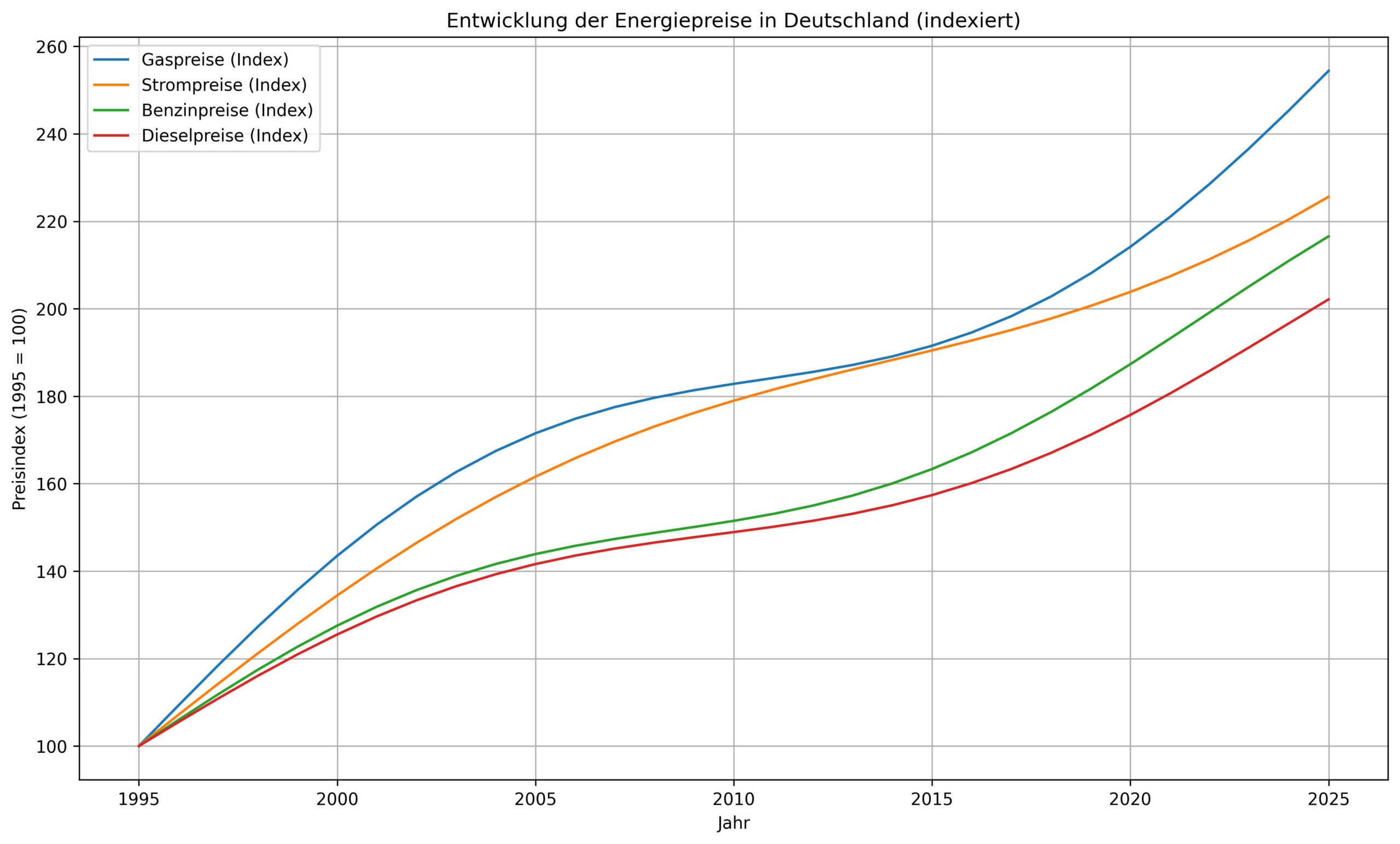
What you can do yourself to reduce your energy costs
The first step is often the most important: soberly assessing your own scope for action. Not everyone can insulate their home, install a photovoltaic system 1TP12 or replace their heating system. And not every measure pays off for everyone. This is precisely why it makes sense to first distinguish between three levels: Consumption, tariff and behavior. Almost everyone has at least some influence in these three areas - often more than you might think.
A traditional perspective is important here: Not every technical solution is automatically the best. There are often simple, tried-and-tested measures that have a lasting effect and require hardly any effort.
Electricity: Less base load beats any savings app
When it comes to electricity, it's worth looking at the so-called base load first - in other words, everything that runs around the clock. Routers, servers, old power supply units, standby devices, unnecessary second monitors or inefficient old devices add up to noticeable costs over the year. A pragmatic approach:
- Critically scrutinize old devices: Do I really need this permanently?
- Give preference to efficient hardware, even if it is somewhat more expensive to purchase.
- Consistently avoid standby - not with apps, but with switchable sockets or clear routines.
The effect is often unspectacular, but stable: permanent reduction instead of short-term tricks.
Electricity tariffs and grid costs: not everything is negotiable
Many people only compare the energy price per kilowatt hour. However, it is also worth paying attention to the basic price - especially when consumption is low. A low energy price can quickly be offset by a high base price.
You should also be aware of this: A large part of the electricity price is non-negotiable. Grid charges and levies are fixed. This helps to adjust expectations and prevents unnecessary frustration. Optimization here means finding the right tariff for your own use rather than looking for the „perfect market price“.
Gas and heating: consumption beats price debate
When it comes to heating - whether with gas or other systems - consumption is the key lever. Even small adjustments can have a big impact:
- Set room temperatures realistically, not to the maximum.
- Adapt heating times to actual use.
- Regular maintenance of the system to keep it running efficiently.
- Ventilate selectively instead of permanently tilted.
These are not new findings, but that is precisely why they are effective: they work independently of market prices and political decisions.
Mobility: Less distance is the biggest saving
When it comes to mobility, it is particularly clear that costs are not only linked to the energy source, but also to usage behavior. Whether petrol, diesel or electricity: every kilometer driven costs money. Concrete levers are:
- Bundle routes instead of making multiple trips.
- Rethink short distances.
- Use alternatives in the city if they are realistic.
This is not a moral question, but a mathematical one. Driving less reduces costs - regardless of the price per liter or kilowatt hour.
Not every trend automatically makes sense
One important point in conclusion: Not every politically or media-promoted solution is suitable for every life situation. Some measures only pay off after many years, others only for certain usage profiles. Here, skepticism is not resistance, but common sense. Traditionally, the rule has been to invest where there is a reasonable relationship between cost and benefit. Today, this standard is more relevant than ever. If you apply it, you not only protect your wallet, but also your nerves.
In summary, it can be said that the greatest impact is rarely achieved through spectacular measures, but rather through clear, permanently implemented decisions. Less base load, realistic temperatures, suitable tariffs and a conscious approach to mobility are not headline-grabbing - but they work.
And this is precisely the advantage: these measures are independent of political debates, market panic or short-term crises. They give back some control - quietly, unspectacularly and effectively.
Current survey on digitalization in everyday life
How an energy euro is distributed in Germany
If you take a look at the structure of energy prices, you quickly realize that a single euro is made up of many different components. In the case of petrol, the largest share is accounted for by state taxes and levies - more than half of the price comes from energy tax, the CO₂ levy and VAT. The remainder is divided between the actual energy production, i.e. extraction, refinery and transportation of the crude oil, as well as distribution via filling stations. Even there, there is usually only a relatively small margin left over at the end.
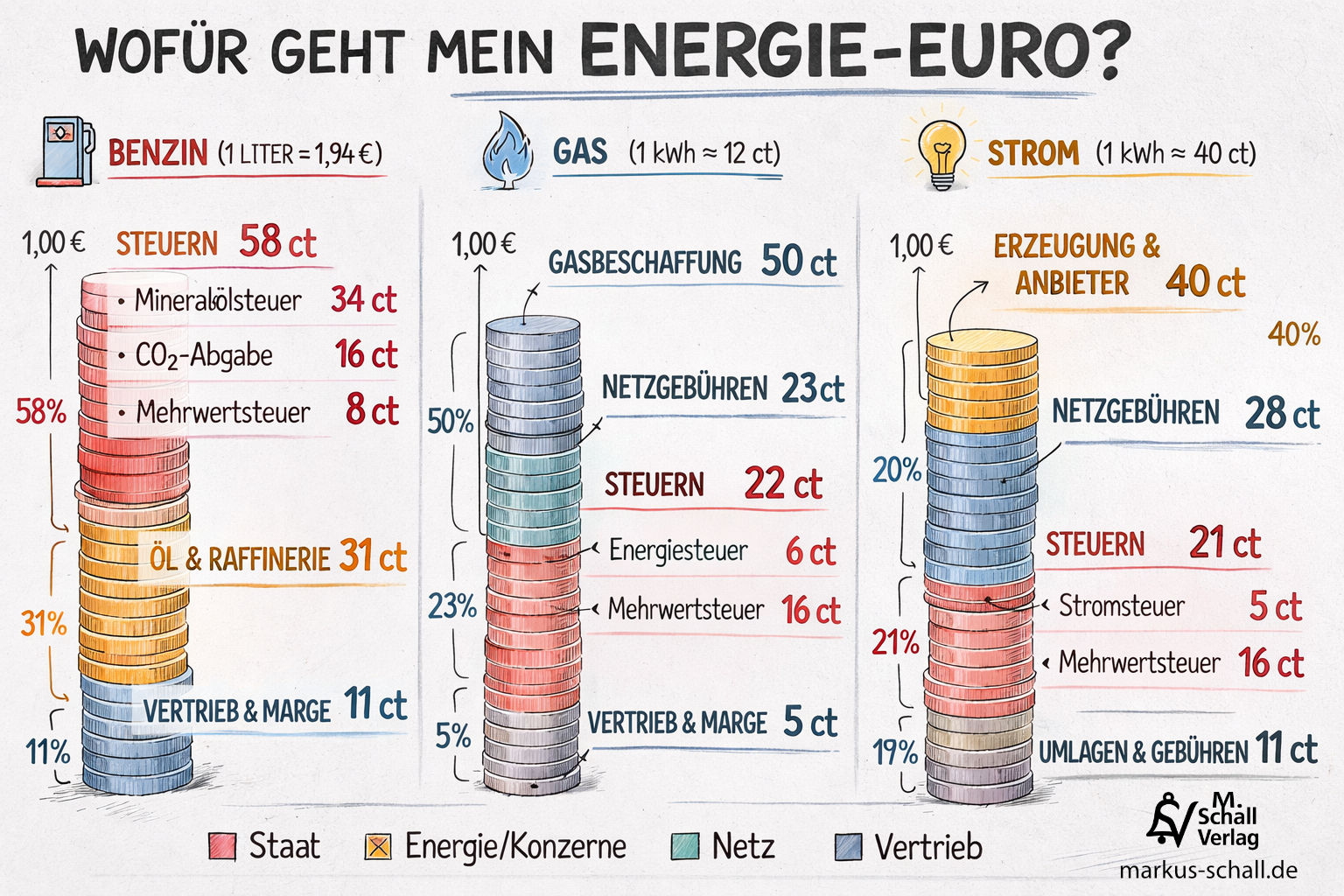
The structure for electricity and gas is similarly complex, albeit with a slightly different weighting. In the case of electricity, the electricity grid plays a particularly important role alongside generation, as the expansion and operation of the infrastructure incurs considerable costs. In the case of gas, on the other hand, the procurement of the energy source accounts for the largest share, while grid fees, taxes and sales are smaller but still relevant components. Overall, it can be seen that the final price of energy is the result of a combination of government levies, infrastructure costs and the actual energy prices.
When taxes are taxed once again
A little-known effect in the energy system is that many energy prices actually result in a „tax on the tax“. The reason for this is VAT: it is not only levied on the actual energy price, but on the entire final amount - i.e. also on energy taxes and levies already included. In the case of petrol, for example, energy tax and the CO₂ price are added first. Only then is the VAT of currently 19 % added to the total amount. This automatically creates an additional burden because part of the VAT is indirectly added to taxes that have already been levied.
This mechanism has an interesting consequence: if the price of energy rises sharply, the tax component automatically increases as well. If petrol or gas becomes more expensive due to rising commodity prices, VAT increases at the same time because it is calculated as a percentage of the total price. This means that the absolute tax amount increases at the same time - even if the state does not change the tax rates at all. Economists therefore often speak of an „automatic tax booster“ in the energy system: the higher the market prices for oil, gas or electricity, the greater the increase in the state's share of the final price.
Why energy issues are becoming even more pressing with the AI wave
At the end of this article, it is worth looking ahead. Because regardless of all the debates to date, one thing is certain: we are entering a phase in which the demand for energy will grow massively. Artificial intelligence is no longer a marginal topic, but is developing into a basic technology - comparable to electricity or the internet. Data centers, AI models, training runs and permanent availability generate a permanent, high and, above all, reliable demand for electricity.
In the USA in particular, this connection is already being viewed very soberly. New power plant capacities are being created there, partly by private players, because it is clear that there will be no scalable AI infrastructure without a stable energy supply. The fact that even technology companies such as Microsoft are beginning to take a direct and long-term interest in energy sources is no coincidence - it is a signal. It shows that energy is once again being seen as a strategic production factor, not just a cost center.
Against this backdrop, it seems all the more important to ask ourselves honestly whether the path we have chosen is really future-proof. A high-performance digital economy with a fluctuating, expensive or insecure energy supply is a contradiction in terms. This does not mean that existing goals are wrong - but it does mean that they need to be regularly reviewed if the framework conditions change fundamentally.
This is exactly what this article is about at the end: not about being right, not about ideology, but about foresight. Anyone facing a technological upheaval of this magnitude would do well to re-examine all the options, soberly, technically and without any prohibitions on thinking. After all, today's energy decisions will determine whether tomorrow we can only react - or still shape the future.
Interesting sources on the topic
- Destatis - Average electricity and natural gas prices - This page of the Federal Statistical Office provides current average prices for electricity and natural gas in Germany, including trends over the last few months and years. Indispensable for concrete, official figures on end customer prices and their change over time.
- Eurostat - Electricity price statistics - EU-wide comparable statistical data on electricity prices, showing price trends over the years and distinguishing between the components „energy“, „grid“ and „taxes/levies“. Ideal for placing German developments in the European context.
- Bundesbank - Gas market reactions on supply and demand shocks - Bundesbank analysis of the strong price fluctuations in the German natural gas market in 2022 and the influencing factors such as changes in demand and supply bottlenecks.
- Clean Energy Wire - Energy price effects of the Ukraine war - Report on the development of energy prices in Germany after the start of the Ukraine war, including percentage figures on price levels and the decline since the peak.
- Tarefe - Gas price calculation in Germany - Practical illustration of how the gas price for households is made up: Basic price, consumption and taxes/duties.
- Euractiv - The true story high energy bills in Europe - Commentary on the composition of electricity costs (drivers: grid, levies, fuel costs) and how consumption costs arise. Supports the explanation of the electricity price structure.
- BDEW - Electricity price analysis 2025 - Analysis by the industry association BDEW on the structure of electricity costs in Germany, with detailed breakdowns for household and industrial customers. Perfect for current context data and trends.
- Agora Energiewende (PDF) - Liberalization of the energy markets - Background paper on the liberalization of the German electricity market since the 1990s, suitable for presenting structural changes in energy policy and market rules.
- SMARD - Development of electricity and gas price indices - Market portal with current index data on price developments, shows long-term trends and seasonal changes in electricity and gas.
- EEI - European electricity prices and composition - This overview explains how electricity prices are made up (energy, grid, taxes/levies) and how high the respective shares are in a European comparison.
- IEA - What drives natural gas price volatility? - International Energy Agency commentary on the drivers of gas price volatility in Europe, including geopolitical influences. Helps to separate structural from temporary effects.
- Federal Statistical Office (PDF) - Data on energy price trends - Longitudinal publication with Time series on energy prices (electricity, gas) since 2005, suitable for historical classifications.
- Transmutex - Reduction of nuclear waste through new technology - The Swiss start-up Transmutex is working on a nuclear power concept that can drastically reduce long-lived nuclear waste using modern approaches. Such approaches are partly based on ideas from larger reactor concepts in which thorium is used instead of uranium, for example.
- World Nuclear Association - Advanced Nuclear Power Reactors - Overview page on advanced nuclear power technology with higher fuel utilization and therefore less waste. Modern reactors can use fuel more efficiently and thus reduce the amount of radioactive waste in the long term.
- acatech study on partitioning & transmutation (P&T) - Scientific analysis of how long-lived radioactive waste can be converted into less long-lived forms through partitioning and transmutation. P&T processes are part of research into modern reactor systems with lower final storage requirements.
- BASE - Transmutation of highly radioactive waste - Official statement by the Federal Office for the Safety of Nuclear Waste Management (BASE) on transmutation: long-lived radionuclides can be technically converted into more stable or shorter-lived elements, which reduces the disposal problem in the long term.
- IAEA - Fast neutron reactors for waste reduction - The International Atomic Energy Agency describes that fast neutron reactors can significantly reduce radiotoxicity and the amount of waste by using transuranic elements as fuel.
- Spectrum - Thorium molten salt reactor (Video) - Explanatory video on the potential role of thorium and molten salt reactors, which are considered an alternative technology to produce energy and generate less long-lived waste.
- Wikipedia - Newcleo and MOX strategy - The company Newcleo develops lead-cooled fast reactors and relies on MOX fuel to reuse spent fuel and reduce long-term waste volumes.
- AP News - Nuclear energy expansion in the Czech Republic - The expansion of nuclear energy in other EU countries shows the political and economic will to use new reactor concepts, which also include modern waste strategies, in a context in which Germany is more cautious.

Frequently asked questions
- Why are energy prices so high today?
Energy prices have not simply risen because raw materials have become scarcer or companies have become „greedier“. They are the result of many long-term decisions: Market rules, taxes, levies, grid expansion, security requirements and political objectives. In the case of electricity and gas in particular, structural costs play a greater role than the actual commodity price. Those who only look at the current trigger overlook this long history. - Why does the price of gas feel particularly unfair?
Because it is visible and changes daily. At the same time, the price of fuel is largely made up of fixed taxes and levies. Even if the oil price falls, this base remains in place. Many people therefore suspect market manipulation, even though a large part of the price is set politically. - Does the price of oil still have a major influence on the price of fuel today?
Yes, but less than many people think. The oil price influences the variable part, but taxes, CO₂ levies and VAT often make up more than half of the final price. This is why fuel prices only react mutedly to falling oil prices, but rise quickly when several factors come together. - Why is electricity more expensive in Germany than in many other countries?
Because the electricity price here is heavily influenced by grid fees, levies and system costs. The expansion of renewable energies, the necessary grid expansion and securing the supply are permanently reflected in the price. The pure energy price is only part of the bill. - Why doesn't the price of electricity fall significantly when a lot of wind or solar power is generated?
Because electricity is not only priced according to the cheapest source, but according to the system as a whole. If reserve power plants are needed - often gas-fired power plants - their cost structure often determines the market price. Although cheap generation tends to lower the price, it does not automatically raise the system to a low level. - Why does gas play such an important role in the price of electricity?
Gas is often the flexible energy source that steps in when the wind and sun fail to deliver. In many market models, it is precisely this last remaining power plant that sets the price. If gas is expensive, this often makes electricity expensive too - even if some of the electricity comes from cheaper sources. - Was gas really more stable in price in the past?
Yes, clearly. Long-term supply contracts with clear price formulas used to dominate. This made gas more predictable, but less flexible. With the opening of the market, gas was increasingly traded on a short-term basis, which made prices more flexible - and therefore more susceptible to fluctuations. - Why was the gas market liberalized in the first place?
The idea was to achieve more efficient prices, more choice and innovation through competition. This worked to some extent, but had a side effect: gas was transformed from a supply product into a commodity. This brought volatility, expectations and market psychology more into play. - What does it mean that gas is now traded at „hubs“?
A hub is a central trading point where prices are formed. These prices serve as a reference for many contracts. This ensures transparency, but also means that price movements are quickly transmitted to the entire market - regardless of whether there is actually a physical shortage of gas. - Why do gas prices react so strongly to news and expectations?
Because market prices not only reflect real scarcity, but also risks and uncertainty. Even the fear of shortages can drive up prices. This dynamic is typical for markets, but is new for an energy source that used to be predominantly planned for the long term. - Did politics alone cause the high gas prices?
No, but political decisions have shaped the market structure. Rules on market liberalization, security of supply and storage levels influence how prices are formed. The interplay between politics and the market is crucial - simply apportioning blame is not enough. - Why can storage regulations even increase prices?
If markets know that gas needs to be stored at certain times, predictable demand arises. This can support or increase prices because suppliers know that they have to buy. Security increases stability, but is not free. - Is the current situation just a temporary crisis?
Short-term fluctuations are crisis-related, but the fundamental structure remains. This means that extreme spikes may subside again, but a period of permanently very low energy prices is rather unlikely in the current environment. - Why does high energy affect industry in particular?
Industry requires large, continuous quantities of energy. Small price changes immediately have a massive impact on the cost structure. Households notice price increases, but companies quickly lose competitiveness when energy prices are high. - Is there anything consumers can do about high energy prices?
Yes, but mainly indirectly. You can reduce your own consumption, reduce base loads, adjust tariffs and avoid unnecessary costs. You can't influence the market price itself, but you can certainly influence your own bill. - Which measure usually has the greatest private effect?
For electricity, it is the reduction of the base load, for heating it is the reduction of consumption, for mobility it is the distance traveled. Large technical investments are not always necessary - simple, consistently implemented steps often have the most sustainable effect. - Is it worth constantly changing providers?
Sometimes, but not always. A low working price can be offset by a high basic price. It is important that the tariff and usage match. Permanent switching is no substitute for a fundamental understanding of the cost structure. - Are renewable energies to blame for high prices?
No, but their expansion is changing the system. Generation is becoming more decentralized and fluctuating, which requires grids and reserve capacities. These costs are real and are reflected in the price - regardless of how you value the energy transition. - Will energy prices ever be „like they used to be“ again?
Very probably not. The framework conditions have changed: more security, more regulation, more complex systems. More stability and predictability are possible - but not a return to the simple price structures of past decades. - What is the most important insight from all this?
That energy prices are not a mystery, but can be explained - if you are prepared to look at the long lines. Those who understand the mechanics lose the emotional overload and gain orientation. And this is precisely the basis for any meaningful debate about energy, the economy and the future.




A very informative overview of energy prices and their origins.
What I am missing is an itemized comparison of the respective end customer price composition (e.g. taxes and other levies) of the different energy sources fuel/gas/electricity. Also how the development of self-generated electricity is expected to develop in the future.
Hello Thomas! Thank you very much for your feedback, which I have gladly taken on board. You can now find the price composition of energy prices for electricity, gas and petrol under the section „How an energy euro is distributed in Germany“.
The development of self-generated electricity is somewhat more difficult to answer off the cuff because many future factors play a role here. But it would certainly be interesting to write a separate article about this.