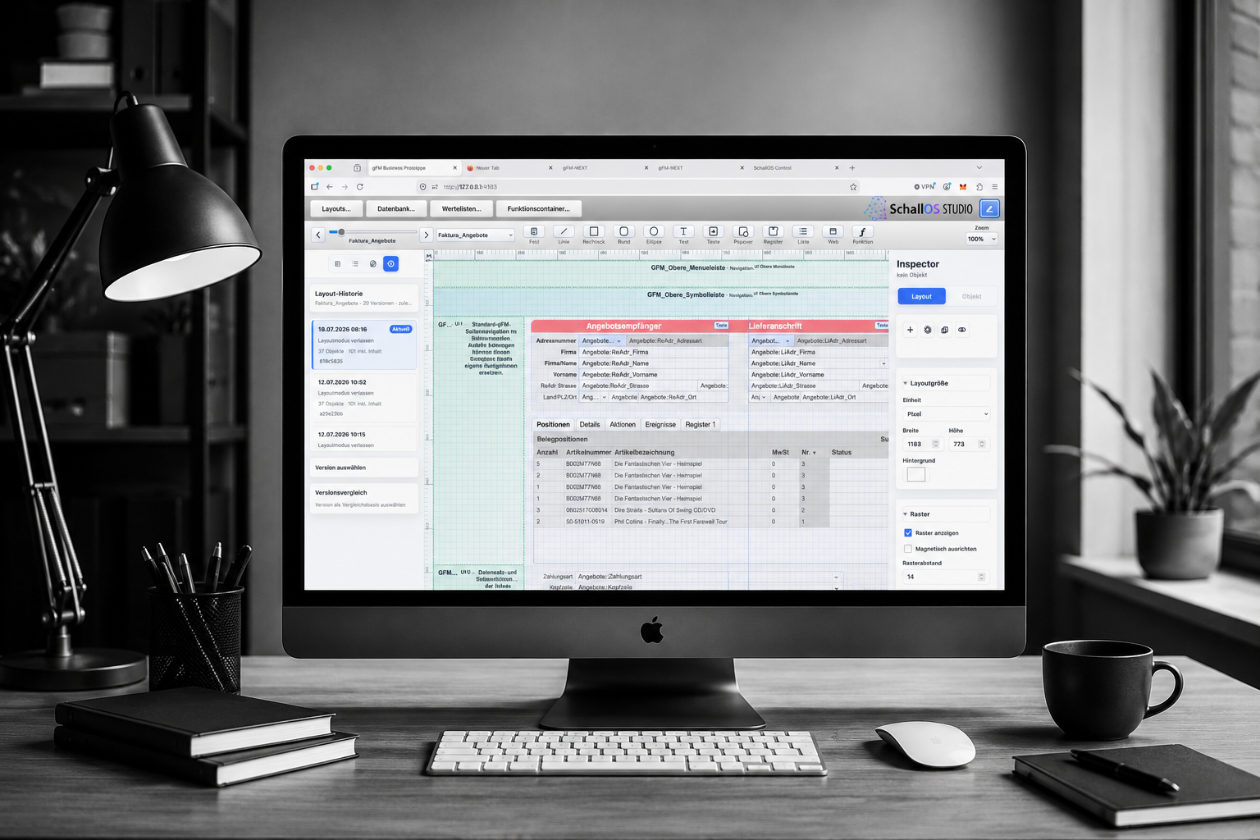
From FileMaker to the Cloud: How SchallOS Connects Business Software with AI, Runtime, and Updates

SchallOS - Intelligent Application Platform

When developing a business application, the focus is initially on the visible tasks. Tables are created, relationships are defined, input forms are designed, and business processes are automated. As soon as the first users are able to work with the solution, a large part of the project appears to be complete. In practice, however, this is when the more challenging long-term phase begins. A business application must be maintained, expanded, and adapted to new requirements. Changes must be documented, new versions deployed, and existing data securely migrated. Added to this are different user permissions, data backups, error analysis, and the question of whether a solution should be operated locally, on a dedicated server, or in the cloud.

Many development platforms focus primarily on building the actual application. Additional tools and custom processes are added later for updates, documentation, deployment, and operations. Over time, this results in a technical environment consisting of many separate components that can only be kept together with considerable effort. SchallOS therefore takes a more comprehensive approach. The platform is designed to support a business application not only during its creation but throughout its entire lifecycle: from development through documentation and deployment to updates and ongoing operation.
Read more

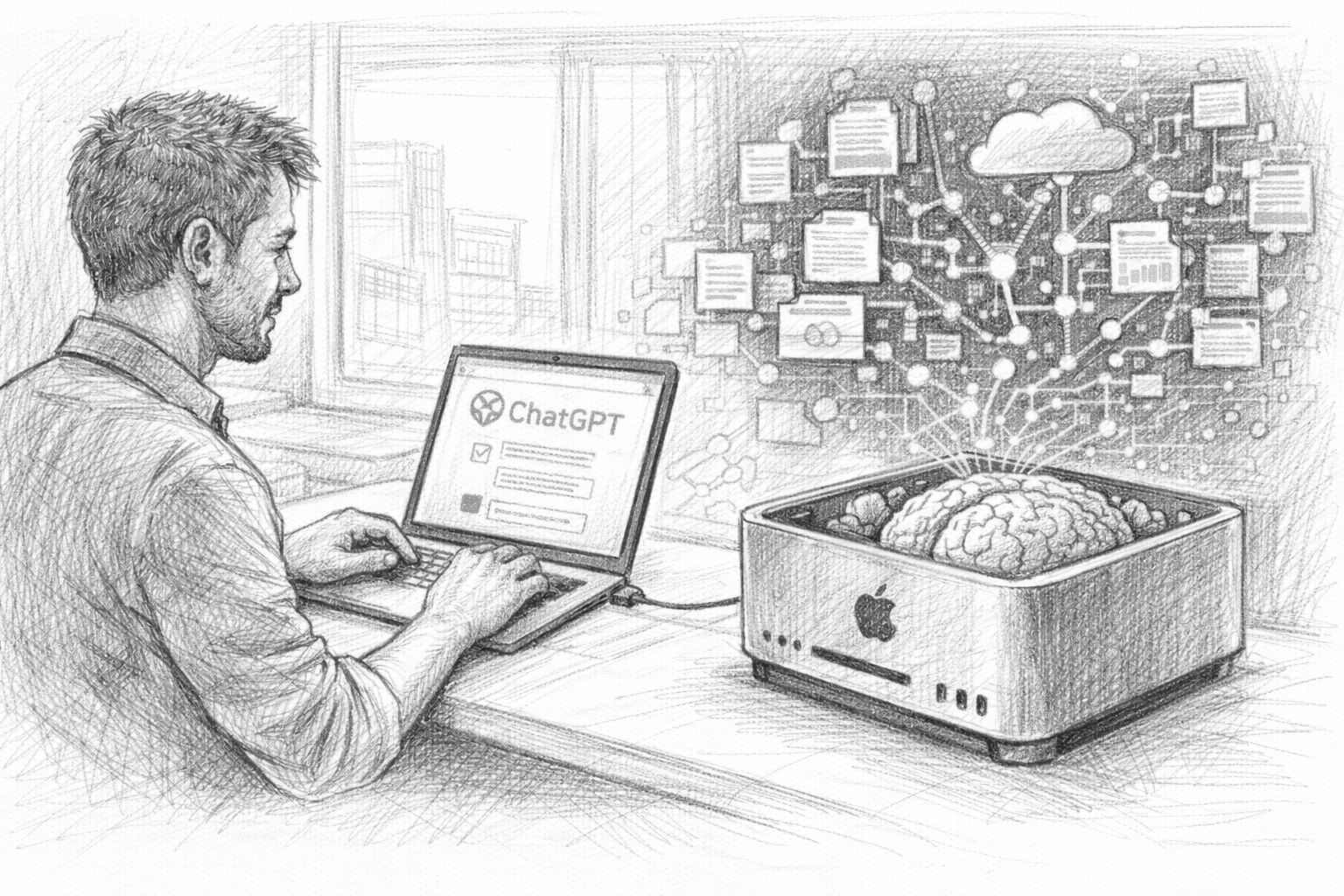
From ChatGPT data export to your own knowledge AI: step-by-step with Ollama and Qdrant

The path to your own AI memory

In the first part of this article series, we saw that the ChatGPT data export is much more than just a technical function. Your exported data contains a collection of thoughts, ideas, analyses and conversations that have accumulated over a long period of time. But as long as this data is only stored as an archive on your hard disk, it remains just that: an archive. The crucial step is to make this information usable again. This is exactly where the development of a personal knowledge AI begins.

The idea is actually surprisingly simple: an AI should not only work with general knowledge, but also be able to access your own data. It should search through previous conversations, find suitable content and incorporate this into new answers. This turns an ordinary AI into a kind of digital memory. This is the second part of the article series, which now looks at the practical aspects.

Read more

RAG with Ollama and Qdrant as a universal search engine for own data

Extend local AI with databases using RAG, Ollama and Qdrant

In an increasingly confusing world of information, it is becoming more and more important to make your own databases searchable in a targeted manner - not via classic full-text searches, but through semantically relevant answers. This is exactly where the principle of the RAG database comes into play - an AI-supported search solution consisting of two central components:

Read more

Ollama meets Qdrant: A local memory for your AI on the Mac

Memory for local AI with Ollama and Qdrant

Local AI with memory - without cloud, without subscription, without detour

In a previous articles I explained how to configure Ollama on the Mac install. If you have already completed this step, you now have a powerful local language model - such as Mistral, LLaMA3 or another compatible model that can be addressed via REST API.

However, the model only "knows" what is in the current prompt on its own. It does not remember previous conversations. What is missing is a memory.

Read more