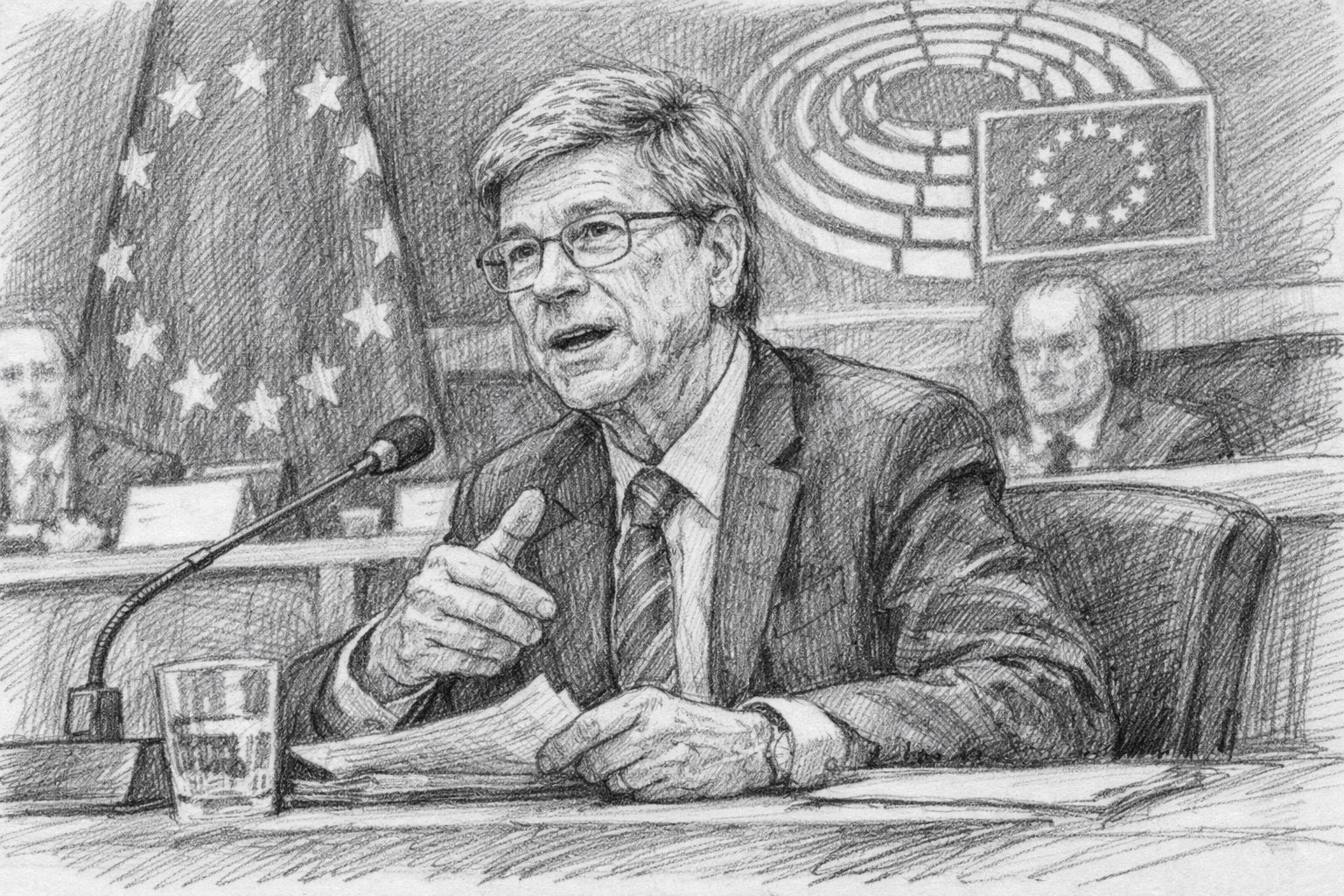
In his open letter to German Chancellor Friedrich Merz, published in the Berliner Zeitung on December 17, 2025, the well-known economist and professor Jeffrey D. Sachs speaks out with a clarity that has become rare in the current European debate. Sachs speaks not as an activist, not as a partisan and not as a commentator from a distance, but as an economist and political advisor who has worked for decades at the central interfaces of international crises, security architectures and economic upheavals. The open letter contains an unusually sharp quote:
„Learn history, Mr. Chancellor.“
The letter is less a political intervention of the day and more a document arguing from a historical perspective. In it, Sachs does not call for quick solutions, but for a return to a way of thinking that has long been taken for granted in Europe: security as a reciprocal relationship, diplomacy as an instrument of stabilization and historical honesty as a prerequisite for trust. The fact that he addresses the German Chancellor directly underlines the special role that Germany plays in Europe in his view - not as a military pioneer, but as an organizing, balancing force.


Latest news on European security and J. Sachs
28.05.2026: Jeffrey Sachs has been involved in a new open letter to Federal Chancellor Friedrich Merz and warned of a further escalation between Europe and Russia. The US economist and geopolitical advisor criticizes above all the fact that Germany has so far hardly pursued any serious diplomatic initiatives towards Moscow despite increasing tensions. Sachs writes that Europe and Russia are „sliding into open warfare“, while direct talks between the political leaders have largely failed to materialize. He particularly emphasizes that Germany bears a central responsibility for possible peace talks due to its economic and political importance.
Sachs calls on Merz to focus more on the path of diplomacy again and to build on the security policy mechanisms of the post-Cold War era. At the same time, he warns of the economic and social consequences of a lasting confrontation between Europe and Russia. The letter comes at a time of increasing geopolitical tensions and is once again sparking debate about Germany's role in the Ukraine war and Europe's future security order.
12.05.2026: A current lecture by Prof. Hans-Werner Sinn at the Institute for Swiss Economic Policy (IWP) adds an economic and structural policy perspective to the debate on Europe's future security order. Sinn argues that, in view of geopolitical changes, Europe could be increasingly forced to act more independently in terms of security policy. In doing so, he criticizes both the current decision-making structure of the EU and the current European defence approaches as being too slow and inefficient.

Prof. Dr. Hans-Werner Sinn | Trump, Putin and Europe: The European Defense League. | IWP
Of particular interest is his thesis that the USA's foreign policy under Donald Trump is increasingly shaped by economic interests and debt problems and that Europe can therefore no longer rely on the previous security architecture in the long term. In contrast to many highly emotionalized debates, Sinn primarily tries to work out economic, historical and strategic connections. The video therefore complements this article not so much as a counter-position, but rather as an additional European perspective on the same fundamental developments.
15.03.2026Economist Jeffrey Sachs has written in a Interview at Democracy Now! on the current conflict between the USA, Israel and Iran. Sachs is extremely critical of the military escalation and describes it as a „war of choice“, i.e. a conflict that did not arise out of immediate necessity but was deliberately brought about politically. In his view, this is a dangerous breach of the basic principles of the international order. Sachs argues that an attack without clear self-defense or without a mandate from international institutions could be in direct conflict with international law and in particular with the United Nations Charter. Such a step, he warns, could have far-reaching consequences and further destabilize the global security architecture.

Economist Jeffrey Sachs: U.S.-Israeli „War of Choice,“ Assault on U.N. Charter Could Lead to WWIII | Democracy Now!
In the interview, Sachs also emphasizes that a military conflict with Iran entails considerable geopolitical risks. He sees the danger that the war could spread regionally and involve other powers. In the Middle East in particular, numerous states are indirectly involved or affected, for example through military alliances, energy interests or strategic alliances. Sachs therefore warns that an escalation could ultimately lead to a much larger international conflict. In this context, he even speaks of the possibility that such a war could trigger a chain reaction that would have an impact on global politics beyond the region. In his view, a diplomatic solution would therefore be urgently needed to prevent further military escalation.
Sachs also criticizes the fact that military strategies in international politics often pursue short-term goals without sufficiently considering the long-term consequences. He argues that conflicts in the Middle East in recent decades have repeatedly shown how difficult it is to achieve stable political solutions through military interventions. Instead, he advocates a stronger focus on diplomacy, international cooperation and political negotiations. Only through such approaches could a sustainable stabilization of the region be achieved. Sachs therefore sees the current situation as a decisive fork in the road: either the conflict escalates further militarily - or the states involved will try to find a political solution through negotiations and international institutions.
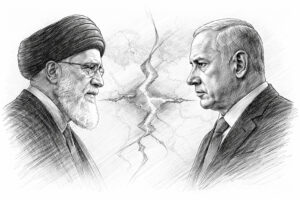 The escalation between Iran and Israel shows how quickly regional conflicts can become a strategic problem for the entire West. In my Article about the Iran-Israel conflict it becomes clear that this is not just about two states, but about a complex web of security interests, alliances and power projections in the Middle East. A direct military clash would have the potential to destabilize the entire region and shake up global energy and trade structures. This is precisely why some strategists speak of a „nightmare scenario“ for Western states: A conflict that can hardly be controlled and at the same time opens up several geopolitical fronts simultaneously.
23.01.2026In a recent interview, Jeffrey Sachs analyzes the political signals from the World Economic Forum (WEF 2026) in Davos together with Glenn Diesen. The focus is on Donald Trump's speech and the reactions of Western politicians. Sachs paints a critical picture of Europe: instead of shaping its own foreign policy, the EU has for years limited itself to observing and adapting. While other regions are increasingly formulating their own interests, Europe appears disoriented and subordinate.

Jeffrey Sachs: Davos - The US empire out of control & Europe's subordination | Glenn Diesen
The interview soberly classifies this development and provides a fundamental analysis of the current geopolitical situation.
Historical responsibility and the concept of security
Jeffrey D. Sachs begins his open letter with a fundamental criticism of the German government's security policy rhetoric. According to Sachs, responsibility for European security cannot be fulfilled through buzzwords, moralizing or the normalization of war rhetoric. Security is not a one-sided concept, but is based on reciprocity.
This principle is not a Russian or American narrative, but a central foundation of the European post-war order, laid down in the Helsinki Final Act, the OSCE structures and decades of diplomacy.
According to Sachs, Germany must face up to this responsibility with historical honesty - a requirement that the current political language does not meet in his view.
Russia's security interests ignored since 1990
A central argument of the letter is the thesis that key Russian security concerns have been systematically ignored, relativized or violated since the end of the Cold War - often with the active involvement or tacit acceptance of Germany. This history should neither be ignored nor relativized if an end to the war in Ukraine is to be achieved or a permanent state of confrontation in Europe avoided. Sachs emphasizes that sustainable peace is only possible if the actual causes of the conflict are named and understood.
Sachs recalls the phase of German reunification in detail. In this context, clear assurances were repeatedly given to the Soviet and later the Russian leadership that there would be no eastward expansion of NATO. These assurances were not casual remarks, but part of the political framework that made the approval of German reunification within NATO possible in the first place. Germany had benefited considerably from these assurances.
Sachs describes their later relativization or denial as historical revisionism and a breach of political trust.
NATO interventions and the changing security order
The letter refers to the NATO airstrikes on Serbia in 1999, in which Germany took part. This intervention was carried out without a mandate from the UN Security Council and represented a fundamental breach of the previous security order.
For Russia, this was a clear signal that NATO was prepared to use military force beyond its alliance territory - regardless of Russian objections. This has permanently damaged strategic trust.
Sachs also criticizes the unilateral withdrawal of the USA from the ABM Treaty in 2002, a central pillar of strategic stability. Germany has hardly been critical of this step. The deployment of missile defence systems close to the Russian border was inevitably perceived as destabilizing from a Russian perspective. To dismiss these security concerns across the board as irrational or paranoid was political propaganda and had nothing to do with responsible diplomacy.
Germany's recognition of Kosovo's independence in 2008 set a further precedent that undermined the principle of territorial integrity. Warnings about the long-term consequences were ignored. Here too, Russian objections were not seriously examined, but morally delegitimized - with consequences for the stability of the European order.
Current survey on trust in politics
NATO accession prospects for Ukraine and Georgia
Sachs is particularly critical of the insistence on a NATO membership perspective for Ukraine and Georgia, as formulated in Bucharest in 2008. This policy has crossed clearly defined red lines.
If a major power clearly and consistently articulates key security interests over decades, then deliberately ignoring them is not diplomacy, but an escalation strategy with foreseeable consequences.
Germany's role in Ukraine since 2014
Sachs devotes a separate section to Germany's role since the upheaval in Ukraine in 2014, saying that Berlin, together with Paris and Warsaw, brokered the agreement of February 21, 2014, which was intended to end violence and secure constitutional order. This agreement collapsed within hours and was followed by a violent change of power. Germany immediately recognized the new political regime and thus effectively abandoned a previously guaranteed agreement.
The Minsk Agreement II of 2015 was intended to correct this breach and end the war in eastern Ukraine. Germany once again acted as a guarantor power. However, the agreement had not been implemented for years, and Kiev had openly rejected its political components in particular. Germany had accepted this. Sachs sees later public admissions by Western politicians that Minsk primarily bought time for military preparations as a serious admission that requires an honest reappraisal.
Criticism of arms deliveries, rhetoric and public manipulation
Against this backdrop, demands for more and more weapons, sharper rhetoric and demonstrative determination seem hollow to Sachs. He criticizes political communication that ignores recent history and seeks to morally infantilize the public.
European societies are well able to understand that security dilemmas are real and that military decisions have consequences.
Sachs recalls Germany's Ostpolitik as an expression of strategic maturity. Dialogue, arms control, economic integration and the recognition of legitimate security interests had once contributed to Europe's stability. This attitude was not a weakness, but a prerequisite for peace. Germany must return to this maturity and no longer present war as unavoidable or morally imperative.
Proposals for a new European security architecture
The letter formulates concrete proposals:
- an end to NATO's eastward expansion, particularly towards Ukraine and Georgia
- Neutrality of Ukraine with international security guarantees
- Mutual demilitarization of border regions
- Lifting of sanctions as part of a negotiated solution
- Rejection of the confiscation of Russian state assets
- Return to arms control treaties such as the INF Treaty
- Strengthening the OSCE as Europe's central security forum
Economic rationality and European strategic autonomy
Sachs warns of long-term damage to the European economy caused by sanction policies and expropriation-like measures. Lawful trade and economic cooperation are not a moral failure, but an expression of realism. Strategic autonomy means shaping a European security order in its own interests - not permanent subordination to an expansive NATO logic.
Final appeal: Honesty as a prerequisite for peace
Sachs concluded by urgently appealing to the Federal Chancellor to take an honest look at history. Without honesty there could be no trust, without trust there could be no security and without diplomacy Europe would be in danger of repeating past disasters. History will judge what Germany remembers - and what it forgets. This time, Germany should consciously opt for diplomacy and peace.

The geopolitics of peace - Professor Jeffrey Sachs in the European Parliament | Martin Sonneborn
Security policy shifts in Germany
Parallel to the international security policy debates to which Jeffrey Sachs refers in his open letter, significant shifts have also taken place in Germany in recent years. For the first time in decades, the so-called state tension a term from the Basic Law that had almost completely disappeared from everyday political life for a long time. It is linked to questions of internal and external security, the role of the Bundeswehr and the resilience of state structures in the event of a crisis. In this context, the suspension of compulsory military service was also increasingly called into question.
Various political actors have developed models for a reintroduction, partial obligation or extended obligation. Compulsory military service The debate on the future of military preparedness has been initiated, sometimes openly, sometimes gradually through legal adjustments and organizational preparations. These debates mark a profound mental shift: away from the decades-long assumption of a permanent peace order and towards a policy that once again regards military preparedness as the norm. This is precisely where Germany's domestic political development intersects with Sachs' fundamental criticism: when security issues are framed primarily in military terms, the political horizon narrows. Historical experience, diplomatic alternatives and social costs are pushed into the background - with far-reaching consequences for democracy, the economy and social stability.
Current survey on a possible case of tension
Brief profile: Who is Prof. Jeffrey D. Sachs?
Jeffrey D. Sachs is a US economist and one of the best-known public intellectuals in the field of development economics and international policy advice. He is currently University Professor (the highest academic rank at Columbia University) and Director of the Center for Sustainable Development at Columbia University in New York.
He is also President of the UN Sustainable Development Solutions Network (SDSN) and serves on UN-related committees, including as SDG Advocate under UN Secretary-General António Guterres. From 2002 to 2016, he also headed the Earth Institute at Columbia University.
Origin and early influence
Sachs was born in Detroit (Michigan) in 1954 and grew up in the suburb of Oak Park. In Biographies It is often emphasized that the social tensions and inequalities of the region (including the Detroit riots) awakened in him an early awareness of the gap between poverty and prosperity.
He is the son of Joan (née Abrams) and Theodore Sachs, who is described as a labor lawyer; Sachs is also often portrayed as having grown up in a Jewish family.
Education: Harvard, and at record speed
His academic career is extraordinarily straightforward: Sachs studied at Harvard University, graduating with a B.A. (1976, summa cum laude), an M.A. (1978) and a Ph.D. (1980) - all in economics.
He was accepted into the Harvard Society of Fellows while still a graduate student, which was an early signal of his reputation as an exceptional talent.
Harvard years: Rise to „star economist“ status“
Sachs came to Harvard as a lecturer in 1980, was promoted very quickly and was awarded a tenured professorship at a young age. He later became the Galen L. Stone Professor of International Trade and headed programs and institutes that were closely intertwined with international political consulting.
During this phase, his reputation grew as an economist who not only works theoretically, but also advises governments directly in crises - with clear, often uncompromising reform proposals.
The 1980s/1990s: „Shock Therapy“ and the debates surrounding it
Sachs became internationally known for his role as an advisor during economic upheavals - for example in countries with hyperinflation or during the transition from a planned to a market economy. In many accounts, he is described as one of the prominent representatives of a rapid stabilization policy, which is often summarized under the term „shock therapy“ (rapid price/currency reforms, tough fiscal discipline, rapid system changeover).
Importantly, this phase is still controversial today. Supporters point to the stabilization successes of individual countries, while critics emphasize social hardship, political side effects and false incentives - especially in the early years of transformation in the former Soviet Union. Sachs’ name regularly appears as a symbolic figure in this debate, both in academic and political discussions.
Moving to Columbia: Sustainable development as a life's work
In 2002, Sachs moved to Columbia University. There he directed the Earth Institute (2002-2016) and today heads the Center for Sustainable Development.
Since then, the focus has been less on „pure macroeconomics“ and more on sustainable development, poverty reduction, health, climate, infrastructure and international cooperation. This fits in with his role as author and organizer of major programmes in which research, policy advice and public communication are intertwined.
Role at the United Nations: MDGs, SDGs and political influence
Sachs was active in UN contexts for many years: among other things, he is described as an advisor to several UN Secretaries-General and was a formative voice in the context of the Millennium Development Goals (MDGs) and later the Sustainable Development Goals (SDGs).
The SDSN (UN Sustainable Development Solutions Network), of which he is President, is a kind of bridge: The aim is for science, civil society, business and politics to work together to promote practicable solutions for SDG goals.
Public impact today: author, commentator, polarization
In recent years, Sachs has not only been present as a development economist, but also as a political commentator on geopolitics, war and international order. Depending on the audience, this has met with either approval or harsh criticism - precisely because he often emphasizes that international conflicts can only be resolved through security architectures, diplomacy and the balancing of interests. It comes as no surprise that he causes offense with this: Sachs rarely argues in headline mode, but rather about long lines, power logic and historical path dependencies.
If you summarize Sachs’ path, a clear pattern emerges:
He is not a „pure university economist“, but an economist in the engine room of history - first in monetary and systemic crises, later in global poverty and development agendas, and today increasingly in fundamental questions of security order and diplomacy. His strength is the big picture; his risk is that big picture issues are quickly misunderstood as „partisanship“ in heated debates.
All points of the open letter at a glance
| Time / Phase | What Sachs criticizes | What Sachs demands |
|---|---|---|
| 1990 (reunification / end of the Cold War) | Assurances that NATO would not expand eastwards were later relativized or presented as „non-binding“. This had damaged trust. | Historical honesty about commitments and their political significance; recognizing security guarantees as a reciprocal principle (Security is „indivisible“). |
| 1999 (NATO air war against Serbia) | Germany's participation in NATO bombings without a UN Security Council mandate; signal that NATO will also use force outside its territory against Russian objections. | Return to a rules-based security order (UN/OSCE logic); do not establish violence as a normal instrument; confidence-building instead of Create precedents. |
| 2002 (ABM Treaty / missile defense) | USA withdraws from the ABM Treaty; Germany raises no serious objections. Deployment/planning of missile defense near Russia Borders are dismissed as destabilizing. | Rebuilding a resilient arms control architecture; do not devalue security concerns as „paranoia“; strategic stability as Address core objective. |
| 2008 (Kosovo recognition) | Recognition of Kosovo's independence despite warnings of precedent and undermining territorial integrity. | Honest recognition of Western precedents; consistent regulatory policy that is comprehensible under international law instead of selective principles. |
| 2008 (NATO Bucharest Summit: Ukraine/Georgia perspective) | Political commitment to NATO accession prospects for Ukraine and Georgia despite repeated, long-term Russian warnings (red lines). | Unambiguous end to NATO's eastward expansion (Ukraine, Georgia and other border states); de-escalation through structural clarity. |
| February 2014 (Kiev: Agreement of February 21) | Germany mediates/guarantees an agreement on de-escalation and preservation of constitutional order; agreement fails within hours, There is a change of power; Germany immediately recognizes the new government. | Consistent diplomacy with commitment; guarantees must not remain without consequences; take political issues of order seriously instead of just „more to the next step“. |
| 2015-2022 (Minsk II as a guarantee model) | Minsk II would not be implemented for years; political components would be rejected; Germany would not enforce implementation. Later Statements that Minsk was more of a „gain of time“ are a serious breach of trust. | Honest review of Minsk; diplomacy as an instrument of peace instead of tactical maneuvering; future negotiating framework with real implementation and verifiable mechanisms. |
| Since 2022 (Ukraine war / escalation dynamics) | Focus on more and more weapons, sharper rhetoric and „determination“; ignoring previous history; moral simplifications („infantilization“) instead of enlightenment. | Return to genuine diplomacy (not PR); recognition of security dilemmas; de-escalation through political architecture instead of symbolic politics. |
| Security order in Europe | Security is thought of too strongly in NATO logic; OSCE is marginalized; European strategy is too much shaped by alliance slogans/expansion logic. | Reinforce the OSCE as a central forum; build a European security order „based on European interests“ (strategic autonomy) and Include Russia instead of excluding it. |
| Neutrality vs. troop deployment | Discussion about European troops/deployment in/near Ukraine; in Sachs’ view this would deepen division and prolong war. | Ukrainian neutrality with credible international guarantees; stability through accepted security arrangements instead of forward stationing. |
| Military reciprocity / border areas | Rearmament and deployment (incl. missile systems) close to borders; one-sided security thinking. | Mutual demilitarization of border regions through verifiable agreements: Russian forces away from NATO borders and NATO systems away from Russian borders (reciprocity). |
| Sanctions | Sanctions would not have brought peace and would have significantly damaged Europe's economy; hardening instead of a solution. | Gradually lift sanctions as part of a negotiated solution; restore economic realism and contractual trade. |
| Confiscation of Russian state assets | „Reckless“ confiscation/confiscation of Russian state assets; from Sachs’ point of view a blatant violation of international law and breach of trust in the global financial system. | Germany should reject such measures; preserve legal certainty; economic recovery through lawful, contract-based trade instead of Expropriation logic. |
| Arms control (INF & nuclear stability) | Erosion of central arms control frameworks; too little pressure to return to stabilizing treaties; increasing risk of escalation. | Push for a return to INF-like frameworks and comprehensive strategic negotiations on nuclear arms control (USA/Russia, later China, if applicable). |
| European deterrence / France | Debates about deterrence without clear defensive containment; danger of advanced systems that act as a threat. | France could expand its nuclear deterrent as a European umbrella - but in a strictly defensive manner, without forward-deployed systems that Russia could use. threaten. |
| Kosovo-Ukraine analogy / borders | Western policy has itself contributed to the shifting of borders; nevertheless, it is often argued that this is unilaterally „unthinkable“. | Honest recognition of precedents and analogies; peace as an overarching goal; applying principles consistently rather than selectively morally to justify. |
Why this letter is more than just a foreign policy commentary
Jeffrey Sachs' open letter to Chancellor Merz is not an isolated statement, but part of a larger debate on international law, security logic and political credibility. If you want to delve deeper into these issues, you can find more information in the supplementary article „Rules-based world order and international law: between claim, reality and breach of law“ a systematic classification of the underlying structures. It also includes a detailed video speech by Jeffrey Sachs in which he explains his own positions - calmly, analytically and without political buzzwords. The article shows how quickly normative vocabulary becomes an empty formula when breaches of the law are declared to be accepted practice.
What Jeffrey Sachs formulates in this letter fits strikingly coherently into a larger development that can also be observed in other areas. In the previously published article on game theory Consideration of European decisions showed how Europe has increasingly abandoned its former role as a shaping actor in favor of short-term alliance logics, symbolic determination and binary friend-foe narratives. Sachs essentially describes precisely this mechanism, only from the perspective of the security architecture: decisions are no longer made on the basis of long-term stability, but on the basis of political expectations and moral simplifications.
A look at the German economy in 2025 fits into this picture. Economic substance, industrial resilience and reliable framework conditions cannot be permanently separated from geopolitical decisions. Anyone who thinks of security exclusively in military terms risks economic self-harm. Sachs openly expresses this connection when he warns against the confiscation of state assets, describes sanctions as economically counterproductive and points to the erosion of trust in international rules. This is not a plea for compliance, but for predictability - a quality on which both diplomacy and business are based.
It is also striking that Sachs is not calling for something fundamentally new. On the contrary: his letter is a reminder of principles that have sustained Europe itself for decades. Ostpolitik, arms control, neutrality as an instrument of stability, multilateral forums such as the OSCE - none of these are exotic ideas, but proven elements of European post-war history. The fact that they are often portrayed today as naïve or outdated says less about their effectiveness than about the state of the political debate.
This is precisely why the letter is so irritating - and at the same time so necessary. It breaks with the current tendency to reduce complex interrelationships to short moral formulas. Sachs does not assume that the European public is immature, but trusts them to understand security dilemmas. This attitude stands in contrast to political communication, which increasingly relies on simplification, emotionalization and a lack of alternatives.
In this sense, the open letter is not only a criticism of specific political decisions, but also an indirect commentary on the state of European thinking. It poses the question of whether Europe is once again ready to assume responsibility in the original sense: not through loudness, but through strategic sobriety; not through escalation, but through order; not through forgetting history, but through remembering.
Whether these questions will be heard remains to be seen. But asking them is a necessary first step - not only for the European security order, but also for the economic, political and social stability on which Europe has long thrived.
International law and „rules-based order“ - claim and reality
 The current conflict also raises a fundamental question: What role does international law still play in an increasingly polarized world order? In my Article on the „rules-based world order“ examines precisely this contradiction. The term sounds clear and morally unambiguous, but often remains blurred in political practice. Time and again, it becomes apparent that the same actors who publicly refer to international rules interpret or circumvent them differently in crisis situations. This creates a tension between political aspirations and real power politics - a tension that characterizes many international conflicts today and puts the credibility of global institutions under increasing pressure.


Frequently asked questions
- Who is Jeffrey Sachs and why is his voice relevant?
Jeffrey D. Sachs is an internationally renowned economist, university professor at Columbia University and long-standing advisor to governments and the United Nations. His relevance does not result from day-to-day political commentary, but from decades of work on international crises, transformation processes and security issues. His arguments are mostly historical, systemic and long-term - independent of party political lines. - Why is Sachs addressing his open letter directly to the German Chancellor?
Sachs traditionally sees Germany as a key power in Europe - not primarily in military terms, but politically, economically and diplomatically. In his view, Germany bears a special responsibility for stability, balance and mediation in Europe. The letter is therefore to be understood less as personal criticism than as an appeal to this historical role. - What is the central message of the open letter?
The core message is: European security is indivisible and cannot be permanently organized against Russia's security interests. Sachs calls for historical honesty, serious diplomacy and a move away from purely military escalation logic in favor of a stable, inclusive security architecture. - Does Sachs’ position justify Russian policy?
No. Sachs does not justify military actions, but analyzes the security policy conditions that have led to escalations. His approach follows the classic security dilemma theory: a lack of consideration for the central interests of a major power increases the probability of conflict in the long term - regardless of moral assessments. - Why does NATO's eastward enlargement play such an important role in the letter?
Sachs views NATO's eastward expansion as a political decision with foreseeable security policy consequences. He refers to earlier assurances, red lines and repeated warnings from Russia. In his view, ignoring such signals is not diplomacy, but a deliberate strategy of escalation. - What significance does Sachs attach to German reunification?
German reunification serves Sachs as a historical example of successful diplomacy: it was only possible because security promises were taken seriously. From this he derives Germany's obligation not to suppress this historical experience, but to use it as a benchmark for today's policy. - Why does Sachs criticize NATO's intervention in Serbia in 1999?
He sees this as a breach of the post-war order, as it was the first time that military intervention had taken place without a UN mandate. For Russia, this signaled that international rules were being applied selectively - a decisive loss of trust for the European security architecture. - What role do the Minsk agreements play in his argument?
For Sachs, the Minsk agreements are an example of failed diplomacy. Germany acted as a guarantor power, but did not enforce implementation. Sachs sees later admissions by Western politicians that Minsk was primarily intended to buy time as a serious breach of trust. - Why is Sachs so clearly opposed to further arms deliveries?
He argues that arms deliveries prolong symptoms but do not solve causes. Without a political solution, they would prolong the war, deepen the division and further fuel the escalation spiral - with increasing costs for Europe itself. - What does Sachs mean by „moral infantilization“ of the public?
He criticizes political communication that reduces complex security issues to moralistic buzzwords. Sachs assumes that European societies are perfectly capable of understanding conflicting interests, dilemmas and historical contexts - if they are given honest information. - What role should neutrality play according to Sachs?
Sachs does not see neutrality as a weakness, but as a proven instrument of stability. In his view, historical examples such as Finland, Austria and Switzerland show that neutrality can take into account the legitimate security interests of all sides and defuse conflicts - including for Ukraine. - Why is Sachs calling for an end to NATO's eastward expansion?
He does not see enlargement as an inevitable consequence of the post-war order, but as a political decision with destabilizing consequences. In his view, a stop is a prerequisite for trust, de-escalation and the establishment of a new security order. - What economic aspects does Sachs particularly emphasize?
Sachs warns of the long-term damage caused by sanctions, expropriation and trade disruptions. He argues that economic stability, industrial performance and social cohesion are closely linked to security policy decisions - especially for Germany. - Why does Sachs reject the confiscation of Russian state assets?
He sees this as a breach of international law and a threat to the global financial system. If state assets are politically confiscated, this undermines trust, contractual security and, in the long term, European economic interests. - What role should the OSCE play in the future?
Sachs calls for a return to the OSCE as a central forum for European security. In contrast to NATO, it is designed for dialog, confidence building and arms control and could enable a more inclusive security architecture. - How does Sachs’ analysis fit in with game theory considerations of Europe?
His letter can easily be read as an analysis of game theory: Europe had repeatedly made decisions that appeared consistent in the short term, but created strategic disadvantages in the long term. Escalation is not a stable state of equilibrium, but leads to permanent uncertainty. - Is Sachs’ approach realistic or nostalgic?
Sachs’ approach is less nostalgic than historically grounded. He refers to functioning models from the past and argues that their basic principles - dialog, reciprocity, predictability - are still valid today, regardless of the changed framework conditions. - Why is this open letter important right now?
Because Europe is at a point where security policy, economic and social decisions are increasingly intertwined. Sachs’ letter offers no easy way out, but a rare moment of clarity - and reminds us that peace does not come from volume, but from structure.