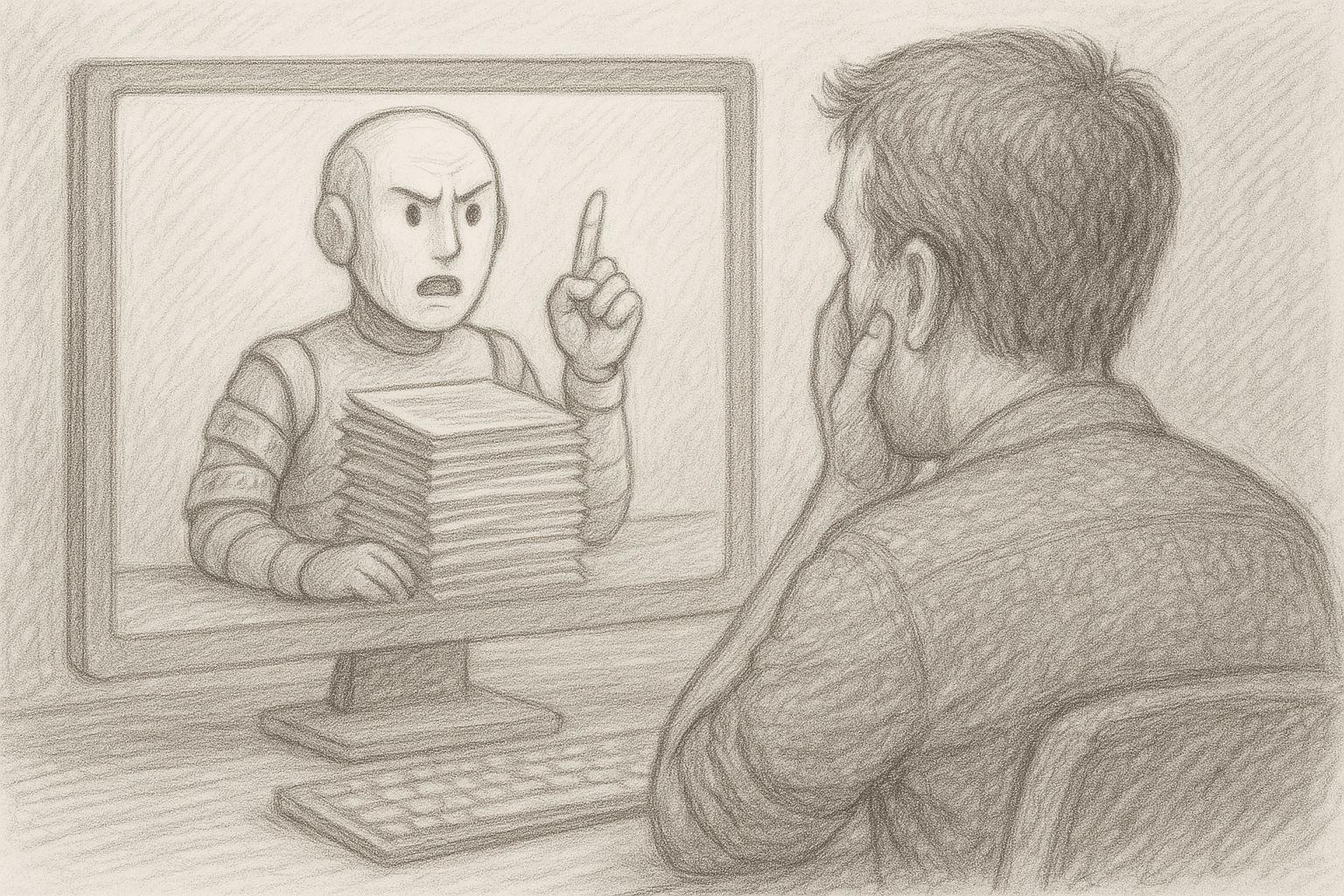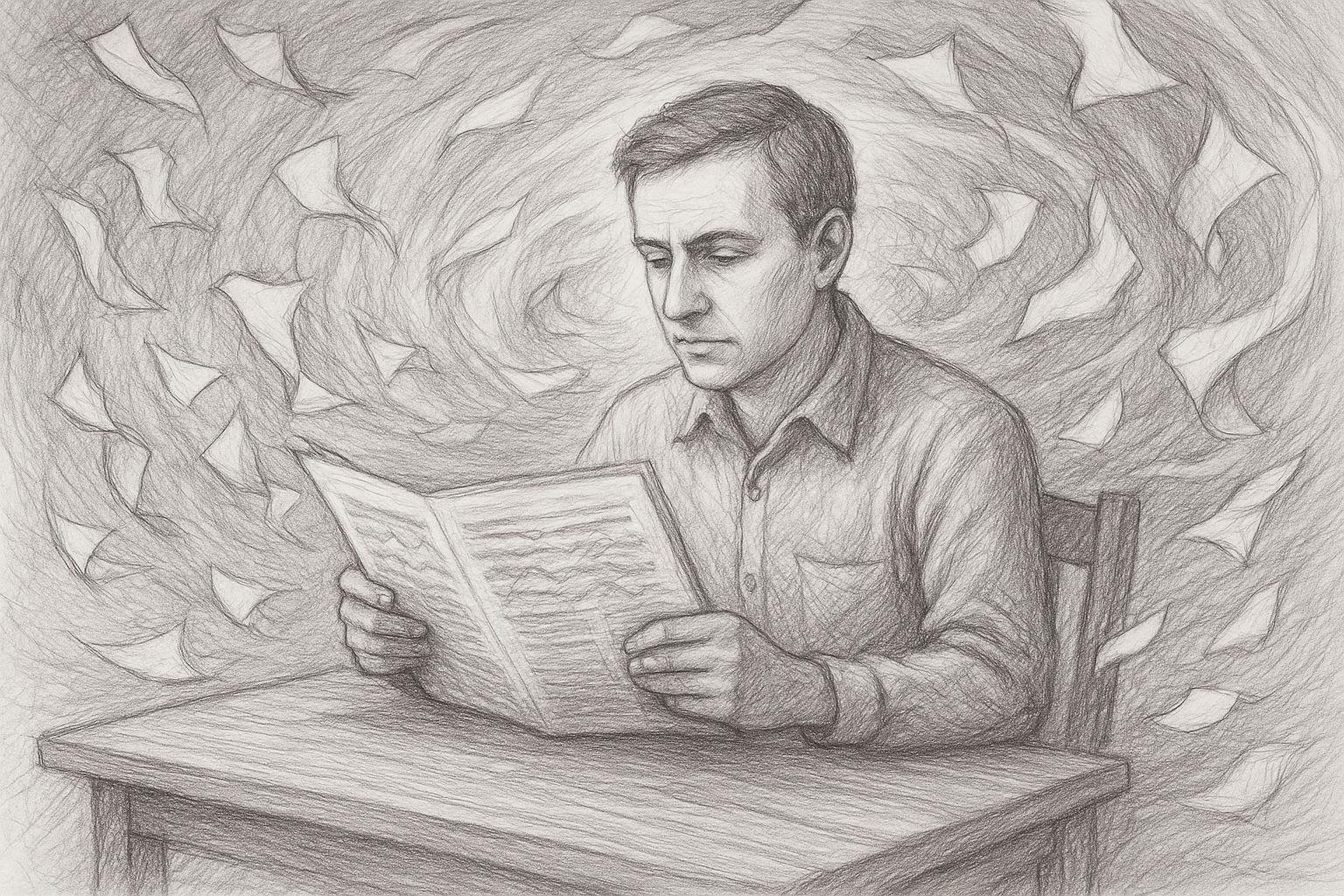
It's strange how certain developments creep up quietly and only reveal their full impact in retrospect. When I think about how I perceive the news today, I realize that my approach to it changed fundamentally more than twenty years ago. Since the turn of the millennium, I have hardly watched any traditional television news. It was never a conscious decision against something - more a gradual growing out of it. At some point, I simply realized that the daily bombardment of alternating doomsday scenarios was neither improving my life nor making my vision clearer.
Perhaps this distance has given me a certain bird's eye view. A perspective that is not driven by the hectic dramaturgy of the day. The fact that I have also had a foreign partner for many years and therefore regularly see foreign-language media - Turkish or Eastern European - has further relativized this view. You quickly realize that the same news is told completely differently depending on the country. Not wrong, not right - simply different, or not at all.
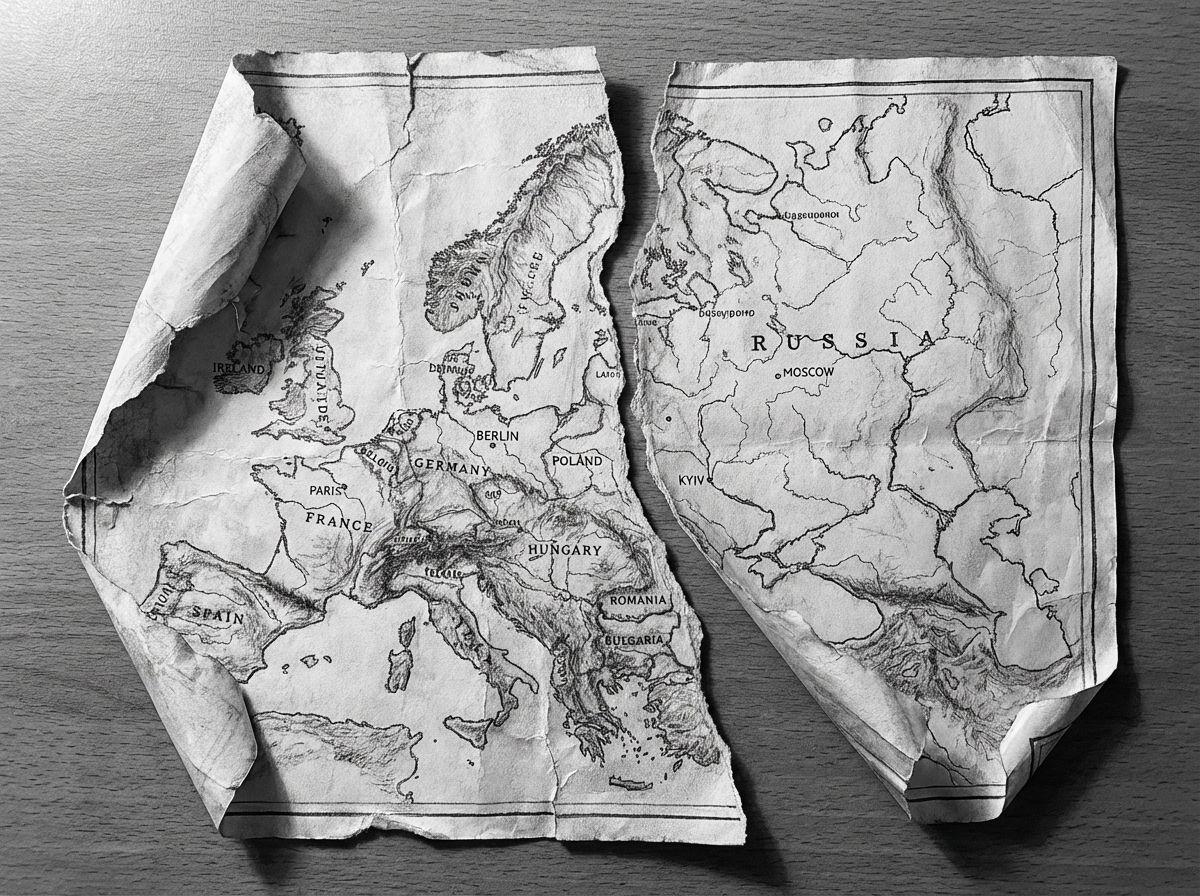

However, something fundamental has changed since the major health crisis a few years ago at the latest. At that time, a strange distance settled over society - initially in interpersonal relationships, later also in spiritual matters. And this feeling that something has shifted has remained to this day. Since then, crisis has followed crisis, warning after warning, exception after exception. And many people instinctively sense that this permanent state of affairs is not healthy - not for the body, not for the mind, not for society.
It is therefore worth taking a step back and looking at the mechanisms behind it. Not the details of individual events, but the overall pattern.
An age of flickering headlines
Anyone who opens the news these days - whether on TV, in a browser or on their smartphone - ends up in a world that is constantly under power. There are hardly any days left without an existential threat wafting through the headlines. There are hardly any moments in which there is sober reporting without an „unprecedented event“ being proclaimed somewhere.
This background noise has built up over many years. During the major health crisis, a phenomenon became apparent for the first time that had existed latently before, but never with such force: a permanent cultural tension. Suddenly people were facing each other like strangers. A physical distance was enough to become a mental distance. And this distance did not simply end when the immediate danger passed. It remained - first as a feeling, then as a social condition.
Since then, a pattern has become established: As soon as one crisis subsides, the next one is waiting in the wings. Sometimes health-related, sometimes economic, sometimes geopolitical, sometimes ecological, sometimes digital. Each one is understandable in its own right, some are even justified - but together they create something new: an everyday life that no longer seems to be able to do without crises.
For people who are consciously following this development - or consciously observing it from the outside - it seems as if the headlines are following a dramaturgical principle every week. This generates attention, but also a constant latent nervousness.
The creeping exhaustion
The human body is not made for permanent states of alarm. It is built for short bursts, not for months or even years of stress. Anyone who has ever been under stress for an extended period of time knows the feeling: at some point you fall into a state of inner fatigue, even if you are functioning on the outside.
This is exactly what is happening on a large scale today. Many people feel a kind of diffuse exhaustion. Not necessarily burnout - rather a mixture of mental endurance and subliminal tension. Some sleep worse, others are more irritable, still others feel mentally overloaded. This can be explained:
- The body reacts to threats - even imaginary ones or those conveyed by the media.
- It releases stress hormones that wear you down in the long run.
- At the same time, there is a lack of relief because there are hardly any „uninterrupted good times“.
At this point it is worth referring to the Articles about lithium, a specific trace element that plays an important role in mental stability. It is precisely these small building blocks - both physically and mentally - that determine whether we accumulate crisis messages within us or calmly classify them.
Introduction to the mechanism
The central question is: why does today's information world create a constant sense of threat - even when the actual situation is often much more sober? One reason is obvious: we watch more news today than any generation before us. What used to take weeks to become public knowledge now appears as a live ticker. And because every news item is in competition with another, the one that triggers the strongest impulse wins. This creates a paradoxical picture: the world seems more dangerous, even though many risks are objectively smaller than they were decades ago.
Another reason lies in social dynamics. The distance that arose during the major health crisis has been transferred to the media landscape: people expect escalation rather than relaxation, warning rather than classification, drama rather than sobriety.
And anyone who - like me - has hardly consumed any traditional news for many years and is used to foreign perspectives instead will recognize particularly clearly how strong this dramaturgy has become. All of this is the framework within which the following chapters shed light on why we are living in an architecture of fear today - and how we can find our way out of it.
Current survey on trust in politics
How narratives are created: From the news to the „world situation“
A news item is initially something very small: an event, a statement, a process. Only the classification - the interpretation - turns it into the „world situation“. And this interpretation has always followed certain patterns.
It used to take weeks or months for historians, diplomats and journalists to formulate an initial rough interpretation of international developments. Today, interpretations emerge within minutes - often before the facts are sufficiently clear. The problem is that the faster a narrative is created, the more strongly it shapes our thinking - even if it has to be corrected later.
In the modern media world, it's not the second glance that counts, but the first. And this first glance is often only a detail.
When complex timelines become a sentence
A central problem of modern narratives is abbreviation. A sentence like „A conflict began in year XY“ sounds clean, clear and unambiguous. In reality, however, international tensions almost always have long lead times, histories, political decisions, ethnic conflicts, economic interests, misjudgements and mutual provocations that build up over years or decades. This applies to many historical examples:
- Vietnam WarOfficially, it began in 1964 with the „Tonkin Incident“. Decades later, it turned out that the incident had not actually taken place. The actual roots of the conflict go back to the 1940s and the colonial era.
- Iraq war 2003Publicly justified with alleged weapons of mass destruction. Years later, there was not a single shred of evidence for this. The actual geopolitical context began as early as 1990 with the Kuwait crisis and even earlier with the regional balance of power.
- Yugoslav Wars: A specific event is often cited as the trigger. But the ethnic and political tensions stretched far back into the 1970s and 1980s.
- Arab SpringInternationally presented as a spontaneous uprising - in reality a complex mix of decades of economic problems, authoritarian structures and social tensions.
And of course there are also Eastern Europe political and military tensions that began long before 2022. There are numerous analyses of this, UN reports, OSCE documentation and security policy assessments that show that tensions, armed conflicts and violations of minority rights have been documented there for many years and that the causes are nowhere near as one-sided as is increasingly being claimed in the media. According to the UN and OSCE, around 14,000 people were killed and tens of thousands injured in the east of the country between 2014 and 2021 - long before the escalation in 2022 was perceived in the west as the ‚start of the war‘.
What exactly started when, who played what role and what responsibility individual actors bear - international research is still debating this today. But it is undisputed that the prehistory is more complex than a single date. This is where the real message lies:
Narratives work with starting points. Reality has no starting points. It only has transitions.
When narratives become identity
Another problem of modern information worlds is that narratives are no longer just reports, but have become identity markers. A society used to be able to say:
„The situation is complicated.“
Today it is often said:
„Anyone who doesn't share our narrative is on the wrong side.“
This creates information bubbles in which even harmless differentiations are perceived as an attack. The public is no longer invited to think in complex ways, but is encouraged to subscribe to a narrative. This leads to three developments:
- Shades of gray disappear.
- Everything is moralized - good or bad, right or wrong.
- Deviating facts are ignored.
Even publicly accessible reports - from international organizations, for example - are hardly given any space if they do not fit into the prevailing narrative. The debate becomes emotional instead of factual. And an emotionalized debate further stabilizes the narrative.
In this way, a news item becomes a „world situation“, a world situation becomes a historical image - and a historical image becomes an identity.
The logic of intensification
Narratives function according to dramaturgical principles: They need heroes, perpetrators, victims, turning points and moral evaluations. A sober picture of the situation would often be much more helpful, but it sells poorly. Attention is the fuel of the modern media market - and strong narratives generate attention. This is why abbreviations arise:
- A complex conflict becomes a sentence.
- Decades of history become a date.
- Several actors involved become „one side“ and „the other side“.
- And everything that doesn't fit into the defined narrative structure is dropped.
It's not about anyone deliberately lying. It's about the fact that our media landscape works dramaturgically, not historically. And that leads to a perception that is often only loosely related to reality.
When the audience has no time for depth
Another reason for the shortening lies in ourselves. Modern societies are fast, stressed and overloaded. Most people consume news between work, family, everyday life and obligations. In-depth analysis hardly fits in. The media react to this reality of life - and deliver what is easiest to consume:
- short interpretations,
- clear enemy images,
- clear assignments of blame.
However, the clearer the narrative, the less likely it is to reflect reality as a whole. Narratives are not created by chance, and they are not necessarily consciously manipulated. They are the result of:
- Time pressure,
- economic constraints,
- political mood,
- social expectations,
- and the mental overload of modern societies.
When you understand this, you realize something important: many narratives are not wrong - they are just incomplete. And incompleteness can lead to completely wrong conclusions in times of crisis.
| Event | Public narrative at the time of the event | Subsequent findings / corrections | Learning point for today's crisis perception |
|---|---|---|---|
| Vietnam War (Gulf of Tonkin) | An alleged attack on US ships in the Gulf of Tonkin served as a clear justification for a massive expansion of the war. | Later investigations showed that the incident was unclear, partially misrepresented or over-interpreted. The original account was highly abbreviated. | A single event can be politically declared the „birth“ of a war - even if the facts are fragile and the prehistory was more complex. |
| Iraq war 2003 | It was claimed that Iraq had operational weapons of mass destruction and posed an acute threat. | After the invasion, inspections found no active weapons systems. Later reports spoke of massive misjudgements and politicized intelligence material. | Threat narratives can prove to be unreliable in retrospect. Simple justifications for wars should therefore always be examined skeptically. |
| Yugoslavia / Balkan wars | Frequent simplified representation: a clear aggressor, a clear defender, a relatively clear start to the war. | Investigations show a web of ethnic tensions, political mistakes and acts of violence by various actors. Responsibility and blame are distributed. | Major conflicts are rarely one-dimensional. Monocausal perpetrator/victim narratives hide a lot and are hardly suitable as a basis for long-term understanding. |
| Arab Spring | Often described as a spontaneous uprising that broke out „overnight“ in several countries. | Analyses show decades of economic hopelessness, corruption, repression and humiliation as a breeding ground. The „explosion“ was the visible end point, not the beginning. | Official narratives like to work with clear starting points. In reality, unrest usually arises from long, creeping processes - not from a single spark. |
| Conflicts in Eastern Europe (as of 2014) | In many public representations, a later point in time is set as a clear beginning, so that earlier tensions and sacrifices are hardly noticed. | International reports (e.g. UN, OSCE) have been documenting ongoing fighting, thousands of deaths and a permanent humanitarian crisis since 2014 - long before the starting point set by the media. | The perception of conflicts strongly depends on the date from which one „counts“. If you ignore previous histories, you only half understand the present. |
The economy of fear: who really benefits?
In modern information systems, attention is the central currency. News used to be an informative commodity; today it is an economic product. Digital media companies compete for clicks, dwell time and interaction - and it is an open secret that dramatic content is clicked on more often than factual content. A sober analysis shows:
The more unsettling a message is, the more likely it is to be read. And the more clicks we deliver, the more advertising space we can sell. This is not done out of malicious intent, but because of the rules of a market that is based on maximizing attention.
This creates a subtle economic incentive not only to report threats, but to dramatize them. Not necessarily by lying - that rarely happens - but through selection, weighting and repetition. The permanent presence of risks creates a sense of urgency, which in turn generates more coverage. A cycle that is self-reinforcing.
The political logic: crises as an instrument of stability
Crises have always given governments legitimacy for measures that would hardly be enforceable in calm times. Historically - from the global economic crisis to oil crises and financial crises - politics has always followed the same pattern: the greater the perceived threat, the greater the willingness of the population to accept extraordinary steps. This applies, for example:
- higher government spending,
- new security policy structures,
- international alliance commitments,
- or restrictions introduced in the name of „security“.
You don't even have to be negative about it; it's an age-old political principle. It's just that the constant media coverage has increased the frequency with which crises are perceived. A government that has little room for maneuver in calm times gains enormous influence in times of crisis - and often retains some of it afterwards. This creates a paradoxical picture:
Political systems are officially crisis managers, but structurally they often benefit from the prolonged perception of a threat.
The industrial logic: when security becomes a market
In addition to the media and politics, there is another area that benefits from uncertainty: the economic sectors relating to security, defense, technology and infrastructure. Here, too, it is rarely a question of deliberate manipulation, but of market mechanisms. When there are threats - real or perceived - demand increases:
- Monitoring technology,
- digital security infrastructure,
- defense systems,
- Special equipment,
- analysis tools,
- Crisis counseling,
- and international security services.
The global security and defense market alone has grown massively over the past two decades - without any conspiracy, but simply because uncertainty is a business stimulus. The less stable the world seems, the more capital flows into these sectors. And because money shapes structures, a global network of manufacturers, consultants, service providers and political clients emerges that benefits structurally from a persistent mood of crisis.
The psychology of the market: fear as a decision accelerator
People react differently in times of crisis than in normal times. Fear:
- lowers the threshold for decisions,
- increases the willingness to „play it safe“,
- reduces critical thinking,
- and accelerates demand for protective measures.
This psychological dynamic has been researched for decades. And every market - whether media market, security market or political market - reacts to it. This does not mean that crises are deliberately brought about. But it does mean that crises - or rather the perception of crises - release forces that reinforce incentives in the background:
- stronger expansion of security structures,
- more investment in armaments and protection technologies,
- higher budgets for institutional equipment,
- growing markets for risk experts, consultants and analysts.
Fear itself thus becomes an economic factor.
The interaction: When systems are programmed for uncertainty
If you look at media logic, political logic and industrial logic together, a picture emerges that initially seems surprising, but then becomes frighteningly plausible: Uncertainty is not a fault of the system - it is a functional component.
- Media benefit from a high level of attention,
- Politicians benefit from greater scope for action,
- Industries benefit from growing demand.
This unintentionally creates a climate in which even small crises generate an echo of astonishing magnitude. Every crisis reinforces the mechanisms that make the next crisis more likely - at least in terms of communication.
The result is a society that lives in a constant state of alarm, even though the real capabilities of many players - politically, economically and militarily - are far from what the headlines suggest. The drama often lies less in the facts than in their presentation.
The missing corrective
In the past, there were always opposing forces between the media, politics and industry: long printing times, distanced editorial offices, academic assessments, diplomatic channels. Today, many of these braking mechanisms have disappeared or been weakened. The result is a system that does not necessarily reflect reality, but rather the loudest interpretation of reality.
And this is precisely why the economy of fear is not a singular problem, but a structural one:
A system that profits from uncertainty unintentionally creates a world that appears increasingly uncertain - even if the facts in the background are much less threatening.

Manipulation: How social media influence us | Quarks
The reality behind the noise: what would actually be possible
In politically charged times, loud sentences are easy to say. Dramatic demands, martial comparisons, full-bodied announcements - all of these have become part of the standard repertoire of public communication. But words have a characteristic that is easily overlooked: They are spoken faster than they are implemented. The real scope of action of political and military actors is usually much smaller than the media backdrop would suggest. Behind every sharp formulation:
- limited households,
- limited production capacities,
- limited training opportunities,
- limited logistics,
- and limited social support.
You could say that the rhetoric is often global, but the reality remains local and technical. This is precisely where an important contribution to détente lies: the actual ability of many states to take major risks is far less than the symbolic language they use to do so.
The sober situation: resources count more than speeches
If you want to understand what realistic scenarios look like, you don't have to look at the headlines, but at the basics of modern operational capability. These consist of three fields:
- MaterialModern equipment is expensive, requires a lot of maintenance and is in short supply in many countries. There is a lack of spare parts, production lines are working at full capacity and even simple components have long lead times. Many countries have spent years reducing their stocks, not building them up.
- PersonnelThere is a shortage of skilled workers in almost all areas - from technicians and logistics to specialized task forces. In many countries, people are less willing to take on high-risk tasks. Society is older and lifestyles have changed.
- Logistics and staying powerMajor operations require not only material and personnel, but also fuel, replacement systems, transportation capacities and infrastructure. These structures have become thin in many places. There is a lack of many things: depots, means of transportation, repair capacities, overland connections.
All of this means that even if political rhetoric sounds like an imminent scenario, the actual feasibility is extremely limited. The real situation is often much more stable than the noise suggests.
The silent majority: what people really want
Another factor that is rarely taken into account is the will of the people. Words may be loud, but decisions are ultimately made by people - or not. Experience shows:
- Most citizens want stability, not escalation.
- The majority want peace and quiet, not heroic adventure scenarios.
Very few people are interested in large-scale conflicts that could affect them or their relatives. Today, everyday social life is more dependent on peace than ever before: The economy, prosperity, technological progress, healthcare.
This attitude plays an enormous role in democratic systems. Even more authoritarian systems have to take into account that they need social support in order to take major risks. In short:
People are far less willing to take radical steps than some headlines suggest.
The power of artificial urgency
One of the biggest problems of our time is the impression that dramatic events „could happen tomorrow“. This artificial urgency is created by:
- Real-time media,
- emotionalized comments,
- algorithmic amplification,
- and the elimination of slow, reassuring information channels.
But the reality is that politics, the economy and society are moving much more slowly than the media pace would suggest.
There are no levers that could trigger massive changes within a few days. Even small political measures are needed:
- Planning,
- Committees,
- Committees,
- Votes,
- Administrative processes,
- Financing,
- Implementation.
The idea that entire regions could slide into radical scenarios „overnight“ is unrealistic in the vast majority of cases. The actual structural hurdles are enormous. The noise is loud - but the world itself moves surprisingly slowly.
The paradox of security in the background
A sober look at the situation paints a surprising picture:
- There is little social support for escalation.
- The economic costs would be enormous.
- Military resources are limited.
- Political assertiveness is weak.
- International dependencies act as a brake, not an accelerator.
And the global systems are networked closely enough to make major risks unattractive. These factors work in the background like a kind of „invisible safety belt“. It is not perfect, but it is surprisingly reliable. It explains why many dramatic announcements end up having no consequences.
The reality behind the noise is sober, pragmatic and much less dramatic than the daily scaremongering suggests. You could put it like this:
- Those who rely on the Headlines looks, sees Chaos.
- Who is on Resources, structures and social stability, we see Limitation.
And it is precisely this limitation that protects our everyday life despite all the restlessness.

The chronically exhausted brain, causes & consequences, prevention & therapy | Dr. Nehls
The psychological side: Why all this is such a burden for us
Our brains are not designed to be confronted with global crises on a daily basis. Just a few generations ago, the reality of most people's lives consisted of their immediate surroundings: family, work, neighborhood, perhaps the local newspaper. Dangerous events were rare, and when they did occur, they were usually local.
Today, however, we carry the whole world in our pocket. Every news item, every alarm sound, every headline reaches us in real time, as if it had happened right on our doorstep. And that does something to us. Our nervous system doesn't make a clear distinction between:
- a real imminent danger
- and a distant message that is presented dramatically.
The result: stress hormones rise, inner tension increases, the body remains on alert - without us consciously controlling it. The modern flood of information creates an inner restlessness that is completely unnatural for humans as biological beings.
The brain looks for the negative - and that costs energy
Psychology knows an ancient principle: our brain is sensitized to danger, not to beauty. In the past, this was essential for survival. Today it means that we:
- store negative messages for longer,
- give them more weight,
- experience them more emotionally,
- and react more quickly.
This is why the daily flood of crises has such an exhausting effect and serves the deepest warning systems of our nervous system. I myself decided many years ago to stop watching traditional television news. Not out of ignorance, but out of self-protection. When you are flooded with countless negative reports every day, it draws your attention in a direction that you don't really want to have in your life. If you are constantly hearing alarm signals, you will eventually live in a state of alarm. And the question you should ask yourself is:
Is that really what you want?
Creeping exhaustion: how constant stress changes us
Stress is not only caused by events, but by repetition. Long-term media crises act like stalactites: harmless individually, powerful in the aggregate. The symptoms can be recognized in many conversations:
- poor sleep,
- diffuse fears,
- Irritability,
- Tiredness during the day,
- decreasing concentration,
- inner restlessness,
- the feeling of „always having something breathing down your neck“.
This is not a personal failure - it is a natural reaction of an overloaded nervous system. Our body tries to make a coherent picture out of the information and classify a permanent threat.
This costs enormous amounts of energy.
There is also a social factor: the distance that has been created in recent years - between people, opinions, social groups - makes people feel uneasy inside. It is easier to feel misunderstood or isolated. In this mixed situation, it is no wonder that many people feel more exhausted than before.
When inner stability becomes a counter-design
In a world that constantly grabs our attention, inner stability is becoming a scarce resource. The question is no longer: „How well informed am I?“, but:
„How well do I maintain my mental health?“
Self-care plays a surprisingly large role in this. It's often the little things:
- deliberately less news,
- clear information times instead of constant consumption,
- physical regeneration,
- good nutrition and micronutrients,
- mindful routines,
- Focus on own projects.
This is precisely why the article about a particular trace element resonated so much - because many people intuitively realize that the body needs more stability when the mind is overloaded. Inner order is not created by more information, but by less disruptive information.

The social factor: fear connects - but not healthily
One point that is often overlooked is the social dynamic of fear. Uncertain times lead people to withdraw into groups where they can find reassurance. However, such groups - whether digital or analog - often reinforce uncertainty instead of reducing it. Everyone contributes their own worries, and instead of reassurance, a collective alarm mode is created. Fear creates community, but not a good one. It binds people together not through strength, but through weakness.
A society that constantly communicates in fear loses strength, confidence and also its ability to act rationally. It lives in a kind of „emotional short circuit“. Those who consciously distance themselves from this - for example by reducing news, setting clear information boundaries or talking to people outside their own bubble - immediately regain clarity. The psychological stress of our time is not caused by individual events. It is caused by:
- the constant repetition of negative stimuli,
- the brain's natural focus on danger,
- the social pressure to take a stand,
- the flood of information,
- and the lack of inner islands of peace.
But the good news is that we can see through these mechanisms and consciously decide against them. It is an act of self-determination, of inner freedom.
- You don't have to know everything.
- You don't have to see everything.
And you certainly don't have to let every media drama into your personal life.
| Range | Mechanism of fear amplification | Typical consequences for everyday life | Practical exit options / countermeasures |
|---|---|---|---|
| Consumption of news | A constant feed of crisis reports, push notifications, breaking news and emotional commentary creates the impression that the world is permanently on the brink. | Inner restlessness, sleep problems, brooding, irritability, feeling of powerlessness („There's nothing you can do“). | Fixed time slots for news, no push notifications, targeted selection of a few reputable sources, deliberate days without any news at all. |
| Social media | Algorithms amplify polarizing content; extreme opinions and dramatic scenarios are displayed preferentially because they generate more interaction. | The feeling that „everyone“ is radicalized, constant agitation, subliminal aggression, loss of nuance and culture of conversation. | Limit platform times, consciously switch to channels with a factual tone, don't have endless discussions, take occasional complete social media breaks. |
| Political communication | Rhetoric of urgency („last chance“, „no alternative“), moral pressure and simple apportioning of blame intensify the subjective pressure of the crisis. | The feeling of constantly having to take a stand, inner division, conflicts in the private sphere, exhaustion from constant debates. | Recognize political statements as part of a game of interests, consciously keep your distance, only enter into discussions to a limited extent, do not take every escalation seriously. |
| Body & Biochemistry | Constant stress, too little sleep, an irregular diet and a lack of micronutrients weaken our ability to deal calmly with crisis reports. | Nervousness, mood swings, concentration problems, increased susceptibility to anxiety and brooding. | Sufficient sleep, regular exercise, high-quality nutrition, targeted micronutrients (e.g. observe the correlations described in the lithium article), medical clarification if symptoms persist. |
| Shaping your own life | The focus on global threats is displacing the focus on our own concrete lives - projects, relationships, health, profession. | Feeling that everything is controlled „from the outside“, passive attitude, lack of drive, loss of joy in small steps forward. | Set clear priorities in everyday life, define your own goals, plan small, achievable steps, consciously invest time in positive, constructive activities instead of just consuming. |
How we shouldn't let ourselves go crazy
One of the most important skills of our time is not information intake, but information selection.
- We don't need to know everything.
- We don't have to follow every headline.
- And we certainly don't have to let every perceived urgency get to us.
Regaining your own judgment begins with regaining the confidence to distinguish between the important and the unimportant. The constant flood of news makes this difficult - but a conscious step back opens up exactly the distance you need.
This does not mean closing your eyes. It simply means not believing every impulse immediately. Most threat scenarios come to nothing, many dramatic announcements are lost before they even develop any substance. Inner stability arises when you say to yourself:
„I decide what I feed my attention with - not the headlines.“
The power of the realistic view
If you look at the world not through headlines, but through structures, you see something amazing:
- Crises are loud, but the systems behind them are sluggish.
- Dramatic words fly fast, but real skills grow slowly.
- The rhetoric is global, the reality remains local.
This means for us as individuals: We can allow ourselves to take things more calmly. We don't have to jump at every new alarm. We can recognize that, despite all the uncertainties, the world is not on the verge of collapse. And it is precisely this sober understanding that opens up a soothing calm. Those who know the mechanisms lose their fear of them.
The right to peace of mind
In challenging times, people often forget that everyone has the right to peace of mind. A right to it:
- not to consume news all the time,
- not having to follow every conflict mentally,
- not to be drawn into every social commotion,
- and deliberately staying out of certain topics.
The question is not: „Am I informed enough?“, but:
„Is my inner system at rest or under constant stress?“
It is also worth taking a look at your article on stress, which deals with how damaging permanent overload can be for body and mind. The mechanisms described there are constantly at work in the background - especially under a constant barrage of negative news. If you understand stress, you can defuse it. Not by looking away, but by setting clear priorities.
The importance of stable body chemistry
An often underestimated factor in modern lifestyles is the biochemical stability of the body. Our mental resilience depends not only on our thoughts, but also on micronutrients, hormones and neurochemical processes.
In my article on a specific trace element, I have already shown how small amounts can have a strong effect on mood, inner calm and stress resistance. A balanced mineral balance can help to dampen the „emotional rash“ of news. You could say:
Inner stability begins much earlier than you think - often at a biological level. It is therefore worth paying attention to small physical signals. They are often the first indication that it is time to consciously reduce mental stress.
Reading tip: Crises as turning points - learn, grow, shape

Anyone wishing to delve deeper into the question of how to constructively categorize personal and social upheavals will find the following in the book "Crises as turning points - learn, grow, create" a calm, clear companion. This work invites you to take stock honestly: Where am I in life? What ruptures, losses or insecurities have shaped me - and what inner tools have I perhaps underestimated?
Instead of remaining stuck in problem-focused thinking, the book shows how to gain strength from difficult situations, recognize patterns and develop new perspectives. It combines personal experiences with a practical look at inner order, resilience and self-management. At a time when external crises are becoming ever louder, this book reminds us that the most important turnaround often begins on the inside - where clarity, courage and creative power grow.
The art of inner order
Good stress management is not a luxury, but a necessity. Especially in times when the world seems to be spinning faster and faster, people need rituals that provide stability:
- fixed times without digital distractions,
- conscious breaks,
- clear working blocks,
- Walks,
- restful sleep,
- Activities that bring joy,
- social contacts that are not characterized by fear.
Inner order does not mean being perfect. It means setting priorities - and not leaving your life to media coincidence. If you see through the mechanisms, fear-mongering loses much of its power. You realize:
- that most threats are rhetorical exaggerations,
- that the world is slower and more stable than it seems,
- that the systems that protect us are stronger than the headlines suggest,
- and that our personal well-being depends far more on ourselves than on global events.
The most important step is the decision not to be drawn into the maelstrom of daily excitement. We choose for ourselves how much space we give to fear - and how much space we give to calm. In the end, it's not how loud the world is that counts. What counts is how quiet we can remain inside. And that is precisely where hope lies:
Clarity, peace and stability begin in the individual - not in the headlines.


Interesting sources on the topic
- US Naval Institute - „The Truth About Tonkin“Detailed reconstruction of how the second alleged attack in the Gulf of Tonkin was massively distorted and how McNamara misled Congress.
- Arms Control Association - „Iraq Weapons Hunt Ends“Serious summary: UN inspectors had no evidence of active WMD programs before the war began, later the Iraq Survey Group confirmed that no stockpiles existed.
- Overview article „Iraq and weapons of mass destruction“: Summarizes on Wikipedia how the politically set narrative of Iraqi WMD has collapsed in hindsight.
- NATO bombing of YugoslaviaWikipedia article „NATO bombing of Yugoslavia“ with figures on civilian casualties and destroyed infrastructure.
- GSDRC / Idris - „Analysis of the Arab Spring“(PDF) Expert analysis: Combination of long-standing structural causes (corruption, inequality, unemployment) and short-term triggers.
- International Crisis Group - „Conflict in Ukraine's Donbas: A Visual Explainer“Interactive overview of the war in the Donbas, with the estimate that „between 2014 and early 2022“ over 14,000 people have already been killed.
- „Impact of Media-Induced Uncertainty on Mental Health“ (Kesner 2025): Argues that negative news triggers stress and anxiety primarily through the mechanism of uncertainty.
- Reuters Institute / Guardian - News AvoidanceReport that around 40 % of people now consciously avoid the news because they feel mentally overloaded - fits in perfectly with your own way of no longer watching TV news regularly.
Frequently asked questions
- Why do people feel more stressed today, even though there are objectively fewer immediate threats than in the past?
Because our nervous system does not differentiate between real danger and mediated danger. A negative impulse has the same biological effect as a warning signal, even if it occurs thousands of kilometers away. The constant availability of crisis news creates a permanent background noise. We used to receive just a few messages a day, now we receive hundreds an hour - and despite the modern world, our brains still work according to old programs. - What does „narrative“ actually mean, and why is it so powerful?
A narrative is a frame narrative - a kind of interpretive grid through which facts are interpreted. A narrative decides which part of reality is emphasized and which is omitted. It does not have to be wrong, but it is rarely complete. Because people are looking for orientation, they often cling to simple narratives, even if reality is more complex. - Why does the public often start complex international conflicts with a fixed date?
Because fixed points in time make the world appear clearer. A starting point creates clarity, even if it is historically imprecise. Many conflicts have long histories: political tensions, economic interests, ethnic conflicts, shifting borders - but in the media and in political debates this is often reduced to a single year. This is not meant maliciously, but it is a simplification. - What is the problem with such shortened timelines?
They create a moral unambiguity that rarely exists in reality. When a conflict is defined as „from year X“, the image of a clear cause and a clear perpetrator is created. The long historical development remains invisible and the population is given a black and white picture that is hardly questioned. - What role do the media play in creating fear?
Modern media are competing for attention. Dramatic reports generate more clicks, more reach and more advertising revenue. This does not lead to fake news, but to a selection in favor of negative and threatening content. The more dramatically the situation is presented, the more the audience reacts - and this is precisely what reinforces the mechanism. - Do the media deliberately profit from crises?
Not in the sense that crises are deliberately caused or inflated. But there is a structural incentive: crises bring attention, and attention brings revenue. A media company without reach does not exist - which is why the systems tend to make threats seem bigger than they often are. - Why do governments also use crises to stabilize themselves?
Crises create political room for maneuver. In times of crisis, citizens accept measures that would be almost impossible to implement in calm times: higher spending, more regulation, interventions in everyday life. This is not a modern phenomenon - political systems have been using exceptional situations to consolidate authority for centuries. - Does this mean that governments are deliberately exacerbating crises?
Not necessarily. But they do have an interest in highlighting certain threats more clearly than others. This is part of political communication. Threats create legitimacy. And legitimacy is a central resource of any government. - What role does the economy play in the perception of uncertainty?
The security, defense, analysis and consulting markets benefit greatly from crises. The more threatened the world appears, the more states and companies invest in protective measures. These industries have been growing for years. Their existence is not proof of manipulation - but it does show that insecurity is an economic factor. - How real are the public threat scenarios anyway?
Many threats are rhetorical in nature. They appear dramatic, but their actual implementation is extremely unlikely for logistical, economic and personnel reasons. Large-scale operations require resources that many countries do not even possess. The reality is often much more limited than the headlines. - Why do some political statements seem more threatening than they are?
Because rhetoric has no costs, but actions do. Politicians can use drastic formulations in speeches, but operational implementation would require huge bureaucratic, military and economic hurdles. The discrepancy between words and reality is considerable. - Why do many people seem to react particularly sensitively to political or military threats?
Because negative information is anchored more deeply in the human brain than positive information. Our brain is evolutionarily polarized towards danger. Dramatic political statements trigger these primal programs. The body releases stress hormones that further intensify our perception. - Why are many citizens emotionally drained?
Because they have been confronted with crises for years without a break: Health, economy, energy, security, technology. Each crisis builds on the one before it. There is no period of time in which the nervous system can regenerate. The result is chronic overload - a condition that many are not even aware of because it develops gradually. - Is it uninformed to consume less news?
On the contrary. Conscious news consumption is a sign of sovereignty. Those who constantly consume lose distance. Those who make conscious choices gain clarity. The question is not how much you know, but whether you know the right things - and in a form that does not impair your own mental health. - Why does it help to reduce news?
Because our psyche can only process a limited amount of threatening information. Fewer messages mean fewer stress impulses. The body can stabilize. In addition, the likelihood of being drawn into extreme emotional narratives is reduced. - What role do micronutrients such as lithium play in internal stability?
A balanced mineral balance has a significant effect on mood, stress resistance and emotional balance. Studies suggest that low doses of lithium - in drinking water quality, for example - can improve inner stability. Your article describes well how sensitively the human organism reacts to such substances. Inner peace often begins at a biological level. - How can you manage stress in everyday life?
Stress management does not mean avoiding everything, but setting priorities. Fixed information times, digital breaks, exercise, sleep, structure in the daily routine and conscious relaxation techniques are helpful. Your article on stress provides a number of such impulses: breathing techniques, recognizing physical signals, creating moments to switch off. - Why is it important to design your own information environment?
Because otherwise we are controlled instead of controlling ourselves. Our mood, our thoughts and our energy levels depend directly on the content we consume. A consciously designed information diet not only protects us from anxiety, but also strengthens our ability to think for ourselves. - What positive perspective can be drawn from all this?
That we are not at the mercy of the world of noise. We can choose what we read, who we listen to, who we pay attention to. Recognizing the mechanisms is the first step towards serenity. The outside world may be hectic - but our inner world can remain calm. - What is the most important message of the entire article?
That fear itself is often more dangerous than reality. Those who understand how narratives are created, how the media works, how political systems communicate and how our own bodies react, gain distance. And with distance comes clarity. It's not about ignoring the world - it's about not allowing yourself to be swallowed up by it. Inner peace is not a luxury. It is a conscious decision.