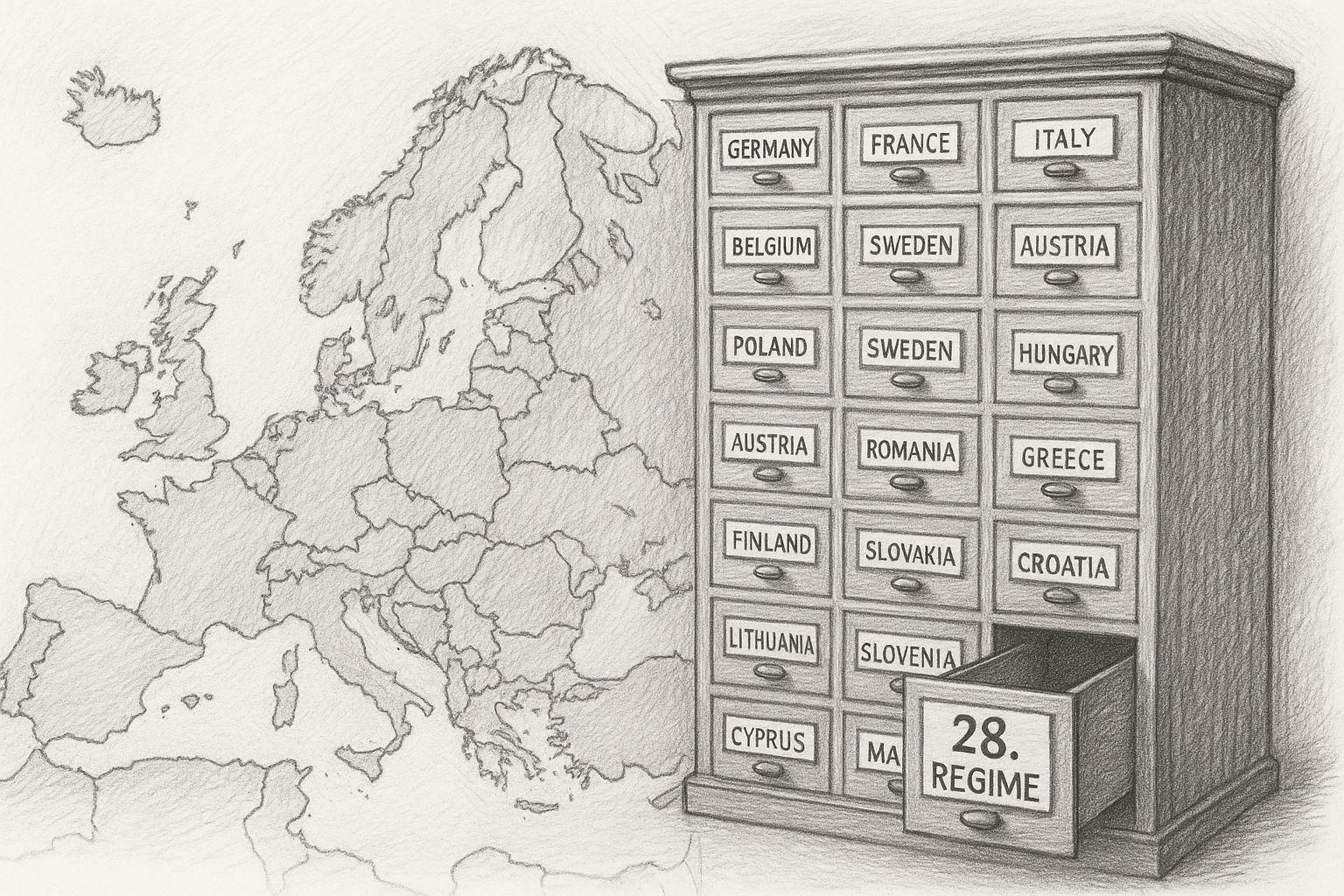
At the moment, half of Europe is talking about the so-called „28th regime“. Many are wondering what this is actually supposed to be. A new state? A secret EU project? Or just another attempt to modernize the single market? In fact, it is a concept that sounds grand, but in essence describes an additional form of company that is supposed to be optional and purely voluntary. The name „28th regime“ comes from the fact that there would be another set of rules in addition to the 27 national legal systems - like an additional tool in an already full toolbox.
The idea behind it did not come about overnight. Start-ups, investors and some SMEs have been complaining for years that the EU consists of 27 very different economic areas. Depending on which country you start up in, you have to follow different rules: different founding formalities, different liability rules, different requirements for employee participation or raising capital. This is an obstacle for international tech companies and often a deterrent for founders. This is precisely where the EU institutions want to start.



Latest news on the 28th EU regime
11.05.2026With the planned „EU Inc.“, the EU Commission is working on a standardized company form across Europe, which could become a real alternative to the traditional German GmbH for the first time. The aim is to make it easier for start-ups, international investors and technology-oriented companies within Europe in particular to set up cross-border structures much more easily. According to the commercial law firm Noerr the new company form could be particularly interesting for digital business models, holding structures and international project companies. EU Inc. should be less bureaucratic, more standardized and more easily scalable across Europe than many existing national company forms.
According to the EU Commission, the first start-ups could be possible as early as 2028. The proposal is supported by industry associations and business organizations, among others. However, critics fear additional conflicts regarding co-determination, liability issues and national company law. Nevertheless, the initiative clearly shows the extent to which the EU is now trying to standardize economic and digital structures and make them more competitive internationally.
A supplementary video by the „Ratgeber Stiftung“ also sheds light on the planned EU Inc. from a practical entrepreneurial perspective. It explains why many of the headlines about „1-euro incorporation“, „48-hour GmbH“ or the alleged „end of the notary“ fall short in some cases. The video points out that although the new EU legal form could simplify formation and international structuring, tax issues or asset protection still depend heavily on the respective national regulations.
EU Inc. from 2027: What the new European legal form means for German entrepreneurs | Foundation guide
At the same time, it becomes clear that EU Inc. could be particularly interesting for international growth strategies, digital business models and holding structures. The video provides an exciting additional insight into the current EU initiative, especially for entrepreneurs who think Europe-wide or want to operate more flexibly in the future.
20.01.2026At the World Economic Forum in Davos, Switzerland, EU Commission President Ursula von der Leyen presented the European Union's new plans for setting up companies. According to the Commission, in future it should be possible to register a company in the EU completely digitally and within 48 hours. In doing so, the Commission wants to significantly reduce the administrative burden for start-ups and other companies and make the economic environment in Europe more attractive, according to the Spiegel report. The proposed reform would be part of a larger project with the working title „EU Inc.“, which aims to standardize legal forms across the 27 member states. Details on specific deadlines and legal framework conditions were still open at the time of reporting.
What is the 28th regime? An introduction to a complex project
In spring and summer 2025, the EU Commission therefore carried out an initial „consultation“. This is an official procedure in which associations, companies, trade unions and experts can give their opinion. This consultation has been completed, but a finished draft law is not yet available. The Commission is currently evaluating what the various groups have proposed. The political objective is clear: a concrete draft is to follow at the beginning of 2026. So until then, it really is still a matter of Planning, However, the plans are at a very advanced stage.
The whole thing is driven from several sides:
- on the one hand from the EU Commission itself, which has been trying to standardize the internal market for years,
- on the other hand by consultants such as Enrico Letta and Mario Draghi, who have stated very clearly in their reports that Europe urgently needs to become a „single economic area“,
- and not least from Start-up associations, calling for a kind of European „super legal form“, often with the working title „EU-Inc“.
The aim is an optional EU set of rules that exists in parallel to the national company forms. Companies could voluntarily decide to run their company under this EU regime. This should facilitate cross-border activities and strengthen Europe in international competition. Whether this will succeed and what risks will arise is another question - which we will systematically examine in later chapters.
An optional additional set of rules - not a new state
First things first: the 28th regime is not a new EU state. Nobody is planning to secretly establish a 28th member state. It is simply an additional legal offer. Anyone setting up or running a company could decide whether to do so under the law of their home country - or under the new EU regime. It's similar to suddenly adding a 28th engine option to a car with 27 different engine variants. It is there if you want it, but nobody is forced to choose it.
The hope: more uniform processes, less bureaucracy, faster procedures and fewer points of friction between EU countries. The criticism: a „parallel right“ that could eventually become stronger than the national systems.
Why the EU is planning this - and what it hopes to gain from it
Europe looks like one big economic area on the outside, but on the inside it still functions like a patchwork quilt. Anyone setting up in France experiences completely different procedures than someone in Sweden or Portugal. For companies that want to expand across Europe, this means more time, more costs and more legal uncertainties.
The EU wants to solve this problem by offering a single rulebook that applies immediately in all member states. No more translation problems, no more different forms, no more contradictory liability models. The tech industry in particular welcomes this idea, as it could grow faster and bring investors on board more easily.
But there is also a bigger dream behind all of this: the EU wants to regain ground in global competition with the USA and China. Both countries have unified markets, while Europe is often stuck within itself. The 28th regime is intended to break this deadlock - at least from the point of view of its supporters.
Where the project stands today - and where it is heading
The 28th regime is currently (as of the end of 2025) still in the preparatory phase. The EU Commission has published its Consultation and is now preparing a legislative proposal. This is expected to be published in 2026. Only then will the actual political process begin: negotiations, rounds of criticism, adjustments, votes. But this is already foreseeable:
- The Commission wants to create a digital, EU-wide business register.
- Start-ups should be possible within 24 hours.
- The rules for capital, investors and corporate governance are to be standardized.
- The tax issue remains officially excluded - but is like a „shadow“ over the project because it can hardly be avoided in the long term.
In its current form, the 28th regime is therefore not a finished product, but a blueprint. But it is a blueprint that already has very concrete outlines and could develop enormous significance in the coming years. This is precisely why it is worth understanding what it is all about now, before the details are finalized.
Why flexible ERP systems will become more important in the future
 The more corporate structures change in Europe, the more important flexible and adaptable ERP systems become. This is precisely where gFM-Business comes in - a FileMaker-based ERP solution, which was specially developed for small and medium-sized companies. While large corporations often rely on cumbersome standard systems, gFM-Business enables individual processes, quick adjustments and much more direct control over their own data and processes. This flexibility can be a decisive advantage, especially at a time when legal framework conditions, digital interfaces and international requirements are changing ever faster.
At the same time, the solution remains deliberately practical: offers, invoices, warehouse management, CRM, e-invoices, webshop connections or individual special processes can be managed and expanded centrally. This is particularly interesting for companies that want to work more digitally across Europe in the future without immediately becoming part of expensive corporate structures or rigid cloud dependencies.
What would change in concrete terms?
When you talk about the 28th regime, a lot of things seem abstract at first glance. „A new EU set of rules for companies“ sounds great, but what does it actually mean in everyday life? What would an entrepreneur do differently? What would be easier, what would be dropped and where would new dependencies arise? In order to answer these questions clearly, it is worth taking a cautious look at the building blocks that are already emerging today - even if the final law is not yet available.
At its core, the 28th regime revolves around a single idea: you set up a company once - and can then work in all EU countries without having to learn new rules everywhere. This is precisely why there should be uniform formation procedures, central digital registers and clear EU-wide rules. But as simple as this idea sounds, the consequences are far-reaching.
Uniform rules for foundation and administration
Today, anyone setting up a company in Germany does so in accordance with German law. If you set up in Austria or Italy, you have to follow their procedures. Each country has its own forms, its own deadlines, its own authorities and often also different requirements for capital, management and liability.
The 28th regime would circumvent this patchwork. You could choose an EU company form - regardless of your place of residence - and thus automatically be valid in all member states. A kind of „European standard“ that works the same everywhere. In concrete terms, this means
- A single statute instead of 27 different variants.
- Uniform liability rules.
- Uniform rules for management.
- Uniform rules for transparency and accounting.
This would be a huge advantage for many young companies, as they would no longer have to learn new legal structures every few months. At the same time, however, this would also create a parallel system to the national company forms - and this is precisely where some of the criticism comes in later.
A digital EU business register
A second central building block is digitalization. The EU wants to create a central register in which all companies in the 28th regime are listed - regardless of where the founders are based or where they do business. This would be a major change, as companies are currently only kept in national registers. The plan is
- 100 % digital formation, without notary, without local visit.
- Registration within 24 hours.
- Uniform documents that apply to all countries.
- An EU-wide search system that makes all of a company's data retrievable.
It could be imagined as a kind of „European commercial register“ that would be much more technically advanced than many of today's national systems. This would have advantages in terms of speed and transparency. At the same time, it would mean that the EU would take on a role that was previously the responsibility of individual countries. This would be convenient for companies. For states, it would mean relinquishing some of their control.
Uniform rules for capital, investors and shareholdings
Many people are not aware of this point, but it is extremely important: one of the main reasons for the 28th regime is the issue of capital. In Europe, it has so far been difficult to reconcile investors from different countries. Each country has its own rules for shareholdings, for employee shares, for start-up shares or for convertible loans. Large investors from the USA or Asia regularly shake their heads at this. The 28th regime is intended to put an end to this - at least in theory. The plan is:
- uniform rules on how investors are involved,
- simplified employee stock ownership plans (ESOPs),
- clear and Europe-wide capital requirements,
- easier access to venture capital.
This would make Europe more attractive for tech companies, which today often move abroad because the EU market is too fragmented. This is precisely why many start-up associations support this project.
The downside: uniform rules always mean that national characteristics disappear - and with them certain protective mechanisms or traditions. This will play a role in the criticism later on.
The open construction site: taxes - officially excluded, practically unavoidable
One of the most exciting points is the tax issue. Officially, the EU says:
„Taxes remain a national matter. The 28th regime has nothing to do with it.“
That sounds reassuring. But in practice, it looks more complicated. Because when companies choose an EU legal form and operate throughout Europe, the question automatically arises: according to which system are profits and losses distributed? Who gets the taxes? And how do you prevent companies from using the system to save taxes or play off countries against each other? This means:
In the short term, tax law will probably really be left out. In the long term, however, there is no way around harmonizing certain rules - because otherwise the entire model will remain unstable. Many experts therefore say:
Taxes are not included in the 28th regime, but they run along as a shadow - and could follow later as a separate building block. The 28th regime would therefore not just be a form of company, but a step towards a separate economic EU area. This is precisely what makes many observers prick up their ears - and this will play a central role in the later chapters.

The 28th Regime! Von der Leyen debates at WEF Davos 2025 | EU Debates
The alleged advantages: What supporters say
Listening to the supporters, you could almost believe that the EU has finally found the philosopher's stone. In their eyes, the 28th regime solves several problems at once that have been holding Europe back for years. They see it as a kind of „turbo cure“ for the European economic area - especially for young, fast-growing companies. And some are even talking about the first genuine European form of company worthy of the name.
To understand why the euphoria is so great, it is worth taking a look at the most important arguments.
1. less bureaucracy - a single rulebook for the whole of Europe
The biggest advantage from the proponents' point of view is the reduction in bureaucracy. Today, a company that wants to work in several EU countries has to learn a new chapter of rules each time. This is exactly what the 28th regime aims to abolish. The idea behind it is charming: set up once, understand the rules once and then be able to work in all countries in the same way.
This should save time and money, especially for international start-ups and digital companies. What often takes months today could take just a few days in future. For some, this is simply overdue.
2. faster start-ups and a modern digital framework
Another advantage is speed. The EU is promoting the 28th regime with the promise that start-ups will be possible within 24 hours. And completely digitally - without a notary, without piles of paper, without visits to the authorities. Supporters say:
„If you can register a company online in the USA in just a few minutes, why shouldn't you be able to do that in Europe?“
The 28th regime would therefore also be a modernization of the European administrative apparatus. For many, this finally seems like a connection to the present day.
3. make Europe more competitive
Another key issue is global competitiveness. Europe is economically strong - but often sluggish. Young companies complain that they lose a lot of time because every country has different rules. It's different in the USA or China: one code, one market, one growth model. Proponents therefore say:
„We need a European counterpart, otherwise we will lose out in global competition.“
The 28th regime is intended to help European companies grow faster, find investors more easily and no longer be slowed down so much by competition.
4. easier access to capital and uniform investor rules
One major issue is the question of capital. Investors shy away from the European patchwork. They want clear rules that apply everywhere - and not 27 national systems that are difficult to combine. With the 28th regime, there would be:
- uniform participation models,
- uniform employee share programs,
- clearer liability rules,
- and a set of rules that investors know and can assess.
This would be a huge advantage for young tech companies. Many supporters therefore see the 28th regime as a kind of „turbo for innovation“. Only time will tell whether this is true. But hopes are high.
5. the internal market finally becomes a genuine internal market
To put it simply: the single market exists on paper, but in everyday life companies often still work as if they were in 27 small countries. A uniform EU company law would dissolve many of these borders, at least in the economic sector. For some, this is the long-overdue step towards a functioning market that deserves its name.
Current survey on the planned digital euro
The risks and points of criticism: What critics say
As enthusiastic as the supporters are, others are skeptical. Critics see the 28th regime less as an opportunity and more as a risk - for national standards, for democracy and for the economic stability of individual states. Some observers even go so far as to say that the 28th regime could permanently shift the balance of power in Europe - away from the nation states and towards an EU level that is difficult to control.
In order not to distort the picture, we summarize the most important points of criticism objectively and calmly.
1. erosion of national rules and protection standards
One of the biggest criticisms is that if companies can choose between national law and the 28th regime, there will be competition between legal systems. Companies would possibly opt for the system that contains fewer requirements, lower costs or fewer employee rights. The concern is:
- national standards could come „under pressure“,
- stricter regulations could be undermined,
- and countries would have to adapt in order not to lose their attractiveness.
This is not a flat horror scenario, but a realistic consequence when two sets of rules exist side by side.
2. less democratic control - decisions move to Brussels
Another major issue is the loss of democracy. If corporate rules are increasingly determined at EU level, national parliaments have less influence. This creates a greater distance between politics and citizens. Critics therefore say:
„The law is moving away from the people it affects.“
Even if the EU institutions are democratically legitimized, many citizens find them difficult to reach and even more difficult to control. An EU legal framework that becomes more important than national laws reinforces this effect.
3. the tax issue as a smoldering time bomb
Officially, the tax issue does not play a role in the 28th regime. But critics consider this to be window dressing. Because as soon as there is a single EU corporate form, the question automatically arises: who gets the corporate taxes? If companies are active throughout Europe, a single EU regime is not enough - you also need rules on the distribution of profits, losses and the tax burden. Many experts warn:
„The 28th regime could be an introduction to an EU tax system.“
Not immediately, but as a logical consequence. And that would encroach deeply on national sovereignty. Some therefore call it a „stepping stone“ through which an EU tax could later be gradually harmonized - not by force, but by „technical necessity“.
4. danger of a two-tier economy
Critics fear that the 28th regime will primarily benefit large, internationally active companies - while small and medium-sized enterprises will remain stuck in national law. This could mean
- large companiesmodern, fast, digital, EU legal area
- small companiesmore old-fashioned national rules, higher costs, more bureaucracy
This would further widen the gap between sectors and company sizes. Traditional SMEs in particular are critical of this development.
5. a parallel system that eventually dominates
Perhaps the most fundamental accusation is that the 28th regime creates a parallel European legal system that could eventually become so attractive that national legal systems become less important. The EU would then still not be a state in the traditional sense - but economically an area would emerge that feels very similar. Critics therefore say:
„The 28th regime is not just a tool. It is a power-shifting project.“
Whether this happens or not depends on many details. But the possibility alone makes many people prick up their ears.
| Supporters | Critics |
|---|---|
| Uniform rules throughout the EU facilitate start-ups and reduce bureaucracy. | Parallel legal systems can undermine national protection standards and put states under pressure. |
| Start-ups should be possible digitally and within 24 hours - a modern EU standard. | Faster procedures also mean less control and can lead to loopholes. |
| More attractiveness for investors through uniform participation and capital rules. | Large companies benefit more than small companies - risk of a two-tier economy. |
| Europe will become more competitive globally and will be better able to hold its own against the USA and China. | National parliaments lose influence, decisions move on to Brussels. |
| The single market will be simpler: one set of rules instead of 27 different systems. | Uniform rules destroy national differences that have historically grown advantages. |
| New EU register creates transparency and digital efficiency. | Central EU register means shifting power from national authorities to EU level. |
| Officially, taxes remain nationally regulated - this creates planning security. | Critics see the tax issue as a „time bomb“ because an EU tax system could loom in the long term. |
| The system is voluntary - no one is forced to use this regime. | „Voluntary“ can later become de facto coercive if the EU form becomes too attractive or too dominant. |
What does this mean for citizens and small businesses?
At first glance, the 28th regime sounds like a technical topic for lawyers, start-ups and politicians. But in everyday life, it can have consequences for ordinary people - just not immediately. A lot happens gradually, in the background. As with so many EU projects, you only realize years later what was actually set in motion. It is therefore worth taking a closer look at what is really at stake for citizens, the self-employed and small businesses.
Hardly noticeable for the average citizen at first
For most people, the 28th regime will not change much for the time being. People will continue to work, shop, pay their taxes and live their lives. The new EU corporate form primarily affects the corporate world, not everyday private life. But as is so often the case, what seems far away today may change the framework conditions tomorrow.
If large companies operate in a different regulatory system in the future, this will eventually have an impact on jobs, tax revenues and economic stability. But this effect is slowly building up - explainable, but not immediately visible.
Indirect effects on the state and society
Where the changes become more noticeable is at the indirect level. When many large companies switch to the 28th regime, the following can happen:
- National tax revenues shiftWhen companies operate within an EU legal framework, states will sooner or later have to clarify how profits are distributed. Is more generated abroad? Is the home state missing out on revenue?
- Labor and social standards can come under pressureWhen national rules are stricter than those of the EU regime, competition quickly arises: who is more attractive - the national form or the EU model?
National parliaments have less influenceIf important corporate issues are increasingly regulated at EU level, national legislators are less able to take countermeasures if things get out of hand.
For citizens, this does not mean that everything will be different tomorrow - but the direction of development can have noticeable consequences, for example for public services or social security systems.
Challenges for the self-employed and small businesses
The situation is particularly complicated for small companies. As a rule, they remain within national law because the 28th regime is more attractive for larger or cross-border companies. And this is precisely where the danger of an imbalance lies:
Small companies still have to deal with national rules - with all the forms, access barriers and traditional processes. Large companies benefit from the flexible EU legal framework and have less bureaucracy. A practical example of this is the Emigrate or activities of digital nomads who change their location more frequently.
At the same time, these large companies can grow more strongly and have easier conditions with investors. In the long term, this can lead to a structural competitive advantage for companies that use the 28th regime - and smaller companies could lose out. This is a crucial point for many medium-sized companies:
They fear that parallel legislation will emerge that promotes large players while traditional European SMEs fall by the wayside.
A cautious classification and the unanswered questions
The 28th regime is not a finished project. It is a blueprint - but a blueprint that bears a clear signature and points the way in a certain direction. Two things need to be understood in order to make a reasonable assessment:
What is actually planned - and what may result as a logical consequence.
Realistic assessment of the next few years
There is no reason to panic, but just as little reason for naïve serenity. Realistically, the 28th regime will not be introduced overnight. The political process is long:
- Commission draft (planned for 2026).
- Discussion in Parliament and Council.
- Adjustments, points of contention, legal fine-tuning.
- Transition periods for companies and countries.
It could be several years before a functional system is in place. But at the same time, the train is already in motion. The reports, statements and consultations clearly show where the journey is heading - even if the details are still open.
The key unanswered questions
There are a few points that need to be clarified from today's perspective before the project can really be assessed:
- How can national standards be prevented from being undermined? An EU parallel right must not lead to companies choosing weaker rules.
- Who will set the rules in future - and how close is this to the citizens? If too much goes to Brussels, there will be a democratic deficit.
- How can the system remain fair for small companies? A good set of rules must apply to everyone, not just international corporations.
- How do you deal with the tax issue? Officially, the issue is excluded.
In practice, it will come sooner or later - because otherwise the system will create contradictions. These questions will decide whether the 28th regime will be a step forward or a risky shift of power and responsibility.
Why you should understand this topic today
Many issues develop quietly, in the background. But it is precisely the quiet changes that are often the most significant. The 28th regime is just such an issue: it seems technical, almost dry - but its consequences could influence the economic structure of Europe for decades. And that is why it is worth understanding the basics early on:
Not out of fear, but out of clarity. Not to drive ourselves crazy, but to recognize developments before they become irreversible.
The 28th regime is neither a European panacea nor a doomsday scenario. It is a tool - and like any tool, it can either be useful or harmful. In the hands of a forward-looking policy, it could strengthen the European economy, reduce bureaucracy and clear the way for young companies.
In the hands of short-sighted or power-centered politics, it could weaken national structures, reduce democratic control and create a parallel right that develops apart from citizens.
The decisive factor is therefore not the idea itself, but how it is implemented. And that is precisely why it is important to take a look today, ask questions and follow the direction carefully. This is the only way to prevent Europe from slipping into a legal automatism that no one really owns anymore - except the institutions that administer it.
Interesting sources on the topic
- Chemnitz Chamber of Industry and Commerce - „28th regime: New EU legal framework for companies“
A clear description of the project in German: objectives, groups of companies affected, elements (e.g. company law, insolvency law, tax law) and reference to the public consultation 2025. Well suited for getting started, in order to capture official views and key data. - Startupverband - Political update on the 28th regime
A statement from the perspective of the start-up and growth scene. It explains why many start-ups welcome the 28th regime and what they believe should be taken into account during implementation (e.g. legal form, digital incorporation, uniform rules). Valuable for understanding the proponents' arguments in a practical way. - Bitkom - Position paper 2025 on the 28th regime
An industry association for the digital economy and tech that brings an informed, technology-oriented perspective. The paper summarizes what a modern, digital EU company law could look like - and what companies are currently looking out for. Particularly useful if you want to shed light on future viability, digitalization and competitive advantages. - European Trade Union Institute (ETUI) - Criticism of 28th Regime („not necessary and harmful“)
A critical perspective from the point of view of employee rights and social standards. The paper argues that many protective mechanisms could be undermined - especially in the area of labor and co-determination. Very relevant if you want to present the social and socio-political risks. - European Parliament - Legal Affairs Committee Study „Identification of hurdles - 28th Regime“ (2025)
A well-founded legal and political analysis: it examines the existing obstacles for companies in the EU and explains how the 28th regime could help - but also what institutional, legal and political hurdles exist. Important for understanding the project in its institutional context. - OECD European Law Blog - „What is the 28th legal regime? Where have I seen it before?“
A concise, easy-to-read introduction to the idea of the 28th regime from a legal perspective. The text places the project in the context of EU history to date, shows parallels with previous attempts and highlights the opportunities and risks. Recommended if you are looking for a clear, legally reflective view. - IIEA - Institute of International and European Affairs - Blog
An analysis from a European think tank perspective. It describes the proposed concept, possible design variants and what should be taken into account during implementation. Helpful if you want to shed light on strategic and economic policy implications. - Verfassungsblog - Article „The 28th Regime“ (2025)
Critical, reflective view of the plans: The author suggests that the 28th regime should not be thought of as a rigid set of laws, but as a kind of „sandbox“ - in other words, a field for experimentation. Very suitable for demonstrating the danger of half-hearted implementation or symbolic solutions.



Frequently asked questions about the 28th EU regime
- What is the 28th regime anyway?
The 28th regime is a planned, additional EU company form that is to exist in parallel to the 27 national legal systems. It is not a new state, but a voluntary set of rules under which companies can set up and operate. The aim is to create a uniform EU company law that functions in the same way throughout the EU. - Why is the EU developing this new business model?
The EU wants to standardize its internal market and make it more attractive. Many start-ups and investors criticize the fact that Europe consists of 27 different corporate worlds. This leads to bureaucracy, costs and delays. The 28th regime is intended to remove these obstacles and create greater international competitiveness. - Does this 28th regime already exist?
No. The project is currently (end of 2025) still in the preparatory phase. The EU Commission has carried out a public consultation and is planning the first concrete draft law for 2026. A finished law does not yet exist. - Who is the 28th regime intended for?
Primarily for companies that are active across Europe or want to grow quickly: Start-ups, tech companies, international trading companies or companies that need investors from different EU countries. Small, locally operating companies will tend to remain within national law. - Would the 28th regime be mandatory?
No. It should be expressly voluntary. Companies can either continue to incorporate under national law or choose the 28th regime. However, many critics are concerned that the EU regime could later become so attractive that it becomes de facto compulsory. - How would the founding of a company change?
Under the 28th regime, incorporation is to be possible entirely digitally - without bureaucracy, without a notary, within 24 hours. This is a clear contrast to the sometimes cumbersome national procedures, which can take weeks. - What about existing companies? Can they switch?
Yes, according to the current concept, companies should later have the option of switching from national law to the 28th regime. This would be particularly interesting for growing companies or international firms. - What is the impact of the new EU register?
There is to be a central EU commercial register in which all companies in the 28th regime are listed. This would give the EU a direct role in company supervision - something that was previously the exclusive responsibility of national authorities. - What advantages do supporters see?
Supporters argue that Europe would: have less bureaucracy, be able to start up more quickly, attract capital more easily, become more competitive globally and finally have a truly functioning single market. They see the 28th regime as a great opportunity for innovation and growth. - What risks do critics see?
Critics fear: The erosion of national labour and protection standards, a loss of democracy due to a shift of power to Brussels, long-term tax harmonization through the back door, competition between national and EU law and a two-tier economy. They see the 28th regime less as a modernization and more as a political power project. - Will the 28th regime replace national rules?
Not officially. National law remains in full force and effect. The EU regime is merely an additional option. However, critics warn that a parallel system could lead to national regulations becoming less important in the medium term. - What does this mean for small and medium-sized enterprises?
For many small companies, the 28th regime could hardly be relevant because they work locally and do not need international structures. At the same time, there is a risk that large companies will enjoy long-term advantages in the EU regime that small companies do not have in the national system. This could increase economic disparities. - What does this mean for citizens who have nothing to do with companies?
Little in the short term. In the long term, however, the consequences could become noticeable, e.g. if tax revenues shift, labor standards are changed or national parliaments have less power. Such developments build up slowly, but can have an indirect impact on everyday life. - Is there an EU tax behind it?
Officially no. The EU emphasizes that taxes remain a national matter. In practice, however, the issue will inevitably arise when companies operate across the EU and have uniform rules. Many experts believe that future harmonization is likely. - What happens when companies switch to the EU regime en masse?
This would effectively create a new „economic legal area“ that is independent of the EU. States would have to clarify how they deal with tax losses, loss of control or changes in the balance of power. Critics warn that national systems would then come under pressure. - Why is the topic so controversial?
Because it offers both opportunities and risks - and because it intervenes deeply in the structure of Europe. For some, it is a modern step towards a single market. For others, it is a danger signal because competencies and influence are gradually migrating to Brussels. - Does the 28th regime have an impact on the labor market?
Very probably yes. If companies can switch to the EU regime more easily, the question arises as to which labor rights apply there. If national protection standards are stricter than those of the EU regime, there will be downward pressure. This makes critics particularly nervous. - How will profits and losses be distributed in future?
This is one of the most exciting open questions. If EU companies are active in several countries, it must be clearly regulated which state receives which share of the taxes. Without such rules, the system would not work. The EU will inevitably have to open up this issue at some point. - Is the 28th regime a step towards an EU federal state?
Not officially. But functionally, it could be a further step in this direction. It creates a new legal area that exists parallel to national law - and could become dominant at some point. Critics see this as „integration through the back door“. - Why should we understand this topic right now?
Because the course is being set now. When the draft law comes in 2026, a decision will be made on the basic framework. Anyone who wants to understand where Europe is heading - economically, politically and socially - should keep an eye on this issue now. It is one of those projects that work quietly but have major long-term consequences.