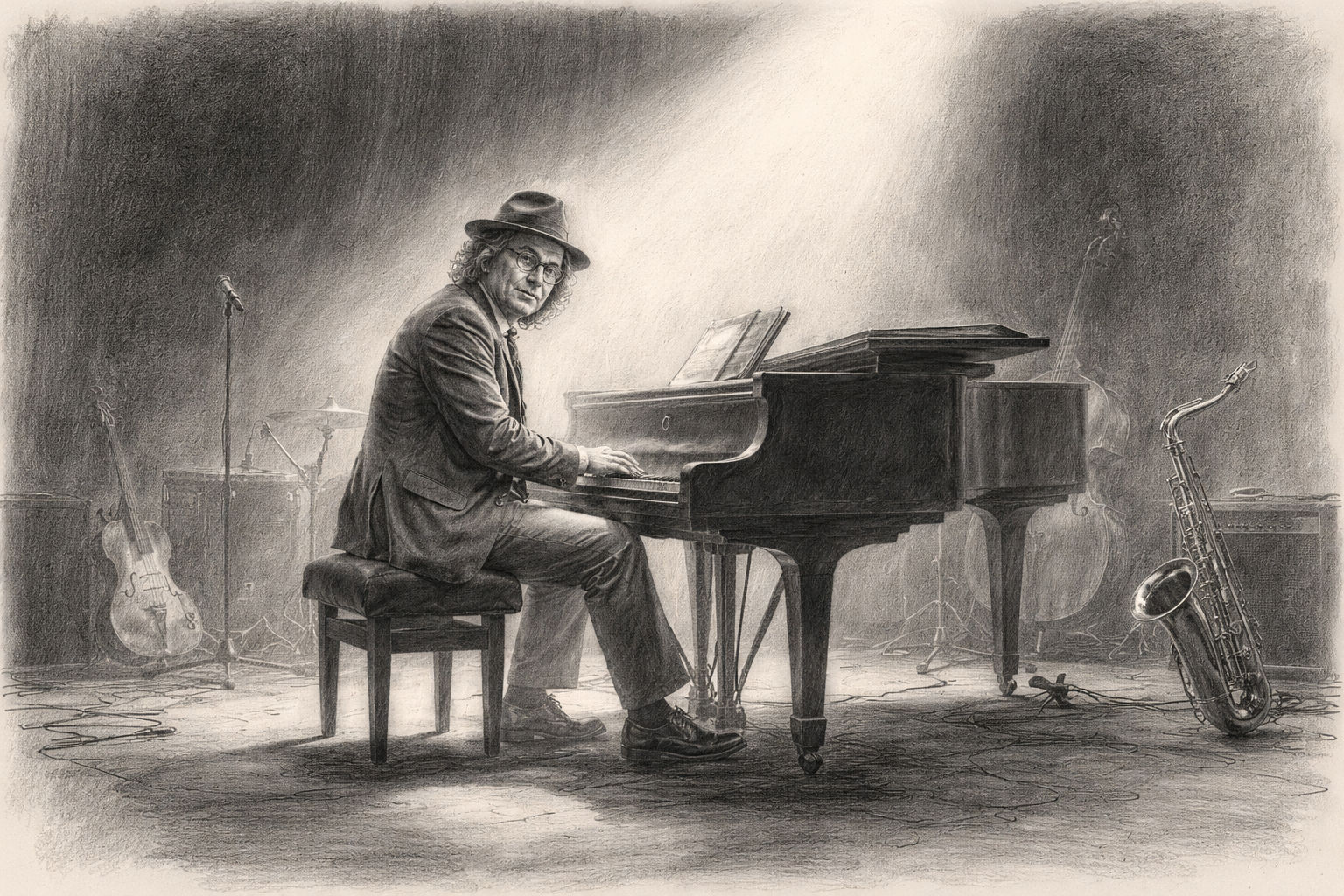
There are personalities that you only really understand when you detach yourself from their public image. Dieter Bohlen belongs exactly in this category. Musically, I myself am not a big fan of his shallow, often very simple melodies - and yet, to be fair, it has to be said that what he created was extremely precise, target group-oriented and clearly structured for the 1980s. Bohlen was never the great artist in the romantic sense. But he was an outstanding businessman, a hard worker and someone who understood his craft in a way that few do today.
What makes him interesting for me is not so much his music - but the fact that he remained successful for decades, while whole generations of artists came and went around him. That he attended the same commercial college in Oldenburg as I did. And that today - after many years of silence - he is suddenly taking a clear stance on social issues. That is the reason why it is worth looking at Dieter Bohlen as a person beyond the usual media image: not as a pop titan, not as a TV pundit, but as a craftsman, businessman and mirror of a time that understands itself less and less.


Dieter Bohlen between cliché and reality
In the public perception Dieter Bohlen often like an artificial figure: loud, direct, sometimes a little gruff, often exaggerated - and always with a wink. Formats such as Deutschland sucht den Superstar have solidified an image that for many people reduces him to just a few characteristics: slogans, laughs, entertainment.
But this television image is just a façade. Behind it is a person who has little to do with the typical romantic image of an artist. Bohlen was never someone who lost himself in creative dramas or waited for great inspirations. He has always worked soberly, structured his music, built his lyrics according to tried and tested patterns - and all with a clarity that is more familiar from traditional trades.
Early years: From humble beginnings to the first spark of music
Dieter Bohlen grew up in northern Germany - first on a farm in the Wesermarsch region, later in Oldenburg. His family was down-to-earth, characterized by craftsmanship and entrepreneurship: his father first worked in the road construction department and later ran his own civil engineering company. This world of pragmatic work, getting up early and a hands-on mentality shaped Bohlen more than many people think today. Music inspired him from a young age, but there was no glamorous start, no stage waiting for him - just the will to create something of his own.
Studies, part-time jobs and initial setbacks - nothing was given to him
At his parents„ request, Bohlen studied business administration in Göttingen and graduated with a degree in business administration. But at the same time, he wrote songs, formed small bands, failed again, got up, tried again. He released singles under a pseudonym, worked for music publishers, learned the mechanics of the industry - often without success and without applause. It is precisely this phase that shows how little Bohlen was a “product of chance". His path was not a rocket launch, but a combination of discipline, tenacity and the ability to keep going even after setbacks.
The breakthrough: success as a result of perseverance, not luck
When 1984 Modern Talking was not a miracle, but the result of years of hard work behind the scenes. By this time, Bohlen had already built up a solid foundation - musically, economically and in terms of craftsmanship. The great success came because someone from a humble background had worked his way up step by step, without shortcuts and without a safe space.
It is precisely this background that explains why Bohlen is so clear, direct and unimpressed to this day: he knows what it means to build everything himself.
„I don't see myself as much of an artist“ - a rare phrase in show business
In one of his more famous interviews, Bohlen was asked whether he saw himself as an artist. His answer came without hesitation:
„I don't see myself so much as an artist. More as a craftsman and businessman.“
This sentence describes him more precisely than any artist biography. While many musicians tend to exaggerate their work with big words or stories of spiritual inspiration, Bohlen deliberately demystifies his own work. He sees music not as divine inspiration, but as work: a sequence of steps that can be learned, practiced and perfected. At a time when many people hide behind the term „art“, this attitude seems almost liberatingly honest - and at the same time pleasantly old-fashioned.
Diligence instead of myth - the Bohlen principle
Bohlen is someone who would rather correct another line at night than wait for the muse to kiss him. His way of working is pragmatic, repeatable, clearly structured and surprisingly unromantic. He himself once said:
„In the end, you just have to do what others are too lazy to do.“
This sentence could come from a time when master craftsmen still admonished their apprentices. And what is remarkable is that it is precisely this principle that has carried him through four decades.
It is no coincidence that Bohlen is still around today, while many of the „real artists“ around him have long since disappeared. He was simply more consistent, more hard-working and more consequent than others. This workmanlike attitude - sober, unaffected, practical - explains his success better than any artistic myth.

Pop titan Dieter Bohlen on his first Ferrari, DSDS and shares | Entrepreneur University
Why Bohlen is misunderstood
The media Bohlen - loud, direct, provocative - is an entertainment product. But the private Bohlen is far more sober, calm and pragmatic than many believe. And it is precisely this contrast that often leads to him being underestimated. While the public looks at his TV slogans, it overlooks the worker behind them: the businessman, the songwriter, the practitioner who was never too shy to build simple melodies if they worked.
A man who doesn't pretend
It is interesting to note that Bohlen has never pretended - neither in music nor in life. He has never tried to appear more intellectual than he is. He has never pretended to be a misunderstood artist. Instead, he has said what he thinks, worked as he sees fit and taken success as it came.
This clarity - sometimes harsh, sometimes humorous, sometimes uncomfortable - makes him a figure who does not fit into the modern image of the „polished media person“. And it is precisely this that explains why he is suddenly attracting attention again today, when many celebrities remain silent:
He simply says what he sees - without pathos, without dramatization, but with a directness that we are hardly used to anymore.
An unprecedented record: 66 gold records, over 120 million records sold
If you take a sober look at Dieter Bohlen, the sheer volume of his work is almost absurd. Over 100 award-winning songs, countless productions, titles released worldwide, more than 100 gold and platinum awards - this is no ordinary record. This is a life's work the likes of which is only seen once or twice a century in Germany. And the amazing thing is:
- Bohlen was never a „genius“ in the classic sense.
- He has never claimed to have special inspirations.
- He simply worked.
Every day, for years, with discipline and with a clarity that you would normally find in a traditional craftsman who goes to his workshop every day, without drama, without self-dramatization.
Songwriting as a process - not as inspiration
Bohlen realized early on that pop music works according to rules. Not according to myth, not according to magic. A song needs:
- a recognizable structure,
- a clear melody,
- Repeatability,
- Understanding target groups
- and the courage to keep things simple.
Many musicians fail because they always want to be more „creative“ than the market demands. Bohlen never saw it that way. He asked himself:
„What works - and how can I produce it reliably?“
This pragmatic approach is exactly what made him so productive. He didn't wait for inspiration - he sat down and worked like a carpenter building a piece of furniture.
The pop craftsman with the most robust work ethic in the industry
While many musicians release one or two albums in their lifetime, Bohlen has delivered consistently for decades - and at a pace that is unique in Germany. He has sometimes produced several songs a week, supervised DSDS on the side, written books and realized his own projects. The special thing is not just the quantity, but the consistency:
- From Modern Talking to Blue System,
- countless productions for other artists,
- right up to his DSDS productions of the last 20 years.
Bohlen has shaped several generations musically - not through innovation, but through reliability. He created something that is rarely seen in the music industry: a stable, handcrafted aesthetic that has worked for decades.
Why his success is no coincidence
Anyone who has repeatedly reached the charts for 40 years is not just lucky. He has a clear work ethic. And Bohlen himself has often described it like this: simply doing what most others are too lazy to do. It is remarkable how unsentimentally he talks about his own success. No pathos, no myth, no „great artist“. Just work.
And it is precisely this attitude that explains why he is still around, while so many of his contemporaries have long since disappeared.
Current survey on trust in politics
Bohlen as a social mirror - a pop titan who suddenly speaks plain language
For many years, Bohlen largely stayed out of social and political debates. While other celebrities were vocal about their positions - whether in line with the system or rebellious - Bohlen remained conspicuously silent. In an industry where public statements are often part of the business, this silence seemed almost conservative. And that's exactly what made it interesting.
It was the silence of someone who had seen a lot, but rarely felt the need to intervene.
The moment when silence becomes speech
At some point, this image changed. In interviews over the last few months, Bohlen began to talk openly about things that many others prefer to keep quiet about:
- the state of Germany,
- economic development,
- the bureaucracy,
- overregulation,
- political irritation,
- social irritation,
- and the increasing narrowing of language and thought.
He didn't do it aggressively, bitterly or ideologically. He did it in the same way that he talks about music: soberly, pragmatically, unvarnished. That is what makes these statements so remarkable. They are not composed, not prepared, not „politically polished“ - but simply a clear German sentence:
„It can't go on like this.“
Why Bohlen, of all people, was one of the first celebrities to become clearer
Many artists are directly or indirectly dependent on funding, on public-law structures, on political networks or on an industry that likes to moralize but rarely takes risks. Bohlen, on the other hand, is independent. He has a life's work behind him. He is economically free. And he has a brand that cannot be damaged because it is based on directness anyway.
When someone like him speaks, it is not because he needs attention - but because he has been observing something for a long time and has reached the point where you no longer want to remain silent.
Comparison with other celebrities - a revealing spectrum
His behavior seems particularly clear when you compare it with the attitude of other personalities:
- Nena: rebellious, resistant, even against great expectations; consistent to this day.
- Wolfgang Grupp: has repeatedly issued warnings about the economy and responsibility in recent years.
- Jan Josef Lieferscritical, alert, with a calm, almost literary skepticism; has never backed down.
Bohlen is right in between: He is not a rebel, but neither is he a defender of the system. He is simply a pragmatic observer who at some point says:
„It no longer works like that.“
The craftsman who speaks plainly - and why this is so noticeable today
In a society in which many things are overdramatized and at the same time kept quiet, this sober attitude seems almost old-fashioned. But that is precisely why it is heard. Bohlen speaks the way he works: clearly, directly, without exaggeration, without metaphor.
And that is precisely what makes it a reflection of a German mentality that many people carry within them but rarely express publicly.
Mixed reactions to the Kettner interview: Between sober classification and harsh criticism
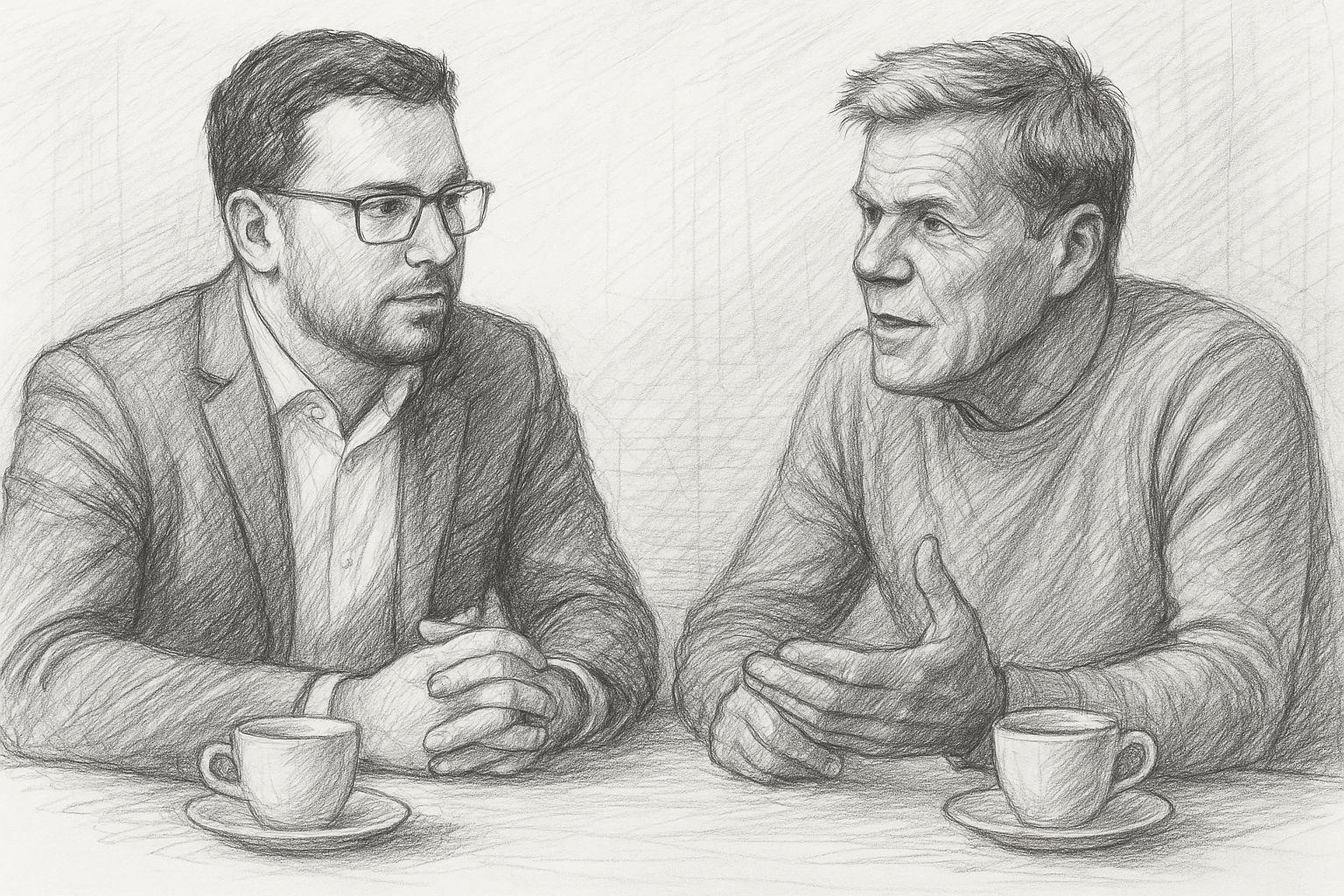 After the Conversation between Dieter Bohlen and Dominik Kettner was published, the reactions were remarkably varied. In many alternative or business-related media, the interview was taken up in a sober manner - mostly with a focus on Bohlen's experience as an internationally active entrepreneur and his clearly formulated view of Germany's economic situation. In contrast, the response in the major leading media was much more critical. In some cases, Kettner was described as a „conspiracy theorist“ and it was suggested that the interview took place in a politically charged environment, although the interview itself did not focus on party advertising or geopolitical narratives. Nevertheless, several major media outlets reacted to the interview with criticism, often with exaggerated headlines that only partially reflected the tone of the interview.
This discrepancy reveals one thing above all: the interview became a burning glass that clearly highlighted the different expectations and interpretative frameworks of different media landscapes.
Dieter Bohlen remains steadfast: How WELT reports, he repeated his views in an interview with the Bild newspaper and made them clear:
„Abroad, everyone shakes their heads at Germany.“
Celebrities between silence, adaptation and contradiction
Celebrities have a strange dual role in modern societies: on the one hand, they are entertainers, singers, actors and judges in entertainment shows. On the other hand, they are increasingly perceived as moral voices and political commentators - whether they like it or not. Many of them react differently to crises, political decisions and social tensions. Some demonstratively back the government line, others remain consistently neutral, while others risk their reputation by contradicting it out loud.
Dieter Bohlen belongs to a relatively rare group: he kept quiet for a long time, never proselytized politically - and only entered the public debate very late, but remarkably clearly.
Dieter Bohlen: Late entry, but clear words
In recent interviews, Bohlen has addressed a number of issues that many people in the country feel, but rarely express so openly. He criticizes:
- what he sees as excessive bureaucracy,
- a social system that has gotten out of hand,
- an ever-increasing burden on top performers,
- the politically erected „firewall“ and the treatment of AfD voters,
- the growing distance between the political class and economic reality.
He speaks of a welfare state that is „beyond good and evil“, wonders why certain parties are effectively excluded from government participation despite high poll ratings, and openly announces that he intends to leave Germany and possibly even to join the government. to emigrate, if an additional wealth tax is introduced. It is not important whether you agree with every one of his points. What is interesting is the role he plays:
- He is not a classic intellectual.
- He is not an activist.
- He is not a professional politician.
He is a music producer and television personality who has worked all his life, paid taxes and now feels that something is out of balance in this country. This is precisely what makes his statements so tangible for many: They are not doctrines, but the observations of a craftsman who senses that the business is no longer running smoothly.
Jan Josef Liefers and #allesdichtmachen: The conflicted middle way
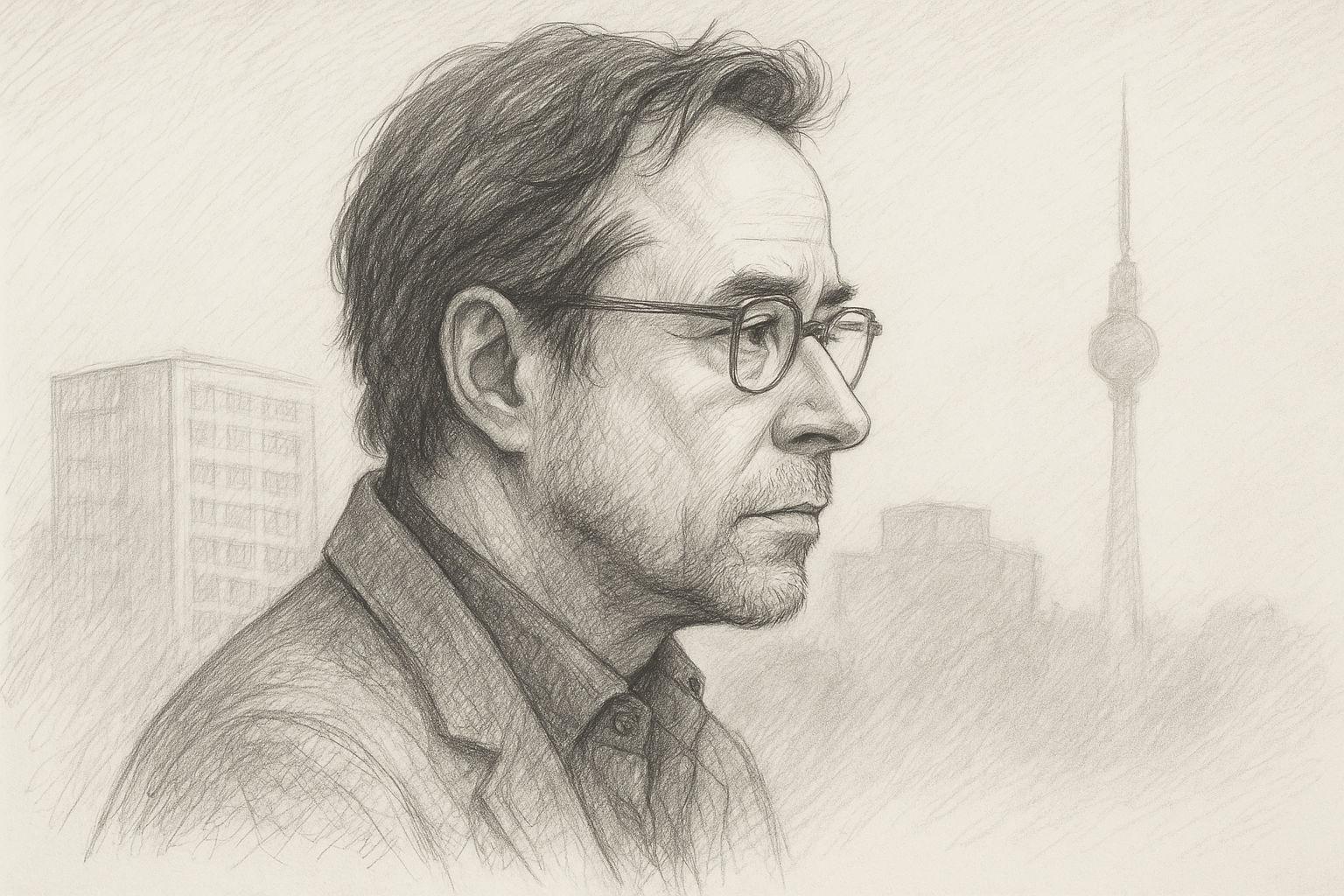
Jan Josef Liefers is a particularly exciting case. With the #allesdichtmachen campaign in April 2021, he got involved in the coronavirus debate - with satirical videos that criticized media and political one-sidedness. The reactions were fierce:
- The media accused the campaign of cynicism,
- Some sections of the press have likened those involved to „lateral thinkers“,
- There was massive public pressure,
- Some of the actors involved withdrew their videos.
Liefers stuck to his position, however, later criticizing the harshness of the reactions and saying that in Germany you can theoretically say anything - but not without consequences. He thus stands between the two camps, but is not radical either, but skeptical, thoughtful and with GDR experience in the background.
In a separate article I present Jan-Josef Liefers, his career, his attitude and his successes in a personal portrait.
Celebrities as seismographs - not as saints
If you place these four figures next to each other - Bohlen, Nena, Liefers, Grupp - interesting lines emerge:
- Nena: rebellious nature, doesn't mince her words when she sees personal freedoms in danger.
- Delivererskeptical observer who points out media bias and pays a high price for it.
- Wolfgang Grupp: Has been reminding us for years from the daily experience of his medium-sized company.
- Planks: late, but clear - an economically independent craftsman who criticizes the state of the country in simple terms.
None of these positions is „the truth“. But all four act like seismographs: they show where tensions lie. They show what can be said - and what cannot. They show how the media and the public deal with deviations. And Dieter Bohlen is a special figure in this field:
He is neither a political activist nor a moral preacher, but someone who has worked hard all his life and now realizes that the framework conditions are becoming fragile. The fact that a pop producer, of all people, has made this point so clearly says a lot about the state of the republic - and about the void that classical intellectuals have left at this point.
Current survey on digitalization in everyday life
What we can learn from Dieter Bohlen - diligence, clarity and independence
Dieter Bohlen clearly shows that success rarely has anything to do with „genius“ - and a lot to do with consistent, often unspectacular work. He has never claimed to be a great artist. On the contrary: he describes himself as a craftsman and businessman. That is an attitude that many people lack today. Instead of waiting for inspiration, we could take a leaf out of Bohlen's book:
- work a bit every day,
- Simplify things instead of complicating them,
- make clear decisions,
- Take responsibility for your own actions.
For a society that is often stuck in the abstract, this is a surprisingly modern message - precisely because it is so traditional.
Independence is a silent but enormous value
Bohlen has worked hard for his independence. He is economically free, not dependent on funding or the goodwill of committees or institutions. This is precisely why he can say things today that many others shy away from. Whether you agree with his statements or not:
His independence is an example of how long-term hard work pays off in the end - not just in money, but in the freedom to express his own observations.
Clarity instead of attitude
At a time when many public figures hide behind complicated formulations, PR platitudes and moral phrases, Bohlen's directness is almost liberating. He doesn't talk in technical terms, in political code or in „posture sentences“ that someone has written for him. He describes what he sees - sometimes harshly, sometimes pointedly, but always in a language that everyone understands.
You can criticize that. You can disagree with him. But you can hardly accuse him of pretending.
Between adaptation and rebellion: the pragmatic middle way
Bohlen is neither a rebel nor a symbolic figure of resistance. Nor is he a mouthpiece for the system. He is somewhere in between - and that is precisely why he is interesting. His attitude is that of someone who observes for a long time, works for a long time, participates for a long time - and at some point realizes that the gap is getting too big.
He is therefore an example of the silent majority that rarely articulates itself, but senses that something is shifting.
What remains - a quiet lesson from a loud life
In the end, Dieter Bohlen is less exciting as a „pop titan“ than as the archetype of a worker who has understood his role:
- He does not see himself as a genius.
- He does not exaggerate his art.
- He knows that success is fleeting.
But he also knows that diligence, craftsmanship and commercial clarity will always remain.
This is precisely why it is worth looking at him not just as an entertainment figure, but as a mirror:
- for our attitude to work,
- for our approach to success,
- for our reluctance to speak clearly,
and for the state of a society in which entertainment is often more honest than politics.
Dieter Bohlen as an uncomfortably honest touchstone
You don't have to like his music. You don't have to agree with his statements. You don't have to like his style. But you can learn a lot from Dieter Bohlen:
- That work is more important than attitude.
- That independence is a silent but enormous value.
- That clear words are sometimes more necessary than perfect formulations.
And that a person who sees himself as a craftsman and merchant can be an astonishingly honest figure in an age full of artificial productions. Perhaps this is precisely where his true significance lies:
Not in the hits, not in the headlines, not in the casting shows - but in the uncomfortable question he asks us:
How much of what we do is really craftsmanship - and how much is just a façade?
Read also: State of the German economy in 2025: Five years of crisis, figures, trends and outlook



Frequently asked questions
- Why is it even worth looking at Dieter Bohlen beyond his pop image?
Because Bohlen is often reduced to his TV slogans in the public eye, but there is a personality behind him that has little to do with the usual artist cliché. Anyone who takes a sober look at him will recognize a consistently hard-working craftsman who has performed consistently for decades. It is precisely this discrepancy that makes him an exciting figure, because it has little to do with the flashy media image and much to do with traditional virtues such as diligence, discipline and clarity. - What distinguishes Dieter Bohlen from many other artists of his generation?
He does not present himself as an „artist“, but as a worker. While many musicians point to great inspirations, Bohlen has always made it clear that his music is above all the result of structured craftsmanship: melody, repetition, understanding of target groups. This matter-of-fact attitude is rare and explains why he has remained continuously successful for so many decades. - Why does Bohlen prefer to call himself a craftsman and businessman rather than an artist?
Because he sees music as work - not as mystical creation. For him, a good pop song consists of clear rules, insights into listener psychology and repeatable patterns. This openness about how pop music really works demystifies the image of the artist, but at the same time makes his work comprehensible and human. - Isn't it derogatory to describe his music as „shallow“?
No - on the contrary. Bohlen himself has never claimed to create profound art. His songs were deliberately kept simple because they were meant to work. For the 1980s, the craft behind them was impressively precise. Anyone who looks at his music critically but fairly will recognize the quality in its simplicity. And that sets him apart from many artists who overestimate themselves. - How do you explain the enormous productivity of over 3,000 songs?
Through work routines, clear processes and discipline. Bohlen often worked every day, sometimes at night, sometimes for weeks. He repeated processes, refined successful formulas and relied on experience rather than inspiration. This is less artistic genius than a mixture of ambition, resilience and repetition - classic craftsmanship virtues. - Why has Bohlen worked musically for decades?
Because he didn't do genius theater. He has built melodies that people understand immediately and written lyrics that are easily accessible. The consistency with which he has repeatedly created this ease is what is really impressive: He didn't reinvent pop music, but he produced it efficiently - and consistently over several generations. - Why is his current social commitment so remarkable?
Because he had previously remained silent for a long time. Bohlen has never been someone who has positioned himself politically or likes to moralize. When someone like him suddenly addresses social grievances, it is not out of calculation, but because an inner point has been reached. It is precisely this delay that gives his statements weight today. It doesn't seem staged - but honestly irritated. - Which topics do Bohlen and other prominent critics currently address most frequently?
It is often about bureaucracy, economic burdens, inefficient political processes and the impression that service providers are increasingly frustrated. This criticism is not ideological, but pragmatic. It usually comes from people who have worked hard, achieved a lot and feel that the social framework is becoming increasingly fragile. - Why is Bohlen heard more often today than some public voices?
Because he has no agenda. He is not speaking on behalf of a broadcaster, not on behalf of a political camp and not as a moral voice. He speaks as a private individual with decades of work experience. People sense this independence. And they take his words more seriously as a result, even if they don't necessarily agree with every point he makes. - How does Bohlen differ from prominent critics of the system such as Nena or Jan Josef Liefers?
Nena took a clear stand early on, Liefers was skeptical and more literary. Bohlen, on the other hand, is neither an idealist nor a rebel. He comes from the working-class tradition: he only speaks when it seems necessary. This makes him a voice of the silent majority - those people who accept everything quietly for a long time, but at some point realize that something is out of balance. - What role do celebrities still play in social debates?
Celebrities are increasingly functioning as seismographs. They indicate where tensions exist. They are not neutral experts, but their reactions reveal a lot about what can be said, where taboos lie and how the media deals with dissenting voices. In this sense, they are less moral leaders and more indicators of social nervousness. - Why are some prominent voices harshly attacked while others are celebrated?
Because celebrities are not really judged by their content, but by their position in the cultural power structure. Statements close to the system are rewarded, while critical voices are often treated as a threat. This was very clear to see at #allesdichtmachen. This unequal treatment makes the few independent voices all the more valuable. - Is Dieter Bohlen political?
No - at least not in the classical sense. He is neither ideological nor programmatic. He is an economically independent pragmatist who expresses things that he observes and that seem illogical to him. It is precisely this lack of ideology that makes his statements credible for many people. - Why is he so polarizing, even though he is actually apolitical?
Because directness is quickly interpreted as provocation in Germany today. Bohlen expresses himself simply, without his words passing through PR filters. This honesty seems unusual today - and is quickly turned into polarization. But he is not being aggressive, just clear. And clarity has become a rarity in the public sphere. - What can readers learn for themselves from his life?
Above all, the realization that success consists of many small steps that are taken consistently over the years. Bohlen stands for an attitude that emphasizes traditional values such as diligence, punctuality, structured processes and repeatability. Things that were out of fashion for a long time - but which are becoming enormously important again in times of digitalization. - Is his way of working still relevant in the modern world?
More than ever. At a time when surface performance and quick effects dominate everywhere, people like Bohlen remind us that stable results almost always come from long-term work. His craft - not his music - is what is actually timeless. It is a kind of counter-model to today's attention economy. - Why is Bohlen also interesting as a social mirror?
Because he looks at things from an undramatic perspective. He does not exaggerate, he does not moralize, he does not lose himself in intellectualism. Instead, he names developments that many people also feel. This makes him a mirror for a broad section of society that rarely articulates itself but is strongly affected. - What long-term effect could his stance have?
When people like Bohlen say in public what many think in private, there is often a shift in the debate. These shifts are slow, but noticeable. They open up spaces for other voices that have not dared to do so before. And they show: Clarity is not a crime - but a form of responsibility.