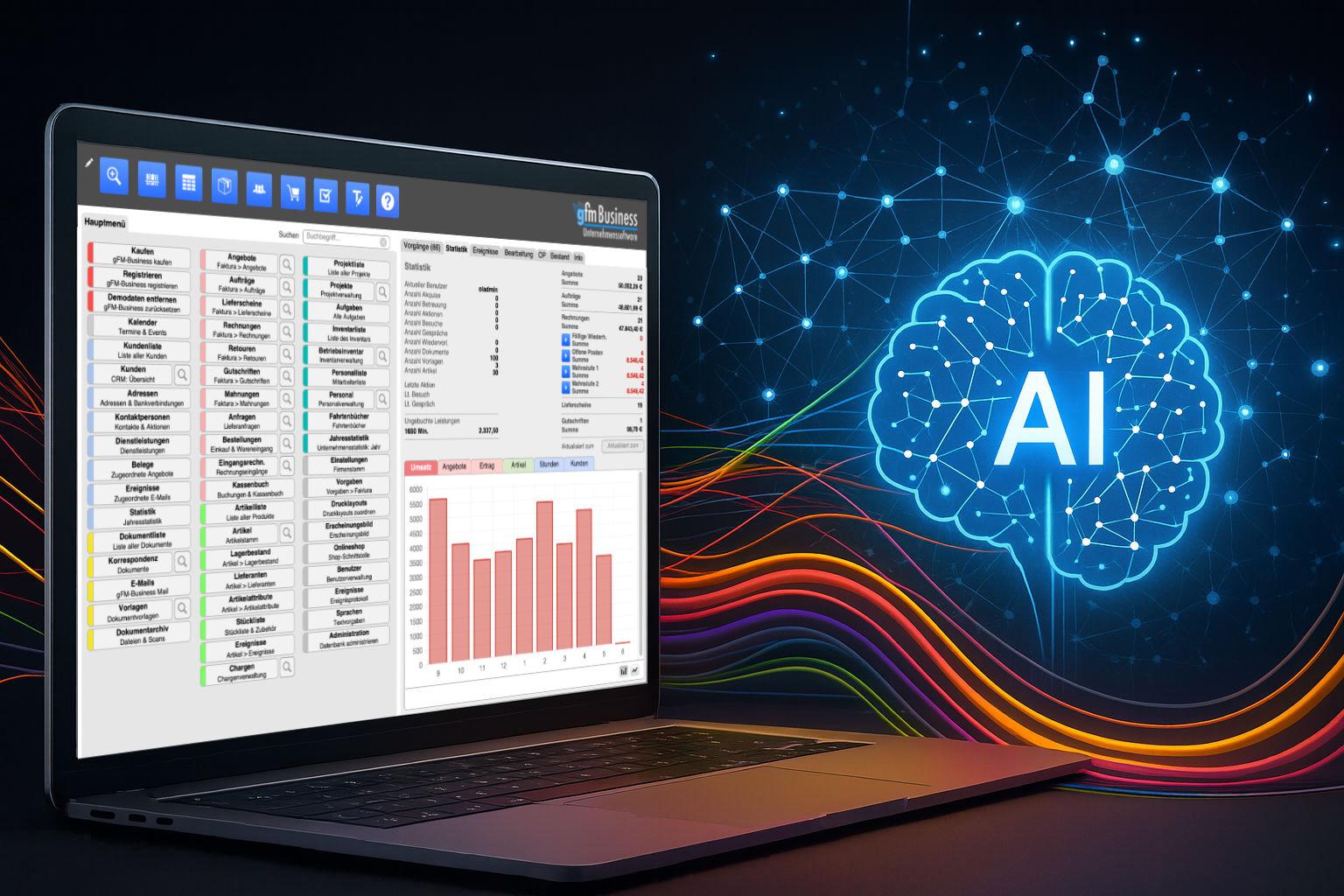
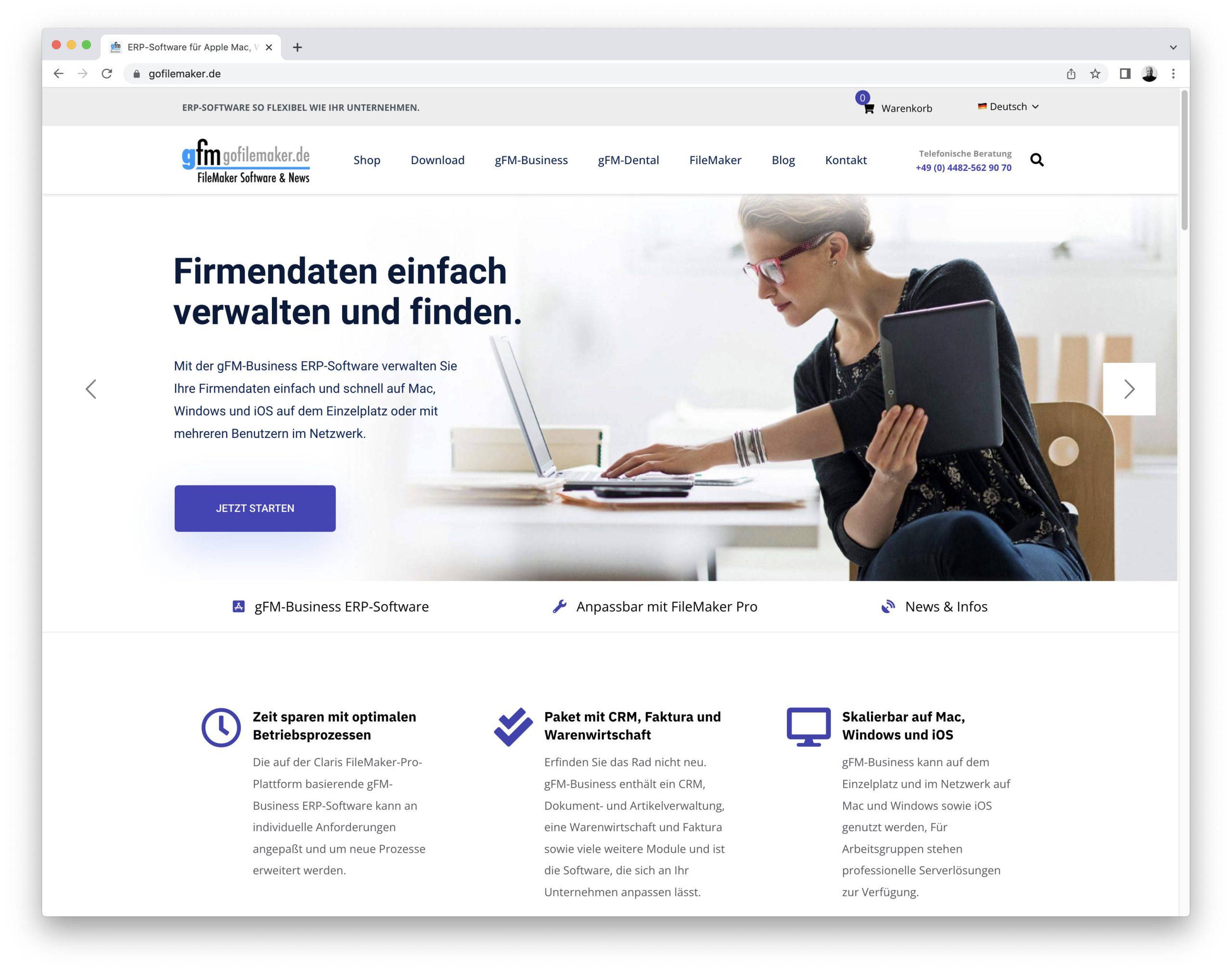
For over a decade, the gFM-Business software has stood for something special in the German ERP market: it is not based on a cumbersome, difficult-to-maintain system, but on the lightweight, customizable and visually modelled FileMaker platform. This has many advantages: gFM-Business can be individually expanded, runs on Windows, macOS and iOS, and can be customized by both developers and ambitious power users.
With the advent of artificial intelligence (AI) - especially through so-called language models such as ChatGPT - new opportunities are now emerging that go far beyond traditional automation. gFM-Business is actively preparing for this future: with the aim of not only managing data, but also unlocking knowledge.


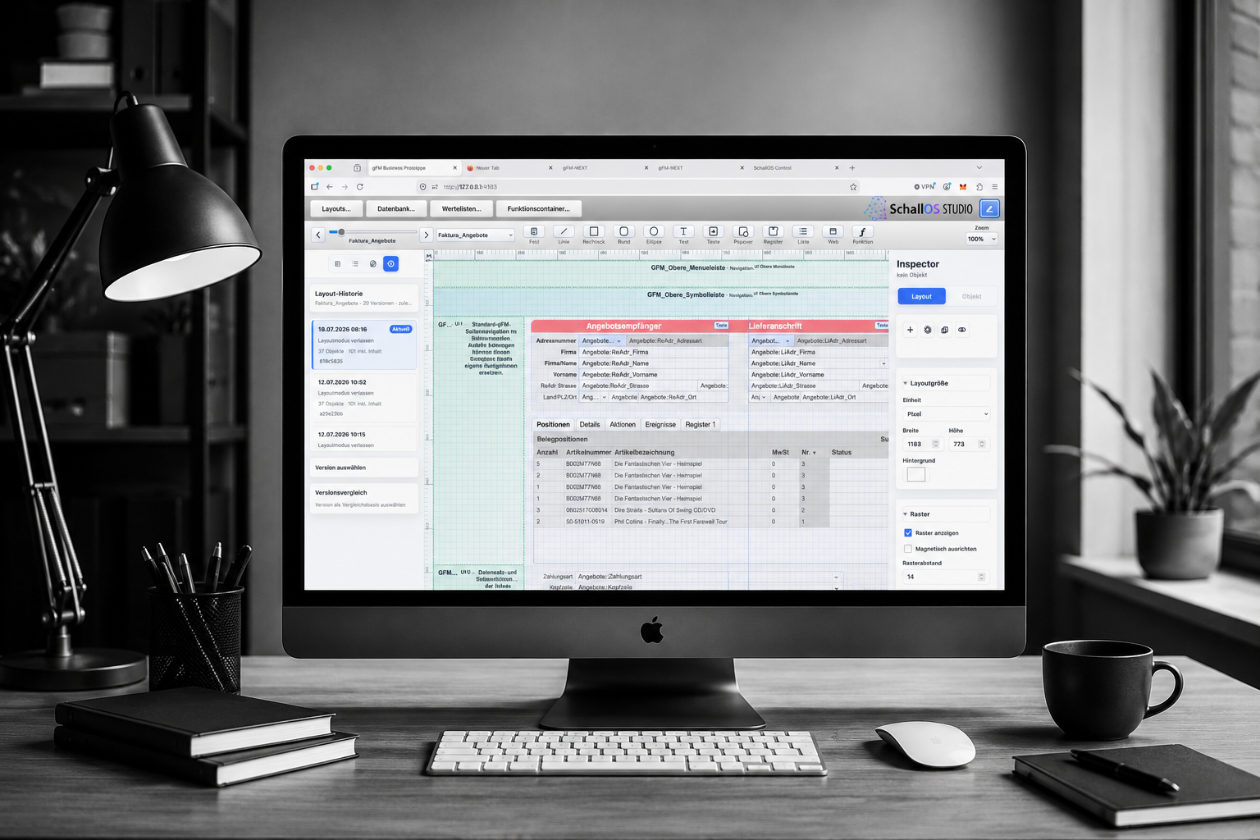
From ERP to intelligent assistance system
Classic ERP systems store customer data, invoices, inventory levels, or projects. They can calculate, structure, and manage many things. But: they don't truly „understand“ what they're doing.
A Intelligent ERP system is designed to do exactly that: understand what the user is trying to accomplish, why certain information is missing, or how a process can be improved. Modern AI tools help with this. Language models like GPT-4 or Mistral can understand and process natural language. This means a user can ask: „Which customers ordered more last quarter than in the previous year?“ – and the assistant doesn't just output a list, but also explains how it arrived at that result.
The role of local intelligence: Why not just cloud?
Many modern AI systems run in the cloud - this means that your data is sent to servers via the internet, processed there and the result is returned. This has advantages (computing power, up-to-dateness), but also disadvantages:
- Data protection: Personal data in the cloud is particularly sensitive in Europe.
- DependenceIf the provider goes out of business or increases prices, the system comes to a standstill.
- Latency and controlThe reaction time is longer, the control is less.
That's why gFM-Business takes a different approach: AI should operate where the data resides. Locally, on the user's computer or within the corporate network. To achieve this, language models are locally installized and prepared to handle the structures of gFM-Business. This is technically demanding but highly effective: the AI then understands not just „language,“ but also „content.“.
It knows the names of your customers, how your invoices are structured and which fields are available. gFM-Business will therefore support both the familiar cloud systems such as ChatGPT or Claude, as well as local language models that can be configured and started directly from gFM-Business at the click of a mouse.

The gFM AI assistant: more than just a chatbot
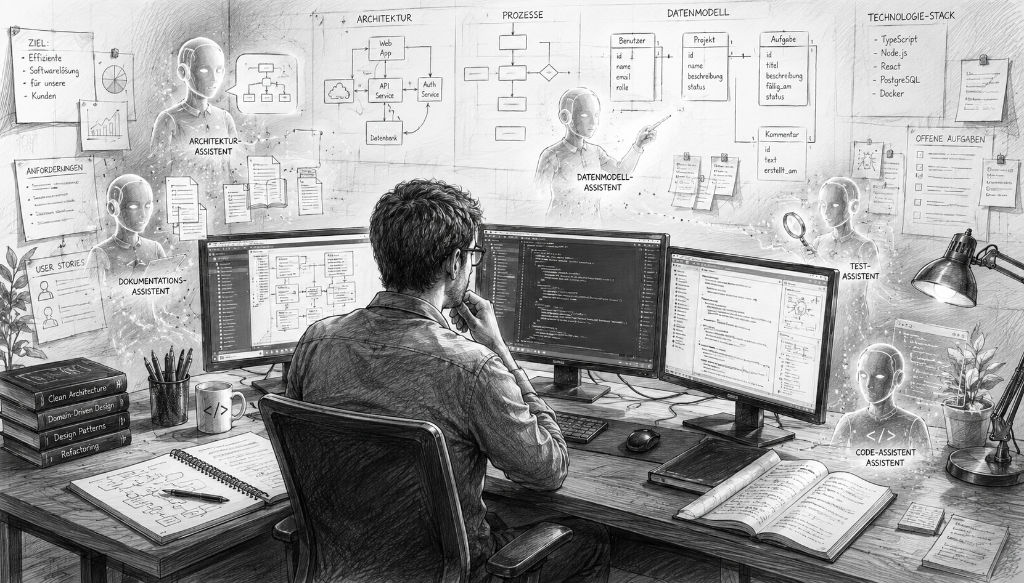
What does this mean for gFM-Business? We are working on an intelligent assistant that is integrated directly into the user interface. This assistant will replace the existing help system in gFM-Business and:
- Answers questions for operation („How do I create a new customer?“)
- Explains functions („What does this field mean?“)
- Analyzes data („Show me the customers with the highest dunning level“)
- gives recommendations for action („What can I do if a customer doesn't pay?“)
- can search documentation („Is there a guide for recurring invoices?“)
And the best thing is: the longer the system is used, the more it learns, because we also tie a Qdrant vector database as a central memory. It remembers what's important, where problems occur, and what has been successful. This „memory“ isn't data hoarding à la Google, but a locally stored knowledge structure that you control.
Knowledge graph instead of Excel: How AI understands structures
A key term for this development is the „Knowledge graph„. Instead of viewing individual fields („Customer Name“, „Amount“) in isolation, the graph connects this information with each other:
- A customer has Invoices
- One invoice referred to to an offer
- An offer was created from an employee
- An employee works in a department
A knowledge graph can depict such relationships - and an AI system can navigate through them. This enables queries such as:
- „Which projects were managed by employees who are no longer with the company?“
- „Which customers placed a new order within 30 days after filing a complaint?“
Questions that could previously only be answered with a lot of SQL or Excel scripting can now be asked in natural language - and receive precise, comprehensible answers.
Current survey on the future of Claris FileMaker and AI
What is possible with gFM-Business, knowledge graph and local AI
By linking gFM-Business with a local language model and a graph-based knowledge network (e.g. via Neo4j), numerous new use cases arise in practice:
- Context-based customer advice and sales support
„Which customers have not placed an order since the last newsletter?“
„Which of my customers might be interested in Product X based on their previous purchases?“
„Who recently reacted negatively to a price increase and should not be contacted again?“ - Automated support and knowledge database queries
Employees can ask questions in natural language: „How do I create a form letter?“, „Which export formats does Module X support?“ or „How do I set up a bank import?“ The AI accesses existing documentation, FAQs, video tutorials and internal process descriptions and provides targeted help at the right time. - Sales management and process optimization
„Which quotes were created but not followed up on within 30 days?“
„Are there customers who regularly experience delivery delays?“
„Which sales processes break off noticeably often at specific points?“ - Intelligent dunning system
The AI can detect risk patterns: Which customers regularly let reminders reach level 3 but then pay shortly before handover to collections? Based on this, reminder levels or payment terms can be adjusted in a targeted manner. - Personnel and project management
„Which projects caused high overtime even though the budget was adhered to?“
„Who has received particularly good ratings in customer feedback over the last 6 months?“
„Are there employees who were involved in multiple successful projects?“ - Historical evaluations with contextual intelligence
„How did order quantities develop after the price increase in February 2023?“
„Which campaigns (discounts, newsletters, events) resulted in measurable changes in revenue?“ - Reaction suggestions and automatic recommendations
„Customer XYZ has received 3 payment reminders and has not responded. Would you like to generate a template for a debt collection letter?“
„You have just created a quote for a customer with a high complaint rate. Would you like to activate a checklist for the delivery?“
Such use cases would be difficult or impossible to implement with traditional ERP systems. The combination of FileMaker flexibility, graph-based relationships (Neo4j) and a local language model creates a new dimension of process intelligence.
What does this mean for companies in concrete terms?
For small and medium-sized enterprises, this development means
- More independenceYou need less support because the assistant helps.
- Faster familiarizationNew employees find their way around more quickly.
- Better decisionsAnalyses and recommendations are available immediately.
- Data protection & controlEverything stays in-house, no cloud obligation.
- Future securityThe software develops with the company.
And all without the need for a huge IT apparatus. This is a real competitive advantage, especially for smaller companies.
Risks and challenges
As great as the potential is, there are also stumbling blocks:
- Technical focusLocal AI needs good hardware (RAM, CPU, possibly GPU)
- Data quality: If you maintain unclean data, you will also get bad answers
- Acceptance: Employees must trust the system, otherwise it will be ignored
- MaintenanceModels must be updated, saved and tested
However, these risks can be minimized with a well thought-out concept - such as the one currently being pursued by gFM-Business. The goal is not an overpowering supercomputer, but a smart assistant that serves humans, not replaces them.
gFM-Business 9 in progress, new sales structure from October
We are currently working intensively on the upcoming version 9 of gFM-Business. This new major version will fully integrate many of the described AI and automation functions for the first time - in particular the connection to local language models and the development of dynamic, graph-based company knowledge with Neo4j. The release of the first expansion stage is expected for early/mid-2026.
Anyone who joins now not only secures attractive conditions, but also a continuous upgrade path to the next generation - and thus early access to perhaps the most flexible AI-enabled ERP solution in the German-speaking world.
Outlook: ERP is becoming more human, not more technical
If we think this development through to the end, we could say that ERP software is becoming more human. It reacts to language, thinks contextually, explains relationships, learns and supports decisions. And FileMaker as a platform is ideally suited to this: thanks to its visual structure, open architecture, strong community and the ability to link data, layouts and logic in one environment.
If you want to get started today, you have the opportunity to think along right from the start: maintain data properly, document processes, name structures, formulate questions. Because in the end, the ERP system of tomorrow will no longer be just a program. It will be a partner - with ears, mind and memory. And gFM-Business is well on the way to leading this change.

Frequently asked questions
- What exactly is gFM-Business and how does it differ from other ERP systems?
gFM-Business is a modular ERP software based on the FileMaker platform. Unlike traditional ERP systems, it is fully customizable, runs across platforms (macOS, Windows, iOS) and can also be operated by smaller companies without a large IT department. Thanks to visual development with FileMaker, it can be expanded particularly quickly - and is now also open to modern AI integration. - Why is FileMaker a suitable platform for AI and ERP?
FileMaker combines database, user interface and business logic in a single development environment. This makes it possible to integrate AI functions directly into forms, evaluations and dialogs without having to use external interfaces or additional tools. This close integration is a major advantage for the use of AI. - What is a language model and why should it run locally?
A language model such as GPT-4 is an AI that understands and processes natural language. If such a model runs locally, i.e. directly on the company computer or server, all data remains in-house. This is a decisive advantage in terms of data protection, independence and performance - especially for companies that do not want to be dependent on external cloud services. - What is a "knowledge graph" and what is it good for?
A knowledge graph does not link data linearly (like a table), but as a network of meanings and relationships. In gFM-Business, for example, this makes it possible to see which customers are linked to which projects, employees, documents or products. AI can provide much more precise answers because it understands relationships, not just individual fields. - What specific advantages do I have with the new AI integration in gFM-Business?
You can communicate with the system in natural language, receive context-related help, intelligent evaluations, automatic recommendations and adaptive assistants. The software thinks for itself - based on your real company data, not on general internet knowledge. - Should I be afraid that my data will be "leaked" by AI?
No. The AI integration of gFM-Business is based on a local approach. This means that the language model runs on your own computer or server. There is no automatic cloud access, no data transfer to third parties and no hidden upload - everything remains in the system and under your control. - What technical requirements do I need to use local AI?
A modern computer with at least 16 GB RAM is sufficient for simple AI functions. For more sophisticated language models or complex knowledge graphs, additional computing power (e.g. a good GPU) may be useful. However, we are working on enabling solid performance even on medium hardware. - Will the AI be automatically integrated into existing gFM-Business systems?
No. The AI integration is part of the upcoming version 9, which is scheduled for release in early/mid-2026. However, anyone working with an existing version now can look forward to a smooth migration path. Early buyers also benefit from more favorable conditions and ongoing further development. - How does the AI actually "learn" when it runs locally?
The AI analyzes which data structures, processes and patterns frequently occur in your company. This knowledge is stored locally as a so-called "knowledge graph". This creates an internal model of your company that gets better and better over time - without data having to be sent outside. - Can smaller companies also make good use of these AI functions?
Yes, especially so! Small teams in particular often lack time for training, analysis or documentation. A smart assistant that shows, for example, how to create a quote correctly or initiate a dunning run saves an enormous amount of time - and prevents typical errors. With FileMaker, the barrier to entry is pleasantly low. - What is the current price of gFM-Business and how long will the old price remain valid?
Until September 30, 2025, gFM-Business can still be purchased in the existing gofilemaker online store at the known prices. From October 1, 2025, the software will be offered via a new sales structure with revised conditions. Those who buy now will benefit from existing customer conditions. - Will it be possible to define your own prompts or commands for the AI?
Yes, in the planned version 9 it should be possible to store your own queries, workflows and voice commands - both as a text prompt and via visual assistance functions. This means that every company can customize the AI without programming. - What role does Neo4j play in this system?
Neo4j is a professional graph database perfectly suited for mapping complex relationships between data records. In gFM-Business, it serves as the knowledge base for the AI used: customers, orders, products, communications, service cases – all captured in a dynamic relationship network that the AI can leverage. - Is there a test option or demo version of the new AI functions?
Version 9 with AI functions is currently (as of September 2025) still under development. However, there will be an open test phase from the beginning of 2026. Interested parties can register early via the gofilemaker newsletter by downloading a test version or via the website to gain access.
