If you look at the German economy today, it is almost impossible to separate the last five years. It was a chain of events that overlapped, reinforced and in some cases blocked each other. The starting point was 2020 - the year in which the pandemic brought public life, supply chains and entire industries to a standstill in one fell swoop. Many companies had to close, production was interrupted and government aid was provided to prevent the economy from collapsing completely in the short term.
However, what seemed like a temporary exceptional situation at the time developed into something bigger: The consequences of the decisions made at the time still affect the everyday lives of entrepreneurs, the self-employed and employees today. Anyone who thought back then that after a few months everything would be „as it used to be“ can now see that many things have changed permanently.



Latest news on the topic
18.08.2026: Germany reports the highest number of business closures in nearly 20 years No longer. According to a joint study by Creditreform and the ZEW, approximately 188,000 companies ceased operations in 2025—10 percent more than in the previous year. It is noteworthy that an increasing number of companies with good or average credit ratings are also disappearing from the market. The causes are believed to be technological change, increasing competitive pressure, labor shortages, and demographic shifts. About 87 percent of closures occur without bankruptcy proceedings; nearly one-third of voluntary business closures are now age-related.
The construction industry was particularly hard hit, with about 24,000 closures, as was the hospitality industry, with more than 15,000, and the manufacturing and healthcare sectors, each with about 11,000 business closures. Among medical practices, the number of closures actually rose by 23 percent to just under 5,500. Creditreform warns that this is leading to the loss of an increasing number of economically sound businesses and that this trend is eroding Germany’s economic foundation.
05.08.2026: Emanuel Böminghaus, an entrepreneur who is very active on YouTube and X, criticizes the German federal government’s planned economic reforms, which he believes fail to address the root causes. He is particularly critical of the mandatory pension contributions for the self-employed and the continued rise in non-wage labor costs. These measures, he argues, weaken precisely those who invest, create jobs, and take on entrepreneurial risk. As examples of the loss of industrial strength, he cites Mercedes, Volkswagen, and the growing technological prowess of Chinese manufacturers such as BYD, among others. He also argues that tariffs are not a viable form of protection if energy prices, bureaucracy, and the cost of doing business remain too high in the long term. Böminghaus further warns of an increasing exodus of innovation, capital, and expertise.

Economic Reforms – Time Is Running Out | Emanuel Boeminghaus
His main criticism is that Germany is wasting valuable time and losing more of its economic strength every day. Optimism and minor relief measures are no longer enough; what is needed are decisive structural reforms that will restore companies’ competitiveness. He therefore considers the political responses to date to be, for the most part, mere symbolic gestures.
25.06.2026: The economic situation in Germany remains tense. According to latest figures from Creditreform In the first half of 2026, the number of corporate insolvencies rose to approximately 12,900 cases—an increase of 7.8 percent compared with the same period last year and, at the same time, the highest level for a first half-year since 2013. Larger companies with more than 250 employees and young companies in their first two fiscal years have been particularly hard hit.

Stabilization Only „When the Economy Finally Grows“ – Study: Bankruptcies Reach New High | The Epoch Times Germany
Creditreform cites high energy and raw material prices, weak consumer demand, bureaucratic burdens, and ongoing geopolitical uncertainties, among other factors, as causes. About 165,000 jobs are now considered at risk. According to the credit reporting agency’s assessment, the situation is unlikely to ease until there is a sustained economic recovery—which is not expected until 2027 at the earliest.
08.06.2026The discussion about Germany's economic development is gaining new momentum. In a recent opinion piece, journalist Julia Ruhs looks at the increasing emigration of German citizens abroad. According to the Federal Statistical Office, around 290,000 Germans left the country in 2025 - a record high in recent history. High taxes and duties, increasing bureaucracy, the rising cost of living and concerns about the economic future are cited as possible causes. Qualified specialists and entrepreneurs in particular are turning their attention to countries such as Switzerland, Austria and Poland, which are often perceived as more economically attractive.

Escape from Germany: The country is losing its top performers | Julia Ruhs | IMAGE
The article also raises the provocative question of whether Germany runs the risk of becoming a „failed state“ in the long term if motivation, investment and skilled workers increasingly emigrate. Irrespective of this pointed formulation, the debate highlights the growing concern about Germany's competitiveness, innovative strength and future economic development.
26.05.2026The economic situation in Germany remains tense. According to a current assessment by the German Chamber of Industry and Commerce (DIHK), the German economy now in a „double crisis“In addition to structural problems at home, international conflicts and rising energy prices are also weighing heavily on the economy. The DIHK has therefore revised its growth forecast for 2026 significantly downwards - from the original 1.0% to just 0.3% growth. Many companies are complaining about high energy and raw material costs, increasing uncertainty and a lack of investment. Particularly alarming: more and more companies are planning job cuts or postponing larger projects. At the same time, business associations are warning of a long-term weakening of Germany as an industrial location. The debate about bureaucracy, energy costs, geopolitical risks and economic competitiveness is therefore likely to become even more important.
From crisis mode to a phase of permanent stress
The years 2021 to 2023 could actually have been a recovery phase. But instead of an upturn, the economy experienced a mixture of uncertainty, new shocks and unexpected burdens. First of all, the problem of disrupted supply chains persisted: Many raw materials were in short supply, containers were extremely expensive and products simply did not arrive on time.
Then came the energy crisis in 2022. Electricity and gas prices rose to historic record highs in a short space of time. This was unpleasant for private households and threatened the existence of many companies. And it was not just energy-intensive industries that were affected. Bakeries, printers, car repair shops and smaller craft businesses also felt the impact directly.
At the same time, inflation set in. Everyday items became noticeably more expensive, from shopping to rent and insurance. The central banks responded with significantly higher interest rates. And higher interest rates mean Loans become more expensive, investments more difficult, entrepreneurship more challenging.
The years 2024 and 2025: when an acute crisis becomes a structural problem
At some point - and this point came around 2024 - it became clear that Germany was not just in a temporary phase of weakness. Many things suddenly seemed more fundamental. Economic growth fell short of expectations, the mood in companies became more cautious and more and more companies got into financial difficulties that could no longer be explained by the pandemic alone.
2025 continues this trend: Insolvencies are on the rise, investment remains weak and many entrepreneurs are struggling not with individual problems, but with a whole package of burdens. It's a bit like a marathon runner stumbling after five kilometers, then getting up again, but realizing at kilometer 30 that he lacks strength because the initial setbacks have taken too much energy. This is precisely the situation in which a large part of the German economy finds itself today.
Why looking back is so important
Many people sense that „something is not right“. They notice that products are more expensive, that companies are acting more cautiously, that jobs seem more insecure. But it is rarely explained how these developments are connected. The reports are often fragmented: sometimes an article on insolvencies, sometimes statistics on falling production, sometimes a commentary on energy prices.
This article is intended to bring these fragments together. Not to paint a bleak picture, but to provide guidance. Because the better you understand the developments of recent years, the more clearly you can see what is important now - for you as a reader, for entrepreneurs, for decision-makers and ultimately also for the country.
Current survey on a possible case of tension
The major economic indicators: What the mood reveals about the situation
The ifo Business Climate Index - the mood barometer of the German economy
If you want to understand how the economy is doing, it is worth taking a look at the so-called ifo Business Climate Index. It is one of the most important instruments for assessing the mood of companies. Every month, thousands of companies are asked how they assess their current situation and what they expect for the coming months. These answers result in a value that shows whether the economic mood is rather optimistic or rather restrained.
Over the past five years, the index has taken an unusual course. After the massive slump in 2020, it initially recovered, but then fell again and again. What is particularly remarkable is that the index Declining again in 2025 although one might actually expect some calm to finally return after years of stress. This decline shows that many companies are taking a critical view of their situation. They are struggling with costs, uncertainties and demand that is rather weak compared to the past. The ifo Barometer does not therefore show a short-term low, but rather a mood that has clouded over for years.
Purchasing Managers' Indices (PMI) - a look into the workshop of the economy
In addition to the ifo index, there is another important indicator: the Purchasing Managers' Index, PMI for short. It measures how well positioned companies in industry and the service sector are. The logic is simple: if companies order more raw materials, increase staff and expand capacity, this indicates growth. If, on the other hand, they reduce orders, leave jobs unfilled or even cut jobs, this indicates economic weakness.
In recent years, PMIs have often been below the growth threshold, particularly in the industrial sector. This means that many companies have produced less or planned more cautiously than before. Even at the end of 2025, this index is not where you would expect it to be in a healthy economy. It shows that key parts of the German economy are running on the back burner - not out of convenience, but out of caution and financial necessity.
Gross domestic product (GDP) - the sober overall calculation
The situation becomes even clearer when you look at the Gross domestic product in other words, the total economic output of a year. GDP shows how much value is created in the country - through work, production, services and trade. In a healthy economy, this figure grows regularly. However, since 2020, there have been several years in which growth has been almost non-existent or even negative.
It is particularly noteworthy that GDP in 2024 and 2025 will be far behind previous expectations lags behind. Economic researchers often refer to this as „stagnation“ - a state in which nothing is really moving forward, but at the same time there is no rapid recovery in sight. This development is critical because a stable GDP actually forms the basis for jobs, investment and economic progress.
Interest rates and inflation - the double pressure
Another important factor is Inflation and interest rates (PDF). The sharp rise in prices from 2022 has not only impacted households, but also companies. Raw materials, primary products, rents, energy - almost everything became significantly more expensive. While inflation has now fallen somewhat, the price level remains high. And once something has become expensive, it rarely becomes cheap again.
At the same time, the central banks have raised interest rates sharply in order to curb inflation. Although this has had an effect, it has also driven up financing costs. Loans for investments, machinery, buildings or operating resources now cost significantly more than they did a few years ago. Many entrepreneurs are therefore under double pressure: high running costs and more expensive financing at the same time. This combination particularly affects SMEs, which rely on loans to modernize or expand their businesses.

Hans-Werner Sinn: „This is the recipe for a real catastrophe“ | Stock Exchange Online
The big picture: A country that is economically insecure
If you look at all these indicators together, a clear picture emerges: Germany is economically insecure. Not in the sense of a sudden crash, but more like someone losing strength over a longer period of time. The mood is subdued, investments are being postponed, risks are being avoided. Many companies are operating in „defense mode“ - they are keeping the business running, but they don't dare to take big steps forward.
This cautious mood is perhaps the most important indicator of all. After all, the economy is not just a question of figures, but also a question of trust. If this confidence is lacking, then even good framework conditions remain ineffective. At the end of 2025, we are at just such a point: the figures tell of an economy that has become tired. And the mood shows that many entrepreneurs do not believe that this will change in the short term.
When we talk about economic indicators, they often seem abstract. But in practice, you can feel these developments very clearly. I myself have been working in the ERP sector for over ten years, in the middle of a market that is normally in demand when companies invest, grow or modernize processes. And this is exactly where a lot has changed in recent years. Inquiries are becoming less frequent, budgets are getting smaller and even companies that used to invest regularly in software and infrastructure are now much more hesitant. You can tell that the willingness to invest has waned - not just selectively, but as a trend. When you talk to SMEs on a daily basis, you get a good feel for the real situation, which is often significantly lower than what official reports suggest. This is one of the reasons why the next figures need to be taken so seriously.
| Year | ifo Business Climate (Trend) | GDP growth | Inflation (tendency) | Interest rate environment (ECB) |
|---|---|---|---|---|
| 2020 | Sharp slump due to pandemic | -4,1 % | Moderate inflation | 0 % Key interest rate |
| 2021 | Recovery, but unstable | +2,9 % | Rising | 0 % Key interest rate |
| 2022 | Decline in sentiment due to energy crisis | +1,8 % | Rising sharply | First interest rate hikes |
| 2023 | Weak sentiment, inflationary pressure | 0 % to slightly negative | High, but declining | Several interest rate hikes |
| 2024 | Subdued mood, hardly any growth | 0 to +0.2 % | Moderate decline | Interest rates at a high level |
| 2025 | Declining, cautious expectations | Stagnation | Normalized, but price level remains high | Interest rates remain high |
Corporate insolvencies: The silent wave that is getting louder and louder
If you want to understand the economic development of recent years, there is one topic you cannot avoid: rising corporate insolvencies. In a way, they are the hardest of all indicators. While sentiment values or forecasts show how companies assess the situation, insolvencies show what actually happens when the burdens become too great. And this is precisely where the figures from recent years are clear - clearer than many would like to admit.
The trend since 2020 - a pattern with a run-up
Interestingly, insolvencies did not rise immediately after the pandemic. On the contrary: state aid, short-time working and protective shields artificially stabilized many companies in 2020 and 2021. Experts were already talking about a „postponed wave“ at the time.
This postponement is now paying off. The curve started to pick up in 2022, became even steeper in 2023 and reached levels not seen for a long time in 2024 and 2025. Many companies can no longer survive the combination of increased costs, higher interest rates and weaker demand. SMEs in particular are getting into difficulties because their financial buffers are limited and because they cannot access fresh capital as easily as corporations.
The figures from Creditreform and Destatis - a clear warning signal
The official statistics confirm this trend:
- 2023Corporate insolvencies rise by over 20 % compared to the previous year.
- 2024Another significant increase - the highest level for almost a decade.
- 2025: Already a ten-year high in the first half of the year, and no indication that the trend could flatten out.
These figures are more than just statistics. They show that many companies only survived the crisis years because they postponed burdens. Now that borrowing costs are higher, energy prices are significantly higher than pre-crisis levels and demand remains weak, this pretension no longer applies.
Who is particularly affected - from small businesses to SMEs
While for a long time it was mainly smaller companies that were affected, the picture has been shifting since 2024, with more and more medium-sized and larger companies also starting to falter. This has serious consequences: If a company with 200 or 500 employees goes out of business, not only do more people lose their jobs - supply chains, customer structures and entire business networks also start to slip.
Industries that are already under pressure are particularly at risk:
- the retail sector, which is suffering from sluggish consumption and high costs,
- the construction industry, which is being held back by expensive loans and material prices,
- Parts of the industry that are struggling with international competitive disadvantages,
- restaurants and hotels, which lack both staff and customers willing to pay.
Why this wave is so dangerous - the domino effect
Insolvencies rarely occur in isolation. When a company fails, unpaid invoices remain, suppliers lose orders, customers lose products or services. Every bankruptcy affects other companies in the chain - and if an economy is in a downturn anyway, this effect is amplified. The result is a kind of economic domino effect: one insolvency begets another.
A development that must be taken seriously
The increasing number of bankruptcies clearly shows that Germany is not just in a superficial phase of weakness. Many companies are no longer struggling with individual problems, but with an overall situation that is so tense that even solid companies are faltering. Insolvencies are therefore not a marginal issue, but one of the most important signals of the true state of a country's economic substance.
| Year | Corporate insolvencies (Trend) | Remarks |
|---|---|---|
| 2020 | Decrease | State aid prevents wave of bankruptcies |
| 2021 | Artificially low | Suspended obligations to file for insolvency continue to apply |
| 2022 | Rise | Energy prices and inflation are a burden |
| 2023 | Significant increase | Over 20 % more insolvencies |
| 2024 | Highly increased | Highest level since around 2015 |
| 2025 | Further increase | 1st half-year: ten-year high |
Structural weaknesses that have built up over the years
For years, one of Germany's biggest structural weaknesses has been the issue of Energy prices. Companies need energy to produce, cool, heat and transport. And in no other industrialized country in Europe is energy as permanently expensive as it is here.
Even before the 2022 energy crisis, Germany was in the upper price range. The crisis did not create this disadvantage, it only exposed it. Even today - at the end of 2025 - prices are no longer at the record level they were back then, but they are still significantly higher than what many international competitors are paying.
This has consequences: Companies become less competitive, investments are relocated and some production is stopped altogether. And even if energy were to become cheaper again at some point, the loss of confidence would remain: Many companies do not make decisions based on current prices, but on long-term predictability. This predictability has not been a given in Germany in recent years.
Bureaucracy and regulation - a drag that weighs more heavily than many people think
There is hardly an entrepreneur or self-employed person who has not complained about the growing bureaucracy. But there is more to these complaints than everyday frustration. The density of regulation in Germany and the EU has reached a level in recent years that places a massive burden on small and medium-sized companies in particular.
Every new regulation means time, money and often legal advice. Large corporations can afford entire compliance departments. Medium-sized companies cannot. And this is precisely where a structural competitive disadvantage arises: the smaller a company, the more it is paralyzed by bureaucracy.
Many entrepreneurs are now talking about a kind of „regulatory overhang“ - a situation in which innovation and investment fail not because of a lack of ideas, but because of forms, deadlines, checks and evidence. And this is something that cannot be corrected overnight. Bureaucracy builds up slowly - and it usually disappears just as slowly.
Skills shortage, education system and demographics - a problem that no one can talk away anymore
The shortage of skilled workers is not a new phenomenon. It has been discussed for years, but not taken seriously enough for a long time. It is now having an impact at all levels: Craft businesses cannot find trainees, industrial companies cannot find technicians, IT companies cannot find developers. Even simple service industries are feeling the lack of personnel.
Added to this is an education system that has long fallen short of its own standards. Schools are struggling with staff shortages, universities with capacity utilization and declining quality, and vocational training with falling standards. At the same time, the population is ageing and fewer and fewer young people are coming into the workforce.
In combination, this creates a structural problem that directly affects the performance of the economy. Without qualified personnel, new technologies cannot be developed, processes cannot be modernized and companies cannot grow. And from a sober point of view, this is one of the biggest challenges of the coming decade.
Sluggish consumption and reluctance to invest - an economy on the brakes
When consumers and companies become more cautious at the same time, the result is a dangerous mix. Consumers reduce their spending because life has become more expensive, while companies reduce their investments because they are not sure whether they can really cope with the expenditure. These two effects reinforce each other:
- If the population buys less, demand falls.
- If companies invest less, there will be no new economic momentum.
The result is a kind of creeping slowdown in which the economy does not collapse dramatically, but hardly makes any progress. And it is precisely this slowdown that has characterized Germany for years. It is one of the clearest signals that the problem is not a short-term weakness, but a deep-rooted structural problem.
An often overlooked cause: mental fatigue in entrepreneurship
In addition to all the economic factors, there is also a human component that hardly anyone openly addresses: the general exhaustion of many entrepreneurs. After five years of permanent crisis - pandemic, energy prices, inflation, interest rates, constant political uncertainty - many business owners are simply exhausted.
- There is not a lack of ideas, but of Power.
- Not in motivation, but in Confidence.
- Not a lack of will, but a lack of clear General conditions.
When you have built up a company over decades, you expect political and economic conditions to be reasonably predictable. But since 2020, many things seem erratic, short-term and confusing. This feeling that you can no longer plan is eating deep into entrepreneurs. And this mental state has effects that are not directly reflected in any statistics - but are certainly reflected in the decisions made by companies.
| Factor | Load (2020-2025) | Description |
|---|---|---|
| Energy prices | High | Strong increase from 2022, permanently above pre-crisis level until 2025 |
| Bureaucracy | Very high | High level of regulation, particularly burdensome for SMEs |
| Skills shortage | Persistent | Demographic change + weakening education system |
| Financing costs | Rising | Interest rate turnaround makes loans massively more expensive since 2022 |
| Slump in consumption | Medium to high | Consumers are spending less, high prices are an additional brake |
| Propensity to invest | Low | Uncertainty leads to restraint in companies |
The overall state of the German economy in December 2025
When you put all the indicators together—business sentiment, trends in bankruptcies, consumer spending, and companies’ willingness to invest—the overall picture could hardly be clearer: The German economy appears to be running on empty.
Not exhausted in the sense of a sudden breakdown, but more like a powerful engine that has been operated under high load for years without really being allowed to cool down in between. The result is a gradual loss of performance. Everything still works, but there is a lack of speed, power and dynamism.
Many companies are struggling through everyday life instead of planning strategically for the future. There is a sense of caution, almost a mental reserve. They want to invest, but are hesitant. They would modernize, but prefer to wait another quarter. And this hesitation now runs through entire industries.
The situation of SMEs - the heart of the economy under pressure
A look at the German SME sector, traditionally regarded as the backbone of the economy, is particularly revealing. A mixture of financial burdens, bureaucratic hurdles and a lack of planning security can be seen here. Many SMEs openly state that they have had to spend more energy on crisis management than on growth or innovation in recent years.
However, this sector in particular is crucial for Germany: SMEs create millions of jobs, train a large proportion of skilled workers and make a significant contribution to regional stability. If this sector falters, the consequences will extend far beyond individual companies.
The reality at the end of 2025 is therefore sobering: SMEs are not facing the abyss, but they are under more pressure than they have been for many years. Some companies are resisting, others are giving up, and many do not know what to do next year.
The mood in the boardroom - caution instead of new beginnings
Even if official statistics often appear sober, you can find out a lot about the actual situation by asking managing directors directly. And this is exactly what institutions such as the ifo Institute, the DIHK and various banks do on a regular basis. The mood they capture is clear:
- little optimism,
- a lot of caution,
- clear reluctance to invest,
- Uncertainty in personnel planning and location decisions.
Many entrepreneurs report that they are delaying decisions because they lack confidence in stable framework conditions. They do not know how energy prices will develop, how political decisions will turn out, how interest rates will change or how demand will develop. This uncertainty is perhaps the biggest factor holding them back.
Because if entrepreneurs do not plan ahead, the entire economy remains at a standstill.
Current survey on trust in politics
Public confidence - when uncertainty becomes part of everyday life
The economic situation has long been reflected in people's everyday lives. Many households are still feeling the effects of the high inflation of recent years: food, services, insurance, rents - everything has become more expensive and remains so.
This leads to a decline in consumption because many people become more cautious, spend less or consciously save. And in a strongly domestically oriented economy like Germany, this decline in consumption has a direct impact on companies and therefore directly affects jobs.
At the same time, a certain basic uncertainty has established itself. Many people are wondering whether jobs are secure in the long term, whether companies will survive and whether politicians really have the situation under control. This diffuse feeling has a stronger impact than can be expressed in figures. After all, the economy is not just a technical system; it always depends on expectations and trust.
Germany's position in international comparison - the old lead is shrinking
For decades, Germany was regarded as the economic powerhouse of Europe. Strong in exports, with a broad industrial base, reliable and solidly financed. But this lead is shrinking - not rapidly, but steadily.
Several other countries are growing faster, investing more boldly or benefiting from more favorable location conditions. At the same time, German companies are finding it difficult to counter the high costs and increasing regulation. Sectors in which Germany used to be a leader are coming under pressure: mechanical engineering, chemicals, automotive industry.
An international comparison is striking: Germany remains a strong location, but it is becoming less attractive. Not because of a single event, but because of a network of structural factors that have built up over the years.

What uncertainty costs the economy | ifo Institute
Outlook 2026: What should happen now
If you take a sober look at the year 2025, one thing is immediately apparent: The central problems have been known for years, but they are not being tackled consistently. Energy prices, bureaucracy, taxes, regulatory pressure, lack of planning security - these are issues that come up in every business survey and yet hardly any substantial improvements are made.
In order for the economic situation to ease, it is precisely these adjustments that need to be made. Energy must become affordable again and calculable in the long term. Bureaucracy must not be cosmetically reduced, but structurally revised. And economic policy decisions must be reliable so that companies can once again plan for the longer term.
This is not a wishful thinking package, but a prerequisite for Germany to maintain its former position as an industrialized nation and a country of small and medium-sized enterprises.
What entrepreneurs can do themselves - don't wait, shape it
Even if many framework conditions are politically influenced, one central insight remains: Entrepreneurs have never had it easy. And those who survive in difficult times are often not those who wait - but those who act.
Today, this means one thing above all: radically simplifying and automating processes wherever it makes sense. The last few years have shown that companies that are flexible and digitally positioned become significantly more resilient. And this is precisely where a point comes into play that many still underestimate.
A personal recommendation: don't be afraid of AI - it won't disappear
 I would advise every entrepreneur not to rely on a displacement strategy in the current situation. AI cannot be regulated away, it cannot be sat out and it cannot be ignored. It is not a short-term trend, but a technological shift that will be just as significant as industrialization or digitalization.
Who today begins to see AI not as a threat, but as a tool can reduce energy guzzlers in the company over the next few years: Frictional losses in processes, manual activities that only cost time and nerves, routine tasks that slow down employees.
When AI takes over these areas, work is not eliminated without replacement, but rather shifted. Employees can concentrate on activities that make sense, are closer to people or generate real quality. And this not only increases productivity, but also satisfaction within the company. So it's not about using technology for technology's sake, but about making a company more resilient for the years to come.
Sustainable visibility with lower advertising costs: Own magazine instead of rented reach
 Year after year, many companies invest considerable budgets in advertising, visibility and external platforms - often with the result that reach is only created in the short term and can disappear again at any time. A more sustainable alternative is to build up your own structures. A own magazine makes it possible to place content in the long term, systematically build up topics and remain visible independently of algorithms. Especially in economically uncertain times, digital ownership becomes a strategic advantage: content works for the company in the long term instead of getting lost in the stream of platforms after a few days. At the same time, specialist topics, classifications and practical examples can be prepared in a targeted manner, creating trust - a factor that cannot be bought in the short term. Those who start to build up their own content in a structured way today not only reduce advertising costs in the long term, but also create a stable basis for visibility that is not dependent on external conditions.
Save costs through optimized operating processes: Efficiency instead of continuous load
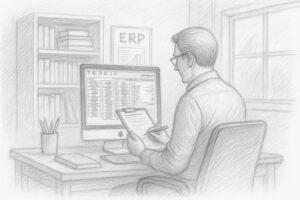 In addition to the issue of visibility, internal efficiency is a decisive lever for many companies. Structures that have grown over the years often lead to unnecessary frictional losses: duplicate data entry, unclear responsibilities or a lack of transparency in processes. This is precisely where a customized Customizable ERP solution on a FileMaker basis. Instead of rigid standard software, a system is created that adapts to the actual processes in the company - not the other way around. Data remains accessible, processes become traceable and can be optimized in a targeted manner. This not only saves time, but also reduces sources of error and coordination problems in day-to-day operations. This is often more effective than any short-term external measures, especially in economically difficult times. Those who have their internal processes under control regain room for maneuver - and can concentrate more on what really drives the company forward.
What political signals could now achieve
Politics alone cannot save an economy, but it can stabilize it. Reliable, transparent and long-term decisions are crucial right now. Companies need to know what they can expect. A country that exudes confidence attracts investment - a country that produces uncertainty loses it.
We don't need ever more complex support programs, but simple, comprehensible framework conditions. Less regulation, less bureaucracy, less intervention in market mechanisms - and more clarity instead. That would be enough for many companies to start new projects again.
Scenarios for 2026 - sober, but not pessimistic
If you take a realistic view of the current situation, the next one to two years will probably not be easy. The structural problems will not be solved overnight and some sectors will remain under pressure. It is therefore reasonable to expect 2026 to be a rather subdued year.
But:
The real turning point could come from a completely different direction - from a productivity boost the likes of which we have not seen for decades. The combination of AI, automation, new working models and falling costs for digital tools will gradually take effect. Probably not immediately. But noticeably.
Those who start using these technologies today will have a competitive edge in two or three years' time. That's why the most important step now is not to keep your head down, but to make targeted preparations.
Why difficult years are often followed by the strongest phases
Even if looking back seems sobering, it is worth looking forward. Throughout its history, Germany has always shown strength when it has had to overcome difficult phases. It often took longer than one would have hoped, but the subsequent upswings were often more powerful than expected.
The next few years will not be a sure-fire success. But they offer an opportunity to reorganize structures, make companies more efficient and use technological developments as a tool rather than a risk. Precisely because many things are in upheaval, there is room for something new.
And those who use this space will benefit the most when the economy picks up again. The path will not be without effort. But it will lead upwards - perhaps not immediately, but reliably. And it is worth setting the right course today.


Frequently asked questions
- What role will the years 2020 to 2025 play overall for economic development in Germany?
The five years constitute a continuous period of stress that is hardly comparable with previous cycles. The pandemic, energy crisis, inflation, supply chain problems and interest rate hikes did not come one after the other, but overlapped. As a result, the economy barely had a chance to recover. Much of what we perceive as a structural problem today is the result of this prolonged exceptional situation. - Why has the economy not recovered as expected after the pandemic?
Because the problems did not simply disappear, but shifted to other areas. When the lockdowns ended, supply chains were destroyed. When these slowly recovered, the energy crisis came. And while this was being dealt with, inflation set in - with interest rates subsequently rising sharply. It was like a chain of aftershocks that repeatedly prevented a real recovery. - Why are insolvencies considered a particularly important indicator?
Because they are not based on expectations, but show the actual inability of a company to remain economically viable. While sentiment indicators convey a feeling, insolvencies show the reality. An increase over several years indicates deeper structural weaknesses. - Have SMEs suffered more from the crisis than large companies?
In many cases, yes. Large corporations have reserves, international locations, better financing options and their own energy contracts. SMEs are more closely tied to Germany, have less of a buffer and are hit harder by bureaucracy and high costs. This is precisely why the pressure in this area is particularly high. - Why are companies currently so hesitant to invest?
Because they are simultaneously confronted with high uncertainty, high prices, expensive loans and weak demand. In such a situation, every investment becomes a risk. As a result, many companies are only taking a long-term view instead of implementing long-term plans. - How strongly do energy prices influence Germany as a business location?
Very strong. Energy is indispensable for production and services. If energy is permanently more expensive than in other countries, this has a direct impact on competitiveness. Some companies therefore relocate investments or production abroad because they have more planning security there in the long term. - Why does bureaucracy play such a big role?
Because every additional process, every new regulation and every reporting obligation costs time and money. For large companies, this is a nuisance - for smaller companies, it can threaten their existence. In recent years, Germany has built up a density of regulation that is noticeably paralyzing many companies. - How does inflation affect the economy in the long term?
Even if inflation falls, the price level remains high. This means that consumers can afford less, companies have higher costs and the pressure to increase wages remains. In addition, the burden of higher financing costs increases because loans have become more expensive. - Why is the mood in the boardroom such an important factor?
Because economic decisions are always influenced by psychology. If entrepreneurs lack confidence in the future, they invest less, hire fewer employees and put projects on hold. A pessimistic mood can slow down an economy just as much as hard facts. - Which sectors are most affected?
Trade, gastronomy, tourism, construction and many parts of industry are under pressure. Each sector has its own reasons: Sluggish consumer spending, high energy prices, a shortage of skilled workers or expensive financing. The decline in the construction industry is particularly critical because this sector is dragging down many other areas. - Why does it take so long to solve the problems?
Because many of the causes are structural. Energy prices, demographics, bureaucracy or a lack of planning security cannot be corrected in just a few months. They have developed over years and therefore take years to improve. - What can companies do now to stabilize themselves?
You can review cost structures, simplify processes, build up liquidity reserves and digitalize in a targeted manner. And above all: get to grips with AI at an early stage to automate recurring tasks and free up resources. Companies that start now will be in a much better position in 2026-2028. - Why should entrepreneurs not be afraid of AI?
Because AI is not a threat, but a tool—just like computers, the Internet, or ERP systems were in the past. Those who ignore AI lose time and productivity. Those who use it gain a competitive edge. AI primarily takes over routine tasks and frees up time for more meaningful work that can help people become better versions of themselves. - What are the specific effects of the skills shortage?
Many companies cannot find enough qualified applicants, which leads to overwork in the existing team. Projects are delayed, orders have to be canceled and growth is slowed down. The shortage of skilled workers is not a temporary problem, but a long-term issue due to demographic change. - Are there also positive developments in the German economy?
Yes, even if they are often overshadowed at the moment. Many companies are modernizing their work processes, relying on new technologies, expanding international contacts or specializing. In addition, every crisis leads to weaknesses becoming visible - and this is precisely what creates the pressure to do things better. - Why is productivity so important for the future?
Because productivity determines how much value a company or a country can generate. If productivity increases through AI, automation and better processes, costs can fall, wages can rise and even working hours can be reduced. Higher productivity is the most important factor for long-term prosperity. - Will the situation improve in 2026?
Probably only slowly. Some negative factors will still be with us. But at the same time, technological developments, especially AI, are creating a new growth spurt. Companies that take advantage of this early on will lead the upswing. - How long will it take for the economy to really pick up again?
A conservative estimate: two to four years. That depends on how quickly energy prices are stabilized, how much bureaucracy is reduced and how courageously companies invest in new technologies. The next big upswing will not come from traditional measures, but from a massive increase in productivity. - What can each individual do to support this development?
Continue your education, embrace technological developments, develop new skills and be open to change. The economy is changing anyway - those who remain agile will benefit from this. - Why optimism is appropriate despite everything
Because historically, the German economy has often developed the greatest capacity for renewal in difficult phases. The combination of experience, know-how, medium-sized structures and new technologies offers the opportunity for one of the strongest recoveries in recent decades. It will take time - but there is no reason to be discouraged.
Older news on Germany's economy
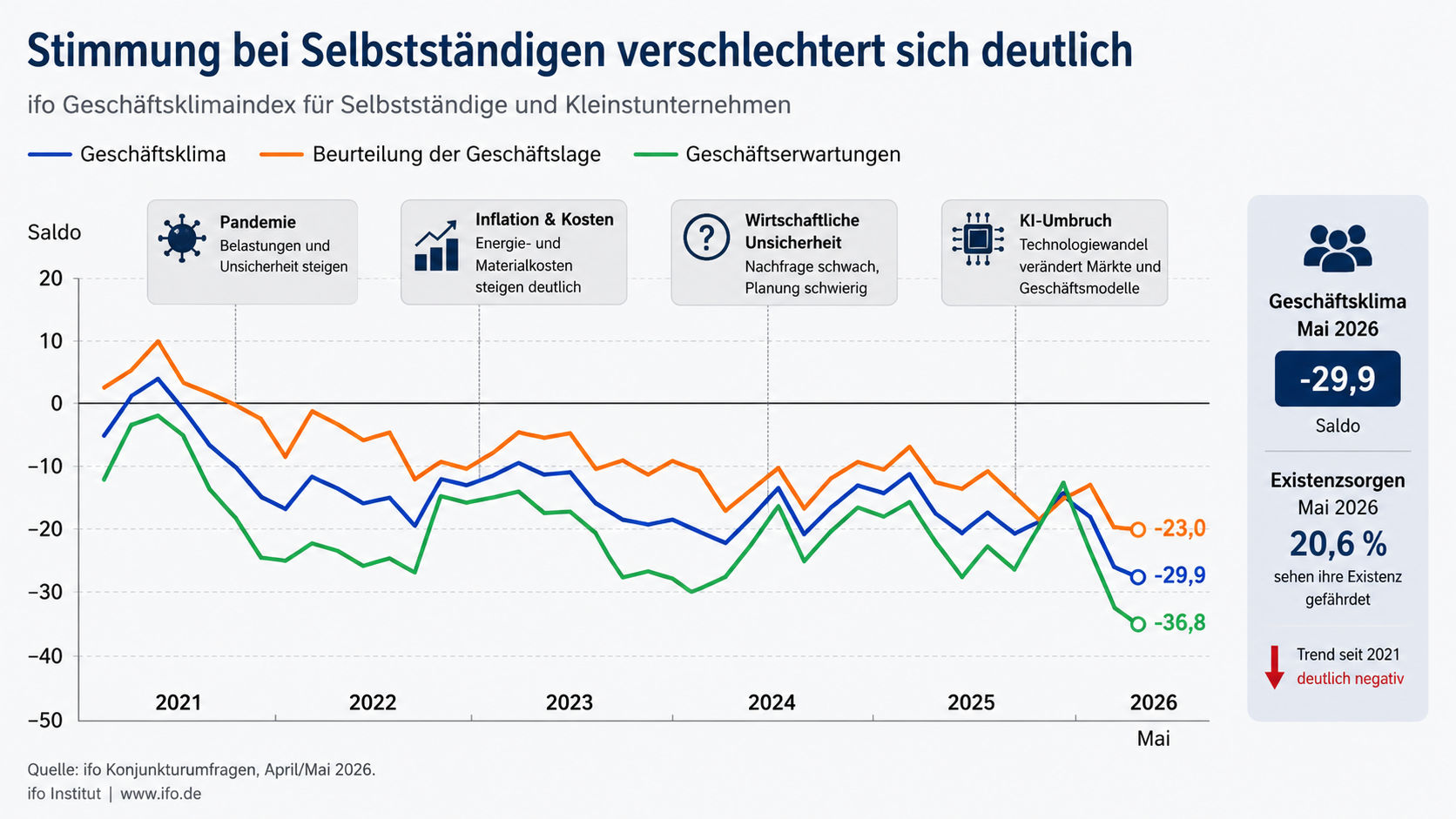
20.05.2026: A current Survey by the ifo Institute shows how tense the situation is for many self-employed people and small businesses. More than one in five self-employed people in Germany see their economic future threatened. Solo self-employed persons and micro-enterprises with fewer than nine employees are particularly affected. Almost half of those surveyed complain about a lack of orders. At the same time, the business climate has fallen to a new low according to the ifo index. The reasons for this include economic uncertainty, weak demand and reluctance to invest on the part of many companies.

Ifo index falls to corona level | Handelsblatt
The figures show that the problems now extend far beyond individual sectors. Smaller businesses in particular are coming under increasing pressure, while many companies are postponing investments and focusing more on cost reduction and stabilization. Economic uncertainty will therefore remain a key issue for many self-employed people and SMEs in 2026.
13.05.2026: The German Association of the Automotive Industry (VDA) is now expecting a Significantly greater job cuts than previously assumed. According to current calculations, a total of around 225,000 jobs could be lost in the German automotive industry by 2035 - around 35,000 more than predicted just a few years ago. According to the VDA, suppliers are particularly affected, as the transition from the classic combustion engine to electromobility is triggering far-reaching changes in production and value creation. At the same time, the association speaks of an ongoing location crisis in Germany and Europe. High energy prices, rising wage costs, bureaucracy and international competition are further exacerbating the situation. The discussion once again shows the extent to which German industry is currently undergoing radical change. While some experts continue to see great opportunities for the sector, there is also growing concern about the long-term economic consequences for industrial locations, SMEs and the labor market. The question of how quickly the industry can actually adapt to the new technological and geopolitical conditions remains particularly interesting.
29.04.2026: The ifo Institute paints a Increasingly tense picture of the German labor market: companies are planning further job cuts across all sectors. According to current evaluation hardly any sector is spared„ - in addition to industry, trade, services, logistics and even tourism are affected. Rising costs in particular, for example for energy and fuel, are having a direct impact on personnel planning. Although the downsizing has recently slowed down slightly, there is no sign of a real trend reversal. Instead, a structural adjustment process is evident that has been ongoing for years and is being exacerbated by weak demand, international competitive pressure and economic uncertainty. This trend is particularly pronounced in industry, while in some service sectors redundancies and new hires are partially balanced out. Overall, there are signs of a phase of sustained restraint on the labor market - with noticeable consequences for growth, investment and employment in Germany.
15.04.2026The German government is planning a new tax and duty-free relief bonus of up to 1,000 euros for 2026, which employers can voluntarily pay out to their employees. The measure is based on the previous inflation compensation bonus, but is significantly lower and limited in time until the end of 2026. For companies, this means a flexible instrument for employee retention, as the payment is tax-privileged, but also additional financial pressure in an already tight economic situation. Associations such as the skilled trades criticize the fact that the relief is effectively being shifted to the companies and that many companies cannot afford the premium at all. It is also unclear how broadly the measure will actually work, as it is voluntary and is often linked to collective bargaining agreements, which means that some employees may miss out. All in all, it can be seen that the relief bonus was quickly decided on politically, but its practical effect on a broad scale is uncertain.

Crisis bonus: 1000 euros tax-free from the boss! „Employers will thank you“ | IMAGE
25.03.2026: VW examines entry into arms production - Iron Dome components from Osnabrück? Volkswagen could produce parts for the Israeli „Iron Dome“ air defense system at its Osnabrück plant in the future. Talks with the Israeli armaments company Rafael Advanced Defense Systems are the background to this, according to several media reports. The plant is currently facing an uncertain future, as vehicle production is expected to end in 2027. Around 2,300 jobs could be saved by switching to defense production. The plan is apparently to manufacture components such as transport vehicles, launchers and generators - but not missiles themselves. The German government is said to support the project, while Volkswagen officially emphasizes that it is not aiming for weapons production. Whether and to what extent the plans will be implemented remains to be seen. The potential move raises fundamental questions: will a German automotive group enter the military supply industry in the future - and will Osnabrück become a location for modern air defense systems?
22.03.2026This current video by entrepreneur Emanuel Böminghaus paints a clear picture of the current state of the German economy and is based on concrete figures from the DATEV SME index, Destatis and industry associations. SMEs in particular are under pressure: declining incoming orders, a slump in profits by double-digit percentages in some cases and increasing burdens due to costs and regulation characterize the situation. There are clear weaknesses in industry, for example in the mechanical engineering and chemical sectors, some of which are already reaching their limits. At the same time, job cuts are increasing noticeably - over 80,000 jobs were affected in February alone. At the same time, a discrepancy between political representation and economic reality is being addressed. Overall, the picture that emerges is of an economy whose stability is coming under increasing pressure and where structural problems are becoming ever more apparent.

Germany in a stall - the numbers are brutal | Emanuel Boeminghaus
As mentioned in the video, the income from the Corporation tax slumped massively in January 2026 - by around 79 % to only around 181 million euros. This is mainly due to significantly lower back payments by companies, while at the same time more refunds were made. The Federal Ministry of Finance also points to the weak economic development, particularly in industry, which is having a negative impact on the profits of many companies. Similar declines can also be seen in trade tax. Overall, it is clear that falling corporate profits are increasingly having a direct impact on government revenue and are seen as an early indicator of the economic situation.
05.03.2026The economic crisis in Baden-Württemberg is a good example of the depth of structural change in Germany. The ZDF magazine „Country mirror“ accompanies companies that are on the verge of going out of business and describes how insolvencies, energy costs and global competition are putting pressure on medium-sized companies. Suppliers in particular are feeling the effects of the changes: Many have little chance of holding their own against locational disadvantages and declining orders.

Economic crisis in Baden-Württemberg: between insolvencies, job cuts and fear of the future
The reportage makes it clear how strongly deindustrialization and transformation are already affecting the everyday lives of employees - and how much the economic basis of the southwest has been shaken.
According to current Figures from Creditreform Economic Research the number of corporate insolvencies in Germany rose significantly in 2025. In total, around 23,900 companies filed for insolvency, an increase of around 8.3% compared to the previous year and the highest figure for more than a decade. Small companies with up to ten employees are particularly hard hit, accounting for over 80 percent of bankruptcies. The results reflect ongoing structural burdens, including high costs, difficult access to credit and competitive pressure. No trend reversal is expected in 2026 either, as many companies continue to suffer from economic weakness and economic headwinds.