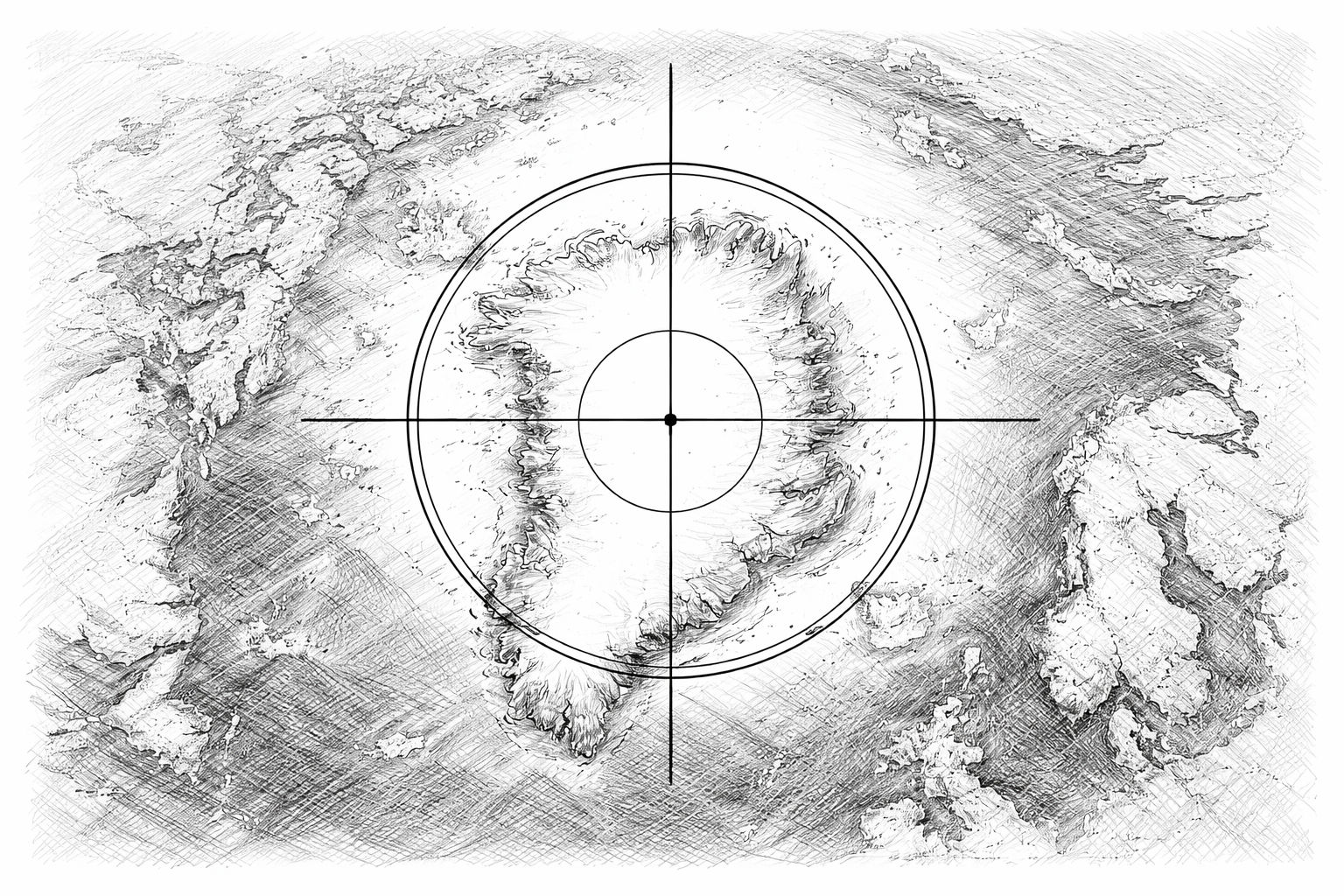
There are topics that you don't actively engage with, but that simply force themselves on you at some point. For many people - including me - Greenland has long belonged in this category. A large, remote island in the far north, a small population, lots of ice, lots of nature. Not a classic everyday topic, not a political hot topic. That has changed noticeably in recent months.
The increasing number of reports, comments and headlines about Greenland - and especially Donald Trump's repeated statements - have suddenly put the island at the center of an international debate. When a former and possibly future US president speaks publicly about wanting to „buy“, „take over“ or take control of an area, this inevitably attracts attention. Not because such statements should immediately be taken seriously - but because they raise questions that should not be ignored.




Latest news about Greenland
16.03.2026The political situation in Greenland has been set in motion again: The social democratic party Siumut has announced its intention to leave the governing alliance and thus triggered a government crisis. The background to this is an internal party dispute over two ministers who want to run in the upcoming parliamentary elections in Denmark. This move was met with clear criticism from the party leadership and ultimately led to the decision to leave the coalition. Prime Minister Jens-Frederik Nielsen regretted the move and warned that this would send the wrong signal in view of the geopolitical tensions surrounding the Arctic island. Although the government will retain its parliamentary majority without Siumut, it will lose an important partner. At the same time, Foreign Minister Vivian Motzfeldt announced her resignation, as she did not support her own party's course and this would make her work in the ongoing negotiations with Denmark and the USA more difficult.
22.02.2026US President Donald Trump has surprisingly announced his intention to US hospital ship to Greenland which is supposed to provide medical aid for citizens there. In a post on his Truth Social platform, Trump wrote that the ship was „on its way“ and was intended to care for people who „are not getting the help they need“. It remained unclear whether there was a specific medical need or whether the deployment had been coordinated with Denmark or the Greenland government. Observers see the announcement as a further irritating factor in the relationship with NATO partner Denmark against the backdrop of existing tensions over Trump's repeated calls for greater US involvement in Greenland and potential negotiations.

GREENLAND: What's behind the hospital ship „USNS Mercy“ | WELT news channel
21.01.2026: At the World Economic Forum in Davos, US President Donald Trump presented his controversial Demands on Greenland reaffirmed (German: ZDFtoday) and at the same time declared that he would not use military force to bring the strategically important island under US control. Trump called for „immediate negotiations“ on a possible acquisition of Greenland and reiterated that the US was in the best position to secure the territory. His speech was met with harsh criticism from European politicians and rejection from Denmark, which clearly rules out talks on a handover. Several EU states and NATO partners expressed concern about Trump's views, while Greenlandic Prime Minister Jens-Frederik Nielsen rejected any US claim.
After a News from the Berliner Zeitung Donald Trump has now refrained from imposing additional punitive tariffs on Greenland. He emphasized that there was already a framework for a future agreement with Greenland.
09.01.2026: US government representatives have According to current reports considered offering Greenlanders one-off payments of between 10,000 and 100,000 dollars to convince them to join the USA. This would be part of the debate about Trump's plans to strategically tie Greenland to Washington. Denmark and Greenland clearly rejected such ideas and emphasized the right to self-determination.
The controversial question of what US President Donald Trump's repeated statements about Greenland mean for NATO and the international system was discussed in a ZDFheute live program. Former US General Ben Hodges and ZDF correspondent Henner Hebestreit examined on camera how a possible claim to Greenland - an autonomous region of NATO partner Denmark - could lead to considerable tensions in Europe's security architecture. While Trump is causing outrage across Europe and linking his rhetorical threats to actual foreign policy steps, experts warned of an erosion of common values and alliance commitments. The program invited viewers to ask questions live and critically reflect on the future of the global order in light of such statements.

What will happen to NATO if Trump attacks Greenland | ZDFtoday
Why Greenland is suddenly back in the spotlight
At first glance, Trump's statements on Greenland appear to be a mixture of provocation, business rhetoric and geopolitical power politics. But regardless of how you assess his personality or his style, such statements almost automatically lead you to ask yourself what this is actually about. Who owns Greenland? Who should decide on it? And on what basis could something like this even be discussed?
Precisely because the public debate is often very quickly characterized by ridicule, outrage or reflexive rejection, there is a need to take a step back. Not to defend or demonize Trump, but to understand the basis of this discussion - historically, legally and politically.
Between headline and substance
It is striking how strongly media reporting tends to reduce complex issues to a single word: „purchase“. This word is catchy, emotional and easy to convey. It suggests a simplicity that does not do justice to reality. States are not real estate. Nations are not bargaining chips. And territories with their own population, history and political structure cannot be transferred like shares in a company.
This is precisely why it is worth looking behind the headlines. Not to relativize them across the board, but to classify them. It often turns out that the actual topic is less spectacular but much more interesting than the exaggerated portrayal.
Greenland as a projection surface
Greenland is particularly well suited as a projection surface: huge, sparsely populated, rich in raw materials, strategically located. At a time when the Arctic is gaining geopolitical importance, the island suddenly appears to be a key region. The fact that this is arousing desires - not only in the USA - is not a new phenomenon. What is new is the openness with which it is being discussed.
However, something is in danger of being lost: Greenland is not just a strategic area, but a living space that has evolved historically. Anyone who talks about Greenland inevitably also talks about the people who live there - and about the long lines that have led to today's political conditions.
Why it is necessary to look back
In order to assess how realistic or unrealistic statements about a „takeover“ of Greenland are, it is not enough to string together current quotations. We need to look back: to the early settlement, to the role of Denmark, to the transition from colonial territory to self-government and to the long history of foreign interests in the island.
Only when these basics are clear can we assess what today's statements actually mean - and what they don't mean. This is precisely the approach that this article aims to take: not indignant, not appeasing, but rather organizing.
A sober starting point
Greenland has not suddenly become important as a result of Trump's statements. It has been important for a long time - just more quietly. The current debate is therefore not so much a new chapter as an opportunity to finally read an old book carefully. Before talking about possible future scenarios, it is worth understanding the history that has led to this point.
And this is where the real view of Greenland begins.
Historical overview: Greenland from the first settlers to the present day
This English-language video provides a comprehensive historical overview of Greenland and places the latest political discussions in a long temporal context. The starting point is the international attention that Greenland received as a result of Donald Trump's statement that he is interested in buying the island. From there, the video takes us chronologically through the history of Greenland: from the first prehistoric settlers to the Inuit cultures and the Viking Age to Danish colonial rule and the path to autonomy.

The History of Greenland - From Prehistory to Modern Times | History and Mythology
Less well-known chapters such as Greenland's role in the Second World War, American protection interests and the so-called „Whiskey War“ are also covered. The video is particularly suitable for readers who are looking for a structured, historically sound introduction and have no problem with English-language material.
Greenland before Europe - early settlement and cultural continuity
When people talk about Greenland today, they sometimes get the subliminal impression of a largely uninhabited space - large, cold, strategically interesting, but historically little shaped. This impression is misleading. Greenland was never just an empty area on the map. People lived there long before Europe even began to take an interest in the region.
Archaeological finds show that Greenland was settled by humans over 4,000 years ago. These early inhabitants did not live permanently and extensively on the island, but adapted to the extreme conditions in temporary phases. Even then, Greenland was not a place for expansion, but for adaptation.
Early civilizations: life on the edge of the possible
The earliest known cultures include the Saqqaq culture and the so-called Independence cultures. These groups lived mainly from hunting, fishing and catching marine mammals. Their existence was closely linked to the climate, the ice conditions and the available resources.
These cultures did not disappear through conquest or displacement, but presumably through a combination of climate change, isolation and limited livelihoods. The decisive factor here is that Greenland was never „abandoned“, but was repopulated again and again as soon as conditions allowed.
The arrival of the Inuit: a lasting imprint
The most culturally and historically formative phase begins with the Thule culture, whose members came to Greenland from around the 13th century. They are considered the direct ancestors of today's Inuit population.
These people brought with them highly developed knowledge that was precisely adapted to the Arctic conditions:
- Flexible hunting techniques
- Sophisticated use of animal materials
- social structures based on cooperation and experience
In contrast to earlier cultures, they were able to adapt permanently to their environment. Their way of life formed the basis for the cultural continuity that still exists today.
Today's Greenlandic society cannot be understood without these roots. Language, traditions and self-image can be traced directly back to these early Inuit cultures. Even though the way of life and technology have changed considerably over the centuries, the cultural identity is not the result of European influences, but is much older. This is a central point for any debate about Greenland today:
The population has not been „settled“ retrospectively, but has grown historically. Greenland is not an artificial entity, but home.
Greenland as a habitat, not as a possession
This early history shows something fundamental: Greenland was always an area that demanded respect for the environment. If you wanted to live there, you had to adapt - not the other way around. Expansion, exploitation or large-scale control were simply impossible for thousands of years.
This historical experience also shapes the way many Greenlanders see themselves today. The island is not seen as an object, but as a living space whose use requires responsibility. This view differs significantly from foreign policy or economic perspectives, which see Greenland primarily as a strategic area or source of raw materials.
A long history as the basis for today's rights
The early settlement of Greenland is more than just a historical detail. It forms the basis for Greenland being understood today as the homeland of its own people - with its own language, culture and identity. The right to self-determination, which plays a central role in modern international law, is also derived from this.
Anyone talking about the future of Greenland cannot ignore this past. It explains why questions of belonging, sovereignty and decision-making authority are particularly sensitive here - and why simple solutions do not work.
Vikings, kingdoms and the path to European power structures
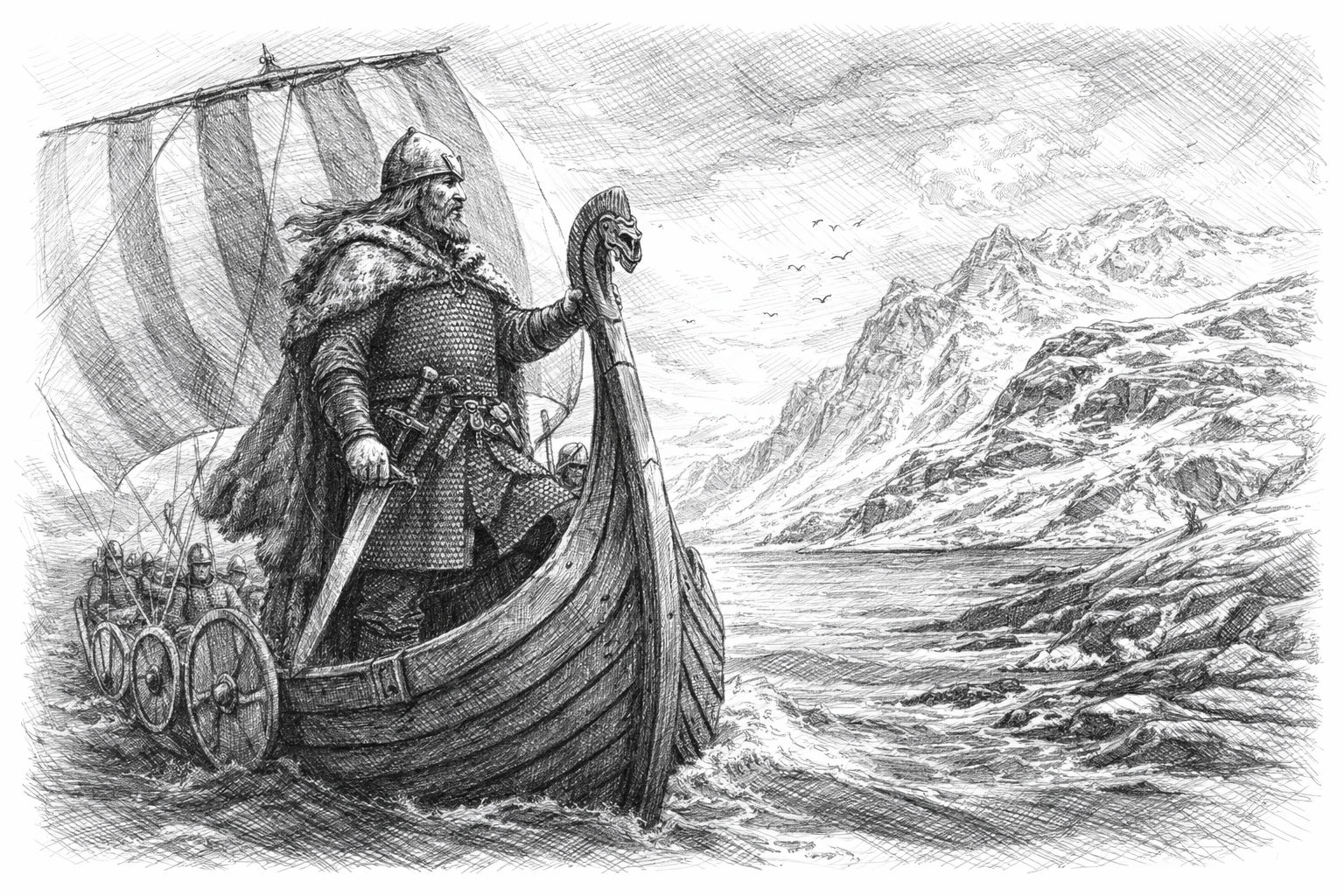
The European view of Greenland begins towards the end of the 10th century. Around the year 985, the Viking exile from Iceland reached Greenland. Erik the Red the southwest coast of the island. He founded several settlements there and gave the country its name, which is still in use today:
Greenland.
The name was less a geographical description than a strategic decision - a deliberately positive term to attract settlers.
The Vikings established two large settlement areas, an eastern and a western settlement. Several thousand people lived there for several centuries. They raised livestock, farmed to a limited extent and traded, among other things, ivory from walrus tusks. Greenland was thus integrated into the Nordic trade network, albeit at the very edge.
Life at the limit: Why the Viking settlements disappeared
Despite their astonishing endurance, the Norse settlements disappeared completely in the course of the 15th century. Exactly why is still not fully understood. Several factors probably came together: an increasing cooling of the climate in the course of the so-called Little Ice Age, economic decline, isolation from Europe and a limited ability to adapt to the harsh environmental conditions.
It is noteworthy that the Vikings largely retained their way of life instead of adapting it more to the Arctic conditions - in contrast to the Inuit, whose strength lay precisely in this. The Norse presence on Greenland was therefore historically significant, but not permanent.
Greenland and the Norwegian Kingdom
Politically, the Vikings regarded Greenland as part of the Norwegian sphere of influence. The island was subordinate to the Norwegian king, even if actual control remained loose. This formal assignment is crucial, as it represents the first step towards Greenland's integration into European state structures.
In 1380, there was a personal union between Denmark and Norway. From then on, both kingdoms were ruled by one king. Greenland thus fell indirectly under Danish influence, without much changing on the ground at first. The island remained remote, difficult to reach and politically marginalized.
For centuries, Greenland existed more on paper than in everyday European politics. Nevertheless, the formal affiliation remained. This legal continuity is one of the reasons why later claims to Greenland did not have to be re-established, but were based on existing legal lines.
It was not until the Peace of Kiel in 1814 that a decisive turning point occurred. After the Napoleonic Wars, Norway was separated from Denmark and handed over to Sweden. However, Denmark retained its non-European possessions - including Greenland. Greenland was thus clearly and permanently assigned to the Danish state.
From de facto absence to formal responsibility
At first glance, this development may seem paradoxical: an island on which there was hardly any European presence at times was clearly assigned to a European state under international law. Yet this is precisely the essence of modern statehood: it is not continuous settlement but recognized legal lines and international treaties that create a sense of belonging.
Greenland thus became part of the European order without being European itself. The indigenous population remained, while a new legal structure was established over it. This tension between historical independence and formal affiliation still characterizes Greenland today.
The beginning of a long relationship
The assignment to Denmark marked the beginning of a connection that would become more and more firmly established over the next few centuries - at first barely noticeable, but later becoming more and more concrete. The Viking Age marked less the beginning of European control than the start of a system of claims, responsibilities and state continuities.
To understand why Denmark plays a central role in the Greenland issue today, it is important to understand this development. It explains why modern debates do not start from scratch, but are based on historical decisions that go back a long way.
From colonial territory to self-government
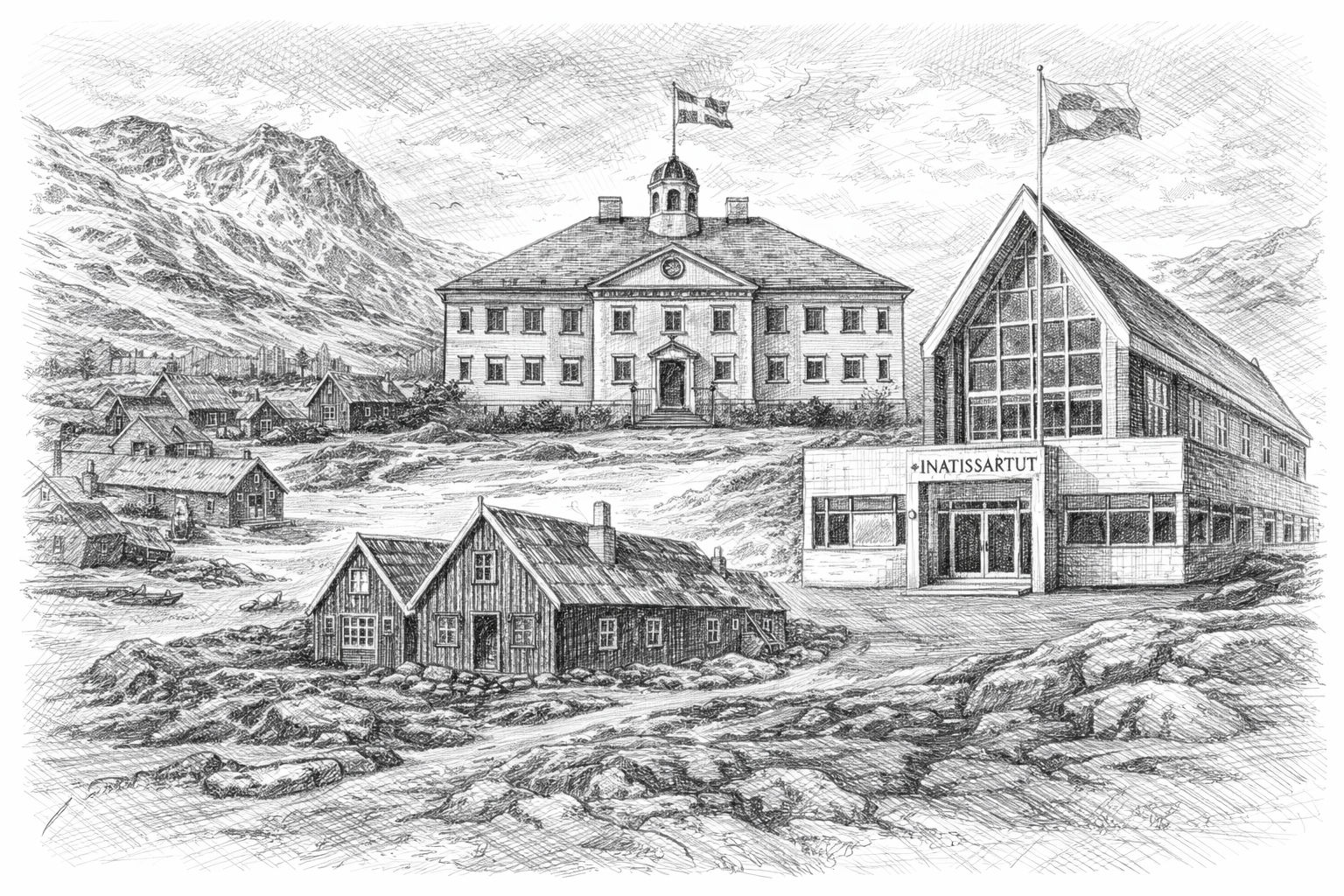
Although Greenland had already belonged to Denmark under international law since the early 19th century, systematic colonial administration only began in the 18th century. In 1721, the Danish-Norwegian missionary Hans Egede began his work in Greenland. His aim was to Christianize the population and reconnect with the supposedly „lost“ Nordic settlements.
The missionary work was gradually accompanied by the establishment of a solid administrative and trade structure. Denmark established trade monopolies, regulated the movement of goods and tied Greenland closely to the mother country economically. Political control remained comparatively restrained for a long time, but economic dependence grew steadily.
The colonial order had ambivalent consequences. On the one hand, medical care, schools and a certain economic stability were created. On the other hand, the trade monopoly led to dependencies and considerably limited the independence of the Greenlandic population.
Greenland was not regarded as an equal part of the state, but as a protected area to be administered, managed and developed. Decisions were mainly made in Copenhagen. The Greenlandic population had little influence on political processes that affected their own lives.
This phase has shaped the relationship between Greenland and Denmark to this day. Many structural issues, such as economic independence or cultural recognition, have their origins here.
1953: The formal end of colonial status
A decisive turning point came in 1953, when Greenland officially lost its colonial status and was integrated as an equal part of the Kingdom of Denmark. The Greenlandic population was granted Danish citizenship and Greenland became part of the Danish constitution.
Legally, this step meant equality. Politically and socially, however, an imbalance remained. Many decisions continued to be made centrally and Greenland's cultural independence was only recognized to a limited extent.
Nevertheless, this step marked the beginning of a fundamental change: Greenland was no longer a colony, but part of a modern state - with all the resulting tensions.
The path to home rule
In the following decades, awareness of the need for greater self-determination grew. Especially in the 1960s and 1970s, the Greenlandic autonomy movement gained in importance. The demand was not for separation, but for co-determination.
Denmark finally introduced Home Rule in 1979. Greenland was given its own parliament and government for the first time. Certain responsibilities, for example in the areas of education, culture and social affairs, were transferred to Greenlandic institutions.
This step was historically significant because it brought political responsibility closer to the Greenlandic population for the first time.
2009: Recognition of the right to self-determination
Another milestone followed with the Self-Government Act of 2009, which went far beyond Home Rule. It explicitly recognized that the Greenlandic people have their own right to self-determination - a central concept in modern international law. Greenland has been self-governing ever since:
- its internal affairs
- the education and healthcare system
- the use of natural resources
Denmark retained responsibilities for foreign policy, defense and currency. At the same time, it was determined that a possible independence of Greenland could only be decided by the will of the people.
A new relationship between Greenland and Denmark
With self-government, the relationship changed fundamentally. A colonial relationship became a partnership based on legally defined responsibilities. Tensions still exist, particularly in economic matters, but today they are negotiated politically and no longer imposed administratively.
This point is crucial for the current debate on Greenland: Greenland is no longer a foreign-administered territory. It has democratically legitimized institutions and a recognized right to make its own decisions.
Today's responsibilities at a glance
| Range | Responsibility today | Why this is relevant to the Greenland debate |
|---|---|---|
| Domestic policy / Administration | Greenland | Greenland has its own government and parliament. Central day-to-day decisions are not made in Copenhagen. |
| Education & Culture | Greenland | Language, identity and cultural development are entirely in Greenlandic hands - a key aspect of self-determination. |
| Healthcare & Social Affairs | Greenland | The social infrastructure is organized independently, which requires political ownership. |
| Natural resources (raw materials, mining, energy) |
Greenland | Greenland decides on exploration and exploitation itself. This makes external „takeover“ fantasies almost impossible to control economically. |
| Economic policy (internal) | Greenland | Economic development is controlled locally; dependencies are politically negotiable, not externally determined. |
| Foreign policy | Denmark (in agreement with Greenland) |
Formal foreign representation lies with Denmark, but Greenland is increasingly directly involved - a transitional model, not a foreign command. |
| Defense & Military | Denmark (NATO framework) |
US military presence is based on treaty, not possession. Security ≠ Sovereignty. |
| Currency & monetary policy | Denmark | A classic feature of state ties, but not an exclusion criterion for autonomy or later independence. |
| Citizenship | Denmark | Greenlanders are Danish citizens - a legal protection factor against external claims. |
| Constitutional status | Kingdom of Denmark + Self-administration law |
Greenland is legally embedded, but with a recognized right to self-determination - a decisive point against any „takeover“. |
| Right to independence | Greenland | A change of status can only be decided by the Greenlandic people themselves - not from outside. |
Why this development is so important today
Anyone talking about the future of Greenland today is talking about an area with its own political voice. Statements about „purchases“ or „takeovers“ completely ignore this development. They fall back on a way of thinking that is historically outdated.
Greenland's self-government is not a theoretical construct, but a lived reality. It forms the basis for the fact that any discussion about affiliation, cooperation or independence must necessarily include the perspective of the Greenlandic population.
US interests, previous purchase ideas and Trump's push
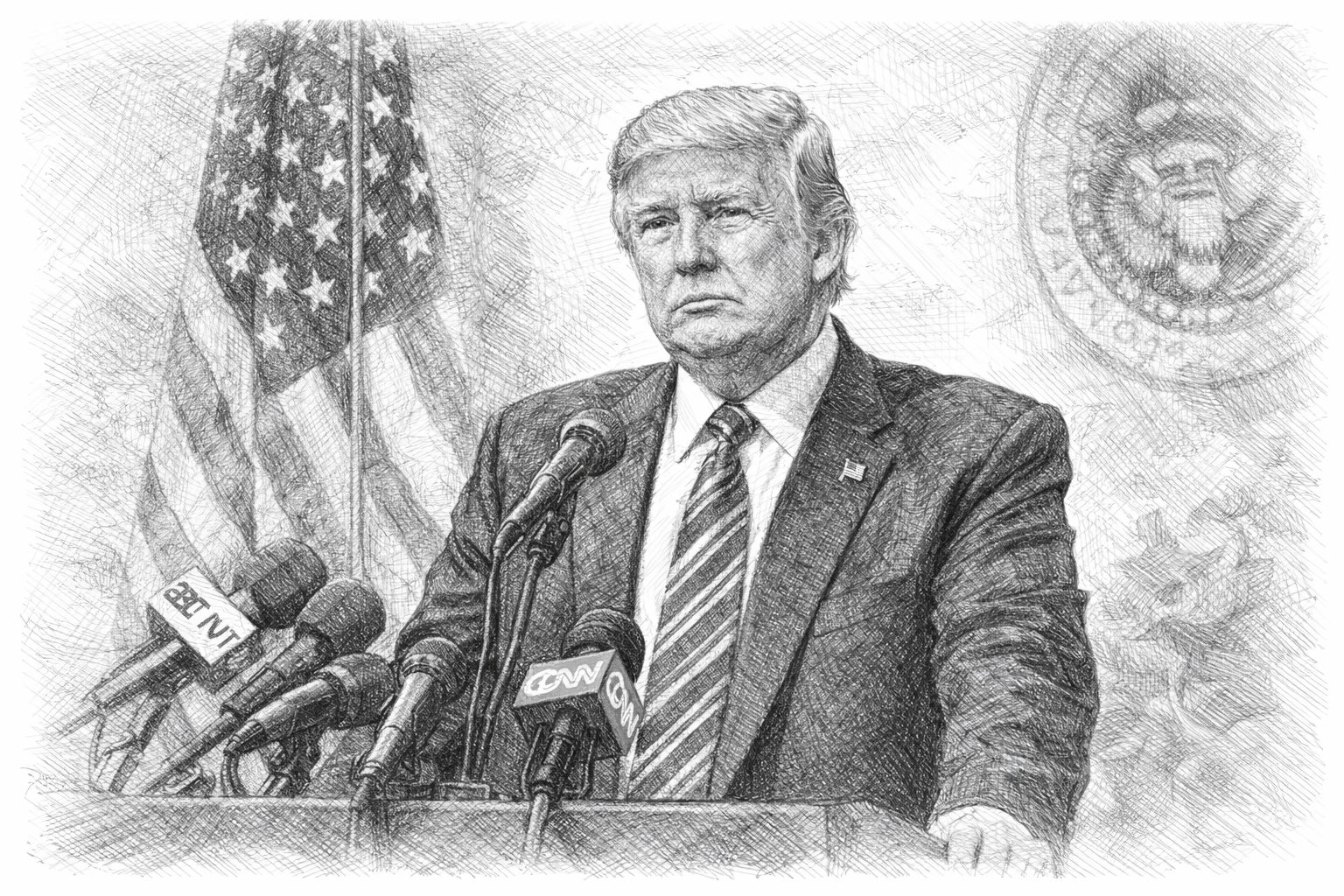
Anyone who has the impression today that the USA has only developed an interest in Greenland because of Donald Trump is mistaken. The truth is that Greenland has been part of American security and power considerations for over a hundred years. The reason is not romantic fascination with the Arctic, but geography: Greenland lies between North America and Europe, on an axis that has always been of military and logistical importance.
With the growing interest in the Arctic - be it for new trade routes, raw materials or military early warning systems - this location has become even more valuable. From the perspective of major powers, Greenland is less a peripheral area than a kind of bridge to the north. And this explains why the island keeps cropping up in American strategy papers.
Previous buying ideas: an old pattern
In fact, the USA was already considering buying Greenland or tying it more closely to Washington in other ways in the 19th and 20th centuries. Such ideas arose in phases in which the USA was expanding its role as a global power or reassessing security policy risks.
The year 1946 is particularly well known, when the USA made Denmark an offer to buy Greenland. Denmark declined. The historical point here is that even without a purchase, the American interest was not without consequences. Instead of acquiring property, the USA expanded its influence through military presence and agreements.
This older story is important because it shows that Trump's push was not the beginning of an interest, but rather a vociferous reprise of an old pattern - with a choice of words that seems unusually crude in modern diplomacy.
Military reality: presence without possession
One key point is often underestimated in debates: the USA is not „on the outside“ in Greenland. Since the Second World War, there have been security policy cooperations that give the United States practical access to strategic infrastructure - without Greenland therefore being American territory.
The best-known example is the Thule Air Force Base (now Pituffik Space Base). It is part of the American early warning and space surveillance system and shows that Washington has long played a strategic role in Greenland. However, this presence is based on treaties and cooperation - not possession.
This is precisely where a crucial difference lies: in reality, international relations often function through influence and agreements. „Ownership“ is neither necessary nor politically expedient.
Trump's choice of words: „deal thinking“ meets geopolitics
When Donald Trump publicly confirmed in 2019 that a „purchase of Greenland“ had been discussed, it seemed like an absurd idea to many. However, this impression is mainly created by the wording. Trump often thinks and speaks in terms of deals, real estate and ownership. However, this language is not only unusual in foreign policy, it is downright misleading.
After all, a territory with its own population, its own history and its own political structure cannot be treated like an island in a real estate catalog. Trump's choice of words thus harks back to a way of thinking that is more suited to the 19th century, when modern states were still taking over, exchanging or buying land. It is therefore understandable that this choice of words caused so much international irritation - and it was precisely this moment of irritation that suddenly made Greenland a media topic.
Reactions from Greenland: cooperation yes, sales no
The reaction from Greenland itself is particularly interesting because it was often more objective than the media debate. The message tended to be clear and at the same time differentiated: Greenland was open to cooperation, investment and economic development - but not for sale.
This is an important point because it shows that the Greenlandic perspective is not simply „anti-US“. Many Greenlanders know that American cooperation can bring economic and infrastructural opportunities. At the same time, the question of affiliation is a red line because it is directly linked to self-determination, cultural identity and democratic decision-making sovereignty.
Reactions from Denmark and Europe: a border becomes visible
Denmark reacted very clearly in 2019. The idea of buying Greenland was rejected as absurd. Even more significant, however, was what happened afterwards: when Trump canceled a planned visit to Denmark, it became clear that a provocative statement can tip over into a diplomatic crisis within hours.
In the later resumptions of the topic - especially from the end of 2024 and the beginning of 2026 - Europe presented a more united front. This reveals a second level: Greenland is not just a Greenlandic or Danish issue, but also a European one, because it is about the integrity of a European state, Arctic policy and alliance issues.
This brought the issue into sharp focus. While there was still a lot of mockery in 2019, later statements were increasingly seen as a test case: How far can a great power go rhetorically when it comes to territories within an alliance system?
The core conflict: „takeover“ as a concept versus reality
If you pull all these reactions together, the core conflict becomes clear: the word „takeover“ does not fit today's reality. Greenland is not an object that could be reassigned from outside. It is an autonomous country within the Kingdom of Denmark, with democratically legitimized institutions and a recognized right to self-determination.
At the same time, Greenland is so important geopolitically that external interests will inevitably grow - whether through the USA, Europe or other powers. This is precisely where the tension arises: between geopolitical logic and political self-determination.
Overview of previous interests in Greenland
| Year / Actor | Event / „Interest in Greenland“ | Why it didn't work out |
|---|---|---|
| 1867-1868 USA (including Secretary of State William H. Seward) |
Following the purchase of Alaska, the USA also considered acquiring Greenland (Arctic expansion, raw materials). Discussions were held and no formal offer was made. | No political tailwind in the USA; the idea was not developed into a concrete, enforceable project (e.g. lack of interest in Congress). |
| 1910 USA (Ambassador Maurice F. Egan / US Government Circle) |
A thought experiment/suggestion: barter deal in which the USA brought territories (including Mindanao/Palawan) into play in exchange for Greenland and Danish colonies. It remained at the level of diplomatic explorations. | Denmark refused; moreover, the construct was politically and diplomatically extremely unlikely (too many parties involved, too complex, too delicate). |
| 1917 USA & Denmark (Danish West Indies / US Virgin Islands) |
In the course of the acquisition of the Danish West Indies (now the US Virgin Islands), the US government explicitly recognized Denmark's claim/responsibility over the whole of Greenland - in effect a consolidation of Danish status, not an attempt to buy it. | Precisely because the USA recognized Denmark's claim (as part of another deal), an acquisition of Greenland became politically less likely - the status quo was strengthened. |
| 1946 USA (President Harry S. Truman) |
Formal purchase offer to Denmark: reportedly 100 million US dollars in gold for Greenland (early Cold War, strategic location, military logistics). | Denmark refused; instead of a change of ownership, it remained with a security agreement and US military rights/presence. Greenland was strategically sensitive for Denmark and politically unalienable. |
| 2019 (August) USA (President Donald Trump) |
Trump publicly confirmed that his administration had discussed a „purchase“ of Greenland. Following Danish rejection, Trump canceled his visit to Denmark; diplomatic disgruntlement included. | Denmark declared the idea „absurd“ and Greenland made it clear: cooperation yes, sale no. Politically and legally, there was no basis for a „purchase“. |
| 2024 (December) USA (Trump as president-elect) |
Trump took up the topic again and spoke of „ownership and control“ as a security policy necessity - more strongly than in 2019, but still without a concrete, realistic mechanism. | Greenland and Denmark again rejected the idea („not for sale“). The term „ownership“ clashes with self-determination and alliance policy. |
| 2026 (January) USA (White House / Trump environment) |
Extended rhetoric: „options“ were discussed, including models of close ties (e.g. COFA-like constructions) - accompanied by a political threat („everything is an option“). | The same applies here: no change of status without Greenland's consent. In addition, Denmark/Europe (and NATO logic) stand as a hard political brake against any form of annexation/takeover. |
Greenland between autonomy, raw materials and new desires
The following documentary paints a multi-layered picture of Greenland between its colonial past, current social challenges and new geopolitical interests. Based on Donald Trump's call for Greenland to become part of the USA, the film shows why these statements are causing great unrest on the island itself and in Denmark.

Greenland between Denmark and Trump ARTE Re:
Greenlanders like Nukannguaq Zeeb, deeply rooted in traditions such as hunting and fishing, are critical of the continuing Danish influence and, despite formal autonomy since 1953, do not see Greenland as truly independent. At the same time, melting ice and accessible natural resources are attracting international investor interests, for example in mining. However, the reportage also reveals the social fault lines: educational deficits, dependencies and a lack of prospects. Greenland is thus caught between old ties and new dependencies - and the desire of many inhabitants to one day decide their own future.
The Thule Incident of 1968: When nuclear weapons crashed over Greenland
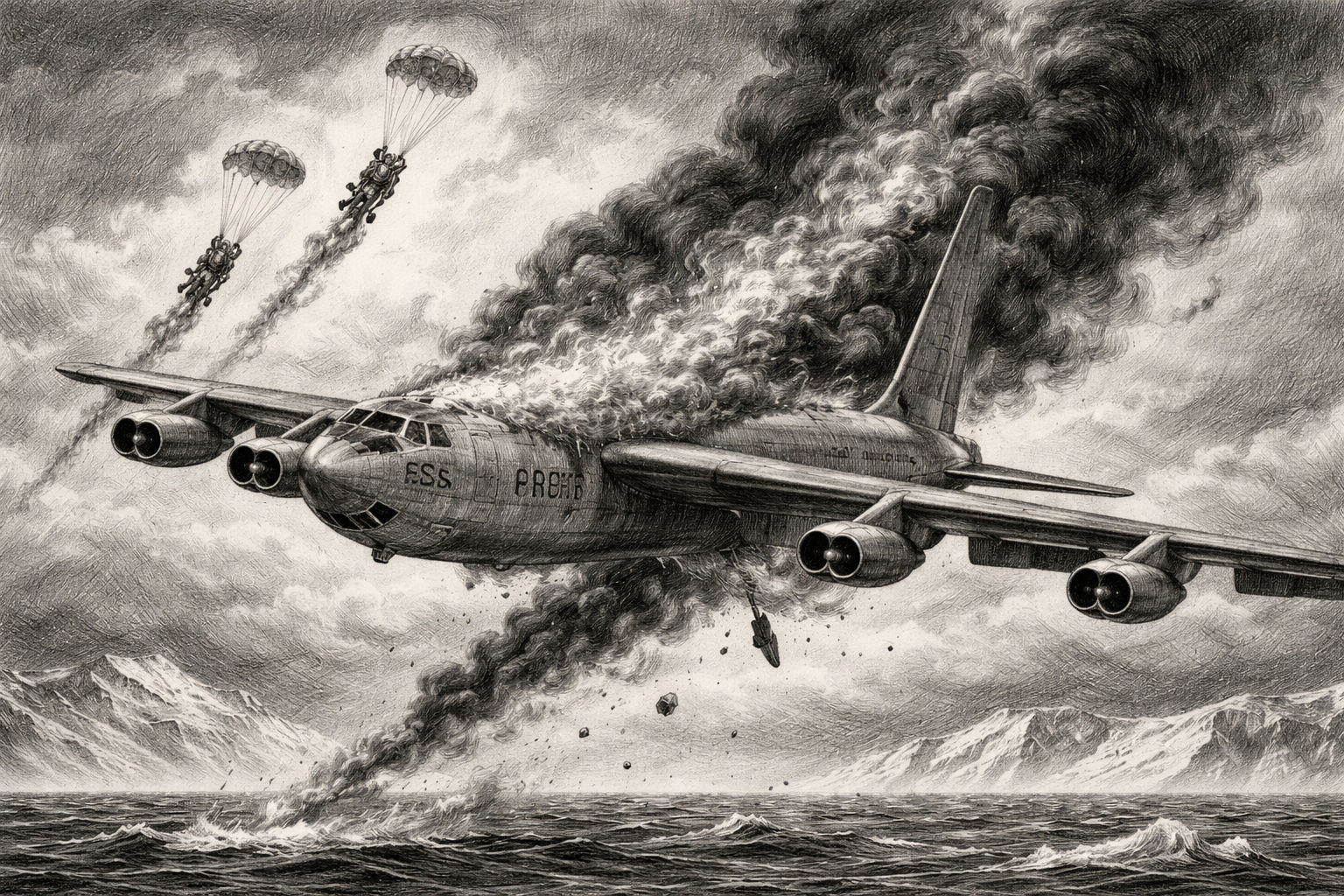
On January 21, 1968, one of the most momentous nuclear incidents of the Cold War occurred near the US airbase Thule in northwest Greenland. An American B-52 bomber crashed during a strategic patrol mission. There were four hydrogen bombs on board. The cause was a fire in the aircraft, forcing the crew to evacuate in an emergency. The aircraft hit the pack ice. Although there was no nuclear explosion, the conventional explosive charges of the bombs detonated on impact. Radioactive materials - particularly plutonium - were scattered over the ice and snow.
The incident was highly explosive politically, as Denmark officially declared a nuclear-free zone on its territory, but Greenland is part of Danish territory. It was only after the crash that it became public knowledge that the USA was permanently deploying nuclear-armed bombers over Arctic regions as part of the „Chrome Dome“ program. The Thule incident ultimately led to the end of these permanent air patrols and made it clear how real the risk of unintentional nuclear accidents was, even outside of active warfare.
Recovery, contamination and unanswered questions: the long-term consequences of the crash
After the crash, a complex salvage and decontamination operation began under extreme climatic conditions. Large quantities of contaminated ice and snow were removed and transported to the USA for disposal. Hundreds of workers - including Greenlandic and Danish aid workers - were involved in the work. It later became known that some of these workers developed health problems, including cancer. The extent to which these illnesses can be directly attributed to radiation exposure is still the subject of investigations and legal disputes to this day, without a clear, conclusive assessment being available.
The question of whether all components of the four nuclear weapons could actually be recovered was particularly controversial. While US authorities declared that all relevant components had been secured or destroyed, speculation about possible remaining parts in the Arctic ice or sea persisted for decades. Regardless of these unanswered questions, the Thule crash remains a symbol of the risks of nuclear deterrence policy: it shows that not only wars, but even routine operations by superpowers can have considerable ecological, political and human consequences - especially in seemingly remote regions such as Greenland.
How realistic is a „takeover“ of Greenland?
Before talking about scenarios, it's worth doing a quick reality check: the word „takeover“ sounds like a company acquisition, a change of ownership, a quick political act. In the case of Greenland, this is precisely the most important misconception. States and territories with their own population do not function according to the principle of a purchase agreement. And Greenland in particular is politically positioned today in such a way that simple ownership logic is not only inappropriate, but practically ineffective.
Therefore, the crucial question is not whether someone „wants“ Greenland, but which paths are open in reality - legally, politically and socially. Only when these levels are kept apart can the debate be conducted objectively.
Legal boundaries: Greenland is not for sale
Legally, the situation is relatively clear: Greenland is an autonomous part of the Kingdom of Denmark, with its own government and a recognized right to self-determination. This means that a fundamental change in status cannot simply be decided from outside. A „sale“ would not only be politically inconceivable, but would also clash with the basic principle that the population must decide its own future.
There is a further point: even if Denmark were theoretically prepared to talk about some form of cession or transfer - which is hardly realistic - Greenlandic consent would not automatically be given. Modern international order is, at least in its aspirations, bound to the idea that people are not a bargaining chip.
Political reality: alliances, treaties and red lines
In addition to the legal level, the political reality is decisive. Greenland is part of a European association of states, Denmark is a NATO member and the USA is also part of this alliance. For this reason alone, the idea of a „takeover“ is extremely unlikely in practice because it would mean a break with the logic of the alliance.
Even if Trump's statements are understood as negotiating language, the core remains: in an alliance system, territorial claims are not only a question of power, but also a question of trust, stability and international credibility. A serious escalation would fail less because of Greenlandic consent than because of the political follow-up costs.
This is a point that is underestimated in many debates: Foreign policy does not consist of maximum demands, but of viable arrangements. And an arrangement that puts a partner under public pressure is rarely stable in the long term.
Greenland's perspective: self-determination instead of changing sides
Ultimately, the attitude of the people of Greenland is decisive. There is a clear line in many reactions: Greenland is open to cooperation, investment and pragmatic collaboration - but it does not want to be treated as an object. This attitude is not ideological, but understandable. Those who have built up more autonomy over decades do not see a possible change of status as a „barter deal“, but as a question of identity and the future.
At the same time, the Greenlandic position is often more differentiated than it is presented in European debates. It is not automatically an either-or situation, not automatically „Denmark or the USA“, but rather a question of room for maneuver. Some Greenlanders see opportunities in closer cooperation with the USA, while others emphasize closer ties to Denmark or Europe. But almost all central voices emphasize the same basic line: decisions must be made in Greenland itself.
What is more likely than a takeover
If you take a sober look at developments to date, three scenarios are much more realistic than any form of „takeover“:
- A stronger economic and security policy Cooperation with the USA, without changing the status. To a certain extent, this has already been a reality for decades, but could be intensified - for example through infrastructure projects, research, raw materials partnerships or additional security agreements.
- A long-term development in the direction of greater independence, possibly towards independence at some point. This issue has existed in Greenland for a long time. However, it is not only a question of political will, but also of economic viability, administrative capacity and international integration.
- A Expansion of European and Nordic cooperation, in which Greenland acts more strongly as an independent partner without formally leaving the kingdom. This would also be a kind of intermediate form: more external weight without having to bear the full burden of state independence.
These scenarios seem less spectacular than headlines about „purchase“ or „annexation“. But they are much better suited to the real mechanisms of modern politics.
Current survey on trust in politics
Why the debate should nevertheless be taken seriously
The fact that a „takeover“ is unlikely does not mean that the debate is irrelevant. On the contrary: it shows the extent to which geopolitical interests are shifting. The Arctic is becoming more important, raw material issues are becoming more political, new shipping routes are changing strategic calculations. And in such phases, pressure situations often arise - not necessarily through tanks, but through investments, dependencies, narratives and political symbolism.
Greenland is a particularly sensitive example because it is large, rich in raw materials and geopolitically valuable, but at the same time has a small population that has only significantly expanded its self-determination in recent decades. Anyone who uses coarse language here risks friction that could damage trust in the long term.
JD Vance: Europe should take Trump's statements seriously
The US Vice President JD Vance has, according to a Article from SPIEGEL Online European states to take President Donald Trump's repeated statements on the strategic importance of Greenland seriously and no longer ignore them. Vance emphasized that Europe has „not done enough“ so far to strengthen the security situation in the Arctic and warned that the US could also act unilaterally if its interests there were not sufficiently taken into account.
At the same time, European and Danish politicians reacted with criticism and reaffirmed Greenland's sovereignty and the right to self-determination of the island's population. Several European countries have publicly backed Denmark and Greenland and made it clear that decisions about Greenland may only be made in agreement with its inhabitants and the Danish state.
Greenland between symbolic politics and long-term interests
When everything is summarized, a sober classification remains: Donald Trump's statements have made Greenland visible, but they have not changed the fundamentals. Greenland has grown historically, has become more politically autonomous and is not legally „tradable“. A genuine takeover would therefore be extremely unlikely in practice.
At the same time, Greenland has long been more than just a remote island in the north. It is a symbol of the extent to which international interests are shifting - and how quickly old ways of thinking can resurface when strategic advantages are involved. Anyone who wants to seriously understand the discussion must therefore keep two things in mind at the same time: the fixed boundaries of law and the moving forces of geopolitics.
Perhaps this is the real lesson to be learned from the current debate: Not every provocative statement describes a real possibility. But sometimes it is enough to bring to light an issue that is gaining in importance anyway.
Greenland is less in the spotlight today because of Trump, but because the world is changing - and so is the Arctic.
International law between claim, reality and language use
In the article „Rule-based world order and international law“ I critically question how terms such as international law and rules-based world order are used in political discourse. According to the article, the term „rules-based“ is used reflexively today when conflicts are perceived or evaluated, but often without a clear legal basis.
International law is not a moral seal, but a legal framework of treaties and recognized principles that states accept voluntarily because it creates long-term stability. In contrast, the „rules-based world order“ often remains vague and malleable, making it more of a political narrative. It is precisely this vagueness that distracts from the actual legal substance and makes debates imprecise.
Interesting and in-depth sources on Greenland
- DIIS - „Why is Greenland part of the Kingdom of Denmark?“This research by the Danish Institute for International Studies explains in detail how Greenland's affiliation with Denmark has developed historically - from the Viking Age to the Danish-Norwegian Union and modern autonomy rights. The presentation combines historical facts with legal principles and places Trump's recent statements in a long-term context. Particularly valuable is how the source traces the development of self-government step by step and explains why Greenland today is neither colonial nor an object to be negotiated.
- AP News - „Greenland history: Vikings, Denmark, World War II“This compilation provides a historical overview from the earliest settlement to the current autonomous position. It highlights how various groups - from Inuit to Norse settlers to the US military presence during World War II - have shaped Greenland. Particularly important is the section on the American attempt to purchase Greenland in 1946 and how Greenland's status has changed since then. This source is an excellent supplement to your historical chapter.
- RTE - „A short history of US interest in Greenland“This background article traces the long, sometimes contentious, US relationship with Greenland - from early US interests to Trump's recent push. It explains, among other things, military presence, strategic considerations and the diplomatic twists and turns over time. The strength of the source lies in its combination of historical moments with current political dynamics, making it a particularly useful reference for your article.
- VisitGreenland.com - „American Interest in Greenland“This overview combines historical data with a timeline of important events, revealing both cultural and political aspects. From Inuit immigration to Trump's statements in December 2024 and the visit of Donald Trump Jr. in 2025, Greenland's role on the international stage is pointedly presented. The timeline and the precise presentation of strategic interests make the source particularly valuable for classification and chronology.
- Wikipedia - „Det Grønlandske Selskab“This documentation on the scientific society for Greenland research describes over a century of Greenland research and debate. The information on publications, cultural projects and exchanges between Denmark and Greenland is particularly revealing. Even though this is not a classic political source, it provides deep cultural and socio-historical insights that can enrich your article.
- Wikipedia - „Greenland Treaty“ (1984)The Greenland Treaty of 1984 is a key event in the political development: it dissolved Greenland's membership of the European Economic Community after a referendum in Greenland decided to leave in 1982. The source explains the background, the resulting political consequences and Greenland's status as an associated overseas territory. This legal dimension helps to understand that Greenland's special political position was also recognized at the European level.
- AP News - „Greenland lawmakers form a new government“: This recent news item describes how Greenlandic parliaments formed a new government in March 2025, just one day before the visit of US Vice President JD Vance. The source shows how closely political stability, domestic consensus-building and international meetings are linked. It is a good example of how Greenland actively makes political decisions instead of just reacting to external interests.
- Reuters - „Trump administration mulls payments to sway Greenlanders...“: A recent report that the US government is considering offering financial incentives to Greenlanders to influence their stance on a possible change of status. This source vividly illustrates what modern policies might look like - controversial and contentious - while providing insight into the reactions from Greenland and Europe, which strongly oppose such an idea.
- Guardian - „US ‘has no right’ to take over Greenland...“: A current report on the clear rejection of Danish policy towards US claims to Greenland. The source not only documents political statements, but also classifies them in terms of security policy - including skepticism towards US actions in an international context. Such statements are important in order to present and substantiate the reactions of sovereign actors in the article.
- Guardian - „85% of Greenlanders do not want to join US“This survey analysis shows how strongly the Greenlandic population is against joining the US, even in the face of persistent outside interests. Such empirical data is particularly valuable to support your argument with a real attitude of the population - not just political statements, but actual opinions.
- Reuters / Tagesspiegel - „European support for Greenland & Denmark“This report shows European solidarity in the face of US claims and underlines the position that Greenland and Denmark decide their own affairs. The mention of joint statements by European heads of state and government makes this source ideal for the part of your article dealing with global responses and alliance issues.
- Apollo / The Dial - „The Pursuit of Greenland“ (photo essay & analysis)
A journalistic essay that sheds light on both strategic and cultural aspects: Trump's attempts to influence public opinion in Greenland, the dynamic between independence aspirations and foreign interests, and the historical presence of the US. This source is particularly suitable if you want to create visual, narrative and contextual depth in your article that goes beyond mere facts.



Frequently asked questions
- Why is Greenland suddenly so much in the public eye?
Greenland has not suddenly become important, but has become visible. Donald Trump's repeated statements have brought to the surface an issue that has long been geopolitically relevant: the strategic importance of the Arctic. New shipping routes, raw materials and military early warning systems are inevitably moving Greenland to the center of international interests. Trump's choice of words has merely accelerated this development and exacerbated it in the media. - Is Greenland actually part of Denmark or is it a separate country?
Greenland is formally part of the Kingdom of Denmark, but is largely self-governing. It has its own parliament and government. Many internal affairs are regulated completely autonomously. At the same time, Greenland is not a sovereign state in the sense of international law, but part of a union of states with clearly defined responsibilities. - Can Denmark sell or cede Greenland?
No. Even if Denmark wanted this politically, a sale would hardly be legally and practically possible. The Self-Government Act expressly recognizes the Greenlandic population's right to self-determination. A fundamental change in status can only take place with the consent of the Greenlanders themselves. Territories with their own population are not tradable goods. - What exactly did Donald Trump say about Greenland?
Trump spoke several times about wanting to „buy“ Greenland or bring it under American „control“. These statements were mostly unspecific and lacked concrete political elaboration. They reflect Trump's personal language and way of thinking rather than a realistic foreign policy plan. - Were there such purchase ideas before Trump?
Yes, the USA was already interested in Greenland several times in the 19th and 20th centuries. A formal purchase offer from 1946 under President Truman is particularly well known. Denmark also turned it down back then. Instead of acquiring property, the USA opted for a long-term military presence and agreements. - Why is Greenland so strategically interesting for the USA?
Greenland is geographically located between North America and Europe and is part of central Arctic routes. This location is particularly valuable for military early warning systems, satellite surveillance and security policy. Added to this are potential raw materials and the growing influence of the Arctic in the wake of climate change. - What role does the US military base in Greenland play?
The US base in Pituffik (formerly Thule) has been part of the American security architecture for decades. Its existence shows that the USA already has considerable influence - without Greenland being American territory. Security presence does not replace possession, but it also makes it superfluous. - How did the people of Greenland react to Trump's statements?
The reactions were mostly calm, but clear. Greenland was open to cooperation, investment and partnerships, but not for sale. Many Greenlandic politicians emphasized that decisions about the country's future must be made exclusively by its own people. - Is Greenland economically dependent on Denmark?
Yes, in part. Greenland receives annual financial subsidies from Denmark. At the same time, it manages its own natural resources and is trying to become more economically independent. This dependence is one of the reasons why the independence issue is complex and long-term. - Could Greenland become independent?
In principle, yes. The Self-Government Act explicitly states that Greenland can declare itself independent if the population decides to do so in a democratic process. Whether and when this makes sense or is realistic, however, depends on economic, political and social factors. - Would independence be tantamount to joining the USA?
No. Independence initially means statehood, not automatically a change of sides. Greenland could then enter into its own alliances and partnerships. Directly joining the USA would be highly controversial politically, culturally and socially. - What role does Europe play in this issue?
Europe is strongly affected indirectly because Greenland is part of a European state and because Arctic policy increasingly affects European security and economic interests. European reactions were correspondingly strong when Trump's statements became harsher. - Why does the word „buy“ meet with so much resistance internationally?
Because it suggests a way of thinking that is historically outdated. Modern international order is at least formally based on self-determination, international law and treaties. The term „buy“ ignores population, democracy and the legal framework - and therefore seems provocative and anachronistic. - Has Trump triggered real political processes with his statements?
Not directly. Indirectly, however, it generated attention. Greenland, Denmark and Europe had to take a stand, and the geopolitical significance of the Arctic became more prominent in the public consciousness. In this sense, the debate acted more as a catalyst than a trigger. - Is a military escalation realistic?
Very unlikely. Greenland is located within a NATO country and the USA itself is part of this alliance. Any military escalation would cause massive political and diplomatic upheaval and is out of all realistic proportion to the potential gains. - Why is the Arctic as a whole becoming increasingly important?
Climate change is altering trade routes, making raw materials more accessible and shifting strategic interests northwards. Countries such as the USA, Russia and China are increasingly investing in Arctic infrastructure and research. Greenland lies at the heart of this conflict. - What is more realistic than a „takeover“ of Greenland?
Closer cooperation is much more realistic: economically, in terms of security policy or infrastructure. A gradual expansion of Greenland's independence is also more likely than any form of annexation or change of ownership. - What remains as a sober overall assessment?
Greenland is not an object, but a political actor with its own history, population and voice. Trump's statements have generated attention, but have not changed the fundamental realities. The future of Greenland will not be decided in Washington or Copenhagen, but in Greenland itself - slowly, politically and democratically.