There are artists who put their opinions on paper like a stamp: visible, unmistakable, sometimes even a little cheap. And then there is Vicco von Bülow - Loriot - who embodies the opposite: Poise without bluster. He could be very clear when he wanted to be. But he didn't do it with a pointing finger, but with a precision that first leads to laughter and then - almost imperceptibly - delivers the seriousness. This is particularly evident in later interviews: he does not speak in slogans, but in nuances. There is often more plain language between the lines than can be found in many a loud speech.
And perhaps this is where the real portrait begins: not with the famous sketches, not with the quotes that everyone knows, but with the question of how a person becomes so that they can look at the world with both kindness and relentless precision.

The name that sounds like order
Bernhard-Viktor Christoph-Carl von Bülow - that doesn't sound like bohemia, it doesn't sound like an artist's basement, it doesn't sound like rebellion. It sounds like origin, form, distance, a world in which you behave correctly because you have learned to do so. A world with rules, titles, clean edges. For many, something like that is a corset. For Loriot, it was more like a storehouse of material. The stage name „Loriot“ is no coincidence, but a classic coat of arms: Loriot is the French word for the oriole, which is associated with the family coat of arms (and the nickname „Vogel Bülow“).
After all, anyone who grows up in an environment where form plays a role learns early on how people define themselves through form: through form of address, rank, tone of voice, sentence structure, through „this is how it's done“. And those who learn this early on have an unbeatable advantage later on: they recognize how quickly people become nervous as soon as this form begins to falter.
Loriot's humor is so spot-on because he doesn't „laugh at people“, but at the small adjustments that people make to their self-image: politeness, status, the right word at the wrong time, the desperate attempt to control the situation - and the failure to do so.
Childhood as a school of observation
Who Loriot If you want to understand your childhood, you can't avoid it. Not as gossip, not as a game of psychology, but as a simple connection: a person rarely becomes so refined in their observations by chance. It usually happens when you learn to be quiet at an early age - and to look closely.
In a household where structures and expectations play a role, people observe differently. You listen more closely: What is said - and what is not said? When does a tone change? When does friendliness turn into pressure? And why is it often the seemingly harmless sentences that turn the mood?
This is the breeding ground for Loriot's later craft. He did not „build gags“. He dissected situations without destroying them. And that is an art that you don't learn from books, but from life experience: from the knowledge that people are rarely evil - but surprisingly often unconsciously funny when they are defending their facade.
The artist's name as a subtle hint
Even the name „Loriot“ is more than just a label. It is typical of this attitude: elegant, a little old-fashioned, a little detached - and yet with a wink. No ruckus, no „I'm an artist now“, but a kind of signature that says: I take the form seriously - but I know that it is sometimes ridiculous.
This sets the scene: Loriot does not stand outside the bourgeois world and throw stones into it. He stands in the middle of it, knows every rule - and can therefore topple it with a single sentence. This is a very traditional form of criticism: not as an attack, but as a mirror.
Attitude: not morality, but moderation
When we talk about „attitude“ today, it often sounds like an opinion, a camp, „right“ and „wrong“. Loriot means something else - and that is precisely what makes him so modern, without wanting to be modern: Attitude as a measure, as self-control, as style. And as a willingness not to make the world simpler than it is.
In his interviews - and also in his work - you can sense this skepticism towards anything that is too clear-cut. He comes across as someone who knows exactly that constantly explaining everything takes away people's dignity. Loriot does not explain. He shows. And he trusts that the reader or viewer can think along with him.
This is perhaps his strongest form of politeness: he doesn't treat his audience like a school class, but like adults who are allowed to take a hint. You laugh - and realize a moment later that the laughter was not superficial, but a kind of insight.
Why this portrait is more than nostalgia today
You could file Loriot away as a pleasant memory: „Oh yes, back in the day, that was still humor.“ But that would be too easy. Because his work is not just comedy, it is a quiet school of perception. And his attitude is not „everything used to be better“, but rather: Look closely, speak cleanly, don't exaggerate, don't despise.
At a time when many things are becoming faster, louder and coarser, Loriot acts as an antidote - not as a moral sermon, but as an invitation: to precision, to self-irony, to the ability to listen to oneself while talking.
And so the direction for the rest of the portrait is clear: we are not just looking at the famous humorist. We look at the person behind him - at his origins, his influences, the course of time. And we ask how an attitude could emerge from all this that seems so friendly - and yet is so razor-sharp.
Growing up in the Third Reich - everyday life, adaptation, observation
Anyone who talks about „childhood in the Third Reich“ today quickly slips into big words: guilt, seduction, ideology. For many children at the time, however, everyday life was different - less spectacular, narrower, more formalized. It was the same for Loriot. School, rules, rituals, a clear idea of what was proper and what was not. Politics was omnipresent, but rarely the subject of a child's conscious discussion.
It was the framework, not the subject.
It is precisely this normality that is decisive. For it explains why there is no pathetic gesture or loud reckoning later on. Loriot's view remains that of an observer of everyday life, not an after-the-fact commentator. He knew how systems work without having to explain them - because he had experienced them while they were „just there“.
School, form and language
Everyday school life in those years was characterized by order: clear hierarchies, fixed procedures, a tone of voice that left no room for doubt. Language was not only a means of communication, but also an instrument of discipline. Anyone who spoke incorrectly was not only speaking impolitely, but incorrectly in a moral sense.
This is an often overlooked link to Loriot's later work: his comedy almost always starts with the language. Not the big conflict, but the sentence that is a little too correct. The word that is supposed to be soothing and has exactly the opposite effect. This sensitivity to language does not arise by chance. It grows where language is strictly managed and deviations are immediately noticeable.
You could say that while others learned what to say, he learned how to say it - and what can go wrong.
Adaptation as a survival strategy
Conformity is a word that is often morally charged today. In the reality of a child's life, it initially means something else: belonging, not standing out, functioning. This is not a political decision, but a human necessity.
This is precisely where the subtle distance develops that would later characterize Loriot. Anyone who adapts without becoming absorbed learns to distinguish between two levels: the official and the real. The level of the rules - and the level of the people who sometimes awkwardly fill out these rules.
This double perception is a key to his humor. He never shows „the system“, but people who try to remain correct within the system - and fail. Not out of malice, but out of excessive demands.
Drawing as a quiet retreat
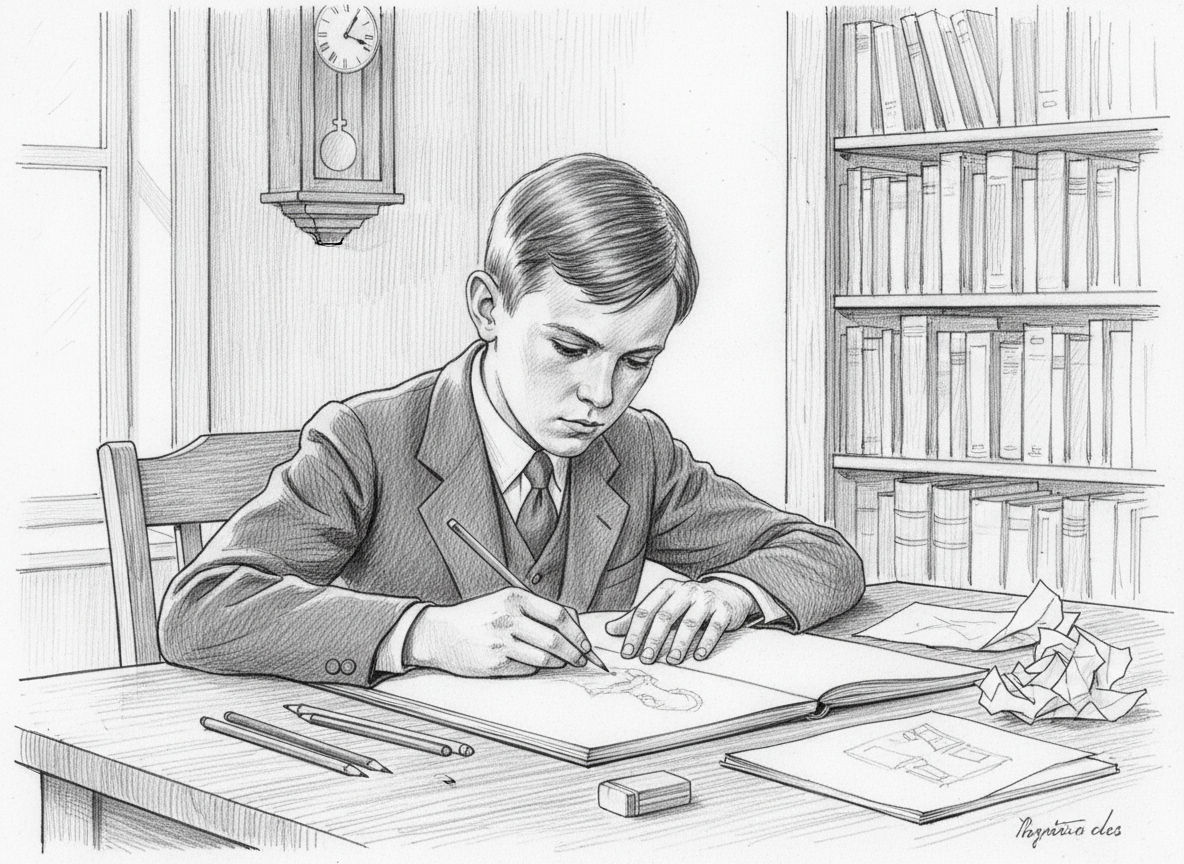
Even at school, Loriot displayed a characteristic that would later become his trademark: the ability to withdraw quietly without turning away. Whilst others stood out, were provocative or conformed, he sat there and drew. Not demonstratively, not provocatively - more as if he were creating a small, manageable space in which the world was ordered. Lines, figures, distances: everything had its place. Drawing was not an escape, but a form of control in an environment that was becoming increasingly standardized and confusing.
Especially in the school days of the Third Reich, this behavior was remarkably inconspicuous. It fitted into the framework without disturbing it. And yet it was more than just an occupation. He who draws, observes. Those who observe evaluate - not aloud, but inwardly. This early practice of silent observation explains much of Loriot's later work: the calm, the patience, the close observation. The humor came later. At first there was order on a small scale, as an antithesis to a world that left no room for nuances.
Observation instead of judgment
What is remarkable is what is missing: Loriot has no urge to settle accounts, no cynicism. Instead, there is an almost old-fashioned patience. He observes, lets situations unfold, does not intervene. This is exactly what gives his scenes their tension.
This attitude probably also stems from the experience that loud judgments rarely clarify anything. Children who experience how strongly language is standardized and monitored often develop a keen sense of when silence is wiser than speaking - and when a precise sentence has more impact than a long explanation.
This creates a form of seriousness that doesn't seem heavy. You laugh - and only realize later that you have just seen something very precise.
Loriot's later interviews show this attitude particularly clearly. He rarely says anything direct about politics or society. Instead, he formulates observations, seemingly harmless, often with a slight smile. But between the lines lies a clear skepticism towards exaggeration, moral rhetoric and false seriousness.
This is no coincidence. Anyone who has experienced at a young age how quickly seriousness can tip over into the grotesque develops a lasting distrust of grand gestures. Loriot's humor is therefore not escapist. It is a form of grounding. A silent corrective against any kind of hardening.
A school for life
Growing up in the Third Reich did not turn Loriot into a political commentator. It made him a master of nuance. He learned that people rarely fail because of big ideas, but because of small rules. That order can provide stability - and at the same time become a trap if it becomes more important than people.
This experience runs like a silent thread through his entire oeuvre. It explains why his characters are never caricatures, but neighbors, spouses, acquaintances. And why you often feel a slight discomfort when you laugh: because you recognize yourself.

War, discipline and the long shadow of order
For many of his generation, youth did not end gradually, but abruptly. School, everyday life, reasonably familiar routines - and then:
Emergency baccalaureate, uniform, chains of command. Loriot also took this path. Not out of a thirst for adventure, not out of ideological enthusiasm, but because it was the obvious, expected step. Tradition, the circumstances of the time and his family background combined to form a logic that left few alternatives.
The war was not a topic of choice, but the framework in which one found oneself. And it is precisely this experience - being placed in a system that is bigger than yourself - that leaves its mark. Not loudly, not heroically, but quietly and permanently.
An officer's career without pathos
The fact that Loriot initially embarked on a career as an officer is sometimes misunderstood. Looking back, some people see it as a statement. In reality, it was more an expression of a sense of order and continuity. Anyone who comes from an environment in which service, responsibility and clear role models are taken for granted does not see this path as a break, but as a continuation.
What is important is what it did not become: no soldierly pathos, no pride in rank or power. Later in his work, the military hardly appears heroically. When uniforms appear, it is more as part of a backdrop in which people try to remain correct - and stumble humanly in the process. The experience of discipline did not harden him, but apparently made him more sensitive to the fragility of order.
Discipline can provide support. But it can also narrow perception. Those who experience it learn both. In war, order is not taught as an aesthetic principle, but as a necessity. Procedures have to work, doubts disturb. This is precisely where the inner distance arises that later becomes so typical of Loriot.
He knew that order is not a value in itself. It is a tool. If it becomes an end in itself, it becomes absurd. This knowledge is not based on theory, but on experience. From the experience that people in systems often do not act badly, but in accordance with the rules - and that this can be dangerous, but also funny, as soon as it is transferred to a different context.


The long shadow remains
This imprint does not disappear after the war. It lies like a background noise underneath later life. Loriot's characters often unconsciously carry this shadow with them: the desire to do everything right; the fear of falling out of shape; the reflexive reach for the rule when uncertainty arises.
You could say that its comedy arises precisely where the war is no longer visible, but the way of thinking has remained. Where order has become a habit without anyone questioning its meaning. This is not an indictment, but a precise observation of human patterns.
Humorlessness as a normal state
Looking back, Loriot spoke less about ideology than about something seemingly banal: the lack of humor. In the school and social atmosphere of the time, there was little room for quiet laughter, irony or subtle distance. Humor existed, if at all, in a crude or authorized form. Subtlety had no place. This experience had a greater impact on him than grand political concepts would suggest.
Normality was serious. Correct. Purposeful. And therein lay its gravity. Anyone who grows up in such an environment either develops a defensive attitude - or a keen sense of where the human element disappears beneath the surface. Loriot's later humor can also be read as a response to this early lack of humor: not as a counterattack, but as a rediscovery. As an attempt to give something back to everyday life that it had long lacked - not loud laughter, but quiet recognition.
No settlement, but conversion
What is once again remarkable is what is missing: bitterness. Loriot would have had every reason to be harsh, to dramatize biographical hardships. He did not. Instead, he transformed experience into form. He translated discipline into timing, commanding tone into dialog, military precision into comic accuracy.
This is perhaps his real trick: he uses the tools of order to make order visible - and thus to be able to relax. Laughter thus becomes a kind of civilian disarmament.
The war did not teach him that order is bad. It taught him that it depends on the context. That it can support people - or crush them. And that the decisive point is often not the system, but the moment in which a person tries to remain dignified within it. This is precisely where Loriot's later attitude comes in. He does not mock the need for order. He shows how people cling to it when they have nothing else left. And he does this without malice, without moral superiority. That's what makes his comedy so enduring - and so serious beneath the surface.
This chapter shifts the focus: Away from imprinting, towards realization. The next section is about how humor becomes a precision instrument - and why Loriot was never funny by chance, but was more precise in his craft than many of his contemporaries.
Interview with Loriot and Evelyn Hamann about „Oedipussi“ 1987, Berlin | rbb media
Humor as a precision instrument
Loriot's humor often seems effortless, almost casual. This is precisely where the danger of misunderstanding lies. Nothing in his work is spontaneous in the sense of unplanned. His humor is calculated, but not cold; precise, but not mechanical. You can sense that this is the work of someone who knows that comedy only works if it is precise. One wrong note, one second too soon, one word too many - and the scene collapses.
This precision is not an end in itself. It serves a purpose: to make human patterns visible without denouncing them. Loriot does not laugh at people, but at situations that arise when people cling to their own expectations.
The central tool of this humor is not the exaggeration, but the minimal deviation. With Loriot, almost everything is „actually correct“. The sentences are correct. The attitude is right. The intention is good. And that's exactly why it doesn't work. This tiny shift - a tone that is too formal, an overly precise choice of words, a moment of too much politeness - is enough to tip the situation into absurdity. Loriot thus demonstrates something very fundamental: it is not the wrong thing that is dangerous, but the overly correct thing.
Timing as a moral category
For Loriot, timing is more than rhythm. It is a form of ethics. He knows when to keep quiet. When a look says more than a sentence. When a pause reveals the real core.
These pauses in particular are crucial. They force the audience to position themselves. The laughter often doesn't come from the punch line, but from the moment when you realize that you yourself have just continued talking inside. Loriot trusts this - and this trust is part of his attitude.
Humor without devaluation
A striking feature of his work is the complete absence of contempt. Even where characters fail, they remain intact. They are not paraded, not morally degraded. Their failure is human, not ridiculous. That is a fine art. Because ridicule would be easier. Loriot deliberately chooses not to. His humor creates closeness, not distance. You laugh - and at the same time feel a slight recognition. Perhaps even an unpleasant one. This is exactly where the effect begins.
Beneath every comic scene in Loriot's work lies a seriousness that is never expressed. Not as a message, but as a resonance. It's about communication, about relationships, about the fragile balance between closeness and order.
This seriousness explains why his comedy does not wear out. It doesn't wear out because it doesn't offer quick relief. It has a lasting effect. You often only realize later why you laughed - and at what.
Precision instead of volume
In a world that increasingly confuses humor with loudness, Loriot's approach seems almost old-fashioned. But it is precisely this old-fashionedness that is his strength. He does not rely on escalation, but on condensation. Not on speed, but on precision. You could say that Loriot's humor is not an outlet, but an instrument. He measures, adjusts, reveals. And he does this with a calmness that creates trust - and with a consistency that has become rare.
In the end, it becomes clear that humor is not an extra, not a decoration, not a trick. It is the expression of an attitude. An attitude that assumes that people are fallible - and still deserve respect. That order is important - but not more important than people. And that laughter is strongest when it connects rather than triumphs.
This chapter thus fits organically between the experience of war and the history of its impact. Humor is the tool with which everything that has gone before is dealt with - quietly, precisely and without any actionism.
„Don't play funny“: The most important rule for comic effect
This rule is almost legendary - and it is expressly confirmed by companions: Loriot taught actors not to make funny scenes funny. Precisely because his characters are not „jokers“, but people who want to do everything right, the acting has to remain serious: correct, hard-working, dignified.
The comedy then arises automatically from the situation, from the over-precise tone, from the friction between form and reality. The SZ-Magazine The actress Dagmar Biener formulates it as Loriot's lesson „not to play funny things funny“ - and thus gets to the heart of his method.
Total preparation: lightness as a result of discipline
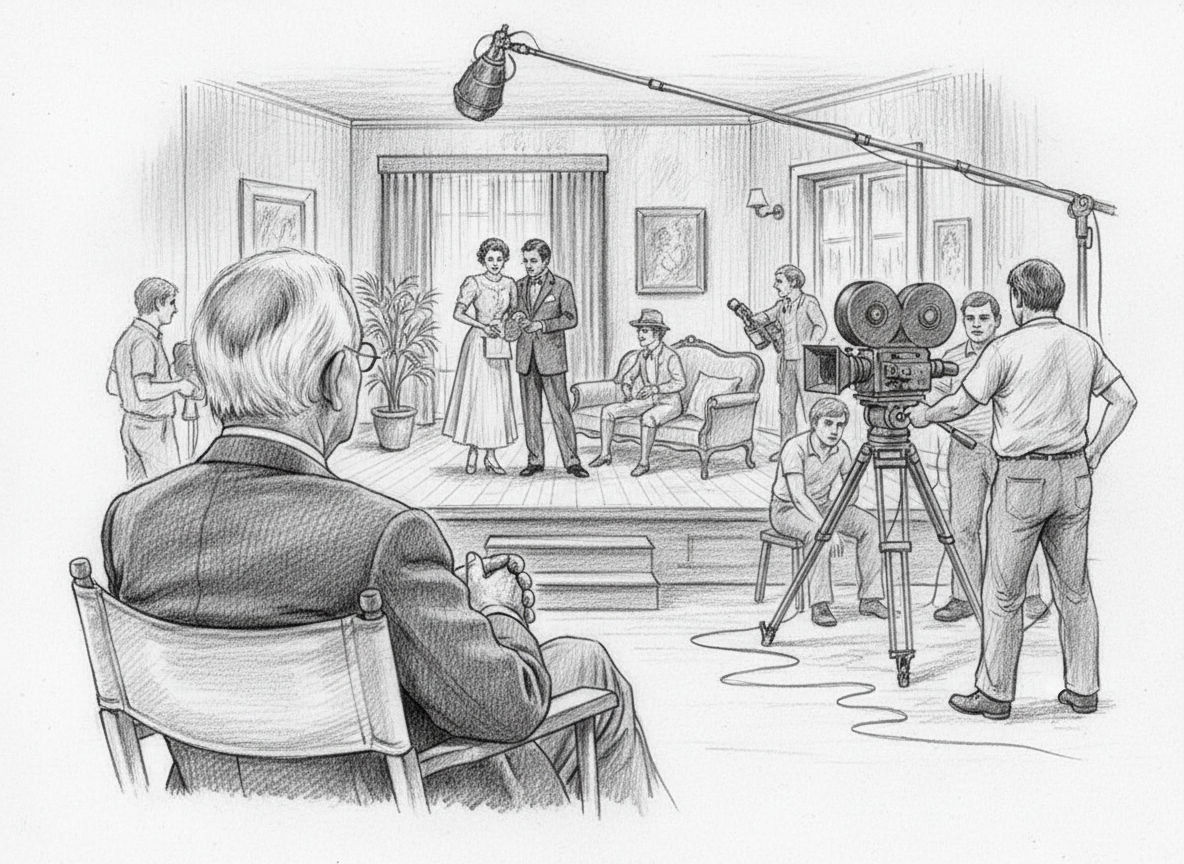
Those who have worked with Loriot unanimously describe a way of working that hardly seems compatible with the later impression of complete effortlessness. Scenes were thought out in advance before they were realized. Pauses, lines of sight, gaps between two sentences - nothing was accidental. There was nothing pedantic about this preparation, but something reassuring:
Everyone involved knew where they stood. This is precisely why there was no pressure on set, but rather concentration. The paradox is that the more precise the planning, the freer the result seemed. Loriot did not see lightness as spontaneity, but as the end point of a well thought-out process. Anyone who had experienced this quickly understood why improvisation was rarely necessary for him - not because it was forbidden, but because it could hardly have improved anything.
Development of an artistic signature
Loriot's artistic entry was not through stage or word, but through drawing. This is more than just a biographical footnote. The drawing allows control: over the image detail, rhythm, direction of the gaze. Nothing happens by chance. Every line is set, every figure remains in a clearly defined space.
It was here that he formed early on what would later characterize his entire oeuvre: reduction. No overload, no effects. Instead, figures that appear almost motionless - and thus create tension. Even in these early works, it is clear that humor does not arise from movement, but from constellation.
The text joins in - language as the actual setting
Over time, the drawing is increasingly accompanied by text. Not explanatory, but contrapuntal. Language takes on the role previously played by the line: it frames, limits, organizes.
It is striking that Loriot never uses language in a naturalistic way. Nobody speaks „real“. The dialogs are minimally shifted: too correct, too polite, too precise. It is precisely this small shift that opens up the space for comedy. It is as if he puts language under a magnifying glass - and shows what otherwise goes unnoticed in everyday life.
Transition to film and television: Time becomes material
With the switch to film and television, it is not the attitude that changes, but the material. Now time is added: pauses, glances, silence. Loriot does not use these new means to become louder, but to work even more precisely.
His technical rigor is particularly evident in the moving image. Pauses are never accidental. They are calculated, sometimes painfully long. But this is precisely where their effect lies. The viewer is forced to endure - and often recognizes himself precisely in this endurance.
Over the years, the focus increasingly shifts from individual situations to relationships. Marriage, neighborhood, social closeness. Not as a drama, but as a permanent state. The perspective also changes: at the beginning, the focus is often on the isolated person, later on on the togetherness that fails due to trivialities. This is not a thematic coincidence, but a logical development. The longer you observe, the clearer it becomes: The greatest frictions do not arise in exceptional circumstances, but in everyday life.
Consolidation instead of escalation
What is remarkable is what is not happening: There is no escalation, no break, no change of style for the sake of renewal. Loriot's work condenses, it becomes calmer, clearer, almost more austere. While other artists become louder or more explicit over time, he withdraws further - and achieves a greater effect precisely because of this. This is a classic, almost old-masterly approach: not expansion, but concentration.
His later interviews also seem less like commentaries on the work than a continuation of it. The same precision, the same restraint, the same art of omission. He does not speak to be heard, but to leave something out. These are often casual sentences that have a long-lasting effect. Not because they are provocative, but because they are neatly placed - like a good punch line that you only understand when it is already over.
Current survey for interested authors
Development without breakage
Looking back, an artistic development without an actual break can be seen. No phase that needs to be overcome. No early works to be excused. Instead, a continuous process of refinement.
Loriot's work is therefore a rare example of artistic consistency: he worked on the same theme all his life - and yet continued to deepen it. Not by looking for something new, but by taking a closer look.
Evelyn Hamann: Precision without pressure
Evelyn Hamann has in Discussions about cooperation made it clear time and again how unusual Loriot's directing style was: no loudness, no power play, no „Now get on with it!“ - but a calm, almost polite tone that was nevertheless razor-sharp. Hamann in particular, who was able to carry his nuances perfectly, benefited from this way of working:
Loriot didn't work with big explanations, but with minimal corrections. A look a little later. A sentence spoken a little „too correctly“ - or not yet correct enough. And suddenly the scene was spot on. The crucial thing is that this precision didn't feel like devaluation, but like craftsmanship. You were not „reprimanded“, but finely adjusted. This atmosphere - concentrated, respectful, almost old-fashioned decency - also explains why the Loriot/Hamann duo so rarely seem like two people who are „playing“, but rather like two people who really are like that and therefore become funny.
The polite objection: criticism without offense
When Loriot disagreed with something, he rarely expressed it directly - and never harshly. Instead, he resorted to a formulation that sounded harmless and yet was unambiguous:
„I'm not sure we quite understand each other.“
There was no reproach in this sentence, but rather an invitation for correction. No one was exposed, no one lost face. And yet it was clear to everyone: the scene was not yet where it should be. This polite objection is more than a working anecdote; it is an expression of an attitude. Criticism does not have to be hurtful to be effective. It can be quiet, precise, respectful - and therefore binding.
In an industry where loudness is often confused with assertiveness, this type of leadership seemed almost out of date. And perhaps that is precisely why it was so successful.
Loriot | Last public speech - Vicco von Bülow | SKB TV Brandenburg
Impact, legacy and relevance today
Many forms of humor age quickly. They cling to the zeitgeist, to fashions, to common excitements. Loriot, on the other hand, escapes this wear and tear almost completely. The reason is simple - and yet often overlooked: He never talked about topics, but about people. About their insecurities, their longing for order, their fear of doing something wrong.
What is funny about him is not the punch line, but the moment before it: the hesitation, the correct start, the too carefully formulated sentence. This mechanism works just as well today as it did fifty years ago because it is not tied to external circumstances. As long as people talk to each other, there will be misunderstandings. As long as people need rules, they will fail because of them.
Loriot's timelessness does not lie in nostalgia, but in precision. He didn't do anything „right back then“, but something fundamental.
The art of not having to explain
Another reason for his lasting effect is his restraint. Loriot does not explain. He does not comment. He does not moralize. He shows - and trusts his audience to close the gap themselves.
This is an attitude that seems almost alien today. In an age in which everything has to be categorized, evaluated and immediately pigeonholed, Loriot's silence seems almost provocative. But this is precisely where his strength lies: he takes people seriously enough to trust them to think. This form of respect has become rare - and that is precisely why it is so effective.
The loss of form in the present
If you look at the present day, you notice something that Loriot would probably have observed with skepticism: the form has become fragile. Forms of address are disappearing, tones are becoming harsher, language is becoming rougher or at the same time artificially morally charged. There is little room for moderation between the two.
It's not about „everything was better in the past“. Form is not an end in itself. But it is a protective space. It enables distance where closeness is too much. It allows conflict without escalation. Where form disappears, often only volume remains.
Loriot's work reminds us that form is not the opposite of freedom, but rather its prerequisite. Only those who know the rules can consciously break them - or humorously overturn them.
It is also striking how little contempt Loriot's humor contains. He doesn't make fun of weakness, but of the attempt to cover up weakness. His characters are not stupid, they are trying. And it is precisely this effort that makes them human - and funny. In a culture that is increasingly quick to judge, this is a quiet alternative. No mockery, no exposure, no moral superiority. Instead, a quiet realization: we all occasionally sit in the wrong chair and say the wrong thing at the wrong time.
A silent alternative
Perhaps Loriot's greatest relevance today lies precisely here: He offers an alternative to a world that is constantly commenting on itself. An alternative to constant indignation, to permanent categorization, to reflexive „taking a stand“. His stance is not neutral, but it is measured. It knows the abysses without illuminating them. It knows about the comedy of human existence without exposing the human being.
Loriot shows that you can be very clear without being loud. That you can criticize without attacking. And that humor does not devalue, but orders.
In the end, what remains is less a work than an attitude. The attitude of looking closely. The attitude of taking language seriously. The attitude of not excluding oneself.
Perhaps that is his real legacy: not how to laugh, but when. Not about whom, but why. In an age that often looks for quick answers, Loriot reminds us that the most precise answer is sometimes a quiet sentence - and a moment of laughter that lasts longer than any slogan.
This closes the circle. What began as an origin and an imprint leads to an attitude that continues to this day. And perhaps that is precisely the reason why you often smile after a Loriot sketch - and only later realize that you have just understood something very serious.
Mr. von L'oreot: A series of articles to make you smile
In the Lord of L'oreot series, classical attitude meets modern absurdities. In the contribution „Future with a charger - Mr. von L'oreot buys an e-scooter“ it is precisely this friction that is brought to a literary head: technology, the rhetoric of progress and well-intentioned reason end up in a situation that exposes itself. The text is supplemented by an embedded interview from Der Spiegel, in which Loriot speaks with his typical calm and clarity. The interplay of narrative satire and the original Loriot voice deepens the topic of attitude in everyday technical life - without slapstick, but with quiet sharpness.
When duty becomes duty again - a kind of essay on the case of tension
The second text in the series, „When duty becomes duty again“, is more essayistic with regard to a possible case of tension in Germany and deliberately more serious in tone. Mr. von L'oreot observes a society in which responsibility, commitment and concepts of duty are simultaneously invoked and emptied. The text asks what remains when rules are no longer upheld, but merely administered. Embedded is an older interview with Loriot from Radio Bremen, which complements this idea in a surprisingly timeless way. The series Herr von L'oreot functions as a literary figure of observation: not lecturing, not nostalgic, but attentive - a mirror that shows less distortion than precision.


Frequently asked questions
Why is Loriot particularly suitable for a portrait about attitude?
Because Loriot doesn't proclaim attitude, he lives it. He dispenses with slogans, moral superiority and loud gestures. His attitude is shown in moderation, restraint and precision. This is precisely what makes it visible. He trusts that people can perceive nuances - and that is precisely what makes him relevant to this day.
What distinguishes Loriot's humor from classic cabaret or satire?
Loriot does not attack political positions or mock groups. His humor is directed at situations, language and social rituals. He does not show who is wrong, but how people get caught up in their own correctness. This makes his comedy timeless and independent of current events.
What role does his origins play in his work?
His background in a strongly formal world sharpened his eye for order, etiquette and language at an early age. This imprint is not a burden, but a tool. Those who know the rules also recognize their breaking points. Loriot uses precisely this knowledge to make subtle shifts visible.
How did growing up in the Third Reich influence his attitude?
Not through political slogans, but through everyday experience. He experienced order, conformity and standardized language as a matter of course. From this, he developed a keen sense for the mechanics of systems - and for the absurdity that arises when people place rules above people.
Why does Loriot lack any form of accusation or reckoning?
Because his interest is not in the question of guilt, but in people. He observes instead of judging. This attitude avoids simplification and preserves dignity - even in characters who fail. This is what makes his work so human and so enduring.
What significance did the war have for his later work?
The war ended the youth abruptly and confronted him with discipline as a necessity. This experience did not lead to hardening, but to skepticism towards blind seriousness. Order remained important to him - but never as an end in itself. This tension characterizes his entire oeuvre.
Why does language play such a central role in Loriot's work?
Because language creates order - and exposes it. Loriot shows how much power lies in formulations, how easily language can tip and how quickly politeness can become a weapon. His dialogs are slightly off the mark and that is precisely why they are so accurate.
What makes Loriot's characters so believable?
They are not overdrawn, but make an effort. They want to do everything right. This is precisely where their comedy lies. You recognize yourself - not as a caricature, but as a person in an uncomfortably familiar situation.
Why do Loriot's works hardly age?
Because they are not bound to the zeitgeist or fashions. It works with universal human patterns: insecurity, the need for order, fear of making mistakes. As long as people interact with each other, these patterns will remain.
How has his artistic career developed?
No breaks, but condensation. From draughtsman to text and film to ever greater concentration on timing, pauses and relationships. It doesn't get louder over time, but quieter - and therefore more precise.
Why are his pauses often more important than his punchlines?
Because they create space. Space for insight, for discomfort, for recognition. The pause forces the viewer to become active. It is not idle time, but part of the message.
What distinguishes Loriot's humor from today's comedy?
He dispenses with provocation and speed. Instead, he relies on patience and precision. While today's comedy often aims for effect, Loriot works with effect - long-term, quietly, sustainably.
What role does self-irony play in his work?
A central one. Loriot does not exclude himself. His world is not a stage on which others fail, but a space in which everyone involved is part of the problem. This prevents arrogance and creates closeness.
Why does Loriot seem almost like an antithesis to the present day?
Because he maintains moderation where exaggeration dominates today. Because he remains silent where others explain. And because he shows trust in his audience's power of judgment - something that is increasingly being lost.
What does „form“ mean in Loriot's work?
For him, form is not a corset, but a framework. It enables distance, protects against escalation and allows for humor. Its loss does not lead to freedom, but often to rudeness. Loriot shows how valuable form can be.
Why is his humor never hurtful?
Because it does not expose, but makes visible. It does not expose anyone, but reveals mechanisms. Laughter arises from recognition, not from superiority.
What role do his later interviews play in the overall picture?
They seem like a continuation of his work with different means. The same restraint, the same precision, the same art of omission. Here, too, he speaks between the lines - and often most clearly.
What remains of Loriot beyond the well-known sketches?
An attitude: look closely, keep a sense of proportion, take language seriously and do not despise people. Perhaps this is his greatest legacy - especially in an age that often demands quick judgments.