
There were times when money was simply „there“ in everyday life. You earned it, withdrew it, paid with it, transferred bills - done. And that was one of the quiet qualities of the old system: it was so reliable that you hardly noticed it.
Many technical things work best when they remain invisible. Cash is a good example of this: it is tangible, easy to understand and allows for an exchange without a system immediately running in the background that logs or evaluates everything. This was normal for decades. You didn't have to be an expert to participate in business life. That will change in the future.




Why everyone is suddenly talking about digital money
Even when online banking came along, the basic feeling remained the same: money was increasingly „digitally visible“, but it was not „digitally new“. It was the same euro, the same account balance, the same transfer - just more convenient. This is precisely why many people initially underestimated the next stage: When people talk about „digital money“ today, they are often no longer just referring to convenient banking, but to a possible change in the form of money itself.
Bitcoin is older than many people think - but for a long time it felt far away
Bitcoin seems like a new phenomenon to many, but historically it has already come a long way. The Bitcoin whitepaper was published at the end of October 2008, and the first block of the Bitcoin blockchain (the so-called „genesis block“) was mined on January 3, 2009 - meaning that the network was practically launched at the beginning of 2009.
Nevertheless, Bitcoin remained a marginal topic for a long time. In the early years, it was more for technology communities, cryptography nerds and later for very speculative circles. Normal everyday life - rent, tax, salary, shopping - simply went on as usual. For most people, there was no compelling reason to get involved.
And that's logical: people rarely voluntarily deal with system details as long as the system works in everyday life. That's exactly how it was for me.
My entry came late - not as a trader, but out of a desire to understand the mechanics
I didn't get in via the traditional route that you often hear about in the media: „I bought early, traded, made profits.“ That was never my point. I started much later - it was only a few years ago that I took a closer look at Bitcoin and other cryptocurrencies.
The trigger was not greed, but simply the moment when you realize that the topic is no longer going away. It comes up again and again, in conversations, in headlines, in subordinate clauses. And at some point you reach the point where you have to make a decision: Either you wave it off permanently - or you take the time to understand the basic concepts properly for once. I then asked myself:
- What is a cryptocurrency at its core - beyond all the myths?
- Why do some people talk about „digital gold“?
- What is actually technically new about it - and what is just marketing?
- Why does the whole thing often seem like a jumble of coins, tokens, exchanges, scandals, memes and promises of salvation?
And you quickly realize that there are two ways to deal with the topic. Either you follow the noise - or you do it the classic way: step by step, term by term.
Why so many people say „crypto“ today - and mean something completely different
The word „crypto“ is a good example of how debates get derailed: It is used as a catch-all term, although in practice it encompasses completely different things. Many say „Crypto“ and mine:
- Bitcoin as the idea of a decentralized currency
- any coin that can be traded
- a token that only runs on an existing blockchain
- a project that is actually just a share-like participation
- or in the worst case: a pure Ponzi scheme
If everything ends up in the same pot, false conclusions are automatically drawn. Then every criticism of a dubious token suddenly becomes „criticism of Bitcoin“. And any enthusiasm for Bitcoin suddenly becomes a blanket enthusiasm for „everything that is somehow called crypto“. This is precisely why the clear distinction (coin vs. token, currency vs. asset, decentralized vs. centralized) is not pedantic - it is the prerequisite for any meaningful discussion at all.
And this is where it gets exciting: while many are still discussing „crypto“, a second strand has developed in parallel, which has linguistic similarities with cryptocurrencies („digital“, „wallet“), but is a completely different project in terms of content.
CBDCs and the digital euro - suddenly it becomes system policy
The moment when I realized that the debate was fundamentally shifting was the discussion about CBDCs - in other words, digital central bank money.
At the digital Euro this is not a loose mental game, but a project with clear phases. The Eurosystem had an investigation phase (2021-2023) and then started a preparatory phase on November 1, 2023, which was initially scheduled to last two years. (The ECB also describes that this preparatory phase ran from November 2023 to October 2025 and that work will continue thereafter).
And this is where many people make the big mistake:
- You hear „digital euro“ and think: Aha, that's something like Bitcoin - only from the state.
- Or they listen „Crypto“ and think: aha, it's all the same - digital, invisible, manipulable.
Neither is true. The basic idea behind CBDCs is that they are centralized, institutionally embedded and controllable by monetary policy. Cryptocurrencies (at least the real „coins“ with their own blockchain) are fundamentally decentralized, without an issuer and without central control. This is not just a technical difference. It is a system difference.
Why the debate is becoming so emotional - and why order is more important here than opinion
When money changes its form, people react instinctively. This is not irrational, but normal. Money is not an arbitrary product - it is the silent framework within which our everyday lives function. But that is precisely why it is dangerous to conduct this debate only emotionally. Because emotions often generate two reflexes:
- Panic („They want to control everything!“)
- Trivialization („Oh, it's just modern and practical!“)
Both lead in the wrong direction. The only thing that really helps is something old-fashioned - and therefore effective: sorting terms, understanding structures, differentiating architecture.
Do not evaluate immediately. Understand first.
And that is the approach of this article: not to proselytize, not to alarm, not to appease - but to clarify.
What the reader can clearly distinguish after reading this article
To make the rest of the text really useful, we are now working with a clear order that makes many debates possible in the first place:
- Cryptocurrency (real coin with its own blockchain)
- Token (runs on a third-party blockchain, often a different concept than „money“)
- Bitcoin & Co. (decentralized, without issuer - with its own strengths and limits)
- Stablecoins (coin linked to a national currency or commodity)
- CBDCs (Central bank money in digital form - and with very different properties depending on the design)
- digital Euro as a concrete European CBDC project with clear Project phases
In the next chapter, we do something that many articles skip over, even though it is the basis for everything: we look at what money actually is - historically and functionally. Because only when it is clear what money does (and what role trust plays in this) can we properly assess what is „new“ about cryptocurrencies - and what is „different“ about CBDCs.

What money actually is - and what it never was
Money is not a thing, but a relationship. When we talk about money, many people first think of something tangible: coins, bills, numbers in the bank account. This is understandable, but it falls short. At its core, money is not an object, but a social relationship. It only works because people agree to ascribe a certain meaning to it. This meaning has three classic functions:
- Means of exchange - Money facilitates the exchange of services
- Computing unit - it makes values comparable
- Store of value - allows performance to be postponed into the future
The decisive factor is that none of these functions necessarily requires a specific technical form. Money can be made of metal, paper, accounting records - or even data. The form is interchangeable. Trust is not.
Trust has always been more important than material
Historically, money has never been accepted because it was „beautiful“ or „technically clever“, but because people trusted that they would be able to exchange it again later.
- Gold was not valuable because it was shiny, but because it was scarce, durable and generally accepted.
- Paper money did not work because paper is valuable, but because there was an order behind it.
- Money in circulation on the account works, because we assume that the number there will still be valid tomorrow.
This trust was implicit for a long time. You didn't have to think about it. This is precisely why money has historically been a very conservative system: changes happen slowly, gradually, often over decades. And that is precisely why every major change causes unrest - not out of irrational fear, but because trust is sensitive.
From cash to scriptural money: The first great abstraction
The transition from cash to scriptural money was an enormous step - even if it seems self-evident today. The bank account became money:
- invisible
- accounting
- dependent on institutions
An account balance is not a physical possession, but a claim against a bank. This is important to understand: Even today's bank money is not „money in a vault“, but a relationship of trust. Nevertheless, a crucial balance remained: Cash continued to exist in parallel. You could get out, withdraw and pay anonymously. This coexistence has kept the system stable for decades - also psychologically.
Digital banking is not digital money
This is one of the most common confusions. Online banking, cards, apps and contactless payments have visibly digitized our money, but have not changed its structure. The money itself has remained the same:
- the same Euro
- the same legal basis
- the same monetary policy mechanisms
You could say that the interface has been modernized, not the foundation. When people talk about „digital money“ today, many are referring to precisely this layer of convenience. However, CBDCs are actually about something else: a new form of money, not just a new access point.
Monetary policy always works - but usually invisibly
Another point that is often overlooked: Money has never been neutral. The classic system is also controlled.
- Interest rate policy
- Expansion of the money supply
- Minimum reserves
- Regulation of banks
All of this influences our money on a daily basis without us being consciously aware of it. The difference is not whether money is controlled, but how directly and how finely granular this control is possible.
The more digital and direct a system becomes, the shorter the distance between decision and effect. This is not a value judgment - but a structural difference that we need to be aware of before talking about opportunities or risks.
Why monetary systems rarely change openly
Monetary systems do not usually change through overt reforms, but through gradual transitions:
- New rules
- New instruments
- New technical possibilities
Looking back, many things seem logical. In the present, it often feels diffuse. This is exactly where we find ourselves today: between a familiar system and a possible new stage whose final form has not yet been determined.
That is why it makes little sense to think in simple categories such as „good“ or „bad“ right now. The question makes more sense historically:
Which features does a system gain - and which might it lose?
Why this chapter is the basis for everything else
Before we talk about cryptocurrencies, coins, tokens or CBDCs, we need to be clear:
- Money is not a law of nature
- Money lives from trust
- Money rarely changes abruptly, but effectively
- Technology is a means, not an end
The next chapters can only be read meaningfully against this background. Otherwise you are discussing symptoms, not structures.
Cryptocurrencies - what they are and what they are not
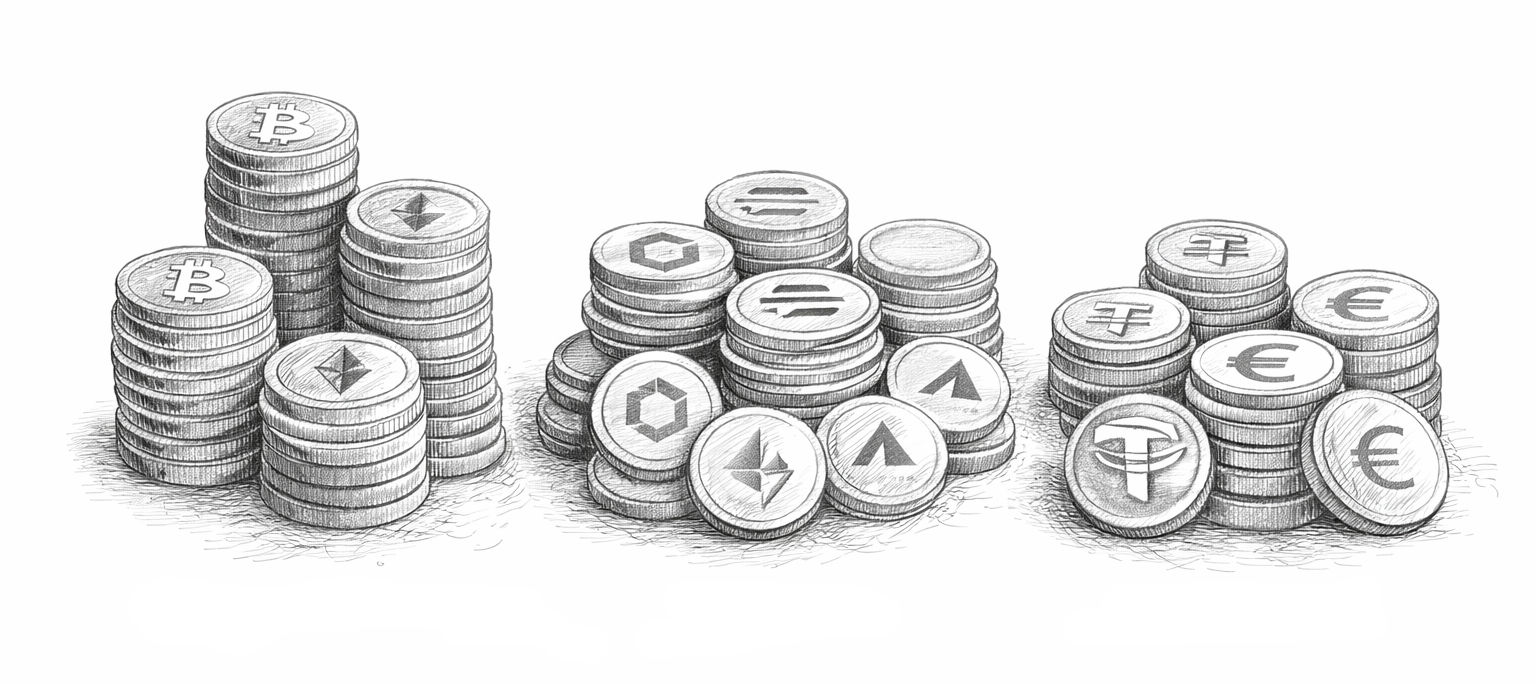
„Crypto“ is not a technical term, but a catch-all. When people say „crypto“ today, they often mean all sorts of things: Bitcoin, some coin, a token, an exchange app, a project, a promise of quick riches - or simply „that digital stuff“.
The problem: as soon as everything collapses into one word, every debate becomes muddled. Then a fraud scandal suddenly becomes „proof“ that Bitcoin is nonsense. Or, conversely, the idea of a decentralized currency suddenly becomes the legitimization for some fantasy token that is only based on marketing.
That's why the first step is classic and boring - but essential: separate the terms. What is a cryptocurrency in the narrower sense? What is just a digital asset? And what is simply a product that has „crypto“ in its name because it sells better?
What makes a real cryptocurrency
At its core, a cryptocurrency is a digital system that does not require a central authority. This is the key difference to traditional monetary systems, which always have an institution at the center - central bank, commercial bank, payment service provider. A „classic“ cryptocurrency (in the narrower sense) typically has these characteristics:
- DecentralizationNo single operator who controls the system alone
- Own networkMany participants (nodes) who jointly enforce rules
- Cryptographic protectionSignatures instead of „trust in a middleman“
- Consensus mechanism: A procedure that decides which transactions are valid
- Transparent rulesThe system follows fixed protocols, not spontaneous instructions
Important: This is the ideal description. In practice, some projects fulfill these points better, some worse - and many that write „crypto“ on them do not fulfill them at all.
Why Bitcoin is often considered a special case
Bitcoin is the historical and cultural reference point. Not because it is technically „perfect“, but because it embodies a certain principle very consistently: No issuer, no centralized control, clear rules. This is precisely why Bitcoin is seen by many more as a „digital object of value“ - in other words, as something you hold, not necessarily as something you spend on a daily basis. This leads to a sober realization that is lost in many discussions:
- A cryptocurrency can technically work
- and still be practically unwieldy as a means of payment
- or as a store of value are subject to strong fluctuations
The fact that Bitcoin fluctuates is not a moral judgment, but a consequence of its market logic. And this is where the separation between „idea“ and „suitability for everyday use“ begins.
Coin vs. token - the difference that sorts everything
One of the most important terms that many people have never learned properly is the difference between a coin and a token. It may seem like a detail, but it is actually a basic structure.
- Coin (own blockchain)A coin belongs to its own blockchain. It is the „native“ currency of this network. Examples are Bitcoin or Ether (Ethereum). The coin is usually closely linked to the mechanisms that operate the network (fees, security, incentives).
- Token (on third-party blockchain)A token runs on an existing blockchain. It therefore uses its infrastructure, its security and its rules. Technically, it is more comparable to a „contract“ or a „token“ within a system.
Why this distinction is so important:
- Coins are more like „infrastructure money“ of a network
- Tokens are often more like digital rights, entitlements, access or usage tokens
Many tokens are therefore not currencies, even if they are traded. Anyone who has understood this quickly realizes that a large part of what is called „cryptocurrency“ out there is actually something else.
Tokens are often not currencies, but digital promises
Many tokens stand for things like:
- Access to a platform
- Voting rights (governance)
- Participation models
- Mapping of real values (e.g. „tokenized“ assets)
- purely speculative constructions without any real benefit
This does not automatically mean that tokens are fundamentally bad. But it does mean that tokens are often closer to financial products than to money. And this is where it becomes interesting for normal readers, because it explains everyday life. When someone says „I have crypto“, it can mean that they:
- holds a decentralized currency (coin)
- holds a right of use (token)
- holds a bet on a project (speculative token)
- or simply holds an exchange product that is only called „crypto“
These are four completely different things - with completely different risks.
Stablecoins: the attempt to make crypto „suitable for everyday use“
Many people stumble across another word: stablecoins. The name sounds reassuring, and that is exactly the idea: a stablecoin should remain stable in value, usually by being pegged to a traditional currency (e.g. euro or dollar). This creates a kind of bridge between the old and new worlds:
- Crypto transfer and processing
- but value reference to the classical monetary system
Important for the classification: Stablecoins are generally not decentralized „natural events“, but are almost always subject to some form of administration, rules, reserve logic and therefore also power structures. This can make sense - but it is a different character to a classic decentralized cryptocurrency. This is a good point for readers to understand: „crypto“ is not automatically free of institutions. It is often just a new form in which institutions reappear.
What cryptocurrencies are not
To keep the terms clean, the negative list sometimes helps. Cryptocurrencies are not automatic:
- Legal tender (this is a political/legal characteristic)
- stable value (this depends on the market, usage and trust)
- anonymous (many systems are rather pseudonymous; evaluation is often possible)
- unregulatable (Regulation can apply to exchanges, interfaces and use)
- synonymous with „blockchain“ (Blockchain is technology; „crypto“ is a social system based on technology)
Those who remain sober here gain something rare: clarity.
Why the crypto debate often goes so wrong
The crypto debate rarely fails because of technology. It fails because of three patterns:
- Promise of salvation„That solves everything.“
- Generalization of scandal„There was fraud, so everything is fraud.“
- Confusion of termsCoin, token, stablecoin, exchange product - everything is treated equally.
When you realize this, it also becomes clear why so many people are either overly euphoric or overly dismissive: They don't react to the system - they react to headlines.

Bitcoin, altcoins, stablecoins & memecoins simply explained | BTC echo
Stablecoins - the attempt to bring stability to the crypto world
Anyone who deals with cryptocurrencies, even briefly, quickly stumbles across a central problem: strong price fluctuations. What is exciting for traders is impractical for everyday life. Nobody wants to pay for a coffee in the morning if the price is suddenly twice as high or half as low in the afternoon - not because of inflation, but because of market movements. This is exactly where stablecoins come in. The basic idea is simple and easy to understand:
A digital asset should function technically like a cryptocurrency, but remain stable in terms of value. Stable usually means: linked to a known quantity, usually a traditional currency such as the euro or US dollar. You could say that stablecoins are an attempt to combine the stable nature of traditional money with the technology of the crypto world.
What a stablecoin is at its core
A stablecoin is a digital token whose value is tied to something „stable“. Typically this is:
- one state Currency (e.g. 1 token = 1 euro or 1 dollar)
- rarer: a Raw material or a basket of currencies
Important to understand: stablecoins are not currencies in the traditional sense. They have no monetary policy of their own, no independent scarcity logic and no economic autonomy. Their value always depends on the functioning of the peg. The decisive factor is therefore not the token itself, but the promise behind it.
How this stability is to be achieved technically
There are various models for creating stability. For non-technicians, it is enough to know the basic principles:
- Fully covered stablecoinsHere, the issuer promises: „For every token issued, there is a corresponding amount in traditional money or secure investments. Put simply: “For every digital euro token, there is a real euro somewhere." This model is easy to understand - and depends on trust, transparency and control.
- Partially covered or algorithmic models: This is an attempt to create stability via mechanisms, rules or market incentives. This sounds elegant, but is much more complex - and has failed more often in the past.
It is important for the normal user to know: The more complicated the stability model, the greater the risk that it will not hold during periods of stress.
Why stablecoins are not „neutral“ instruments
At first glance, stablecoins seem harmless: digital, practical, stable. But they inevitably bring with them new power structures. Because someone has to:
- Manage the cover
- Set rules
- decide who may participate
- Intervene in case of doubt
This means that many stablecoins are more like private payment systems than free currencies. They work - but only as long as you trust the operator. This is not an accusation, but a sober observation. Traditional banks work in exactly the same way. The only difference is that stablecoins often appear in the guise of „crypto freedom“, even though they are structurally highly organized.
Stablecoins in everyday life: practical, but no substitute for money
In everyday life, stablecoins are mainly used for three things:
- as an intermediate step in trading between cryptocurrencies
- for fast, international transfers
- as a „parking lot“ in the crypto world, without constant price fluctuations
Which they are not:
- not legal tender
- Not a fully-fledged substitute for cash
- no sovereign monetary system
You could say that stablecoins are tools. Useful - but dependent on the system in which they are used.
Why stablecoins are often confused with CBDCs
This is where the next confusion of terms often arises. Stablecoins and CBDCs appear superficially similar because both are „digital“ and „stable in value“. The difference lies in the origin:
- Stablecoins come from the private world
- CBDCs come from the state monetary system
Stablecoins are therefore more like private substitute solutions that have emerged because there is no digital central bank money yet. CBDCs are an attempt to close this gap by the state - with completely different goals and framework conditions.
Why stablecoins could be a transitional phenomenon
Historically, stablecoins are a typical sign of a transitional phase. They emerge where there is a need but the official system has not yet delivered. It remains to be seen whether stablecoins will play a central role in the long term or whether they will be replaced by CBDCs at some point. What is likely is that they are justified - not as a new foundation for the monetary system, but as a bridging technology.
After cryptocurrencies and stablecoins, we now turn to the government's answer to digital money: CBDCs. And here it becomes particularly clear that similar terms can describe very different realities.
Current survey on the planned digital euro
CBDCs - digital money from the state
CBDC stands for Central Bank Digital Currency, i.e. „digital central bank money“. This is important because it openly expresses the essence: this is not about a private project, not about a scene, not about a new „community currency“, but about money that comes from the state-central banking system. You can imagine it very simply at first:
A CBDC is a digital form of central bank money that can be used for payments - depending on the design for citizens (retail) or only for banks and financial institutions (wholesale). The Bank for International Settlements (BIS) describes CBDCs as a way of offering „cash-like“ security and convenience in digital payments - albeit with very different technical designs.
And this is where the crucial point begins: there is no „one“ CBDC. There is only one collective term - and very different blueprints behind it.
Why governments and central banks develop CBDCs at all
If you look at the issue soberly, there are a few recurring motives that drive central banks:
- Payment transactions as an infrastructure issueDigital payments today often run via private systems (banks, card networks, tech platforms). A CBDC would be an attempt to secure part of this infrastructure publicly - similar to how cash used to be understood as a basic public service.
- Sovereignty and dependenciesWhoever controls payment transactions controls more than just technology. States traditionally think in terms of stability, crisis resistance and dependencies. This is not automatically „good“ or „bad“, but it explains why the issue is political.
- Cash usage declines - the role of central bank money is shrinking: cash is being used less in many countries. When cash disappears, a visible form of central bank money also disappears from everyday life. CBDCs are often discussed as a response to this: Central bank money should also retain a role in the digital realm.
- Competition with private digital formatsStablecoins and large platforms show: Digital value carriers can become very large very quickly. Central banks are reacting to this - if only for the classic self-preservation of the monetary order.
The digital euro as an example: a project with phases and an open outcome
In Europe, the digital euro is a central point of reference. The ECB has launched a preparatory phase for this, which began on November 1, 2023 and was initially scheduled to last two years.
Current ECB information describes that this preparatory phase ran from November 2023 to October 2025 and that technical work and support for the legislative process will continue. Two things are important here:
- A project is not yet a finished product. It is tested, drafted, politically discussed - and in the end a lot depends on the legal structure.
- The form has not been decided, only the direction. The key question is not „Is the digital euro coming yes/no?“, but rather: What would it look like, what roles would banks have, what privacy would be possible, what limits would there be?
In its project descriptions, the ECB explicitly mentions topics such as user experience, data protection/privacy, financial inclusion and environmental impact - i.e. classic requirements that can be in tension with each other.
Why CBDCs are not cryptocurrencies
A clean cut helps here so that the reader is not left with the wrong image:
- Cryptocurrencies (in the narrower sense) often want to manage without a central authority.
- CBDCs are by definition designed with a central authority - namely the central bank and the state legal framework.
This has practical consequences:
- Rules do not come from „code consensus“, but from law and institutions.
- Changes are politically possible, not just technically.
- Access can be controlled (who can do what, where, how much).
- Enforcement and control are systemically simpler because the system is linked to existing structures.
You don't have to dramatize it. We should just be honest about it: A CBDC is an instrument within a monetary order - not its counter-design.
The big design question: retail or wholesale - and who has access at all
Many readers immediately think of „citizen wallets“ when they think of CBDC. But that is only one possible form.
- Retail CBDCfor citizens and companies in everyday life
- Wholesale CBDCfor banks/financial institutions, e.g. for settlement between banks
Which option a country prioritizes already says a lot about what it actually wants to achieve: more convenient payments for citizens - or a more efficient financial market infrastructure. And then comes the next classic question: who manages the customer relationship?
Central banks are traditionally not „customer service organizations“. This is why many models rely on intermediaries (e.g. banks) that operate wallets or perform identity verification. BIS describes precisely this range: designs differ in terms of whether intermediaries are involved, whether the infrastructure is conventional or distributed, and whether access is account-based or token-based.
Account-based or token-based - and why this is crucial for privacy
A key difference lies in the access logic:
- Account-basedYou „have an account“ (or an account-like wallet). Transactions are more dependent on identity/registration, similar to today's banking model
- Token-basedYou „have a digital token“ (comparable to digital cash). Focus is more on the possession of the token, less on identity, can - depending on the design - appear more cash-like
Data protection authorities and specialist papers often describe this distinction in exactly the same way, while at the same time emphasizing the practical tension: completely anonymous solutions are difficult to reconcile with requirements such as combating money laundering.
The most important message: „Digital“ is not automatically „surveillance“ - but it is also not automatically „like cash“. It depends on the design.

Programmability: the word that triggers many - and that needs to be properly categorized
Hardly any term becomes emotional as quickly as „programmable money“. Skepticism and precision are worthwhile here. Two questions should always be kept separate:
- Can the money itself be programmed? So: Can the value carrier contain conditions („can only be used for X“, „expires“, „only in region Y“)?
- Or are only payments programmable? So: can payment processes be automated (e.g. smart contract logic) while the monetary value carrier itself remains „neutral“?
In practice, the two are often mixed up. Technically, many things are possible - politically and legally, many things are tricky. This is precisely why serious CBDC projects talk a lot about boundaries: Limits, role models, offline capability, data protection, and the question of what cash will mean in the future.
The sober point is: CBDCs can theoretically be very powerful - but whether this power is used does not depend on technology, but on the legal framework, control and political culture.
A look at China: e-CNY as a different approach
A comparison shows why one should not speak in general terms about „CBDCs“. With the e-CNY, China is pursuing an approach that is presented in official descriptions as a two-tier architecture: The central bank (PBoC) is responsible for issuance and core infrastructure, while intermediaries and operators carry the wallet economy and operations.
In addition, there are constantly new management and regulatory frameworks that show that such systems are not „finished“, but are being further developed and more tightly contained.
The difference to the European discourse is not so much „technology“, but often governance and embedding: What role do private platforms play? How is user behavior controlled? What control mechanisms are socially accepted? These are cultural questions - and that is precisely why a CBDC is never just a technical project.
In-depth study: The digital euro from a game theory perspective
In a video worth watching, Christian Rieck categorizes the digital euro from a game theory perspective - and makes some points that go beyond technical details. Rieck makes it clear that the digital euro is not a mere modernization of cash, but a new category of money with systemic consequences. Three design issues are particularly relevant: issuance via commercial banks (in his view, this makes sense because it preserves the tried and tested two-tier monetary system), the planned renunciation of anonymity (problematic because economic freedom always requires private payment spaces) and the unclear question of programmability. While programmable payments may be practicable, programmable money itself would be a breach of the neutrality of money. Rieck's analysis from the perspective of game theory shows soberly: The digital euro is less about technology than about the balance of power, incentives and long-term rules of the game in the monetary system.

Digital euro: How bad will it get? (Programmable money and sovereign money) | Prof. Rieck
Why there is no „one CBDC“
Many people imagine a CBDC as if there were ultimately „the“ digital national currency that works the same everywhere: one app, one wallet, done. In reality, CBDC is more of a construction kit in which states and central banks can make very different decisions.
This is also the reason why two countries can both say „CBDC“ - and still build systems that feel completely different in everyday life. You have to think of it like a house: Two houses can both be called „house“, but one is a half-timbered house with thick walls and a small window, while the other is a glass building with a smart home and a camera in every corner. Both are houses - but they are completely different places to live in.
The most important distinction: retail or wholesale
The first big switch is: Who is the CBDC for?
Retail CBDC
- is aimed at citizens and companies
- should be usable in everyday life (similar to cash/card)
- is particularly politically sensitive because it directly affects the reality of life
Wholesale CBDC
- is aimed at banks and financial institutions
- is used for settlement between institutions (settlement)
- is hardly visible in everyday life, but can change the financial architecture
Why this is important: If a country initially only builds „wholesale“, this is often an indication that they want efficiency in the system, but not a broad social debate. If a country pushes „retail“, this is an indication that it wants to anchor the new form of money in everyday life.
Account-based or token-based
The second major design question determines how you „own“ a CBDC:
Account-based
- You have a type of account or registered wallet
- Transactions are heavily dependent on identity and access rights
- is similar to today's bank thinking
Token-based (Token-based)
- You own digital „value units“ (like digital cash)
- Ownership and transfer are more important
- can appear more cash-like - depending on how it is implemented
The practical difference for the reader: Account-based often feels like „online banking 2.0“. Token-based can feel like „cash in digital form“ - but only if privacy and offline capability are seriously built in.
Directly with the central bank or via intermediaries
A third switch is: Who „operates“ the contact with the user?
Direct model
- Citizens would have direct access to the central bank infrastructure
- sounds clear and „clean“ on paper“
- is practically difficult because central banks traditionally do not have mass customer service structures
Intermediary model (e.g. banks, payment service providers)
- Wallets, support, identification run via existing players
- fits more easily into the current system
- can mean: more complexity, more dependencies, more interfaces
Here you can again see the conservative character of monetary systems: Many designs try to incorporate the new in such a way that the old does not break. This is not cowardly, but historically normal - money experiments are not done like app updates.
Current survey on the planned EU Digital ID
Offline capability: The inconspicuous question with a big impact
One of the most underestimated questions is: Does a CBDC also work offline? Offline capability would mean Payment without a constant online connection. This increases crisis resilience (power outage, network failure, disasters) and - depending on the design - can strengthen privacy
Without offline capability, a CBDC quickly becomes „just a digital payment system“.
With offline capability, it comes closer to what cash traditionally does: Paying without permanent dependence on infrastructure. And this is where it becomes political: a system that can pay offline is more difficult to control completely. A system that is always online is easier to control and analyze. This is not a conspiracy, but pure system logic.
Privacy is not a yes/no - but a spectrum
Many discussions get tangled up because privacy is often treated like a switch: either „anonymous“ or „not anonymous“. In practice, there are gradations, for example:
- Fully identified payments (like traditional banking)
- pseudonymous payments (identity not directly visible, but can be reconstructed)
- tiered privacy (e.g. small amounts more private, large amounts more scrutinized)
- Privacy vis-à-vis the retailer, but not vis-à-vis the system operator
- Privacy only under certain conditions (e.g. offline or up to limits)
For the reader, this is the crucial point: you don't have to ask „Is the CBDC anonymous?“, but:
Who sees what - when - and under what conditions?
That's how you ask the right questions. Everything else is a regulars' table.
Limits, fees, durability: the „silent adjusting screws“
CBDCs can (but do not have to) come with adjusting screws that do not exist with cash:
- Maximum amounts per wallet or per transaction
- Fee models, that can be set politically
- Interest rate mechanics (theoretically possible, practically politically sensitive)
- „Durability“ of money (very controversial - technically conceivable, socially explosive)
It is important to note that many of these things are not necessarily part of a CBDC. But the mere fact that they are technically and systemically possible changes the debate. In the case of cash, these kinds of levers had to be reached in a roundabout way. In a digital system, they can be brought closer to the surface.
And this is where a skeptical but calm attitude pays off: don't assume that everything will happen - but don't act as if it's impossible either.
Why the digital euro may be different from the e-yuan
If you really want to understand CBDCs, you have to accept it: Money is also culture. A European CBDC project is embedded in a different context than a Chinese one:
- different data protection culture
- different role of the state in everyday life
- other institutional landscape
- other political control mechanisms
- different social expectations of transparency and debate
This does not automatically mean that Europe is „better“ or China „worse“. It just means that the systems will differ, even if the same technology is used - because governance, law and political practice shape the technology.
And this is precisely why flat statements such as „CBDC = monitoring“ or „CBDC = only convenient“ are almost always too crude. You can only talk about it once you know the specific design.
All definitions at a glance
| Term / What is it? | Brief description (understandable) | Reference / Issuer |
|---|---|---|
| Cryptocurrency | Collective term for digital value systems that are cryptographically secured. In a narrower sense, this refers to „decentralized“ systems without a central authority that validate transactions via a network. | No single issuer (for decentralized coins). Created/lives through network, rules and users. |
| Coin | „Native“ currency of a own Blockchain. The coin is part of the basic infrastructure (fees, incentives, security) of the respective network. | No classic issuer; rules are defined in the protocol and are supported by the network. |
| Token | Digital value carrier on of an existing blockchain (e.g. Ethereum). Often more of a digital right/entitlement/access than „money“ in the narrower sense. | Is usually „issued“ by a project/team/organization via smart contract (technically shaped, often centrally organized). |
| Blockchain | Technology/data storage principle: a distributed, tamper-resistant chain of data records. Blockchain is not automatically „crypto“, but merely a tool on which many things can run. | No issuer; depending on the system, borne by network/operators/participants. |
| Wallet | „Wallet“ for digital assets. In the crypto world, usually software/hardware for managing keys. For CBDCs, „wallet“ can be more of a government/regulated account or app concept. | Crypto: user manages keys themselves (or service provider). CBDC: typically central bank/bank/service provider as provider. |
| Stablecoin | Token that is intended to remain stable in value, usually by linking it to the euro/dollar. Practically a „bridge“: crypto technology, but value reference to traditional money. | Private issuer/operator (company/consortium). Stability depends on cover/rules/trust. |
| Fiat money | Sovereign money without a link to gold/silver. Value is created through legal recognition, trust and monetary policy. | State/central bank; implemented via cash and banking system. |
| Money in circulation | „Book money“ in bank accounts. Most money in everyday life is bank money: Figures in the account that exist as a claim against the bank. | Commercial banks (within the framework of central bank and regulatory policy). |
| Central bank money | Money that is issued directly by the central bank. Today, mainly cash (visible to citizens) and reserves (for banks in the background). | Central bank (e.g. ECB/Eurosystem). |
| CBDC | Digital central bank money. Government money in digital form - depending on the design for citizens (retail) or only for banks (wholesale). Not a crypto derivative, but part of the monetary order. | Central bank (state-institutional, legally regulated). |
| Retail CBDC | CBDC for citizens and companies in everyday life (similar to cash/card). Politically sensitive because it has a direct impact on the reality of life. | Central bank - often with banks/payment service providers as intermediaries. |
| Wholesale CBDC | CBDC for banks/financial institutions for background processing (settlement). Barely visible in everyday life, but relevant for financial markets. | Central bank, use primarily by financial institutions. |
| Account-based CBDC | CBDC, where access is via a registered account/wallet. It feels more like modernized bank money, only with the character of central bank money. | Central bank (directly or via intermediaries); identity usually plays a greater role. |
| Token-based CBDC | CBDC in which digital „units of value“ are transferred (more similar to cash). Can - depending on the design - enable offline payments and more privacy. | Central bank; concrete privacy depends on design, limits and law. |
| Digital Euro | Concrete CBDC project of the Eurosystem. Objective: a digital form of the euro as a supplementary means of payment (concept, design and legislation are key points). | Eurosystem/ECB (with EU legislation as a framework). |
Why this distinction is crucial
Before we close, a quick note for readers who would like to take a closer look at a specific project: I have already written my own detailed Article on the digital euro in which the objectives, background and unanswered questions are systematically reviewed.
If, after reading this text, you would like to understand in more detail how a European CBDC is actually conceived and where the political and legal levers lie, you will find a good supplement there. This article is deliberately intended to be broader: It is intended to organize, classify and clearly separate the terms.
The real problem is not technology - but confusion of terms
If you take the past chapters together, one thing becomes clear: most heated discussions about digital money fail not because of a lack of intelligence, but because of a lack of order.
- Cryptocurrencies are confused with CBDCs
- Stablecoins are mistaken for government money
- „Digital“ is automatically equated with „surveillance“ or „progress“
- Individual scandals are projected onto entire systems
This creates camps where differentiation would actually be necessary. The first step would be quite traditional: calling a spade a spade and keeping things separate. Those who know what they are talking about need to be less vocal.
Why vigilance has nothing to do with panic
Vigilance is not an expression of mistrust, but of responsibility. Especially when it comes to money, one of the most sensitive social systems of all, it has historically always been wise to pay close attention to changes. Being vigilant does not mean
- reflexively reject everything new
- to suspect evil intent behind every project
- getting lost in worst-case scenarios
Being vigilant means:
- Ask questions
- Understanding designs
- Demanding limits
- Designing transitions consciously
This is not modern mistrust, but a very old, bourgeois virtue.
Cash is more than nostalgia
In many debates, cash is treated as if it were a relic that needs to be left behind for reasons of efficiency. This falls short of the mark.
Cash has properties that no digital system can completely replace:
- Immediate availability
- Technical independence
- Intuitive comprehensibility
- Transactions without permanent intermediaries
- a form of quiet privacy
You can think cash is old-fashioned - but you shouldn't underestimate it. Historically, cash has always been a counterbalance to complex systems. Not as a substitute for everything, but as a corrective.
Freedom often manifests itself in alternatives, not in compulsion
Freedom rarely consists of having only one option. Freedom arises where you can choose. A monetary system that is exclusively digital takes away this choice. A system in which cash, book money and digital forms exist side by side is more robust - technically, socially and politically. Therefore, the crucial question is not: „Digital or cash?“, but:
„What options are available to citizens in real terms?“
This question is not ideological, but practical.
Why you shouldn't just „let change happen“
Large systems rarely change with one big bang. They change through many small steps, each of which seems harmless on its own.
- a pilot project
- a new comfort function
- a voluntary option
- a transitional rule
Looking back, everything looks logical. In the present, we need people who remain attentive without blocking. It was no different with earlier money changes - they were just slower.
I didn't get involved with cryptocurrencies, stablecoins and CBDCs out of enthusiasm or fear, but for one simple reason: because money is too important to be left to the headlines.
You don't have to be a trader, a technology expert or an activist. It is enough to be a citizen - with the ambition to understand what is changing.
Digital developments cannot be turned back. But they can be shaped. And design always starts with clarity.
We will continue to talk about digital money in the coming years - factually or emotionally, orderly or chaotic. Every reader can decide for themselves on which level they want to participate. Anyone who has read this far has an advantage:
It can differentiate.
And sometimes that is precisely the most important form of freedom.




Frequently asked questions about CBDCs
- What are CBDCs anyway and why do countries deal with them?
CBDCs are digital forms of central bank money. They are not issued by private companies but by central banks and are part of the state monetary order. States are dealing with this because payment habits are changing, cash is being used less and private digital payment systems are becoming increasingly dominant. A CBDC is intended to ensure that central bank money continues to play a role in the digital space and is not completely supplanted by private solutions. - Are CBDCs simply cryptocurrencies from the state?
No, CBDCs are not a state counterpart to Bitcoin or other cryptocurrencies. Cryptocurrencies are fundamentally decentralized and do not require a central controlling authority. CBDCs, on the other hand, are deliberately centrally organized, legally embedded and controllable by monetary policy. The commonality is essentially limited to the digital form, not the underlying idea. - What is the main difference between cryptocurrencies and CBDCs?
The key difference lies in the power structure. Cryptocurrencies try to replace trust with technology and rules in the code. CBDCs continue to rely on institutions, laws and political responsibility. Cryptocurrencies do not have an issuer, CBDCs do. This leads to completely different characteristics in terms of control, stability and intervention options. - What are stablecoins and why are they often confused?
Stablecoins are digital tokens whose value is pegged to a traditional currency such as the euro or US dollar. They originate from the private sector and are an attempt to bring stability to the crypto world. They are confused with CBDCs because both appear digital and stable in value. The crucial difference, however, is the issuer: stablecoins are private constructions, CBDCs are state money. - Are stablecoins real money?
Stablecoins are not legal tender or an independent monetary system. They are digital promises of value whose stability depends on whether the underlying collateral actually exists and is credibly managed. They can be practical, but are no substitute for cash or state money. - What does „coin“ mean and what does „token“ mean?
A coin is the native currency of its own blockchain, i.e. part of the basic infrastructure of a network. A token runs on an existing blockchain and usually represents a right of use, a claim or a project promise. Many so-called „cryptocurrencies“ are actually tokens and not currencies in the true sense of the word. - Why do cryptocurrencies fluctuate so much in value?
Cryptocurrencies are not subject to any traditional monetary policy control mechanisms. Their value is determined solely by supply, demand and expectation. As usage, acceptance and market sentiment fluctuate greatly, this results in high volatility. This is not a flaw in the system, but a direct consequence of its design. - Are CBDCs automatically a monitoring tool?
CBDCs can theoretically generate very detailed data traces, but do not necessarily have to. Whether and to what extent transactions are traceable depends on the specific design. Account-based models are more transparent, token-based models can be more cash-like. The decisive factor is the legal framework, not just the technology. - Can cash be replaced by CBDCs?
Technically, it would be possible to completely replace cash, but politically and socially it is highly controversial. Cash fulfills functions that digital systems find difficult to replicate, such as technical independence and immediate use. Many central banks therefore emphasize that CBDCs should complement cash and not replace it - whether this will remain the case in the long term is an open question. - Why is cash more than just a means of payment?
Cash is an infrastructure of freedom. It allows transactions without technical requirements, without registration and without permanent intermediaries. Historically, cash has always been a counterbalance to complex, institutional systems. This characteristic still makes it socially relevant today. - What does „programmable money“ mean and why is the term so controversial?
The term is often used loosely. Programmable can be either payment processes, such as automatic execution under certain conditions, or the monetary value itself. The latter would mean that money is linked to conditions. Many things are technically possible, but politically this point is highly sensitive and controversial. - Why is there not „the one CBDC“?
CBDCs are not a standardized product, but a collective term for very different concepts. Countries themselves decide on the architecture, access model, role of banks, data protection and offline capability. This is why digital central bank money can function completely differently in Europe than in China or other regions. - What does „Retail CBDC“ and „Wholesale CBDC“ mean?
Retail CBDCs are aimed at citizens and companies for daily payment transactions. Wholesale CBDCs are intended for banks and financial institutions and are used for background processing. Many countries are starting with wholesale models because they trigger less social debate. - Why is offline capability so important for CBDCs?
Offline capability increases the resilience of a payment system and can strengthen privacy. Without offline capability, digital money becomes completely dependent on infrastructure. Cash shows how valuable it is to be able to pay even without electricity or a network. - Are CBDCs necessary if online banking already exists?
Online banking is a digital interface for existing bank money. CBDCs would be a new form of central bank money. The difference is not in the convenience, but in the foundation. CBDCs change who issues money and how directly citizens can interact with central bank money. - Why do many people react emotionally to the topic of digital money?
Money is deeply connected to security, control and everyday life. Changes to the monetary system affect fundamental needs and generate instinctive reactions. This emotionality is not a sign of irrationality, but an indication of the importance of the topic. - What does vigilance mean in concrete terms when dealing with CBDCs?
Vigilance means following developments, understanding designs and asking questions. It does not mean rejecting every innovation, but rather paying attention to which options remain. Critical monitoring is a sign of maturity, especially when it comes to basic infrastructure. - Should citizens consciously continue to use cash?
Using cash is not a backward-looking approach, but a conscious decision for diversity in the monetary system. As long as cash exists and is used, an alternative remains. This choice is a silent but important component of social freedom. - What is the most important insight from the whole debate?
The most important realization is that terms count. Anyone who can clearly distinguish between cryptocurrencies, stablecoins and CBDCs will lose their fear of buzzwords. Understanding is no substitute for political decisions or personal attitudes, but it is a prerequisite for forming an objective and self-determined opinion.