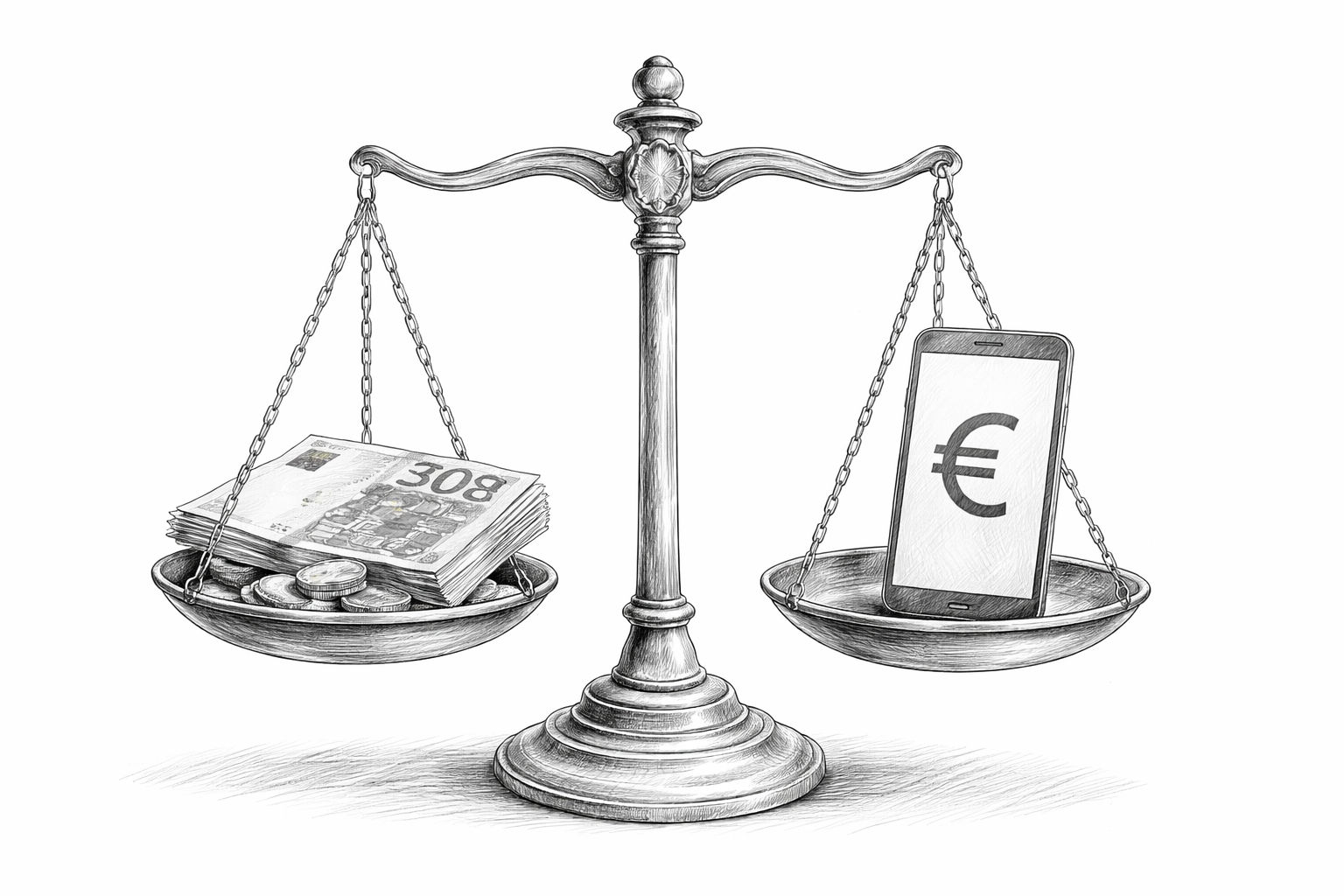
Understanding digital money: Bitcoin, stablecoins and CBDCs explained simply

CBDCs, cryptocurrencies and stablecoins

There were times when money was simply „there“ in everyday life. You earned it, withdrew it, paid with it, transferred bills - done. And that was one of the quiet qualities of the old system: it was so reliable that you hardly noticed it.

Many technical things work best when they remain invisible. Cash is a good example of this: it is tangible, easy to understand and allows for an exchange without a system immediately running in the background that logs or evaluates everything. This was normal for decades. You didn't have to be an expert to participate in business life. That will change in the future.


Read more

Ulrike Guérot: A European between idea, university and public discourse

Ulrike Guérot and Europe

There are people whose thoughts you like to follow not because you agree with them on everything, but because they make an effort to penetrate things. For me, Ulrike Guérot is one of these voices. I have been watching her lectures for several years now - not regularly, not ritualized, but when I come across a topic that I feel is worth listening to more closely. What strikes me is that her arguments are calm, structured and largely non-ideological.

This does not make her lectures spectacular in the media sense, but they are sustainable. You can listen to her for a long time without getting the feeling that she is trying to sell a ready-made world view. Especially at a time when political debates are often morally charged or emotionally truncated, this way of speaking seems almost old-fashioned. In the best sense of the word.

Read more

Game theory explains 25 years of geopolitics: How Europe lost its strategic role

Game theory explains 25 years of geopolitics

For many, game theory sounds like dry mathematics, like formulas, like something that only plays a role in lectures or business games. In reality, however, it is an ancient thinking tool that existed long before its academic formalization. Diplomats used it, commanders used it, captains of industry used it - long before it was even called that. In the end, it is nothing more than a sober question:

„When several players have to make decisions in an uncertain situation - what options do they have and what are the consequences?“

This kind of thinking has become surprisingly rare today. Instead of analyzing alternatives, much is narrowed down to moral narratives or spontaneous interpretations. Yet in geopolitical issues in particular, a clear analysis of the possibilities would be the foundation of any mature policy. It is precisely this old craft that I would like to take up again in this article.

Read more

The new EU censorship laws: What Chatcontrol, DSA, EMFA and the AI Act mean

EU censorship laws

In an increasingly digitalized world, we spend a lot of time online: Chatting, shopping, working, informing ourselves. At the same time, the rules on how content is shared, moderated or controlled are changing. The Digital Services Act (DSA), the European Media Freedom Act (EMFA), the planned Regulation to Prevent and Combat Child Sexual Abuse (CSAR, often referred to as „chat control“) and the AI Act are key pieces of legislation proposed by the European Union (EU) to regulate the digital environment.

These regulations may seem far away at first glance - but they have an impact on you as a private individual as well as on small and medium-sized companies. This article will guide you step by step: from the question „What is planned here?“ to the background and timelines to the change of perspective: What does this mean for you in everyday life?

Read more