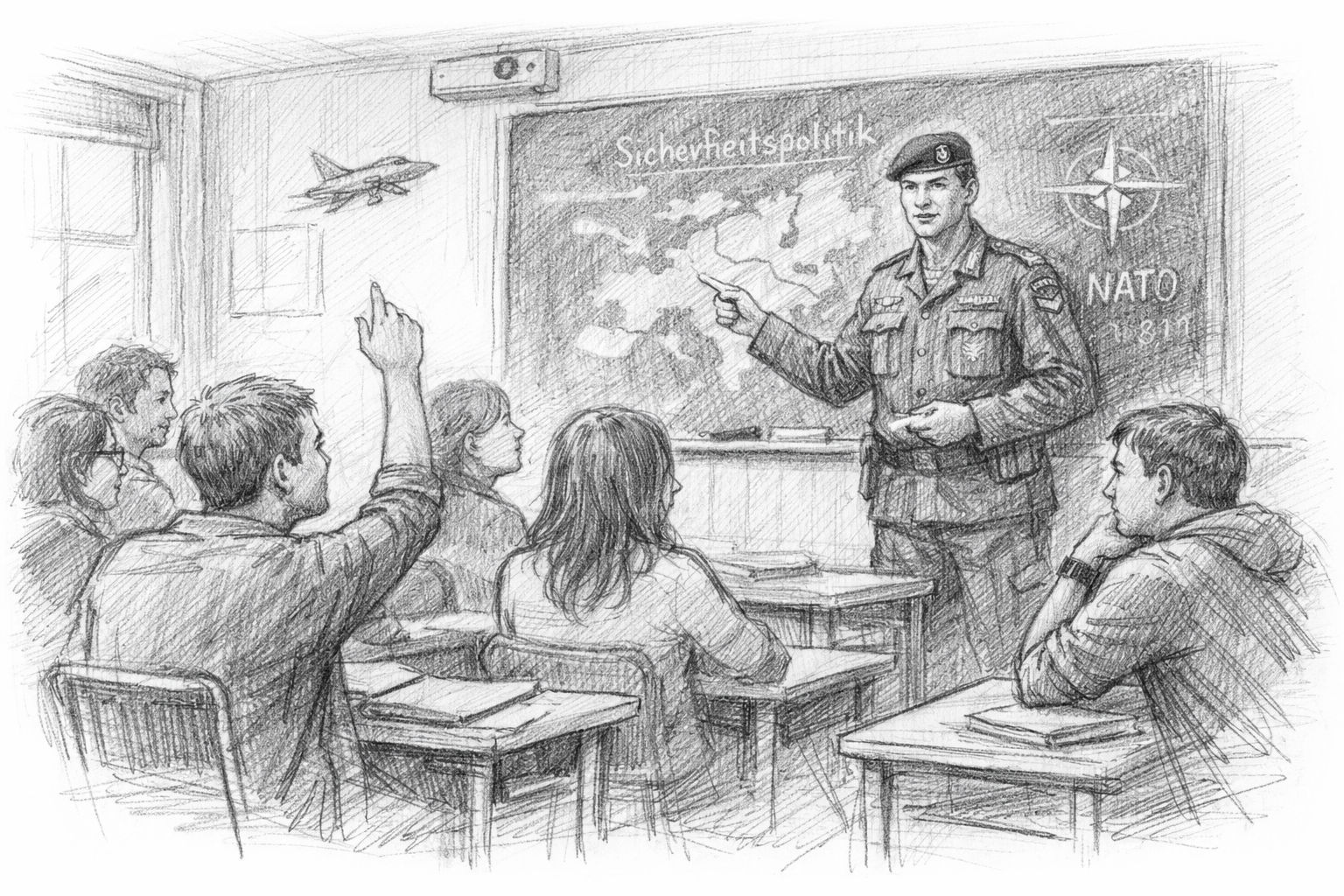
When I myself was conscripted into the Bundeswehr in the 1990s, it was still a fairly normal part of life for many young men in Germany. Anyone who had finished school did either civilian service or military service. It was simply part of life back then - just like training or studying. People talked about it, they knew roughly what to expect, and almost everyone had someone in their circle of acquaintances who was currently doing military service or had recently done so.
I myself also did my military service. There were no major ideological debates about it in my environment. Of course, there was criticism of the military or discussions about deployments abroad - but the Bundeswehr was basically a normal part of the state. It was there, but it didn't play a particularly dominant role in most people's everyday lives. Interestingly, this also applied to school.




Latest news on the topic
10.05.2026: A new report on the protest movement „School strike against compulsory military service“ shows how much the debate has changed in the meantime. While the first demonstrations were still perceived as spontaneous student protests in many places, security authorities are now apparently increasingly reporting attempts by extremist groups to exert political influence. According to Research by Bayerischer Rundfunk various anti-constitutional actors are deliberately trying to exploit the insecurity of many young people about compulsory military service, rearmament and war for their own purposes.

„School strike against compulsory military service“: Enemies of the constitution driving the protests? | BR24live
Social networks in particular play a central role here. There, emotional messages, simplified images of the enemy and calls for mobilization often spread much faster than differentiated political classifications. At the same time, however, the development also shows how great the insecurity of many young people has become. The discussion has long gone far beyond the actual issue of compulsory military service and touches on topics such as fear of the future, militarization, education policy and social trust. For this very reason, the movement is increasingly becoming a reflection of a deeper-rooted social nervousness in Germany.
06.05.2026: On May 8 - the anniversary of the end of the Second World War in Europe - the initiative „School Strike Against Conscription“ is once again calling for protests across Germany against a possible return of compulsory military service, see press release from April 16, 2026. Nordstadtblogger report, demonstrations are to take place in numerous cities, including Dortmund.
The motto „Never again conscription, never again war“ deliberately ties in with the historical significance of May 8 as the day of liberation from National Socialism. The background to the protests is the new Military Service Act, which has been in force since the beginning of 2026 and provides for mandatory questionnaires and future physicals for young men. The organizers criticize not only the possibility of compulsory military service itself, but also a societal trend towards greater armament and militarization. At the same time, the article shows that the debate is emotional and triggers many questions, particularly among young people, about their own future, war, peace and state obligations.
29.04.2026: The presence of the Bundeswehr in German schools on the rise and is increasingly being given formal structures. In Hamburg, for example, a new cooperation agreement has been concluded that will make visits by youth officers binding in future. The background to this is the growing importance of security policy topics in the classroom, which, according to politicians, should be addressed to a greater extent. At the same time, those responsible emphasize that the teaching must be controversial and without influence. However, criticism has come from the education union GEW, which warns of a creeping militarization of everyday school life. It sees the increasing number of Bundeswehr appearances as a problematic development and calls for civilian perspectives to be given greater consideration. The trend is clear throughout Germany: thousands of school visits have already been registered in the first few months of the year alone. The debate highlights the tension between political education and the potential to influence young people.
16.04.2026: For May 8, according to the website of the initiative „School strike against compulsory military service“ another strike has been announced. However, specific details regarding the scope or the schools involved are not yet known. The initiative is positioning itself against the possible reintroduction of compulsory military service and is calling on pupils in particular to take part.
The topic receives attention, among other things, through contributions from the non-attached MEP Martin Sonneborn, which comments on the protest in a satirical manner and even supports it in the form of a downloadable letter of apology. Whether this is a small, one-off action or a broader movement remains to be seen. However, observers see such initiatives as a possible signal that security policy debates are increasingly reaching younger generations. Further developments are likely to depend on whether greater momentum develops via social networks or traditional media.
03.04.2026: A largely unnoticed Amendment to the Military Service Modernization Act is causing discussion: Men between the ages of 17 and 45 must obtain permission from the Bundeswehr before longer stays abroad. Specifically, this applies to stays of more than three months - for example for study, work or travel. The main novelty is that this regulation no longer only applies in a state of tension or defense, but is also applied permanently in a normal situation. This significantly increases state control over potential conscripts. The Ministry of Defense justifies the change with better military registration in an emergency. At the same time, the Ministry itself admits that the effects could be „far-reaching“, while specific exceptions have not yet been fully worked out. The adjustment shows how the framework conditions surrounding compulsory military service and military preparation are gradually changing - often without much public attention.
27.03.2026A recent video highlights the increasing presence of the Bundeswehr in the school environment and the associated debate. The background to this are cooperation agreements between the Bundeswehr and educational institutions that enable so-called youth officers to teach directly in classrooms. Officially, this serves the purpose of political education and the communication of security policy contexts.

The Bundeswehr in classrooms? | Berliner Zeitung
However, critics see a problematic development: organizations from science and society warn of a creeping militarization of the education sector. Access to underage pupils in particular is viewed critically, as the possibility of targeted influence cannot be ruled out. Advocates, on the other hand, argue that security policy issues need to be taught more in an increasingly insecure world situation.
School without soldiers in the classroom
When I hear the current debates about Bundeswehr visits to schools, I always have to think: Did we actually have anything like that here? The honest answer is - I don't even know exactly. It was theoretically possible, but I simply can't remember it.
What I do remember quite clearly, however, is that a dentist once came to our elementary school and explained how to brush your teeth properly. That was obviously an important health education topic back then. I actually remember things like that.
But soldiers in the classroom? Lectures on security policy? Youth officers explaining international conflicts? I can't remember any of that. Of course, that doesn't automatically mean that there was no such thing. Perhaps such an event actually took place once and I was ill that day or not in class for other reasons.
It is also possible that such events tended to take place in the higher grades - in year 12 or 13, for example. However, I myself only went to grammar school up to year 11. After that, I left school. So it could well be that such topics were only dealt with later in lessons and that I didn't experience them at all. But even if that was the case, the Bundeswehr was certainly not part of everyday school life.
Another time
Looking back, this is actually not particularly surprising. In the 1990s, compulsory military service was still in force in Germany. This meant that the state received its military recruits practically automatically. Thousands of young men were conscripted every year. So there was no particular reason to intensively recruit volunteers. The Bundeswehr didn't have to actively fight for attention back then. It was simply part of the system.
Today, the situation is different. Since the suspension of compulsory military service in 2011, the Bundeswehr has gradually evolved into a volunteer army. At the same time, Europe's security policy environment has also changed. New conflicts, new geopolitical tensions and rising defense spending are now shaping the political debate.
In this new situation, one question is much more urgent than before: where will the soldiers of the future come from? This is precisely where the Bundeswehr is increasingly appearing in everyday school life - for example through presentations by youth officers, security policy simulation games or information events about military career opportunities.
At the same time, however, criticism is also growing. Some teachers' associations and peace organizations are sceptical about such activities. They warn that schools could become places for recruiting young talent.
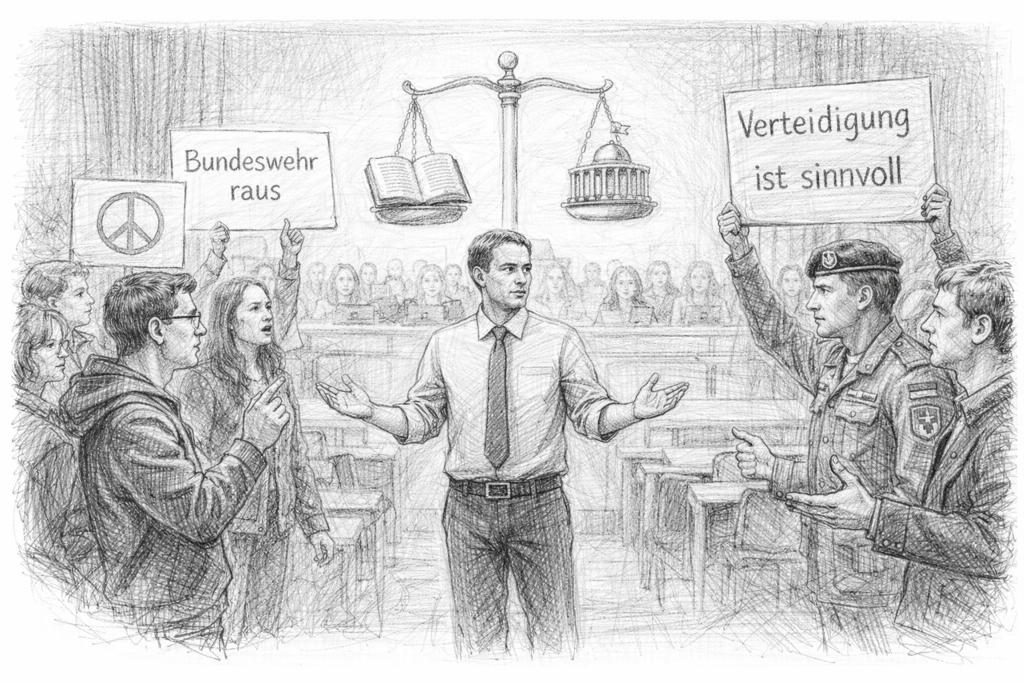
And now the pupils themselves are also speaking out. In recent months, there have been school strikes in many German cities against the German government's new military service plans. Thousands of young people took to the streets to protest against a possible return to compulsory military service.
This development has made me curious. Because it raises a number of questions:
- To what extent is the Bundeswehr actually present in German schools today?
- How long has this form of cooperation existed?
- And where is the line between political education and military recruitment?
I would like to take a closer look at precisely these questions below.
Turning point: How Europe's security situation has changed
If you follow the political debate in Europe today, one term comes up again and again:
„Turning point“
This word appears in speeches by politicians, in newspaper articles, on talk shows and in security policy analyses. It refers to the assessment that the strategic situation in Europe has changed fundamentally - and faster than many observers would have expected just a few years ago.
For a long time, Germany lived in a relatively stable security environment. After the end of the Cold War, a major military conflict on European soil seemed almost inconceivable. The Bundeswehr was downsized, defence spending decreased and many people had the impression that military issues would play a subordinate role in the future. Today, the situation is different.
The Ukraine war as a turning point
The war in Ukraine was a decisive turning point. Since 2022 at the latest, the topic of security policy has returned to the top of Europe's political agenda. Many countries are discussing how stable the European security order actually still is and what role national armed forces will have to play in the future.
This development has also led to a clear change of course in Germany. Politicians are now openly saying that Europe must once again focus more on military deterrence and defense capabilities. The German government decided on a large special fund for the Bundeswehr, defense spending was increased and Germany is now much more committed to NATO than it was a few years ago.
These changes not only have an impact on foreign policy. They also affect very practical issues: equipment, infrastructure - and personnel.
The growing importance of the Bundeswehr
In this new environment, the Bundeswehr is moving more into the center of political discussion. For many years, it was seen in Germany as an institution that existed but was barely visible in the everyday lives of most people. Deployments abroad did take place, but they often only played a limited role in the public consciousness.
Today, things are different. Suddenly, there is more intense discussion about how big the armed forces should be, what tasks they should take on and how well prepared they are for potential crises. At the same time, NATO has raised its expectations of the member states. Germany is expected to make a greater contribution to collective defense.
All of this means that the Bundeswehr not only needs modern technology, but also sufficient personnel.
The personnel requirements of the armed forces
A modern army does not function with vehicles, aircraft or digital systems alone. Above all, it needs people - soldiers, technicians, specialists, officers and many other specialists.
This has been one of the biggest challenges for the Bundeswehr for several years. Time and again, the media report on difficulties in recruiting personnel. Certain technical or specialized areas are particularly difficult to fill. At the same time, the need for qualified new recruits is growing.
This is not a purely German problem. Many European countries are facing similar issues. In modern societies, the military competes with many other employers for well-trained young people. Whereas in the past, compulsory military service ensured that new soldiers were regularly available, a volunteer army has to actively recruit its members.
A new strategic question
This also changes a fundamental perspective: the military is increasingly becoming one employer among many. Today, the Bundeswehr has to explain why young people should choose a military career. It must present training paths, show career opportunities and present its role in society. In short: it must be visible.
And this is precisely where schools come into the picture. After all, if you want to reach young people, it makes sense to go where they are anyway: to schools, training centers or universities. From this perspective, information events, lectures or discussions on security policy initially appear to be a logical measure.
But this is exactly where the social debate begins.
Military and society
In Germany, the relationship between the military and society is traditionally sensitive. The historical experience of the 20th century has led many people to pay very close attention to the role the armed forces play in public life.
This is why the increasing presence of the Bundeswehr in schools is viewed differently. For some, security policy is a natural part of political education. They argue that pupils have a right to get to know the perspective of the armed forces.
Others take a more critical view. They fear that military interests could gain too much influence in the field of education - especially if new recruits are being sought for the army at the same time.
Today, a large part of the public debate moves between these two positions.
The case of tension: What happens when Germany officially goes into crisis mode?
 Another term that is appearing more and more frequently in security policy discussions is the so-called state of tension. This state lies legally between peacetime and a state of defense and can be declared by the Bundestag if a serious international crisis threatens. However, many citizens hardly know what the specific consequences would be. In my Article on voltage drop I therefore explain in detail which political and legal mechanisms would then take effect. These include possible mobilizations of the Bundeswehr, special powers for government agencies and changes in the everyday lives of the population. The article clearly shows how this rarely discussed part of the German security architecture actually works.
Current survey on a possible case of tension in Germany
A debate that is only just beginning
If you look at current developments, it quickly becomes clear that the question of the role of the Bundeswehr in schools is part of a much larger debate. It touches on fundamental issues such as security, democracy, political education and the responsibility of the state towards its citizens. At the same time, it shows that the relationship between young people and state institutions is also changing.
A few decades ago, it would probably have been hard to imagine schoolchildren today demonstrating and publicly discussing military service or military policy.
All of this indicates that Europe - and with it Germany - is indeed in a phase of upheaval. It is therefore all the more interesting to ask how it came about that the Bundeswehr now has to recruit more young people. The decisive starting point for this development lies in a political decision that was made more than a decade ago: the end of compulsory military service.
The end of compulsory military service and its consequences
In 2011, Germany made a security policy decision, the effects of which are still being felt today: Compulsory military service was suspended. Although it was not formally abolished completely, in practice this decision meant the end of a system that had been a central component of the German security structure for decades.
For many generations, compulsory military service was a matter of course. Anyone who came of age as a young man had to expect to spend a few months of his life either in the armed forces or in civilian service. The state thus had a steady stream of recruits - regardless of how attractive military service was for the individual.
This principle changed fundamentally with the suspension of compulsory military service.
From the conscript army to the volunteer army
Since 2011, the Bundeswehr has been based on a voluntary system. This means that no one is automatically conscripted. Anyone who wants to become a soldier must make a conscious decision to do so.
There were initially quite understandable reasons for this change. In previous years, the number of conscripts had already been greatly reduced and many experts argued that a modern army could work better with volunteer and professionally trained soldiers.
The Bundeswehr's tasks had also changed. Foreign missions, international cooperation and technically sophisticated military systems required increasingly specialized training. Against this backdrop, a smaller, more professionalized army seemed more sensible to many politicians.
But every political decision also has side effects.
The challenge of recruiting young talent
With the end of compulsory military service, a mechanism that had automatically ensured a new generation of soldiers for decades disappeared. Suddenly, the Bundeswehr had to convince young people to sign up voluntarily.
That sounds easier at first than it is in practice. After all, the Bundeswehr is now competing with many other employers for qualified young people. Universities, companies, start-ups, public administration - they are all looking for young talent. At the same time, the world of work has changed dramatically. Many young people attach great importance to flexible life planning, international mobility or creative professional fields.
Under these conditions, a military career is not attractive to everyone. In addition, the military profession is associated with special requirements: physical strain, discipline, possible deployments abroad and the willingness to use military force in an emergency. These are aspects that cannot be compared with ordinary jobs.
For the Bundeswehr, this means that it must explain why young people should still choose this path.
New public relations strategies
In the years after 2011, the Bundeswehr therefore began to significantly expand its public relations work. Information campaigns, career portals and social media appearances were intended to show the opportunities that a military career can offer.
Events for young people also gained in importance. Information stands at training fairs, advisory services for school leavers and presentations on technical professions within the armed forces became an increasingly important part of the recruitment strategy.
Another instrument was educational events - such as lectures on security policy, simulation games on international conflicts or discussions on the role of NATO. Officially, the focus is on political education and providing information. However, some critics see this as an indirect form of recruitment.
Irrespective of this, this development shows one thing above all: the Bundeswehr is now more dependent on visibility than in the past.
A society in transition
This change comes at a time when society's attitude towards the military has also changed. While national defense was a central political issue during the decades of the Cold War, it increasingly receded into the background after German reunification.
Many people in Germany grew up at a time when war in Europe seemed almost inconceivable. Security policy was perceived more as a task of international cooperation and diplomatic solutions. Military issues hardly played a role in the everyday lives of many citizens.
With the current geopolitical tensions, this picture is changing again. Topics such as defense capability, alliance policy and military deterrence are once again being discussed more intensively. This development inevitably leads to another question: What role should the Bundeswehr play in society - and how visible should it be?
The return of an old debate
For some years now, there has therefore been discussion about the possible return of compulsory military service. Some politicians argue that compulsory service would not only secure the armed forces' personnel requirements, but could also strengthen the relationship between society and the military.
Others firmly reject this idea. They see it as an encroachment on personal freedom and doubt that compulsory military service still makes sense in a modern society.
The political debate is currently moving between these positions. Only one thing is certain: the 2011 decision has permanently changed the system.
A look at the younger generation
While politicians are discussing reform models, young people themselves are also reacting to these developments. The current school strikes against military service plans show that the issue of military service and security policy is now once again affecting a generation that has long had little contact with this topic.
This is precisely why the education sector is increasingly becoming a place where this discussion becomes visible. Schools are not only places of learning, but also spaces in which political issues are perceived and discussed more intensively for the first time.
This automatically brings another question to the fore: What role does the Bundeswehr actually play in everyday school life today - and how often do pupils actually encounter soldiers in the classroom? This is precisely the question we want to address in more detail in the next chapter.
Turning point in the Bundeswehr: Between pressure to reform and personnel shortages
Since the start of the war in Ukraine, politicians and the military in Germany have been talking about a „turning point“ in security policy. A documentary by SWR accompanies several soldiers in their everyday lives and shows how this political decision is having a concrete impact on the Bundeswehr. The film follows, among others, a young female recruit, an experienced reconnaissance soldier on NATO's eastern flank and a lecturer who is supposed to prepare soldiers for new security policy realities.

Turning point in the Bundeswehr - A year with soldiers | SWR documentary
The challenges currently facing the Bundeswehr become clear: a lack of personnel, equipment that has been neglected for years and the task of refocusing on national and alliance defense. The report provides a personal insight into an army in transition.
The situation before and after the end of compulsory military service
| Before 2011 (compulsory military service) | After 2011 (volunteer army) | Effects |
|---|---|---|
| Automatic conscription of many young men. | Voluntary application for military careers. | The Bundeswehr must actively recruit new recruits. |
| The military was present in society, but rarely in school lessons. | More information events and public relations work. | Bundeswehr appears more frequently in the education sector. |
| State had a predictable supply of personnel. | Recruitment is becoming more difficult. | New recruitment strategies are emerging. |
| Military service was part of many young men's lives. | Military service is a conscious professional decision. | The relationship between society and the military is changing. |
When soldiers come to class
When soldiers appear in German classrooms today, they are not usually recruiters in the traditional sense. They are usually so-called youth officers of the Bundeswehr. This special function has existed since the end of the 1950s. Their official task is to provide information about security policy and hold discussions with young people.
Youth officers are trained officers who also receive pedagogical training. They visit schools, universities and political educational institutions to give lectures or take part in discussion events. Topics include international conflicts, alliance policy, the role of NATO and the security situation in Europe.
Formally, this activity is seen as political education. The Bundeswehr regularly emphasizes that youth officers should not directly recruit young people. They act as speakers, not as career advisors.
Nevertheless, their presence in the education sector has become much more visible in recent years.
Security policy as a teaching topic
The events with youth officers usually take place as part of subjects such as politics, social studies or history. Teachers can request such a visit if they would like to explore a topic in more depth - such as international security policy or the structure of NATO.
The typical procedure is relatively simple: an officer first gives a presentation on current security policy developments. This is followed by a discussion round in which students can ask questions.
It is not just about military aspects. Political decision-making processes, international organizations and Germany's role in global conflicts are also frequently addressed.
For many pupils, such a visit is probably their first direct contact with a member of the armed forces.
Simulation games and conflict simulations
In addition to traditional lectures, there are also more interactive formats. Particularly well known is the POL&IS simulation game - Politics and international security. This is a simulation of international politics.
Students take on various roles in this game, such as the government of a state or the head of an international organization. They have to make decisions about economic developments, diplomatic relations or security policy conflicts. The question of what role military means can play in certain situations is also discussed.
The idea behind such simulation games is to make complex political contexts easier to understand. International politics consists of many interconnected factors - economics, diplomacy, environmental issues and military security. This complexity can often be presented more vividly in a simulation than in a traditional classroom discussion. However, such formats are also subject to criticism.
A fine line between information and presentation
Critics argue that simulation games or presentations can sometimes portray military aspects too positively. When conflicts are simulated in a playful setting, there is a danger that the reality of military violence is lost sight of.
Others see it differently. They emphasize that political education is particularly useful when it includes different perspectives. The viewpoint of the armed forces can also play a role, as long as it is discussed critically in class.
This debate shows how sensitive the topic is.
Excursions and encounters outside the classroom
In addition to classroom visits, there is another form of encounter: excursions to Bundeswehr locations. Some schools organize visits to barracks or military training facilities.
For example, pupils can see technical equipment, talk to soldiers or gain an insight into training processes. For many young people, this is an opportunity to get to know an institution that otherwise seems rather abstract.
Such visits are often seen by the organizers as informational offers. At the same time, they also raise questions. Critics sometimes speak of a kind of „experiential character“ that could make military structures appear particularly interesting.
Whether this assessment is correct or not probably depends heavily on the actual organization of such events.
How often do such visits take place?
The exact number of school visits varies from year to year. According to estimates, youth officers reach tens of thousands of pupils in Germany every year. In total, thousands of events take place - not only at schools, but also at universities or political educational institutions.
This does not mean that every school experiences such visits on a regular basis. Rather, it depends heavily on individual teachers, regional networks or specific teaching projects.
In some schools, such events are an integral part of politics lessons. In others, they are not taught at all.
The schools' perspective
This raises a practical question for teachers and school administrators: Which external speakers should be invited into the classroom?
Schools regularly work together with guests - such as scientists, journalists, politicians or representatives from companies. Organizations from civil society also hold lectures or workshops.
In this context, the Bundeswehr is one state institution among many. Nevertheless, its role is discussed more intensively than that of other speakers. The reason is obvious: the military is no ordinary employer. It is an organization that must use force in an emergency in order to defend state interests. For this reason, particular attention is paid to how its presence in the education sector is organized.
For some, visits by the Bundeswehr are a legitimate part of political education. Security policy is a topic that affects young people and it can be useful to get to know different perspectives.
For others, a certain unease remains. They wonder whether schools are really the right place for military institutions - especially in times when the armed forces are actively looking for new recruits.
These different perspectives show that the debate about Bundeswehr visits in the classroom is ultimately part of a larger social discussion. Because as soon as state institutions enter the education sector to a greater extent, a fundamental question automatically arises: what role should they play there?
It is precisely at this point that the next level of the debate begins - namely the cooperation between the Bundeswehr and education policy.
Forms of Bundeswehr contact with schools
| Format | Description | Goal |
|---|---|---|
| Presentations by youth officers | Soldiers explain international security policy and discuss it with pupils. | Political education on security policy issues. |
| Simulation games (e.g. POL&IS) | Simulation of international politics and conflict decisions. | Making complex political contexts understandable. |
| Career information | Information about training and career opportunities in the Bundeswehr. | Arouse interest in military professions. |
| Barracks visits | Pupils visit military sites and talk to soldiers. | Insight into the day-to-day work and technology of the armed forces. |
Cooperation between the Bundeswehr and ministries of education
When soldiers appear in lessons or security policy simulation games take place in schools, this is not usually completely spontaneous or coincidental. Many of these activities are based on official agreements between the Bundeswehr and the education ministries of the federal states.
These collaborations are not a secret project in Germany, nor are they a new development. In fact, many of these agreements were concluded more than a decade ago, mostly between 2008 and 2011. During this time, the desire arose in several federal states to integrate security policy topics more strongly into lessons.
The idea behind it was initially relatively pragmatic: schools should have access to expert speakers when it comes to questions of international security policy.
This is because curricula now cover topics such as NATO, international conflicts, peace missions and European security policy. And this is precisely where the youth officers of the Bundeswehr were seen as potential contacts.
The content of the agreements
The cooperation agreements between the Bundeswehr and the ministries of education primarily regulate organizational issues. They determine the conditions under which youth officers can visit schools and what role they are allowed to play. One central point is almost always that the educational responsibility remains entirely with the school. In concrete terms, this means
- Teachers decide whether to invite a youth officer.
- The school determines the topic and course of the event.
- The visit is voluntary and part of the teacher's teaching project.
In addition, many agreements explicitly emphasize that youth officers should not directly recruit new recruits. According to official statements, their task is to explain security policy contexts and facilitate discussions. The Bundeswehr therefore sees this work as a contribution to political education.
A network of contacts
In practice, such collaborations often result in relatively stable networks. Youth officers regularly work together with certain schools, teachers know their contacts at the Bundeswehr, and some teaching units are repeated in a similar form over the years.
This can certainly have practical advantages for schools. Security policy topics are among the more complex areas of political education. External speakers can help to explain current developments or provide practical insights. Simulation games or discussion events can also be organized more easily with the support of experienced moderators.
From the perspective of the Bundeswehr, this network also has a clear benefit: It creates access to young people who are concerned with political issues and are about to make the transition to working life.
A sensitive topic in the education sector
Despite this organizational structure, cooperation between the military and education policy remains a sensitive issue. In Germany, the education sector is traditionally very keen to maintain political neutrality.
Schools should be places where different perspectives can be discussed - without one particular state institution having a dominant influence. This is precisely why some observers are critical of the cooperation with the Bundeswehr. They wonder whether the military should really be the right partner for political education.
Others, on the other hand, do not see this as a problem. They argue that security policy issues in particular cannot be discussed without the perspective of the armed forces. When students talk about international conflicts or defense policy, it can make sense to involve someone who is professionally involved in these issues.
Different regulations in the federal states
Another point that is sometimes overlooked in the public debate: Education policy in Germany is a matter for the federal states. This means that there is no uniform regulation for the whole country.
Some federal states maintain relatively close cooperation with the Bundeswehr. Others take a more cautious approach or rely more heavily on alternative forms of political education. In some regions, visits by youth officers are part of the regular program for schools. In other federal states, such events are organized less frequently or are the subject of more discussion.
This federal system means that the actual presence of the Bundeswehr in everyday school life can vary greatly.
The role of the schools themselves
Ultimately, the decision often lies with the schools themselves. School principals and teaching staff decide which external speakers are invited and which topics are to be explored in greater depth in the classroom.
Some schools regularly use the Bundeswehr's services, for example for simulation games or discussion events on international politics. Others deliberately refrain from doing so. In some cases, schools have even expressly decided not to hold any events with military speakers. Initiatives such as „Schools without the Bundeswehr“ call on educational institutions to reject such visits.
There are usually no legal consequences for this. Schools are basically free to organize their lessons as they wish.
A debate about the educational mission
All these developments show that the cooperation between the Bundeswehr and schools is ultimately part of a larger discussion: What exactly is part of political education?
Should students also get to know the perspective of state institutions when they talk about international politics? Or should lessons deliberately keep their distance from military organizations?
These questions cannot be answered with a simple yes or no. They touch on fundamental ideas about the role schools play in a democratic society.
It is therefore hardly surprising that teachers' associations, peace initiatives and social organizations are increasingly getting involved in this debate. For them, there is a very fundamental question: How much military can the education sector tolerate?

Criticism and opposing positions - a debate with many voices
As soon as state institutions become more involved in education, a public debate arises almost automatically. This is especially true when it comes to the military. The reactions to Bundeswehr events at schools vary accordingly.
While some observers see this as a legitimate component of political education, others express clear criticism. Between these two positions is a debate that not only concerns education policy, but also fundamental questions about the relationship between the military, the state and society.
It is therefore worth taking a closer look at the most important arguments on both sides.
Criticism from teachers' associations
One of the loudest voices in this debate comes from teachers' associations. The German Education and Science Union (GEW) in particular has been expressing concerns about the presence of the Bundeswehr in the classroom for years.
The central point of criticism is that political education should primarily be shaped by teachers themselves - not by representatives of state institutions with their own interests.
According to critics, there is a danger that pupils could become familiar with one-sided perspectives. Military institutions naturally have a certain view of international conflicts, defense policy or security strategies.
Teachers' associations therefore argue that such topics should be considered from different perspectives in the classroom - for example from a political science, historical or peace policy perspective.
Another point concerns the age of the target group. Pupils are still in a phase of political orientation. Critics therefore warn that military institutions could gain too much influence in the education sector.
Peace initiatives and civil society groups
In addition to teachers„ associations, peace initiatives also regularly speak out. Some organizations from this environment speak of a “militarization of the education sector".
This means that military topics are increasingly present in everyday school life - be it through lectures, simulation games or cooperation with state institutions.
For these groups, there is a fundamental question: Should military organizations play a role in the classroom at all?
Some peace initiatives argue that schools should deliberately be places where conflict resolution, diplomacy and international cooperation take center stage. In their view, military perspectives could send the wrong signal, especially in times of growing global tensions.
Some of these groups are actively involved in campaigns such as „School without the Bundeswehr“, which calls on schools to refrain from receiving visits from youth officers.
Criticism from children's rights organizations
Another point of criticism concerns the fact that the Bundeswehr also trains 17-year-old volunteers. Although these minors are not allowed to be deployed on combat missions, they are already beginning their military training.
Children's rights organizations are sometimes critical of this practice. They argue that young people should be particularly protected when it comes to military structures and possible later deployments.
In international debates, it is often discussed whether states should only deploy their armed forces with soldiers of legal age. Germany operates within a legally permissible framework here, but the debate remains lively.
The critics' main concern
If you summarize all these arguments, one central point emerges: critics fear that schools could become an indirect recruitment space.
Even if youth officers do not officially recruit young people, their presence alone could have a positive influence on the image of the Bundeswehr. Especially if career opportunities or technical training paths are discussed at the same time.
From this perspective, the boundary between information and advertising is perceived as blurred.
The counterarguments
On the other hand, there are equally clear opposing positions. Many politicians, education experts and even some teachers consider the criticism to be exaggerated. Their argument is that security policy is a real part of political discussions. If pupils are to understand international conflicts, NATO structures or military alliances, it can be useful to learn about the perspective of the armed forces.
It is also pointed out that youth officers do not act alone in the classroom. Teachers can moderate discussions, ask critical questions or bring in additional perspectives. Political education thrives on comparing different points of view.
Another point concerns the democratic control of the Bundeswehr. Germany sees its armed forces as a „parliamentary army“ that is firmly integrated into the democratic structures of the state. From this perspective, it seems perfectly legitimate for soldiers to also take part in political education.
A comparison with other speakers
Proponents also ask a simple counter-question: why should military speakers of all people be excluded when schools regularly invite representatives from other institutions?
Journalists report on media work, entrepreneurs explain economic relationships, environmental organizations talk about climate policy. In many areas, involving external experts has long been part of everyday school life.
If political education is to be realistic, it might even make sense to allow different social actors to have their say - as long as their statements are discussed critically.
A balancing act for schools
In practice, schools are therefore often faced with a balancing act. On the one hand, they should present political topics in as many different ways as possible. On the other hand, they must ensure that no one institution has a dominant influence.
Many teachers solve this problem pragmatically: they use external speakers, but combine their contributions with critical discussions or additional materials. This allows pupils to get to know different perspectives and form their own opinions. Ultimately, this is also the core of democratic education.
A debate without simple answers
If you look at the various arguments, it quickly becomes clear that the discussion about Bundeswehr visits to schools cannot be reduced to simple buzzwords.
It touches on fundamental questions about how political education should be organized, what role state institutions can play in teaching and how young people are introduced to complex social issues.
This is precisely why this debate is likely to continue for some time to come. It is interesting to note that pupils themselves are now also getting more involved in this discussion. The school strikes against military service plans show that a new generation is beginning to formulate its own positions.
This means that some of the debate is moving out of the classroom and onto the streets - and that's where we'll take a closer look in the next chapter.
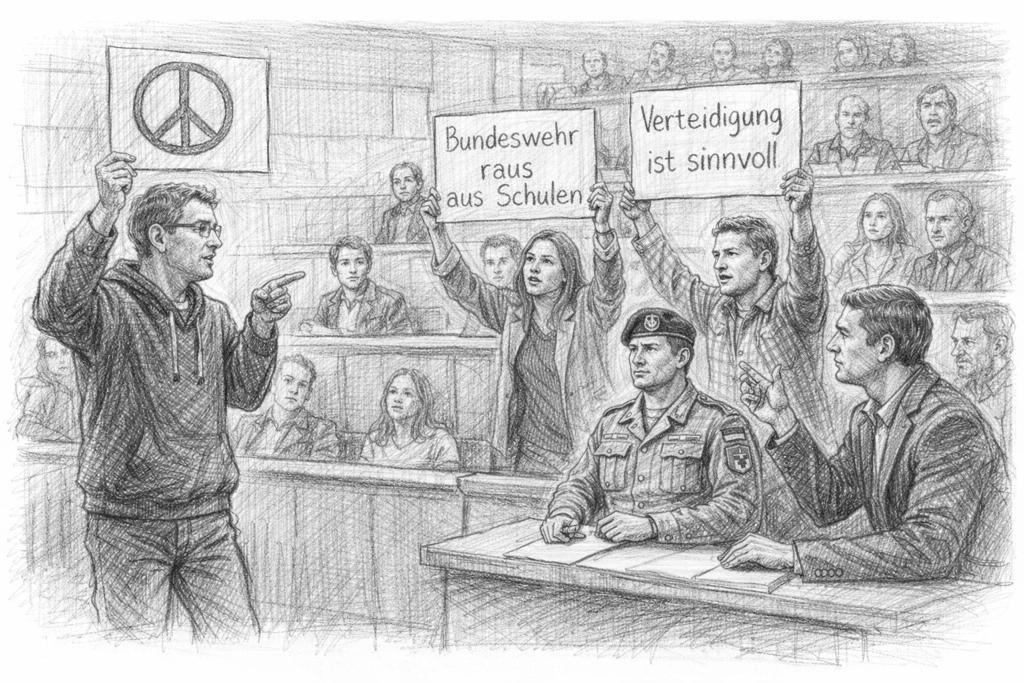
Arguments from critics and supporters of the Bundeswehr in schools
| Critics' argument | Proponents' argument | Central question |
|---|---|---|
| Military institutions should not have direct access to students. | Security policy is part of political education and should be explained. | Does the military belong in the education sector? |
| Young people could be positively influenced by soldiers. | Students are able to critically discuss different perspectives. | How strong is the influence of external speakers? |
| Bundeswehr visits could be indirect recruitment. | Officially, youth officers only serve to provide political information. | Where does information end and advertising begin? |
| Schools should remain as military-free as possible. | Other state institutions also appear in the classroom. | Which external actors are useful in the classroom? |
A new protest movement: school strikes against military service plans
In recent months, we have seen a development that has been rather rare in this form for a long time: schoolchildren are increasingly taking part in political protests again. One of the reasons for this is discussions about new models of military service in Germany.
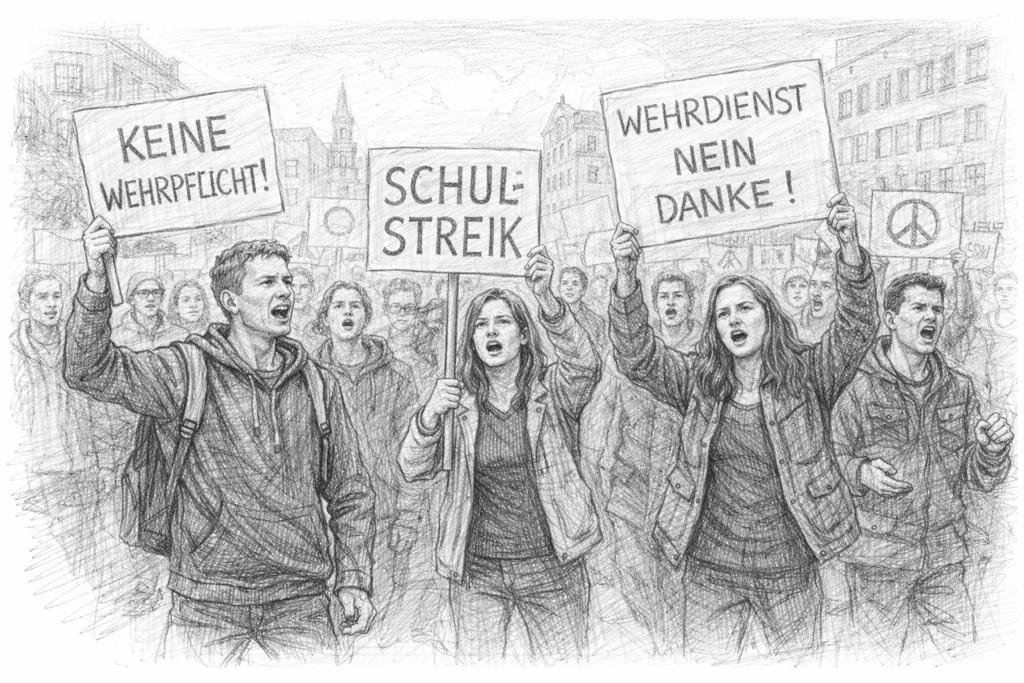
In several German cities there were School strikes against possible military service reforms. Thousands of young people left their schools during school hours to take part in demonstrations. Their aim was to draw attention to the possible consequences of new security policy concepts and to express their rejection of a possible return to compulsory service.
These protests show that security policy issues now also concern a generation that has long had little direct contact with military issues.
Background: New military service models
The protests were triggered by political discussions about a new military service model. After compulsory military service was suspended in 2011, the Bundeswehr is now based on voluntary service. However, in view of the changed security situation in Europe, politicians have been discussing ways of adapting the system for some time.
One proposal is to first write to all young men in a year group and ask them about their willingness to do military service. Such a questionnaire would collect information on interest, qualifications and health requirements. On the basis of this data, the state could then decide whether and how many young people could be recruited for voluntary service.
In the political debate, this model is often described as a kind of interim step. If there are not enough volunteers in the long term, the legislator could theoretically also consider reactivating compulsory military service.
It is precisely this possibility that causes anxiety for many young people.
Demonstrations in many cities
In December 2025, there was therefore a major wave of protest. Students organized demonstrations in over 90 German cities. According to estimates, a total of around 55,000 young people took part in the actions.
The cities in which protests took place included Berlin, Hamburg, Cologne, Düsseldorf, Munich, Stuttgart and Dresden. Several thousand participants gathered in some cities.
The demonstrations were often organized via social networks. Student groups networked online, spread calls for strikes and coordinated meeting points for joint rallies.
Many participants carried posters with slogans against conscription or against the increasing militarization of politics.
Political commitment of a young generation
For many observers, these school strikes were an interesting signal. They show that young people are definitely interested in political issues - especially when they themselves could be directly affected.
The discussion about military service touches on fundamental issues: personal freedom, state responsibility, international security and the role of the military in a democratic society. The fact that pupils discuss these issues in public can therefore also be seen as an expression of a lively political culture.
At the same time, a generational conflict is evident here. Many young people grew up in a time when military issues hardly played a role in everyday life. For them, the idea of compulsory service may be more difficult to comprehend than for older generations who have experienced compulsory military or civilian service themselves.
Student protests against possible compulsory military service in the media
Public media are now also reporting on the increasing protests by young people against possible military service models. In a report by the Daily news shows schoolchildren in several cities taking to the streets under the slogan „School strike against compulsory military service“. Many of the young people express their concern that a new compulsory military service could restrict their life plans. Some emphasize that although they want to deal with security policy issues in principle, they do not see military service as a compulsory option.

Nationwide demonstrations: Why students are protesting against the new military service law
The video shows interviews with pupils as well as impressions of demonstrations and makes it clear how emotional and controversial the topic is among young people.
Conflict with compulsory education
However, the school strikes also led to a practical question: are pupils allowed to demonstrate during school hours?
School attendance is compulsory in Germany. This means that pupils are obliged to attend lessons during school hours. Political demonstrations are not normally considered an official excuse.
Some school authorities therefore declared that participants in the strikes could be considered truant. In some cases, it was pointed out that absences would appear on school reports or that missed class tests would have to be made up.
This attitude in turn led to criticism. Some pupils and supporters argued that political engagement should not be made more difficult by school sanctions. They pointed out that other protest movements - such as climate demonstrations - had also sometimes taken place during school hours.
A debate on political participation
As a result, a second discussion quickly developed from the school strikes: the question of political participation by young people.
Should pupils only express their political concerns outside school hours? Or is it part of democratic culture for young people to draw public attention to social issues during school hours?
As is so often the case, there are also different perspectives here. Some teachers support political engagement in principle, but at the same time emphasize that schools need clear rules. Others consider it problematic when lessons are regularly interrupted by demonstrations.
A sign of social change
Regardless of how one assesses these issues, the school strikes clearly show one thing: security policy issues have once again become more prominent in the public debate.
A generation that for a long time had little direct connection to military issues is beginning to engage with these topics. New political movements, new arguments and new forms of engagement are emerging.
This poses an additional challenge for the education sector. Schools are not only places of learning, but also places where social developments become visible.
When young people start discussing military policy, military service or international conflicts, another question automatically arises: How can schools deal with such political debates?
This is exactly where many educational institutions find themselves today - between teaching, political education and a generation of pupils who are increasingly formulating their own positions.
Schools between political education and political pressure
When talking about visits by the German armed forces, political discussions in the classroom or student demonstrations, sooner or later you end up with a fundamental question: What role should schools actually play in political debates?
First and foremost, schools have an educational mission. They should impart knowledge, promote critical thinking and help young people to form their own opinions. Subjects such as politics, history or social studies therefore inevitably deal with social conflicts, international developments or state institutions.
Political education is therefore a natural part of everyday school life. At the same time, schools must ensure that lessons do not lead to one-sided influence. Teachers should explain topics, present perspectives and moderate discussions - but they should not run political campaigns.
It is precisely in this area of tension that many of the current debates are taking place.
Teachers in a field of tension
For teachers, this situation is often more challenging than it might appear from the outside. On the one hand, they have to address current political developments in the classroom. On the other hand, they have to make sure that different points of view are taken into account appropriately.
If, for example, a youth officer is invited to talk about security policy, the question automatically arises: What other perspectives should also be included in the lessons?
Some teachers therefore make a conscious decision to allow several voices to be heard. In addition to representatives of state institutions, academics, journalists or representatives of non-governmental organizations are invited, for example. This creates a broader picture of the political discussion.
Other schools take a more cautious approach and generally avoid external speakers from areas that are particularly controversial.
Both paths are possible in the German education system.
Pupils between commitment and compulsory education
There is also an area of tension for pupils. On the one hand, they are expected to take an interest in social issues and understand democratic processes. On the other hand, compulsory education still applies.
When political protests - such as school strikes against military service plans - take place during school hours, these two principles collide. Political engagement clashes with the organizational rules of school life.
Some students see this as a contradiction. They argue that democracy also depends on young people being able to express their concerns publicly. Others accept compulsory education as the necessary basis of a functioning education system.
For schools, this situation often means walking a tightrope between understanding political commitment and enforcing clear rules.
Rejection of Bundeswehr visits
A further expression of these tensions can be seen in the question of whether schools want to hold events with the Bundeswehr at all.
In recent years, some schools have decided to forego such visits. Initiatives such as „Schools without the Bundeswehr“ call on educational institutions not to invite military speakers. This is often justified by the desire to keep schools as neutral as possible.
Other schools see things differently. They argue that political education is particularly useful when pupils get to know different perspectives. This could also include the viewpoint of state institutions.
It is interesting to note that both positions refer to the same principle - namely the educational mission of schools. While some emphasize neutrality, others point to the importance of pluralistic discussions.

The responsibility of school management
In practice, the decision often lies with the school management and teaching staff. They determine which projects are implemented, which guests are invited and how political topics are dealt with in lessons.
Many factors play a role here: regional networks, teachers' personal convictions, specific teaching projects and the expectations of parents and pupils.
For example, a school principal has to weigh up whether a Bundeswehr lecture fits in with the teaching objectives or whether it could potentially lead to controversy among the teaching staff or parents. These decisions are rarely easy.
The school as a mirror of social debates
Perhaps this is precisely the crucial point: schools are not only places where knowledge is imparted, but also a mirror of society. Sooner or later, the conflicts, discussions and political issues of a society also emerge in the classroom.
When there are disputes about security policy, when demonstrations take place or when state institutions want to explain their role, the education sector is not unaffected.
This does not necessarily mean that schools themselves become political. But they are becoming places where political issues are discussed - sometimes more intensively than originally planned.
A balancing act in everyday life
For teachers, school administrators and pupils, this ultimately means a permanent balancing act. Political education should inform, not indoctrinate. Discussions should take place, but not completely dominate lessons.
This balance is particularly challenging in times of major social change. Because when political conditions change - for example due to new security policy challenges or debates about military service - new questions automatically arise in the education sector.
And that is precisely why it is worth taking a step back at the end and taking a closer look at this development.
Germany in comparison - Compulsory military service in Europe
| Country | Status of compulsory military service | Special features |
|---|---|---|
| Germany | Suspended since 2011 | „New military service“, Bundeswehr was previously based solely on volunteers. |
| Austria | Active | Basic military service about 6 months; alternative: civilian service. |
| Switzerland | Active | Militia army system with regular refresher courses. |
| Finland | Active | Compulsory military service for men, voluntary service possible for women. |
| Sweden | Reintroduced in 2017 | Selective conscription for men and women. |
| Norway | Active | Gender-neutral compulsory military service since 2015. |
| Denmark | Partially active | Combination of volunteer and conscription lottery procedure. |
| Estonia | Active | Compulsory military service for men; an important part of national defense. |
| Latvia | Re-introduced in 2023 | New compulsory military service after abolition in 2007. |
| Lithuania | Reintroduced in 2015 | Reactivation due to geopolitical tensions. |
| France | Abolished in 2001 | Discussion about compulsory civil or national service. |
| Italy | Suspended since 2005 | Professional army with voluntary military service. |
| Spain | Abolished in 2001 | Professional armed forces without conscription. |
| Netherlands | Exposed | Compulsory military service exists formally, but is not implemented. |
| Poland | Suspended since 2009 | Discussion about new forms of military training. |
An open debate about the military, society and youth
If you look at the current debate about Bundeswehr visits to schools, military service models or student protests, it quickly becomes apparent: There is also a generational difference behind many of these discussions.
Older generations in Germany often grew up with compulsory military service. For many, it was a matter of course to either join the armed forces or do civilian service after leaving school. Military structures were a normal part of the state, even if they were not always present in everyday life.
Younger generations, on the other hand, have had a very different experience. Since the suspension of compulsory military service in 2011, the topic of the military has remained rather abstract for many young people. Although the Bundeswehr still existed, it hardly played a role in the everyday lives of most young people.
When military service, military deterrence or security policy strategies are suddenly being discussed again, it feels like a new reality for some young people that they first have to familiarize themselves with.
The relationship between state and citizen
The discussion about Bundeswehr visits to schools therefore also touches on a larger question: How visible should state institutions be in the everyday lives of citizens?
In a democracy, the armed forces are naturally part of the state. They are subject to parliamentary control, are financed by taxpayers' money and perform tasks that are ultimately intended to protect society.
At the same time, the relationship between the military and society in Germany is historically sensitive. Many people are particularly concerned that state institutions perform their role transparently and responsibly.
When soldiers appear in the classroom or talk about security policy issues, this relationship becomes immediately apparent. For some, this is a normal part of political education. For others, a certain unease remains.
Both perspectives are part of a democratic discussion.
Security policy as a social issue
Another aspect of this debate concerns the question of how openly a society talks about security policy. For a long time, this topic tended to play a minor role in everyday public life in Germany. Military issues were often dealt with by experts or political decision-makers.
However, this has changed in recent years. International conflicts, geopolitical tensions and new security policy challenges are bringing defense issues back into focus. This automatically gives rise to new discussions - including in schools, universities and public debates.
Perhaps this is precisely a sign that a society is coming to terms with its role in a complex world.
Compulsory military service in Germany: rights, duties and the possibility of refusal
 The debate about Bundeswehr visits to schools often also touches on another question: what would actually happen if compulsory military service was reintroduced in Germany? Many people know surprisingly little about what rights they would have in such a case. In my detailed article on compulsory military service is therefore primarily concerned with the legal aspects: Who can be called up at all? Who can refuse military service - and how does such an application actually work? It explains step by step which legal principles apply, which deadlines need to be observed and what alternatives there are to military service. So if you are interested in how the system works legally, you will find a detailed and comprehensible overview there.
Current survey on compulsory military service in Germany
The role of the younger generation
The role of young people themselves is particularly interesting. The school strikes against military service plans show that young people are not just passive observers of these developments.
They take part in discussions, organize demonstrations and formulate their own positions on political issues. This can be seen in different ways - as an expression of political maturity, as a youthful culture of protest or simply as part of a vibrant democracy.
Irrespective of this, it shows that security policy issues are now returning to the public sphere. This is precisely why the education sector is becoming an important venue for this debate. Schools are often the first place where young people discuss political issues more intensively, exchange arguments and learn to understand different perspectives.
A discussion without simple solutions
The question of how much of the military should be present in the education sector is therefore likely to remain a controversial issue in the future.
Some will continue to argue that schools should remain as independent as possible from state institutions. Others will point out that political education is only complete if security policy perspectives are also taken into account.
There is a debate between these positions that cannot be resolved with simple answers.
But perhaps this is also a sign of functioning democratic structures. After all, democracy does not mean that all issues are resolved quickly - but that different opinions can be discussed openly.
An open question
Perhaps the most important insight from this discussion is not whether Bundeswehr visits to schools are fundamentally right or wrong.
The crucial question is perhaps rather:
How do we as a society deal with issues such as security, responsibility and political education?
When young people start to think about these questions, when teachers moderate discussions and when state institutions have to explain their role, it shows one thing above all: a democratic society is in conversation with itself.
So perhaps the most important question is not whether soldiers should perform in schools.
But whether we as a society are prepared to have this discussion openly, calmly and without ideological blinkers.
Further sources on the topic
- Annual report of the youth officers of the BundeswehrThe Bundeswehr's official annual report on the activities of its youth officers. The document contains figures on school events, simulation games and lectures as well as strategic statements on the Bundeswehr's security policy education work. It also shows how many pupils are reached each year and what role cooperation with schools and educational institutions plays in the armed forces' work with young people and the public.
- Bundeswehr youth officers in school lessons - Press release from the state of Schleswig-HolsteinOfficial presentation of a federal state on cooperation between schools and the Bundeswehr. The text explains that youth officers offer lectures, seminars and simulation games and that these events serve the purpose of political education. At the same time, it is emphasized that such visits only take place at the invitation of the schools and are under the educational responsibility of the teachers.
- Cooperation between schools and the Bundeswehr - Baden-Württemberg Ministry of Education and Cultural AffairsThis page documents one of the most important cooperation agreements between the Bundeswehr and a German Ministry of Education. It describes that a formal cooperation has existed since 2009 in order to familiarize pupils with security policy issues. At the same time, it emphasizes that the lessons must follow the so-called Beutelsbach Consensus, according to which controversial political topics must also be presented controversially in the classroom.
- Debate in the German Bundestag on youth officers in schoolsDocumentation of a parliamentary debate on the deployment of Bundeswehr youth officers in school lessons. Among other things, this debate calls for an end to existing cooperation between the Bundeswehr and schools, while other MPs emphasize their importance for security policy education. The document shows how politically controversial the topic is in parliament.
- Cooperation agreement between the Bundeswehr and ministries of educationOverview of the framework agreements between the Bundeswehr and several German federal states. Among other things, these agreements regulate how youth officers can be deployed in the classroom and how teacher training courses are organized. According to the information provided, thousands of teachers have at times taken part in Bundeswehr security policy training courses.
- POL&IS - Politics and international security simulation gameDescription of a well-known Bundeswehr simulation game that is often played in schools. Pupils take on the roles of various states and organizations and simulate international politics. The simulation game is intended to make political contexts understandable, but is criticized by parts of the peace movement, who see it as an overly militaristic representation of international conflicts.
- German Armed Forces at Schools - Report by Terre des HommesA critical report by the children's rights organization Terre des Hommes on the presence of the Bundeswehr in educational institutions. The text argues that the Bundeswehr reaches hundreds of thousands of young people every year through youth officers, career advisors and events and criticizes in particular the recruitment of minors for military service.
- GEW: Reduce the influence of the Bundeswehr in schoolsThe German Education and Science Union (GEW) is one of the best-known critics of cooperation between the Bundeswehr and schools. In this article, it argues that military institutions should have no influence on curricula or teacher training and that political education must remain independent.
- Bundeswehr out of the schools - documentation of a peace initiativeThis documentary describes the development of the cooperation agreements between the Bundeswehr and ministries of education from a critical perspective. It analyzes how these agreements came about and what effects they could have on school lessons. The role of youth officers as lecturers on security policy issues is particularly addressed.
- Youth Protests Against Military Service - Analysis by the Konrad Adenauer FoundationThis article analyzes current protest movements of young people against possible military service models and places them in the context of the European security policy debate. At the same time, it emphasizes that security policy education in schools can help to make political discussions more objective.
- Preparing Youth for Defense - Comparative Study on Defence EducationA scientific study on military education and security policy socialization of young people in several European countries. The study compares different models used by states to prepare young people for security policy issues and analyzes similarities and differences in an international context.
- Bundeswehr in schools - Mecklenburg-Western Pomerania state parliament documentA parliamentary document with concrete figures on events organized by youth officers at schools. It explains how such lectures are organized and what their content is. At the same time, it explains that, according to the Bundeswehr, they are not intended for direct advertising but to facilitate discussions on security policy.
- Weizsäcker Commission: Common security and the future of the BundeswehrThe so-called Weizsäcker Commission was a group of experts appointed by the German government to develop proposals for the future structure of the Bundeswehr. Its work influenced long-term security policy discussions in Germany and forms an important background for today's reform debates on compulsory military service, the structure of the Bundeswehr and the social integration of the military.
- Infopost from the BundeswehrHistorical example of the Bundeswehr's public relations work with young people. The magazine „Infopost“ was sent to young men for decades and contained reports from the Bundeswehr as well as information about military careers. It shows how the military tried to inform young people about its work in the past.

Frequently asked questions
- What role do Bundeswehr youth officers actually play in school lessons?
Youth officers are specially trained Bundeswehr officers whose official task is not recruitment, but political education. They visit schools at the invitation of teachers and talk about topics such as international security policy, NATO structures, conflict analysis or Germany's role in international alliances. As a rule, they give a lecture and then hold discussions with the pupils. However, critics complain that such an information event can also influence the image of the Bundeswehr. Supporters, on the other hand, argue that security policy issues can hardly be fully understood without the perspective of the armed forces. - Since when has the Bundeswehr actually been visiting schools in Germany?
The so-called youth officers have existed since 1958, i.e. from the early phase of the Federal Republic of Germany. Their original task was to explain the role of the Bundeswehr in a democratic state to young people. In practice, however, such school visits were relatively inconspicuous for a long time. It is only in the last two decades that they have come more into the public eye. An important background to this is the suspension of compulsory military service in 2011. Since then, the Bundeswehr has had to recruit more volunteers and has therefore become more visible in the public sphere. - Are soldiers even allowed to advertise for the Bundeswehr in class?
Officially, direct recruitment by youth officers in the classroom is not planned. The Bundeswehr distinguishes between youth officers, who are supposed to provide security policy education, and career advisors, who provide information about specific training and career opportunities. However, critics point out that this distinction is not always clearly perceived in practice. Even the presence of uniformed soldiers in the classroom can have an impact on the perception of the Bundeswehr. Supporters counter that other state institutions or organizations are also allowed to present their perspectives in the classroom. - Why is the Bundeswehr more dependent on recruiting young people today than in the past?
The decisive turning point was the suspension of compulsory military service in 2011. Until then, the Bundeswehr automatically received new recruits every year through conscription. With the transition to a volunteer army, it must actively persuade young people to opt for a military career. At the same time, it is competing with many other employers for qualified new recruits. As a result of this development, information campaigns, career portals and events for young people have become much more important. - What exactly is the POL&IS simulation game that is often mentioned in connection with Bundeswehr events?
POL&IS stands for „Politics and International Security“ and is a simulation game moderated by youth officers. Students take on roles as representatives of various states or international organizations. They have to make decisions about economic developments, diplomatic relations or security policy conflicts. The aim is to make complex political contexts easier to understand. However, critics see the danger that military solutions could become too prominent. - Why is there criticism of Bundeswehr visits to schools?
Criticism comes from different directions. Teachers„ associations, peace initiatives and some civil society organizations fear that military institutions could gain too much influence in the education sector. Some critics consider the target group to be particularly problematic, as pupils are still in a phase of political orientation. Others are fundamentally critical of any form of military presence in education and see this as a possible “militarization" of everyday school life. Supporters consider this criticism to be exaggerated and emphasize that political education should include different perspectives. - What do supporters of Bundeswehr events in the classroom say?
Supporters of such events argue that security policy is a central component of modern politics. If pupils are to understand international conflicts, NATO structures or defense policy, it could make sense to listen to representatives of the armed forces. In addition, youth officers are only one component of the lessons. Teachers could critically question their statements and bring in additional perspectives. From this point of view, the Bundeswehr, as a democratically controlled institution, definitely belongs within the framework of political education. - Are there schools that generally reject visits by the Bundeswehr?
Yes, some schools have deliberately decided against events with military speakers. Initiatives such as „Schools without the Bundeswehr“ campaign for educational institutions to refrain from such visits. The decision is usually made by the school management and teaching staff. A refusal usually has no legal consequences. Schools are basically free to invite external speakers or decide not to do so. - What role do the Ministries of Education and Cultural Affairs play in these events?
Several federal states have cooperation agreements between the ministries of education and the Bundeswehr. These agreements regulate organizational issues, such as how youth officers can be invited and what framework conditions apply. A central principle is that the educational responsibility remains entirely with the school. Teachers decide whether and in what form such events take place. - Why are students protesting against military service plans?
Many young people see current reform proposals for military service as a possible step towards a new compulsory military service. Even if only questionnaires or voluntary models have been discussed so far, some young people fear compulsory service in the long term. For a generation that has grown up without compulsory military service, this idea sometimes seems unfamiliar or problematic. The school strikes are therefore also an expression of a political dialog between the generations. - How big were the school strikes against military service plans?
According to various estimates, around 55,000 students took part in demonstrations in over 90 German cities in December 2025. The protests were often organized via social networks. In some large cities, several thousand young people took part in the demonstrations. - Are pupils allowed to demonstrate during school hours?
School attendance is compulsory in Germany. Demonstrations during lesson time are not normally considered excused absences. Pupils can therefore be deemed to be absent without excuse or have to make up missed exams. At the same time, there are always discussions about how young people's political involvement can be reconciled with school rules. - What role does the Bundeswehr play in German democracy?
The Bundeswehr is often referred to as a „parliamentary army“. This means that important decisions - for example on foreign deployments - must be made by the Bundestag. This parliamentary control is intended to ensure that military power in Germany remains democratically legitimized. From this perspective, some observers believe it makes sense for young people to be informed about the role of the armed forces in the classroom. - Why is the relationship between the military and society in Germany particularly sensitive?
The historical experience of the 20th century has shaped the relationship of many Germans to the military. After the Second World War, the Bundeswehr was deliberately established as a democratically controlled institution. At the same time, a political culture developed in which military issues are often discussed cautiously. This historical sensitivity still plays a role in debates on security policy today. - How do the federal states differ in their cooperation with the Bundeswehr?
As education policy in Germany is a matter for the federal states, there are no uniform regulations. Some federal states have established relatively close cooperation with the Bundeswehr, while others are more cautious. As a result, the presence of youth officers in everyday school life can vary from region to region. - What alternatives are there to political education by military speakers?
Many schools work together with universities, political foundations, journalists or non-governmental organizations to deal with security policy issues. Some teachers combine several perspectives, for example by inviting representatives of the German Armed Forces as well as peace researchers or political scientists. The aim is to give pupils as broad a picture of political debates as possible. - How do parents react to Bundeswehr events at schools?
The reactions of parents are very different. Some see it as an interesting opportunity for their children to learn more about state institutions. Others are skeptical about such events and fear too strong a military presence in the education sector. In some cases, such questions lead to discussions within the parent body or the school conference. - Will compulsory military service actually be reintroduced in Germany?
Compulsory military service is currently only suspended, not abolished. This means that it could theoretically be reactivated. Whether this actually happens depends on political decisions and security policy developments. Politicians are currently discussing models that are initially based on voluntary service. - Why is the debate about the Bundeswehr and schools likely to continue for a long time to come?
The discussion touches on fundamental questions about political education, security policy and the relationship between state and society. Such issues can rarely be definitively clarified because political conditions and social attitudes are constantly changing. For this very reason, it is likely that the role of the Bundeswehr in education will continue to be discussed again and again in the future.