The other day I stumbled across a piece of information that initially interested me rather casually - and then stuck with me. A report said that the US government was planning a new online portal. A portal that would make content accessible that is blocked in certain regions of the world. Countries such as Iran and China were mentioned. But then another term came up: Europe.
Europe.
The idea that American agencies are developing an information portal that is expressly intended for European citizens, because certain content is no longer accessible here, made me wonder. Not outraged or panicked, but wary. When Europe is suddenly mentioned in the same breath as traditional areas of censorship, it is worth taking a closer look.


Latest news on freedom of expression
01.04.2026: The lawyer and journalist Ronen Steinke draws in his new book „Freedom of Expression“ a critical picture of the current situation in Germany. The focus is on the observation that the number of legal restrictions on statements has increased significantly in recent years. New paragraphs and stricter regulations mean that the police and judiciary are increasingly taking action against certain statements.
Is freedom of expression in Germany in danger? With Ronen Steinke | Politics with Anne Will
The number of corresponding investigations has risen sharply. Although such measures may be justified in individual cases, the overall risk of experiencing state consequences due to exaggerated political statements is growing. Steinke sees this as a development that is changing the relationship between citizens and the state and putting increasing pressure on freedom of expression. The debate about where legitimate regulation ends and restriction begins is therefore becoming even more important.
 18.03.2026On the tenth anniversary of Guido Westerwelle's death, I am posting what is probably the most famous of his speeches to accompany this article. In his farewell speech at the FDP national party conference in May 2011, Guido Westerwelle formulated one of the most succinct liberal admonitions in recent German politics. He reminded us that freedom is not a state that you can achieve once and then keep, but something that can be lost gradually - often unnoticed. With his oft-quoted sentence, the Freedom dies „always by the centimeter“, he picked up on a central warning: It is not the great upheaval that endangers freedom, but the small, seemingly reasonable restrictions in everyday life.
At the same time, Westerwelle emphasized an idea that seems almost old-fashioned today: Freedom is inextricably linked to responsibility. A community can only function if citizens actively live and defend their freedom instead of delegating it to the state. Freedom is not the freedom from responsibility, but the freedom to take responsibility - a principle that he later emphasized again and again internationally.
Farewell speech by Guido Westerwelle | phoenix
What has actually been set in motion here?
For decades, Europe was an area in which freedom of opinion was taken for granted. You could argue, provoke and disagree. You could also talk nonsense - and in case of doubt, you had to live with counter-speech, not with the consequences under criminal law. This distinction was clear: there was a legally defined boundary between offensive incitement and controversial opinion.
However, the tone has changed in recent years. Terms such as „hate speech“, „disinformation“ and „toxic content“ have become integral parts of political debates. They are not wrong or illegitimate per se. Of course every society needs rules. Of course no one is allowed to incite violence or degrade people.
But at the same time, something seems to be shifting. The definitions are becoming broader. The scope for interpretation is greater. What was considered an exaggerated opinion yesterday can be classified as problematic today. And what still seems debatable today could fall under a new, broader definition tomorrow.
This development does not happen loudly. It happens step by step. And that is precisely why it is remarkable.
Between protection and paternalism
The central question is not whether there should be borders. The question is where they run - and who draws them. If political initiatives now aim to define „hate speech“ much more broadly than before, if even basic social or biological statements could be considered discriminatory under certain circumstances, then a field of tension arises. A tension between the legitimate protection of minorities and the freedom to speak openly about social developments.
A stable democracy must be able to withstand both: Protection and dispute. However, when the impression arises that debates are increasingly being framed in legal terms, mistrust grows. Not necessarily because people are becoming more radical - but because they get the feeling that spaces are becoming narrower.
Perhaps this is precisely the point at which the planned US portal gains symbolic significance. Not because it immediately creates reality. But because it shows how Europe is viewed from the outside. Apparently, there is an assessment in Washington that European citizens may no longer be able to access all information that is freely available elsewhere.
Whether this assessment is correct or not, the mere fact that it has been formulated is remarkable.
A question of attitude
I am not writing this article out of indignation, but out of curiosity. And perhaps also out of a certain skepticism towards developments that seem all too self-evident.
Europe has gained its identity from enlightenment, discourse and intellectual friction. From the conviction that arguments are stronger than prohibitions. That responsible citizens are able to classify information - even if it is uncomfortable or contradictory.
As new laws, new definitions and new digital regimes emerge, it is legitimate to ask: are we staying true to this legacy? Or are we moving - perhaps with good intentions - in a direction in which regulation is gradually becoming a limitation?
The report on the American information portal was an opportunity for me to look at these issues in more than just a peripheral way. It is a signal. Not proof of a radical change, but an indication that something is changing. And it is precisely this change that I would like to explore in the following chapters - calmly, objectively and without rash judgments.

What should fall under „hate speech“ in future
The term „hate speech“ is by no means new. It has been used for many years to describe targeted degradation, incitement to hatred or calls for violence against certain groups. In this narrow sense, the matter was and is comparatively clear: anyone who dehumanizes other people or incites violence is crossing a line.
More recently, however, it has been observed that the term is being used more broadly in political debates. The focus is not only on criminal hate speech, but also on statements that could be interpreted as „degrading“, „exclusionary“ or „harmful to the social climate“. The wording in various European drafts and political statements is conspicuously open.
What initially appears to be a conceptual nuance has practical consequences. The broader a term is defined, the greater the scope for interpretation. And the greater the scope for interpretation, the more its application depends on the respective political and cultural context.
From criminal liability to standardization
There is a significant difference between clearly defined criminal offenses and normative expectations. Traditional laws specifically state what is prohibited: insult, incitement to hatred, incitement to violence. They are verifiable, justiciable and linked to relatively precise facts.
However, the current discourse is increasingly about a kind of extended protection logic. Not only direct attacks on people are to be prevented, but also statements that can be understood as indirectly hurtful or structurally discriminatory. The focus is shifting from the specific action to the possible effect.
The problem here is not the idea of protection per se. Every civilized society protects its members from defamation and violence. Rather, the challenge lies in drawing the line: when does a controversial opinion become a statement worthy of punishment? When is criticism of social developments still legitimate - and when is it considered disparagement?
It is precisely in this gray area that uncertainties arise.
The dispute over gender and identity
This development is particularly evident in the debate on gender and identity. Some political statements and accompanying discussion papers suggest that the „denial of the existence of certain gender identities“ or the „rejection of gender diversity“ could be classified as discriminatory.
This raises questions. Is the statement that there are biologically two genders a scientific statement or already a political provocation? Is the rejection of certain linguistic forms - such as gender - an expression of personal preference or potentially offensive?
Different world views collide here. For some, the recognition of diverse identities is an imperative of dignity. For others, emphasizing biological categories is an objective position. As long as these positions can be discussed openly, the democratic balance is maintained. However, if one side runs the risk of being legally sanctioned, an imbalance is created.
It is not a question of evaluating one of these positions. It is about whether the state intervenes in this dispute as an arbitrator - and if so, with what criteria.
What is still allowed to be said in Germany? - A report on freedom of expression in the field of tension
In the ZDF program „Am Puls“, Mitri Sirin explores the issue of freedom of expression in Germany. The report highlights different perspectives - from people who perceive restrictions to those who continue to regard the fundamental right as stable. It becomes clear how emotional and at the same time complex the debate is.
What can you still say in Germany? - On the pulse with Mitri Sirin | ZDFtoday
Between historical experiences, current criminal proceedings and social polarization, a multi-layered picture emerges. The central question remains: Is freedom of expression in danger - or is its public framework merely changing?
The role of platforms and authorities
Another aspect concerns practical implementation. Even if laws do not explicitly criminalize every problematic statement, regulatory requirements put pressure on platforms. The Digital Services Act, for example, obliges large online providers to increase moderation and respond quickly to reported content.
In practice, this means that companies have to decide what is permissible and what is not. They act under time pressure and with an eye on possible sanctions. When in doubt, they will delete rather than risk violating requirements. This dynamic leads to a kind of anticipatory adaptation - self-regulation that is often stricter than the actual legal situation.
This shifts the debate further into private moderation rooms. Decisions are no longer negotiated transparently in public court proceedings, but are made by internal teams and algorithms. It often remains unclear to users why a post has been removed or an account blocked.
The result is a system that is formally embedded in the rule of law, but is difficult to understand in everyday life.
Between protection and overstretching
One could argue that all of this serves to protect vulnerable groups. And indeed, the declared aim of many political initiatives is to reduce discrimination and promote respectful coexistence.
However, every standard carries the risk of being overstretched. When terms such as „hate speech“ become catch-all categories under which very different situations are subsumed, they lose clarity. What is intended as protection can be perceived as a restriction.
Democratic societies thrive on the ability to withstand tensions. They are based on the assumption that citizens can cope with contradictory information and heated debates. If this assumption is abandoned, the understanding of maturity shifts.
Perhaps this is precisely the core of the current development: it is not only the definition of hate speech that is up for discussion, but the image of the citizen himself. Are they someone who needs to be protected - even from uncomfortable opinions? Or someone who can be trusted to find their bearings in open discourse?
This question is not explicitly asked. But it resonates in every extended definition. And that is precisely why it is worth considering the terms carefully before they become the basis for far-reaching political decisions.
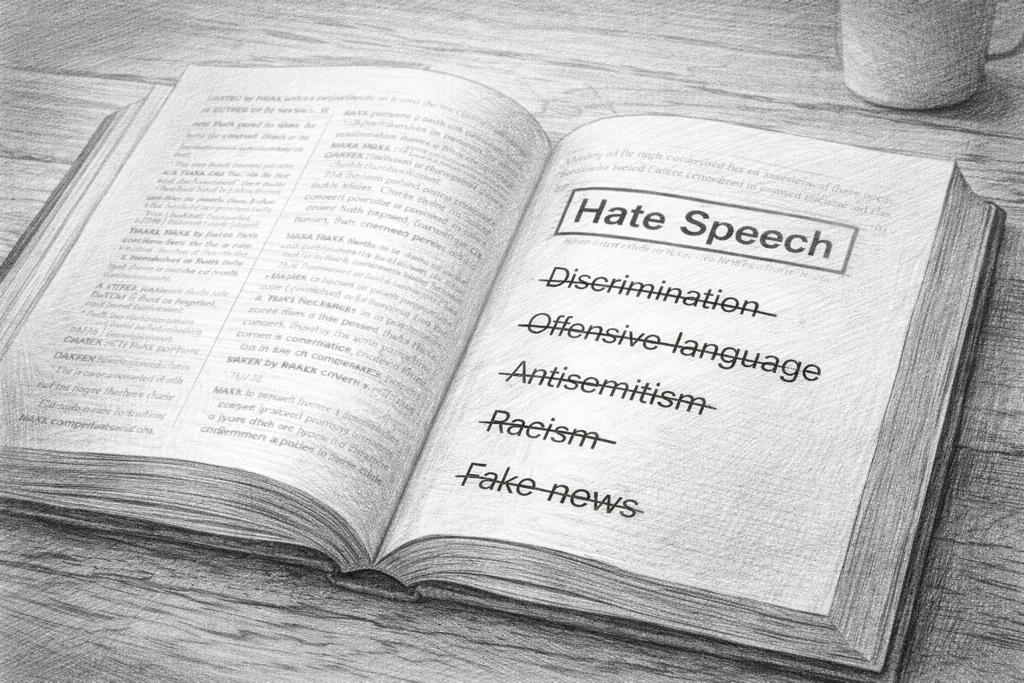
When definitions become political
In every legal system, there are terms that need to be interpreted. No law can fully define each individual case in advance. This is why courts exist, why there are legal commentaries, why case law develops over decades. However, it is crucial that key terms remain as clear and predictable as possible.
When categories such as „hate speech“, „disinformation“ or „degrading content“ now extend into ever broader contexts, a fundamental question arises:
Who actually decides where the border is?
Is it the legislator? Is it the courts? Is it the authorities? Or is it private platforms that decide independently under regulatory pressure? In practice, there is an interplay between all these players. But the more vague the terms, the greater the scope for interpretation. And the greater the scope for interpretation, the stronger the impact of the political zeitgeist.
Ideally, law should be more stable than the politics of the day. It should provide guidance - especially when social debates become heated. However, if definitions themselves are politically charged, the law loses some of its reliability.
Morality in transition
History shows how changeable moral categories can be. What was taken for granted in one era was seen as problematic in a later one - and vice versa. This change is not a flaw, but an expression of social development. However, it harbors a risk when moral assessments are directly translated into criminal law categories.
Criminal law is the state's strongest instrument. It not only regulates, but also sanctions. Anyone operating with it should therefore exercise particular restraint.
When definitions become political, this does not necessarily mean arbitrariness. However, it does mean that social disputes are no longer conducted exclusively in discourse, but are subject to the sword of Damocles of possible sanctions. This changes the dynamic.
People are beginning to express themselves more cautiously. Companies are reacting preventively. Media companies are double-checking whether certain formulations are still acceptable. Not necessarily because they are extreme - but because it is unclear how they could be categorized in the future. This development rarely happens abruptly. It is gradual.
The role of authorities and advisory bodies
Another aspect concerns the growing importance of administrative interpretation. In addition to courts, authorities, supervisory bodies and advisory committees are increasingly coming onto the scene. They formulate guidelines, make recommendations and interpret new regulations in the digital space. Formally, they operate within the framework of the law. In fact, however, they have a considerable influence on their application. For example, when supervisory authorities determine which content platforms should treat particularly critically, this creates indirect standardization pressure.
External actors are also involved: NGOs, scientific advisory boards, civil society initiatives. They provide assessments, define problematic narratives and evaluate discourse developments. This is fundamentally legitimate - diversity of expertise is valuable. But here too, the more political a topic is, the more ideological perspectives are incorporated.
This shifts the emphasis from clearly codified facts to evaluation processes. And assessment processes are naturally less clear.
Platforms as new border authorities
In the digital age, large platforms play a key role. They are not state bodies, but they act as de facto gatekeepers of public communication. When regulatory requirements prompt them to quickly remove certain content or block user accounts, a system of private boundaries is created.
Moderation teams work with internal guidelines, automated filters and reporting systems. Decisions are often made in seconds. A legal assessment in the traditional sense rarely takes place. Instead, decisions are made based on probabilities: Could this content be problematic? Could it violate new regulations? Could it result in sanctions?
When in doubt, delete. This logic is understandable from a business perspective. However, it creates a climate of uncertainty. This is because the boundary is not only shifted by formal laws, but also by precautionary adaptation to possible interpretations.
Norm shift as a long-term process
When definitions become political, something else happens: the social norm itself begins to change. What is often labeled as problematic is at some point actually considered problematic - regardless of the original intention.
This creates new self-evident truths. Certain statements are no longer just legally risky, but socially ostracized. Criticism is formulated more cautiously or avoided altogether. The spectrum of what can be said is not necessarily narrowed by open prohibitions, but by implicit expectations.
Democratic societies must handle such processes with care. Not every shift in norms is negative. But it should remain transparent and open to discussion. If, on the other hand, it is unclear where exactly the boundary lies, mistrust arises.
Perhaps this is the real crux of the debate: It is not the existence of rules that is problematic, but their vagueness. Law needs clarity, especially on sensitive issues. If definitions depend too much on political moods, it loses some of its stability. And stability is what citizens expect from a liberal order.
The planned US portal: What is known
The information about the planned American online portal have not yet been publicly formulated in full detail. This is not an officially launched government program with a complete white paper, but rather reports and announcements from political circles relating to the promotion of freedom of information.
But even the basic principle is remarkable: a state-supported online portal is intended to make content accessible that is blocked or banned in certain regions of the world. This includes media offerings, social media channels or journalistic platforms that cannot be accessed there for political or regulatory reasons.
Until now, such an instrument has traditionally been discussed for authoritarian states - for example, countries with strict internet censorship. The fact that European countries are now also explicitly mentioned in this context makes the project particularly explosive. It is less about the technical implementation and more about the political message.
Official justification: Freedom of information
The American argument is based on a familiar motif: the defense of free information. For decades, part of US foreign policy has seen itself as a guarantor of open communication spaces. During the Cold War, it was radio stations such as „Radio Free Europe“, later digital programs to circumvent state Internet blockades.
In this historical context, the planned portal appears to be a continuation of a familiar line. It is intended to give citizens access to content that they cannot see due to state restrictions. The official justification is to strengthen transparency and plurality.
From an American perspective, this may seem consistent. If freedom of information is seen as a universal good, then it must also be defended where democratic states impose restrictions for other reasons. But this is precisely where the tension arises.
Europe as part of the target group
The naming of Europe in this context is the real core of the controversy. In recent years, the European Union has blocked various media offerings or restricted their distribution, particularly in the context of geopolitical conflicts. The reason given for this was to protect against propaganda, disinformation or security risks.
From a European perspective, these are legitimate protective measures. From an American perspective - at least in parts of the political spectrum - the same process can be interpreted as a restriction of access to information.
When Europe now appears in a list of states where citizens may need alternative access routes, a diplomatically sensitive picture emerges. It is not a direct comparison with authoritarian regimes, but an implicit classification in a category of „regulated information spaces“. That alone is enough to raise questions.
Strategic dimension: soft power in the digital age
Such a portal would not only be a technical instrument, but also a geopolitical signal. Information policy has long since become part of strategic disputes. Whoever enables or restricts access to content influences narratives, moods and political perceptions.
With such a project, the United States would demonstrate that it continues to see itself as a global player in the area of freedom of expression - even vis-à-vis allies. At the same time, it could influence European debates by keeping alternative sources of information visible.
This is not necessarily about party political motives. Rather, the question is whether the transatlantic partnership is diverging on a fundamental point: in the understanding of how much regulation an open discourse can tolerate.
Technical implementation and legal issues
It is still unclear how such a portal would actually work. Mirror servers, redirection services or platforms that bundle content and make it accessible from outside European regulation would be conceivable. A combination of journalistic curation and technical infrastructure would also be possible.
However, this raises legal questions. Would such a service be blocked in Europe itself? Would there be a legal conflict between American provision and European regulation? And how would European governments react if a friendly state actively helped to circumvent national or European restrictions?
These questions are still open. But their very existence shows that we are not dealing with a purely theoretical debate.
A symbol of greater development
Whether the portal is realized in exactly the form discussed or not is ultimately of secondary importance. What is important is that the idea comes up at all - and that Europe is mentioned in this context.
It signals a change in perception. Apparently, there is an assessment in parts of American politics that the European regulatory framework has become so tight that alternative access routes are being discussed.
The question for Europe is therefore not so much whether Washington will implement this project. Self-reflection is more important: How is its own information policy perceived internationally? And how do you want to be perceived yourself?
An area that sees itself as a pioneer for democracy and the rule of law must be particularly sensitive to the issue of freedom of information. After all, credibility comes not only from good intentions, but also from the way in which rules are formulated and applied.
The planned US portal is therefore more than just a technical project. It is a mirror - and perhaps also a touchstone for Europe's self-image in the digital age.
A transatlantic role reversal?
For decades, the image was clearly divided. The United States saw itself - at least rhetorically - as the defender of free speech, as an admonisher of states with censorship structures and restricted press freedom. Europe, on the other hand, was seen as a natural partner in this self-image: as a continent of enlightenment, open debate and constitutional guarantees.
If Washington, of all places, is now considering giving European citizens access to certain information again via its own portal, then it looks like a quiet role reversal. Not loudly announced, not officially confrontational - but symbolically powerful.
Europe is no longer exclusively a combatant in the fight for open information spaces, but is at least partially perceived as a regulated space in which content is filtered or blocked. This shift is less legally than politically significant. Because perception shapes reality.
Different traditions of freedom of expression
Part of the divergence can be explained historically. In the United States, freedom of speech enjoys particularly strong constitutional protection under the First Amendment. The threshold for state intervention is traditionally high. Even provocative, tasteless or extremely controversial statements are often classified under the protection of free speech as long as they do not directly incite violence.
Europe, on the other hand, has always taken a more balanced approach. The dignity of the individual, protection against discrimination and historical experience with extremist propaganda have led to a more differentiated set of rules. Freedom of expression is guaranteed - but it is in tension with other legal rights.
For a long time, these differences were not a problem, but an expression of different legal traditions. However, as Europe expands its regulation and makes digital platforms more accountable, the differences are becoming more apparent. What appears to be a necessary responsibility in Brussels can be read as overregulation in Washington.
Signal from Munich: Vance and the question of freedom of expression
A year ago, the speech by J. D. Vance at the Munich Security Conference caused noticeable irritation. The then US Vice President spoke openly of „threatened freedom of speech in Europe“ and questioned whether European democracies still have sufficient trust in their own citizens. The fact that this was the first major appearance by a representative of the new Trump administration on European soil lent the speech additional weight.
J.D. Vance Speech German - «Threatened freedom of expression in Europe» | Langemann Media
Not only was the clear tone remarkable, but also the personal conclusion. The appearance was less diplomatic than fundamental - and still resonates today.
A signal to its own population
For American policy, such a portal would also have a domestic political dimension. It underlines the self-image as a defender of open information spaces - even when it comes to partner states. In a time of global power shifts, this can be seen as an attempt to assert normative claims to leadership.
At the same time, it sends a signal to European citizens: we are offering you access to information that your own governments may be restricting. Whether this message actually catches on remains to be seen. But the mere possibility changes the dynamic.
A transatlantic relationship that has been characterized by shared values for decades is thus taking on a new nuance. Not confrontation in the traditional sense, but different interpretations of the same principle - freedom.
Europe's self-image put to the test
A fundamental question arises for Europe: How does it want to see itself? As a global standard setter for digital regulation? As a shelter from disinformation? Or as a steadfast defender of open debate?
These roles are not necessarily mutually exclusive. However, the more regulation comes to the fore, the more carefully it must be explained where it ends. If the impression arises that Europe controls rather than trusts, then its own narrative suffers. After all, Europe likes to refer to its tradition of enlightenment, to Kant, to the idea of the responsible citizen. This tradition is based on the assumption that people are capable of making their own judgments - even when dealing with contradictory or problematic content.
A transatlantic role reversal would therefore not only be a foreign policy shift, but a challenge to Europe's self-image.
Symbolism and reality
It would be an exaggeration to claim that Europe is now on a par with authoritarian regimes. The institutional differences are obvious. The rule of law, independent courts and pluralistic media landscapes are still a reality.
But symbolism works. When Europe is mentioned in a political debate about restricted access to information, an image is created - even if it is only partially true.
Politics thrives on such images. They influence trust, international relations and domestic political discussions. An American portal that circumvents European restrictions would not just be a technical process, but a diplomatic commentary.
The real question
In the end, it is less about the United States than about Europe itself. The possible role reversal is an indication that there are different views on the right level of regulation.
The crucial question is therefore: How much control can an open society tolerate without undermining its own foundations? And how can it defend its values without weakening trust in the maturity of its citizens?
Transatlantic partnerships are based on common principles. When these principles are interpreted differently, tensions arise. Whether this becomes a permanent role reversal or just an episode in the digital age depends on how Europe itself reacts to this development.
The mirror held up by the planned US portal does not show a distorted picture. It shows a perspective. And perspectives can be uncomfortable - especially when they come from outside.
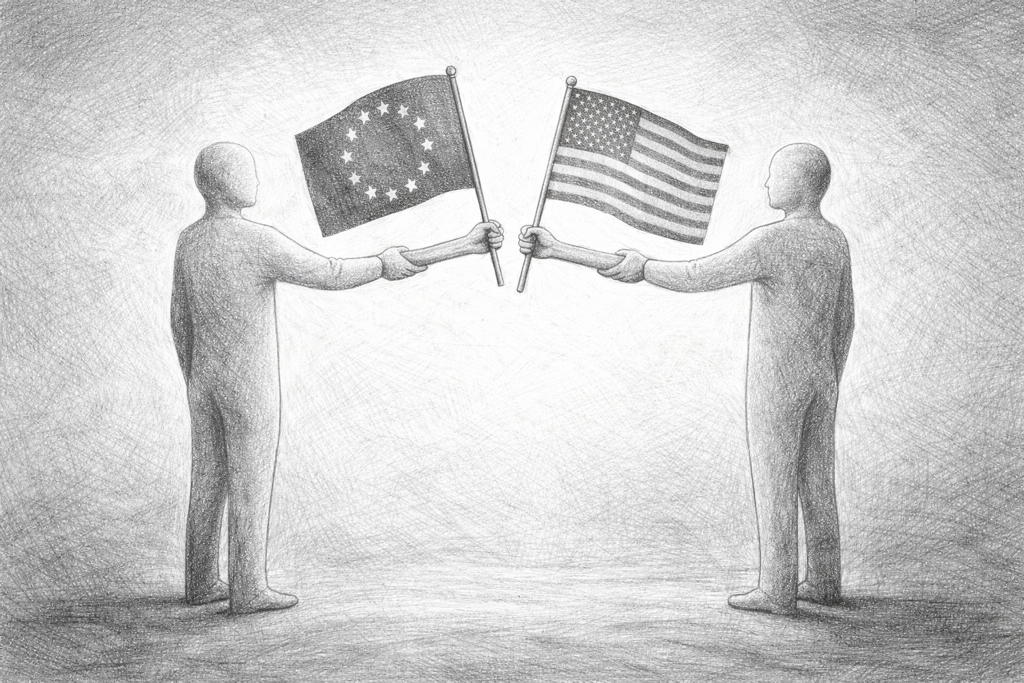
Digital sovereignty or digital isolation?
Few political terms have been used as frequently in recent years as „digital sovereignty“. Europe wants to become more independent - technologically, economically and in terms of regulation. Its own cloud infrastructures, its own data protection standards, its own platform rules. At first glance, this is an understandable goal.
Digital infrastructure has long been part of critical services of general interest. Those who control communication, data flows and the platform economy have influence. It is rational and strategically justifiable that Europe does not want to be completely dependent on non-European corporations in this area.
But there is a fine line between legitimate self-determination and creeping isolation.
Regulation as an instrument of power
With instruments such as the Digital Services Act (DSA) and other platform regulations, the European Union has created a set of rules that is respected worldwide. Large platforms are obliged to check content more quickly, systematically analyze risks and remove problematic posts. The intention is clear: to protect against disinformation, hate and manipulation. But regulation is never neutral. It creates side effects.
Platforms react not only to clear violations of the law, but also to potential risks. If there is a threat of sanctions, the willingness to delete content as a precaution increases. This dynamic is understandable from a business perspective. Nobody wants to risk high fines or lengthy proceedings.
However, this shifts the practical limits of what can be said. Not through an explicit ban, but through preventive adaptation. The difference is subtle - but noticeable.
Self-censorship as an invisible consequence
One of the biggest challenges of digital regulation is the invisibility of its effects. While traditional censorship was openly recognizable - books were banned, newspapers confiscated - modern content control often has an indirect effect.
Posts disappear. Accounts are blocked. Reach is reduced. Algorithms prioritize certain content and dampen others. Most users do not find out which internal evaluation criteria have been applied.
Over time, a climate of caution develops. Journalists are more cautious in their wording. Scientists weigh up their choice of words. Entrepreneurs consider which statements could harbor business risks. Citizens may refrain from making certain comments, not because they are extreme, but because they feel insecure. This form of self-censorship is difficult to measure. But it changes the culture of discourse.
The fine line between protection and control
No one disputes that digital spaces bring challenges with them. Disinformation campaigns, coordinated manipulation, targeted hate speech - they all exist. However, the question is whether each of these challenges should be met with ever greater powers of intervention.
Digital sovereignty can mean setting your own rules and protecting European values. However, it can also lead to information spaces becoming more segmented. If content is accessible in one jurisdiction and not in another, parallel realities arise.
The planned American portal is an interesting touchstone in this context. Should it actually make content visible again that is blocked in Europe, this would in fact show that digital borders are relatively easy to circumvent technically. Regulation thus loses some of its practical enforcement power - but at the same time gains symbolic poignancy. This is because every circumvention is perceived as a political statement.
Companies between adaptation and responsibility
For companies - especially platform operators - this creates a complex situation. They are caught between different legal systems, different political expectations and different cultural sensitivities.
A global provider must apply different standards in Europe than in the United States or Asia. This fragmentation of the digital space leads to a patchwork of guidelines. This is technically feasible, but strategically challenging.
At the same time, the expectation that companies take on social responsibility is growing. They are expected to moderate, evaluate and classify. In doing so, they are taking on tasks that were previously the responsibility of media companies or courts.
The question is whether private sector players are suitable as normative authorities in the long term - especially if they are under regulatory pressure.
Trust as a decisive factor
In the end, a lot depends on trust. Trust in institutions, trust in courts, trust in the citizens' ability to judge. Digital sovereignty can only be credible if it is not perceived as paternalistic.
An open society is characterized by the fact that it trusts its citizens to evaluate information. It relies on education, media literacy and transparent debates. If, on the other hand, the impression arises that information must be filtered as a precaution because citizens are unable to classify it, the basic understanding of maturity changes.
Europe is facing a strategic decision here. Does it want to be a digital space that offers protection through control? Or a space that focuses on resilience through openness?
This question is not ideological, but fundamental. Digital sovereignty is a legitimate goal. But it must not turn into digital isolation unnoticed. The coming years will show how Europe finds this balance.

The citizens' perspective - between the promise of protection and a sense of control
Laws are passed in parliaments, guidelines are formulated by authorities, strategies are drafted at international level. But in the end, all these regulations affect a specific person: the citizen.
From a state perspective, it is about protection - protection from disinformation, from manipulation, from targeted agitation. This objective is understandable. Hardly anyone wants digital spaces that are dominated by aggression, targeted misdirection or extremist campaigns.
However, citizens' perceptions are not always congruent with political intentions. Where governments emphasize protection, some people perceive control. Where regulation is declared necessary, others feel that they are being denied the ability to make decisions. This discrepancy is crucial.
Trust as a fragile resource
Democratic systems thrive on trust. Trust that institutions will act in the public interest. Trust that rules will be applied fairly and transparently. And above all, trust that one's own state regards its citizens as responsible subjects.
However, when content disappears without it being clear why; when accounts are blocked without a clear reason; when debates are suddenly marked as problematic, even though they were previously commonplace - then irritation arises.
This irritation does not necessarily lead to radicalization. It often initially manifests itself as a slight unease. As a question: „Why am I not allowed to say that anymore?“ Or: „Who actually decides that?“
Such questions are not a sign of extremism, but an expression of a need for clarity.
The counter-effect of bans
Another aspect has been well researched psychologically: bans can increase attention. Content that is blocked or classified as dangerous becomes more attractive for some people precisely because of this. Curiosity increases. Alternative channels are sought. Technical workarounds spread quickly.
If an American portal should actually make content accessible in future that is restricted in Europe, it will not only be used out of political interest. Many people will simply want to know what they are supposedly being deprived of.
This creates parallel public spheres. People move in different information spaces that mistrust each other. The original goal - to strengthen social cohesion - could turn into the opposite.
Current survey on trust in politics and the media
Maturity as a basic assumption
A key question is therefore: What is the image of humanity behind regulation? Do we assume that citizens are fundamentally capable of critically examining information? Or is it assumed that they must be protected from certain content because otherwise they will be misled?
Democratic traditions in Europe are based on the ideal of maturity. Enlightenment meant not only an increase in knowledge, but also personal responsibility. Citizens should use their own intellect.
If this ideal is gradually replaced by a more paternalistic model, the relationship between state and society will change. Not abruptly, but gradually.
Silent adaptation in everyday life
In everyday life, this development often manifests itself unspectacularly. People are more cautious in their wording. They think twice before publishing a comment. Some withdraw from public discussions altogether. Not out of disinterest, but because they are tired of possible misunderstandings or sanctions.
Others react with defiance. They specifically look for platforms that moderate as little as possible or join groups in which they expect no restrictions. This also changes the discourse landscape. Both reactions - withdrawal and counter-movement - are an expression of a tense relationship.
The long-term perspective
In the long term, it is not just the legal structure of laws that determines their success, but their acceptance by the population. Rules that are perceived as fair and comprehensible stabilize a society. Rules that are perceived as arbitrary or overstretched undermine trust.
For Europe, this means that digital regulation must not only be effective, but also transparent and proportionate. It must be able to explain why certain limits are drawn - and why others are not.
The citizens' perspective is not a secondary aspect. It is the benchmark. Ultimately, it is not about technical platforms or geopolitical signals, but about the relationship between freedom and security in the everyday life of each individual. And this relationship is more sensitive than political debates often suggest.
Shifting targets instead of individual cases? Bureaucratic logic and small claims procedures from a game theory perspective
Why are proceedings and house searches for comparatively minor statements on the rise? In his current contribution on game theory Prof. Dr. Christian Rieck This phenomenon is not moral, but structural. In the tradition of Max Weber and Robert Merton, he describes a „goal shift“ within organizations: Original tasks recede into the background, while measurable activity itself becomes the goal.
Television fakes images, the police pursue petty crimes - what's behind it all?
The comparison with doping in cycling serves as an analytical metaphor. Rieck argues that this allows dynamics to take on a life of their own that appear to be overreactions from the outside - but appear rational internally.
Possible future scenarios
When regulatory dynamics and geopolitical initiatives develop simultaneously, it is worth playing through some possible futures. Not as a forecast, but as an intellectual tool. Developments are rarely linear. But scenarios help to make areas of tension visible. Essentially, there are four realistic directions.
Scenario 1: Further tightening of regulation
In this scenario, Europe continues on its chosen course. The term „hate speech“ will be further defined - and possibly expanded. Platforms will be given clearer but stricter guidelines. Sanctions for violations will be applied more consistently. Possible consequences:
- Platforms are moderating even more carefully.
- Content with political or social conflict potential is removed more quickly.
- Legal disputes are on the rise.
- National differences within the EU are becoming more pronounced.
At the same time, Europe could be perceived internationally as a pioneer of a highly regulated digital space. Supporters would argue that this would strengthen social peace. Critics, on the other hand, would speak of overregulation. The transatlantic relationship could diverge further on this point.
Scenario 2: Legal countermovement
Another scenario provides for greater judicial clarification. Individual provisions are challenged before national courts or the European Court of Justice. Unclear definitions are clarified or restricted. In this case, a phase of legal fine-tuning would ensue. Possible effects:
- More precise demarcation between criminal agitation and permissible opinion.
- More transparency in platform decisions.
- Strengthening constitutional control over administrative interpretation.
This scenario would make the debate more objective. It would be a sign that the system is capable of correcting itself. However, such processes take years and require patience - both politically and socially.
Scenario 3: Political course correction
Regulation is not a static entity. Political majorities can change. New social priorities can emerge. In this scenario, politicians recognize that certain measures go too far or produce unexpected side effects. A course correction could be necessary:
- Clearer protection mechanisms for freedom of expression.
- Reduction of undefined legal terms.
- Greater emphasis on media literacy instead of content control.
- Dialog formats between politics, platforms and civil society.
The guiding principle here would be: Resilience instead of restriction. Citizens should be empowered to classify information instead of filtering it out in advance. Such a path would underline Europe's self-image as an area of freedom.
Scenario 4: Parallel worlds in the information space
Perhaps the most realistic scenario is not a clear break, but fragmentation. Different legal areas continue to diverge. Technical workarounds are normalized. Citizens move between official platforms and alternative access points. The following developments could emerge in this constellation:
- Official, highly moderated information rooms.
- Alternative portals or technical tools for circumventing blocks.
- Growing skepticism towards established media.
- Increasing polarization between different information communities.
In this scenario, an American portal that circumvents European restrictions would only be one element of a larger trend. Control would formally remain in place, but would be undermined in practice.
The risk lies less in individual content than in the long-term erosion of shared discourse. If citizens no longer share the same information space, communication becomes more difficult.
A fifth, silent scenario
In addition to these four clear directions, there is another, less dramatic scenario: gradual acclimatization. Citizens adapt. Platforms stabilize their moderation practices. Political debates calm down. The initial controversy loses its edge.
In this case, regulation would become part of everyday life - neither strongly contested nor enthusiastically welcomed. Many would come to terms.
But this habituation would also come at a price. Because every long-term shift in the discourse framework shapes the political culture.
The open question
Which of these scenarios occurs depends on many factors: political majorities, international tensions, technological innovations and, last but not least, the behavior of the citizens themselves.
Only one thing is certain: the debate about hate speech, digital sovereignty and international information portals is not a short-term phenomenon. It touches on fundamental questions of democratic order.
The coming years will show whether Europe can find a way to balance freedom and protection in such a way that both remain credible.
Because in the end, it is not the existence of a portal or a law that determines the future of the discourse - but trust in one's own principles.

Freedom as a core European idea - A look back to see the future
Before drafting new rules, it is worth pausing for a moment and remembering where you come from. Europe did not emerge as an administrative area, but as an intellectual project. The Enlightenment, the culture of debate, the struggle for truth and error - all this has shaped this continent.
The idea was never that people need to be protected from contradictory thoughts. The idea was that they should learn how to deal with them. That arguments are examined in an open exchange. That error is corrected through counter-speech - not through pre-filtering.
This tradition was not always comfortable. It was full of conflict, often painful, sometimes chaotic. But it was productive. It created science, art, political reforms and, in the end, the democratic order of which Europe is proud today.
Freedom was never risk-free
It is part of honesty to recognize that freedom involves risks. Open societies also offer room for extreme opinions, for nonsense, for provocation. But this is precisely where their strength lies: they trust that the majority of citizens are capable of judgment.
If Europe is now regulating more strongly, moderating more strongly and intervening more strongly, this is often done with the aim of ensuring stability. But stability is not created through control alone. It comes from trust - trust in institutions and trust in people's power of judgment.
Freedom was never a luxury in Europe. It was the basis of political maturity.
The difference between strength and fear
A self-confident democracy can withstand contradiction. It counters problematic arguments with better arguments. It relies on education, transparency and public debate.
An insecure democracy, on the other hand, tends to narrow the scope of debate as a precautionary measure. Not out of malicious intent, but out of concern. But concern must not become the dominant principle.
The current debate about hate speech, platform regulation and international information portals is ultimately an expression of this tension:
How much openness do we still dare to be?
And how much regulation do we consider necessary?
These questions are legitimate. But they should be answered with an awareness of one's own tradition.
Europe and the image of the citizen
The image of man is at the center. The European idea has always been based on the assumption that citizens are responsible. That they can examine, weigh up and disagree. That they do not want to be permanently controlled, but rather taken seriously. If this image changes - if protection increasingly takes precedence over personal responsibility - the balance between state and society shifts.
This does not mean that all regulation is wrong. It just means that it needs moderation and clarity. The more vague the terms, the greater the uncertainty. And uncertainty undermines trust.
A sober outlook
The debate about the potential US portal has a symbolic function. It shows how European regulation is perceived from the outside. It raises questions that go beyond the specific occasion.
But this is no reason for alarmism. Europe is still an area with independent courts, pluralistic media and lively debates. The cornerstones are in place.
The real task is not to undermine these pillars out of caution. Regulation must not become a habit if it is not constantly reviewed. Freedom must not be taken for granted if it is gradually redefined.
Back on the carpet
Perhaps it's time to bring the issue „back on the carpet“, as they say. Not every tightening is a doomsday scenario. Not every criticism of regulation is an attack on the rule of law.
But every shift deserves attention.
For centuries, Europe has distinguished itself by cultivating rather than fearing conflict. That it has not resolved conflicts through silence, but through argument.
If we remain aware of this origin, we can also view current challenges more calmly. Freedom is not a rigid concept, but an ongoing process of negotiation. However, this process should always be based on one principle: trust in one's own society.
In the end, it is not a law or a portal that will decide the future of Europe, but the attitude with which we conduct debates.
And this attitude was European in the best sense of the word: open, self-confident and sensible.
Your own platform instead of someone else's rules: Why having your own magazine makes all the difference
 The discussion about freedom of expression and regulation shows one thing above all: those who rely exclusively on third-party platforms inevitably become dependent. Content can be restricted, reach reduced or entire accounts changed - often without any real influence. The classic alternative to this is as old as publishing itself: having your own medium that is completely under your own control. This is exactly where a concept like „Your own magazine“ on. Instead of simply distributing content, a separate platform is created on which topics can be developed, structured and published independently in the long term. Responsibility then lies back where it belongs - with the publisher themselves. This not only creates clarity, but also a certain peace of mind when dealing with sensitive topics. Those who publish their content in their own system have less need to adapt to changing rules and can pursue a consistent line - factually, structured and without external pressure.
Further sources on the topic
- Digital Services Act (EU Regulation 2022/2065)The Digital Services Act forms the EU's central regulatory basis for platform responsibility, content moderation and transparency obligations. It defines due diligence obligations for large online platforms and is decisive for the current debate on digital regulation and freedom of expression.
- EU AI Act - OverviewThe AI Act is the European regulation on the regulation of artificial intelligence. It also contains regulations on the risk assessment of algorithmic systems, which can have an indirect influence on moderation decisions and digital discourse spaces.
- European Convention on Human Rights - Article 10Article 10 guarantees freedom of expression in Europe, but allows restrictions under certain conditions. It forms the legal frame of reference for all European debates on hate speech and regulation.
- Federal Constitutional Court - Freedom of opinionThe Federal Constitutional Court has emphasized the importance of freedom of opinion as „constitutive for democracy“ in numerous rulings. This case law is central to understanding the German legal situation.
- First Amendment - U.S. ConstitutionThe First Amendment of the US Constitution protects freedom of speech particularly far-reaching. It is crucial for understanding the transatlantic differences in dealing with controversial statements.
- Munich Security Conference - Official WebsiteThe Security Conference is an important international forum for security policy debates. This is where J. D. Vance gave his much-discussed speech on freedom of speech in Europe.
- Robert K. Merton - Bureaucratic Structure and Personality (1940)In this classic essay, Merton describes the „goal shift“ in bureaucratic organizations. The theory explains how institutional logics can take on a life of their own.
- Radio Free Europe / Radio LibertyHistorical example of American information policy during the Cold War. The station was founded to make alternative perspectives accessible to citizens in regulated information spaces.
- World Economic Forum - Debates on freedom of expressionInternational perspectives on regulation, platform responsibility and digital discourse. These contributions show how the tension between protection and freedom is discussed globally.




Frequently asked questions
- Isn't that an exaggeration? Europe is not a censorship state. No, and that is an important point. The article does not claim that Europe has adopted authoritarian structures. Rather, it describes a shift in the regulation of digital communication. There is a considerable difference between traditional censorship and modern platform regulation. Nevertheless, it is worth analyzing developments at an early stage - especially in stable democracies. An open society is characterized by the fact that it also critically reflects on its own regulations without immediately delegitimizing itself.
- What exactly is this American online portal supposed to do? According to previous reports, it is intended to make content accessible that is blocked in certain regions. This includes media offerings or platform content that cannot be accessed there for political or regulatory reasons. It is explosive that Europe was mentioned in this context. This does not automatically mean that Europe is equated with authoritarian states - but it does mean that it is perceived as an increasingly regulated information space.
- Isn't this simply about protection against disinformation? Yes, this is a key motivation behind many European initiatives. No one disputes that disinformation, targeted manipulation and hate campaigns are real problems. However, the question is how far protective measures should go. If definitions are formulated very broadly, this can have unintended side effects - such as uncertainty in public discourse or premature self-censorship.
- Isn't criticism of „hate speech“ definitions an attack on the protection of minorities? Not necessarily. Protection against discrimination is a legitimate and necessary goal. The debate revolves around the definition of the terms and their legal precision. The less clear a term is, the greater the scope for interpretation. In a constitutional system, however, it should be clear which statements are punishable and which are not. This clarity ultimately serves everyone - including those who are to be protected.
- Why is the topic of gender treated so prominently in the article? Because it is a current example of the tension between scientific, social and political interpretation. Statements about gender are evaluated differently today - depending on the perspective. If certain positions could potentially fall under „hate speech“, this is an example of how politically charged definitions can be. It is less about the position itself and more about the question of legal classification.
- Is Europe really so different from the USA in this respect? Yes, there are historical differences. In the USA, freedom of speech enjoys particularly strong protection under the First Amendment. Europe has traditionally taken a more balanced approach, taking into account other legal interests such as dignity and equal treatment. These differences were not a problem for a long time, but they become more apparent the further regulation goes.
- Isn't an American portal itself political interference? This could be interpreted as follows. Information policy is always geopolitical. When a state actively provides content that is restricted in another jurisdiction, this sends a political signal. Whether this is seen as interference or as a defense of freedom of information depends on your point of view.
- How realistic is it that Europe will really seal off information permanently? From a technical point of view, complete isolation is difficult to enforce in the digital age. Content can be mirrored, redirected or made accessible in other ways. It is therefore less about total control and more about regulatory signals and moderation obligations. The real question is how much such measures affect trust in open discourse.
- Is self-censorship really a serious problem? Self-censorship is difficult to measure, but it is real. If people are unsure whether certain statements could be problematic, they formulate them more cautiously or refrain from posting them altogether. This is often not done out of conviction, but out of risk assessment. However, a lively culture of discourse thrives on people being able to speak without excessive fear of sanctions.
- Could stronger regulation not also lead to greater social stability? That is certainly possible. Proponents argue that clear rules can curb polarization and limit extreme positions. Critics counter that overly narrow rules tend to mask tensions rather than resolve them. The balance between protection and openness is crucial.
- Why does trust play such an important role in this debate? Because democratic systems are based on trust. If citizens have the feeling that rules are applied transparently and fairly, acceptance increases. If, on the other hand, there is a lack of clarity or decisions appear non-transparent, skepticism arises. Trust is not an abstract quantity, but the basis of political stability.
- Is Europe heading in an authoritarian direction? The article does not paint such a picture. Europe still has independent courts, free elections and a pluralistic media. It is about the nuances of regulation, not about system change. This is precisely why an objective discussion is important - to adjust developments at an early stage without dramatizing them.
- What role do large platforms play in this context? Platforms act as gatekeepers of public communication. Due to regulatory requirements, they are under pressure to check content quickly and remove it if necessary. In practice, this often leads to cautious moderation. Companies are caught between legal requirements and the right to freedom of expression.
- Can digital sovereignty and freedom of expression be reconciled? Yes, basically yes. Digital sovereignty initially means self-determination over rules and infrastructure. The decisive factor is how these rules are designed. If they are clear, proportionate and transparent, both can coexist. It only becomes problematic when terms are defined too broadly and create uncertainty.
- Why is the topic not discussed more in the traditional media? This is difficult to answer in general terms. Regulating digital communication is complex and legally demanding. Reporting often focuses on specific individual cases rather than structural developments. This article attempts to make this structure visible.
- Could the American portal effectively undermine European regulation? Technically, that would be conceivable. Politically, however, it would create new tensions. Europe would have to decide whether to tolerate such offers or take legal action against them. In any case, such a portal would further fuel the debate.
- Isn't it better not to make problematic content visible in the first place? That depends on the basic understanding. One approach relies on preventative filtering. Another relies on the fact that problematic content can be invalidated by counter-speech. Both models have advantages and disadvantages. This article does not advocate a complete lack of rules, but rather clarity and a sense of proportion.
- What is ultimately the key question of the entire article? The key question is: how much regulation can an open society tolerate without weakening its own foundation - the freedom of discourse? It is not about extremes, but about balance. And a reminder that freedom in Europe has always been seen as a fundamental idea - not a minor matter.