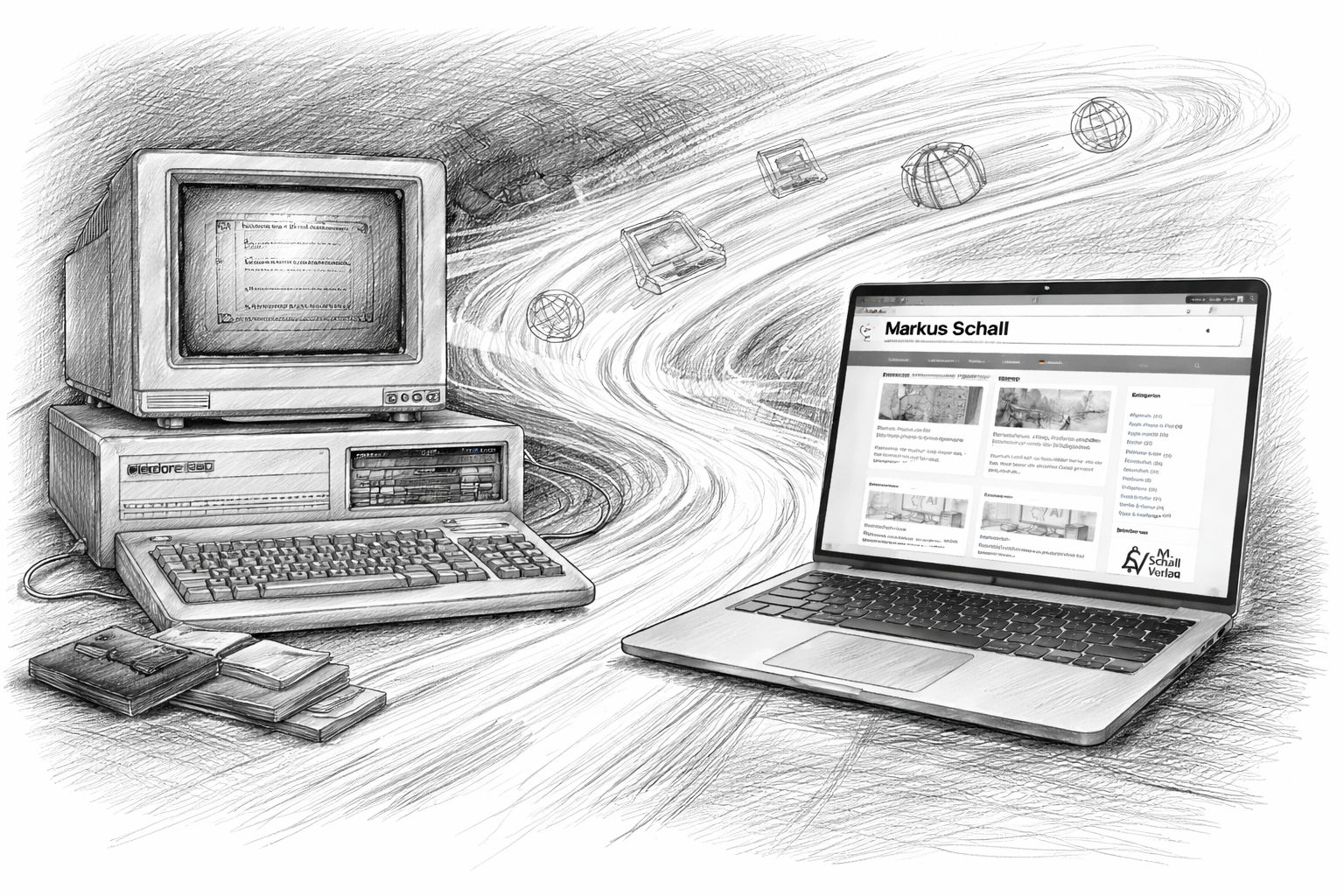
When you pick up a smartphone today, it contains more computing power than entire computer rooms used to. In the 1980s, things were completely different. Computers were rare, expensive and, for many people, a mysterious machine. Back then, if you had your own home computer, you belonged to a small group of tinkerers, inventors and curious people. The exciting thing was that you didn't just consume computers. You had to understand them. Many programs were not available to buy ready-made. Instead, computer magazines contained pages of listings with BASIC code that you had to type out line by line. Only then could you see whether the program worked at all.
That sounds tedious today, but it had one big advantage. You automatically learned how computers work. If you made a mistake, you immediately got an error message - and had to find out for yourself where the error was. In this way, many young computer fans developed a very natural approach to technology and programming.
It was at this time that I began my own journey into the world of computers.




My start with the Commodore C16
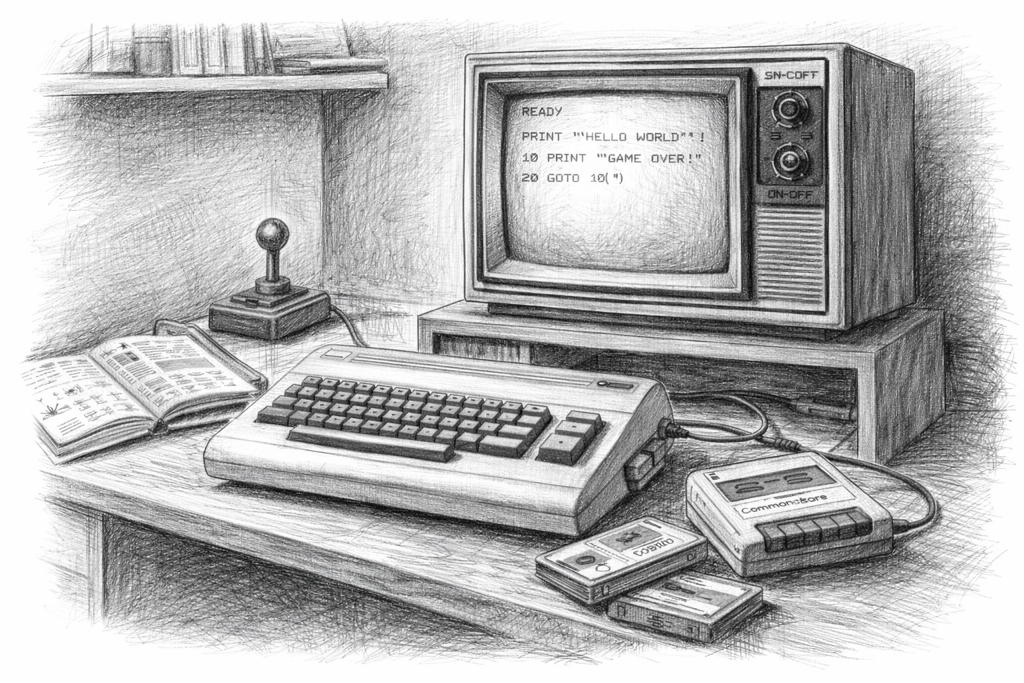
My first contact with my own computer began with the Commodore C16. From today's perspective, it was a very simple device. The RAM was tiny, the graphics simple and programs were usually loaded via cassette drives.
Nevertheless, this computer opened up a whole new world. Suddenly you could write your own programs, try out simple games or conduct small experiments. I spent many hours modifying, testing and improving BASIC programs.
It was less about achieving a finished result. Much more important was the feeling that you could suddenly create something with a few lines of code. The computer reacted to what you told it to do. This experience left its mark on many young computer enthusiasts.
Looking back, it was a very direct way of learning. There were no tutorials, no video guides and no large platforms with ready-made solutions. If you wanted to know something, you had to try it out for yourself.
The Commodore 128D for confirmation
A decisive step came a few years later: I bought a Commodore 128D for my confirmation. This computer was much more powerful than the C16. It had more memory, better options and, above all, an integrated floppy disk drive. This meant that programs no longer had to be loaded from cassettes, but from floppy disks - a big step forward for those days.
With this computer, work became more serious. Programs could be saved, modified and reused more easily. At the same time, there was a growing interest in not just playing games or testing small programs, but really understanding computers.
Many people today have nostalgic memories of this phase of home computers. It was a time when technology was still something of a craft. You had to get to grips with the machine, get to know it and sometimes accept its limitations.
The switch to the Atari system
After some time, the next step followed: the switch to the world of Atari computers. At that time, Atari computers offered new possibilities, especially in the area of graphics and applications. Many programs looked more modern, and the user interfaces also slowly evolved.
For many computer enthusiasts, this change was a natural step in their development. Technology developed rapidly and each new system opened up new possibilities.
Looking back, this phase was a kind of foundation. The first computer experiences were not just games or entertainment. They were also training in logical thinking, experimenting and dealing with technology.
These early experiences later gradually developed into a deeper interest in computers, networks and finally the Internet. However, the real online world would not begin until a few years later - initially with modems, telephone lines and the first mailbox systems.
The mailbox era: communication before the Internet
Before the internet became a part of everyday life, digital communication ran via a completely different system: the telephone network. If you wanted to go online back then, you needed a modem, i.e. a device that could convert computer signals into sounds. These tones were transmitted via the telephone line and converted back into data at the other end.
Anyone who has ever dialed into a mailbox will hardly forget the typical sound: whistling, rattling and crackling from the loudspeaker while two modems „negotiated“ with each other about the speed at which they could communicate. The connection was slow. Very slow, in fact, compared to today's standards. Data rates of 2,400 or 9,600 baud were considered completely normal back then. Downloading large files could take many minutes.
There was also another factor: the telephone costs. As long as you were dialed in, the telephone clock continued to run. So if you stayed online for a long time, you had to expect a correspondingly high phone bill. As a result, many users consciously planned their online time. They read posts offline, pre-wrote replies and only dialed back in when everything was ready.
Mailbox systems as forerunners of the Internet
The so-called mailbox systems - often simply called „mailboxes“ - were to a certain extent the forerunners of today's Internet. In technical terms, they were mostly individual computers that were accessible around the clock. Users could dial in, read messages, write their own posts or exchange files.
The structure was surprisingly similar to what we know today from forums or social networks. There were discussion areas on various topics, private messages between users and sometimes also small download areas for programs or texts.
However, everything was much more manageable. A mailbox often only had a few dozen or perhaps a few hundred users. This created an atmosphere that was more reminiscent of a small community than a global network.
Many discussions were surprisingly factual. People knew each other, sometimes over long periods of time, and the communication had a certain commitment. Anyone who wrote regularly quickly became a familiar name within the community.
My experience with the MausNet
One of my early online experiences was in the MouseNet, a German mailbox network that was used by many computer enthusiasts in the 1990s. MausNet connected numerous individual mailboxes with each other. Messages could be forwarded between these systems so that discussions took place not only within a single mailbox, but across several locations.
By the standards of the time, this was a remarkable development. Suddenly you could discuss things with people who didn't live in the same town. Topics ranged from technology and programming to everyday conversations.
The exchange of knowledge also played a major role. Many users helped each other with technical questions or gave tips on programs and computers. This mixture of curiosity, experimentation and mutual support characterized many early online communities.
Digital community before social media
Looking back, this mailbox era almost seems like a different world. There were no algorithms, no reach optimization and no platforms with millions of users. Instead, the networks consisted of many small, sometimes very committed groups.
The tone was often more direct and personal. Discussions could certainly be controversial, but they rarely had the dynamic that we know today from large social networks.
Another important difference was that the technology itself required a certain level of interest. Anyone who bought a modem, configured dial-up programs and accepted telephone costs usually had a genuine interest in computers and communication.
In a way, this phase was a transitional period. The basics of digital communication were already in place, but the global network as we know it today was still in its infancy.
This was only to change with the increasing spread of the internet and new access services. In the 1990s, a development began that brought millions of people online permanently for the first time - thanks to providers such as America Online.

The AOL era: The Internet in a closed system
In the mid-1990s, a phase began in which the Internet became accessible to many people for the first time. One of the best-known providers at this time was America Online, usually simply AOL called.
For many users, AOL was their first contact with the online world. The provider relied heavily on easy access and aggressive distribution of its software. Almost every computer magazine at the time included floppy disks or later CDs on which the AOL client could be installed. Often a free trial month was even included.
The idea behind it was simple: you the software, created an account and could get started straight away. For many people, this was a much lower barrier to entry than the often complicated settings required to access the open Internet. In this way, AOL brought millions of people online for the first time - including in Germany.
The AOL business model
Technically, AOL initially worked in a similar way to many mailbox systems. You dialed in with a modem via a telephone line and entered a digital environment operated by AOL itself. The difference, however, was in the scope. AOL offered a complete online world with different areas: News, discussion forums, chats, e-mail and various information services. Much of the content was provided or curated directly by AOL.
A monthly fee was usually charged for use. Depending on the tariff, additional costs could be incurred for longer online times. Nevertheless, the offer was attractive to many because everything was bundled in one place.
There were no technical details to deal with, no complicated server addresses to enter and no different programs to configure. AOL promised a simple online experience - and that was exactly what many beginners needed.
Video tip: How the internet changed the world in the 90s
A ZDF documentary from the Terra X series vividly shows how the Internet experienced its decisive breakthrough in the 1990s. The focus is on the development of the World Wide Web by Tim Berners-Lee at CERN - a technology that was deliberately made free and accessible to all.

The world goes digital - 20th century 1990-1999 | MrWissen2go | Terra X
The documentary explains in an understandable way how computers became suitable for mass use during this time, how e-mail and early online services changed everyday life and how new technologies such as mobile telephony and SMS emerged at the same time. A compact overview of the years in which the Internet went from a research network to a global communication space.
Early social networks in the AOL cosmos
Numerous digital communities quickly emerged within AOL. Chats and discussion forums were a central component of the platform. Users were able to exchange ideas on a wide range of topics - from technology and hobbies to everyday conversations.
In a way, the system was already reminiscent of modern social networks. There were profiles, chat rooms and themed groups. People met regularly in certain areas and had conversations there, similar to what we know today from forums or platforms.
However, all of this took place within a closed environment. Anyone who used AOL moved within the so-called „AOL cosmos“. Content, discussions and contacts were tied to the platform. For many users, this was perfectly adequate. They had the feeling of being on the Internet - even if they were still technically operating in a closed system.
The limits of the system
Over time, however, it became clear that this model also had its limits. The Internet itself continued to develop in parallel. More and more websites were created and more and more people began to publish their own content online. The open web worked according to different principles. Websites were freely accessible, independent of individual platforms. Anyone could run their own site, publish content or share information.
AOL, on the other hand, remained a relatively closed system for a long time. Although the service later also offered access to the open Internet, the structure of the platform was not originally designed for this.
There was also another development: the increasing spread of faster Internet connections. While many AOL users still went online via modems and dial-up services, new technologies began to enable significantly higher speeds. With the advent of DSL, user behavior changed fundamentally. Suddenly you could be online all the time without having to dial in every time. Websites loaded faster, new services emerged and the open Internet became increasingly attractive.
As a result, AOL's closed system gradually lost importance. For many users, the next step was clear: they switched from the platform model to the free, open web - a development that would have a decisive impact on the Internet in the following years.
CompuServe - the other big online service
In addition to AOL, there was another important provider at this time: CompuServe. In fact, CompuServe had been around for much longer and was one of the earliest commercial online services. As early as the 1980s, companies, technology enthusiasts and professional users were using the system to access information or communicate with each other.
Compared to AOL, however, CompuServe had a much more sober appearance. While AOL focused heavily on ease of use, chats and community, CompuServe was geared more towards information services and professional use. Many areas were more reminiscent of databases or specialist forums than social meeting places. As a result, the service had a somewhat more „business-like“ character and often appealed to a technically or professionally oriented audience.
However, both systems had one fundamental feature in common: they were separate online worlds with a clearly defined structure. Users moved within a specific system that was controlled by a provider. It was only with the increasing spread of the open World Wide Web that this structure slowly began to dissolve. Websites that could be accessed independently of individual platforms became increasingly important - and this also changed the way people used the internet.

DSL - The moment when everything got faster
For a long time, the Internet was closely associated with the dial-up sound of a modem. If you wanted to go online, you had to connect your computer to the telephone line and establish a connection to a dial-up server. During this time, the telephone line was blocked and every minute cost money.
With the advent of Digital Subscriber Line - usually simply called DSL - this principle changed fundamentally. DSL also used the existing telephone lines, but worked with a completely different technology. The Internet connection ran over a separate frequency range and could therefore be used in parallel with the normal telephone.
The biggest difference, however, was the speed. While classic modem connections worked at a few kilobits per second, early DSL connections already reached several hundred kilobits per second. That sounds modest today, but at the time it was a huge step forward.
Many users remember the first DSL tariffs with speeds of around 768 kbit/s. Websites suddenly loaded much faster, files could be downloaded in minutes instead of hours, and the internet felt really smooth for the first time.
My early DSL connection in 1999
When the first DSL connections became available, I was one of the early adopters of this new technology. The switch from modem to DSL was a real turning point back then. Suddenly you no longer had to dial in every time. The connection was permanently available. The computer could go online at any time without having to establish a connection or block the phone.
This „always-on“ principle changed the entire user behavior. People no longer consciously „went online“, the internet was simply there. You could look something up, call up a website or download a file at any time.
This also opened up new technical possibilities. Websites could become more extensive, images no longer had to be extremely compressed, and new services emerged that would have been almost impossible to use with slow modem connections.
The open Internet displaces platform systems
With the increasing spread of DSL, the structure of the Internet itself also changed. Platforms such as America Online or CompuServe gradually lost importance. The reason was simple: the open web became increasingly attractive. More and more websites were created, companies presented themselves online and private individuals began to publish their own content.
Anyone with a fast Internet connection no longer needed a closed platform. You could access websites directly, use search engines or start your own projects online. This development made the Internet more open and diverse. Information was no longer tied to individual providers, but was freely accessible via the World Wide Web.
A new phase of digital independence
For many users, DSL ushered in a new phase of Internet use. The Internet was no longer just a place to consume content. It also increasingly became a space in which you could become active yourself.
The technical hurdles were lower than before. Hosting offers became cheaper, web servers easier to use and new tools made it possible to create your own websites.
This moment was also an important step for me. With a fast internet connection, the web became a real platform for your own ideas. Instead of just communicating in existing systems, you could start to publish your own content and build your own presence.
This development eventually led to the next logical step: my first own website. What initially began as an experiment would develop into a long-term project over the following years - and thus become an integral part of my work on the Internet.
Development of Internet access speed since the 1980s
| Technology | Typical speed | Period |
|---|---|---|
| Modem (Dial-Up) | 2.4 - 56 kbit/s | 1980s to late 1990s |
| ISDN | 64 - 128 kbit/s | 1990s |
| DSL (first generation) | 768 kbit/s - 1 Mbit/s | from approx. 1999-2001 |
| DSL / VDSL | 16 - 100 Mbit/s | 2000s to 2010s |
| Glass fiber | 100 Mbit/s - 1 Gbit/s+ | 2010s until today |
Your first website and first steps in web publishing
Once the Internet had become faster and more convenient thanks to DSL, the next step was almost obvious: not just reading content online, but publishing something yourself. In the late 1990s, this meant one thing above all - learning HTML.
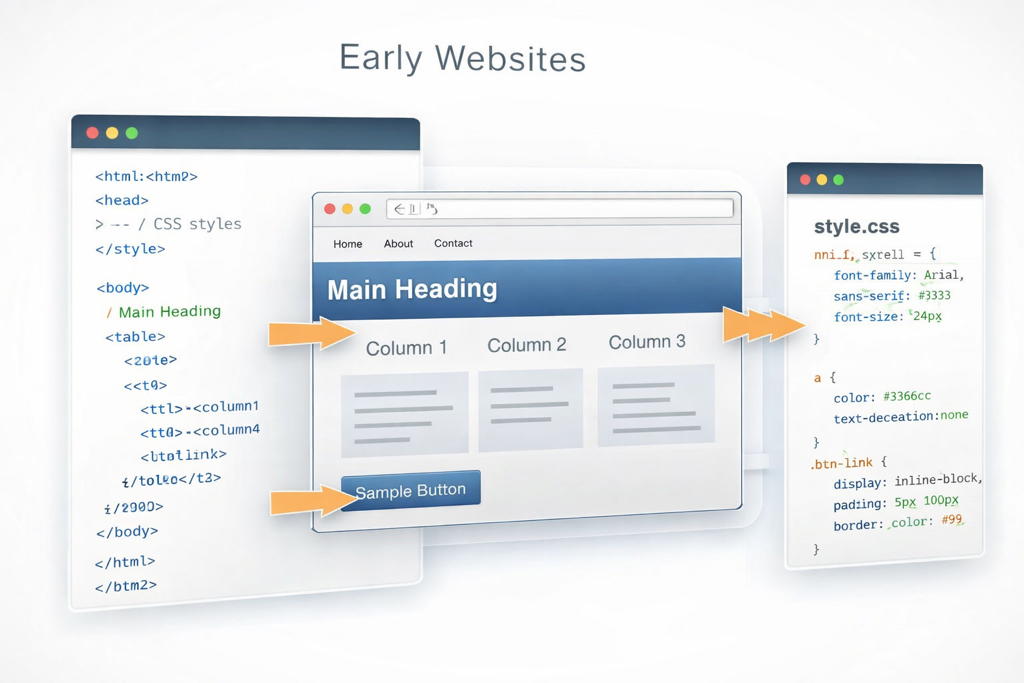
Today, there are modular systems, content management systems and numerous tools that can be used to create websites with almost no technical knowledge. Back then it was different. If you wanted to put your own website online, you had to learn at least a little HTML. Many pages were initially created quite simply in a text editor.
That's exactly how it started for me too. The first websites consisted of simple HTML files with headings, text and a few images. We experimented with table layouts, colors and font sizes. From today's perspective, a lot of it seemed improvised, but that was precisely the appeal. Every small change in the code immediately led to a visible result in the browser.
This phase was strongly characterized by trial and error. Step by step, you learned how websites are structured and how browsers display content. At the same time, we slowly developed a feeling for how information can be presented on the Internet.
First tools: Macromedia Dreamweaver and Fireworks
However, more professional tools also came into play relatively quickly. Macromedia programs, which were widely used in the web design scene, were particularly influential at the time.
One of the most important programs was Macromedia Dreamweaver. With Dreamweaver, you could not only edit websites in code, but also design them visually. The program showed a preview of the page during development, which made work much easier.
Macromedia Fireworks was often used for the design of graphics. With Fireworks, image editing could be directly aligned to web graphics. Buttons, graphic elements and small layout details could be created relatively easily.
I used these tools to create my first static websites. „Static“ in this context meant that each page was created and saved individually. There were no databases, no dynamic content and no automatic publishing processes. Every change had to be made manually.
Nevertheless, this way of working was surprisingly effective. Once you understood how HTML, images and links work together, you were able to create and publish your own pages relatively quickly.
The motivation behind your own website
Back then, the most important motivation for creating a website was often quite simply curiosity. The Internet suddenly offered the opportunity to make content accessible worldwide - something that had previously only been possible for large media companies or organizations.
Having your own website therefore also meant a degree of digital independence. You were no longer just a user of other platforms, but could publish information yourself, pick up on topics or present your own projects. Many websites at this time were personal projects. They were created without a major business model or marketing strategy. Instead, it was about gaining experience, trying out ideas and exploring the possibilities of the new medium.
My first website was also born out of precisely this motivation. It was initially an experiment - a place where I could test how content can be displayed on the Internet and what technical possibilities the web offers.
Websites as a digital home
Looking back, having your own website had a special meaning back then. While many online services continued to function as closed platforms, having your own domain offered something completely different: your own place on the Internet.
You owned the content yourself. You could decide which topics to publish, how the pages were structured and what information you wanted to share. This independence was an important factor for many early web projects.
At the same time, web design was constantly evolving. New browser functions, better graphics options and faster internet connections meant that websites became more and more extensive. What began as a simple HTML page could develop into a larger project over time.
A look back: The website from 1999
The following image shows one of the early versions of my website from 1999. Back then, websites were usually much simpler than they are today. Layouts often consisted of tables, graphics were kept small and many design elements looked very minimalist from today's perspective.
Nevertheless, such early screenshots show very well how the web worked back then. It was a phase of experimentation in which many people took their first steps in online publishing.
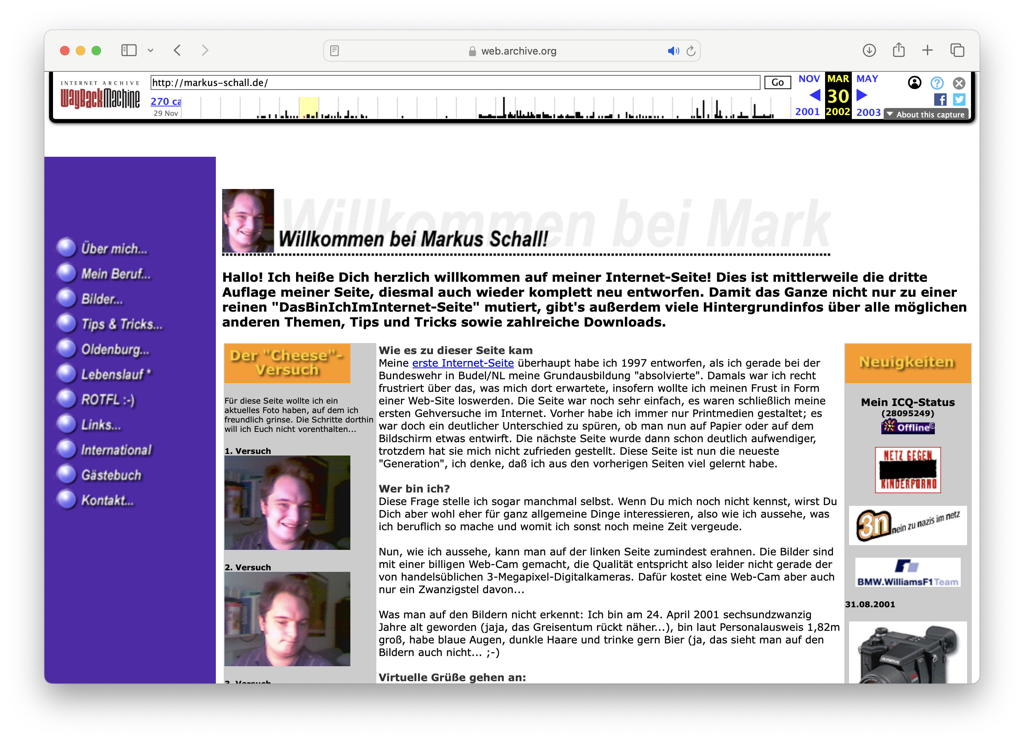
Even though technology and design have changed considerably since then, this first website marks an important starting point. Over the years, a small HTML project gradually developed into a much larger online presence - a process that will be continued in the next chapter.
The development over many years - changes in web design
Once the first website was online, a phase of continuous experimentation began. In the early years, the pages were still created using classic static HTML. Programs such as Macromedia Dreamweaver and Macromedia Fireworks made it possible to design layouts, create graphics and design websites relatively easily.
Nevertheless, this way of working was quite time-consuming in the long run. Each individual page had to be created and maintained manually. If, for example, a navigation changed, this change had to be adapted individually on many different pages. This was still manageable for small projects, but as the number of pages increased, this method became increasingly impractical.
At the same time, web design continued to develop. New browser functions, better layout options and faster internet connections meant that websites became increasingly complex. Simple HTML pages gradually evolved into larger web projects with many subpages and regular new content.
Content growth
Over time, the scope of the company's own website also grew. Initially, it consisted of just a few pages, but new content was gradually added. Every new idea led to another page, every new topic to an additional section.
This growth also brought with it organizational challenges. The more content there was, the more important a clear structure became. Visitors had to be able to find their way around the website and new content had to fit into the existing structure in a meaningful way.
This phase also showed how the internet was changing. More and more people were publishing their own content, and the web slowly developed from a collection of individual pages into a huge network of information.
New technologies and tools
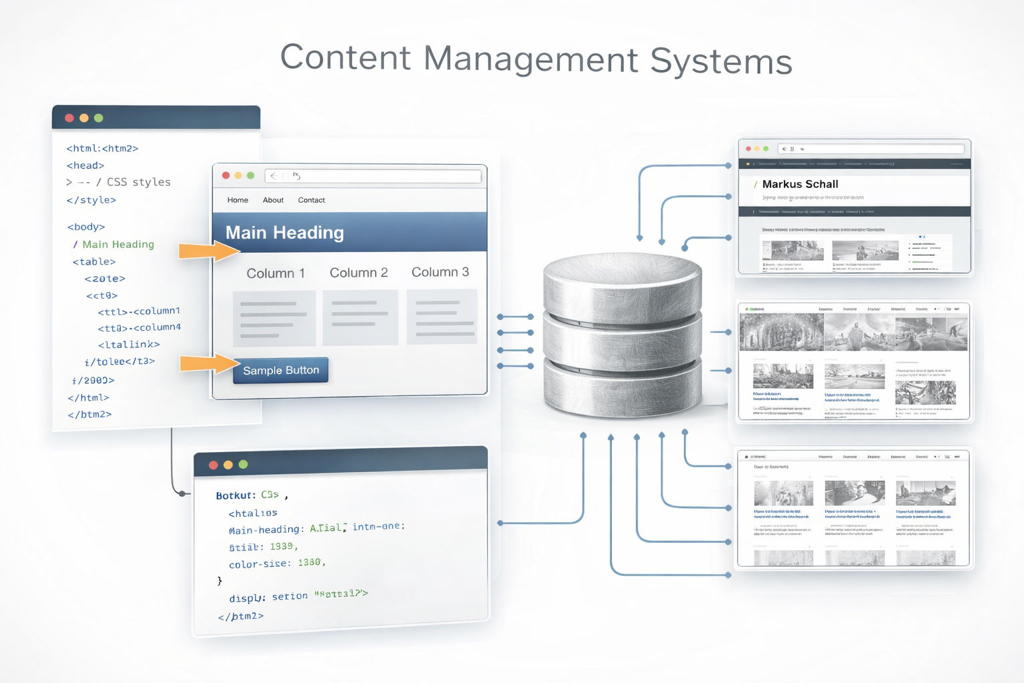
With the increasing size of many websites, new technical solutions also emerged. The first content management systems, or CMS for short, were particularly important. These systems were the first to make a clear distinction between design and content. Instead of saving each page individually as an HTML file, content was stored in a database. The system then generated the web pages automatically from this data. This made it easier to maintain and update content.
One of the systems that already existed at that time and was frequently used in web development was TYPO3. TYPO3 was one of the early high-performance content management systems and was used particularly in a professional environment.
I was also working with such systems at the time. The idea of storing content centrally in a database and displaying it automatically on websites was a big step forward compared to static HTML pages.
These new tools clearly showed the direction in which the web would develop. Websites became more dynamic, content could be updated more quickly and larger projects could be managed much more efficiently.
Current survey on digitalization in everyday life
The role of search engines
Parallel to these technical changes, the way in which people found information on the internet also developed. In the early years, many users navigated the web via link lists or web directories.
With the advent of modern search engines, this behavior changed fundamentally. Google, which began to systematically search the web and rank websites according to relevance at the end of the 1990s, was particularly influential.
This created a completely new way of accessing information. Users no longer had to know which website certain content was on. Instead, they could simply submit a search query and receive suitable results.
For website operators, this also meant new opportunities. Content could be found via search engines, even if visitors had never heard of the website in question before.
This development made it clear that websites were increasingly becoming part of a large, interconnected information system. What had begun as a small personal web project was now moving into an increasingly interconnected digital world - paving the way for the next big step: the transition to modern content management systems and new forms of online publishing.
Video tip: How communication has changed our world
How has human communication developed throughout history - and where is it taking us in the digital age? A documentary by Harald Lesch on the Terra X History channel that is well worth watching covers precisely this arc. The 45-minute episode shows how communication has developed from speech and writing to email and messenger services and the internet. It also reveals the key technologies behind modern messaging.

Voice, telephone and WhatsApp - the history of communication with Harald Lesch | Terra X
The outlook on artificial intelligence and the question of how digital communication could change the way we live together in the future is particularly interesting. An informative overview of the development of communication in the digital world.
The big relaunch with WordPress
After many years with static pages and initial experiments with various web technologies, it became clear at some point that the existing structure of the website was reaching its limits. The content had grown over the years, new topics were added and, at the same time, expectations of modern websites were constantly evolving.
Maintaining many individual HTML pages was cumbersome in the long run. Changes to navigation or layout often had to be made in several places at the same time. New content could also only be integrated with additional effort. The more extensive a website became, the clearer it became that a more flexible solution would make sense.
At the same time, content management systems had developed considerably during this time. They offered a way to centrally manage content and automatically display it on websites. This made it much easier to publish new articles and update existing content more quickly.
These developments ultimately led to the decision to fundamentally modernize the website and put it on a new technical footing.
The switch to WordPress in 2010
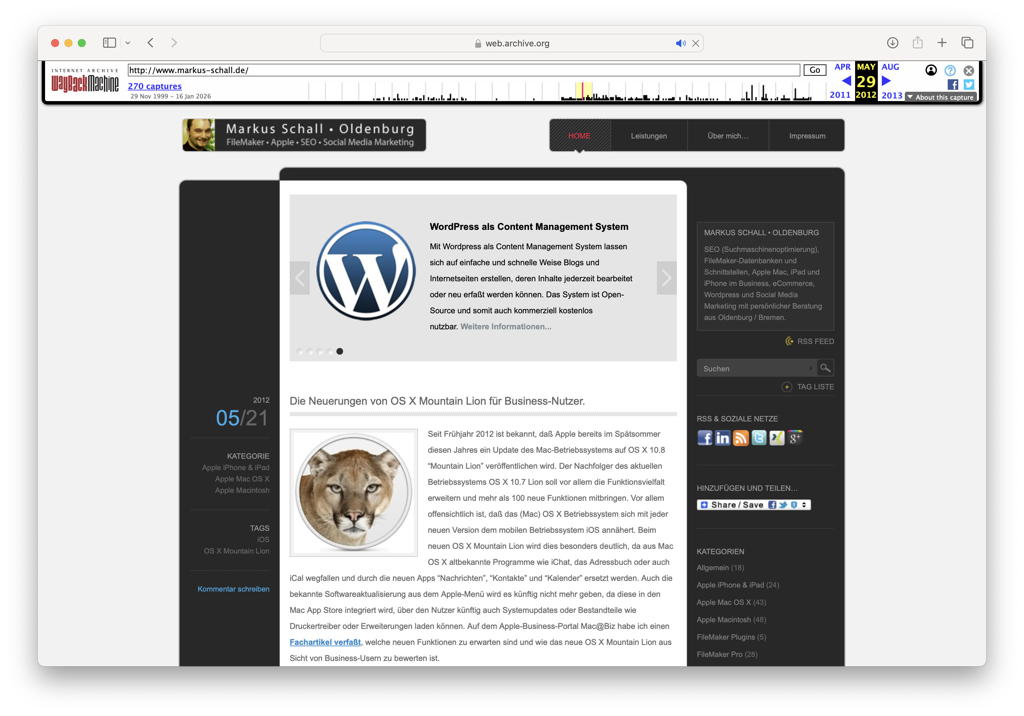
The major relaunch of the website based on WordPress then took place at the end of 2010. At this point, WordPress had already established itself as one of the most important content management systems on the internet. Originally launched as a blogging platform, the system quickly developed into a flexible basis for many different types of websites.
The big advantage was the clear separation between content and design. Texts, images and articles could be conveniently created and organized via an administration interface. The system automatically generated the corresponding web pages.
This made publishing new content much easier. Instead of editing individual HTML files, articles could be written and published directly in the system. At the same time, it was still possible to adapt or expand the design of the website. This step was a decisive milestone for the further development of the website.
The long-term stability of the system
Another advantage of WordPress became particularly clear over time: the long-term stability of the platform. While many previous web technologies have disappeared or been replaced over the years, WordPress has continued to evolve.
Regular updates improved security, expanded functions and adapted the system to new technical requirements. At the same time, a large community of developers emerged around WordPress, providing additional extensions and design templates.
This combination of stability and expandability made WordPress attractive for many website operators. New functions could be integrated relatively easily without having to rebuild the entire system.
This structure also proved to be very advantageous for my website. Content could be continuously expanded while the basic system was retained.
A system that still works today
Looking back, the relaunch in 2010 was an important turning point. The website was given a modern technical basis that could be further developed over many years.
Over time, new designs were introduced, extensions and technical details adapted. But the basic system remained the same. Much of today's content is still based on the structure that was introduced back then.
This continuity also shows a special feature of the internet: good technical decisions can last for many years. A solid system can be developed further without the need for a complete reboot.
The relaunch on WordPress was therefore not just a technical modernization. It also created the basis for a long-term online presence that has been able to adapt to new requirements over the years - and is still actively used today.
Digital consistency: Why early internet work pays off
When you look back on the development of your own website today, it really becomes clear how much the internet has changed over the last few decades. From simple HTML pages that were created in the late 1990s, a comprehensive online presence has developed step by step.
Almost everything has changed during this time: Internet speeds, browser technologies, design standards and the entire structure of the online world. Services have come and gone, platforms have emerged and later been replaced by new ones.
Your own website, on the other hand, often follows a different rhythm. It grows slowly, is expanded, modernized and adapted again and again. Individual technical elements change, but the basic idea remains the same.
Over the years, the result is not just a collection of articles or pages, but a kind of digital archive - a documentation of topics, developments and thoughts that have emerged over a long period of time.
The importance of digital continuity
One important aspect of this development is continuity. Many projects on the Internet are created quickly and disappear just as quickly. Websites are created, maintained for a while and later abandoned or replaced by new projects.
A website that is maintained over many years, on the other hand, develops a different quality. Content builds on each other, topics are accompanied over longer periods of time and readers can follow developments.
This form of digital continuity creates trust. Anyone who visits a website that has existed for many years and has been continuously expanded quickly recognizes that it is not a short-term project.
At the same time, this is also a fundamental advantage of having your own website: You are independent of platforms or social networks. Content remains available where it was originally published.
From personal website to magazine
The character of a website often changes over time. What originally begins as a personal project can gradually develop into a larger platform.
New topics are added, content is organized in a more structured way, and individual pages are turned into extensive articles or entire subject areas. The design and technical implementation are also continuously improved over the years.
Step by step, a simple website evolves into a magazine that bundles information, explores topics in depth and can inspire readers to reflect. However, an important core remains: the idea of publishing content independently and permanently in its own digital space.
A lesson from the early Internet era
The early years of the internet have shown how quickly technical developments can change. Platforms emerge, gain great importance and sometimes disappear again just as quickly.
Your own website, on the other hand, is a long-term project. It grows over the years, adapts to new technologies and yet remains a stable place on the web.
The most important insight from this development is perhaps quite simple: if you start publishing your own content early on and continuously develop it, you will create something over time that goes far beyond individual articles or pages. The result is a digital foundation that can last for many years - a place on the Internet that functions independently of short-term trends and yet constantly adapts to new developments.
And this is perhaps one of the best things about the Internet: that small projects born out of curiosity and experimentation can grow into something lasting over time.
Reading tip: Why having your own magazine is more valuable than advertising in the long term
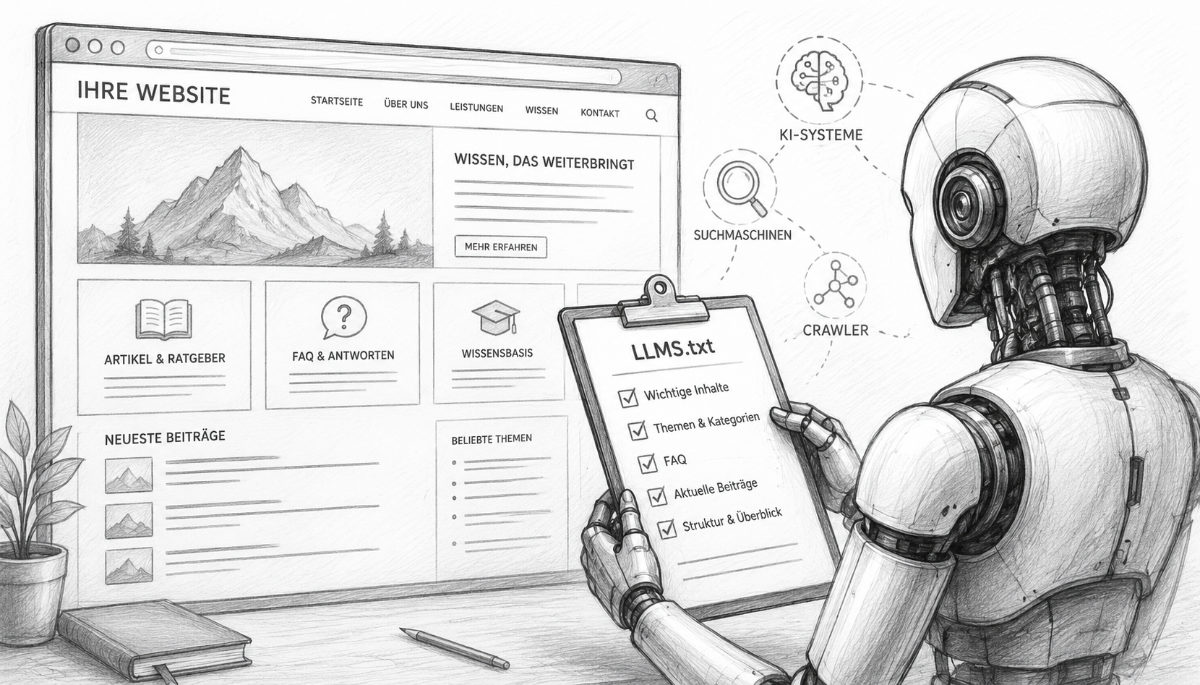
 Many companies today invest large budgets in advertising, social media or platforms - and often do not realize that this visibility is only borrowed. As soon as ads are stopped or algorithms change, a large part of the reach disappears again. A dedicated specialist section or magazine on your own website, on the other hand, works differently: content remains permanently findable, is discovered via search engines and can continue to grow over the years. This gradually creates a stock of knowledge and visibility that is not rented, but truly owned by the company. Exactly this idea explains this article.

Frequently asked questions
- Why did you start working with computers back in the 1980s?
For many people at the time, the fascination with computers arose from a mixture of curiosity, a love of experimentation and the completely new opportunity to program something themselves. Home computers were not just devices for consuming software, but tools for learning and trying things out. If you wanted to start a program, you often had to understand how it worked. This early phase was particularly formative because people worked very directly with the technology. You wrote your own programs, modified existing codes and automatically learned how computers think. For many computer enthusiasts, this was the start of a long-term involvement with technology and digital media. - How did home computers in the 1980s differ from today's computers or smartphones?
The differences are enormous. Home computers such as the Commodore or Atari only had a tiny fraction of the computing power of modern devices. Working memory was often in the range of a few kilobytes or kilobytes, whereas today's smartphones use several gigabytes. Operation was also different: many programs were controlled via simple text interfaces and you often had to program yourself to use certain functions. At the same time, this time had a special charm because you worked very directly with the technology and didn't just use ready-made applications. - What were mailbox systems and why were they so important for early online communication?
Mailbox systems were early online platforms that were accessible via telephone lines. Users used a modem to dial into a computer that was accessible around the clock. There they could read messages, write posts or exchange files. These systems were basically a mixture of forum, news service and file archive. Mailboxes were so important because they made digital communities possible for the first time. People were able to exchange information over long distances long before the Internet as we know it today was widespread. - How did the connection to mailboxes work technically?
The connection was made via so-called modems. A modem converted digital data from the computer into sounds that could be transmitted via a telephone line. At the other end, these tones were converted back into data. The typical whistling and rattling that many people remember from this time came about during the so-called negotiation of the connection. The two modems agreed on a common transmission speed. The connection was significantly slower than today's internet connections, but it enabled digital communication over longer distances for the first time. - What was the difference between mailbox systems and services like AOL or CompuServe?
Mailbox systems were mostly smaller, independent systems with relatively manageable user groups. AOL and CompuServe, on the other hand, were large commercial online services with their own infrastructure and a wide range of content. While mailboxes were often operated by private individuals, AOL and CompuServe were professional platforms with millions of users. They offered structured information areas, chats, e-mail services and many other functions within a closed system. - Why was AOL considered by many people to be the gateway to the Internet?
AOL made access to the Internet particularly easy. The provider distributed its software en masse via diskettes and CDs enclosed in computer magazines. Once installed, it was relatively easy to dial in and use various online functions. For many people, this was their first experience of digital communication. Although AOL was initially technically a closed system in its own right, it gave many users the feeling of being part of a larger online world for the first time. - What was the difference between CompuServe and AOL?
CompuServe was an older and technically oriented online service. While AOL focused heavily on social functions and ease of use, CompuServe had a more factual and information-oriented character. Many users were technically or professionally interested, and the platform offered numerous specialist forums and information services. As a result, CompuServe often appeared somewhat more sober than AOL, but also played an important role in early online history. - Why was DSL such a turning point for the Internet?
DSL fundamentally changed the Internet because it enabled significantly faster and more stable connections. Before DSL, you had to dial up via modems and often paid per minute for online time. With DSL, the Internet became a permanent connection. You were practically always online without having to connect every time. This also changed usage behavior: Websites could become more extensive, new services emerged and the Internet became an integral part of everyday life. - How fast were the first DSL connections compared to today's connections?
The first DSL connections were often around 768 kilobits per second. From today's perspective, this seems slow, as modern connections often reach several hundred megabits per second. Nevertheless, this speed was revolutionary at the time. Websites suddenly loaded much faster and large files could be transferred in minutes instead of hours. For many users, this was the moment when the Internet became truly convenient for the first time. - How did the first own websites come about in the 1990s?
In the early years, websites were mostly written directly in HTML. Many people used simple text editors to create the code. Later, programs such as Dreamweaver were added, which made it easier to create websites. Nevertheless, much of the work was still manual. Each page had to be created and maintained individually. Despite these limitations, it was an exciting time because suddenly everyone could publish their own content on the internet. - What role did programs like Dreamweaver and Fireworks play in web design?
Programs such as Dreamweaver and Fireworks were among the most important tools in the web design scene at the time. Dreamweaver made it possible to design websites visually and edit the HTML code at the same time. Fireworks was often used to create web graphics. Both programs helped to make websites more professional and made it easier to work with layouts, graphics and navigation elements. - Why have static websites become impractical over time?
Static websites consist of individual HTML files. If a navigation or layout changes, this change must be made on each individual page. This is still manageable for small websites, but it quickly becomes very time-consuming for larger projects. This is why content management systems were developed that store content centrally in databases and automatically display it on websites. - What is a content management system and why was it an important development?
A content management system, or CMS for short, separates the content from the design of a website. Texts, images and articles are stored in a database and automatically displayed on web pages. This makes it easier to create and update content. CMS systems make it possible to efficiently manage large websites and regularly publish new content. - What role did TYPO3 play in early CMS development?
TYPO3 was one of the first powerful content management systems to be used in a professional environment in particular. It enabled extensive website structures and offered numerous functions for editors and website operators. For many developers, TYPO3 was an important step in the development of modern web technologies. - Why did you later decide to use WordPress?
WordPress quickly developed into one of the most popular content management systems on the internet. The system is comparatively easy to use, but can also be expanded very flexibly. This makes it suitable for both smaller websites and larger online projects. The relaunch of the website on WordPress in 2010 created a stable foundation on which the content could continue to develop over many years. - How has WordPress changed since 2010?
WordPress has developed continuously over the last few years. New functions, security updates and extensions have made the system more and more powerful. At the same time, a large developer community has emerged that provides additional plugins and design templates. This has enabled the system to keep pace with the technical developments of the internet. - Why is having your own website more valuable in the long term than many platform profiles?
Your own website offers independence. Content is not controlled by platform rules or algorithms, but remains under your own control. While social networks can change quickly, your own website remains a stable place on the internet. Content can remain available in the long term and can be found via search engines. - What is the significance of digital continuity on the Internet?
Digital continuity means that content remains accessible for many years and is continuously expanded. Websites that are maintained over long periods of time develop a special credibility. Readers recognize that these are not short-term projects, but long-term information offerings. - What can young people today learn from the early days of the Internet?
The early years of the Internet show how important curiosity, experimentation and independent learning are. Many of the developers and website operators at the time acquired their knowledge themselves. Anyone who starts their own projects today and works on them continuously can have similar experiences. The internet still offers the opportunity to implement your own ideas and build long-term digital projects.