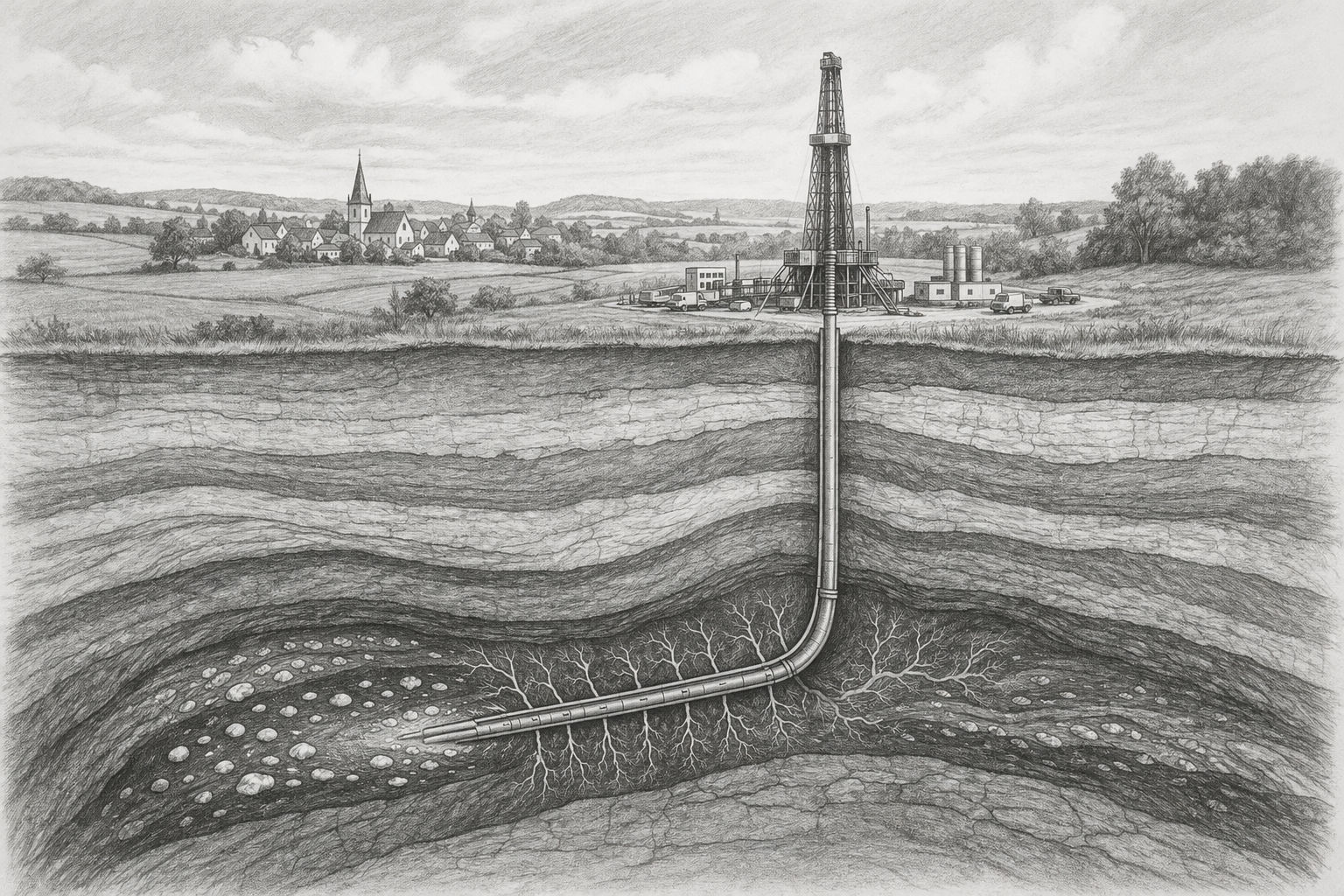
There are political and social discussions that are not linear. They come in waves. Fracking is one such issue. For years, the matter in Germany seemed settled. With the legislative package of 2016 and the resulting regulation from 2017, the framework was clear: commercial fracking in unconventional reservoirs will not take place. The debate calmed down and the issue largely disappeared from the public eye. It was as if a lid had been put on it.
But this impression was deceptive. Because while the debate in Germany was dying down, the world was changing in the background. The energy supply, which had long been considered relatively stable, came under increasing pressure. Prices began to fluctuate, supply chains became more fragile and geopolitical tensions increased. The events from 2022 at the latest made it clear that energy is not a matter of course, but a strategic commodity.




Latest news on fracking in Germany
15.04.2026: The Federal Minister of Economics Katherina Reiche raises the issue of fracking is once again entering the political debate. In view of the current energy crisis, it is calling for greater use to be made of domestic gas reserves and is also explicitly examining the controversial fracking technology. It is supported in this by economic policy advisors who argue that environmental and safety risks can now be better controlled thanks to technological advances.

GERMANY: Big bang! Fracking for gas supply? Debate picks up speed | WELT news channel
At the same time, the topic remains highly controversial: unconventional fracking has been largely banned in Germany since 2017, primarily for precautionary reasons relating to environmental and groundwater protection. Critics continue to warn of potential risks and do not see it as a sustainable contribution to the energy transition. Supporters, on the other hand, emphasize the opportunity to reduce dependency on energy imports. However, it is also clear that even with a political reassessment, fracking would not be a short-term solution, but a long-term project with a considerable lead time.
The return of an old debate
In this new environment, old questions are cropping up again. Not because someone is nostalgically remembering past debates, but because the starting point has shifted. What used to be considered avoidable now seems at least worth discussing. And this is where the real challenge begins.
Because the return of the topic does not mean that the arguments from back then have disappeared. On the contrary. Concerns about the environment, groundwater, climate impact and geological risks remain. At the same time, they are confronted with new realities: greater dependence on imports, increased energy costs and the realization that the restructuring of the energy supply will take time. This simultaneity makes the debate difficult. It is no longer a question of a simple „for“ or „against“, but of weighing up the options under changed conditions.
There is also a second, often overlooked aspect: the debate is being conducted differently today than it was ten or fifteen years ago. Back then, fracking was often a symbol of a supposedly reckless industrial policy. Today, the picture is more nuanced. Technical advances have at least partially alleviated some of the original problems. At the same time, confidence in simple solutions has declined. Neither complete rejection nor unqualified support seem convincing today.
What remains is a certain uncertainty. And perhaps this is precisely the most honest starting point for a fresh look. The return of the fracking debate is therefore not a sign that earlier decisions were wrong. Rather, it is an expression of a changed situation in which old answers no longer automatically fit. Anyone dealing with the issue today must be prepared to endure both: the justified concerns of the past and the new constraints of the present.
That is exactly what this article is about. Not about presenting a quick solution, but about making the connections visible. Step by step, without shortcuts. Because this is the only way to assess whether and under what conditions fracking could play a role in Germany again in the future - or not.
What fracking actually is (clearly explained)
When natural gas is mentioned, many people think of a resource that lies somewhere underground, is drilled into - and then simply flows upwards. In fact, this was the case for a long time. This is referred to as conventional reservoirs. The gas is located in porous layers of rock and can be extracted relatively easily.
However, these easily accessible deposits have already been largely developed in many regions. What remains are so-called unconventional deposits. Here, the gas does not sit freely in the rock, but is trapped in very dense layers - for example in shale, clay or coal seams. Without additional measures, it remains where it is.
This is precisely where fracking comes into play. It is basically not a new source of energy, but a method of accessing gas that would otherwise not be economically viable.
How fracking works technically
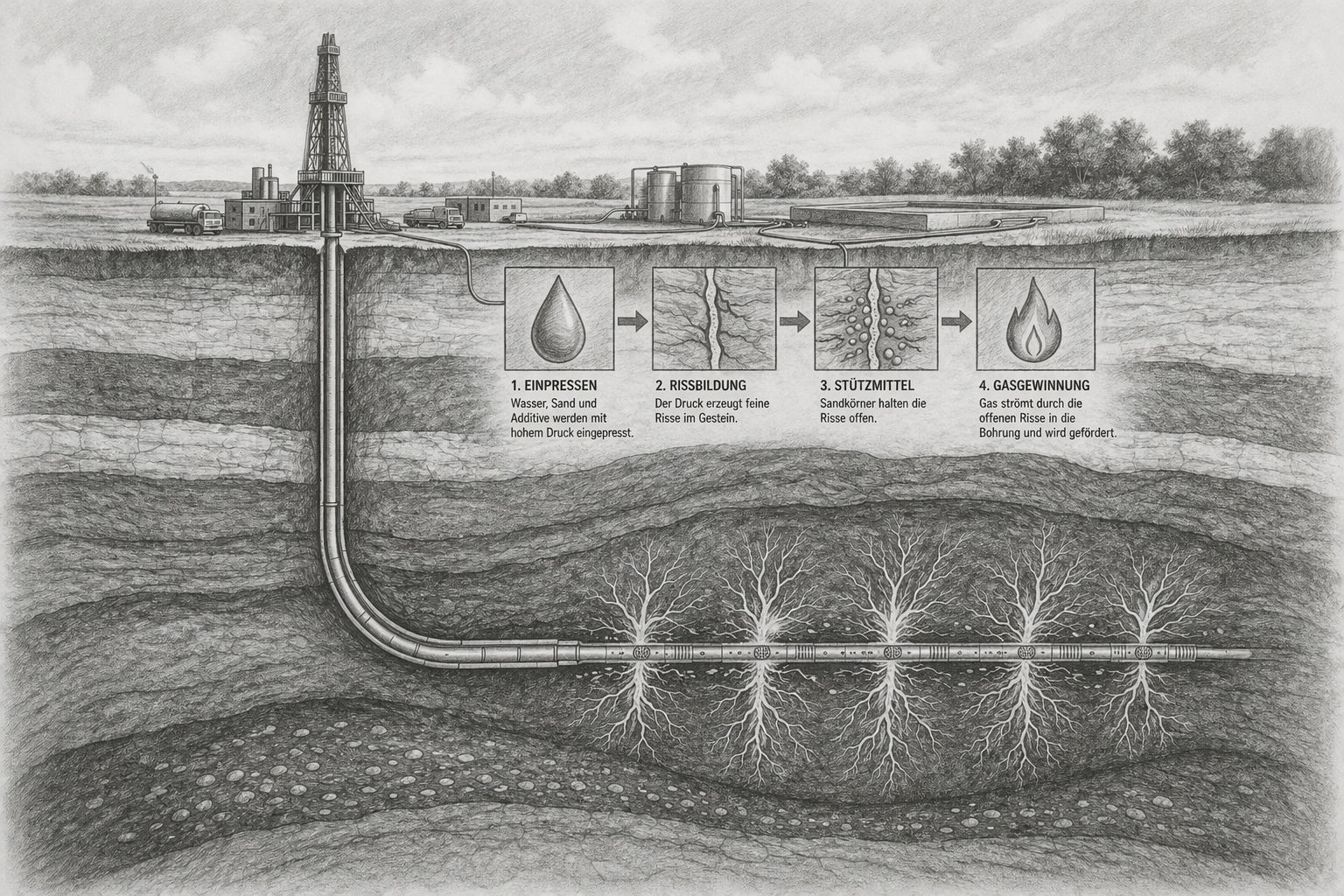
The principle is simpler than it seems at first glance - even if the technical implementation is highly complex. First, a borehole is drilled several thousand meters deep into the earth. In many cases, this is followed by a horizontal borehole that extends for several kilometers through the gas-bearing rock layer. This technique is crucial because it greatly increases the contact area with the rock.
A liquid is then pressed into the rock under high pressure. This consists mainly of water, plus sand and small amounts of chemical additives. The pressure creates fine cracks in the rock - hence the term „fracturing“. The sand fulfills an important function: it keeps the cracks open. The gas can then flow through these small cracks towards the borehole and be pumped upwards.
What looks like a single process from the outside is actually a precisely controlled process in several stages. Modern systems work with so-called „stages“, i.e. individual fracking phases along the horizontal borehole. This makes it possible to control very precisely where and to what extent the rock is fractured.
Conventional vs. unconventional fracking
One point that is often confused in the public debate is the difference between different forms of fracking. Fracking is not the same as fracking.
Traditional natural gas extraction has also been used in Germany for decades to a limited extent - for example, to improve the permeability of a reservoir. This form is often referred to as conventional fracking. It takes place in rocks that are already more permeable and is technically less complex.
However, unconventional fracking is the main subject of controversy today. This involves dense layers of rock in which the gas would not be accessible without massive intervention. It is precisely this form that has been practically ruled out in Germany since 2017.
The difference is not only technical, but also politically relevant. While conventional methods are still permitted in certain cases, unconventional fracking is at the center of the debate.
Why fracking is used at all
The real question is not just how fracking works, but why it is being considered at all. The answer lies in a combination of resource scarcity and rising demand. In many regions of the world, fracking has led to previously unexploitable gas deposits becoming economically viable. This has been particularly evident in the USA, where the so-called „shale revolution“ has fundamentally changed the energy market.
The situation is different for countries without large conventional reserves. Here, it is less about export opportunities and more about security of supply. Domestic gas - even if it is more difficult to extract - can be an alternative to imports.
At the same time, fracking is not an end in itself. It is always embedded in a larger energy policy issue: how does a country cover its energy needs and under what conditions?
Between technical solution and political issue
At this point, it becomes clear why fracking is so controversial. From a technical point of view, it is a process that has developed considerably in recent decades and is used in many parts of the world.
Politically and socially, however, the assessment is different. After all, fracking is more than just a drilling technique. It is an intervention in geological structures that makes it clear that energy extraction is always associated with consequences. The question is not whether there are effects, but how they are assessed and how they relate to the benefits.
This makes fracking an example of a fundamental challenge facing modern industrial societies: how to deal with technologies that are neither clearly good nor clearly bad.
Anyone dealing with this topic should therefore not stop at the technology. It is only the starting point. The decisive factor is how you classify the resulting opportunities and risks - and this is exactly what the following chapters will look at step by step.
New debate about domestic gas reserves in Germany
A recent report by the WELT news channel revisits the question of domestic gas deposits - and thus brings movement to a debate that was long considered closed. The focus is on the geophysicist Hans-Joachim Kümpel, who points to considerable untapped shale gas reserves in Germany. According to his assessment, environmentally friendly fracking using modern methods would be possible in principle, although extraction would require extensive preparation times. At the same time, the article makes it clear that this is not a short-term solution, but a strategic option for the coming years.
Against the backdrop of rising energy prices and geopolitical uncertainties, the question of whether Germany should rely more heavily on its own resources in future - or remain dependent on imports - is becoming increasingly important.

GAS IN GERMANY: „We have huge reserves!“ | Expert sees huge potential for fracking WELT news channel
Germany 2017: Why fracking was banned
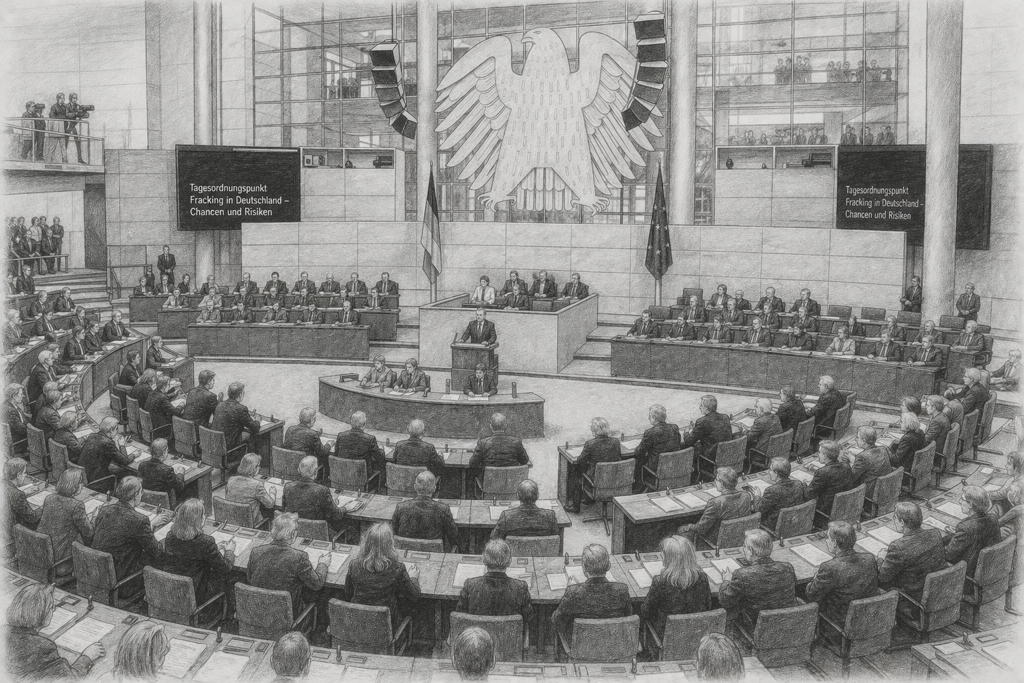
When the German Bundestag passed the so-called fracking law package in 2016, the thrust was clear: Germany should take a different approach to unconventional fracking than the USA, for example. The regulation came into force in 2017 and was often perceived as a de facto ban - even if it is formulated in a slightly more nuanced legal way.
At its core, it was about one thing: precaution. Not in the sense of an acute emergency, but as a political principle. The aim was to avoid risks before they even arose. That sounds reasonable at first, almost self-evident. However, as is so often the case, it is only in the details that it becomes clear what such a decision means.
This is because not every form of fracking was banned. Above all, the commercial extraction of natural gas from unconventional deposits was banned - in other words, the very technology that had led to a massive expansion of gas production in other countries. At the same time, the law theoretically left room for scientifically supported testing measures. In practice, however, it remained the same: fracking of this kind does not take place in Germany.
The role of environmental concerns
The political justification for this decision was primarily in the area of environmental and health protection. The public debate focused on several points.
On the one hand, it was about groundwater. The concern was - and still is - that fluids or substances released during fracking could enter drinking water reservoirs. Even if such scenarios appear technically avoidable, the uncertainty about possible long-term consequences remains.
A second aspect concerned the chemicals that are added to the frack fluid. Although they only make up a small proportion in terms of quantity, their composition and possible interactions underground were difficult for many to assess.
There were also concerns about methane emissions, which are relevant to climate policy, and the possibility of induced seismicity - i.e. small earthquakes triggered by changes in the subsurface.
All of these points were discussed intensively. And even if not every concern was substantiated by specific cases of damage, the overall picture that emerged was politically difficult to ignore.
Public perception and political dynamics
In addition to the technical arguments, public perception played a decisive role. Fracking was portrayed in many media reports as a risky technology that was difficult to control. Images from the USA - such as burning taps or large-scale drilling landscapes - shaped the image more than sober analyses.
This perception had an effect on politics. After all, in a democracy, major infrastructure decisions cannot be made without social acceptance. Resistance from the population, particularly at regional level, increased the pressure to take a clear position.
The topic was particularly sensitive in federal states with existing gas production, such as Lower Saxony. Here, it was not just about abstract risks, but about concrete effects in one's own environment. The proximity to the potential intervention made the discussion more tangible - and therefore also more conflict-prone.
The legal framework in detail
The legislative package that was passed attempted to reflect this tension. It was not a simple ban, but a combination of restrictions, conditions and exemptions. The key points were
- Ban on commercial fracking in shale, clay, marl and coal seam rock
- Possibility of up to four scientific testing measures under strict conditions
- Conventional fracking still permitted in certain reservoirs
- Introduction of stricter rules for handling water and chemicals
This differentiation shows that the decision was not based on a fundamental rejection of the technology, but on a specific assessment of its application in certain geological contexts.
In the public perception, however, this was often only a shortened picture: fracking is banned in Germany. The fact that this is a targeted restriction was often overlooked.
A decision in the context of its time
In order to understand the decision at the time, it is important to consider the general conditions. The energy supply was considered to be comparatively stable. Natural gas was available, prices were within a manageable range and although dependence on imports was discussed, it was rarely perceived as an acute problem.
At the same time, the energy transition gained in importance. The expansion of renewable energies was politically driven forward and fossil technologies were increasingly under pressure to justify themselves. In this environment, it seemed logical to abandon a controversial extraction method.
In other words, the decision against fracking was not isolated, but embedded in an overall picture characterized by relative security of supply and growing environmental awareness.
What remains from back then
Today, a few years later, we can see that the decision at the time drew a clear line - and at the same time left questions unanswered.
The risks that were discussed at the time have not disappeared. They still form the core of the critical attitude towards fracking.
At the same time, external conditions have changed. Energy has become more expensive, supply chains are more uncertain and the geopolitical situation has worsened. This does not automatically mean that the 2017 decision was wrong. But it does mean that it was made under different conditions than those that apply today.
And this is where the real discussion begins: whether a decision that seemed sensible under certain conditions needs to be reassessed under changed circumstances - or whether its basic assumptions are still valid.
This question cannot be answered with a simple yes or no. It requires a fresh look - step by step, with a view to technology, the environment, the economy and society.
The controversial thesis: external influence
Whenever political decisions have a major economic impact, sooner or later a question arises: Who actually had an interest in this?
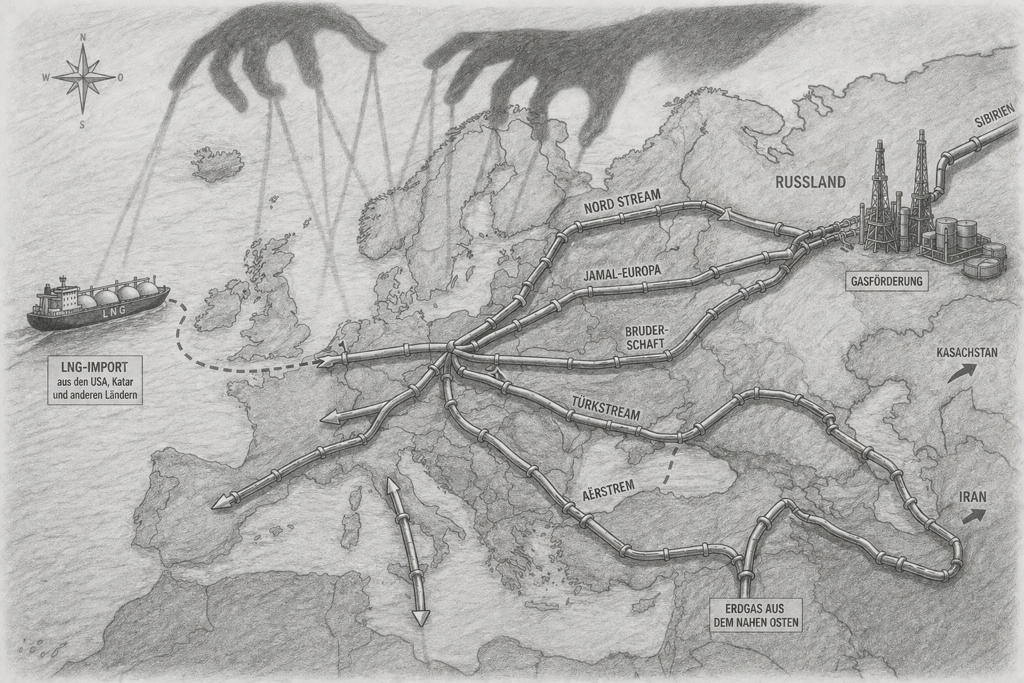
In the case of fracking in Germany, this view has been directed outwards for several years - more specifically towards Russia and the energy company Gazprom. Put simply, the theory is that Russia had an economic interest in Europe - and Germany in particular - not tapping into its own gas resources. And that is why campaigns were specifically supported that cast fracking in a negative light.
This is a theory that seems plausible at first glance. After all, it follows a simple pattern: those who benefit from something could have an interest in preventing alternative developments. However, as is so often the case, the truth lies not in the plausibility of a story, but in its verifiability.
The statement by Anders Fogh Rasmussen
A central point of reference in this discussion is a statement made in 2014, when the then NATO Secretary General Anders Fogh Rasmussen declared that Russia was actively working with environmental organizations to prevent fracking in Europe.
This statement attracted attention - not least because it came at a time when relations between Russia and the West had already cooled considerably. It fitted into an overall geopolitical picture in which energy was increasingly seen as a strategic instrument.
However, this statement was not enough. Concrete evidence, for example in the form of publicly proven financial flows or clearly attributable campaigns, was not provided. Even within NATO, it was later emphasized that this was not an official, institutionally documented position, but a personal assessment.
This left an area of tension between a geopolitically plausible assumption and a lack of evidence.
What is actually documented - and what is not
If you take a sober look at the available information, a clear picture emerges - but not in the sense that some people expect.
Occupied:
- For years, Russia had a strong economic interest in exporting gas to Europe
- An expansion of European own funding would have weakened this position
- Energy policy was and is a central component of geopolitical strategies
Not documented:
- That concrete anti-fracking campaigns in Germany were demonstrably financed by Russian actors
- That such campaigns were decisive for the political decision of 2016/2017
- A direct link between individual environmental organizations and state-controlled influence operations
This does not mean that exerting influence is fundamentally impossible. But it does mean that a distinction must be made between conjecture and proven knowledge. And it is precisely this distinction that is crucial if the topic is to be treated seriously.
The interests of the energy players
Regardless of the question of concrete influence, one thing is clear: The interests in the global energy market are anything but neutral. For a company like Gazprom, Europe has been a key sales market for many years. Increasing its own production within Europe would inevitably have led to more competition - and thus to potentially declining market shares.
However, this logic does not only apply to Russia. Other major energy exporters - such as the USA in the LNG sector - are also pursuing their own economic interests. The same applies to international corporations that profit from or reject certain extraction methods.
In other words, exerting influence in the energy sector is not an exceptional case, but a structural one. The question is not whether interests exist, but how strong they are and how transparent they are.
Between geopolitical thinking and provability
This is the real crux of the problem. Geopolitical thinking often works with probabilities and interests. It asks: Who benefits? Who has a motive?
Traditional research, on the other hand, requires evidence: Documents, payment flows, verifiable connections. In the case of the fracking debate, these two perspectives collide. Geopolitical logic suggests that there may have been attempts to influence public opinion. However, the verifiable facts are not sufficient to derive a reliable cause-and-effect relationship.
For a factual article, this means that you can and should mention this thesis - but you have to classify it clearly.
Why this question nevertheless remains relevant
Even if the evidence is unclear, the discussion about possible influence has an important side effect: it draws attention to the vulnerability of open societies to external interests.
Regardless of the specific case, a fundamental pattern emerges. Political decisions, especially in the field of energy, are rarely purely technical in nature. They arise from the conflicting priorities of the economy, the environment, public opinion and geopolitical interests.
The question is therefore not so much whether there are attempts to exert influence - but how societies deal with them. How transparent are decision-making processes? How critically is information examined? And how is it possible to distinguish between justified criticism and possible instrumentalization?
In the context of this article, a clear interim position can be formulated: The thesis of targeted influence by Russia on the German fracking debate is plausible in terms of geopolitical interests, but not proven in terms of hard facts. It is therefore in an area that deserves attention, but does not allow any hasty conclusions to be drawn.
Particularly with topics that are so economically and politically charged, this restraint is not a sign of uncertainty, but of care.
Because in the end, the real question remains - regardless of who pursued which interests:
Did the decision against fracking make sense under the conditions at the time? And does it still make sense today?
The answer to this question depends not only on the past, but above all on how we assess the present.
In the Comments Prof. Dr. Hans-Joachim Kümpel, geophysicist and President of the Federal Institute for Geosciences and Natural Resources (BGR) from 2007 to 2016, has published a number of links to further information on this topic, some of which is controversial and previously unknown.
Current survey on energy policy in Germany
What lies beneath German soil - A hidden raw material
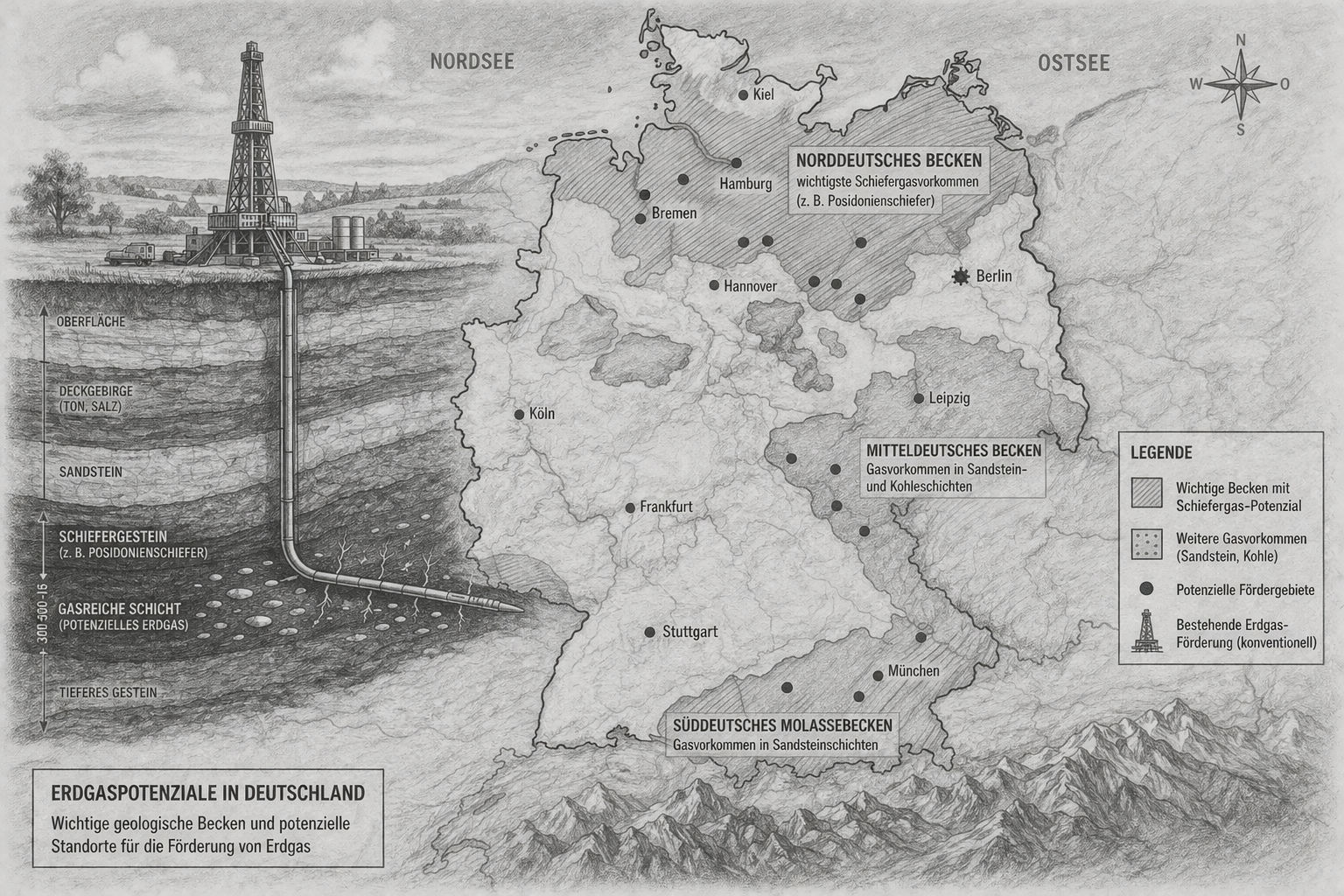
When people talk about fracking, they often get the impression that it is a theoretical possibility - something that may or may not exist. In fact, the initial situation is much clearer: there are natural gas deposits under German soil. The real question is not their existence, but their accessibility.
Germany is not a classic gas-producing country like Russia or Qatar, but neither is it a region without its own resources. In northern Germany in particular, especially in Lower Saxony, natural gas has been extracted for decades. However, this production was mainly based on conventional deposits - i.e. deposits that were comparatively easy to develop.
What is at the center of the discussion today are other resources. We are talking about gas that is not lying freely in the rock, but is trapped in dense layers. And this is where the uncertainty begins.
Shale gas and other unconventional deposits
A few years ago, the Federal Institute for Geosciences and Natural Resources (BGR) carried out extensive investigations into possible shale gas deposits in Germany. The results were remarkable: there are indeed relevant quantities of gas that could be technically exploitable.
Depending on how you look at it, the estimates range from several hundred billion to over two trillion cubic meters of gas. At first glance, such figures seem impressive. They suggest that Germany could have considerable potential.
But caution is advised here. This is because these figures do not describe what can be produced tomorrow, but rather what would be technically achievable under certain assumptions. There is a long way between theoretical potential and actual production.
Technically possible is not always economically viable
A crucial point that is often overlooked in the public debate is the difference between technical developability and economic extractability. Even if a gas deposit is geologically available, this does not automatically mean that it makes sense to extract it. The costs of development, infrastructure and operation also play a role, as do market prices and regulatory framework conditions.
In Germany in particular, with its high population density and strict environmental regulations, the conditions are more complex than in many other regions of the world. This means that some of the theoretical resources may never be used - simply because the cost would be too high.
There is also another factor: the quality of the deposits. Not every deposit is equally accessible or equally productive. Here too, numbers alone only tell part of the story.
Regional focus and geological reality
The potential shale gas deposits in Germany are mainly concentrated in certain regions. These include parts of northern Germany in particular, including Lower Saxony and North Rhine-Westphalia. These regions have geological structures that are generally suitable for the formation of shale gas.
But even within these areas, the situation is not uniform. Geological formations can vary greatly over a comparatively short distance. This makes a precise assessment difficult and requires detailed on-site investigations.
Another aspect is the depth of the deposits. In Germany, many of these deposits are located at depths of several thousand meters. From a technical point of view, this can have both advantages and disadvantages. On the one hand, deeper layers are often better separated from near-surface groundwater systems; on the other hand, the greater the depth, the higher the technical requirements and costs.
Between hope and reality
The idea that Germany could cover a large part of its demand with its own gas production is tempting - but it falls short. Even optimistic scenarios do not assume that shale gas could completely replace the existing supply. If anything, it would be a building block within a larger energy system.
This means that Germany would remain dependent on imports even if it were to use them. The difference would be that part of the supply would take place domestically - with corresponding effects on dependency, prices and infrastructure.
At the same time, the symbolic character of such resources should not be underestimated. Own resources not only represent physical energy, but also a form of agency. They open up options - even if they are not fully utilized.
The real question behind the figures
In the end, the consideration of resources leads to a fundamental question: What does it mean to have your own raw materials? Is it enough that they exist - or does it depend on whether and how they are used?
There is no purely technical answer to this question. It touches on economic considerations, ecological considerations and social decisions in equal measure. After all, resources are never just a question of geology. They are also always a question of priorities.
The figures assumed to be under German soil therefore do not provide a ready-made answer. Rather, they form the starting point for a discussion that goes far beyond pure extraction technology. And it is precisely at this point that it becomes clear that the question of fracking is not just a question of „can“, but above all one of „will“.
Fracking today: technical progress since 2017
Anyone looking at fracking today is looking at a technology that has changed significantly over the last ten to fifteen years. The process itself has essentially remained the same - pressure creates cracks in the rock to release gas. However, the way in which this process is controlled has evolved noticeably.
While early applications were often perceived as comparatively crude, today it is increasingly about precision. Modern drilling technology makes it possible to target specific layers of rock and to limit interventions very precisely in terms of space. This does not mean that interventions have disappeared - but they have become easier to control.
In densely populated regions in particular, this development would be a basic prerequisite for any form of application. After all, the more precisely an intervention can be planned and monitored, the easier it is to talk about its effects.
Efficiency through horizontal drilling and multiple stimulation
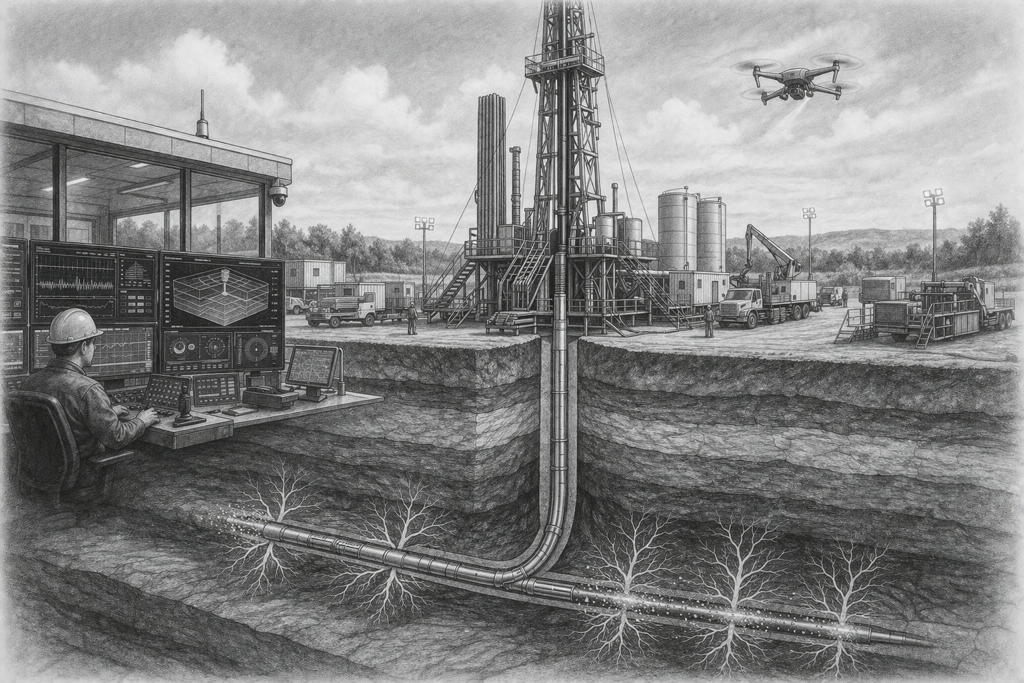
A key advance lies in the combination of horizontal drilling and so-called multiple fracks along a borehole. Instead of drilling several individual vertical boreholes, a single borehole is now often used, which runs horizontally through the deposit over long distances. Along this route, the rock is broken up in individual sections. These „stages“ make it possible to structure and optimize the process. The advantage is obvious: more gas per well, while using less space.
This has two consequences. Firstly, the infrastructural effort on the surface is reduced - fewer drilling sites, less transportation, less visible interventions. Secondly, economic efficiency increases because existing resources can be better utilized.
However, the same applies here: Efficiency does not automatically mean harmlessness. It merely shifts the relationship between cost and return.
Progress in water and chemical management
One area that was viewed particularly critically in the early fracking debate was the handling of water and additives. A lot has actually changed here. Modern plants are increasingly relying on closed circuits in which some of the fluid used is recycled and reused. This reduces the need for fresh water and reduces the amount of waste water that has to be disposed of.
There have also been developments in the substances used. The trend is towards less problematic additives and more comprehensible compositions. In some cases, targeted efforts are being made to reduce chemical additives or replace them with less critical alternatives.
This is progress - but not a complete breakthrough. Even with optimized methods, fracking remains a water-intensive process and some of the fluid used remains underground permanently.
Monitoring and control in real time
Another important step is to improve monitoring. Modern fracking projects work with a variety of sensors and measurement methods that monitor the condition of the subsurface throughout the entire process. These include, among others:
- Pressure measurements along the borehole
- Seismic sensors for detecting the smallest vibrations
- Digital models for the simulation of crack propagation
These systems enable real-time control. This means that the process can not only be planned, but also adjusted during execution. Anomalies can be detected more quickly and - at least in theory - corrected at an early stage.
This is a decisive step forward, particularly with regard to possible earthquakes or uncontrolled crack formation. Today, the technology allows a much more precise understanding of what is happening underground.
What has improved - and what hasn't
If we summarize the developments of recent years, a differentiated picture emerges. Above all, the following have improved:
- the controllability of the interventions
- the efficiency of the promotion
- the transparency of processes
These are not small steps forward. They change the starting position compared to the situation that existed at the time of the German fracking ban. At the same time, fundamental questions remain. The technology has developed further, but it has not changed its nature. It is still an intervention in complex geological systems whose behavior cannot be fully predicted.
The conflict of objectives also remains: between the use of a resource and the potential impact on the environment and climate.
Progress without a simple resolution
The technical development of fracking shows a pattern that can be observed in many areas of industry. Problems are not simply solved, but gradually reduced and made more manageable.
That is an important difference. Because it means that the debate is shifting. Away from the question of whether the technology works in principle - which it does - and towards the question of whether its use is justifiable under certain conditions.
This is precisely the challenge. Technological progress does not take the decision away from politics and society. It merely changes the basis on which this decision is made. And perhaps that is the most important insight of this chapter:
Fracking today is not the same as it was ten or fifteen years ago. But it hasn't become something completely different either.
The risks: What critics rightly point out
Anyone talking about fracking today cannot avoid one thing: the criticism of this technology has not been plucked out of thin air. It has grown over the years, is based on concrete experience and has been scientifically supported.
Even if the technology has developed further, as described in the previous chapter, this does not mean that all risks have disappeared. Rather, the discussion has shifted - from fundamental rejection to a more differentiated view. But it is precisely this differentiation that shows that there are still arguments that need to be taken seriously.
And this starts with one of the most sensitive topics of all.
Groundwater: the central concern
In Germany, water is not an abstract commodity, but part of the daily basis of life. Accordingly, the public reacts sensitively to anything that could potentially have an impact on the quality of drinking water.
In fracking, attention is focused primarily on two potential sources of danger: Firstly, the fluids used, and secondly, substances that are already present underground and could be mobilized by the process.
Fracking usually takes place at great depths, far below the drinking water horizon. In addition, boreholes are technically secured to prevent fluids from escaping. But this is precisely where the criticism comes in: It asks not only whether a leak is likely, but what happens if it does occur.
In addition, there is another aspect that is difficult to grasp: the long-term effects. Even if no problems occur in the short term, the question of how changes in the subsurface could affect us over decades remains unanswered. It is this uncertainty that makes the issue so sensitive.
Chemicals: Small quantities, big effect?
The chemical additives in the frack fluid are a frequently discussed point. Even if their proportion in relation to the total amount is small, their composition causes skepticism.
Critics argue that even small quantities of certain substances can be enough to cause environmental problems - especially if they get into sensitive systems. Furthermore, it is not always completely transparent which substances are used and how they interact.
The industry points out that the substances used have changed over time and are now subject to stricter requirements. Nevertheless, a certain degree of uncertainty remains, particularly with regard to possible interactions and degradation processes underground.
So it is not so much the sheer quantity that is being discussed, but the question of controllability and traceability.
Methane leaks and climate issues
In addition to local environmental aspects, the global perspective also plays a role. Natural gas is often regarded as a comparatively climate-friendly fossil fuel - at least in comparison to coal. However, this advantage depends heavily on how cleanly it is extracted.
Possible methane leaks are a central problem. Methane is a much stronger greenhouse gas than carbon dioxide, especially over shorter periods of time. Even small losses along the production chain can have a significant impact on the carbon footprint.
Critics point out that such leaks are not always fully detected and could occur more frequently in practice than assumed in theoretical models. Here too, technology has improved, but it has not completely eliminated the problem.
This makes fracking part of a larger climate policy debate that goes far beyond the actual extraction technology.
Earthquakes: Small causes, noticeable consequences
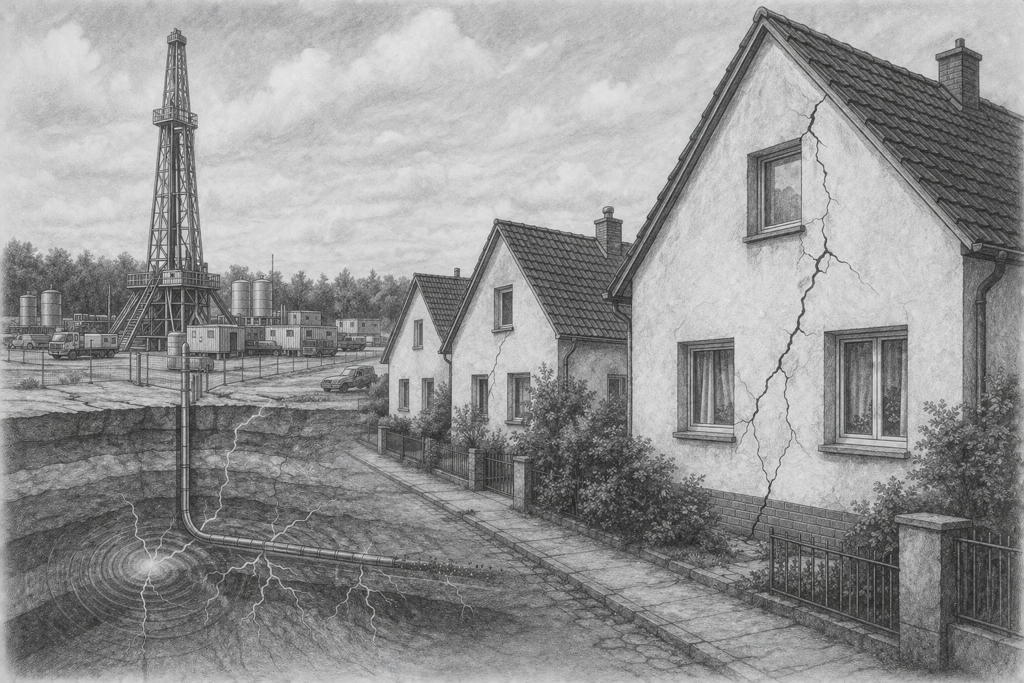
Another point that is repeatedly mentioned is the risk of induced earthquakes. As a rule, these are not strong quakes, but smaller tremors that are triggered by changes in the subsurface.
These can have various causes. Fracking itself causes cracks in the rock due to the pressure. In addition, the disposal of wastewater in deep layers of rock can lead to stress shifts.
In many cases, such tremors are barely noticeable. However, there are examples, particularly in Europe, where they have been clearly felt and have led to damage to buildings.
This issue is becoming increasingly important, especially in densely populated regions. Even if the risk is statistically low, perception changes as soon as the effects become visible in the immediate living environment.
The often underestimated dimension: how deep fracking actually goes
A key point that is often lost in the public debate is the actual spatial dimension of fracking. While many depictions give the impression that interventions are taking place relatively close to the surface, the reality is much deeper.
Unconventional reservoirs in Germany are generally located at depths of around 1,000 to 5,000 meters. Drinking water horizons, on the other hand, are usually located at a depth of a few hundred meters. In between, there are several geological layers that act as natural barriers. This separation is not a theoretical detail, but an essential part of the technical argumentation for the controllability of the risks.
This does not mean that risks are excluded. But it does put the idea of direct contact between fracking processes and near-surface water systems into perspective.
Cracking in the rock: smaller than often assumed
Another point concerns the spread of the cracks created during fracking. Public perception often conveys an image in which these cracks spread over large areas in an uncontrolled manner. In reality, these so-called fractures usually range in size from a few tens to a few hundred meters. They generally remain within the target rock layer and do not spread arbitrarily upwards. Modern methods also use precise measurement methods to monitor the extent of these cracks.
Here too, the risk is not zero, but it is much more limited than is often assumed. The decisive factor here is not so much the existence of cracks per se, but their controlled limitation.
Between simplified representation and geological reality
The challenge in presenting fracking is that you have to serve two levels at the same time: Comprehensibility and accuracy. Simplified graphics and sketches help to explain the principle, but can only depict the actual dimensions to a limited extent. This often results in a distorted picture - in both directions. While critics overestimate the proximity to sensitive areas, supporters sometimes underestimate the complexity of the underground.
A realistic assessment therefore does not lie in simplification, but in the combination of both: comprehensible presentation and geological classification. Only when both levels are brought together does a picture emerge that comes closer to the actual situation.
An illustrative comparison: Thinking underground in terms of scale
To better visualize the spatial dimensions, a simple mental image helps: Imagine that the entire underground from the earth's surface to the fracked deposit is reduced to a 15-storey high-rise building. You yourself are on the roof. The usable groundwater would be on the upper floors - i.e. comparatively close to the surface. The actual reservoir where fracking takes place, on the other hand, would be located deep down in the basement.
The connection there would be a borehole with a very small diameter, which is led through several layers and technically secured. This image clearly shows the distance between sensitive areas such as groundwater and the actual extraction. The comparison is no substitute for a detailed geological analysis, but it does help to get a feel for the proportions - and it is precisely this that often determines how risks are perceived.
The uncertainty factor
Perhaps the most important point in the criticism is not so much a concrete risk as a fundamental feeling: uncertainty. Fracking intervenes in geological systems that can only be fully understood to a limited extent. Models and simulations provide important indications, but they are no substitute for real experience over long periods of time.
This uncertainty is difficult to quantify - and therefore difficult to communicate. It can neither be clearly confirmed nor completely refuted. For many critics, however, it is a decisive argument.
Because it touches on a fundamental question: How do we deal with technologies whose long-term effects are not fully foreseeable?
Between justified criticism and blanket rejection
When the various arguments are brought together, a picture emerges that is neither simple nor unambiguous. Criticism of fracking is based not only on fears, but also on understandable considerations and, in some cases, on concrete experience. At the same time, it is not equally substantiated or uncontroversial in all respects.
This means that there are risks that must be taken seriously. But there is also a range in the assessment of these risks - depending on perspective, weighting and experience.
For an objective discussion, it is therefore crucial to neither exaggerate nor relativize the criticism. It forms an important part of the debate because it makes the limits of the technology visible. And it is precisely these limits that will play a central role in the following chapters - especially when it comes to comparing alternative ways of supplying energy.
Comparison of risks: local extraction and import model
| Model | Main loads | Political and social impact |
|---|---|---|
| Domestic gas extraction by fracking | Interventions in the subsurface, water consumption, possible methane leaks, acceptance problems on site, possible seismic effects. | Burdens are visible in our own country and can be directly felt politically. Instead, more control over funding, rules and monitoring. |
| Pipeline import | The consequences of production are mainly felt abroad, in addition to pipeline dependencies and geopolitical risks. | Domestically often less conflictual than its own promotion, but more vulnerable to foreign policy crises or tensions. |
| LNG import | Production abroad, additional energy use for liquefaction and transportation, emissions along the supply chain, terminal operations. | Burdens are largely outsourced, but are partially visible domestically due to terminals and infrastructure. Strategically more flexible, ecologically more complex in the overall chain. |
The often forgotten comparison: imported gas
When people talk about fracking in Germany, they usually look downwards - at what lies beneath the earth and the possible consequences of interfering with these structures. The question of what happens if this intervention is not carried out is asked much less frequently.
Because energy does not simply disappear if you do not generate it yourself. It is then extracted, processed and transported elsewhere. And it is precisely this process that often remains invisible because it takes place outside our own sphere of perception. It is technically complex - and by no means free of consequences.
LNG: The long journey of gas
A large proportion of the natural gas that reaches Europe today is transported in the form of LNG (liquefied natural gas). The route taken by this gas is complex and consists of several steps, each of which requires energy.
First, the gas is extracted in the country of production - often also by fracking, for example in the USA. It is then cooled down to around minus 162 degrees Celsius in special facilities until it becomes liquid. This step is necessary to greatly reduce the volume and make transportation economical.
After that, transportation takes place by ship. These so-called LNG tankers are technical masterpieces, but they themselves consume energy to maintain the low temperature throughout the journey.
At its destination, the gas is returned to its original state. It is heated in so-called regasification plants and then fed into the existing gas grid.
Each of these steps is technically manageable on its own. Taken together, however, they create a supply chain that is significantly more complex than the extraction and use of gas on site.
Energy consumption and losses along the chain
One point that is often underestimated in the public debate is the additional energy required for this process. The liquefaction of natural gas requires considerable amounts of energy. Small portions of the gas are also lost during transportation - for example through evaporation. Some of these losses are used to propel the ships, but they are still part of the overall balance.
Added to this is the energy required for regasification and feeding into the grid. All these steps mean that some of the energy originally generated is already consumed before the gas even reaches the end consumer.
This does not mean that LNG is fundamentally inefficient. But it does mean that the comparison with locally produced gas is not complete if this additional effort is disregarded.
Shifted environmental impacts
Another aspect concerns the question of where the environmental impacts arise. If Germany foregoes its own production and imports gas instead, the associated impacts do not disappear. They are merely shifted. Production then takes place in other countries, often under different regulatory conditions.
This applies in particular to regions where fracking is already being used on a large scale. The environmental impacts there - whether in terms of water, landscape or emissions - remain, even if they are not directly visible.
Added to this are the effects of transportation itself. Emissions from shipping, possible methane losses along the supply chain and the operation of terminals are part of a system that must be considered as a whole.
This perspective changes the question. It is no longer just about whether a certain technology is used on site, but about how different ways of supplying energy differ in the overall picture.
Infrastructure and its side effects
The infrastructure required to import gas also has its own impact. LNG terminals, storage facilities and transportation networks are not invisible facilities. They require space, encroach on existing structures and need to be operated and maintained.
Several LNG terminals have been built or planned in Germany in recent years. They are an expression of a strategic realignment of the energy supply - away from pipeline dependencies and towards global markets.
This development has advantages, such as greater flexibility in procurement. At the same time, it brings with it new challenges. After all, any additional infrastructure is also associated with effort, costs and potential risks.
The comparison that is rarely made
When all these aspects are taken together, a picture emerges that is often only incompletely presented in the public debate. The central question is not simply: fracking - yes or no? Rather:
Which form of energy supply has which consequences?
This involves a comparison between different systems:
- local promotion with its direct interventions
- import-based solutions with their relocated and extended processes
This comparison is complex because it encompasses different levels: technical, ecological, economic and geopolitical. It cannot be reduced to a simple denominator. But that is precisely why it is necessary.
A change of perspective
Perhaps the most important contribution of this chapter is a simple thought: energy always has a price - and this price is not just financial. It consists of interventions in nature and the landscape, of technical expenditure, of dependencies and of decisions on where to accept these consequences.
Those who reject fracking do not automatically opt for a risk-free alternative. And those who support it do not automatically decide against environmental pollution. In both cases, there are trade-offs to be made.
The difference lies in whether these considerations are made openly - or whether certain aspects are overlooked. And this is precisely where further consideration begins: with the question of what experiences other regions have had that have dealt with these challenges in different ways.
Comparison of supply routes for natural gas
| Supply route | Efficiency and costs | Special features and risks |
|---|---|---|
| Domestically produced fracked gas | Short transportation routes, therefore often more energy-efficient than LNG. High initial costs due to development, permits and technology. Profitability heavily dependent on production volume and regulation. | More supply at home, but direct environmental and acceptance problems on site. Politically sensitive, especially in densely populated regions. |
| Pipeline gas from abroad | Usually more efficient and cheaper than LNG, as long as existing pipelines can be used. Costs and prices depend heavily on supply contracts and the geopolitical situation. | Relatively low additional transport costs, but high political dependence on supplier countries and transit routes. |
| LNG by ship | Generally the most complex and energetically most expensive way, as liquefaction, transportation and regasification cause additional costs. Usually more expensive than pipeline gas, but can be procured more flexibly. | Higher system losses, additional infrastructure such as terminals required. In return, a broader supply base and fewer ties to individual pipeline partners. |
Europe as a real-life test: What we actually know
While fracking has been developed on a large scale in the USA over the years, the picture is different in Europe. Although the technology has been tested here, it has rarely been used on a scale comparable to the American development.
There are several reasons for this. Europe is more densely populated, politically more regulated and socially more sensitive to interventions in the environment and landscape. Decisions here are not made solely on the basis of economic considerations, but also always in the context of public acceptance.
This is precisely why it is worth taking a look at Europe. Because even if there is no nationwide application, there is experience - and it is more informative than you might think at first glance.
Great Britain: The cautious attempt
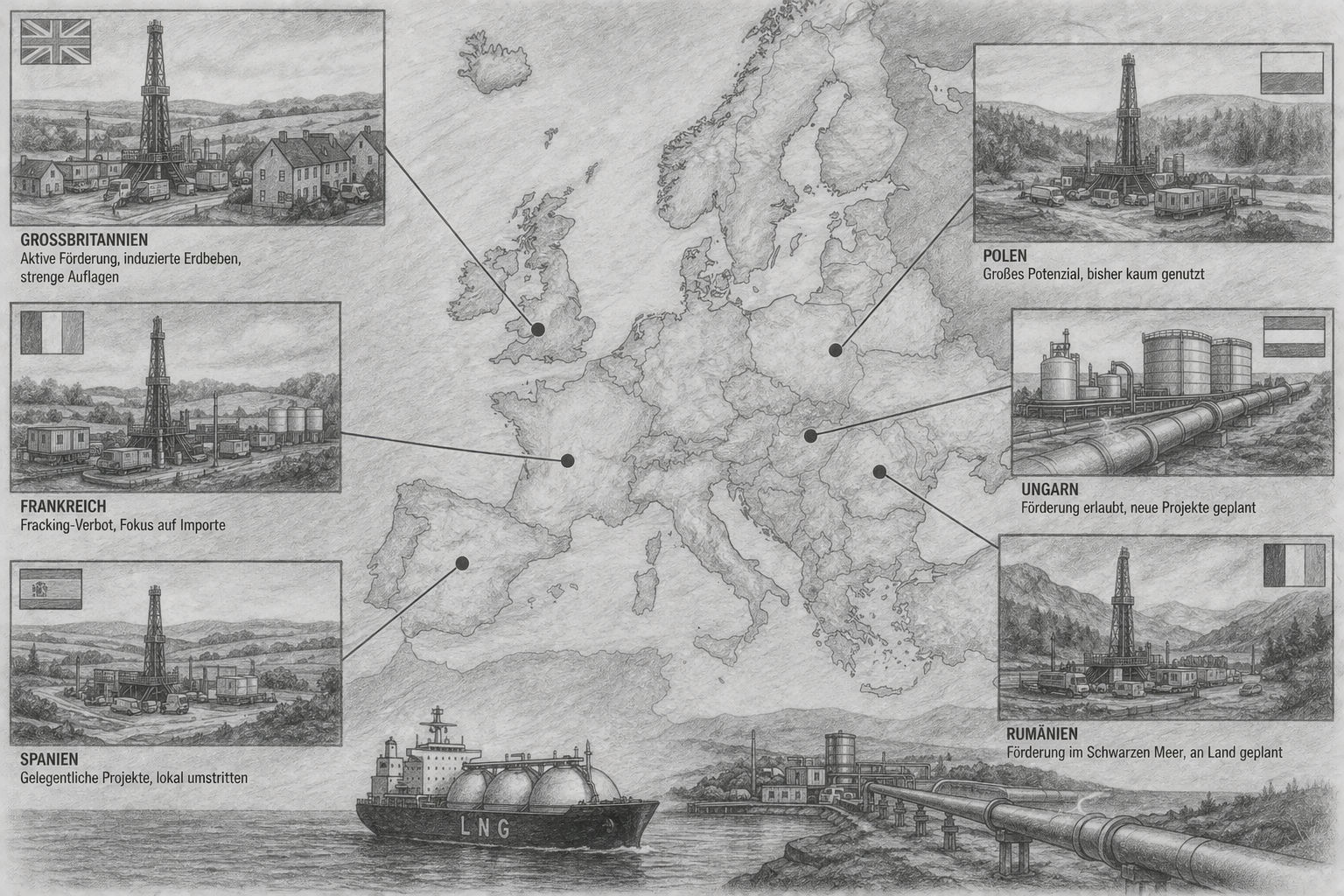
Probably the best-known example of fracking in Europe is the UK. Attempts were made there over several years to develop shale gas extraction. The conditions initially seemed favorable: political support, available resources and a fundamental interest in greater energy independence.
However, the practice turned out differently than planned. Even during early drilling, small earthquakes were felt by the local population. From a technical point of view, these tremors were not unusual. They were within a range that is considered manageable in many regions of the world.
Politically, however, they had a considerable impact. The British government responded with a moratorium and later with a de facto halt to activities. The reason given was not so much an acute risk situation as the difficulty of reliably predicting the risks and communicating them to society.
This example shows how closely technology and perception are linked. What is considered a moderate risk in geological terms can quickly become a political burden if it is felt in everyday life.
Netherlands: A different path, similar findings
A second, frequently cited example is gas extraction in the Netherlands, particularly in the Groningen area. Although this is not classic fracking, but conventional extraction, the findings are still relevant.
Natural gas was extracted there for decades, on a large scale and with considerable economic significance. But over time, seismic effects began to occur. Small earthquakes caused damage to buildings and triggered a broad social debate. The reaction was clear: production was gradually reduced and eventually largely discontinued.
What this example shows is not so much a specific weakness of fracking, but a fundamental pattern: interventions in the subsurface can have long-term consequences that are not always completely predictable. Such effects are particularly significant in densely populated regions - regardless of which technology is actually used.
Other European experiences
There have also been attempts to establish fracking in other European countries, such as Poland, France and Romania. The results are mixed.
Great hopes were initially raised in Poland, but economic and geological difficulties led to many projects being discontinued. France took a different approach and imposed a ban early on, which was strongly influenced by social resistance.
Romania also experienced protests against fracking projects, which ultimately led to international companies pulling out.
These examples show a common pattern: technical feasibility alone is not enough. The decisive factor is whether a project is economically viable and socially acceptable.
No disasters - but no breakthrough either
If one summarizes the European experience, a remarkable picture emerges. There is no evidence of widespread environmental disasters caused by fracking in Europe. The technology has not led to the dramatic scenarios that were sometimes feared in the public debate.
At the same time, however, it has not been possible to establish fracking as an integral part of the energy supply. Neither economically nor politically has the technology been able to establish itself in the long term.
The result is a kind of intermediate state: no clear refutation, but also no convincing proof of broad applicability.
Why Europe reacts differently
The differences between Europe and other regions cannot be explained by technology alone. They lie above all in the framework conditions. Europe is a continent with a high population density, complex political structures and a pronounced environmental awareness. Decisions here are not only made according to efficiency, but also according to their social sustainability.
This means that risks are assessed differently. Not necessarily more stringent in a technical sense, but more sensitive in terms of how they are perceived and their potential impact on daily life.
This perspective changes the scale. A technology that is considered acceptable in sparsely populated regions can meet with significantly greater reservations in Europe.
A realistic look at the European experience
So what can be deduced from the European „real-world test“? First of all, that fracking is not a fundamentally uncontrollable process. Experience shows that the technology works and can be used under controlled conditions.
At the same time, it is clear that their application in Europe is reaching its limits - not only technically, but above all politically and socially.
These boundaries are not static. They can change if framework conditions shift. But they cannot be ignored either.
For Germany, this means that looking to Europe does not provide a simple answer. Rather, it shows the range of possible developments - from cautious attempts to economic retreats to political stops. And it is precisely this range that makes the current debate so challenging.
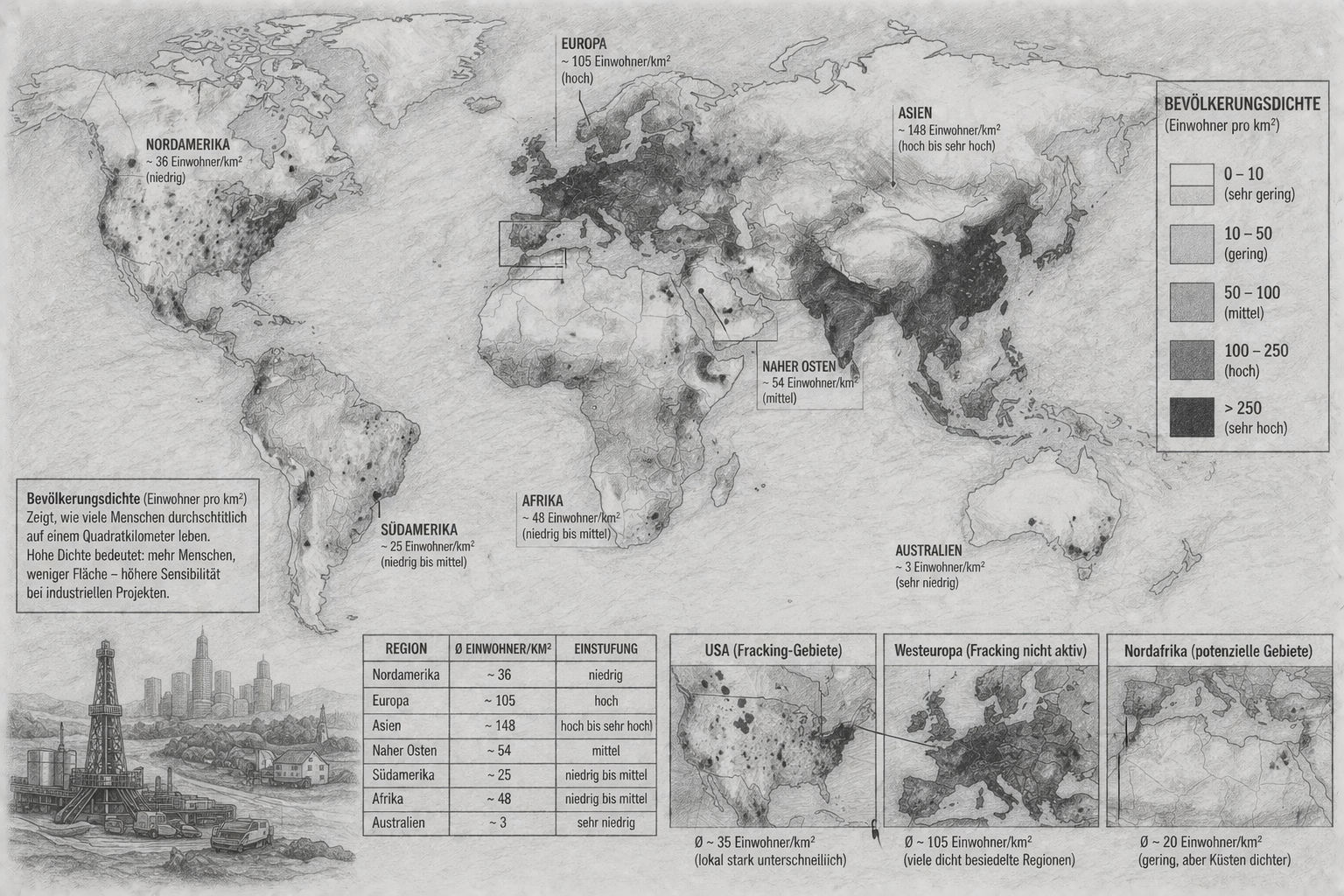
Population density and acceptance - a country in a confined space
Germany is not a large, sparsely populated country with vast, untouched areas. It is a densely structured country in which cities, villages, industry and agriculture are closely interwoven. This spatial proximity not only shapes daily life, but also the way in which technical interventions are perceived.
What might be considered a distant industrial project in other regions of the world quickly becomes part of people's direct experience here. A drilling rig is then not just a dot on the map, but part of one's own environment. Noises, traffic, visible changes - all of this is perceived more directly.
This proximity changes the perspective. Risks are not assessed in the abstract, but experienced or at least imagined in concrete terms.
Technology meets reality
Many things can be put into perspective from a technical perspective. Probabilities can be calculated, safety measures described and processes optimized. But this is not the only level at which decisions are made. Because technology always comes up against the reality of life.
For example, a small, statistically rare earthquake may not be a problem from a geological point of view. But when it is felt in a residential area, perception changes immediately. An abstract quantity becomes a personal experience.
The situation is similar with other aspects. The idea that interventions are taking place at a depth of several thousand meters can be rationally classified. At the same time, there remains a feeling of uncertainty that cannot be resolved by figures alone. This discrepancy between technical assessment and personal perception is not a contradiction, but part of reality. And it plays a central role in the question of whether a technology is accepted or not.
Acceptance is not a secondary factor
In many debates, acceptance is seen as something that can be achieved retrospectively - through information, communication or compensatory measures. However, when it comes to sensitive issues in particular, it is clear that acceptance is not an afterthought, but a prerequisite.
When people feel that decisions are being made over their living space, resistance arises. This resistance is not necessarily irrational. It is often based on a need for control and security in one's own environment.
In Germany, this pattern has become apparent in many areas - from infrastructure projects to energy plants. Fracking fits into this picture. The technology may have evolved, but the fundamental question remains: Is it perceived as reasonable?
The difference to the American experience
A comparison with the USA makes this point particularly clear. There, fracking projects have often been implemented in regions where larger areas are available and the population density is significantly lower. This does not mean that there are no conflicts there. But the spatial conditions are different. Interventions are spread over larger areas and their direct effects affect fewer people at the same time.
In Germany, on the other hand, everything is concentrated in a small space. A project that is technically manageable can have a major social impact because it affects or at least could potentially affect many people.
These differences cannot be compensated for by technical improvements. They are part of the structural starting position.
Perception, trust and experience
Another factor is trust in institutions and processes. How are decisions made? Who monitors compliance with rules? And how transparent are these processes?
This trust is particularly important in a densely populated country. After all, the closer a potential intervention comes to one's own living space, the more people question whether the existing systems offer sufficient protection.
Experience from other areas plays a role here. If people have the impression that risks have been underestimated or insufficiently communicated in the past, this has an impact on the assessment of new technologies. Fracking is then not viewed in isolation, but in the context of general experiences with industry, the environment and politics.
The limit of what is technically feasible
All these aspects lead to an insight that is crucial for the further discussion:
Not everything that is technically possible is automatically socially viable. This applies in particular to technologies that intervene underground and whose effects are not immediately visible or fully explainable. It is not enough to point to safety standards and technical progress. Rather, the crucial question is:
Is society prepared to accept the associated risks?
This question cannot be answered by experts alone. It arises from the interplay of knowledge, experience and personal involvement.
A factor that is often underestimated
Population density is therefore more than just a statistical parameter. It is a decisive framework factor for the evaluation of technologies. It influences how risks are perceived, how significant interventions are and how great the need for social discussion is. In a country like Germany, it can determine whether a technology is politically feasible - regardless of how it is technically assessed.
For the fracking debate, this means that even if many of the original concerns can be relativized, this factor remains. It cannot be solved through innovation, but is part of the initial situation. And this is precisely why it will play a central role in the further deliberations - especially when it comes to weighing up different interests against each other.

USA Fracking: curse or blessing? | World mirror
Why reports from the USA often seem more dramatic
When you see reports from the USA in which residents complain about health problems, it seems clear at first glance: fracking appears to have direct negative consequences. However, if you take a closer look, a more nuanced picture emerges.
In many US regions, production is organized much more intensively than what one would realistically imagine in Germany. It's not just about individual wells, but often about entire fields with numerous installations, tanks, compressors and a considerable amount of traffic. The impact is often not deep in the rock, but on the surface:
- Truck traffic around the clock
- Emissions from combustion (e.g. flaring)
- Noise and light
- Handling waste water and chemicals
Residents' complaints therefore often relate to this overall situation - and less to the actual fracking process underground.
What would be structurally different in Germany
Germany differs from the USA in several key respects. The most important is not the technology, but the framework in which it would be used.
On the one hand, much stricter environmental and approval regulations apply here. Water law, emissions protection and waste management are closely regulated, and many of the processes practiced in the USA would not even be permitted in this form. Secondly, the population density is significantly higher, which severely restricts large-scale industrial use.
If fracking were to play a role at all in Germany, it would therefore be with a high degree of probability:
- significantly more regulated
- spatially limited
- Intensive political and social support
This does not mean that there are no risks - but the framework conditions would be different.
The decisive difference lies on the surface
One point is particularly important when evaluating the US experience: most problems do not arise deep in the rock, but on the surface. This applies above all:
- Emissions from plants and vehicles
- Storage and transportation of liquids
- Distances to residential areas
- Density of drilling sites
This is precisely where the structural difference lies. While a high industrial density is emerging in the USA in some cases, in Germany - for legal and social reasons alone - the focus would tend to be on the extent to which such effects can be limited.
For you as a reader, this means that the reports from the USA are to be taken seriously, but above all they describe a certain form of implementation. The real question is therefore not whether fracking has caused problems somewhere, but under what conditions it takes place - and what these conditions would look like in Germany.
Differences between fracking in the USA and Germany
| Aspect | USA | Germany |
|---|---|---|
| Funding intensity | Partly large-scale, highly industrialized extraction with many drilling sites and surface facilities. | Due to the legal situation, acceptance and density of settlement, this is only conceivable on a selective basis, not on a US scale. |
| Proximity to residential areas | In several extraction regions, drilling and production facilities are located comparatively close to residential areas. | Politically and legally much more sensitive; proximity to residential areas would probably be one of the biggest points of conflict. |
| Main causes of health complaints | Frequent surface pollution: Air pollutants, noise, traffic, light, flaring, flowback handling. | Would depend heavily on how strictly emissions, transportation, waste water and site density are limited. |
| Regulation | Varies greatly from state to state; in some parts much more business-friendly and less uniform. | Strict water and environmental legislation; commercial unconventional fracking currently practically prohibited. |
| Political perception | Treated more as an industrial and economic issue. | More strongly discussed as an environmental, acceptance and precautionary issue. |
| Transferability of experience | US cases show real risks, but often under conditions of very high operating density. | Only transferable to a limited extent; German requirements, site selection and surface management would be decisive. |
Security of supply vs. the environment: the real trade-off
If we summarize the previous chapters, it becomes clear that the fracking debate essentially boils down to a fundamental conflict of objectives. On the one hand, there is the desire for security of supply - for stable prices, reliable supply chains and as little dependence as possible on external players. On the other hand, there is environmental and climate protection, combined with the question of which interventions should be permitted in one's own country.
Both objectives are understandable in themselves. Both are politically desirable. And both cannot easily be maximized at the same time. This is precisely where the difficulty lies.
Dependence as a strategic risk
The past few years have shown that energy is not only an economic factor, but also a geopolitical one. Supply chains can be disrupted, prices can fluctuate wildly and political tensions can have a direct impact on supply.
In this context, the question of in-house production becomes increasingly important. Own resources do not mean complete independence, but they can expand the scope for action. They make it possible to react more flexibly to changes and to keep at least part of the supply within one's own sphere of influence.
This also applies to natural gas. Even if Germany could not cover its entire demand with its own production, an additional share from domestic sources would reduce dependence on imports. However, this consideration is only one side of the coin.
Environmental and climate targets as a guard rail
At the same time, Germany has set itself ambitious environmental and climate protection targets. The decision to phase out fossil fuels has been made politically, even if it will take time to implement.
In this context, fracking appears to many to be a step in the wrong direction. The extraction of natural gas - regardless of the method - is at odds with long-term decarbonization goals. Added to this are the local environmental aspects already described, which are particularly serious in densely populated regions.
The criticism is therefore not only directed against the technology itself, but also against the signal that would be associated with its use. The question is whether investments in fossil infrastructure are compatible with the desired restructuring of the energy system. This perspective is also understandable.
Reality check on the accusation of „clinging to fossils“
A frequently voiced objection is that fracking means holding on to fossil fuels and thus delaying the transition to renewable energies. This objection has a clear logic - but often falls short in practical terms.
The reality is that natural gas continues to play a role in the energy system. It is used for heating, industry and power generation, and this demand cannot be completely replaced in the short term.
The real question is therefore not whether gas should be used, but under what conditions. If it is imported, the associated effects are shifted abroad. If it is produced domestically, they occur locally. In both cases, natural gas remains part of the system.
This does not mean that long-term climate targets are irrelevant. However, it does mean that the transition to these goals will not take place in a single step, but via interim solutions. Fracking would be such an interim solution - if at all - and not a permanent strategy.
Costs, prices and economic stability
Another aspect that plays a role in the consideration is the economic impact. Energy prices not only affect private households, but also the competitiveness of companies.
High and volatile prices can slow down investments, increase production costs and make long-term planning more difficult. In this context, it is argued that partial self-sufficiency could have a stabilizing effect.
However, caution is also required here. The actual costs of domestic production depend on many factors - geological conditions, regulatory requirements and technical complexity. It cannot be taken for granted that locally produced gas would automatically be cheaper. The economic assessment is therefore just as complex as the ecological one.
Weighing up as a political task
In the end, all this leads to a realization that cannot be simplified any further: The decision on fracking is not a purely technical or scientific question. It is a political consideration.
It's not about finding a perfect solution - because there is no such thing in this case. It's about setting priorities and consciously accepting the consequences.
- How much dependency is acceptable?
- How much intervention in the environment is justifiable?
- What role does time play - especially with regard to the restructuring of the energy system?
These questions cannot be answered objectively. They reflect values, interests and assessments.
A debate without simple answers
Perhaps this is precisely the reason why the fracking debate was avoided for so long. As long as the energy supply was considered secure, it was easier not to deal with this trade-off.
This is more difficult today. The framework conditions have changed, and with them the need to re-evaluate decisions. This does not mean that previous positions automatically become obsolete. But it does mean that they have to be considered in the light of new developments.
The real challenge is to conduct this reassessment objectively - without rash simplifications and without claiming to resolve all contradictions. Because that is precisely the reality of this issue:
There is no solution without costs. And there is no decision without consequences.
Fracking in Germany: a comparison of key arguments
| Topic | Critics' argument | Proponents' argument |
|---|---|---|
| Environment and water | Risks to groundwater, chemicals, wastewater and long-term consequences underground cannot be adequately calculated. | Technology, monitoring and water treatment have improved; risks are now easier to control than they were ten or fifteen years ago. |
| Climate | Fracking would prolong the fossil fuel era and could worsen the climate balance due to methane leaks. | As long as gas is needed anyway, domestic production could be climatically more favorable than energy-intensive LNG imports with long transport routes. |
| Security of supply | Germany should focus on renewable energies, energy saving and other future technologies instead of new fossil fuel projects. | Own production could reduce dependence on imports, cushion price pressure and increase the strategic ability to act in times of crisis. |
| Social acceptance | In a densely populated country, even minor risks and interventions are politically and socially difficult to accept. | Precisely because of the high level of dependency and vulnerability, Germany must at least examine whether modern processes are justifiable under strict conditions. |
Outlook: A debate that will return
Looking back over the past few years, the fracking decision of 2017 almost seems like a conclusion. An issue that had been the subject of intense debate found a political answer - and then largely disappeared from the public eye.
However, as it turned out, it was not a final conclusion, but rather an interim decision under certain conditions. These conditions have changed in the meantime. Energy has become scarcer and more expensive, geopolitical tensions have become more prominent and the issue of security of supply has taken on a new urgency. At the same time, the environmental and climate targets remain - they have not disappeared, but are still on the agenda.
This means that two developments are coming together today that cannot be easily resolved.
Why the issue will not disappear
Fracking is not an issue that can be permanently „closed“. It is too closely linked to fundamental questions of energy supply. As long as natural gas remains part of the energy system - and this will be the case for the foreseeable future - the question of its origin will inevitably arise. And thus also the question of whether part of this supply could or should take place in our own country.
There is also another factor: uncertainty. As long as global supply chains remain stable, many things can be organized. But as soon as this stability begins to falter, alternatives gain in importance - even those that were previously considered politically inappropriate.
In this sense, fracking is less an isolated technology debate than a symptom of larger developments. It resurfaces whenever the framework conditions shift.
Possible scenarios for Germany - What could happen next?
One conceivable scenario is that Germany sticks to its current course. The use of unconventional deposits is ruled out and the focus remains on the expansion of renewable energies and import solutions.
Another scenario would be a cautious opening - for example in the form of new studies, pilot projects or a reassessment of the legal regulations. Not as a complete turnaround, but as an adaptation to changed framework conditions.
There are a multitude of nuances in between. The reality will probably not be a clear cut, but rather a gradual balancing act. The decisive factor will be how three factors develop: Energy prices, geopolitical stability and technological progress. They form the framework within which political decisions are made.
The role of public debate
One point that should not be underestimated in this context is the quality of the public debate. Fracking is a topic that polarizes quickly. It invites people to adopt clear positions - for or against. However, as the previous chapters have shown, simple answers do not do justice to the topic.
An objective debate does not mean that you have to abandon one position. Rather, it means taking the arguments of both sides seriously and understanding their respective consequences. Particularly in an area that is characterized by so much uncertainty, it is important to distinguish between verifiable facts, plausible assumptions and open questions. This is challenging - but necessary.
A look ahead
Perhaps the most important insight of this article lies not in a specific recommendation, but in an attitude. Fracking is neither the simple solution to all energy problems nor an issue that can be permanently ignored. It is an example of how complex modern infrastructure decisions have become.
Technology has developed further. The risks are better understood, but have not disappeared. The alternatives are available, but also present challenges. The debate will continue to move in this area of tension.
In the end, there is one conclusion that runs through the entire article: There is no decision without consequences. Anyone who rejects fracking is not opting for a risk-free world, but for other forms of energy production with their own consequences. Those who consider it must be prepared to take responsibility for the associated interventions in their own country.
The real question is therefore not which option is free of problems - but which problems we are prepared to bear. As long as the energy supply appears stable and predictable, this question is easy to ignore. However, in times of uncertain supply chains, fluctuating prices and geopolitical tensions, it inevitably comes back into focus.
It is therefore likely that fracking in Germany cannot be regarded as a closed chapter. Rather, it will come up again - in whatever form. And perhaps that is the right thing to do. Not because it provides a simple answer, but because it forces us to ask the fundamental questions of energy supply openly.
Questions that cannot be definitively resolved - but which must be answered again and again.
Understanding fracking means understanding energy policy
 At first glance, this article presents a technical question: to promote or import, risk or benefit. But on closer inspection, it becomes clear that there is much more at stake. It is about the question of where Europe gets its energy from - and who decides. This is precisely where the article ends Energy, power and dependency: Europe's path from world export champion to consumer on. It describes how Europe has developed in recent decades from a stable, predictable energy supply to a system that is increasingly dependent on external factors. Today, energy is no longer background noise, but a strategic lever that influences prices, industry and political scope for action.
So if you want to understand why fracking is being discussed again at all, there is no getting around this major development.
Gas storage facilities show the symptom - fracking poses the real question
 The article Declining gas storage in Germany makes it clear how strongly the debate is currently focused on storage levels, technical limits and political intervention. Falling storage levels - at times to historically low levels of around 20 % or below - show one thing above all: the system is working under increasing pressure. But this is precisely where the fracking article comes in and shifts the perspective. After all, gas storage facilities are ultimately just a buffer - they balance out fluctuations, but do not solve the fundamental question of origin. The fracking article addresses precisely this point: When storage facilities become empty or difficult to fill, the question of in-house extraction inevitably comes back into focus. The two articles therefore directly complement each other: one shows the limits of the existing system, while the other poses the uncomfortable question of what alternatives are still on the table.
Further sources and studies on fracking and gas supply
- BGR: Shale oil and shale gas potential in Germany (2016)Comprehensive geological study on the available shale gas resources in Germany. The Federal Institute for Geosciences and Natural Resources analyzes in detail what quantities are theoretically available and under what technical conditions they could be tapped. One of the most important basic sources for the entire debate. :contentReference[oaicite:0]{index=0}
- Federal Environment Agency: Fracking for shale gas extraction in Germany (2022)Current assessment by the Federal Environment Agency on the role of fracking in the energy supply. Addresses environmental and climate risks as well as the question of whether fracking can contribute to security of supply. Particularly relevant for the political classification after 2022. :contentReference[oaicite:1]{index=1}
- BGR: Literature study on methane emissions (2020)Scientific analysis of the climate footprint of natural gas, particularly with regard to methane leakage along the production chain. Shows how strongly the climate impact of gas depends on technical details and losses. :contentReference[oaicite:2]{index=2}
- Emission scenarios of a potential shale gas industry in Germany and the UKScientific study on possible emissions from a European fracking industry. Analyzes different scenarios and shows that methane losses and emissions depend strongly on technology and regulation. :contentReference[oaicite:3]{index=3}
- ESYS (Leopoldina/acatech): Fracking - an option for Germany?Interdisciplinary analysis by leading German science academies. Deals with security of supply, environmental aspects and energy policy and provides a balanced assessment of the opportunities and risks. Particularly valuable for an objective overall view. :contentReference[oaicite:4]{index=4}
- German Advisory Council on the Environment: Fracking statementEarlier but fundamental assessment of the technology in the context of the energy transition. Discusses in particular the role of natural gas as a transition technology and the potential impact on prices and energy systems. :contentReference[oaicite:5]{index=5}
- IASS Potsdam: Fact sheet on shale gas and frackingCompact, easy-to-understand introduction to the technology, opportunities and risks of fracking. Particularly suitable for readers looking for a quick overview without delving into technical details. :contentReference[oaicite:6]{index=6}
- ifo Institute: Fracking in Germany and Europe - hype or opportunity?: Economic perspective on the fracking debate. Discusses in particular price effects, market mechanisms and the differences between Europe and the USA. :contentReference[oaicite:7]{index=7}
- BUND: Shale gas resource scamCritical perspective on fracking from the point of view of an environmental organization. Questions the economic viability, environmental impact and transferability of the US model to Europe. Important for the presentation of the opposing position. :contentReference[oaicite:8]{index=8}
- Exploring seismic hazard in the Groningen gas fieldScientific analysis of the earthquake problem in the Dutch Groningen gas field. Shows how gas extraction can lead to long-term seismic effects and why these are difficult to predict.
- On the origin of induced earthquakes in GroningenStudy on the development of earthquakes caused by gas production. Provides a physical explanation for the increasing seismic activity and its connection with pressure changes in the subsurface.
- SciGRID_gas - European gas transport networkData-based analysis of the European gas network. Shows the complexity of the infrastructure and makes it clear how strongly Europe is already networked and dependent on import structures.
- IEA: Golden Rules for a Golden Age of GasInternational Energy Agency on best practices for fracking. Defines standards for safe extraction and shows the conditions under which risks can be reduced.
- IEA: The Role of Gas in Energy TransitionsAnalysis of the role of natural gas as a transition energy in the global energy system. Discusses the balance between climate targets and security of supply.
- US Energy Information Administration: Gas transportation and LNGClear explanation of the transportation routes of natural gas, including pipelines and LNG. Helpful for understanding the technical differences and energy costs.



Frequently asked questions
- What exactly is fracking - and why is it so hotly debated?
Fracking is a technical process in which liquid is injected under high pressure into deep layers of rock to create small cracks and release trapped gas. It is controversial because, although it works technically and is used worldwide, it also involves interventions in the subsurface whose effects - particularly on water, climate and rock stability - cannot be fully predicted. It is therefore less a purely technical issue than a question of social consideration. - Is fracking really completely banned in Germany?
No, not completely. Since 2017, commercial fracking in unconventional reservoirs such as shale has been banned. Conventional fracking is still used in certain cases. In addition, scientific test projects would theoretically be possible, but have not yet been implemented. In the public perception, this has nevertheless created the impression of a complete ban. - How much gas is actually under Germany?
There are certainly relevant deposits, particularly in northern Germany. Estimates assume large quantities of technically exploitable shale gas. However, this does not mean that these quantities can be extracted in an economically viable or politically desirable way. There is a considerable difference between geological existence and actual use. - Has fracking technology improved in recent years?
Yes, clearly. Modern processes work more precisely, use fewer wells per production volume and have better monitoring systems. There has also been progress in the handling of water and chemicals. Nevertheless, the fundamental interventions in the subsurface have remained and many risks have been reduced, but not completely eliminated. - How dangerous is fracking for groundwater?
The risk is considered technically manageable, but cannot be completely ruled out. Modern wells are secured several times over and fracking usually takes place far below drinking water layers. However, critics point out that even minor leaks or long-term changes underground can be problematic. Uncertainty about long-term consequences plays a major role here. - Can fracking trigger earthquakes?
Yes, but mostly in the form of small, often barely noticeable tremors. These are caused by changes in the stress structure of the rock. In some cases, such as in the UK or the Netherlands (with conventional extraction), these effects have been more noticeable. In densely populated regions, even small quakes can become politically and socially relevant. - Is fracking bad for the climate?
This depends heavily on the implementation. Natural gas itself produces less CO₂ than coal, but methane leaks can significantly worsen the carbon footprint. Methane is a very powerful greenhouse gas. It is therefore crucial how well emissions are controlled along the entire extraction and transportation chain. - Why is fracking used on a large scale in the USA but not in Europe?
The differences lie primarily in population density, political structures and social acceptance. In the USA, there are larger areas and often less direct involvement. In Europe, on the other hand, technical projects meet with resistance more quickly because they take place closer to people's living environment. - Is imported gas really more environmentally friendly than domestic fracking?
Not necessarily. Imported gas is often also extracted - sometimes by fracking - and must also be transported. LNG also involves energy-intensive processes such as liquefaction and transportation. This results in additional emissions. The difference often lies more in where the environmental impact takes place, not whether it exists. - What exactly is LNG and why is it so expensive?
LNG stands for liquefied natural gas. It is cooled down considerably so that it can be transported by ship. This process requires a lot of energy. At its destination, the gas is reheated and fed into the grid. This creates a complex and energy-intensive supply chain that goes beyond mere extraction. - Would fracking make Germany independent of gas imports?
No, this would not make Germany completely independent. Even with the optimistic use of domestic resources, fracking would only be an additional building block. It could reduce dependency, but not replace it. Germany would still be dependent on imports. - Would gas from fracking be cheaper than imported gas?
This cannot be said across the board. Local extraction saves transportation costs, but requires high investments and is subject to strict regulations. Profitability depends heavily on market prices, production volumes and political framework conditions. In some scenarios it could be cheaper, in others not. - Why was fracking banned in the first place?
The decision was primarily based on precautionary principles. Environmental concerns, particularly with regard to water and long-term consequences, were paramount. At the same time, the energy supply was stable at the time, so there was no acute pressure to develop new extraction methods. - Was there really influence from abroad on the fracking debate?
There were corresponding assumptions, for example in connection with Russian interests, but no clear evidence of concrete influence on political decisions in Germany. The thesis is plausible, but not certain. - Why is the issue being raised again now?
The framework conditions have changed. Energy has become more expensive, supply chains are more uncertain and geopolitical tensions are playing a greater role. As a result, the question of in-house energy production is once again coming more into focus. - Is fracking just a temporary solution or a long-term strategy?
If anything, it would be a temporary solution. In the long term, energy policy is aimed at expanding renewable energies. At best, fracking could serve to bridge a phase in which alternative systems are not yet fully developed. - What role does population density play in the assessment of fracking?
A very big one. In densely populated countries such as Germany, interventions are more noticeable and affect more people. This increases sensitivity to risks, even if they are technically classified as low. - Are there any positive experiences with fracking in Europe?
There are no widespread disasters, but there is also no sustainable breakthrough. Projects have often been stopped or not pursued, mostly for political or social reasons. The experiences are mixed and do not allow any simple conclusions to be drawn. - What is ultimately the key question in the fracking debate?
The key question is not whether fracking is perfect or completely unacceptable, but what consequences we are prepared to accept. It is a question of weighing up security of supply, the environment, costs and social acceptance - and this weighing up has to be carried out again and again under changing conditions.





KI, I can hear the traps ...
Even if much is presented in a pleasantly balanced and sober manner, the article fails to recognize the bias in many of the references, which were created under bias and were unaware of new findings or because deeper specialist knowledge was lacking. It is clear that AI delivers such results on this basis. The sketches do the rest. It is a pity that no attempt was even made to depict the underground conditions in a realistic spatial dimension. That would have put some things into perspective.
Thank you for your comment - it is a valid and important point. My article does not claim to provide a detailed geological analysis, but is intended to give an understandable overview of a complex topic. One of the biggest challenges with fracking in particular is that many underground effects are difficult to visualize spatially.
But you are right: the actual dimensions - in particular the depth of the deposits, distance to groundwater and the extent of the cracks - play a decisive role in assessing the risks. This can only be depicted to a limited extent in a simplified presentation. I have taken up this point and added a more precise classification of the geological dimensions to the article under „Risks“. This is precisely where it is often decided whether an assessment is more emotional or technical.
Thank you for your reply, Mr. Schall.
If I may, I would like to make two suggestions regarding the spatial dimension and actual quantities:
(1) Let's assume that the subsurface from the earth's surface to the fracked deposit could be represented in a 15-storey high-rise building (approx. 50 m high). We are sitting on the roof, the reservoir is in the basement. The usable groundwater is in the attic. The borehole that reaches into the basement would have the diameter of a straw. Frac fluid is fed down through this tube, which is reinforced several times in the groundwater zone and monitored 24/7 for possible leaks, and then retrieved and shale gas is extracted. That's it.
(2) Let us now assume that the entire subsoil is mapped in a two-storey detached house, the ground surface on the roof, the borehole, thin and firm like the cannula for a blood sample, ends in the cellar. The amount (volume) of chemical additives poured into the subsoil on the cellar floor would fit into a shot glass. It can be assumed that every household contains large quantities of water-polluting substances.
Thank you for the illustrative examples - it is precisely this type of classification that helps enormously to better understand the often difficult to grasp dimensions. The comparison with the high-rise building in particular makes it clear how far removed the relevant underground processes actually are from areas close to the surface. This at least puts into perspective some of the fears that often play a major role in the public debate.
I have added another paragraph to the article accordingly and, under the Weltspiegel video, have highlighted the differences between conditions in the USA and Germany in more detail. This also seems to me to be a central point: that experiences from the USA are not easily transferable.
Such tips definitely help to further sharpen the picture - thank you very much for that.
Perhaps, because the topic is really boiling up again, I may also refer to a recent substack article posted by A. Bojanowski and a recent LinkedIn post?
https://axelbojanowski.substack.com/p/fracking-in-deutschland-kritik-an-verbot-grosse-ressourcen-erdgas
https://www.linkedin.com/feed/update/urn:li:activity:7440858924641263616/?originTrackingId=n20Yqd90xPEJLlVLI3SSFg%3D%3D