
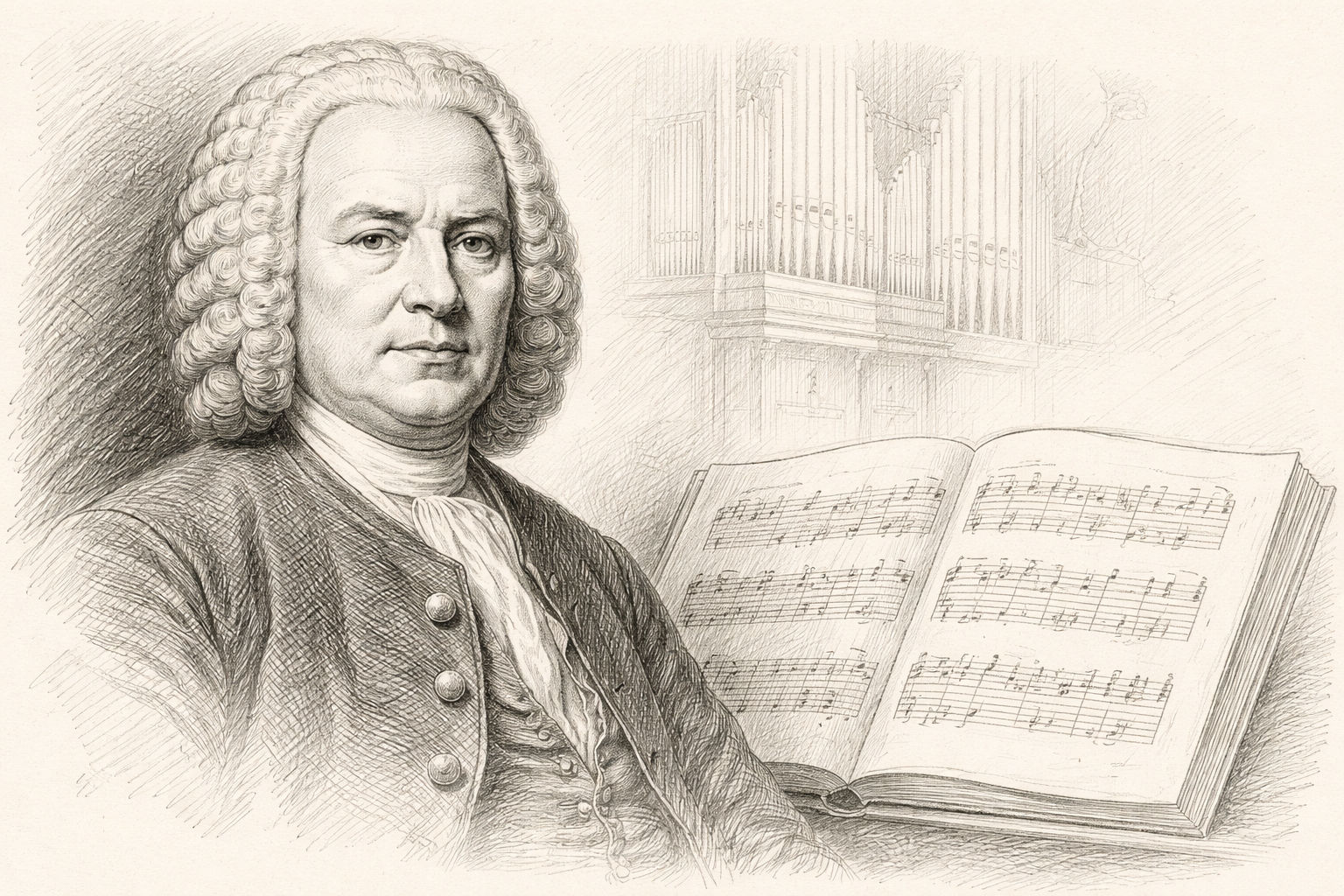
As a child and teenager, I grew up in a family of musicians. Both my parents are music teachers. My mother plays the flute, my father the piano. Music was not a decorative background in our home, but a natural part of everyday life. We practiced, taught, discussed, sometimes even wrestled. Sheet music was laid out on the piano, not in the cupboard.
I played the piano myself, and later also the saxophone. And like so many people who go through classical training, I ended up with Johann Sebastian Bach at some point - more specifically, the first prelude from the „Well-Tempered Clavier“. I can still play it. Perhaps no longer flawlessly, I would have to practise again. But the structure of this piece is still with me today. This calm sequence of broken chords, the clear harmony, the self-evident order - even as a pupil, you can sense that something important is happening here. This portrait is dedicated to my mother on her 70th birthday, who made it possible for me to take piano lessons at that time.
Latest news about Johann Sebastian Bach
21.05.2026A new MDR documentary about Johann Sebastian Bach traces the life of the world-famous composer not only as a musical success story, but also shows the man behind the historical icon. The documentary accompanies Bach from Eisenach via Arnstadt, Mühlhausen, Weimar and Köthen to Leipzig and sheds light on his path as an organist, family man, cantor of St. Thomas' Church and uncompromising artist.
Johann Sebastian Bach: genius, faith and headwinds | MDR DOK
What is particularly interesting is how clearly the documentary also highlights the difficult aspects of his life: personal losses, conflicts with authorities, financial bottlenecks and the constant struggle for artistic freedom within rigid social structures. However, it was precisely this area of tension that gave rise to the music that is still considered timeless today. Works such as the Brandenburg Concertos, the St. Matthew Passion, the Christmas Oratorio and the Goldberg Variations continue to shape classical music worldwide. The documentary not only provides an overview of Bach's work, but also an impressive picture of his character, his faith and his extraordinary artistic aspirations.
More than „classical music“
Many people initially associate Bach with an image from another world: wig, candlelight, church. They associate him with so-called classical music and thus mentally push him into the past.
But the closer you listen, the clearer it becomes: Bach is not a museum piece. He is a foundation. Much of Western music - from Romanticism to film music, from jazz to pop music - is based on a harmonic system that found its clear form in the Baroque era. Bach did not invent this system, but he permeated it with a consistency that made it stable. The relationships between tonic, dominant and subdominant, the play with tension and resolution - all of this is so familiar to us today that we are barely aware of it. And yet we listen with an ear that has been shaped by this tradition.
Order that carries
Anyone who plays or listens to the first prelude in C major quickly realizes that nothing here is random. The harmonies follow each other in a calm logic. Every chord leads to the next, every turn of phrase has its purpose. The piece seems simple - and that is precisely why it is so convincing.
This experience is typical of Bach. His music is structured, but not rigid. It is well thought out, but not dry. It lives from an inner order that is not constricting, but supporting.
Perhaps this is precisely where his modernity lies. In an age in which many things are created quickly and disappear just as quickly, Bach seems like an alternative. His works do not unfold quickly. They demand attention - and reward it with depth.
A silent benchmark
Bach was not a composer who staged himself. He was an organist, cantor, teacher and family man. He worked within the framework of clear obligations and wrote new music week after week. No headlines, no big stage in the modern sense. And yet he created something that has endured for centuries.
Perhaps the secret lies not in spectacular gestures, but in consistency. In the willingness to thoroughly master one's own craft. In the decision to put quality above convenience.
When I think back today to the first prelude I played as a pupil, I see it as more than just a finger exercise. I see an example of how structure enables freedom. That discipline is not a cage, but a framework. That depth does not begin loudly, but often very quietly.
Why this portrait makes sense today
This portrait is therefore not just a list of his life and works. It wants to show why Johann Sebastian Bach still has something to do with us today. Why his music does not remain in the past, but continues to have an impact in our present.
Those who engage with him do not encounter a distant monument, but a person with temperament, humor, conflicts and a remarkably clear attitude. And perhaps you will realize that greatness lies not in spectacle, but in moderation.
Bach built - note by note, work by work. And because he built thoroughly, this building still stands. With this in mind, we now begin our journey through his life - from his family of musicians in Eisenach to the musical foundation that still supports our world today.
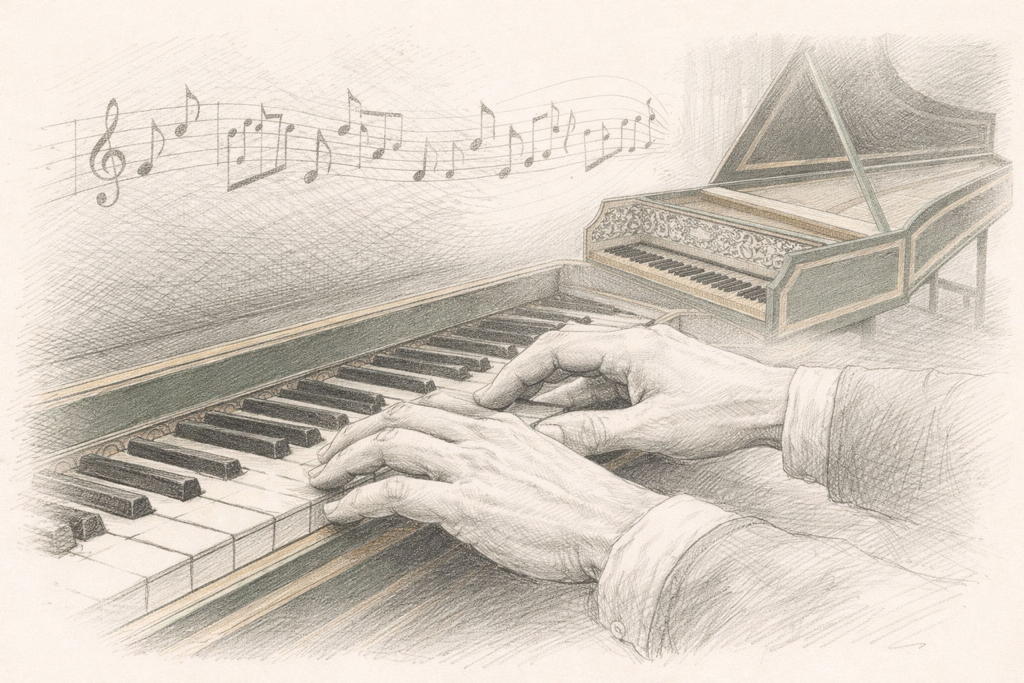
A family full of music - origins and early influences
If you want to understand why Johann Sebastian Bach became what he became, you have to go back to the beginning - to a small town in central Germany in the 17th century. To Eisenach. To a world without electricity, without concert halls in the modern sense, without sound recordings.
But with music. Not as a leisure activity, but as a profession. As an obligation and part of public order.
Bach was born on March 31, 1685. And he did not come into a family of artists in the modern sense. He came into a musical guild.
The name „Bach“ as a job title
In central Germany, the name Bach was associated with music for generations. Organists, court musicians, town pipers - it appeared everywhere. If you heard „Bach“ in Thuringia or Saxony back then, you knew it was the musicians.
His father, Johann Ambrosius Bach, was the town piper in Eisenach. This meant that he was an official musician of the town. Not a freelance artist, but part of a fixed system.
The family was organized like a craft business. Music was passed on like a trade. You learned instruments, repertoire, notation. Discipline was learned. For the young Johann Sebastian, music was not a discovery. It was an environment.
Music as everyday life, not as an exception
Imagine a household that rehearses regularly. Where instruments are not decoration, but tools. Where sheet music lies on the table like technical drawings or files today. This is how Bach grew up.
His father played the violin. He led ensembles. He was involved in church services, celebrations and official events. Music was a service to the city - and at the same time a religious duty. That left its mark.
If you experience from an early age that sound means responsibility, then you develop a different relationship to art. Then it's not just about expression. It's about reliability.
Early loss - a turning point
But this childhood was not a carefree one. When Bach was ten years old, his mother died, followed shortly afterwards by his father. He lost both parents within a few months. One can speculate about what this does to a child. One thing is certain: it forces them to mature early on.
He moved in with his older brother Johann Christoph in Ohrdruf. The latter was an organist - also a musician. The family line continued.
But the atmosphere changed. The family home became a place of education.
Training in the spirit of craftsmanship
Bach received a systematic musical education in Ohrdruf. And at that time, education did not mean inspiration, but work. He learned:
- Organ playing
- Composition
- Notation
- Instrument care
- musical theory
The story is famous that he secretly copied his brother's sheet music - by dim candlelight. Whether every detail is historically accurate is almost irrelevant. What matters is the image behind it.
He wanted to understand. Not superficially, but deep down.
Copying was not just copying. It was analysis. If you copy note for note, you understand structures. They recognize patterns. He discovers connections. This early thoroughness became a characteristic trait.
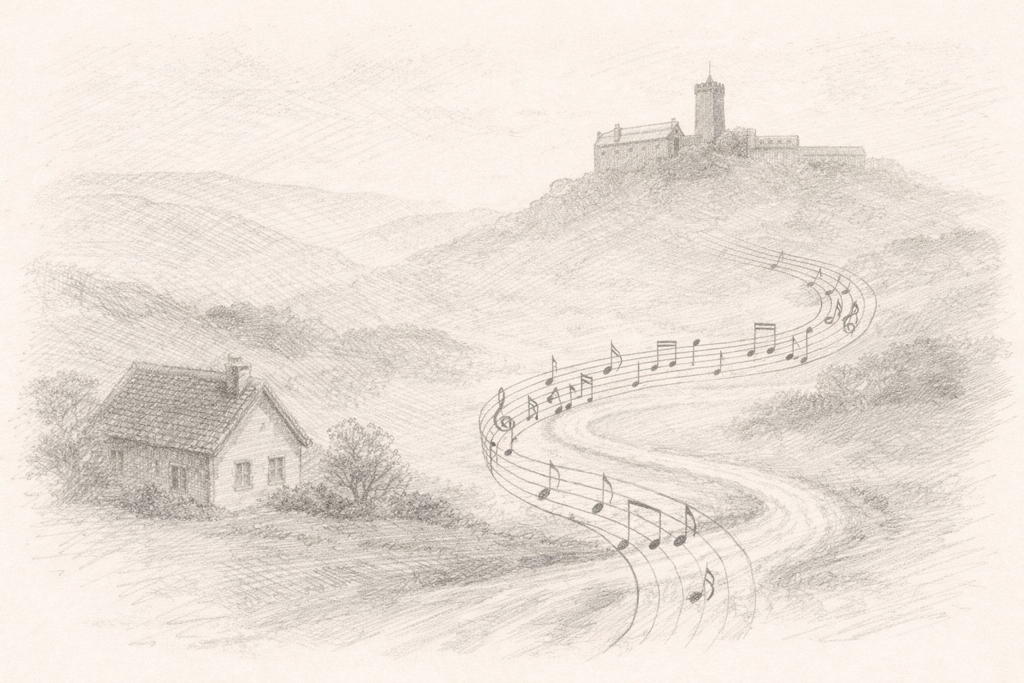
The environment: order and faith
We must not forget: The 17th century was characterized by religion. Everyday life was structured by church festivals, prayers and sermons.
Music was not a neutral space. It was part of the faith.
Bach grew up in a Lutheran environment. Martin Luther's conviction that music had a special closeness to God was deeply rooted. Music was proclamation. It was not a decorative accessory, but a theological statement.
This later explains the depth of his spiritual works. They are not decorative. They are well thought out - textually, musically, structurally.
Early independence
At the age of fifteen, Bach left Ohrdruf and went to Lüneburg. There he sang in the church choir and continued his education. This shows that he moved independently at an early age. He sought out opportunities. He oriented himself upwards.
Even as a teenager, he had contact with important organists and musicians of his time. He listened, observed and learned. He was not a child prodigy in the sense of Mozart, who performed in public as a child. Bach was more of a quiet worker in the background.
But he built. And he built thoroughly.
A character is created
If you look at these early years, you can recognize three formative elements:
- Firstly, music as a craft.
- Secondly, discipline through family tradition.
- Thirdly: Maturity through early loss.
These are not romantic ingredients for an artist's biography. They are serious foundations. Perhaps this is precisely the key to his later attitude. Those who experience responsibility early on, who know order from an early age, develop a different relationship to duty and quality.
Bach didn't have to learn that work was part of it. He didn't know any different.
What you can take away from this
Sometimes we tend to think of great personalities as isolated geniuses. As if they had developed their abilities out of nothing. But with Bach, you can clearly see that foundation comes before greatness.
It was not a flash in the sky. It was the result of a long line. And that is precisely what makes it so interesting. Because it shows that substance rarely arises spontaneously. It grows from tradition, from discipline, from passing it on.
In an age in which many things emerge quickly and disappear just as quickly, this image is almost reassuring. Bach did not begin with fame. He began with work.
In the next chapter, you will see how this young, thorough musician became a man who not only learned, but was also controversial - and why exactly this friction was important.
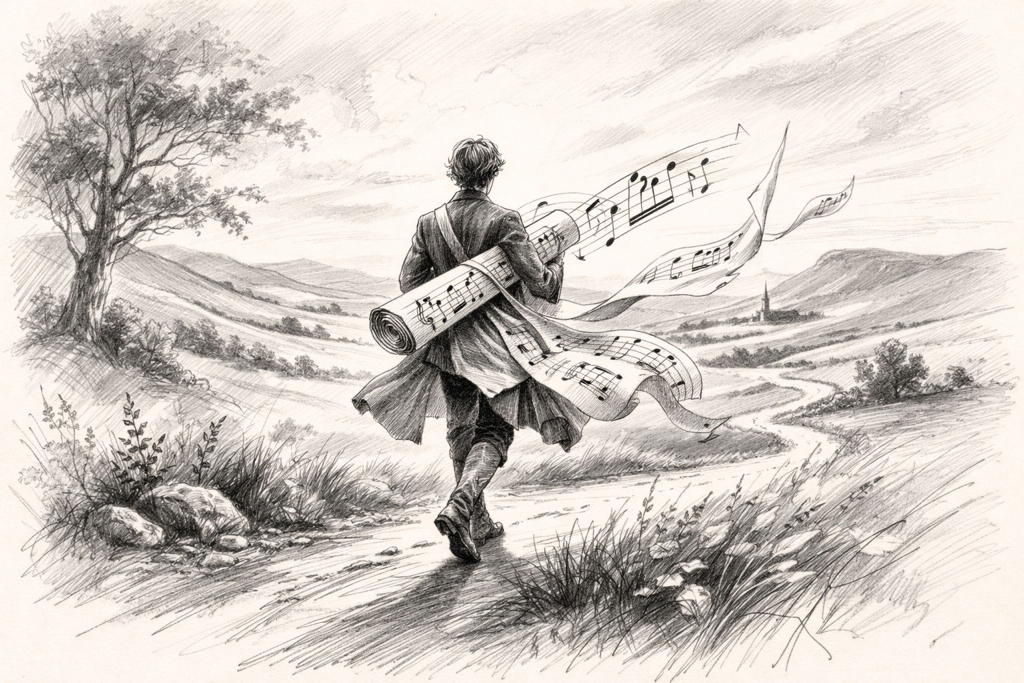
Apprenticeship years - discipline, curiosity and initial friction
When we look at Johann Sebastian Bach as a finished composer, it is easy to get the impression that he had a closed cosmos from the very beginning - as if he had known early on where his path would lead. But for him, too, everything began with years of apprenticeship.
- With practicing.
- With listening.
- With copying.
- And with conflicts.
Because talent alone is not enough. It is only in dealing with others - and with resistance - that a character develops.
Learning by copying
Today, you click on a file if you want to analyze music. It was different in Bach's time. If you wanted to understand it, you had to copy it.
Bach copied works by important composers by hand. He was particularly influenced by North German organists such as Dieterich Buxtehude. Copying was more than just a mechanical activity. It was analysis in slow motion. Anyone who transcribes a fugue note by note recognizes how a theme is developed. Where it becomes denser. Where it dissolves.
Bach learned structure not superficially, but from the inside out. He didn't just want to be able to play. He wanted to understand.
And this understanding was not an end in itself. It was preparation.
The famous march to Lübeck
In 1705, the young organist made a decision that reveals a lot about him: he walked from Arnstadt to Lübeck - over 400 kilometers - to hear Buxtehude.
This was not an educational trip in the tourist sense. It was an investment in our own development. Four weeks' absence was authorized. He stayed for four months. You can see youthful enthusiasm in that. But also something else: consistency in learning. If he was interested in something, he wanted to get to the bottom of it.
Back in Arnstadt, he had to explain himself. There was little enthusiasm for the unauthorized extension. But Bach had heard what he wanted to hear. And he had learned.
First conflicts in Arnstadt
Bach was organist in Arnstadt - a prestigious but not conflict-free position. He improvised extensively. He arranged chorales artistically. Sometimes so artfully that the congregation had difficulty singing along.
The church council was irritated. He was accused of his music being too complex. That is remarkable.
It became clear early on that Bach did not primarily ask whether something was easy to consume. He asked whether it was musically coherent.
Quality before convenience.
The „Zippelfagottist“
There is also an episode from his apprenticeship years that makes us smile a little. A bassoonist named Johann Heinrich Geyersbach felt insulted by Bach. Bach is said to have called him a „Zippelfagottisten“ - which means „incompetent bassoon player“.
The matter escalated. It came to a physical altercation in the form of a fight. What does that tell us?
- Firstly, Bach was not an unworldly theorist.
- Secondly, he had a temperament.
- Thirdly, he set high standards - also for others.
Perhaps his tone was sometimes sharp. But he took music seriously.
Between adaptation and independence
When you are young, you are often faced with the question: Do I adapt - or do I stay true to my line?
Bach opted for the latter early on. He was not a provocateur on principle. But if he was convinced that something was musically right, then he defended it.
This led to tensions. But it also shaped his style. If you're only ever confirmed, you don't develop any further. Friction sharpens.
Discipline as a foundation
In addition to these conflicts, one thing must not be overlooked: Bach worked tirelessly. He studied other people's works. He experimented with forms. He refined his technique. It was during this phase that the foundations of his later skills were laid.
It is tempting to regard great art as a sudden inspiration. But in Bach's case, we can clearly see that his mastery was the result of diligence.
Not spectacular. Not glamorous. But sustainable.
Building character through resistance
Looking back, these early disputes seem almost necessary.
- The long journey to Lübeck.
- Trouble with the church council.
- The fight with the bassoonist.
None of these are heroic stories. But they show a young man who was prepared to stand up for his understanding of quality.
Not yet perfect. Not yet world-famous. But already with a clear inner line.
A young musician with his own signature style
His musical language also began to take shape during these years of apprenticeship. He combined influences from northern Germany with Italian clarity and French elegance. He would later develop his own system from this - but here, in this phase, the building blocks were collected.
It's like an architect who first studies other people's buildings before planning his own. Bach learned from others - but he did not copy them permanently. He integrated. He transformed. And that is where greatness lies: not in imitation, but in further development.
The apprenticeship years show us a crucial point: attitude does not only arise in fame. It arises in everyday life. In decisions. In conflicts. In the way you deal with criticism.
Bach could have turned to easier paths. He could have composed more simply. He could have discussed less. But he did not. He remained curious. He remained demanding. And he remained true to himself.
In the next chapter, we will see how this young, pugnacious organist became a man who took on responsibility in the public sphere - and how much the office of town piper shaped him, even beyond his childhood.
A brief glimpse into the world of the historical Bach - Sarah's Music in the footsteps of the master
The DW documentary „In the Footsteps of Johann Sebastian Bach“ offers a warm, immediately accessible introduction to Bach's life in Leipzig. Presenter Sarah Willis not only visits central locations such as St. Thomas Church, but also meets Sir John Eliot Gardiner, one of the most important Bach interpreters of our time.
In the footsteps of Johann Sebastian Bach | Sarah's Music
The video combines historical instruments, rooms and personal impressions to create a vivid overall picture that makes Bach's presence palpable to this day. For the reader, this documentary is a harmonious addition to the article: It vividly shows how closely music, place and personality are interwoven in Bach's work - and how much his work continues to radiate into our time.
The town piper - music as a craft, duty and public service
When we think of musicians today, we often see soloists on stage, bands in the studio or artists on tour. Music appears to us as an expression of personal creativity - free, individual, sometimes even rebellious.
Things were different in Johann Sebastian Bach's time. Music was part of public order. And to understand this, it is worth taking a closer look at the office that had already shaped his father - and thus indirectly also him: the office of town piper.
A profession with guild rules
The town piper was not a street musician or an improvising minstrel. He was an officially employed musician of the city - bound by a system of clear duties.
Town pipers belonged to a guild. They underwent regulated training, had to pass examinations and were obliged to master a wide range of instruments. Wind instruments such as cornets, trombones, shawms and trumpets were particularly important. Their tasks were varied:
- Music at church services
- Accompaniment of weddings and funerals
- Appearances at council meetings
- Festive music at municipal celebrations
- Tower blowing at certain times of the day
Music was not an end in itself. It was a service. And it was visible - or rather: audible - in the public space.
Music as part of the city's identity
You shouldn't think of it as casual background music. When town pipers played from the church tower, it structured the day. When they performed at council meetings, they represented the dignity of the town. Music was part of a community's identity.
This also means that the town piper was under observation. Quality was not a private matter. It had an impact on the city's reputation. Anyone who worked carelessly here was not only harming themselves.
This attitude - that music carries responsibility - was familiar to the young Bach from an early age.
Craftsmanship before inspiration
In such an environment, you don't grow up with the idea that music is all emotion. You learn that it requires skill. Preparation. Punctuality. Reliability. A town piper had to be flexible. Sometimes sacred music was required, sometimes secular dance music. They played for festive occasions as well as for social gatherings.
This versatility also characterized Bach's later work. He was capable of both sacred depth and courtly elegance. He could be both austere and light. This did not come out of nowhere. It comes from a tradition of craftsmanship.
The invisible school of duty
Even though Bach himself did not later become a town piper, this model remained familiar to him. His father showed him what it means to deliver reliably. Not only when the muse kisses, but also when it is simply expected.
This early experience perhaps explains why Bach developed an almost unbelievable productivity in later years. In Leipzig, for example, he wrote years of complete cantatas in a short space of time - a new work every week.
This is not a whim. It's work ethic.
Between art and service
Today, we tend to separate art from duty. But in the 17th and 18th centuries, this was hardly possible. A musician was part of a structure - ecclesiastical or courtly. His task was to deliver music within the framework of this order. Bach accepted this framework. But he made use of it. He fulfilled his duties - and filled them with substance. That is a crucial point: he was not a rebel against the system. But neither did he allow himself to be reduced to mediocrity.
There is a certain beauty in this old job description. A town piper would get up in the morning, get ready, turn up on time, play his parts and contribute to the success of a public event. Without any fuss. Without self-promotion. That was honorable work.
And it is precisely this attitude that permeates Bach's life. Even when he later became one of the greatest composers in music history, he remained a craftsman at heart. He built pieces. He constructed fugues. He designed musical architectures. Not out of vanity, but out of conviction.
Perhaps it is precisely this combination of craftsmanship and depth that makes Bach so timeless. He shows that great art is not in opposition to duty. On the contrary: it often arises precisely from the consistent fulfillment of tasks.
Discipline is not the enemy of creativity. It is its foundation. When you listen to Bach, you don't just hear sound. You hear structure, order, care. And perhaps you also sense something of the old world in which music was still a natural part of public life - carried by people who took their profession seriously.
In the next chapter, we meet Bach as an adult musician at new stations - in Weimar and Köthen - and experience how his talent increasingly encounters resistance because it becomes larger than the framework in which he moves.
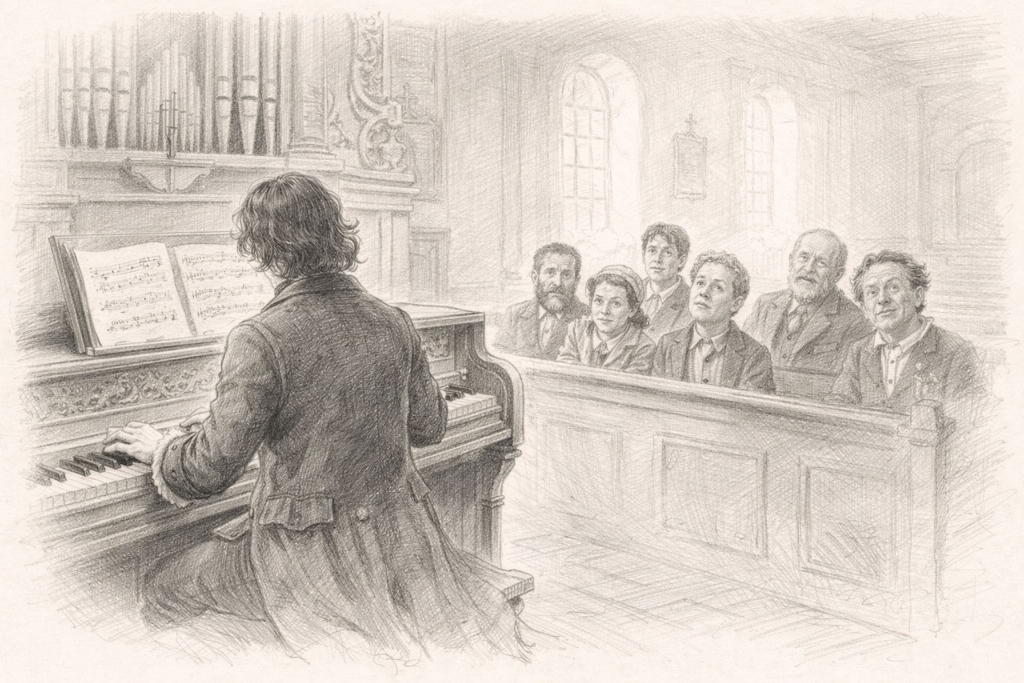
Arnstadt, Weimar, Köthen - talent meets stubbornness
The young organist with temperament now becomes an adult musician with a growing reputation. But as his ability grows, so does the tension between his demands and his environment.
The stops in Arnstadt, Weimar and Köthen are not mere changes of location. They mark steps in development - musically and in terms of character.
This shows that talent alone is not enough. If you think bigger than your frame, you will inevitably reach your limits.
Arnstadt - The beginning with friction
Bach was still very young in Arnstadt. He was given the post of organist at the New Church - a responsible position for someone in his early twenties. He played with virtuosity. He improvised extensively. He experimented with forms.
But not everyone was enthusiastic. He was accused of his accompaniments being too elaborate, too extravagant, not suitable for the congregation. The chorales were „confusing“. The congregation could not sing along properly.
Something becomes visible here that will run through his life: Bach did not rashly conform to expectations when he was convinced he was doing the right thing musically. He was not a provocateur. But he was also not a composer to please.
Weimar - Rise and conflict
In Weimar, Bach became court organist and later concertmaster. The position brought prestige - and responsibility. It was here that his organ skills developed further. Many important organ works were composed during this time. The technical brilliance that we admire today was honed here.
But even here, things were not without conflict. When the opportunity arose in 1717 to move to Köthen as Kapellmeister, Bach wanted to go. For him, this was a career move - more creative freedom, better prospects. The Duke of Weimar saw things differently.
Prison for a decision
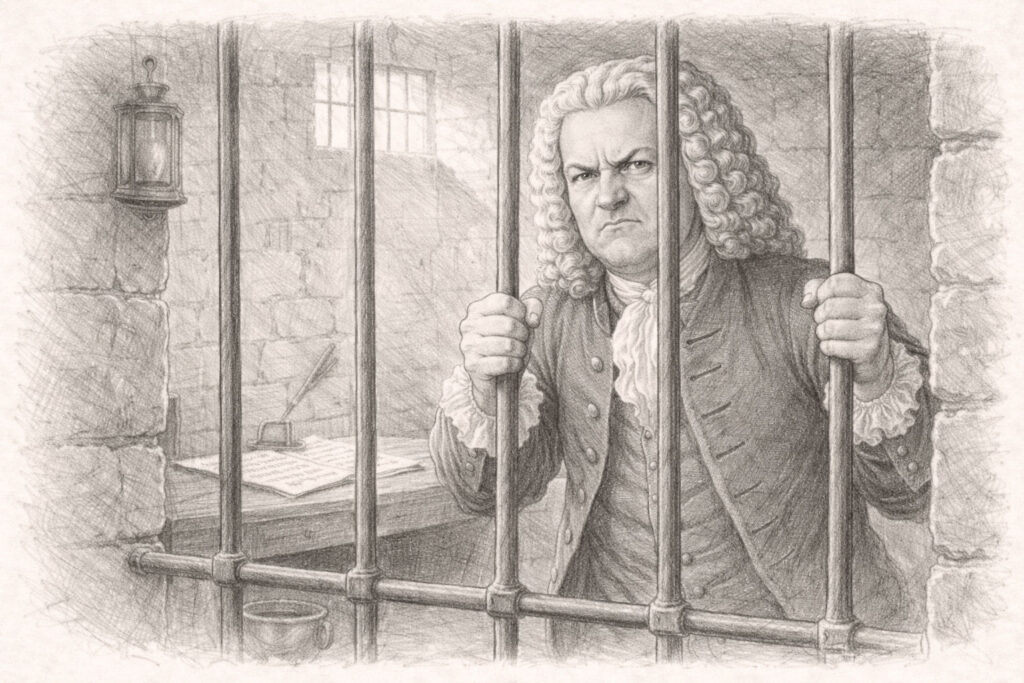
Bach insisted on his dismissal. The duke reacted sensitively. The result: Bach was imprisoned for several weeks - officially for „stubbornly insisting on his dismissal“.
It's easy to overlook this episode. But it is remarkable. A musician going to prison for a professional decision - that sounds dramatic, but it is above all a sign of consistency.
He could have given in. He didn't. Not out of defiance. But out of clarity. He knew what he wanted.
Köthen - Freedom without church coercion
In Köthen, at the court of the music-loving Prince Leopold, Bach found a new environment. The court was reformed, so church music played a lesser role. This meant that Bach was able to devote himself more to secular instrumental music. Among other things, he composed here:
- The Brandenburg Concertos
- The violin sonatas
- The cello suites
- The first book of the Well-Tempered Clavier
These works show a different side of Bach: not primarily theological expression, but pure musical construction and elegance. His architectural thinking unfolds particularly clearly here.
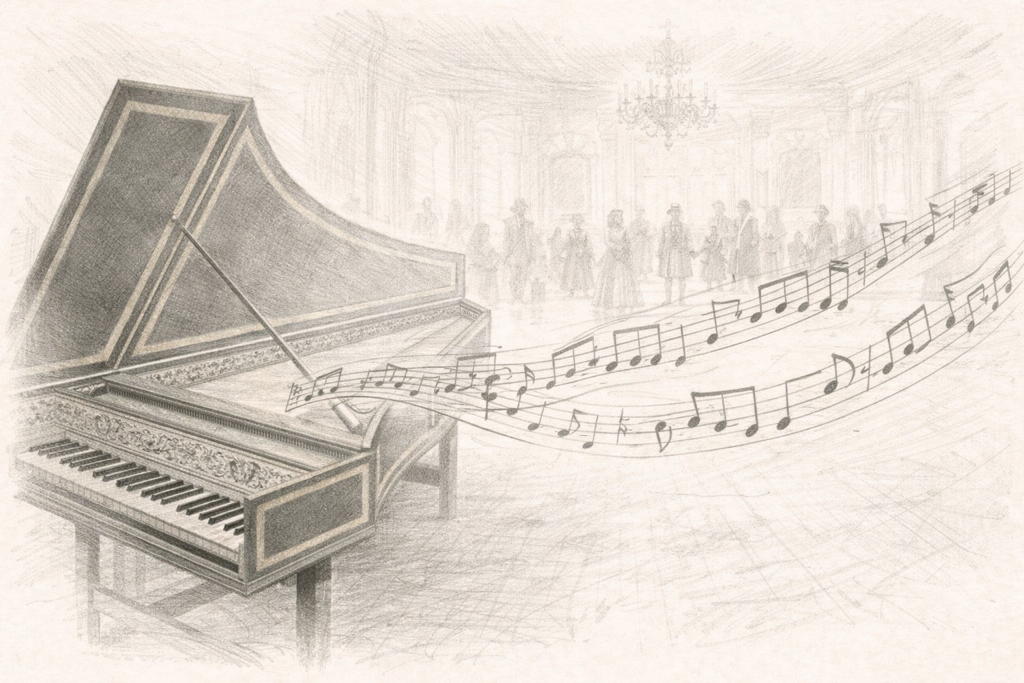
Talent under good conditions
The Prince of Köthen was himself musically educated. He appreciated Bach. He gave him space. And you can see that when surroundings and aspirations go together, great things happen.
But even here Bach did not remain a carefree artist. In 1719, he traveled to inspect a new organ. He examined instruments critically. He was not a man of superficial approval. For him, quality was not a question of politeness.
Personal blows of fate
But this phase was not only professional. In 1720, while Bach was traveling with the Prince, his first wife Maria Barbara died unexpectedly. He returned - and she was already buried.
This episode appears quietly, almost matter-of-factly in the chronicles. But you can guess what it meant: several small children, responsibility, loss. That was also part of his path.
He later married Anna Magdalena, a singer. Together they ran a large, lively house - full of children, pupils and music. Bach was not a solitary scholar. He was a family man.
Growing mastery
In Köthen, his music achieves a new clarity. You can hear self-confidence. Not the self-confidence of the loud, but that of the sovereign. He masters forms. He plays with structures. He develops themes with a precision that impresses.
It doesn't seem strained. It seems self-evident. But behind this matter-of-factness are years of learning and friction.
What makes this phase special is the combination of ability and character. Bach does not become soft as his success grows. He remains demanding. He remains critical - even of himself. He leaves a secure position if it is not enough for him. He accepts conflicts. He seeks better conditions - not comfort.
This is a form of attitude that is quiet, but clear.
Preparation for Leipzig
The Köthen phase ends in 1723. Bach applies for the post of Thomaskantor in Leipzig. Interestingly, he was not the first choice. Several candidates declined or were preferred. But Bach got the job.
One could say that the years of teaching and traveling are now complete. The mature musician enters the phase of his greatest work.
But Leipzig will not be a haven of peace. It will finally show how much backbone this man has.
In the next chapter, we enter the Thomaskirche in Leipzig with him - and experience a composer at the height of his responsibility, but also in the midst of new conflicts.
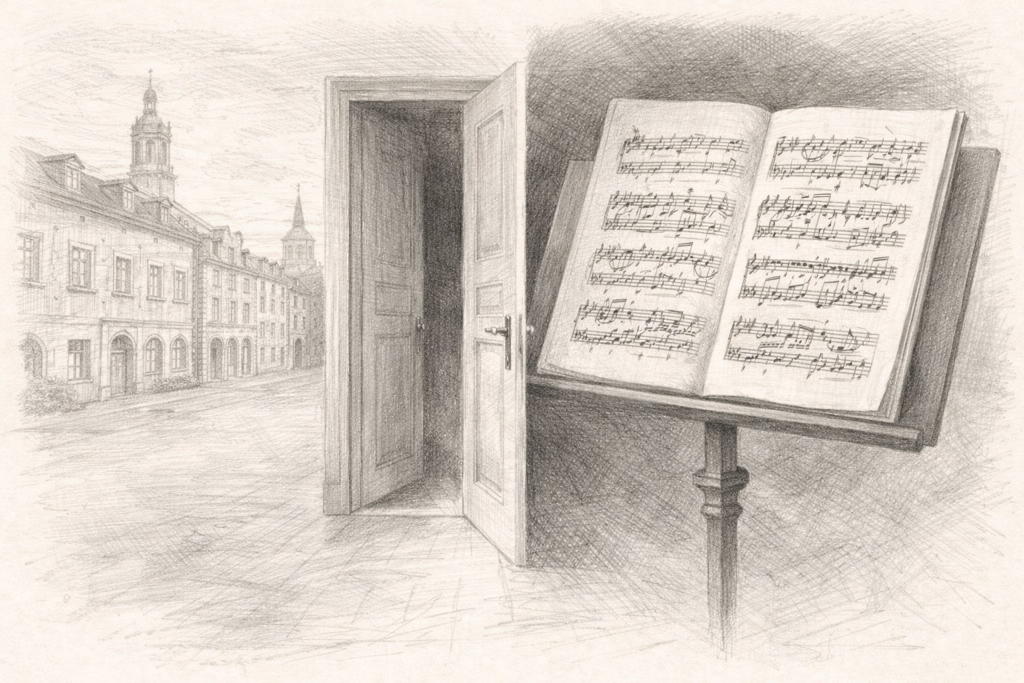
Leipzig - responsibility, resistance and greatness
When Johann Sebastian Bach took up the post of Thomaskantor in Leipzig in 1723, the most important - and at the same time most strenuous - period of his life began. Leipzig was not a small residential city like Köthen. It was an important trading and university city. Here, music was expected not only to function, but to represent.
And here Bach was to show what he was made of.
An office with weight
The Thomaskantor was not simply an organist. He was responsible for:
- the music at several main churches
- the education of the Thomaner students
- the organization of the rehearsals
- the selection and composition of the cantatas
- the musical organization of high holidays
New music had to be created week after week. This was not occasional composing out of inspiration. It was structured work under time pressure. You have to keep that in mind: In his first years in Leipzig, Bach wrote a new cantata for almost every Sunday. An entire year's worth of sacred works was created in an astonishingly short time.
This is not a romantic artist's story. This is discipline.
Claim meets administration
But Leipzig not only brought artistic development. It also brought administration. The city council was Bach's employer. And he was not always enthusiastic about his high standards.
Bach repeatedly complained about insufficiently trained pupils and a lack of musical quality. He demanded better conditions, better instruments and more support. This caused tensions.
He was no silent sufferer. But neither was he a political schemer. He argued objectively - and remained persistent.
Between duty and vision
Above all, Leipzig demanded church music from him. And Bach took this task seriously. But he did not leave it at functional accompaniments. He created works of enormous depth.
- The St. John Passion.
- The St. Matthew Passion.
- Numerous cantatas of theological and musical complexity.
Here it becomes clear: he fulfilled his duty - and transformed it into art. He did not write superficially, just to fulfill requirements. He wrote with inner conviction.
The daily responsibility
Bach was not just a composer in Leipzig. He was also a teacher. He taught Latin, music theory and singing. He led rehearsals, corrected sheet music and organized performances. At the same time, his family continued to grow. You can imagine what his everyday life was like:
- Get up early.
- Samples.
- Lessons.
- Composition.
- Negotiations with the Council.
- Family life.
No retreat to a quiet studio. No romantic existence as an artist. And yet it was precisely in this concentration that his greatest music was created.



Resistance to mediocrity
Bach repeatedly clashed with the city council. He complained about the quality of the pupils. He demanded reliable musicians. He criticized organizational shortcomings. Some may have found him uncomfortable.
But you can also see it differently: He wanted the music to be right. Not approximately. Not enough. But right.
He could have come to terms. He could have lowered his standards. But he didn't.
Size without pose
It is remarkable that Bach did not raise his voice despite these tensions. He wrote letters of complaint - yes. But he did not stage himself. His reaction to opposition was not public outrage, but better work.
The St. Matthew Passion is not a defiant statement. It is a work of such inner order and depth that any discussion seems small next to it. It shows greatness that does not shout.
In Leipzig, his art reached a maturity that can hardly be surpassed. His fugues are complex but clear. His choral writing is dense but transparent. His harmonies carry text and emotion in equal measure. He thinks musically like an architect.
- Every voice has a function.
- Every mission makes sense.
- Nothing is random.
- And yet it seems alive.
That is the paradox of his art: highest order - and expression at the same time.
Between recognition and misunderstanding
Interestingly, Bach was primarily known as an organ virtuoso and music scholar during his lifetime. As a composer, he was not the celebrated star we see today. Some found his music too complex. The taste of the time was slowly moving towards gallant, lighter styles.
Bach stuck to his line. He did not adapt to fashionable trends. Perhaps he was aware that depth is not always immediately recognized.
Attitude in everyday life
Leipzig is the phase in which its character is finally revealed. Not in a spectacular event. Not in prison as in Weimar.
But in persevering. Delivering week after week. Defending your claim. Providing for the family. Shaping pupils.
That is quiet greatness. And perhaps it is precisely this unspectacular form of attitude that is impressive again today. Not the loud signal, but the constant work.
When Bach worked in Leipzig, he was no longer a young, hot-tempered organist. He had matured. His conflicts were more objective. His music was deeper. His decisions more considered. But one thing remained the same: he sought quality. And he remained true to himself.
In the next chapter, we encounter a side that is easily overlooked in this seriousness - the humor, the lightness and the little whimsical episodes that reveal the person behind the work.
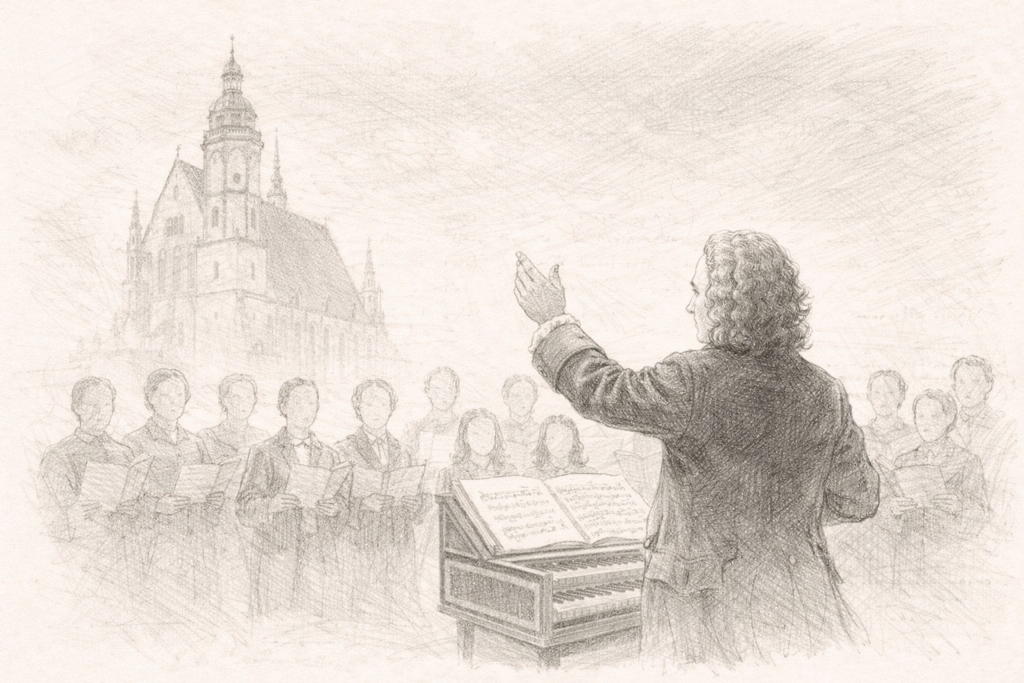
Humor, coffee and little scandals - the man behind the wig
Anyone who only knows Johann Sebastian Bach from school books can easily conjure up the image of a serious cantor with a stern face. A man standing between music stands and pews, engrossed in fugues and chorales, almost removed from everyday life. This image is not wrong - but it is incomplete. For behind the wig was not a humorless scholar, but a lively, alert, thoroughly spirited man. Bach was no salon entertainer, but he understood very well how music can make you smile.
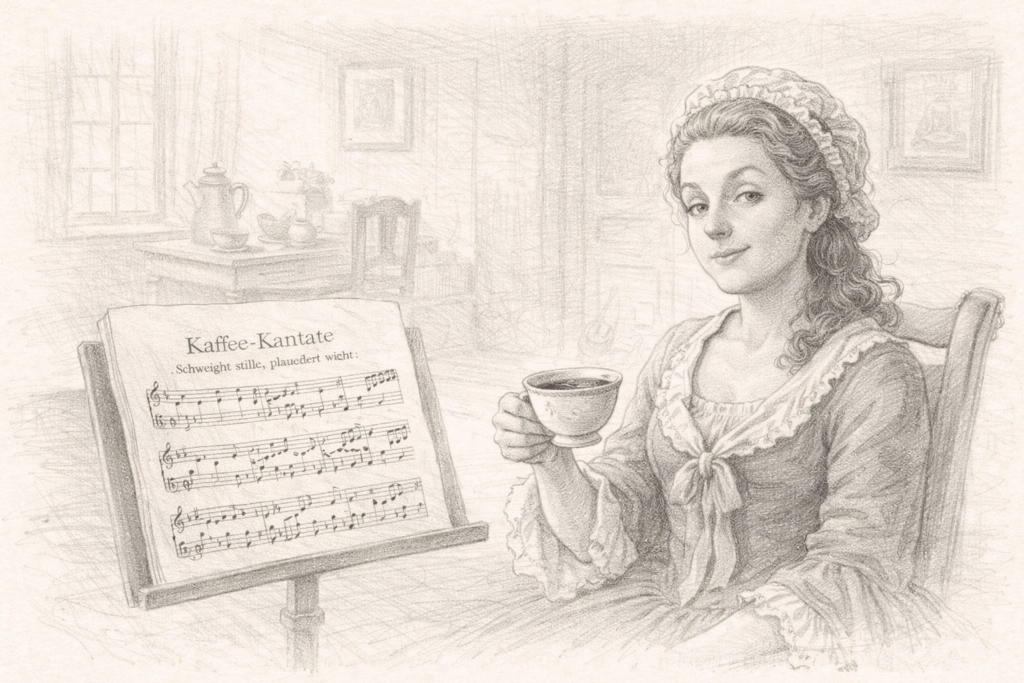
A particularly fine example is the so-called „Coffee Cantata“. At a time when coffee was a new fashionable drink and was sometimes viewed with moral criticism, Bach wrote a secular cantata in which a young woman passionately defends her enjoyment of coffee while her father tries to dissuade her.
The music is light, playful, almost tongue-in-cheek. You can sense that someone here can translate not only theological depth but also social observation into sound. Bach does not comment on current affairs with a raised index finger, but with musical irony.
Humor in Bach is rarely loud. It is embedded in structure. It flashes up if you listen carefully. It can be found in surprising turns of phrase, in dance-like rhythms, in musical dialogs between voices. His music can be serious, even harrowing - in the Passions, for example - but it is never rigid. It breathes. And where there is life, there is also a fine sense of the human.
Temperament and discipline at the same time
His temperament is also part of this image. The famous confrontation with the „Zippelfagottist“ was not an isolated slip of the tongue, but the expression of a man who had clear ideas and did not always express them diplomatically. Bach could be direct. Perhaps sometimes too direct. But you can tell: he did not live in subdued restraint, but with inner involvement. For him, music was not a decorative matter, but something to be taken seriously - and something to get upset about.
At the same time, his house in Leipzig was anything but a quiet refuge for scholars. It was a lively place. Children ran around, pupils came and went, there was rehearsing, teaching and discussion. His second wife, Anna Magdalena Bach, was herself musically trained and supported him not only organizationally but also artistically. You can imagine how music was not only a duty in this household, but also a shared experience. In such an environment, a moving world is created rather than a rigid one.
There are reports that Bach was strict but fair when examining other organists. He did not shy away from clearly naming shortcomings. At the same time, however, he was helpful to talented pupils and emphatically encouraged the gifted. Strictness and care were not mutually exclusive. With him, they belonged together.
Humanity in his compositions
Even in serious works, traces of humanity can be recognized. In some cantatas, there are almost dance-like passages in which the joy of life shines through. In instrumental works, there are moments in which themes appear almost like little figures, talking to each other, teasing each other, catching up and releasing each other again. This is not cold arithmetic, but lively communication.
Perhaps it is precisely this combination of seriousness and humor, of discipline and liveliness, that makes Bach so human. He was not an enraptured genius who only floated in higher spheres. He was a man with a family, with responsibilities, with annoyances and with small pleasures. He could argue, laugh, work, doubt - and all of this flowed into his music.
If you listen carefully, you will notice that there is no cold designer behind the order of his works, but a person with warmth. His music is structured, but not rigid. It is precise, but not emotionless. And it shows that true greatness does not mean suppressing the human element, but rather giving it a form that endures.
In the next chapter, we will take a closer look at how a clear attitude was formed in all of this - in the conflict, in the humor, in everyday life. For Bach was not only musically consistent. He was also consistent in life.
Attitude - prison, conflicts and principles
When we talk about „attitude“ today, we often think of grand gestures, public statements or courageous appearances in the face of opposition. For Johann Sebastian Bach, attitude looked different. It was not spectacular, not dramatically staged - but quiet, consistent and designed to last. This is precisely why it is so remarkable.
Bach was not a political rebel. He did not seek a stage for personal vanity. And yet there are several moments in his life in which it becomes clear that he was not prepared to bend against his convictions. His steadfastness was not shown in his loudness, but in his perseverance.
Stubborn testimony to his dismissal
His time in Weimar is a particularly impressive example. When the opportunity to move to Köthen presented itself in 1717, Bach decided that this step would make sense for his professional development. He wanted more artistic freedom, better conditions and new prospects. However, his employer, the Duke of Weimar, was anything but pleased. Instead of a smooth dismissal, he was arrested. Bach was imprisoned for several weeks, officially for „stubbornly protesting his dismissal“.
You have to keep that in mind: A musician who goes to prison because of a professional decision. He could have given in. He could have waited, appeased or come to terms. But he stuck to his decision. Not defiantly, not loudly, but resolutely.
This episode does not show a desire for revolution, but inner clarity. Bach knew where he wanted to go. And he was prepared to pay a price.
Conflicts with the city council in Leipzig
We also encounter this attitude again in Leipzig - albeit in a less dramatic form. There, he was subordinate to the city council, had to fulfill administrative requirements and work with limited resources. He repeatedly complained about the quality of the pupils or the inadequate support. His letters to the council were factual but clear. He did not want any compromises when it came to musical quality.
He was not interested in personal pride. He was concerned with the work. About the music itself. Anyone who looks at his cantatas or passions will recognize that they are not half solutions. They are worked through down to the last detail. Text interpretation, voice leading, harmony - everything is well thought out. Attitude here means: not sinking into mediocrity, even if the circumstances suggest it.
Meeting with Frederick II of Prussia
A further expression of this inner strength can be seen in his meeting with Frederick II of Prussia in 1747. The king, himself interested in music, presented Bach with a challenging theme and asked him to improvise a fugue on it. Bach did so - confidently, concentrated, without hesitation. He later developed the „Musical Offering“ from this theme, a complex work full of canons and elaborate constructions.
What is visible here is not subservience to power. It is composure. Bach does not meet a king with reverence, but with competence. His response is musical - and it is at the highest level. This is perhaps the most elegant form of attitude: not resistance through loudness, but self-assertion through quality.
He also remained consistent in everyday life. He ran a large house, was responsible for many children, taught, composed and organized. Despite personal losses - such as the early death of his first wife - he did not break away from his path. He continued to work, not out of indifference, but out of a sense of duty.
This form of consistency seems almost unusual today. We are used to people changing course or reinventing themselves in the face of opposition. Bach didn't do that. He continued to develop, yes. But he did not abandon his foundations. His music shows this clearly. While the taste of his time increasingly turned to the lighter, „galant“ style, Bach remained true to his contrapuntal thinking. He did not write fashionably. He wrote substantially.
Perhaps he was aware that fashion fades, but structure remains
For Bach, attitude therefore does not mean rigidity. It means loyalty to an inner standard. A standard that is not based on applause, but on coherence. Those who live this way are not always comfortable - neither for others nor for themselves. But he remains clear.
In a world that often demands quick effects, this form of posture seems almost old-fashioned. And yet it has something timeless about it. It shows that integrity doesn't have to be loud. That you don't have to have every argument in public in order to stand firm. Bach was not a hero in the dramatic sense. He was a man of principle. And that is precisely where his quiet greatness lies.
In the next chapter, we turn to the core of his work: the architecture of his works - and the question of why his music is still considered a foundation today.
Architecture of sound - Why Bach's work is still relevant today
When you approach the works of Johann Sebastian Bach, you are initially confronted with a sheer abundance. Cantatas, passions, organ works, concertos, suites, fugues, masses - it is as if someone has not only composed, but also erected an entire musical edifice.
And this image perhaps sums it up best: Bach was an architect of sound.
His music is not random. It seems constructed.
Order as a principle
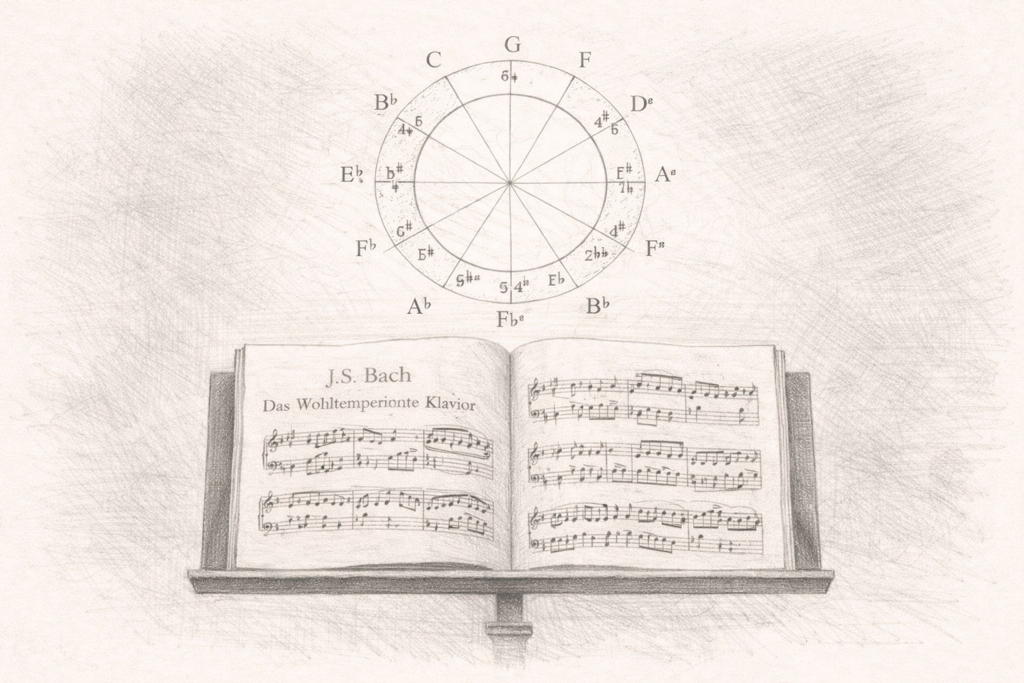
Structure is a central feature of his works. This is particularly evident in the „Well-Tempered Clavier“. This work systematically runs through all keys - each with a prelude and a fugue.
This was not a loosely compiled notebook. It was a well thought-out system. Bach wanted to show that the newly developed „well-tempered“ tuning system made it possible to compose in all keys. And he demonstrated it - completely.
This reveals something fundamental: he thought in contexts, not in individual pieces. He didn't just want to write a beautiful piece, he wanted to make order visible. For him, order is not an end in itself. It is a framework that makes freedom possible in the first place.
The art of the fugue
His mastery of counterpoint - the art of leading several independent voices simultaneously so that they work together harmoniously - is particularly impressive.
A fugue usually begins with a theme introduced by one voice. This is followed by a second voice, then a third, sometimes a fourth. The theme is mirrored, shortened, extended, reversed. It wanders through the piece, changes, remains recognizable. It sounds technical - and it is.
But with Bach, this technique never seems mechanical. It is alive. You don't hear arithmetic, but movement. The astonishing thing is: the more complex the structure, the clearer it appears. Nothing blurs. Every voice has its place. It's like a well-constructed cathedral: you can see the whole - and yet every detail contributes to the stability.
Depth in the Passions
Alongside the instrumental architecture are the great sacred works, above all the St. John and St. Matthew Passions. Here Bach combines structure with emotion.
The Passion stories are not just musical accompaniments to biblical texts. They are dramatic narratives in sound. Chorales comment on the events, arias reflect them, recitatives drive the plot forward. And again you can sense this inner order. Even in the most emotional moments, the musical construction remains clear.
This is not a flood of feelings without direction. It is permeated sensation.
An international look at Bach - the DW documentary „The Fifth Evangelist“
The English-language DW production „Bach: The Fifth Evangelist“ on the channel of DW Classical Music opens up a fascinating approach to Johann Sebastian Bach that extends far beyond the German-speaking Bach tradition. The documentary illuminates the theological and musical depth of his work and places it in the context of the Leipzig Bach Festival. Musicians, choirmasters and musicologists paint an impressive picture of how strongly Bach's compositions are influenced by biblical thought and why he is often referred to as the „Fifth Evangelist“ in international discourse.
Johann Sebastian Bach: The Fifth Evangelist | Music Documentary (Bachfest Leipzig 2013)
It is particularly valuable that this video is available in English - and thus builds a bridge to a global audience that experiences Bach not only as a composer, but as a spiritual ambassador.
The Brandenburg Concertos - virtuosity with measure
The Brandenburg Concertos reveal a different side: joy of playing and virtuosity. Each concerto is orchestrated differently. Bach experiments with combinations, uses unusual solo instruments and allows voices to dialogue with each other. And yet he never loses the overview.
There is no gimmickry. Everything is embedded in a clear structure. You can tell that someone is writing here who doesn't see the orchestra as a mass, but as an interplay of independent characters.
Music as a form of thought
Perhaps a key to understanding Bach lies in the fact that his music is also a form of thought. He composes not only with feeling, but with logic. Themes develop logically. Tensions are built up and resolved. Motifs return, are transformed and interlinked.
This is reminiscent of mathematical clarity - and yet it is never dry. It is as if thinking becomes audible. This also explains why his works still play a central role in musical education today. Those who study Bach don't just learn pieces. They learn connections.
The balance between freedom and rules
One misunderstanding is to see Bach's music as strict and rule-bound. Yes, it follows rules. But enormous freedom unfolds within these rules. Counterpoint in particular shows how creatively one can deal with fixed forms. A theme can be mirrored, enlarged, reduced or rhythmically altered - and still remain recognizable.
This balance of rule and freedom is perhaps the decisive factor. Bach shows: Discipline does not restrict. It enables creation.
During Bach's lifetime, musical tastes began to change. Lighter, catchier styles were gaining popularity. His complex polyphony was considered old-fashioned by some.
But Bach remained true to his line. He did not write to serve trends. He wrote to express musical truth - as he understood it. This may have attracted less attention in the short term. But it gave his work longevity. What is based on substance survives fashions.
A closed building
If you look at his oeuvre as a whole, you get the impression of a closed cosmos. The individual pieces stand on their own, but they belong together. They follow an inner logic. You can hear a prelude and already sense the handwriting. You can recognize the way in which themes are led, how harmonies develop.
Bach was not a collector of individual ideas. He was the master builder of a system. And this system still works today.
Why his music remains
Perhaps Bach's lasting effect lies in the fact that his works function on several levels.
- They are emotionally accessible.
- They are intellectually imbued.
- They are technically masterful.
- They are structurally stable.
- If you just listen, you can enjoy them.
- Those who analyze discover depth.
And that is exactly what makes great art: It does not exhaust itself on first hearing. In the next chapter, we will take a look at the present day and consider why Bach's harmonic and structural principles still live on today in jazz, film music and pop music - often unnoticed, but effective.
From Bach to pop music - the invisible foundation
It may seem daring at first to associate Johann Sebastian Bach with modern pop music. There are centuries, technical revolutions and cultural upheavals between a baroque fugue and a radio song. And yet there is a line that can be followed with astonishing clarity. This line does not run through instruments or timbres. It runs through structure.
Bach worked out musical principles of order in a way that still shapes our hearing today - often without us realizing it.
The language of harmony
Much of Western music is based on functional harmony. Put simply, certain chords are in fixed relationships to one another. A tonic acts like a home. The dominant creates tension. The subdominant leads on.
This principle of tension and resolution is no coincidence. It is the result of a long development that reached maturity in the Baroque period.
Bach did not invent these harmonic relationships - but he penetrated them and applied them so consistently in countless works that they became the foundation.
If a pop song today works with four chords, then it moves in exactly this system. Even if the style is different, even if drums and electric guitar have been added - the inner logic remains comparable.
- Tension arises.
- It is held.
- It dissolves.
This is a principle that our ear expects.
Four chords - one system
Many successful pop songs are based on simple chord progressions. The same harmonic patterns are often repeated. Sometimes four chords are actually enough to reach millions of people emotionally.
Why does it work?
Because our ear is socialized in a system that perceives precisely these relationships as harmonious. This system was consolidated in the 17th and 18th centuries - and Bach was one of its greatest masters.
Of course, a pop song sounds different from a cantata. But if you reduce the harmony, you recognize the relationship. The foundation has remained the same. The surface has changed.
Counterpoint in the background
Bach also left his mark in the area of polyphony. Counterpoint - the simultaneous performance of several independent voices - is not just a Baroque specialty.
In jazz, for example, the conscious guidance of individual voices in the chord is a central creative tool. Good arrangers think not only in block chords, but also in moving lines.
Even in film music, techniques reminiscent of baroque voice leading can be found: themes are introduced, varied, layered and interwoven. The principle is old. The context is new.
J. S. Bach: Concerto for two violins in D minor | hr symphony orchestra
Music as a blueprint
Another aspect is the form. Bach worked with clear structures. Exposition, development, recapitulation - even if these terms were systematized later, we already find a pronounced awareness of form in his works.
Modern music - whether pop or film music - also works with clear formal elements: Verse, chorus, bridge. Build-up of tension, climax, release. It's always about dramaturgy. And dramaturgy follows laws.
Bach understood these laws intuitively and analytically at the same time. His works are not just strings of ideas, but rather through-composed arcs.
Why our ear hears the way it does
Music is not just a taste. It is a habit. A certain way of listening has become established over generations. A sense of harmony, the expectation of resolution, a feeling for tension - all of this has been culturally shaped.
Bach stands at a point where this cultural imprint becomes particularly clear. He organizes, systematizes and demonstrates.
In a way, he has helped shape our hearing.
If a certain chord progression seems „right“ to us today, it is also because we are part of a tradition that was shaped by him.
From the church to the studio
Of course, it would be an exaggeration to say that every pop composer consciously studies Bach before writing a song. But many musicians - even in modern genres - have played or analyzed Bach as part of their training.
Piano students often start with his preludes. Music students practise fugues in order to understand voice leading. Even electronic music producers use harmonic models based on this foundation.
The church of the 18th century and the recording studio of the 21st century are far apart. But the musical grammar is related.
Consistency under change
What changes are timbres, instruments and production methods. What remains are structures. This is perhaps Bach's true modernity: he did not create a fashionable phenomenon, but a sustainable system. A system that is flexible enough to adapt to new styles. A system that does not become outdated because it is not based on surface.
It is tempting to put Bach on a pedestal and regard him as an unattainable monument. But that would be to relegate him to the past.
Another image is more apt: it is not a monument. It is a foundation. You don't see a foundation when a house is finished. But without a foundation, it doesn't stand. This is how Bach works in our musical history.
- Still.
- Carrying.
- Indispensable.
In the next chapter, we turn to the last years of his life - a phase between physical decline, unbroken mental clarity and the strange fact that his work was initially forgotten after his death.
Late years, quiet greatness and the strange time of oblivion
When we look at Johann Sebastian Bach today, we see one of the greatest composers in the history of music. His works are performed, analyzed and admired all over the world. It seems self-evident that his name is one of the foundations of European culture.
But this was not always the case. The last years of his life were characterized by physical weakness - and his post-fame was initially surprisingly restrained.
The late Bach - concentrating on the essentials
In his final years, Bach once again turned particularly strongly to pure musical form. Works such as the „Art of Fugue“ or the „Musical Offering“ display an almost abstract clarity. Here, the focus is less on external effect than on inner perfection.
The „Art of Fugue“, for example, is not a work for a specific occasion. It is almost a musical legacy - a systematic development of a theme in ever new contrapuntal variations. It is like a look back at everything that had occupied him:
Structure, polyphony, order.
You don't hear an ageing man flagging here. You hear concentration. Perhaps even concentration.
Physical limits
But physically, things became more difficult. Bach suffered increasingly from sight problems. In the late 1740s, his eyesight deteriorated considerably. Several operations - according to the medical standards of the time - brought no lasting improvement.
He became largely blind. And yet he continued to work. He dictated compositions. He revised earlier works. Even under restricted conditions, he remained creatively active.
This once again shows the quiet attitude that runs through his life: no dramatic lamentation, no public staging of suffering, but continuing to work within the bounds of what is possible.
Death - without much ado
Johann Sebastian Bach died in Leipzig on July 28, 1750.
Historically, this date often marks the end of the Baroque era. But for his contemporaries, his death was not an earth-shattering event. He was respected - especially as an organist and music scholar. But he was not regarded as the undisputed center of the musical world. Tastes had changed. Lighter, more gallant styles were in demand.
His complex polyphony seemed old-fashioned to some. And so something astonishing happened: his work partially disappeared from the active repertoire.
Forgotten - but not lost
This does not mean that Bach was completely ignored. His sons - such as Carl Philipp Emanuel Bach - were successful composers in their own right. However, they represented a different style, more modern, more sensitive, less contrapuntally dense.
The musical zeitgeist had shifted. Bach's works continued to be studied - especially by specialists. But they were not at the center of public concert life.
It is almost paradoxical: the master builder of the musical foundation himself faded into the background.


The rediscovery
It was not until the 19th century that the picture changed fundamentally. A young composer by the name of Felix Mendelssohn Bartholdy performed the St. Matthew Passion again in Berlin in 1829 - a work that had not been heard in public for a long time.
This performance was a turning point. Suddenly the greatness, the depth, the architectural mastery of this music was recognized anew. Romanticism discovered not only history but also spiritual substance in the Baroque.
From then on, Bach's real triumphal march through music history began. What was considered sophisticated or old-fashioned during his lifetime was now recognized as timeless.
Substance sometimes takes time
This phase of forgetting and rediscovery tells us something fundamental. Great works do not always establish themselves immediately. Sometimes it takes time. Sometimes contemporary tastes have to change for depth to be appreciated again.
Bach did not write for short-term fashion. He wrote in a language that was designed to last. The fact that this language disappeared from the foreground at times does not alter its stability. On the contrary: it underlines the fact that substance does not depend on applause.
A legacy beyond fame
At the end of his life, Bach was not a celebrated superstar. He was a respected but not revolutionarily celebrated cantor.
His real legacy only unfolded after his death.
That seems almost comforting. It shows that impact does not always go hand in hand with immediate recognition. That work done with conviction can find its time - even if it seems inconspicuous at first.
Bach died without knowing what rank would later be attributed to him. But perhaps that would not have been of decisive interest to him.
He had done what he thought was right. And the foundations were in place. In the final chapter, we will now look back to the present and ask what we can learn from this life today - beyond all music theory.
The monumental Mass in B minor in the Elbphilharmonie - a concert full of inner expansiveness
The live concert from the Hamburg Elbphilharmonie presents Johann Sebastian Bach's Mass in B minor in an impressive interpretation by Thomas Hengelbrock and the Balthasar Neumann Ensemble. The video description particularly emphasizes how this music expresses central human tensions: loneliness and consolation, despair and confidence, joy and quiet exaltation. The acoustic clarity of the Elbphilharmonie amplifies this effect noticeably and makes the mass an almost physical experience.
Elbphilharmonie LIVE | Bach Mass in B minor | Thomas Hengelbrock & Balthasar Neumann Choir and Ensemble
The carefully assembled ensemble of soloists and the Balthasar Neumann Choir lend the work an extraordinary transparency. For the reader, this video rounds off the article perfectly - it shows Bach not only as a composer, but as someone whose music has a deep impact on the existential questions of life.
What we can learn from Bach today - and why he remains
When you reach the end of this journey - from Eisenach to Arnstadt, Weimar, Köthen and Leipzig - you are left with more than just an impressive list of works. What remains is a picture of a man who was not loud, but clear. Not spectacular, but consistent. Not fashionable, but enduring.
Johann Sebastian Bach was not a revolutionary in the political sense. He wrote no manifestos, left no theories about society or progress. And yet he exemplified something that is important in every age: Attitude through quality.
Discipline is not the opposite of freedom
Today, we live in a culture that values spontaneity. Creativity should be free, unbound, as unfiltered as possible. Rules are quickly seen as a restriction.
Bach presents a different picture. His music is strictly constructed - and free for this very reason. His fugues follow clear rules - and yet unfold an astonishing liveliness. His works are well thought out - and yet they are immediately moving.
This is perhaps one of the most important lessons: Structure is not a cage. It is a framework. Those who master their craft gain freedom. If you develop discipline, you gain freedom. This is just as true in music as it is in life.
Quality over convenience
At many moments in his life, Bach could have made things easier for himself. He could have composed more simply. He could have lowered his standards to avoid conflicts. He could have followed fashionable trends.
He did not do it. Not out of defiance, but out of an inner standard. He obviously knew that you don't gain substance by adapting to short-term expectations.
In an age in which many things are produced quickly and forgotten just as quickly, this attitude seems almost unusual. But that is precisely why it is so valuable.
- Quality takes time.
- Depth requires patience.
- Consistency needs conviction.
Responsibility as a matter of course
Bach was the father of twenty children. He was a teacher, organizer and employee. His everyday life was not romanticized, but characterized by responsibility. He made no distinction between art and duty. He lived both at the same time.
Perhaps this is also a message for today: great achievements do not happen in a vacuum. They are created in everyday life, in persevering, in taking one's own tasks seriously. Attitude is not only demonstrated in exceptional circumstances. It is shown in daily actions.
Humor and humanity
For all his discipline, Bach remained human. The coffee cantata, the small disputes, the liveliness of his house - all this reminds us that seriousness does not mean tenseness.
Structure does not exclude warmth. Principles do not exclude humor. On the contrary: those who are inwardly stable can also smile.
Substance over time
Perhaps the most impressive thing about Bach is not just the complexity of his works, but their duration. He was forgotten for a time after his death. Tastes changed. Fashions came and went. But his work remained.
That is a powerful image: What is well built survives change. Not because it is loud, but because it is strong. In an era that often strives for quick impact, Bach reminds us that true impact sometimes begins quietly - and lasts a long time.
The quiet benchmark
There are personalities who impress through drama. And there are those who impress through consistency. Bach belongs to the second group. He did not fight for attention. He worked. He built. He created structures that remain standing even when the zeitgeist turns.
Perhaps this is precisely the deeper meaning of his life: he shows that greatness does not lie in spectacle, but in measure. An inner standard by which one orients oneself - regardless of the applause.
When you listen to a work by Bach today - be it a fugue, a cantata or a simple prelude - you are not just listening to music. You are hearing the result of discipline, conviction, responsibility and a fine sense of humanity.
You hear a man who took his task seriously. And perhaps this is the best thought to conclude with: you don't have to be famous to be important. You don't have to be loud to be heard. You don't have to be fashionable to stay modern.
Bach was not a hero in the bright light. He was a master builder in the background. And because he built thoroughly, his work still stands - as a foundation, as a benchmark, as an invitation to listen more closely.
Perhaps that is the greatest gift that this life has left us.

Frequently asked questions
Was Johann Sebastian Bach really a genius - or „just“ a particularly hard-working craftsman?
Bach was both. His work shows extraordinary talent, especially in the area of counterpoint and harmonic structure. At the same time, his mastery would be inconceivable without his diligence and discipline. He studied, copied, analyzed and developed tirelessly. Genius in Bach does not mean spontaneous inspiration, but the combination of talent, education and decades of work. His greatness lies precisely in the fact that inspiration and craftsmanship work inseparably together.
Why is Bach considered so important for music history?
Bach systematically penetrated the musical organizing principles of his time and brought them to a climax. His works display a clarity and completeness that served as a benchmark for later generations. His fugues, passions and the „Well-Tempered Clavier“ in particular became the foundations of musical education. He did not invent a new genre, but brought the existing into a form that is still viable today. That is why he is regarded as the foundation of the Western musical tradition.
Isn't Bach's music too complicated for someone with no musical background?
Not at all. You can listen to Bach's music on different levels. Those who are familiar with theory will discover complex structures. If you simply listen, you can let yourself be carried away by the sound, mood and expression. Works such as the cello suites or many preludes are immediately accessible. Bach's music requires attention, but no academic training. It reveals itself over time - and rewards patience.
What exactly is a joint?
A fugue is a polyphonic compositional form in which a theme appears successively in different voices and is developed further. The theme is mirrored, shortened, extended or rhythmically altered. The result is a dense network of voices that nevertheless remains structurally clear. Bach did not invent this form, but he created it to a degree of perfection that is still considered a benchmark today.
Why was Bach not as famous during his lifetime as he is today?
During his lifetime, Bach was highly regarded, especially as an organist and music scholar. But musical tastes were changing. Lighter, more gallant styles gained in popularity. His complex polyphony was considered old-fashioned by some. It was not until the 19th century that the timeless greatness of his work was recognized anew. His fame therefore grew posthumously - an indication that substance is not always recognized immediately.
What distinguishes Bach from Mozart or Beethoven?
In terms of style, Bach is at the end of the Baroque period, while Mozart and Beethoven belong to the Viennese Classical period. Bach's thinking is more contrapuntal, i.e. polyphonically interwoven. Mozart and Beethoven work more strongly with thematic development within clear formal sections. In addition, Bach was more closely integrated into church structures, while Beethoven, for example, worked as an independent artist. Nevertheless, Mozart and Beethoven also built on the foundations that Bach had helped to shape.
Did Bach really influence pop music?
Not directly in the sense of personal influence, but structurally. Functional harmony, on which much of Western music is based, was systematically developed in the Baroque period. Bach masterfully applied and consolidated this system. When today's songs work with principles of tension and resolution, they draw on precisely these harmonic relationships. The foundation is therefore related, even if the surface sounds different.
Was Bach a particularly religious man?
Bach lived and worked in a Lutheran environment, and his sacred works show a deep theological penetration. For him, his music was not only an aesthetic expression, but also a service to the faith. It is difficult to say whether he could be described as particularly pious in the modern sense. What is certain is that he took his ecclesiastical task seriously and combined artistic excellence with religious conviction.
How could Bach be so incredibly productive?
One important factor was his professional obligation. As Thomaskantor, he had to regularly deliver new works. This external structure forced him to be disciplined. Added to this were his enormous technical skills and his work routine. He thought musically in systems and was therefore able to work efficiently. His productivity was not hectic, but organized.
Is it true that Bach was in prison?
When he wanted to resign from his position in Weimar in 1717, the Duke initially refused to dismiss him. Bach insisted - and was imprisoned for several weeks. This episode shows his consistency. He was prepared to accept personal disadvantages for his professional decision.
Why was Bach partially forgotten after his death?
Musical taste was changing. The so-called „galant style“ was easier and more catchy than the complex polyphony of the Baroque period. Bach's works were considered too demanding by many. It was not until the 19th century, particularly with the revival of the St. Matthew Passion by Felix Mendelssohn Bartholdy, that his work was brought back to the fore.
What is the „Well-Tempered Clavier“ and why is it so important?
It is a collection of preludes and fugues in all major and minor keys. Bach thus demonstrated the possibilities of well-tempered tuning, which allowed playing in all keys. At the same time, he created a pedagogical and artistic masterpiece that is still the basis of piano training today.
Was Bach rather strict or humorous?
Both. He had high standards and could be very direct when it came to quality. At the same time, works such as the Kaffeekantate or some instrumental pieces show a playful, almost tongue-in-cheek side. He was not a humorless scholar, but a person with temperament and a sense of irony.
Why do his works seem so timeless?
Because they are based on structure and substance, not fashion. His music is precisely crafted and emotionally penetrating. It does not exhaust itself in the first impression, but develops depth with repeated listening. This combination of clarity and complexity gives it longevity.
Can Bach still be rediscovered today?
Absolutely. Every generation hears Bach differently. Historical performance practice, modern interpretations, new instrumentation - all this opens up new perspectives. At the same time, the core remains stable. It is precisely this mixture of stability and openness that makes him alive.
What can we personally learn from Bach?
Discipline as the basis of freedom. Quality over short-term recognition. Responsibility in everyday life. And the realization that substance takes time. Bach shows that you don't have to be loud to have a lasting effect. Attitude comes from perseverance.
Was Bach more of a loner or part of a network?
He was heavily involved in family and professional structures. The Bach family was musically active for generations. He was also in contact with other composers of his time. He was not an isolated genius, but part of a tradition - which he took to a new level.
Why is it still worthwhile to study Bach intensively today?
Because his music is more than historical culture. It is a training ground for attention, for understanding structure and for patience. It shows how order and vitality can work together. Anyone who engages with Bach discovers not only a piece of music history, but also a model of depth and consistency - something that is valuable in every age.






Thank you so much for all this material. I’ve always loved Bach—ever since I was eight years old—and I became a pianist so that I could play his music for the rest of my life. Each of his works brings me joy and gives me peace. He has strengthened my Christian faith, for I believe that his art is directly inspired by God. Engaging with his music fosters a pursuit of perfection and fidelity to his artistic vision—whether in terms of style, tempo, or flawless technique. Bach does not belong solely to the past; he belongs to the present and to eternity.
I thank God for creating Bach, and I thank Bach for leading us to God.