At first glance, artificial intelligence seems almost weightless. You type in a question and an answer appears seconds later. No noise, no smoke, no visible movement. Everything seems to happen „in the cloud“. This is precisely the error in thinking. AI is not abstract magic, but the result of very concrete, physical processes. Behind every answer are data centers, power lines, cooling systems, chips and entire infrastructures. The more AI enters our everyday lives, the more visible this reality becomes. And this is where the question of sustainability begins.
Anyone who talks about AI without talking about energy, resources and infrastructure is only describing the surface. This article goes deeper. Not with alarmism, but with a sober look at what AI actually needs to function - today and in the future.




The common misconception: AI as an „immaterial cloud“
Many people imagine AI to be similar to software of the past: a program that runs somewhere, is updated and that's it. This idea comes from a time when computing power was comparatively cheap, locally limited and energetically inconspicuous. AI goes beyond this framework.
The term „cloud“ further reinforces this impression. It sounds soft, almost natural. Clouds float, they don't weigh anything down. In reality, it conceals one of the most energy-intensive industries of our time. Large halls full of high-performance computers running around the clock. Thousands of kilometers of cables. Massive cooling systems. Permanent maintenance.
The difference to traditional software lies not in the principle, but in the scale. AI does not scale linearly. The more powerful it becomes, the more resources it requires. And it doesn't grow somewhere abstract, but very specifically on site.
What modern AI really needs
To understand why AI is no longer just a software topic, it helps to take a look at its basic needs. Modern AI systems require three things in particular: computing power, energy and cooling.
Computing power is not created out of thin air. It is provided by specialized chips that are optimized for machine learning. These chips work in parallel, extremely quickly - and they consume enormous amounts of power in the process. The larger the AI model, the more of these chips have to work simultaneously. A single model can consist of tens of thousands of such computing units.
Power consumption is not a side effect, but a key factor. AI does not calculate selectively, but continuously. Requests come in around the clock. Training runs take days or weeks. Standing still is not an economical option. The system has to run, whether at night, at the weekend or on public holidays.
This immediately creates the next problem: heat. Electrical energy is not fully converted into computing power. A significant proportion becomes waste heat. Without extensive cooling, modern AI computers would fail within a short time. Cooling, in turn, requires energy itself - and often water.
This is where it becomes clear: AI is physical. It is tied to places, to networks, to resources. And this inevitably makes it a question of sustainability, even if you want to avoid using that word.
Training and use: two completely different loads
Another point that is often overlooked in the public debate is the difference between training an AI and its subsequent use. The two are often lumped together, although the burdens are very different.
Large amounts of data are processed during training. The system learns correlations, patterns, language and images. This phase is extremely computationally intensive. It is usually concentrated in large data centers and can consume enormous amounts of energy. A single training session for a large model can consume as much electricity as a small town over a longer period of time.
Training is followed by use. Here, the model is no longer fundamentally changed, but applied. Every query triggers computing processes, but on a smaller scale. The problem lies in the masses. When millions or billions of people use AI every day, this seemingly small effort adds up to a permanent base load.
Both phases are relevant. Training ensures peak loads, use ensures continuous consumption. Sustainability must take both levels into account, otherwise the analysis remains incomplete.
Why AI is different from previous digitalization
You could argue that every new technology consumes energy. That is true. But AI differs from previous digitalization steps in one crucial respect: it doesn't just replace existing processes, it creates new ones.
The Internet has made communication more efficient. Emails have replaced letters, video conferences have replaced business trips. AI, on the other hand, is often used in addition. Texts are not only written, but varied several times. Images are not only created, but in series. Decisions are not automated and finalized, but simulated, evaluated and recalculated.
Efficiency gains here often do not lead to savings, but to increased use. What is cheap and quickly available is used more often. This phenomenon is not new, but it is particularly pronounced with AI. The better it gets, the greater the desire to use it everywhere. This is precisely why the hope that technical efficiency alone will solve the sustainability problem falls short. Even more efficient systems can ultimately lead to higher overall consumption.
When people talk about sustainable AI today, there is often a moral undertone. This is understandable, but not always helpful. Before talking about good and evil, it is worth taking a look at the physical principles.
Electricity must be generated. Heat must be dissipated. Water is finite. Networks have capacity limits. These facts cannot be argued away, no matter how advanced the software is. Sustainability therefore does not start with good intentions, but with the question:
What is technically and infrastructurally feasible?
Only when this basis is understood can meaningful decisions be made. Decisions about where AI is used, to what extent, and at what price - both economically and socially.
The real question behind the debate
At the end of this first chapter, there is still no assessment, but rather a shift in perspective. The crucial question is not: „Is AI sustainable?“ This question is too general and invites quick answers.
The more precise question is: What form of AI do we want and what are we prepared to spend on it? Energy, resources, infrastructure, political decisions - all of these are part of the equation. Anyone who views AI purely as a software product is overlooking these interrelationships.
The following chapters are therefore not about hype or fear, but about structures. About energy policy, chip design, location issues and future scenarios. Because only when you see the machine behind the magic can you talk meaningfully about its future.
The political turning point - when AI demands its own power plants
Sometimes a single sentence says more about the state of a development than pages of studies. When Donald Trump said at the World Economic Forum in Davos that AI companies should build their own power plants or just build their own. participate in the financing, It wasn't an elaborate energy policy master plan. But it was a remarkably honest moment. Because this sentence contains an unspoken realization:
Artificial intelligence is no longer just another branch of software, but an industrial complex with massive energy requirements.
Regardless of how you rate Trump politically, the statement hits a nerve. Large AI companies are now openly making it clear that they can no longer rely on existing electricity grids to simply „serve“ their needs in the long term. They need predictable, permanent and large quantities of energy. And this is precisely where the political dimension of AI sustainability begins.
Data centers as the new heavy industry
For a long time, data centers were considered a comparatively inconspicuous infrastructure. They were located somewhere on the outskirts of the city, consumed electricity, generated heat - and were otherwise hardly the subject of public debate. This is now changing fundamentally.
Modern AI data centers are on a scale that was previously only known from traditional industry. Their power requirements can be equivalent to those of a medium-sized industrial park. Their cooling requirements are complex. Their space requirements are growing. And above all: they don't just run during the day, but 24 hours a day, seven days a week.
This automatically puts them in the same category as steelworks, chemical plants or refineries. In the past, such plants were specifically located, politically supported and planned in terms of energy policy. Exactly the same questions now arise with AI infrastructure - only much faster and often without clear responsibilities.
Why politics cannot be avoided here
Energy is not a free market in a vacuum. Power grids, power plants and approval procedures are politically regulated, planned for the long term and socially sensitive. If a single data center suddenly needs as much electricity as an entire city, this is not without consequences.
Politicians are faced with a dilemma here. On the one hand, AI is seen as a key technology for economic competitiveness, innovation and national security. On the other hand, its energy requirements compete directly with households, SMEs and existing industry. Rising electricity prices, grid expansion costs and local bottlenecks quickly turn into political conflicts.
The idea that AI companies should organize their own energy supply is therefore not only pragmatic, but also politically relieving. It shifts responsibility. Instead of expanding and subsidizing public grids, private players should create their own solutions. That sounds like a market economy - but it has far-reaching consequences.
Trump and the tech-energy issue - a political turning point
In the USA, an unusual case is currently energy policy proposal for discussion: President Donald Trump and several governors are pushing for large technology companies to effectively co-finance the construction of new power plants in order to limit rising electricity costs for private households.
The background to this is the massive demand for electricity from data centers, which are operated for AI services, among other things, and put a noticeable strain on the grid. A so-called reliability auction is planned, in which tech companies are to conclude long-term electricity contracts that secure the construction of power plants - regardless of whether they actually purchase the electricity or not. This could trigger billions in investment in new power plants and reduce pressure on public grids. However, critics warn of possible side effects, such as rising costs for smaller suppliers and greater privatization of energy infrastructure.

The logic behind „build your own power plants“
At first glance, the idea seems radical. On closer inspection, however, it follows a clear logic. Anyone who needs large amounts of energy on a permanent basis should also be involved in generating it. This was common practice in industry for a long time. Factories operated their own power plants or concluded long-term supply contracts.
For AI companies, this means having their own power plants, their own electricity storage facilities, direct connections to producers or exclusive supply contracts. This can involve gas, nuclear power, renewable energies or mixed forms. The decisive factor is not the technology, but the ability to plan.
However, this creates a new form of infrastructure: private energy islands. High-performance data centers with their own supply, their own prioritization and their own protection. They are less dependent on the public grid - and therefore less integrated into traditional balancing mechanisms.
When location policy becomes energy policy
This is where it becomes clear why AI infrastructure is politically controversial. The location of a data center is no longer selected solely on the basis of tax law or workforce, but also on the basis of energy availability, approval situation and political predictability.
Regions with stable grids, cheap energy sources and fast approval are becoming more attractive. Others fall behind. This can exacerbate existing imbalances - between countries, within countries and even between municipalities.
This is a new situation for local decision-makers. On the one hand, data centers promise investment and prestige. On the other hand, they bring hardly any jobs, but high infrastructure costs. Roads, networks, water connections and security measures have to be provided, while the direct benefits remain limited.
What sounds abstract in national strategies becomes very concrete on the ground. Citizens ask why new pipelines are being built. Why water is becoming scarcer. Why electricity prices are rising. And why all this is happening so that texts can be generated or images calculated somewhere.
This acceptance issue is often underestimated. While traditional industrial products are tangible, the benefits of AI remain vague for many people. This makes political communication more difficult. Sustainability is not just a technical category here, but also a social one. The more visible the infrastructure becomes, the greater the pressure to justify it. AI cannot be regarded as an invisible service in the long term if its physical traces become increasingly clear.
Power shift through energy self-sufficiency
Another aspect is rarely discussed openly: Energy self-sufficiency creates power. Those who control their own supply are less dependent on political decisions, grid outages or regulatory intervention.
This is attractive for large tech companies. For states, it can be problematic. This is because traditional control instruments - grid charges, prioritization, shutdowns - are less effective when critical infrastructure is privately organized.
This creates a new level of negotiation between politics and technology companies. No longer just about data or regulation, but about energy, space and long-term resources.
The turning point has been reached
The first chapter showed that AI is physical. This chapter shows that this physics is becoming political. The statement that AI companies should build their own power plants does not mark a slip, but a turning point. It makes visible what has often been ignored until now: AI is not just a question of algorithms, but of infrastructure, power and responsibility.
The next chapters will therefore be even more specific. It is about electricity volumes, cooling, water and technical limits. Because only when these basics are understood can we talk realistically about sustainability - beyond buzzwords and euphonious declarations of intent.
Power hunger, cooling, water - the physical reality of AI
As long as AI is seen as a software phenomenon, numbers remain abstract. A few percent more computing power here, a new model there. But as soon as you start thinking about energy requirements in kilowatt hours, megawatts or even terawatt hours, the perspective changes. Then it's no longer about technical gimmicks, but about real resources, grids, power plants and distribution conflicts.
This chapter is dedicated to precisely this level. Not to create fear, but to paint a realistic picture. Because sustainability begins where abstract concepts are translated into physical boundaries.
How much electricity AI really consumes
One of the most frequently asked questions is: „How much power does AI actually consume?“ The honest answer is: it depends. It depends on the model, the use, the location and the hardware. Nevertheless, it is possible to name orders of magnitude - and they are revealing.
Today, large AI data centers operate in power ranges that used to be typical for entire industrial areas. Individual systems require several hundred megawatts of connected load. This is equivalent to the power requirements of tens of thousands of households. And this is not a one-off peak value, but a permanent load.
What is important here is that AI does not generate seasonal consumption like heating or air conditioning systems. It runs continuously. This makes it a so-called base load. It is precisely this type of consumption that is particularly challenging for electricity grids because it has to be permanently secured.
The crucial point is not whether this electricity demand is „too high“, but how quickly it is growing. While traditional industries have often expanded over decades, AI infrastructure grows in just a few years. Grids, power plants and approval procedures are not designed for this pace.
Why forecasts are often misunderstood
Large figures are often quoted in the public debate. Doubling electricity consumption, exploding demand, massive burdens. Such statements are not wrong, but they are often misunderstood.
They do not mean that the lights will go out tomorrow. They do mean that long-term planning comes under pressure. Electricity grids are built for specific load profiles. If these profiles change fundamentally, bottlenecks arise - locally, regionally or nationally.
The problem is less the absolute consumption than the concentration. AI data centers are not evenly distributed. They are concentrated where networks, cooling and political framework conditions are suitable. This is precisely where conflicts arise.
Cooling: The invisible second system
Electricity is only half the story. Every kilowatt hour consumed by a data center sooner or later turns into heat. This heat must be dissipated, otherwise operations will collapse. Cooling is therefore not an add-on, but a central operating system of modern AI infrastructure.
Air cooling used to be enough. Fans, air conditioning systems, warm exhaust air. With the increasing power density of modern chips, this principle has reached its limits. Today, liquid cooling systems are increasingly being used in which coolants are fed directly to the processors. These systems are more efficient, but more complex. They require pumps, heat exchangers and emergency mechanisms. And they create new dependencies: on water, on chemical coolants, on stable temperatures.
Cooling is not a detailed problem. It determines where data centers can be operated at all. Regions with high outside temperatures, scarce water resources or unstable networks fall behind.
Water: the often suppressed bottleneck
While there is a lot of talk about electricity, water is surprisingly often left out. Yet it is indispensable in many cooling concepts. Evaporative cooling, recooling plants, heat exchangers - all of these require water in relevant quantities. In water-rich regions, this is hardly noticeable. In arid regions, however, water quickly becomes a political issue. When data centers compete with agriculture, industry and households, distribution conflicts arise. And these cannot simply be solved with money.
In addition, water consumption is local. Electricity can be transported via networks, water only to a limited extent. This makes the location factor even more critical. A data center cannot simply be built where the land is cheap if there is no water.
The sustainability debate on AI will therefore inevitably become more regional. What seems to make sense globally can be problematic locally.
It is often argued that new technology will alleviate the problem. More efficient chips, better cooling, optimized software. This is not wrong - but it is incomplete. Efficiency gains reduce consumption per computing unit. At the same time, costs and barriers to deployment are falling. This often leads to AI being used more frequently and in new areas. The overall effect can then even be higher consumption.
This pattern is familiar from other areas. More efficient motors did not lead to less traffic, but to more. More efficient lighting did not automatically reduce electricity consumption, but increased usage. AI follows the same principle.
Sustainability can therefore not be solved technically alone. It is always a question of limitation, prioritization and conscious decision-making.
Power grids as a bottleneck
Another aspect is often underestimated: the electricity grid itself. Building power plants is complex, but expanding grids is often even more complicated. Approvals, routes, acceptance - all of this takes time.
AI data centers not only need a lot of power, but also stable grids. Voltage fluctuations, outages or bottlenecks can cause expensive damage. This is why operators prefer locations with high grid quality. This leads to a paradoxical situation. It is precisely where grids are well developed that pressure increases the most. New large-scale consumers exacerbate existing bottlenecks. Expansion is lagging behind.
This shows once again that AI is not an isolated system. It has an impact on existing infrastructures and changes their requirements.
At this point at the latest, it becomes clear that the physical reality of AI cannot be viewed in isolation from social issues. Electricity, water and networks are common goods. Their use is politically regulated and socially sensitive.
The more AI takes up these resources, the greater the question of priorities becomes:
- What do we use energy for?
- Which applications justify which expenditure?
- And who decides?
These questions cannot be answered by engineers alone. They affect politics, business and society in equal measure.
The uncomfortable realization
This chapter leads to an uncomfortable but necessary realization: AI is not a „clean“ digital product. It is embedded in a material world with finite resources. Every use has a price, even if it is not immediately visible.
In this context, sustainability does not mean doing without, but awareness. Awareness of scale, of interrelationships and of consequences. Only when this reality is recognized can viable solutions be developed.
The next chapter focuses on the technology itself - on chips, the promise of efficiency and the question of whether technological progress alone is enough to overcome these challenges.

AI and the water crisis: why do data centers use too much water? | DW German
Chips, efficiency and the illusion of the technical self-healing process
When the enormous energy requirements of AI are mentioned, a reassuring sentence almost reflexively follows: the technology is becoming more efficient. New chips, better software, more intelligent cooling - the problem will be solved with the next generation. This hope is understandable. It is based on decades of experience. Computers have become smaller, faster and more economical. Why should AI be any different?
The short answer is: efficiency gains are real, but they do not automatically solve the basic problem. On the contrary - they can even exacerbate it. To understand this, it is worth taking a closer look at the technology behind AI and the dynamics that efficiency triggers.
Why specialized chips perform so well - and consume so much
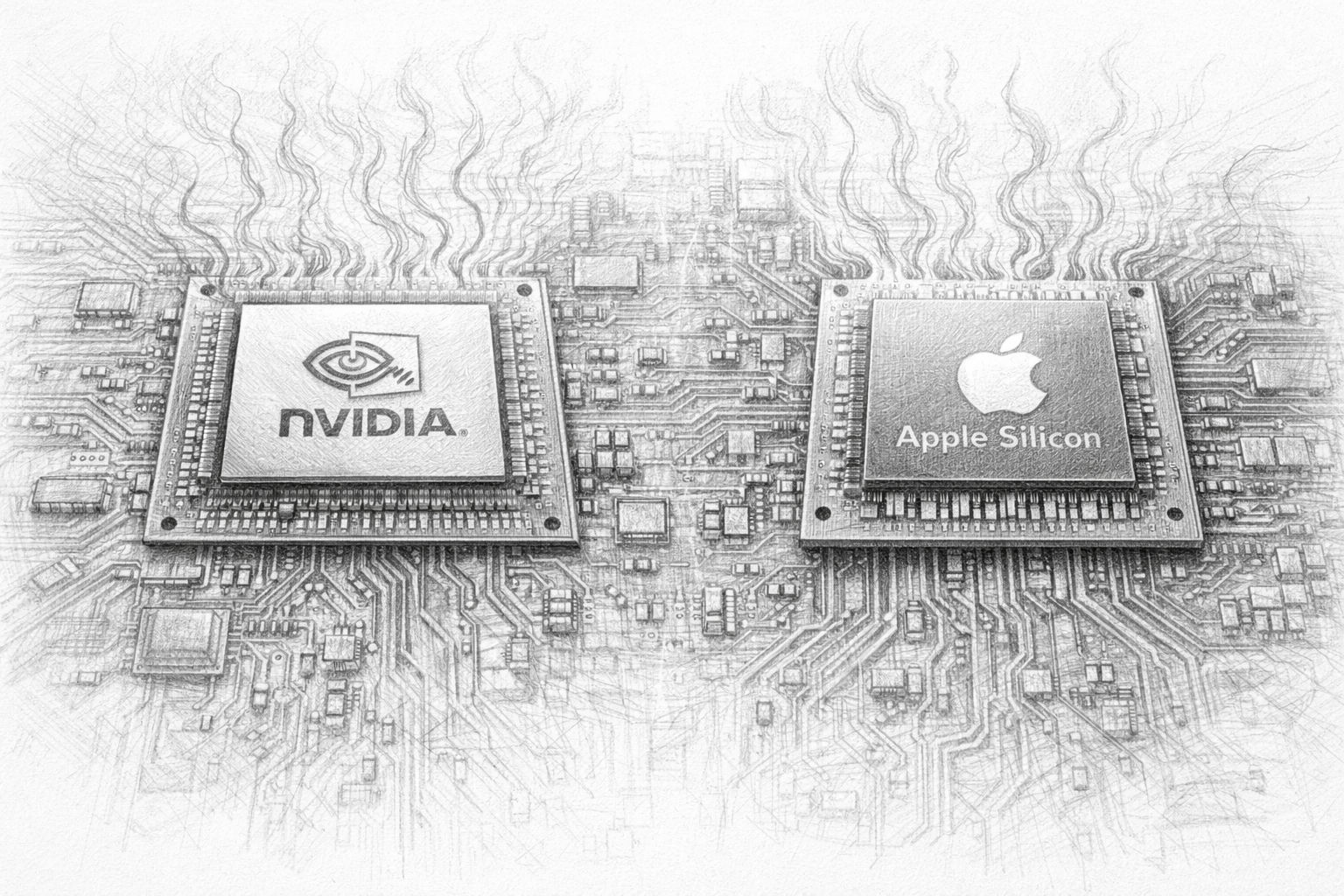
Modern AI no longer runs on classic universal processors. It requires specialized computing units that can perform many simple calculations in parallel. This is precisely where their strengths - and weaknesses - lie. These chips are designed to process enormous amounts of data simultaneously. They do not calculate step by step, but in large blocks. This makes them extremely powerful, but also energy-hungry. The more densely the computing power is packed, the greater the waste heat and the more complex the cooling.
The key point is that these chips are not built to be economical, but to deliver maximum throughput. Efficiency plays a role, but performance is paramount. Because in the competition for AI capabilities, speed counts. Those who train faster, those who run larger models, gain an advantage.
This creates a structural conflict of objectives. Efficiency is improved, but not at the expense of increased performance. Overall consumption does not necessarily fall, but shifts.
Performance per watt - an important but limited key figure
In recent years, a new key figure has become established: Performance per watt. It describes how much computing power is achieved with a certain amount of energy. This key figure is useful because it makes efficiency visible. However, it is not a panacea.
A system that is twice as efficient consumes only half as much energy for the same task. But if it is used four times as often, the total consumption increases. This is exactly the pattern we see again and again.
Performance per watt is a technical optimization. Sustainability, on the other hand, is a system issue. It depends on how technology is used, not just how well it is built.
Why efficiency often leads to more use
This phenomenon is not new. It was already described in the 19th century, long before computers existed. Efficiency reduces costs and hurdles. What is cheaper and faster is used more often. Exceptions are rare.
This effect is particularly strong with AI. The more efficient models become, the easier they can be integrated into new applications. Texts, images, videos, simulations - everything suddenly becomes possible where it was previously too expensive or too slow.
This does not lead to savings, but to an expansion. AI not only replaces existing processes, it creates new ones. Efficiency becomes a growth driver.
Anyone who thinks of sustainability solely in terms of technical optimization is overlooking this dynamic. It's like hoping that more efficient cars will reduce traffic.
The myth of the „next big breakthrough“
Another common argument is that the next generation of chips will change everything. Quantum leaps, new materials, revolutionary architectures. Such breakthroughs are not impossible, but they are rare - and they rarely solve all problems at the same time.
Even if a chip becomes twice or three times more efficient, the basic pattern remains the same. AI grows, scales and spreads. Every breakthrough is immediately translated into new applications. Technical progress is absorbed, not used to limit.
What's more, many efficiency gains are already priced in. The simple optimization is done. Further progress will be more complex, more expensive and slower. At the same time, demand is rising faster than efficiency is increasing.
Local AI as a counter-model - with limits
A frequently cited counter-model is local AI. Smaller models, less computing power, lower energy requirements. This model is attractive because it slows down scaling and reduces dependencies.
But here too, local AI does not replace all applications. Large models, complex analyses and global services cannot simply be decentralized. Local efficiency relieves the system, but it does not eliminate the basic dynamics.
Sustainability does not come about automatically through decentralization. It is created by consciously choosing what makes sense locally - and what should perhaps not be done.
Why technology alone does not take responsibility
Technology optimizes what it is given. It knows no goals beyond this optimization. Sustainability, on the other hand, is a normative goal. It requires someone to draw boundaries, set priorities and make decisions. Anyone who hopes that technology will take on this responsibility is confusing means and ends. Efficient chips are tools. Whether they lead to more or less consumption depends on how they are used.
In this respect, AI is no different from earlier technologies. The difference lies only in speed and scale.
The uncomfortable role of limitation
Limitation is not a popular word. It sounds like renunciation, like standing still. In reality, limitation is a form of control. It decides where technology makes sense and where it does not.
Sustainable AI will not be created by making everything more efficient. It will come about by deciding which applications have priority and which are dispensable. This decision is not technical, but political and social. Efficiency can help. It can ease the burden. But it is no substitute for a decision.
This chapter leads to a clear interim conclusion: technological progress is essential, but it does not solve the sustainability problem by itself. More efficient chips, better software and optimized cooling are part of the solution - but only part. If you take sustainability seriously, you have to talk about utilization, scaling and limitation. About goals, not just means.
In the next chapter, we therefore turn our attention away from pure technology and towards the energy issue itself. Where should the electricity that AI needs in the long term come from? And what options are realistic, beyond ideology and wishful thinking?

Energy requirements of AI: a growing challenge | DW German
Where should the electricity come from? - Energy options without ideology
At this point at the latest, the question of sustainability can no longer be addressed in the abstract. If AI requires large amounts of electricity on a permanent basis, the simple but uncomfortable question inevitably arises: where should this electricity come from? Not theoretically, but practically. Not at some point, but continuously.
This question is so explosive because it charges old energy policy conflicts with new urgency. AI is not an occasional consumer, but a permanent load. It needs electricity when it is needed - not just when the sun is shining or the wind is blowing. This makes it a touchstone for every energy system.
Why AI needs base load
AI systems cannot be switched on and off at will. Training runs often take days or weeks. Services must be available around the clock. Interruptions are not only annoying, but also economically expensive. The energy requirements of AI are therefore similar to traditional industries with continuous operation. They require base load capability. This means that electricity must be available in sufficient quantities at all times, regardless of the time of day, weather or season.
This is where the difficulties begin. Many energy sources do not provide a constant supply of electricity. They fluctuate or are seasonal. This is not a fundamental problem as long as there is sufficient compensation. However, this balancing is expensive, technically demanding and often politically controversial.
Renewable energies: indispensable, but not sufficient on their own
Renewable energies play a central role in any sustainable future. There is little doubt about that. They are climate-friendly, increasingly cost-effective and socially accepted. Nevertheless, they are reaching their limits in base load-intensive applications such as AI.
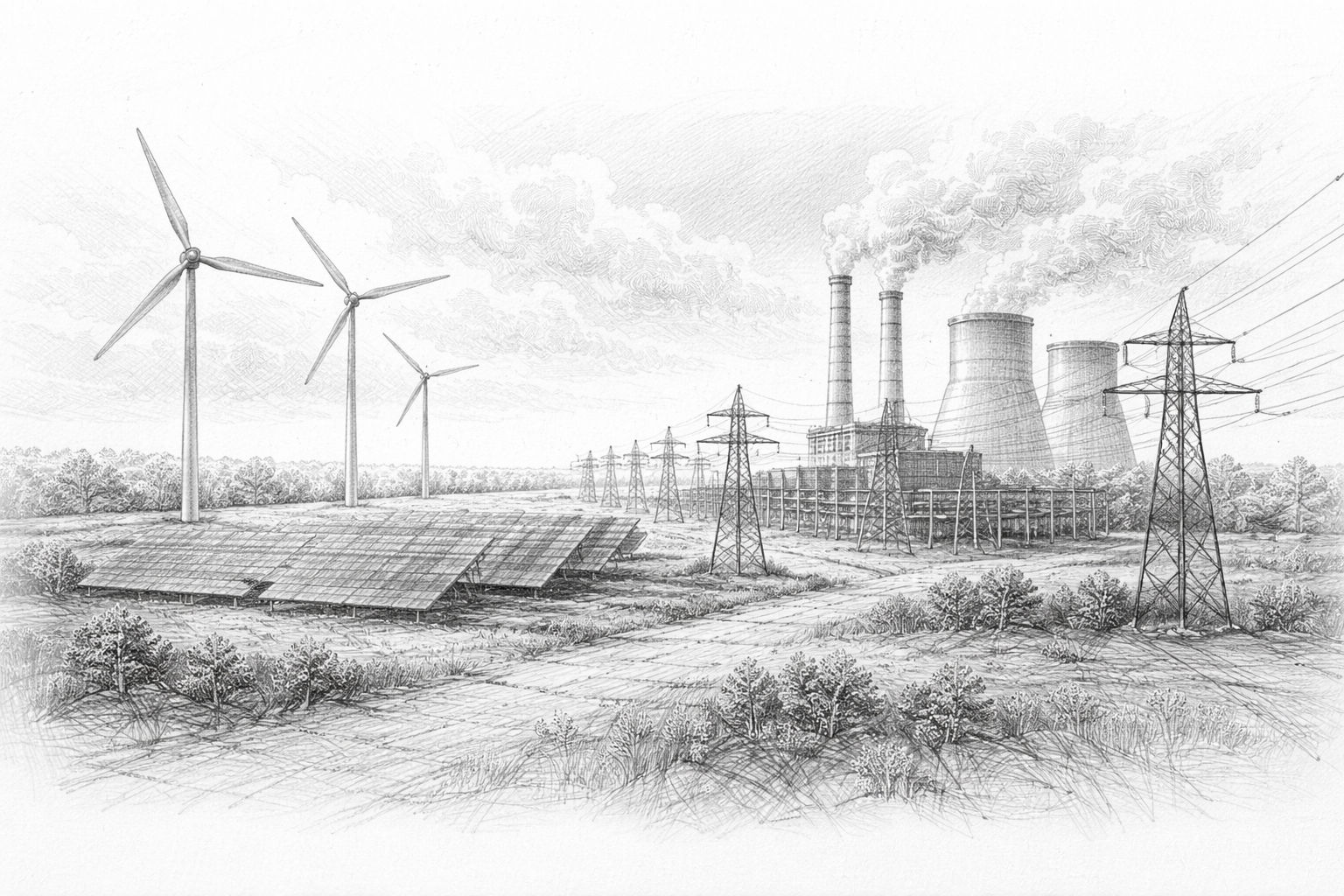
Solar and wind energy supply electricity when the conditions are right. Storage systems can compensate for fluctuations, but only to a limited extent. Large storage facilities over days or weeks are technically possible, but expensive and land-intensive.
For AI data centers, this means that renewable energies can make an important contribution, but they do not guarantee a continuous supply. Without additional measures, a supply gap will remain. This gap must be closed - otherwise sustainability will remain mathematical, but not real.
Nuclear power: the inconvenient renaissance
Hardly any other energy topic is as emotionally charged as nuclear power. It is therefore all the more remarkable that it is suddenly being discussed soberly again in the context of AI. Not out of enthusiasm, but out of need.
Nuclear power supplies large quantities of electricity continuously, with low land consumption and regardless of the weather. This is precisely what makes it attractive for energy-hungry data centers. Not as a panacea, but as a stable basis.
For AI companies, the social debate is less important than the technical reality. The focus is on predictability, security of supply and long-term contracts. The fact that large technology companies are once again interested in nuclear energy is therefore less ideological than pragmatic.
At the same time, the known problems remain: long construction times, high costs, final storage issues, political acceptance. Nuclear power is not a quick solution, but a long-term decision with high barriers to entry.
Gas: bridge with risks
Natural gas is often seen as a flexible supplement. It can be ramped up and down relatively quickly, power plants can be built comparatively quickly and the technology is tried and tested. Gas can be a bridge solution for AI data centers.
But this bridge has cracks. Gas is fossil. It causes emissions and remains geopolitically sensitive. Even with CO₂ capture, a residual problem remains. Gas is also volatile in terms of price. This is a risk for long-term planning.
Nevertheless, gas will play a role in many scenarios. Not because it is ideal, but because there are no alternatives. Sustainability here often means choosing between bad and less bad options.
Storage, grids and the underestimated expense
It is often argued that storage would solve the problem. Large batteries, hydrogen, pumped storage. All of these technologies exist - but they do not scale at will.
Storage systems are expensive, material-intensive and energy-hungry. They are useful for balancing out fluctuations, but they do not replace permanent generation. The greater the consumption, the larger the storage system needs to be. This is not a theoretical limit, but a physical one.
Then there are grids. Electricity must not only be generated, but also transported. High-performance data centers require high-performance connections. The expansion of these grids is costly, time-consuming and fraught with conflict.
Private energy supply: Return to old patterns
In view of these challenges, an old idea is gaining new relevance: private energy supply. Large industries used to operate their own power plants or conclude exclusive supply contracts. AI companies are increasingly moving in this direction.
Own power plants, own storage facilities, direct connections - all this reduces dependencies. At the same time, it removes some of this infrastructure from public control. Electricity becomes a private resource.
This development is rational, but not socially neutral. It shifts the balance of power. Those who control energy control the scope for action. This applies to both states and companies.
Sustainability without illusions
At this point, it becomes clear why ideological debates are of little help. There is no perfect solution. Every energy source has advantages and disadvantages. Every decision involves conflicting goals.
Sustainability here does not mean finding the „right“ technology, but rather openly naming the consequences of each option. What risks do we accept? What dependencies do we accept? What costs do we bear - and who bears them?
AI is forcing us to ask these questions anew because it is condensing and accelerating energy requirements.
This chapter marks a shift in thinking. The question is no longer whether AI can be operated sustainably, but under what conditions. Energy is the limiting factor here. Not computing power, not software, but electricity.
The next chapter therefore deals with the images of the future that arise from these conditions. Not as forecasts, but as scenarios. Because how sustainable AI becomes will not be decided by a single breakthrough, but by the sum of our decisions.
Current survey on the use of local AI systems
Three future scenarios - how sustainable AI can really become
After five chapters full of figures, technical limitations and political tensions, it would be easy to get the impression that AI is inevitably heading towards a sustainability problem that can hardly be contained. This view would be understandable - but it would be too short-sighted.
The future of AI is not fixed. It will not emerge from a single technological breakthrough, but from many decisions that are being made today and in the coming years. Decisions about how AI will be used, where it will be operated and how important it will be in relation to other social goals.
To make this openness tangible, it helps to speak not of a single future, but of possible development paths. Three such scenarios can already be identified today. None of them is guaranteed, none of them is completely unrealistic. Reality will probably contain elements of all three.
Scenario 1: Centralization and energy enclaves
In this scenario, the logic of scaling continues consistently. Large AI providers bundle computing power in a few, extremely powerful locations. These locations have their own energy sources, their own network connections and, in some cases, their own storage solutions. They are highly optimized, isolated and efficient in the industrial sense.
The advantage of this model is obvious. Energy supply can be planned, outages are minimized and costs can be calculated over the long term. AI becomes reliable, efficient and globally available. This scenario is attractive for companies and countries that rely on technological leadership.
The price is also clear. Energy is becoming more privatized. Infrastructure is partially beyond public control. Regional imbalances are increasing. Local acceptance is becoming a permanent construction site. Sustainability is understood here primarily in technical terms and less in social terms.
This scenario is realistic because it follows existing patterns. It is not a radical break, but a continuation of industrial logic with new means.
Scenario 2: Efficiency, regulation and deliberate limitation
Another vision of the future relies more heavily on control. In this scenario, politicians and society recognize that unlimited scaling makes neither technical nor social sense. AI is used in a targeted manner, prioritized and regulated.
Efficiency remains important, but it is supplemented by framework conditions. Certain applications are preferred, others are deliberately restricted. Energy-intensive training runs are subject to conditions. Location decisions are coordinated more closely. Sustainability is not left to the market alone.
The advantage of this model lies in the balance. AI remains powerful, but embedded. Energy and infrastructure issues are considered together. Burdens are distributed more transparently.
The disadvantage lies in the complexity. Regulation costs time, coordination costs speed. Pressure to innovate collides with planning processes. This scenario requires the political ability to act and social consensus - neither of which can be taken for granted. Nevertheless, this scenario is not utopian. Many industries have been embedded in a similar way without losing their efficiency. It presupposes that AI is not seen as an end in itself, but as a tool.
Scenario 3: Decentralized and local AI
The third scenario shifts the focus. Instead of building ever larger centralized systems, AI is used more decentrally. Smaller models, local computing power, specialized applications. Not every task requires maximum performance.
In this model, AI is brought closer to the point of use. Companies operate their own systems. Devices become more powerful. Data remains local. The energy requirement per application is reduced because scaling is limited.
The advantage lies in the robustness. Dependencies are reduced. Infrastructure is relieved. Sustainability is achieved through moderation, not through maximum efficiency. The limits of this model are also clear. Large, complex applications cannot be fully decentralized. Research, global services and highly complex analyses still require centralized resources.
This scenario is not a replacement for the others, but a supplement. It shows that sustainability can also be achieved through diversity - not everything has to be the same size, the same speed and the same performance.
Why there is no „right“ scenario
These three visions of the future are not in an either-or relationship. Rather, they are different answers to the same challenge. Depending on the application, region and objective, different solutions will make sense.
The crucial point is not which scenario prevails, but whether the underlying decisions are made consciously. Sustainability does not automatically arise from technology. It arises from priorities.
If AI is used everywhere and at all times, its energy requirements will inevitably grow. If it is used in a targeted manner, this demand can be controlled. This is not a moral judgment, but a sober observation.
The real question behind sustainability
There is no simple answer at the end of this article. The question „Is AI sustainable?“ is misleading. It suggests that there is a clear yes or no.
The more sensible question is: What are we using AI for - and what are we prepared to spend on it? Energy, resources, infrastructure, political attention. This question cannot be delegated to algorithms.
AI is a tool with enormous potential. It can make processes more efficient, knowledge more accessible and decisions more informed. At the same time, it requires real resources. Both are true.
A cautiously optimistic outlook
Despite all the challenges, there is reason for cautious optimism. The problems are visible. They are being discussed. They can be named. That is more than could be said of many earlier technological upheavals.
The debate about sustainable AI does not start with renunciation, but with understanding. If you know the physical reality of AI, you can make better decisions. Those who recognize its limitations can use it wisely.
Not „everything will be fine by itself“. But all is not lost either. There is a wide space between blind faith in progress and paralyzing scepticism. This space will determine what role AI will play in the future - and how sustainable it can actually be.
In the end, sustainability is not a state, but a process. AI will be part of this process. Not as a promise of salvation, but as a tool that needs to be used responsibly.




Frequently asked questions
- What exactly does „sustainability“ actually mean in artificial intelligence?
Sustainability in AI does not just mean climate protection or saving electricity, but the entire consumption of resources over the life cycle. This includes energy for data centers, water for cooling, raw materials for chips, network infrastructure and long-term social impact. AI is sustainable when its benefits are in reasonable proportion to these costs. - Why does AI consume so much power when it is only software?
AI looks like software, but runs on very powerful hardware. This hardware works around the clock, processes enormous amounts of data in parallel and generates a lot of heat in the process. Power is not only needed for computing, but also for cooling, network technology and reliability. - Is the power consumption of AI really a new problem?
Not fundamentally new, but new in its scale and speed. While earlier digital technologies grew slowly, AI scales up in just a few years. Networks and energy supply are often not prepared for this. - Does more AI automatically mean more energy consumption?
In practice, mostly yes. Systems are becoming more efficient, but falling costs lead to more use. New applications are created, old processes are multiplied. Efficiency slows down the increase, but rarely stops it. - Why can't AI systems simply calculate when there is enough power?
Many AI applications require continuous availability. Training runs take days or weeks, services must be available at all times. AI is therefore not a flexible consumer, but a permanent base load. - What role do data centers play in the sustainability debate?
Data centers are the physical heart of AI. They bundle power consumption, heat generation and cooling in one place. The larger and denser they become, the greater their impact on local infrastructure and the environment. - Why is cooling such a big issue with AI?
Powerful chips generate enormous amounts of heat. Without efficient cooling, they would quickly fail. Modern cooling systems are complex, energy-intensive and often rely on water, which creates new bottlenecks. - Is water consumption really relevant for AI?
Yes, especially regionally. In areas where water is scarce, data centers compete with households, agriculture and industry. Water cannot be transported at will and quickly becomes a political conflict factor. - Can renewable energies fully cover AI's electricity needs?
In the long term, they can make a major contribution, but they are currently not enough on their own. AI needs electricity around the clock. Without storage, grid expansion and supplementary energy sources, a supply gap will remain. - Why are AI companies suddenly interested in nuclear energy again?
Not out of ideology, but out of need. Nuclear power provides predictable, continuous electricity with low land consumption. This stability is attractive for energy-hungry data centers, despite all the known problems. - Is natural gas a sustainable solution for AI?
Natural gas is more of a transitional solution. It is flexible and available, but causes emissions and geopolitical dependencies. It is only sustainable in a relative sense, not as a permanent solution. - Why are AI companies building their own power plants?
Own energy supply offers predictability and independence. Public grids reach their limits, approvals take a long time. Private power plants secure operations, but shift responsibility from the state to the company. - Is private energy supply problematic for AI?
It is efficient, but not socially neutral. It can relieve the burden on public grids, but is partly beyond democratic control. Energy is becoming a private resource with political explosive power. - Could local AI solve the sustainability problem?
Local AI can help by using smaller models and processing data locally. It reduces central loads, but does not replace all applications. Large models remain energy-intensive. - Why is technical progress alone not enough?
Because efficiency usually leads to more use. Technology optimizes means, not ends. Sustainability requires decisions about what AI is used for - not just how efficiently it calculates. - Does AI therefore need to be regulated more?
Regulation can help to set priorities and limit extreme developments. However, it is complex and slow. The decisive factor is not maximum control, but a sensible framework. - Is there a risk that AI will reinforce social inequalities?
Yes, especially due to location and energy issues. Regions with good infrastructure benefit, others fall behind. Private energy islands can exacerbate these imbalances. - Is there reason for optimism despite all these problems?
Yes, the challenges are visible and can be discussed. AI is not a natural phenomenon, but can be shaped. With awareness, moderation and clear priorities, it can be used sensibly - without overtaking itself.