
When you talk to entrepreneurs about visibility these days, it's almost always about reach. People talk about findability on Google, social media, paid ads on Google or other platforms, click numbers, followers and interactions. Visibility is considered a prerequisite for commercial success, and in many industries this is true.
What is rarely discussed is a quiet but decisive shift: most companies are visible today - but on spaces that do not belong to them. This development has not been dramatic. It was convenient, gradual and seemingly logical. That is precisely why it is hardly questioned.




What visibility means in practice today
In practice, visibility today usually means that a company appears in search engines, that posts are displayed in social networks or that content is distributed via platforms that have a large audience. Media reach promise. All of this works - often surprisingly well.
However, this visibility follows a clear logic: it does not arise from ownership, but from participation. Those who play are shown. If you pause, you disappear.
This is not a criticism of individual platforms, but a structural characteristic. Visibility today is almost always temporary, conditional and revocable.
The difference between presence and ownership
Many companies equate presence with ownership. If you are visible, you feel established. Those who have reach believe they have built something. But it's worth taking a closer look here.
Ownership means that something remains, even if you take a step back. A property you own is still there even if you don't renovate it for a month. A rented space, on the other hand, is always subject to conditions.
Digital visibility on platforms behaves in a similar way. It is bound by rules, algorithms and third-party business models. It can grow - and it can shrink just as quickly, without the company concerned having any influence over it.
Why this model was accepted for so long
It is understandable that this system has become established. Platforms have simplified access to the public. Advertising became more precisely measurable. Content could be disseminated faster than ever before. This was a benefit for many years. The costs were manageable, the effects clearly visible. Hardly anyone had cause to question the basic principle.
Only today, with increasing budgets, decreasing organic reach and growing dependency, is it slowly becoming apparent that something is missing here: a stable core of its own.
Visibility without stock
One thought is worth considering at this point: What is actually left when a company stops placing ads, publishing posts and using platforms for a few weeks or months?
In many cases, the honest answer is: not much.
Visibility disappears, reach collapses, presence dissolves. This is not due to a lack of quality, but to the structure of the system.
Visibility was consumed - not built up.
A look back that seems surprisingly up to date
In the past, companies had their own media as a matter of course. Customer magazines, information brochures, regular publications. Not for image reasons, but out of a clear understanding: your own content creates trust and consistency.
This way of thinking is not outdated. It has merely been covered up by platform logic, which has prioritized speed and reach.
Today it is clear that speed alone is no substitute for a foundation.
Why this topic is now relevant
Many entrepreneurs are now feeling a certain fatigue. The measures are becoming more numerous, the effect less predictable. Formats are changing, rules are shifting, dependencies are growing.
At the same time, there is a desire for something that remains. For clarity. For a place where content is not lost in the stream, but can be collected. This is exactly where this article comes in.
It's not about rejecting advertising or platforms. It's about categorizing them correctly. As tools - not as a foundation.
In the following chapters, we therefore take a sober look at where companies are investing money today without building lasting value, why platform dependency represents a real entrepreneurial risk and how a company magazine can fundamentally change this situation.
Not as a trend, nor as a marketing measure, but as a return to a principle that has always worked:
Ownership creates stability.

Where companies are systematically losing money today
When people talk about „burning money“, it quickly sounds like an accusation. But that is not the point here. Most companies act in a comprehensible, often even very disciplined manner. Budgets are planned, measures evaluated, results measured. On paper, many things seem sensible.
The problem lies not in individual decisions, but in the basic pattern that has become established over the years. Today, marketing is judged almost exclusively on whether it is visible in the short term. Anything that cannot be measured or demonstrated immediately is considered difficult to communicate - and is therefore rarely pursued.
Paid advertising: effect without memory
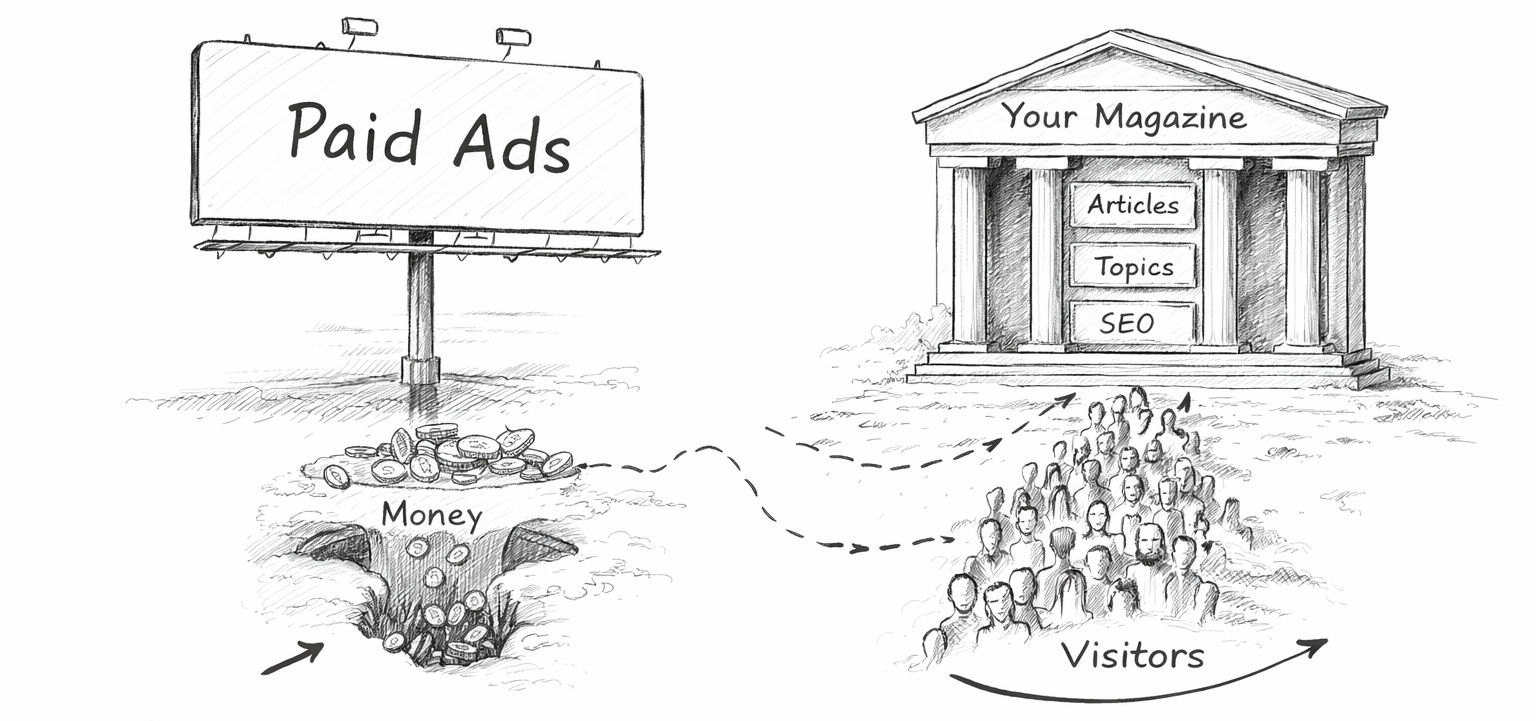
A large proportion of marketing expenditure flows into paid advertising. Search engine ads, display advertising, sponsored posts. These measures work. They generate reach, clicks and, in some cases, sales.
But they leave no trace.
As soon as a company stops paying, visibility ends. There remains no archive, no growing stock, no body of content that continues to develop. Every new euro only has an impact for the moment. After that, it is used up.
Over the years, this creates a paradoxical situation: companies invest considerable sums of money - and yet are always back at the same starting point.
Activity is no substitute for a foundation
Alongside advertising, a lot of energy is invested in ongoing activities. Content is produced, articles are published, channels are maintained. This conveys dynamism and presence. To the outside world, it looks as if the company is constantly visible. But this activity is fleeting.
In social networks, a post often disappears from view after just a few days. Content cannot be found systematically, is not interlinked and is not developed over the long term. Knowledge dissolves in the stream.
What remains is effort - without compression.
Why it worked for so long
This model was sufficient for many years. Reach was favorable, competition was manageable, attention was easier to gain. Companies could be visible with a manageable investment without having to think more deeply about sustainability.
Today, conditions have changed. Budgets are increasing, attention is decreasing, channels are becoming denser. At the same time, platforms expect more and more continuous activity in order to maintain visibility.
What was once intended as an amplifier has become a continuous operation.
Marketing as consumption instead of development
In hardly any other area of a company is there as little talk about inventory as in marketing. Machines are purchased, software is implemented, processes are documented. Marketing, on the other hand, is often treated as an ongoing cost item.
- Money in, effect out.
- And the next month, everything starts all over again.
This logic is not wrong - but it is incomplete. It ignores the fact that communication can also be infrastructure. That content can grow, mature and increase in value if it is given a fixed location.
Fragmentation instead of direction
Another effect of this development is fragmentation. Companies serve many channels simultaneously, often without a clear focus. A little here, a little there. Each measure can be justified on its own, but together they do not form a coherent picture.
There is no center from which everything else can be meaningfully supplemented. Instead, there is a feeling of permanent movement without any real direction. Marketing becomes a reaction, not a design.
Short-term key figures provide control. Click figures, reach and interactions can be displayed quickly. They give the feeling of having something under control.
What they do not show is the long-term effect. They say nothing about whether a company can still be found in five years' time, whether content is still effective or whether knowledge has been lost. What counts in the long term is often harder to measure - and is therefore suppressed.
When efficiency becomes a boomerang
Many of today's measures are efficient in the narrower sense. They produce visible results with little effort. But this efficiency has a price: it prevents development.
What appears efficient in the short term can be expensive in the long term because it does not create any substance. Companies remain dependent on constant commitment - and lose the opportunity to gradually become freer.
After all this, a simple but uncomfortable question arises: What media substance does your company have today that still exists even if budgets are cut, campaigns ended or platforms changed?
If the answer remains vague, this is not due to a lack of competence. It is the logical consequence of a system that rewards visibility - but does not provide for ownership.
The next chapter therefore deals with the flip side of this model: the risks that arise when companies rely permanently on external platforms - and why this dependency is far more than just a marketing problem.
Current survey on digitalization in everyday life
Platform dependency as an entrepreneurial risk
Platform dependency rarely feels like a risk. It doesn't come from a single decision, but from many small, seemingly sensible steps. An additional channel here, a new format there, another budget to remain visible. Each measure in itself seems comprehensible, almost without alternative.
This is precisely why this dependency is not perceived as such for a long time. As long as there is reach and the figures are right, everything seems stable. Only when something changes does it become apparent how little control there actually is.
When rules are made from outside
Digital platforms are not neutral infrastructures. They are economic systems with their own interests, their own priorities and their own goals. These goals can change - and they do so regularly.
What brought reach yesterday may lose importance tomorrow. Formats are favored or downgraded, visibility is rebalanced, organic reach is restricted. These changes do not affect individual companies, but entire markets - and are beyond any individual influence. Companies adapt because they have to. Not because they want to.
A central entrepreneurial principle is: if you are dependent on a factor that you do not control, you bear a risk. This is exactly what applies to platform reach. There is no guarantee of visibility. No contractually guaranteed minimum reach. No planning security over months or years. Even presences that have been built up over many years can lose their impact within a short space of time.
This makes platform reach an unstable foundation - especially if it is the only or most important communication channel.
The deceptive proximity to the target group
Platforms convey a feeling of direct proximity. Comments, likes and messages generate interaction. But this closeness is mediated. It takes place within a system that can change rules at any time.
Contact with the target group is not direct, but filtered. Content does not reach people because it is relevant, but because it fits into a certain grid. This grid is not transparent and cannot be negotiated.
What appears to be a relationship is actually temporary access.
When the channel itself becomes a bottleneck
At some point, many companies experience that their content has less impact. Reach stagnates, interactions decline, even well-made posts disappear into the background. The reaction to this is usually hectic.
New formats are tried out, new platforms developed, strategies adapted. What is lost in the process is calm and continuity. Communication becomes reactive instead of forward-looking.
The company follows the platforms - instead of setting its own direction.
Attention as borrowed capital
In traditional business models, borrowed capital is considered sensible as long as it is used in a targeted manner. It becomes dangerous when the entire system depends on it. In the case of platforms, attention is paid to this debt capital.
If customer contacts, brand perception and information transfer run almost exclusively via external systems, the company has no communication space of its own. It has no place where it can speak independently. This is not a theoretical risk, but a practical one. It always becomes apparent when framework conditions change.
Another aspect is rarely addressed openly: Uncertainty. Platforms work with automated checks, guidelines and filters. Errors, misunderstandings or blanket assessments can hardly be clarified. When in doubt, a company is faced with a form rather than a contact person. Decisions are often incomprehensible and corrections are lengthy or impossible.
This uncertainty cannot be hedged against. It can only be avoided - by becoming more independent.
Growth without a foundation remains fragile
Platforms are ideal for increasing reach quickly. They are amplifiers. But amplifiers are no substitute for a foundation. If growth is based solely on them, it remains vulnerable.
As soon as the amplifier becomes weaker, everything collapses. Visibility, perception, contact. What is missing is something that carries you, even when it gets quieter.
All this does not mean that platforms are fundamentally problematic. They fulfill an important function. They can draw attention, disseminate content and facilitate new contacts.
It only becomes problematic when they become the basis. When companies start to bind their entire communication to external rules and in doing so renounce their own property.
Platforms should be feeders, not living space.
When reach fluctuates, rules change and visibility is determined by others, the desire for something of one's own inevitably arises. For a place that is not dependent on trends, algorithms or third-party business decisions.
This is exactly where the idea of digital ownership begins. Not as a marketing idea, but as a business necessity. The next chapter therefore deals with the question of what a company magazine really is in this context - not as another channel, but as an infrastructure that brings control and calm back into the system.

The company magazine as digital property
Up to this point, the main focus has been on what is missing: stability, control, continuity. At this point, a conscious change of perspective is worthwhile. A company magazine is not an additional marketing channel that you „also“ have to serve.
Properly understood, it is something completely different. A company magazine is infrastructure.
Just as a company builds up production resources, IT systems or organizational structures, a magazine creates its own media space. A place where content not only appears, but remains. A place that is not dependent on short-term attention, but is designed for long-term impact.
Ownership begins with control
The key difference between rented visibility and digital ownership lies not in the design, not in the text style and not in the reach. It lies in the control. A magazine is only real property if the company itself decides:
- where it runs
- how it is structured
- what happens to the content
In concrete terms, this means that the magazine must be operated on its own infrastructure. On its own server or at least in an environment that is completely under its own control.
Everything else remains a form of rent.
Why your own server is more than just a technical detail
At first glance, having your own server seems like a technical issue. In reality, it is a business decision. If you operate content on your own infrastructure, you decide on availability, archiving and further development.
No one can downgrade, restrict or remove content because business models change or rules are adapted. No one decides on visibility except the company itself.
This form of control creates calm. And calm is an underestimated resource in today's communication.
There are enough systems - the decisive factor is how they are used
Today, there is no shortage of suitable content management systems. There are mature, stable tools that can be used to operate magazines in the long term. The decisive factor is not which system is used, but how it is used.
A system that runs on your own server, is open and allows content to be exported creates independence. A solution that is convenient but includes content in a third-party cloud creates new dependencies.
Convenience pays off in the short term. Ownership pays off in the long term.
A company magazine is not a place where you compete for attention. It is a place where content is allowed to have a context. Articles are not isolated next to each other, but build on each other. Thoughts can be deepened, supplemented and updated.
The magazine becomes the home of your own content
While platforms focus on speed and reaction, the magazine allows for classification and depth. It does not force constant activity, but rewards clarity and continuity.
Today, there is a large selection of sophisticated content management systems that are suitable for precisely this purpose.
The top priority for many companies is WordPress - not by chance, but because:
- it open
- widespread
- Long-term care
- and flexibly expandable
The distinction is important here:
- WordPress on your own server
- not a hosted platform solution
There are also other systems such as:
These systems also allow complete control, provided they are operated by the user.
WordPress itself installiere - explained step by step
installoday, setting up WordPress is much easier than many people think. This video shows step by step how to set up WordPress yourself - calmly, comprehensibly and without assuming any prior technical knowledge. In the example, the installation is carried out at ALL-INKL, but the procedure can easily be transferred to other hosters such as Strato or 1&1.

▶︎ WordPress 2025 [in just 6 minutes] | KopfundStift Blog
The video gives you a feel for what is really important, where the typical pitfalls are and why it makes sense to run WordPress on your own hosting environment. Ideal if you want to stay in control and set up your website properly right from the start.
Content can age - and win in the process
Another difference becomes apparent over time. Content in social networks ages badly. It quickly loses visibility and disappears into the stream. Content in a magazine ages differently.
They are found, quoted, linked. They can be updated, expanded and placed in new contexts. A good article becomes more valuable over time, not worthless.
The magazine thus becomes a growing collection, not a sequence of moments.
Having your own magazine also changes the way content is created. Instead of constantly having to react, a company can plan topics. Set priorities. Build connections. Communication becomes slower - but clearer. Less loud, but more sustainable. Structure is created instead of constant fire.
For readers, this means orientation. For companies, it means sovereignty.
Search engines as an amplifier, not a risk
It is often feared that having your own magazine makes you dependent on search engines. In fact, the opposite is the case.
Search engines work best where content is permanently available, clearly structured and thematically clear.
A magazine on its own infrastructure provides precisely these conditions. Search engines do not become gatekeepers, but rather amplifiers of what is already there.
Visibility is not created by tricks, but by existence.
The magazine as a quiet center
In an age of permanent sensory overload, a company magazine seems almost old-fashioned. And this is precisely where its strength lies. It is not a place for haste, but for classification. Not a place for trends, but for attitude.
For companies, this means less pressure, more clarity. Communication can be shaped again instead of being driven.
The magazine becomes the calm center around which everything else can be arranged sensibly.
Up to this point, it is clear that a company magazine creates digital property because it is based on control, structure and inventory. What spoke against it for a long time was the effort involved. Time, costs, personnel.
This is precisely where a development comes in that has changed everything. The next chapter therefore deals with the role of artificial intelligence - not as a fad, but as a turning point that makes the creation of own content realistic and economical for the first time.
Why AI marks the decisive turning point
For many years, there was a very practical reason why companies did not set up their own magazine despite all the insight: It was simply too costly. Good content was not created on the side. It required time, experience, coordination and often external support.
An in-depth article used to take several working days. Topics had to be prepared, texts written and corrections agreed. This was feasible for large companies, but often not for smaller ones. The desire for in-house content was there, but the reality was different.
This bottleneck has shifted fundamentally in recent years.
AI does not change the claim, but the feasibility
Artificial intelligence is often misunderstood. Not as a tool, but as a substitute. That is exactly what it is not. AI does not replace an entrepreneurial attitude, specialist knowledge or responsibility. But it does replace something else that has long blocked the development of our own content: Friction.
Many steps that used to take up time and concentration can now be structured, prepared and accelerated. Thoughts can be organized, rough drafts created, contexts worked out neatly. Not automatically good - but easy to prepare.
This fundamentally changes the feasibility.
From exceptional project to plannable task
What used to be a special project is now a plannable task. Content is no longer only created when capacity is available, but as part of a process. Topics can be prepared, worked out in stages and developed over longer periods of time.
That is a crucial difference. A corporate magazine does not live from individual highlights, but from continuity. AI makes precisely this continuity realistic without lowering the standards. Not faster at any price, but more consistent.
A common objection is that AI makes content superficial. This concern is understandable - but it falls short. Superficiality is not created by tools, but by attitude.
Used correctly, AI enables the opposite: it creates space for depth. Because less energy flows into formulation and structuring, more attention remains for content, argumentation and perspective. Thinking is not replaced, but relieved.
Current survey on the use of local AI systems
Content moves closer to the management level again
An interesting side effect of this development is that content is once again moving closer to the corporate decision-making level. Where previously it was outsourced, delegated and fragmented, it is now possible to work more directly.
Not because managing directors have to write texts themselves, but because they can specify topics, tone and direction more clearly. AI translates these specifications into text - without the detour of long coordination processes.
This makes the magazine less of a marketing tool and more of an expression of the entrepreneurial perspective.
Scaling without loss of control
Another turning point is scalability. In the past, more content automatically meant more staff, more coordination and more costs. Today, above all, it means better planning. Once a style has been defined, a clear thematic structure and a consistent tone can be continued without having to rethink each new piece from scratch. Quality no longer comes from individual battles, but from a systematic approach.
This makes long-term media work calculable - and therefore commercially viable.
Making visible what has long been there
Many companies have an enormous amount of knowledge. Experience from projects, decision-making processes, backgrounds, assessments. This knowledge exists - but is rarely made visible. Not because of secrecy, but because it was too costly to publish.
AI helps to structure this existing knowledge and make it accessible. Not as a self-presentation, but as a classification. The magazine thus becomes a place where expertise is not asserted, but explained.
One point is crucial here: AI only makes sense if it is managed. Content gains value not because it is created automatically, but because it is consciously designed.
A magazine that uses AI as a tool remains human. It carries attitude, experience and responsibility. AI ensures that this attitude can be conveyed efficiently. The difference is subtle - but decisive.
The economic tipping point
All of these aspects lead to a clear result: the economic tipping point has shifted. What was previously only possible with large budgets can now be achieved at a manageable cost.
Having your own magazine is no longer a prestige project. It is a realistically calculable project - even for smaller companies. This removes the last argument against building up your own media substance.
If platforms are unstable, advertising remains transient and content can be planned thanks to AI, then there is a logical consequence. Companies can start to build something of their own again - without overextending themselves.
The last chapter is therefore about bringing this idea together. Not as a technical issue, but as a business decision. And the question of what remains when reach disappears - and ownership begins.

Conclusion: Reach is not ownership
If you look at the previous chapters together, one thought runs like a red thread through the entire text:
Visibility alone is not enough. It can help, it can accelerate, it can strengthen - but it does not replace a foundation.
Many companies have learned to generate reach. Few have learned to build something of their own that lasts independently. This is precisely the core of this article.
Range feels like ownership - but it's not
Follower numbers, clicks, subscribers and views create a feeling of progress. They are visible, comparable and seemingly tangible. But they do not belong to the company. They exist within external systems and are subject to external rules.
What has reach today may disappear tomorrow. Not arbitrarily, but because priorities change, algorithms are adapted or business models shift.
Range is borrowed. Ownership is something else.
The idea behind „Reach is not ownership“
The article „Reach is not ownership“ has already addressed this point and looks at it primarily in the context of social media. The core message is simple but far-reaching: those who communicate exclusively on external platforms are not building up their own assets - neither medially nor strategically.
This text goes one step further. It shows that this insight applies not only to social media, but to all corporate communications. Wherever visibility is rented, there is a lack of substance in the long term.
The company magazine as an answer, not a promise
Having your own magazine is no guarantee of success. Nor is it a quick route to reach. And that is precisely what makes it valuable. It is an answer to the question of how companies can regain control - not through volume, but through structure.
A magazine creates a place where content can remain. Where thoughts can be expressed. Where knowledge does not disappear into the stream, but collects. It does not replace other channels, but gives them direction.
Platforms attract attention. The magazine holds them.
Ownership changes the view of communication
As soon as content is understood as property, the perspective changes. Communication becomes less hectic, less reactive. It no longer focuses on short-term effects, but on long-term impact.
Questions are shifting. It's no longer about what works the loudest today, but about what will still be relevant in a year's time. It's no longer about trends, but about attitude.
This shift is subtle, but fundamental.
Why this path is realistic today
For a long time, there were many arguments against developing your own media: lack of time, costs, complexity. These arguments are losing weight. Technical hurdles have fallen, tools have matured and processes can be planned. Artificial intelligence has not taken on the role of author, but that of enabler.
Setting up your own magazine is no longer a question of size or budget, but a question of choice.
An invitation to take stock honestly
Finally, it's worth asking a simple but honest question: what would remain of your corporate communications if you didn't run any advertising, platforms or campaigns for a while?
If the answer is sobering, this is not a flaw. It is the normal state of many companies. This is precisely why this topic is relevant.
Having your own magazine is one way to change this situation. Not overnight, not spectacularly - but permanently.
Purchase a ready-made magazine and start straight away
 If, while reading this article, you had the feeling that traditional advertising is increasingly looking like a bottomless pit for many companies, then you are not alone in this impression. More and more entrepreneurs are realizing that although reach can be bought at a high price, it rarely lasts. This is precisely why it is now possible to purchase a technically prepared company magazine as a professional basis and use it directly for productive purposes.
The infrastructure is already in place: cleanly structured, internationally expandable, search engine-friendly, AI-supported and designed to build up real digital inventory over the years. Instead of constantly burning through new advertising budgets, a growing system of content, visibility and trust is being created step by step.
The decisive factor here is that the content belongs to your company itself. No rented reach, no complete platform dependency, but your own foundation that can grow in the long term. If you start building media ownership today, you will gain a head start in many sectors that will be hard to catch up on in a few years' time.
Further information on the finished company magazine
What remains
Reach comes and goes. Platforms change. Formats become obsolete.
What remains is what you build yourself.
A company magazine is not a trend. It is a return to an entrepreneurial principle that has never stopped working: Ownership creates stability.
And stability is a good basis for everything that is to follow.
Old SEO rules, new media world: Why content is more important than traditional advertising today
 An interesting aspect of modern magazine and visibility strategies often only becomes apparent in retrospect. A detailed article about this appeared in this magazine back in 2011, how to optimize websites for search engines with topics such as keyword research, link structure, page titles, comprehensible content and long-term findability. What is particularly remarkable is how many of these basic principles still apply today. Although search engines, AI systems and user behavior have changed massively, the actual basis remains the same: visibility is created in the long term primarily through content with substance.
This is precisely why magazines, knowledge platforms and thematically strong articles are becoming more important than traditional advertising for many companies today. While advertisements disappear, a well-written specialist article often remains visible for years, is picked up by search engines, AI systems and social networks and thus develops into digital property instead of short-term attention. Looking back, the old SEO article shows surprisingly well how early many of these developments were already in place.

Frequently asked questions
- What exactly is meant by „rented visibility“?
Rented visibility means that a company receives reach, but does not have this reach permanently. This is typically the case with paid advertising or platforms that only display content for as long as you continue to deliver or pay for it. As soon as budgets expire or activity decreases, visibility also decreases. The company has then not built up any lasting substance, but has bought or borrowed attention. - Why is reach alone not a sustainable corporate value?
Reach is seductive because it is measurable and feels like progress. However, it only becomes sustainable when it is linked to something that remains: content that can be found permanently, an archive, a structured knowledge base and a place that the company controls. Reach can be an amplifier, but it is not an asset if it is created without ownership. - Does this mean that advertising and social media should be left out completely?
No. The point is not abandonment, but classification. Advertising and social media are good supplements if they contribute to a foundation of their own. It becomes problematic when they replace the foundation. This creates a permanent dependency, and the company has to keep adding to it in order to remain visible at all. - What is the difference between a company magazine and a normal blog?
A blog is often a loose collection of posts that tend to be written on an ad hoc basis. A company magazine is more structured, thematically planned and long-term. It's not just about publishing something, but about building knowledge, linking content and developing trust over time. The magazine is therefore less of a „channel“ and more of an infrastructure. - For which companies is it particularly worthwhile to have their own magazine?
A magazine is particularly useful for companies that offer services that require explanation, need to build trust or work in a market where expertise and classification are crucial. These are often service providers, consultancies, craft businesses with specialization, IT companies, healthcare providers or industries with high comparability. In principle, however, smaller companies also benefit if they want to establish a clear position and communicate more independently. - Isn't a magazine like this extremely time-consuming?
It can be time-consuming if you work without structure or lose yourself in perfection. With clear topic planning and a sensible process, the effort is easily manageable. Above all, AI has changed the situation: Content can now be prepared and elaborated much faster without sacrificing quality. The decisive factor is regularity in the right measure, not constant pressure to publish. - What specific role does AI play in this?
AI helps to organize thoughts, develop outlines, formulate rough drafts, create variants and make texts linguistically clean. It does not replace the responsibility of the company, but takes over mechanical work. The content remains human, but the way to get there is much more efficient. This makes continuous content work realistic even for small teams. - Isn't there a danger that AI texts could appear arbitrary or interchangeable?
This danger exists when AI is used without guidance. A good text is not created by a tool, but by a clear perspective, experience and a clean choice of topics. If the company specifies what it stands for, what attitude it has and what content is really relevant, AI can help to efficiently translate this substance into an understandable form. Arbitrariness arises where attitude is lacking, not where AI is used. - Why is it so important that the magazine runs on its own server?
Because control is the core of ownership. Having your own server means data sovereignty, independence and continuity. Content cannot simply be downgraded or removed because a platform provider changes rules or a business model. Content can also be backed up, exported and further developed in the long term. If you publish on third-party infrastructure, you have an interface, but no real ownership. - Isn't a hosted solution like WordPress.com or another platform enough?
This can work for a quick start. For long-term independence, however, it is risky because you become dependent again. Hosted platforms can change prices, conditions and functions. In the worst case, your own presence is restricted without you having any real control. When it comes to ownership, the infrastructure should belong to the company, not a provider. - Which content management systems are suitable for this?
In practical terms, the name of the system is less important than the question of whether it is self-operated and maintained in the long term. WordPress is attractive for many companies because it is widespread, flexible and easy to expand. However, there are also other established systems that are suitable for in-house infrastructures. Above all, it is important that content is not trapped in a closed cloud and that the company retains control at all times. - Does a company magazine need to be constantly updated to be effective?
A magazine works differently than social media. It doesn't need new articles every day. It needs continuity and structure. A good, well-founded article can be effective for years if it is well structured and thematically appropriate. Updates make sense, but more as maintenance of an inventory, not as a hectic production pressure. - How long does it take for a magazine to produce measurable results?
This depends on the industry, topics and initial situation. The first effects are often noticeable after a few months, when content becomes established in search engines and is linked to. The full strength usually becomes apparent over longer periods of time because the magazine grows as a portfolio. The crucial point is that a magazine becomes stronger over time, whereas short-term advertising measures lose their effect immediately after they have ended. - What content is best suited for a company magazine?
Content that makes expertise visible and provides orientation is most suitable. This could be explanatory articles, background information, case studies, classifications, decision-making principles or typical questions from practice. The more clearly a company defines its subject areas, the easier it will be to build up a portfolio that really works. - In the end, isn't this just content marketing under a new name?
The proximity is there, but the focus is different. Traditional content marketing is often campaign-driven and strongly focused on short-term metrics. The corporate magazine in this approach thinks in terms of ownership, archive, structure and long-term impact. It is less „tactics“ and more „infrastructure“. This makes it calmer, but also more sustainable. - What does search engine optimization have to do with it?
Search engines work particularly well where content is permanently available, clearly structured and thematically related. A magazine creates precisely these conditions. SEO becomes less of a game of tricks and more of a by-product of good, stable content. If the foundation is right, many effects arise almost automatically. - What typical mistakes do companies make when setting up a magazine?
The most common mistake is to want too much too quickly. This creates pressure and the magazine becomes a stress factor. Another mistake is to start without a structure, so that content stands side by side but does not form a system. And many underestimate the importance of their own infrastructure by tying themselves back to platforms. A magazine works best when it starts small, is clearly planned and consistently focuses on ownership. - How can you combine social media with the magazine in a meaningful way?
Social media is an excellent way of attracting attention. The magazine is the place where this attention arrives and is sustained. A clear division of roles makes sense: social media provides impetus, teases, refers. The magazine provides depth, context and permanent findability. This is how reach becomes substance. - Is it possible to buy such a magazine from you as a ready-made basic system?
Yes, that is possible. There is the option of acquiring a corporate magazine as a clean basis, built on your own infrastructure and structured in such a way that content can be built up over the long term. - What is the first step if you want to take something like this seriously?
The first step is a sober stocktaking: which topics are really relevant, what knowledge is already available and which target group should be reached? After that, it is worth creating a clear structure that focuses on meaningful priorities rather than masses. Once this foundation is in place, the technical implementation is just a tool - and no longer the real hurdle.