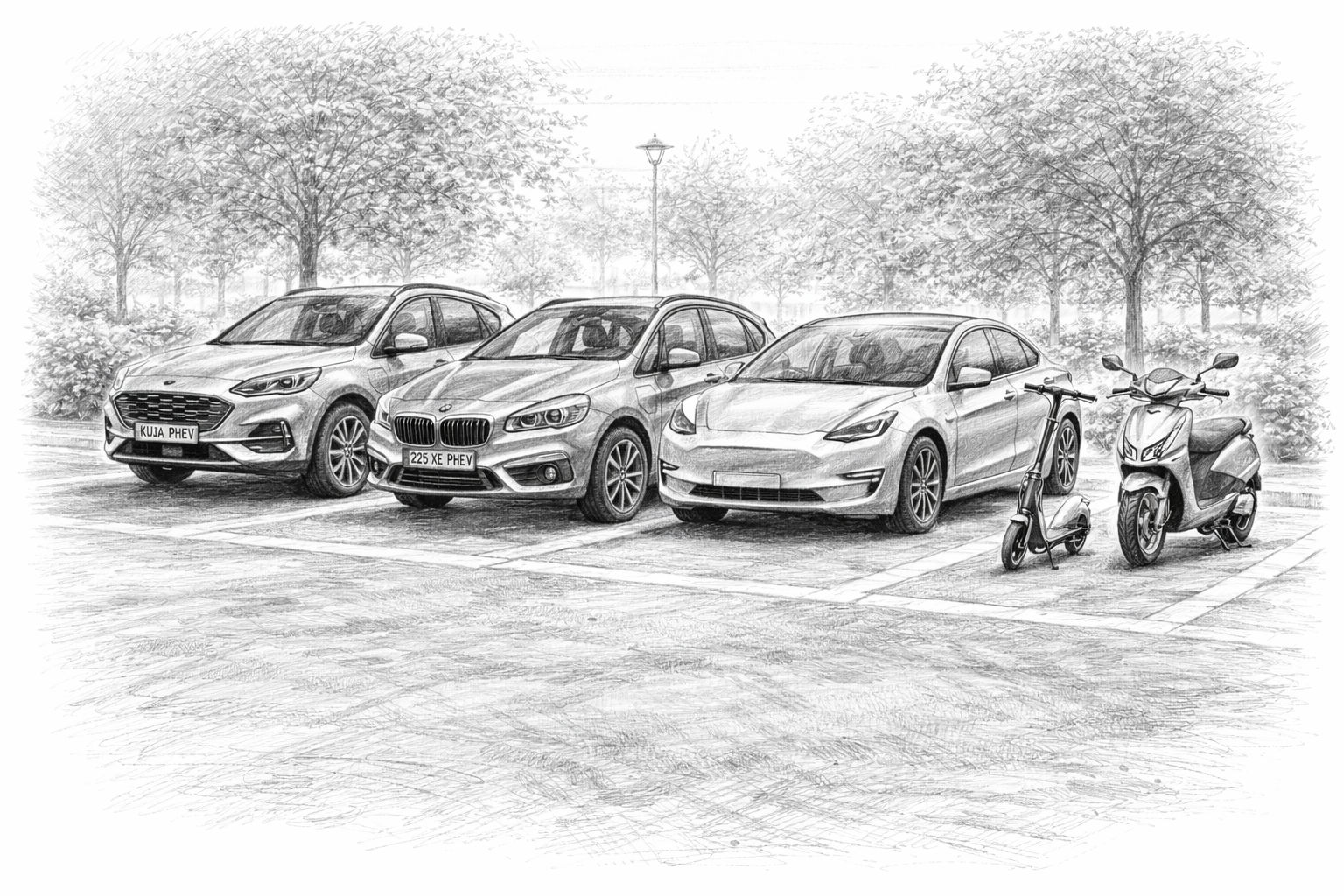
For many people, electromobility is an abstract topic, characterized by political debates, subsidy programs and marketing promises. In practice, however, a completely different picture emerges as soon as you drive an electric vehicle yourself. Today, personal experience often goes further than any theoretical discussion - from e-scooters and electric scooters to hybrid vehicles.
This perspective is important because electromobility rarely starts where it is publicly discussed. It doesn't start with the electric car, but much earlier - with small, lightweight vehicles, short distances and very pragmatic everyday issues.




Electromobility is not a uniform concept
A key mistake in many discussions is to view electromobility as a single, homogeneous system. In reality, we are talking about very different vehicle classes with completely different areas of application:
- E-scooter (for hire)
- Electric scooters for city traffic
- Hybrid and plug-in hybrid vehicles
- Pure electric cars
These concepts cannot be meaningfully compared with each other without considering their respective purpose. What makes sense for an e-scooter may be completely unsuitable for a car - and vice versa. Electromobility only works convincingly where the application and technology are a good match.
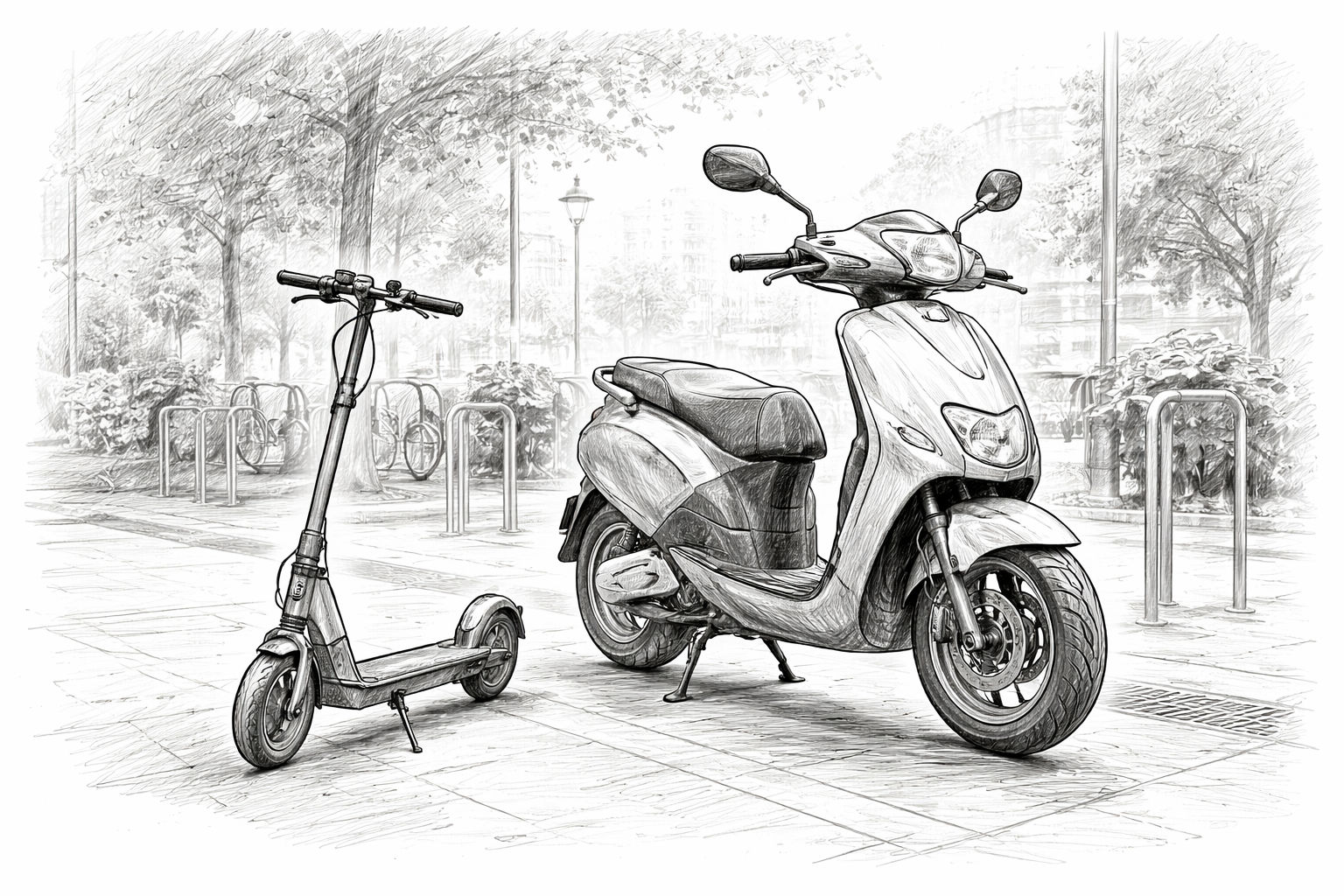
E-scooter (for hire): Mobility for short distances
For many people, e-scooters are their first contact with electric mobility. They are quickly available for hire, can be used at a low threshold and do not require any investment on your part. They can be practical for short distances, especially as a supplement to other means of transportation. At the same time, e-scooters very clearly show the limits of electric micromobility:
- Limited driving stability
- Hardly any safety reserves
- Strong dependence on the respective provider
- Conflicts in public spaces
Borrowed e-scooters are not a fully-fledged means of transportation, but a bridging tool. They do not replace bicycles or cars, but rather fill gaps in a situation. They can work within this framework - beyond that, they quickly reach their limits.
With your own e-scooter, you can cover predictable short distances reliably and as quickly as with a bicycle.
Electric scooters: a coherent application scenario
Electric scooters represent a clear step towards electric mobility suitable for everyday use. They are quiet, low-maintenance and well suited to city traffic. The ranges are limited, but realistically calculated - and that is precisely what makes them practical. Electric scooters are particularly convincing where there are clear expectations:
- Short to medium distances
- Predominantly inner-city use
- Charging at the normal socket
- No claim to long-distance suitability
Of course, electric scooters also have limitations, for example in terms of weather or speed. However, these disadvantages are transparent and calculable. Claims and reality are close together - a decisive factor for acceptance.
Small electric vehicles in particular show when electromobility makes sense. It works particularly well where it:
- does not create a new dependency
- does not create additional complexity
- existing processes simplified
E-scooters and electric scooters make it clear that electromobility is not a fundamental failure. It fails above all where it is overstretched - where attempts are made to make a single concept suitable for all life situations.
Charging infrastructure must be available
Even with electric scooters, however, it is clear in practice that electromobility can never manage entirely without infrastructure. Although the requirements are significantly lower than for electric cars, a real charging facility is still needed. If you live on the first floor, have a parking space with a socket or can remove the battery and charge it in your home, there are hardly any problems.
However, things become more difficult in classic apartment buildings without suitable connection options. If you live on the third floor and don't have access to a socket outside, you quickly face a practical obstacle. Temporary solutions such as long extension cables from the window or lugging a 10 kg battery into the apartment every time are neither practical nor suitable for everyday use. The same applies here: electric mobility only works smoothly if the framework conditions are right - even for comparatively simple vehicles such as electric scooters.
Security: little protection, high responsibility
Electric scooters and e-scooters are among the vehicles with the least passive protection in road traffic. There is no crumple zone, no bodywork, no airbags - the body is directly exposed to the traffic. At the same time, the vehicles are fast enough to cause serious injuries in the event of a fall or collision.
Added to this are comparatively long braking distances, small wheels and a high susceptibility to bumps in the road. Anyone opting for this form of mobility must therefore ride extremely defensively and with foresight. For safety-conscious people who value protection and reserves, e-scooters and electric scooters are only suitable to a limited extent. Electromobility may seem quiet and uncomplicated - but the physical risks remain real and should not be underestimated.
Anyone looking at these early forms of electric mobility quickly recognizes a central pattern: electric mobility works best when it complements, not replaces. This is precisely where hybrid vehicles come into play - as an attempt to combine electric advantages with classic range.
Hybrid vehicles: the underestimated interim solution
Hybrid vehicles have a difficult time in the public perception. For some they are not consistent enough, for others they are already too complicated. Yet their strength lies precisely in this intermediate position. Hybrids do not attempt to completely replace an existing form of mobility, but rather to combine two proven concepts in a sensible way.
From today's perspective, hybrid drives are not so much a compromise as a realistic response to different driving profiles. They take account of the fact that mobility is not the same for everyone - and that technology must adapt to this diversity.
What types of hybrid vehicles are available
The term „hybrid“ is often used indistinctly. In fact, there are several technically different concepts that differ significantly in everyday life:
- Mild hybridA small electric motor supports the combustion engine, usually when starting off or accelerating. Purely electric driving is not possible.
- Full hybridThe vehicle can cover short distances purely electrically, but charges itself exclusively via recuperation and the combustion engine.
- Plug-in hybridAdditional external charging via the socket, larger battery, significantly longer electric range.
This distinction is crucial because it determines how much electric mobility can actually be used in everyday life.
Why even modern gasoline engines have become „more electric“
Regardless of the vehicle class, there is a clear trend: even classic petrol engines are becoming increasingly electrified. Small electric motors with 10 to 20 hp are no longer a rarity. They improve:
- Start-up behavior
- Acceleration in the lower speed range
- Recuperation during braking
- Consumption and emission values
This explains why many modern vehicles feel more direct, powerful and confident than their predecessors - despite similar engine performance. Electromobility has long since arrived in everyday life here, often without being consciously noticed.
Current survey on electromobility
The plug-in hybrid as a sensible centerpiece
From today's perspective, the compact plug-in hybrid is proving to be a particularly well-balanced solution. The decisive factor here is not maximum range, but a coherent overall package. A small plug-in hybrid offers:
- Electric journeys in everyday life
- Full range for longer distances
- Independence from charging infrastructure
- Manageable vehicle weight
Large plug-in SUVs weighing two tons and with huge batteries often fail to achieve this. They combine high resource consumption with limited efficiency - and thus counteract the original idea of the hybrid drive.
Range is relative - the driving profile decides
A key issue with hybrid vehicles is the question of electric range. However, this cannot be answered in general terms, but depends directly on the individual driving profile.
- Anyone who commutes 150 kilometers a day needs a significantly greater electric range.
- If you don't commute and mainly drive short distances, you can get by with significantly less.
For many people, the daily mileage is less than 40 kilometers. In these cases, a small battery is perfectly sufficient to cover the majority of everyday journeys electrically. A larger battery offers hardly any advantages here - but increases weight, costs and complexity in everyday life.
Weight is often an underestimated factor
A larger battery not only means more range, but also more weight. This additional weight:
- increases consumption in combustion mode
- Deteriorates driving dynamics and braking behavior
- Loaded chassis and tires
This is why restraint makes sense, especially with hybrid vehicles. A well-balanced plug-in hybrid thrives on efficiency, not on maximum values. More is not automatically better.
Of course, this assessment will change in the future. New battery technologies promise:
- Higher energy density
- Lower weight
- Shorter loading times
Both hybrid and electric vehicles will benefit from this. However, the considerations described here deliberately refer to the current state of the art - and to what is realistically available in everyday life today.
Hybrid vehicles are neither a temporary solution out of convenience nor a technical aberration. They are a functional bridge between the existing infrastructure and the electric future. Anyone who assesses them on the basis of their own driving profile and not on the basis of ideal images will quickly recognize their practical value. The next chapter looks at pure electric vehicles - their strengths, their limitations and the question of who they actually make sense for today.
Pure electric vehicles: driving fun with prerequisites
Pure electric vehicles are now an integral part of the road scene. I don't have any long-term driving experience of my own, but some points are so obvious that you can clearly classify them even without personal test drives. Two things in particular stand out:
- Firstly, the technical approach is fascinating.
- Secondly, the suitability for everyday use depends more than with other drives on the framework conditions.
It is plausible that a powerful electric car can offer a lot of driving pleasure. Torque, direct throttle response, smooth running - all this should be impressive in everyday life. At the same time, the crucial question does not start with the driving experience, but with the system behind it.
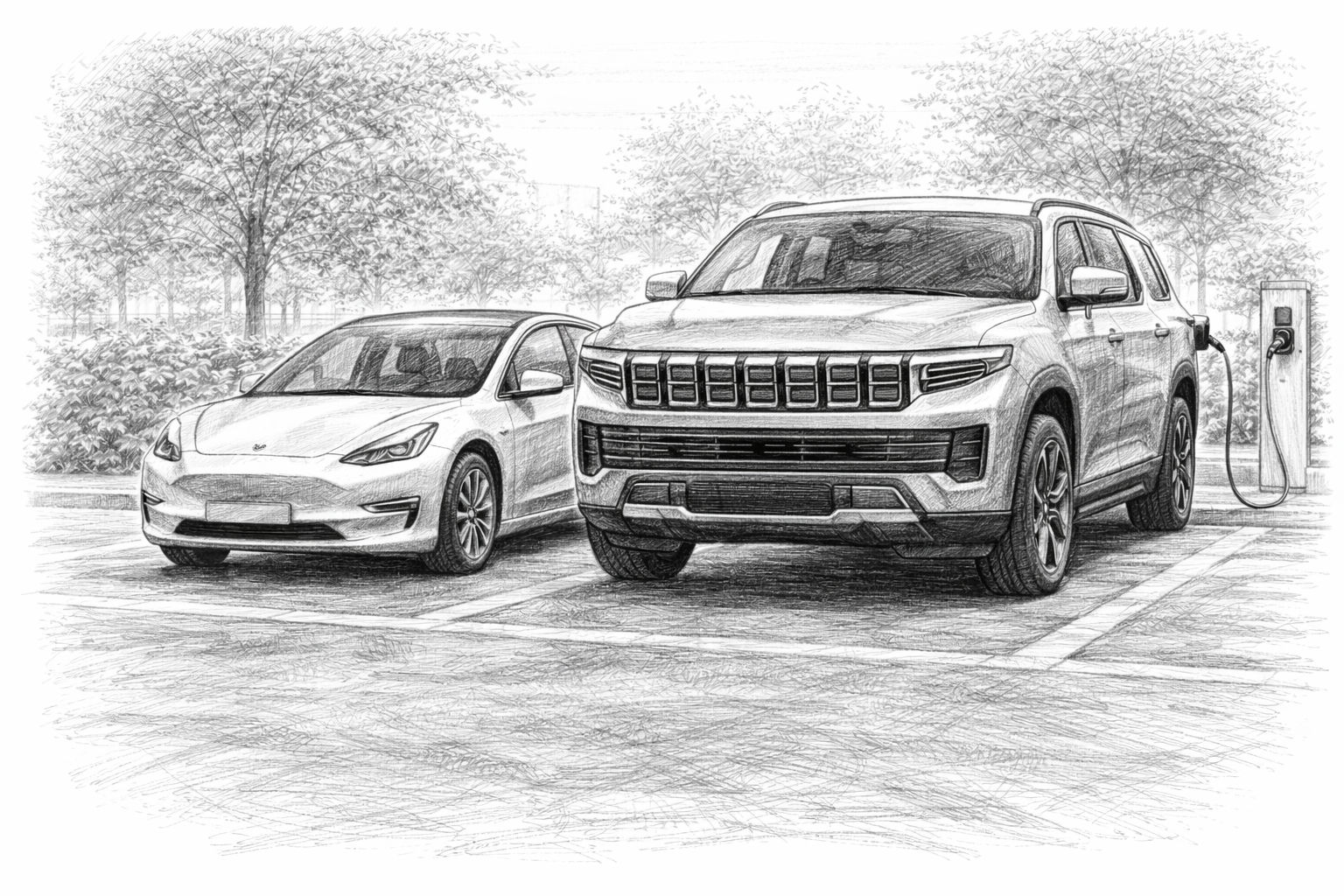
Reach is not just a number - it is also weight
The main bottleneck in today's electric cars is not so much the motor, but the battery. A simple principle still applies to current battery technology: more range means more battery - and more battery means more weight. This weight is not just a theoretical value. It has an impact:
- Efficiency (the car has to constantly „drag itself along“)
- Tire and brake wear
- Driving dynamics and braking distance
- Resource requirements in production
This creates an area of tension: range is desirable, but it has its price - and this price is not only financial, but also physical.
Charging is not a refueling process - it is infrastructure
With a combustion engine, the energy supply is trivial: filling station, five minutes, go on. With electric cars, the power supply is part of the overall system. And this system is not equally good everywhere.
The decisive factor is not just whether there is a charging station somewhere, but how quickly it can charge - and whether the vehicle can accept this power at all. A large battery is of little use if the charging power cannot keep up on the road or at home.
When charging power is low, a practical problem arises: it takes a long time until the range can be felt to be recharged. And not as an exception, but as a routine if the infrastructure is not suitable. This means that charging quickly becomes an organizational issue - and that is precisely what makes electromobility difficult for some people.
For whom is this actually worthwhile?
In the case of purely electric cars, it is not so much ideology that is decisive as the life profile. The question is not „Electric - yes or no?“, but rather: Does this system suit my everyday life?
A purely inner-city driver could theoretically seem ideal - short distances, low consumption. In practice, however, it seems paradoxical: large batteries are unnecessary for pure city driving, but small batteries generate range concerns, and heavy batteries are actually oversized for the purpose. In the city, the electric car therefore often seems like a large tool for a small task. The concept seems to make more sense where the driving profile can be planned:
- Commuters who know their daily route
- Trips with clear routines
- Range plus reserve that fits reliably
If you know that you can get there safely with the available range, and if charging at your destination or at home is well organized, an electric car can be very convenient in everyday life. The concept becomes even more attractive if you have your own electricity available - for example from solar power.
Wallbox, home connection, everyday life: the effort often lies with the user
An important difference to the combustion engine: with an electric car, part of the „vehicle quality“ is not created by the car, but by its surroundings. If you want to charge conveniently at home, you usually need a wallbox - and this is where issues that many people underestimate begin:
- Can a Wallbox 1TP12 be used at all?
- Is the existing house electrics sufficient?
- Does the house connection need to be adapted?
- What is the situation in apartment buildings?
- What are the costs for installation and permits?
Here it becomes clear: the electric car is not just a purchase decision, but often an infrastructure project. And depending on the living situation, this project can be easy, difficult or practically impossible. This shifts more responsibility to the user: if you want to drive smoothly in electric mode, you often have to create the conditions first.
Current survey on digitalization in everyday life
Life profile instead of driving profile
With a hybrid, the driving profile is the main deciding factor: how many kilometers per day, how often long distances, how often city traffic. With an all-electric car, there is a second level: the life profile.
- Do you live in such a way that loading at home is uncomplicated?
- Do you have a fixed parking space?
- Is a wallbox realistic?
- Are there reliable charging options at the workplace or nearby?
- Can everyday life be planned or is it more spontaneous?
The better these points fit, the more logical an electric car becomes. The worse they fit, the more electromobility becomes an organizational problem - and that is precisely what reduces acceptance.
Pure electric vehicles are technically fascinating and can be very convincing in the right setting. Their weakness lies less in the vehicle itself than in the prerequisites: Weight of the batteries, dependence on charging power, need for suitable infrastructure and the associated expense.
The electric car is therefore not a universal solution, but a solution for people whose everyday lives support the concept. And this is precisely where it becomes clear why the discussion often misses the point: Not everyone lives in conditions where electromobility works „just like that“.
The next chapter therefore deals with the practical level: concrete experiences with different vehicles and why hybrid solutions in particular are often the quieter, more realistic option in everyday life.
Classification by video: Drives explained clearly
This video from Auto, Motor und Sport provides a very helpful, factual classification for anyone who is unsure about which drive system to choose. Alexander Bloch explains clearly how full hybrids, plug-in hybrids and pure electric vehicles work technically, where their respective strengths and weaknesses lie and for which driving profiles they make sense.

Full hybrid, PHEV & electric: Which drive suits me? | auto motor & sport
Driving/life profiles and suitable vehicles in comparison
| Driving profile | Suitable vehicle types and instructions |
|---|---|
| Mainly short distances in the city (less than 40 km/day) | Plug-in hybrid with small battery or full hybrid. Pure electric car only makes sense if a wallbox is available. Petrol engine possible, but inefficient in short-distance operation. |
| City + occasional cross-country trips | Plug-in hybrid as a very balanced solution. Full hybrid also suitable. Pure electric car only with good charging infrastructure. Petrol engines can still be used without any problems. |
| Daily commuter (80-150 km/day, easy to plan) | Plug-in hybrid with greater electric range or purely electric car with reliable charging option at home or at work. Diesel still makes sense. |
| Long-distance drivers (often highway, >20,000 km/year) | Diesel or modern petrol engine. Plug-in hybrid only makes limited sense, as the additional weight brings hardly any advantages. Pure electric car only with very good fast charging infrastructure. |
| Irregular driving profile, changing routes | Plug-in hybrid or classic petrol engine. Electric cars can be complex to organize. Flexibility is more important here than maximum efficiency. |
| Vehicle is mainly used for short everyday trips | Full hybrid or plug-in hybrid with small battery. Pure electric car often oversized due to battery weight. Petrol engine technically feasible, but not very efficient. |
| Home with wallbox and photovoltaics if required | Pure electric car or plug-in hybrid makes a lot of sense. High suitability for everyday use due to own charging. Choice of vehicle depends more on driving profile than infrastructure. |
| Rented apartment without fixed charging option | Petrol, diesel or full hybrid. Plug-in hybrid only makes limited sense. Pure electric car mostly impractical due to dependence on charging. |
| Driving pleasure-oriented driver with moderate fuel consumption requirements | Plug-in hybrid with additional electric torque offers noticeable driving pleasure with reduced consumption. Modern petrol engine also suitable. |
| Maximum simplicity, no organizational effort required | Classic gasoline or diesel. No charging planning, no dependence on infrastructure. Electromobility here often involves additional expense. |
My own experiences: What works in my everyday life - and what doesn't
An important part of my own experience with electromobility does not start with a car, but with an electric scooter. Specifically, it is a 50cc scooter with an electric drive, visually based on a classic 125cc scooter. The top speed is around 50 km/h and the real range at full throttle is around 35 to 40 kilometers.
In everyday use, this is initially convincing: quiet, uncomplicated, no refueling, charging at the socket. The range is perfectly adequate for short distances in the city. At the same time, one of the downsides of electric two-wheeled mobility becomes very clear: the safety risk. With an electric scooter, you are comparatively fast on the road, but have:
- Little protection
- long braking distance
- High vulnerability in road traffic
This forces you to adopt a very defensive riding style. Anyone who rides an electric scooter must be constantly aware that riding fun and ease go hand in hand with a real risk. Electric mobility does not make scooters any more dangerous - but it does make it tempting to underestimate the dangers.
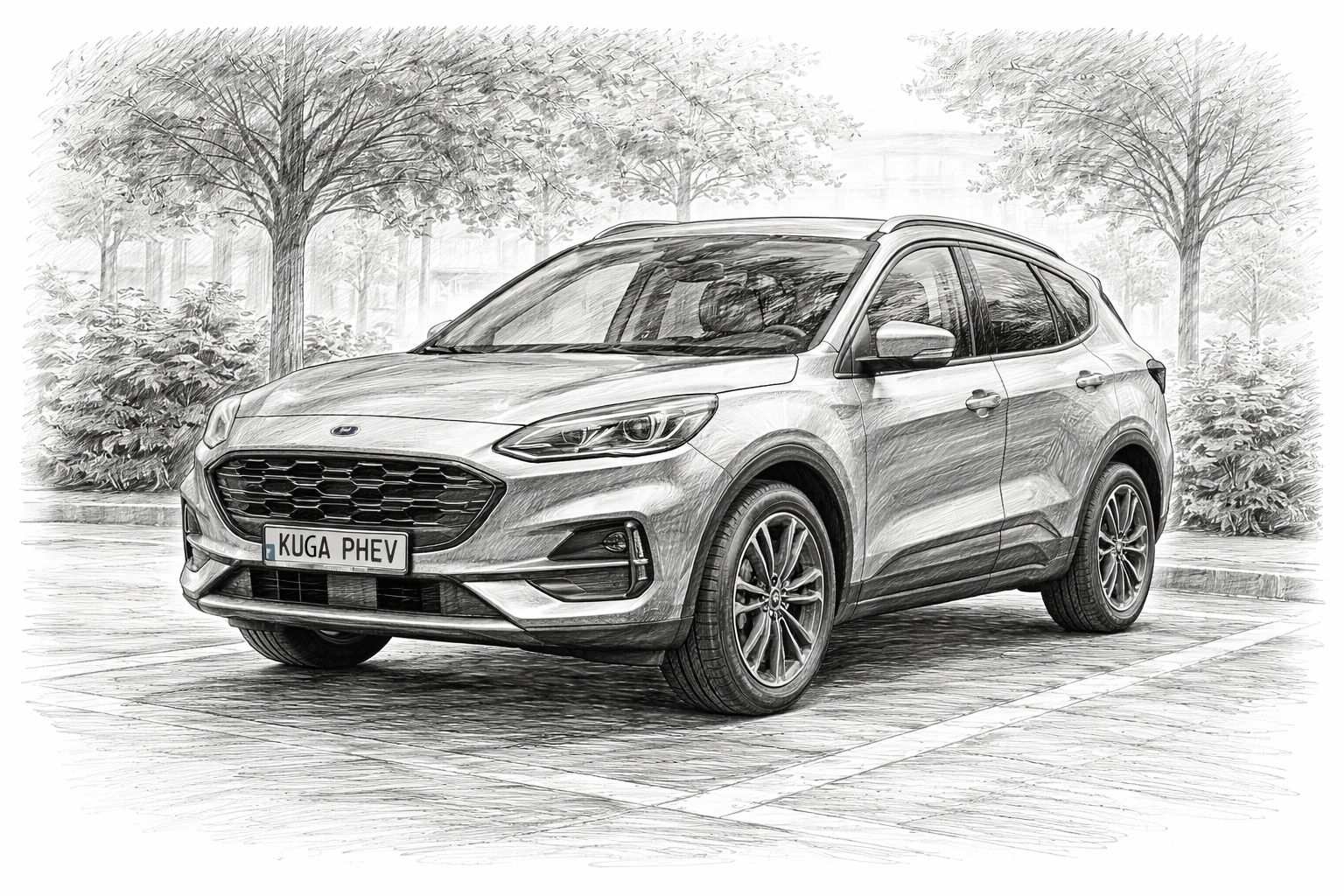
The entry-level plug-in hybrid: Ford Kuga plug-in hybrid
The first plug-in hybrid was a Ford Kuga plug-in hybrid. Basically a solid vehicle, comfortable, quiet, with a decent electric range on paper. In practice, however, it is very clear how much the actual consumption depends on the driving profile and the charging infrastructure.
A comparison makes this clear: with predominantly inner-city use and consistent charging, consumption of less than 3 liters is possible. For longer distances and less frequent charging, the average consumption increases significantly - in practice to around 5.5 to 6 liters.
The decisive factor here is not the vehicle, but the environment. Those who can charge regularly benefit. If you don't have a charging point at home or at your partner's, you will have to rely on the combustion engine again - and thus lose a large part of the hybrid advantage. This quickly becomes a practical problem, especially in apartment buildings or in apartments without a fixed parking space.
Loading decides - not the technology
This is where a fundamental problem with many plug-in hybrids becomes apparent: the technology works if it can be used. If there is no possibility of charging, the hybrid effectively becomes a heavy petrol engine with additional ballast.
This is not a technical failure, but a question of the reality of life. Electromobility - including hybrids - is always a combination of vehicle, use and infrastructure. If one of these factors is missing, the concept collapses.
The switch to a more compact hybrid: BMW 225xe
After leasing the Kuga, the decision was made in favor of a BMW 225xe. The difference is noticeable - and revealing. The BMW is around 200 kilograms lighter, lower and more aerodynamic. The result is a much more agile driving experience.
Although the battery is significantly smaller, the vehicle is more efficient in everyday use. While the Kuga often displays high electric ranges, but often fails to achieve them in practice, the BMW is more reserved - displays less, but then reliably delivers this range. This creates confidence and makes planning easier.
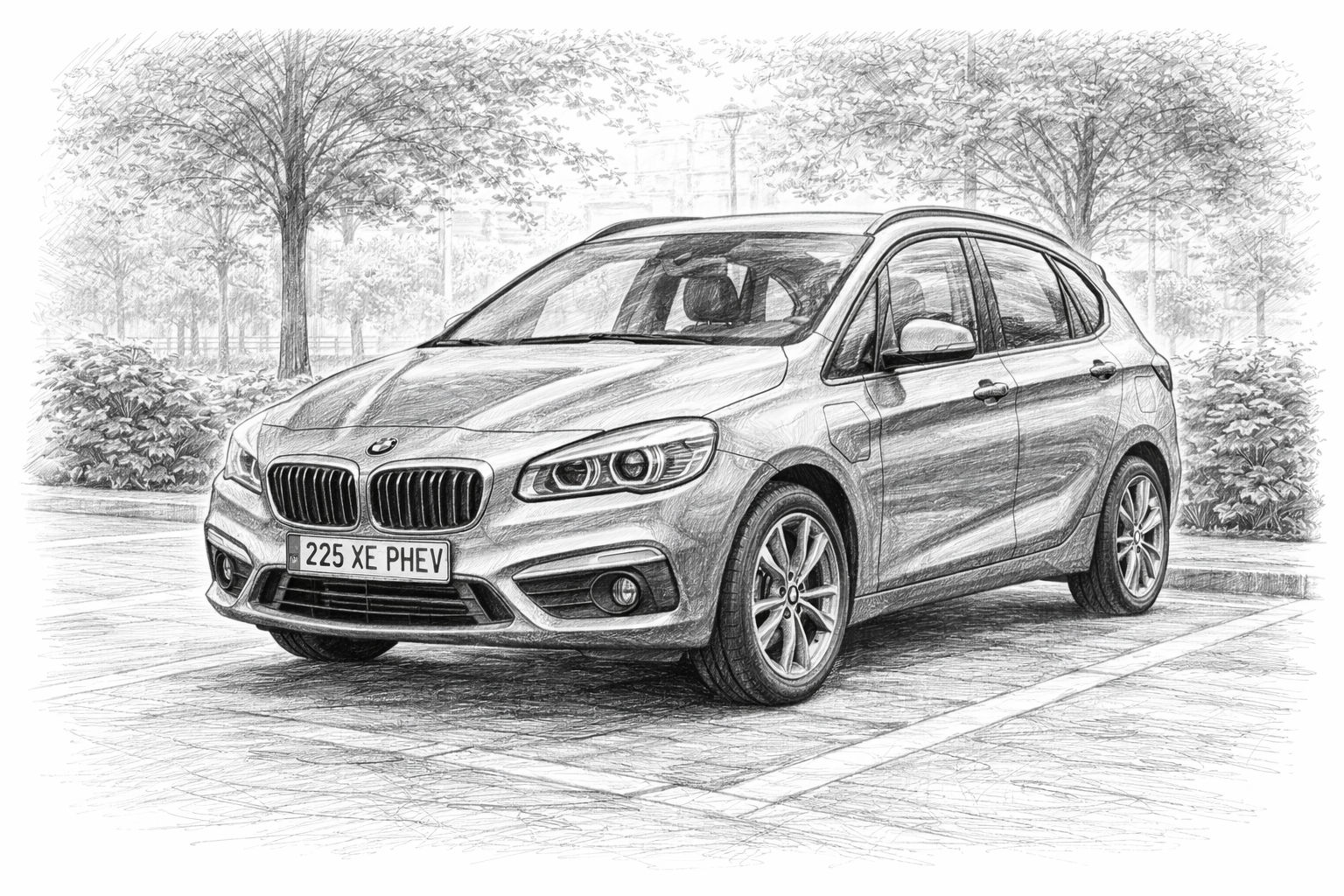
Overall, the BMW seems more economical, not because of a larger battery, but because of:
- lower weight
- better air resistance
- more compact vehicle concept
This is where it becomes clear that efficiency is not achieved through maximization, but through balance.
The positive experience with the plug-in hybrid is closely linked to the driver's own driving profile. Short distances in the city, no regular long journeys, reliable charging options at home - under these conditions, the concept works very well.
If the driving profile were different, the assessment would probably also be different. This is the crux of the whole discussion: there is no one right type of drive. There are only suitable or unsuitable solutions.
Conventional vehicles: reliable, unspectacular, predictable
The electric and hybrid phase was preceded by many years of classic vehicles. Mainly petrol engines, plus two diesels - one four-cylinder, one six-cylinder. Technically solid, reliable, without any particular conspicuous features. They did exactly what was expected of them: drive, work, do their job. Neither particularly exciting nor problematic.
Depending on the engine and usage, these vehicles usually consumed between 7.5 and 8.5 liters. This is not an outlier, but a realistic average for conventional vehicles in this class. Maintenance, refueling, range - all known, all predictable. In this respect, combustion engines had a clear advantage for a long time: you didn't have to worry about anything apart from making regular trips to the filling station.
Driving experience in the past: good, but technically exhausted
These vehicles were by no means bad in terms of driving pleasure either. A modern gasoline engine with a turbo delivers sufficient power, drives confidently and is a joy to drive on country roads or highways. One example of this is a classic mid-range BMW with a pure petrol engine, which despite turbocharging still managed completely without an electrical system. The car was agile, direct and absolutely convincing in its time.
At the same time, this already showed the limits of classic technology. More power meant more consumption, more weight, more emissions. Development increasingly moved in small optimization steps - more efficient, cleaner, but without a real qualitative leap in the driving experience. It was precisely at this point that electric assistance started to become interesting.
The comparison: Why hybrid is noticeably different in everyday life
Switching from a pure combustion engine to a plug-in hybrid makes the difference clear. With a comparable driving profile, the average consumption drops from around eight liters to around five liters. This means a real saving of around three liters per 100 kilometers - without sacrifice, without restriction, but with increased comfort at the same time.
There is also a noticeable improvement in the driving experience. Compact plug-in hybrids in particular benefit from the electric motor when starting off and accelerating. The additional torque provides more directness, more punch and an overall more confident driving experience. In direct comparison, a modern plug-in hybrid feels livelier than a classic petrol engine - even if it has a powerful engine.
This makes the difference tangible: While conventional vehicles reliably fulfill their purpose, hybrid vehicles expand the scope of action. They save fuel, increase driving comfort and offer a more modern driving experience - provided that the driving profile and infrastructure are suitable. This is precisely why the hybrid is currently the most logical further development for many.
A personal conclusion on electromobility
My experience so far shows a clear picture: electric mobility works well where it is used realistically. Small electric vehicles make sense as long as you know their limits. Plug-in hybrids can be very efficient in everyday life - if the driving profile and infrastructure are right. Pure electric cars require even stronger external conditions.
In the end, it's not marketing or ideology that counts, but everyday life. Those who take this into account usually make the better decision - regardless of whether it is electric, hybrid or classic.
Own experience welcome
Electromobility is not a theoretical construct, but something that feels very different in everyday life. Driving profiles, living situations and personal priorities play a major role. Anyone who has had their own experiences with electric cars, hybrid vehicles, electric scooters or other forms of electric mobility is invited to share them in the Comments to share.
Factual reports from the field help more than any advertising brochure - and contribute to a differentiated and realistic view of the topic.




Frequently asked questions
- What does electromobility actually mean today?
Electromobility encompasses far more than just electric cars. It includes e-scooters, electric scooters, hybrid vehicles in various forms as well as purely electric vehicles. The decisive factor is not the drive alone, but the specific application. Electromobility is not a uniform concept, but a collective term for very different solutions, each of which has its own strengths and weaknesses. - Why doesn't electromobility start with the car?
Because the fundamental advantages of electric drives - quiet operation, simple technology, low maintenance - are first and most clearly visible in small vehicles. E-scooters and electric scooters show very early on where electric mobility makes sense without requiring long ranges, large batteries or complex infrastructure. - Are e-scooters a real mobility solution?
E-scooters are primarily a supplementary tool. They can cover short distances, but are no substitute for a fully-fledged means of transportation. Their strengths lie in spontaneous use, their weaknesses in safety, stability and integration into the traffic environment. They are practical, but not a sustainable substitute for other forms of mobility. - Why do electric scooters often work better than e-scooters in everyday life?
Electric scooters are more stable, easier to plan and more clearly positioned. Their range matches their intended use, they are easy to charge and do not require a complicated infrastructure. The expectations placed on them are realistic, which means that aspirations and everyday life go well together. - What is the fundamental difference between hybrid vehicles and purely electric cars?
Hybrid vehicles combine two drive systems and are therefore less dependent on charging infrastructure. They enable electric driving in everyday life while retaining the range of the combustion engine. Pure electric cars, on the other hand, rely entirely on electrical energy and require suitable framework conditions. - What types of hybrid drives are there?
A distinction is made between mild hybrids, full hybrids and plug-in hybrids. They differ in terms of whether and for how long purely electric driving is possible and whether external charging is possible. These differences are decisive for the actual benefits in everyday life. - Why are plug-in hybrids often misunderstood?
Because they depend heavily on usage behavior. Those who charge regularly benefit considerably. If you don't charge, you are basically driving a heavy gasoline engine. The vehicle itself is rarely the problem - the driving profile and infrastructure are decisive. - Why does a small plug-in hybrid often make more sense than a large SUV?
Compact vehicles are lighter, more efficient and consume less energy. Large plug-in SUVs combine high resource consumption with additional battery weight and therefore lose many of the advantages of the hybrid concept. Efficiency comes from balance, not maximization. - What role does vehicle weight play in electromobility?
Weight influences consumption, driving dynamics, wear and efficiency. Larger batteries increase the range, but also the weight considerably. This correlation is often underestimated, but is central to the evaluation of electric vehicles. - Why are modern gasoline engines often more lively today than in the past?
Many petrol engines now have electric assistance in the form of small electric motors. These improve starting behavior and acceleration and ensure a more direct driving experience. Electromobility has therefore long since arrived in the classic combustion engine. - For whom are pure electric cars useful today?
Especially for people with a predictable driving profile and good charging infrastructure. Commuters with known routes, their own wallbox or reliable charging options benefit the most. Spontaneous use without fixed charging points makes everyday life much more difficult. - Why are electric cars not automatically ideal for pure city drivers?
Large batteries are actually oversized for short distances. At the same time, they are heavy and require a lot of resources. This results in a disproportion between ends and means, which relativizes the advantage of electric driving. - What role does the charging infrastructure play in everyday life?
It is a central component of the overall system. Charging performance, availability and reliability determine whether an electric car can be used in a relaxed manner or generates organizational effort. Charging is not a refueling process, but a planning issue. - Why is a wallbox often crucial?
Without a wallbox, charging is slow and impractical. However, their installation is not always easy and depends on the living situation, house connection and permits. Electromobility therefore shifts some of the responsibility from the vehicle to the user. - What is the difference between driving profile and life profile when choosing a vehicle?
The driving profile describes route lengths and frequency of use. The life profile includes living situation, charging access, infrastructure and everyday life. For electric cars, both levels are decisive - for hybrids, usually only the driving profile. - How do conventional vehicles compare?
Classic petrol and diesel engines are reliable, predictable and uncomplicated. Their fuel consumption is often between 7.5 and 8.5 liters. They offer few surprises, but also no more fundamental leaps in efficiency. - Why do many electric and hybrid drivers find driving more fun than with a combustion engine?
The electric motor delivers instant torque and improves acceleration and directness. As a result, hybrid vehicles often appear more agile and superior than pure combustion engines with comparable performance - while at the same time consuming less fuel. - What fuel consumption advantages are realistic for plug-in hybrids?
With a suitable driving profile, the average consumption can be reduced by around three liters compared to pure gasoline vehicles. This saving is not achieved by doing without, but by making sensible use of electric components in everyday driving. - What is the main conclusion of the article?
There is no universally correct form of drive. Electromobility works well when it is used realistically. The decisive factors are the driving profile, living conditions and infrastructure - not marketing promises or ideological expectations.