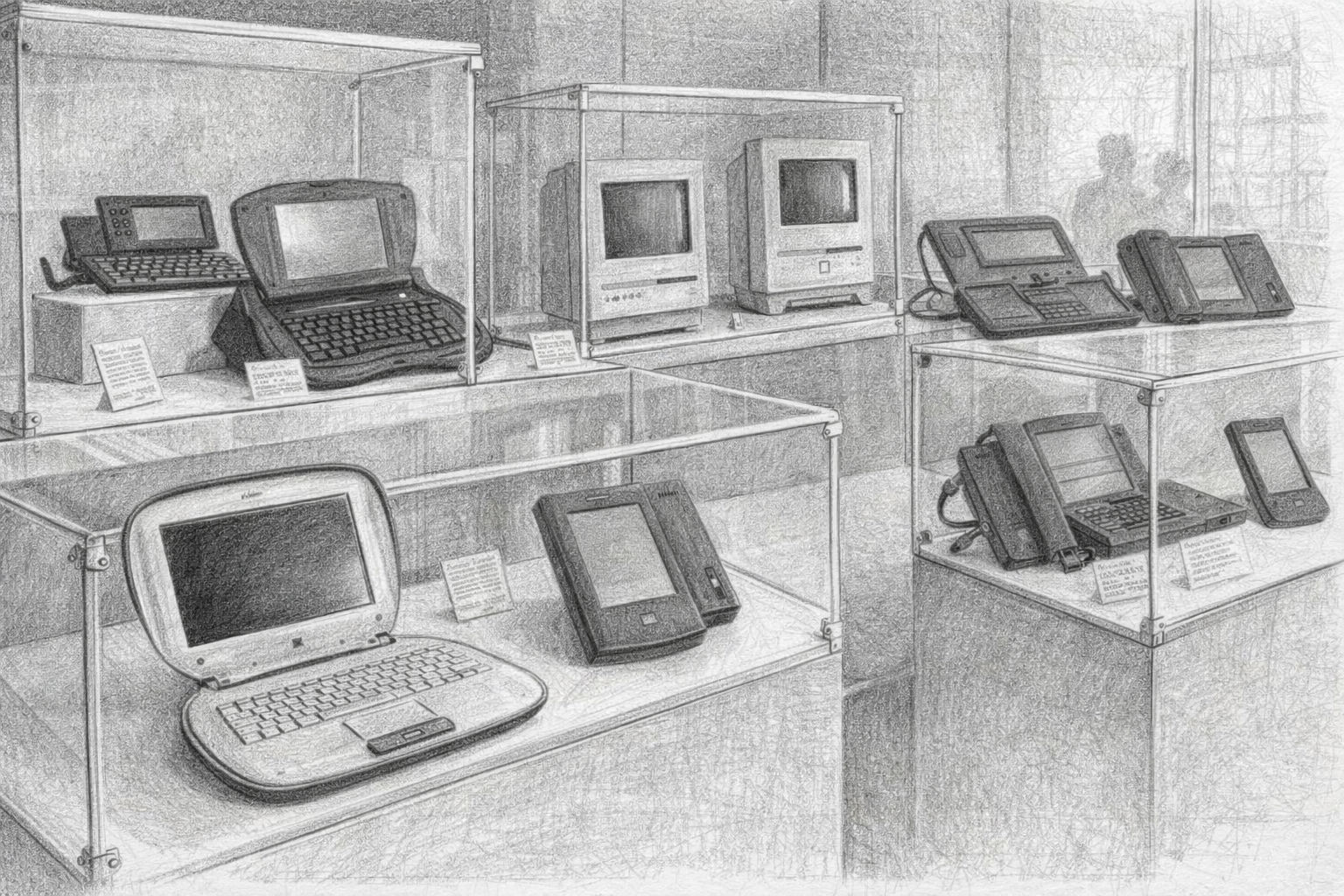
If you are interested in computer history, a visit to the Oldenburg Computer Museum is particularly worthwhile. The museum is one of those places that doesn't have to be loud to make an impression and will be hosting a special exhibition from April under the motto „50 years of the Apple computer“. For many years, technology has not only been exhibited there, but kept alive. Devices are not behind glass, but often ready for use on tables - just as they were actually used in the past.
That's what makes the difference. You don't just see old computers, you get a feeling for what it was like to work, play and think with these machines. From early home computers to classic office computers and special one-offs, everything is represented - carefully collected, maintained and, above all, clearly arranged.



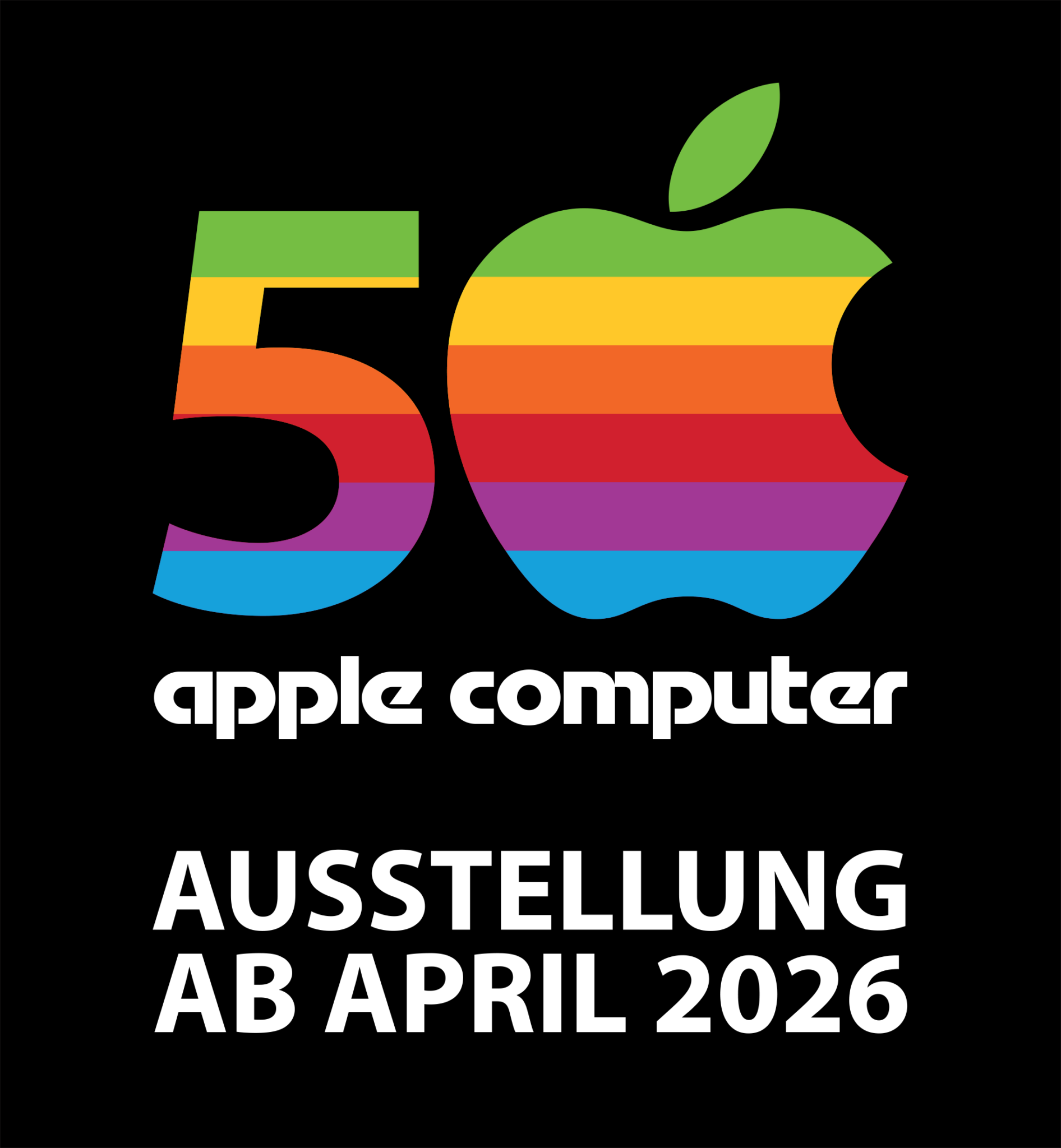 From April, an extensive Apple Exhibition on. This is fitting, because hardly any other company has shaped the development of computers as much as Apple - both technically and in terms of design. And this is exactly where it gets interesting: when you look at exhibitions like this, you quickly realize that many ideas that seem obvious today were already conceived decades ago.
For me, this is a good opportunity to not only look at the exhibition, but also at my own small collection. Over the years, a lot has accumulated here - devices that I have used, devices that I have deliberately kept and a few pieces that are not so easy to find today. It's not a museum in the traditional sense. But it is a piece of living technical history.
And that's exactly what this article is about: not a complete chronology, but a look back - from a practical perspective, with devices that were actually used.
A date in 1993
When you think of mobile computers today, you probably immediately think of a smartphone or a slim notebook. In the early 90s, things looked a little different. In 1993, I had an appointment with Creditreform. It was about training. Back then, preparation was still a very traditional affair. No internet, no quick search. So I simply went there beforehand, got some documents and looked at what the store actually did. It was nothing special - but apparently not many people did that.
At the end of the conversation, it was about scheduling. And I did something that came naturally to me: I got out my little computer and entered the appointment.
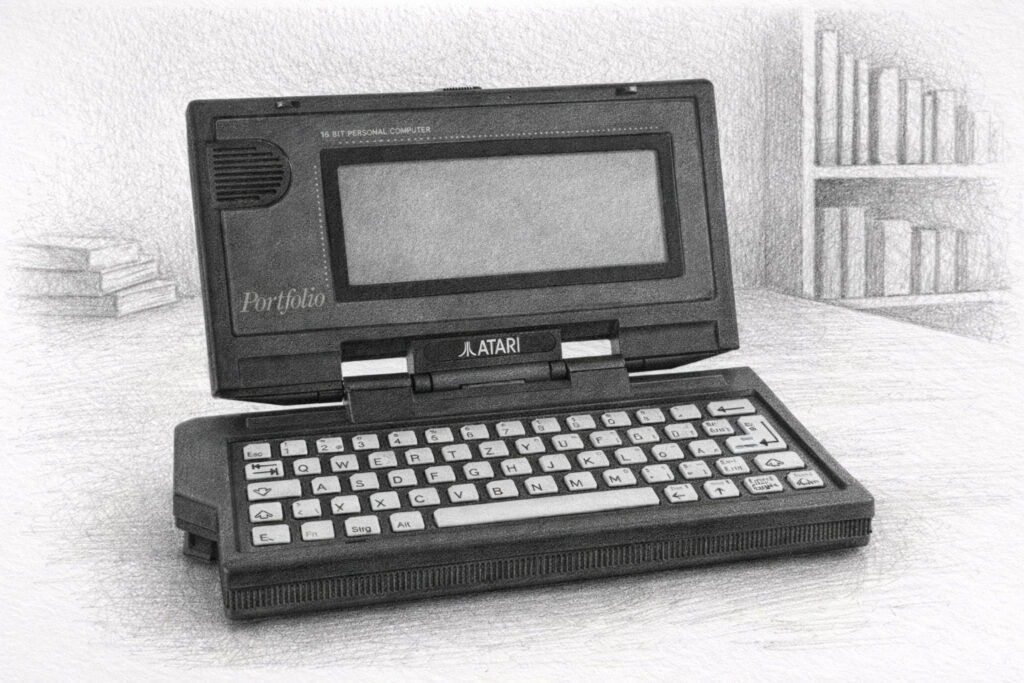
That was an Atari Portfolio. An inconspicuous device, barely bigger than a paperback book, with a small keyboard and a simple display. Technically speaking, it was nothing spectacular. But for the time, it was a real statement: mobile, autonomous, independent of the desk.
Years later, at the Oldenburg Kramermarkt, the authorized signatory told me after a few beers that this particular moment had stuck with me. Not because the device was so impressive - but because it showed that I was prepared and had things under control.
Looking back, that suits me quite well. I rarely waited until something was „usual“. If something seemed to make sense, I just did it. And that's exactly how it was with this little computer.
Early mobile computers - more idea than convenience
If you look at a device like the Atari Portfolio today, it almost looks like a toy. The display is small, the presentation simple, the operation anything but convenient. And yet there is an idea behind this device that is still alive today.
The Atari Portfolio was one of the first truly portable computers worthy of the name. No accessories, no external drive, no monitor - everything in one compact device. Switch on, work, plug in again. Of course, this had its limits. Memory was scarce, programs were simple, and many things had to be solved in a roundabout way. But there was also a certain clarity in that. You had a tool, not a system that overloaded you with functions.
If you look at it today, you quickly realize that the idea was already there. Mobility, personal data, appointment management - everything that we take for granted today was already there back then. Only the implementation wasn't quite ready yet.
And this is precisely where a look at Apple becomes interesting. Because while devices like the Portfolio were designed to be highly functional, Apple began to take a different path a little later - one that focused more on usability, design and a coherent user experience. But we'll come to that in a moment.
Compact and closed - Apple's early desktop phase
When Apple further developed its compact computers in the early 1990s, the aim was not to make as much technology as possible visible. On the contrary: the aim was to reduce everything to such an extent that the computer as a tool faded into the background.
The Macintosh Classic is a good example of this. A device that appears inconspicuous at first glance. Black and white screen, compact design, no superfluous elements. And yet there is a clear idea behind it: switch on, work, done. No assembling, no thinking about components. The system was closed - in a positive sense.
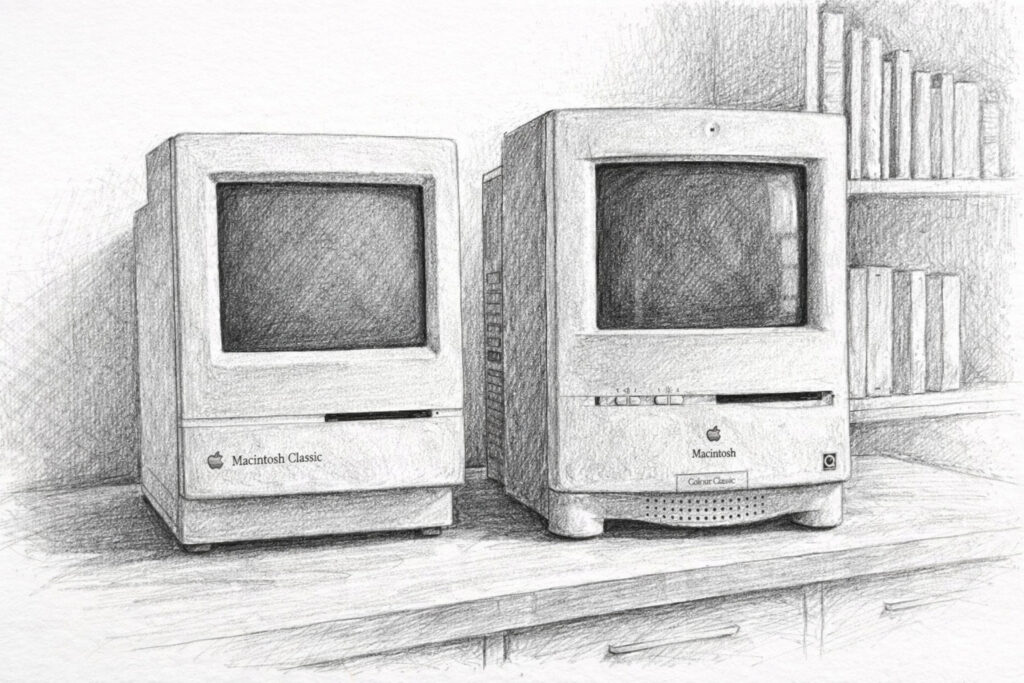
9″ Screen first in black and white, later in color
The Apple Color Classic followed a little later. Externally similar, but with one crucial difference: color. Today, this seems obvious, but back then it was a step that noticeably changed the way we used the device. Suddenly, it was no longer just about function, but also about presentation, visual orientation and a more pleasant way of working.
If you place both devices next to each other, you will see exactly this transition. Not as a break, but as a further development. Apple rarely overturned everything at once. Instead, it was refined step by step.
What makes these devices special from today's perspective is not so much their performance, but their attitude. They were designed to be used - not to be constantly tinkered with. This clearly distinguishes them from many PC systems of the time, where the assembly itself was often part of the work.
And this is exactly where something that runs through the Apple story begins: the attempt to simplify technology to such an extent that it fits into everyday life. Sometimes this works better, sometimes worse. But the direction was clearly recognizable early on.
My entry into Apple - and the first disillusionment
My own entry into the Apple world was less enthusiastic than you might expect. It was more of a pragmatic step - and one that wasn't immediately convincing. My first Apple was a Performa 5200, already equipped with a PowerPC processor at the time, so on paper it was more modern than many of the previous systems.
Expectations were correspondingly high. New architecture, new possibilities - that sounded like progress. But in practice it felt different. The computer wasn't bad. But it didn't seem any faster, rather the opposite. Especially in direct comparison with older systems, I had the feeling that many things ran more slowly than they actually should. It's hard to say whether this was due to the software or the still immature platform. But the impression remained.
Quadra beats Performa
So I got rid of it relatively quickly and switched to a Quadra 840AV. A system from the previous generation, still based on the 68k architecture. And suddenly the feeling was completely different. The computer responded more directly, was more stable and smoother overall. To be fair, it has to be said that the Quadra had faster SCSI interfaces for the hard disks than the newer (consumer) Performa.
That was an experience that I had several times later: New doesn't automatically mean better. And just because something is more modern on paper doesn't mean that it feels the same in everyday life.
Looking back, that was an important point. It shaped my view of technology. I learned not to automatically trust every advance, but to take a closer look. What does it actually do for me? Does it feel better? Does it make my work easier? These questions are still with me today.
And maybe that's also the reason why I kept switching between systems later on - and never fully committed to one side.
Mobile evolution - the PowerBook generation
When Apple began to consistently develop its mobile computers, this was not done in big leaps, but in small, comprehensible steps. This is precisely what makes the PowerBook series so interesting to this day. It shows very clearly how a concept can be refined over the years.
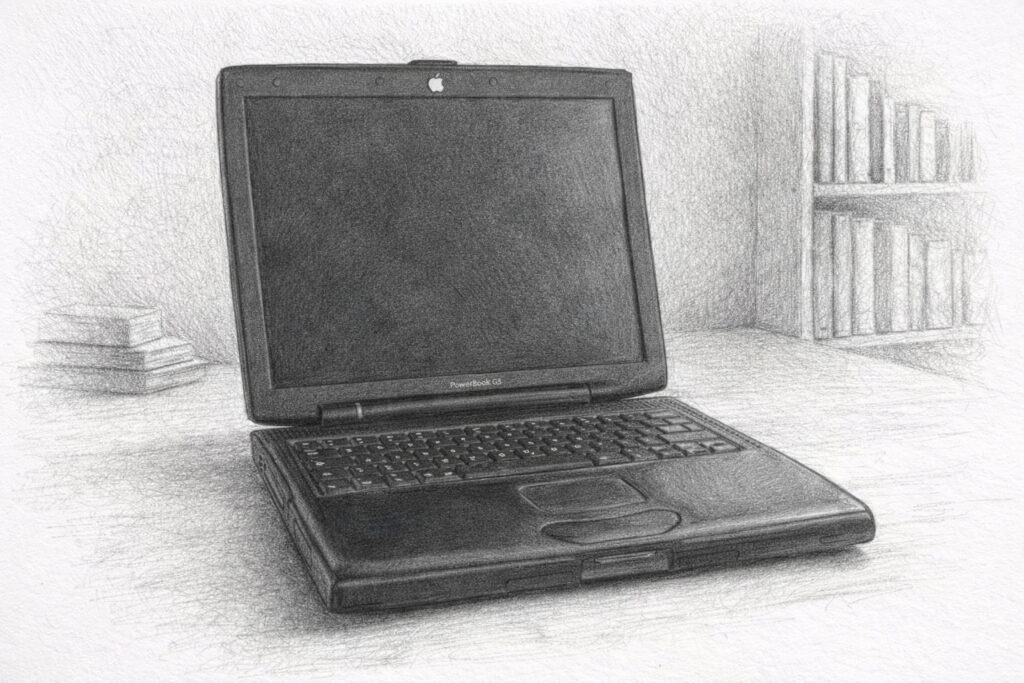
From experiment to working machine
The early PowerBooks were still clearly recognizable as a mobile extension of the desktop concept. They were intended to make it possible to do on the move what you used to do at your desk. Accordingly, they were often still heavy, not particularly compact and technically more of a compromise.
This slowly began to change with devices such as the Wallstreet. The machines became more robust, better structured and generally closer to what we would now call „real mobile working“. It was no longer just about being mobile at all, but about being mobile in a meaningful way.
Small steps, big impact
If you look at the development from the Wallstreet to the Lombard to the Pismo, you will notice that not much has changed on the outside. And that is precisely where the strength lies. Apple has not reinvented everything here, but has consistently improved existing concepts:
- Housing has become more stable and lighter at the same time
- Connections have been arranged more sensibly
- Operation has become clearer and more intuitive
These are not spectacular innovations. But in everyday life, it is precisely these details that make the difference. The Lombard, which is often somewhat overshadowed by the other models, belongs precisely in this phase of refinement. It seems unspectacular, but is an important intermediate step. Finally, with the Pismo, you get the feeling that many of these developments have come together. A device that looks well-rounded. Not perfect, but coherent.
Evolution instead of revolution
What is easily overlooked from today's perspective: These devices were not intended as milestones. They were tools. And that is precisely why they are so interesting. Apple did not try to present something completely new every year. Instead, it improved, adapted and optimized. An attitude that is much less common today.
When you have worked with these devices, you quickly realize that they are designed for continuity. You didn't have to completely reorient yourself every time. Things were where you expected them to be. And that's exactly what creates trust.
The other way - Newton, eMate and early digital assistants
Parallel to this rather classic development in the field of mobile computers, Apple tried out a completely different approach in the 1990s. One that was ahead of its time in many respects - and at the same time did not really fit into the world of the time.

The idea behind the Newton
With the Apple Newton, Apple pursued a vision that seems almost self-evident today: a personal digital assistant. A device that:
- Notes managed
- Dates organized
- recognizes handwritten entries
All controlled via a stylus, directly on the display. From today's perspective, it looks familiar. Back then, it was something completely different. There were no established patterns, no familiar operating logic. You had to get involved.
Between aspiration and reality
The idea was strong. The implementation had its limits. Handwriting recognition worked - but not always reliably. The devices were technically limited and the software was not yet fully developed. Many users simply didn't know what to do with it.
And this is precisely where a recurring pattern in the history of technology becomes apparent: a good idea is not enough. It must also fit into the context of its time. In a way, the Newton was too early. It anticipated things that only really became suitable for everyday use many years later.
The eMate - a special case for schools
A particularly interesting device in this context is the Apple eMate 300, a semi-transparent, green calculator that was specially designed for use in the education sector. Robust, independent, with a clear focus on practical use.
When you pick it up today, it almost seems like a forerunner of modern appliances. Not because of its performance, but because of its concept. Compact, focused, reduced. And at the same time, you can sense that it comes from a time when many things were still being tried out.
A view from today's perspective
Looking back, the Newton is less a failed product than an early attempt to establish a new type of interaction. Many of the ideas are back today:
- Pen operation
- Handwriting
- Personal assistance systems
The difference is that the technology is now so advanced that these ideas can be implemented reliably.
And that's exactly why it's worth looking back. Not to say that everything was better in the past. But to realize that much of what we take for granted today was once an experiment.
A rare detail - the Siemens Notephone
In addition to all the devices that you know or have at least seen before, there are always pieces that stand out. Devices that were not intended for the mass market or only exist in small numbers. And my Siemens Notephone is just such a device.
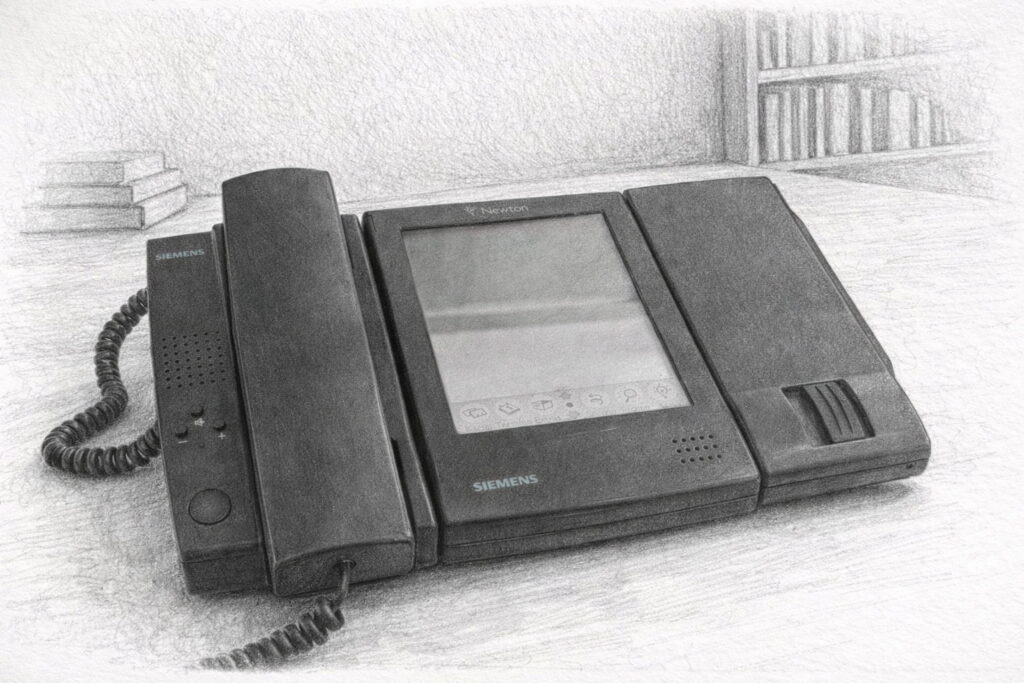
An unusual approach
At first glance, the device looks inconspicuous. No typical Apple design, no logo that immediately catches the eye. Instead, it says Siemens. And that's exactly what makes it interesting. Inside is technology that is closely related to the Apple Newton. A combination that you don't often find. Apple technology in a different housing, designed for a special area of application.
The notephone is therefore not a classic Apple device - and yet it is one at the same time. It stands somewhere between the two worlds. And that is precisely why it fits so well into this article.
When you pick up the device, you immediately notice that it comes from a different era. The materials, the workmanship, even the weight - everything feels different from today's devices.
As with the Newton, it is operated using a stylus. Writing, typing, navigating - everything happens directly on the surface. This seems familiar today, but back then it was anything but a matter of course.
And this is where something interesting becomes apparent: many things that we perceive as progress today already existed in their basic form decades ago. Just not as sophisticated, not as fast and not as reliable. Nevertheless, the principle works. You can work with it. You understand what the idea behind it was. And that is often worth more than perfect technology.
A piece that stays
What makes this device special for me is not just its rarity. It's the combination of technical history and personal connection. It's not a device that you simply replace. It's one that you keep. Perhaps because it shows how many paths there were in development. And how many of them are almost forgotten today.
Apple discovered Design
With the transition to the late 90s and early 2000s, something fundamental changed at Apple. Technology remains important, but it increasingly recedes into the background. Instead, something else comes to the fore:
Design.
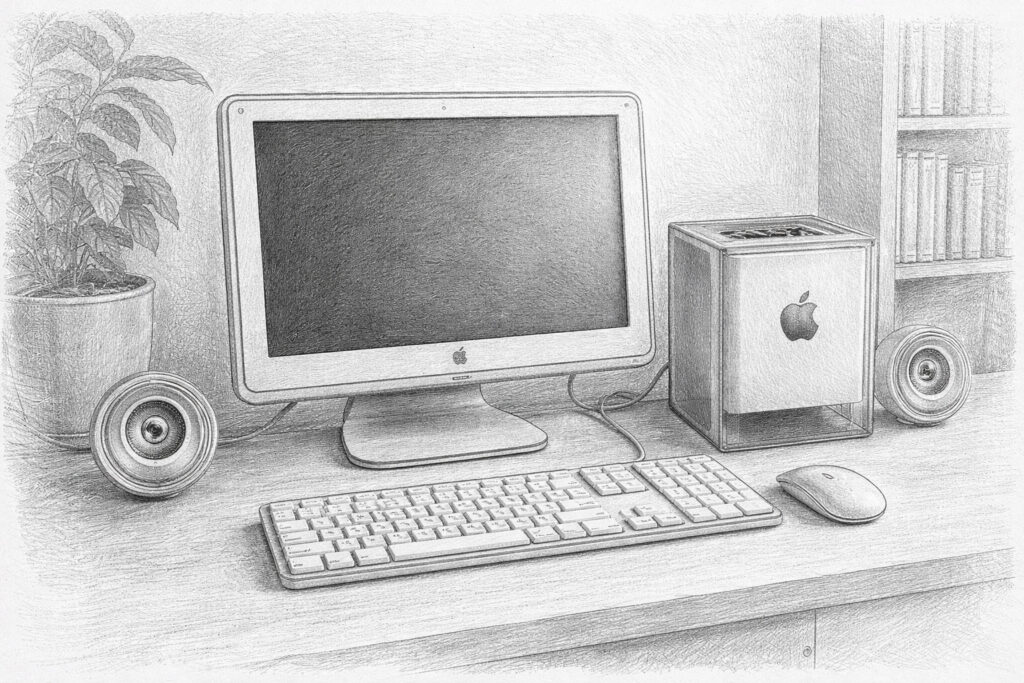
The moment when technology becomes visible
A good example of this is the Power Mac G4 Cube. A computer that looks less like a work tool and more like an object. Clear lines, transparent elements, a shape that is not just functional, but deliberately designed. When you look at it, you immediately realize that it's not just about what the device can do. It's also about how it looks.
This was not a matter of course at the time. Many computers were functional but of secondary importance in terms of design. Apple has taken a different approach here. The Cube G4 is even on display in the New York Museum Of Modern Art issued.
Form does not just follow function
Of course the Cube fulfills its purpose. But it does so in a way that goes beyond the purely technical. The housing, the materials, the way the device is constructed - it all looks well thought out. Almost minimalist. And eye-catching at the same time.
It is debatable whether such an approach always makes sense. The Cube was not a mass product. It was more of a statement. And that's exactly what makes it interesting today.
A new direction
With devices such as the Cube and the Power Mac G4 systems, it is clear that Apple is beginning to think about technology differently. No longer just as a tool, but as part of the environment. As something that is allowed to be visible. This is an approach that continues to this day. Sometimes stronger, sometimes weaker. But the direction was clearly set at this time.
And when you look at the devices from this phase, you realize that something has emerged here that goes beyond individual products. An attitude that does not hide technology, but consciously shapes it.
Transition to the modern Apple world
The early 2000s marked the beginning of a phase in which Apple not only further developed its devices technically, but also made them much more accessible. Many things appear more rounded, friendlier and less technical in the classic sense. A good example of this is the iBook G4.
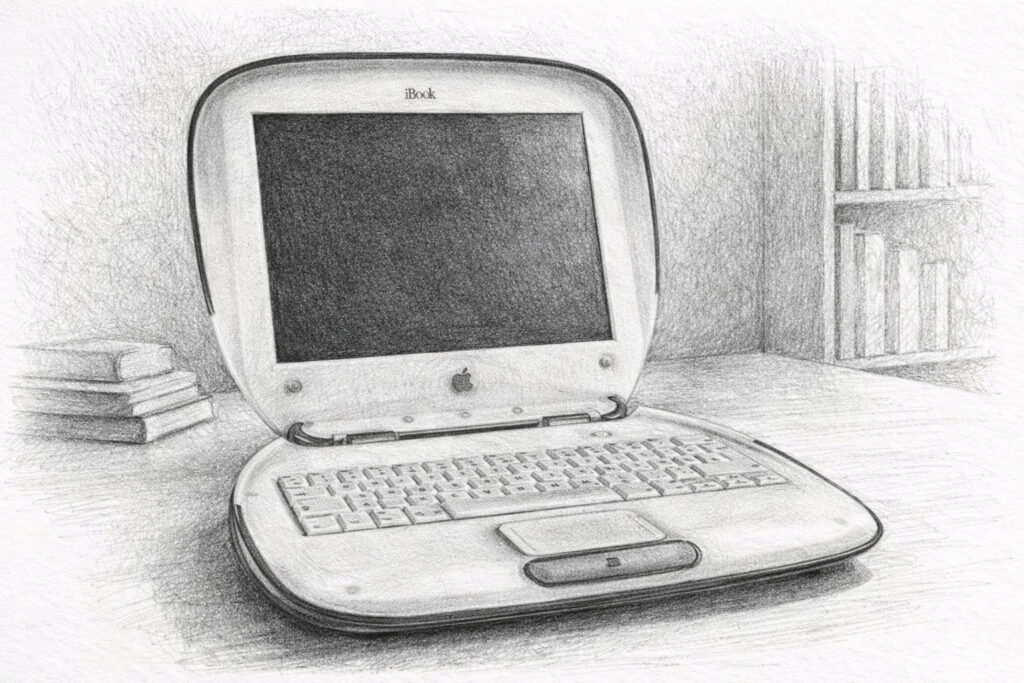
While the earlier PowerBooks were clearly intended as tools for specific target groups, the iBook is aimed more at everyday use. It is less „professional“ in the classic sense, but closer to what many people actually need.
The shape is softer, the materials more accessible, the overall appearance less technical. The device no longer feels like something you have to work hard to get, but like something you simply use.
And this is an important step. At this stage, computers are increasingly becoming part of everyday life - not just for specialists, but for a wide range of users.
Continuity in change
Despite this new direction, much of what Apple had previously built up remains. The clear structure, the simple operation, the idea of a closed system - all of this is still there. Only the packaging has changed.
The iBook G4 thus stands somewhat between two worlds. It is still clearly recognizable as a product of its time, but already contains many elements that will later become a matter of course.
When you work with it, you realize that something is coming together here. Not perfect, not final, but coherent. And that's exactly what makes this transition so interesting.
Current survey on the use of local AI systems
My path - between Apple and Windows
Looking back on this development, it would be easy to think that the path was straightforward. That once you decide on a system, you stick with it. In practice, things often look different. Over the years, I have repeatedly switched between Apple and Windows. Not out of conviction for one or against the other, but for practical reasons.
For a long time, Windows was the standard in many areas. If you worked in certain environments, there was no getting around it. Accordingly, I also familiarized myself intensively with it, including administrative tasks and corresponding certifications. This was not a transitional phase, but an integral part of my work.
Experience instead of stock thinking
It is precisely this change between the systems that creates a different perspective. You see strengths and weaknesses on both sides. And to a certain extent, you lose the tendency to judge things fundamentally.
There is no one „right“ system. There are tools that are better or worse suited to certain tasks. This realization does not come from theory, but from use.

The breathtaking story of Steve Jobs (Apple, Pixar, NeXT) | Biographer_EN
Back to Apple - and stayed
Despite these changes, there has been a clear development over time. I have been working continuously with Apple systems for around twenty years. Not because everything is perfect. But because it works best for me in the overall picture.
The combination of hardware and software, the stability in everyday use, the way the devices fit into the workflow - these are things that have proven themselves over the years. At the same time, the experience from the Windows world remains in the background. It ensures that you don't take everything for granted.
And perhaps that is precisely the point: it is not the decision in favor of one system that is decisive, but the experience of getting to know both sides.
Important Apple milestones over time since 1985
| Year | Device | Meaning / Classification |
|---|---|---|
| 1985 | Macintosh 512K | Early expansion of the first Macintosh concept, basis for graphical user interfaces in everyday life. |
| 1990 | Macintosh Classic | Compact, accessible entry into the Macintosh world, all-in-one approach for broad user groups. |
| 1991 | PowerBook 100 | Justifies the modern laptop shape with central trackball and compact design. |
| 1993 | Apple Newton | Early attempt at a digital assistant with pen operation and handwriting recognition. |
| 1998 | iMac G3 | Re-launch of Apple with a focus on design and ease of use, leaving a lasting mark on the brand. |
| 2000 | Power Mac G4 Cube | Design-oriented desktop, Apple shows the claim to design technology as an object. |
| 2001 | iPod | The beginning of Apple's expansion beyond the computer shapes the digital music world. |
| 2006 | MacBook Pro (Intel) | Transition from PowerPC to Intel, important step for performance and compatibility. |
| 2007 | iPhone | Revolutionizes mobile use, combining phone, internet and apps in one device. |
| 2010 | iPad | Establishes tablets as a separate device category between smartphones and laptops. |
| 2020 | MacBook with M1 | Launch of Apple Silicon, high efficiency and performance thanks to proprietary processor architecture. |
| 2023 | Mac with M3 | Further development of the Apple chips, increasing performance and focus on local AI processing. |
Apple today - between enthusiasm and distance
When you have been involved with a platform for many years, your view of it changes. What may have been characterized by curiosity or enthusiasm at the beginning becomes calmer over time. More sober. And often more differentiated.
I have been working with Apple systems for many years. The devices I use are technically up to date, powerful and reliable in everyday use. That's one thing.
The other is that my relationship with Apple has changed over time. It's no longer uncritical enthusiasm. It's more like a love-hate relationship. Apple still builds very good products. There is no question about that. But at the same time, the company has become much more commercial. Processes are more standardized, decisions seem less playful, less experimental than before.
That is not an accusation. It is a development that can be observed in many large companies. But it is noticeable.
„Never change a running system“
One point that has become increasingly important to me in my everyday life is the conscious use of updates. The old principle „Never change a running system“ dates back to a time when it felt like Windows 95 had been 1TP12ed for the hundredth time. But in essence it is still valid today.
I have no great desire to installiere every new operating system immediately. If a system is stable, then I let it run. And for as long as it makes sense. This permanent update culture - this constant „there's something new again“ - doesn't suit my way of working. I need systems that I can rely on, not systems that are constantly changing.
That's why I often deliberately lag behind when it comes to operating systems. Not out of ignorance, but out of experience.
„Apple is not your friend“
During my time as a Apple dealer, there was one phrase that kept coming up: „Apple is not your friend.“
That sounds harsh at first, but it is actually a very sober observation. Large corporations do not act out of personal closeness, but out of economic interests. That is neither good nor bad - it is simply reality.
If you understand this, it is easier to categorize things. You expect less and you become more aware of your strengths.
Change instead of loss
You could say that there used to be more attention to detail in many products. Maybe that's even true. But maybe it only seems that way because a lot of things were new back then.
Today, many things are more standardized. Processes are clearer, products are more structured. This can be viewed critically, but it also has advantages. The devices are powerful, reliable and surprisingly well thought out in many areas.
What I currently give Apple credit for is its strategic orientation. With its own Silicon processors, Apple has taken a path that is clearly different from many others. The performance is high, the integration tight, and especially in the area of local AI something is emerging here that is likely to become very relevant in the long term.
I believe that Apple will play a strong role in this area in the coming years. Not necessarily through spectacular individual products, but through consistent further development.
And perhaps that fits in quite well with what runs through this article: fewer big leaps, more continuous development.
The museum and a look back
 The view of these devices is not just theoretical. It can be experienced first-hand - at the Oldenburg Computer Museum. The Apple exhibition in the museum opens on April 04, 2026 opens at 4 pm and runs until September 2026.
This gives you enough time to take a look at the development on site - in peace and without haste. It's worth taking your time, especially at exhibitions like this. Not to want to take in everything immediately, but to let individual devices have an effect on you.
More than just looking
In addition to the exhibition, there are regular offers:
- Public guided tours every Friday from 5 to 7 p.m., from April 17, 2026
- Apple-Talks every second Wednesday from 6 to 8 p.m., from April 15, 2026
These are opportunities where you not only see, but also understand. And it's often in conversations like these that the most interesting insights arise.
Hands-on history of technology - the Oldenburg Computer Museum
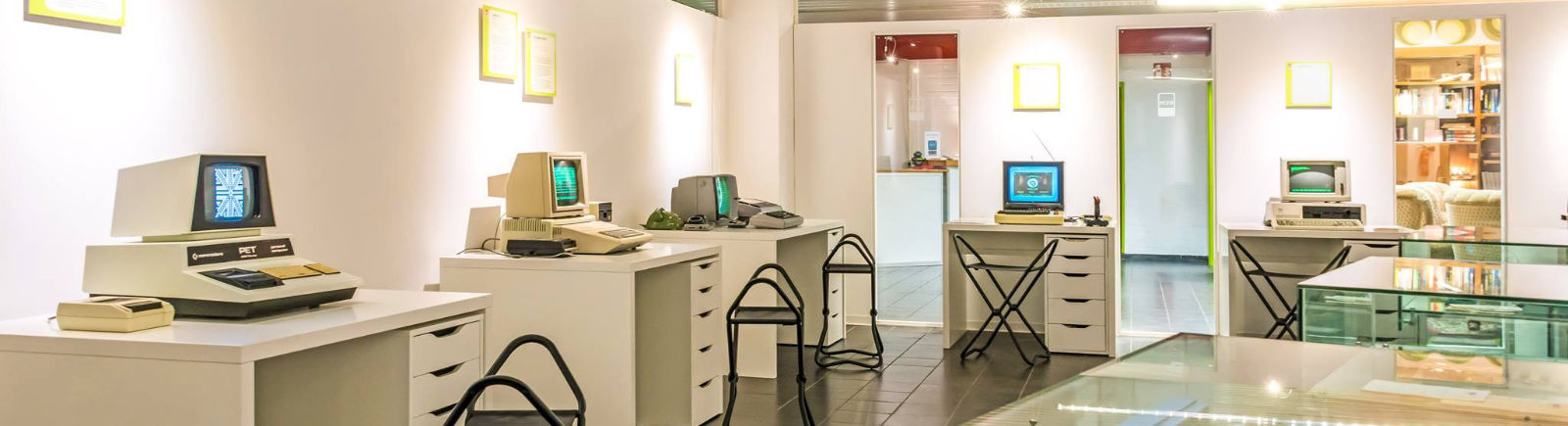
The Oldenburg Computer Museum does not see itself as a traditional museum, but as a lively place to learn and experience the history of home computers. Founded in 2008, its aim is not just to exhibit technology, but to make it tangible.
The focus is on computers, games consoles and arcade machines from the 1970s to 1990s - in other words, from a time when many of the foundations of today's digital world were laid. The special feature: The devices are ready to use and may be used explicitly. Visitors can try out programs, start games and experience first-hand what computer use used to feel like.

The museum thus builds a bridge between the past and the present. It is not just about nostalgic viewing, but about understanding technical development - from graphics and memory to operation. It is precisely this interactive approach that makes the difference: history is not understood theoretically, but practically.
This turns the history of technology into an immediate experience - and old devices into a comprehensible part of our digital present.
Conclusion - what remains
If you take your time to look at this development, you will notice one thing: Much of what seems self-evident today did not come about suddenly. It has grown. In small steps, over many years.
Devices such as the Atari Portfolio, the early Macs, the PowerBooks or even the Newton do not stand for perfection. They stand for experiments. For ideas that sometimes worked and sometimes didn't. But this is exactly what gave rise to what we use today.
For me personally, my view of this technology has changed. It used to be more about the new, the faster, the more powerful. Today, it's more important to me that things work. That they are reliable. That I can rely on them.
Perhaps that is also the reason why I have kept certain devices. Not because they were objectively the best, but because they represent a certain moment in time. For a phase in which something changed. That's exactly what makes such collections - whether in a museum or at home - interesting. They don't just show devices. They show developments. Incidentally, 15 years ago I already had a Article about the Oldenburg Computer Museum written.
In the end, perhaps one simple thought remains: not every innovation is automatically progress. And not everything that is older is therefore outdated.
Sometimes it's worth taking a step back - to better understand where you actually stand today.

Frequently asked questions
- How did your collection of old computer devices come about in the first place?
The collection was not created specifically as a „museum“, but has developed over many years. Many devices originate from phases in which they were actively used - whether professionally or privately. Others were added later because they were technically interesting or had a special history. Over time, you realize that you no longer give certain devices away, but consciously keep them. Not out of a passion for collecting in the traditional sense, but because they represent certain developments. At some point, this results in a collection that is more than just a collection of old hardware. - Why does the article start with the Atari portfolio and not directly with Apple?
The Atari Portfolio is a deliberately chosen entry point because it represents an important contrast. It shows that the idea of mobile computers already existed in rudimentary form before Apple - albeit in a very functional, reduced way. Only through this comparison does it become clear which different path Apple later took. The introduction via the portfolio makes the development more comprehensible and prevents the article from coming across as a pure Apple review. - What was so special about the Atari portfolio back then?
The Atari Portfolio was one of the first truly portable computers that could be used without any additional accessories. It fitted in a jacket pocket, ran independently and enabled simple office applications such as word processing or scheduling. It seems unspectacular by today's standards, but at the time it was a big step towards mobile use. Above all, independence from a fixed workstation was new and changed the way we looked at computers for good. - Why did you initially have a negative experience with the first Apple calculator?
On paper, the Performa 5200 was a modern computer with a PowerPC processor. In practice, however, it did not feel as fast as one would have expected. Especially in comparison to older systems, many things seemed slower. This discrepancy between technical innovation and actual user experience was formative. It meant that new technologies were not automatically perceived as progress, but always had to be tested in everyday use. - What made the Quadra 840AV better for you than the Performa?
Although the Quadra 840AV was technically older, it was much more direct and stable in everyday use. The reaction speed, the overall feeling when using it - all of this was more convincing. It was less about pure performance data and more about the interplay between hardware and software. It is precisely this interaction that is often more decisive than individual technical innovations. - Why are PowerBooks so important for development?
The PowerBooks show very well how technology improves over several generations without each model being a completely new start. Small adjustments to the housing, operation and structure have led to the devices becoming better and better in everyday use. This type of evolution is less spectacular than big leaps, but is often more sustainable in the long term. - What was the idea behind the Newton and why did it fail?
The Newton was to be a personal digital assistant - with handwriting recognition, appointment management and mobile use. The idea was way ahead of its time. The problem lay less in the concept than in the implementation. The technology was not yet mature enough, the operation was unfamiliar to many and expectations were not always met. In retrospect, the Newton was not a failure, but a premature attempt. - What makes the Siemens Notephone so special?
The Siemens Notephone is special because it is a combination of Apple technology and another manufacturer. It is based on Newton technology, but does not appear as a classic Apple device. Such hybrid developments are rare and show how open the technology landscape was at the time. In addition, the device is not widely used, which makes it a truly unique piece today. - Why do you attach so much importance to the feel of the devices?
Haptics is an often underestimated aspect. It determines how a device feels in everyday use. Weight, materials, buttons - all of these have a greater impact on use than you might initially think. With older devices in particular, you notice that they have been built differently. Not necessarily better or worse, but with a different objective. - What has changed in Apple with the G4 Cube?
With the G4 Cube, it became clear that Apple had begun to view design as a factor in its own right. The computer was not just a tool, but also an object. The form, the materials and the presentation were more in the foreground. This was a step away from pure function towards a conscious design of technology. - Why was the iBook G4 an important transition?
The iBook G4 represents the moment when computers finally arrived in everyday life. It was more accessible, less technical in appearance and therefore suitable for a broader target group. At the same time, it anticipated many elements of modern devices. It combined the older Apple world with what later became a matter of course. - Why did you switch back and forth between Apple and Windows?
The change was mostly pragmatic. Depending on the environment and requirements, one system or the other made more sense. These changes give you a broader view of both worlds. You learn to recognize the strengths and weaknesses without committing to one side. This experience is often more valuable than a clear affiliation. - What did you take away from your time as a Windows administrator?
Working as an administrator created a basic technical understanding that is still helpful today. You learn not only to use systems, but also to understand them. Analyzing problems, recognizing correlations and developing solutions. This knowledge also helps when dealing with other platforms. - Why do you still mainly work with Apple today?
Over the years, it has become clear that the combination of hardware and software at Apple works best for my day-to-day work. The systems are stable, well integrated and can be used efficiently. That doesn't mean they are perfect, but overall they are the best fit for my requirements. - What do you mean by „love-hate relationship“ with Apple?
The „love-hate relationship“ describes the tension between recognition and criticism. On the one hand, the products are technically convincing, on the other hand, the company has changed considerably. Processes are more standardized, decisions are often more commercial. People enjoy working with the devices, but at the same time take a critical view of the developments. - Why are you reluctant to update your operating system?
Stability is more important to me than constant innovations. If a system works reliably, I see no reason to change it immediately. Updates not only bring improvements, but also new bugs or changes. That's why I deliberately wait and only use new versions once they have proven themselves. - What does the sentence „Apple is not your friend“ mean?
The sentence comes from practice and describes a sober reality. Apple is a company with economic interests, not a personal partner. Those who understand this are better able to classify decisions and develop more realistic expectations. This helps to avoid disappointment. - How do you see the future of Apple, especially in the AI sector?
Apple has created a very good basis with its own processors. The integration of hardware and software enables powerful systems that are particularly interesting for local AI applications. I see great potential here, precisely because Apple takes a different approach to many of its competitors. - Why is a visit to the Oldenburg Computer Museum worthwhile?
The museum offers the opportunity not only to see technology, but also to experience it. Many devices are functional and can be tried out directly. This creates a completely different understanding of the development of computer technology. The Apple exhibition is an additional reason to take a closer look at this topic. - What can we learn from the history of computers for today?
Perhaps the most important insight is that progress is rarely straightforward. Many ideas appear early on, disappear again and come back later in an improved form. A look at the past helps to better classify current developments and not immediately overestimate every innovation.