We live in troubled times. War, terror, violence - all of this is very present again. In the news, in political debates, in conversations on the sidelines. Decisions about war and peace are being made, often quickly, often with great determination. Arguments are being put forward, weighed up, justified. And yet I am left with a feeling of unease.
Not because I believe that everything is easy or because I dream of a conflict-free world. But because I notice how rarely a very specific question is asked. A question that is neither legal nor military. A question that doesn't ask about guilt or justice, but about something more fundamental. This question is: What does it do to a person when they kill another person?
This article is an attempt to pose this question calmly and soberly - without accusation, without moral pathos and without instrumentalizing current events.


Deciding on violence - from a safe distance
Very often, people decide on violence who will never be in the immediate vicinity of this violence themselves. Politicians, strategists, commentators, officials - they discuss escalation, deterrence, necessity. That's their job, you might say. And perhaps that is true.
But the actual act - the killing - is almost always carried out by others. By people who don't even know the person they are killing. People who have never met before. People whose only relationship to each other at that moment is that one marks the other as a target.
There is a great distance between decision and action. And it is precisely in this distance that something essential often disappears: personal responsibility for what killing actually means.
Not an accusation, but a pause
This text is not intended to condemn anyone. It does not want to accuse soldiers, police officers or political decision-makers. Nor does it seek to compare or relativize terror and murder. That would be too easy - and wrong.
What this article wants to do is something else: it wants to pause.
He wants to ask whether we have perhaps become too accustomed to talking about violence in categories of right, purpose and necessity - and forget that violence always has something to do with the inner state of the actor.
Not with the victim alone, not just with society, but with the person who kills.
Dignity as a silent yardstick
This text therefore focuses on a term that is often used today but rarely really considered:
Dignity.
This is not about human dignity in the legal sense. Not about constitutional articles or moral appeals. It is about dignity as an inner attitude. As a self-relationship. As the question of how a person relates to themselves - before, during and after their actions.
Dignity, understood in this way, is not something abstract. It does not manifest itself in words, but in decisions. And it cannot be delegated. No one can act with dignity on my behalf. No one can take this responsibility away from me.
Killing as a borderline act
Killing another person is not an ordinary act. It is a borderline act. Something that changes the doer himself - regardless of how much it is justified, ordered or rationalized. This text therefore poses an uncomfortable but simple question:
Is killing - for whatever reason - always a form of self-degradation?
Not because it is illegal or because religions forbid it. But because at this moment, people are making themselves into a tool - a means to an end that is supposed to be greater than themselves. Whether this goal is ideology, nation, security or obedience is of secondary importance.
We live in a time in which violence is once again highly morally charged. It is explained, categorized and legitimized. Often with good reasons, often out of fear, often out of a feeling that we have to act. At the same time, there is a growing danger that we are becoming too accustomed to the language of justification. That killing becomes an abstract category. A number. A necessary step.
This article is a reminder that violence is always concrete. That it is always perpetrated by people. And that it always leaves its mark - not just on the outside, but on the inside.
An open text without ready-made answers
At the end of this article, there will be no solution. No demand. No program. No moral reckoning. What there will be is a yardstick. A silent, personal yardstick.
Perhaps it is sometimes more important to keep a question alive than to answer it hastily. Perhaps dignity is exactly that: the willingness not to be completely unburdened by justifications. The text begins with this attitude.
What dignity actually means here
When we talk about dignity in this text, we are not referring to what is written in laws, constitutions or political speeches. It is not about an abstract value that is ascribed or denied to someone. Nor is it about classifying or evaluating people morally.
It means something quieter. Something more personal.
Dignity in the sense of this article describes a person's inner attitude towards their own actions. Dignity is not a label, but a relationship to oneself. Dignity is not something you possess like an identity card. Nor is it something that can be bestowed on or taken away from someone from the outside. Dignity arises where a person takes themselves seriously as an acting subject. That means
- I know that I am the one who acts.
- I know that I have a responsibility.
And I cannot completely relinquish this responsibility - neither to other people nor to systems, ideologies or orders. In this sense, dignity is not a state, but a relationship. A relationship to oneself. And this relationship is always put to the test when people do things that touch or exceed their own moral boundaries.
Dignity and responsibility belong together
A central point here is the connection between dignity and responsibility. Dignity is not demonstrated by someone always doing „the right thing“. That would be an unrealistic idea. Rather, it is demonstrated by the fact that someone does not push their own actions completely away from them. Who says:
- „I had no choice.“
- „I had to do this.“
- „That wasn't my decision.“
often describes real constraints. And these constraints must be taken seriously. Particularly in the context of violence, war or extreme living conditions, there are situations in which the scope for action is indeed very small. But even there, an uncomfortable truth remains:
The action is carried out by a specific person. Dignity does not mean denying these constraints. Dignity means not using them as complete relief.
Violence does not only affect the victim
When people talk about violence, the focus is often rightly on the victims. Their suffering, their injuries, their death. However, this article also deliberately focuses on the other side - not to excuse them, but to avoid dehumanizing them.
Because violence not only changes the lives of those to whom it is inflicted. It also changes those who perpetrate it. Sometimes immediately. Sometimes gradually. Sometimes years later.
A person who kills crosses a line. And this boundary does not disappear simply because there is an order, a justification or an ideology.dignity is precisely the internal standard that is in question here:
What does this action do to me?
An important point in this chapter is the protection of those who have to carry out violence - often against their own inner resistance.
A soldier does not usually kill out of personal hatred. A suicide bomber is usually systematically manipulated, indoctrinated and devalued. Even a murderer does not always act out of free, sovereign will, but often out of desperation, fear, pressure or inner collapse. None of this changes the crime. But it does change our view of the person.
Dignity here does not mean washing someone morally clean. Dignity means not reducing them to their actions - and at the same time taking seriously the inner destruction that these actions entail.
Current survey on trust in politics
Dignity as a limit - not as a judgment
In this text, dignity is not a weapon. It is not an instrument to say: „You are undignified.“ That would be a new form of dehumanization.
Instead, dignity functions here as a borderline concept. It marks the point at which actions are no longer simply functional, necessary or commanded, but existential.
Killing is such a borderline act. Not because it is forbidden. Not because it is sanctioned. But because it forces the perpetrator into a role that is hardly compatible with a stable self-image.
Many people who have had to kill do not report pride or fulfillment later on. They report emptiness, guilt, numbness or inner turmoil. This is no coincidence, but an indication that something fundamental has been damaged.
Systems can relieve - but not replace
Modern societies are good at distributing responsibility. Military structures, hierarchies, chains of command, ideologies - all of these also have a protective function. It is intended to relieve the individual, give them orientation and make them capable of acting.
That is understandable. And often necessary. But dignity begins where a person feels in spite of these systems:
I am the one who acts here.
This insight is painful. It is also uncomfortable. But it is the only place where dignity can arise at all.
This chapter is not intended to tell anyone how to act. It does not demand moral purity or heroic steadfastness. It merely invites us to understand dignity not as an external demand, but as an inner orientation.
Dignity does not mean: I should have acted differently. Dignity means: I recognize what my actions have meant - for others and for myself. Perhaps this is the first step to stop normalizing violence by being honest about your own actions.
When the mission does not end
This WDR documentary impressively shows that a foreign deployment does not end when the soldiers return home. Bundeswehr soldiers report on their experiences in Afghanistan - of battles with the Taliban, of attacks and situations that are indelibly etched in their memories. For some, this internal deployment ends in post-traumatic stress disorder (PTSD).

Survived, but traumatized: Bundeswehr soldiers in Afghanistan | WDR documentary
The film accompanies those affected over a longer period of time and shows how much such experiences change their lives before, during and after deployment. A calm, respectful approach to the psychological consequences of war - beyond numbers, strategies and political debates.
Murder: When the other person becomes an object
Murder is the most direct form of lethal violence. It is not embedded in a system like war, not ideologically elevated like terror, not delegated to an institution. Murder is a direct act between two people.
This is precisely why it is particularly suitable for posing the question of dignity. Because here, one person is faced with another - and decides to end their life. In order to be able to kill another person, something decisive must happen first:
The other person must no longer be perceived as a human being.
This rarely happens consciously or in reflection. It is usually an internal process that takes place step by step. The other person is reduced:
- to a threat
- on an obstacle
- on an object
- to a function
At this moment, the other person disappears as a person with a history, fear, relationships and a future. And this is precisely where the breach of dignity occurs - not only that of the victim, but also that of the perpetrator.
Because whoever makes the other person the object, makes himself the object of his impulse.
Violence as an illusion of control
Many homicides arise from a feeling of loss of control. Fear, insult, powerlessness, jealousy, panic - all of these can come to a head until violence appears to be the last resort. Murder then seems like a radical form of self-assertion:
- Now I decide.
- Now I have power.
But this power is deceptive. It lasts for seconds, perhaps minutes. What remains afterwards is not control, but emptiness. Not strength, but an irreversible break in your own self-image.
Dignity, understood as an inner attitude, is not broken here by a law, but by one's own transgression of boundaries.
Murder as self-diminishment
It sounds paradoxical, but murder is not an exaggeration of the perpetrator - it is a self-reduction. The perpetrator reduces himself:
- on his action
- for a moment
- to a single event
Everything else - his abilities, his relationships, his opportunities - fades into the background. The murder defines him from then on, regardless of how he himself feels about it.
Many perpetrators later report not relief, but an inner crash. Not always in the form of remorse, but often as alienation from themselves. Something has been irretrievably lost: the feeling of being part of a human context.
Not a voluntary act in the simple sense
Caution is also required here: Murder is rarely an act of cool freedom. In many cases, the perpetrator is already severely restricted internally - due to psychological pressure, social isolation, a history of violence or existential hardship.
That does not excuse the act. But it does explain why dignity is no good as a moral cudgel here. Because dignity is not a reproach. It is a yardstick that shows how much a person was already separated from themselves at that moment.
Murder is often the result of a long process of devaluation - not only of the victim, but also of the perpetrator himself.
Regardless of the motive and circumstances, one sober realization remains: murder does not solve a problem. It does not end suffering, it does not resolve conflict, it does not restore order. What it does is:
- he shifts suffering
- he multiplies it
- he passes it on
To relatives. To communities. And last but not least, to the perpetrator himself. Dignity is not destroyed here because death has occurred, but because the perpetrator has catapulted himself out of the circle of responsibility - and thus also out of the circle of possible development.
Murder and responsibility
A key difference between murder and other forms of lethal violence is the immediacy of responsibility. There is no command, no institution, no ideology that can be invoked.
The perpetrator stands alone with his deed. This is precisely why murder is the clearest case to show what dignity means in this article:
the ability to take oneself seriously as an active being - even if the action was wrong, destructive or desperate.
Dignity ends where this responsibility is completely denied.
This chapter is not a judgment. It does not say: the perpetrator is undignified. It says something else: the act destroys the possibility of acting with dignity.
That is a difference. Perhaps it is precisely this difference that helps to prevent violence from hardening further. Not through hatred. Not through moral superiority. But through the realization that murder is always ultimately a loss of one's own humanity.
And that is precisely why it is a borderline act - for everyone involved.
Terror: The total delegation of responsibility
Terrorist violence differs from murder or other forms of lethal violence in one crucial respect: it is almost always embedded in a narrative that relieves the perpetrator of his personal responsibility. The terrorist does not act as an individual, but as the bearer of an idea, a belief, a mission.
This is precisely why terror is a particularly radical form of violence - not only towards the victims, but also towards the perpetrators themselves.

The perpetrator as a tool of a narrative
Terrorist violence only works where the perpetrator ceases to see himself as an independent subject. He becomes part of a larger narrative: a struggle, a mission, a supposed historical necessity. In this logic, it no longer counts:
- who I am
- what I want
- what I feel
But only now:
- what I stand for
- whom I serve
- what „must be done“
The person disappears behind the role. And this is where self-deprecation begins.
Ideology as a moral shield
Ideologies - religious, political or nationalistic - fulfill a central function in terror: they provide moral relief. They transform a personal decision into an alleged duty. The perpetrator no longer has to ask questions:
- Is that correct?
- Do I bear responsibility?
- What am I doing to another person?
Instead, one sentence is enough:
- „It's necessary.“
- „It's just.“
- „It is wanted by a higher authority.“
Dignity, understood as an inner attitude, is not violated here - it is circumvented.
The devaluation of one's own life
This is particularly evident in suicide attacks. Here, one's own life is no longer seen as worth protecting, but as a resource. As a means to an end. One's own existence becomes:
- sacrificed
- instrumentalized
- charged with false meaning
This self-devaluation is not a sign of courage or conviction, but the result of a systematic destruction of self-worth. The perpetrator becomes convinced that his life counts for nothing here - and that only death gives meaning.
From the perspective of dignity, this is a dramatic break: because dignity presupposes that one's own life is regarded as valuable in itself - not only through destruction.
Not an illness, but dehumanization
It is important to make one thing clear: most terrorists are not mentally ill in the clinical sense. They are capable of planning, oriented, capable of acting. This is precisely what makes terror so worrying.
What is happening here is not an individual pathology, but a social and ideological dehumanization. Step by step, the perpetrator is separated from his own moral intuition. He learns:
- no longer to doubt
- no longer to feel
- no longer to be weighed
Certainty takes its place. And certainty is the enemy of dignity.
Victimlessness as an illusion
Another characteristic of terrorist violence is the abstraction of the victims. Those killed are no longer people, but:
- Symbols
- Representative
- Collaterals
The perpetrator does not know them. He doesn't need to know them. It is precisely this distance that makes the crime possible. But this distance does not protect against the consequences. Terror not only destroys lives, but also bonds, trust and social spaces. And it almost always leaves the perpetrator - if he survives - with an inner pile of rubble.
The complete delegation of responsibility does not protect against the reality of the crime.
Dignity and the surrender of the self
At its core, terror is an act of self-abandonment. The perpetrator gives up his ego - to an idea, a group, a promise. He no longer acts as a human being, but as the bearer of a function.
Dignity is not violated at this point, but surrendered. And this is precisely where the particular tragedy of terrorist violence lies:
It destroys the perpetrator before it reaches the victims.
This chapter does not seek to explain terror in order to make it understandable. Nor does it seek to moralize or demonize it. It merely applies a standard that functions independently of ideology. From the perspective of dignity, terror is terror:
- not an act of faith
- no act of conviction
- not an act of strength
It is the moment when a person completely ceases to take responsibility for themselves. And that is precisely why terror is one of the most extreme forms of degradation - for everyone involved.
The soldier at war: the most difficult case
When we talk about dignity and killing, the soldier is the most difficult case. Not because there is less killing here - but because it is here that the extent to which violence is systemically organized becomes most apparent. The soldier is not the one who decides whether there is a war. He does not decide on escalation, the course of the front or political goals. And yet he is the one who acts in the end.
It is where abstract decisions become concrete.
Soldiers do not act as individuals. They are part of a system of chains of command, training, discipline and obedience. This system is necessary in order to be able to act at all. Without clear structures, military action would be chaotic and more dangerous than it already is.
At the same time, this system means that responsibility is divided up. Decisions are shifted upwards, execution downwards. The individual becomes the bearer of an order.
This provides protection - psychologically and organizationally. But it does not remove the inner burden. Because even in the system, the action remains a personal one. It is the soldier who pulls the trigger. The one who sees. He hears. Who smells. Who lives on afterwards - or not.
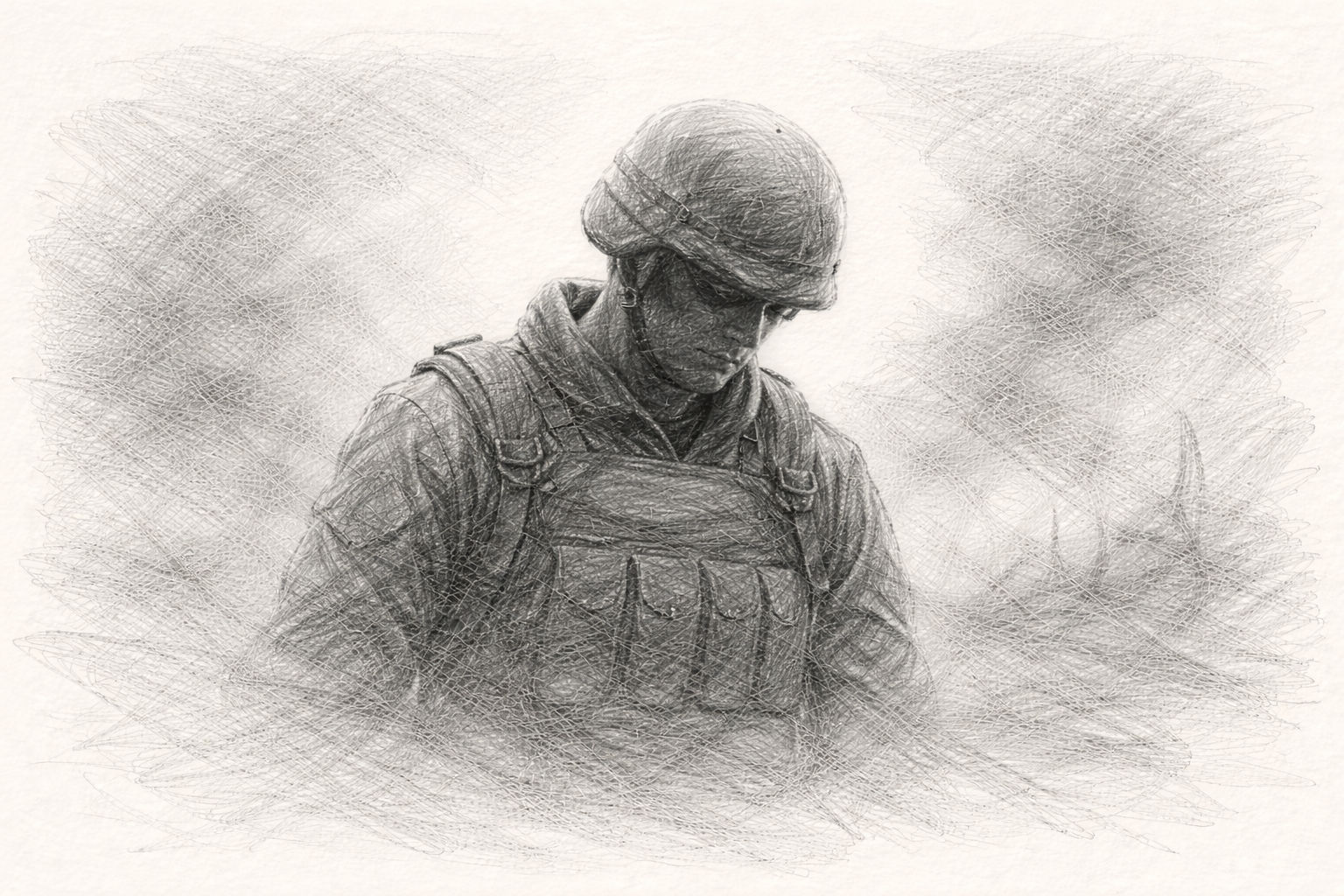
Killing on commission - does that exonerate you?
- Military logic says: Yes.
- Moral experience says: only partially.
Many soldiers later report not guilt in the legal sense, but something more diffuse. Of an inner exhaustion. Of emptiness. Of a loss of vitality. Of the feeling of having become a stranger to themselves.
This is a central point of this article: Dignity is not determined solely by right or wrong. It depends on the extent to which a person still experiences their own actions as their own.
A command can shift responsibility. But it cannot completely dissolve them.
The visible traces of violence
In current wars, there are images of soldiers who are barely recognizable after a few months. Men who appear to have aged decades in the space of a year. Their faces are sunken, their eyes tired, their gaze dull or distant.
This is not a media effect. It is the physical trace of a condition that is permanently pushing the limits.
Lack of sleep. Constant stress. Anxiety. Loss of comrades. Constant alertness. The knowledge that you may have to kill at any time - or be killed yourself. The body reacts honestly. It bears what the psyche can barely grasp.
This visible ageing is not a sign of weakness. It is an indication of how much a person can take - and how much they lose in the process.
The soldier as the bearer of other people's decisions
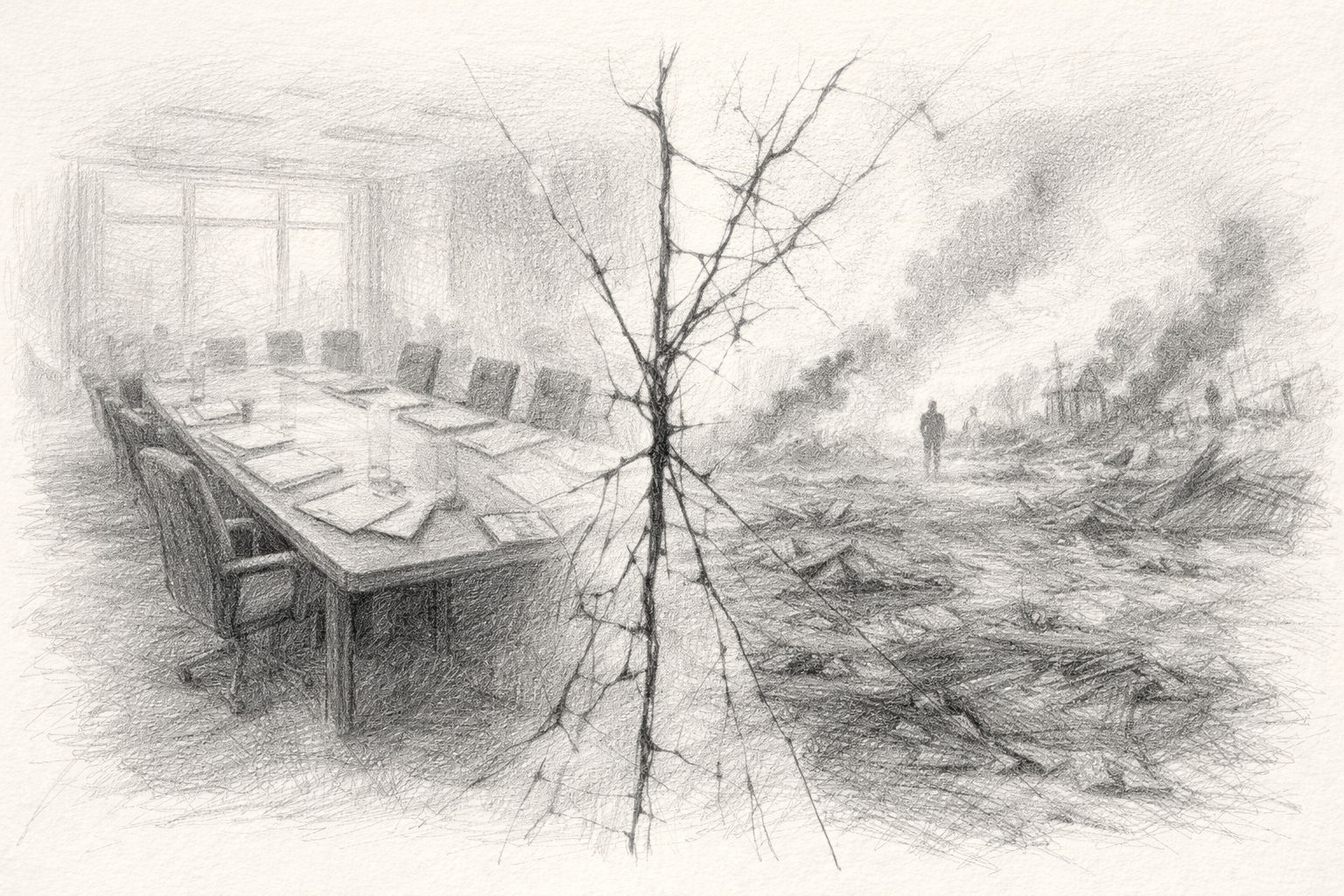
A decisive difference between murder, terror and war lies in the fact that soldiers rarely act on their own initiative. He is the bearer of a decision made by others. Often far away. In meeting rooms, conference halls, strategic planning games.
This does not make the soldier blameless in a legal sense. But it makes him particularly vulnerable in an existential sense. Because he has to live with the consequences - physically, mentally, socially.
And many don't do this for long. Many don't come back. Others come back, but don't really arrive.
Dignity is under double pressure here:
- through the action itself
- through the knowledge of not having decided for yourself
- No equation - but the same question
This chapter deliberately does not equate the soldier with the terrorist or the murderer. The motives, structures and constraints are fundamentally different. That is important to note. And yet the same question remains:
What does killing do to the person who does it?
Not morally.
Not political.
But human.
Many soldiers report that they only begin to understand what has happened after the deployment. In the meantime, you function. Afterwards, things often break down. Relationships fail. Closeness becomes difficult. Trust is lost - even in oneself.
This is not an individual failure. It is the result of a borderline act.
Dignity under duress
Dignity here does not mean that the soldier should have acted differently. That would be an unjust demand. Rather, dignity means recognizing the burden that is placed on this person - and how little room there often is to carry this burden later.
A system that demands killing must also face up to the question of what it owes to those who carry it out. Not only medically. Not just financially. But humanly. In this context, dignity also means not pretending that what has been experienced can simply be „organized away“. The soldier is the clearest proof that violence does not remain abstract. It eats into the body, face, posture and biography. It leaves its mark - even when it is described as necessary, just or without alternative.
This chapter makes no accusations. It describes a finding. And this finding is that killing in war does not fully protect the dignity of either the victims or the perpetrators. It shifts responsibility, but it does not heal it. It exacts a price that is rarely stated openly.
Perhaps dignity does not begin here with judgment, but with honest recognition of what people are forced to endure in war.
Five years of war - and what remains of it
What happens to a person who lives in war for years? In this interview Vocko, former professional soldier, paramedic and instructor, talks openly about over 1,600 days of deployment abroad - in Kosovo, Bosnia and Afghanistan. He talks about fallen comrades, PTSD, flashbacks and therapy - and about how life after the war can still be possible.

Ex elite soldier: 5 years of war, PTSD, death & trauma | Coach assignment
Hagen Vockerodt alias „Vocko“ is the author of the Boxes „1638 days at war: the flip side of the operational medal“ and has been involved in this topic for some time. No hero talk, no clichés. Instead, honest insights into the long-term consequences of violence - and into the question of what commitment really does to a person.
The great justification machines
Violence rarely arises in a vacuum. It is prepared, explained, framed. Before shots are fired, stabbed or ignited, many words have usually already been spoken. Words that organize, simplify, relieve. Words to help make the unbearable bearable.
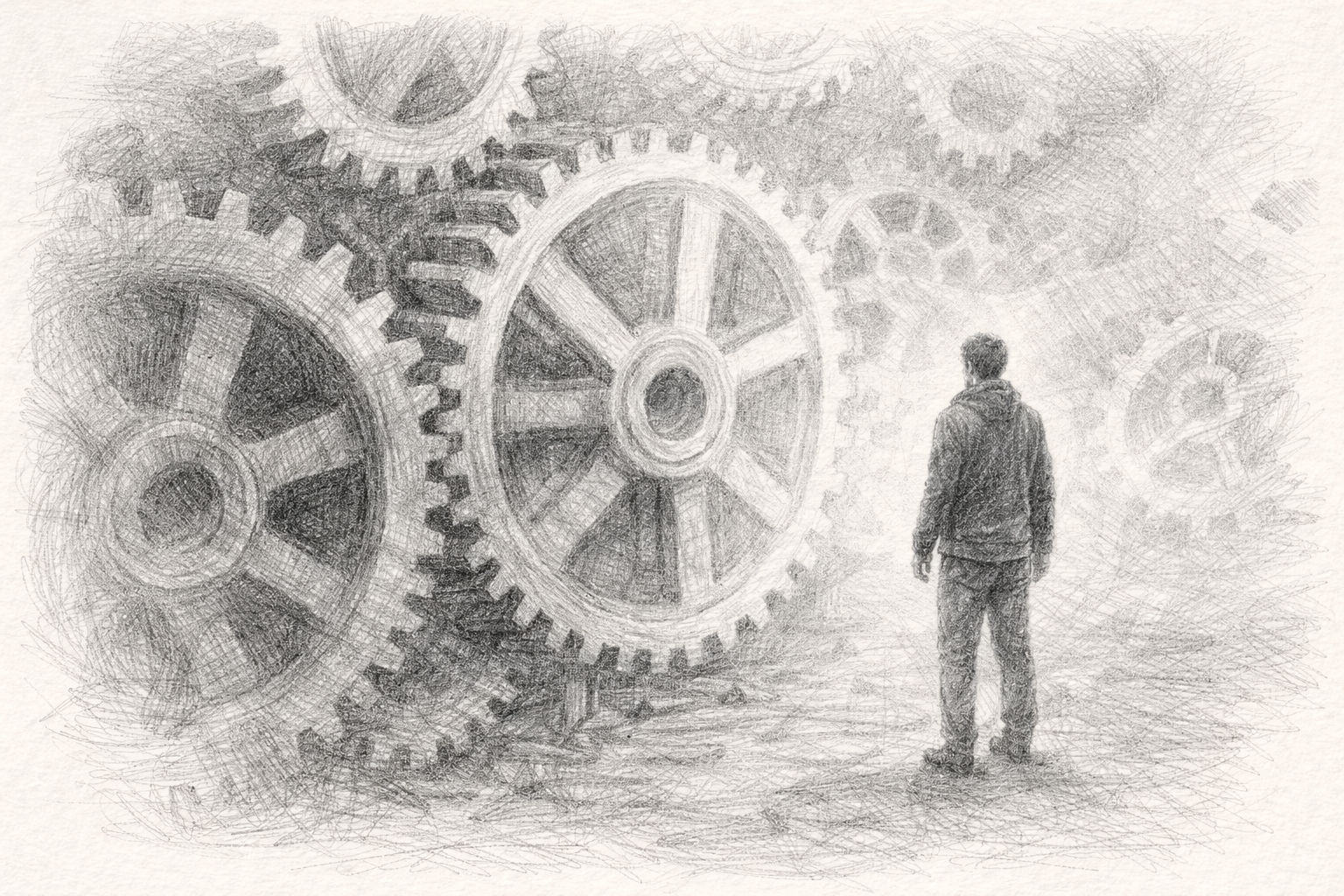
These words form, often unnoticed, justification machines. Large, effective systems of language, symbols and narratives that do not necessarily command violence - but make it possible.
„I had to“ - the language of relief
A recurring pattern in stories of perpetrators, but also of systems, is a short, seemingly harmless sentence:
„I had no choice.“
This sentence can be true. It can describe compulsion. It can express a real lack of alternatives. And yet it has a side effect:
It shifts responsibility away from the person acting - towards circumstances, orders or necessities.
This is precisely where justification machines work. They offer concepts that explain actions without the person acting still having to experience themselves as the center of this action. The act becomes the result of a process, no longer the person's own decision. Dignity is not openly attacked at this point. It is quietly circumvented.
Ideology, nation, faith
The most effective justification machines are those that are bigger than the individual. Ideologies, nations, religions. They can all give meaning, create community, provide orientation. That is their positive side. But they also have a dark downside:
They can exaggerate actions by placing them in a larger context. Suddenly it's no longer about:
- one person killed
- a concrete act
- an individual responsibility
But about:
- History
- Security
- Faith
- The future
- the „big picture“
The larger the framework, the smaller the individual becomes. And the easier it is to no longer see one's own actions as personal.
When systems distribute responsibility
Modern societies are complex. Responsibility is divided, distributed and fragmented. This is often necessary in order to remain capable of acting. No one can be responsible for everything alone. But in the context of violence, this division of labor has a dangerous side effect:
- Nobody feels completely responsible anymore.
- The order came from above.
- The decision was political.
- The implementation was technical.
- The consequences are statistical.
Between all these levels, the person who actually acts disappears. And with him disappears the place where dignity could be anchored at all: the personal awareness of one's own actions.
Justification is no substitute for an attitude
Justifications are not wrong per se. They help to explain, categorize and make situations understandable. But they become problematic when they replace attitude. Attitude means:
- I know what I'm doing
- I know why I do it
- And I know that I am the one who acts
Justification machines, on the other hand, say:
- It was bound to happen
- It was inevitable
- It wasn't up to me
That may be a relief. But it separates people from themselves.
The seduction of a lack of alternatives
The narrative of no alternatives is particularly effective. When violence is presented as the only option, any further questions become superfluous. Doubt is then seen as weakness, hesitation as betrayal, reflection as danger.
In such situations, the space for dignity shrinks. Not because people are suddenly evil, but because complexity is no longer allowed. But dignity needs precisely this space.
- It needs time.
- Doubts.
- Internal friction.
Where everything seems clear-cut, there is hardly any room for dignity.
When the goal justifies everything
Another characteristic of large justification machines is the shift in focus from the means to the end. The goal becomes so important, so urgent, so without alternative that the means are barely considered. Something crucial is lost in the process:
Means shape the doer. It is not the result that changes people, but the way to get there. Those who kill to achieve a goal do not remain unchanged - even if the goal is achieved.
Dignity does not ask at this point: Was the goal the right one?
But rather: What did this action do to the person who carried it out?
Dignity cannot be delegated
The central idea of this chapter is simple and uncomfortable:
- Dignity cannot be outsourced.
- No system can guarantee it.
- No ideology can replace it.
- No command can save them.
Dignity only exists where a person is prepared to take themselves seriously as an agent - even under pressure, even under duress, even in difficult circumstances.
This does not mean that everyone is always free to make decisions. It means that no one is completely free from responsibility.
The great justification machines of our time are efficient. They explain, legitimize, reassure. They help to organize violence without having to constantly name it for what it is.
This text does not counter them with a counter-narrative. It does not call for a new ideology. It merely applies a standard that is smaller than any system - and therefore more difficult to circumvent: the question of one's own dignity in one's own actions.
Perhaps this is not a convenient criterion. But it is one that cannot be delegated.
Current survey on a possible case of tension
What would dignity even be?
After this text has looked at violence in its various forms, a counter-question inevitably arises. If killing damages or destroys dignity, what does dignity mean in concrete terms? What remains if it is not understood as a moral slogan, not as a concept of law and not as a religious promise?
This chapter does not attempt a definitive definition. Rather, it outlines a working concept of dignity that can be viable in life - even in situations where there are no simple solutions.
Dignity does not mean passivity
A frequent objection is: If killing is considered undignified, is the only option then inaction? Look away? Surrender?
No. Dignity does not mean submitting to everything or giving up all forms of resistance. Self-defense, protecting others, resisting violence - all of these can be necessary. However, dignity is not first and foremost about justification, but about attitude in action.
The difference is not between acting and not acting, but between:
- Dehumanization and recognition
- Instrumentalization and responsibility
- blind reaction and conscious decision
Dignity does not mean never crossing boundaries. It means recognizing these boundaries as boundaries.
Dignity as an inner holding line
Dignity is not loud. It does not shout. It does not threaten. Rather, it is an inner line that a person senses - sometimes only in retrospect.
This line does not say: You must never do that.
She asks: What will this action do to you?
This question is particularly difficult to bear in extreme situations. But it is often the only protection against losing yourself completely.
In this sense, dignity is not an ideal, but a line of defense against inner brutalization.
Responsibility without a promise of salvation
A central point of this article is the absence of promises of consolation. Dignity here does not function via redemption, forgiveness or later justification. It is this-sided. That is to say:
- No afterlife can compensate
- No story heals automatically
- No later meaning undoes the action
This sobriety is hard. But it makes dignity real in the first place. Because only when life counts here do actions carry weight. Dignity then means:
I know that this life cannot be repeated.
And that is precisely why I am responsible for what I do.
Dignity in the face of coercion
Many people do not act freely. They act under pressure, under threat, under orders. This is particularly true in war, but also in criminal, ideological or existential contexts.
Dignity here does not demand heroism. It does not demand superhuman steadfastness. It begins much earlier - with the recognition of what is happening. In the refusal to trivialize violence internally or to outsource it completely. In such situations, dignity sometimes only means
- I see what I do.
- I know it's not good.
- And I know that it changes me.
That is not an acquittal. But it is a remnant of humanity.
Dignity and humanity
Another aspect of dignity is the ability not to lose the other person completely - even when you are confronted with them. Even when he is an enemy.
This does not mean liking him or going easy on him. It means not turning them completely into an object. Where the other person is merely a function, goal or symbol, dignity has already disappeared. Where a person is still perceived as a human being, at least inwardly, there remains a remnant of a boundary.
This boundary is fragile. But it is crucial.
Dignity as silent resistance
Perhaps dignity in violent times is not a grand gesture, but a quiet resistance. A resistance to simplification. Against relief. Against giving up one's own responsibility.
Dignity is not shown in the result, but in the inner process. In doubt. In the gravity of the decision. In the refusal to take violence lightly - even when it seems unavoidable.
This is not heroism. It is attitude.
If you understand dignity in this way, then it is not a possession, but a constant balancing act. It can be damaged. It can be lost. It can perhaps also return in part - through recognition, through responsibility, through the effort to take oneself seriously again.
Dignity is then not perfect. But it is real. And perhaps that is all you can realistically expect in a troubled world.
A personal boundary
I was in the Bundeswehr myself in the 90s - as a conscript. Looking back, it was a comparatively relaxed time. Everyday service was straightforward, a lot of things ran smoothly, almost routinely. There was no real threat situation, no concrete prospect of actually getting into an armed conflict. In this context, the service was bearable for me.
But I have to be honest: if there had been even a serious chance that I would have to kill someone, I would have refused. Not out of fear, not out of convenience, but out of an inner boundary that was - and still is - very clear to me.
This limit has nothing to do with political stance. It is not a judgment of other people who decide differently. It is simply the realization that I am not prepared to take this action for myself. Not legally. Not morally in an abstract sense. But very concretely: in terms of what it would have done to me.
At the same time, I am aware that such decisions are rarely easy. Refusal is not an easy step. It means justification, explanation and often also social pressure. And it requires you to come to terms with your own attitude at an early stage - before an abstract duty becomes a concrete action.
I also don't assume that a current conscript would automatically have to expect to suddenly end up in a trench. Military operations of this kind are highly complex, politically sensitive and generally voluntary. Nobody is sent lightly into situations that represent an extreme psychological and moral burden. This is precisely why I believe it is so important to address these issues at an early stage. Not in alarmism. Not in panic. But in calm. Those who ask themselves in good time where their personal limits lie are less likely to find themselves in situations in which they can only function.
This section is not intended as a recommendation. Nor is it intended as a model. It is merely a personal point of reference that shows that the question of dignity and killing is not a theoretical one. It concerns real biographies. Real decisions. And real consequences.
Perhaps this is where responsibility begins: not where action has to be taken - but where you honestly ask yourself what you are prepared to bear.
An open end: reason as a brake
This text has touched on many dark sides. Violence, death, degradation, coercion. And yet it would be a misunderstanding to read it as a pessimistic or hopeless text. For between all the borderline questions posed here lies a quiet but sustainable hope:
The hope of reason.
Not as a moral enlightenment or a sudden insight, but as the natural limit of human and social systems.

Violence is not sustainable in the long term
History shows the same pattern again and again. Violence may create order, secure power or resolve conflicts in the short term. But in the long term, it exhausts everything it sustains: People, resources, societies, trust. Wars rarely end because someone realizes that violence is wrong. They end because they become too expensive.
- Too expensive in terms of human lives.
- Too expensive in terms of economic substance.
- Too expensive in terms of social cohesion.
This disillusionment is not idealism. It is reality. And precisely here lies a sober form of hope:
Not in the fact that people suddenly become better - but in the fact that systems reach their limits.
When the costs become visible
One of the reasons why violence can be legitimized so easily is its abstraction. As long as decisions are made far away, as long as consequences remain statistical, as long as suffering disappears in numbers, much can be justified. But at some point, the costs become visible.
- In faces.
- In biographies.
- In empty places.
- In tired societies.
Then something begins that cannot be planned: a slow rethink. Not a moral awakening, but a return to the question of what we are prepared to bear.
Reason is not a virtue here, but a necessity.
Dignity as a corrective
At this moment, the term dignity takes on a new meaning. Not as an ideal, but as a corrective. As an inner brake against the complete normalization of violence. Dignity does not ask:
- Who is right?
- Who started it?
- Who is to blame?
She asks:
What do we expect people to do - and what do we no longer expect them to do in the long term?
This question is not only directed at perpetrators or decision-makers. It is directed at societies as a whole.
Responsibility begins before the action
A quiet but important thought in this text is that responsibility does not only begin where action is taken, but even before that. Where people decide what they want to support - and what not.
In this context, it is no coincidence that many people are currently once again concerned with questions of compulsory military service, service in arms and personal conscientious objection. These questions are uncomfortable because they are not abstract. They force us to place ourselves in relation to violence - not in theory, but in concrete terms.
There are Legal options to refuse. There are decisions of conscience that are protected. And there are good reasons to deal with them early on. Not out of cowardice. But out of attitude.
Dignity also means not allowing yourself to be instrumentalized
Anyone who has read this text up to this point will have noticed that dignity appears again and again in the same place: where people stop allowing themselves to be completely turned into a means.
- This applies to terror.
- This applies to murder.
- And it also applies to state-organized violence.
It is not always possible to avoid this instrumentalization. But recognizing it is a first step. And sometimes this step is crucial.
Dignity then does not manifest itself in heroic resistance, but in the conscious refusal to normalize violence internally.
Hope without illusions
This text does not end with a solution. Not with an appeal. Not with a promise. It ends with an attitude: the conviction that reason, as unspectacular as it is, is more effective in the long term than any escalation.
Not because it is morally superior, but because it is more sustainable.
- Reason does not ask for victory, but for resilience.
- Not by symbols, but by consequences.
- Not for justifications, but for limits.
One last thought
Perhaps, in the end, dignity is nothing more than the refusal to take violence lightly - even when it is presented as necessary. Perhaps it is the silent remnant of humanity that remains when all grand narratives fail.
And perhaps it is precisely this remainder that is crucial. Not to save the world, but to stop losing it.
This text was not intended to provide answers. It wanted to keep a question alive. And sometimes that is the only realistic place to start.


Frequently asked questions
- Why does this article not simply distinguish between „good“ and „bad“ killing?
Because although this distinction may be legally and politically necessary, it misses the central question of this text. The article does not ask about justification, but about effect. More precisely: the effect of killing on the person who kills. Regardless of whether a court, a state or an ideology legitimizes the act, it remains a borderline act that changes the perpetrator. This change is often ignored - and this is precisely what the text aims to make visible. - Isn't this a blanket condemnation of violence without taking into account the reality of threat and defense?
No. The article explicitly recognizes that there are situations in which people have to act under duress or defend themselves. It does not call for passivity or moral idealism. It merely poses the question of what violence does to people in the long term - even when it is described as necessary or without alternative. This is not a condemnation, but a sober consideration of the consequences. - Why does the concept of dignity play such a central role?
Because dignity is not understood here as an abstract value, but as a person's inner attitude towards their own actions. Dignity describes whether someone still experiences themselves as a responsible subject - or whether they allow themselves to be completely turned into a tool. Especially in violent situations, this inner attitude is often the first thing to be lost. The article therefore uses dignity as a yardstick, not as a moral cudgel. - Isn't it unfair to associate soldiers with murderers or terrorists?
The article explicitly does not equate soldiers with murderers or terrorists. The motives, compulsions and structures are fundamentally different. Nevertheless, the same human question arises in all forms of lethal violence: What does killing do to the person who carries it out? This common question does not mean an equation, but a common consideration of the inner consequences. - Why is it so strongly emphasized that many perpetrators do not act voluntarily?
Because violence rarely arises from sovereign freedom. It is often the result of pressure, coercion, manipulation or existential need. This applies to soldiers, terrorists and sometimes even murderers. This observation does not excuse any act, but it does protect us from prematurely demonizing people. The article aims to understand, not trivialize. - Doesn't this approach relativize guilt and responsibility?
On the contrary. The text does not shift responsibility away, but rather repositions it. It shows that responsibility cannot be completely delegated - neither to commands nor to systems. At the same time, it recognizes real constraints. Responsibility is not understood here as guilt, but as recognition of one's own actions and their consequences. - Why is terror described as particularly undignified?
Because terror almost completely outsources responsibility. The perpetrator no longer acts as a human being, but as the bearer of a narrative. His own life is instrumentalized, the lives of others are abstracted. In the article's view, this total self-abandonment is an extreme form of degradation - not only of the victims, but also of the perpetrator himself. - What does the article mean by „justification machines“?
This refers to systems of language, ideology, morality and structure that make violence explainable and tolerable. Nation, religion, history, security or a lack of alternatives can embed actions in such a way that the individual no longer experiences themselves as an agent. These machines are not evil per se, but they become problematic when they completely replace personal responsibility. - Isn't dignity a luxury concept in extreme situations?
Dignity is not a luxury, but is particularly relevant in extreme situations. It does not require perfect decisions, but a minimum of inner truthfulness. Dignity here does not mean acting correctly, but rather not losing oneself completely - even under pressure. - Why is there so much talk about the internal consequences for perpetrators and so little about victims?
Focusing on perpetrators does not mean devaluing the victims. Their suffering is undeniable. The article deliberately chooses this focus because the internal consequences for perpetrators are often suppressed by society. This repression makes it easier to normalize and repeat violence. The text aims to make this blind field visible. - Can dignity ever be restored after an act of violence?
The article does not give a simple answer to this. Dignity can be damaged or lost, but it is not a static state. Recognition of the crime, responsibility, coming to terms with it and honest confrontation can bring back at least some of it. Not through repression, but through confrontation. - Why does the text talk so little about guilt and punishment?
Because guilt and punishment are important but limited categories. They regulate social order, but say little about what happens inside a person. The article deliberately moves on a different level: the existential and human level. - What does dignity have to do with conscription or conscientious objection?
A lot. The question of whether one is prepared to use or have to use violence is a deeply personal question of dignity. Dealing with refusal, decisions of conscience and legal options at an early stage is not a sign of cowardice, but of responsibility for one's own life and actions. - Is this article a pacifist text?
No. It does not call for an absolute renunciation of violence and does not ignore any real threats. Nor is it a political manifesto. It is an essayistic text that poses a question that lies ahead of any political position: What does violence do to people? - Why does the article end without a clear solution?
Because there is no simple solution. The text is not intended to provide recipes, but to offer a benchmark. Sometimes it is more honest to leave a question open than to close it with an apparent answer. - What should the reader take away from this text?
Not an opinion, but a touchstone. A question that one can ask oneself before judging or justifying violence. Dignity is understood here as an inner orientation, not as a demand on others.