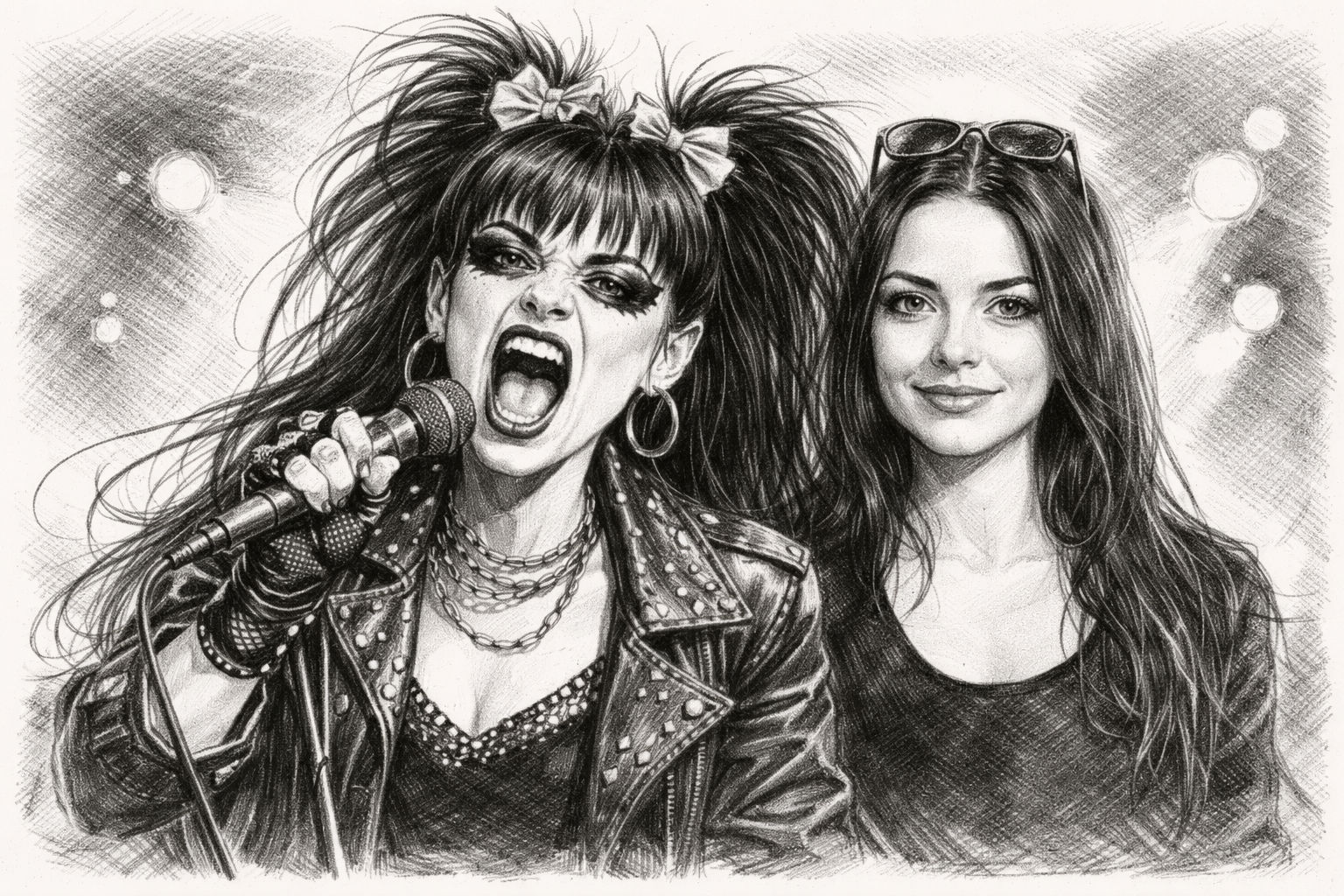
When you approach a portrait of Nina Hagen, it's tempting to talk about music first. About punk, provocation, shrill performances. About everything that is loud and visible. This portrait deliberately begins differently. Not with songs, not with styles, not with images. But with something quieter - and more important: attitude.
Attitude is not a label. It cannot be put on like a costume, pasted on afterwards or explained with marketing. Attitude is evident in early behavior, long before someone becomes famous. It can be seen in how someone reacts to limitations, to contradictions, to power. And this is where Nina Hagen becomes interesting - not as an icon, but as a personality.

Only what has been quietly decided beforehand has a loud effect
What many perceive as „crazy“ is, on closer inspection, usually the opposite of randomness. Provocation rarely arises from chaos. It arises from clarity. Those who deliberately exaggerate know what they are doing. If you don't want to explain yourself, you have already understood very clearly. This portrait therefore follows a simple assumption:
Nina Hagen was not eccentric first - she was attentive first. She observed, sensed tensions, registered injustices. Only later did she find forms of expression that became visible. Attitude came before style.
Especially at a time when many people confuse loudness with courage, it is worth taking this difference seriously. Attitude is not noise. Attitude is consistency.
Why this portrait is being written
This portrait is not a fan text. It is not intended to please, to capture, to glorify. Nor is it a reckoning. It is an approximation. Written out of interest in a person who has repeatedly refused to become simple - although simplification would often have been the more convenient way.
You won't find a chronological sequence of successes here, no complete discography, no list of media scandals. All that is available, everywhere. What is rarer is a calm reflection on what people wear when they don't want to conform.
Nina Hagen is particularly well suited to this because she has polarized without ever allowing herself to be completely taken over. Neither by the system, nor by the market, nor by her fans.
Attitude as an early decision
Attitude is not created in the spotlight. It is created in spaces where you are observed. In systems that formulate expectations. In families, schools, structures. It arises where you notice that something is wrong - and decide how to deal with it.
This early imprint is central to Nina Hagen. Not because she had to suffer exceptionally, but because she learned early on to distinguish between surface and reality. Between what is said and what is meant. Between the official narrative and everyday life.
This ability is unspectacular - and yet rare. It forms the basis for everything that later became visible.
Many public figures develop a program in the course of their career: a role, an expectation, a fixed set of statements. Nina Hagen has repeatedly eluded this pattern. That makes her uncomfortable. But that is precisely where her consistency lies.
Attitude does not mean always being right. Nor does it mean always appearing consistent. Attitude means not deliberately bending yourself just to meet expectations. Those who develop inevitably contradict themselves. Those who seek honestly do not stand still.
In this sense, Nina Hagen is less a completed figure than a process. And that is exactly how she is treated in this text.
A portrait at eye level
This portrait is aimed at readers who are not looking for instructions or hero worship. It is aimed at people who are interested in personalities - not myths. In decisions - not in labels.
You don't have to like Nina Hagen's music to find it interesting. You don't have to admire her performances to respect her attitude. It is precisely this separation that is crucial. The work, the effect and the person are not identical - nor should they be.
This portrait attempts to make precisely this separation visible.
The following chapters will be devoted to her origins, her childhood, growing up in the GDR system, the breaks and transitions. They will show how early experiences gave rise to an inner independence. And how this independence later became visible to the outside world - sometimes loudly, sometimes irritatingly, often misunderstood. The common thread remains constant:
- Attitude before fame.
- Decision before the pose.
- Clarity before volume.
If you continue reading this text, it is not to confirm an icon - but to get closer to a person who decided early on not to be simple. And who has carried this decision. Until today.
Origin as imprint - childhood, family and early sensitivity
A person's background doesn't explain everything - but it does explain a lot. In Nina Hagen's case, it is not a decorative background, but a supporting foundation. Born in East Berlin in the mid-1950s, she grew up in a world characterized by contrasts: artistic openness in the private sphere, ideological narrowness in the public sphere. It was precisely in this field of tension that a special sensibility was formed early on.
The parental home is artistically influenced, language, music and the stage are a natural part of everyday life. At the same time, there is a state that dictates what may be said, thought and shown. For a child, this means two realities. One that feels real. And one that is official. Anyone who grows up in such an environment learns to differentiate at an early age - not in theory, but in practice.
The role of the mother is central to this. She is not a marginal figure, but a point of orientation. Artistically active, present, independent. No conformist functioning, but a life with expression. This is formative for a child without having to be explained. Attitude is not preached here, but exemplified.
In such constellations, there is no blind obedience, but attention. Children observe closely. They register when adults say something they don't believe. They sense where conformity begins and where conviction ends. Anyone who grows up like this develops a sense of authenticity early on - and of its absence.
This early imprint is crucial: attitude does not develop as a rebellion against parents, but as the continuation of an inner self-evidence. Not loud, not combative - but awake.
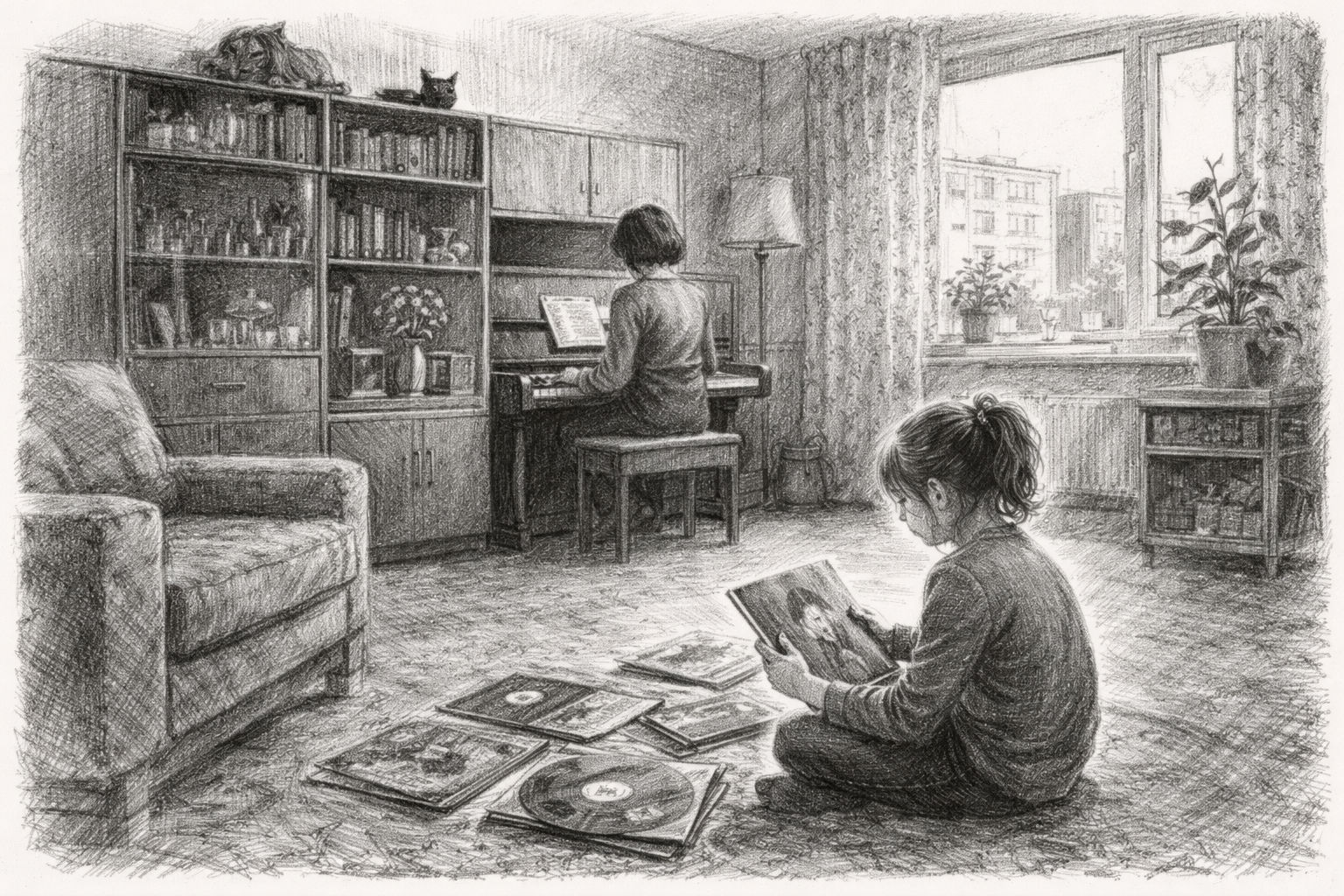
Early encounters with art - without romanticization
Music, singing, dancing: all of these are part of Nina Hagen's everyday life from an early age. Talent is recognized, encouraged and challenged. But it is not glorified. Art is not a luxury, but work. Practice. Discipline. This is also a form of attitude: not to regard creativity as a state of emergency, but as a serious activity.
At the same time, it becomes clear early on that talent alone is not enough. In a state-controlled cultural sector, talent is evaluated, categorized and controlled. Support is never neutral. It is always linked to expectations. If you belong, you have to fit in. Those who stand out are observed.
For a sensitive child, this does not result in defiance, but caution. You learn to move without revealing yourself. An ability that is later often misunderstood - as calculation or staging - but which is initially nothing more than self-protection.
Childlike alertness instead of childlike naivety
What many underestimate: Children in authoritarian systems are not automatically conformist. They are often particularly attentive. They listen carefully. They notice when something is wrong. This alertness is not a sign of precociousness in the romantic sense, but a necessity.
Nina Hagen is not growing up in a vacuum either. Conversations, moods, unspoken tensions - all of this is perceived. Attitude does not arise here as opposition, but as inner distance. You don't have to disagree out loud in order not to be taken in.
This ability to keep her distance without turning away is a recurring theme in her later life. It explains why she never allowed herself to be completely taken in - neither by the state, nor by the market, nor by scenes.
School as a place of adaptation
In the GDR, school is more than just a place of education. It is an instrument. Performance is assessed, but so is attitude. If you stand out, you stand out. If you ask questions, you are registered. For children from artistic households, it is a balancing act: belonging without denying yourself.
Nina Hagen also moves between the lines here. Not as an open rebel, but as someone who realizes that there are rules that are non-negotiable - and others that can be circumvented. Attitude is not shown here in resistance, but in an inner compass.
This experience is important for her later understanding of herself. It explains why provocation never has an unreflected effect on her. Anyone who has learned to control themselves at an early age will later know exactly when to consciously give up control.
Family, politics and unspoken conflicts
Then there is the family's political environment. Critical voices, tensions with the system, consequences that do not remain theoretical. For a child, this means that politics is not something abstract. It affects their own lives. It has consequences.
This experience heightens awareness of power structures. Not ideologically, but existentially. Attitudes do not arise from slogans, but from observation. Those who experience how quickly life circumstances can change develop a sense for dependencies - and for their dangers.
Nina Hagen grows up in this climate without turning it into a victim narrative. There is no self-stylization. Rather an early understanding that freedom can never be taken for granted - and that you don't get it for free.
What is often dismissed as hypersensitivity is actually a strength: sensitivity. It enables perception. It allows differentiation. In an environment that demands simplification, this is a risk - and at the same time a resource. This sensitivity explains why Nina Hagen did not become smooth later on. Why she did not fit into roles easily. Anyone who has learned to hear nuances at an early age cannot accept one-dimensional answers later on.
Here, attitude is not the result of defiance, but of a deep need for coherence. Inside and outside should fit together. If this does not succeed, it becomes loud - not out of a desire for provocation, but out of incompatibility.
Origin as a starting point, not as an explanation
It would be too easy to blame everything on the origin. It does not explain the later path, but it does make it understandable. It shows why certain decisions were obvious - and others impossible.
Nina Hagen's childhood is not a story of heroism or suffering. It is an example of how attitude is quietly created: through observation, through contradictions, through early experiences of limitation and freedom.
This origin is not destiny. It is a starting point. What it became is the result of many decisions. But without this beginning, many things could not be explained.
Before attitude becomes visible, it has to grow. Before it provokes, it has to consolidate. The next few years will show how this early sensitivity develops into an independent personality - in a system that leaves little room for it. The next chapter is dedicated to precisely this phase: growing up in everyday life in the GDR, the first successes, the first limits - and the quiet decisions that prepare the way ahead.
Growing up in the system - GDR, school, early career and first borders
Growing up in the GDR did not mean a permanent state of emergency. It was everyday life. School, rehearsals, exams, performances. It is precisely this normality that is important in order to understand how attitude develops under such conditions. The system was omnipresent, but rarely spectacular. It worked through rules, through expectations, through unspoken boundaries.
For Nina Hagen, this meant that talent alone was not enough. Anyone who was promoted was under observation. Anyone who stood out had to explain. And those who didn't explain learned to keep quiet - at least on the outside.
In such environments, attitude does not arise as overt resistance, but as inner navigation. You learn to read between the lines. You know when to speak and when to remain silent. This ability is often misunderstood later on. It is not opportunism, but survival skills.
School in the GDR as a filter
School in the GDR was not a neutral space. It sorted. Not just by performance, but by adaptability. Questions were allowed - as long as they weren't the wrong ones. Creativity was welcome - as long as it fitted in.
For an artistically inclined child, this meant a constant balancing act. On the one hand encouragement, on the other control. On the one hand recognition, on the other expectation. If you wanted to survive here, you had to learn to move without offending. Not out of fear, but out of clarity about the rules of the game.
This phase is crucial because it shapes an attitude that is later often misinterpreted as „calculation“. In fact, it is an early understanding of power relations. Those who know how systems work can later consciously decide against them - or consciously play with them.
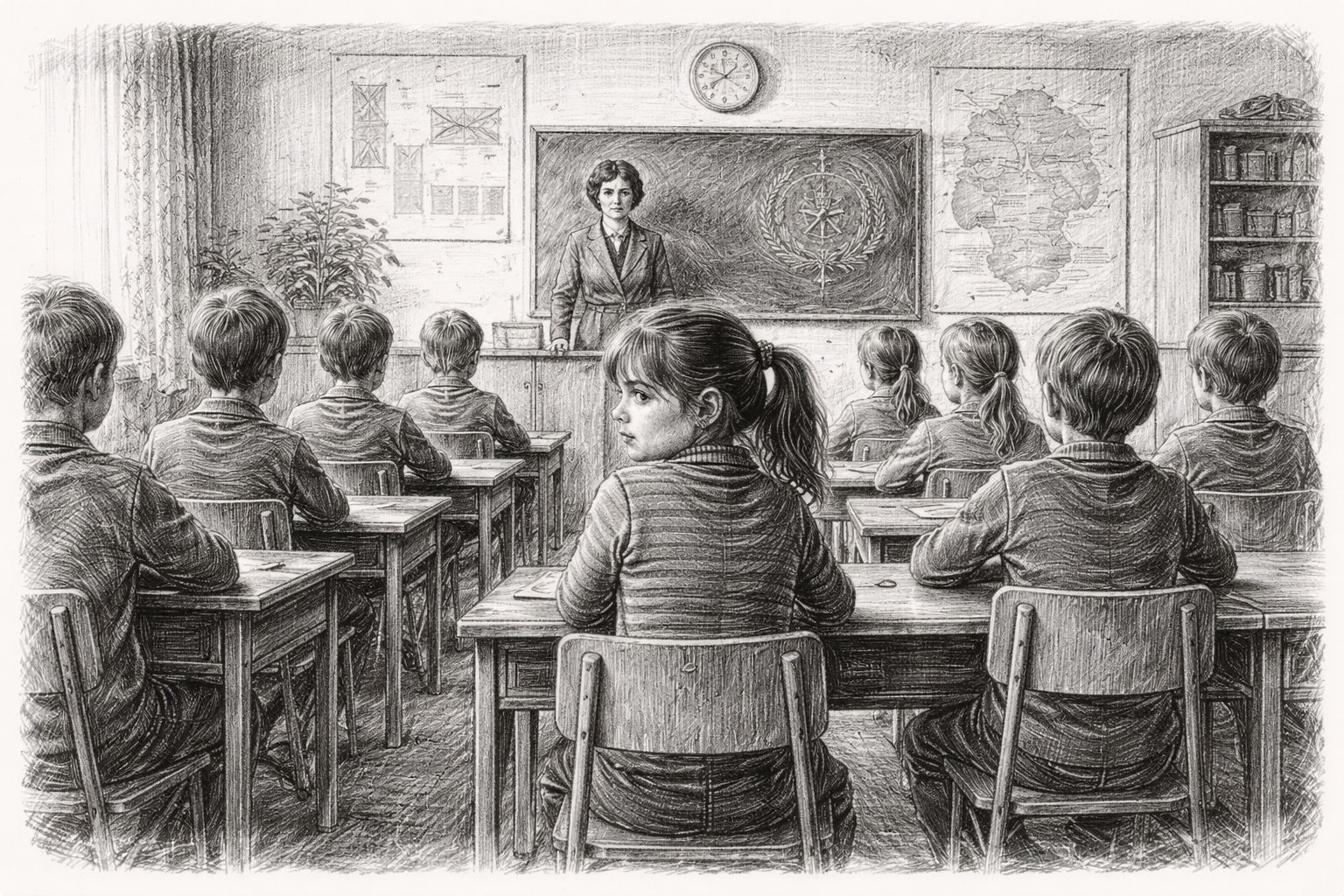
Early education and musical promotion
Nina Hagen's musical training was serious and demanding. Singing, technique, discipline. No romantic artistic ideal, but solid craftsmanship. This early professionalism shaped her later appearance more than the outward provocation would suggest.
Craftsmanship creates independence. Those who master their instrument are less susceptible to blackmail. This insight is old, but timeless. It explains why Nina Hagen's attitude was never just an assertion. She was able to perform. And that's precisely why she didn't have to pander. At the same time, it was clear that promotion also meant commitment. Those who stood on stage represented. Those who represented were controlled. This equation was inescapable.
First public successes
Visibility comes with the first appearances and successes. Visibility brings attention - and not just positive attention. Songs that seem harmless are interpreted. Lyrics that are ambiguous are scrutinized. Irony is allowed as long as it is not unambiguous.
The success of „You forgot the color film“ is an example of this phase. A song that seems banal at first glance unfolds its effect in context. It is precisely this kind of ambiguity that was possible in the GDR - and risky at the same time.
Here, for the first time, an attitude clearly emerges that will remain influential later on: not attacking anything head-on, but also not unconsciously reproducing anything. There is a fine line between adaptation and inner distance. Those who can walk it remain capable of acting.
Boundaries become visible
With increasing awareness, boundaries become clearer. Not always openly expressed, often indirectly. Hints, conversations, expectations. The message is clear: there is room for maneuver - but it is limited. For many, this point is crucial. Some continue to adapt. Others withdraw. Still others escalate. Nina Hagen initially chooses a fourth approach: she observes. She registers. She collects.
This phase is important because it shows that attitude is not always immediately visible. Sometimes it matures quietly. Those who rebel too quickly burn themselves out. If you wait too long, you lose yourself. The art lies in the right moment.
When a system becomes personal
At the same time, the political environment is intensifying. Conflicts do not remain abstract. Decisions made by the state affect the private sphere. Loyalty is demanded where art should actually be created. Here, at the latest, it becomes clear that neutrality is not an option. Not because you want to be politically active, but because you can no longer avoid it. Attitude becomes a necessity.
This experience left a lasting impression. It explains why Nina Hagen later showed so little patience with appropriation - no matter from which side. Anyone who has experienced how quickly roles are assigned mistrusts simple attributions.
Adaptation as a conscious strategy
It would be wrong to describe this phase as a pure adaptation process. Here, adaptation is not a loss of self, but a conscious strategy. You fulfill requirements without identifying yourself internally. You play along without giving up on yourself.
This ability is ambivalent. It can be demoralizing. But it can also give you strength. The decisive factor is whether you retain your own core. This is exactly the case with Nina Hagen.
Later, she is often accused of being contradictory. In fact, she is consistent in something else: in protecting her inner independence.
The point at which something tips over Every system generates friction at some point. In Nina Hagen's case, this point doesn't come suddenly, but gradually. Expectations intensify. Scope narrows. The feeling of having to explain herself grows.
This reveals a central characteristic: she does not seek open conflict at any price. But neither does it accept permanent self-denial. Here, attitude means recognizing when a system demands more than you are prepared to give. This realization is uncomfortable. It does not immediately lead to solutions. But it marks an inner turning point.
First inner distance
Even before external decisions are made, an inner distance is created. You still belong - but no longer really. You fulfill expectations - but without inner approval. This distance is both dangerous and liberating. It makes you vulnerable, but also clear. Anyone who is familiar with this state knows that it is not sustainable in the long term. Something has to happen at some point.
With Nina Hagen, this phase is characterized by observation and collection. No loud revolt, no demonstrative break. But rather a quiet preparation.
Growing up in the GDR system doesn't end with a bang, but with a realization: that certain paths are possible, but not sustainable. That success has a price - and that you don't always want to pay that price. The next chapter will be dedicated to precisely this moment: the break, the decision, the departure. Not as a heroic story, but as a consequence. Attitude is not shown here in slogans, but in the willingness to accept uncertainty in order to remain true to oneself.
Rupture lines and decisions - departure, loss and new beginnings
There are moments when political conditions cease to be abstract. They then no longer affect „society“, but one's own everyday life, one's own environment, one's own future. For Nina Hagen, this moment is not a single event, but a condensation. Conversations change their tone. Scope becomes narrower. Things that are taken for granted disappear.
Up to this point, adaptation had been a strategy, inner distance a protection. But now it is clear that the system demands more than before. Not just conformity on the outside, but loyalty on the inside. This is precisely where a fault line runs that can no longer be ignored.
In such moments, attitude does not manifest itself in grand gestures. It is shown in recognizing when a compromise ceases to be a compromise.
Departure as a consequence, not as an escape
The decision to leave the GDR is not an adventure, not a departure in the romantic sense. It is a cut. With everything that goes with it: loss, uncertainty, leaving behind the familiar. Those who take this step do not do so lightly.
For Nina Hagen, leaving the country is not an act of provocation. It is the logical consequence of an inner development. Anyone who has realized that their own integrity is permanently called into question is faced with a clear choice at some point: stay and bend - or leave and start again. This decision is not a moral exaggeration. It is simply consistent.
The price of the decision
Every attitude has a price. This is often overlooked when people talk about courage or resistance afterwards. For Nina Hagen, leaving the country meant not only freedom, but also a loss of security, of structures, of familiarity in a familiar setting.
What remains is uncertainty. The West is not a promise, but a space. And spaces have to be filled. Those who arrive are initially nobody. Even talent does not protect against this.
This phase is important because it shows that attitude is not rewarded - at least not immediately. It is tested.
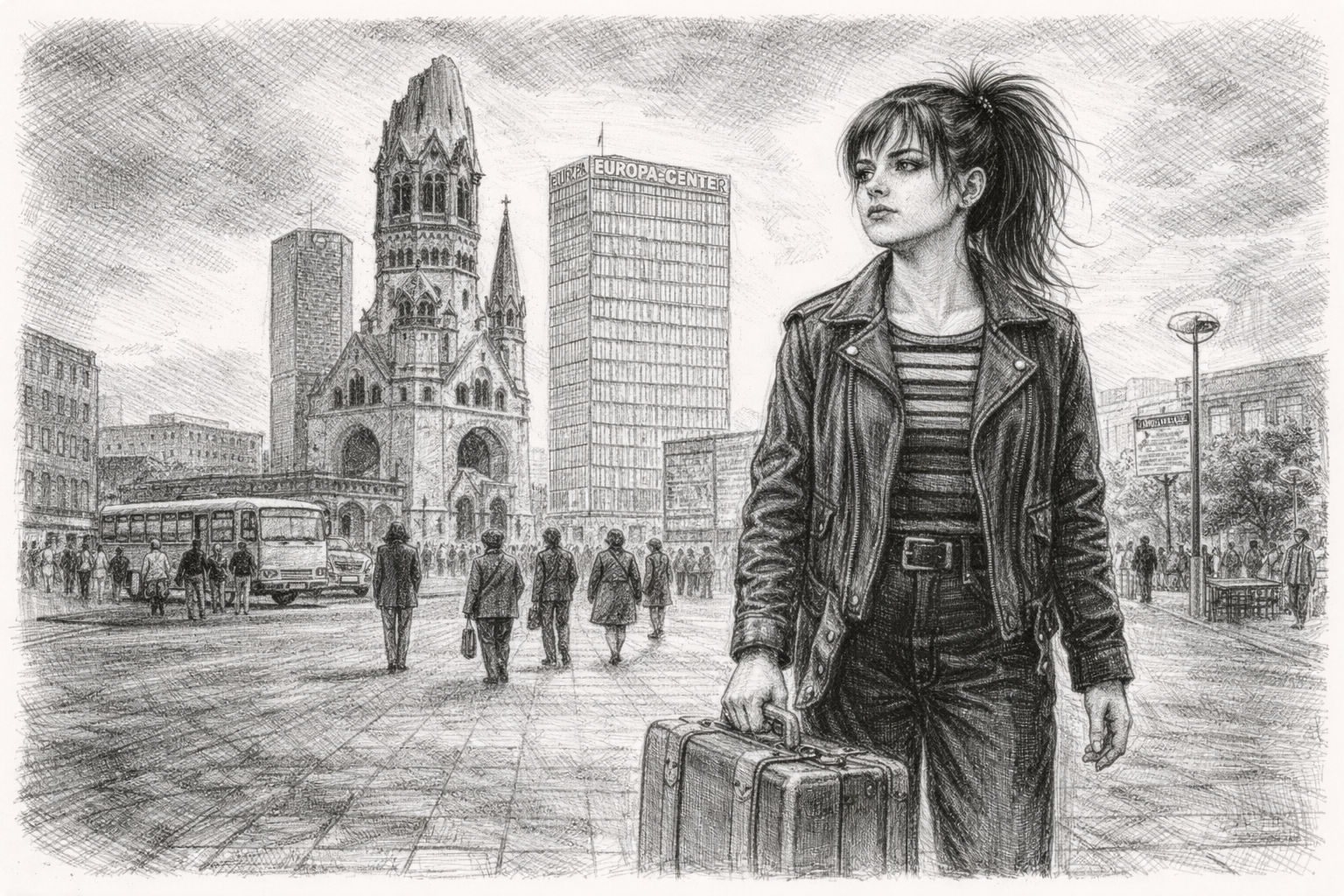
West Berlin: Freedom without instructions
West Berlin in the late seventies is a program of contrasts. Where rules used to dominate, openness now prevails. Where there was control, there is chaos. For many, this is liberating. For others, it is overwhelming.
For Nina Hagen, this new context initially means disorientation. Freedom is not automatically clarity. It demands decisions where previously there were guidelines. She is confronted with expectations of a different kind: market, scene, audience.
Attitude is redefined here. No longer as an inner resistance to control, but as the ability not to dissolve in the space of possibility.
Something shifts in this phase. The inner distance, which was previously protection, now becomes the driving force. Observation alone is no longer enough. The desire for expression arises - not adapted, not filtered. The transition is fluid. It is not a sudden invention of a role, but rather a gradual admission of what was previously held back. Voice, body language, presence become more direct. Not to shock, but to stop limiting herself further.
Attitude becomes visible.
Loss of home - gain of autonomy
Home is more than just a place. It is a habit, a language, an implicit understanding. All of this is lost when you leave the country. What remains is autonomy - an abstract gain that first has to prove itself. This tension characterizes Nina Hagen's further development. She is often perceived as radical, but her path is one thing above all: self-determined. Decisions are no longer based on expectations, but on inner coherence.
That does not mean security. It means responsibility.
Insecurity is uncomfortable. It is often avoided, concealed, overplayed. For Nina Hagen, it becomes a companion. Not sought after, but accepted. Anyone who takes attitude seriously cannot completely avoid insecurity. It is the price of not being absorbed into other people's structures.
This acceptance distinguishes attitude from defiance. Defiance wants security through demarcation. Attitude accepts uncertainty as part of the journey.
Breakage as a productive force
Breaks are often read as failures. In fact, they are transitions. They mark the end of a sustainable state and the beginning of an open one. For Nina Hagen, the break with the GDR is not a final farewell to her origins, but a re-positioning. The past is not denied, but neither is it glorified. It remains part of one's own history - without any claim to control over the future.
This ability to integrate ruptures is central. It enables development without losing identity.
What is conspicuously missing is a victim narrative. Despite real restrictions, despite losses, despite political pressure, there is no narrative of disadvantage. Instead, there is a sober attitude: that was the situation. These were the possibilities. That was the decision.
This sobriety is part of her strength. It allows them to move on without clinging to the past.
Preparation for visibility
What happens in this phase is more than just a change of location. It is an inner readjustment. The willingness to become visible - not in the sense of adaptation, but in the sense of presence.
The next steps will be louder. More conspicuous. More misunderstood. But they would not have been possible without this phase. Attitude needs a foundation. And this foundation is created here: in enduring uncertainty, in making decisions, in dispensing with simple explanations.
The break has been made. The decision has been made. What follows is not a return, but a forward movement without railings. The next chapter will show how this newly won autonomy becomes expression - how provocation becomes language, not as an end in itself, but as a form of consequence. For it is only now that what many associate with Nina Hagen begins. But it begins on a foundation that is quieter than its reputation suggests.
Between image and confession: Nina Hagen in conversation
In this Bibel TV report from 2010, we meet Nina Hagen beyond the familiar attributions. The focus is not on the punk icon or provocateur, but on a woman who is prepared to talk about ruptures, aberrations and her Christian faith. At the Ecumenical Church Congress in Munich and at a reading in Bavaria, she meets Anna Dressel and puts her own life into perspective - calmly, personally and without posturing.
The report shows how far apart public images and inner reality can be - and why attitude often begins where people are prepared to explain themselves.

Nina Hagen - Confessions, biography of a punk icon | Bible TV
Expression instead of conformity - punk, provocation and exaggeration
Freedom alone is not enough. It is a space, not a content. After the departure, after the break, after the phase of disorientation, a new question arises for Nina Hagen: How can what has long since been decided internally be externalized - without bending again?
Expression now becomes the central category. Not adapting to a new expectation, but consciously shaping one's own presence. Posture requires a form, otherwise it remains invisible. And this form can stand out, can irritate, can exaggerate - as long as it is not determined by others.
Punk as a language, not a label
For Nina Hagen, punk is not a scene costume. It is a language. A way of making the incompatible visible. Loud, contradictory, physical. Not because loudness is an end in itself, but because subtle nuances are often overlooked.
While many see punk as refusal, she uses it as a tool. Not against everything, but against simplification. Against slickness. Against expectations that are already solidifying again.
This distinction is important. It explains why it has never been fully absorbed into a scene. Scenes quickly create new norms. Attitude requires distance - also from one's own role.
The deliberate exaggeration
What many perceive as excess is, on closer inspection, calculated. Voice, gestures, appearance - everything seems exaggerated. However, exaggeration is not an escape from reality, but a method of making it visible.
By overfulfilling expectations, it exposes them. By exaggerating roles, it shows their artificiality. This strategy is old, theatrical, almost classical. It requires an audience that is prepared to look - or at least react with irritation.
Attitude is not shown here in restraint, but in the conscious decision not to want to be misunderstood, but to accept being misunderstood.
Femininity without permission
A central aspect of this phase is dealing with femininity. Not conforming, not pleasing, not explaining. Body, voice and sexuality are not hidden, but they are not offered either. They are part of the expression, not its purpose.
At a time when female role models are either adapted or scandalized, something third is emerging here: self-determination without apology. Not a feminist program, but a lived consequence.
That is provocative. Not because it's loud, but because it can't be categorized.
Misunderstandings as a side effect
Misunderstandings grow with increasing visibility. Reduction to outward appearances. Attributions. Simplifications. This is no coincidence. Those who remain complex are simplified.
Nina Hagen becomes a projection surface. For both admiration and rejection. But it is remarkable how little she tries to correct these projections. No long explanations. No adaptation of the performance in order to be understood.
Attitude here means not having to fight for interpretative sovereignty.
Craft beneath the surface
Despite all the provocation, something remains constant: Craft. Voice, technique, presence. If you look closely, you will recognize discipline beneath the surface. The ability to fill a space without losing yourself.
This distinguishes expression from mere loudness. Many people shout because they have nothing to say. Others scream because they can't express something in any other way. Nina Hagen rarely screams out of helplessness. It is usually a deliberate choice.
This professionalism is a protection. It prevents provocation from tipping over into the arbitrary.
No adaptation to the market
As success grows, so does the pressure to meet expectations. Marketability, recognizability, repetition. Many careers fail here - not because of a lack of talent, but because of a willingness to commit.
Nina Hagen refuses to make this commitment. Not demonstratively, but consistently. Changes of style, breaks, irritations are accepted. Success is not optimized, but relativized.
Attitude can be seen here in the refusal to be reduced to a working formula.
Provocation as a mirror
Provocation is not an attack. It is a mirror. It shows where boundaries lie - and who has drawn them. Reactions often say more about the environment than about the provocateur.
Nina Hagen seems to have internalized this insight early on. She rarely reacts defensively. She doesn't explain why something should be allowed. She simply does it.
That is uncomfortable. But that is precisely the consequence.
Expression instead of identity
It is important to distinguish between expression and identity. Expression can change. Identity remains. Nina Hagen uses forms of expression without confusing herself with them. Punk is a phase, a language, a tool - not the whole thing.
This agility prevents rigidification. It enables further development. And it protects you from the prison of your own icon.
Many are measured by what they once were. Attitude here means not allowing yourself to be pinned down.
The more visible someone becomes, the greater the risk of appropriation. Fans, media, markets - everyone wants a clear image. Nina Hagen doesn't provide one. At least not a lasting one.
That creates friction. But it preserves autonomy. Visibility is not sought, but used. As a stage, not as a home.
This distance is crucial. It prevents expression from becoming an obligation.
After this phase, nothing is innocent anymore. Expression is established. Attitude is visible. The roles have been assigned - at least from the outside. But this is exactly where a new challenge begins: how do you remain flexible when you have long since become a character?
The next chapter will be dedicated to this question. It is about change, contradictions and continuity. It is about the ability not to preserve an attitude, but to develop it further - even at the risk of disappointing expectations.
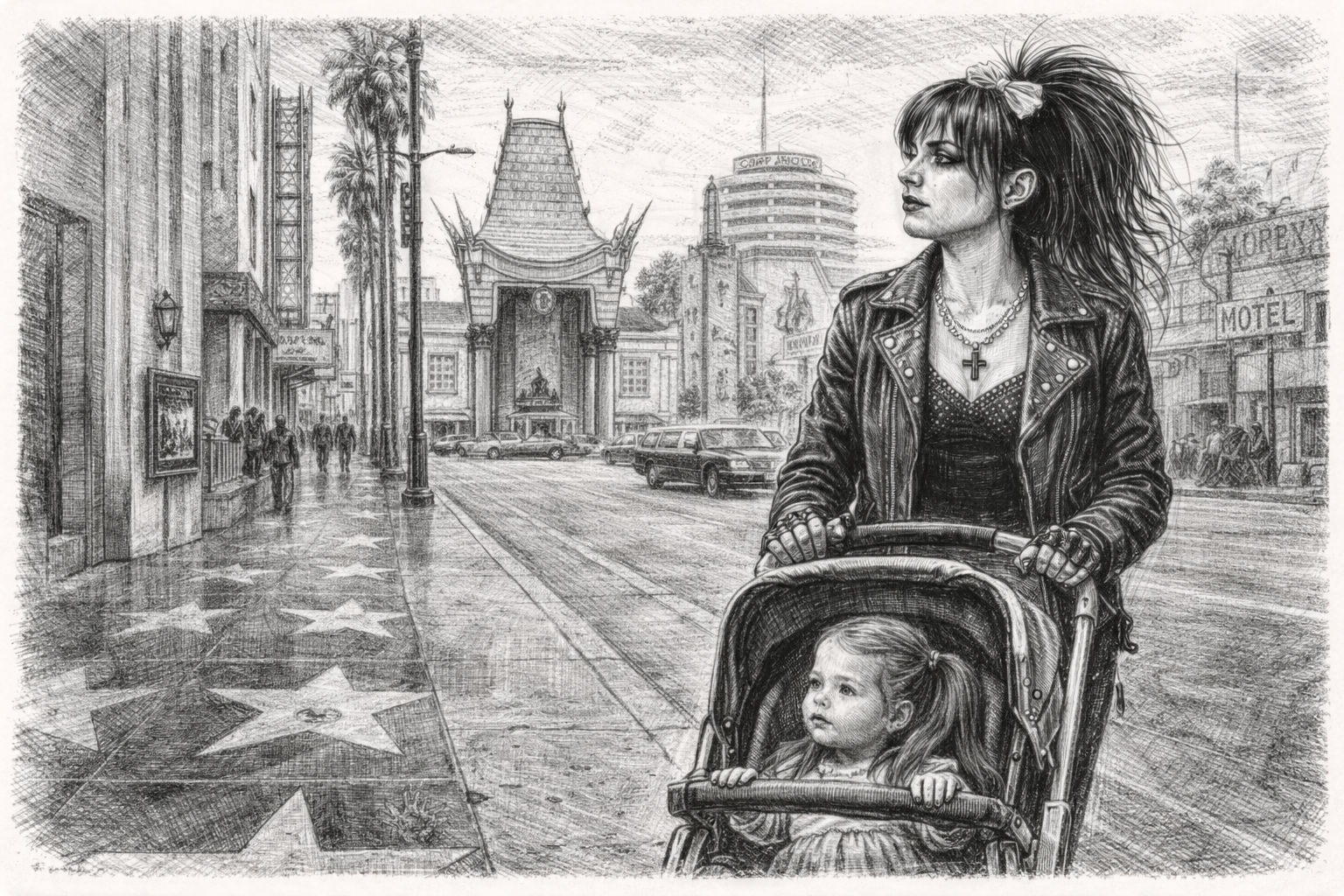
Between punk and Hollywood - Nina Hagen's years in the USA
When Nina Hagen moved to the USA in the early 1980s, it was not escapism, but a conscious break. After her early international success with the Nina Hagen Band and the transition from GDR exile to West German pop provocateur, she was looking for a larger resonance space - both artistically and personally. Los Angeles became the center of her life for several years, a place that promised freedom but also brought new frictions.
Los Angeles, studio work and radical experiments
In the USA, Nina Hagen worked with international producers and musicians and moved even further away from the classic punk format. Albums such as NunSexMonkRock (1982) and Fearless (1983) were created during this phase and are still regarded today as uncompromising documents of an artistic upheaval. Here she combined punk energy with opera quotations, religious motifs, science fiction allusions and radically personal lyrics - musically and thematically beyond what the mainstream expected.
Between freedom and excessive demands
The years in the USA were both inspiring and stressful for Nina Hagen. The American music industry offered opportunities, but demanded adaptation, and life between studios, tours and public attention left little room for stability.
This period also saw the early childhood of her daughter Cosma Shiva Hagen, who literally grew up between continents, cultures and artistic extremes. Looking back, the USA years mark a phase of maximum openness - creatively fruitful, personally challenging and formative for everything that followed.
Cosma Shiva Hagen - Between cosmos and camera
The history of Cosma Shiva Hagen cannot be told without first placing her in the context of an amazing family of artists. Daughter of a punk icon and granddaughter of a celebrated actress, she grew up in an environment that would seem like an unfamiliar cosmos to many - a world between tour buses, stages and the frontiers of art.
Childhood between tour bus and punk rock
Cosma Shiva was born in Los Angeles on May 17, 1981, in the middle of a time when her mother Nina Hagen was already touring internationally as an irrepressible punk and new wave artist. Even her name - Cosma Shiva - in a way tells the story of those early years: it is a tribute to the cosmos and to the Hindu god Shiva, a choice her mother is said to have linked to a personal experience in which she saw a UFO while she was pregnant.
This cosmic choice of name was no mere statement in a vacuum, but an early sign of a family that eschews conventional paths. In one of her mother's songs from 1982, Cosma's voice contributes to the musical collage while still a baby - a whimsical, loving detail in an album that is now considered a classic of experimentalism.
Cosma's childhood was characterized by constant movement. Her mother's tour bus became a kind of traveling home, where she came into contact with music, language and encounters with a wide variety of people at an early age. Paris, Hamburg, Berlin, Ibiza - these were all stops before she settled down at a boarding school in Hamburg as a teenager. These years of instability shaped more than just her world: they gave her an early independence and the certainty that life is often more than just a single place.
From the band bus to the camera
It would have been a narrow path to simply be „the daughter of ...“. Cosma Shiva, however, was looking for her own expression - and found it in acting. As a teenager, she was already shooting roles that went far beyond supporting parts. At the age of 15, she made her film debut in a TV movie in which she played a teenager with difficult life circumstances - an unusual start that demanded both talent and courage from her.
Her breakthrough came in 1998 with the feature film „Das merkwürdige Verhalten geschlechtsreifer Großstädter zur Paarzeit“, a comedy that was also a reflection of the reality of urban life in Germany. In the following years, she took on roles in TV crime dramas, classic series and popular cinema productions such as the successful comedy „7 Dwarfs - Men Alone in the Forest“, in which she appeared as Snow White.
Cosma Shiva has never committed herself to one style alone. She has acted in both serious dramas and light, cross-genre productions, always with a natural presence that has characterized her from the very beginning. In the British-German co-production Short Order, she swapped German for international screen air and stood in front of the camera alongside Vanessa Redgrave, among others. This mixture of German cinema and international projects shows an actress who does not shy away from the polyphony of her life.

The dark side of an unusual name
Cosma's unusual name was not without its anecdotes. 13 years after her birth, a German court even had to decide whether the name „Cosma Shiva“ was even registrable - a case that shows just how much her life fluctuated between genius and borderline at an early age.
Her private life also had its ups and downs. Her father, the Dutch guitarist Ferdinand Karmelk, died of drug addiction in 1988, long before Cosma had fully developed her own artistic identity. Such experiences do not remain without effect, especially not in a family that already operated with extreme positions of art and life.
Independent paths beyond the stage
Cosma Shiva Hagen is not just an actress. Over the years, she has repeatedly tried her hand in other areas, for example as a dubbing artist for internationally successful animated films: she has lent her voice to characters in productions such as Mulan and Maya the Bee - roles that underline her versatility and adaptability.
In the meantime, she even became a model and posed for renowned magazines such as the German-language Playboy, which gave her her own media profile. She also ran a bar in Hamburg for several years under the name „Sichtbar“, which was not only a gastronomic but also a cultural meeting place; however, this path finally ended because the stress of entrepreneurship demanded more of her than expected.
In 2020, she retreated to a simpler life in a tiny house in northern Germany, a symbol that she does not want to define herself solely through the limelight and publicity.
A rebellious spirit, unique and independent
When describing Cosma Shiva Hagen, you don't have to look for big provocative gestures. Her rebellion is not loud, but internally motivated: the rebellion of someone who has grown up with an unusual heritage and who has learned to go her own way - sometimes in front of the camera, sometimes away from the spotlight, sometimes in public discourse, sometimes in a quiet tiny house.
Perhaps this is the real parallel to her mother: both show that art and attitude are not bound to a single form, but to the question of how one expresses one's innermost being - whether with a screaming voice or a calm gaze into the distance.
Current survey on trust in politics and the media
Change, contradictions and continuity - attitude as a movement
If you take attitude seriously, you cannot preserve it. It is not a possession, not a status, not a closed chapter. Attitude must prove itself - again and again, under new conditions, in new times. For Nina Hagen, this means understanding change not as a break with oneself, but as a necessary continuation.
Many public figures thrive on being found once. A style, a role, an image - and then staying in it for as long as possible. Nina Hagen has never chosen this path. Not out of restlessness, but out of consistency. Those who stay awake change. Those who change appear contradictory. And those who appear contradictory are irritating.
The imposition of development
Contradictions are uncomfortable - especially for an audience that seeks clear categorizations. But contradiction is often nothing more than the trace of development. Nina Hagen has never allowed herself to be reduced to a single narrative: neither politically, nor spiritually, nor artistically.
This openness has often been interpreted as inconsistency. In fact, it is an expression of an attitude that is not tied to any particular camp. She is not looking for connectivity, but coherence. This makes her difficult to categorize - and this is precisely where her independence lies.
Attitude here does not mean always holding the same opinion, but retaining the freedom to reposition oneself.
Spiritual search without a label
An often misunderstood part of their path is the spiritual dimension. For many, it is irritating because it does not fit into the usual picture. But here too, it is not about belonging, but about searching.
Nina Hagen has never used her spiritual questions as a marketing tool. She has made them public because they are part of her life. This is provocative - not least in a cultural environment that either privatizes or ironizes spirituality.
Attitude is shown here as a willingness to ask questions without having to answer them definitively. That, too, is consistency.
The public as a touchstone
The public sphere changes over the years. Media logics accelerate, debates polarize. Shades of gray disappear. Anyone who cannot be clearly categorized quickly becomes suspect.
Nina Hagen sensed this development early on. And she did not adapt to it. No simplification, no smoothing over, no strategic silence. Instead, an attitude that consciously accepts being misunderstood.
This decision is risky. But it preserves integrity.
Attitude beyond majorities
A central point of this chapter is the question of majorities. Many people confuse attitude with approval. But attitude is not measured by applause. It can be seen precisely where there is no applause.
Nina Hagen has never tried to organize majorities. Nor has she ever claimed to be right. Her claim is a different one: to remain true to herself.
This independence makes them vulnerable - and credible.
Despite all the changes, something remains constant: the refusal to be taken in. Neither by political camps, nor by scenes, nor by media expectations. This continuity is the real common thread of her life.
Attitude is not shown here as a rigid position, but as an inner standard. It allows change without arbitrariness. It allows contradiction without losing oneself.
Perception changes with increasing age. Provocation is more quickly read as a disturbance. Deviation as anachronism. But here, too, Nina Hagen remains consistent. She does not conform to the image that others have of her - neither that of the icon nor that of the „eccentric old woman“.
Attitude here means: not becoming quieter in order to remain acceptable. Instead, remain clear, even if it irritates.

Nina Hagen - 16 Tons (official video) | Nina Hagen
What remains
There is no final assessment at the end of this portrait. No classification into good or bad, right or wrong. What remains is the image of a person who has refused to be simple for decades.
Nina Hagen is not without contradictions. But she is consistent. Not always comfortable, not always comprehensible - but with integrity in what she does.
Her attitude is not reflected in the absence of wrong paths, but in her willingness to take them without denying herself.
Final thought
At a time when many are loud and few are clear, this kind of attitude seems almost old-fashioned. And perhaps that is precisely why it is so valuable. It reminds us that freedom is not about being allowed to say everything - but about being able to say what you really think.
Not adapted, not filtered, but carried by an inner consistency that is quieter than its reputation - and stronger than any pose.




Frequently asked questions
- Why are you portraying Nina Hagen even though you are not a particular fan of her music?
Because this portrait is not created out of enthusiasm for a work, but out of interest in a personality. Musical taste is subjective and of secondary importance for this portrait. The decisive factor is how someone maintains their attitude over decades - regardless of whether the artistic result appeals to you personally. It is precisely this distance that allows for a calmer, more honest view. - What exactly do you mean by „attitude“ in connection with Nina Hagen?
Attitude here does not mean political slogans or moral superiority. What is meant is the ability not to allow oneself to be taken over internally - neither by the state, nor by the market, nor by the zeitgeist. It is about consistency in thought and action, even when this becomes uncomfortable or entails disadvantages. - Why don't you start the portrait with their music or their successes?
Because fame is the result, not the origin. If you only focus on success, you miss the decisive factor: the inner prerequisites that led to these successes - and the disruptions that went hand in hand with them. Origin, influence and early decisions often say more about a person than any chart position. - What role did her childhood in the GDR play in her later attitude?
A very central one. Growing up in a controlled system sharpens perception and the ability to differentiate. Those who learn at an early age to differentiate between official narratives and experienced reality often develop an inner distance - and it is precisely from this that attitudes can develop. - Why don't you describe her time in the GDR as a story of pure oppression?
Because that would be too easy. The GDR was not a permanent state of emergency, but everyday life with rules, expectations and limited room for maneuver. It is precisely this normality that explains why adaptation was often strategic - and why attitudes there emerged quietly, not spectacularly. - What distinguishes adaptation from opportunism in this portrait?
Adaptation can be a conscious strategy to remain capable of acting without giving up inwardly. Opportunism begins where the inner compass is lost. The portrait shows that Nina Hagen adapted for a long time without identifying herself - and this is precisely where her later freedom of choice lay. - Why is leaving the GDR described as a consequence and not as an escape?
Because it was the result of an internal process, not a spontaneous escalation. Escape implies panic or a thirst for adventure. Consistency means thinking a development through to the end - even if the price is high. - What has West Berlin changed for them?
West Berlin offered freedom, but no guidance. Control fell away, but new expectations took its place: Market, scene, public. This made it clear that attitude is not only created in resistance to control, but also in dealing with limitless possibilities. - Why is punk described here as a language and not as a scene?
Because for Nina Hagen, punk was not a sign of belonging, but a means of expression. Scenes quickly create new norms. As a language, punk allows exaggeration, contradiction and irritation - without permanent commitment. - Hasn't their provocation often been an end in itself?
At first glance, this may appear to be the case. However, a closer look reveals calculation and craft. Exaggeration serves here as a mirror of social expectations, not as a mere search for attention. - What significance does craftsmanship have in your appearance?
A great one. Voice, technique and stage presence are no coincidence. Craftsmanship creates independence. Those who have mastered their instrument have less to please and can allow themselves more. - Why do you keep emphasizing the separation of work, effect and person?
Because this separation is often lost today. You can reject a work and still find the person interesting. The reverse is also true. This differentiation is a prerequisite for a portrait at eye level. - How do you classify their spiritual twists and turns?
Not as a break, but as part of a consistent search. Taking a stance does not mean finding a position once and defending it. It means taking questions seriously - even if they don't fit the picture. - Why do you deliberately refrain from a final evaluation?
Because attitude is not a points system. People are contradictory, developments are not linear. A conclusive evaluation would not do justice to the subject matter. - What distinguishes this portrait from classic artist biographies?
The focus is not on career, but on inner decisions. Not on successes, but on consequences. It's less about the what and more about the why. - Who is this article intended for?
For readers who are interested in personalities, not heroic images. For people who appreciate differentiation and are prepared to put up with contradictions. - What should the reader take away from this portrait?
Perhaps not an opinion about Nina Hagen - but a sense that attitude begins quietly, can be expensive and is never complete. And that you can remain true to yourself without being simple.