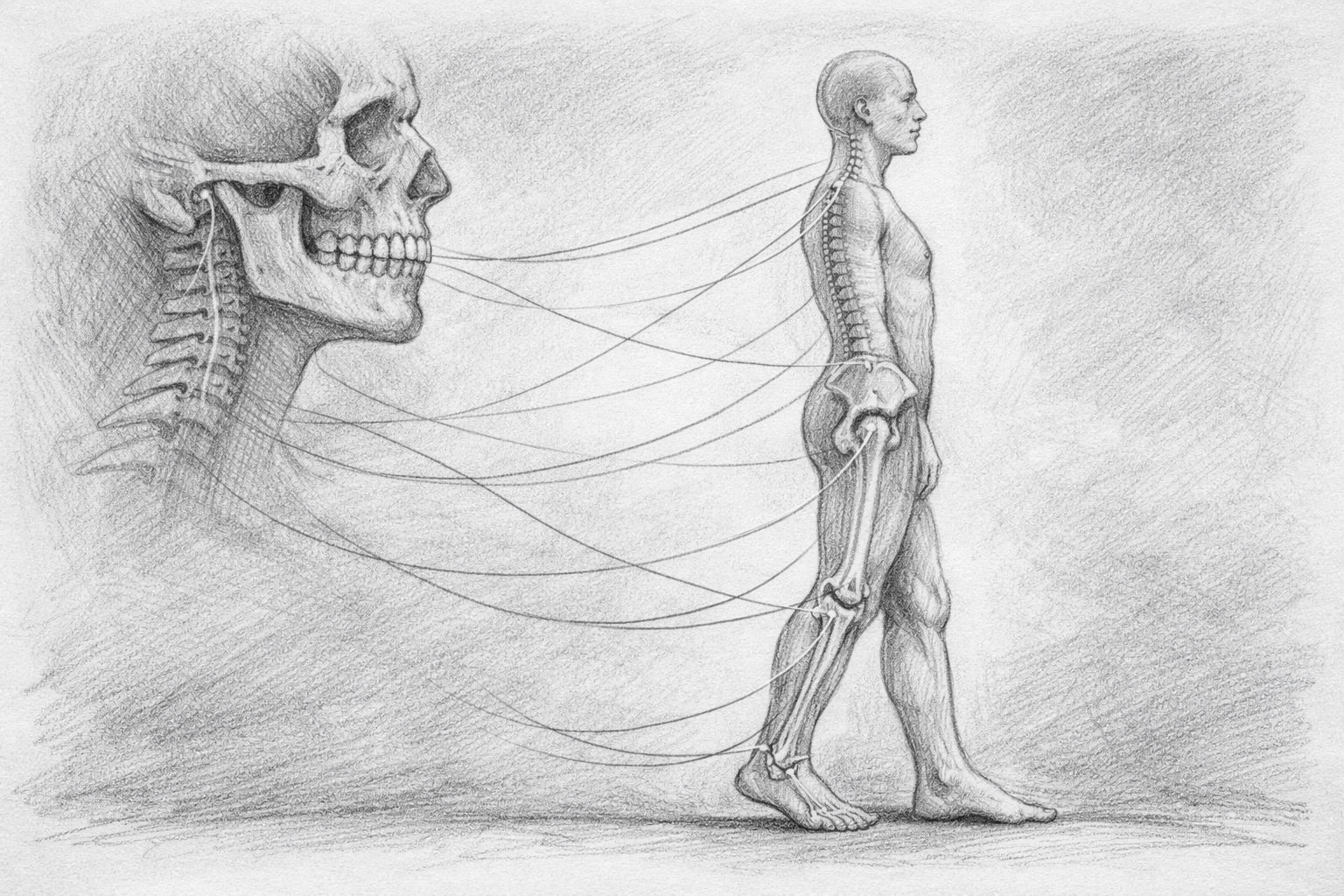
It started unspectacularly. No accident, no loud bang, no dramatic moment. An old crown on a lower molar simply crumbled. These things happen at some point. Materials age, stresses add up over the years. I didn't give it much thought at first. It wasn't an emergency, more of a technical problem - something you repair and then tick off.
The appointment with the dentist was appropriately routine. Examination, quick look, factual explanation. The old crown had to come off, underneath it was cleaned, prepared and built up. Nothing out of the ordinary. No long discussions, no complicated decisions. Unfortunately, it soon became apparent that the problem would become bigger and last longer than initially expected.




A pragmatic solution
Instead of immediately fabricating a complex final restoration, the dentist decided on a plastic crown as a temporary solution. A material that can be molded directly in the mouth and hardened with a special lamp. Practical, fast, uncomplicated. He said, "It will last for a few years. That sounded reasonable. No time-consuming lab work, no second appointment in quick succession. Everything seemed settled for the moment.
The new crown felt unfamiliar at first - that's normal. Every dental prosthesis feels a little strange at first. But there was no pain, no obvious malocclusion, no immediate warning signal. In situations like this, you leave the practice with a reassuring feeling: done.
Two hours of patience
After insertion, I was given the usual instructions. Don't eat for two hours. Don't chew anything hard if possible. Give the material time to harden completely. The cement used needs to rest, even if the light has already set it.
So I went home and waited.
These two hours were basically inconsequential. I didn't eat anything, I didn't try anything, I simply did what you do after such an appointment: be careful. I wasn't even consciously thinking about the splint at that moment. It was part of my routine, but not an acute problem. Sometimes it's precisely these small transitional phases in which decisions - or non-decisions - set an unnoticed direction.
Routine instead of alarm
Looking back, there was nothing that day that should have caused alarm. No sharp pain. No clear feeling that „something was wrong“. The bite may have felt slightly different, but it almost always does after a new crown. The oral cavity is sensitive and changes are registered without necessarily being immediately problematic.
So I deliberately didn't drive myself crazy.
Especially when you are intensively involved with body statics, TMD and functional correlations, there is a danger of immediately seeing causes and effects everywhere. However, not every change is automatically a catastrophe. You have to learn to distinguish between justified attention and exaggerated interpretation. On this day, it was simply a dentist's appointment for me.
The body remembers everything
What I didn't know at the time was that even small changes in the millimeter range can trigger a chain. Not immediately. Not loudly. But gradually.
A new crown always means a new height. Even if it is only slightly different from the previous one, the first contact when biting down changes. The lower jaw finds its way slightly differently. The muscles react. The system registers. But none of this happens in seconds. It is not a dramatic break, but a slight shift.
On the day of installation, none of this was noticeable. It was more of a sober feeling: a technical problem had been solved. The tooth is restored. On with everyday life.
Trust in craftsmanship and experience
I always rely on solid craftsmanship. Dentistry is not an esoteric field, but precise work in the micrometer range. And that's exactly why I didn't leave the practice with mistrust, but with a certain serenity.
You can't check every little thing immediately. Sometimes you have to let things happen and observe how your body reacts. And that's exactly what I did. It seemed perfectly logical to me that I wasn't allowed to try the splint on that day because the cement had to harden. Two hours is not an eternity. And there was no need to rush. Looking back, this moment seems almost symbolic: a short wait, a transition, a seemingly inconsequential day.
But this is exactly where a phase began - unnoticed - that would later become clearly noticeable in the pelvis, knees and even toes.
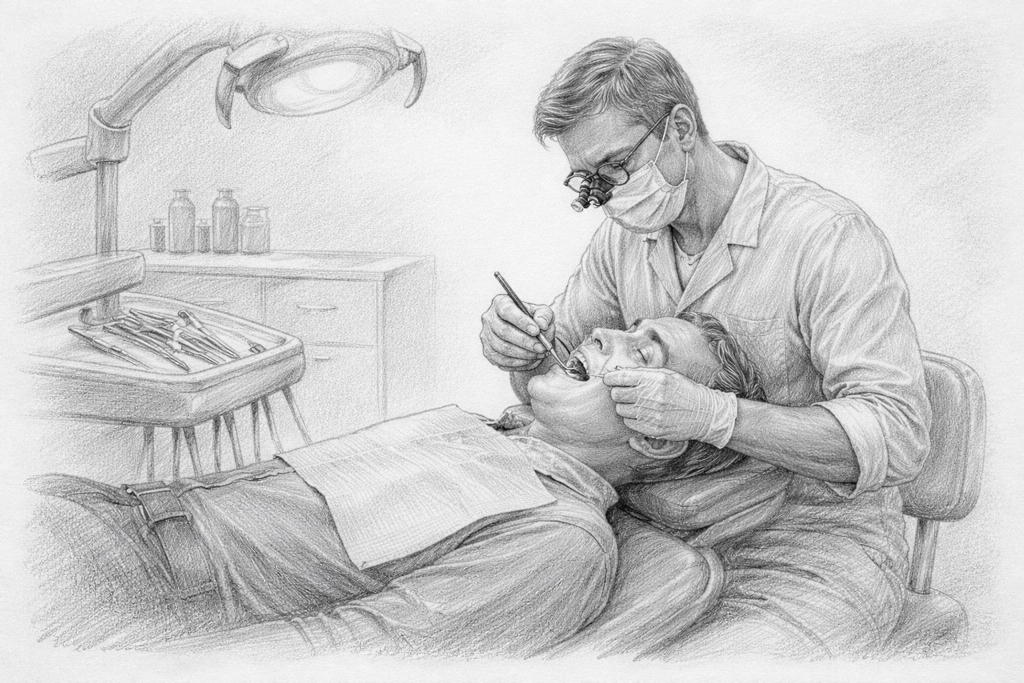
When the rail no longer fits
On the same day, after the two hours had passed, I wanted to insert my splint as usual. Nothing special was planned. Just routine. Putting it in, checking that everything fits as it should. Over time, this movement has become as natural as brushing my teeth.
But this time it was different. The splint could no longer be put on properly on one side. I put it on, as I had done hundreds of times before - and immediately felt resistance. No easy click. No familiar „click“ feeling with which it normally finds its place. Instead, it stopped halfway.
I took it out again. Tried it again. Same place. Same resistance.
No place for violence
You cannot use force to insert a splint. At least you shouldn't. It is precisely crafted. It distributes forces and corrects the most minimal misalignments. If it doesn't fit, then it doesn't fit. Using force would either damage the splint - or yourself.
So I tried it calmly and in a controlled manner. I checked whether there might be a small burr on the new crown. Whether something was jamming. Maybe I was just putting it on at a slight angle. But no matter how I turned it around, the splint simply couldn't be pressed over the tooth on the side with the new plastic crown. It was as if the tooth had grown slightly.
The first suspicion
At that moment, I realized what was obvious: the new crown was obviously slightly higher or wider than the old one. Perhaps only slightly. But enough to unbalance the precisely fitted splint.
Splints are made to measure. They take into account the former tooth position down to fractions of a millimeter. If the shape or height of a tooth is changed, the system is new.
I realized that the splint had been based on the old situation. The new crown changed this basis. And even if it was only half a millimeter - that can be crucial for a finely tuned system.
One week without stabilization
I decided not to force anything. So I left the splint off for the time being. That sounded harmless at the time. A week without a splint - that will be fine. After all, I had lived without a splint for decades before the whole TMD thing. Why should a short break be so problematic now?
But there is a difference: before the splint, my body had become accustomed to a certain misalignment. With the splint, it had begun to slowly realign itself. A break does not mean returning to a neutral state. It means a renewed search for stability.
And this search is not always in the right direction.
The body looks for a way
Without the splint, I didn't feel anything dramatic at first. Perhaps a slightly different feeling when I clenched my teeth. A hint of tension in my neck, which I could have imagined. It was nothing concrete, nothing measurable.
But I know from experience that the body reacts immediately to changes in contact points. The lower jaw looks for the first contact. The muscles adapt. And this adaptation is not neutral. It follows the new mechanical offer. If a crown is slightly higher, it becomes the new reference point.
It sounds technical, but it's basically simple: the tooth that makes contact first determines the direction.
The decision to make a subsequent correction
After a few days, it was clear that it couldn't stay like this. The splint was not an accessory for me, but a functional tool. So I made an appointment for regrinding. The dentist checked the situation. The crown was indeed slightly higher. Not dramatically. But enough to block the splint. So it was reground. Minimally. Precisely. Controlled.
In practice, the splint fitted better afterwards - at least that's how it seemed. I went home again with the feeling that it should work again now.
Not quite in balance yet
But even after this first correction, I realized that it was better, but not perfect. The splint fitted, but it sat differently. It still felt slightly too high on the side in question. Not in such a way that it couldn't be used. But I could feel that the system was under tension.
And that is precisely the point at which many would probably say: „You're imagining things.“
But when you have experienced over a longer period of time how finely the interplay between bite and body reacts, you learn to take these nuances seriously - without becoming hysterical. It wasn't a drama. But it wasn't neutral either.
And so began a phase in which the body had to work with a slightly altered but permanently present incorrect height. A phase that would only become apparent weeks later in the pelvis and knees.
At that moment, it was only a small difference. A tooth that wasn't quite where it had been before.
How a TMD splint works - how treatment works
The video explains clearly how a TMD splint works and what is important during treatment. If genuine TMD is diagnosed, the splint is a central component of the treatment. It is worn day and night - except when eating - is barely visible and does not restrict speech or everyday life. After around three weeks, the first check-up appointment takes place, during which symptoms are checked and initial improvements are discussed.

How a TMD splint works Dr.med.dent.Hamide Farshi, M.D.Sc.
The therapy usually lasts six to eight months, with regular adjustments every three to four weeks. Support is provided by protecting the jaw, a suitable sleeping position and targeted exercises. The aim is to achieve a stable bite - and long-term freedom from symptoms.
When the jaw controls the pelvis
What has become very clear to me again over the past few weeks is a basic principle that is easy to forget: the body is not a collection of individual components. It is an interconnected system. And statics are not created locally, but globally.
A tooth is not „just a tooth“.
The jaw is not „just a joint“.
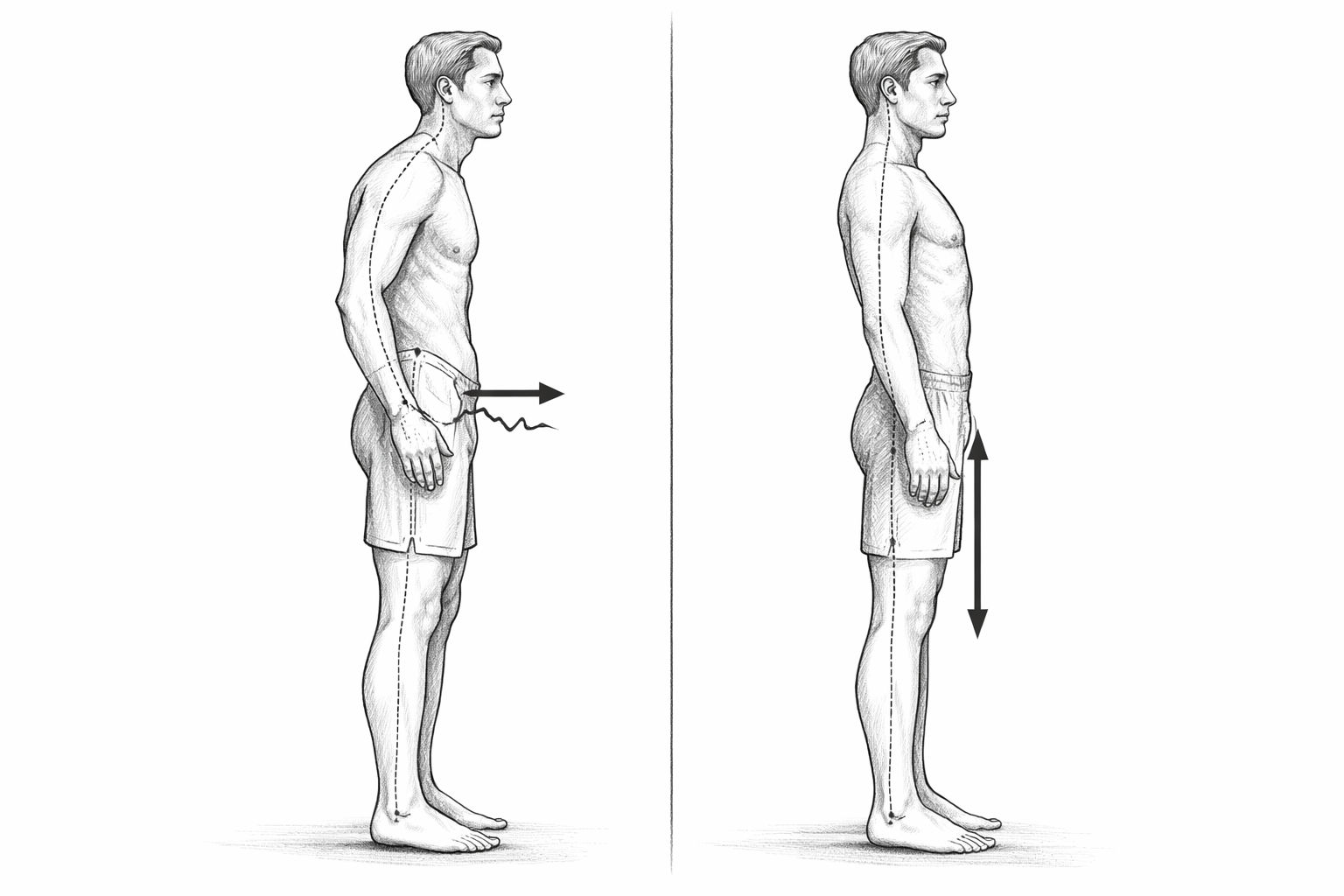
It is the upper end of a chain that runs from the cervical spine, thoracic spine and lumbar spine to the pelvis - and from there to the hips, knees, feet and even the toes. This sounds theoretical, but is very real in everyday life.
The first contact decides
There is always a first point of contact when biting together. One tooth touches slightly earlier than the others. This point is registered by the nervous system. The muscles react. The lower jaw aligns itself to this point.
If this contact is changed minimally, the entire muscle tension in the jaw area shifts. And the masticatory muscles are not a small, insignificant group. They are powerful, have a strong blood supply and are closely interconnected neurologically.
A minimal height difference can mean that one side works slightly harder than the other. And asymmetry is never isolated in the body.
From the jaw to the neck
The masticatory muscles are functionally connected to the neck muscles. Anyone who has ever suffered from massive jaw tension will be familiar with this: the neck becomes hard, the shoulders pull up and the head feels heavy.
This does not happen by chance. The head must be balanced on the spine. If the lower jaw is positioned slightly differently, the head posture changes. And when the head posture changes, the cervical spine reacts.
It's like scaffolding: If an element is moved slightly at the top, it is readjusted at the bottom.
The spine compensates
The adjustment continues from the cervical spine. The thoracic spine compensates. The lumbar spine reacts. And finally, the pelvis comes into play.
The pelvis is a central element of the body's statics. It connects the upper body and legs. It carries the weight. It transfers forces to the hips.
If the pelvis tilts or rotates slightly, you don't immediately feel it dramatically. It often manifests itself subtly:
- One leg feels slightly longer.
- One side appears more burdened.
- The stand becomes less secure.
It was precisely this kind of shift that I slowly began to notice.
Pelvis, groin, knee
At first it was a pulling sensation in the groin area. Not a sharp pain, but a dull signal. As if the muscles there had to work harder. As if something was slightly twisted.
Later, my knees joined in. They felt more unstable. Sometimes slightly swollen. Not massively, but noticeably different. Especially when climbing stairs or walking for long periods, I noticed that the load was not distributed evenly.
And then - what I found particularly remarkable - even the feet reacted. Sometimes even individual toes. If the pelvis is not positioned exactly, the weight distribution changes right down to the forefoot.
It is amazing how far a minimal change in the bite can go.
Not an esoteric construct
I am careful with exaggerations. You shouldn't immediately blame every complaint on the jaw. But anyone who has experienced how a functioning splint improves posture, tension and load distribution knows that this is no coincidence.
The rail had provided stability for months. Not spectacularly, but continuously. The pelvis had become calmer. The knees were more stable. The stance more secure.
And now, after a few weeks with a minimally changed bite position, the old restlessness returned. It wasn't a dramatic collapse. More like a gradual slide back.
The underestimated precision mechanics
What particularly concerned me was the precision of the system. We're not talking about centimeters here. We're talking about fractions of a millimeter.
- A plastic crown, modeled slightly higher.
- A rail that rests differently as a result.
- A first contact that shifts.
And the body reacts. Not in panic, not immediately with pain, but with adaptation. With compensation and by silently shifting the load. It is this precision mechanics that is often underestimated in everyday life. There is no visible misalignment. Nobody would say at first glance: „There's something wrong.“
And yet you can feel it.
A system in motion
During this phase, I realized that the body is constantly in motion, even when we are standing still. It balances, corrects and redistributes forces. If the initial conditions are right, this system works efficiently. If they are minimally shifted, it works under tension.
The decisive factor is not the size of the change, but its duration. The body easily compensates for a few days. Weeks, however, shape new patterns.
And this is exactly the phase I found myself in: weeks with a minimally altered bite position that quietly but consistently influenced the entire static system. What started out as a minor dental episode now had an effect along the entire chain - from the jaw to the pelvis.
Survey on TMD-specific symptoms
When the pelvis responds
The first clear signals did not come from the jaw. Not in the neck. But much deeper. It started in the groin area. Not a sharp pain, not a sudden loss. More like a pulling sensation. A diffuse feeling that there was more tension there than before. As if one side had to work harder to compensate for something.
At first you don't pay too much attention to it. A pulling sensation in the groin can have many causes. You may have walked differently, sat for longer, moved in an unusual way. But in my case, there was this quiet feeling: it's part of the statics.
It didn't feel muscularly isolated. It felt systemic.
A pool that is not quite straight
Over time, another sensation was added: the pelvis seemed slightly twisted. Not so much that I was visibly crooked. But when I was standing, I had the feeling that one side was carrying slightly more weight.
Such perceptions are difficult to describe. It is not a dramatic finding, but a subtle shift. You notice that the balance is no longer as natural as before.
When I was standing still, it felt like I had to unconsciously readjust. Small micro-movements to keep my balance. As if the body was constantly making minimal corrections. And that's probably exactly what it was doing.
Sciatica on both sides
It was particularly noticeable in the sciatic area. Interestingly, not just on one side, but on both sides. Not acute nerve pain, but a kind of pressure sensation that was noticeable along the back of the pelvis. As if something was under tension there.
The sciatica reacts sensitively to pelvic rotations. If the pelvis tilts or rotates slightly, the tensile conditions change. And even if there is no structural damage, the nervous system can send signals: Something is not quite right here.
It was not a dramatic condition. But it was noticeably different from the stable phases with a correctly fitted splint.
The nights became more restless
It was particularly noticeable at night. I mainly sleep on my side. In stable phases this works without any problems. But during these weeks I woke up more often.
After a short time on one side, unrest arose in the pelvis. I turned around. Then, after a while, a similar tension arose again on the other side. So I turned again.
It wasn't a massive pain that woke me from my sleep. It was more of a subtle pressure, an uncomfortable feeling that forced the body to change position.
This constant rotation was a clear sign for me: The statics were not in balance. The body instinctively searched for a relieving position at night - and didn't find it permanently.
No drama - but no imagination either
What's important to me is that it wasn't a catastrophic condition. I was able to walk, work and move around. It was nothing that put me out of action. But it was clear enough not to be ignored.
Precisely because I know the more stable phases, I know what an aligned system feels like. And it was precisely this comparison that made the change noticeable. You might be tempted to dismiss something like this as imagination. However, when several regions respond at the same time - groin, pelvis, sciatica, knee - a pattern emerges. And patterns are rarely random.
The rail is still too high
At this point, the splint had been reground, but not yet optimally. It was in place. However, it still felt slightly too high on the affected side.
This means that the first contact when biting together was still slightly one-sided. Perhaps only minimally. But permanently. And permanent is the decisive word.
The body compensates for a few hours of incorrect loading. A few days too. But weeks lead to adjustments. Muscles shorten minimally, others work more. Fasciae tighten differently. The pelvis reacts.
It's like a car with a slightly misaligned track. You can drive it. But in the long run it wears out unevenly.
The knees become more unstable
Alongside the pelvic complaints, I noticed that my knees were becoming more unstable again. Especially when climbing stairs or standing for long periods of time. They didn't feel weak due to injury, but rather statically overstrained. It was as if the load wasn't being transferred properly through my hips and pelvis.
Some of them swelled slightly. Not dramatic edema, but enough to notice: The system is not working efficiently here.
This was a clear sign to me that the incorrect loading was not localized.
A phase - not a permanent state
Despite all these symptoms, I remained calm. I knew that the system was in a transitional phase. Nothing was irreversible yet. No structural damage had yet occurred. But it was clear that I had to act. A second correction of the crown and the splint was necessary. Because as long as the first contact was not right, the body would continue to compensate.
These weeks were an impressive reminder for me of how finely tuned the body's statics are - and how quickly it reacts to minimal changes. Not dramatically or loudly, but consistently.
And it was precisely this consistency that was particularly noticeable in the pelvis and during sleep.
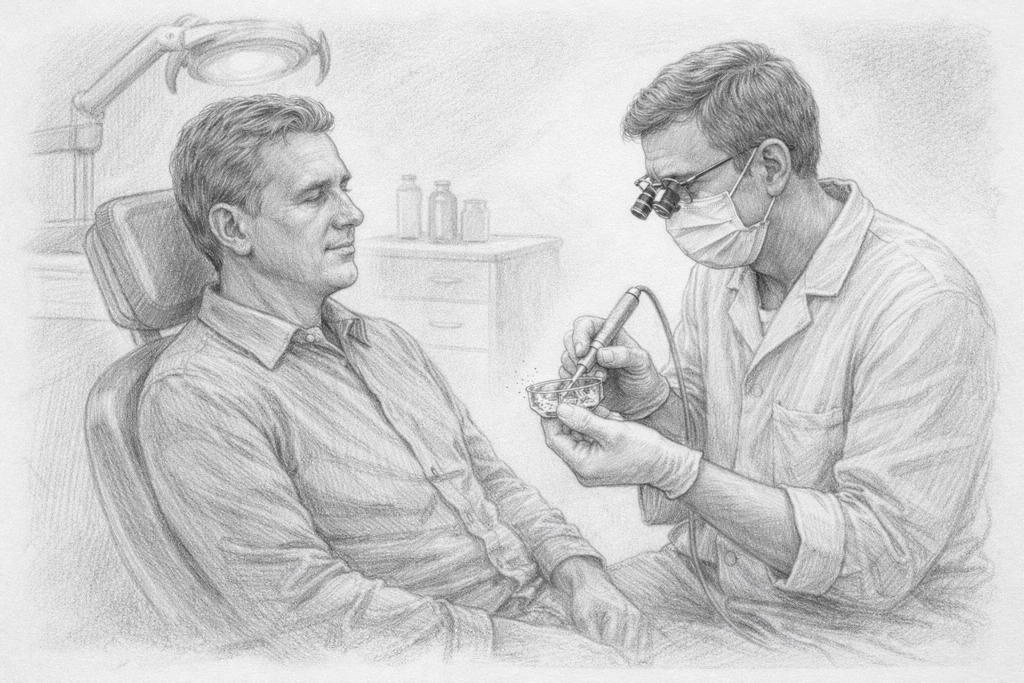
The correction: Why there is no instant reset
At some point it became clear that it couldn't stay like this. The symptoms weren't dramatic, but they were clear. So I went to the dentist again - with the specific indication that although the splint fitted, it still felt too high on one side.
Such corrections are difficult. It's not about taking away „a lot“. It's about making minimal adjustments. A touch of material can make all the difference. So we checked again, marked again, carefully reground again. This time much more precisely.
It immediately felt better in practice. The splint could be inserted cleanly. The contact seemed more even. No more noticeable tilting on the affected side. Technically, the problem was now solved.
Technically solved - not yet functional
But this is exactly where the misunderstanding that many people have begins: People think that everything is immediately back to normal once the correction has been made. As if a switch had been flipped.
That's not how the body works. It is not a computer that you restart. It is a living system that has adapted over weeks. And these adaptations don't disappear the moment the dentist sets the last grinding point.
Five or six weeks of incorrect loading had left their mark. Muscles had organized themselves differently. Fasciae had redistributed tension. The pelvis had rotated minimally. The knees had changed load patterns. This cannot be reversed with a grinder.
The body corrects slowly
After the second post-correction, a new phase began: the return movement. I noticed that something was relaxing - but gradually. The pulling in the groin did not get better overnight. The rotation at night did not decrease immediately. The knees didn't feel stable the next morning.
It was more of a gradual decline. Little changed in the first week. In the second week, I felt that the pelvis became calmer. In the third week, the sciatic tension was significantly reduced. And only after around eight to ten weeks was I able to say: now it feels straight again.
Ten weeks. This roughly corresponds to the time during which the system had previously been running incorrectly.
Adaptation takes time - in both directions
What particularly concerned me was this time relationship. The body adapts relatively quickly to new conditions - even if they are unfavorable. But it takes about the same amount of time to correct it back.
You could almost say that the body is loyal to what it has learned. Once it has built up a certain muscle tension, it maintains it. Once the pelvis has rotated minimally, this rotation remains in place until the system receives enough reliable signals that the foundation is correct again.
The new, correctly fitting splint was such a signal. But it had to be worn for weeks for the nervous system to gain confidence:
The starting position is stable again.
Small improvements, big impact
I noticed small changes with every week.
- The stand became quieter.
- The feeling of carrying more weight on one side disappeared.
- My knees felt more resilient.
- The feet stood up more evenly again.
Something decisive changed, especially at night: I could lie on one side for longer without getting into this restless rotation. My body found a stable position again.
For me, that was the clearest indication that the statics were moving backwards.
Not a miracle cure - but consistency
The splint itself is not a miracle cure. It is a tool. The decisive factor is consistency. Wearing it every day. Patience. No hectic self-corrections. It would have been wrong to constantly demand new changes during this phase or to let things slide again just because they weren't perfect straight away. The body needs stable conditions to realign itself. Constant intervention would have created unrest.
This experience has shown me once again: Functional corrections work in the long term - but only if you give them time.
The skeleton does not „bend“ back abruptly
Looking back today, when I say that the skeleton has „bent back“, of course I don't mean a dramatic bone deformation. It's about alignment. About micro-movements in joints. About muscle chains that reorganize themselves.
The skeleton follows the musculature. And the musculature follows what it perceives as stable. Only when the splint fitted reliably and symmetrically could this return movement begin.
And it wasn't spectacular. But quietly. Week after week.
A lesson in patience
This phase was a lesson for me. Not about dentistry - but about patience. You can't reverse undesirable developments in an accelerated manner. You can only improve the conditions and allow the body to do its work.
After about two and a half months - calculated from the second correction - the system was largely back in balance. The pelvis felt straight. The groin was calm. The knees were stable.
Not a perfect ideal state - but significantly better than in the missing height phase. And this is precisely what shows how precisely and at the same time sluggishly this system works. Mistakes work. Corrections also work. But both take time.
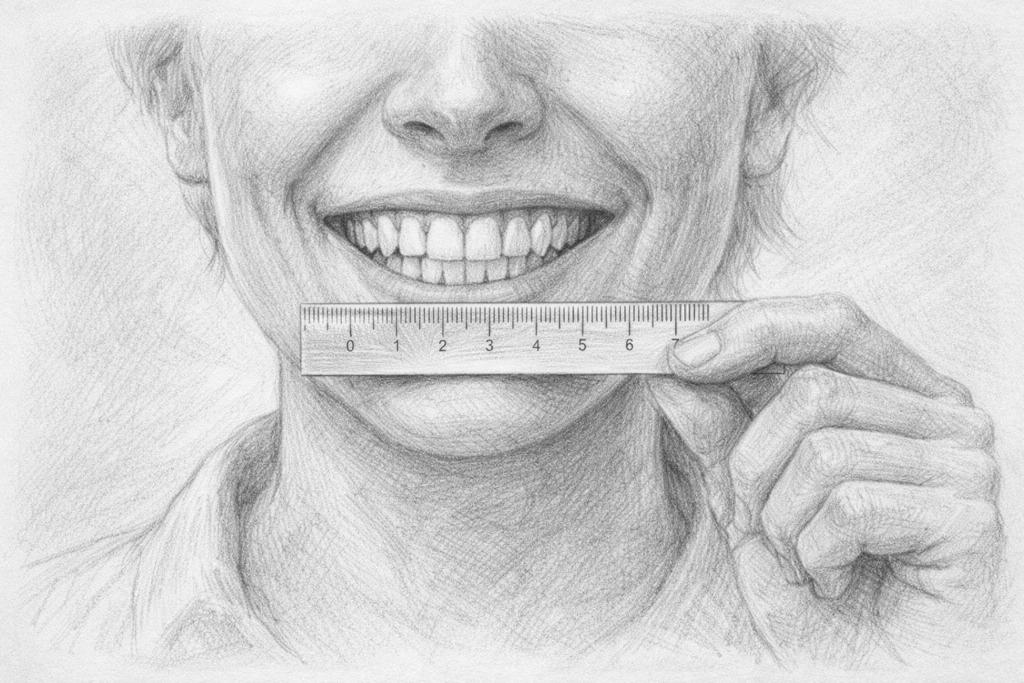
Why millimeters decide
If you look at this story soberly, it seems almost absurd. A plastic crown. Modeled slightly higher than the previous one. Perhaps half a millimeter. Maybe even less. And yet it was precisely this difference that affected the pelvis.
The decisive factor is not the size in absolute terms, but the precision of the system. The human body does not work roughly. It works like a precision mechanic. Anyone who has ever experienced how sensitively the first tooth contact is registered understands that millimetres are no small matter here.
In mechanical engineering, tolerances in the hundredths range would be applied to certain components. In everyday life, however, people are often surprisingly generous when it comes to bites.
The first contact as a reference point
There is always initial contact when biting down. One tooth makes contact slightly earlier than all the others. This contact is a reference point for the nervous system. From there, the chewing muscles are activated. From there, the lower jaw aligns itself.
If this reference point is shifted even slightly, the pattern changes. It's not that everything is suddenly „crooked“. It's about the body orienting itself to a new zero point. And this new zero point can encourage asymmetrical loading.
The problem does not arise from the existence of a tooth - but from its position in the system.
The body is more precise than any machine
What particularly impressed me during this phase was the accuracy of the reaction. No visible misalignment. No dramatic blockage. And yet a noticeable change in the statics.
The body is more precise than any machine - because it constantly provides feedback. A machine often wears out without reporting it immediately. The body, on the other hand, sends signals. You just have to learn to perceive them. Don't overinterpret them, but don't ignore them either.
- A pull in the groin.
- Minimal instability in the knee.
- Restlessness during sleep.
These are not coincidences. They are feedback.
How much is taken into account in everyday life?
This experience raises a fundamental question for me: How often are overall statics really considered when it comes to dentures? Of course attention is paid to occlusion. Of course we grind, mark and check. But in the routine of a busy practice, the focus is usually on the tooth itself - not the patient's pelvis.
The correlation is functionally comprehensible. If a crown is slightly higher, the load distribution changes. If the load changes, the muscles react. If the musculature reacts, the statics change.
This is not speculation, but a chain principle.
The underestimated permanent stress
Another point is the duration. A single false contact for a few minutes has no dramatic consequences. But a minimally raised tooth that comes into contact thousands of times a day acts like a permanent impulse.
The body works around the clock. Even at night, many people press or grind unconsciously. A minimal difference in height thus becomes a permanent signal. And duration shapes structure.
That's exactly why my phase with the too high crown and the not yet perfectly adjusted splint was not a trivial matter. Not because it was extreme. But because it was constant.
How many of them are walking around with a minimum of false contacts?
I now often ask myself the question: How many people walk around with minimal misalignments without knowing it? How many knee problems possibly start in the jaw? How many pelvic rotations are not caused by the leg, but by the bite?
I am not claiming that every complaint originates there. That would be too simplistic. But the possibility is discussed surprisingly rarely.
Precisely because the changes are so small, they are underestimated. People look for major causes. Intervertebral discs. Osteoarthritis. Inflammation. But sometimes the basis lies in the millimeter range.
Precision requires attention
The consequence of this is not distrust of dentists or panic at every small change. The consequence is attention.
When dentures are fitted, you should not just ask: „Does it hurt?“
- But also: „Does the contact feel even?“
- And: „How will the body react over the next few weeks?“
This observation needs calm. No hysteria, but no pushing away either. In my case, it was precisely this attention that led me to the second correction in time.
A system that demands precision
The longer I study TMD and body statics, the clearer it becomes to me that this system demands precision. Not perfection in the mathematical sense, but functional symmetry.
Millimeters are not a minor matter here. They are the basis for balance. And perhaps this is precisely the most important insight from this phase: major complaints are not always caused by major mistakes. Sometimes a minimal deviation is enough - if it has a lasting effect.
The body does not react dramatically. But it reacts precisely.



When it suddenly feels „bad“ again
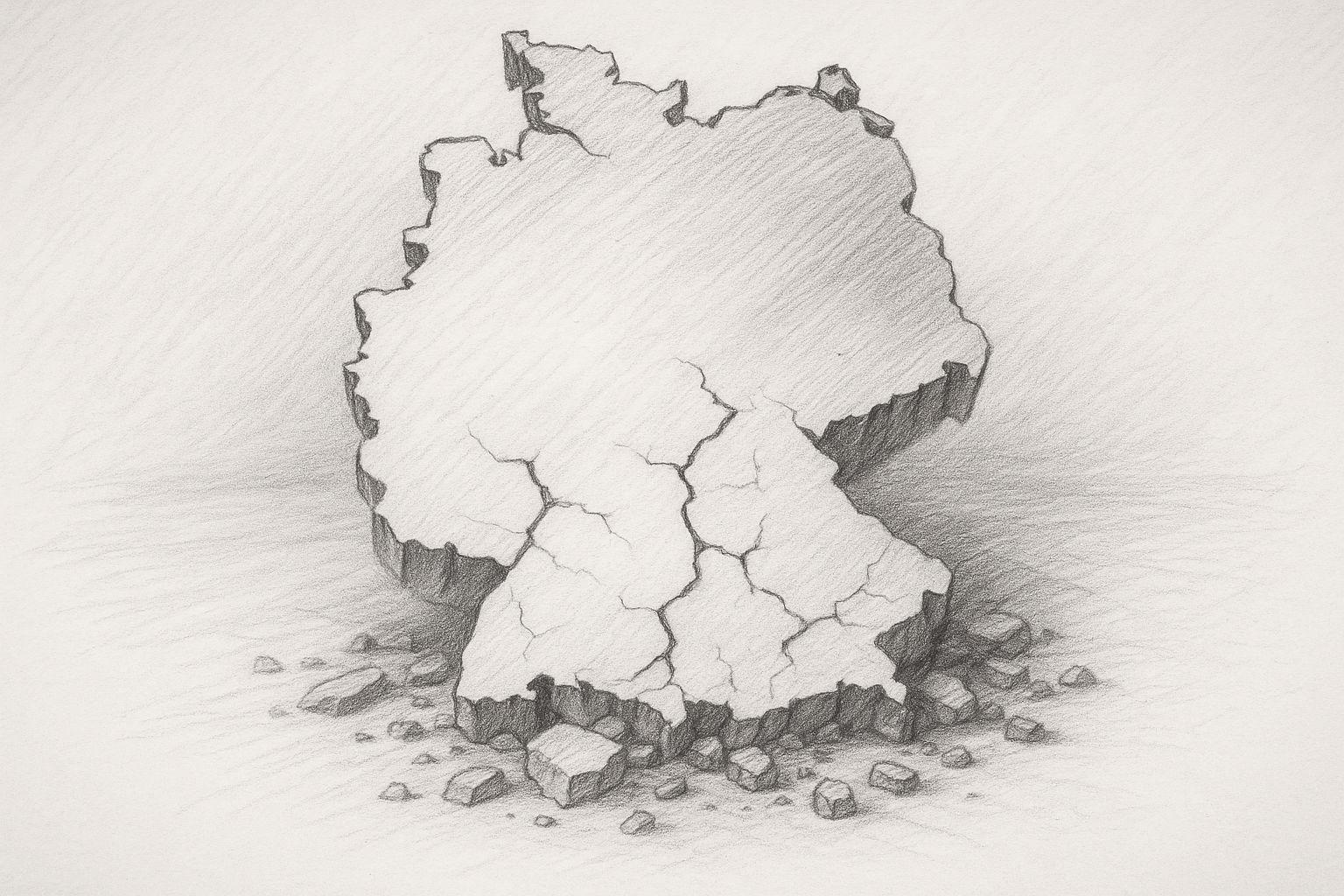
What makes this phase emotionally challenging is not just the physical change - but the contrast. When you come out of a stable phase in which your pelvis is calm, your knees are resilient and your sleep is working, every shift back feels more intense. You involuntarily think: now everything starts all over again.
Especially when you have experienced months of progress, a step backwards quickly feels bigger than it objectively is. This is a psychological effect that should not be underestimated.
The body has not collapsed. It has merely reacted. But the feeling can be more dramatic in the short term than the actual situation.
Tension migrates
One experience that I have made particularly clear: Tension does not remain rigidly in one place.
- Sometimes there is a stronger pull in the groin.
- Then the lower back is more likely to get involved.
- On another day, it's the knees.
- Later perhaps the neck.
These „wandering“ tensions can be unsettling. You ask yourself: Why is it somewhere else today? Is it getting worse? Is something new developing?
But basically this is a sign that the body is working. When a system realigns itself, the focus of stress shifts. Areas that previously compensated are allowed to let go. Others temporarily take on more work. This doesn't feel linear - it feels dynamic.
And dynamism means movement, not stagnation.
Why you feel it more with a splint
Interestingly, such changes are particularly noticeable if you wear a functional splint - i.e. one that is regularly checked and reground and actively intervenes in the statics.
Without a splint, many adjustments are so slow that you hardly notice them. The body compensates for years. You get used to slight misalignments, asymmetrical loading and chronic tension.
With a functional splint, however, the system becomes more sensitive. The splint actively changes the bite position. It sets impulses. It forces the body to reorganize. And this is precisely why you can feel more clearly when something is wrong.
This is not a disadvantage. It is a sign that the system is responding.
Sensitivity is not an alarm
However, this increased awareness can also be unsettling. You suddenly notice things that you didn't notice before. Small changes become noticeable.
The temptation to sound the alarm immediately is great. But patience is crucial here. Not every tension means deterioration. Not every pull is a sign of a new undesirable development. Often it is simply a transition.
A body that is reorganizing itself does not always feel calm.
The right way to deal with setbacks
During this phase, I made a conscious effort not to react frantically. No constant new appointments. No constant questioning of the track. No self-diagnoses every hour. Instead: observe.
- How does it develop above ground?
- Is it gradually getting better?
- Will it remain constant?
- Is it shifting?
This sober view helps to differentiate between genuine misalignment and temporary adjustment. And in my case, it was clear that it was an adjustment phase.
Trust in the process
What helps me in such moments is the thought that the body fundamentally strives for order. It wants balance. It wants symmetry. If the framework conditions are right - i.e. if the splint fits correctly - it works in this direction.
But it works at its own pace. Especially when you are being treated functionally, you should give the system time. The skeleton, the muscles, the nervous system - they all need repetition to consolidate new patterns.
- A few days are not enough.
- Often not even for a few weeks.
- But stability develops over months.
A question of attitude
Perhaps patience here is not just a physical attitude, but also a mental one. You accept that progress is not linear. That there are waves. That tensions are allowed to move. That setbacks are part of the process.
Panic, on the other hand, increases tension - both internally and externally. Anyone who is constantly worried increases muscle activity. And muscle tone is a key factor in TMD in particular. Calmness is therefore not only useful psychologically, but also functionally.
Looking back, this phase was not a failure, but an interim chapter. A disruption in the system that was corrected. An adjustment that took time. A way back that required patience.
Today, with a more stable pelvis and calmer sleep, the situation back then seems less dramatic than it felt at the time.
And that is perhaps the most important insight of this chapter:
Anyone who works with a functional rail is embarking on a process. And processes require patience. Not every tension is a relapse. Not every shift is a mistake. Sometimes it is simply the body trying to find its way back into balance.

An interim conclusion: TMD is not automatic
TMD is not a fashion trend or a wellness gimmick. Anyone who seriously considers a functional splint quickly realizes that this is about statics, load and long-term stability. It is not a cosmetic procedure. It is an intervention in a functional system.
And that's exactly why you shouldn't treat it like a pill that you are prescribed and then take thoughtlessly every day. A pill works chemically, largely independently of your own behavior. A splint works mechanically - and mechanical systems react to every change. This makes treatment more demanding, but also more transparent.
Observation instead of blind routine
The experience with the broken crown and the excessive initial treatment showed me once again: You should watch yourself. Not anxiously or excessively, but attentively.
- How does the first contact feel?
- How does the body react in the following weeks?
- Is the status changing?
- Hiking tensions?
These questions are not a sign of mistrust towards the dentist. They are part of your own responsibility. Because nobody feels the body as precisely as you do.
This thinking is particularly important for a regularly reground functional rail.
The rail is a tool
A rail is not a self-runner. It is a tool for guiding the system. However, like any tool, it only works optimally if it is regularly checked and adjusted if necessary.
- Dentures change the initial situation.
- New fillings can move contact points.
- Even periods of stress can affect the muscles.
All of this has an effect on a sensitive structure. This is why TMD splint treatment is not a passive process. It is a process that requires cooperation - between dentist and patient, between technique and perception.
Small causes, big effect
The story with the plastic crown was not a medical incident. It was not a treatment error in the dramatic sense. It was a minimal height deviation that became noticeable in a highly sensitive system.
It is precisely this normality that makes the case interesting. It doesn't take a major mistake to have an impact. Sometimes a small shift is enough - if it works for weeks.
And a precise correction is just as sufficient - if you give it time.
Responsibility on both sides
Functional splint therapy depends on both sides remaining attentive.
- The dentist pays attention to contact points, material thickness and uniformity.
- The patient pays attention to body reactions, sleep quality and stress distribution.
When the two come together, stability is created. If one of the two is not looking, small deviations can persist longer than necessary.
Interim report instead of financial statements
This episode is not a definitive conclusion to my TMD story. It is an interim report. A stage in a longer process.
That is precisely what makes it valuable. It shows that progress is not a straight line. That setbacks are possible even after stable phases. And that corrections work - but take time.
After about two and a half months, my pelvis felt straight again. The groin was calm. My knees were more stable. My sleep was more relaxed.
Not perfect. But much more balanced.
Mindfulness as a basic principle
If I can draw one key lesson from this phase, it is this:
Mindfulness is not an esoteric concept. It is a functional principle. Anyone wearing a TMD splint should not panic - but neither should they be indifferent. Changes can be noticed. Questions can be asked. Corrections can be demanded. This is not a sign of weakness, but of responsibility.
In the end, a sober realization remains:
The body reacts precisely. Incorrect loads have an effect - even if they are small. Corrections also work - if they are implemented consistently. TMD splint treatment is not an automatic healing mechanism. It is a path. And like any path, it requires attention, patience and thinking.
The broken crown was just a minor technical incident. But it showed me once again how finely tuned this system is.
And perhaps that is precisely the most important message of this interim report: not everything is dramatic. But nothing is insignificant.
Reading tip: Classify symptoms better instead of looking at them in isolation
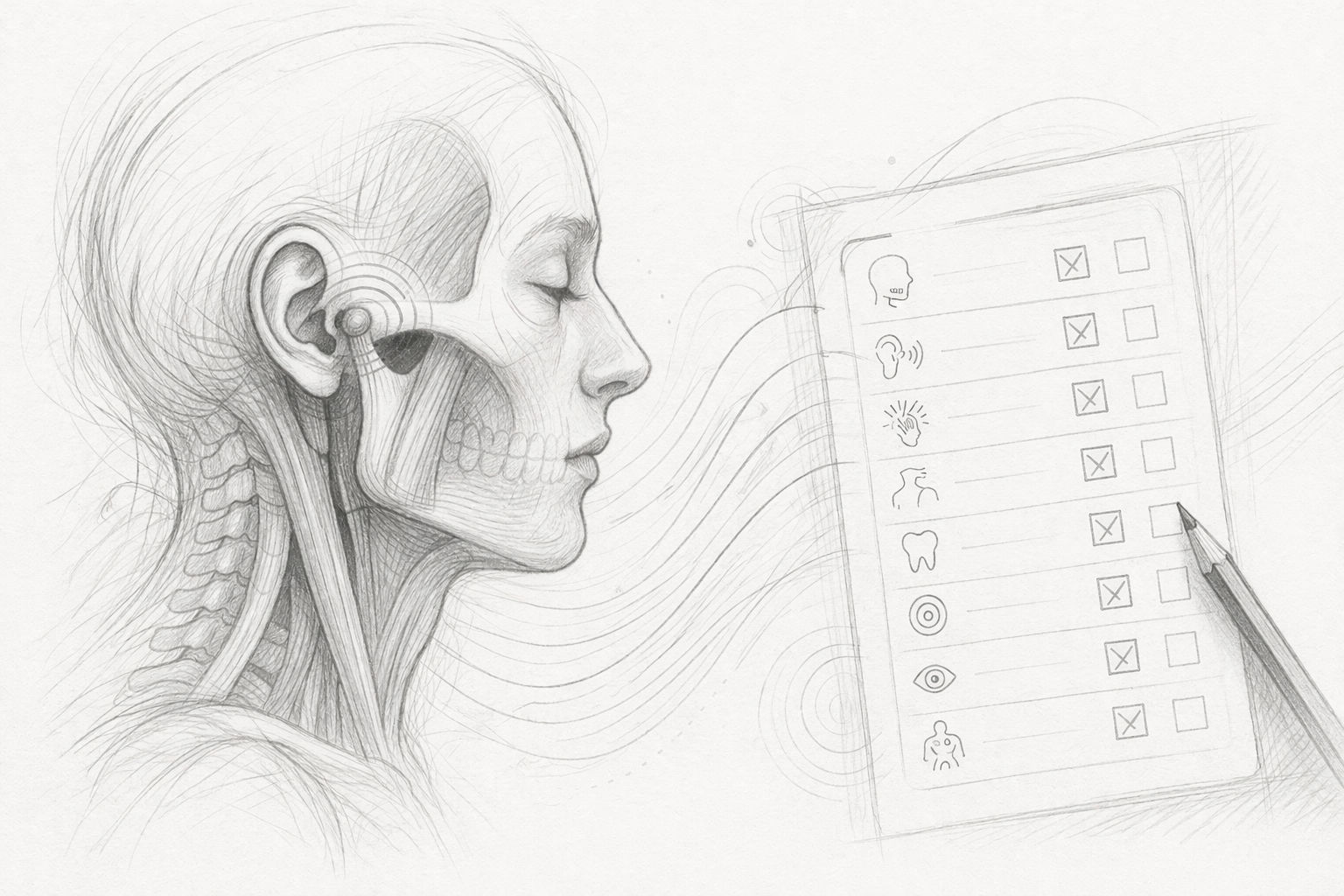
 Issues such as minimal misalignments after dentures in particular show how sensitive the interaction in the jaw area is. The initial symptoms are often localized, but over time the effects can become noticeable throughout the entire body. This is precisely where the CMD self-test to: It helps not only to look at individual symptoms, but also to make possible connections visible. If you have the impression that your symptoms extend beyond the jaw or cannot be clearly explained, the test can provide an initial structured assessment. It does not replace a diagnosis, but gives you a clearer view of the overall picture - and this is often the decisive step in such cases.
Update - Stop and Repeat: When the crown breaks again
No sooner had this interim report been completed than the temporary plastic crown broke off again. This seems frustrating at first - but at the same time it confirms how dynamic this treatment is. It is a posterior tooth without any further support to the rear. This can result in a stronger leverage effect when biting together, especially under the guidance of a functional splint. Plastic is resilient, but not unlimited. There may simply be a material limit here in combination with the individual statics. For me, this does not mean a step backwards into chaos, but a further step in the process. Observing, analyzing, readjusting - TMD is not an automatic process, but one of continuous fine-tuning.
Update two days laterThe crown is back in, splint adjusted, everything fits again. I'm noticing very slight adjustments again and the fact that I couldn't wear the splint for two days. But after such a short time, everything should settle down again quickly.


Frequently asked questions
- Can a single new dental crown really have an impact on the pelvis?
Yes, this is possible - but not in the sense of a spectacular immediate reaction, but via a functional chain reaction. The first tooth contact when biting affects the chewing muscles. These are connected to the neck, spine and pelvis via muscle chains. If a crown is slightly higher, the lower jaw can align itself differently. This altered alignment leads to asymmetrical muscle activity. This can change the statics over weeks - not dramatically, but gradually. This is exactly what often makes it difficult to recognize. - Why didn't you notice the missing height immediately?
Because the body is incredibly adaptable. A minimal deviation in height does not immediately cause severe pain. Instead, the body begins to compensate. Muscles compensate, the pelvis rotates minimally and weight is redistributed. These processes often take place below the acute pain threshold. Only when several regions react - groin, knee, sciatica - does the pattern become clearer. It is less an acute event than a process. - Why was the rail suddenly no longer usable?
A functional splint is precisely adapted to the existing tooth position. If the height or shape of a tooth changes - due to a new crown, for example - the previously precisely manufactured splint will no longer fit correctly. Even minimal deviations can result in it not fitting properly. Force would be wrong here, as it would either damage the splint or cause additional incorrect loading. - Is it dangerous not to wear a splint for a few weeks?
It is not usually dangerous in an acute sense - but it can certainly be functionally relevant. If the body has already adapted to a new, more stable bite position, a break can lead to old compensation patterns returning. Especially if a new crown is slightly too high at the same time, an asymmetrical load can become established. The longer this condition lasts, the more strongly it shapes the system. - Why did the back-correction take as long as the error phase?
The body stores patterns. Muscle tension, fascia pull and joint positions adapt to new conditions over weeks. If the cause is corrected, these adaptations do not disappear immediately. The nervous system needs repeated, stable signals to rebuild the old symmetry. This process is gradual and takes about the same amount of time as it took for the incorrect strain to become established. - Why do the complaints move around in the body?
Because the system is dynamic. When one region is relieved, another can temporarily take on more tension. During the back correction, old compensations dissolve and new stress patterns stabilize. This can lead to tensions not remaining constant in one place, but changing. This „shifting“ is often a sign of adaptation - not necessarily of deterioration. - Why are such changes more noticeable with a functional splint?
A regularly checked and reground functional splint actively intervenes in the statics. It consciously changes the bite position and guides the system into a new alignment. This makes perception more subtle. Small deviations are more noticeable because the system reacts more sensitively. Without a splint, many changes take place more slowly and are hardly consciously registered. - Can a crown that is too high cause knee problems?
It can at least exacerbate an existing instability. If the pelvis twists minimally, the load axis of the legs changes. Knees react sensitively to asymmetrical loading. A permanent minimal misalignment in the bite can therefore have an indirect influence on knee sensation, stability or the tendency to swell. This does not mean that every knee problem comes from the jaw - but the connection is functionally comprehensible. - Why was there more restlessness at night?
There is no conscious muscular control during sleep. If the pelvis is minimally rotated or the muscle tension is distributed asymmetrically, the body automatically seeks relief. As a side sleeper, this can lead to frequent turning. The restlessness at night was therefore less a pain problem than a sign of static instability. - Is a plastic crown fundamentally problematic?
No. The material itself is not the problem. The functional height and the contact point are decisive. A plastic crown can be stable and durable if it is fitted correctly. The critical factor here was not the material, but the minimal height deviation in relation to the existing splint restoration. - Should you always have the splint checked after dentures?
Yes, absolutely. Any change to the tooth structure can affect the bite position. Anyone who wears a functional splint should have the fit checked after new crowns, fillings or extensive treatment. This is not mistrust, but functional logic. - How do you distinguish between genuine malalignment and temporary adjustment?
Through observation over time. A temporary adjustment improves gradually over days or weeks. A real misalignment remains constant or worsens. If you observe carefully, you will often recognize a pattern. It is important not to panic immediately, but to observe developments over several days. - Is patience really so crucial for TMD?
Yes, TMD is not an acute inflammatory process, but a functional process. Changes take effect slowly, as do corrections. If you demand new adjustments too quickly, you can create additional unrest. Patience here does not mean passivity, but consciously waiting for stable conditions. - Why does a step backwards sometimes feel so dramatic?
Because you can feel the contrast. If you have been well for a long time, any deterioration has a more intense effect. The brain compares it with the better state and evaluates the change more strongly. Objectively, the regression is often moderate - subjectively, it can feel bigger. - Is it possible to imagine such connections?
Imagining in the sense of „creating out of nothing“ is unlikely if several body regions react simultaneously and patterns are repeated. Of course, not every little thing should be over-interpreted. But recurring, comprehensible changes are more likely to indicate functional connections than mere imagination. - Is a TMD splint a permanent solution?
It is a long-term tool, but not an automatic healing mechanism. Its effectiveness depends on regular monitoring, adaptation and your own attention. It accompanies the body - it does not replace thinking. - What is the most important lesson from this episode?
That small changes can have a big impact if they are sustained over time. And that adjustments take time. Who a functional splint Anyone wearing it should remain alert but calm. The body works precisely—but it works at its own pace. - What specifically should those affected take with them?
Observe instead of ignore. Ask questions instead of dramatizing. Have the splint checked after dentures. Take changes seriously, but give them time. TMD is not a quick fix, but a process - and processes require patience, attention and cooperation.