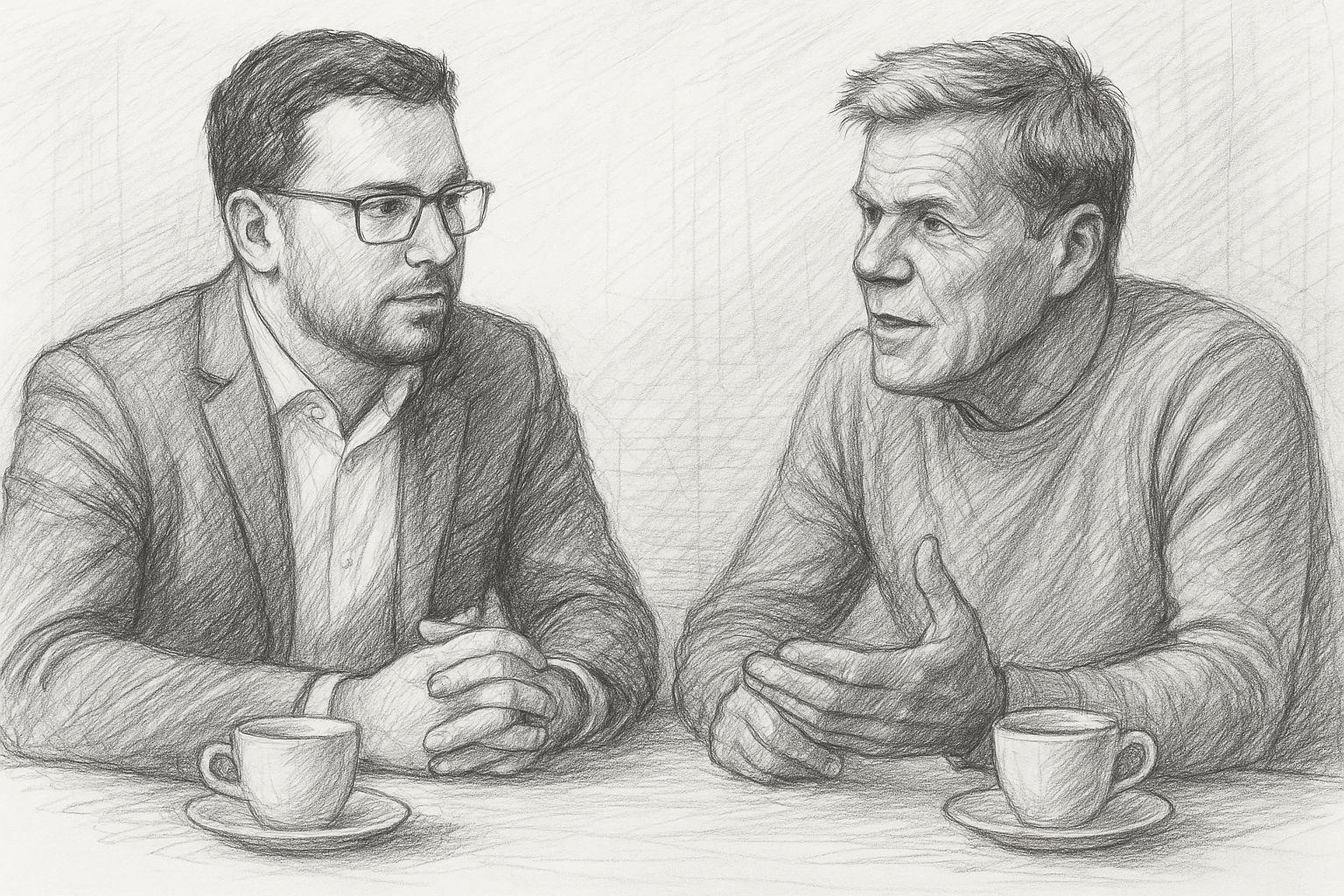
This article highlights a recent, remarkably candid conversation between Dieter Bohlen - the longtime music producer, entrepreneur and one of the most recognizable faces of German pop culture - and Dominik Kettner, a precious metals expert, YouTuber and financial entrepreneur who has been studying wealth protection and economic trends for years.
At first glance, the meeting of the two seems unusual: here the entertainer with decades of international experience, there the financial analyst who primarily addresses security-conscious savers and entrepreneurs. But it is precisely this mixture that makes the interview so exciting. Bohlen speaks freely, without a PR filter, while Kettner drills down and makes complex developments tangible. Together, they create a space in which undesirable political developments, economic risks and personal experiences are interwoven - clearly, directly and without excuses.

News about the article
09.12.2025How the Berlin Courier a planned panel discussion with Dieter Bohlen and publicist Hendrik Kettner in Berlin was canceled at short notice. Initially, it was assumed that the reason was sluggish ticket sales - but according to Kettner's lawyer, the cause lies elsewhere: both protagonists have been the subject of massive hostility and public attacks since the joint interview. In order to prevent the situation from escalating any further, they agreed to cancel the event.
When the entertainer suddenly becomes the realist
Dieter Bohlen is not known for hiding behind diplomatic formulations. But rarely has he spoken so openly about undesirable political developments as in this interview. His tone is direct, sometimes sharp - and that is precisely why it is remarkable. Not because a celebrity is complaining, but because his observations come from everyday life: from encounters with people abroad, from experiences as an entrepreneur and from the sober view of a man who once knew Germany as a land of opportunity.
The chapters of the interview paint a picture that many citizens intuitively sense, but hardly anyone says publicly: Germany has lost its former dynamism, and those who bear responsibility, of all people, seem to be blockers instead of shapers.

Dieter Bohlen on the government, firewall, expropriations, asset protection
Do-gooderism and political failure
Bohlen begins with an attack that is now almost taboo in Germany: he criticizes the „do-gooder attitude“ that has covered political decisions like a veil. For him, this means moral self-aggrandizement without a realistic assessment of the consequences.
He describes how political decisions today often seem like symbolic gestures rather than well thought-out measures. The aim is to please everyone, but this creates an atmosphere in which you look good but don't make any progress. For entrepreneurs and citizens, this means high costs, little benefit and constant uncertainty in everyday life.
Germany no longer respected abroad
According to Bohlen, one of the most impressive passages is his experience abroad. For decades, „Made in Germany“ stood for quality, reliability and technical expertise. But today, he says, he hears more doubt than admiration from international business partners.
Germany is „no longer hip“ - a statement that is more alarming in its simplicity than any study. When a citizen of the world like Bohlen realizes that Germany is losing its appeal, it is more than just a perceived mood. It is a trend.
Made in Germany - from economic miracle to permanent crisis
Bohlen becomes particularly emotional when he describes how Germany has squandered its exceptional economic position. He recalls a time when you could buy German products almost blindly because quality was taken for granted. This trust has been crumbling for years - and he holds the political line of recent decades partly responsible.
While other countries think pragmatically, Germany loses itself in moral debates, bureaucracy and doubts. The economic miracle is long gone, but people still act as if the old reputation can fix everything. For companies, this means rising costs, declining competitiveness and more and more rules that paralyze everyday life.
Friedrich Merz and the ignored offer of advice
With a side-swipe at politics, Bohlen tells us that Friedrich Merz once tried to recruit him as an advisor - an offer he turned down. However, during the interview it becomes clear that his refusal was not so much directed against Merz, but rather an expression of his attitude: Bohlen no longer believes in the political class' ability to reform.
He paints a picture of politicians who do not listen, do not act and do not recognize how serious the situation is. His impression: many live in a parallel world of party tactics and ideology, while the reality outside has long since spoken a different language.
Firewall policy and understanding of democracy
In another chapter, he criticizes the concept of the „firewall“, which has become a political battle term in Germany. For Bohlen, it is a sign of weakness if debates are replaced by moral demarcation. Democracy, he says, thrives on exchange, not isolation.
His statement is clear: this firewall logic divides society and prevents problems from being addressed openly. Instead of solutions, there is only the formation of camps - a situation that is detrimental to any sensible country.
Economic reason vs. morality - Germany's fundamental conflict
Bohlen describes a conflict that runs through practically every political issue: In Germany, moral self-presentation has displaced economic reason. Whether energy policy, Russia strategy or bureaucracy - decisions are made more on the basis of moral prestige than pragmatic logic.
He asks the simple question that used to be taken for granted:
What does this mean for the people who have to live and work here?
And this, he criticizes, is precisely where politics and the media have lost touch with citizens.
Mobilizing savings - the threat of expropriation through the back door
One particularly controversial topic in the interview is the idea of „activating“ private savings in order to stimulate investment. Bohlen gets straight to the point: to him, this sounds like a silent expropriation.
He warns that such measures would never be openly described as expropriation - but that is exactly how they work. When citizens increasingly feel that their savings are no longer safe, a central pillar of any stable society begins to falter.


Property tax: „Then I'll be gone in six hours“
When the topic of wealth tax comes up, Bohlen reacts almost instinctively: if this tax were to be reintroduced, he would be „gone in six hours“. His choice of words is drastic, but it makes it clear that many successful people, entrepreneurs and investors now see Germany as unpredictable.
You can dismiss the sentence as an exaggeration - or you can recognize in it a warning signal that many entrepreneurs share. A country that drives away top performers is losing its future.
The future of children - a sober, almost sad view
In one of the last chapters, Bohlen addresses the topic that concerns everyone: the future of the younger generation. And this is where he gets particularly serious. He doubts that children in Germany still have the same opportunities as previous generations.
He talks about the lack of education, bureaucracy, outdated structures and the political inability to make bold decisions. For him, one thing is certain: if Germany continues like this, it will not strengthen its next generation, but weaken it.
Why Dieter Bohlen is an example of inner maturity in my book

In my book „Crises as Turning Points - learn, grow, create“ I deliberately cited Dieter Bohlen as an example of „inner maturity in terms of personal responsibility“. Not because of his fame or his public presence, but because of an attitude that has become rare today: he takes responsibility for his life, makes decisions without excuses and remains sober, pragmatic and self-critical.
It is precisely in crises that character is revealed - and Bohlen has been demonstrating for decades that personal responsibility does not have to come across as harsh or cold, but as liberating. This attitude also resonates in this interview: He analyzes grievances not out of convenience, but out of the awareness that you yourself always have a share in success or failure. It is precisely this view that makes his statements tangible and valuable for many people.
A mirror that should not be ignored
Whether you like Dieter Bohlen or not - this interview holds up a mirror to Germany. Direct, unembellished, sometimes harsh. But that's precisely why it's important. He says what many people think but don't dare to say in public.
Germany has lived off its substance for decades, while other countries have modernized. The criticism is not based on ideology, but on experience. And it is a reminder of how important it is not just to manage, but to shape. In another interview in the summer, Bohlen already emphasized, to leave the country if in doubt.
Perhaps that is the real power of this interview: It calls for responsibility to be taken seriously again - not as a moral pose, but as a duty towards future generations.
At the very end - on Kettners When asked how long he wanted to stay in Germany, Bohlen said perhaps the most important sentence of the evening:
"I'm not giving up hope.“
Questions and answers about the article
- Why is this interview with Dieter Bohlen so politically significant?
Because a prominent artist without a party-political agenda clearly states what many citizens are quietly feeling. His criticism does not come across as an election campaign, but as a personal assessment. That gives his statements weight. - What does Bohlen mean by „goody-goody“?
He thus describes a political culture that delights in moral exaltation while practical solutions are lacking. As a result, decisions often seem symbolic, but not realistic. - Why does Bohlen say that Germany is „no longer hip“ abroad?
It is based on personal experience and discussions in an international environment. Germany used to be seen as a problem solver with quality standards. Today, many partners associate the country with bureaucracy, ideology and economic weakness. - How does Bohlen explain the decline of „Made in Germany“?
He attributes it to decades of complacency, wrong political decisions and a growing alienation from economic realities. The former promise of quality has lost its power due to overregulation and a lack of planning. - What does he criticize about the so-called „firewall“?
He sees it as an ideological symbol that prevents open debate. Democracy thrives on exchange, not on excluding entire areas of thought. In his view, a firewall shows political weakness. - Is the interview about party politics or about fundamental developments?
Bohlen avoids party political ideology. Instead, he criticizes a mentality: moral self-presentation instead of pragmatic responsibility. It is a critique of the system - not a critique of a party. - Why do some people in the interview talk about the threat of „expropriation through the back door“?
Because political proposals to „mobilize“ private savings could result in citizens being indirectly forced to invest their savings in government-defined projects. For many, this is an alarm signal. - Why does Bohlen react so sharply to the idea of a wealth tax?
He sees this as a signal that top performers and entrepreneurs in Germany are increasingly seen as a problem rather than a contribution. His statement that he would be „gone in six hours“ shows a deep frustration with political uncertainty. - What concerns does Bohlen have about the younger generation?
He doubts that children today still have the same opportunities as previous generations. He criticizes outdated structures, weak education policy and a lack of courage to implement fundamental reforms. - What key message should we take away from the interview?
That a country does not live by moral phrases, but by the ability to take responsibility, honestly name problems and combine economic reason with human moderation. Bohlen reminds us that substance is used up at some point - and that we must act in good time before a turning point is missed.