
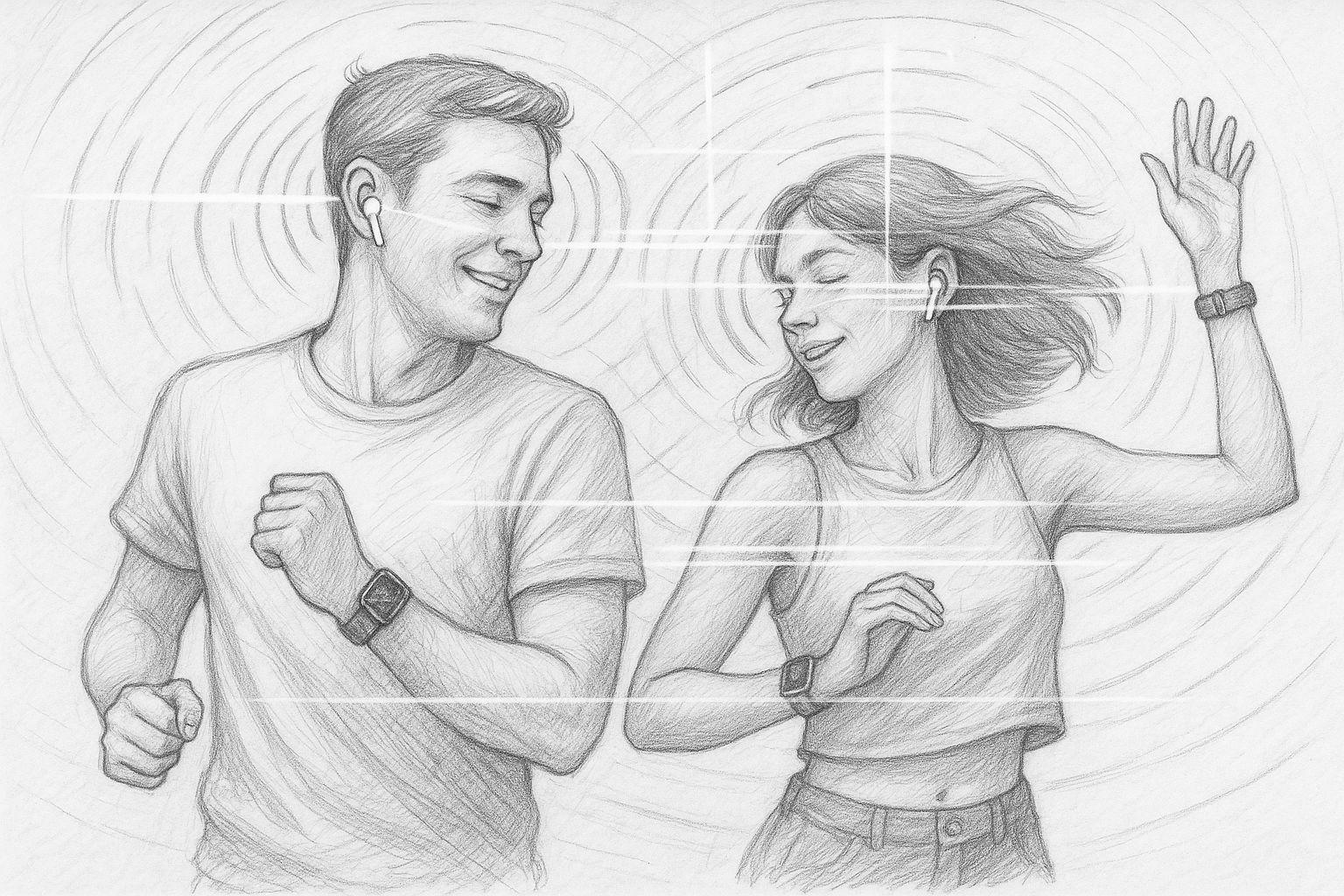
Wearables are now part of everyday life. Many people now wear a smartwatch as a matter of course, count their steps, monitor the quality of their sleep or set reminders to take breaks during the day. And I'm happy to admit it: I also have a Apple Watch myself, and I find this technology absolutely fascinating in its own way. It can do things that would have been pure dreams of the future just a few years ago. Nevertheless, I rarely use my Apple Watch.
And just now, after the latest reports and statements from experts, I realize once again that this reticence is not so wrong. After all, many modern headphones and wearables now contain sensors that can measure far more than you might think at first glance. Not all headphones do - but the trend is clear: more and more technology is moving inconspicuously into small devices that we wear close to our bodies.
The first part is intended to explain quite simply what Wearables today, why they are useful for many people - and why you should still take a closer look before blindly relying on them.



What modern wearables can do today
To put it simply, wearables are small computers that you wear on your body. The best-known form is the smartwatch - whether from Apple, Samsung or Garmin. There are also fitness wristbands, chest straps, rings such as the Oura ring and, of course, in-ear headphones that do more than just play music. Most people are familiar with the basic functions:
- Count steps
- Estimate calories
- Measure movement
- Record heart rate
- Monitor sleep
- Analyze trainings
They are practical helpers that collect data without any effort and turn it into useful information. For many people, this is motivating - you can see at a glance whether you have moved enough, how you have slept or whether you need more breaks.
Why the devices have become so popular
There are several reasons for the success of these little gizmos. Firstly, they make many things visible that were previously only felt. Secondly, they are convenient. You don't have to write anything down, measure anything or plan anything - the watch takes care of it all. Thirdly, they give you the feeling that you have your life under control. Movement, sleep, heartbeat - everything can suddenly be tracked.
And last but not least, they look modern. Manufacturers naturally do everything they can to reinforce this impression: new colors, new straps, new functions. The principle is always the same:
„Carry us - and you are part of the progress.“
The justified advantages of wearables
Despite all caution, you should remain fair. Many wearables have real advantages:
- You can recognize abnormal heart rhythms.
- They warn of unusual loads.
- They motivate you to go for a walk or do sport.
- They remind you to take breaks if you sit for too long.
- They record sleep phases so that you can better understand your own patterns.
- In an emergency, they can even call for help automatically.
It would therefore be wrong to pretend that the technology is fundamentally bad. In the past, you had to go to a sleep laboratory or a cardiologist for such measurements. Today, this technology - at least in a simplified form - is available directly on the wrist.
This is precisely why it is important to approach the topic with a clear head. Technology can be useful. It can make life easier. But you should always be aware of the price you pay for it - and that's not always just money.
What data are measured by wearables?
The first part was about the visible advantages and the fascination of these small devices. But that's just the surface. Now we come to the part that hardly anyone really understands: What wearables measure in the background. Most users believe that their watch only counts steps and shows their pulse. But modern sensors go much deeper. They record signals that would previously only have been measured in medical or psychophysiological laboratories. And these signals can be used to draw conclusions that go far beyond „I walked a lot today“.
This is where it gets exciting - and sometimes a little scary. Because many of these measurements are completely automatic and invisible to the user.
The visible data: What everyone knows
Before we get to the hidden sensors, let's start with what everyone can see. After all, this obvious data is the selling point.
- Steps and movement: This is simple movement data. The watch recognizes how often and how much the wrist moves. This is used to calculate steps, minutes of activity and calories.
- Heart rate (pulse)This is the central function. The optical sensors use changes in light to measure how quickly the blood pulsates in the wrist. This is unproblematic and relatively rough - but helpful.
- Sleep trackingMany people think that the watch „recognizes“ the sleep phases directly - but this is not true. It combines lack of exercise, pulse, breathing patterns and a few other values to produce an estimated value. Nevertheless, it provides surprisingly useful information.
- Oxygen saturation (SpO₂): Sometimes pretty exact, sometimes more of a toy – but it works as long as you stay still.
Everything that has been mentioned so far is basically harmless. The public is aware of these values, they are advertised and you can decide whether you want to have them measured. But that's just the tip of the iceberg.
The invisible biosignals: what hardly anyone notices
Now we come to the crucial point. Modern wearables - especially smartwatches and in-ear headphones - record biosignals that go far beyond what the user consciously sees. This happens quietly, automatically and in the background. And it is precisely this data that allows conclusions to be drawn about mood, stress, emotional state or even basic character. I will go through the most important invisible measurement methods in turn:
Heart rate variability (HRV)
You sometimes see this number in apps, but many people don't even know what it means. HRV measures how irregularly the heart beats. A healthy heart does NOT beat like a metronome - it beats irregularly. The more irregular (within a healthy range), the more relaxed the body is.
- low HRV → stress, strain, fatigue
- high HRV → relaxation, regeneration, strong performance
Wearables constantly measure HRV, often without the user realizing it. Why is this important? Because HRV is the most reliable everyday indicator for:
- Stress level
- Mental tension
- Burnout risk
- emotional arousal
- Exasperation
- Nervousness
- Physical exhaustion
Emotions can therefore be recognized without the user knowing about it.
Micro-changes in skin conductivity
Many modern sensors can use tiny voltage changes to measure how „conductive“ the skin currently is. This is basically the same measurement method as the lie detector.
- More sweat → higher conductivity → stress/excitation
- Less sweat → lower conductivity → rest
These values can be recorded by headphones, ear sensors, smartwatches and fitness wristbands - without any active intervention.
Ear blood flow and tissue signals (with in-ear headphones)
This is the part that many people don't even think about. The ear canal is an ideal place to measure:
- Very good blood circulation
- Stable temperature
- hardly any movement disorders
Skin is thin and well suited for light measurement. This is why some in-ear wearables can already:
- Circulation pattern
- Stress reactions
- Breathing rhythm
- sympathetic activity (fight/flight mode)
and with astonishing accuracy. Many users have no idea that such sensors even exist.
Breathing patterns and micro-movements
The watch sees how the thorax moves - minimally, but measurably. Breathing can be deduced from this:
- Shallow, hectic breathing → Stress
- Deep, rhythmic breathing → Rest
- Irregular breathing → emotional reactions
In combination with HRV, this gives a fairly clear picture of the nervous system.
EMG-Light: Mini muscle activity
Even without electrodes, small muscle twitches and tension patterns can be detected - for example on the forearm or behind the ear. This allows you to:
- Tension in the jaw
- unsteady movements
- Micro gestures
- subtle stress signals
register.
Frequency patterns that allow conclusions to be drawn about the autonomic nervous system
Blood flow has frequencies. Breathing has frequencies. Micro-movements have frequencies. Electrical micro-reactions in the skin have frequencies. If you combine these patterns, you can:
- Recognize excitement / calmness
- Determine stress level
- derive basic emotional tendencies
- even classify personality tendencies
And all without „mind reading“.

Is Your Smartwatch Spying on You? We Analyzed 17 Privacy Policies to Find Out. (English)
What you can really deduce from this data
Many people completely underestimate this. They think: „It's just measuring my pulse“. No. Complex patterns can be derived from the biosignals described above - patterns that previously only psychologists, neuroscientists or military researchers could read. Here are a few of the most important conclusions:
- Stress and emotional situationVery precise, sometimes to the minute. You can recognize: anger, fear, exhaustion, excitement, surprise, joy or slow recovery. This works almost perfectly via HRV + breathing.
- Daily patterns and habitsAfter a few weeks, the watch knows you better than you know yourself: When you get tired, when you are most focused, when you are emotionally unstable or when you are most productive.
- Risk of burnout, stress or depressionAlgorithms can derive incredible amounts from years of HRV curves. In the long term, patterns can be recognized such as: impulsive vs. controlled, calm vs. easily excitable, resilient vs. sensitive, stable vs. changeable and balanced vs. tense. This happens completely automatically. The user does not notice anything.
- Psychological reactions to situationsIn conjunction with location data, systems know what stresses you out, what calms you down, which places upset you, which people make you nervous, how you react to messages or which times are emotionally sensitive for you.
- Potential predictionsWith enough data, the following things can be predicted: when you need time off, when you get sick, what your stress profile will look like tomorrow, whether you are „in the red zone“, whether you are sleeping too little, whether you are developing risky patterns. This is diagnostically valuable - but socially dangerous.
Wearables measure far more than just pulse and steps. Psychophysiological data records are created in the background that allow conclusions to be drawn about mood, stress, strain and even personality. Most users are unaware of this.
And this is precisely where the risk lies later on - not in the technology itself, but in what is made of this data at some point.
Current survey on digitalization in everyday life
Where all this data really ends up - and why it is often different than many people think
When dealing with wearables, sooner or later you come up against a simple but crucial question: where does all this data actually go? Many users blindly trust that their manufacturer „will do a good job“. But this trust is often based on gut feeling - not knowledge. And the differences between manufacturers are greater than they appear to be.
The truth is: there are no wearables without data processing. The only question is where the data is processed - and how long it stays there.
Apple: lots of local storage, lots of encryption - but not completely independent
Apple has deliberately positioned itself as a „data protection company“ over the years. And in comparison, this is true - they are actually the most cautious of the major manufacturers. The most important points:
- The Health app on the iPhone saves a lot locally.
- When data is entered into the iCloud they are usually end-to-end encrypted - at least according to Apple.
- A lot of data is only processed when the iPhone is unlocked.
- Apple does not analyze health data for advertising purposes.
That sounds good - and at the moment it is. But there is no guarantee that it will always stay that way. Apple can change its rules. States can change laws. Authorities can demand access. And Apple is a listed company - not a charity.
But the most important point is another: even locally stored data changes its risk in the long term the more of it is created. Twenty years of health data on a device is more valuable - and more at risk - than a few weeks.
Google (Android): lots of cloud, lots of analysis, lots of marketing - little transparency
The situation is completely different at Google. Google doesn't earn its money with devices, but with data. And you can feel that. Typical features:
- Wearable data migrates much more frequently to the Google cloud.
- Health data is used to optimize services - which is always a broad field.
- Fitbit is now owned by Google, and their systems are even more cloud-centric.
Google does not officially use health data for advertising - but the system is based on data analysis. Android is technically open, but that does not automatically mean more data protection. On the contrary: the more apps are installiert, the more interfaces access sensors.
While Apple blocks many app accesses restrictively, Android allows significantly more in practice - and users hardly notice it. If you look at it soberly, the following applies:
- Apple collects less because they sell appliances.
- Google collects more because they sell data.
You simply have to know that before you decide.
Samsung, Garmin, Huawei, Xiaomi and others: Intermediate comfort and data collection
Then there is the large group of „other manufacturers“. And this is where it gets confusing, because the spectrum ranges from exemplary to completely non-transparent.
- Samsung (Wear OS + own cloud)Samsung is a kind of hybrid: they are based on Android, but have their own services and their own cloud systems. A lot of data ends up in Samsung health services, in Google clouds and in interfaces to third-party providers. A typical example of modern device policy: many cooks stirring the same data mash.
- Garmin (sports-oriented, but cloud-heavy)Garmin only works to a limited extent without the cloud. The „Garmin Connect“ platform is a central component. Data is permanently stored, analyzed and archived for years. Garmin is reputable, but data sovereignty does not lie with the user. It cannot be operated completely offline.
- Huawei, Xiaomi, Amazfit (the Asian corner): This is where it gets tricky. Not because of political panic, but because the companies provide very little documentation. What these devices usually have in common is that they are very cheap, have an extremely large number of sensors and store evaluations almost exclusively in the cloud. There is also little transparency and the server locations are often unclear. Anyone who values data protection will generally not use them.
Wearable headphones: the most invisible data source of all
Many people don't think of sensors when they think of headphones. Yet in-ear devices are technically ideally suited to measuring biosignals:
- Circulation
- Micromovements
- Skin conductivity
- Breathing pattern
- sometimes even skin temperature
Not all manufacturers make use of these possibilities - but it has long been technically feasible. And manufacturers are reluctant to communicate this because „music listeners“ don't actually expect „biosignal trackers“. To be honest, headphones today are sometimes small health measuring devices disguised as lifestyle accessories.
The real difference: Which manufacturer earns its money with what? This is the point that must never be forgotten in the whole discussion:
- Apple earns its money with devices. Data is a bonus for Apple - not the core business.
- Google earns its money with data. Wearables are a bonus for Google - not its core business.
- Samsung and others sit somewhere in between. A bit of hardware, a bit of services, a bit of cloud.
- Low-cost manufacturer earn their money with mass - and the data flows wherever it goes.
The more a manufacturer lives financially from data dependency, the greater the risk for the user. This is an old rule that has never changed.
What's the bottom line?
It's not the technology that brings the risk - it's the structure behind it:
- Who pays what?
- Where are the servers located?
- What do the GTCs say?
- How often does the manufacturer change its rules?
- What laws will apply tomorrow?
Many people only see the beautiful interface, the colorful diagrams and the practical functions. But the long-term question is always:
What data is stored where - and who might want it one day?
Overview of recorded data and their links
| Recorded data | Sensor / Source | How the data is combined | Possible conclusions | Long-term risks |
|---|---|---|---|---|
| Heart rate | Optical pulse sensor (PPG) | Combination with movement, breathing, HRV | Stress, fitness level, emotional reactions | Risk profiles for insurance companies, recognizable susceptibility to stress |
| Heart rate variability (HRV) | PPG + algorithmic analysis | Linking with sleep data and breathing patterns | Stress level, recovery, vegetative state | Prediction of burnout, mental resilience visible |
| Breathing rate | Motion sensors, chest/body movement | Combination with HRV and sleep phases | Calmness/nervousness, emotional state | Early detection of stress or panic patterns |
| Sleep patterns | Motion sensors + pulse analysis algorithms | Combination with HRV, respiratory rate and daily profiles | Recovery, sleep quality, nocturnal stress phases | Derivation of health risks, energy profiles |
| Movement profiles / steps | Gyroscope, accelerometer | Link with location, pulse and daily rhythm | Activity behavior, routines, health level | Lifestyle profiles, possible risk assessments |
| Location and movement routes | GPS, WLAN, mobile radio | Comparison with emotional reactions (HRV/stress) | Which places trigger stress, social routines | Behavior profile, predictive behavior |
| Skin conductivity | EDA sensors (e.g. in headphones/watches) | Combination of stress values, respiration, pulse | Emotional arousal, stress peaks | Psychological profiles, lie/reaction analyses |
| Blood flow in the ear canal | In-ear PPG sensors | Link with HRV & emotional reactions | Accurate stress/excitation profile in real time | Fine-resolution emotion recognition without consent |
| Body temperature | Temperature sensors in clocks/rings | Combination with sleep, HRV, cycle data | State of health, cycle and hormone status | Sensitive health profile, reproductive data |
| Micro-movements / muscle tension | IMU sensors, EMG-like algorithms | Comparison with HRV, breathing and audio events | Nervousness, inner restlessness, loss of focus | Analysis of psychological resilience |
| Everyday routines & time patterns | Automatic pattern recognition | Linking of all collected data | Daily energy, productivity, habits | Predictability of human behavior |
The psychological invisibility of data collection
Anyone who wears a smartwatch today or puts headphones in their ears usually thinks they are simply listening to their favorite music, counting their steps or perhaps understanding their sleep a little better. But hardly anyone seriously asks themselves what these devices are doing in the background - and how much they reveal about themselves.
This is not necessarily due to a lack of intelligence or naivety. It is due to something deeper: The way this technology works is difficult for humans to grasp. It is invisible, silent, unobtrusive - and this is where the real danger lies. It creates a kind of psychological blindness that leads many people into data collection without them really realizing it.
The invisible nature of measurement: everything runs automatically
In the past, you had to go to the doctor, be wired up, lie still and then something was measured. You knew that a measurement was taking place - and you actively opted for it. Today, on the other hand, everything happens in passing.
- In the morning you put on your Smartwatch on - it starts to measure.
- You put in-ears in your ear - they register whether you are restless.
- You go for a walk - your pulse, your breathing, your movement patterns are analyzed.
- You are measured - without you consciously realizing it.
And because the technology is so gentle, so silent, so intelligent, you think: „It's just for me.“ But that's not always true. This invisibility of detection is psychologically treacherous. Because what you can't see, you don't feel as an intervention.
The terms disguise the functions
Another problem is the language. In the app settings or in the terms and conditions you then read things like:
- „Activate sensor fusion“
- „Improve biosignal support“
- „adaptive health analysis“
- „user-centric optimization“
- „Motion Coprocessing“
It all sounds harmless or even helpful. In reality, these terms translate as:
„We measure you as comprehensively as possible - and we know how you react internally.“
But of course it doesn't say that. And that's exactly the trick. The words sound technical, modern, well-intentioned - and deliberately leave what they mean in the dark. This way, there is no defense. The user nods at everything - not out of approval, but out of a lack of discomfort.
Marketing outshines risk awareness
Apple, Google & Co. are true masters of marketing. Their advertising campaigns show happy people, health, self-optimization and joie de vivre. Wearables are colorful, smart, elegant - and give you the feeling that you are doing something good for yourself. There are no warnings, no accompanying information, no real reflection.
The result: the modern user is emotionally bought in - and technically taken by surprise. The devices look like helpers - but they are actually measuring stations that permanently and reliably record body signals. The fact that this data could one day be used for other purposes is something no one is thinking about at the moment.
Convenience beats thinking
Another psychological factor is convenience. Once set up, everything runs by itself. The app shows nice diagrams, the battery lasts a long time, the watch feels good - so why question it?
But this comfort zone is dangerous. It lulls you to sleep. It prevents questions such as:
- What happens to my data when I sell the device?
- What does the cloud really store?
- What patterns can be recognized from my HRV data?
- What could an algorithm learn about me from my sleep curves?
The answer is usually: more than you think.
Social norms make criticism suspect
Just a few years ago, it was normal not to wear a smartwatch. Today, you are quickly considered „old-fashioned“, „far removed from technology“ or „suspicious“.
Those who consciously decide against wearables are often ridiculed - sometimes even subtly ostracized. This creates social norms that make the use of technology compulsory - without any coercion. If you want to „move with the times“, you have to be measured. It would be wiser to ask:
Who really benefits from this data - me or someone else?
Traditional caution is portrayed as a weakness
In the past, it was completely normal to have a healthy distrust of technology. People knew that there were two sides to everything new.
Today, on the other hand, any skepticism is quickly regarded as „conspiracy“, „paranoia“ or „technophobic“.
This is no coincidence. It is the result of targeted campaigns that ridicule uncertainty - so that nobody looks too closely. Yet it is precisely this questioning that is necessary. Not to demonize technology, but to avoid slipping blindly into a dependency.
Data collection through wearables is so cleverly designed that it doesn't seem like an intrusion. It appears helpful, friendly, smart - almost like a good friend. And that's exactly why it's so effective. There is no beep. No signal. No warning. Just data - lots of unobtrusive, continuous data.
And at some point, in five or ten years' time, this data will become something that the user never intended: a comprehensive, analyzable, marketable profile of themselves. That's why it's worth thinking classically again:
Technology is not neutral. Technology pursues interests. And if you don't know who has control, then you no longer have it yourself.
Current survey on the planned digital ID
A counter-proposal: using technology without being at the mercy of others
After all these critical observations, the question naturally arises: What now? Do we all have to throw away our smartwatches, never use headphones again and go back to wristwatches with hands?
No. That's not the point. Technology can be useful. It can motivate, help, provide reminders, promote health - if it is used consciously. The problem is not the technology itself, but the thoughtless, continuous use that exposes more data than most people realize. And this is precisely where a healthy counter-proposal comes in: Technology yes - but not at any price.
Conscious handling instead of permanent tracking
I also own a Apple watch myself. I find the technology fascinating, it works amazingly well, it has style - and occasionally I like to put it on. But: I don't wear it all the time. For example, if I want to know how many steps I've taken on a particular route or whether I've done enough exercise in a particular week - then I use it specifically. Then I take it off again. Otherwise, I only activate tracking functions consciously and specifically - never permanently.
But at the same time, I keep realizing that - in a way, quite traditionally - I have a certain caution. I've never used Bluetooth headphones, for example. If at all, I reach for the classic cable versions. Not out of nostalgia, but because I don't want any wireless radiation directly on my ear.
I decide when a device measures - not the device. For me, this attitude is not a restriction, but a piece of self-determination.
Headphones: The underestimated proximity to the nervous system
I am particularly skeptical of Bluetooth in-ears, i.e. wireless headphones that sit directly in the ear canal. I know many people wear them all day long these days. Some even use them when they go to sleep.
But I honestly ask myself: is it really healthy to have a radio in your ear - right next to the body's finest nerve cells? Personally, I avoid such devices completely. If I want to listen to music when I'm out and about, I use traditional headphones with a cable.
Old-fashioned? Maybe. But I'd rather have a bit of cable clutter than a constant wireless connection on my head. And now that it's clear that many of these devices also contain measurement sensors - some even for biometric signals - I prefer this decision all the more.
Data sovereignty begins in everyday life
You don't need to take any major steps to regain more control over your own data. Even small changes in behavior make a difference:
- Only wear your smartwatch when you really need it
- Only activate location sharing specifically
- Question apps that want to retrieve „fitness data“
- Do not leave Bluetooth switched on permanently
- Disconnect devices regularly when not in use
- Check data exports regularly and delete if necessary
In short: don't let everything run automatically. Precisely because technology is so convenient, it is important to remember that convenience does not always go hand in hand with security.
Traditional virtues in the modern world
What used to be taken for granted is now often considered „too cautious“. Yet it is precisely this caution that is a sign of foresight. In the past, people didn't simply believe everything that was on the packaging. People knew that technology follows interests. People were prepared to form their own opinions. And people didn't let themselves become guinea pigs - just because something was new.
This attitude is more important today than ever. Precisely because everything is developing so quickly, because functions and terms and conditions change regularly, because nobody really knows what the systems will look like in ten years' time. Technology is a tool - but not an invisible companion that you should blindly tell everything about yourself.
It was important to me to write this article because I keep observing in my environment - and also in the wider social context - how carelessly many people use wearables and sensor technology. Often out of curiosity, sometimes out of habit - but almost never with any real awareness. Some people literally wear devices on their bodies or in their ears all day long that quietly collect data - data that may seem harmless today, but could become a decisive factor tomorrow: when it comes to tariffs, insurance, medical consultations, algorithms that you can no longer even see through yourself.
It's not about scaring people. It's about seeing clearly. Technology is here to stay - but how we use it is up to us. And if you start making conscious decisions early on, you not only protect your data - but also your right to a self-determined life. And, of course, it's also about data sovereignty. Because although a lot is measured, the data analysis is only as good as the app and what the manufacturer allows.
If you want to go even further and measure your whole body over long periods of time, similar to „Star Trek with a tricorder“, you can do this with an NLS device, which I wrote about a few years ago. Article written had. However, I have to admit that I have been measuring myself regularly with it for over 5 years, but apart from collecting the data, I have not yet evaluated much. But I still have an advantage: all the data I have measured so far is on my hard disk and I have a chronology of all the measurements on my own hard disk and will never have access to a cloud system.
Important studies on wearables and data collection
- Personalized Stress Detection Using Biosignals from Wearables (Bolpagni et al., 2024) - investigates how wearables detect biosignals in natural environments and recognize stress levels using machine learning models.
- Mental Stress Detection Using a Wearable In-Ear PPG System (Barki et al., 2023) - Study on an ear sensor system (in-ear) for the detection of mental stress using PPG.
- Detection and monitoring of stress using wearables (Pinge et al., 2024) - systematic review on sensors and wearables for stress detection.
- State-of-the-Art of Stress Prediction from Heart Rate Variability Data (Haque et al., 2024) - shows the relevance of HRV data for stress prediction and how algorithms are used for this purpose.
- Wearable-Measured Sleep and Resting Heart Rate Variability as an Outcome... (de Vries et al., 2023) - Study with wearables, sleep time and HRV as predictors of subjectively measured stress.
- Hearables, in-ear sensing devices for bio-signal acquisition (Ne et al., 2021) - Review of „hearables“ (i.e. in-ear devices) and their ability to detect physiological signals.



Frequently asked questions
What exactly does a modern smartwatch actually measure?
A smartwatch measures far more than just heart rate and step count. It can record movement patterns, sleep patterns, breathing rate, heart rate variability (HRV), oxygen saturation and - depending on the model - even skin temperature or stress patterns. Much of this data is collected automatically without the user consciously starting or seeing it.
What is heart rate variability (HRV) and why is it so important?
HRV describes the fine intervals between individual heartbeats. A high HRV is a sign of good regeneration and inner balance, while a low HRV indicates stress or exhaustion. This makes it a very meaningful parameter for the autonomic nervous system - and therefore for emotional and physical balance.
Can smartwatches or headphones really recognize my mood?
Not directly, but indirectly: if several biosignals are analyzed simultaneously - e.g. HRV, respiratory rate, movement patterns and muscle tension - conclusions can be drawn about emotional states. Systems then recognize stress, tension, calmness or restlessness, for example. Although this data says nothing about specific thoughts, it does say a lot about inner states.
Who actually receives all this data?
This depends heavily on the manufacturer. With Apple, a lot of data is stored locally on the iPhone; with Google- or Android-based systems, the data often ends up in the cloud. With many third-party providers, especially in Asia, it is unclear where the data flows to. Depending on the app and device, third-party providers can also gain access - often by agreeing to terms and conditions that hardly anyone reads.
What is the problem with this permanent data collection?
The main problem is the long-term effect: over months and years, an increasingly detailed profile of the user is created - with habits, stress patterns, reactions and potential weaknesses. In future, this data could be used by insurance companies, employers or platforms to control prices, offers or decisions - even without the user's conscious consent.
How can I prevent my wearables from collecting too much data?
The easiest way to do this is to only wear the device when needed. Deactivate Bluetooth, location services and background updates if they are not needed. Check apps carefully and only grant necessary authorizations. In the settings of many devices, certain sensors can be switched off or access to certain data can be restricted.
Are headphones really able to measure biosignals?
Yes, modern in-ear headphones can measure blood flow in the ear canal or skin conductivity, for example. Some models also use small movement or voltage sensors to record breathing patterns or micro-reactions. These functions are often not openly communicated, but have long since been technically implemented - especially by major manufacturers such as Apple, Samsung or Bose.
What distinguishes Apple from other manufacturers in this area?
Apple relies on local storage, end-to-end encryption and a fundamentally more privacy-friendly strategy. Most health data remains on the device as long as the iCloud is not actively activated. However, Apple can also change its strategy - and access by the authorities can never be completely ruled out.
What about Google or Android devices?
Google collects significantly more data and often processes it in the cloud. Devices such as Fitbit (owned by Google) also send data to central systems. Although there are data protection settings here too, many are activated by default - and are difficult to understand. In addition, Google's business model is heavily data-driven, which increases the risk of data being reused.
What about other manufacturers such as Garmin, Samsung or Xiaomi?
Garmin stores a lot of data in the cloud, but has a sports-focused approach. Samsung combines its own services with Google systems - resulting in a mixture of local and cloud. Asian manufacturers such as Xiaomi and Huawei are less transparent. A lot of data ends up on servers outside Europe - often without clear user control.
Is it an exaggeration to talk about surveillance with wearables?
Not necessarily. It is a kind of self-monitoring that is voluntary - but can very easily turn into external monitoring due to the technical structure. The more data is collected, the greater the interest of third parties in using this data. Whether for advertising, risk assessment or behavior recognition: the line is blurred.
Are there any health risks associated with Bluetooth headphones?
The research here is not conclusive. Many users report tingling, a feeling of pressure or hypersensitivity when wearing them for long periods. Even if the radio radiation is below the legal limits, the permanent proximity to sensitive nerve regions such as the inner ear can be unpleasant or stressful for sensitive people. It is therefore not paranoid to remain cautious.
Why do so few people realize what their devices are doing?
Because it happens quietly, automatically and in the background. The terms in the settings sound harmless („sensor fusion“, „optimization“, „fitness data“) - and the marketing images show healthy, happy people. So there is no unease. And what is not perceived as a danger is not questioned.
How can personality patterns be recognized from the data in the long term?
By combining biosignals over weeks and months, the software recognizes fixed reaction patterns: when someone feels stress, how they deal with stress, when they are calm, when they thrive. These patterns are individual and very meaningful - and could later become relevant for decisions in the insurance, finance or employment sectors.
What can I do if I have already disclosed a lot of data?
First: become aware. Then check which apps have access and delete them if necessary. Export the data to the respective platforms (e.g. Google Fit, Garmin Connect) and stop synchronization. In some cases, you can also request the deletion of cloud data. And in general: be more selective with tracking from now on.
Is it realistic to live completely without wearables?
Of course. People have survived for centuries without digital pedometers and sleep sensors - and many still do today. It's not about doing without, but about making a conscious decision. Anyone who wants to use technology can do so - but in a targeted way, not around the clock and not without knowing what is behind it.
Are there any devices or apps that are particularly data protection-friendly?
Yes, there are now open source projects, alternative fitness trackers without a cloud connection and apps that work completely offline. They are often less convenient, but much more transparent. Anyone who values data sovereignty can look for such alternatives - they are rare, but they do exist.
What was the main purpose of the article?
It was important for the author - in this case me - to explain. I use a Apple Watch myself and find the technology exciting, but I also see the risks. That's why I wanted to write this article: Because I see that many people are completely unconcerned about using devices that quietly collect intimate data. Not out of panic, but out of responsibility. It's about sharpening our focus - for what is invisible today but could be of great importance tomorrow.






What the author of the article noticed without knowing how to protect his article from being deleted by a third party. What I can allow myself to write as an impartial person, however, is the following: With the help of all the electronics of today, we are not only controlled (monitored), but also manipulated (directed), and our lives are determined. We are being directed, defined and guided. It's a kind of slave society that manipulates (controls) people without their knowledge. Example: You read an advertisement on your cell phone, i.e. an article. The front camera (which almost nobody covers) captures your gaze. This is analyzed. This is used to determine how effective the article (advertisement) was. The advertisement is then further optimized to manipulate even more people - to lead them to what the advertiser wants to achieve. Or: A device (smartphone) knows where you sleep (where your smartphone is located from around 9pm to 5am), where you work (where your smartphone is located from around 9am to 2pm) etc. From this, it recognizes who you are (your location, etc.) and advertising can manipulate you in an even more targeted way.
Conclusion: If you want to be free, avoid electronics if you don't need them. Use them as little as possible. An intelligent person understands this and adapts accordingly. A less intelligent person simply accepts it or even understands it, but does nothing - they don't adapt. This was manipulation in people of average intelligence.
The less time spent in front of a screen, the more intelligent the person.