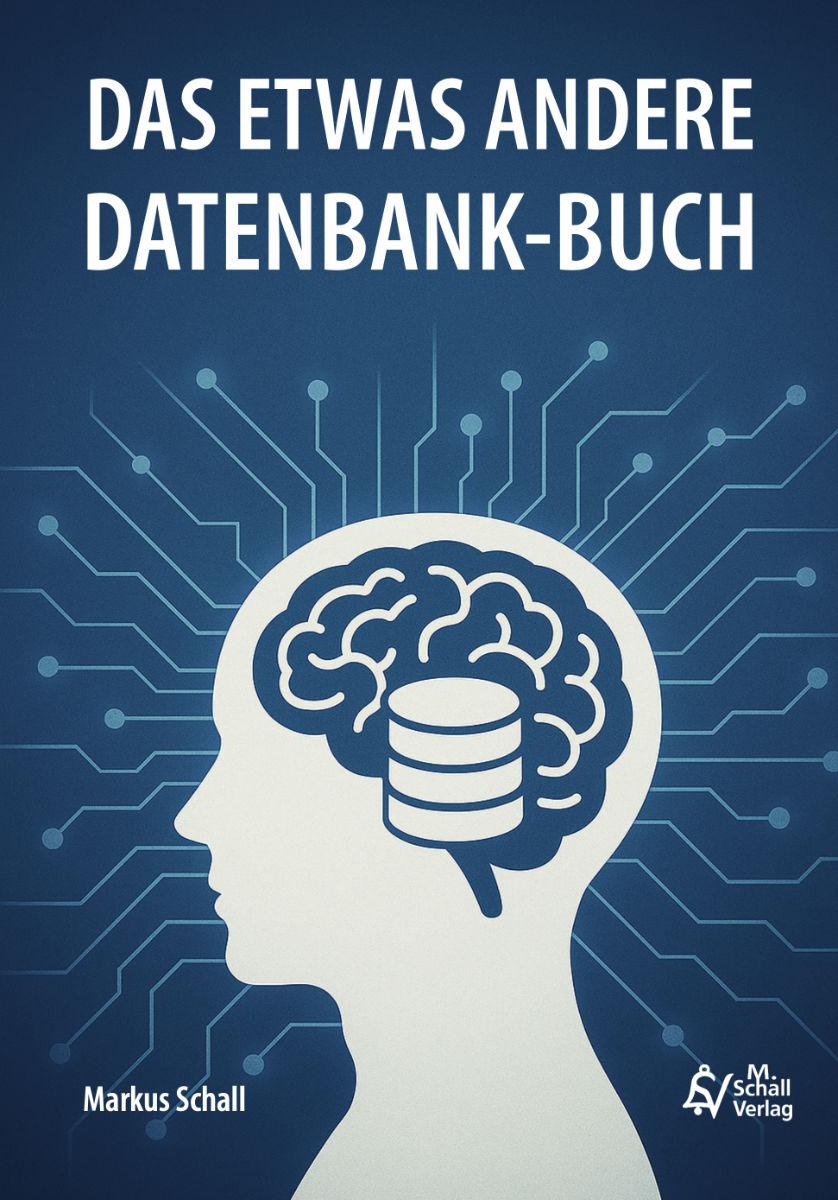
What do cell phone contacts, to-do lists, calendars and even your own closet have in common? That's right: they can be displayed as tables - and that's no coincidence. Data has long since become a basic building block of our everyday lives. If you understand it, you understand the world a little better. This is exactly where „The database book with a difference“ comes in.
Because anyone who can understand processes and backgrounds in everyday life is automatically able to design software processes quickly and intuitively and implement them in practice.
What is the book about?
This book is aimed at anyone who wants to look deeper - beyond standard tutorials or abstract theory. It is written for people who don't just want to know how to set up a database, but why databases work the way they do - and how to use them sensibly with clear thinking, structure and creativity.
Instead of providing step-by-step instructions, the book aims to create an awareness of data logic. It shows how databases structure thinking, how information can be organized in a targeted manner - and how a few basic principles can lead to significantly better results, both professionally and privately.
A book for the new generation of thinkers
Whether you already work with data or are completely new to it - this book picks you up where you are and takes you on a journey into the world of tables, relationships and structures. The approach: to use databases not only technically, but to penetrate them intellectually.
Among other things, the book deals with:
- Thinking models for database design
- Why clarity and order create more freedom
- How to develop a clean table structure from an idea
- What no-code and low-code platforms really do (and where they reach their limits)
How artificial intelligence helps with database thinking - but does not replace thought processes
Lively, understandable, practical
The book deliberately avoids complicated technical language and abstract diagrams. Instead, the reader can expect clear examples, comprehensible analogies and clear impulses on how data structures can be found in everyday life - from the closet to customer management, from the e-mail inbox to the logistics system.
The use of SQL is also covered - without programming hurdles, but with the aim of understanding the principle behind the queries. Because if you know why an SQL query works, you can later apply it flexibly to many areas of life - regardless of whether you are developing software or just want to bring order to your own world.
A book that changes the way we think
The book is not a how-to manual - it is a tool for reflection. It awakens understanding, creates a desire for clarity and is aimed at a target group that is often neglected today: people with curiosity but without IT training. Or also: designers, decision-makers, entrepreneurs, teachers, consultants, coaches, doers.
And even for developers who have been working with data for a long time, this book can open up surprising perspectives: Because it broadens the view. Because it shows how much data is connected to thinking. And because it dares to start at the very beginning - with the question: What is a table?
A book for the future
At a time when AI systems, automation and cloud services are changing everyday working life, a fundamental understanding of data structures is more important than ever. „The somewhat different database book“ does not provide a software solution - but intellectual tools. It helps to organize complexity, recognize connections - and make better decisions.
More information from M. Schall Verlag
📘 Title: The Unconventional Database Book
✍️ Author: Markus Schall - ISBN: 978-3819262630
📖 Scope: 214 pages
📚 Available as: Paperback, Softcover
🛒 Can be ordered via: Bookstore, Amazon, BoD
