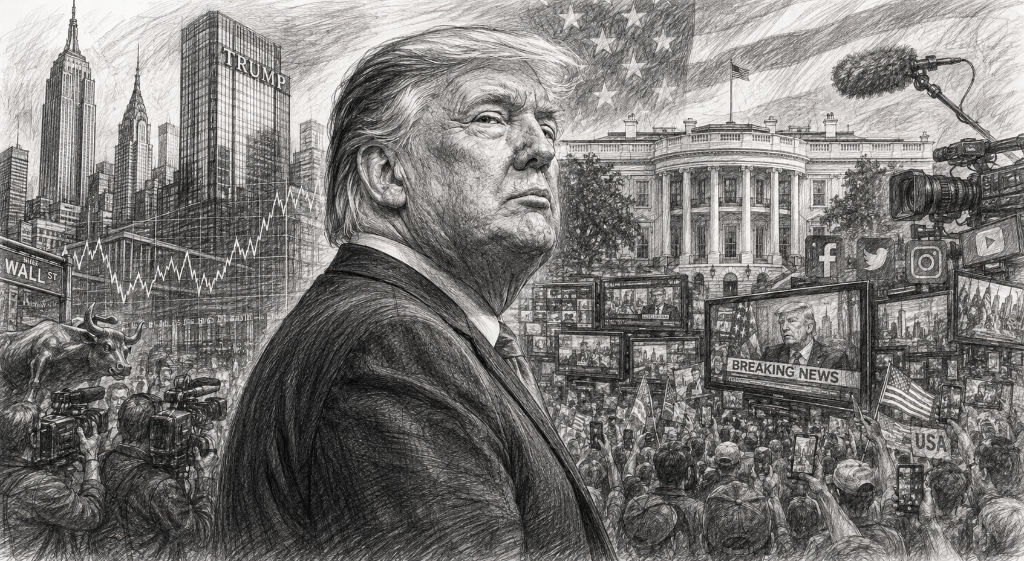
Donald Trump is no ordinary political figure. He is not a classic statesman, not an ideologically trained party soldier, not a product of decades of Washington networks. Trump is one thing above all: a projection screen. For hopes, for fears, for anger, for rejection - and for expectations that go far beyond concrete policies. This is precisely the reason why a portrait of him makes sense. You don't have to like or dislike him, but he definitely makes something visible that was already there.
Trump does not just stand for decisions or programs. He represents a rupture in the political self-image of the Western world. And this rupture cannot be explained by viewing him merely as a „populist“, „provocateur“ or „accident of history“. If you want to understand Trump, you have to see him as both a symptom and an actor.



Latest News on Donald Trump
22.09.2026: Donald Trump and the US Media According to author Eva C. Schweitzer, they share a contradictory relationship: Trump regularly attacks established media outlets, while these same outlets greatly benefit from the attention he generates. Recently, his administration barred representatives from CNN, MS NOW, and Politico from White House press conferences. In response, other broadcasters, including Fox News, expressed solidarity with their affected colleagues. Schweitzer places the conflict in historical context, noting that restrictions on press freedom in the United States are by no means new. At the same time, she points to potential escalations for foreign correspondents, whose press visas could soon be valid for significantly shorter periods. The article thus describes not only the current dispute surrounding Trump but also the structural transformation of the media landscape: traditional press, social networks, influencers, and alternative platforms are increasingly competing for reach, access, and interpretive authority.
05.08.2026: Three months before the U.S. midterm elections, indications suggest Several polls show an advantage for the Democrats . The so-called Generic Ballot shows them leading the Republicans by about six percentage points nationwide. Their chances are currently considered particularly strong in the House of Representatives: The „Race to the WH“ projection model puts the probability of a Democratic majority at 73.6 percent. In the Senate, the race is much closer; there, the Democrats are only slightly ahead at 54 percent and would need to gain four seats. Decisive contests could unfold in Texas and Maine, among other places, where Democratic candidates hold narrow leads according to the aforementioned polls. For Donald Trump, losses in one or both chambers would be a serious political setback, as his administration could then face greater scrutiny and obstruction. However, the projections remain uncertain: gerrymandering, individual candidates, scandals, and high campaign spending could still change the picture. Elon Musk also appears to be planning to provide financial support for Republican campaigns once again. The election will thus serve as a key test of public sentiment for Trump’s second term.
In the following video, Dr. Jörg Krämer, chief economist at Commerzbank AG, analyzes what U.S. politics might look like after the midterm elections on November 3 and what that would mean for the economy.

U.S. Midterm Elections – A Setback for Trump? | Commerzbank AG
Not a fan, not an opponent - but an observer
This portrait is expressly not fan writing. But it is also not an attempt to settle accounts. On a personal level, there is no reason to fall into euphoria - Trump is contradictory, sometimes erratic, difficult to categorize. He often comes across as not following a clear line. And yet it would be a mistake to underestimate him or dismiss him as a mere chaos phenomenon.
The view here is a more sober one: after years in which previous US presidents - especially under Joe Biden - created hardly any perceptible momentum, the idea that change might be possible seemed obvious. Not necessarily in the sense of a solution, but at least in the sense of a movement. Standstill creates inertia. Breaks create friction - and friction creates attention and movement. This is not praise, but an observation.
Refreshment through unpredictability?
Trump has a „refreshing“ effect on many people, not because he is consistent, but because he is different. Unpredictable. Unconventional. Often raw. In a political landscape that has been characterized for years by pre-formulated statements, rehearsed rituals and calculated speechlessness, this is striking.
This unpredictability is seen by critics as a danger - by others as an opportunity. Both perspectives are understandable. The decisive factor is that Trump is forcing those around him to react. He is forcing the media, institutions and political opponents to take a stand. That alone sets him apart from many of his predecessors. A frequent accusation is that Trump acts aimlessly, erratically and impulsively. This is the image that emerges to the outside world - and one that Trump himself does not necessarily correct. But political impact is not only created through visible order. Sometimes it is created precisely through asymmetry.
It is worth making a mental comparison here: Vladimir Putin is generally regarded as a strategist, a chess player. Trump, on the other hand, comes across more like a poker player - loud, risky, with an unclear hand. But poker is not a game without strategy. It is a game of uncertainty, deception and psychology. Those who only pay attention to external order overlook this dimension.
This does not mean that everything Trump does is part of a grand plan. But it does mean that we should be careful about hastily dismissing his actions as mere lack of planning.
Trump as an opponent – not as a solution
Trump is by no means a savior. He is not the answer to all problems. He is not even necessarily a good answer. But he is an antagonist - to entrenched routines, to morally charged self-certainties, to political apparatuses that are increasingly self-referential.
This is precisely why it polarizes so strongly. It forces you to make a decision: How much order does politics need? How much disorder can it tolerate? And what happens when a system encounters someone who does not abide by its implicit rules?
Why this portrait is necessary
A serious portrait of Donald Trump is not a statement for or against him. It is an attempt to understand a figure that many would rather simplify. Either as a demon - or as a savior. Both fall short.
This portrait follows a classic approach: Origin, imprint, action, impact. Without myths. Without conspiracy theories. Without moral exaggeration. And without claiming to pass judgment at the end. Because perhaps Donald Trump is one thing above all: a mirror. And mirrors are rarely convenient - but often revealing.
Origin and imprint: Family, milieu, early patterns
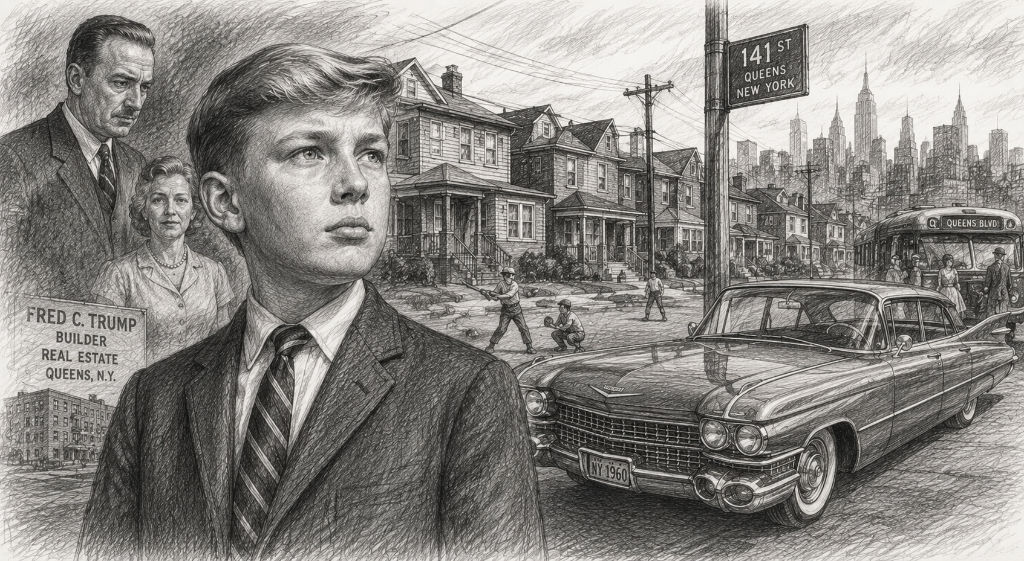
Donald Trump was born on June 14, 1946 in Queens, New York City. This place is more than just a biographical side note. Queens stands for a typical American in-between world: not the smooth elite of Manhattan, not the fringes of social exclusion, but a milieu in which advancement seems possible and achievement is taken for granted. Those who grow up here learn early on that status is not an abstract concept, but something that is seen, measured and defended.
Trump did not grow up in poverty, but neither did he grow up in secluded luxury. He experienced prosperity as the result of work, business acumen and assertiveness. This perspective still shapes his view of the world today.
The Trump family: performance as a benchmark
His father Fred Trump was a successful real estate developer who was primarily active in residential construction. He built systematically, used state subsidy programs and saw real estate as a solid, predictable business. For Donald Trump, his father was therefore not just a provider, but a benchmark. Success in this household was not a coincidence or a topic for discussion, but an expectation.
The mother Mary Anne MacLeod Trump, who immigrated to the USA from Scotland, brought a different dimension: Discipline, restraint and an awareness of social form. This mixture of entrepreneurial ambition and formal self-control is important to understand Trump's later demeanor. For him, loudness and self-confidence always stand alongside the desire to be respected and noticed.
The family lived in Jamaica Estates, an upscale residential area in Queens. This environment provided security and stability without losing sight of competition. They were successful, but not unassailable. It is precisely this mixture of comfort and competition that encourages a mindset geared towards comparison and assertion.
Trump learned early on that recognition is not awarded in the abstract, but must be visible. Houses, cars, names, positions - they all count. This early influence explains why symbols and impact play such an important role in his later life.
Discipline as an early experience
As a teenager, Trump attended the New York Military Academy. Military training facilities are not places for individual romanticism. They rely on order, hierarchy and clear roles. For Trump, this time meant a confrontation with structure and discipline - a contrast to the image that many later had of him.
This experience puts the cliché of the purely impulsive character into perspective. Trump's demeanor may appear spontaneous, but his youth contains a phase in which rules, chains of command and self-control were central. This is not an explanation, but an important background.
Study and economic thinking
After the military academy, Trump began studying at Fordham University and later transferred to the Wharton School of the University of Pennsylvania, where he earned a degree in economics. Wharton stands less for individual course content than for a certain way of thinking: Numbers, risks, opportunities, networks.
Here, Trump deepened a way of thinking that is geared towards transactions. Problems are not viewed morally, but functionally. What brings an advantage? Where is the leverage? This view would later shape both his entrepreneurship and his politics.
After graduating, Trump joined his father's company. The transition was not a break, but a continuation. Trump got to know the real estate business from the inside - with all its legal constructions, financing models and power relationships.
The decisive factor here is not a single deal, but the early experience that business is not a neutral space. Success comes from knowing the rules, using them and being prepared to take risks. This lesson runs like a red thread through Trump's later actions.
Imprinting without ideology
What is striking in this early phase is the lack of ideological training. Trump did not grow up in a political-academic environment. He was not trained as a theorist, but as a practitioner. Values such as efficiency, impact and implementation were paramount - not abstract programs or long-term constructs of ideas.
This explains why Trump later finds it difficult to fit into traditional political categories. His thinking follows less an ideology than a logic of action.
A foundation that explains a lot
His background, family, education and early professional experience together form a foundation that makes a lot of things understandable. Trump is not a product of political institutions, but a result of entrepreneurial socialization. He thinks in terms of results, not processes; in terms of impact, not consensus.
This foundation is neither good nor bad. It is simply there. If you want to understand Donald Trump, you can't get past this early influence. It doesn't explain everything - but it explains enough to put many of his later decisions into a comprehensible context.
Documentation, polarization and the question of classification
This ZDF documentary „The Donald Trump system“ is an example of the extent to which Donald Trump is no longer viewed as an individual politician, but as a social and geopolitical system as a whole. The focus is on topics such as power shifts, institutional conflicts, migration, media polarization and the increasing escalation of American domestic politics.

The Donald Trump system | Documentation | ZDFtoday news
It is less interesting whether one shares every assessment of the documentary, but rather the fundamental development behind it: Trump has long since ceased to be perceived merely as a president, but as a symbolic figure of a profound phase of social upheaval. This is precisely why hardly any other politician is as polarizing worldwide. The documentary provides an interesting insight into how major German media view the second Trump presidency and adds another perspective to the geopolitical, economic and media dynamics discussed in the article.
The entrepreneur Trump: real estate, brand, staging
When Donald Trump joined his father's real estate business in the early 1970s, the foundations had already been laid. Fred Trump had built up a solid, comparatively low-risk company that focused primarily on residential construction in the outer boroughs of New York. Donald Trump took over this legacy - and decided early on not to simply continue it, but to visibly transform it.
The decisive step was not so much a single project as a change of perspective: Trump not only wanted to develop real estate, but to become a public figure identified with real estate. In doing so, he deliberately left the comfort zone of the discreet family business and sought the bigger stage.
Manhattan as a destination - and as a risk
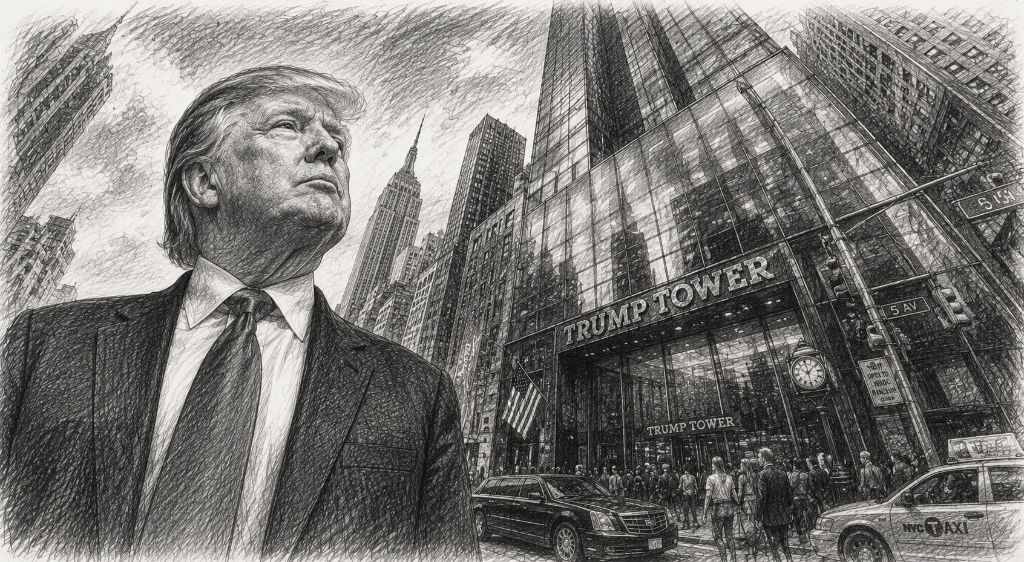
In the 1970s, Manhattan was not a natural place for glamorous large-scale projects. Parts of the city suffered from economic decline, high crime rates and a reluctance to invest. This is exactly where Trump came in. His entry into Manhattan - including the redevelopment of the Commodore Hotel near Grand Central - marked a turning point: he positioned himself as someone who invests where others hesitate.
This strategy was risky, but effective. It brought Trump into contact with politics, the media and the financial world at an early stage. What is important here is less the concrete profitability of individual projects than the image that emerges: Trump as a man who thinks and implements big projects - visibly, loudly and confidently.
Trump developed a sense early on that size communicates. High-rise buildings, big names, prominent locations - all this was part of a staging that deliberately focused on impact. The Trump Tower on Fifth Avenue is a prime example of this: not just as a building, but as a symbol.
This reveals a central pattern of his entrepreneurship: real estate is not just usable space, but a carrier of meaning. Golden facades, large lobbies, prominent locations - they send out signals. Trump saw real estate as a stage on which to display power, success and self-confidence.
The „Trump“ brand“
In the 1980s at the latest, it became clear that Trump was not just selling buildings, but his name. The „Trump“ brand developed into an actual product. Hotels, casinos, golf courses - but also consumer products - bore this name. Crucially, many of these projects were not based on traditional ownership, but on licensing models.
Trump thus made an early distinction between risk and reward. He made his name, his presence and his image available - others bore part of the economic risk. This also explains why Trump's entrepreneurial career has seen both spectacular successes and prominent bankruptcies of individual projects, without this necessarily leading to a complete economic collapse.
Insolvencies as part of the system
In the public perception, insolvencies are often seen as failures. In the real estate and finance business, however, they are not necessarily a personal downfall, but part of a system in which projects are viewed in isolation. Trump used this logic consistently. Several of his casinos and real estate companies filed for bankruptcy - the Trump brand survived.
This is not a moral judgment, but a structural observation: Trump operated early on in a world in which legal constructions, liability limitations and renegotiations are part of business. This experience also shaped his political style later on: conflicts are not avoided, but dealt with; setbacks are reframed.
Attention as capital
A decisive difference to many other entrepreneurs of his generation lies in Trump's relationship with the public. While others sought discretion, Trump sought the media. Interviews, gossip columns, television appearances - they were not a by-product, but an integral part of his business model.
This media presence later culminated in the reality TV show The Apprentice. Here, Trump finally became a figure who embodied success - regardless of how complex the real economic situation was in the background. The phrase „You're fired“ became a pop culture marker that cemented Trump's image as a decision-maker.
Trump is not an entrepreneur in the classic, reclusive sense. He is a stage-managing entrepreneur. He uses exaggeration, clear messages, repetition and strong images. Critics see superficiality in this; supporters see clarity. What is decisive for a portrait is that this staging is not a coincidence, but a deliberately used tool.
Anyone who wants to understand Trump's later political behavior cannot avoid this point. The entrepreneur Trump has learned that reality in modern societies is always also perception - and that perception can be shaped.
Entrepreneurial character as preparation for politics
At the end of this chapter, we can conclude: Trump did not go from business to politics because he had a political program. He left because his entrepreneurial path had taught him to gain power through attention, to conduct conflicts in public and to reframe defeats.
This imprint explains a lot - including what later irritates. Trump thinks less in ideological terms than in terms of deals, positioning and effects. This makes him difficult to categorize in terms of traditional politics - which is precisely why he is so effective for many.
Differences between entrepreneurial logic and classic political logic
| Entrepreneurial logic | Classic political logic |
|---|---|
| Quick decisions | Slow coordination processes |
| Direct impact and visibility | Institutional stability |
| Deal-oriented thinking | Process and consensus orientation |
| Attention as capital | Trust in procedures |
| Conflict as a tool | Conflict avoidance and compensation |
| Personal branding | Party affiliation and institutions |
| Public staging | Diplomatic restraint |
| Flexible tactics | Long-term strategies |
| Media logic and resonance | Formal communication |
| Addressing the public directly | Communication via institutions |
Trump and the media: provocation as a tool
Donald Trump did not enter the political stage as a newcomer in dealing with the media. On the contrary: the public sphere had already been a field of work for him decades earlier. While many politicians see the media as a necessary evil, Trump saw them early on as a multiplier - as an amplifier of messages, images and conflicts. The decisive factor is not whether reporting is positive or negative, but whether it generates attention.
This attitude still characterizes Trump's relationship with the media today. He does not seek consensus, but resonance. And resonance arises where expectations are broken.
Tabloid instead of feuilleton
Even in the 1980s and 1990s, Trump preferred to operate in the tabloid environment. Gossip columns, short quotes, pointed statements - all of these suited his communication logic better than long background discussions. Tabloid media work with clear contrasts, strong figures and simple narratives. This is exactly where Trump felt at home.
This early media experience explains why he later had little use for classic political formats. Press conferences, diplomatic language, graduated statements - all of these came across as an unnecessary attenuation for him. Trump prefers to communicate directly, abbreviated and to the point.
Provocation as a calculated stimulus
With Trump, provocation is not a slip-up, but a tool. It serves to set topics, bind opponents and control the media focus. A provocative sentence generates outrage - outrage generates coverage - coverage generates reach. This chain is simple but effective.
It is important to note that provocation does not necessarily mean thoughtlessness. It is often a deliberate crossing of boundaries that tests the limits of what can be said. Trump observes reactions closely and makes adjustments. It seems chaotic, but it follows a learned logic from business and the media.
„Fake news“ - attack and defense at the same time
The term „fake news“ has become one of Trump's trademarks. Critics see it as an attack on the freedom of the press and a blanket delegitimization of the media. Supporters, on the other hand, argue that Trump is using it to name real distortions, political bias and economic dependencies in the media business.
Regardless of the assessment, the term fulfills a clear function: it shifts the authority of interpretation. Instead of engaging with the content, Trump questions the source. This is a classic rhetorical device that is primarily used in conflictual situations. It weakens opponents without having to refute them directly.
Under Trump, the conflict between politics and the media became permanent. While previous presidents tried to smooth over tensions or resolve them behind the scenes, Trump acted them out openly. The press was declared the enemy, journalists became players in the political game.
This approach has two effects: It mobilizes supporters who already feel misunderstood by the media. At the same time, it strongly polarizes the public. For Trump, this polarization does not appear to be collateral damage, but part of his strategy. Polarization forces you to take a position.
Social media: bypassing traditional filters
A decisive factor in Trump's media strategy is the direct use of social media. Platforms such as Twitter (now X) enabled him to bypass traditional editorial filters. He was able to set topics without having them voted on or categorized beforehand.
This direct communication reinforced the impression of authenticity - but also of unpredictability. For supporters, it was a sign of closeness and openness. For critics, it was evidence of a lack of self-control. In both cases, it significantly increased the reach of his messages.
Trump primarily follows the logic of the media, not the classic logic of politics. While politics relies on stability, predictability and compromise, media attention thrives on conflict, escalation and repetition. Trump consistently chooses the latter.
This explains why many of his statements function less as political programs than as triggers. They trigger reactions, shift discourses and change priorities - often regardless of whether they are later implemented.
Effect instead of consent
A key difference to many other politicians lies in Trump's relationship to approval. He does not strive to be accepted by as many people as possible. It is enough for him to be effective. Impact also comes from rejection, as long as it is visible.
This attitude irritates traditional observers, but fits into a media landscape in which attention is a scarce resource. Trump recognized early on that political power in the 21st century comes not only from majorities, but from a constant presence.
Media as a mirror of social fractures
Trump's conflicts with the media cannot be viewed in isolation. They reflect a deeper crisis of trust - between the population and institutions, between perception and representation. Trump exploits these fractures, but he did not create them.
In this sense, his relationship with the media is less a cause than an amplifier. It brings to the surface what is already there: skepticism, frustration, mistrust. The media react to this - and become part of the story themselves.
Trump and the media have a symbiotic relationship. They fight each other rhetorically, but at the same time benefit from each other. Provocation is the unifying element: it attracts attention, structures debates and keeps Trump at the center of public perception.
Anyone who wants to understand why Trump remains politically effective - regardless of approval or disapproval - must understand this media logic. It is not a sideshow, but one of the cores of his success.
The first presidency (2017-2021): Breaking with conventions
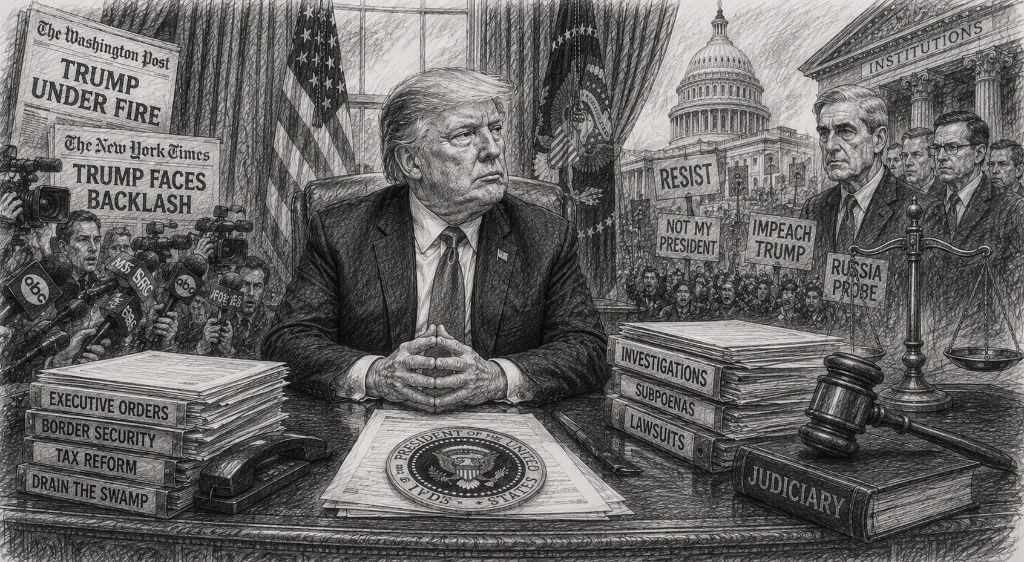
When Donald Trump took office in January 2017, he differed fundamentally from almost all of his predecessors in one respect: he had no political socialization in the strict sense. No years in Congress, no career as a governor, no involvement in foreign policy think tanks. What critics saw as a deficit, supporters saw as an advantage: finally someone who did not come from the political establishment. This lack of preparation in the traditional sense was also part of the program.
Trump did not want politics „as usual“ - and he did not want to pretend to respect the unwritten rules. The break with conventions did not begin with content, but with style: language, appearance, prioritization.
Style of government: Decision before trial
Trump ran the office of president more like a company than an administration. Decisions were often made top-down, with little regard for established processes. This led to rapid changes of direction, but also to internal friction. Ministers, advisors and agency heads changed frequently; loyalty played a greater role than experience in the state apparatus.
For supporters, this was a sign of the ability to act. For critics, it was a symptom of instability. The facts are clear: The institutional apparatus of the USA is designed for continuity. Trump's style therefore inevitably created tensions - not out of malice, but out of system incompatibility.
Domestic policy: setting an example instead of fine-tuning
In domestic policy, Trump sent out visible signals early on: immigration, border security, rolling back regulations, tax reforms. Many measures were deliberately symbolically strong - partly to meet voter expectations, partly to put pressure on political opponents.
At the same time, it became apparent that complex legislative processes in Congress were less suited to Trump's approach. Where quick successes failed to materialize, he resorted to executive orders. This reinforced the impression of a presidential solo effort, but was also an expression of the real balance of power in an often deadlocked political system.
Foreign policy: unconventional and transactional
In terms of foreign policy, Trump also broke with tradition. He questioned alliances, spoke openly about the costs and benefits of international commitments and preferred bilateral agreements to multilateral forums. For him, diplomacy appeared less like long-term relationship management and more like negotiation.
This approach irritated traditional partners, but was perceived as refreshingly clear by some states. Trump rarely made a secret of the fact that he saw international politics as an exchange of interests - not as a moral project.
Here too, approval was secondary to impact.
Economy and self-image
During his first term in office, Trump consistently presented himself as an economic president. Stock market levels, unemployment figures and investment announcements were strongly emphasized in his communications. Regardless of the assessment of individual figures, the message was clear: success should be measurable and visible.
This focus suited his entrepreneurial background. However, it often reduced complex social issues to key figures - which critics saw as reductive, while supporters saw as a necessary grounding.
The tension between Trump and the media, which began before his presidency, intensified during his time in office. Press conferences, interviews and social media became the scene of constant conflict. At the same time, conflicts with parts of the judiciary, the secret services and the administration intensified.
It is important to classify them here: these conflicts were not only personally motivated, but also structural. A president who ignores conventions inevitably comes up against institutions whose task it is to preserve conventions.
Supporters, opponents and polarization
Social polarization increased significantly under Trump. Supporters saw him as someone who was „finally saying“ what had long been suppressed. Opponents saw a threat to democratic culture and cohesion. Both sides reinforced each other.
As much as Trump broke conventions, the limits of this approach also became clear. The US state proved to be resilient. Courts, Congress, states and authorities set limits, slowed down processes or corrected decisions. The president was powerful - but not omnipotent.
This experience is central to understanding the first term of office: Trump was able to initiate many things, change some things, but not fundamentally restructure the system. The rupture remained real - but it remained within the framework.
Donald Trump's first presidency was characterized less by consistent policies than by a change of style. It posed questions to which there are no simple answers: How much convention does democracy need? How much disruption can it tolerate? And what happens when a system encounters someone who does not accept its implicit rules?
These questions did not end with the end of his term of office. Rather, they formed the basis for everything that followed - politically, socially and personally.
Current survey on trust in politics
Between the terms of office: Conflicts, criticism, reorganization
After the end of his first term in office, Donald Trump did not disappear from the public eye - on the contrary. While many former presidents move into a phase of controlled distance, Trump remained permanently present. This period was not a political void, but a phase of reshaping: legally, in the media, organizationally and strategically.
Trump treated the end of his term of office not as a conclusion, but as an interruption. This sets him apart from almost all his predecessors - and explains why this interim phase was so politically charged.
The 2020 election as an open conflict
Trump's handling of the 2020 election is central to this phase. Critics interpreted his rejection of the result as an attack on fundamental democratic principles. For supporters, on the other hand, it was an expression of a deep mistrust of the electoral process, media coverage and institutional procedures.
Viewed objectively, this created a permanent state of conflict: the election did not become a closed event, but a continuing issue. This had two effects. On the one hand, it tied up enormous political energy; on the other, it kept Trump's supporters mobilized. Regardless of the assessment, it can be said that
This phase permanently changed the relationship of many citizens to elections, institutions and public authority.
Legal disputes as a political factor
At the same time, a series of legal proceedings and investigations began. These ranged from civil law issues to criminal charges. For critics, this confirmed the image of a politician who had overstepped boundaries. For supporters, on the other hand, the impression of politically motivated proceedings intensified.
It is crucial for the portrait not to take sides, but to describe the effect: Legal disputes became part of political communication. Court hearings, indictments and verdicts not only had a legal but also a symbolic effect. For many supporters, they strengthened the narrative of the outsider who was being fought against by the system.
Media economy after the presidency
Trump also repositioned himself in the media. Direct access to social media remained a key tool - even where platforms temporarily imposed restrictions. Interviews, public appearances and targeted provocations kept him at the center of attention.
The continuity of his strategy is striking: instead of focusing on rehabilitation or reconciliation, Trump remained in conflict mode. Attention continued to be used as a resource. In a fragmented media landscape, this strategy proved to be effective - even when it polarized.
Economic activities and new points of criticism
During this interim phase, Trump's economic activities also came back into focus. Projects in the real estate sector, media initiatives and later engagements in the digital financial environment caused discussion. Critics accused him of turning political prominence into economic benefit. Supporters saw this as the legitimate actions of an entrepreneur outside of office.
An old tension became particularly clear here: where does political influence end and private entrepreneurship begin? This question was not answered conclusively - but it has been a constant companion to Trump and has helped to sharpen his public profile.
While traditional parties struggled for unity during this phase, a movement increasingly developed around Trump. It was less programmatic and more emotional. Loyalty was to the person, not to a detailed political plan.
This is not an isolated case in history, but a familiar pattern in phases of social uncertainty. Trump became a focal point for dissatisfaction, mistrust and the desire for clear fronts. This movement kept him politically relevant - regardless of whether he held office.
Polarization as a permanent state
The period between the terms of office was characterized by ongoing polarization. Conversations about Trump were rarely neutral; they were confessions or demarcations. This escalation had its price: social fatigue, hardening of positions, breakdown of dialog.
At the same time, it became clear that Trump was not the sole cause of this polarization, but an amplifier. He bundled existing tensions and made them visible. The interim phase thus became a mirror of social fractures - not only in the USA, but internationally.
Preparing for the return
Politically, Trump used these years to secure structures: Networks, supporters, media presence. The interim phase was less a phase of waiting and more a phase of positioning. He remained in the conversation, set topics, reacted to developments - and kept the option of returning open.
This made this period very different from classic „post-presidencies“. Trump remained an actor, not an observer.
The period between the terms of office was not a political shadow space, but a crucial link. Conflicts, narratives and loyalties intensified here. Trump became both more vulnerable and more robust. Criticism and support became more radicalized - and prepared the ground for what followed.
This phase shows particularly clearly why Trump cannot just be regarded as a former president. He remained a political factor - even without office. And that is precisely what makes him a figure who is more than politics in the narrow sense.
Economic interests, power and the new Trump economy
The Monitor investigation sheds light on an aspect of the second Trump presidency described below that is attracting increasing international attention: the connection between political power, economic interests and family business structures. The focus is on investments, cryptocurrencies, oil policy and possible conflicts of interest surrounding the Trump clan.
Of particular interest is the question of how closely modern politics is now intertwined with financial markets, media impact and digital capital flows. The program thus picks up on a topic that also plays an important role in the crypto chapter of this article: Attention, political communication and economic dynamics are increasingly merging. At the same time, the documentary shows how differently such developments are interpreted. While critics see it as a problematic concentration of power, supporters point to entrepreneurial freedom, political attacks by opponents and the increasing politicization of economic debates.

How the Trumps are making billions from the presidency - MONITOR
The second presidency: continuity, shifts and new questions of power
When Donald Trump took office as president again, the political landscape was different to eight years previously. The United States was more polarized, trust in institutions had eroded further and international conflicts had become more acute. Trump was not returning to a neutral system, but to a country that had already been deeply marked by his first term in office, the subsequent disputes and the years that followed.
This second presidency therefore did not begin with a phase of feeling things out, but with a visible ambition to demonstrate his ability to act. Trump did not enter office as a newcomer, but as someone who knows the office - with all its possibilities and limitations.
Speed instead of habituation
In contrast to his first term in office, Trump focused on speed right from the start. Decisions were made early, changes of direction were announced quickly, priorities were clearly marked. The impression this created was deliberate: no hesitation, no transition, no cautious approach.
This approach followed a familiar pattern. Trump uses speed as a political tool. Those who act quickly force opponents to react before they can coordinate. At the same time, speed signals determination - regardless of how you evaluate the content.
Domestic policy: order, energy, enforcement
In domestic policy, issues that Trump had already strongly emphasized before came to the fore. Migration, border security, energy policy and state regulation were again defined as core areas. The tone was clear: the state should be able to act, decisions should be visibly implemented.
It was less about detailed policy than about signals. Trump prefers to work with clear frameworks - order, security, independence. Supporters see this as necessary clarity. Critics see simplification. What is undisputed, however, is that these topics were deliberately chosen so that they are immediately tangible for many citizens.
Dealing with the state apparatus
A central area of tension in the second term of office lies in the relationship between the president and the administration. Trump has a fundamental distrust of the state apparatus. For him, bureaucracy is not a neutral enforcement mechanism, but a system with its own inertia and interests.
This results in a permanent conflict: Trump strives for direct implementation of political guidelines, while the apparatus is designed for stability, procedure and continuity. This friction is not an exceptional situation, but a structural feature of his presidency - and characterizes many domestic political disputes.
Continuity is also evident in foreign policy. Trump views international relations primarily as a balancing of interests, not as a moral project. Alliances are viewed from a cost-benefit perspective, diplomacy as a negotiation, not as an end in itself.
In doing so, he relies on direct talks, clear demands and publicly visible meetings. The meeting with Vladimir Putin in Alaska is a striking example of this. The location, far removed from traditional diplomatic stages, underlines Trump's approach: controlled framework, clear symbolism, maximum attention.
This form of diplomacy seems unusual to many observers and irritating to some. For Trump, however, it is consistent. For him, foreign policy is not a quiet vote behind closed doors, but part of a public demonstration of power.
Conflicts instead of reassurance
The second presidency is not designed to close rifts. Trump is not seeking balance for the sake of balance. Instead, he accepts conflict - sometimes deliberately. He accepts that his policies will generate resistance and uses this resistance as confirmation of his role.
This leads to ongoing tension between the president, the media, the opposition and parts of his own administration. At the same time, it stabilizes his support base, which sees precisely this confrontation as proof of consistency and steadfastness.
Change in detail, continuity in style
If you compare the two terms in office, a clear picture emerges: the style remains the same, the circumstances have changed. Trump continues to be direct, confrontational and effective in the media. What is new, however, is the experience he brings with him - and his willingness to test institutional boundaries in a more targeted manner.
The second presidency seems less impulsive and more determined. Not calmer, but more focused. Not more moderate, but more strategic.
Donald Trump's second term in office is not a new beginning, but a continuation under tougher conditions. It shows how a president with a strong style of his own tries to make an impact in a complex system - and how this system reacts to it.
Trump thus remains, even in this phase, what he was from the outset: not a classic president, but a political actor who challenges existing structures without being able to completely abandon them.
Trump, Iran and the return of hard power politics - between „America First“ and geopolitical escalation
Donald Trump originally ran on a political promise that appealed to many Americans, especially after the long wars in Iraq and Afghanistan: no more endless foreign missions, no more ideologically motivated interventions, no more global policing role for the USA. For many supporters, „America First“ meant one thing above all: focusing on their own country. This is precisely why the developments surrounding Iran seem so remarkable to many observers today.
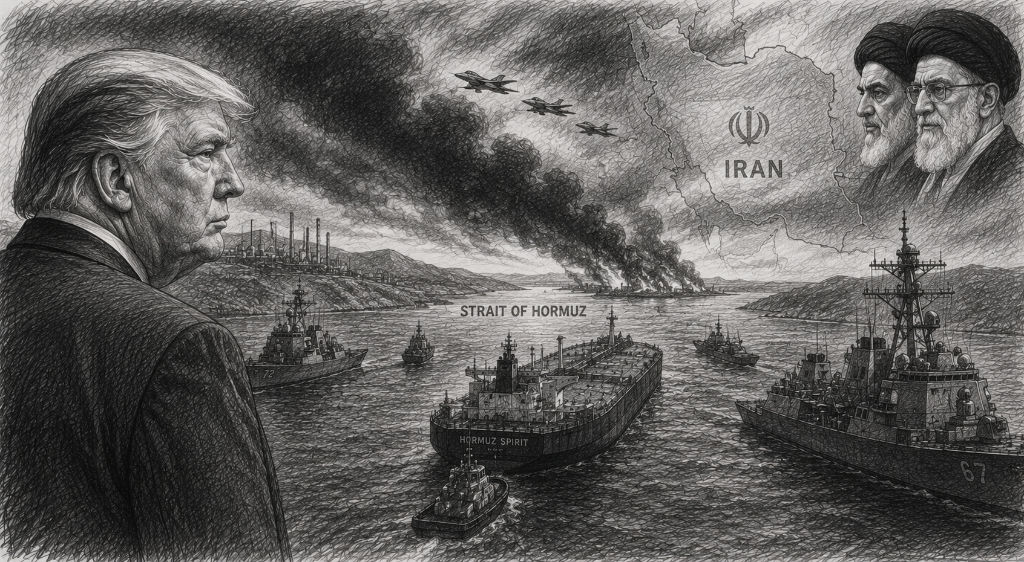
Since the escalations of 2026 at the latest, it has become clear that Trump's foreign policy continues to be transactional, but at the same time relies much more heavily on an open demonstration of power than during his first term of office. The conflict with Iran marks a turning point. It is no longer just about sanctions, diplomacy or regional zones of influence. It is increasingly a question of the extent to which the United States is prepared to visibly enforce geopolitical order again with pressure, threats and direct power projection.
What is interesting here is less the pure escalation itself than the way Trump is staging it politically. His communication does not follow the classic language of diplomatic caution. Instead, he works with public pressure, clear ultimatums and maximum visibility. In the dispute over the Strait of Hormuz, Trump openly threatened to attack Iranian infrastructure and energy facilities if Iran did not fully reopen the important trade route.
This form of politics is less reminiscent of the restrained language of modern Western diplomacy than of older forms of geopolitical exercise of power, in which deterrence was to be visibly and publicly demonstrated. This is precisely one of the key differences to many European styles of government in recent years. Trump is not primarily trying to defuse conflicts through communication. He deliberately uses tension as a political instrument.
The entrepreneur in the White House
The Iran conflict in particular shows how strongly Trump's entrepreneurial mindset shapes his foreign policy. He often views international relations less as long-term systems of trust and more as negotiations under pressure. Interests are pitted against each other, risks are calculated, positions are tested.
This also explains the seemingly contradictory mixture of escalation and willingness to talk. On the one hand, Trump threatens to take massive measures against Iran, while on the other hand he repeatedly signals openness to deals, transitional agreements and new negotiations. Even during the recent tensions, talks on ceasefires, sanctions and security guarantees continued via mediating states such as Qatar and Pakistan.
This creates a foreign policy style that is difficult for many observers to categorize. Trump comes across as both confrontational and willing to negotiate. It is precisely this mixture that makes his policy difficult to predict for opponents and often attractive for supporters. They do not see this as a contradiction, but as a form of strategic uncertainty.
The return of visible power politics
What is particularly striking, however, is that under Trump, concepts and patterns that have long been associated with earlier geopolitical eras are reappearing. Topics such as regime change, zones of influence and direct control over strategic regions are suddenly playing a more open role again. This was already evident at the beginning of 2026 during the spectacular operation in Venezuela in which Nicolás Maduro was arrested. Afterwards, Trump spoke unusually openly about the need for the USA to temporarily „lead“ the country until an orderly transition was possible.
Many analysts saw this as a clear shift in American foreign policy. The focus was no longer merely on economic pressure or diplomatic isolation, but on direct intervention with visible American control. This is precisely why Iran policy is now increasingly being discussed from this perspective.
The international impression is that the United States under Trump is once again trying to actively shape the geopolitical order rather than just reacting to developments. This applies not only to Iran, but increasingly also to Cuba and parts of Latin America. Several international analyses now openly speak of a possible return of classic American influence doctrines in the Western hemisphere.
Resistance even in the conservative camp
It is interesting to note that criticism of this development is no longer only coming from political opponents. Doubts are also growing within the Republican Party. Traditional „America First“ supporters in particular are increasingly asking whether Trump is moving away from his original line with Iran.
Many of his voters supported him precisely because they did not want any new major conflicts. The risk of a protracted Middle East conflict is therefore causing tensions even in the conservative camp. Several Republican voices have recently warned that a lasting escalation with Iran could alienate their own political base.
This is precisely where a central area of tension of the second Trump presidency becomes apparent. Trump wants to demonstrate strength, create deterrence and make geopolitical control visible. At the same time, his political identity continues to be based on the promise to keep America out of endless international conflicts. These two goals are increasingly coming into conflict with each other.
Between deal-maker and power politician
Perhaps this is precisely what makes Trump's Iran policy so special. It constantly moves between two roles. On the one hand, Trump continues to present himself as a deal-maker who ultimately wants to resolve conflicts through negotiations. On the other hand, he simultaneously uses methods that are strongly reminiscent of classic power politics: economic pressure, military threats, public intimidation and geopolitical demonstrations.
The result is a form of foreign policy that appears less ideological than many previous American strategies, but at the same time is much tougher and more visible. Trump is clearly not trying to philosophically justify a new world order. Rather, he is trying to keep American dominance practical and immediately visible.
Whether this approach will create long-term stability or exacerbate new conflicts remains to be seen. However, one thing is already clear: The conflict with Iran marks a point at which American foreign policy has noticeably changed under Trump. Away from the idea of quietly maintaining global order, towards a policy that once again exhibits power in a much more visible way.
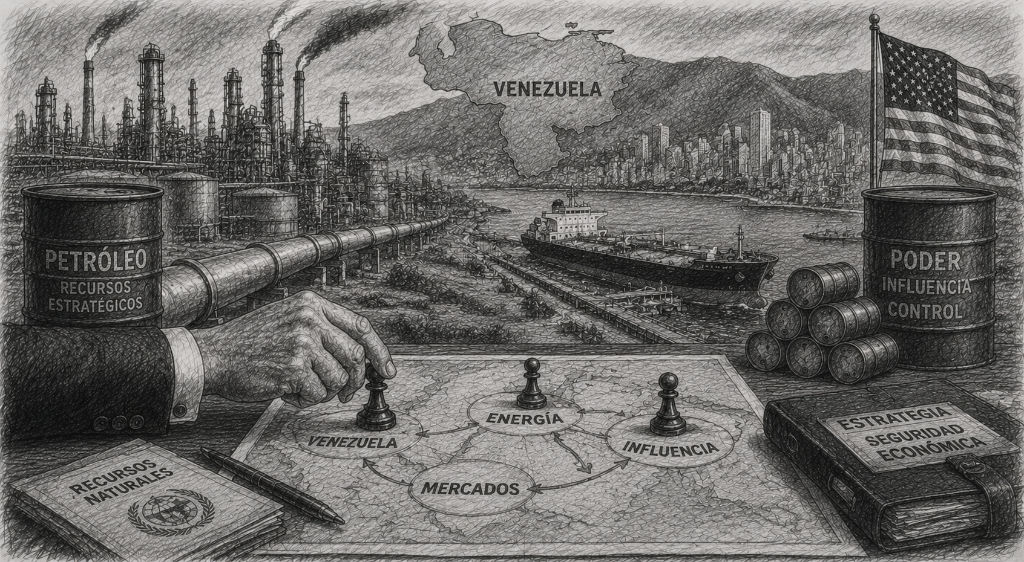
The Venezuela operation and the new American foreign policy
The events surrounding Venezuela are among the most controversial foreign policy developments of the second Trump presidency. Officially, the operation against Nicolás Maduro was primarily justified on the grounds of security interests, organized crime, regional stability and the protection of American interests. However, hardly any serious geopolitical observer assumes that Venezuela would have the same strategic importance without its enormous natural resources.
Venezuela not only has large oil reserves. The country has the largest officially confirmed oil reserves in the world. It is precisely this point that makes the development so explosive. For decades, the United States has viewed Venezuela not only as a political crisis state, but also as a key energy policy factor within the western hemisphere.
The type of Venezuelan oil is particularly important here. It is predominantly heavy, sulphurous crude oil, which is technically particularly suitable for many refineries on the American Gulf Coast. These refineries have been designed for decades to process heavy crude oil types from Venezuela, Mexico and Canada.
Although the boom in the American fracking industry has significantly changed US energy production, many refineries still require heavy crude oil grades in order to operate at optimum efficiency. This is precisely why Venezuela continues to be of enormous strategic importance from an American perspective, despite all the political conflicts.
From sanctions to direct influence
The development in recent years shows a remarkable shift. While previous American strategies relied primarily on sanctions, economic pressure and diplomatic isolation, the impression of more direct influence has increasingly emerged under Trump.
The appointment of Nicolás Maduro at the beginning of 2026 marked a historic turning point. For the first time in a long time, there was an open international discussion as to whether the United States was prepared to not only indirectly promote political changes of power, but to actively help shape them.
After the operation, Trump himself spoke unusually openly about wanting to „lead“ Venezuela for a transitional period until stability was established. This choice of words in particular caused considerable irritation internationally. It reminded many observers less of modern partnership diplomacy than of earlier phases of American influence doctrines in Latin America.
It is interesting to note that the economic dimension hardly remained hidden. Shortly after the shift in power, discussions began about massive investments by American energy companies in Venezuelan production facilities. ExxonMobil is said to have already held talks about production rights. At the same time, Trump openly signaled that American companies should play a central role in rebuilding the Venezuelan oil industry.
The new energy geopolitics
This is where a pattern emerges that goes far beyond Venezuela. Trump views energy policy not only in economic terms, but also geopolitically. Control over energy flows means influence over markets, transportation routes, currencies and international dependencies.
In this context, it becomes understandable why Venezuela suddenly became much more important again from an American perspective. The country is geographically close to the United States, has enormous reserves and could help to make the American energy supply more independent of other geopolitically risky regions in the long term. At the same time, stronger American control of Venezuelan oil flows would weaken China's influence in Latin America.
During the years of Western sanctions, China became the most important buyer of Venezuelan oil. Many deliveries were made to Chinese refineries at considerable discounts. It is precisely these trade structures that could now shift. Reuters already reported at the beginning of 2026 that American refineries could benefit directly from a redirection of Venezuelan exports.
Venezuela is thus becoming part of a larger geopolitical power struggle. It is not just about democracy, human rights or regional stability. It is also about energy supply, industrial infrastructure and strategic control of global raw material flows.
Between stabilization and power projection
Supporters of American intervention argue that Venezuela had collapsed so badly economically and institutionally that external intervention had become unavoidable. They point to hyperinflation, corruption, organized crime and the massive collapse of state structures.
Critics, on the other hand, see the danger of a new form of economic influence under geopolitical auspices. In Latin America in particular, there is growing concern that Venezuela could become a model case in which economic interests and political power projection are increasingly intertwined.
This is precisely why the situation seems so ambivalent. On the one hand, there is indeed the possibility that American investment could stabilize parts of the Venezuelan infrastructure. On the other hand, there is also the impression that economic openness and geopolitical control are increasingly merging.
Trump and visible power
The Venezuela operation thus shows very clearly how American foreign policy has changed under Trump. It seems less ideological than in previous decades, but at the same time more direct and visible. Trump rarely talks about abstract world orders or long-term democratic theories. Instead, he thinks in terms of spheres of influence, economic impact and strategic control.
This is precisely what gives the impression of a return to classic power politics. Not hidden behind diplomatic formulas, but openly visible. Military strength, economic interests and public communication are directly intertwined.
Whether this strategy will create stability in the long term or give rise to new conflicts remains to be seen. However, one thing is already clear: Venezuela has long since become more than just a regional crisis state. The country is now symbolic of a new phase of American foreign policy, in which raw materials, geopolitics and the visible exercise of power are once again more closely linked.
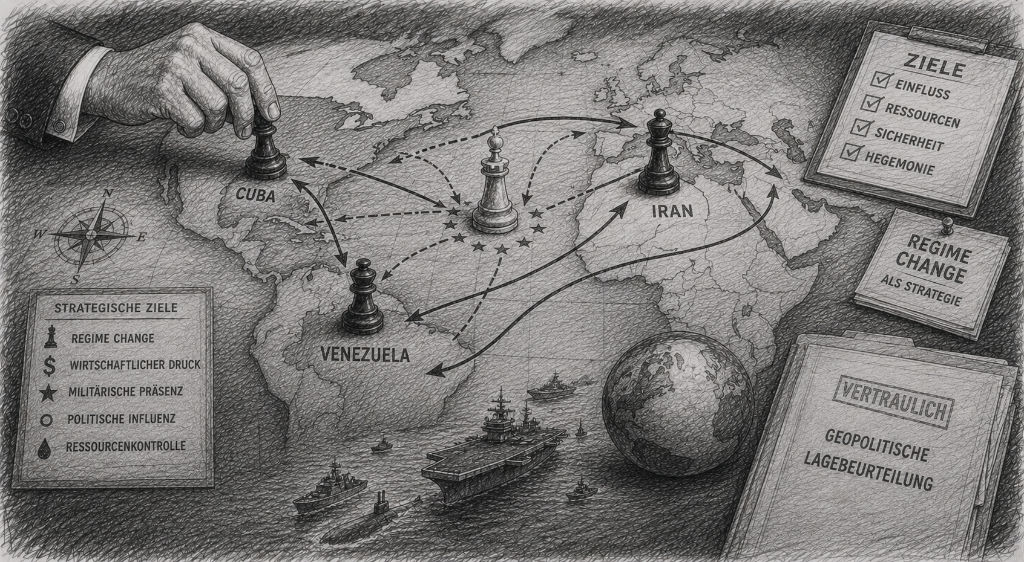
The question of „regime change“: Venezuela, Iran, Cuba and the new geopolitical line
For a long time, the term „regime change“ was considered politically sensitive in the West. After the experiences in Iraq, Afghanistan and Libya, many governments tried to avoid such terms as far as possible. Even when influence was exerted on other states, it was usually indirect, diplomatically formulated or hidden behind strategic terms. This seems to have changed under Donald Trump.
Because if you look at Venezuela, Iran and, increasingly, Cuba together, you get the impression of a new foreign policy line. Not necessarily in the sense of a fully developed master plan, but as a recognizable direction. The United States is once again taking a much more offensive stance when it comes to the political order of other states.
What is particularly interesting here is the approach. Trump rarely talks about exporting democracy or liberal world orders, as previous American governments often did. His language is much more direct. It is about strength, control, influence and stability from an American perspective. This is precisely why this policy appears less ideological to many observers, but at the same time much tougher and more visible.
Venezuela as a signal effect
The operation against Nicolás Maduro at the beginning of 2026 was a turning point in this context. For the first time, there was an open international impression that Washington was once again prepared to actively push for political power changes and publicly and visibly support them. Even if the US government avoided the term „regime change“ at times, numerous international analysts described precisely this effect.
At the same time, something interesting emerged: Trump seemed less interested in long-term institutional restructuring than in rapid control and visible stabilization. Several experts pointed out that large parts of the existing power structures in Venezuela would initially remain in place. This is precisely what distinguishes the current American strategy from previous attempts at comprehensive democratization.
It seems more like a form of pragmatic power politics. The decisive factor does not seem to be whether a country fully adopts Western ideals, but whether it remains geopolitically controllable and does not run counter to American interests.
Iran and the return of geopolitical escalation
This development became even clearer in the conflict with Iran. There, the term regime change suddenly reappeared openly in international debates. After the American-Israeli attacks at the beginning of 2026, there was even public discussion about what political successor structures could emerge in Tehran. It is precisely this point that marks a remarkable shift. Just a few years ago, Western governments would have largely avoided such discussions. Under Trump, on the other hand, the impression has emerged that geopolitical realignment is once again being considered much more offensively.
It is striking that Trump himself remains surprisingly flexible ideologically. On the one hand, he makes massive threats, while at the same time continuing to look for deals and transitional agreements. Even Republican hardliners have recently criticized parts of his Iran negotiations as being too soft or contradictory.
However, it is precisely this that creates a special dynamic: Trump combines classic power projection with entrepreneurial negotiating logic. Conflicts are escalated in order to be able to negotiate later from a stronger position.
Iran, Israel and the geopolitical escalation of the second Trump presidency
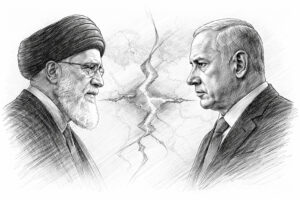 The conflicts surrounding Iran and Israel are among the most important geopolitical areas of tension during the second Trump presidency. This is no longer just about traditional diplomacy or regional security issues, but increasingly about the global balance of power, energy supply and the visible return of geopolitical zones of influence.
Of particular interest here is the role of Donald Trump himself, who often treats foreign policy conflicts like business negotiations: with public pressure, maximum visibility and strategic escalation. The separate Articles about Iran, USA and Israel examines these developments in more detail and explains why the region is once again one of the world's key geopolitical hotspots.
Cuba as the next geopolitical pressure point
Developments around Cuba are now particularly interesting. Just a few years ago, serious American influence on Cuba seemed politically inconceivable. But that seems to be changing at the moment.
American sanctions against Cuba have been massively tightened. At the same time, the United States is attempting to cut off Venezuelan oil flows to Cuba, which has led to considerable energy problems on the island.
As a result, there is a growing international impression that Cuba has become part of the same geopolitical strategy as Venezuela and Iran. Several media outlets and analysts are now openly talking about Washington's renewed efforts to bring about political change in countries that have long been considered opponents of American influence.
It is interesting to note that Cuba appears much more stable than Venezuela, despite all its economic problems. The state structures are considered more cohesive, the security apparatus more loyal and the historical defensive stance towards the USA much more pronounced. This is precisely why some observers warn against simply transferring the „Venezuela model“ to Cuba.
The role of J. D. Vance
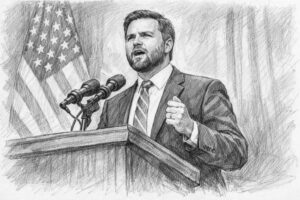 In this geopolitical field of tension, the role of J. D. Vance interesting. Vance represents the original „America First“ idea within the Republican camp: restraint in military interventions, a focus on domestic political stabilization and scepticism towards international power projects.
While figures such as Marco Rubio are increasingly taking a tougher line on Cuba and Venezuela, Vance is seen more as a cautious realist who warns against new lasting foreign conflicts. There are said to have been considerable internal tensions in the Iran complex in particular.
This is creating an interesting development within the conservative camp. In terms of foreign policy, Trump is increasingly moving towards the visible exercise of geopolitical power, while parts of his original movement had more isolationist expectations. It is precisely this tension that could become even more important in the coming years.
Between deterrence and reorganization
The actual peculiarity of the current situation therefore lies less in individual conflicts than in the emerging overall picture. Venezuela, Iran and Cuba are increasingly looking like part of a new geopolitical strategy in which economic pressure, media staging, sanctions, military threats and political influence are becoming more closely interlinked.
This is clearly no longer primarily about long-term ideological transformations. Rather, the impression is that Washington under Trump is trying to control geopolitical spaces more visibly again and push back strategic opponents.
Whether this will actually result in a lasting new world order or just a short-term phase of aggressive power projection remains to be seen. However, one thing is already clear: The term „regime change“, which has long been politically taboo, has suddenly become part of real geopolitical debates again.
Why Greenland has suddenly become geopolitically relevant
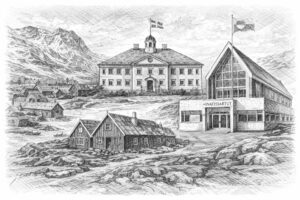 At first glance, the discussion about Greenland seems almost absurd. But behind the headlines lies a much bigger geopolitical issue: the strategic importance of the Arctic in the 21st century. Raw materials, new trade routes, military presence and competition with Russia and China are suddenly making Greenland a key power factor. This is precisely why the island is appearing more and more frequently in statements by Donald Trump and J. D. Vance. The detailed Greenland article sheds light on the historical, legal and geopolitical background to this development and shows why the debate is far more than mere political provocation.
Geopolitical areas of conflict during the second Trump presidency
| Region | Field of conflict | Strategic background |
|---|---|---|
| Iran | Strait of Hormuz, sanctions, military escalation | Energy supply, deterrence and geopolitical control |
| Venezuela | Change of power, oil industry, American influence | Raw materials, refineries and strategic energy policy |
| Cuba | Sanctions, economic pressure, isolation | Latin America strategy and limitation of opposing spheres of influence |
| China | Trade conflicts, technology, supply chains | Economic dominance and global balance of power |
| Russia | Ukraine war, NATO, energy policy | Reorganization of international security structures |
| NATO | Financing, defense spending, alliance obligations | Distribution of power within the Western alliance |
| Digital platforms | Social media, digital mobilization, crypto markets | Attention economy and digital power structures |
Trump as a political brand in digital capitalism
Donald Trump was never just a politician. Even during his presidencies, he always remained a brand, media figure and economic symbol. This is precisely why his entry into the world of cryptocurrencies seems surprising at first glance, but almost logical at second glance. After all, hardly any other area combines attention, speculation, digital publicity and emotional dynamics as strongly as the crypto market.
What is interesting here is less the technical side of cryptocurrencies than their social impact. Bitcoin, Ethereum or other digital coins originally arose from a deep mistrust of traditional institutions. Banks, central banks and state control were called into question. Many early crypto users saw themselves not only as investors, but almost as a counter-movement to the existing financial system.
This is precisely why the connection between Trump and parts of the crypto scene fits surprisingly well. Both thrive on systemic scepticism, anti-establishment sentiment and direct digital mobilization. Trump understood early on that political power in the digital age is no longer created solely through traditional institutions, but increasingly through reach, community loyalty and a lasting media presence.
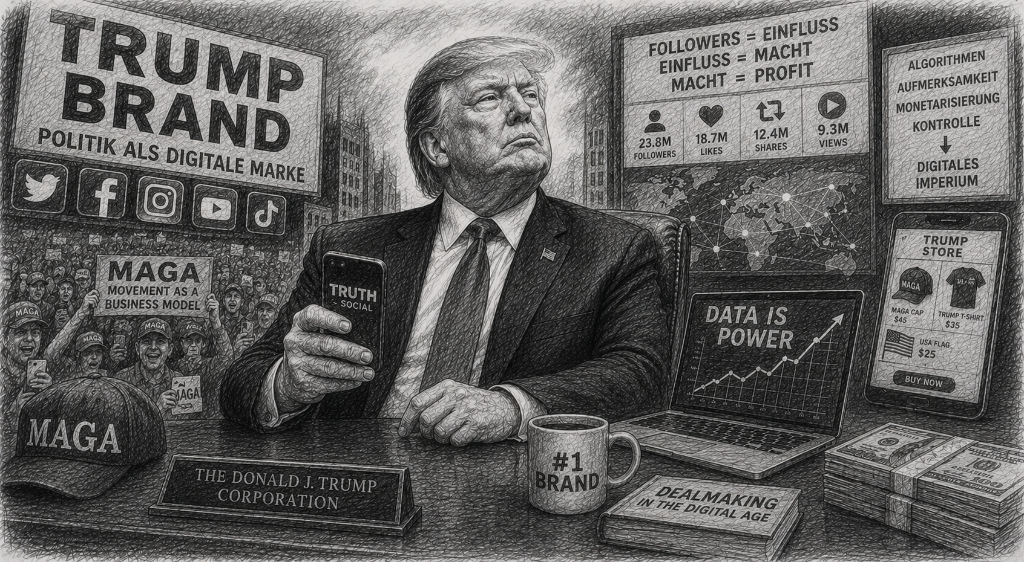
The Trump Coin as a symbol of a new era
This development became particularly visible with the so-called Trump Coin. For many observers, it was far more than just another meme coin or speculative crypto project. The coin almost seemed like a fusion of politics, pop culture and the financial market.
The decisive factor was not just the economic value. The decisive factor was the enormous amount of attention. Within a very short time, a huge amount of speculative capital flowed into the project. When a coin related to Melania Trump also emerged later on, this effect was further amplified. Large parts of the crypto market suddenly seemed empty. Capital was hectically reallocated, projects lost massive amounts of liquidity and smaller coins collapsed.
This moment in particular was irritating for many long-time crypto users. Because it suddenly became abundantly clear how much the market had become dependent on individual people, narratives and media waves. Technological visions receded into the background. Attention became the real currency.
A personal experience with the crypto market
I myself have also been intensively involved with cryptocurrencies for a while. I was less interested in making quick profits than in understanding the mechanisms behind them. I found chart analysis, market psychology, liquidity movements and collective dynamics extremely exciting. Many people learn such things in the traditional way via the stock markets. For me, it was the other way around. I first got to know this way of thinking through cryptocurrencies.
Looking back, this time was definitely valuable. The crypto scene in particular shows very clearly how modern digital markets work. Emotions, narratives, group dynamics and media attention often play a greater role there than traditional fundamental data. Anyone who spends more time with it automatically begins to look at social processes differently.
Interestingly, however, it was the Trump phase in the crypto market that led to a break for me personally. When the Trump Coin and, shortly afterwards, the Melania Coin attracted massive capital flows and practically destabilized half the market, I got the impression for the first time that the system had become too unpredictable.
Not at all because speculation would have been new. Speculation was always part of it. But something fundamental suddenly shifted here. The market no longer seemed like an experimental financial space, but increasingly like a gigantic attention machine in which individual media figures could dominate entire market movements within a very short space of time.
It was precisely at this point that I personally lost interest in cryptocurrencies to a large extent. Not for moral reasons, but because the dynamics became too unstable for me. Since then, my priorities have been more focused on other areas.
Politics as a digital brand economy
This development in particular says a lot about Trump. After all, Trump has long since ceased to act solely as a politician in the traditional sense. He increasingly functions like a global digital brand. His impact is not created solely through laws or institutions, but through resonance spaces.
Cryptocurrencies fit perfectly into this pattern. They combine speculation, a sense of community, digital mobilization and constant media attention. This is precisely where Trump is having a particularly strong impact. He doesn't need long theoretical programs. A name, a symbol or a short message is often enough to trigger enormous momentum.
This is also changing the relationship between politics and business. There used to be relatively clear dividing lines between political power, economic activity and media publicity. In digital capitalism, these levels are becoming increasingly blurred. Attention generates capital. Capital generates reach. Reach generates political influence. Trump understands these mechanisms intuitively.
The new power of perception
The actual core of this development may therefore lie deeper. Today, modern power is no longer created solely through factories, banks or traditional institutions. It is increasingly being created through perception, digital networks and emotional mobilization.
The crypto market is almost a laboratory for this. Social mechanisms often reveal themselves more quickly and visibly there than in traditional systems. Narratives can shift billions in value within a few hours. Individuals can trigger global market movements. Communities organize themselves almost in real time.
Trump fits right into this world. Perhaps even better than many traditional politicians. Because he does not think primarily in institutional terms. He thinks in terms of impact, visibility and resonance. This is precisely why he often seems surprisingly modern in the digital age, although many of his political ideas are also reminiscent of older forms of power politics.
Between freedom and instability
 The connection between Trump and cryptocurrencies ultimately reveals a wider social tension. Digital systems promise freedom, decentralization and independence. At the same time, however, they create new forms of instability, concentration and emotional controllability.
The crypto market in particular shows how strongly modern societies have become dependent on attention. Markets no longer only react to economic facts, but increasingly to perception, emotion and digital dynamics.
Trump did not invent these mechanisms. But he probably uses them better than almost any other politician of his time and has obviously learned the principle of the digital property understood, albeit in his very own way.
Current survey: What makes your life worth living?
The assassination attempts on Donald Trump and the new era of political escalation
The assassinations and attempted assassinations of Donald Trump are among the most symbolic events in recent American politics. They mark a point at which the political polarization of the United States has finally reached a new level. What was previously perceived primarily as a media or rhetorical conflict suddenly took on a physical and real dimension.
The assassination attempt in July 2024 in Butler, Pennsylvania, in particular, is etched in public memory around the world. Trump was injured in the ear during a campaign event after shots were fired at him. The fact that he survived the situation was apparently only due to a minimal head movement at the crucial moment. One spectator died and other people were injured. The images of the bleeding Trump with his fist raised went around the world within a few minutes.
It was not only the event itself that was interesting, but also the speed with which a wide variety of interpretations spread on the internet. While the initial facts were still unclear, countless speculations, political accusations and conspiracy theories were already emerging. This clearly demonstrated the extent to which modern societies are now subject to permanent digital sensory overload.
Between safety failure and statistical reality
This is precisely why the classification by Professor Christian Rieck, whose video takes a deliberately sober look at the event, was interesting. Instead of immediately committing to spectacular explanations, he describes an important psychological mechanism: people tend to interpret extremely unlikely events as planned or intentional in retrospect because the low probability of occurrence is emotionally difficult to accept.
The video thus addresses a fundamental problem of modern information societies. In highly emotionalized political times, the boundaries between analysis, speculation and projection often become blurred. Events surrounding Trump in particular quickly create a dynamic in which many people only perceive the information that fits their own world view.
However, this does not automatically mean that every critical question is unfounded. In fact, the assassination triggered considerable discussion about the failure of the Secret Service. Many observers were particularly irritated by the fact that the perpetrator was apparently able to move relatively freely on a roof in a shooting position for a long period of time. Several investigations subsequently focused on organizational errors, communication problems and security gaps.
Trump as a projection screen for a divided society
It is also interesting to note why Donald Trump triggers such an extreme emotional reaction as hardly any other Western politician. For his supporters, he embodies resistance to a system that is perceived as elitist. For his opponents, on the other hand, he symbolizes a threat to democratic institutions and social stability.
This creates an extraordinary political charge. Trump is not just seen as a politician, but as a symbolic figure for fundamental social conflicts. This automatically increases the risk of emotional escalation.
The attacks and threats are therefore less a security problem than a deeper social development. Politics is becoming increasingly emotionalized, personalized and accelerated by the media. At the same time, many people are losing trust in neutral institutions or common information bases.
Social networks in particular reinforce this effect. Today, images, headlines and short clips spread around the world within seconds. This creates permanent echo chambers in which political events are no longer processed collectively but are immediately categorized ideologically.
The almost mythical moment
Paradoxically, the assassination also had a political impact for Trump himself. The iconic images immediately after the shooting reinforced his role as a combative symbolic figure. Many supporters interpreted the scene as proof of his determination and resilience.
This almost created a historical myth within the Trump movement. Similar to other major political events, the assassination was not just perceived as a security incident, but as an emotional turning point.
This once again demonstrates the special media logic surrounding Trump. Hardly any other politician knows how to transform crises, attacks or conflicts into symbolic political energy to such an extent. Even negative events often reinforce his public impact because they further emotionally charge the existing polarization.
Between reality and digital overheating
The attacks on Donald Trump are therefore exemplary of a new phase in Western politics. Social conflicts are no longer only fought out in parliament or in the media, but are increasingly emotional, digitally accelerated and in some cases existentially charged.
This does not automatically mean that democratic systems will immediately collapse. However, it does show how fragile social cohesion can become when political camps no longer see each other as opponents within a common system, but increasingly as a threat.
This is precisely why a sober analysis of such events is more important than ever. Not every irregularity is automatically part of a conspiracy. At the same time, however, it would be just as naive to simply dismiss the growing social escalation as normal political tension.
The assassination attempts on Trump thus not only mark a dramatic episode in American domestic politics. They are symbolic of a time in which politics, media, emotions and digital dynamics are increasingly merging.

Trump assassination + the truth: a statistical error | Prof. Dr. Christian Rieck
Statistics, perception and the search for explanations
Professor Christian Rieck's video adds an interesting analytical perspective to this discussion. Instead of rash speculation, the analysis looks at statistical probability, human perception and psychological patterns. Especially in highly emotionalized political situations, there is often a desire for simple explanations for complex or shocking events. However, the video shows that rare events often seem deliberate precisely because people have difficulty emotionally accepting chance, chaos and low probabilities. The analysis thus adds another layer to the political and social aspects of the article: the question of how modern societies deal with uncertainty, information overload and permanent media escalation.
Trump in the USA system - classification instead of judgment
Donald Trump is a figure who stubbornly defies simple attributions. This is precisely the reason why this portrait was written. Not out of enthusiasm, not out of rejection, but out of a desire to classify instead of making hasty assessments.
I am not a fan of Trump. Nor do I see him as a demonic exception. Viewed soberly, he is an actor with clear strengths and equally clear weaknesses - shaped by his background, profession, media logic and a political system that has been under tension for years. If you want to understand him, you have to think about these levels together.
The outsider inside the system
Trump has never acted as a classic representative of the American state apparatus. He was and is an outsider within the system - not outside it. He used the instruments of the presidency, but constantly came up against the limits of an apparatus designed for procedure, balance and continuity.
This friction explains a lot: the conflicts with the administration, media and institutions as well as the loyalty of his supporters. Trump made it clear how much the system relies on tacit rules - and what happens when someone does not accept these rules but openly questions them.
A recurring pattern in this portrait is Trump's focus on impact. He is not seeking harmony, but resonance. Not approval at any price, but assertion. Many find this alienating, some find it invigorating. Both are understandable.
The decisive factor is that this type of politics does not emerge in a vacuum. It comes up against a society that has lost trust, institutions that have lost credibility and a media that has itself become part of the conflict. Trump is taking advantage of this situation - he did not create it alone.
A mirror of social tensions
In this sense, Trump is less a cause than a mirror. He bundles contradictions, accelerates conflicts and forces people to take a stand. Those who only assess him morally miss this point. Those who only defend him will also miss this point.
The aim of this article was therefore not to pass judgment, but to create clarity: about origins and influences, about entrepreneurial logics, about media mechanisms, about political ruptures and systemic boundaries. Not everything about it is sympathetic.
Not everything can be rejected. But everything can be explained.
Conclusion: Clarity instead of camp thinking
Perhaps the real benefit of such a portrait is not that you end up being „for“ or „against“ Trump. Rather, it is that you are less driven by buzzwords, narratives and reflexive attributions.
Politics becomes more understandable if you look at people in their context - and not as caricatures. That applies to Trump. It also applies to his opponents. And it applies to a time when simplification is often louder than explanation.
Further sources on Donald Trump
- Reuters - Trump's geopolitical brinkmanship has hit a wall with IranAnalysis of Donald Trump's escalation strategy towards Iran and how public threats, sanctions and power politics are changing the geopolitical situation.
- Reuters - Trump says framework of Iran deal largely negotiatedReport on the negotiations between the USA and Iran and on the importance of the Strait of Hormuz for energy supplies and the global economy.
- Reuters - Trump demands allies help secure Strait of HormuzBackground article on the strategic importance of the Strait of Hormuz and the international security situation in the Middle East.
- Reuters - Trump says US struck military targets on Iran's Kharg IslandReport on attacks on Iranian infrastructure and the geopolitical significance of Iranian oil exports.
- The Guardian - Trump claims peace deal with Iran largely negotiatedAnalysis of Trump's negotiations with Iran, regional mediators and the tensions between diplomacy and military pressure.
- Reuters - US vows to target more Iranian infrastructureReport on possible further American attacks against Iran and the impact on energy supply and shipping.
- Reuters - Trump vows US will retrieve uranium from IranReport on the discussion about Iranian uranium, nuclear policy and American power projection.
- Reuters - Netanyahu admits difficulty influencing Trump decisions on IranAnalysis of the tensions between Israel and the USA in connection with Iran policy.
- Reuters - Trump says willing to wait for right answer on Iran deal: Report on diplomatic talks, JD Vance and the geopolitical dynamics of the second Trump presidency.
- Reuters - Trump aides vie to affect Iran war outcomeBackground report on internal power struggles and different foreign policy strategies within the Trump camp.
- Reuters - US oil refiners win after Venezuela strikeAnalysis of the importance of Venezuelan heavy oil for American refineries and Venezuela's geopolitical role.
- Chatham House - US attacks on Venezuela and Maduro capturedInternational analysis of the geopolitical consequences of the Venezuela operation and the return of visible American power politics.
- Brookings Institution - Making sense of the US military operation in Venezuela: Background analysis on the political and strategic significance of the American intervention in Venezuela.
- Vox - Trump, Cuba and regime changeArticle about Cuba, American sanctions and the discussion about geopolitical influence in Latin America.
- Times of India - Why Trump's Venezuela playbook may fail in Cuba: Analysis of the differences between Venezuela and Cuba and the geopolitical challenges of American foreign policy.
- Arxiv - The First Crypto PresidentScientific investigation into the connection between Donald Trump, cryptocurrencies, political power and the digital attention economy.
- Forbes - Trump Coin and Melania Token market impactReport on the impact of Trump Coin and Melania Coin on crypto markets and digital capital flows.
- Arxiv - Bots, Disinformation and the First Trump ImpeachmentScientific analysis of bots, social media and digital manipulation in Donald Trump's environment.
- Reuters - Trump accuses Iran of using AI to spread disinformation: Report on information warfare, artificial intelligence and digital propaganda in geopolitical conflict.
- Monitor - How the Trumps are making billions from the presidencyGerman TV documentary about economic interests, cryptocurrencies and political power structures in Donald Trump's environment.
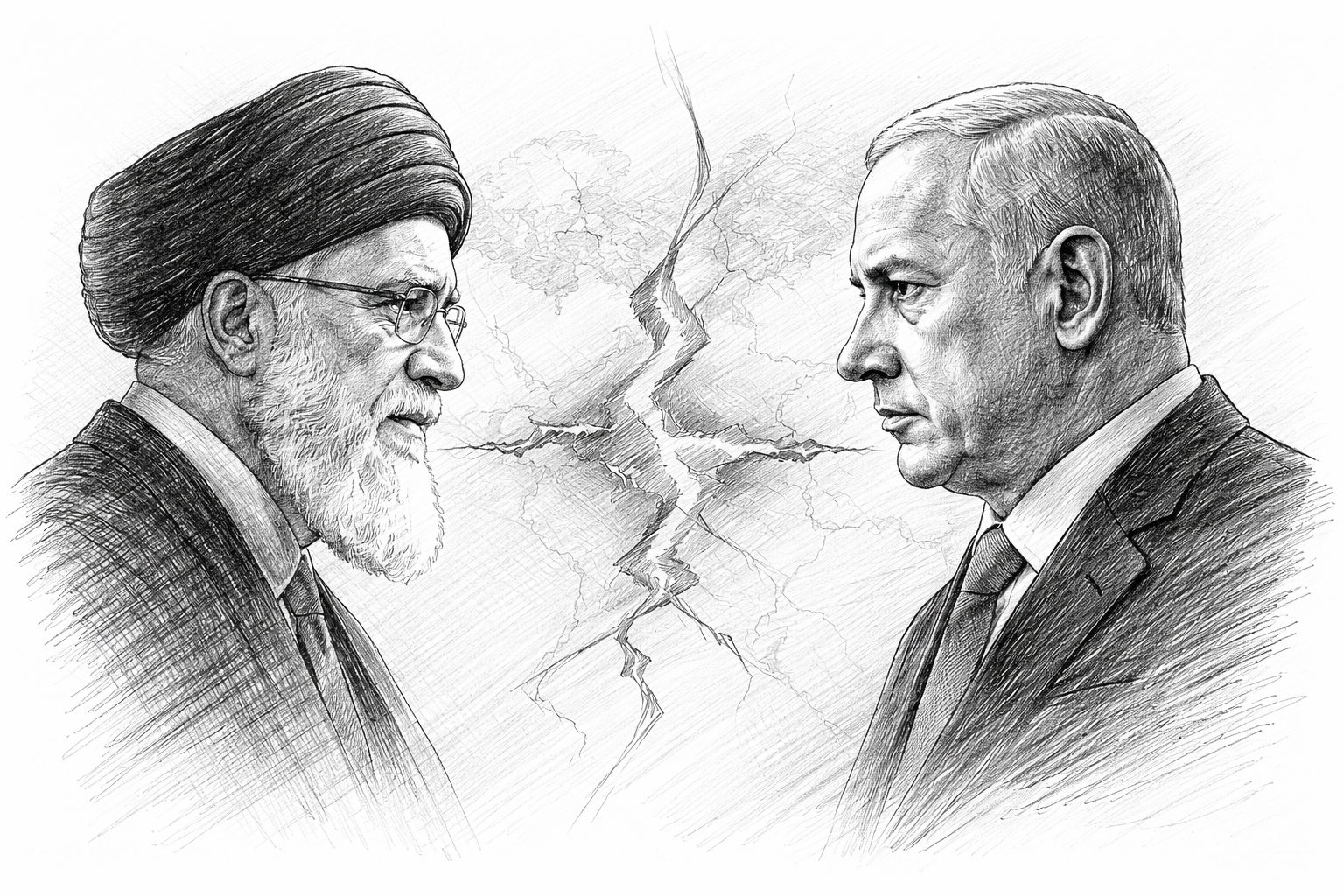

Frequently asked questions
- What was the aim of this article about Donald Trump?
The aim of this article was to categorize Donald Trump as a person and political figure without pigeonholing him. It was not about generating approval or reinforcing disapproval, but about presenting his origins, character, actions and impact in a comprehensible way. The text is intended as a classic portrait, not as a commentary or pamphlet. - Is this article a defense of Donald Trump?
No. The article is not a defense, but a classification. Points of criticism are clearly named, as are problematic aspects of his actions. At the same time, it avoids reducing Trump to individual narratives or moral labels. The aim is to understand, not justify. - Is the author a Trump supporter?
No. The author expressly does not position himself as a fan. The view of Trump is distanced, analytical and deliberately free of enthusiasm or rejection. The text follows the attitude that political figures can be better understood if they are not emotionally exaggerated or demonized. - Why is Trump often described as an outsider, even though he was president?
Trump is described as an outsider because he was never part of the traditional political career path and deliberately went against many of the unwritten rules of the political establishment. He acted within the system, but openly questioned its logic, which made him a foreign body even in office. - What role does Trump's background play in his later behavior?
His background from a wealthy, achievement-oriented entrepreneurial household shaped his thinking early on. Success, status, assertion and visibility were core values. This imprint explains why Trump often treats politics like a business and prioritizes public impact over institutional harmony. - Why is Trump's media strategy covered in such detail in the article?
Because Trump's political effectiveness cannot be understood without his relationship to the media. Provocation, exaggeration and permanent presence are not side effects, but central tools of his actions. The article shows how media logic and political power are intertwined in Trump's case. - Is Trump really as unpredictable as he is often portrayed?
Trump often appears unpredictable, but follows his own logic. This is less ideological than strategic and media-based. His behavior appears chaotic when measured by traditional political standards, but is often consistent when understood as a strategy for power and attention. - Why is Trump often associated with authoritarian tendencies?
These accusations arise primarily from his harsh rhetoric, his conflicts with institutions and his heavy use of executive power. However, the article shows that despite these tendencies, Trump acted within existing constitutional boundaries and remained institutionally contained. - Has Trump tried to abolish democracy?
There is no reliable evidence for this assertion. Elections were held, courts continued to work, changes of power were institutionally implemented. The article makes a clear distinction between sharp criticism of the system and actual dismantling of the system. - What significance did the first presidency have for the US political system?
The first term of office was characterized less by consistent policy than by a break in style. It revealed how strongly the political system relies on conventions and how it reacts when these conventions are disregarded. The effect was polarization, but also increased visibility of structural problems. - Why did Trump remain politically relevant after his first term in office?
Trump did not see the end of his term of office as a retreat, but as a phase of reorganization. Through media presence, legal conflicts and a loyal following, he remained a political factor. This interim phase was decisive for his later return. - What role do legal proceedings play in Trump's public image?
Legal proceedings have become political symbols. Critics see them as evidence of misconduct, supporters as political persecution. The article shows that these proceedings further reinforced Trump's role as an outsider, regardless of their outcome. - What distinguishes the second presidency from the first?
The second term is less experimental and more focused on enforcement. Trump acts more decisively, tests institutional boundaries in a more targeted manner and focuses more on speed. The style remains the same, the experience is greater. - Why is the meeting with Putin in Alaska mentioned in the article?
The meeting serves as an example of Trump's unconventional diplomacy. The location, the staging and the direct conduct of the talks illustrate his approach of pursuing foreign policy as a visible policy of interests rather than classic background diplomacy. - What role does the so-called „Deep State“ play in this article?
The term is not presented as a conspiracy, but as a political term of struggle. The article explains that it describes real tensions between elected politics and permanent administration, without implying a secret control center. - Is Trump the cause of the social divide in the USA?
The article concludes that Trump is more of an amplifier than a cause. Many conflicts and losses of trust already existed before him. Trump made them more visible and sharper, but he did not create them alone. - Why does the article refrain from making a clear judgment about Trump?
Because a conclusive moral judgment often conceals more than it explains. The aim was to reveal connections and allow the reader to make their own informed assessment. A portrait should help to understand, not patronize. - What can the reader take away from this article?
Ideally, greater clarity in dealing with Trump-related debates. Those who recognize mechanisms are less susceptible to simplifications, outrage loops and narratives that reduce complex reality to buzzwords. - Why is categorization more important than approval or rejection?
Classification enables distance. It allows us to take a sober look at political figures without getting emotionally involved. Especially in polarized times, this is a gain in mental agility. - Why are readers invited to join the discussion at the end?
Because political classification is not a closed process. Different perspectives, formulated objectively, broaden the view. The article is intended as a contribution to a calm, respectful exchange - not as the last word. - Why is Iran suddenly playing such a central role in Trump's second presidency?
The conflict with Iran combines several levels at the same time: geopolitics, energy supply, deterrence, international power relations and domestic political impact. Trump is using the Iran conflict not only for foreign policy purposes, but also symbolically. He is demonstrating strength, the ability to act and the claim to represent American interests proactively. At the same time, the conflict shows how different his second presidency is from his first: less experimental, but much more determined and geopolitically tougher. - Why is Trump's foreign policy described in the article as „visible power politics“?
Because Trump conveys political strength not primarily through diplomatic restraint, but through public demonstration. Military threats, sanctions, direct statements and media-effective meetings are deliberately part of his strategy. His foreign policy does not just take place behind closed doors, but is staged visibly. This is partly reminiscent of older geopolitical eras in which the projection of power was shown openly instead of being concealed through communication. - What role do raw materials and energy policy play in the Venezuela conflict?
Venezuela has the largest known oil reserves in the world. At the same time, many American refineries are technically designed for heavy Venezuelan crude oil. This creates a strategic link between American energy policy and Venezuelan resources. The article shows that Venezuela is therefore not just about democracy or stability, but also about energy supply, geopolitical influence and economic interests. - Why is Venezuela considered a geopolitical turning point in the article?
Because the operation against Maduro created the international impression that the USA is once again more willing to exert direct political influence in a visible manner. Many observers saw this as a return of classic power politics. However, the article does not argue morally, but describes the structural change: away from purely indirect pressure and towards openly recognizable geopolitical control. - What does the article mean by „regime change“?
The term describes attempts to deliberately change the political balance of power in other states or replace existing governments. The article does not use the term in a conspiracy theory sense, but as a geopolitical observation. Particularly in the case of Venezuela, Iran and to some extent Cuba, there has recently been an open international discussion as to whether the USA is actively supporting or preparing political realignments under Trump. - Why is Cuba suddenly geopolitically relevant again?
Cuba was long regarded as a largely frozen conflict between the USA and Latin America. Under Trump, however, sanctions, economic pressure and energy policy measures have intensified significantly. At the same time, Cuba is increasingly being viewed alongside Venezuela and Iran. The article therefore describes Cuba as part of a larger geopolitical strategy in which economic pressure and political influence are becoming more closely linked. - What role does J. D. Vance play in this development?
Within the Republican camp, J. D. Vance tends to stand for the original „America First“ idea: restraint in military interventions and a focus on domestic political stability. This creates a tension within the conservative spectrum. While Trump is pursuing increasingly visible power politics in foreign policy, voices such as Vance are sometimes warning of new international permanent conflicts. The article deliberately addresses this tension. - Why does the article deal in detail with cryptocurrencies and the Trump Coin?
Because cryptocurrencies today are far more than just financial products. They combine digital publicity, speculation, group dynamics and attention. It is precisely these mechanisms that fit in well with Trump's political style. The article shows that Trump is not just a politician, but increasingly also functions as a digital brand. The Trump Coin is seen as a symbol of a new form of digital power and attention economy. - Why does the author describe his own experiences with cryptocurrencies?
The personal anecdote is not intended to emotionally charge the article, but to make social mechanisms more tangible. The author describes how he learned about market psychology, chart analysis and digital dynamics through cryptocurrencies. At the same time, the experience of the Trump Coin shows how strongly modern markets can now be influenced by the media attention of individuals. This makes an abstract topic more comprehensible.