There is a lot of talk about war. In the news, talk shows, commentaries, social media. Hardly any other topic is so present - and at the same time so strangely abstract. Figures, maps, frontlines, expert assessments. We know where something is happening, who is involved and what is at stake. What is almost completely missing are the voices of those who have experienced war rather than declared it.
Perhaps it is because these voices are slowly falling silent. But perhaps it is also because we have forgotten how to listen to them.


War as an experience - not as an opinion
Today, war is often a topic of discourse. People position themselves, classify, evaluate, express outrage or relativize. All of this happens with a matter-of-factness that is irritating when juxtaposed with the stories of those who were actually there. People who were not asked whether they wanted to take part. People for whom war was not an argument, but a condition.
My grandfathers belonged to this generation. They didn't „talk about the war“, they talked about it - sometimes casually, sometimes haltingly, sometimes in sentences that you couldn't really understand as a child. They weren't big speeches. More like splinters. Scenes. Observations. And that's precisely why they had a long-lasting effect.
The inspiration for this text
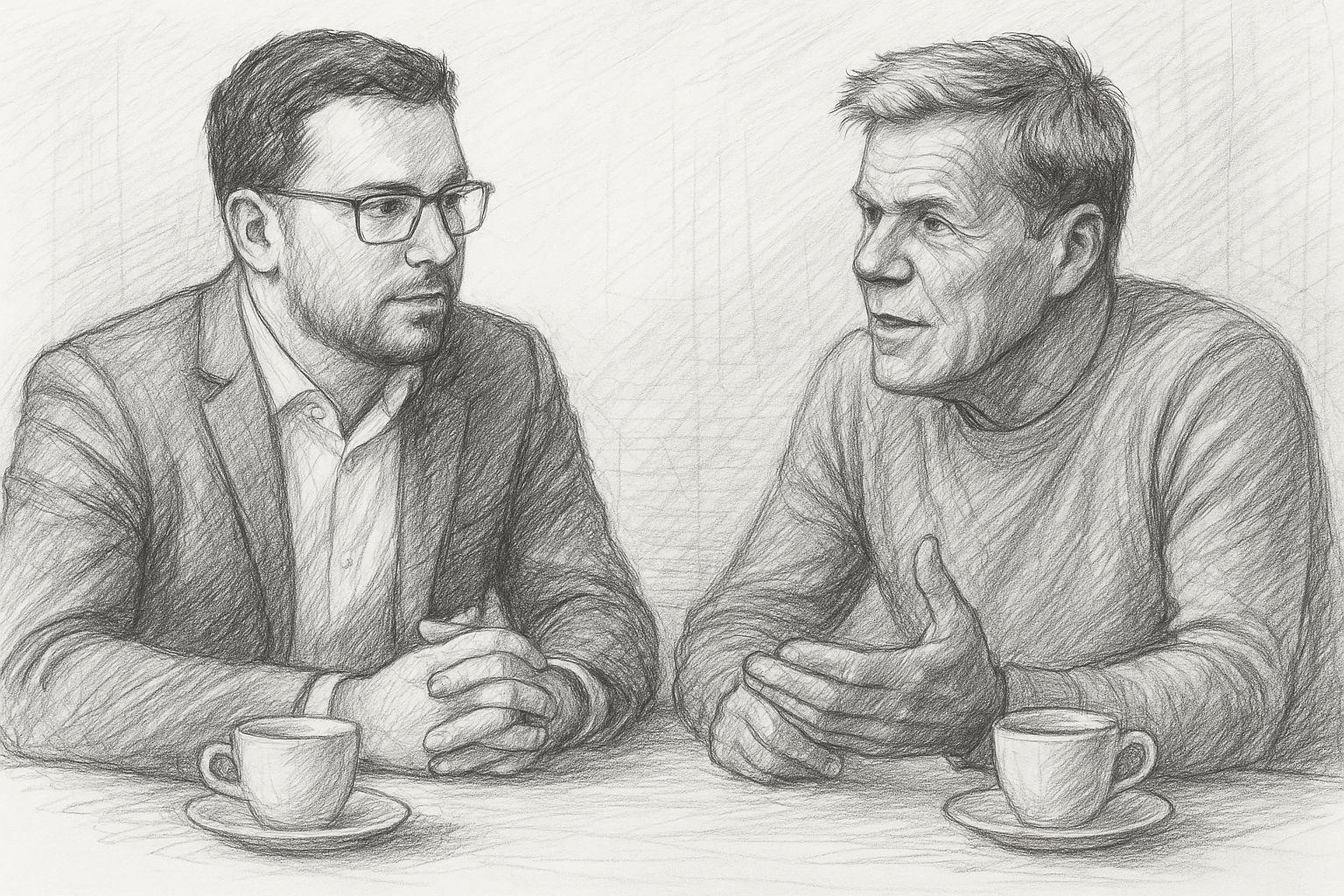
The actual impetus for this article came not from a book or a historical documentary, but from a short, casual sentence by Harald Schmidt. In a recent interview, he said that there was perhaps something missing in today's world: the grandmas and grandpas who were still in the war and could talk about it.

Harald Schmidt with Monika Gruber: War & media hysteria | The Gruabian
That was not a pathetic sentence. Rather a sober observation. And that's exactly why it struck a nerve. Because the longer you think about it, the clearer it becomes: With the disappearance of this generation, not only contemporary history disappears, but also a very specific way of speaking about violence, responsibility and dignity.
Tell instead of explain
What characterized these stories was their restraint. My grandfathers rarely judged. They didn't explain why something was right or wrong. They described what happened - and sometimes what it did to them. Often decades later, sometimes only indirectly.
This makes these stories fundamentally different from today's war debates. There, it's all about sovereignty of interpretation, narratives and moral superiority. With the grandpas, it was about memories that you couldn't get rid of - and about experiences that couldn't be made sense of.
A generation without a choice
Both grandfathers were soldiers. Not because they wanted to, but because there was no alternative. Emergency A-levels, conscription, service. This was not an individual decision, but part of a time in which biographies were determined from the outside. Those who apply moral standards today in retrospect often fail to recognize this historical framework.
That does not mean an apology. But it does mean context. And context is a prerequisite for any serious understanding.
Why these stories are hard to bear today
Perhaps this generation is missing not only because it has grown old and died. Perhaps they are also missing because their stories are uncomfortable. They don't fit into clear camps. They are not easy to instrumentalize. They contradict simple narratives of good and evil, perpetrators and victims, right and wrong.
- A grandpa who deliberately shoots past.
- Another who gives an order - and decades later recognizes a hole in the church tower.
- A musician who remains human with a flute, where humanity actually has no place.
Such stories demand something other than approval or rejection. They demand listening.
Memory as responsibility
It used to be a matter of course that these stories were passed on. At the kitchen table, on a walk, in the living room in the evening. Not systematically, not planned - but present. Today, we like to delegate remembrance to museums, memorial days and documentaries. That is important. But it is no substitute for passing it on personally.
This article is not a historical contribution in the strict sense. It is an attempt to capture something that would otherwise be lost: the quiet, contradictory, sometimes difficult to bear stories of two men who carried their duties - and carried the traces of them with them throughout their lives.
No accusation, no appeal
What follows is neither an indictment nor a reckoning. Nor is it a political commentary. It is a collection of memories as they were told. Incomplete, subjective, sometimes fragmentary. But therein lies their truth.
Perhaps there is something in these stories that is actually missing in our time: a humility before the reality of war. And a distrust of overly quick judgments.
That is what this text is about.
Current survey on trust in politics and the media
Two grandfathers, a generation without a choice
When people talk about war today, there is almost always an implicit question: Why did we take part in it?
This question is understandable - but it is often asked incorrectly. It presupposes a freedom of choice that did not exist for my grandparents' generation.
Both were soldiers. Not out of conviction, not out of a thirst for adventure, not out of political zeal. But because they were meant to be. One with an emergency school-leaving certificate, the other via the normal conscription route. Life had no plans to branch off at this point.
Duty as a normal state
For this generation, duty was not a big word. It was a condition. Something you didn't constantly question, but accepted - just like you accept the weather or a bad harvest. You could complain about it, you could try to escape it inwardly, but you could hardly escape it.
Today, people like to look back and ask why they didn't just say „no“. This question sounds logical, but it reveals one thing above all: a lack of feeling for the reality of the time. A „no“ was not simply a decision, but a break with everything - family, environment, survival. Anyone who overlooks this from a safe distance today is confusing courage with anachronism.
No heroes, no monsters
My grandfathers weren't heroes. But they weren't monsters either. They were people in a historical situation that we can hardly imagine today - and perhaps no longer want to imagine.
What they said was never heroic. It wasn't about victories, awards or strategic cleverness. It was about cold, hunger, fear, waiting. It was about situations in which you had to function because thinking was dangerous. And about decisions that had less to do with morality than with survival.
It is precisely this sobriety that distinguishes her stories from many later interpretations of the war.
The silence between the stories
What was striking was not only what was told, but also what was not. There were often long pauses between the anecdotes. Topics that were never touched on. Questions that you sensed as a child, but didn't ask. Not out of fear, but out of an instinctive respect.
This silence was not repression in the classic sense. Rather a form of self-protection - and perhaps also of consideration for the listeners. After all, those who tell stories not only pass on their own memories, but also place a burden in the hands of others.
War as a biographical turning point
For both grandfathers, the war was not a closed chapter that they simply closed when they returned home. It was a turning point that shaped the rest of their lives - sometimes visibly, sometimes subtly.
Career choice, family life, dealing with conflicts, even the body: many things only took on a different meaning in retrospect. Not everything could be clearly assigned. But the experience of war was always there, like a quiet undertone.
Perhaps this is one of the biggest misconceptions of modern depictions of war: the assumption that war ends with the last shot. For those affected, the long, unspectacular part often begins afterwards - the continuation of life.
Historical distance and moral shortcuts
It is tempting to make clear judgments from today's perspective. The moral coordinates seem clear, the historical facts accessible. But this clarity often only arises through temporal distance. Those in the midst of events do not have it.
My grandfathers never tried to justify their time. But they also didn't allow people to judge them too hastily. Their stories were not defense papers. They were accounts of their experiences.
And perhaps this is precisely their strength: they do not demand approval, but attention.
Generational differences in thinking
The difference in dealing with guilt and responsibility is also striking. While today's debates tend to clearly personalize both, the thinking of the war generation was often more systemic - without knowing this word.
You were part of an apparatus. This did not absolve you of responsibility, but it changed the shape of it. Responsibility was not discussed, it was borne. Sometimes quietly, sometimes for a lifetime.
From today's perspective, this attitude seems strange. Perhaps even irritating. But it explains why many of these people did not speak out loud about their past - and why their few stories were all the more important.
Looking forwards, not backwards
Both grandfathers were pragmatic in their own way after the war. It was about rebuilding, starting families, finding work, establishing normality. The past was not suppressed, but neither was it made the center of life.
This does not mean that there were no internal struggles. But they were rarely externalized. Perhaps because people believed that life owed them no compensation. Perhaps also because you had learned to live with the unfinished.
A generation that is disappearing
With the death of this generation, not only does personal memory disappear, but also a certain attitude towards life. An attitude that was based less on explanation than on experience. Less on judgment than on acceptance.
This chapter is not intended to create a myth. It is intended to capture something that would otherwise be lost: the context in which the following stories take place. Two lives shaped by a time in which choices were limited - and in which decisions were often only recognized as such in retrospect.
From here, the individual stories can be better understood. Not as individual cases, but as an expression of a generation that has learned to live with uncertainty - and the consequences.
The grandpa who shot past on purpose
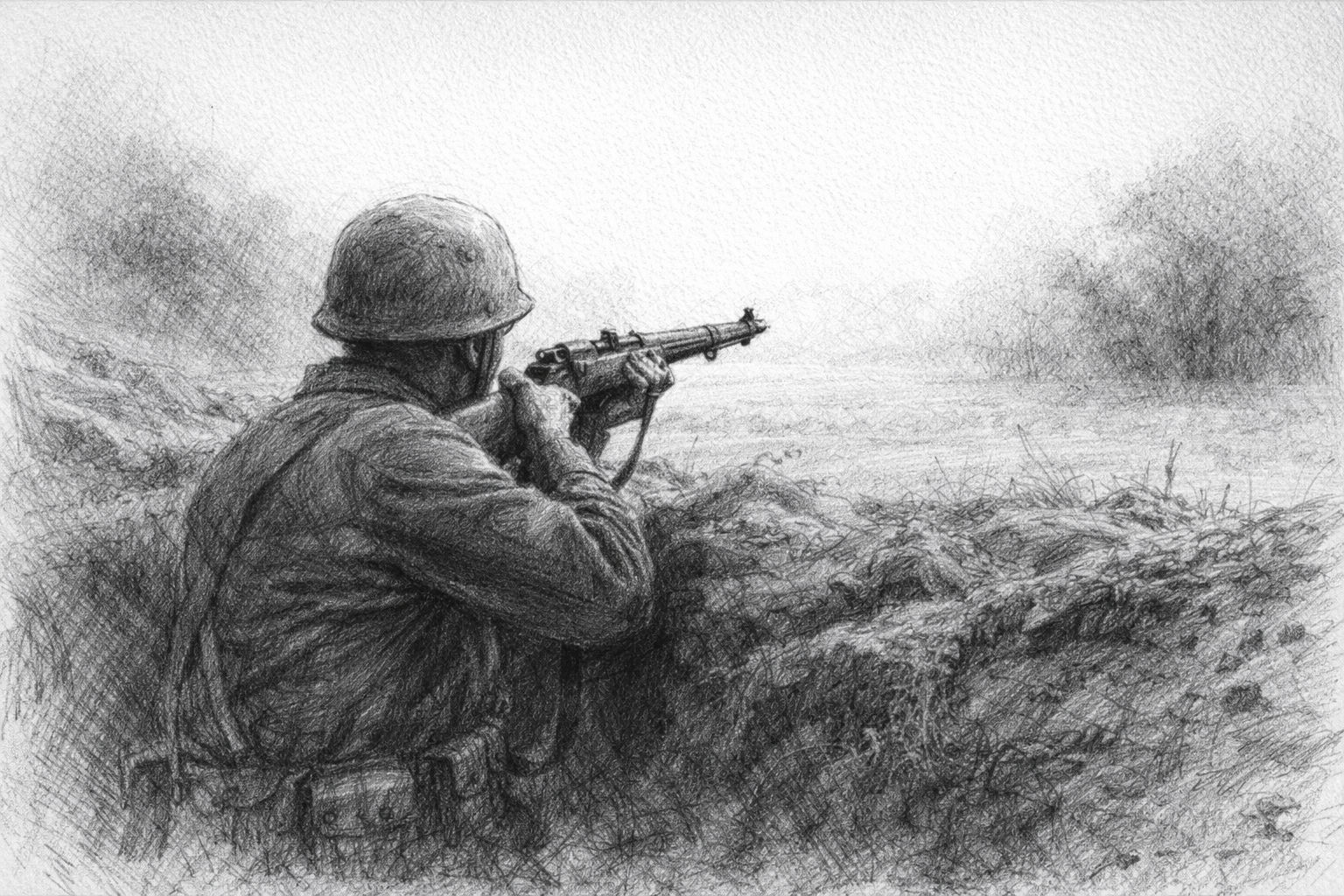
There are stories that cannot be told aloud. Not because they are spectacular, but because they touch on an inner decision that can hardly be explained. The story of my grandfather is one of them. He was at the front, somewhere in the East, in the trenches. And he told me that he deliberately shot over people as often as he could.
Not next to it. Not away. But consciously above it.
No big scene, no gesture
He never told this story dramatically. No pathos, no trembling in his voice. It was more of a matter-of-fact sentence, almost casual, like saying it was raining or cold. It was precisely this sobriety that made it so impressive.
He did not say: I was brave.
He did not say: I put up resistance.
He just said: I didn't want to kill anyone.
That is a simple sentence. And at the same time an incredibly difficult one.
Decision under duress
What is often overlooked: This decision was not made in a moral vacuum. It was made in the middle of the war system. In a situation in which obedience was expected, in which functioning was essential for survival and in which deviation could be dangerous.
It was not a decision against the war. It was a decision in the war. And that is precisely where its significance lies. He did not evade killing by fleeing or refusing - both of which were hardly possible - but by a minimal shift in his actions. He fulfilled the outer form and withdrew the inner core.
Dignity on a small scale
Today, dignity is often associated with grand gestures. With public stances, with clear commitments. There is no room for this in war. Dignity is not shown in the big picture, but in the small. In decisions that no one sees. In actions that have no witnesses.
Shooting over someone is not a heroic act. It is not a sign of strength. It is a silent form of resistance - if you want to use that word at all. Perhaps it is more appropriate to speak of self-assertion.
He remained with himself, where everything was designed to dissolve the individual.
The question of guilt
Of course, the question of guilt arises in retrospect. Could he have done more? Should he have acted differently? These questions are understandable - but they are often unfruitful.
Because they presuppose that there would have been a clear, unambiguous alternative. An option that would not have had any consequences. This assumption is convenient, but wrong.
My grandpa didn't claim to be innocent. Nor did he try to whitewash himself. He simply told me where his line was - and that he hadn't crossed it.
The inner border
This boundary was not negotiable. It was not the result of long deliberation, but an inner certainty. Something that you may not be able to justify, but you can still feel it.
This is precisely what distinguishes this story from later moral constructions. It is not theoretical. It is existential. It does not ask questions: What is right?
But rather: What can I agree with myself?
This question does not only arise in war. But it becomes radical in war.
No judgment of others
What he did not say is also important. He never judged other soldiers. Never claimed that they had acted wrongly. Never established a hierarchy of morality.
He didn't tell his story to stand out, but to communicate something. Perhaps also to get something off his chest. But certainly not to put himself above others.
This is what gives this story its credibility. It is not a moral statement. It is a personal account.
Late findings
As a child, I heard this story without really understanding it. It sounded strange, almost contradictory. It was only much later that I realized how much there was in this one sentence.
Not killing where killing is expected is not a matter of course. It is a conscious deviation. And it comes at a cost. Perhaps not immediately, but in the long term. Because those who resist inwardly carry this tension with them. It does not simply dissolve.
Connection to later life
Looking back, this decision seems like an early marker. A point at which something was established. Not as a heroic story, but as an inner line that was not later crossed.
Perhaps this also explains why the war was not simply over for him when it officially ended. Decisions made under extreme pressure leave their mark. Even if they seem „right“.
Or just then.
Killing and dignity
This story touches on a question that is not limited to war: the question of human dignity - even in our own actions. Killing is an irreversible act. It not only changes the lives of others, but also one's own. In another article, I therefore pose the simple question: Is killing undignified?
My grandpa drew this line for himself. In silence. Without an audience. Without protection. The fact that he talked about it is perhaps the real act of passing it on. Not as a role model, not as a benchmark. But as an invitation to reflect.
A quiet form of attitude
At a time when moral positions are often advocated loudly, this story seems almost alien. It gets by without buzzwords. Without an appeal. Without demands. It shows that attitude is not always visible. That it sometimes manifests itself in a minimal movement - in the raising of a gun barrel by a few degrees.
That was all it was. And that's all it needed.
The flautist in captivity - music as a lifeline
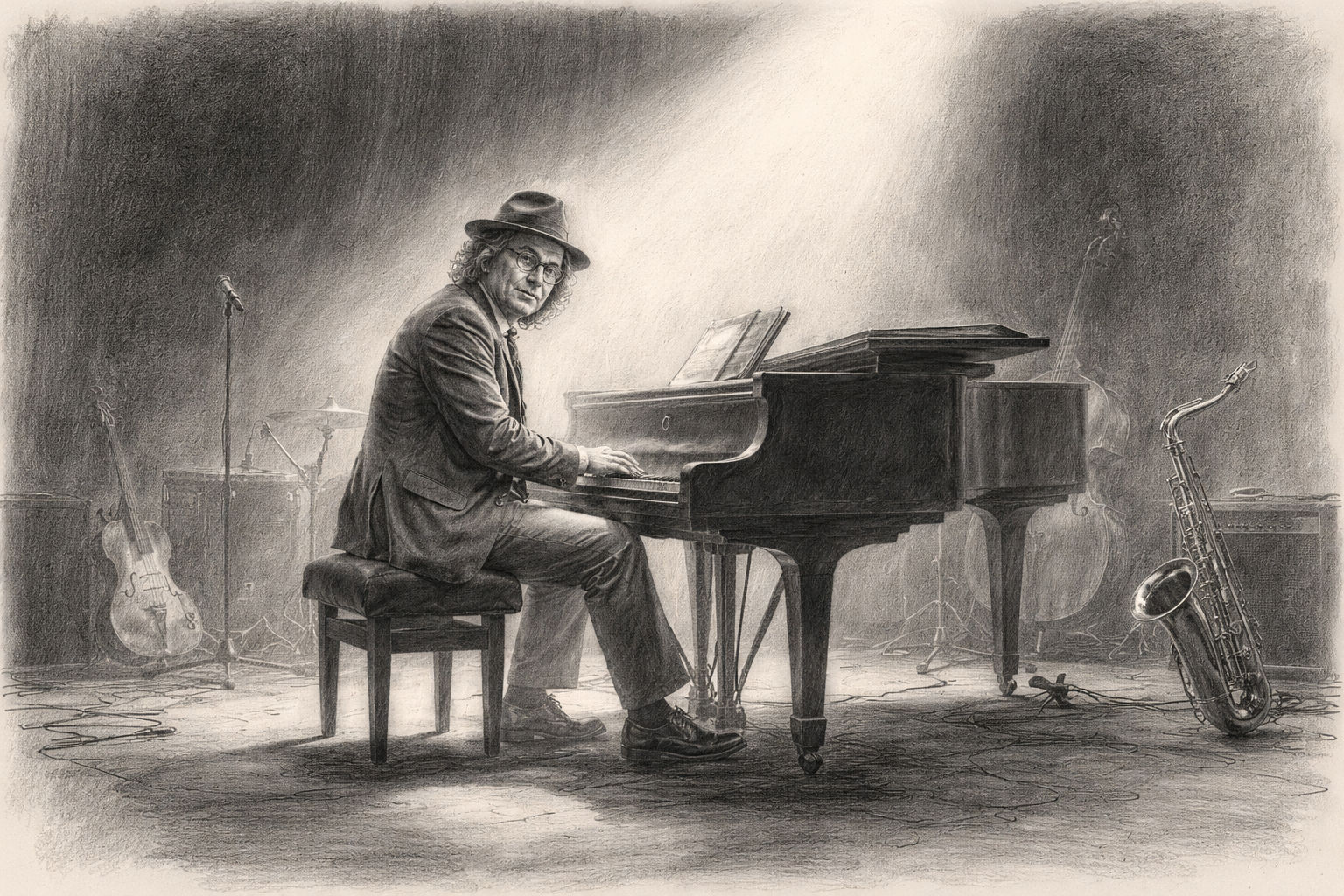
The grandpa I'm talking about was a musician from a very early age. At the time, he wasn't a professional musician in today's sense, not a virtuoso for the big stages. But he was someone for whom music was not a hobby, but part of his identity. He played the flute, and this instrument was more than just an object. It was his „sweetheart“, as he called it. Something that accompanied him, that kept him organized, that kept him with him. After the war, he became a solo flutist in a medium-sized German theater and delighted audiences with his music for many decades.
Perhaps it is no coincidence that this story is particularly moving. It is not about fighting, not about command and obedience, but about the attempt to remain human when everything was designed to break people.
Giving up what is most valuable
When he was captured by the Russians and deported, he knew one thing for sure: he could not lose this flute. Everything else was replaceable. Clothes, luggage, even personal belongings. But not this instrument.
That he was able to save it at all borders on the improbable. On the train, somewhere on the journey east, he didn't smuggle the flute under his clothes or in his luggage - instead, he took the opportunity to place it on the roof of the carriage. He pushed it up through a window in the hope that it would stay there.
This is not a heroic story. This is an act of desperation - and trust at the same time. He literally gave up the most valuable thing he had. And hoped that it would find him again in the end.
The fact that the flute was actually still there when the train arrived is almost beside the point. What is more important is that he tried.
Captivity and loss of role
In captivity, he was initially what everyone else was: Prisoner. Number. Part of a mass. His own biography no longer played a role. Origin, education, abilities - everything was leveled.
„ты музыкант - ты симулянт“
the Russians are said to have said to him at first - which means something like:
„You're a musician? You're a malingerer!“
And yet something remained. The flute was there. And with it the memory that he was more than what had been made of him.
At some point, he began to play. Not publicly, not demonstratively. Probably more for himself, maybe for a few others. Music as a retreat. As an inner space. As a quiet resistance to silence.
The fear of loss
The fact that this flute playing was noticed was not good news at first. When a Russian soldier heard about it and approached him, his first reaction was fear. Not abstract fear, but concrete fear:
Now the flute is gone.
Now I've shown too much.
Now comes the punishment.
This reaction is understandable. In a system based on control, any deviation is risky. Art, music, individuality - it all seems suspicious there.
When the soldier took him away, this fear intensified. And when it became clear that he was going to the captain, it seemed to be confirmed. More power, more danger, more unpredictability.
„Play something“
The moment when the captain asked him to play something marks a turning point. Not loud, not dramatic. But fundamental. Something happened here that is rare in war: a man was not judged by his function, but by what he could do - and who he was. Not as a soldier, not as a prisoner, but as a musician.
What he played is ultimately unimportant. What matters is that he played. That he had the courage not to fall silent in this situation. That he didn't make himself smaller than he had already been made.

Man recognizes man
The captain listened. That is not a matter of course. Listening is an exception in war. It means leaving your role for a moment, giving up your distance, allowing yourself to be touched.
What happened next was never greatly embellished. No pathos, no exaggeration. But the consequence was clear: Grandpa was not punished. On the contrary. He was protected. Favored. Made a „darling“, as he himself called it - a word that sounds almost absurd in this context. From then on, he was supposed to play music more often, which he did.
It is important not to misunderstand this scene. It is not a glorification of imprisonment. It is not proof of humanity in the system. It is an exception, and that is precisely why it is so impressive.
Music as a bridge
What was at work here was not nationality, not ideology, not power. It was music. Something that exists beyond commands. Something that doesn't need to be translated. Later, my grandpa even said that this time was one of the best of his life - as absurd as that may sound.
At that moment, the music bridged a front line. Not permanent, not political, but real. For a moment, two people were not opponents, but listeners and players. One day my grandfather told me that many of the Russian soldiers and the captain were even a little sad when my grandfather was released from captivity and returned to Germany, because that meant the music stopped.
It didn't save the war. But it may have saved a life.
No great morale
My grandfather never told this story as proof of the good in people. He told it because it remained incomprehensible to him. Because it showed how thin the line is between losing and preserving one's own dignity.
He has learned no lesson from this. No demand. No message formulated. The story stood for itself. And it worked - precisely for that reason.
Reverberations to this day
This episode has left a deep impression. Not only for him, but also for those who heard it. Perhaps because it shows how fragile humanity is - and how effective it can be at the same time.
The fact that this story is still moving decades later is not a sign of sentimentality. It is a sign that it touches on something that is timeless: the question of what we are left with when everything else is taken away.
Culture as the last stop
Weapons, marches and orders appear in many war reports. But rarely instruments. And yet it is often precisely these seemingly insignificant things that make the difference. A book. A song. A melody.
For my grandpa, it was the flute. It didn't free him from captivity. But she kept him with her. And that is perhaps the greater achievement.
Looking back, this story seems like a turning point - not in the external course of the war, but in the inner experience. It showed that even in a system of coercion, spaces can exist in which something else applies.
Not always. Not for everyone. But sometimes. And perhaps this „sometimes“ is enough to sustain a life.
This chapter stands between the trenches and captivity, between violence and survival. It shows a different form of resistance: not against the enemy, but against the reduction of people to their role. And that is precisely why it belongs in this story.
Voices that remain - 100-year-old eyewitnesses about the Second World War
In an extraordinary peace project, Daniel Pleunik spent a year interviewing more than twenty 100-year-old witnesses to the Second World War. In chronological order, these very old people describe how they experienced the war - and what they believe is necessary today to prevent history from repeating itself. The result is an impressive contemporary witness document to mark the 80th anniversary of the end of the war.

100-year-old eyewitnesses talk about the Second World War | Daniel Pleunik
This project was only possible thanks to the trust of the families behind each individual contemporary witness. Special thanks go to them, as this valuable document could not have been created without their consent. The interviews were conducted parallel to Pleunik's work as a qualified health and nursing professional - driven by a clear desire to make a personal contribution to peace.
Chance, luck and guilt - the story in the tree
Some stories are difficult to categorize because they undermine any familiar logic. They fit neither the pattern of bravery nor that of guilt. The story of the tree is one of them. It comes from the other grandfather - the one who remained unclear about what he did and didn't do during the war. It is precisely this lack of clarity that makes the story so disturbing.
It's a story about chance. And about what it means to survive without having achieved anything.
A branch above the void
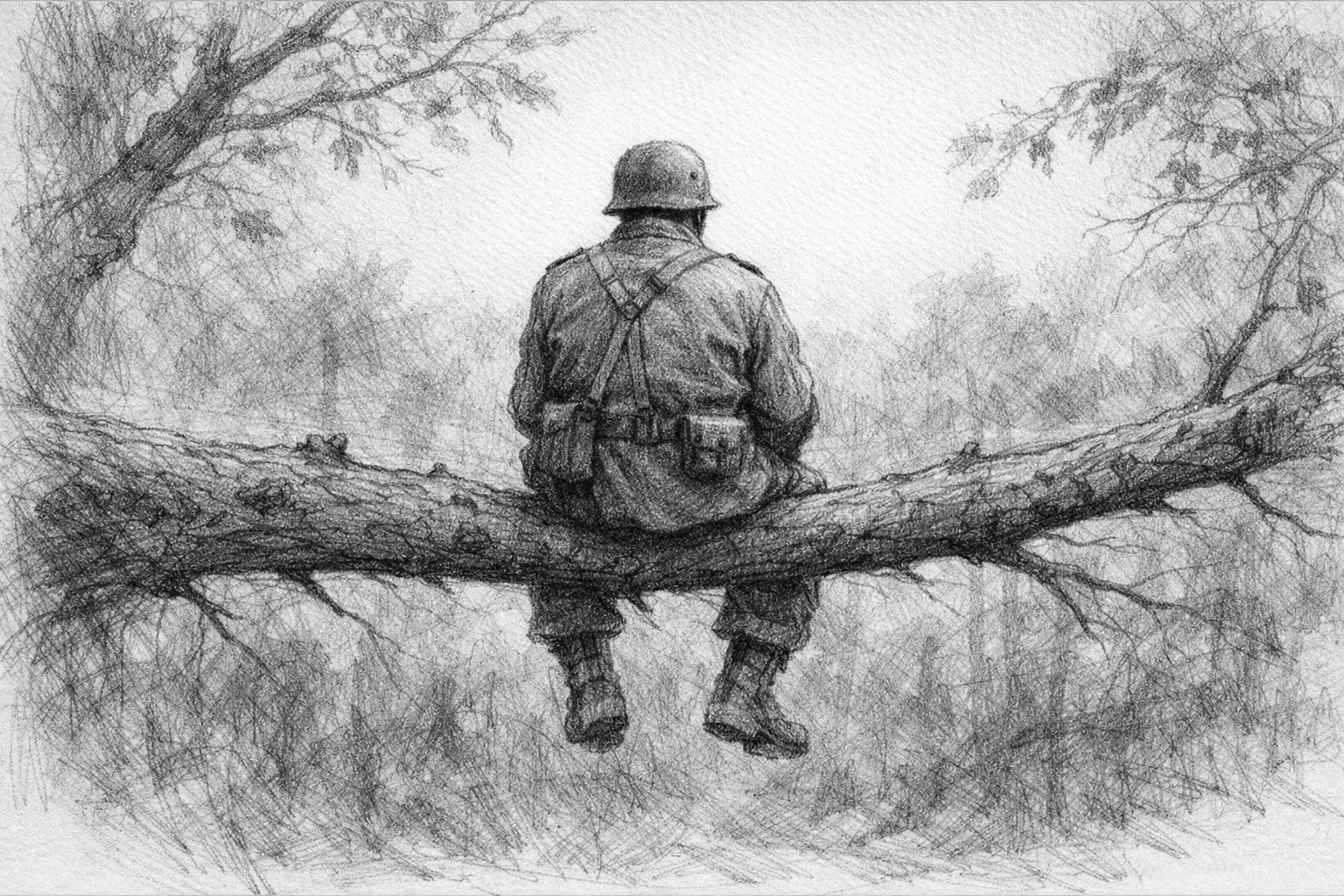
He said that the three of them were sitting in a tree. Not up in the crown, but on a sturdy branch, somewhere elevated, with a view over the terrain. Observation posts, one would say today. Back then, it was simply a position you were assigned.
They did not sit there in silence. On the contrary. They told each other jokes. Black humor, flat jokes, silliness - anything that helped them endure the tension. Gunshots could be heard between sentences. Sometimes closer, sometimes further away. It wasn't a state of emergency, but background noise.
This mixture of mortal danger and ordinariness seems absurd from today's perspective. For them, it was normal.
Humor as a survival strategy
Humor was not a sign of recklessness. It was a form of self-regulation. If you laughed, you could forget where you were for a moment. Those who laughed kept their distance from the fact that every moment could be their last.
My grandpa told this scene without irony. It was just what you did. Talk, laugh, endure.
He told a joke. Not a particularly good one, as he said later. But he told it the way people tell stories to fill the silence. During the joke, there was a volley of shots. Nothing unusual. You ducked down, ducked your head, waited. Routine.
When the joke was over, there was no reaction. No laughter, no comment, no groan. Instead, the two other soldiers fell off the branch. Just like that. Dead.
This moment is difficult to describe, precisely because it is so abrupt. No build-up, no dramaturgy. Life and death lie side by side, separated by seconds - and by chance.
Staying behind alone
Suddenly he was sitting alone on the branch. Alive, unharmed, functioning. He had done nothing differently from the others. He hadn't looked for better cover, hadn't made a smarter decision. He had simply continued to sit and talk.
Why he survived could not be explained. And that is precisely the core of this story.
„Always stick to Mr. ...“
Later, he said, he heard the phrase: "You have to stick with him, he's so lucky. A typical soldier's saying, half-joking, half-bitter. Humor as an attempt to make the incomprehensible tangible.
This sentence sounds harmless. In truth, it carries an enormous burden. Because happiness is not an achievement. It is nothing to be proud of. And it's not something you can say thank you for without feeling guilty at the same time.
This is where the difficult part begins. The question of guilt arises not because he did something, but because he did nothing that would explain his survival.
Why the others?
Why not him?
These questions cannot be answered. And yet they arise - often later, often unspoken. My grandpa didn't think about it. He didn't use psychological terms. But between the lines, it was clear that this scene remained. Not as a trauma in the classic sense, but as a disturbance in his world view.
War as a place of chance
War is not a just place. It does not reward the right or punish the wrong. It distributes death and life according to criteria that defy our logic.
The story in the tree shows this with brutal clarity. It contradicts any narrative of meaning, purpose or merit. And that is precisely why it is so honest. Anyone who knows stories like this understands why many war veterans later had difficulty talking about guilt. Guilt presupposes action. War often confronts people with feelings of guilt without action.
The burden of survival
Survival is generally regarded as luck. And of course it is. But it is also a burden. One that is rarely talked about. Those who survive while others die carry an unspoken question with them. It cannot be put aside, cannot be discussed away. It remains a silent companion.
Maybe that explains why my grandpa told this story - and at the same time didn't comment any further. It was there. It was part of his inner inventory. Nothing more.
This story has no conclusion. No conclusion, no lesson. It does not end with knowledge, but with a state: the state of having survived.
And perhaps this is the most honest way to talk about war. Not as a narrative with a punchline, but as a fragment. As a scene that stands still and does not dissolve. The tree, the branch, the joke, the silence afterwards - these are images that are memorable. Not because they are spectacular, but because they show how thin the line is on which life sometimes balances.
This chapter is one of the most difficult. Not because of the violence, but because of the senselessness it reveals. And perhaps this is precisely one of the most important experiences that this generation had to pass on.
Current survey on a possible case of tension
The church tower in Italy - traces that remain
There are war experiences that seem like snapshots: loud, abrupt, clearly outlined. And there are others that only unfold their meaning much later. The story of the church tower in Italy clearly belongs to the second category. It is not a dramatic climax, not a turning point in the course of the war. And yet it is perhaps one of this grandfather's most enduring stories.
Because it shows that actions leave traces - even if they seem to have no consequences.
One observation, one command
From a military point of view, the situation was clear. Enemy soldiers had entrenched themselves on a church tower. An elevated position, good visibility, a risk for our own troops. My grandfather recognized the situation and gave the order to open fire.
This is one of those sentences that is easy to write and difficult to endure. He gave the order. No personal shot, no direct eye contact. But responsibility.
Heavy shells were aimed at the church tower. Not to destroy the church, but to make the position unusable for the enemy soldiers. A hole was made in the roof. The soldiers on the tower disappeared. Whether they fled, were injured or worse - that remains unclear.
And it is precisely this lack of clarity that is important.
No certainty, no conclusion
My grandfather never claimed to know what happened to the men on the church tower. He gave no figures, no results. He wasn't concerned with the „success“ of the action. It was about the process.
This distinguishes this story from many other war narratives. It does not end with an outcome, but with an open question. And this openness accompanies it into the post-war period.
Decades later: return
Many years after the war, in the 1960s, my grandpa was back in Italy. Vacation. A peaceful time. Sun, landscape, lightness. A contrast that could hardly be greater.
At some point, he stood in front of this church again. Not deliberately, not actually planned beforehand. It was simply there. And with it the tower.
He pointed upwards and said: I shot a hole in it at the top.
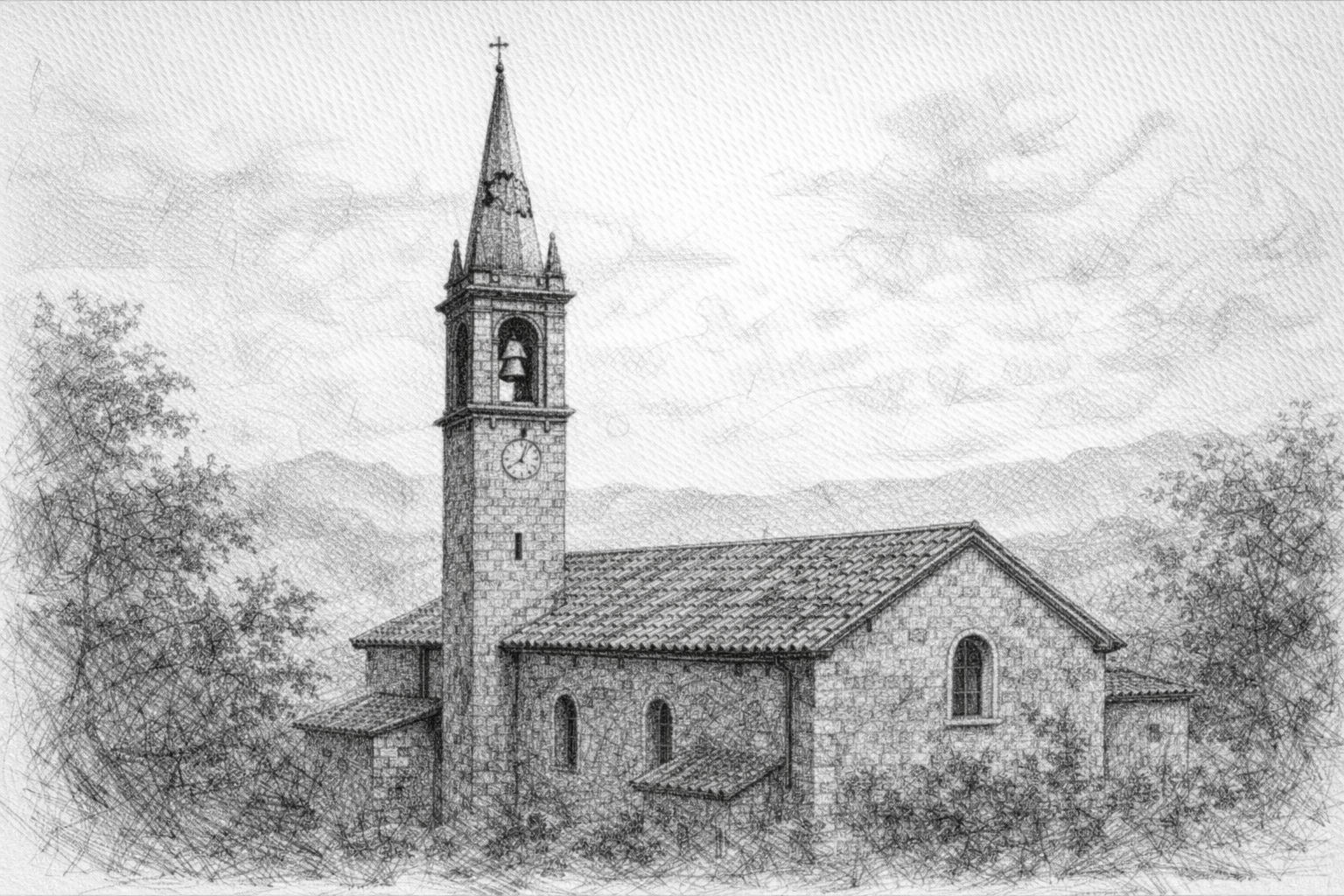
The companions looked. At first they saw nothing. A roof, a tower, old stones. Only after taking a closer look, after the hint, after pointing, did it become visible: a shadow, a small circle, an irregularity.
This not seeing is almost symbolic. Those who do not know what they are looking for see nothing. The traces of war do not necessarily disappear - they are overlooked.
The hole was immediately visible to my grandpa. Not as damage, not as a trophy, but as a connection. Past and present suddenly lay on top of each other.
No pride, no regrets
What is remarkable is what is missing in this scene. No pride. No justification. No sentence like That had to be or That was right. But no demonstrative remorse either. It was a statement. Objectively. Almost sober. And that's what made it so impressive.
This attitude irritates modern expectations. Today, people are often expected to take a clear stance - either confess or repent. The war generation often moved in a different mode. They knew that there were things that could not be clearly categorized.
Traces in the room
The hole in the church tower is more than just a structural detail. It is a material trace of a decision. Of an action that has long since passed and yet remains visible. Unlike memories that fade, this trace is real. You can show it. You can touch it - at least with your gaze.
Perhaps that is why this story is so resonant. It makes it clear that war not only lives on in people's minds, but also in space. In buildings, landscapes, cities.
Responsibility without pathos
The order to shoot at the church tower was not an exceptional case. It was part of everyday military life. And yet it is something else to be faced with the consequences of this order years later.
This shows a form of responsibility that is not loud. No self-accusation, no heroism. Just the quiet knowledge: I did this.
This form of knowledge is difficult to endure. Perhaps that is why it was not often shared. But it is one of the most honest forms of remembrance.
A past that never fades
The war was not simply over for this grandfather when it ended. It reappeared - in images, in places, in casual sentences. The church tower is an example of how the past suddenly becomes present without announcing itself.
You walk through a city as a tourist - and suddenly find yourself back in the middle of another time.
This story does not provide a clear lesson either. It does not demand judgment. It merely shows that actions have consequences, even if they are not immediately visible.
The church tower is still standing. The hole is still there. And so is the memory. This chapter is not about guilt or innocence. It tells of responsibility that doesn't disappear just because time passes. And of traces that remain - even when the world has long since moved on.
Perhaps this is precisely one of the most important experiences of this generation: that you have to live with what you have done. Without dramatization. Without shortcuts. Simply by carrying it.
When the war comes back later at night
What has been told so far are second-hand stories. Memories that have been passed on, sometimes casually, sometimes deliberately. This chapter begins at a different point. Not in the war, not at the front, not in captivity - but in my own childhood. And in a bedroom that was supposed to be a place of peace.
This is where the grandfathers' stories end. And this is where my own observations begin.
Nights you won't forget
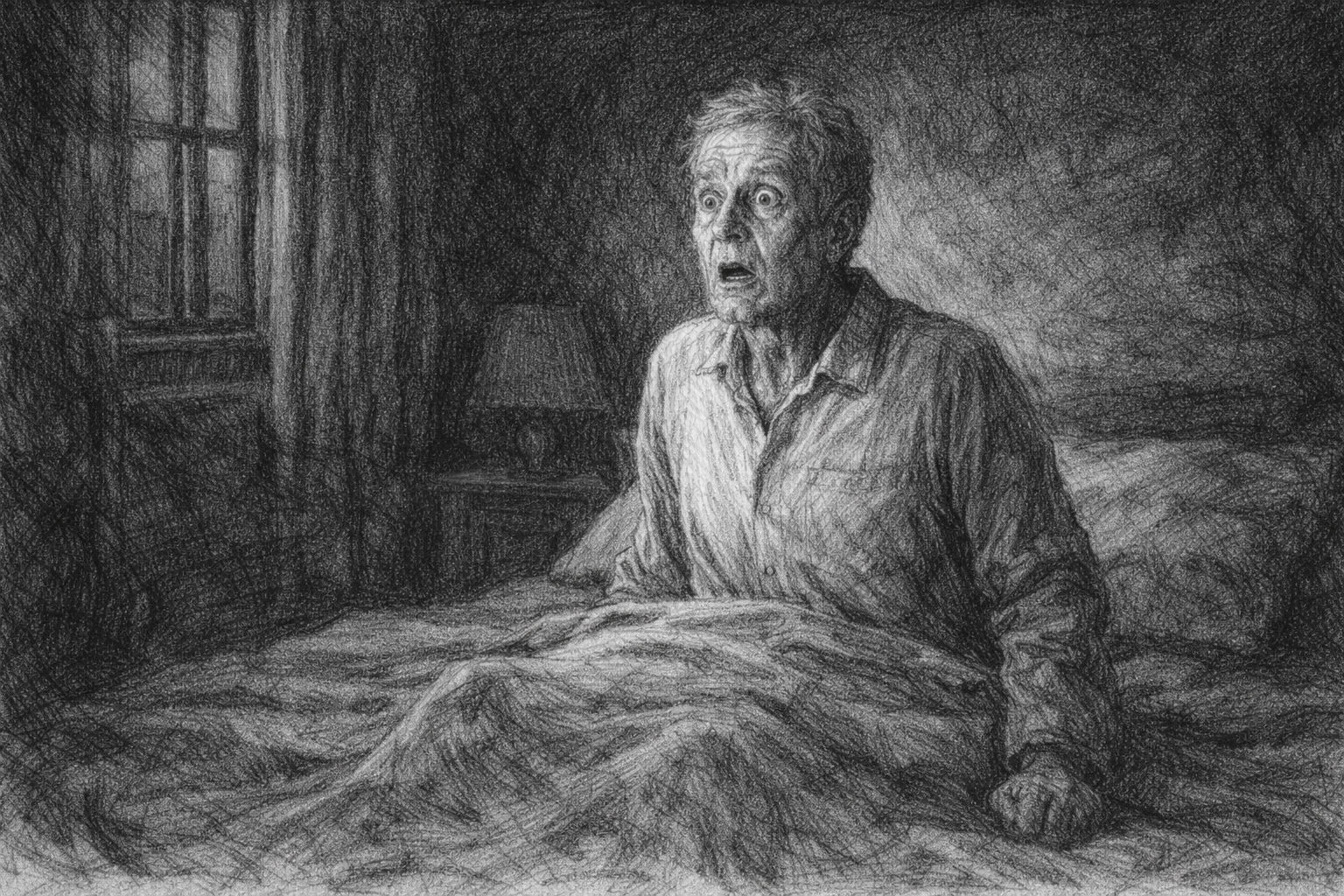
I often spent the night with my grandparents as a child. It was familiar, quiet, unspectacular. And yet there were those nights that have remained etched in my memory. Nights when my grandpa suddenly woke up from his sleep. Not slowly, not searching - but bolt upright, drenched in sweat, abruptly.
He literally flew from sleep to wakefulness. Sat upright in bed. Rigid. For seconds, sometimes minutes. No screaming, no talking. Just tension. Then, just as suddenly, he lay down again. And slept on as if nothing had happened.
As a child, you don't understand such scenes. You register them. You memorize them. And you feel that you shouldn't ask any questions.
The bedroom as a boundary
I later realized that these nocturnal episodes were probably not without consequences. My grandparents slept in separate bedrooms relatively early on. I don't know if that was the sole reason. But it's hard to imagine that these nights didn't play a role.
If someone is torn from their sleep at night for decades, the person next to them is also affected. Insomnia, anxiety, constant tension - all this affects not only the person who is dreaming, but also the person lying next to them.
Perhaps the separation of the bedrooms was not a sign of distance, but of pragmatism. An attempt to keep everyday life bearable.
The war after the war
What was missing in my perception for a long time was the bigger picture. It was only much later that a picture came together. This grandfather had not simply left the war behind him. He had - years later - become a soldier again.
When the Bundeswehr was founded at the end of the 1950s, he was offered a career. He was politically unencumbered, had not been a party member and had not attracted negative attention. At a time when many biographies were being rearranged, this was a crucial point.
He actually wanted to study architecture. That was his original plan. Instead, he opted for surveying in the German Armed Forces. A pragmatic decision. Security, perspective, order. He thus studied with the Bundeswehr as part of an officer's career and made it to the rank of lieutenant colonel.
Stay in instead of locking up
This decision changes the view of the night scenes. Because it means that not only did the war not end for him internally - he also remained part of the system externally. Uniform, hierarchy, military context. Even if surveying has nothing to do with trenches: You stay involved. You remain a soldier.
Perhaps it was a way of regaining control. Perhaps it was also a form of avoidance. Or simply the best option in a time that offered few alternatives.
The important thing is: it wasn't a clear cut. No after in the sense of now it's over.
The body remembers differently
Looking back, what particularly concerns me is the way the war manifested itself in him. Not in stories about battles. Not in political commentary. But in his body. In his sleep. In moments when control is gone.
The body does not forget. Not even when the mind has learned to function. Perhaps just then.
These nocturnal episodes did not seem like dreams in the usual sense. They seemed like a return. Like something that hadn't been processed, but discarded - and then came back when no one could stop it.
No language for the experience
It was also striking what was not talked about. Not from him. Not from my grandma. There was no explanation, no categorization. No that comes from the war. No that's bad. It was just there.
Perhaps the language was missing. Perhaps also the idea that you should talk about it. In that generation, it was often considered a strength to endure things. Not to talk about it. Not to analyze.
What is lost in the process is often only noticed in the next generation.
Standing next to it as a child
For me as a child, it was unsettling, but not traumatic. It was more of a quiet amazement. Something you take seriously without being able to categorize it. Perhaps also an early learning of restraint.
These scenes have become ingrained. Not as fear, but as a question mark. And this question mark stays with you, even if you don't consciously look at it for a long time.
Today I see these nights differently. No longer isolated, but embedded in a biography that knew no easy transitions. War, post-war, rearmament, a career in the military. No clear separation. No clean ending.
Perhaps these continuities explain something. Perhaps not completely. But they provide a framework in which the nocturnal scenes appear less mysterious.
The war as a silent roommate
What this chapter shows is something that existed - and often still exists - in many families: The war as a silent roommate. Not present in everyday life, but noticeable in certain moments.
He does not sit at the table. He doesn't join in. But he comes at night.
A personal boundary
This chapter is more personal than the previous ones. Because it shows that war is not just history, but a relationship. It affects families, marriages and childhoods. Not loudly, not spectacularly, but permanently.
Perhaps this is the point at which memory becomes responsibility. Not in the sense of guilt, but in the sense of understanding. Understanding that what you have experienced yourself is part of a longer chain. And that this chain does not end just because you no longer see it.
Here, on these nights, it becomes clear: the war is over - and at the same time not over.
Rest in peace - what remains of these stories
There is no conclusion in the traditional sense at the end of these stories. No conclusion, no message, no invitation. Perhaps that is precisely what is appropriate. Because what has been told here defies simple summaries. It cannot be reduced to a lesson without doing violence to it.
What remains are voices. Pictures. Attitudes. And a silent responsibility.
No answers, only questions
These stories do not provide answers on how to behave „correctly“ in war. They do not provide moral instructions. They show neither heroes nor clear culprits. Instead, they open up questions that are uncomfortable - precisely because they cannot be closed.
- What does dignity under duress mean?
- What does responsibility without choice mean?
- What does guilt mean when chance decides?
- And what does it mean to live on with what you have done - or survived?
Perhaps it is precisely this openness that is missing today.
The quiet authority of experience
What distinguishes the grandfathers' stories from many of today's debates is their reticence. They didn't want to convince. They didn't want to enforce anything. They didn't want to be right. They told their stories because it was part of their lives.
This form of authority is quiet. It is not based on arguments, but on experience. And it demands something that has become exhausting: listening without immediately categorizing.
No claim to sovereignty of interpretation
The grandfathers would probably have smiled if you had asked them what you should „learn from their stories“. Not out of indifference, but out of skepticism towards big words. They knew that life rarely turns out the way you tell it later.
Perhaps that is the most important attitude they have passed on: Distrust of simple explanations. Caution against quick judgments. And a sense that reality is contradictory.
Remembrance as a silent act
Remembering is not a political act in the strict sense. It is a human one. It means not letting something disappear just because it is inconvenient or no longer fits in with the times.
This text makes no claim to completeness. It tells excerpts. Fragments. Subjective impressions. But that is precisely where its honesty lies.
It preserves something that would otherwise be lost: the connection between experience and descendants. Between what was and what is still working.
What we can pass on
Perhaps our task is not to formulate answers, but to preserve stories. Not to glorify them. Not to instrumentalize them. But to keep them available.
So that later generations understand that war is not just a historical event, but a condition that has long-lasting effects. In bodies. In relationships. In decisions.
And so that they realize that dignity is often created where no one is looking.
Gratitude without glorification
Gratitude is not a big word here. It is not directed towards deeds, but towards bearing. On enduring. To living on.
Both grandfathers carried out their tasks as best they could with the means at their disposal. They told their stories without putting themselves in the foreground. And they kept silent where words were not enough. That deserves respect. Perhaps that is the right tone for the conclusion: no appeal, no pathos. Just a quiet acknowledgement of what was - and what remains.
These stories do not belong to me alone. They belong to a generation that is slowly disappearing. And to a time that we shouldn't repeat, precisely because we can't really understand it.
Rest in peace. Not as a cliché, but as a thank you for telling the story.
And as an obligation to listen while it is still possible.


Frequently asked questions
- Why are you only telling these stories now - so many decades after the war?
Because it takes time to understand some things. As a child, you absorb such stories and observations without being able to categorize them. Only with distance, personal life experience and inner peace does it become clear what they actually mean. This „now“ is no coincidence, but the moment in which listening, remembering and understanding come together. - Is your point in the article to justify the war or individual actions?
No. The text deliberately avoids any justification. It does not attempt to reinterpret or relativize guilt. It is about making experiences visible without reducing them morally. Justification argues - memory describes. - Why do you largely dispense with historical data, figures and military details?
Because the focus is not on the war as an event, but on the war as an experience. Numbers create distance. These stories are effective precisely because they are fragmentary, personal and incomplete. They complement historical accounts, but do not replace them. - Isn't it problematic to tell stories of Wehrmacht soldiers in such a personal way?
It only becomes problematic when you generalize or make excuses. The article does neither. It shows individual biographies in a historically forced context and leaves contradictions unresolved. It is precisely this ambivalence that makes the stories honest. - Why don't you make a clear moral assessment of your grandfathers' behavior?
Because moral clarity is often deceptive in retrospect. The article does not seek to judge, but to understand. It shows where boundaries were drawn, where chance decided and where responsibility was borne - without deriving simple categories from this. - What particularly moved you about the story of the grandpa who deliberately shot past?
The silence of this decision. It was not a heroic act, not a protest, not a rebellion. It was an inner boundary that nobody saw. It is precisely this invisibility that makes it so impressive - and so difficult to evaluate. - Isn't deliberately shooting past the target also a form of guilt displacement?
There is no clear answer to this question. The article does not claim to resolve it. Rather, it shows that guilt in war is not always linked to specific deeds - sometimes it arises from survival itself. - Why does music history play such a central role with the transverse flute?
Because it shows that identity can be more than a role or function. In a situation designed to reduce people, music became the last remnant of selfhood. This story stands for dignity without words. - Aren't you romanticizing the war with this flute story?
No. Precisely because this scene is an exception, the war is not glorified. The story does not show a good war, but a rare moment of humanity in an inhumane system. - Why is the story in the tree so hard to bear?
Because it destroys any notion of meaning. Nobody does wrong, nobody does right - and yet two die while one survives. This form of randomness is difficult to accept, but central to the understanding of war. - What does guilt mean when chance decides over life and death?
Perhaps in such cases it means above all: living on with an unanswerable question. The article shows that guilt does not always arise from action, but sometimes from mere survival. - Why did you mention your grandfather's later career in the Bundeswehr?
Because it shows that the war was not a clearly closed chapter for him. His return to the military creates a biographical continuity that helps to understand why certain things - such as nightly flashbacks - never really disappeared. - Isn't it contradictory to volunteer to become a soldier again after the war?
From today's perspective, perhaps. From the perspective of the time, it was often a pragmatic decision. Security, recognition, structure - and the opportunity to continue something familiar instead of completely reinventing yourself. - Why do you describe the nocturnal scenes in the bedroom so matter-of-factly?
Because that's exactly how they were. No drama, no shouting, no attempt at explanation. It is precisely this sobriety that makes it clear how deeply the war can be anchored in the body - beyond language. - Is the penultimate chapter more about your grandfather or about yourself?
About both. It shows how war experiences affect subsequent generations, even if they are never openly discussed. The war does not end with those who have experienced it. - Why don't you speak openly about trauma or PTSD?
Because although these terms can be helpful, they would tend to be distancing here. The scenes described do not need a diagnosis to be understandable. They speak for themselves. This topic is discussed in the article Is killing without dignity? also covered in more detail with two matching videos. - What will our society lack if this generation disappears?
A quiet form of authority. People who did not want to convince, but had experienced. Their stories do not compel consent, but humility in the face of the reality of violence. - What would you like readers to take away from this article?
No conclusion, no opinion, no attitude to nod off. But rather a pause. Perhaps also a distrust of quick judgments - and a greater appreciation for storytelling itself.