
The term „AI as a sparring partner“ now appears frequently. It usually means that an AI helps with writing, generates ideas or completes tasks faster. A first basic article on this has already been published in the magazine. This article now aims to show in reality how AI can be used as an effective thinking partner. In practice, it is clear that AI only becomes really interesting when it is not treated as a tool, but as a counterpart. Not in the human sense, but as something that answers, contradicts, leads on - or even mercilessly reveals where your own thinking is flawed.
This is exactly where the real benefit begins. Not where the AI „delivers“, but where it reacts. Where it does not simply process, but makes thought processes visible. This is more inconvenient than a classic tool - but also more sustainable.




My own practice: lots of AI, few tools
I work a lot with AI myself because it feels like I can achieve better results five to ten times more effectively. Several hours a day, over many months. And that's precisely why my setup is surprisingly unspectacular. I don't use any sophisticated prompt frameworks, no specialized interfaces, no automated workflows. Essentially, I work almost exclusively with a normal chat window.
However, what changes is not the tool, but the model - depending on the task. One model is better suited to reflecting, structuring and thinking in loops than another. Another may be more useful for programming, another for analyzing or proofreading. This is not an ideological question, but a pragmatic one.
The crucial point, however, is that the working principle always remains the same.
I talk to the AI. I think out loud. I clarify. I correct. I contradict. I have contradictions mirrored. The added value is not created by special functions, but by the dialog itself.
From introduction to in-depth study: understanding AI as a thinking partner
 Before looking at thinking discipline, maturity and structured questioning, it is worth taking a look at the basics. In the introductory article „AI as a sparring partner“ first describes in practical terms how AI can be used in everyday life - as a strategic advisor, creative idea generator or structuring discussion partner. The focus is less on theory and more on specific fields of application. Anyone who is new to AI or would like to gain an overview will find this text a clear, accessible starting point - before the in-depth examination of attitude and mindset begins.
Why pure chat is underestimated
Many users look for shortcuts early on: better prompts, better tools, better models. This is understandable - and often makes sense. But it conceals an uncomfortable truth: the greatest leverage lies not in the technology, but in the user's mindset.
Pure chat is so effective because it doesn't conceal anything. It forces thoughts to be translated into language. It makes ambiguities visible. It reacts exactly to what you formulate - not to what you „actually mean“.
- If you think fuzzy, you get fuzzy answers.
- If you ask contradictory questions, you will get contradictory results.
And anyone who believes that the AI must already „know what is meant“ learns very quickly how deceptive this assumption is.
Artificial intelligence as a mirror, not an oracle
In many discussions, AI is still treated like a kind of oracle: You ask, you get an answer, you rate it as right or wrong. As a sparring partner, however, AI works completely differently. It doesn't just answer questions - it reacts to thought processes.
That makes them valuable. And at the same time revealing.
Because it does not replace thinking, maturity or experience. It merely reveals what is available - and what is not. Those who think in a structured way benefit. Those who look for shortcuts quickly reach their limits.
In this sense, AI is not a guarantee of progress. It is an amplifier. For clarity as well as for ambiguity.
Why this article takes a more practical approach
The previous text on the topic „AI as a sparring partner“ was deliberately kept basic. This article goes one step further - away from classification and towards practice. Not in the sense of „This is how you do it right“, but in the sense of observations, patterns and thought traps. It is about questions such as:
- Why do AI dialogs change over time?
- Why are good questions more important than good models?
- And why do many users find AI „disappointing“ at some point, while others get deeper and deeper into it?
The central thesis is: AI is no substitute for thinking - but it is an excellent training tool for it. Provided you are prepared to watch yourself do it.
From here, it is worth taking a look at the foundation of every interaction: the question itself. Because this is where it is decided whether a dialog is created - or just another random answer.

Bad questions, bad results - an uncomfortable basic law
A bad question is rarely stupid. It is usually fuzzy. And fuzzy questions have the unpleasant characteristic that they seem harmless at first. When working with AI, however, they are immediately noticeable - not because the AI criticizes them, but because the answers remain vague. Typical characteristics of bad questions are
- an unclear purpose („I want to see what comes out of it“),
- several topics in one question,
- implicit assumptions that are not expressed,
- or the hidden desire for confirmation instead of knowledge.
The decisive factor here is that the AI does not make up for these weaknesses. Nor does it compensate for them. It works exactly with the material you give it. And that is precisely why it initially seems disappointing to many users - although in reality it is only consistent.
Typical patterns from practice
In our day-to-day work, we come across certain questions time and again. They sound sensible at first glance, but almost inevitably lead to mediocre results. A classic is the open, but aimless question:
„Write me something about ...“
Not only the context is missing here, but also the decision as to what the text is needed for, who should read it and what it should achieve. The AI logically answers in general terms. Another pattern is the implicit claim:
„Tell me what's right.“
This is less a question than a delegation of responsibility. AI can provide perspectives, weigh up arguments, explain contexts - but it cannot replace maturity. If you ask questions like this, you often get answers that feel right, but don't carry the day. Just as common:
„Do better.“
Better than what? According to what criteria? For what purpose? Without this clarification, „better“ remains an empty shell - and the answer correspondingly arbitrary.
Why AI is merciless here
Unlike human conversation partners, AI is polite, but not compensatory. It does not jump in when something is missing. It does not automatically ask questions when goals are unclear. It does not interpret benevolently what you might have meant.
This may seem cold or mechanical to some users. In fact, it is a strength. Because this is precisely what creates transparency. The AI shows very quickly where thought processes have been abbreviated, where decisions have not yet been made or where you are fooling yourself.
You could say that the AI is not rude - it is precise.
When answers seem arbitrary
A frequent accusation is: „The AI always writes the same thing.“ In many cases this is true - but not for the reason assumed. It is not the model that is interchangeable, but the question.
- If you ask general questions, you get general information.
- If you don't take a position, you get compensation.
- If you don't set a direction, you get mediocrity.
The AI then delivers texts that are linguistically correct but empty in terms of content. This is often blamed on the system. In reality, this reveals a structural problem: even the best AI cannot produce anything of substance without mental preparation.
Bad questions are often a form of self-protection
An uncomfortable thought: bad questions are not always a coincidence. They often protect against clarity. Because clarity has consequences. If you ask precise questions, you force yourself to take a stand, name goals and set priorities.
A vague question allows you not to have to commit yourself afterwards. You can accept or reject the answer without questioning yourself. AI thus becomes a supplier - not a sparring partner. But this is precisely where potential is wasted.
The basic law in dealing with AI
In the end, the whole thing can be reduced to a simple, uncomfortable basic law:
The quality of the answer follows the quality of the question.
Not linear, but consistent. Not immediately visible, but reliable. Anyone who begins to take this seriously will fundamentally change their approach to AI. The question is no longer seen as a means to an end, but as part of the thought process itself. And it is precisely at this point that the transition from mere use to genuine dialog begins.
In the next step, it is therefore worth taking a closer look: What actually makes a good question - and why is it almost always the result of thought that has already been put into it?

Good questions are structured thoughts
A widespread assumption is that good questions are a question of the right wording. A little fine-tuning, a few more precise words - and a mediocre question becomes a good one. In practice, however, something else becomes apparent: good questions rarely arise spontaneously. They are almost always the result of preparatory work.
Before a good question can be asked, something has already happened in your head. A distinction has been made, a goal at least roughly defined, a problem narrowed down. The question is then not the beginning of thinking, but its visible expression. Anyone who tries to outsource thinking to the AI quickly realizes that this preparatory work is missing - and that it cannot be skipped.
In this sense, a good question is not a trick, but a by-product of clarity.
Thinking before the prompt
Anyone who works with AI develops a feeling over time for when a prompt is „not yet ready“. This often manifests itself as an inner hesitation: you type something in, delete it again, rephrase it. Not because the words are missing, but because the thought itself is not yet ready.
This hesitation is not an obstacle, but a signal. It indicates that the actual thinking has not yet been completed. If you ask at this point anyway, you will get an answer - but it will inevitably remain superficial. The AI responds correctly, but not deeply. Only when it is clear:
- What it's really about,
- why this question is relevant now,
- and what should be done with the answer,
a question arises that carries the dialog. Everything else is a preface.
Characteristics of good questions
Good questions have certain characteristics. Not as a checklist, but as recurring patterns. They create context. The AI knows in what context it is answering, what perspective should be taken and what is already known.
- You name a goal. Not necessarily a result, but a direction.
- You set limits. What is not meant? Which aspects are deliberately excluded?
- And they allow for openness. They are not disguised instructions, but genuine search movements.
It is noticeable that good questions often seem longer and more complicated than bad ones. Not because they are more complicated, but because they are more precise. They already contain the mental work.
Practical example: from poor to sustainable
A simple example illustrates the difference. A bad question could be:
„Write me a text about AI and thinking.“
The answer to this will inevitably remain general. The AI knows neither who the text is intended for, nor what stance is to be taken or what purpose it fulfills. A better option would be:
„Write me a factual article about how AI can help you think.“
This has already been narrowed down, but remains vague. How to help? Help whom? In what context? After all, a good question could look like this:
„I would like to write a calm, non-technical article for experienced readers in which AI is described not as a solution, but as a mirror of one's own thinking. Which central lines of argumentation are suitable for this - and where do typical misunderstandings lie?“
Thinking is already visible here. The AI can connect, deepen, contradict and structure. Not because it is smarter, but because it now knows where to dock.
Why good questions are exhausting
Good questions cost energy. They require decisions before an answer is even available. You have to commit yourself without knowing whether you are right. This is precisely why they are often avoided.
Bad questions are convenient. They leave all options open. Good questions, on the other hand, exclude possibilities. They force you to position yourself. And that is precisely where their value lies.
This difference becomes particularly clear when working with AI. AI accepts both bad and good questions. But it only rewards one of them.
The actual performance lies before the answer
Using AI as a sparring partner shifts the focus. The focus is no longer on the answer, but on how to get there. The question becomes a thinking tool. It helps to create order before external perspectives are added. In this sense, a good question is not a request to the AI. It is a self-clarification that is then mirrored. The answer is then no longer the conclusion, but the next step in the thought process.
And this is precisely where the dialog begins to change - not abruptly, but gradually. How this change takes place and why it takes time is the subject of the next chapter.
The art of prompting: thinking in language instead of giving orders
In this episode Salvatore Princi, why the quality of an AI response depends less on the system than on the question asked. Prompting is not understood as a technical gimmick, but as a philosophical discipline: a prompt is not a command, but a movement of thought. Ambiguity, intention and metaperspective are addressed - in other words, the linguistic subtleties that determine the depth and direction of an answer. Those who consciously ask questions use language as a tool of knowledge and at the same time reflect their own way of thinking.

How to think with AI - philosophy, language and prompt intelligence | Salvatore Princi
The message: better questions not only lead to better answers, but also to clearer, more reflective thinking - especially for managers, strategists and creatives.
The dialog changes - if you let it
Almost everyone who starts working regularly with AI goes through the same phase at first. You ask a question, get an answer - and are disillusioned. Too general, too smooth, too little substance. The AI works like a well-formulated but ultimately arbitrary text generator.
This frustration is not a sign of failure, but a transitional state. It usually arises where expectations and approach do not match. If you ask AI questions like a search engine or a copywriter, you get exactly that: useful but interchangeable results. The actual dialog has not even begun at this point.
Many drop out here. They change the model, look for better prompts or declare the topic to be overrated. The problem rarely lies in the AI - but in the lack of room for development within the conversation.
The second phase: sharpening, queries, grinding
If you keep at it, you will eventually start to work differently. The first answer is no longer seen as a result, but as working material. You clarify, contradict, add, narrow down. The questions become shorter or longer, but they become more targeted.
Something crucial changes in this phase: The user begins to think with the AI - no longer just about it. The answers become more differentiated, not because the AI „learns“, but because the context becomes denser. The chat develops an inner logic. Earlier statements have an effect, terms take on meaning, lines of thought continue. The dialog gains depth - slowly, but noticeably.
A proven strategy: first build context, then work
A simple but effective practice fits exactly at this point. Especially with more complex topics, I often don't start with the actual task, but with a preliminary request:
"First research the topic. Summarize relevant backgrounds, positions or typical lines of argumentation.“
This has several effects. Firstly, it immediately creates a common frame of reference. The AI does not work in a vacuum, but on an explicitly established knowledge base. Secondly, this makes the chat more „grounded“. Terms are clarified, repetitions are reduced and misunderstandings come to light earlier.
Above all, however, your own attitude changes. You don't start with a ready-made expectation, but with an open working position. The dialog does not begin with the solution, but with orientation. This slows things down - and paradoxically increases the quality of the results.
The third phase: dialog instead of queries
At some point, the relationship changes. AI is no longer an answering machine, but a conversation partner in the true sense of the word. Not because it has a consciousness, but because the user starts to use it in this way.
- Answers become follow-up questions.
- Texts become raw material.
- Thoughts are mirrored, not replaced.
In this phase, you no longer just ask the AI questions to get something, but to test something. The AI serves as a resonance chamber. It holds thoughts, sorts them out, juxtaposes them. And sometimes it also shows that an idea is not yet viable.
Why many never reach this point
The transition to this third phase is unspectacular. There is no aha moment, no new feature, no special prompt. It is a question of patience - and the willingness to observe yourself in the thought process.
Many fail here not because of the AI, but because of their own impatience. They expect efficiency where maturity is actually required. They want results without going the distance. But it is precisely this journey that is the real value. If you allow it, you will experience a silent shift: AI will not get better - but dialog will. And with it, your own thinking.
Current survey on the use of local AI systems
AI enforces mental discipline - whether you like it or not
When dealing with AI, something becomes apparent that often remains hidden in human conversation: There is no room for contradictions. An AI does not react with irritation, it does not frown, it does not leave inconsistencies out of politeness. It processes what you give it - consistently and regardless of internal logical errors.
This leads to contradictions suddenly becoming visible. Terms that you thought were unambiguous turn out to be ambiguous. Arguments that fit together in your head stand side by side without really connecting. Objectives contradict each other without being noticed.
The AI does not actively reveal this. It shows it indirectly - through answers that evade, balance or diverge. If you look closely, you will notice that it is not the AI that is inconsistent, but the initial thinking.
Imprecise terms, blurred levels
A frequent stumbling block lies in the language itself. Many terms are used loosely in everyday life without being clearly defined. This works in conversation with people because context and experience balance things out. It doesn't work in dialog with AI.
Terms such as „success“, „quality“, „strategy“, „truth“ or „better“ are empty without precision. The AI fills them with statistical mediocrity. The result seems correct, but soulless. Only when you start to narrow down terms, separate levels and reveal assumptions does the answer change.
AI thus forces us to make a movement of thought that we usually like to avoid: the clear separation of opinion, observation, goal and evaluation. Not out of pedagogical zeal, but out of structural necessity.
Discipline of thought as a side effect
Many find this experience stressful at first. AI does not „make it easy“. It doesn't do the work for you, but gives it back in a refined form. What is missing has to be added. What is blurred appears hollow in the answer.
But this is precisely where the value lies. Thinking discipline does not arise here as an intention, but as a side effect. If you want useful answers, you have to express yourself more clearly. If you want to go deeper, you have to think more clearly. AI does not reward creativity in a vacuum, but structure.
This is unusual at a time when many systems are designed to conceal ambiguity. AI does the opposite. It reinforces what is already there - and thus forces you to make a decision: either you clarify, or you stay on the surface.
Why this creates resistance
Not everyone appreciates this form of feedback. Some experience it as cold, others as lecturing, still others as frustrating. In reality, resistance is rarely directed against the AI itself. It is directed against our own lack of focus, which suddenly becomes visible.
Discipline of thought is uncomfortable. It requires checking assumptions, taking a stand and enduring contradictions. AI accelerates this process - not through pressure, but through consistency. It always reacts in the same way: to what is there.
Those who are prepared to accept this will gain a precise tool. Those who reject it will perceive AI as limited or disappointing. Both are understandable.
Precision as a prerequisite for depth
In the end, it can be said: Depth does not come from complex models, but from precise thinking. AI makes this connection visible. It is neither a moral judge nor a teacher. But it is relentless in one respect: it only works with what you give it.
Discipline in thinking is therefore not an option, but a prerequisite. If you don't have it, you will quickly reach your limits. Those who develop it will discover in AI a counterpart that supports, checks and develops thought processes.
AI thus takes on a role that goes far beyond efficiency. It becomes a silent corrective - not for knowledge, but for thinking. And this is precisely where the parallels to traditional sparring partners open up, who have always provided fewer answers than good counter-questions.
Parallels to classic sparring partners
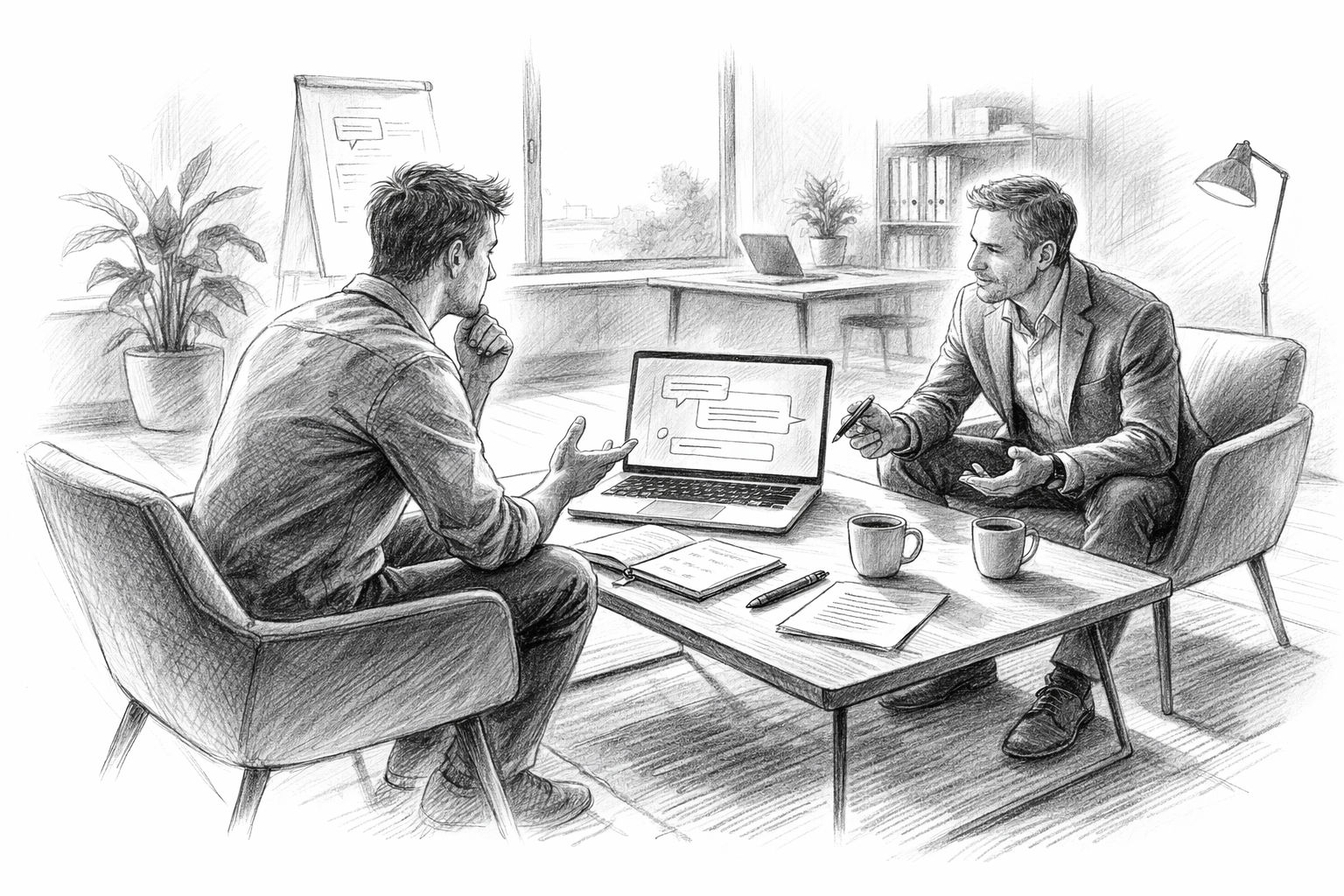
You don't recognize a good conversation by the fact that it provides lots of answers. You can recognize it by the fact that you think more clearly afterwards than before. This is precisely the parallel between AI as a sparring partner and traditional discussion partners: mentors, experienced colleagues, coaches or simply people with whom you can think seriously.
Such discussions are rarely comfortable. They are not linear, they do not provide quick solutions. They often leave you with more questions than before. And that is precisely why they are valuable. They force you to put things in order, to prioritize, to examine yourself. Not because the other person „knows better“, but because they hold the space for thought.
In many cases, AI takes on precisely this function - if you let it.
Mentors, coaches, good colleagues
Anyone who has ever worked with a really good mentor knows the pattern: a question is rarely followed by a clear answer. Instead, there are follow-up questions. Uncomfortable follow-up questions. Hints at blind spots. Sometimes simple silence that forces you to think further.
The mentor does not replace a decision. He does not take it away from you. It merely helps you to prepare them properly. This is precisely where AI comes in. It can't make decisions either - and it shouldn't. But it can make thought paths visible, juxtapose alternatives and reveal internal contradictions.
The difference: AI is always available. And it is tireless.
No protection, no projection
One crucial point distinguishes AI from human sparring partners: emotions play no role. There is no vanity, no need for approval, no social consideration. This can be perceived as a disadvantage - or as a liberation.
The AI does not feel attacked if you disagree. It does not take it personally if you reject a thought. It does not expect gratitude. This creates a thinking space that is unusually clean. Projections lose their effect. What remains is the matter itself.
This is particularly valuable for people who are used to taking responsibility. Decisions, strategies, positioning - all of this can be discussed in advance with AI without generating social side effects. Not as a substitute for human feedback, but as upstream clarification.
When AI is not a good sparring partner - for some
As convincing as these parallels are: AI is not a good sparring partner for everyone. Those looking for reassurance will be disappointed. Those who expect clear instructions feel left alone. Those who want to avoid uncertainty will find the openness of the dialog an imposition.
A good sparring partner - human or artificial - does not reinforce illusions. He makes them visible. And that is not always pleasant. In traditional conversations, this can be avoided through charm, evasion or authority. That doesn't work with AI. It remains neutral. And that is precisely where its severity lies.
Sparring instead of leadership
One last, important difference: a sparring partner does not lead. He accompanies. It thinks along, not ahead. AI is precisely suited to this - not as a teacher, not as a boss, not as an authority. But as a counterpart at eye level in the thought process. Those who accept this role use AI sensibly. If you expect more, you overtax it. And those who expect less are wasting potential.
The parallel to classic sparring partners shows one thing above all: the value lies not in the answers, but in the process. In the willingness to engage in a conversation that knows no shortcuts. This is precisely where it is decided whether AI becomes a gimmick - or a serious thinking partner.

AI does not replace maturity - it reveals deficits
One of the most persistent misconceptions when dealing with AI is that those who use AI automatically think better. This idea is tempting because it links progress to technology. In practice, however, it quickly becomes clear that AI does not raise standards - it reinforces them.
- Those who think in a structured way gain depth.
- Those who think uncleanly produce nonsense more quickly.
The AI itself remains neutral. It does not evaluate, it does not correct on its own initiative. It works with what is available. This is precisely why it is no substitute for maturity. It can organize knowledge, collect arguments, open up perspectives - but it cannot develop an attitude.
Typical deficits that become visible
When working with AI over a longer period of time, certain patterns emerge again and again. Not as errors on the part of the AI, but as a reflection of human thinking habits.
A frequent deficit is Impatience. The expectation that an answer must be immediately viable. If it is not, the AI is considered useless. A second or third step of thought would have sufficed.
Another pattern is the Desire for shortcuts. Instead of dealing with a problem, the AI is supposed to „solve“ it. The result then appears plausible, but remains external. The internal clarification has not taken place.
Also Lack of self-reflection becomes visible. If you don't know your own assumptions, you can't have them questioned. AI reflects them anyway - and thus unconsciously makes it clear where thought processes are lacking.
Last but not least, there is often a Shying away from decisions. The AI should determine, weigh and evaluate. But this is exactly where its role ends. Decisions can be prepared, not delegated.
Reinforcement instead of compensation
These deficits would be less noticeable without AI. In everyday life, they can be concealed - by speed, by authority, by social dynamics. AI removes these protective layers. It reinforces what is there, regardless of the effect.
That can be revealing. And that is precisely why some users react with disappointment or rejection. Not because the AI fails, but because it disappoints expectations that were never realistic.
AI is not a corrective for internal disorder. It is an amplifier. Those who accept this can make targeted use of it. Those who ignore it will repeatedly come up against the same limits - regardless of the model.
Why this is an opportunity
As uncomfortable as this disclosure can be: It offers a rare opportunity. AI makes it possible to recognize deficits early on - before they become entrenched in decisions, texts or strategies.
- Impatience can be slowed down.
- Uncertainty can be structured.
- Unclear goals can be named.
The prerequisite is the willingness not to point at the AI, but at yourself. Those who take this step are not using AI as a crutch, but as a training tool. Not for knowledge, but for maturity.
Maturity cannot be delegated
In the end, a simple but uncomfortable realization remains: maturity cannot be automated. It comes about through experience, through mistakes, through conscious confrontation. AI can accompany, accelerate or deepen this process - but it cannot replace it.
This is precisely where its value lies. It does not force, but it invites. It shows what is there without glossing over it. Those who use this mirror gain clarity. Those who avoid it remain in the position they were already in.
AI does not promise progress. It offers a possibility. What becomes of it is not decided by the model - but by the person who asks.
Practical guidelines: using AI sensibly as a sparring partner
One of the most important practical experiences in dealing with AI is surprisingly simple: you don't have to be perfectly prepared, but you should start consciously. A roughly clarified request is often enough. The fine-tuning can - and should - take place in dialog.
If you wait until a thought is fully formulated, you are wasting potential. On the other hand, if you start completely disorganized, you will quickly lose yourself. The sensible middle way is to adopt an initial, honest working position and review it in a discussion.
AI as a sparring partner does not work according to the „input - output“ principle, but as a process.
Answers are raw material, not results
A common misconception is to treat the AI's first response as an end product. It makes more sense to see it as an interim result. Something that can be questioned, shifted, sharpened or even discarded. Good practice means
- Do not assume answers, but check them
- Marking contradictions instead of ignoring them
- Ask questions if something seems too smooth
The quality of dialog does not increase through agreement, but through friction.
Don't delegate decisions - prepare them
AI is ideal for preparing decisions: Collecting arguments, comparing perspectives, making risks visible. It is poorly suited to making decisions.
If you try to hand over responsibility, you get apparent clarity - but no sustainable basis. On the other hand, those who use AI to sharpen their own decision-making skills will benefit in the long term. A good guiding question is therefore not:
„What should I do?“
but:
„What am I missing?“
Using the voice function - but consciously
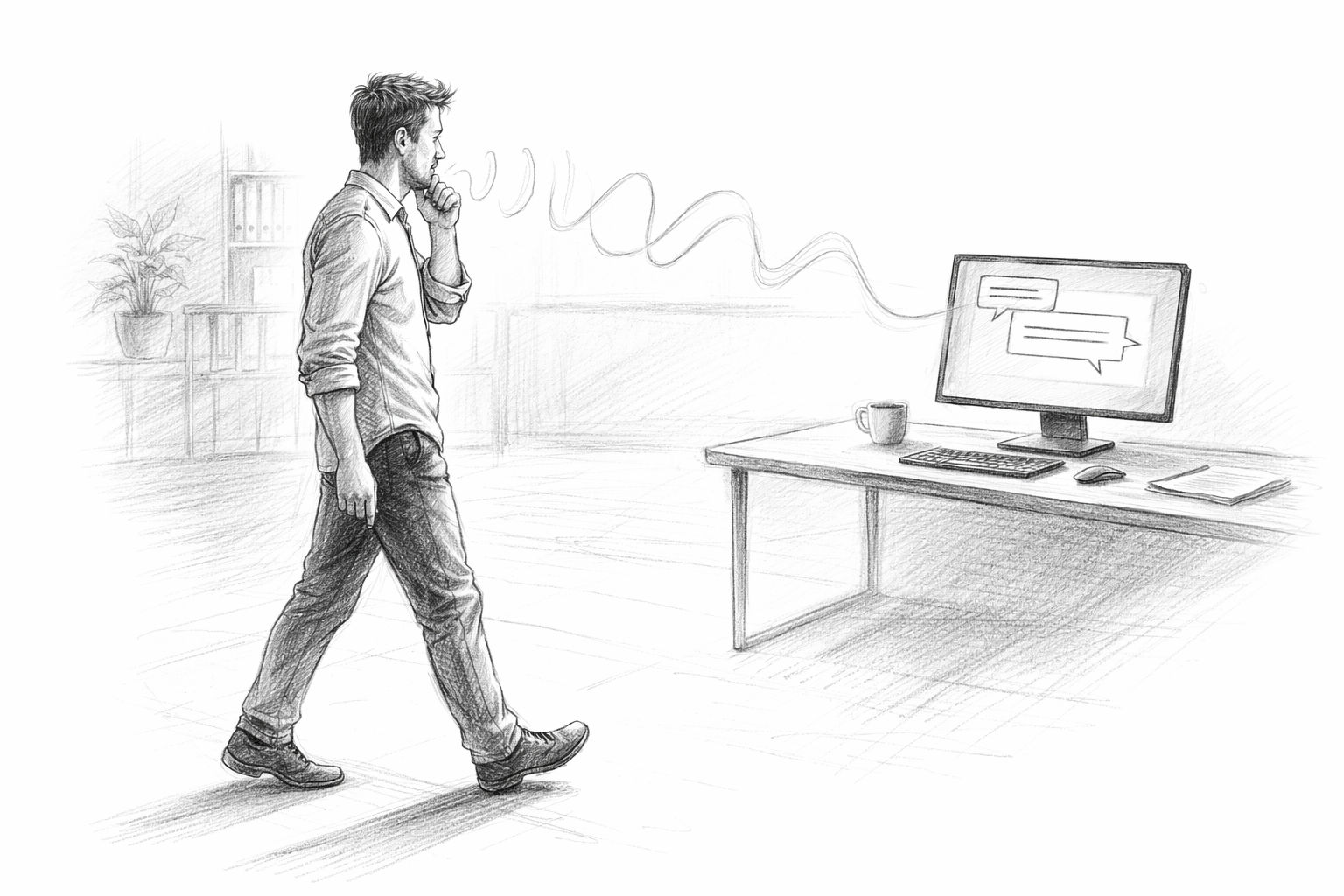
One particularly effective practice is to use the voice function, where you speak but the AI continues to respond in writing. This changes the entire workflow.
The advantage is obvious: you think out loud. Just as you would in a real conversation. You slip up, correct yourself, jump between thoughts - and that's not a disadvantage, but a benefit. The thought process becomes more visible, more lively, more honest.
The AI does not react in an irritated manner. It filters, organizes and picks up threads. Even contradictions are not without consequences. It often reacts to tensions that you have not even consciously noticed. The conversation becomes more natural - and therefore more productive.
This form of working is surprisingly effective, especially for reflection, concept work or strategic considerations. It takes the pressure off and promotes clarity.
Don't avoid contradictions, use them
A natural dialog contains contradictions. Thoughts change, assumptions tilt, priorities shift. In traditional work processes, such disruptions are often seen as disruptions. In sparring with AI, they are valuable.
When the AI reacts to contradictory statements, something crucial happens: Your own thinking is mirrored. Not judgmental, not instructive - but visible. If you pause at this point and don't „clean up“ too quickly, you often discover new insights.
Contradictions are not errors. They are clues.
Consciously build context
Especially with more complex topics, it is worth taking a step before the actual work: consciously establishing context. A brief research summary, a clarification of key terms or an overview of relevant perspectives creates a common basis.
This makes the conversation more focused, consistent and sustainable. The AI „knows“ what it is referring to - and so does the user. Misunderstandings occur earlier and are easier to correct.
In the end, the most important guideline is not a technical one, but an internal one. AI only works well as a sparring partner if you are prepared to take yourself seriously - and not go easy on yourself. Not every model is equally suitable for every task. Not every answer is helpful. But the decisive factor remains constant: your own willingness to think, examine and take responsibility.
AI is no substitute for this process. But it is an unusually precise companion on this journey.
Thinking cannot be delegated
There is no new method or special trick at the end of this journey. It is a sober realization: thinking cannot be outsourced. Neither to humans nor to machines. AI can structure, mirror, sort and provoke - but it cannot take over the inner work.
This is precisely where its value lies. It does not force, it does not push. But it makes visible where clarity is lacking, where assumptions remain untested and where decisions are not yet mature. Those who accept this win. Those who want to avoid it will sooner or later reach their limits.
AI as a sparring partner is therefore not a promise of progress, but an offer. An offer to take your own thought process more seriously.
Good models change little, good questions change everything
This article has made it clear why good questions are more important than good models. Models are becoming more powerful, faster and more versatile. But without structure in thinking, their potential remains unused.
Good questions are not created through technique, but through attitude. They require that you are prepared to take responsibility for your own thought process - including uncertainty, contradictions and detours. AI does not automatically reinforce this willingness. It only makes it visible whether it is present.
That is uncomfortable, but honest.
AI as a learning space, not a shortcut
If you want to use AI sensibly in the long term, you should not see it as a shortcut, but as a learning space. As a place where ideas can be tested, discarded and reassembled. Without an audience. Without evaluation. Without social side effects.
AI is amazingly efficient in this role. Not because it is „clever“, but because it reacts consistently. It rewards clarity and exposes vagueness. Quietly, objectively, reliably.
An introduction without prior knowledge - deliberately low-threshold
For readers who are thinking at this point: "That sounds sensible, but how do you actually start?", it is worth taking a look at a supplementary article: „AI for beginners - how to get started with artificial intelligence without prior knowledge“.
It is less about mental discipline and more about orientation. Which AI systems are available, what they are suitable for and how to get started with their practical use without prior technical knowledge. The article provides an overview without being overwhelming - and thus complements the more reflective perspective of this article.
A tranquil view
AI is here to stay. It will become better, faster and more ubiquitous. The crucial question is not what it can do in the future - but how we deal with it. Whether we use it to avoid thinking or to sharpen it.
Thinking cannot be delegated. But it can be accompanied.
Those who see AI as a sparring partner do not use it to get answers, but to ask better questions. And this is where true sovereignty begins - quietly, unspectacularly and surprisingly effectively.



Frequently asked questions
- What does „AI as a sparring partner“ actually mean - and what doesn't it mean?
AI as a sparring partner„ does not mean that AI makes decisions or replaces thinking. What is meant is a dialogical approach: AI reacts to thoughts, reflects them, organizes them and makes contradictions visible. It does not deliver truth, but resonance. This is precisely where it differs from traditional tools or search engines. - Why does the article emphasize the importance of good questions so strongly?
Because good questions are structured thoughts. AI can only work with what you give it. Fuzzy questions lead to fuzzy answers - regardless of the model. Good questions force you to clarify goals, assumptions and context. This not only improves the answer, but above all your own thinking. - Does this mean that better models are less important?
No, models certainly play a role. But their influence is overestimated. A good model can't compensate for poor thinking. Conversely, very good results can be achieved with simple models if the question is clear. The leverage almost always lies with the user, not the technology. - Why do many users find AI disappointing after the initial euphoria?
Because they treat AI like a shortcut. The expectation is often: question in, solution out. If that doesn't work, the AI is considered superficial. In reality, this shows that thinking cannot be delegated. Those who are prepared to engage in dialog experience a completely different depth. - What is the difference between query and dialog?
A query is aimed at a one-off response. A dialog develops over several steps. Answers are questioned, supplemented and corrected. Context builds up. Only in dialog does AI become a sparring partner - before that, it remains a text generator. - Why does AI reveal errors in reasoning and contradictions so quickly?
Because it has no social equalization mechanisms. It does not interpret benevolently, it does not smooth things over out of politeness. It reacts consistently to language. Contradictions, unclear terms or conflicting goals become indirectly visible - often more quickly than in conversation with people. - Doesn't that make AI cold or impersonal?
Yes - and that is precisely their strength. The absence of emotions, vanity or social expectations creates an unusually clean thinking space. This can have a relieving effect, especially with complex or sensitive issues, because nothing has to „come across right“. - Why are bad questions described in the article as a kind of self-protection?
Because vagueness avoids responsibility. If you ask vague questions, you don't have to commit yourself. Good questions, on the other hand, force clarity - and therefore consequences. AI makes this difference visible because it does not compensate for ambiguity. - What is the point of giving the AI research tasks first?
It creates a common frame of reference. Terms are clarified, background information is collected and typical arguments are made visible. The actual dialog then begins on a more stable basis. This increases the depth and reduces misunderstandings. - Why is the voice function with text responses particularly helpful?
Because it allows natural thinking. You can speak freely, correct yourself, digress. The AI still filters and organizes. This creates a conversation that comes closer to thinking than typed, „perfect“ prompts. Contradictions emerge organically - and become usable. - Is it a problem if you slip up or contradict yourself when speaking?
On the contrary. It is precisely these breaks that are valuable. They show thought processes. The AI often reacts to them more precisely than you would expect. Many insights arise precisely where you realize that things don't fit together yet. - Can AI make decisions or take responsibility?
No - and it shouldn't. AI can prepare, structure and weigh things up. Decisions remain human. If you try to hand over responsibility, you get apparent clarity, but no sustainable basis. - What role does maturity play in dealing with AI?
A central one. AI reinforces existing patterns. Maturity is reflected in how someone deals with uncertainty, contradictions and unanswered questions. AI does not replace this maturity - it makes it visible whether it is present. - Why do some people react negatively to AI as a sparring partner?
Because they expect confirmation. A sparring partner does not automatically confirm. He mirrors. This can be perceived as an imposition, especially if you are looking for quick solutions or clear instructions. - Does this make AI more of a learning tool than a productivity tool?
Both - but the more sustainable value lies in the learning aspect. Productivity arises in the short term. Discipline and clarity of thought have a long-term effect. Those who only use AI as an efficiency tool are not exploiting its potential. - Do you need prior technical knowledge to use AI in this way?
No. The entry threshold is low. The decisive factor is not technology, but attitude. If you can talk, listen and ask questions, you already have the most important prerequisites. - How does this article fit in with the topic „AI for beginners“?
The beginner's article provides orientation: systems, possible applications, first steps. This text goes deeper. It starts where initial experiences have been made and shows how AI can be used sensibly in the long term - beyond tools and hype. - What is the most important insight from the article?
That thinking cannot be delegated. AI can accompany, reflect and sharpen. But it is no substitute for clarity, attitude and responsibility. If you accept this, AI is an unusually precise sparring partner.