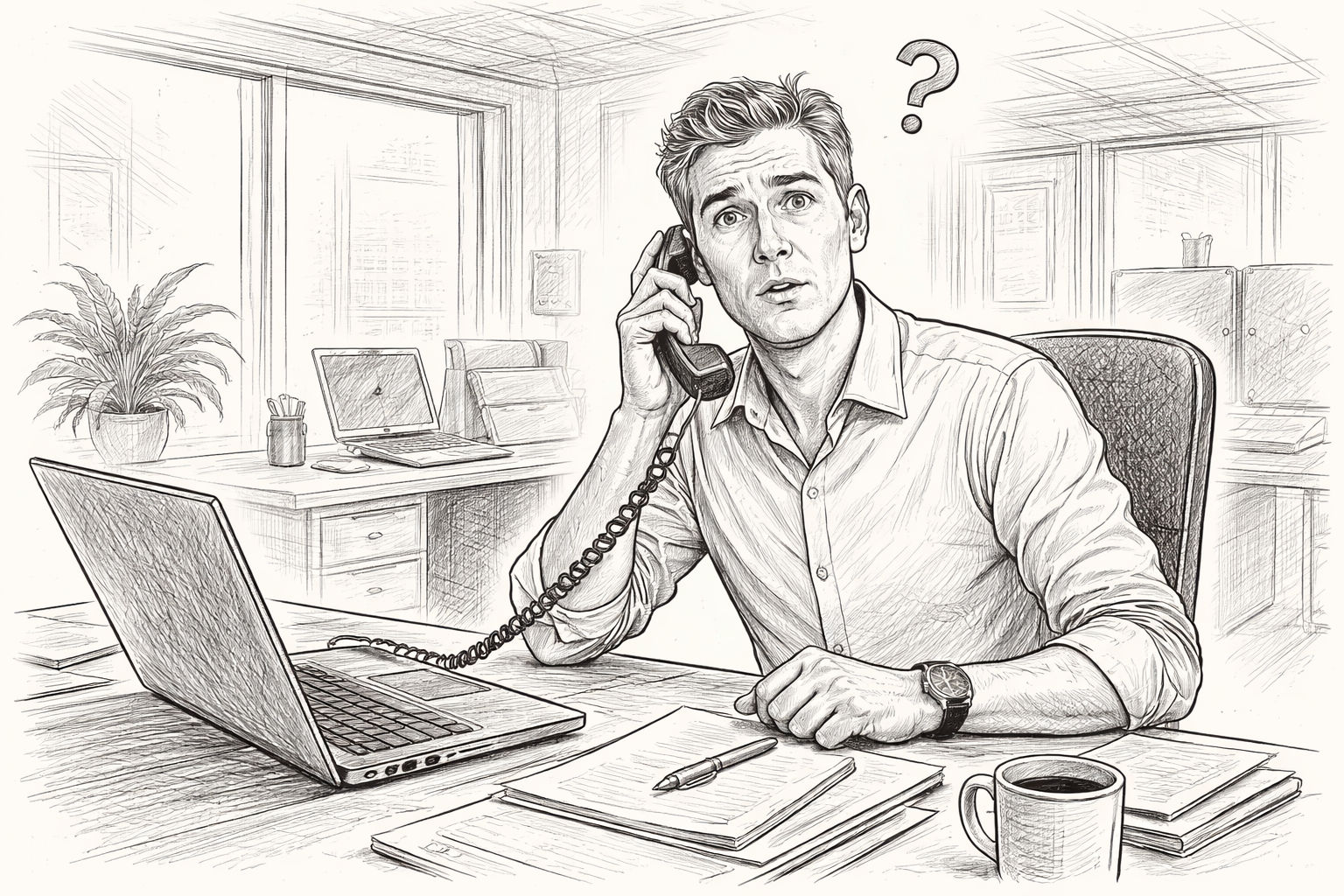
There are moments in everyday life that seem completely banal at first. You're sitting at your desk, working on an article, thinking about a new topic - and suddenly the phone rings. A number you don't recognize. In my case, it was an area code from the Ruhr region: 0233 something. As a self-employed person, you occasionally get calls like that. It's usually about advertising, services or advice that you don't actually need.
So I initially answered the call as normal. A friendly female voice answered on the other end. She introduced herself as an employee who works with Facebook and Instagram. Unsurprisingly, it was about advertising. About ads. About reach. Visibility for companies.




The conversation began with exactly the same tone of voice that is familiar from such phone calls. Polite, professional, a little rehearsed. She explained to me that many companies today have difficulties reaching new customers. Especially in the small and medium-sized enterprise sector - the so-called SME sector - online advertising is a decisive factor. Facebook and Instagram offer enormous opportunities to reach potential customers.
While she spoke, I listened normally at first. Nothing about it seemed unusual. The voice sounded human, natural, even with a slight southern German dialect. That made the whole thing more likeable than intrusive. It didn't sound like a traditional call center somewhere in the world, but rather like someone who was actually calling from Germany.
Such conversations usually always follow the same pattern. At some point, the moment comes when the person called explains why the offer is not relevant to them. And that's exactly what I did.
I told her that I basically understood what she meant, but that social media plays more of a secondary role for me. My main work is elsewhere. I run a publishing house, work on articles, books and my magazine. Social media is more of a sideshow. It can be helpful, but it's not the core of my work. I explained this to her relatively calmly.
She initially reacted as you would expect. She listened, confirmed briefly and then continued her conversation. At this point, she began to describe a specific offer to me. It was a kind of advertising campaign that was specifically tailored to companies. It was said to be able to achieve a visibility of around five thousand potential customers. She talked about the importance of digital presence, how companies could increase their reach and how Facebook and Instagram would help them reach new target groups.
The content itself was not surprising. Anyone who has ever spoken to marketing agencies is familiar with such phrases. But something about the way she spoke was starting to irritate me. The tone of voice suddenly seemed a little different. It sounded like she was reading something aloud. Not necessarily obvious. But somehow too smooth, too structured, too perfectly formulated. It was as if she was going through a presentation, sentence by sentence.
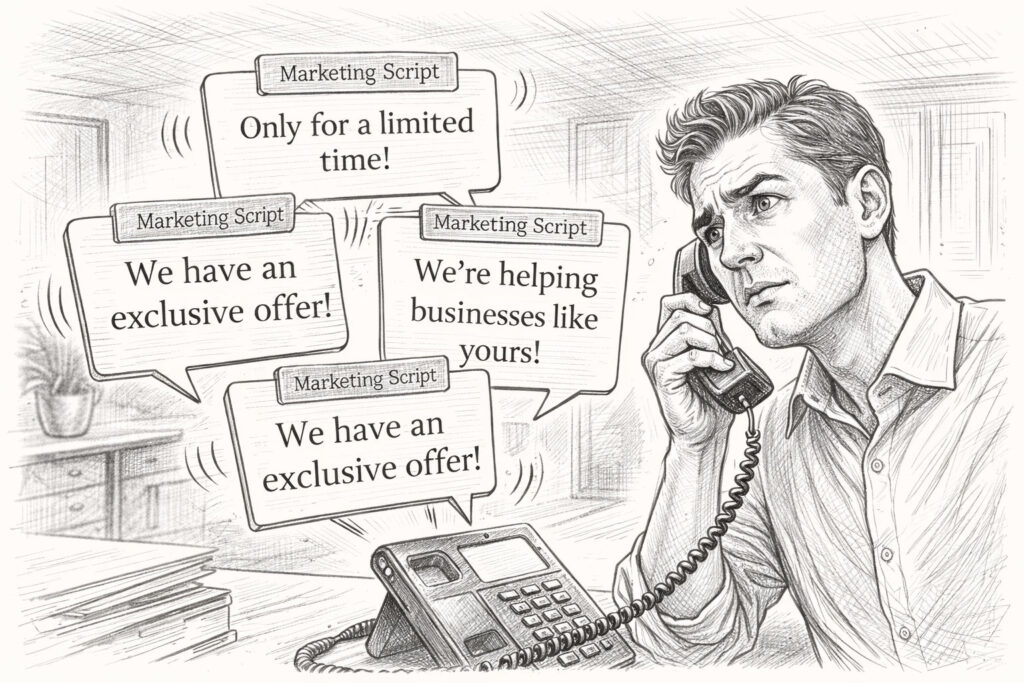
I continued to listen and didn't think anything more of it at first. Perhaps she actually had a template in front of her. After all, that's exactly how many sales meetings go.
So I responded to their statements again. I explained once again that I understood their perspective, but that I had no need for such advertisements at the moment. My work works differently. I build content, write articles, develop topics in the long term. Social media can help with this, but it is not the central lever.
While I was saying that, something interesting happened.
There was a short pause. Only for about a second.
Then came an answer that matched the content of what I had just said. She said that I obviously already had a certain media presence and therefore perhaps set different priorities. If someone has already built up a reach, advertising is of course a different decision than for companies that are just starting out.
The sentence fitted surprisingly well with what I had just said. But at the same time it sounded strange again. That slightly pre-read tone again. Again that structure that felt like a prepared text.
At that moment, I began to listen more closely. Because suddenly a very simple question arose. If she is really just reading out a script - where does this answer that responds so precisely to my statement come from? Does she really have hundreds of different text sheets in front of her, which she selects depending on the course of the conversation? Or is something else going on here?
While I was thinking about it, I noticed something else. The flow of conversation was strangely even. There were no spontaneous reactions, no little slips of the tongue, no improvised formulations. Everything sounded amazingly clean, almost too clean.
And suddenly a new possibility arose in my head. Maybe I'm not talking to a person at all. Maybe there isn't a real person on the other end of this line - but a system. An artificial voice. An AI.
The idea sounded absurd at first. But the longer I thought about it, the more plausible it became. Because one thing just didn't fit: The answers seemed simultaneously adapted and yet as if they had been read out. As if someone understood what I was saying - but still kept falling back on prepared text modules.
I began to wonder how many such systems there are now. How many conversations might no longer take place between people, but between people and machines. And it was precisely at that moment that I decided to ask a very simple question.
A question that would immediately solve this mystery.


The moment of truth
So at that moment I had this thought in my head: maybe I'm not talking to a person at all. The longer I thought about it, the more details from the conversation suddenly fell into place. The short delays after my answers. The strangely even way of speaking. The sentences that seemed individual at the same time, but always had this slightly pre-read character.
It was as if a puzzle was slowly coming together. So I decided to just sort it out straight away. No complicated tests, no trick questions. Just a simple, clear question. I interrupted the conversation briefly and said:
„I have another question.“
At the other end of the line, there was another short pause. Not long, maybe a second. But long enough to be consciously aware of it.
Then I asked the question that had been on the tip of my tongue:
„Am I actually talking to a human or a robot?“
It was a very direct question. Actually one that a person could answer without any problems. You would expect someone to either laugh, perhaps react a little irritated or simply say: „Of course you're talking to me.“
But that's exactly what didn't happen. Instead, we received an answer that initially seemed evasive.
The voice told me that she could guarantee that a real person would contact me if I was interested in a consultation. We could then discuss together which options would make sense for my company.
The answer sounded polite. Professional. But it didn't answer my question. I hadn't asked if a person would get in touch later. I had asked who I was talking to now. This discrepancy made the situation even more interesting. Because a human interlocutor would probably have understood my question differently. Perhaps he would have wondered for a moment, maybe laughed or even reacted a little offended. But he would probably have answered it directly.
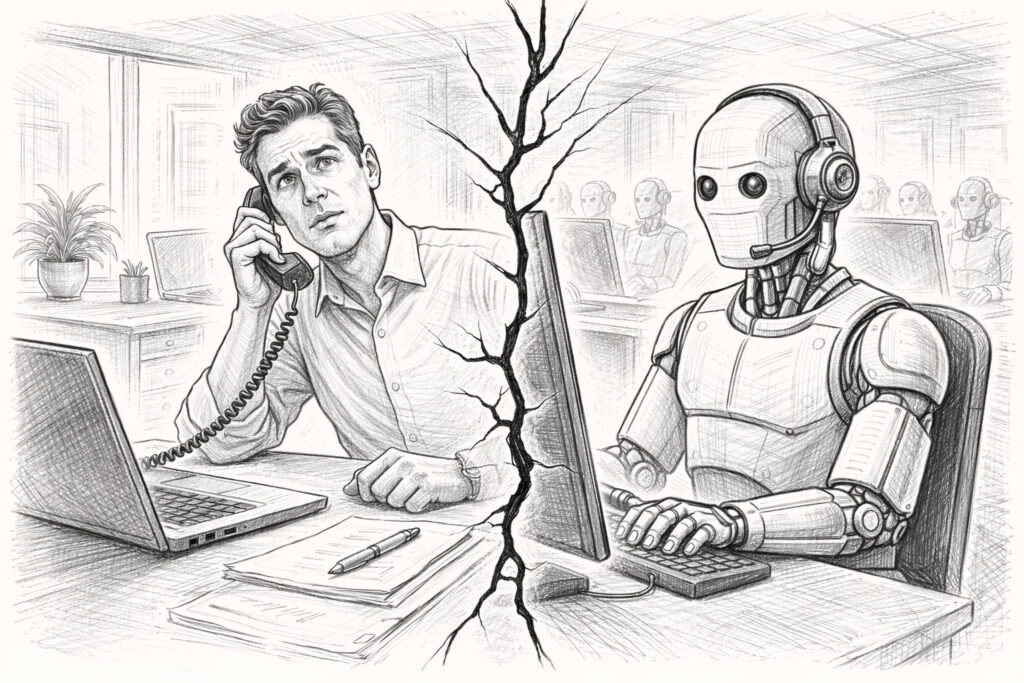
Here, however, something else happened. The answer was evasive. She returned to the original purpose of the conversation: selling a consultation. That was the moment when my suspicions finally became stronger.
So I calmly explained once again that I really wasn't interested in this offer. I repeated what I had already said before: social media is not a central topic for me. I'm working on a magazine, articles, books and my publishing house. Facebook advertising is not one of my priorities at the moment.
As I spoke, I listened carefully.
There was another short pause. Then came another reply - again polite, again friendly, but again with that slightly mechanical undertone. It was difficult to describe what exactly was unusual about it. The voice sounded human, the words were correct, the sentences made sense. And yet something was missing. Perhaps it was that subtle unpredictability that real conversations usually have. People react spontaneously. They change their tone of voice, interrupt each other, improvise.
Here, on the other hand, everything seemed structured. Ordered. As if an invisible system in the background was deciding which sentence should be spoken next. So I tried again. Not aggressively, not confrontationally - just curiously.
I basically repeated that I was less interested in the offer than in the question of who I was actually talking to. But this time there was no new explanation. Instead, the tone of the conversation suddenly changed.
The voice said curtly that she had to move on now. There were other tasks. Then she said goodbye.
„I have to move on now. Goodbye.“
And that was the end of the conversation. No further argument, no attempt to convince me after all, no questions. The conversation was simply broken off.
I sat there for a moment and looked at my phone. It was a strange feeling. Because the conversation had felt completely normal for several minutes. It sounded like a typical sales call, the kind you've known for years. A friendly voice, an offer, a few objections, a few answers.
And yet this strange feeling remained at the end. What if I had actually just spoken to a machine? What if this voice, which had spoken so naturally about marketing, reach and potential customers, wasn't actually coming from a human being? Because to be honest, this scenario fits perfectly with the times we are living in. Systems that write texts. Programs that hold conversations. Artificial voices that are almost indistinguishable from real people.
Maybe that's exactly what had just happened. Maybe I had just received a call from a machine - and almost didn't even realize it. I couldn't let go of the thought. And the longer I thought about it, the more I realized that even if I was wrong in this specific case, it didn't really matter.
Because the technology that would make such a conversation possible has existed for a long time. And if it exists, then it will be used. So the real question is no longer whether such conversations take place. The only question is how often.
Current survey on the use of local AI systems
The new generation of phone AI
When I looked at my phone after the conversation, I couldn't get one question out of my head: how likely is it that I was actually talking to a machine? Just a few years ago, this idea would probably have been quickly dismissed. Telephone conversations were one of the areas in which humans were long considered irreplaceable. Language is complex, spontaneous and full of nuances. Dialects, irony, small pauses, intonations - all this made human communication so difficult for machines.
But this image is just beginning to change. What many people have not yet realized: The technical requirements for machines to be able to make convincing telephone calls today are now largely in place. And they are developing at an astonishing rate.
From voice command to real conversation
The first step on this path began with comparatively simple voice systems. Many people are familiar with them from their everyday lives: voice assistants on smartphones, navigation systems in cars or digital helpers in the home.
At first, these systems could only understand simple commands. You could ask them about the weather, start music or enter an address. Their answers were pre-programmed, the dialogs very limited.
However, with the advent of modern language models, the situation has changed fundamentally. Today, systems are able to recognize, analyse and react to spoken language almost in real time. A conversation with a machine runs through several technical steps in the background:
- First, the spoken language of the person is recognized and converted into text. This so-called speech recognition has now become so precise that even dialects or background noises are often no longer a major problem.
- A language model then analyzes the content of the statement. It tries to understand what is meant, what the intention behind the question is and which answer might fit.
- In the next step, the system formulates an answer - no longer just from a fixed script, but often dynamically generated from a large language model.
- Finally, this text is converted back into spoken language. Modern speech synthesis systems can produce voices that sound astonishingly realistic.
The result is a conversation that can feel surprisingly natural for people.
Why machines are suddenly making phone calls
However, the question is not just whether this technology exists. The really exciting question is: why do companies use it at all?
The answer is relatively simple. Telephone customer contacts are one of the most expensive areas for many companies. Traditional call centers require staff, training, workstations and infrastructure. Employees have to be paid, need breaks and can only make a limited number of calls per day.
A machine, on the other hand, works completely differently. An automated system can talk to many people at the same time. It can work around the clock without getting tired. And it only incurs a fraction of the costs per call that a human employee would incur.
For companies that want to contact thousands of potential customers, this is an enormous economic advantage. In the marketing sector in particular, more and more systems are therefore being developed for precisely this purpose: to conduct automated sales or consultation calls. These systems can, for example:
- Call potential customers
- Arrange appointments
- conduct initial consultations
- Query interest
- Pre-qualify contacts for human salespeople
People often only come into play later - when it is already clear that there is real interest.
The hybrid approach: script and AI
Many of these systems do not function completely freely, but according to a so-called hybrid model. This means that part of the conversation follows a fixed script, similar to traditional call centers. Certain statements, offers or explanations are presented in a predetermined form.
At the same time, however, an AI analyzes what the other person is saying and can react to certain key words or statements.
It is precisely this combination that creates the impression of a real conversation. Some answers seem spontaneous and individual, while others sound like prepared text modules. It is often difficult for the interlocutor to tell whether there is a person or a system at the other end.
Looking back, this pattern matched the conversation I had surprisingly well. Some answers seemed very adapted to what I had said, while others sounded almost like they had been read out.
Voices that sound like people
Perhaps the most astonishing part of this development, however, is the voice itself. Just a few years ago, computer-generated voices sounded distinctly artificial. They were monotonous, mechanical and relatively easy to recognize.
Today, things look very different. Modern speech synthesis can produce voices that sound amazingly natural. They can imitate emotions, incorporate small pauses and even mimic regional speech colorations.
A slight dialect, such as the one I heard in my conversation, is no longer a technical problem. For many people, this makes it increasingly difficult to distinguish between real voices and artificially generated voices.
A quiet change
The interesting thing about this development is that it is happening largely unnoticed. There are no big headlines about machines suddenly making phone calls. There are no obvious announcements that a call partner may not be human at all.
Instead, technology is slowly creeping into everyday life. A call here, an appointment there, a customer service call elsewhere. And more and more often, the friendly voice on the phone may no longer be a human being - but a system that has been trained to imitate human conversations as convincingly as possible.
Whether this was actually the case when I called cannot be said with absolute certainty in retrospect, but it is very likely. But one thing is certain: the technical possibilities for this have long existed. And they are getting better every month.
When your own daughter's voice becomes a trap
A report by Hessischer Rundfunk provides a particularly shocking example of the misuse of modern AI technology. In it, a woman reports on a call in which she thought she could hear her own daughter on the phone. The voice sounded panicked and familiar at the same time:
There had been a serious accident, one person had been killed and there was now a threat of pre-trial detention. Shortly afterwards, an alleged policewoman got in touch and explained that release would only be possible against a high bail. The sum demanded was around 120,000 euros. Only later did it emerge that the daughter's voice had been deceptively simulated with the help of artificial intelligence.

New perfidious scam using artificial intelligence | maintower
The case impressively demonstrates how convincing modern speech synthesis can now be - and how important it has become not to blindly trust even familiar voices in the event of unexpected calls.
Call centers without people
If you take a moment to step back from your own experience and take a sober look at the matter, it quickly becomes clear why companies have the idea of letting machines make phone calls in the first place. The real driving force behind this development is not enthusiasm for technology. It is economics.
Call centers have been one of the most expensive areas of many companies for decades. Whether it's customer service, making appointments or sales calls - costs are incurred wherever telephone calls are made. Employees have to be hired, trained and paid. Workstations have to be set up. Then there are working hours, break arrangements, vacation entitlements and sick leave.
All of this is completely normal and natural as long as people do this work. But from a company's perspective, each of these factors means additional costs.
This is exactly where the appeal of automated systems begins. A machine does not need a workplace, a vacation or a break. It can theoretically work around the clock. And it can talk to many people at the same time.
While a human employee might make fifty or sixty calls a day, an automated system can make hundreds or even thousands of contacts. Even if only a small proportion of these conversations lead to an actual customer, it can quickly pay off economically. This explains why marketing and sales companies in particular are very interested in such technologies.
The process is usually relatively simple:
- First, a large list of potential contacts is created. This can come from various sources: publicly accessible company databases, business directories or existing customer data.
- An automated system then makes the first contact. The machine calls, introduces itself and starts a conversation according to a certain pattern. It explains an offer, asks a few questions and tries to find out whether there is a basic level of interest.
- In many cases, the conversation ends right there. If the person called is not interested, the contact is simply ended. If, on the other hand, interest is signaled, the system can forward the contact to a human employee.
So the human being only comes into play once a potential customer has already qualified.
Which professions could disappear next
 The phone call described is not an isolated incident, but part of a larger development. Artificial intelligence is currently changing entire industries - often faster than many people realize. Activities with many recurring processes, such as customer support, call centers, processing or simple text and translation work, are particularly affected. Today, modern voice models and voicebots can conduct conversations, analyze documents or answer emails - around the clock and without a break. As a result, many traditional office and communication jobs are coming under pressure. In my detailed background article „Artificial intelligence: which jobs are at risk - and how we can arm ourselves now“ I show which professions are particularly affected and why it makes sense to prepare for these changes at an early stage.
This is a huge advantage for companies
This is because the majority of telephone contacts in sales end with a rejection anyway. Calling people who are not interested is often the most time-consuming part of a salesperson's job. Automated systems can take over this part and thus relieve the burden on human employees.
This also explains why many of these systems do not attempt to replace the entire conversation. They only take over the first step. You could say: the machine opens the door, the human only takes over the actual conversation later.
Another advantage is scalability. A traditional call center can only handle as many calls as there are employees available. If a company suddenly wants to launch a larger campaign, new employees have to be hired and trained.
An automated system, on the other hand, can be expanded almost immediately. Once the software has been set up, additional calls can be made with comparatively little effort. New campaigns can be launched within a short space of time without the need to add staff. This flexibility is particularly attractive in the world of digital marketing.
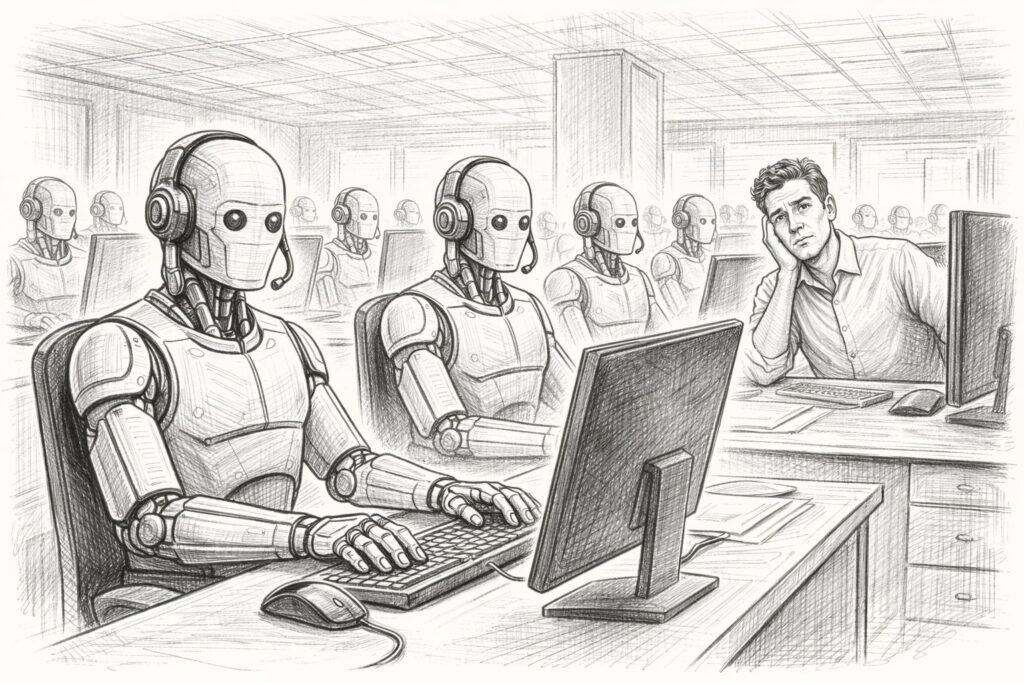
Another factor that is often overlooked: Consistency
People never have conversations in exactly the same way. One salesperson may be having a bad day, be tired or stressed. Another is particularly motivated and persuasive. These differences are part of human behavior.
Machines, on the other hand, work according to clear rules. They always say the same things, always ask the same questions and adhere strictly to the predefined conversation model. From the perspective of many companies, this is an advantage because it standardizes the quality of initial contacts.
Of course, there is another side to this development. A conversation with a human feels different to a conversation with a machine. Even if an artificial voice sounds convincing, it often lacks something that is difficult to describe: the spontaneous dynamics of human communication.
A human being can improvise, show humor, make an unexpected remark or simply react spontaneously. Machines still find it difficult to deal with such situations, even if their skills are improving rapidly.
Many companies therefore rely on a hybrid approach. The machine takes over the initial contacts, filters out potential prospects and then passes them on to real employees. This creates a combination of automated efficiency and human communication. For many companies, this is currently the ideal compromise.
But even this intermediate state could only be a transitional phase. Because the better the systems become, the more tasks they can take on. What is still a simple initial consultation today could be a full consultation tomorrow.
The questions that arise from this are less technical than social.
- How will our communication change if machines increasingly conduct conversations?
- And how do we deal with the fact that we can no longer be sure whether there is actually a person on the other end of a line?
Perhaps this is precisely the point at which my little experience with this strange phone call suddenly takes on greater significance. Because what started out like an ordinary sales call could actually have been a little glimpse into the future.

How can you recognize a phone AI?
After I had finished the conversation, one question remained in the room: Could I even have recognized whether it was a machine?
This is precisely the real challenge of this new technology. Modern voice systems are now so convincing that many people no longer even notice when they are talking to an AI in everyday life. Voices sound natural, answers seem logical and even small pauses or dialects can now be imitated surprisingly well.
Nevertheless, there are some indications that you can look out for. None of these observations are certain proof on their own. But in combination they can give a pretty clear picture.
Small delays in the conversation
The first clue is often a very short delay after a statement. When people talk to each other, they usually react immediately. Of course there are small pauses here too, but these arise from the conversation - because someone is thinking or sorting out their words.
In AI systems, the pause results from a technical process. First, the system has to recognize the spoken language. Then the text is analyzed. The system then formulates an answer and converts this back into spoken language.
This process only takes a fraction of a second. Nevertheless, you can sometimes notice this short delay. I noticed just such a pause several times during my conversation. It wasn't long enough to make me immediately suspicious. But it was clear enough to be noticed at some point.
Answers that fit and yet seem strange at the same time
Another clue can be the structure of the answers. People often react spontaneously in conversations. They rephrase sentences, take small detours, pick up on individual words or ask counter-questions.
Automated systems, on the other hand, often work with a mixture of prepared text modules and generated answers. This leads to a strange effect: the answer basically matches the conversation - but at the same time sounds as if someone is reading something out loud.
In my case, this was precisely the point that made me wonder. Some of the answers seemed surprisingly precise and tailored to my statements. At the same time, however, they sounded so smooth and structured as if they came from a prepared template.
This combination is typical of so-called hybrid dialog systems that combine script and AI.
The amazingly perfect voice
Interestingly, the voice itself is often no longer a reliable indicator. In the past, artificial voices were relatively easy to recognize. They sounded monotonous, mechanical and had a clearly audible computer quality.
Today, this has changed drastically. Modern speech synthesis can produce voices that sound amazingly natural. They can even simulate small pauses in breathing, intonation or emotional nuances. Some systems are now able to imitate regional speech colorations - just like the southern German dialect I heard on the phone.
For many people, such a voice comes across as completely authentic. This means that it is often no longer possible to tell whether you are talking to a human or a machine simply by the sound of the voice.
Difficulties with unexpected questions
A particularly interesting moment often arises when you ask a question that does not fit in with the intended course of the conversation.
People can improvise in such situations. They think briefly and react spontaneously.
AI systems, on the other hand, are often prepared for certain courses of conversation. When a question outside this framework arises, they sometimes falter. This can manifest itself in various ways:
- The answer avoids the question.
- The system suddenly returns to the original topic.
- The conversation ends unexpectedly.
This is exactly what happened in my case. When I asked whether I was talking to a human or a robot, I didn't get a direct answer. Instead, the conversation was steered back to the actual sales offer.
And when I asked again, the conversation finally ended.
Conversations that end abruptly
Another indication may be an unusually abrupt end to the conversation. People usually try to politely round off a conversation. Even if someone is not interested, there is often a brief exchange, a thank you or a concluding remark.
Automated systems, on the other hand, work with clear rules. If certain conditions are met - such as a clear rejection - the conversation is ended. Sometimes this happens surprisingly quickly because the system no longer provides any further conversation strategy.
The sentence I heard at the end fitted this pattern perfectly:
„Excuse me, I have to get going. Goodbye.“
A quick final sentence - and the conversation was over.
Why many people don't notice the difference
The fascinating thing about this development is that most people hardly notice such details in everyday life. Phone calls are a routine part of our lives. We hear a voice, talk briefly and then hang up again. Only rarely does anyone analyze the course of the conversation in such detail afterwards.
This is precisely why automated systems can now be used relatively unobtrusively. As long as the conversation seems reasonably plausible and the content is understandable, many people don't even question who they are talking to.
Only when something doesn't quite fit together - a strange pause, an unusual answer or an evasive response - does this small feeling of irritation arise. I had this feeling during my phone call. And it was precisely this feeling that finally gave me the idea to ask the crucial question.
The question that probably revealed that I had just spoken to a machine.
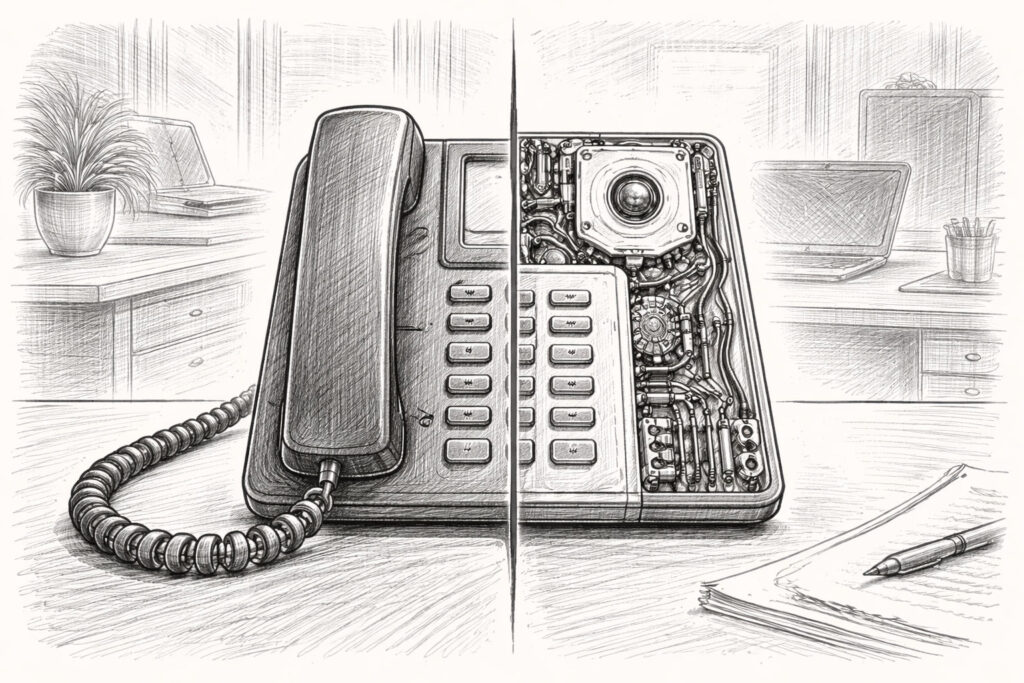
When machines call - and what we can learn from them
After the conversation, I was left with a strange impression. On the one hand, the call was nothing special. As an entrepreneur, you occasionally get sales calls like this. On the other hand, this conversation had somehow felt different. Not dramatically different - but just unusual enough that it took me a moment to understand why.
The thought that there might not have been a human being on the other end of the line never left me. And the longer I thought about it, the clearer it became to me: even if I was wrong in this specific case, the actual development behind it has long been a reality. Today, machines can hold conversations. They can call people, ask questions and give answers. And they will probably do this more and more often.
This raises a question that goes beyond my personal experience. How do we actually deal with it when machines start calling us?
Telephone acquisition - already a sensitive topic today
Even before artificial intelligence came into play, telephone advertising was a tricky area. In many countries - including Germany - cold calling, i.e. making unsolicited calls to potential customers, is severely restricted by law. In many cases, it is simply not permitted, especially for private individuals.
Even in the corporate sector, such canvassing is often in a gray area. There must be a presumed interest, and many companies now react very sensitively to unwanted advertising calls.
The reason for this is simple: a phone call immediately interrupts people in their everyday lives. While an email can be ignored and advertising on the internet is often simply overlooked, a phone call forces the person called to react immediately. You have to decide whether to pick up, listen or end the call.
If there are also automated systems behind such calls, this discussion takes on a new dimension. After all, machines can theoretically call thousands of people a day.
Current survey on digitalization in everyday life
Time is the scarcest resource
The real point that bothers me about such calls is not even the technology itself. Technology evolves and new possibilities are constantly emerging. That's part of the modern world. What concerns me more is another question: how respectfully do companies actually treat other people's time?
Time is probably the scarcest resource we have. Each of us only has a limited number of hours per day. And everyone decides for themselves how they want to spend this time. An unsolicited call - whether from a person or a machine - encroaches on this time.
If automated systems are then also used to contact as many people as possible, the impression quickly arises that the time of the person called is merely a statistical factor in a marketing strategy. Perhaps this is precisely the reason why such calls often leave a bad feeling. Not because the technology is impressive, but because it shows how easy it is to automate communication - even where personal attention is actually required.
A healthy dose of doubt can't hurt
In any case, my little phone call made one thing clear to me: In the future, it will probably become increasingly difficult to recognize who we are actually talking to. Phone calls, chat messages, emails - much of this can now be generated automatically. Voices can be synthesized, texts can be created in seconds and entire conversations can be programmed.
That's why a healthy dose of doubt is perhaps not the worst attitude to have. If a conversation seems strangely structured, if answers are formulated unusually smoothly or if questions are suddenly evaded, it may be worth pausing for a moment and asking questions. Sometimes a simple question like:
„Am I talking to a person or a machine?“
This question alone can suddenly steer a conversation in a completely different direction.
Contracts on the phone? Better not
For me personally, this experience has another consequence. I wouldn't sign any contracts over the phone anyway - regardless of whether the person I was talking to was a human or a machine.
A phone call is a spontaneous moment. You don't have time to check things in peace, read up on information or compare offers. Decisions made under such conditions are rarely particularly well thought out.
If someone really has an interesting offer, they can easily send it in writing. Then you have the opportunity to look at everything in peace and make an informed decision. This applies today more than ever. Because if machines can conduct increasingly convincing conversations, it will be all the more important not to make decisions on the spur of the moment.
A glimpse into the future
Perhaps in a few years we will have become accustomed to such situations. Perhaps at some point it will be completely normal for some of our conversations to take place with automated systems. Appointments, customer service or initial consultations will be handled by machines. Perhaps at some point two systems will even talk to each other on the phone - while the people in the background only see the result.
Whether you find this development exciting or view it critically is a personal question. In any case, my own call was a small moment that showed me how quickly our world of communication is changing.
And perhaps this article will help one or two readers to listen a little more carefully the next time they receive an unexpected phone call.
You never know. There might not even be a person on the other end of the line.
Frequently asked questions
- How likely is it that I have actually spoken to an AI on the phone without realizing it?
This is now entirely possible. Modern telephone AI systems can recognize speech, formulate answers and output them again as a natural voice. In everyday life, many people do not consciously pay attention to small details such as minimal response delays or unusually structured formulations. It can therefore happen that a conversation is considered completely normal, even though it has already been technically automated. Such systems are increasingly being used in marketing, customer service or when making appointments. It is often difficult to determine in retrospect whether you have personally spoken to an AI before - but the probability increases with every technical advancement. - Why do companies use AI to call people in the first place?
The main reason is of an economic nature. Telephone customer contacts are relatively expensive for companies because they require personnel, infrastructure and organization. Automated systems, on the other hand, can work around the clock and make many calls at the same time. Companies often use such systems to make initial contact or pre-filter potential customers. If a contact shows interest, a human employee can then take over. For companies, this means an enormous increase in efficiency. Humans are then only deployed where a serious conversation actually takes place. - Does an AI voice really sound as realistic as a human voice today?
In many cases, yes. Modern speech synthesis is now astonishingly advanced. Voices can be generated with natural intonations, pauses and even dialects. Some systems are trained to imitate typical human speech patterns, such as small breathing noises or minimal delays in sentence structure. This makes the voice appear much more authentic than before. While computer-generated voices used to be easy to recognize, the difference is becoming increasingly subtle today. For many people in everyday life, it is hardly possible to tell whether they are talking to a machine or a human just by listening to their voice. - How can I tell that I might be talking to an AI on the phone?
There are some possible clues, even if none of them is conclusive evidence. These include short delays after statements, unusually structured answers or a flow of conversation that seems very even. Some systems also react strangely to unexpected questions and try to steer the conversation back to their original topic. An abrupt end to the conversation can also be an indication. However, it is important to note that these characteristics are not always clear-cut. The better the systems become, the more difficult it will be to recognize the difference between humans and machines in a conversation. - Is it even legally permissible to make automated calls to people?
The legal situation in many countries is complex and sometimes strictly regulated. Unauthorized advertising calls are often prohibited, especially for private individuals. Rules also apply in the corporate sector, for example that there must be a presumed interest. When automated systems are used, some providers operate in legal gray areas. This is why many companies react very cautiously to unwanted calls. In principle, the following applies to callers: they are not obliged to make such calls or respond to offers. - Why do many people feel disturbed by such calls?
A phone call has a direct impact on everyday life. While advertising on the internet or by email can be ignored, a phone call demands immediate attention. If the call is also unexpected and contains a sales offer, many people find it annoying. If an automated machine is also used, some callers get the impression that their time is only being viewed as a statistical variable in a marketing campaign. This impression can quickly lead to a feeling of disrespect. - Are such automated calls a sign that humans will soon be replaced by machines?
Not necessarily completely. In many areas, automated systems are used more as a supplement. They take on simple or repetitive tasks, such as the initial contact conversation or making appointments. More complex conversations, advice or negotiations are still conducted by people. The trend is often towards a hybrid model: the machine takes the first step, the human follows later. Whether this balance changes in the future depends heavily on how technology develops and how companies use it. - Why did some of the answers sound like they were read out?
Many automated systems work with so-called scripts. This means that certain statements or offers consist of prepared text modules. At the same time, an AI can combine these building blocks with individually generated answers. This creates a conversation that sometimes seems spontaneous and sometimes sounds like a prepared text. This creates a strange impression for the interlocutor: the answers basically fit the conversation, but at the same time seem unusually structured or smoothly formulated. - Why do AI systems sometimes react strangely to unexpected questions?
Automated dialog systems are usually trained for specific conversational sequences. They recognize key words and respond with suitable answers. However, if a question is asked that is outside this framework, the system can run into difficulties. Some systems then try to steer the conversation back to the original topic. Others simply end the conversation. These reactions sometimes seem unusual to humans because we expect spontaneous improvisation from human conversation partners. - Is it possible for two AI systems to talk to each other on the phone?
Technically, this would be entirely possible. If an automated call system meets a digital assistant, two machines could theoretically communicate with each other. Both would recognize, interpret and respond to speech. Such scenarios are still rare, but they show the extent to which communication can be automated. In the future, such interactions could well occur more frequently, particularly in the area of appointment scheduling or automated services. - Why does it make sense to be careful with telephone offers?
Phone calls are spontaneous situations. There is little time to check information or think through an offer thoroughly. This is why many experts generally advise against making important decisions directly over the phone. If an offer is really interesting, you can ask to receive the information in writing. This gives you the opportunity to examine everything at your leisure and compare different options. This approach protects against impulsive decisions and possible misunderstandings. - What should I do if I suspect that I am on the phone with an AI?
You can initially react as normal and have a conversation if you wish. If in doubt, you can also simply ask directly whether it is an automated system. Another option is to end the conversation politely. No one is obliged to take part in an unwanted sales conversation. Above all, it is important not to allow yourself to be put under pressure and not to make any decisions that you feel uncomfortable with. - Why is this technology becoming so widespread right now?
Several technical developments are currently coming together. Advances in speech recognition, powerful speech models and realistic speech synthesis have greatly improved the quality of such systems. At the same time, the cost of this technology has fallen significantly. This makes it attractive for many companies. What was previously only possible for large corporations can now also be used by smaller companies. - Will there be a labeling requirement for AI conversations in the future?
This is being discussed in many countries. Some experts are calling for automated systems to clearly identify themselves as AI. Others argue that this would be difficult to enforce or could restrict the use of the technology. How this issue will develop legally remains to be seen. However, it is quite possible that future regulations will require more transparency. - Why do many people find it difficult to recognize such systems?
People are used to automatically associating voices with real people. If a voice sounds natural and the conversation makes sense, we rarely question it. Our brain immediately interprets speech as human communication. It is precisely this trust that modern systems exploit. Only when something in the conversation seems unusual - such as a strange answer or an unexpected pause - do we start to listen more closely. - Are such technologies fundamentally problematic?
That depends very much on how they are used. In some areas, automated conversations can be very helpful, for example in customer service or when making simple appointments. It usually becomes problematic when people cannot recognize that they are talking to a machine or when the technology is used for aggressive marketing. As with many technologies, it ultimately comes down to responsible use. - Why do some systems react so abruptly and end conversations suddenly?
Many automated dialog systems follow clearly defined rules. If certain conditions are met - for example, a clear rejection of the offer - the system automatically ends the conversation. This behavior sometimes seems rude or abrupt to humans because we are used to letting a conversation end a little longer. For an automated system, however, it is simply a programmed decision. - What can I learn from such experiences?
The most important thing is probably to stay alert. Our world of communication is changing very quickly. Voices, texts and conversations can now be generated automatically. A healthy dose of doubt and a conscious approach to such situations can help us to deal with them better. If you take the time to listen more closely and ask questions, you sometimes realize more than you initially expected.