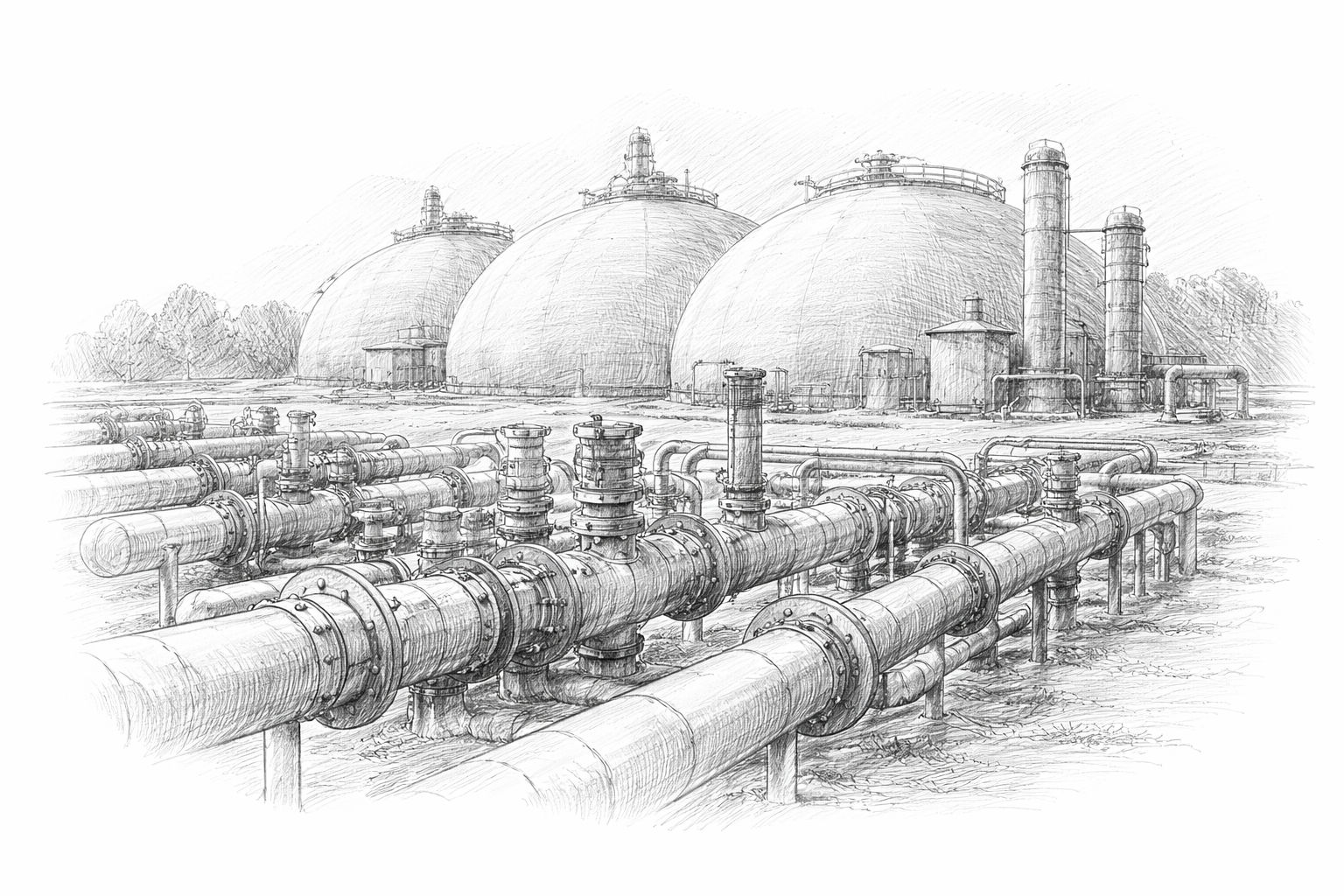
When the news reports about „40 percent filling level of the gas storage facilities“ When we talk about percentages, it sounds abstract at first. Percentages seem technical, far removed from everyday life. And yet there is something very concrete behind it: the question of how stable our energy supply really is - not in theory, but in everyday practice.
Gas is not only used for industrial plants or power stations in Germany. It heats homes, supplies hot water, drives district heating networks and is still the central backbone of the energy supply in many regions. Unlike electricity, however, gas cannot be produced at will „at the push of a button“. It has to be extracted, transported - and above all stored.
This is where the gas storage facilities come into play. They are like the country's store cupboard. As long as it is well filled, hardly anyone gives it a second thought. If it becomes visibly empty, questions arise: Will it last? For how long? And what happens if things continue to go downhill?

Latest news on gas supply in Germany
14.03.2026: A recent report in the Berliner Zeitung shows that Europe's gas supply transition following the Russian gas embargo is facing a major challenge. structural challenge. Following the EU's decision to phase out Russian gas completely by 2027, LNG (liquefied natural gas) has become much more important - the share of LNG imports in the EU gas supply recently rose to over 43 %. However, LNG is generally more expensive and more volatile than Russian pipeline gas, and geopolitical tensions such as the Iran crisis are exacerbating the situation. The result: rising energy prices, uncertain storage levels and increasingly risky gas trading with global competition for scarce LNG supplies.
09.03.2026: According to a Report in the Berliner Zeitung the refilling of European gas storage facilities for the coming winter could become significantly more expensive than previously assumed. The background to this is the increased competition for globally available LNG supplies and geopolitical tensions, which are putting additional pressure on the gas market. Experts assume that Europe will have to procure around 700 LNG cargoes in order to fill its storage facilities sufficiently for next winter. Due to the increased prices, filling could take around Cost 11.7 billion euros more than in the previous year. The situation shows how much Europe's energy supply now depends on global LNG markets and how sensitive the system is to international crises.
05.03.2026: Russia's President Vladimir Putin is currently having a review (Spiegel Online, Reuters) as to whether gas supplies to the European Union should be stopped immediately, even before an already agreed EU plan to phase out Russian gas is fully implemented. According to Russian media, Putin is considering cutting off supplies and relying on other, “more reliable” export markets instead, because the EU wants to end imports completely by 2027 at the latest. This threat comes at a time of global energy uncertainty, in which geopolitical tensions on the gas market are also becoming apparent. Should Moscow actually suspend deliveries, this would make it much more difficult to fill Europe's gas storage facilities in the summer and put additional pressure on the energy markets, as alternative supply capacities such as LNG or pipeline import networks would then be in even greater demand.
20.02.2026: According to T-Online, German gas storage facilities are currently only about one fifth full, which is well below historical averages and may pose new risks in spring. Simulations by experts show that, under normal weather conditions, storage levels could fall to around 16 % by the end of March before a slight increase becomes apparent. In an extreme cold scenario, levels below 10 % would even be possible, although experts consider this unlikely. Although models and authorities do not currently see a complete lack of storage, the further development remains closely linked to the weather, demand and import flows.
17.02.2026: In a recent video by the CDU-affiliated Union Foundation analyzes the German gas supply situation with a view to the winter of 2026. The low storage levels, the growing dependence on LNG imports from the USA, Norway and Qatar and the particular situation in southern Germany, especially in Bavaria, are discussed. The connection between gas and electricity prices is also explained, as rising gas prices have a direct impact on the electricity market via the merit order. The growing demand for energy due to AI data centers and new gas-fired power plants worldwide is also classified as an additional burdening factor.

Rising gas prices, exploding electricity costs - what's in store for us? | Union Foundation
The current status of gas storage facilities in Germany can be viewed at the Federal Network Agency can be viewed with a delay of a few days to the current day. The data of all gas storage facilities in Germany and Europe are available in real time. available on the AGSI website.
16.02.2026: According to Apollo News are the German LNG imports recently slumped significantly - to its lowest level this winter. One of the reasons for this is that ice off the island of Rügen has made access to the LNG terminal in Mukran more difficult because vehicles such as icebreakers have not been able to get through in sufficient numbers or without technical problems. This delays the unloading of LNG tankers, which puts additional pressure on the import route. The German government continues to rely on LNG infrastructure to secure supplies, but these logistical challenges illustrate how sensitive such supply routes can be to seasonal weather conditions.
Gas consumption is not uniform - and that is precisely the problem
One key point is often underestimated in the public debate: gas consumption fluctuates greatly. And not just a little, but massively. In summer, consumption is comparatively low. Heating systems hardly ever run, hot water is used more sparingly and many industrial processes can be planned more consistently. In winter, on the other hand, demand rises sharply - depending on temperature, weather conditions and economic activity.
However, gas is not extracted „in stock“ like coal or oil. It flows continuously through pipelines or is landed as LNG. These supply flows are relatively constant, but consumption is not. This is precisely where a structural gap arises:
- In the Summer more gas enters the country than is consumed
- In the Winter significantly more gas is consumed than can be supplied in the short term
Without storage, this system would not work. There would be surpluses in summer and shortages in winter - regardless of how reliable suppliers are.
Gas storage facilities are therefore not a luxury, but a technical necessity.
Gas storage facilities are not a substitute for supplies - they are a time buffer. An important error in thinking is to regard gas storage facilities as a „reserve for emergencies“. They are indeed that - but above all they are something else: a balancing mechanism.
You can think of it like a water tank that sits between a constant supply and a strongly fluctuating consumption. The tank does not produce anything itself. It only ensures that supply and demand can be decoupled over time. This also means that gas storage tanks do not replace ongoing supplies. They can only supplement, cushion and bridge the gap. If more is withdrawn than is stored over a longer period of time, the fill level will inevitably fall - regardless of how large the storage facility originally was.
This insight is important in order to classify percentages correctly. A storage tank with a 40 percent fill level can be completely uncritical in a stable supply situation - or an early warning signal in a tense situation. The figure alone says little. The context is crucial.
Why Germany is particularly reliant on storage
Over decades, Germany has built up a gas infrastructure that was designed for continuous supply and high reliability. For a long time, pipeline gas from a few, easily plannable sources played a central role in this. Storage facilities were an integral part of this system - not as an exception, but as the norm.
In addition, Germany is not a traditional producer country. The majority of natural gas is imported. This automatically increases the importance of storage facilities, as they offer:
- Time flexibility
- Security of supply in the event of supply interruptions
- Stability in extreme weather conditions
- Relief for the grids during consumption peaks
In short: without storage, the German gas grid would be structurally unstable.
Fill level does not equal availability
One point that will play a central role in the rest of the article should already be touched on here: A high filling level does not automatically mean high performance. Gas storage tanks work physically via pressure. The fuller they are, the easier it is to extract gas. If the filling level drops, the pressure also drops - and with it the maximum possible withdrawal quantity per day.
It's comparable to a water bottle: as long as it's full, the water flows easily. The emptier it gets, the more you have to tip, shake and help. At some point, some will still come out - but not in the quantity you might need.
In terms of supply, this means that there is not only an „empty“ limit, but also functional thresholds above which storage facilities still contain gas, but can no longer supply sufficient capacity. This differentiation is crucial - and will be explained in more detail later.
Percentages have a psychological effect. 40 percent sounds like „not yet critical“, 80 percent like „safe“, 10 percent like „alarm“. In technical systems, however, such linear interpretations are often wrong.
A storage tank is not a linear vessel that functions evenly from 100 to 0. Rather, its behavior changes as the fill level decreases. There are also other factors:
- Type of memory
- Design of the system
- Current withdrawal rate
- Network situation
- Weather conditions
A well-filled storage tank in the fall has a completely different significance than the same level in February when it is still cold. Anyone who only looks at the percentage overlooks these correlations.
This is precisely why it is worth taking a structured look at the topic - not in headlines, but in context.
A sober view instead of alarmism
This chapter - and the entire article - deliberately does not take an alarmist approach. Panic doesn't help anyone. But neither does trivializing or omitting uncomfortable technical realities. Gas storage facilities are neither a panacea nor a ticking time bomb. They are a highly complex instrument for stabilizing the energy supply that has proven itself over decades. Knowing their limits is not a sign of fear, but of understanding.
In the next chapter, we will therefore take a concrete look at how the German gas storage landscape is structured: what types of storage facilities there are, where they are located, how large they are - and why their design is decisive for how they behave in critical phases. This turns the abstract figure of „40 percent“ into a comprehensible picture.
Germany's gas storage landscape: locations, types and capacities
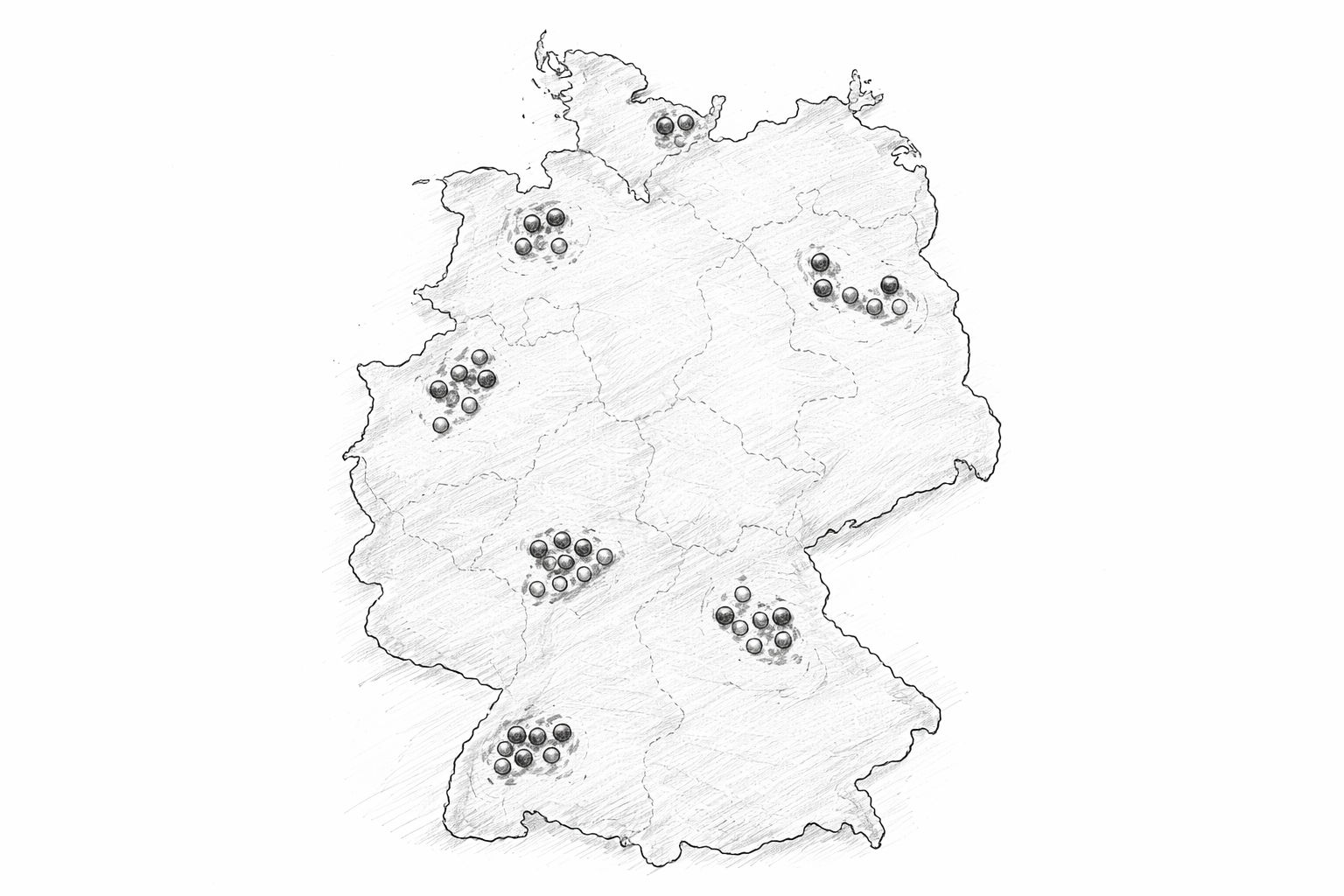
Anyone who thinks of Germany's gas storage facilities as one large central tank is mistaken. In fact, it is a densely distributed network of many individual storage facilities that have historically developed where geology, infrastructure and demand matched. This decentralization is no coincidence, but a stability factor: it allows regional balancing movements, shortens transport routes and reduces dependencies on individual hubs.
In total, Germany has around 40 underground gas storage facilities (depending on how you count and combine individual cavern locations). This means that Germany has been one of the countries with the largest storage capacity in Europe for decades. The facilities are mainly concentrated in northern and western Germany, with additional clusters in southern Germany.
Why gas storage facilities are located where they are
The location of a gas storage facility is not a political wish list, but geology. Two conditions are decisive:
- Suitable underground formationsNot every subsurface is suitable for storing large quantities of gas. Salt domes (for cavern storage) or porous rock layers of former natural gas or oil fields are particularly in demand
- Connection to the gas gridA storage facility is of little use if it is not efficiently integrated into the transmission grid. Many German storage facilities are therefore located near historically grown transit axes and consumption centers.
This combination explains why large storage sites are mainly located in Lower Saxony, North Rhine-Westphalia, Saxony-Anhalt, Bavaria and Baden-Württemberg.
Two basic types: Cavern storage and pore storage
Germany's storage landscape can technically be reduced to two main types. Both fulfill the same task, but differ significantly in their behavior.
Cavern storage - fast, flexible, powerful
Cavern storage facilities are created artificially. Large cavities are flushed out of deep salt formations, which are then filled with gas. Salt is ideal for this: it is dense, stable and self-sealing. Typical properties:
- Very high storage and retrieval capacity
- Particularly suitable for short-term peaks (e.g. cold spells)
- Comparatively low storage volume, but high dynamics
Cavern storage systems can be described as the system's „sprint reserves“. They are not primarily intended for continuous withdrawal over months, but for rapid reactions to fluctuations in demand.
Pore storage - large-volume, inert, balancing
Pore storage facilities use former natural gas or oil fields or natural water-bearing rock layers. The gas is stored in the pores of the rock - similar to water in a sponge. Typical properties:
- Very large storage capacity
- Lower storage and retrieval capacity
- Ideal for seasonal compensation (summer → winter)
Pore storage systems are the „long-distance runners“ of gas supply. They supply gas continuously over long periods of time, but react less flexibly to short-term peak loads.
Working gas, cushion gas - and why capacity is not the same as usable volume
When people talk about the „capacity“ of German gas storage facilities, they almost always mean the working gas volume. This is the part of the gas that can actually be injected and withdrawn during normal operation. This is to be distinguished from cushion gas:
- It remains permanently in the memory
- It ensures the necessary minimum pressure
- Without cushion gas, the storage tank would not be technically operable
Depending on the storage type, the cushion gas content can be considerable. It is generally higher in pore storage tanks than in caverns. This means that
A storage facility can appear „full“ even though a significant proportion of the gas can never be used for supply.
This is important for public perception, as total volumes are often mentioned without explaining this differentiation. If you want to understand capacities properly, you always have to ask: How much of this is actually working gas?
Order of magnitude: How much gas can Germany store?
In total, the working gas capacity of German storage facilities is around 23 to 24 billion cubic meters, which corresponds to around 240 to 250 terawatt hours of energy. That sounds like a lot - and it is. But this figure only becomes significant in proportion:
- It roughly corresponds to two to two and a half average winter months of gas consumption
- It is not enough to bridge an entire heating period without ongoing imports
- It is sufficient to cushion supply disruptions, not to replace them permanently
This is a common misconception: gas storage facilities are not a self-sufficient supply system, but a buffer within an ongoing market.
Operator structure: Private plants with systemic importance
Another point that is often misunderstood: Most gas storage facilities in Germany belong to private or semi-private operators. They are not state emergency storage facilities in the traditional sense.
Many operators across the industry are organized in the German Energy Storage Association (Verband Energien Speichern e.V.), which pools the interests of gas and energy storage companies. Storage facilities are used on a market basis - i.e. depending on prices, contracts and economic expectations.
Only in exceptional situations does the state intervene to regulate, for example via statutory filling level requirements or as part of the gas emergency plan. This also explains why storage levels cannot be viewed in isolation: They are always also the result of market decisions.
Regional differences and their significance
Not every storage facility is equally important. Some facilities primarily supply regional grids, while others are systemically relevant for the entire transmission grid. Large pore storage facilities can supply base load for weeks, while caverns can provide enormous quantities in just a few days - and can be empty again just as quickly.
For overall stability, it is therefore not just the sum of all storage units that counts, but also the sum of all storage units:
- their geographical distribution
- their technical design
- their integration into the network
A bottleneck in one region cannot always be easily compensated for by a storage facility at the other end of the country.
This makes it clear that Germany's gas storage landscape is complex, efficient - and limited. It does not function according to simple percentage logic, but according to physical and technical rules.
The next chapter therefore goes one step deeper: What happens technically when storage tanks become empty? Why does not only the volume decrease, but also the withdrawal rate - and why terms such as „15 percent remaining fill level“ mean more than just a symbolic mark. Only then does it become clear when a storage tank really becomes critical - and why this often happens earlier than many expect.
Overview of available memory types
| Memory type | Technical principle | Strengths in operation | Typical role in the system | Properties |
|---|---|---|---|---|
| Cavern storage (salt) | Artificially flushed out cavities in salt formations. | High storage/retrieval capacity, fast response to peak demand. | „Sprint reserve“ for short-term load peaks (e.g. cold spells). | Can deliver a lot quickly, but can also fall „dynamically“ more quickly. |
| Pore storage (former gas/oil fields) | Storage in porous rock, gas is distributed in the formation. | Very large capacity, suitable for longer withdrawal periods. | „Long-distance buffer“ for seasonal compensation (summer → winter). | Performance can be slower; capacity alone says little about daily quantities. |
| Aquifer storage (water-bearing) | Storage in water-bearing rock layers (technically demanding). | Can provide additional capacity if geologically suitable. | Supplementary storage where other structures are lacking. | More complex depending on the system; statements on performance are highly location-dependent. |
The part that many overlook: Cushion gas, pressure and extraction rate
When people talk about gas storage tanks, the image of a tank that empties evenly quickly arises: full at the top, empty at the bottom, with a simple scale in between. This image is intuitive - but technically incorrect. A gas storage facility is not a passive container, but a pressure-dependent system. And it is precisely this point that is almost always overlooked in the public debate.
A storage facility supplies gas not because there is still „something in it“, but because there is enough pressure to release gas into the network at a sufficient rate. If the pressure drops, not only does the quantity drop, but above all the performance of the storage facility. That is the core of this chapter.
Cushion gas: The invisible base of the supply
Every underground gas storage facility requires a minimum quantity of gas that remains permanently in the storage facility. This gas is called cushion gas. It fulfills a purely technical function:
- Build-up and maintenance of the necessary pressure level
- Stabilization of the geological structure
- Ensuring the extraction capability of the working gas
Without cushion gas, a storage facility would simply not be operable. It is not a „reserve gas“ for bad times, but the basic prerequisite for being able to withdraw gas at all. The crucial point:
Cushion gas is not part of the available supply. It cannot be used without endangering the storage tank itself or rendering it inoperable. Depending on the storage tank type, the proportion of cushion gas is roughly between:
- approx. 20-40 % for cavern storage systems
- partly significantly higher for porous storage tanks
These figures are not exact limit values, but orders of magnitude. However, they make it clear why the statement „the storage tank is still X percent full“ is not very meaningful without context.
Working gas is not immediately usable - at least not at all times
The gas above the cushion gas is referred to as the working gas. It is the part that is theoretically available for the supply. However, the following also applies here: „available“ does not automatically mean „can be called up at will“. Working gas can only be extracted efficiently if:
- the pressure is high enough
- the storage system is designed for this
- the connected network can absorb the quantities
The lower the fill level, the closer the system gets to the area in which working gas is still present but can only be extracted slowly or to a limited extent.
This is not a political problem, but pure physics.
Pressure: the decisive factor behind all percentages
Gas does not flow by itself. It follows pressure differences. In a storage tank, this means that the fuller the tank, the higher the pressure - and the easier it is to extract gas.
At the start of emptying, storage tanks operate in a so-called plateau range. In this range, an almost constant withdrawal quantity can be supplied over a longer period of time. This is exactly where systems feel „stable“. If the fill level drops further, the following happens:
- the pressure decreases
- the maximum possible daily withdrawal decreases
- the storage system reacts more slowly to peaks in demand
At a certain point, the storage tank leaves the plateau area. From then on, it is no longer the amount of gas stored that is the limiting factor, but the withdrawal rate. This is the moment when storage levels can still have a calming effect psychologically, but are already becoming critical technically.
Current survey on trust in politics
Withdrawal rate: Why „there's still enough gas“ is not enough
The decisive factor for the supply is not how much gas is still in the storage facility, but how much gas can be withdrawn per day. A simplified example:
- A storage tank still contains enough gas for several weeks
- At the same time, the maximum daily withdrawal is no longer sufficient to cover current consumption
In such a case, a supply problem arises even though the storage tank is not „empty“. The system fails not because of the quantity, but because of the capacity. This is precisely the second, often overlooked threshold of gas storage systems:
The Power threshold, not the empty limit. This threshold is not fixed at a specific percentage value. It depends on:
- Memory type
- Design of the system
- Network situation
- current consumption
This is why blanket statements such as „below 15 percent it becomes critical“ are not completely out of thin air, but are too rough to serve as a hard limit.
Why low levels are systemically more sensitive than high levels
Storage tanks are comparatively robust in high filling level ranges. Small fluctuations can be absorbed well technically. The lower the fill level drops, the more sensitive the system becomes:
- Small increases in consumption have a greater impact
- Cold spells hit faster
- Technical reserves are shrinking
You can compare it to a car whose fuel gauge is approaching the red zone. Not because the car stops immediately, but because every additional load suddenly becomes relevant. In the gas supply sector, storage facilities do not work in isolation. They are part of a network. If their capacity drops, other sources have to step in - such as imports, LNG landings or other storage facilities. If this does not work sufficiently, a structural bottleneck occurs.
The psychological trap of percentages
Percentages suggest linearity: 50 % sounds like „half full“, 25 % like „a quarter left“. Technically, this view is misleading. A memory at 25 % can:
- still deliver relatively well - or
- already be severely restricted
Both are possible. The decisive factor is not the percentage value, but where the storage tank is located on its pressure and performance curve.
This also explains why experts often react more nervously to falling storage levels than the general public. They not only see the quantity, but also the underlying physical limits.
Assessment: Warning of industrial shutdowns and economic consequences
In an interview with Apollo News, energy expert Fritz Vahrenholt warns of a renewed deterioration in the gas situation. In view of significantly falling storage levels, he believes that shutdowns in the industry are possible and sees considerable risks for economic development. He is particularly critical of the German government's current energy policy, which he accuses of ignoring structural problems for too long. The interview classifies the current situation as more than just a short-term fluctuation and focuses on the question of how resilient the gas supply actually is in the face of sustained consumption and limited reserves.

„Then there will be shutdowns“ - Interview with Fritz Vahrenholt | Apollo News
Why these connections are rarely explained openly
There are several reasons why cushion gas, pressure and withdrawal rates are rarely mentioned in public communication:
- The relationships are technical and difficult to simplify
- Percentages are easier to communicate
- Politically, simple messages are often more attractive
The result is a debate that focuses on visible values and ignores invisible but decisive factors. This is not necessarily malicious intent - but it does lead to misjudgements. A sober view of technology is therefore not alarmism, but a prerequisite for realistic classification.
At this point, it becomes clear that a gas storage facility can reach its functional limits long before it is calculated to be empty. Not because the gas is „gone“, but because it is no longer available quickly enough.
The next chapter therefore deals with the practical consequences of this finding: What happens if storage continues to fall? What specific risks arise - and why can problems occur even though statistically there are still considerable quantities available? This is where technology becomes reality.
Components and factors that influence gas extraction
| Building block | What it means | Why it is important | Typical misunderstandings |
|---|---|---|---|
| Working gas | The proportion of the storage tank that can be regularly injected and withdrawn. | Describes the „usable“ storage quantity for the supply. | Is incorrectly equated with „total gas in the storage tank“. |
| Pillow gas | Gas that remains permanently in the storage tank to ensure minimum pressure and stability. | Explains why a memory can never be emptied „up to 0 %“. | Often misunderstood as a „reserve“ that can simply be used in an emergency. |
| Pressure level | Physical basis for the removal capability (the higher, the easier the removal). | Shows why the performance decreases as the fill level falls. | „Percent“ is interpreted as a linear scale, although performance is not linear. |
| Withdrawal rate | Maximum possible gas delivery per day from a storage tank. | Crucial for supply during cold phases and peak loads. | „Still enough gas“ is confused with „still enough daily power“. |
| Plateau phase | Range in which storage tanks can supply relatively constant high daily volumes over a longer period of time. | Explains why it appears „stable“ for a long time - and can then suddenly tip over. | It is believed that the power remains constant until shortly before empty. |
| Power threshold | Point at which extraction capability decreases significantly, although gas is still present. | Important for understanding „critical before empty“. | Is confused with a fixed percentage limit (e.g. 15 %). |
LNG terminals in winter: Why rated capacity does not equal availability
The officially communicated capacities of German LNG terminals are mainly based on optimal operating conditions, which occur primarily in the summer months. Technically, this is known as open-loop operation, in which relatively warm seawater is used to regasify the cryogenic LNG.
However, if the water temperature drops - below 4 to 5 degrees Celsius in winter, for example - this operation is no longer possible. The systems then have to switch to closed-loop mode, in which water is heated on board using gas burners. For physical reasons, this switch leads to a noticeable reduction in the feed-in power and at the same time increases the self-consumption of the gas. The actual amount of LNG available in winter is therefore well below the peak values often mentioned.
Logistics and physics as limiting factors for LNG supply
In addition to the reduced regasification capacity, logistics also play a key role. In order to maintain a realistic feed-in volume even in winter, an almost uninterrupted delivery of LNG tankers is required. Any downtime due to weather, technical problems or delays has a direct impact on the amount of gas available.
LNG terminals are therefore not an autonomous supply system, but part of a sensitive chain of global transportation, port operations and technical conversion. As with gas storage facilities, this is also evident here: Security of supply does not arise from theoretical maximum values, but from the question of what capacity can be permanently called up under real winter conditions.
Current statements in the wider security policy context
 In recent years, the Russian president has publicly stated on several occasions that gas could continue to be supplied to Germany via the remaining Nord Stream 2 pipeline if the political green light is given. However, these statements are never isolated, but are part of a broader security and geopolitical context that extends far beyond energy issues. Anyone wishing to understand how such offers are categorized and which arguments play a role in the current debate can find more information in the Article on NATO and Russia a systematic analysis of interests, risks, perceptions and political conclusions.




What happens if gas storage continues to fall?
Falling memory levels are initially a statistical finding. But at a certain point, these statistics turn into an operational challenge. Then it is no longer a question of forecasts or diagrams, but of very specific questions: Is the daily withdrawal quantity still sufficient? Can load peaks be cushioned? And how stable will the overall system remain under additional stress?
This chapter does not describe the extreme case, but the transitional area - precisely where supply is still formally available, but safety margins are shrinking noticeably.
Step one: The power reserve begins to disappear
As described in the previous chapter, storage tanks primarily lose capacity as the fill level falls. As long as the system remains in the so-called plateau range, this is hardly noticeable. However, as soon as this range is left, the general conditions change:
- Storage facilities can supply less gas per day
- Flexibility for short-term consumption peaks decreases
- Reserves for unexpected events are shrinking
This is not a visible change for households at first. However, industry, grid operators and large consumers will notice this change much earlier because they are dependent on predictable, high daily volumes.
Step two: weather and consumption suddenly gain in importance
In phases of high storage levels, cold days can be cushioned relatively easily. Falling storage levels change this equation. Any additional cold spell then has a disproportionately strong effect. A few degrees less outside temperature means
- significantly higher heating requirements
- Increased gas extraction within a few days
- greater pressure drop in the storage tanks
What was previously a normal winter day now becomes a stress test. The supply does not immediately collapse, but it becomes more sensitive to fluctuations.
Step three: The network becomes a bottleneck factor
Gas storage facilities are always part of a network. If their capacity drops, other sources have to step in - such as imports, LNG terminals or alternative storage locations. But the grid itself also has limits:
- Transport capacities are not infinitely scalable
- Regional bottlenecks cannot be compensated for immediately
- Detour cost time and management effort
In this phase, it becomes clear why storage facilities are distributed regionally - and why this distribution is nevertheless no guarantee of smooth balancing movements.
Step four: Industry and large consumers come under pressure first
An important, often misunderstood point: supply problems do not start with households. They start with the sectors that can - or must - react flexibly. Industry and large commercial consumers:
- require high, constant daily quantities
- are technically more controllable
- are not considered „protected customers“
If the amount of gas available per day decreases, adjustments are necessary here first. This can range from voluntary load reduction and production curtailment to contractually regulated shutdowns.
This is rational for the overall supply. For the companies affected, it is economically painful - and economically noticeable.
Step five: Psychological stability becomes a factor
As long as gas is reliably available, trust hardly plays a role. Only when storage levels fall does it become clear how important expectations are.
- Companies are hedging more cautiously
- Market participants react more sensitively to news
- Prices react more quickly to uncertainties
An emptying store not only has a physical effect, but also a psychological one. It changes decisions - sometimes faster than the actual supply situation would justify.
This effect is self-reinforcing: Caution generates additional demand for hedging, which in turn puts a strain on the system.
Step six: Small disruptions have major consequences
In well-buffered systems, minor faults often go unnoticed. The opposite is true for low memory levels:
- Technical maintenance is becoming more critical
- Delays in imports have a more immediate effect
- Unplanned downtime is more difficult to compensate for
The system loses its fault tolerance. Not because it is poorly designed, but because its buffers are deliberately shrinking.
What does not happen automatically
It is also important to state clearly what will not happen automatically if storage continues to fall:
- Households are not suddenly switched off
- There is no immediate supply disruption
- the system remains controllable
Gas storage tanks are not a binary system. There is no switch from „all good“ to „all off“. Instead, risk zones are shifting - slowly but noticeably.
Why this transition area is politically sensitive
This phase in particular is difficult in terms of communication. Officially, the supply is still secure, but technically decisions are becoming tighter. Warnings quickly come across as alarmist, reassurances as naïve.
What's more, measures designed to stabilize the system - such as load reductions in industry - are visible and tangible, even though they are designed to prevent worse things from happening. This makes declining storage levels an issue that has less to do with panic than with early, sober management.
If storage tanks continue to fall, the focus will shift from technology to organization. Then it's no longer just about pressure and withdrawal rates, but about rules, responsibilities and priorities.
The next chapter will therefore clarify: When does the state intervene - and how exactly? When is a gas shortage declared, who makes the decision and what criteria are used for distribution? Only then does it become clear how technical scarcity becomes a formal crisis mechanism - and what this means in concrete terms.
Documentation: Energy dependency, the turnaround and the search for stability
In a documentary by Bayerischer Rundfunk, the central energy policy question of recent years is addressed: How vulnerable is Germany's energy supply - and how can this vulnerability be reduced? The war in Ukraine has suddenly highlighted the country's dependence on Russian coal, oil and gas. The German government responded with the aim of eliminating these imports as quickly as possible, expanding renewable energies and significantly reducing energy consumption. At the same time, there are growing concerns about supply bottlenecks and rising prices. The documentary assesses these tensions and asks soberly how a secure, sustainable energy mix can be achieved under real conditions.

The energy dilemma: How do we secure our supply? | Documentary BR Story
Legal situation and crisis mechanics: When the state intervenes
Falling storage levels and limited withdrawal rates do not yet mean a legal crisis. The gas supply in Germany is organized in such a way that technical bottlenecks are initially cushioned by the market and operations. Only when these mechanisms are no longer sufficient does a clearly defined state framework come into play.
This framework is not an improvised instrument, but has been prepared for years: the gas emergency plan. It defines when, how and by whom intervention is to take place - and, above all, in what order.
It is precisely because these rules are rarely discussed in public that many misunderstandings arise in tense phases. This chapter therefore aims to explain soberly what actually happens legally - and what does not.
The gas emergency plan: three stages, clear escalation
The legal basis of the German crisis mechanism is the Gas Emergency Plan, which is embedded in European guidelines. It distinguishes between three levels of escalation, which are deliberately separated from one another.
1st early warning level - increased attention
The early warning level is declared if there are signs of a concrete deterioration in the supply situation, for example due to:
- geopolitical tensions
- Technical problems with suppliers
- Unusually high demand
Important: In this phase, there is still no state coercion. Market mechanisms continue to function, storage facilities are used and supply flows are adjusted. The early warning stage is above all a signal: to market participants, grid operators and the public.
2nd alarm level - the market is coming under pressure
The alert level marks the point at which the situation becomes more serious. Supply is still possible, but no longer stable. Typical characteristics:
- Continued high withdrawals
- Limited delivery flexibility
- Rising prices
- Increased coordination requirements
Here too, the state is monitoring, coordinating and communicating - but it is not yet actively distributing gas. Companies are still responsible for fulfilling their contracts and securing themselves. This phase in particular is politically sensitive because it is often accompanied by significant economic consequences without any formal mention of an „emergency“.
3. the emergency stage: when market mechanisms are no longer sufficient
The system only changes fundamentally with the emergency level. It is declared when:
- the market can no longer guarantee supply
- technical and economic measures have been exhausted
- there is a significant risk to the gas supply
From this moment on, the state takes on an active role. The Federal Network Agency, which acts as the federal load distributor, is then responsible.
This is the transition from market control to sovereign allocation.
Federal load distributor: What this means in concrete terms
As the federal load distributor, the Federal Network Agency does not make decisions in the abstract, but operationally. It determines:
- which consumers will continue to be supplied
- where loads are reduced
- which shutdowns are required
It does not follow political moods, but legally defined priorities. The aim is not economic optimization, but the safeguarding of vital supplies.
Protected customers: Who has priority - and why
A central concept in the crisis mechanism is that of protected customers. These include in particular
- private households
- Social institutions such as hospitals
- certain district heating systems that supply households
These groups have priority. Their supply should be maintained for as long as possible - even if other consumers have to accept restrictions.
This does not mean that households are „untouchable“. But they are at the end of the intervention chain, not the beginning.
Industry and commerce: why they are affected first
Industry and large commercial consumers are not considered protected customers. There are several reasons for this:
- they consume large, controllable quantities
- you can throttle or change processes
- their supply is technically easier to interrupt
In an emergency situation, it is therefore rational to start here first. This can mean
- Contractually regulated shutdowns
- Temporary production stops
- Targeted load reductions
These measures are not a sign of arbitrariness, but part of a deliberate damage limitation concept.
Regional implementation: the crisis is not the same everywhere
Even in the emergency stage, there is no „uniform nationwide shutdown“. The gas supply is organized regionally, and bottlenecks often occur locally or on a grid-related basis. This means that:
- certain regions may be affected earlier
- other areas remain stable for longer
- Measures vary in intensity
This often seems unfair to those affected. Technically, however, it is a consequence of the network structure - not political decisions.
Why there are no fixed percentage limits
A common mistake: the assumption that a gas shortage is automatically declared at a certain storage level. This is not the case. The declaration of the emergency level depends on:
- available daily output
- Grid stability
- Import options
- Weather development
- Market reactions
A storage level of 20 % can be manageable - or critical. Conversely, a higher level can also be problematic if withdrawal rates are insufficient.
Legally, it is not the percentage that counts, but the ability to provide.
Communication between safety and panic prevention
An underestimated aspect of the crisis mechanism is communication. The state has a dual responsibility:
- Warn early
- Avoid unnecessary panic
Alerting too early can destabilize markets. Acting too late can destroy confidence. This is why official statements often come across as cautious, sometimes even appeasing. This is not a sign of a lack of transparency, but an expression of a fine balancing act.
The legal instruments are clearly defined. They take effect late, in a targeted manner and according to fixed rules. However, the decisive factor is how early a system is managed so that these instruments are not necessary at all.
The final chapter therefore deals with the overarching question: What do we learn from this structure - and what does this realistically mean for politics, the economy and society? Not as a list of demands, but as a sober classification of what gas storage facilities can - and cannot - achieve.
The gas emergency plan at a glance
| Level | What it signals | Market reactions | What can change | Who is affected first |
|---|---|---|---|---|
| Early warning level | There are indications of a deterioration in the supply situation. | Market mechanisms continue, storage/imports are adjusted. | More monitoring, more coordination, initial precautionary measures. | As a rule, no one immediately - rather increased vigilance. |
| Alarm level | The situation is tense, supply is still possible, but less stable. | Market still functions, but with greater pressure (prices, procurement, risk). | Load reduction may increase, companies react more cautiously. | Often industry/large consumers voluntarily or contractually via flexibilities. |
| Emergency level | Market mechanisms are no longer sufficient, state distribution becomes necessary. | Market recedes into the background; sovereign control becomes possible. | Federal load distributor prioritized; allocation/shutdowns are ordered. | Non-protected customers first: large parts of industry and commerce. |
Further information in the FAQ of the Federal Network Agency
The lessons learned: Security of supply is a question of balance
Gas storage facilities are a key stabilizing element of the energy supply. They balance out temporal fluctuations, buffer peak loads and give the system room for maneuver. This interaction has proven itself over decades. At the same time, the previous chapters show very clearly that gas storage facilities are no substitute for reliable supply structures. They buy time, but they do not create energy.
Falling storage levels are therefore less an isolated problem than an indicator. They indicate that injection and withdrawal, demand, weather and supply flows are no longer in balance. Anyone who looks at storage alone is ignoring the real core of the issue: the structure of supply.
The original insight: avoid dependencies
For a long time, Germany had a comparatively sober energy policy guideline: not to be dependent on a single supplier. This insight did not arise from ideology, but from experience. Security of supply thrives on diversification - geographically, technically and contractually.
This logic applied regardless of which country the gas came from. It was not aimed at a specific supplier, but at the principle of risk diversification. Pipeline gas from different directions, storage as a buffer, flexible trading structures - all this was part of a system designed for robustness.
From one dependency to the next?
With the complete renunciation of Russian pipeline gas, a break was made that was politically justified and highly charged in terms of communication. Regardless of the assessment of this decision, a factual question arises today: is the new structure really less dependent - or just differently dependent? The current focus on LNG is fundamentally changing the dependency structure:
- Gas is traded globally, often at shorter notice and with greater price volatility
- Supply chains are longer and more susceptible to disruption
- Infrastructure such as terminals, transportation and regasification is gaining in importance
LNG offers flexibility, but it is no substitute for long-term stable supply relationships. Those who rely almost entirely on LNG are more exposed to the dynamics of the global market - including competition for cargoes, price peaks and geopolitical events outside Europe.
Nord Stream, security of supply and the question of dependency
 The discussion about gas storage inevitably leads to a more fundamental question: how did Germany end up in this supply situation in the first place? In my article on Nord Stream, I dealt with precisely this - not polemically, but analytically. It deals with infrastructure decisions, political decisions and the often abbreviated depiction of „dependency“. In connection with the gas storage facilities, it becomes clear that the abandonment of Russian pipeline gas has not only changed supply flows, but also the functioning of the entire supply system. Storage levels, LNG imports and price volatility can hardly be meaningfully assessed without this context. The Nord Stream article therefore provides the necessary historical and structural context to understand the current situation not in isolation, but as the result of successive decisions.
Security of supply is not an either-or proposition
The real lesson from the storage debate is therefore not to demonize or idealize a particular source. It is this:
Security of supply is created through diversity, not exclusion. A resilient system is characterized by the fact that:
- several sources of supply are available in parallel
- different transportation routes exist
- Storage used strategically
- Dependencies are limited and distributed
This explicitly includes LNG. However, there is an argument against making a single supply logic the dominant pillar - no matter how well-founded it may seem at the political moment.
Memory as a seismograph, not as a culprit
In the public debate, gas storage facilities are easily cast as the cause of the problem. In fact, they are more of a seismograph. They indicate how well or poorly the overall system is currently balanced.
High levels signal relaxation, falling levels indicate structural tensions. The storage tanks themselves are not the problem, but reveal where the system is coming under pressure. If you draw the wrong conclusions from low levels, you run the risk of working on symptoms instead of causes.
This is precisely why it would make sense to review the German gas strategy soberly and without symbolic exaggeration. Not with the aim of reversing past decisions, but to take the original logic of diversification seriously. This includes:
- Evaluate sources of supply functionally rather than ideologically
- Transparently naming dependencies - including new
- To once again understand storage systems for what they are: Buffers, not lifelines
Such a reassessment does not mean abandoning political positions. It means bringing technical reality and strategic reason closer together again.
Responsibility also means keeping options open
Energy policy is always policy under uncertainty. Nobody has a crystal ball. This is precisely why it is wise not to close options prematurely. A system that only knows one direction is not robust, but fragile - even if this direction works well in the short term.
Germany has the technical expertise, the infrastructure and the experience to operate a diversified supply system. The gas storage facilities are part of this. LNG can be part of it. Pipeline gas can - in principle - also be part of it. The decisive factor is not the individual source, but the balance between them.
Falling memory levels are no reason to panic. But they are a cause for reflection. They are a reminder that security of supply does not come from political slogans, but from technical reality, strategic balance and long-term thinking.
Perhaps the most important lesson lies precisely here: Don't always replace new dependencies with old ones - but stick to what you have once recognized as right.
In-depth: How energy prices really arise - beyond the headlines
 If you want to understand why falling or rising gas storage levels play such an important role at all, there is no getting around the mechanisms of energy price formation. In my detailed Articles on energy prices I am investigating precisely this question: How are gas prices, electricity prices and gasoline prices actually made up? What role do procurement costs, network charges, taxes, levies and market logic play - and where do the greatest distortions arise between real scarcity and public perception? The article adds a crucial perspective to the gas storage analysis: prices often react earlier and more strongly than the physical supply situation. Anyone who understands pricing is much better able to classify political decisions, market reactions and individual burdens - without being guided by simplified explanations.
Older news about the article
11.02.2026: According to the financial publication THE SHAREHOLDER the current tense situation of German gas storage facilities is the reason for new financial assessments. In a current report entitled „Gas emergency plan“ highlights that storage levels have fallen below the critical level of around 30 % and could fall further. Experts warn that a further reduction to below 20 % could lead to emergency legal measures such as curtailing the supply of gas to industry in order to protect households and critical facilities. Against this backdrop, the report sees potential opportunities for investors in certain energy and gas industry stocks in the current market environment - especially with longer-term supply risks.
10.02.2026As various current calculations show, the further development of gas storage depends heavily on the weather in the coming weeks. This is reported by Apollo News in a current contribution. In a scenario analysis, which was also recently reported in the media, the industry association DVGW came to the conclusion that even relatively small temperature deviations can have a significant impact on consumption and remaining stocks. If it is only a few degrees colder on average, the storage tanks would empty much faster than previously assumed and under certain circumstances be completely emptied in April. At the same time, experts emphasize that these are model calculations based on certain assumptions - not a concrete forecast. Nevertheless, such scenarios illustrate how sensitively the system reacts to changes in demand, import volumes and weather.
07.02.2026: According to a Report from Capital Germany's gas storage facilities are once again coming under the spotlight: while the authorities consider the supply situation to be secure, current figures in the south of the country Particularly low fill levels. In Bavaria, storage levels are significantly below the national average in some cases, which industry representatives describe as a particular challenge for the gas network, as gas has to be transported from northern Germany and via LNG imports to the south. Despite an officially sufficient supply, tension is growing in the industry, especially as storage facilities in Bavaria are significantly less full than in previous years. Kapital reports that the economic incentives for storage are currently low, meaning that storage capacities are not being used as usual.
05.02.2026In the following interview with Apollo News, energy expert Fritz Vahrenholt warns of a tense gas situation. He talks about rising prices, possible industrial shutdowns and sees supply becoming increasingly dependent on the weather. At the same time, he criticizes energy policy decisions and calls for a more realistic assessment of the current storage and market situation. Assessments of this kind show that the debate on security of supply is currently taking place more in specialist and individual interviews, while a broader public discussion has so far only been visible to a limited extent.

„All we can do is hope for the weather“ - Fritz Vahrenholt | Apollo News
03.02.2026: Loud Berliner Zeitung Germany's gas storage facilities are currently at a historically low level: on February 1, 2026, they were only filled to around 32 % - a well below the seasonal EU guideline values, which provide for higher fill levels at this time. This development is creating political pressure to act. According to media reports, the German government is examining the possibility of introducing a new storage regulation after the EU storage rules expire in 2027. Realignment of obligations, for example, by placing greater emphasis on national strategic reserves instead of mandatory EU minimum targets for all storage system operators. The background to this is the question of how security of supply should be organized in the future if binding EU targets are abolished.
01.02.2026Another aspect of the current gas situation is the cross-border gas flows within Europe. Data from the European network operator platform ENTSO-G show that Germany occasionally exports significant quantities of gas to the east, including to Poland. This happens despite the fact that German gas storage facilities themselves are comparatively low. The reason for this is the integrated European gas network, in which supply obligations, network stability and regional bottlenecks play a role. Especially since the recent Attacks on energy infrastructure in Ukraine, the importance of west-east flow directions has increased. Although a direct causality cannot be clearly deduced from this, the data makes it clear that Germany's supply situation is increasingly characterized by European balancing mechanisms.
29.01.2026: According to Telepolis German gas storage facilities are currently emptying faster than expected and could already critically low in a few weeks if the trend continues. The filling level recently fell to around 35 %, which is considerably lower than in previous years. Despite this development, the Federal Network Agency has so far remained calm and believes that supplies from LNG imports and other sources are still secure. However, experts see weaknesses in the system and warn that insufficient filling before the winter of 2025/26 harbors long-term risks. In addition, the price of gas on the wholesale market rose significantly within a week, even if this has not yet directly affected end customers.
27.01.2026: In the Reporting The Frankfurter Neue Presse points out that the German gas situation continues to deteriorate. Gas storage facilities are currently emptying much faster than in the previous year, resulting in a Gas shortage increasingly likely will. At the same time, the markets are reacting: wholesale gas prices are already rising noticeably, indicating growing uncertainty about future supply. Experts point out that critical thresholds could be reached more quickly than previously expected if consumption continues and the weather remains cold. This development shows how sensitively storage levels, market prices and supply expectations are now interlinked.
25.01.2026: In a recent Short report from BR24 points to a development that is attracting increasing attention: Germany's gas storage facilities are significantly less full than they were a year ago; in Bavaria they are only around a quarter full in some cases. At the same time, the winter has been unusually cold, which has increased daily gas consumption. Although the Federal Network Agency continues to emphasize that supplies are secure, experts and industry voices are expressing doubts as to whether this assessment takes sufficient account of the actual technical reserves. The report makes it clear that there can be a growing discrepancy between formal security of supply and the real load limits of the system.


Frequently asked questions
- Why are gas storage facilities so important for supply if there are ongoing gas supplies?
Gas storage balances out the fundamental contradiction between relatively even supply flows and strongly fluctuating consumption. While gas is imported all year round, demand increases massively in winter. Storage facilities take on the task of making surpluses from the summer available for the winter. Without them, the system would be unstable, even with reliable suppliers. - What does a storage level of around 40 percent actually mean?
A fill level of 40 percent is initially a snapshot, not a direct statement about safety or danger. The decisive factors are when this level is reached, how high the current consumption is, which withdrawal rates are possible and which supply streams are running in parallel. In the fall, such a value may not be critical, but in late winter it may be a warning signal. - Why is it not enough just to look at percentages?
Percentages suggest a linear logic that does not exist with gas storage tanks. As the fill level decreases, not only does the stored quantity decrease, but also the capacity of the storage tank. The decisive factor is therefore not only how much gas is still available, but also how quickly it can be withdrawn. - What exactly is cushion gas and why can't it be used?
Cushion gas is the amount of gas that remains permanently in the storage tank in order to maintain the necessary pressure. Without this gas, the storage tank would not function technically or would be damaged. It is therefore not part of the available supply, even if it is mathematically „in the storage tank“. - Why does the withdrawal rate fall when storage tanks become empty?
Gas is pumped via pressure differences. The fuller a storage tank is, the higher the pressure and the easier it is to withdraw gas. If the filling level falls, the pressure drops - and with it the maximum possible daily withdrawal. At a certain point, it is no longer the quantity but the capacity that becomes the bottleneck. - What does the frequently mentioned threshold of around 15 percent mean?
This figure is not a fixed technical limit, but a rough guide. It describes a range in which many storage tanks have left their stable extraction phase and their performance drops sharply. Depending on the type of storage tank, this critical range can be reached sooner or later. - Can a memory still be „half full“ and still cause problems?
Yes, a storage facility can mathematically still contain large quantities of gas, but no longer supply enough gas per day to cover current demand. In this case, a supply problem arises even though the storage tank is not empty. - What role does the weather play in falling memory levels?
As storage levels fall, systems react more sensitively to cold spells. Every additional degree of cold significantly increases consumption. While high storage levels can cushion such peaks, low levels have an immediate negative impact on withdrawal rates and grids. - Why are industry and large consumers affected first?
Industry and large commercial enterprises are not legally considered protected customers. They consume large, controllable quantities and are technically easier to throttle or switch off. This is why the system starts there first in order to protect households for as long as possible. - What exactly are „protected customers“?
Protected customers primarily include private households, hospitals and certain social institutions as well as district heating systems that supply households. Their supply has priority over other consumers in a gas crisis. - When does the state actually intervene in gas distribution?
Only in the so-called emergency stage of the gas emergency plan. As long as market mechanisms are still functioning, the state does not intervene directly. Only when supply can no longer be secured in any other way does the Federal Network Agency take over control as the federal load distributor. - Are there fixed storage levels from which a gas shortage situation is automatically declared?
No. There are no fixed percentage limits. The decisive factors are withdrawal rates, grid stability, weather, import options and the overall situation. A certain storage level alone does not trigger a legal escalation. - Why does official communication often come across as appeasing?
Because communication itself is part of crisis management. Warnings that are too early or too drastic can destabilize markets and trigger panic. At the same time, it is important not to react too late. This balancing act often leads to cautious, technical language. - Are gas storage facilities to blame for rising energy prices?
No. Gas storage facilities react to market conditions, they do not cause them. Prices arise from supply, demand, procurement costs, network charges and political framework conditions. Storage levels act more as an amplifier of market sentiment. - Why do energy prices still play a major role in the storage issue?
Because prices often react faster than the physical supply. Rising prices can occur even though there is still sufficient gas available - for example, if there is uncertainty about future withdrawal rates or supply flows. If you want to understand prices, you have to look at storage, markets and expectations together. - What does Nord Stream have to do with today's memory levels?
The loss of pipeline gas from Russia has fundamentally changed the structure of gas supply. The relationship between storage facilities, LNG imports and price volatility is different today than it used to be. Storage facilities have to do more because supply flows are less constant. - Is LNG a safe alternative to pipeline gas?
LNG offers flexibility and diversification, but is more dependent on the global market. Prices are more volatile, supply chains are longer and competition for cargoes is greater. LNG can supplement pipeline gas, but is no substitute for stable long-term supply relationships. - What is the most important lesson to be learned from the entire gas storage debate?
Security of supply is not achieved through exclusion, but through balance. Gas storage facilities are buffers, not a solution in themselves. The decisive factor is a diversified structure consisting of different supply sources, transport routes and storage facilities - exactly what Germany itself originally formulated as a goal.