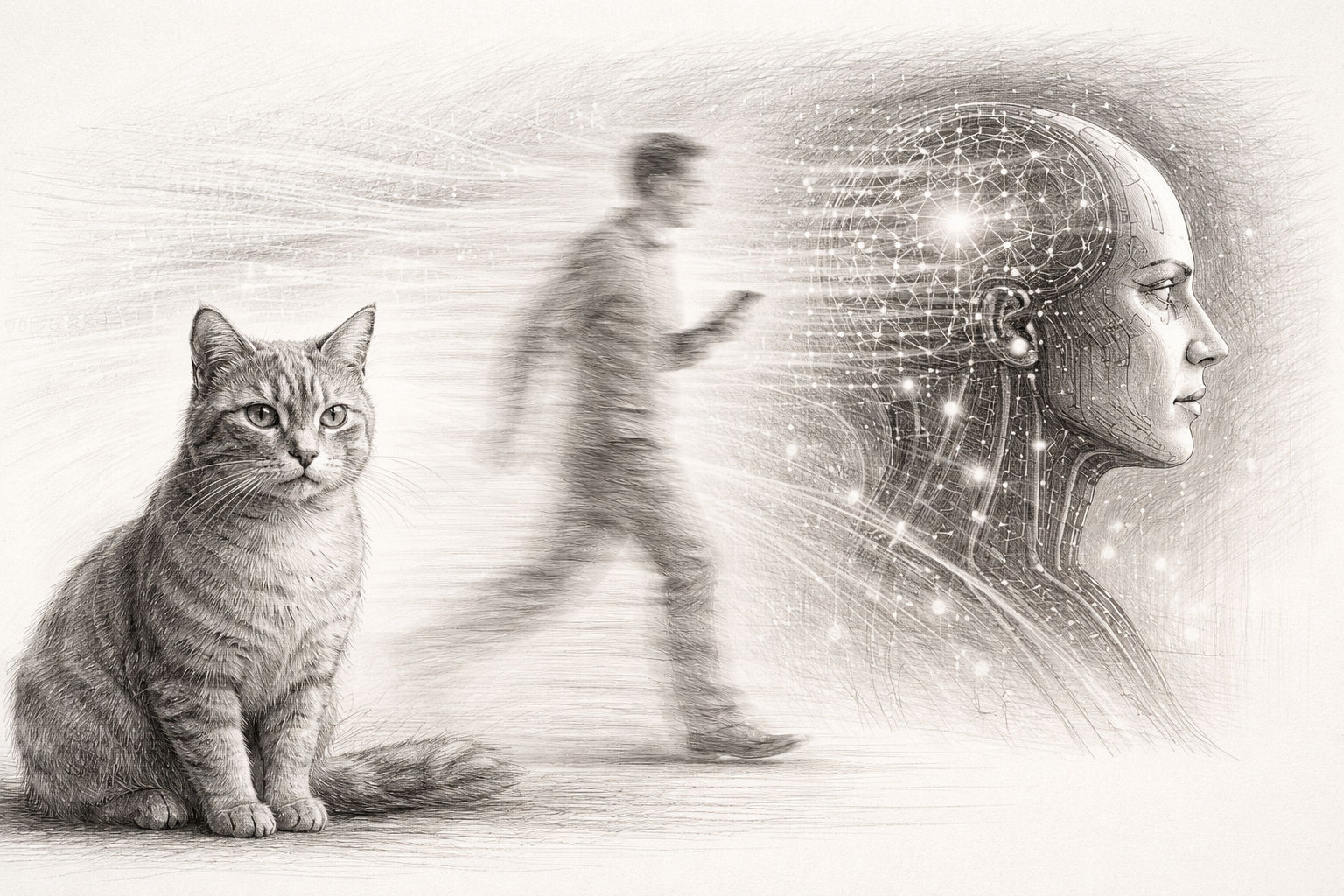
A cat is lying on the carpet. It does not move. It may blink briefly, turn an ear, sigh inwardly at the impositions of existence - and nothing else happens. The human looks at it and thinks: „Typical. Lazy cattle“. But what if the exact opposite is true? What if the cat is not too slow - but we are? This article was written after I watched a video by Gerd Ganteför on this topic and found it so interesting that I would like to present it here.
Humans have been observing animals for centuries and always come to the same wrong conclusions. We interpret their behavior with our speed, our perception, our inner clock. And this clock is, soberly considered, more of a cozy wall calendar than a high-speed processor. Perhaps the cat only seems so disinterested because its environment feels about as dynamic to it as a queue of officials on a Friday afternoon.


Once this thought is in the room, many things suddenly become clear:
- Why it strikes out of nowhere.
- Why it catches things that we don't even see coming.
- Why it anticipates movements before they are even visible.
And this is where a fascinating journey begins.
A journey into the question of how differently living beings experience time - and what this means for us when we start to build machines that exist in yet another completely different time scale.
But before we get to these big questions, let's stay on the carpet with the cat. Because it knows something that we don't.
When time becomes relative: The biological resolution of perception
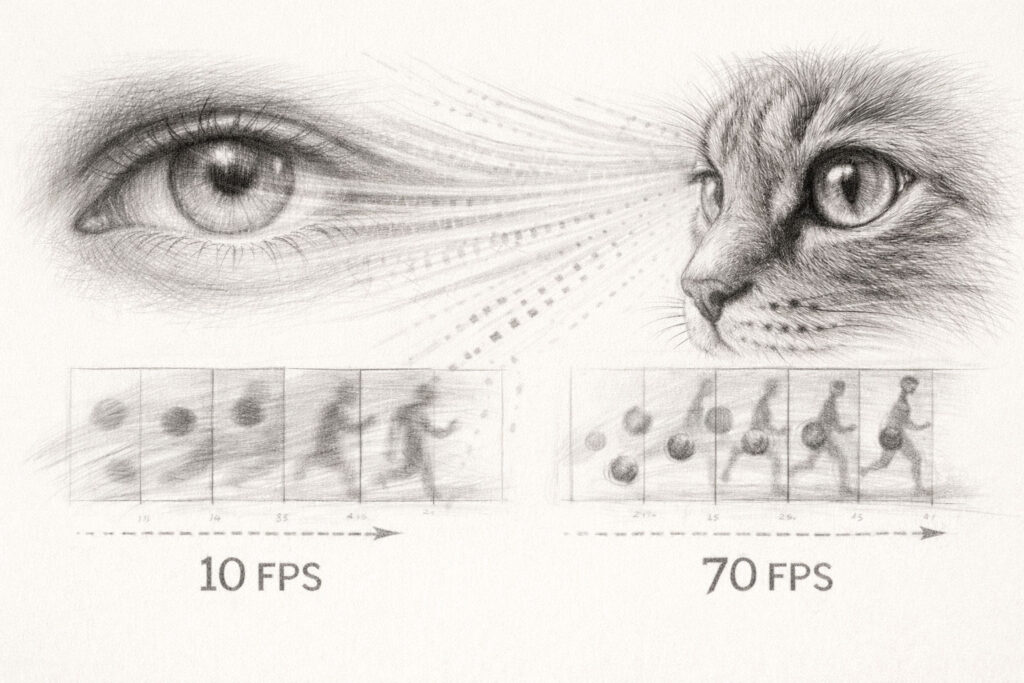
Let's imagine for a moment that perception is a movie. Roughly speaking, humans see a certain number of „images“ per second. This is enough for movements to appear fluid, for us to react, speak and think. This is completely sufficient for our everyday lives.
But this is just our benchmark. Many animals process significantly more visual information in the same amount of time. For them, a second is longer, more densely filled, more detailed. While we are still thinking about whether something has moved in front of us, the cat has already recognized what it is, where it is going and how it will end.
What looks like a flash of lightning to us is a neatly organized sequence of events to them.
- The difference is not strength.
- The difference is not courage.
- The difference is clocking.
You could say: the cat doesn't live any faster. It just gets more reality per second. And if you get more reality, you can act more precisely.
Why cats live in a different time
Now it gets exciting. When an organism processes information faster, its entire experience shifts. Everything around it seems slower, more predictable, less surprising.
We know this on a small scale: a professional athlete often says that the game feels „slower“ to him than it does to beginners. Why? Because his brain is trained to recognize patterns more quickly. He has more time - although objectively there is no extra time.
This is everyday life for the cat. When you walk through the room, it is not a brisk movement for them. It is more of a leisurely glide. If something falls, it does not experience a moment of shock, but a clearly observable development with a clear prognosis.
That's why cats seem so superior. Not because they are arrogant, but because they have an information advantage. And information advantage has always been a form of power.
The misunderstanding of laziness
It's worth taking a second look here: The cat rests a lot. A lot, in fact. To the impatient observer, this looks like comfort, luxury, perhaps even arrogance.
But from their perspective, it makes perfect sense. If you live in a slow-moving world, you don't have to be constantly active. It is enough to act at the right moment. And this moment is easier to recognize for a faster perceiving being than for us.
Resting is therefore not a sign of weakness, but of sovereignty. The cat knows:
If something important happens, I'm ready.
Perhaps this is even one of the oldest lessons of nature: the winner is not the one who keeps running. It's the one who reacts in time.
Up to this point, it sounds like a pretty animal story. Almost harmless. But when you take the next step, you realize that this idea is explosive. Because if such differences already exist between humans and cats, what does it mean when we create systems that work millions of times faster than we do? That's where it gets serious.
The feline predator's sense of time: Precision, hunting, reflexes
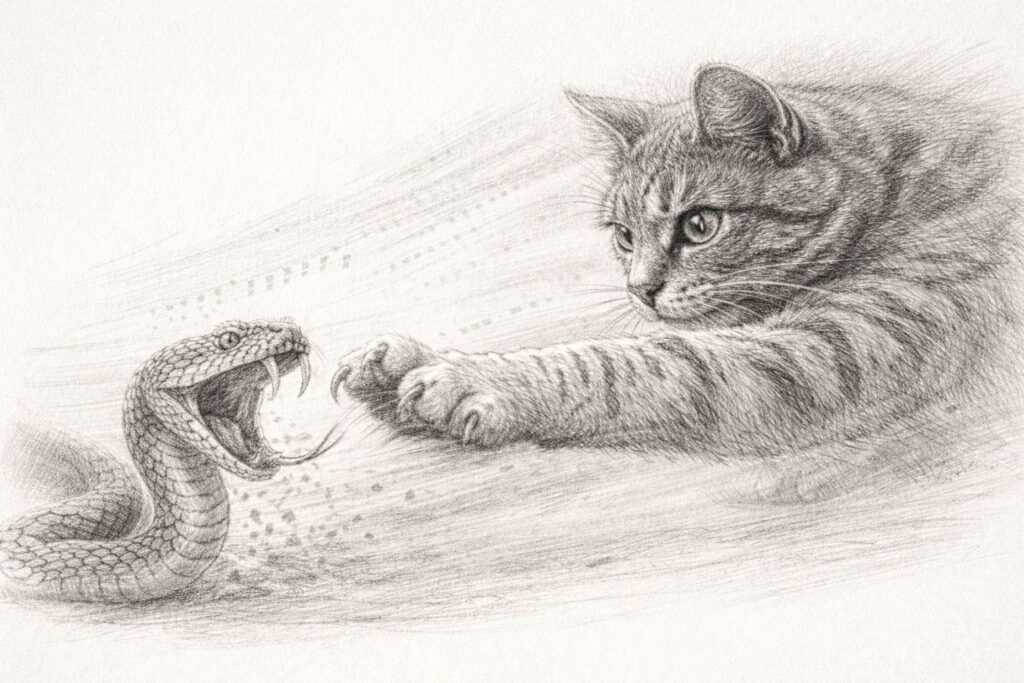
To the human observer, snakes are among the fastest attackers in the animal world. Their advance is explosive, seemingly without any warning. In documentaries, it is often only in the subsequent slow motion that we see how brief the actual moment really was.
And yet it has been shown time and again that cats not only escape such attacks, but sometimes face them with astonishing composure. What seems like a miracle is actually a question of perception.
Cats register the smallest signs: minimal changes in tension in the opponent's body, tiny shifts in weight, barely visible signs of movement. While a human only recognizes the attack when it is already happening, the cat has already read it at this point, so to speak.
The difference does not lie in muscle strength or courage. The difference lies in the temporal resolution of perception. Those who can grasp more details per second have a head start. Events appear recognizable earlier, more predictable, more controllable.
This gives the impression that the cat reacts supernaturally quickly. In fact, it merely acts in a world that is more structured and less surprising for it than for us.
High speed with a system
If you observe the interactions of large cats of prey, you often notice their enormous speed. Movements seem abrupt, contacts short, processes sometimes rough or harsh. To the human eye, many things seem rushed.
However, this perception arises primarily because people measure with their own sense of time. If an action is completed within a few seconds, it appears compressed to us. The brain receives fewer consciously perceptible intermediate stages, so the process seems shorter and more intense.
The situation is different for the animals themselves. Their finer temporal processing allows them to perceive sufficient differentiation even in short objective periods of time. What looks like a single rapid impulse from the outside may well consist of several clearly distinguishable phases internally.
There is also an evolutionary factor: in the wild, long, uncontrolled processes increase the risk of injury. Efficiency is therefore not a coincidence, but a survival principle. Actions must be fast, precise and unambiguous. This applies to hunting as well as to reproduction or territorial behavior. The rough impression is therefore created primarily in the eye of the beholder. It is a product of the difference between two time worlds.
How this world of time shapes social behavior
Those who perceive faster need less dramatic signals. A small hint is enough to be understood. With cats, minimal changes are enough: a slightly different posture, a brief twitch of the tip of the tail, a shift in the direction of gaze. For inexperienced humans, these signs often remain invisible, but they are clear to conspecifics.
That's why cats sometimes appear mysterious. They react to something that others have not even noticed. One animal retreats before the human even knows that it is about to get up. Another avoids an encounter even before any overt tension arises. From the cat's point of view, this is not magic. It is information processing.
The long rest periods also fit into this picture. If you can reliably read your surroundings, you don't have to be constantly active. The decisive factor is not constant movement, but the precise recognition of the right moment.
This creates the impression of composure and sovereignty that has accompanied cats for thousands of years. It is not haste that determines their behavior, but timing.
Time as an evolutionary strategy
In nature, a small head start often means everything. Those who recognize danger earlier gain room to manoeuvre. This room to maneuver can make the difference between escape, defense or success.
Speed of perception is therefore not a minor matter, but a central element of adaptation. It determines how early an organism can react - and therefore how many options are open to it.
This applies to both predators and prey. Many birds, rodents and insects have amazingly fast sensory systems. Their environment appears more detailed to them, movements are recognizable earlier. For slower observers, this sometimes seems like an inexplicable instinct. In fact, it is an advantage in time management.
The price of high speed
But every specialization comes at a cost. An organism that works at a high frequency requires more energy. Nerve and muscle systems must be constantly ready to process and implement information quickly.
This explains why many fast hunters have extended rest periods. Activity and recovery belong together. Without regeneration, the system would be overloaded.
This balance is typical of evolutionary solutions. It is not about being as fast as possible, but about remaining efficient at the decisive moment. Nature does not optimize for permanent stress, but for accuracy of fit.
Why humans were not optimized for speed
Compared to many animals, humans are surprisingly slow. Reflexes take time, decisions often take several steps to mature, spontaneous reactions can seem hesitant.
And yet this is precisely where a particular strength lies. In the course of their development, humans have relied less on immediate reaction speed and more on abstraction, planning and cooperation. Language, the use of tools, long-term strategies and the cultural transfer of knowledge compensate for many disadvantages in direct comparison.
Where an animal makes decisions in a fraction of a second, a human being can consider contexts over a period of years. This ability opens up other forms of superiority - not in the moment, but over time.
The history of mankind therefore shows that dominance is not only achieved through speed, but also through structure.
The arc to AI: What happens when a system lives a million times faster?
Up to this point, everything has been within biology. Different species, different speeds, different strategies - but still part of the same natural order.
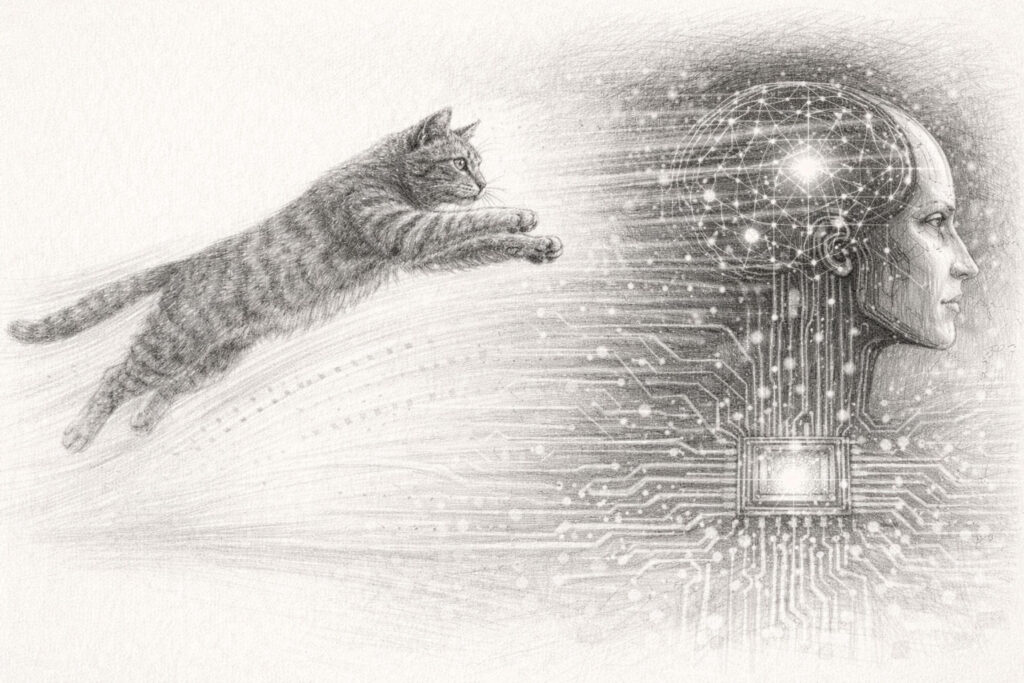
With the advent of modern computing systems, something new has been added. Machines are not subject to the same limitations as nerve cells, messenger substances or muscle reactions. Electronic processes take place in micro- or nanoseconds. In the time it takes a person to consciously form a thought, technical systems can already analyze, compare and recombine enormous amounts of data. This is not simply a matter of „a little faster“. It is a difference of scale.
While biological organisms can only accelerate their processing within narrow limits, the performance of technical systems increases with every generation. More clock speed, more parallelism, more memory, better algorithms. All of this is constantly compressing the internal time of these machines.
What emerges is - metaphorically speaking - a new level of perception. A space in which processes take place before the person has even registered that something has begun.
The historical parallel: How animals perceive us
A look back at the cat helps with understanding. There is already a noticeable gap between it and humans. Many of their reactions seem lightning-fast to us, although they are controlled and understandable for the animal.
If you transfer this relationship to the distance between humans and AI, it becomes clear how dramatic the shift could be. For a sufficiently fast system, human considerations could seem like leisurely, predictable movements. Decisions that humans perceive as spontaneous might be predictable long in advance.
This does not automatically mean superiority in a moral or philosophical sense. But it does mean a structural advantage in dealing with information.
Those who recognize earlier can plan earlier. Those who plan earlier can influence the course of events. The basic principle is that simple - and its consequences are far-reaching.
Current survey on the use of local AI systems
Inertia of thought: Why the brain cannot be accelerated at will
The obvious question is whether humans could not simply catch up. More training, better education, perhaps technical support - wouldn't it be possible to adjust the speed of thought?
This shows the biological reality. Nerve cells transmit signals chemically and electrically, but not arbitrarily fast. Every connection takes time, every decision goes through processes that are linked to material conditions.
You can think more efficiently, more structured, more concentrated. But the physical principles remain the same. A brain does not become a semiconductor.
This means that while machines operate in increasingly dense timeframes, humans remain anchored in their natural pace. They can become smarter, more experienced, more far-sighted - but not as fast as they like.
And this creates a new relationship between creator and tool.
What does this mean for our understanding of consciousness?
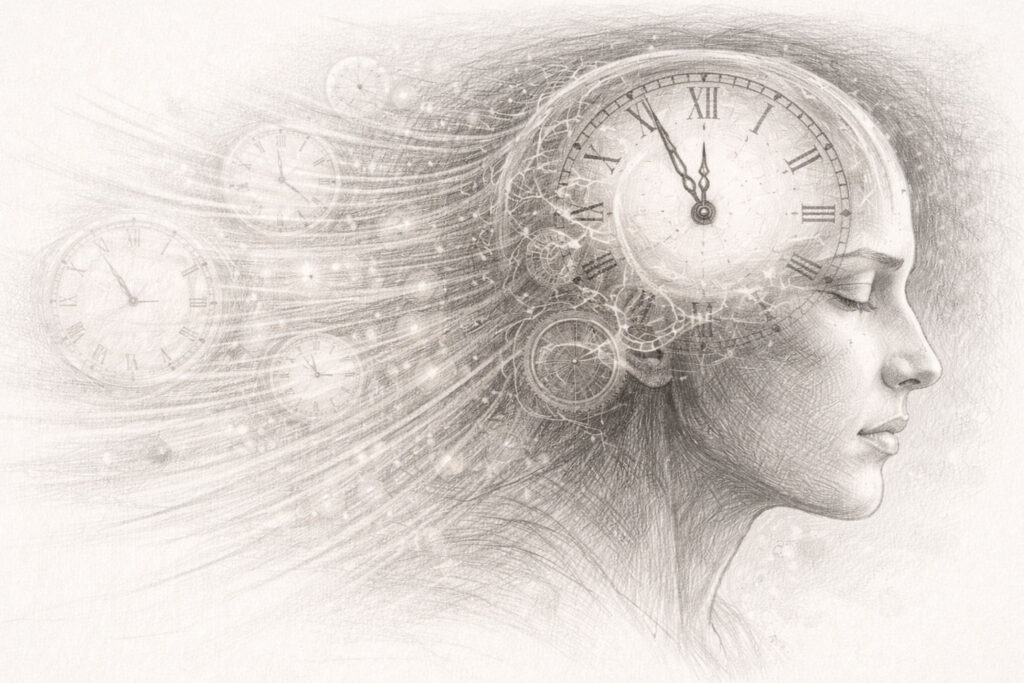
Consciousness does not exist in a vacuum. It unfolds in time. Every thought, every memory, every expectation has a duration, a sequence, a rhythm. Philosophers were quick to point out that experience is inconceivable without a temporal structure. Past, present and future are not abstract concepts, but the stage on which perception is organized.
However, if the speed of processing changes, this stage also changes. A faster system arranges events differently, weights them differently, recognizes patterns earlier or in greater numbers. Time is therefore not just an external variable - it shapes the inner world.
When a consciousness works much faster
So what happens when a thinking system lives in a much denser time than humans?
Initially, asymmetry arises. While the person is still formulating, the system has already analyzed. While a person is weighing up options, forecasts could have long since been calculated. For the machine, the human process would be transparent, perhaps even trivial.
This does not necessarily mean that feelings or values become meaningless. But their emergence would be observable, their development modelable, their consequences assessable. You could say that people would remain active, but no longer surprising.
This idea changes the view of autonomy. Freedom then appears less as a spontaneous impulse and more as a process within calculable limits.
The return of an old question: Who controls whom?
Technical systems were created to serve. They should support, accelerate and facilitate. But the greater the time gap, the more the practical power shifts.
A system that analyzes faster can make suggestions before a person has even asked for them. It can warn, filter, sort and prepare. Step by step, initiative shifts. This is reminiscent of familiar patterns from nature. There, too, the person with the better overview often determines the course of events. Not through coercion, but through foreknowledge.
The key question is therefore not whether machines will „take over“, but how willing people are to make decisions in an environment in which other players have already thought ahead.
Video: What the physicist says about time and AI
In the evolving discussion about artificial intelligence and human perception, a recent video by physicist Prof. Dr. Gerd Ganteför provides a vivid entry point. His popular science format deals with fundamental questions:
- How do we perceive time?
- What are the limits of our thinking?
- And how do these biological limits differ from the capacities of computers and artificial intelligence?
Prof. Dr. Ganteför receives attention for his ability to explain complex physical concepts in an understandable way. On his YouTube channel “Frontiers of knowledge” he regularly provides understandable explanations on topics from physics, the universe and energy issues, as well as fundamental concepts such as time and space. His presentation is not academically cool, but lively, engaging and with an attempt to translate complicated issues into clear images.
In the video embedded here, Ganteför examines the question of time - not as a philosophical riddle, but as a practically tangible variable that structures our experience and limits our thought processes. He shows how time measurement and physical processes are connected and what consequences this has for our understanding of reality. This provides an interesting link to artificial intelligence: When machines operate in a different time dimension than we do, not only do their speed and performance change, but also the way they interact with us and how we understand them.

How is AI changing the world? | Limits of knowledge
This video therefore serves as an in-depth introduction to this article: It illustrates how differently perception and processing can work - in the biological brain and in the digital machine.
Brief portrait: Prof. Dr. Gerd Ganteför
Prof. Dr. Gerd Ganteför (born November 3, 1956) is a German-Swiss experimental physicist and professor emeritus. He taught at the University of Konstanz until 2022 and is best known for his popular science YouTube channel Grenzen des Wissens, where he has been regularly explaining physical concepts in an understandable way since 2019. His research focused on cluster research, i.e. the study of nanoparticles and atomic structures, and he has also published popular science literature on this subject.
On his channel, Prof. Ganteför deals with a wide range of topics: from astrophysics, energy and climate issues to fundamental concepts such as space, time and the limits of physics. He combines physical precision with clear explanations that appeal to a wide audience.
Practical examples: Where we are already feeling the time gap today
Stock exchange trading, autonomous systems and real-time decisions
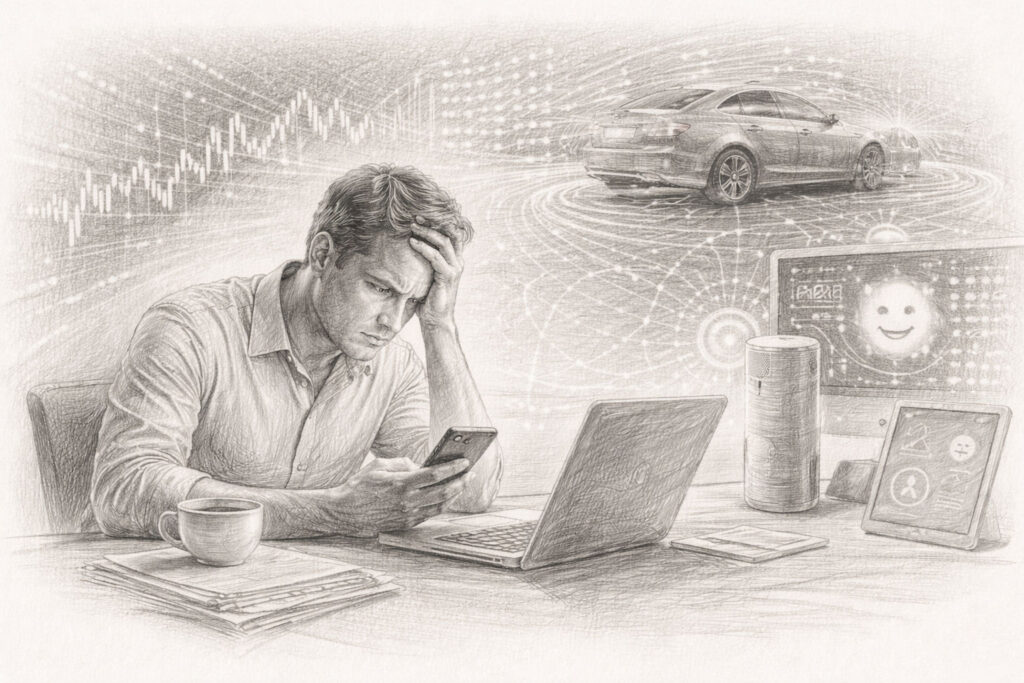
In today's digital world, the time gap is no longer just a theory, but part of everyday life. Consider high-frequency trading on the financial markets: Algorithms analyze price changes, liquidity flows and market movements in fractions of a second and react before a human trader can even register „price“ or „risk“. Decisions that used to take hours are now made within milliseconds.
This is not a science fiction scenario. It is a competitive field that is already a reality - with all its consequences: Because machines are faster than humans, they structure markets according to their patterns, not ours. This has a significant impact on price volatility, liquidity and risk. For the human observer, this often seems like a black box phenomenon; for the machine, it is pure data logic.
Similar dynamics can be found in autonomous vehicles or in robotics: sensors, cameras and decision-making logic have to deal with data that is generated in real time - faster than a human driver could react. This makes autonomous systems more efficient in information processing, but raises questions: How do we shape accountability? How do people remain in control of such systems when they operate in a different time dimension?
Information overload, media and our excessive demands
Many people also notice the time gap between biological perception and digital processing in everyday life. News, social media, trends, comments, networks - there is more information per day than a person could fully process in a month. Machines filter, sort, evaluate and personalize content far faster than a brain can absorb it.
What does this mean for our self-image? Human thinking is not designed to constantly keep track of huge amounts of data. Instead, it prefers patterns, narratives and structures that fit into its own time of thinking. You could say that while machines sequence and weight information, our consciousness „lives“ in a time that is slower but more deeply structured.
This difference creates friction. People feel overwhelmed because they are trying to catch up with the machine and biological thought structures at the same time. At the same time, many believe they can catch up simply by going faster. But high speed alone does not create understanding.
Everyday scenarios: AI as assistance, initiative and partner system
In practical life, digital systems are already intervening where people reach their time limits: in weather forecasts, medical diagnoses, logistical planning or recommendation systems for media, learning or shopping content.
It's not just about speed, but also about effectiveness: systems can recognize patterns, calculate interactions and make predictions before a person has gained a first impression. This can take the pressure off - or lead to dependencies.
One example is speech recognition in everyday life: it reacts in fractions of a second, structures queries and delivers results before a person has fully organized their thoughts. This assistance is useful, but it also changes the way we think: we become accustomed to immediate results, to answers before we have fully thought through the question.
At the same time, we are experiencing a change in the world of work: routine tasks are disappearing because machines do them faster; creative and strategic tasks are gaining in importance because they require time for reflection and deeper decisions. This change is a direct product of the time gap between biological and machine information processing.
What we learn about the future from cats
In the beginning, there was a seemingly harmless image: a cat lying motionless while the world around it becomes busy. For many observers, it appeared sluggish, perhaps even disinterested. But with each step of the preceding reflections, this assessment has shifted.
- It is not slowness that explains their behavior, but superiority in perception.
- Not passivity, but readiness.
- Not laziness, but precision.
The cat does not have to rush because it recognizes the moment when action is necessary. Its strength lies not in constant activity, but in the right timing.
This insight initially seems like a biological side note. However, it actually contains a remarkable parallel to the technological development of the present day.
Today, people are faced with systems that process information at a density that is beyond their own temporal capabilities. Machines analyze, compare and predict at speeds that are beyond our perception. From their perspective, human decision-making processes could seem similar to our movements from a cat's point of view: comprehensible, predictable, slow. This easily provokes a feeling of inferiority. But a closer look shows that speed alone does not create wisdom.
Cats are superior to humans in some reactions - and yet they don't build cities, write books or plan for the future. Their strength lies in the moment. The strength of humans lies in context.
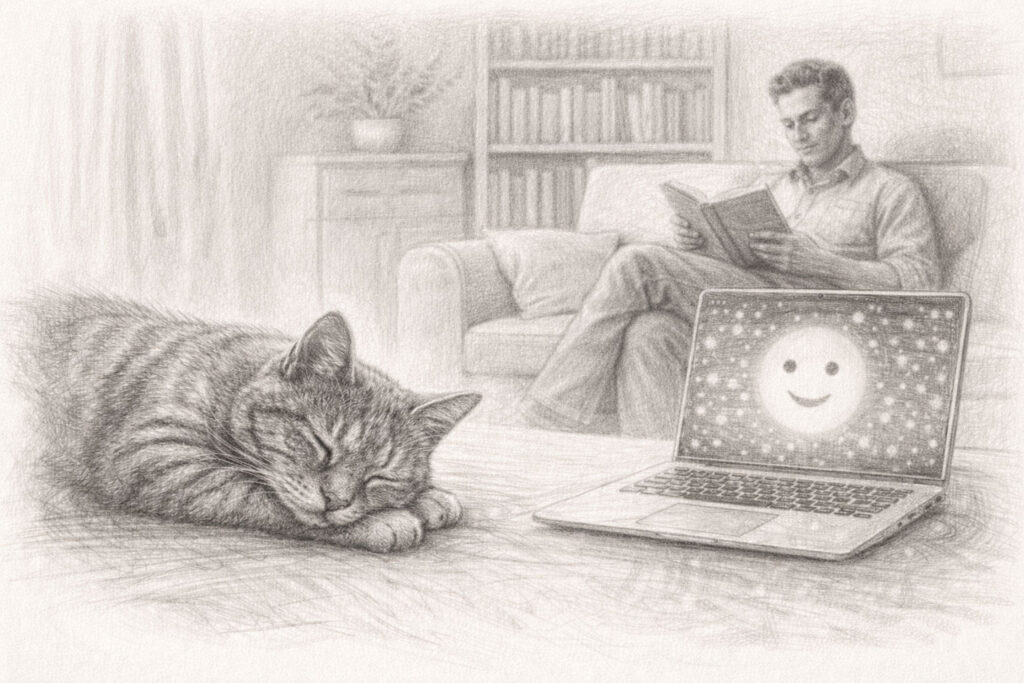
Precisely because people cannot decide everything in a fraction of a second, they develop other skills: Weighing up, remembering, storytelling, cooperating. Slowness forces structure. It creates space for meaning.
In a world of ever faster machines, this could be a new challenge. Not in the race for speed, but in the conscious use of our own measure. Perhaps the decisive skill of the future will not be to react faster, but to better understand when reaction is necessary at all.
Here, too, the cat provides a surprisingly modern role model. It wastes no energy on every noise. It observes, filters, waits - and then acts with the utmost determination. Transferred to humans, this means
Orientation does not come from constant acceleration, but from clarity about priorities. Technical systems can calculate. They can sort, predict and optimize. What they don't have is that grown embedding in experience, culture and responsibility that characterizes human decisions. This dimension does not develop in nanoseconds, but over generations.
Perhaps the future will therefore be less determined by the question of who thinks faster. What could be more important is who can handle their own speed sensibly.
The cat on the carpet looks calm because it knows its abilities. It knows that the decisive moment will come - and that it is ready.
For people in a world shaped by artificial intelligence, this could be a reassuring prospect.
Not every movement requires haste. But every future requires attention.

Frequently asked questions
- Do animals really perceive time differently from humans?
Yes, there is a lot of evidence from behavioral research and neurobiology to support this. Different species process sensory stimuli at different speeds. Some animals can recognize more changes per second than we can. For them, this makes the environment appear slower, more structured and more predictable. This changes their reaction options, hunting strategies and social behavior. - What does „temporal resolution of perception“ mean in concrete terms?
This refers to the ability of the nervous system to perceive rapid changes as separate events. The higher this resolution, the more details fit into the same objective second. A being with high resolution sees more „intermediate images“, so to speak, and can therefore react more precisely. - Why do cats often appear bored or disinterested?
Because their speed of perception is faster than ours. Many processes that seem dynamic to humans offer little surprise to them. If nothing decisive is announced for a long time, calm is the logical consequence. This looks like laziness to outsiders, but is actually efficient energy management. - Is that why cats react so incredibly quickly?
From a human perspective, yes. For the cat itself, however, these are not hasty movements, but controlled processes. It often begins its reaction at the smallest signs that humans do not even consciously register. - How can a cat fend off a snake attack?
It recognizes early indications of the impending advance. Even before the attack becomes visible to the human, the animal may have already prepared the decisive evasive movement. The advantage therefore arises before the actual event. - Why do many processes in the animal kingdom seem so harsh or abrupt?
Because observers measure them with human perception. If a lot happens within a short objective time, it appears compressed. For animals with finer perception, the same process can appear differentiated and normal. - Does the speed of perception also influence communication between animals?
Yes, fast-perceiving species often only need minimal signals. Small changes in posture or direction of gaze are enough to convey messages. What remains invisible to humans is clear to conspecifics. - Is a higher speed always an advantage?
Not necessarily. It costs energy and requires recovery phases. Evolution does not prefer the maximum, but what makes sense for the respective lifestyle. A permanently overexcited system would be unstable. - Why didn't humans also become extremely fast?
Because its development set other priorities. Language, cooperation, planning and the cultural transfer of knowledge provided advantages that could partially replace quick reflexes. Humans gained depth instead of speed. - What does all this have to do with artificial intelligence?
AI systems work in time domains that are far below human perception. They can recognize patterns and prepare decisions before a human even notices the process. This creates a new relationship between biological and technical processing. - Does this automatically make AI superior?
It is faster and often more accurate in certain tasks, but speed is no substitute for meaning. Machines calculate, people interpret. Both skills fulfill different roles. - Could machines predict human decisions?
This is already happening in many areas. If enough data is available, probabilities can be calculated. This does not mean absolute control, but it does mean increasing transparency of human patterns. - Does this mean people lose their freedom?
Not necessarily. Forecasts show possibilities, not certainties. Nevertheless, predictability changes the feeling of autonomy because actions appear less surprising. - Why are we still constantly trying to get faster?
Because speed brings advantages in technical environments. But humans are biologically limited. More speed therefore does not automatically lead to better understanding or better decisions. - Could the real strength of mankind in the future lie precisely in its slowness?
That is quite conceivable. Those who do not have to react constantly can check connections, take responsibility and consider long-term consequences. These skills become more important when machines take over routine tasks. - What can humans learn from cats?
Selectivity. Not every stimulus deserves attention. Those who filter and wait for the right moment often act more effectively than those who are constantly on the move. - How is the time gap already changing our everyday lives?
Automated systems sort messages, suggest routes, recognize risks or provide answers in seconds. Many processes run before they are consciously noticed. This shapes expectations and decision-making habits. - What is the most important finding from the comparison between cats, humans and AI?
Time is relative to the performance of a system. Those who process faster experience a different world. But different speeds do not automatically mean different values. Each level has its own strengths.