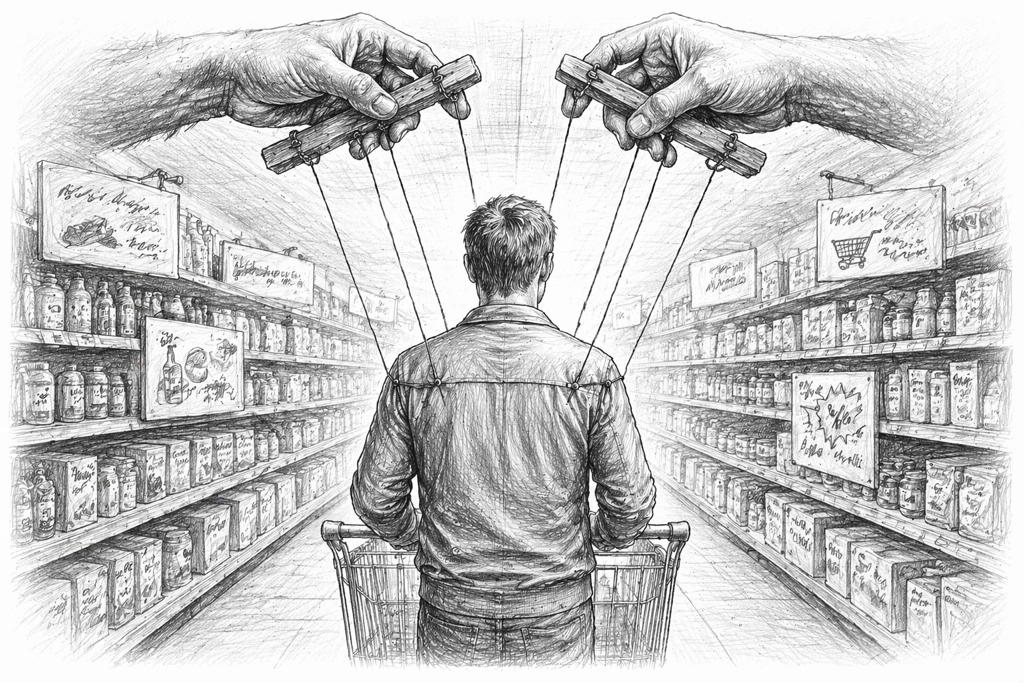
It's often the little things that make you wonder. No big events, no loud break - rather a quiet moment when you stop and ask yourself: wasn't it different before? I recently had such a moment in the supermarket. A store I've known for many years. One of those places where you don't have to think. You know where things are. Milk at the back on the right, bread at the front on the left, the usual routes in between. It's a quiet form of reliability that you hardly notice in everyday life - as long as it's there.
But this time something was different. I was looking. Not for long, but longer than usual. The milk was no longer where it always was. A few steps further, then back again. Finally I found it - but the thought remained. Why? At first it seems banal. A shelf is rearranged, a product is moved. That happens. But when such moments accumulate, the whole thing loses its random character. It creates an impression that is difficult to grasp, but is nevertheless tangible: something is being changed here - not for me, but with me.

Silent sales tricks in-store and online
I've been experiencing similar things more and more often on the internet in recent months. Perhaps it is particularly noticeable if - like me - you do a lot of research, read a lot and compare a lot. But it becomes apparent even during short visits.
You open a page - and instead of being received, you are stopped. A cookie banner is superimposed over the content. Often with two options: a large, colored button to agree and somewhere in the margin an inconspicuous alternative that requires more clicks. You click to move on, not because you have made a conscious decision.
Once you have overcome this, the next step often follows: a pop-up, a notice, an offer. „Subscribe now“, „Only available today“, „Exclusive access“. The actual content recedes into the background - the trappings come to the fore.
And even if you get involved, it often ends after a few paragraphs: Paywall. The text breaks off, access becomes a commodity. What used to be freely accessible is now increasingly portioned.
A quiet doubt
All these things in themselves are explainable. A store converts. A website finances itself. A provider wants to sell. There's nothing wrong with that. But the accumulation, the uniformity, the repetition - they create a quiet doubt.
Why does it all feel so similar? Why do we encounter the same mechanisms in completely different areas? And, above all, why do we so often have the feeling that we are no longer free to decide, but are being led in one direction?
Perhaps all this is no coincidence. Maybe it's not just about offering something - but about influencing decisions.
This assumption is initially just a thought. Not an accusation, not a ready-made thesis. Rather a starting point. But the closer you look, the more this impression intensifies. What seem like minor irritations in everyday life could be part of a larger pattern. And it is precisely this pattern that is worth taking a closer look at.

Everyday life today: taking stock
The supermarket has long been a place of routine. You went in, picked up your usual products and left the store again. Efficient, predictable, almost mechanical.
But if you take a closer look today, you will notice changes. Products change their place. Not just once, but regularly. What was on the left yesterday is now on the right. Familiar paths lose their orientation. You search, you look around, you notice things that you would have overlooked before.
Then there is the placement itself. More expensive products are often at eye level, cheaper ones further down or at the top. There are small items at the checkouts that you hadn't planned to buy - and which find their way into the shopping basket for this very reason.
None of this is obtrusive. It is subtle, almost incidental. And that is precisely where its effect lies.
The Internet as a counterpart - and amplifier
While the supermarket works with space and movement, the internet uses other means - but with a similar objective. Anyone visiting a news site or blog today is rarely taken directly to the content. Instead, there is a sequence of hurdles. First, consent to the use of data. Then there are references to subscriptions, exclusive content or time-limited offers.
The design is rarely neutral. Decisions are prepared. The path to „yes“ is short, clear and highlighted in color. The path to „no“ is often longer, hidden or involves additional steps.
Here too, none of this is unusual on its own. But together they create an impression of steering.
Subscriptions, offers and automatic renewals
Subscription models are another area that is increasingly present in everyday life. Many services start with a seemingly simple offer: a free trial, a low-cost entry, non-binding access. The hurdle is low, the decision is quickly made.
What follows often remains in the background. The automatic renewal, the notice period, the conditions - all of this is rarely consciously noticed. Only later, when costs are incurred or the exit becomes more complicated than expected, does it become clear that the original decision was less neutral than it seemed.
A new normality
What all these examples have in common is not their individual impact, but their frequency. We encounter them in stores, online, in apps, in everyday decisions. Different forms, different industries - but similar mechanisms.
And this is where the real change lies. What used to be used occasionally now seems to have become the norm. Not as an exception, but as the standard.
As long as you look at these things in isolation, they remain inconspicuous. A rearranged shelf, an eye-catching button, a favorable offer. But when you start to see them in context, your view changes.
You recognize patterns. Repetitions. Structures. And with this realization, a new question arises:
If all this is no coincidence - then what is behind it?
This question inevitably leads further. Away from pure observation and towards analysis. And this is where the real core of this topic begins.
Between habit and sensory overload
At first glance, modern everyday life has become convenient. Everything is available at any time, often just a click away. Products, information, services - it has probably never been so easy to find what you are looking for.
And yet at the same time, the opposite impression is created. Because as availability increases, so does the number of stimuli. Every provider wants to be seen, every piece of content wants to be noticed, every product wants to be sold. As a result, many environments can no longer be opened up quietly, but actively compete for attention.
You often only notice this when you pause for a moment. Not because something is particularly loud - but because there are hardly any quiet areas left.
Purchasing as a guided process
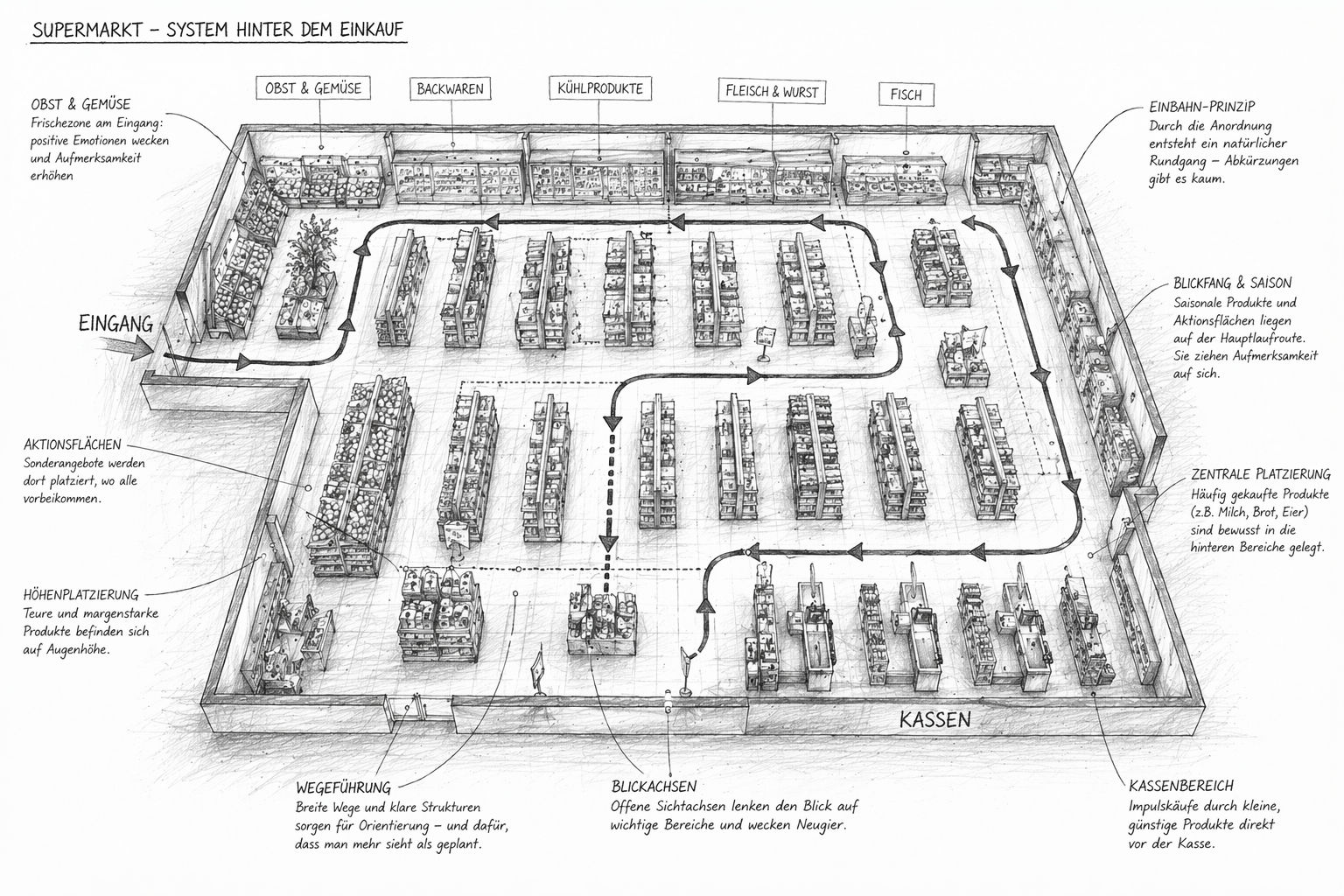
In bricks-and-mortar retail, this can be seen in an almost inconspicuous way. The path through the store is rarely random. It is guided, even if you don't immediately recognize it. You enter the supermarket and are usually guided past fresh products first. Fruit and vegetables convey freshness, quality and a good introduction. From there, the paths continue - past offers, promotions, special areas.
The really necessary products are often not at the beginning. They are further back, in places that you only reach when you have already gone through several areas.
Something interesting happens: you notice things that you weren't originally looking for. Maybe you grab them. Or maybe you don't. But the opportunity does not arise by chance - it is created.
The role of repetition
A single impulse often has no effect. But repetition changes perception. This is just as true in the store as it is in the digital space. If you are repeatedly confronted with similar messages - „popular“, „recommended“, „today only“ - a certain naturalness develops over time.
Terms lose their original meaning and become an integral part of the environment. We begin to no longer consciously question them. And this is precisely where a silent shift occurs. Because at some point, what appears regular seems normal.
Digital surfaces as decision-making spaces
This effect can be observed even more clearly on the Internet. Websites are no longer just information spaces. They have become decision-making spaces - designed with the aim of persuading the user to take action.
It starts with seemingly simple things. One button is bigger than another. One color stands out more. A text suggests urgency.
All these elements do not work in isolation. They interlock and create a direction.
You click because it's obvious. Not necessarily because it was a conscious decision.
The shift in control
What is interesting here is not so much the individual measure as the sum total. This is because the more of these mechanisms work simultaneously, the more control over the situation shifts. You still have the opportunity to decide - formally, everything remains voluntary. But the framework in which this decision takes place is not neutral. It is shaped. And this design rarely follows chance.
Many of these developments are based on convenience. And to a certain extent, this is true. Recommendations can be helpful. Pre-selected options save time. Guided processes make decisions easier.
But at the same time, a new form of complexity is emerging. Because in order to make truly free decisions, you would have to actively go against the predetermined paths. You would have to search, compare, consciously reject. This requires attention - and this is limited in everyday life.
Step by step, a change occurs that is barely noticeable as long as you are in the middle of it. Everyday life remains the same. You shop, you read, you use services. Externally, little has changed.
And yet something has shifted. It's not the supply that's the problem. Nor is it the opportunity to vote. It is the way in which this choice is prepared.
The point at which it becomes apparent
For many, this remains invisible for a long time. Only when irritations accumulate - when you search more often, click more often, pause more often - does a different awareness emerge. You start to take a closer look.
And it is precisely at this point that the perspective changes. What previously seemed like a series of individual observations begins to come together to form a picture. A picture that raises a new question:
If our everyday lives are increasingly being shaped - who is actually shaping them? And according to what principles?

Supermarket tricks | Galileo | ProSieben
The turning point: coincidence or system? When patterns repeat themselves
Up to this point, many things can still be classified as individual observations. A rearranged shelf here, an eye-catching button there, a subscription model with automatic renewal. None of this seems unusual on its own.
But over time, something else emerges. Because these situations do not occur sporadically. They repeat themselves. In different contexts, with different providers, in different areas of life - and yet with astonishing similarities.
You encounter the same structures in the supermarket, on websites, in apps and in services. The forms vary, but the basic mechanics remain recognizable. And it is precisely at this point that a question arises that can no longer be pushed aside so easily:
Is this all still a coincidence?
The logic behind the repetition
Coincidence has one characteristic: it is irregular. Things happen without a pattern, without a clear structure. Sometimes one way, sometimes another. What we increasingly observe in everyday life, however, seems different. The repetitions are too consistent. The mechanisms are too similar. The effects are too predictable.
If products always end up in certain places, if decisions are always steered in one direction, if processes always work according to the same principle - then chance loses its probability.
What remains is another explanation: system.
From impression to realization
This transition often happens imperceptibly. At first there is just a feeling. Something doesn't quite fit. Then comes the observation: this happens more often. Finally, the realization emerges: there is a pattern. And with this realization, the view changes.
What previously appeared to be a single measure becomes part of a larger context. Individual decisions are no longer viewed in isolation, but as elements of a structured framework.
You begin to understand that it is not only the offer itself that plays a role - but also the way in which it is presented.
Design instead of randomness
Design is a matter of course in many areas of our everyday lives. Architecture follows certain principles, products are consciously designed, processes are optimized.
Why should decisions be any different? If companies have an interest in certain products being purchased, certain content being read or certain services being used, it stands to reason that they will also influence the way in which these decisions are made.
Not openly, not directly - but via the surroundings. About what is visible. About what is emphasized. And about what fades into the background.
The silent consequence
The decisive factor here is not that influence is exerted at all. Influence is contained in every form of offer.
The real change lies in the system. When design is no longer selective, but continuous. When it is no longer obvious, but subtle. When it is no longer used sporadically, but becomes the standard.
The role of the individual then changes. You continue to move freely - but within a framework that is consciously set.
This idea shifts the focus. It is no longer just about what is on offer. It's about how decisions are made. The focus is no longer just on products or content, but on the mechanisms behind them.
And this is where a deeper understanding begins. Because if decisions are not made in isolation, but arise in a structured environment, then another question inevitably arises:
Who shapes this environment? And on what basis?
The transition to analysis
This is where pure observation ends. The question of chance or system is more than a theoretical consideration. It is the turning point at which everyday experiences become a topic that can be examined more closely.
What initially seemed like a series of small irritations begins to form a structured picture. A picture that can no longer be explained by personal impressions alone. And that is precisely why it is worth going one step further. Away from perception - towards the question of how this system came about. Because systems do not come into being by chance. They have a history.
A look back: how sales used to work
If you look back a few decades, you quickly realize that sales used to work differently. Not necessarily better in every respect - but different in its basic approach.
In many cases, traditional retail was a place of reliability. You knew the routes, the processes, often even the people. Products had their fixed place, and this place remained unchanged for a long time. Those who shopped regularly moved through the space almost automatically.
This form of orientation was not a product of chance, but part of a tacit understanding between provider and customer. The customer was supposed to find what they were looking for - preferably without detours. Shopping was not an experience in today's sense, but a task that was completed efficiently.
Visible advertising, clear intention
Advertising itself also used to have a much simpler structure. There were advertisements in newspapers, posters, maybe a sign in the shop window. Offers were communicated, prices highlighted, promotions announced. The intention was clearly recognizable: something was being sold here.
This openness in particular had a certain honesty. The customer knew when he was in a sales situation. There were no hidden levels, no subtle steering in the background. Advertising was visible - and therefore easier to classify. You could accept it or ignore it.
The role of habit and trust
Another decisive difference lay in the relationship between supplier and customer. Many stores thrived on regular customers. Relationships developed over years. People knew each other, at least superficially. And with this familiarity grew a certain amount of trust.
This trust was based less on sophisticated strategies than on consistency. A store that was reliable, that constantly offered its products, that did not constantly introduce changes, had an advantage. Customers came back - not because they were actively persuaded, but because they could find their way around. The principle was simple: if you were satisfied, you stayed.
Limited options, clear structures
Another factor that should not be underestimated was the limited range of options. The offer was more manageable. There was less choice. Information was not always available. Decisions were often made on the basis of experience, not endless comparisons.
This limitation had a side effect: it reduced complexity. The customer did not have to constantly make new decisions. They went with what had proven itself. And the provider had fewer opportunities to intervene in this process. The decision remained more with the buyer.
Of course, sales at the time were not free from influence. Even then, there were placements, recommendations and targeted offers. But they were mostly selective and less systematic.
Over time, this began to change. Slowly at first, almost imperceptibly. New findings from the field of psychology were introduced. The first attempts were made to better understand customer behavior. It was no longer just about offering products - it was about making decisions more predictable.
This change was not a break, but a transition. A process that developed over years and was barely noticeable at first.
Another form of control
The decisive difference lies in the degree of penetration. In the past there was influence - today there are systems. What was once based on experience and observation has increasingly been studied scientifically. Behaviour was analyzed, patterns recognized, mechanisms identified.
And with this knowledge, a new possibility arose: not just to react - but to shape in a targeted manner. With this development, something was lost that had long been taken for granted. The simple, direct relationship between offer and decision.
Today, there are often a number of intermediate steps between the product and the buyer. Design elements, hints, placements, processes - they all influence the decision before it is even consciously made. The customer continues to buy. But the way to get there has changed.
Looking ahead
This review is not an attempt to idealize the past. People sold in the past, and there were interests in the past too. But the way has changed. And it is precisely this change that is crucial to understanding the present.
Because anyone who can understand how sales once worked will recognize all the more clearly how much the mechanisms have shifted today.
And so the next question is almost self-evident:
When exactly did this change begin - and what triggered it?


The turning point: Psychology enters the picture and the focus shifts to people
For a long time, sales were primarily a question of supply. What products are available? At what price? In what quality?
But at some point, the focus began to shift. The focus was no longer on the product, but on the people who buy it. More precisely: their behavior, their decisions, their habits.
This shift marks a decisive turning point. Because it raises a new question:
No longer just what is sold? - but how does the customer actually decide?
The beginnings of behavioral research
As early as the middle of the 20th century, people began to take a closer look at precisely this question. Psychologists investigated how people perceive, how they make decisions and which factors play a role in this. Sociologists analyzed group behavior, the influence of environment and social orientation.
These findings were not limited to academia for long. The potential was also quickly recognized in marketing. If you understand how people make decisions, you can make the sales process more targeted.
This was done cautiously at first. Individual concepts were adopted and initial models developed. But the direction was clear: sales increasingly became applied psychology.
The realization of irrationality
A particularly important step was the realization that people do not make decisions as rationally as had long been assumed. One might have expected buyers to compare prices, weigh up the benefits and then make a logical decision. In reality, however, things turned out differently.
Decisions are often made quickly. Intuitively. Shaped by impressions, habits and unconscious factors. A low price alone is not enough. Neither is good quality if it is not perceived.
This insight fundamentally changed the way we think. Because if decisions are not purely rational, they can also be influenced in other ways.
From observation to application
What began as a theoretical insight was gradually put into practice. Salesrooms began to be designed in a targeted manner. Products were not only placed according to logical aspects, but also according to their effect on the customer.
The tone of advertising also changed. It was less about sober information and more about emotion, appeal and impact. The question was no longer just: What are we saying? But rather: What effect does it have on the person who hears or sees it?
This further shifted the focus. From the product - to the perception of the product.
The emergence of new methods
Over time, concrete methods emerged from this. They tested different arrangements, varied texts, experimented with colors and shapes. Observed how people reacted. Adapted, optimized, refined.
These processes were initially relatively simple. However, they followed a principle that is still valid today:
Behavior can be influenced if you create the right framework conditions. These framework conditions are increasingly being created deliberately. Not by chance, but deliberately.
What is interesting is how unobtrusively this change took place. There was no clear break, no moment when everything changed. Instead, the system developed step by step. A small adjustment here, a new insight there. Individual measures that seemed harmless in themselves.
But the result was something new.
A sales environment that was no longer based solely on supply and demand, but on a deeper understanding of human behavior.
The beginning of a new logic
With this development, a new logic prevailed. It was no longer just about having a good product or offering a fair price. How this product is presented, the context in which it appears and the impressions it triggers became increasingly important. The sales process thus shifted partly into the customer's head. Where decisions are made. And this is exactly where you could now start.
Many of the mechanisms that we encounter in everyday life today have their origins here. Not in the digital world, not in modern technologies - but in fundamental insights into human behavior that were gained decades ago.
What has changed since then is one thing above all: the consistency with which this knowledge is applied. And the opportunities to refine it further.
The next step
This paves the way for what seems to be a matter of course today. The mechanisms are in place. The findings are available. What now follows is their systematic application. And this is where it gets concrete.
Because the principles that were once developed in theory can now be clearly identified. They have names. Structures. Terms. And it is precisely these terms that help us to understand precisely what is often only perceived diffusely in everyday life.
Current survey on trust in politics and the media
The mechanics behind it: How decisions are really made
For a long time, it was assumed that people make their everyday decisions largely rationally. We compare, weigh up and decide on the best offer - at least that was the idea.
But if you take an honest look at your own everyday life, you quickly realize that it rarely works like that. Many decisions are made spontaneously. In passing. Without conscious consideration. You reach for a product, click on a button, confirm a selection - and only afterwards do you ask yourself why.
This discrepancy between perception and reality is no coincidence. It is the starting point for understanding how decisions are actually made.
Quick thinking instead of thorough analysis
Everyday human life is characterized by one simple necessity: saving time. No one can think through every decision completely. There are not enough resources for that. So people use shortcuts.
These shortcuts are not a weakness, but a natural mechanism. They make it possible to act quickly without having to check every detail.
You recognize patterns, follow habits, follow familiar signals.
A familiar product is preferred. A conspicuous notice is heeded. A simple option is chosen. This often happens unconsciously. And that is precisely why it is so effective.
Heuristics - the silent helpers
In psychology, this is referred to as heuristics. These are mental simplifications that help to make decisions quickly. They reduce complexity, create orientation and provide certainty.
But they have a special feature: they work well - but not always correctly. One example: If a price originally appears higher and is then reduced, the offer looks more attractive. Even if the actual value is unchanged.
Or if a product is labeled as „popular“, you are more likely to consider it yourself. Not because you have tested it - but because it feels right.
Biases - systematic distortions
In addition to these heuristics, there are also so-called biases, i.e. systematic distortions of thought. They influence how we perceive and evaluate information. We encounter some of these effects again and again in everyday life:
- The so-called Anchor effect ensures that the price mentioned first shapes our perception. Everything that follows is evaluated in relation to it.
- The Loss aversion leads us to give more weight to things we could lose than to things we could gain.
- And the Social orientation causes us to align ourselves with the behavior of other people - even if we don't know them.
These mechanisms run in the background. You don't notice them - but they work.
The role of the environment
Decisions are rarely made in isolation. They are always embedded in an environment. And it is precisely this environment that plays a decisive role.
A product that is clearly visible is more likely to be noticed. An option that is easily accessible is more likely to be chosen. An action that requires little effort appears more attractive.
This means that it is not only the content that influences the decision - but also the form in which it is presented. The same offer can have different effects depending on how it is embedded.
The crucial point: preparing the decision
This is the real crux of the matter. Decisions are rarely made at the moment you think you have to make them. They are prepared. Through hints, through placement, through design. Through everything that happens beforehand.
If one button is larger than another, it appears more relevant. If an option is highlighted, it appears more obvious. If a process leads in a certain direction, you are more likely to follow this path.
The decision feels free. But it has already been influenced before it is consciously perceived.
Why it works so well
The reason for this is simple - and at the same time fundamental. People trust their perception.
- What is visible is important.
- What is simple is effective.
- What many people do makes sense.
These principles are deeply rooted in human behavior. They have developed over a long period of time and fulfill an important function in everyday life.
But that is precisely why they can also be used.
Between support and influence
This is where a fine line is drawn. Because not every simplification is problematic. Many mechanisms actually help to make decisions faster and easier. The question is not whether influence is exerted. But how.
Are people supported - or are they guided? This distinction is often not obvious. It is not evident in individual elements, but in their interaction.
Those who begin to recognize these mechanisms see everyday life differently. A clue is no longer just a clue. A placement is no longer just random. A recommendation is no longer neutral.
You recognize structures where previously there were only individual impressions. And it is precisely this realization that changes something decisive:
It creates distance. Between what you see - and what you make of it.
The next step
With this understanding, the view becomes clearer. You realize that decisions do not simply arise, but are prepared. That perception is shaped. That behavior not only reacts, but can also be guided.
But to fully understand this picture, we need to go one step further. Because the mechanisms described here are not just theoretical. They are concretely named. They have terms that precisely describe what is often only diffusely perceived in everyday life.
And it is precisely these terms that help us to recognize the system in all its clarity.

The psycho tricks of the supermarkets | Dr. Frank Hagenow | Psychologist | Business Coach
The technical terms: The system gets names
Up to this point, we have described many things that can be observed in everyday life. Small shifts, recurring patterns, a feeling of control that is difficult to grasp.
But this is exactly where it gets interesting. Because what often seems vague in everyday life has long been clearly defined by experts. There are terms, models and concepts that describe exactly what is happening here. And these terms have a special effect:
They take away the random character of the whole thing. What previously seemed like a personal impression becomes a structured system.
Nudging - the gentle steering
One of the key terms in this context is „nudging“. Translated, this means something like „nudging“ or „pushing“. It refers to a form of influencing behavior without coercion.
People are not forced to do anything. Nor are they directly persuaded. Instead, the environment is designed in such a way that a certain decision becomes more likely.
A classic example is the placement of products. What is at eye level is noticed more often - and therefore chosen more often. In the digital space, nudging can be seen in preset options. A selection is already active, the user would have to consciously change it if they want something else.
The decisive factor here is that the choice remains formally free. But the direction is predetermined.
Nudging is often presented in a positive light, for example when it comes to promoting healthier decisions or simplifying processes. And it can indeed be useful in this context.
But the same method can also be used differently. Not for support - but for targeted control.
Choice Architecture - the architecture of decision
Another term closely associated with nudging is „choice architecture“. This refers to the design of the decision-making environment. In other words, everything that influences how a choice is perceived:
- What options are there?
- In which order do they appear?
- Which one is highlighted?
- Which is particularly easy to access?
These questions are by no means secondary. They determine how a situation is interpreted. An offer can remain identical - and yet have a different effect depending on how it is presented.
For example, if three price options are offered, one of them is often deliberately designed to look unattractive. Not because it is intended to sell, but because it makes the other options appear better.
So the decision is not only based on the content. But also by the framework.
Dark patterns - the dark side of design
While terms such as nudging or choice architecture still sound relatively neutral, there is also a much more critical term: „dark patterns“. This refers to design patterns that are deliberately aimed at deceiving users or pushing them in a certain direction.
In contrast to simple simplifications, this is no longer just about support, but about manipulation. Typical examples of this are
- Cancellation options that are difficult to find
- misleading formulations
- Hidden additional costs
- Artificially created urgency („only a few still available“)
The user should make a decision - but not on the basis of complete and clear information, but under the influence of targeted design.
The key difference lies in the intention. While nudging can theoretically also be used to the user's advantage, dark patterns are often primarily aimed at the provider's advantage. And this is precisely why they are increasingly being discussed critically.
Sludge - when processes become intentionally heavy
A lesser-known but equally important term is „sludge“. If nudging means making decisions easier, sludge describes the opposite: deliberately making processes more difficult.
This becomes particularly clear when terminating or amending contracts. Getting started is easy. One click is all it takes to take advantage of an offer. Exiting, on the other hand, is often complicated. Several steps, hidden options, unclear paths. You have to search, work your way through menus, maybe even make contact.
The goal is obvious: the hurdle should be so high that many users abandon the process. Not because they are convinced - but because it is too time-consuming.
Here too, the decision remains formally free. But the way to get there is deliberately designed.
Psychological pricing - the perception of prices
Another key area is price psychology. This is less about the actual price and more about how it is perceived.
- Why does a product for €9.99 seem cheaper than one for €10?
- Why does €79 seem particularly attractive after a crossed-out price of €199?
The answer does not lie in mathematics, but in perception. People do not evaluate numbers in isolation. They put them in relation to each other, use comparative values as a guide and react to visual cues.
A high starting price serves as an anchor. Everything below it automatically appears cheaper. A discount appears larger if it is highlighted.
The same applies here: the information is correct - but its effect is deliberately influenced.
Heuristics and biases - the foundation of the system
All of these terms have a common basis. They are based on the aforementioned heuristics and biases - the mental shortcuts and thought distortions that shape our behavior. Without these mechanisms, the system would not work. Because it is only through them that it is possible to indirectly influence decisions.
People seek orientation. They react to signals. They follow simple paths. These characteristics are not new. They are part of human behavior. What is new is how specifically they are used.
From feeling to clarity
These terms fundamentally change our view of everyday life. What previously seemed like a series of individual observations can now be clearly categorized.
- A cookie banner is not just a hint.
- Product placement is not random.
- A complicated termination process is not an oversight.
All these things follow certain principles. And these principles have names.
The importance of classification
This classification is more than just theoretical knowledge. It provides orientation. Because those who know the terms recognize the mechanisms more quickly. Those who recognize the mechanisms can classify them better. This creates a gap between perception and reaction.
- You no longer click automatically.
- You no longer reach for it unconsciously.
- You start to question.
Not out of mistrust - but out of understanding.
With this knowledge, an important point has been reached. The mechanisms are named. The structures are visible. But this raises a new question:
How exactly are these principles implemented in everyday life? Where do we encounter them in concrete terms - and how do they work in practice? One answer to this question can be found in a place that almost everyone knows. And which, on closer inspection, turns out to be an astonishingly precisely designed system.
Central mechanics in everyday life - effect and goal
| Mechanics | How it works | Target in the background |
|---|---|---|
| Nudging | Options are presented in such a way that a choice becomes more likely | Steering without coercion, prepare decision |
| Choice Architecture | Structure of the selection influences the perception of the options | Making certain decisions appear more attractive |
| Price psychology | Prices are perceived visually and emotionally differently | Increase willingness to buy without a real price advantage |
| Impulse placement | Products appear at the right moment (e.g. checkout) | Trigger impulse purchases |
| Urgency mechanisms | Time pressure or scarcity is signaled | Generate quick decisions without weighing things up |
| Sludge | Processes are deliberately made complicated | Prevent undesirable actions (e.g. termination) |
The supermarket as a textbook
For most people, the supermarket is a place of routine. You go in, do your shopping and leave the store again. Without paying much attention, without giving it much thought. This is precisely why it is particularly well suited to making the mechanisms described above visible. Because this is where theory and practice meet directly.
On closer inspection, what we take for granted is often the result of careful planning. The supermarket is not a neutral space. It is designed.
This design begins as soon as you enter the store. In many supermarkets, the first route leads through the fruit and vegetable section. Fresh colors, natural products, an impression of quality. The entrance has a pleasant, almost calming effect.
From there, you move on - usually along a clear but unobtrusive route. The corridors are arranged in such a way that you pass through as many areas as possible. Shortcuts are rare. There is often no direct route to the destination.
What initially appears to be a simple spatial structure serves a purpose: it extends your stay. And with every additional meter, the likelihood of discovering something that you weren't originally looking for increases.
Placement as a decision-making aid
Another key factor is the placement of the products. Not all goods are equally visible. Some are right in the field of vision, others further down or up. These differences are rarely accidental.
Products at eye level are perceived particularly frequently. Accordingly, items that have a higher margin or are targeted for sale are often placed here.
Cheaper alternatives are often found in less convenient positions. You have to bend down, search and compare. The difference may seem small - but it makes a difference. Because convenience is often the deciding factor in everyday life.
The targeted irritation
This is where a point comes into play that many people initially find annoying: the rearrangement of products. What was in a certain place yesterday is in a different place today. Familiar routes no longer work and you start to search.
This irritation is not a by-product. It is intentional. Because the search attracts attention. You look around, notice other products, discover alternatives. The usual routine is interrupted - and this is precisely what opens up new possibilities.
From the customer's point of view, this is often annoying. From the system's point of view, it is effective.
Impulse buying - the moment decides
One particularly visible example is impulse buying. They mainly take place in places where you don't have much time to think - at the checkout, for example. Small products are placed there: Sweets, snacks, magazines. Things that you hadn't planned, but which are quickly to hand.
The moment is decisive. You wait, you have time, you see something, you grab it. Not because you need it - but because it presents itself at that moment.
Here, too, a recurring principle emerges: the decision is not made in advance. It arises in the situation.
Size, quantity and perception
One aspect that is often underestimated is the design of the shopping itself. Large shopping carts convey a feeling of emptiness when there are only a few products in them. You get the impression that you haven't bought enough.
Quantities or packaging sizes have a similar effect. A product appears more attractive if it looks larger or is presented in a certain proportion. These effects are subtle. But they influence perception - and therefore also behavior.
All these elements do not work in isolation. They interlock. The route through the store, the placement of the products, the targeted irritation, the impulse moments - they form an overall system. A system that is designed to influence decisions without visibly controlling them.
The customer moves freely. But the environment is designed in such a way that certain paths are more likely than others.
The personal example reclassified
Against this background, the situation in the supermarket described at the beginning has a different effect. Rearranging the goods is not simply an organizational measure. It is part of a strategy. Not directed against the customer - but not exclusively for their benefit either.
It's about drawing attention, breaking habits and creating new buying impulses. What begins as a minor irritation is part of a larger context.
The supermarket is therefore more than just a place to shop. It is a practical example of the mechanisms we described earlier. Nudging, choice architecture, price psychology and other concepts can be directly observed here. Not theoretically, but in everyday life. And that's what makes it so interesting.
Because once you start to recognize these structures, you will not only see them in the supermarket. But also in many other places.
The view continues
The supermarket shows how these mechanisms work in a physical space. But it has a decisive difference to the digital world:
Its possibilities are limited. Space, time, movement - all these things set limits. On the Internet, many of these limits no longer apply. And that is precisely why the mechanisms are used even more consistently there.
What is already evident in the supermarket unfolds in a new dimension in the digital space. And this is exactly where the next step leads.
Design in comparison - support vs. influence
| Aspect | Helpful design | Problematic exertion of influence |
|---|---|---|
| Transparency | Options clearly visible and understandable | Important options hidden or difficult to find |
| Expenditure | All paths similarly easily accessible | Desired action easy, others deliberately more difficult |
| Freedom of choice | Selection presented neutrally | One option is strongly emphasized |
| Communication | Objective and comprehensible | Emotional pressure or artificial urgency |
| Objective | Support for the user | Maximization of clicks or purchases |
| Effect on trust | Strengthens long-term loyalty | Leads to skepticism and distance |
The Internet as an amplifier - from space to surface
In the supermarket, design is bound by physical limits. Paths, shelves, space - all of this can be planned, but only changed to a certain extent.
On the Internet, these boundaries largely disappear. There is no fixed space, no fixed paths, no natural boundaries. Instead, interfaces are created that can be adapted, tested and changed at any time.
This fundamentally changes the dynamic. While the supermarket works with structures, the internet works with reactions.
Every movement is measurable
A decisive difference lies in the measurability. Almost every action can be recorded in the digital space:
- Where do people click?
- How long does someone stay on a page?
- At what point does it break off?
- Which variant leads to the goal more often?
This data forms the basis for continuous optimization. What works is reinforced. What does not work is adapted or discarded.
The process is not a one-off - it is permanent. And this creates a form of fine control that is hardly possible in the analog space.
A/B tests - the silent optimization
So-called A/B tests are a key tool here. Different versions of a page are used simultaneously. Some users see version A, others version B. Differences can be minimal:
- another color
- a modified text
- a slightly shifted position
The system then measures which version leads to more clicks, more purchases or longer use. The more successful version prevails. This process is repeated again and again. Step by step, an interface is created that is not randomly designed, but has been optimized based on real behavioral data.
Decisions under time pressure
Another factor is the targeted creation of urgency. We regularly encounter notices such as „only a few available“ or „offer ends in a few minutes“ in everyday digital life.
Such elements intervene directly in the decision-making mechanism. Time pressure reduces the willingness to weigh things up. People act faster, check less and are more likely to follow their first impulse.
Here too, the decision remains formally free. However, the conditions under which it is made have changed.
The design of consent
This development is particularly evident in so-called consent processes. Cookie banners are a well-known example. They are used to obtain consent - formally a neutral decision.
In practice, however, the picture is often different. The path to approval is simple, clearly visible and quickly achievable. The path to rejection is often more complex, less conspicuous or involves additional steps.
The design influences the direction. Not through compulsion - but through convenience.
Content as a means to an end
Another shift concerns the role of the content itself. Content used to be the focus. Today, it is often part of a larger system.
Articles, videos or contributions not only fulfill a content-related function. They are embedded in structures that are intended to promote certain actions:
- Registration
- Subscription
- Click on
- Dwell time
The content thus becomes a building block within an optimized overall process. It should inform - but also bind, guide and lead.
The dissolution of the border
In the digital space, the boundary between information and offer is also blurred. A text can inform and sell at the same time. A note can appear neutral and give direction at the same time.
It becomes more difficult for the user to distinguish between these levels. What appears to be a recommendation may be part of a strategy. What appears to be a decision may have been prepared.
This blurring is no coincidence. It results from the combination of design, data and continuous optimization.
The speed of adaptation
Another decisive difference lies in the speed. While changes in stationary retail take time, digital interfaces can be adapted in the shortest possible time.
A text is changed, a button is moved, a process is simplified or made more difficult. What applies today may look different tomorrow. This dynamic reinforces the effect. Because it makes it possible to react immediately to behavior.
All these developments lead to a central question: Are people at the center - or are they within a system that reacts to their behavior?
At first glance, everything seems to be geared towards the user. Offers are personalized, content adapted, processes optimized. At the same time, however, an environment is emerging that is increasingly designed to achieve specific results. The user is taken into account - but also directed.
The comparison to the supermarket
Compared to the supermarket, the difference becomes clear. There, the mechanisms are visible, tangible, limited. You can recognize them, avoid them, choose alternative paths.
This is more difficult on the Internet. The design is more invisible, customization faster, the influence more precise. What already works in the supermarket is reinforced here.
This development takes the topic to a new dimension. The mechanisms we described earlier are not only in place - they are being systematically deployed, continuously improved and increasingly fine-tuned.
That alone is not an assessment. But it does lead to a crucial question: where is the boundary?
- between helpful design and targeted influence?
- between support and manipulation?
And it is precisely this question that deserves a closer look.
The limit: when does it become problematic?
Up to this point, many things can be soberly stated: Decisions are influenced. Environments are shaped. Behavior is - at least partially - directed. But influence alone is nothing new. Every form of offer already contains a certain direction. A well-sorted shelf helps with selection. A clear structure on a website facilitates orientation. Recommendations can be useful.
The crucial question is therefore not whether influence is exerted, but how. When does design support people - and when does it start to control them?
The role of transparency
Transparency is an important benchmark. If it is clear what is happening, the decision remains comprehensible. The user understands what options they have and can make a conscious choice.
It becomes problematic where this clarity is lost. When an option is hidden. When an alternative becomes difficult to find. When a decision is designed in such a way that it is no longer understandable at first glance.
Then the balance shifts. Not through coercion, but through a lack of transparency.
Expenses as a silent influencing factor
A second crucial point is the effort involved. People decide not only on the content, but also on how to get there.
If an action is simple, it is more likely to be carried out. If it is complicated, it is more likely to be avoided.
This simple rule can be used in a targeted manner. A purchase is often possible with just a few clicks. Cancellation, on the other hand, requires several steps, perhaps even additional confirmations or contact. Formally, both remain possible. But in practice, there is an imbalance.
The path in one direction is easy. The way back is difficult. And that is exactly what influences behavior.
The illusion of free choice
Another critical point is the perception of one's own decision. Many processes are designed in such a way that they feel free. You click, you choose, you confirm. But if the environment is already leading you in a certain direction, the question arises as to how free this decision actually is.
The options are there - but they are not equal. One is visible, simple and obvious. The other is hidden, cumbersome, less present.
The decision is not prevented. But it is being prepared.
The shift in responsibility
It is also interesting to note how responsibility is changing. On the surface, it still lies with the user. They have agreed, they have bought, they have made a decision. But if this decision was made under certain conditions, the situation becomes more complex.
Responsibility is shifting. Not completely, but partially. Because whoever shapes the environment also influences the result. And this raises the question of how far this design can go.
The boundary between support and manipulation is not always clearly visible. It is not based on a single measure, but on the interplay of various factors.
A helpful hint can be useful. A clear structure makes decisions easier. But if several elements are at work at the same time - if time pressure arises, options are hidden, paths are made more difficult - then the quality changes. Then it's no longer just about support, but about exerting targeted influence. And this is exactly where it becomes problematic.
Trust as a decisive benchmark
In the end, this boundary can often be reduced to a simple concept: Trust. An environment that creates trust is characterized by clarity. Decisions are comprehensible, options are visible and paths are fair.
An environment that undermines this trust has a different effect. It creates uncertainty. It demands attention. It leaves the feeling that something has been overlooked.
This feeling is difficult to grasp - but it is clearly perceptible.
The long-term perspective
Targeted influencing measures can be successful in the short term. They increase click rates, boost sales and extend usage times.
But in the long term, the effect is different. Trust is difficult to build - but easy to lose. When users gain the impression that decisions are no longer neutral, their behavior changes. They become more cautious, more skeptical, more distant.
And in the long term, this can work against the system itself.
A question of balance
This ultimately leaves us with a central challenge: how can design be used sensibly without crossing the line into manipulation? It is not a question of avoiding influence completely. That would be neither possible nor sensible.
But it's about finding a balance:
- Between clarity and design.
- Between support and steering.
- Between supply and trust.
This balance is not a theoretical idea. There are examples that show that it is possible. Places where orientation is more important than irritation. Offers that focus on clarity. Structures that do not hide, but make visible.
And it is precisely these examples that are decisive. Because they show that things can be done differently.
Current survey on digitalization in everyday life
Counterexamples: How it also works
After all the observations and analyses, it is easy to get the impression that everyday life is completely permeated by design and influence. And indeed, many mechanisms are widespread, often used systematically and can hardly be overlooked.
But that is precisely why it is worth looking at the opposite. To situations in which these mechanisms are consciously withdrawn. To places where the focus is not on guidance but on orientation. Because they show that things can be done differently. Not spectacular - but calm, clear and often surprisingly natural.
The small store that hides nothing
An example of this can often be found where you wouldn't expect it at first: in a traditional specialist store. A stationery store, for example, as we have known it for years. No big marketing, no eye-catching promotions, no constant changeovers.
The products are where you expect them to be. Regular visitors will find their way around immediately. There is no irritation, no deliberate uncertainty, no attempt to divert the customer. You go in, take what you need - and leave.
It is precisely this simplicity that seems almost unusual today. But it has an effect that cannot be measured immediately: Trust. The customer knows where he stands. They don't have to search, compare or question. And this is precisely what creates a form of calm that has become rare in everyday life.
Orientation instead of attention
A decisive difference lies in the objective. Many modern systems work to generate attention. They want to be seen, noticed, clicked on.
Traditional structures, on the other hand, focus more on orientation. The customer should find what they are looking for - with as few detours as possible. At first glance, this may seem less efficient. Less „optimized“. Less focused on short-term results.
But in the long term, a different quality emerges. Not the maximum exploitation of a moment - but the stability of a relationship.
Your own magazine as a counter-design
 Such an approach is also possible in the digital space. One example of this is a deliberately reduced own magazine without banners, without a paywall, without constant calls to action. The reader enters the site and finds content. No hurdles, no distractions, no hidden decisions. They can read - or not.
This simplicity is no longer a matter of course today. It is a conscious decision. Because it dispenses with many mechanisms that could generate attention in the short term. Instead, it relies on something else: trust, concentration and clarity.
Less is often more
Interestingly, this reveals an apparent contradiction. Less design can have more impact. If the reader is not constantly directed, there is room to make their own decisions. If information is presented clearly, the willingness to engage with it increases.
This does not mean that design is fundamentally negative. But it does show that its reduction can also be an effective principle. Especially in an environment that is increasingly characterized by stimuli.
Another common feature of these counterexamples is their consistency. Structures remain the same. Processes are predictable. Changes are rare and comprehensible.
This reliability provides orientation. You know what to expect. You don't have to constantly adapt. You can concentrate on the essentials. At a time when many things are constantly changing, this stability is almost like an antidote. And that's exactly what makes it so valuable.
Trust as a strategic advantage
What may seem like a sacrifice at first glance can prove to be a strength in the long term. Because trust is not created through short-term optimization. It is created through consistency, transparency and comprehensible structures.
A customer who can find his way around comes back. A reader who is not interrupted stays longer. A user who does not feel rushed makes more conscious decisions.
These effects are more difficult to measure than click figures or short-term sales. But they have a more lasting effect.
A question of attitude
Ultimately, these counterexamples are less a question of technology than of attitude.
- How do you want to deal with people?
- As a target group that is controlled?
- Or as a counterpart to whom you offer something?
This decision shapes the design - on both a small and large scale. And it is not reflected in individual measures, but in the overall picture.
These examples do not prove that all systems are wrong. But they do show that alternatives exist. That clarity is possible. That trust works. That orientation does not have to be at odds with success.
And this is precisely where their importance lies. Because they open up a perspective that goes beyond pure analysis. A perspective that not only asks how something is - but also how it could be.
When perception is shaped: Parallels to propaganda
 It is no coincidence that many of the mechanisms described are reminiscent of another field that is often much more widely discussed: Propaganda. There, too, it is not a question of overt coercion, but of the targeted shaping of perception. Information is not necessarily distorted - but presented, weighted or repeated in such a way that it has a certain effect. If you would like to take a closer look at this topic, you will find a calm and objective classification in the linked article: How propaganda works, how to recognize it and why it is often more subtle today than in the past. The parallels to everyday life are surprisingly clear. Whether in the media or in consumption, the question is always the same - how is the image we use for our decisions created?
Back to personal responsibility
Anyone who brings together the observations made so far will recognize one thing above all: everyday life has changed. Not at first glance. The processes have remained similar. You shop, read, click, decide. On the outside, many things seem familiar.
But something has shifted beneath the surface. Decisions are no longer made on the spur of the moment. They are prepared, accompanied and in many cases consciously influenced.
This does not mean that every decision is controlled by others. But it does mean that it is rarely completely neutral.
Recognize instead of avoid
The obvious reaction would perhaps be to want to escape this system completely. But this is neither realistic nor necessary. After all, the mechanisms described are deeply embedded in everyday life. They cannot simply be switched off or circumvented.
The decisive step is therefore not to avoid, but to recognize. Those who understand how decisions are prepared gain distance. Between what they encounter - and what they make of it. This distance is small. But it is crucial.
Reclaiming your own decision
With this distance, the role of the individual changes. You are no longer just part of a system, but begin to see through it.
- A reference is questioned.
- A placement is recognized.
- An offer is categorized.
The decision remains. But it becomes more conscious. And this is where the real strength lies. Not in avoiding any influence - but in being able to classify it.
Attention as a scarce resource
A central point here is your own attention. It is limited - and that is precisely why it is so valuable.
Many of the mechanisms described are aimed at directing this attention. They want to be seen, perceived, processed. Those who are aware of this can deal with it differently.
- Not every tip has to be followed up.
- Not every offer requires a response.
- Not every decision has to be made immediately.
You can take your time. And this opportunity alone changes a lot.
This is not about being fundamentally suspicious. A blanket rejection would help just as little as an unthinking acceptance. The decisive factor is an attitude of clarity. To recognize what is happening - without immediately judging it. To understand how something works - without being driven by it. This form of distance is calm, unagitated and effective at the same time.
The responsibility of the providers
In addition to personal responsibility, there is also a second perspective. The responsibility of those who design. Companies, platforms, providers - they all decide how they build their systems. Which mechanisms they use. Which paths they make easier or more difficult. This is also a question of balance.
- How much design makes sense?
- Where does exerting influence start to become problematic?
- And what role does trust play?
These questions are not easy to answer. But they become more important - the stronger the systems work.
When the voice is no longer human: AI in direct conversation
 The mechanisms of influence described do not end with websites or in the supermarket - they increasingly continue in direct conversation. A particularly impressive example of this is shown in this Field report about a phone call with an AI. What used to be clearly recognizable - man or machine - is becoming increasingly blurred today. Modern voice dialog systems, so-called voicebots, are able to conduct natural language conversations and are already widely used in customer service. The article clearly shows how subtly these systems now work and how they can still be recognized. A new dimension is emerging here, particularly in the context of sales and customer interaction: when it is no longer just surfaces that are designed, but conversations themselves. A topic that once again significantly expands our view of everyday decisions.
A quiet change
In the long term, this could lead to change. Not abruptly or through clear breaks - but gradually. The more people recognize the mechanisms, the less self-evident they become. What goes unnoticed today may be questioned tomorrow.
And this is precisely where a certain dynamic lies. Systems that rely too heavily on influence run the risk of losing trust. Systems that focus on clarity can gain in importance.
In the end, there is no final verdict. The world of sales, offers and decisions is complex. It cannot be reduced to simple opposites.
But one thing is clear: Those who start to take a closer look recognize more. And those who recognize more make different decisions. Perhaps not at every moment. Perhaps not always consciously. But step by step.
Perhaps it's not about escaping the system. It's about understanding it. Because understanding creates freedom - not in the sense of complete independence, but in the sense of a more conscious decision.
And it is precisely this form of freedom that often makes the biggest difference in everyday life.



Frequently asked questions
- I wasn't even aware of a lot of this before - am I really so strongly influenced in everyday life?
Yes, but not in the sense of direct management or control. Rather, it is about a multitude of small influences that work together. Individual measures are often harmless and barely noticeable. But together they create an environment that steers decisions in certain directions. The important thing is that you retain your freedom of choice. But this freedom is within a framework that has been consciously designed. - Is all this really intentional or are we not reading too much into it?
Individual measures may seem random, but many of the mechanisms described have actually been specifically developed and researched. Terms such as nudging, price psychology or dark patterns show that these are systematic approaches. It is therefore less about interpretation and more about recognizing patterns that are used deliberately in many areas. - Are such sales tricks fundamentally a negative thing?
Not necessarily. Many of these methods can also be helpful. A clear structure, well-placed information or sensible default settings make everyday decisions easier. It only becomes problematic when there is a lack of transparency, options are hidden or the user is deliberately pushed in a direction that they might not have chosen if there had been full clarity. - What is the difference between nudging and manipulation?
The difference lies primarily in the intention and transparency. Nudging can be used to make decisions easier or to highlight sensible options. Manipulation, on the other hand, uses similar mechanisms to influence users in a targeted manner - often without them realizing it. The line is blurred, but it is crossed where decisions are no longer clear and comprehensible. - Why does it all work so well for us humans?
Because our brain is designed to work efficiently. We use mental shortcuts, so-called heuristics, to make decisions quickly. This saves time and energy, but also causes us to react particularly strongly to certain stimuli - such as simple options, social cues or visual highlights. These natural mechanisms make us susceptible to targeted design. - Can I protect myself against these influences at all?
Complete protection is hardly possible - nor is it necessary. Awareness is crucial. When you recognize how decisions are influenced, you automatically gain distance. You no longer react exclusively impulsively, but can pause and choose more consciously. This small moment of reflection is often enough. - Why do supermarkets constantly rearrange their goods? It seems rather annoying.
From the customer's point of view, it is often annoying. From a sales strategy perspective, however, it has a clear purpose: familiar processes are interrupted, the customer looks around and discovers new products. This additional attention increases the likelihood of spontaneous purchases. The irritation is therefore part of the strategy. - Are online stores and websites really that highly optimized?
Yes, and often even more so than traditional stores. On the Internet, every behavior can be measured and analyzed. Variants are continuously compared and optimized using A/B tests. As a result, many interfaces are specifically designed to encourage certain actions - be it a purchase, a registration or a click. - Why are terminations often more complicated than concluding a contract?
This is a typical example of the „sludge“ principle. Getting started is deliberately made easy in order to attract as many users as possible. Exiting, on the other hand, is made more difficult so that as few users as possible cancel. Formally, the decision remains free, but in practice it is influenced by the effort involved. - Are such methods actually legal?
Many of these methods are within the legally permissible framework. However, there are increasing discussions and legal regulations, particularly in the area of dark patterns. The difficulty lies in the fact that it is often difficult to draw the line between permissible design and impermissible deception. - Why do so many companies rely on these strategies?
Because they work. Even small changes in design can have measurable effects - more clicks, more sales, longer dwell times. In a highly competitive environment, this creates a strong incentive to use and further optimize such methods. - Are there industries in which these tricks are used particularly heavily?
Yes, especially in online retail, digital platforms, streaming services and subscription models. But many of these principles are also widespread in bricks-and-mortar retail. Basically, wherever decisions need to be made quickly, such mechanisms play a role. - Why does it sometimes feel uncomfortable, even though you can't put your finger on it?
Because a part of our perceptual system reacts very sensitively to inconsistencies. If something is not completely transparent or does not feel right, a diffuse feeling of irritation arises. This feeling is often an indication that there is more going on in the background than is visible at first glance. - Can we learn to recognize such mechanisms more quickly?
Yes, and it often happens faster than you think. As soon as you know the basic principles - such as pricing psychology, placement or urgency mechanisms - you start to recognize them in everyday life. Over time, you develop a sharpened eye that makes many things visible that previously went unnoticed. - Are older people or younger people more affected?
This cannot be said unequivocally. Different age groups react to different mechanisms. Younger people are often more accustomed to digital interfaces, while older people may react more strongly to traditional sales strategies. In principle, however, these mechanisms affect everyone. - Why don't more companies rely on clarity and trust instead of such tricks?
In the short term, optimized strategies often bring measurable benefits. Trust, on the other hand, is a long-term factor that is more difficult to quantify. Nevertheless, there are companies and providers that consciously focus on clarity - often with the aim of building long-term customer relationships. - Is my own behavior really that easy to influence?
To a certain extent, yes - and that applies to everyone. This has nothing to do with weakness, but with the way our thinking works. The important thing is not whether you are influenced, but how consciously you deal with it. - What do I take away from this topic for my everyday life?
Above all, a changed view. You don't have to change anything radically. It is enough to take a closer look, take your time and not always make decisions immediately. These small adjustments often lead to you acting more consciously - and that is the crucial difference.