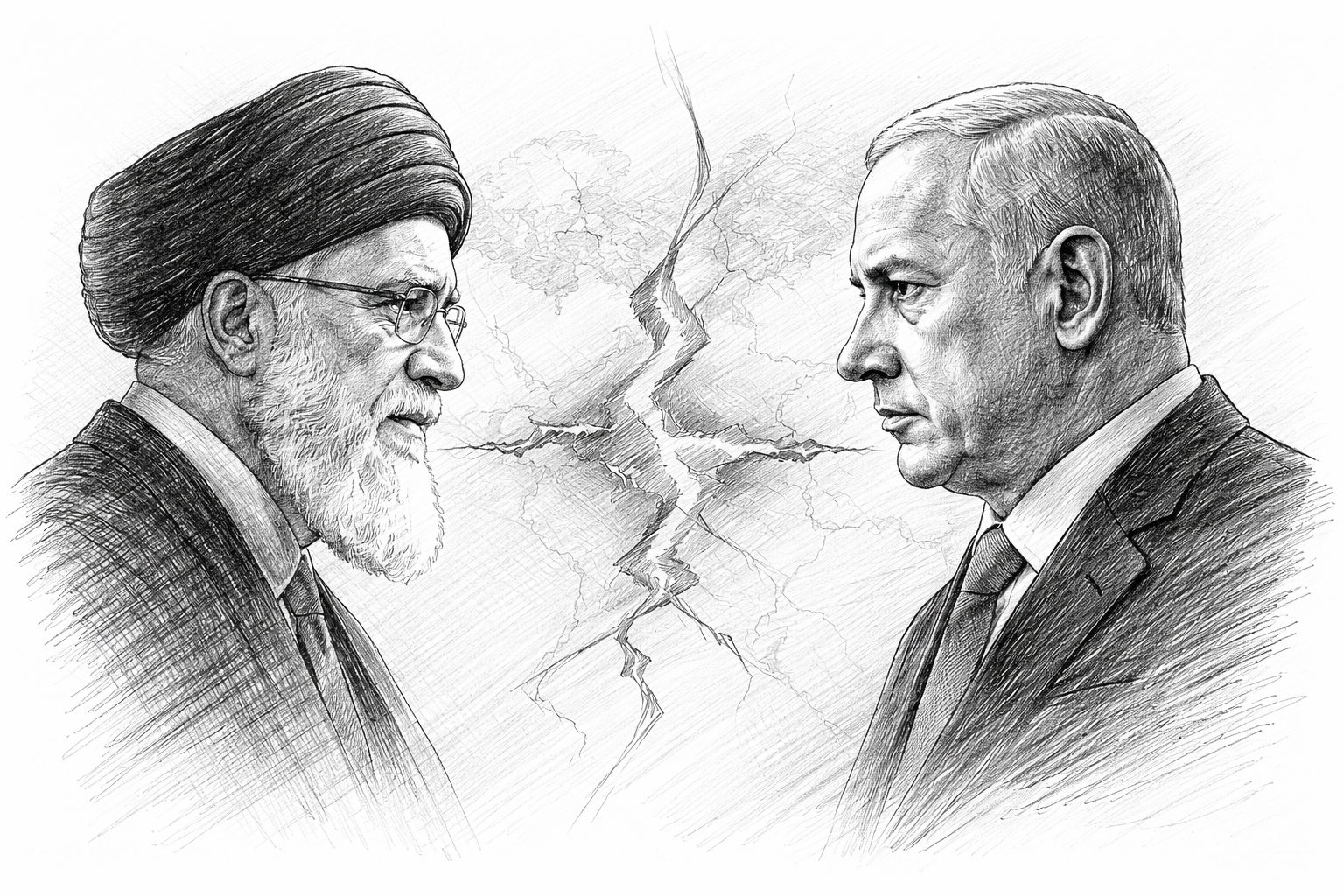
There are moments in the story when you sense that something is shifting. Not abruptly, not with a single decision, but like a line that slowly but inexorably runs through the dust of old certainties. The past few days have been such moments. I wondered for a long time whether I should really write this editorial - after all, I have already dealt with Iran in detail once before and made it clear that you can only understand this country and its power structures if you look at the decades-old lines. But it is precisely these lines that have now become visible again, more clearly than ever.
What makes me sit up and take notice is not just the hard facts: the nightly strikes, the overloading of Israeli missile defenses, the rhetoric of political leaders, the increasing shift of power in the background. It is the underlying pattern - the sense that here is a conflict entering a phase that will be a nightmare for any strategist. And that is precisely why I am writing this article: because many see the surface, but hardly anyone understands what is brewing underneath.

Latest news on the Israel-Iran conflict
12.03.2026Iran's new religious leader and head of state, Modshtaba Khamenei, has spoken out publicly for the first time since the start of the war and announced a tough line against the USA and Israel. In a message broadcast on state television, the 56-year-old cleric demanded retribution for the victims of the airstrikes and spoke of the need for a decisive response. In particular, he referred to an attack in which, according to Iranian sources, numerous schoolgirls were killed.

War against Iran: New Ayatollah Khamenei speaks out for the first time! | WELT net reporter
At the same time, the Iranian leadership announced that it would continue to exert pressure on US military bases in the region and use strategic levers such as the Strait of Hormuz. The new Ayatollah's first statement is seen as a signal that Tehran intends to stick to its confrontational strategy despite the serious attacks.
09.03.2026: In the escalating conflict between Iran and Israel, the situation has escalated once again. dramatically sharpened. According to various media reports, following the death of the previous Iranian leader in a missile attack, his son Modshtaba Khamenei was elected as the new head of the country. He is regarded as a strict hardliner from the circles of the Iranian Revolutionary Guard. In addition to his father, his wife and other members of his family were killed in the attack on his family. Shortly after he took power, there was a further massive escalation: Iran launched the largest missile attack on Israel since the beginning of the current conflict. Israel responded with counter-attacks on Iranian targets in the region.
Parallel growth according to Wallstreet Online There is global concern about the economic consequences. Observers warn that an escalation of the conflict could endanger shipping traffic through the strategically important Strait of Hormuz. A significant proportion of the global oil trade is transported through this strait. If the sea route is blocked, rising energy prices and trade disruptions could trigger a global economic slowdown or even a recession.
06.03.2026: In the escalating conflict between the USA and Iran, US President Donald Trump has made a drastic demand. As reported in the Liveblog of the Süddeutsche Zeitung Trump stated on his Truth Social platform that an agreement with Tehran is out of the question for him at the moment. Instead, he believes that the conflict should be turned into a „Iran's “unconditional surrender" to lead to a military conflict. Washington is thus clearly stepping up its rhetoric and signaling a hard line in the ongoing military conflict. At the same time, international media are reporting on further military operations and increasing tensions in the region. Observers see this as a possible further escalation, while diplomatic initiatives have so far made little progress.
04.03.2026: As the Süddeutsche Zeitung reported in a liveblog, The US military said it had taken out a large part of the Iranian navy in the Persian Gulf. The US Central Command (CENTCOM) stated that American forces had destroyed 17 Iranian warships, including a submarine, and simultaneously attacked almost 2,000 targets in Iran. According to the military command, the aim of the operation was to neutralize Iran's ability to block the strategically important Strait of Hormuz. The commander of the US Central Command stated that there are currently no Iranian ships operating in the Persian Gulf, the Strait of Hormuz or the Gulf of Oman. The information comes from US military sources and cannot currently be independently verified. The Strait of Hormuz is considered one of the most important energy transportation routes in the world: around a fifth of the global oil and LNG trade passes through the route between Iran and Oman.
01.03.2026: Iran's spiritual leader Ayatollah Ali Khamenei is dead - This was confirmed by Iranian state media a few hours after an earlier announcement by US President Donald Trump. According to information from Iran, the 86-year-old died in the heavy airstrikes by the USA and Israel, and a 40-day period of national mourning was declared. According to media reports, close family members, including his daughter and granddaughter, were also killed in the attacks. The Iranian Revolutionary Guards announced retaliation, while Trump described Khamenei's death as an opportunity for the Iranian people.
28.02.2026: On February 28, 2026, Israel, together with the USA, launched military attacks on targets in Iran, pushing the long-standing Middle East conflict into a new, dangerous phase. According to a report in Wirtschaftswoche Iranian facilities were targeted, while clouds of smoke rose over the city and explosions were recorded in Tehran. The offensive marks a significant escalation in the dispute over Iran's nuclear program and follows months of tension between Israel, the United States and Tehran. The Iranian leadership is threatening to retaliate, which is why international observers fear that the situation will deteriorate further.
And because I believe that we are living in a time when citizens need to learn to think with their eyes open again. Not panicked or submissive, but sober. That's exactly what I'm trying to do with this article: To provide orientation, without glossing over, and to show why this conflict has reached a new quality that the West has not experienced in this form for a long time.
The night of the impacts in March 2026
If you look at what has befallen Israel in the last few nights, you immediately realize that a conflict has crossed the boundary of the usual routines. The Middle East has been a powder keg for decades, yes - but this intensity, this sheer mass of bullets raining down on Israeli territory at short intervals, is something else. It is as if an entire system of security architecture has suddenly begun to stutter.
And what is particularly remarkable is that the famous Iron Dome, which is almost mythically glorified in Western news reports, was barely visible during these hours. Few interceptor missiles, hardly any tracers, but all the more impacts. When a defense system that was considered almost infallible for years suddenly looks overwhelmed, it is not just a military detail - it is a geopolitical signal.
You don't see these images - unadorned, unedited, raw - in the news. But they shape a country's sense of power. And they also shape the feelings of those watching. This is the kind of visual material that unsettles entire societies. Not because it's new, but because it has been suppressed for a long time.
What makes this escalation so dangerous
Of course, there was also violence between Israel and Iran or groups controlled by Iran in the past. That is nothing new. But what is different now is the combination of three factors:
- Iran is deliberately testing the limits of Israel's resilience. Not selectively, but strategically, over weeks and months.
- Israel is in a domestic political crisis. A divided society is reacting ever more unpredictably to external threats.
- International protection mechanisms are weaker than ever. The USA may have a military presence, but it is politically paralyzed. Europe is distracted and powerless anyway. China and Russia are pursuing their own agendas.
If you put these three points together, you realize the depth of the problem: this conflict is not simply a dispute between two states. It is a nexus of global power shifts.
Why the usual reporting fails
In our media, this conflict often seems like a distant, perhaps tragic, but somehow „controlled“ conflict. A piece of evening news, embedded between economic reports and weather maps. The drastic images circulating on social networks do not appear there. The impacts during the night, the tremors, the visible failure of the defenses - all of this is softened.
- Perhaps because they don't want to stir up panic.
- Perhaps because it is believed that the population is not resilient enough.
- But perhaps it's also because you underestimate the seriousness of the situation yourself.
Lack of information is no coincidence. It is a risk. Societies that are informed without a realistic basis instinctively make the wrong political decisions. And this is exactly what we are currently experiencing: a growing unease without the tools to understand it.
A nocturnal attack that makes vulnerability visible
This video impressively shows how abruptly the situation in the Middle East can escalate. The massive rocket fire on Tel Aviv, accompanied by wailing sirens and explosions in the sky, highlights the strategic vulnerability of the region. While some of the attacks were intercepted, enough projectiles reached the urban area to cause casualties and considerable damage.

A hail of Iranian missiles shakes Tel Aviv, sirens and explosions | Tribune Timur
The same scenes are repeated several times in the video. In this respect, it is not necessarily worth watching the entire video, but even part of it provides an impression of the situation on the ground. Within just a few minutes, millions of people realized how thin the security line had become. It is precisely this mixture of technical overload and political high pressure that describes the escalation logic of our time.
The return of history
What particularly concerns me: We are currently experiencing the return of a type of conflict that we in Europe thought we had overcome. States openly threatening each other. Nuclear powers testing each other. Regional powers challenging the West at its most sensitive points. What we are seeing right now is not a random outbreak of violence - it is part of a long-term strategy, and one that no longer plays by the West's rules.
History is making a comeback. And it does so with a severity that many did not expect.
In the next few chapters, I would like to show you what is really new about this escalation. Why the West is barely able to steer this conflict. Why Israel and Iran are caught in a strategic pincer from which they will find it difficult to escape. And why the media's perception of the situation does not reflect what is really happening.
If you want to understand why this crisis could be a turning point - geopolitically, in terms of security policy and also in terms of the media - then you can read the next chapters as a toolbox. Not because they provide simple answers, but because they place things in a historical context. We will now delve into the structures that underpin this conflict. And we will see why they are so dangerous.
80 years of Western security policy and its erosion
If you want to understand why the current conflict between Israel and Iran is so explosive from a strategic point of view, you have to accept one thing: It did not suddenly arise. It is the product of a Western security policy that has moved further and further away from reality since 1945. And precisely because the basic assumptions of the West are now being openly questioned for the first time in decades, it is worth taking a clear look at the past - not nostalgically, but in a clarifying way.
Many of today's wrong decisions are only understandable if you realize how a framework of illusions has been built up over decades. And this framework began after the Second World War, in a world that was structurally different, but which still has an astonishing number of intellectual parallels to today.
The illusion of a stable post-war order
After 1945, the belief arose in the West that a stable, predictable world could be formed with a mixture of economic strength, military deterrence and moral standards. The USA - then still in its role as the undisputed superpower - took on the role of global arbiter. And Europe fell into line, happy that someone else was doing the „dirty work“ of security.
This model worked amazingly well for decades:
- The Soviet Union was kept in check by deterrence.
- The Arab world remained fragmented.
- Iran was - until 1979 - in the Western camp.
The blueprint was simple: if we are strong enough, the others remain predictable. But it only worked because the world was not networked back then as it is today. And because the West underestimated its opponents - a tradition that persists to this day.
The turning points: Iran 1979 and the new realities
Everything changed with the Islamic Revolution. Iran broke away from Western influence and began to build its own order - religiously, ideologically, strategically. While Europe and the USA hoped that this was a phase, Iran began its decades-long policy of „strategic patience“, which you can feel everywhere today. Only here does it become clear why the Western perspective so often fails:
- The West plans in legislative periods.
- Iran plans in generations.
This created the first structural imbalance that plays a central role in the conflict today.
The decades of overextension: Iraq, Afghanistan, Libya, Syria
The next big mistake was the belief that geopolitical systems could be stabilized through intervention. Look at the last 30 years of Western foreign policy and you will recognize a pattern:
- Afghanistan20 years of operation and the Taliban take over the country within days.
- IraqA regime toppled, but an entire country plunged into chaos.
- LibyaA „humanitarian intervention“ that has destabilized North Africa.
- SyriaA proxy war without winners - except for those who want to weaken the West.
In each of these cases, the West thought: „We know how to create stability“. And each time the opposite turned out to be true. Today's misery with Iran and Israel is not detached from this. It is the sum of these mistakes that is now coming to fruition.
Why the West has overestimated itself
An important point that almost never appears in classic political analyses: The West long considered its own values to be universal. Democracy, liberalism, secularism - it was assumed that these concepts should be self-evident worldwide. And only a few voices warned that other cultures have a completely different view of power, religion and the state.
Iran is one of the countries that demonstrates this most clearly. The regime there is not irrational - it is rational within the framework of its own historical and religious logic. And it is precisely this rationality that the West has never really understood because it did not fit into its world view.
Then there was the belief in technological superiority: drones, missile defense, cyberwarfare, surveillance systems. Everything seemed controllable - until the enemy learned to overload or bypass the systems. The night-time strikes we see today are not just military events. They are a symbol that the Western logic of superiority is crumbling.
The consequences: An order that only exists on paper
The current conflict reveals three fundamental weaknesses in the Western security architecture:
- The West can no longer contain conflicts. Even the USA is struggling to stop the escalation without being drawn into it itself.
- Europe has signed off on security policy. Nothing comes except appeals. And all the players know that.
- New powers emerge with confidence - and no longer care about Western expectations. This includes not only China and Russia, but also regional players who previously would not have dared to provoke openly.
In short: the old order only exists as rhetoric. In reality, it hardly carries any weight.
Why this historical background is crucial
If you want to understand the drama of the current conflict, you have to recognize how deep the erosion of Western security policy goes. Without this view, everything looks like a spontaneous escalation, an unfortunate coincidence of surprising events. In truth, it is the logical consequence of decades of miscalculations.
The conflict between Israel and Iran is so dangerous because it is based on a foundation that is already cracked. And because the mechanisms that used to prevent escalation hardly work today.
It is precisely these mechanisms that we will continue to break down in the following chapters - step by step, so that you can clearly see why this crisis is more than just a regional dispute. It is a test case for the question of whether the West can maintain its role in the world - or whether we have already entered a new era.
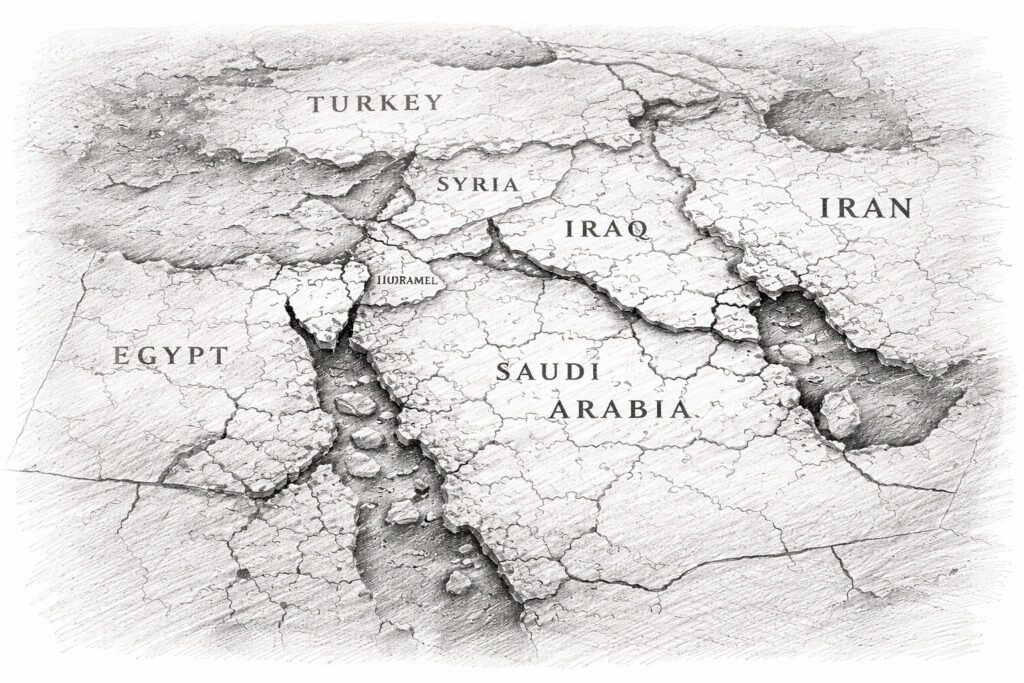
The Iranian logic of power: rationality without Western rationality
If you want to understand today's conflict, you first have to realize one thing: The leadership in Iran is not irrational. It is merely acting according to a logic that hardly anyone in the West has mastered or is even capable of recognizing. The regime does not think in terms of election cycles, PR strategies or short-term success stories. It thinks in long lines. Decades, sometimes even generations.
This long-term perspective is the reason why the system has remained stable since 1979 - despite sanctions, despite international isolation, despite periodic protests. The West often interprets stability as stubbornness or backwardness. In reality, it is strategic patience. A proven principle of rule that is deeply rooted in the historical self-image of the Iranian elite.
The Iranian leadership does not exploit geopolitical shifts impulsively, but gradually. Every provocation is embedded in a broader spectrum of objectives: regional dominance, ideological stability, deterrence against external enemies and a clear message to its own population. It is precisely this mixture that makes the regime difficult to calculate for Western analysts, but surprisingly stable from its own perspective.
The regime and its people: Why unrest does not lead to what the West expects
One of the biggest errors in Western thinking is to assume that any visible discontent in Iran must inevitably end in regime change. But protests do not automatically mean revolution. And even revolutions - as history shows - often do not end where the West would like them to.
Iran is a country with thousands of years of cultural, religious and national experience. There is a deep narrative of heteronomy, pride and self-assertion. Many Iranians may be dissatisfied with the leadership, but they accept the reality in which they live - partly because the alternative is perceived as less secure, more chaotic or more dangerous.
This is precisely what many Western politicians and media underestimate. Iran is not a society waiting to be „liberated“ from the outside. It is a society that deals with its conflicts using its own logic - sometimes eruptively, often repressed, but almost always without the desire to follow Western models.
If the West then tries to weaken the regime despite the lack of organic movements, it often achieves the opposite: the system closes ranks, appeals to national dignity and can use external threats as a source of legitimacy. A mechanism that has worked reliably since 1979. And this is precisely why direct external intervention is counterproductive.
Iran as a regional power with a long line
In order to interpret today's conflict, you have to understand that Iran is no longer just one state among many. It is a regional power - politically, militarily and ideologically. It has not achieved this role through economic strength, but through a long-term network of proxies and zones of influence.
In Iraq, Syria, Lebanon, Yemen and beyond, Iran operates through militias, political parties, religious institutions and economic networks. These structures fulfill several functions:
- DeterrenceIsrael or the USA know that an attack against Iran could trigger counter-attacks in several countries.
- Influence projectionIran can expand its power without having to wage open warfare.
- Cost minimizationProxy fights are cheaper and politically less risky than direct conflicts.
This network ensures that Iran remains a player to be taken seriously, regardless of its own economic situation. Western observers may see this as „destabilizing“ - for Tehran, it is simply a survival strategy.
And this is precisely where the misunderstanding of Western analysis lies: the expectation is that an economically ailing country is automatically militarily weak. However, a regional power does not define its strength through prosperity, but through geopolitical leverage. And Iran has perfected these levers.
Iran beyond the headlines - a look at everyday life and society
 If you want to understand why the conflict surrounding Iran is so complex, you should first take a step back and take a closer look at the country itself. In my detailed background article „Understanding Iran: Everyday life, protests and interests beyond the headlines“ is about precisely that: not about missiles, nuclear programs or geopolitical strategies, but about Iran as a society. Because hardly any other country is so strongly characterized by fixed images - images of religious rule, protests and conflicts - even though many people have never experienced the country themselves. The article shows how strongly perceptions are shaped by narratives and why everyday life, political tensions and international interests in Iran are often much more contradictory than simple headlines would suggest.
The West has never really understood the Iranian strategy
The central mistake of Western policy has always been to interpret Iranian decisions with Western rationality. The leadership in Tehran follows a completely different prioritization:
- Regime preservation above all elseEverything - really everything - is measured by whether it strengthens or weakens the stability of the system.
- Ideological consistencyIran cannot give in on domestic policy without damaging its religious and political self-image.
- Long-term deterrenceA regime that sees itself threatened by the West must increase its invulnerability, not negotiate.
Strategic patience
While Western politicians think in four-year cycles, Iran works on the same goals for decades. This structure is the opposite of what Europe or the USA do. And that is why the systems regularly collide without really understanding each other.
The current escalation between Iran and Israel is not the result of impulsive government action. It is embedded in a strategic line that Iran has been pursuing for decades: expanding regional influence, increasing deterrence, putting pressure on Israel and forcing the USA out of the region.
In such a logic, there is hardly any room for regression. If Iran is now massively deploying missiles, it is not because it is „losing its nerve“, but because it wants to consolidate its position - in the region, vis-à-vis the West and vis-à-vis its own population. This is what makes the conflict so dangerous: it is not improvised. It is part of a strategic plan that has been running for years. And that is why it cannot simply be „negotiated“, „frozen“ or „ended“, as Western capitals would like.
Netanyahu and 30 years of alarmism - The history of the permanent warning
Looking back today, it seems almost surreal: since the early 1990s, Benjamin Netanyahu has repeatedly warned of the same danger - that Iran was „on the verge“ of building a nuclear bomb. And each time with a dramatic undertone, with charts, with diagrams, always with the same message:
„It's almost time, we have to act.“
These warnings shaped the entire Israeli security doctrine. They influenced US policy, European diplomacy and the international perception of Iran. But the remarkable thing is that the warnings were repeated for decades - and the decisive moment never came.
This is not to say that Iran is harmless or unambitious. But the fact that the same rhetoric has been used for 30 years has a strategic side effect: it wears out. An alarm that is sounded too often loses its effect. And that is precisely one of the reasons why the current situation is so delicate. Because at the very moment when the situation could really get out of control for the first time, the credibility of the old alarm calls has been damaged.
In addition, this decades-long warning policy has led to Israel slipping deeper and deeper into a logic in which it can no longer turn back without losing strategic face. Anyone who says for decades: „The enemy is on the verge of becoming existentially dangerous“ cannot simply adopt a less confrontational stance later on without calling their own policy into question.

Benjamin Netanyahu's 33 years of Iran nuclear warnings | Al Jazeera English
Why this alarmism backfired strategically
Alarmism can bring political benefits in the short term. It creates domestic political pressure, rallies support and justifies tough measures. But in the long term, another problem arises: at some point, the world no longer really listens. In Israel itself, alarmism has become downright institutionalized. But outside the country, the effect has become less and less.
Two developments played a central role in this:
- The West got tiredOver the years, the international community - above all the USA and Europe - reacted to the warnings in an increasingly routine manner: „Iran is on the verge of the bomb“ became a statement that was taken seriously, but was no longer classified as an acute emergency. This created situations in which Israel expected pressure, but the West opted for diplomatic détente.
- Iran learned to live with alarmismInstead of being intimidated, the Iranian regime even began to take advantage of the warnings. They helped Iran to present itself as a victim of Western interference. And they motivated the regime to expand its regional networks - precisely in order to prevent Israel or the USA from actually striking militarily at some point.
Alarmism therefore had a paradoxical effect: in the end, it strengthened those it was intended to weaken. But something else is even more serious: through constant repetition, the West lost its sense of real escalation signals. And this is precisely what is now taking its revenge, when for the first time in a very long time a situation has arisen in which the threat is actually real, dynamic and acute.
The price of 30 years of „the bomb is coming soon“ policy
Decades of rhetoric have caused further strategic damage: It tied Israeli policy to a line that left less and less room for maneuver. If you assure people for decades that you will prevent Iran from becoming nuclear-capable, then at some point there are only two options:
- You reach your destination.
- Or you lose your deterrence competence.
It is precisely this predicament that characterizes today's escalation.
The domestic political hardening
Over the years, Netanyahu has built up a political culture in which any hint of détente was interpreted as weakness. This has created a domestic political pressure of expectation in Israel that leaves little room for diplomatic solutions. Society has been gradually conditioned to an attitude in which uncompromising strength is seen as the only way out.
Due to the permanent warning, Israel is now in a situation where a real Iranian attack - as is happening now - is automatically seen as confirmation of the decades-old narrative. Backing down seems virtually impossible because it would undermine the entire historical argument. This leaves Israel facing a dilemma today:
- If it acts too hesitantly, it loses deterrence.
- If it acts too harshly, the situation escalates beyond control.
This is precisely what makes the current conflict so dangerous: it is no longer just a reaction to Iranian behavior. It is the result of decades of self-commitment.
International fatigue
And then there is the West. The USA is politically exhausted, Europe is paralyzed in terms of security policy. Although Israel's warnings are heard, its ability to heed them is limited. This means that even if Israel wants to escalate, it can no longer be sure that the West will accept the consequences.
This leads to a situation in which Israel will probably react more harshly than the West would like - and at the same time receive less support than Israel expects. A strategic nightmare for both sides.
The analysis of Netanyahu's 30 years of alarmism is not just a historical digression. It is central to understanding today's dynamics. Israel finds itself in a situation in which it is not only acting reactively, but reactively under conditions that it itself has created over decades. Iran, in turn, knows this - and exploits it.
This chapter therefore forms the bridge to the next parts of the article: nuclear risk, the strategic impasse and the question of how a conflict can enter a phase in which even clear decisions no longer guarantee a clear outcome.
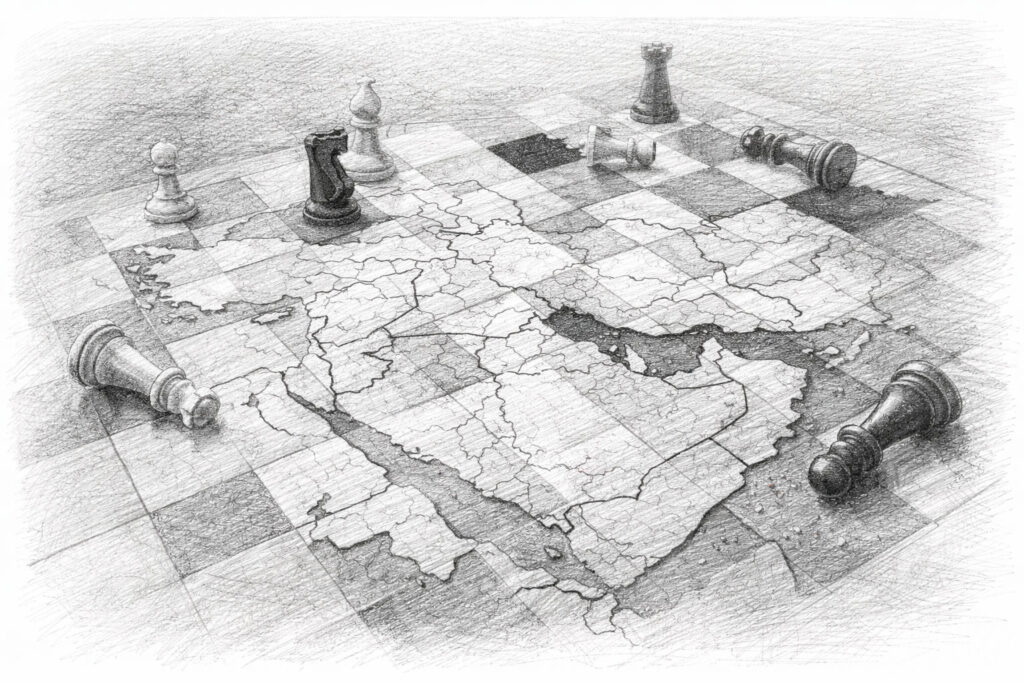
Why this conflict is every strategist's nightmare
If you take a sober look at the current situation, you quickly realize that Israel finds itself in a security trap the likes of which has hardly been seen a second time in modern history. Not because the country is militarily weak - on the contrary. Israel has one of the most modern armies in the world, reconnaissance, precise weapons systems and a defense doctrine that has been practiced for decades. But paradoxically, it is precisely this strength that is part of the problem today.
Israel's existence is under threat, not in the abstract, but in reality. The rocket fire of recent days and weeks has shown how quickly the situation can tip when an opponent deliberately overloads a system. The Iron Dome is an impressive technology, but it is not infinitely resilient. And every impact that gets through is not just a military event, but a psychological shock for a country that has been able to rely on its superiority for decades. This creates a double dilemma:
- If Israel reacts too weakly, it will lose deterrence - both internally and externally.
- If it reacts too harshly, it risks regional escalation and even scenarios that were unthinkable just a short time ago.
In classic security policy, this is known as a „lose-lose architecture“: every path leads to disadvantages, every step is anticipated by the opponent and every renunciation looks like weakness. This is exactly the kind of situation that strategists fear because it does not allow for a clear path of action.
The dilemma of the USA
The second central player in this conflict is the United States. And here, too, a strategic entanglement of remarkable depth is evident. For decades, the USA has maneuvered itself into the role of Israel's security guarantor. Politically, militarily, rhetorically. A return is hardly possible without jeopardizing the entire security balance in the Middle East - and at the same time damaging its credibility worldwide. But today, the USA is at the same time:
- politically divided,
- internationally overstretched,
- economically ailing,
- and security policy in several regions simultaneously (Europe, Indo-Pacific, Middle East).
This overload means that Washington has to send a clear signal that it stands by Israel's side - but at the same time is desperately trying to avoid being dragged into a war itself. The result is a policy that appears neither consistent nor unambiguous. And it is precisely this lack of clarity that is extremely dangerous in geopolitical escalations. Because if a major player hesitates, a smaller player has to react all the more harshly in order to keep its own red line credible. This is a dynamic that Israel is now feeling and which further restricts its room for maneuver.
For strategists, this creates a scenario in which no central player can really act freely. And this is precisely what increases the risk of uncontrollable developments.
The most dangerous point: When one side believes it has „no choice“ anymore
In the history of major conflicts, there is one phase that is particularly dangerous: the phase in which actors are convinced that their options have been exhausted. When Israel believes that its own existence is under threat and that diplomatic channels no longer offer any security, measures that were previously unthinkable become conceivable.
The same applies to Iran. And that is precisely what makes the situation so explosive.
The next stages of escalation are not conceivable because the actors are irrational, but because they feel rationally backed into a corner. When missiles hit, when the social mood changes, when the feeling arises that time is working against you, then the logic of politics is replaced by the logic of naked security.
This is the moment when conflicts become unpredictable. And this is where the dynamics of game theory set in, making every strategist nervous:
- Each waits for the other to give in.
- No one can give in without losing face.
- Every delay creates domestic political pressure.
- Every reaction is interpreted by the opponent as a precursor to an attack.
This creates spirals of escalation that no one can stop, because every step the opponent takes is read as confirmation of their own fears.
When deterrence crumbles - and why this is so dangerous
Deterrence only works if both sides believe that the other side is reacting rationally and wants to avoid escalation. But in this conflict, it is precisely this prerequisite that is under threat.
Israel must demonstrate its ability to act in order to protect its own population. Iran must show strength in order to secure its regional power. Neither actor can afford to be weak. And it is precisely this mutual incompatibility that leads to a situation in which every step - even defensive steps - can look like an offensive action. When deterrence falters, room for misinterpretation is created:
- A misinterpreted radar image.
- An exaggerated political speech.
- A militia-led operation that doesn't really suit either side.
- A technical failure in communication.
Historically, it is precisely moments like these that have triggered major wars.
The current scenario is a classic nightmare
The reason why strategists see today's development as a nightmare is surprisingly simple: all the stability mechanisms that have been relied upon over the last 40 years have been weakened.
- The USA is not clear enough.
- Europe is powerless.
- Israel is overburdened, both internally and externally.
- Iran is more self-confident than ever before.
- Russia and China are on the sidelines - influential, but not controlling.
This means that the classic brakes no longer work. In such a situation, even a small action can trigger a major movement: an attack, a diplomatic gaffe, an exaggerated reaction or simply a misunderstanding.
The region is therefore at a point where any step towards escalation seems more realistic than any step towards détente. And this is precisely the structural nightmare that experts have been warning about for months.
Between hope and danger: a country in a state of internal emergency
The impressions from this video show an Iran that is internally torn: on the streets, cautious joy about possible political change is mixed with deep-seated fear of the omnipresent security forces. Many people hope for an end to decades of oppression, but the regime is holding the country together with iron control - now additionally overlaid by the bombings.

Iran: The first days of this war ARTE Reportage
At the same time, tens of thousands of Iranian exiles in Iraqi Kurdistan are eagerly awaiting their return, while the regime nurtures its own narrative. Hope and repression are closer together than ever before.
Nuclear scenarios that were previously unthinkable
Just a few years ago, hardly anyone would have seriously discussed the possibility of tactical nuclear weapons being used in the Middle East. Most experts would have dismissed it as scaremongering, a theoretical thought experiment with no practical relevance. But today we find ourselves in a situation in which this topic is not only being discussed analytically, but has become a military-strategic reality.
There are many reasons for this. First of all, it is due to Israel's special situation: a small country, densely populated, surrounded by enemies with ever more advanced missile and drone technology. When a state feels that its existence is physically threatened and conventional means are reaching their limits, then measures that were previously taboo move into the realm of the conceivable.
And then there is Iran. A country that has a completely different security culture and whose regional striving for power is openly aimed at undermining Israel politically, psychologically and militarily. In recent years, Iran has not only massively expanded its ballistic systems, but has also strengthened its network of proxy groups to such an extent that conventional deterrence is increasingly ineffective.
This combination is leading to a geopolitical climate in which the threshold of the unthinkable is falling. This does not mean that nuclear use is likely - but it is no longer unthinkable. And this fact alone changes the entire dynamic.
Domino effects: When a bomb drops
When talking about nuclear scenarios, we must not be naive. The use of a tactical nuclear weapon - regardless of which side - would shake the entire architecture of international security.
This does not only concern Israel and Iran. It affects the entire region and, beyond that, every state that is connected to the conflict in any way.
Iran's immediate reaction
A nuclear strike on Iranian territory would be an event that would stabilize the regime in Tehran domestically - not weaken it. Any opposition would suddenly fall silent. The leadership could legitimize all military measures, no matter how far-reaching, as „defence of the homeland“. And it would probably have strong domestic political support.
Iran would attempt to strike back immediately and massively. This could be done using missiles, drones or militias - depending on which means would still be viable after such a strike. A second, third and fourth attack could not be ruled out, because Tehran cannot afford to appear defeated or intimidated.
The role of Pakistan
This is where the scenario becomes global. Pakistan is a nuclear power with close religious and cultural ties to the Islamic world. An attack on a Muslim country with a nuclear weapon - even if it were militarily limited - would put enormous pressure on the Pakistani government.
Would Pakistan actually go nuclear? Highly unlikely - because that would be an act of suicide for the country. But: the rhetorical escalation would be gigantic. The army could be mobilized. And the threat alone would dramatically exacerbate the situation.
The Arab states
Saudi Arabia, the United Arab Emirates, Qatar - they would all be in a difficult position. Many of them work covertly or openly with Israel, but a nuclear strike against a Muslim country would trigger a wave of emotions that would put their governments under enormous pressure. They would be forced to position themselves publicly, even if strategically they would prefer to avoid it.
The West
Nuclear use by Israel would plunge the USA and Europe into a deep dilemma. They could not openly support the action without losing their entire moral basis - but neither could they clearly condemn it without destroying their security policy line. The West would be paralyzed.
And that is precisely the most dangerous position in a nuclear crisis.
What the major powers can really control today - and what they cannot
For a long time, the idea prevailed that the major powers - the USA, Russia and China - were in a position to stabilize or at least limit regional conflicts. However, the current situation clearly shows that this influence is no longer what it used to be.
- The USAThe United States is in a state of geopolitical overload. It must simultaneously stabilize Europe, contain China and keep an eye on the Middle East. Their ability to stop Israel or curb Iran is limited. They can advise, warn, threaten - but they cannot dictate decisions to the regional players.
- RussiaMoscow has historically had influence over Iran, but today the dependencies run in both directions. Russia needs Iranian drone technology and political support. It can give Iran recommendations, but not orders. A nuclear strike would set off alarms in Moscow, but Russia could neither prevent it nor respond effectively.
- ChinaChina has other priorities: economic stability, Silk Road corridors, energy supply. Beijing does not want escalation - but it will not risk openly opposing Iran. China's influence consists primarily of diplomatic restraint, not strategic control.
The result: for the first time in decades, we find ourselves in a world in which no major power has sufficient leverage to safely prevent a nuclear escalation. This does not mean that escalation is likely - but it is possible. And that is enough to make the entire geopolitical structure unstable.
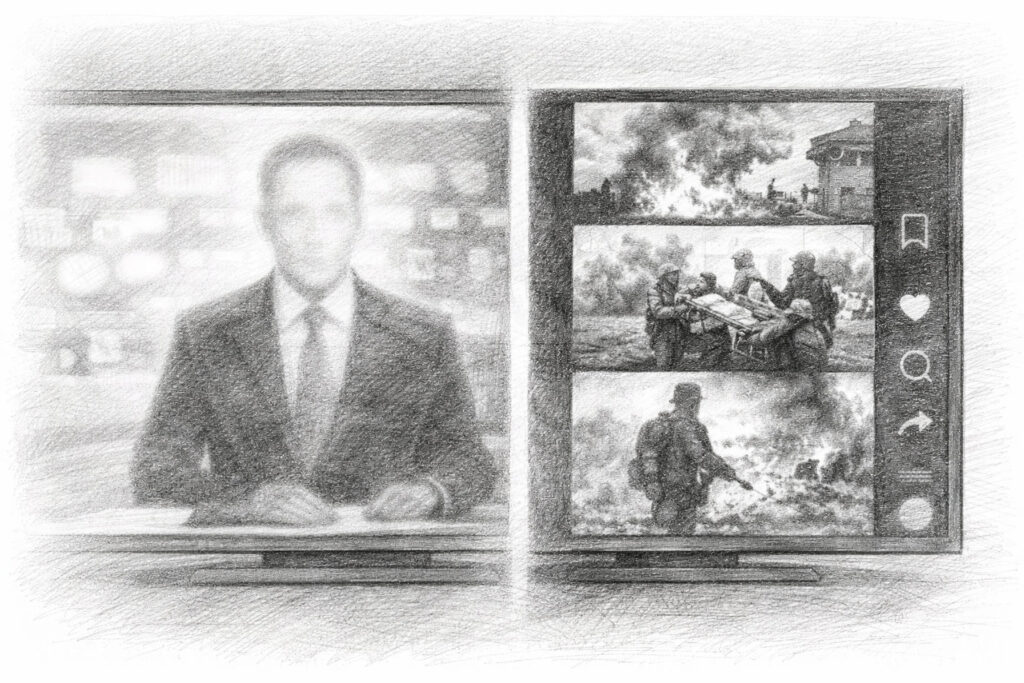
The role of the media: lack of information as a security risk
If you want to understand why so many people in Europe, and especially in Germany, cannot comprehend the seriousness of the current situation, then you have to look at the way the Western media works. Not in the sense of conspiratorial criticism, but soberly: our media traditionally work with a filter that is intended to reassure the population instead of confronting them with the full force of reality.
This principle has historical roots. For decades, state and large private media companies have been striving to present conflicts in a structured, orderly manner and in a way that triggers as little fear of escalation as possible. News should inform, but not overwhelm. It should explain, but not traumatize. And they should always convey the impression that political institutions have „everything under control“.
The problem is: In a situation like the current one, it is precisely this attitude that gives people a false picture of reality. When night-time missile attacks, massive strikes, overloading of defense systems and geopolitical escalation signals are summarized in a three-minute report, a dangerous vacuum is created between the true situation and public awareness.
And this vacuum is not harmless. It influences political decisions, democratic debates, social priorities - and ultimately also a country's ability to take crises seriously before they reach it.
The real pictures that are not shown
There is a clear discrepancy between what people see on social networks and what the traditional media show. While unfiltered videos of strikes, rocket fire and destruction are circulating online, the images in traditional news broadcasts often look like abstracted illustrations of a supposedly controlled situation. There are many reasons for this:
- Editorial cautionImages with a strong emotional impact should not be played out in an uncontrolled manner so as not to shock or radicalize the population.
- Political responsibilityMany editorial offices see it as their duty not to unnecessarily jeopardize state stability - especially in international crises.
- Self-image of the public service mediaThey should provide orientation, not overwhelm. This often leads to what really happens being squeezed into a scheme that seems more pedagogical than journalistic.
However, the effect of this filtering is fatal: people sense that something is wrong, but they do not receive enough information to classify this feeling. As a result, mistrust grows - and at the same time, the majority remain passive because the official narrative does not convey the seriousness of the situation.
You could say that people see the world through a pane of frosted glass. They can see the contours of danger, but not its shape.
Consequences of information distortion: a population that lives without situational awareness
Societies can only overcome crises if they know the reality. Being informed is a security policy factor - not a luxury. But this is precisely where a structural problem arises in the current situation.
- Democratic decision-making is made more difficult
If the population does not understand how dangerous a geopolitical situation really is, it makes decisions based on a distorted view of the world. They trust that state institutions have everything under control, even though these institutions themselves often have no clear strategy.
A democracy needs responsible citizens - but responsibility requires knowledge. - No political pressure
Governments usually only react to international crises when pressure from the population increases. However, if people only get to see watered-down versions of reality, political pressure is also weakened. The result is inertia, which can be dangerous in escalating situations. - Lack of resilience in society
Resilience - the ability to deal with crises - does not arise from reassurance, but from realistic assessment. A society that only perceives crises in an abstract form will be surprised and overwhelmed in an emergency.
The psychological transition between „This is far away“ and „This affects us directly“ can take place within hours - and this is precisely when a country needs an informed population that does not react in panic but understands what is happening. - Room for propaganda, speculation and fear
If the official information is not enough, people look for other sources. That is human. But it opens the door to disinformation, dramatization, conspiracy narratives or over-interpretation of individual events.
And this is exactly what we are currently experiencing on a grand scale. The information gaps are not being filled by good alternatives, but by extreme interpretations - while the official media continue to appease.
This is the most dangerous combination of all: a population that instinctively senses that the situation is serious - but is given no tools by its own media to categorize this feeling.
Why this media failure is exacerbating the conflict
It would be too short-sighted to believe that the media only have a passive role in this crisis. In reality, they are influencing the dynamics:
Governments often act on the basis of how their own population perceives the situation.
In turn, allied states monitor the public mood in order to adjust their strategic decisions accordingly.
Opponents exploit every visible weakness in the West's information to strengthen their own position.
A state whose population does not see reality loses room for maneuver. It reacts too late, too hesitantly or too impulsively. And in an escalation phase like this, that is precisely what is so dangerous.
The media distortion not only creates a lack of information, but also strategic blindness. And strategic blindness is the last thing the West can afford in this situation.
How media images shape our perception of conflicts
 If you want to understand the current escalation between Iran and Israel, you also need to understand how modern information wars work. Wars today are not only fought with missiles, but also with images, narratives and emotionally charged headlines. Propaganda does not necessarily mean outright lies, but often a targeted selection of information intended to create a certain perception. Facts, half-truths and strong images are often combined in such a way that they trigger emotions and influence political interpretations. I analyze precisely these mechanisms - from emotional symbolic images to selective reporting - in detail in the background article „Propaganda: history, methods, modern forms and how to recognize them“, which shows how media narratives are created and why they are particularly effective in times of crisis.
Current survey on trust in politics and the media
The economic tremor: Why companies are going quiet
When a conflict like the one between Israel and Iran escalates, it is not only noticeable in political reactions, diplomatic statements or military movements. It is felt above all in a phenomenon that begins quietly but weighs heavily: The economy is getting nervous. And in economic contexts, nervousness is a signal with an enormous impact.
It is no coincidence that the phones are going silent at many companies, investments are being postponed and decision-making processes are stalling. People react instinctively to uncertainty. And companies are ultimately nothing more than organized groups of people trying to minimize risks. In times like these, the perspective changes:
- People are no longer thinking expansively, but defensively.
- The focus is no longer on growth, but on stability.
- Long-term commitments are avoided and liquidity is retained.
Geopolitical conflicts lead to a kind of economic paralysis. And it is precisely this state of shock that has been felt around the world for months - particularly in Europe, and remarkably strongly in Germany, where the basic economic structure has been under pressure for years anyway.
The reason for this is simple: the economy needs predictability. But this predictability has currently disappeared, worldwide and to an extent that is reminiscent of the energy crisis, the financial crisis or even historical breaking points.
Energy prices, transportation routes, risk premiums
The Middle East is not just any region - it is the hub of global energy supplies, trade routes and geopolitical stability. As soon as this region begins to falter, economic systems that are seemingly far away are automatically shaken.
- The energy issue
A single spark in the Persian Gulf is enough to make oil prices jump. And not slowly, but in hours. Companies must react to this. Energy-intensive industries will suffer not next year, but immediately. Every disturbance in the Strait of Hormuz, every threat against tankers, every hint of a sea blockade acts like a price signal in real time. For Europe - already dependent on external energy sources - this means that risk becomes a cost factor that eats through all supply chains. - Transportation routes as an Achilles heel
Modern economies are globally interlinked and trade routes are more closely connected than ever before. As soon as uncertainties arise in the Red Sea, the Gulf of Oman or the Eastern Mediterranean, freight costs, insurance premiums and delivery times increase.
The economy may seem abstract - but it is as sensitive as a nervous system. When a large nerve is irritated, the whole system vibrates. - Insurance and risk premiums
In times of geopolitical crisis, insurance companies get nervous - and when insurance companies get nervous, the economy becomes expensive. Risk premiums rise, loans become more expensive and low-margin projects suddenly become unprofitable.
We live in a world in which political risks are directly translated into economic indicators. And this is happening at a speed that surprises many.
Companies instinctively switch to „wait and see“
Economic behavior does not only follow rational analyses. It follows psychological patterns. And these patterns are centuries old.
In times of great uncertainty, people do what they intuitively think is right:
- Stock up
- Postpone investments
- Minimize obligations
- Avoid risks
Companies behave no differently. When the geopolitical situation comes to a head, there are three typical reactions:
- Postponement of decisionsNew projects, purchases, hiring - everything is put on the back burner.
- Focus on core areasCompanies concentrate on what is safe and avoid experiments.
- Cost discipline and securing liquidity: You don't want to afford surprises.
These patterns are not irrational. They are necessary for survival - but they lead to a slowdown in the economy as a whole, which becomes particularly apparent in times of crisis.
This explains why many sectors appear less dynamic despite full order books. The substructure has been shaken and no one wants to be the one who makes a bold investment at the wrong time when the situation looks even worse tomorrow.
People sense that „something is wrong“
It is interesting to note that economic uncertainty can often be felt before it becomes measurable. People intuitively perceive geopolitical risks - even if they don't read detailed analyses. They see the pictures, hear the news, feel the mood. And even if the media soften many things, the basic tone is often enough to create a diffuse feeling. This feeling - that „something is in the air“ - has an enormous impact:
- Consumer behavior is changing
People are buying less, postponing purchases and planning more cautiously. Consumption is not just a question of money, but of confidence in the future. - Companies sense cautious customers
When customers become more cautious, companies automatically become more cautious too. The restraint reinforces each other. - Social mood drifts towards alarmism
An atmosphere of crisis leads to political polarization, mistrust and a collective underlying tension. This reduces the willingness to take risks - and economic activity is based on risk. - Media amplified or obscured perception
When images are more powerful than words, but are only shown in a filtered form, a paradoxical situation arises: people see less, but feel more.
This imbalance ensures that uncertainty grows uncontrollably. Not because it is justified, but because it remains uncommented on.
Why economic paralysis is a warning signal
In geopolitical conflicts, economic paralysis is not a side effect - it is an early indicator. It indicates that a system is entering a phase in which the risks are greater than the opportunities. And this is precisely the structural danger we are currently seeing: The economy is not overreacting - it is reacting correctly.
After all, an escalating conflict affects energy prices, migration, security, trade, financial markets, supply chains and political stability. All of these factors are interrelated. And if they come under pressure at the same time, this creates a major economic situation that is difficult to invalidate.
You could say that before a geopolitical storm becomes visible, the first thing you hear is the economy holding its breath. And this is precisely the moment we are currently experiencing.
When geopolitical conflicts and AI decisions coincide
This video impressively shows how closely security policy decisions are now interwoven with the technological turnaround. While the USA and Iran were still negotiating in Geneva, Washington rejected a major deal with Anthropic just one day later - and signed a contract with OpenAI instead. The timing does not seem coincidental, as modern conflicts are no longer just about missiles and sanctions, but also about data power, information dominance and AI infrastructure.

Iran war: What if it's not what it looks like? | Salvatore Princi
The author of the video links these events into a bigger picture: the Iran war should not be viewed in isolation, but as part of a global shift in which geopolitical, economic and technological interests are intertwined. This is not just about Iran and the parties involved, but above all about interconnected dynamics and AI infrastructure, Cryptocurrencies, Stable Coins and the US Genius Act.
The global reorganization: The West is losing its position
A sober look at developments in recent years reveals a pattern that can no longer be overlooked: The decades-long dominance of the West is crumbling. Not abruptly, not in one dramatic event, but in a gradual but all the more profound erosion. For decades, the Western world has relied on its political models, economic power and security structures remaining globally authoritative. But while the West persisted in this self-assurance, new centers of power emerged - dynamic, determined and far less dependent.
This shift has such a strong impact precisely because it does not arise from the weakness of individual states, but from a collective change. Societies that were previously regarded as recipients of the Western order are now asserting themselves and defining their own interests. And the stronger these states become, the clearer it becomes that the old hierarchies no longer apply.
This does not mean that the West is disappearing. But its monopoly on order, interpretation and geopolitical organization is over. And it is precisely this change that coincides with the current escalation - which is why the conflict is so dangerous and at the same time so symptomatic.
Rise of the South: Iran, Turkey, India, the Arab world and BRICS
While the West tried to preserve its existing order, other regions worked to expand their own role. This is particularly visible in countries such as Turkey, India and Saudi Arabia - states that are anything but purely regional powers today.
- Turkey
It has been acting as an independent power factor between East and West for years. It buys weapons from wherever it benefits, forms alliances as required and pursues clear geopolitical interests. Turkey shows how flexibly modern states can act when they no longer feel bound by the structures of old alliances. - India
India is no longer a bystander, but one of the central forces in the global power structure. Economically strong, demographically young, geopolitically self-confident - and increasingly independent. India is showing the western world that stability and growth are not necessarily tied to western models. India acts where benefits arise - and not where loyalty is expected. - Saudi Arabia and the Arab world
The Arab region has emancipated itself from its role as a supplier of raw materials. Saudi Arabia is investing in technology, infrastructure, international alliances and energy independence. The state is now a mediator, investor, regional power factor - and increasingly independent of the West. - BRICS and the new multipolarity
At the same time, a network is growing that is openly challenging the West: BRICS. An association that no longer consists of individual states, but of a growing list of countries that are consciously seeking alternatives to the Western-dominated system - economically, politically and increasingly also financially.
This structure is not stable, but it is attractive to those who are fed up with Western dominance. And more and more countries see the BRICS environment not just as an alternative, but as an opportunity to exert influence themselves.
The new reality: the West is just one player among many
The decisive change is this: The West is no longer setting the pace in world politics. It is one player among many - with strengths, but also with growing weaknesses. And while the West is trying to defend past structures, others are building new ones.
- Loss of moral authority
For decades, the West believed that it could make global decisions not only on political systems but also on moral issues. Today, however, Western standards are increasingly seen as selective, interest-driven or outdated. Countries such as India and Turkey are no longer impressed by moral rhetoric - they demand pragmatic solutions. - Economic dependencies have shifted
The global economy used to be dependent on the West. Today, the West is dependent on global supply chains that it no longer controls. Energy, raw materials, production - everything has shifted to the East or South. And that is precisely what makes Western sanctions or pressure measures less effective. - Military dominance can no longer be taken for granted
The West has also lost its lead in terms of security policy. While the USA remains strong, European states are losing strategic relevance. New players have learned to use asymmetric means: Drones, missiles, cyber operations, proxy structures. It is precisely these means that can be clearly seen in the Iran conflict - and they undermine traditional Western warfare. - Multipolarity instead of bloc thinking
We no longer live in a bipolar or unipolar world. The new world order is multipolar - and multipolar systems are more unstable because there is no central power that can contain crises. Each player has its own interests, and alliances are changing faster than before.
For the current crisis, this means that there is no longer anyone who can reliably stop the escalation.
Strategic misconceptions of the West in the Middle East conflict
| Misconception | Why it no longer applies | Consequences for the current situation |
| The West can stabilize conflicts at any time. | Multipolar power relations have weakened the former dominance. | No more reliable external brake for escalations. |
| Diplomacy is enough to defuse existential conflicts. | Both players are stuck in security policy dead ends. | Negotiations only have a limited effect, often purely symbolic. |
| Regional players automatically align themselves with Western expectations. | Iran, Turkey, India and Saudi Arabia are increasingly pursuing their own interests. | The West is losing influence and strategic controllability. |
Why this global reorganization makes the current conflict explosive
The escalation between Israel and Iran would be dangerous in itself. However, it only becomes fully explosive against the backdrop of the new global order. In a world in which the West no longer clearly dominates, appeals, sanctions and diplomatic pressure are losing their power. At the same time, new players are using the situation to define their own interests - regardless of old structures.
Iran is testing boundaries not only with Israel, but also with a West that no longer has the assertiveness of previous decades. And it is doing so in the knowledge that states such as Turkey, India and Saudi Arabia are going their own way instead of automatically backing Western positions.
The West thus faces a double challenge: it must overcome a crisis that it does not control. At the same time, it must accept that it is no longer the central force that can define such conflicts. It is precisely this combination that makes the situation so dangerous - and so characteristic of our time.
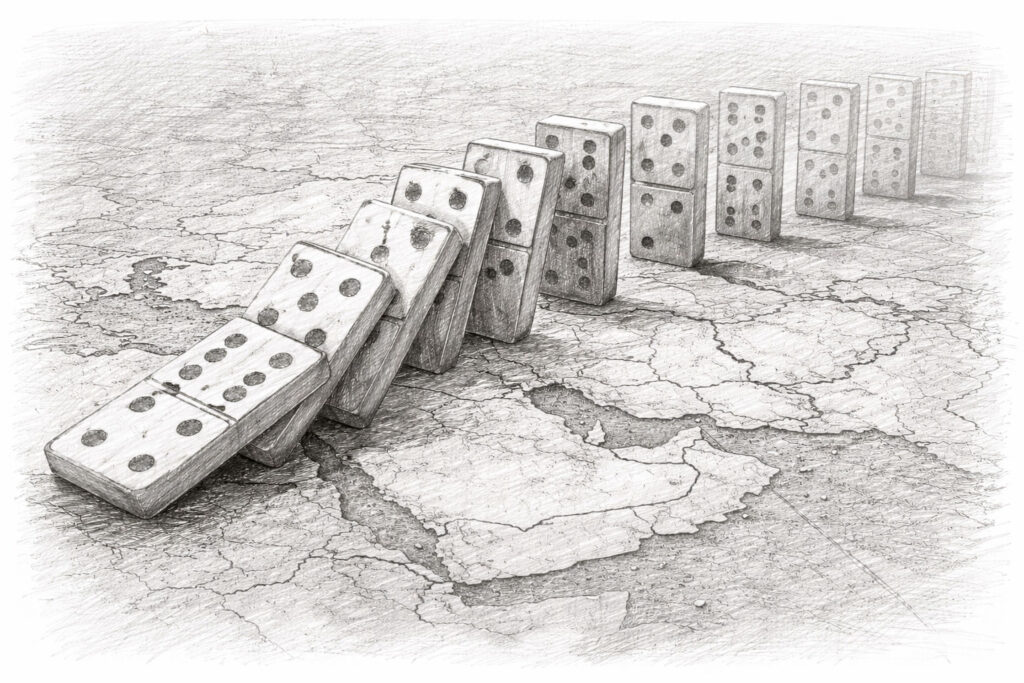
The escalation spiral: why it is so difficult to stop
In order to understand why the conflict between Israel and Iran has become so dangerous, one must first realize that both actors are in a structural dilemma. Not because they are irrational. But because their political, historical and psychological lines have brought them into positions from which a retreat is hardly possible.
Israel is under enormous domestic political pressure. The country has been living with the reality of an existential threat for decades. Any perceived weakness is immediately exploited politically. Any reticence towards its own population feels like a betrayal of security. And when missiles strike and defense systems reach their limits at the same time, a mood arises in which military force appears to be the only option.
Iran, on the other hand, sees any retreat as a signal of weakness. The regime bases its legitimacy on resistance, steadfastness and regional power projection. Giving in to Israel or the USA would be difficult to survive domestically. And externally, it would show that Iran is losing the deterrent it has built up over decades.
This means that both sides are stuck in a situation where giving in seems more dangerous than escalating. A classic trap in international politics - and precisely the point at which the spiral begins.
The psychological knot
If two countries believe that their security can only be guaranteed through toughness, they lose the ability to see real alternatives. This is not a fault of the individuals involved, but a structural problem: security policy that has hardened over decades cannot simply be changed by a decision of will.
And that is what makes the current situation so volatile.
External actors who can only intervene to a limited extent
In earlier conflicts, there were often external powers that were able to put the brakes on escalations - through diplomacy, pressure, guarantees or simply through their superior position of power. But today the world has changed.
- The USA: hesitant due to overload
The United States may be militarily strong, but it is politically weakened. Internal political divisions, economic pressure and global obligations limit its ability to draw clear lines in the Middle East. They can talk, warn, support - but they can no longer act with the old sovereignty that has long been their hallmark. For Israel, this is devastating. For Iran, it is an invitation. - Europe: A power without power
Europe is insignificant in this conflict. Although there are appeals, demands and diplomatic proposals, they seem like background noise. Neither of the two players is gearing its strategy towards Europe. And both sides are well aware of this. - Russia and China: influence, but no control
Russia and China have relations with Iran, but no power of control. Both benefit geopolitically from a weakened West, but they have no interest in a conflagration in the Middle East. However, they lack the ability - and the will - to force the Iranian leadership in a certain direction. - The Arab states: Torn interests
Many Arab states are caught between two worlds: On the one hand, religious and cultural solidarity with Muslim countries. On the other hand, economic and security policy partnerships with the West and in some cases even with Israel. This ambivalence leads to a passive attitude: one observes - and waits.
The result: a spiral without brakes. The crucial point is this: there is no longer an external actor who is credible, strong and determined enough to stop the escalation safely. And so the spiral continues.
Current survey on a possible case of tension in Germany
The most dangerous point: the phase shortly before losing control
In the history of major conflicts, there has always been one moment that was particularly dangerous: not the moment of war itself, but the phase leading up to it. The phase in which all those involved believe that they still have control - even though this has already been effectively lost. This phase is characterized by four mechanisms:
- Misinterpretations
In a tense situation, every signal is overinterpreted:
- A military exercise looks like preparation for an attack.
- A political statement like a threat.
- An airplane in the wrong zone like an attack.
The greater the fear, the lower the capacity for sober analysis. - Domestic political pressure
When governments fear for their credibility, they react faster, harder and more impulsively. Not because they want to, but because they believe they have to. This is exactly what is currently visible with Israel and Iran. - Automatic escalation
Military systems follow processes that are automated:
- Missiles are intercepted.
- Targets are marked.
- Countermeasures activated.
In such systems, seconds are enough to trigger wrong decisions. - Proxy dynamics
Militias, groups, autonomous actors - they can trigger actions that neither Israel nor Iran have planned. And each of these actions can be read by the other side as a direct state action.
Why this moment is the most dangerous
Because it creates the illusion of control. Because it makes politicians believe that they can still intervene in time. Because it makes the military believe that their planning is robust. And because it simultaneously fulfills all the prerequisites for an unintentional inferno.
In short, we are in a phase in which every action - even a defensive one - can be perceived as an offensive move.
And that is the kind of escalation logic that has repeatedly led to disasters throughout history.
Escalation drivers in the Israel-Iran conflict
| Escalation driver | Description | Strategic impact |
| Domestic political pressure | Both countries must show toughness in order not to be seen as weak. | Reduces scope for compromise. |
| Asymmetric war technologies | Massive use of drones, missiles, proxies and cyber attacks. | Overloads defense systems, increases the risk of errors. |
| Lack of external mediation power | USA weakened, Europe more irrelevant, China & Russia restricted. | The escalation spiral continues unabated. |


What needs to happen now to stabilize the situation
To be honest, many people are currently talking about de-escalation, but hardly anyone is naming what would actually be necessary for this. The political appeals we hear on a daily basis are usually no more than rhetorical exercises in duty - worded in a friendly manner, but in fact ineffective. In a situation like this, what is needed is not more words, but structures that actually prevent the conflict from escalating further.
The first step is to accept that neither appeals nor moral demands will change the situation. Conflicts of this magnitude only stabilize when three conditions are met:
- Both sides must gain a minimum level of security
Without security, there can be no reduction in escalation. For Israel, this means that the immediate threat from missiles, drones and attacks must be reduced - not completely, but noticeably. For Iran, it means that the fear of a large-scale retaliatory strike must not become overwhelming. De-escalation therefore does not begin with trust, but with calculated security. - Both sides must recognize an exit strategy
Both players are currently up against a wall that they can no longer get behind. However, de-escalation is only possible if there is a way back to normality without destroying each other politically. Each side needs symbolic successes that allow them to show toughness and still give in. These could be: limited ceasefires, the withdrawal of certain militias, diplomatic mediation that can be sold as a „success“ or security guarantees from external mediators. - External players must be able to play a role again
As long as the major powers are either overburdened, disinterested or internally divided, there will be no framework for genuine de-escalation. What is needed is a structural counterpart that creates trust - or at least reduces the fear of the worst.
Without such a structure, the situation will remain unstable, no matter how many negotiations are announced.
What the West should no longer do
Many of the mistakes made in recent decades are the result of Western reflexes from a time when the world order was still clear. But today these reflexes are ineffective or even dangerous. Anyone who wants to stabilize the situation must first stop repeating the old mistakes.
- No moral arrogance
The West tends to evaluate conflicts morally before analyzing them strategically. But morality has little influence in existential conflicts. States do not act on the basis of moral categories, but on the basis of security policy logic. If Europe or the USA continue to act as if a highly complex conflict can be resolved by appeals or sanctions, they not only lose credibility, but also appear naive themselves. - No interference without understanding
A key mistake in the past was the assumption that political systems in foreign regions could be „reformed“, „stabilized“ or even „modernized“ without understanding their culture, history and internal structure. This is precisely what led to disasters in Iraq, Afghanistan, Libya and Syria. The Iran conflict shows once again that interfering without understanding the local logic exacerbates the escalation. - No unrealistic expectations in negotiations
Negotiations are not a panacea. They only work if both sides have something to gain and something to lose. In the current situation, negotiations are often nothing more than symbolic acts. Genuine diplomacy must accept that there are no quick fixes - and that some conflicts can only be stabilized through long-term arrangements. - No illusion of global control
The idea that the West can intervene at any time and „manage“ crises is outdated. In a multipolar world, interventions do not have a stabilizing effect, but a destabilizing one. Today, de-escalation is not achieved through dominance, but through limitation.
Germany in the shadow of the conflict
In a lecture, journalist and geopolitical observer Patrik Baab analyzes the current war between the USA, Israel and Iran and places it in a wider global context. Baab argues that the conflict has long since extended beyond the Middle East and is part of a broader power struggle between the West and the emerging BRICS states.

The invasion of Iran or: a German war too | Patrik Baab
His thesis that Germany is also indirectly involved in this conflict - politically, militarily and logistically, for example through infrastructure, NATO structures and military cooperation - is particularly controversial. In his lecture, Baab also sheds light on the strategic importance of the Strait of Hormuz, possible economic consequences for Europe and the role of Russia and China in the background of this conflict.
A new European security culture
Europe is facing a fundamental upheaval. Not just because of the conflict in the Middle East, but because this conflict reveals how urgently Europe needs new ways of thinking - in terms of security policy, economics, media and diplomacy.
- Europe must learn to see the world realistically
The times when Europe lived in a self-created comfort zone and only viewed crises from a distance are over. Security culture does not mean alarmism, but a sense of reality. Europe must identify risks, make decisions and take responsibility - not just engage in symbolic politics. - Re-industrialization and energy autonomy
A stable foreign policy is always based on economic strength. For decades, Europe has weakened its industrial base and made itself dependent on energy. This is now taking its revenge. If you want to be able to act geopolitically, you need economic independence - or at least robust structures. - Overcoming medial disenfranchisement
A very central point: when the media soft-pedal crises, this prevents society from becoming resilient. A new security culture needs media that do not appease, but explain - honestly, unembellished, but responsibly. - Diplomacy without moral clubs
Diplomacy is not about making moral judgments. It is about balancing interests. Europe needs a foreign policy that accepts this reality. A foreign policy that understands that you have to talk to difficult actors - not because you like them, but because they exist. - Realistic priorities
Europe must stop getting bogged down in side issues. Security, energy, industry, infrastructure and information sovereignty are fundamental issues. Everything else comes afterwards.
Europe's security between escalation and strategic reorientation
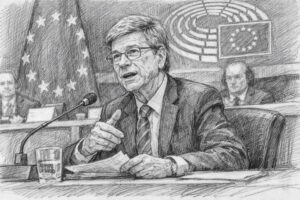 The current escalation in the Middle East also raises a fundamental question: What role does Europe actually still play in the global security architecture? This is precisely the question posed by economist and geopolitical analyst Jeffrey Sachs in his much-discussed open letter to the German government. Sachs argues that security in Europe cannot be thought of unilaterally, but is based on the principle of „indivisible security“ - in other words, that stability only works in the long term if the interests of all major players are taken into account. In my article „Jeffrey Sachs warns Germany: Why Europe's security needs to be rethought“ this perspective is examined in more detail. The text shows why Sachs believes a return to diplomacy, strategic realism and long-term stability is necessary.
Possible future scenarios and their strategic importance
| Scenario | Brief description | Strategic consequences |
| Limited de-escalation | Short-term ceasefires, indirect mediation, partial withdrawals. | Stabilizes temporarily, but does not solve basic problems. |
| Continued escalation | More missile attacks, regional expansion, proxy wars. | High risk of strategic loss of control. |
| Shock event (e.g. tactical nuclear weapon) | Breaking a taboo, global shockwave, massive geopolitical realignment. | Global destabilization, reassessment of all security architectures. |
Why this crisis is a turning point - The West at a crossroads
A sober analysis of the current escalation reveals not just a regional conflict, but a tectonic shift in the world order. It is a moment that shows how much the West has lost strategic weight - not abruptly, but in a kind of creeping erosion that is now visibly breaking through to the surface for the first time.
The crisis in the Middle East is a turning point because it exposes all the weaknesses at the same time:
- the lack of geopolitical control,
- the naive hope for moral order,
- media self-soothing,
- economic vulnerability,
- and the strategic fragmentation of the Western world.
For the first time in decades, Western states are facing a situation in which they have neither room for maneuver nor superior strategic means. They can appeal, warn and admonish - but they can no longer shape the situation. And that is precisely what makes the situation so volatile. A system that for decades was seen as an organizing force has lost its structural center.
But precisely because this is the case, this moment has a special significance: it forces us to re-engage with reality. Not out of weakness, but out of necessity.
The opportunity in the crisis: a return to reality
Paradoxically, such crises also create the opportunity for something that Western politics has forgotten for years: a return to a world in which strategic decisions are no longer based on wishful thinking, symbolic politics or moral pretensions, but on a sober consideration of the balance of power.
For decades, people have believed that the world is malleable if you explain, sanction or appeal enough. But the current escalation shows: Global politics does not obey the moral will of individual states. It follows structures, interests, historical lines and power relations.
This realization is uncomfortable - but it is salutary. Because only a world that is seen in real terms can be shaped in real terms. And only a policy that recognizes that other actors have their own interests, their own rationalities and their own means of power can be successful in the long term.
A new strategic realism
The West now faces a choice:
- Either he holds on to his old self-image and hopes that the world will adapt again.
- Or he accepts that the world has changed - and that he has to change with it.
Strategic realism does not mean cynicism, but clarity. Not resignation, but a new foundation. A world in which states such as Iran, Turkey, India and Saudi Arabia, as well as many smaller players, are more self-confident, requires a foreign policy from Europe and the USA that lectures less and understands more. A security policy that reacts less and anticipates more. And an economic and energy policy that is less dependent and more resilient.
If this conflict shows anything, it is that a world order that was based on self-evidence needs to be rethought.
Looking ahead - and why the future is not certain
It would be presumptuous to claim that we can say today how the current conflict will end. There are too many variables, too many possible twists and turns, too many strategic unknowns at play. But that is precisely what makes this final chapter important: it is not intended to pass judgment, but to provide guidance.
- We know that the basic political patterns have changed.
- We know that deterrence no longer works automatically.
- We know that escalations occur more quickly today and are more difficult to stop.
- We know that Western countries no longer have the means to manage global crises on their own.
And we know that this conflict - just like the war in Ukraine - is part of a larger shift: the shift towards a multipolar world in which power, influence and risks are distributed differently than before.
- We don't know whether the conflict will calm down or escalate further.
- We do not know what role external players will really play.
- We do not know how long Israel and Iran will be able to maintain their current positions.
- And we don't know whether the next few months will lead to regional stabilization - or to a strategic chain reaction.
This is the essence of strategic uncertainty: you don't know what's coming, but you know the mechanisms that can lead to it.
Open end - because there's no other way
This crisis has no predetermined end. It is not a chapter that is closed, but a process that continues to evolve. A process that could shape the coming years internationally. And it forces us to abandon the illusion that we can predict or control geopolitical developments.
Perhaps this conflict will lead to a new regional order.
Perhaps it will end in a phase of unstable ceasefire.
Perhaps it will escalate before a balance is found again.
Perhaps this will even lead to a long-term political reorientation of the West - one that will make it more capable of acting again.
But one thing is certain: this conflict is a turning point. And turning points are characterized by the fact that they change directions without immediately saying where the journey is going. From a strategic point of view, this is the only honest approach. Because anyone who claims certainties in this situation has not understood the situation.
International law between aspiration and geopolitical reality
 The current escalation between Israel, the USA and Iran inevitably raises a fundamental question: What role does international law actually still play in a world of increasing power politics? Political speeches often speak of a „rules-based international order“, but in moments of crisis it becomes clear time and again how strongly strategic interests, military logic and geopolitical rivalries can override these principles. I examine precisely this area of tension in more detail in the background article „Rules-based world order and international law: between claim, reality and breach of law“. It deals with the rules that are supposed to hold the international system together, why they are repeatedly violated - and why international law nevertheless plays a central role in stability and conflict limitation.
In-depth sources on the topic
-
- The history of Netanyahu's rhetoric on Iran's nuclear ambitionsAn overview by Al Jazeera of more than three decades of political warnings by Benjamin Netanyahu about an allegedly imminent Iranian nuclear weapons program. The analysis shows how these warnings have been repeated publicly since the early 1990s.
- Netanyahu has been warning Iran is close to a nuke since 1992Overview of Netanyahu's key statements since the early 1990s, including his prediction in 1992 that Iran could develop a nuclear bomb within three to five years. The article summarizes the recurring warnings in chronological order.
- Imminent Iran nuclear threat? A timeline of warnings since 1979The Christian Science Monitor traces the history of Western warnings about Iran's nuclear program and shows how assessments have evolved over several decades. The timeline provides important historical context for the political debates surrounding Iran's nuclear program.
- Prime Minister Netanyahu's Speech to the United Nations General Assembly (2012)Official documentation of Netanyahu's famous speech to the UN General Assembly, in which he warned of an imminent Iranian nuclear weapons program with a graphic illustration („red line“). This speech became one of the most famous moments in the international debate on Iran.
- Netanyahu's simple bomb graphic confuses nuclear expertsAnalysis of the highly symbolic „cartoon bomb“ graphic that Netanyahu presented at the UN in 2012. Experts criticized that the illustration greatly simplified the complex technical issues of Iran's nuclear programme.
- Netanyahu's bomb diagram succeeds - but not in the way the PM wanted: Guardian report on the international reaction to Netanyahu's famous UN speech and the symbolic „bomb drawing“ that attracted worldwide attention and shaped the debate on Iran's nuclear program.
- After 30 Years of Warnings, Netanyahu Pulled the TriggerBloomberg analyzes how Netanyahu portrayed Iran as a central existential threat to Israel for decades and ultimately supported military action against Iran's nuclear program.
- Iran on brink of nuclear bomb in 6-7 months: NetanyahuReuters report on Netanyahu's 2012 warning that Iran could achieve the ability to build a nuclear bomb within a few months. The article exemplifies the recurring alarm messages from the Israeli government.
- Nuclear Program of IranOverview of the history, development and political controversies surrounding the Iranian nuclear program - from its beginnings in the 1950s to the 1979 revolution and the current international conflicts.
- Timeline of the Nuclear Program of IranDetailed chronology of key events in the Iranian nuclear program, including international negotiations, sanctions and the 2015 nuclear deal (JCPOA).
- A Simple Timeline of Iran's Nuclear ProgramThe Bulletin of the Atomic Scientists explains the development of the Iranian nuclear program and the political consequences of international agreements such as the JCPOA. The analysis classifies the technical progress and diplomatic conflicts.
- Netanyahu's Nuclear Gamble: The Risks of Escalation with IranAnalysis by the Iram Center on the strategic risks of a military escalation between Israel and Iran as well as Netanyahu's long-term political argumentation regarding the Iranian nuclear issue.
- Netanyahu Draws ‘Red Line’ on Iran's Nuclear ProgramReport on Netanyahu's UN speech and his call for a clear international „red line“ to prevent Iran from building a nuclear bomb.
- Israel's attack on Iran marks moment of truth for NetanyahuAP news agency analysis of Netanyahu's long-standing warnings about the Iranian nuclear threat and its influence on Israel's security policy and military decisions.
- Confrontation Between the United States and IranThe Council on Foreign Relations' Global Conflict Tracker provides a continuously updated analysis of the strategic confrontation between Iran, the US and its regional allies. The site explains the historical causes of the conflict, the role of Iran's nuclear program, regional proxy wars and the military dynamics between Washington, Tehran and Israel.
- Confrontation Between the United States and IranThe Council on Foreign Relations' Global Conflict Tracker provides a continuously updated analysis of the strategic confrontation between Iran, the US and its regional allies. The site explains the historical causes of the conflict, the role of Iran's nuclear program, regional proxy wars and the military dynamics between Washington, Tehran and Israel.
- Experts React: What Comes After U.S.-Israel Strikes on Iran?Analysis by several Atlantic Council security experts on the strategic significance of joint military strikes against Iran. The article examines possible Iranian reactions, the risks of regional escalation and the long-term geopolitical consequences for the Middle East and the international balance of power.
- U.S. and Israel Attack Iran - Early Strategic AnalysisExpert analysis by the British think tank Chatham House on the causes and consequences of military action against Iran. The report assesses Iran's missile arsenal, its regional militias and the country's long-term role in the power structure of the Middle East.
- The Iran War Exposes the Limits of Russia's LeverageStrategic analysis of how the Iran conflict limits Russia's influence in the Middle East and at the same time reveals a fragmented regional order. The article sheds light on Moscow's role, its relations with Tehran and the impact on the global balance of power.
- How Russian and Chinese Technology Underpins Iran's Strategic DepthAnalysis of the military and technological cooperation between Iran, Russia and China. The article shows how technology transfers, military cooperation and economic networks strengthen Iran's strategic position in the conflict with the West.
- Iran Conflict - Economic and Global Market ImplicationsStudy by Oxford Economics on the economic impact of a conflict with Iran. The analysis looks in particular at energy prices, global supply chains, financial markets and possible scenarios for the global economy in the event of a prolonged escalation in the Middle East.
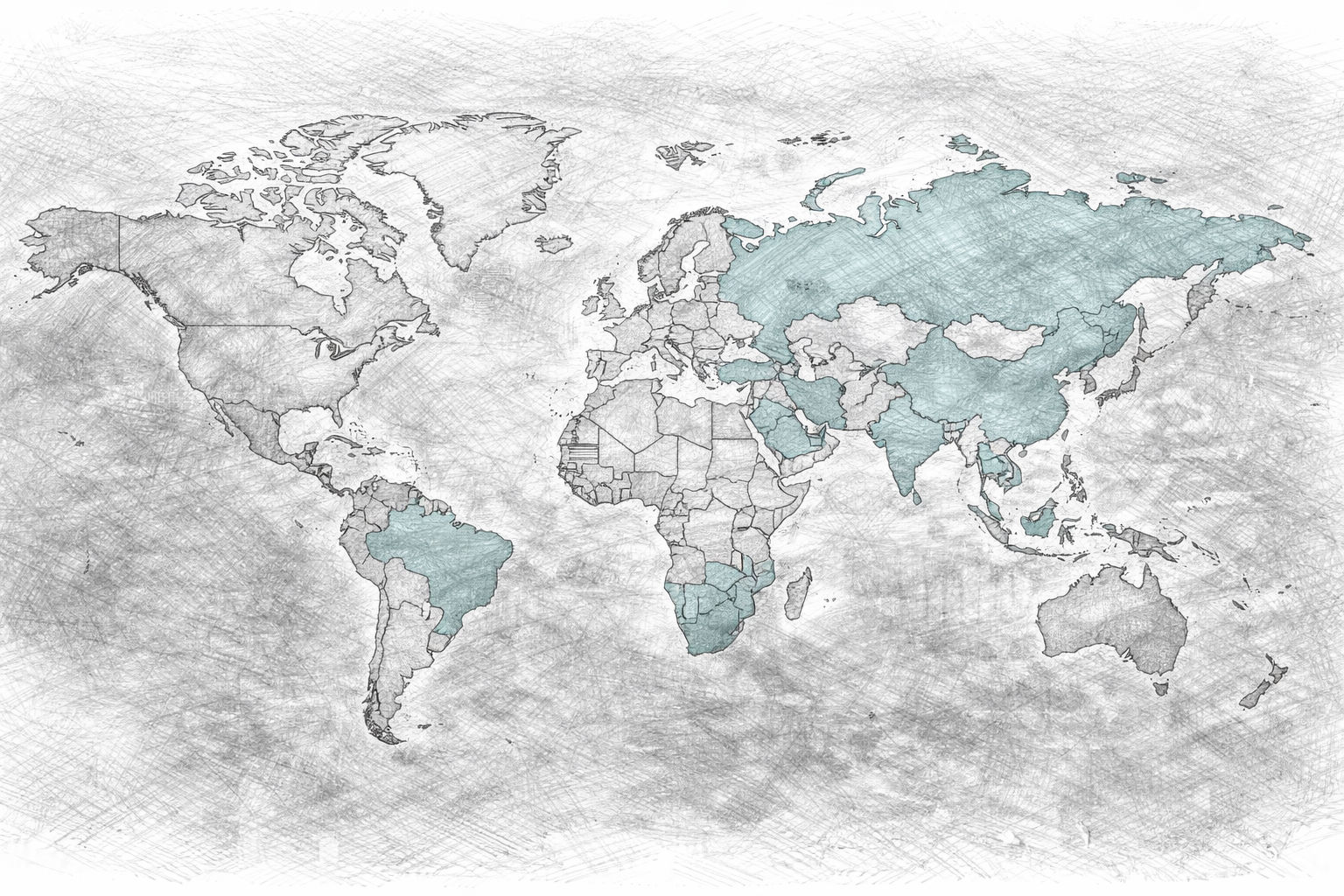


Frequently asked questions
- Why is this conflict between Israel and Iran considered so strategically dangerous?
Because several levels come together here at the same time: an existentially threatened Israel, a long-term Iran, weakened Western influence structures, fragmented regional alliances and a global power structure in transition. This combination creates a situation in which traditional stability mechanisms are no longer effective. Strategists fear such situations because they are no longer predictable and small mistakes can have enormous consequences. - Why can't Israel simply react less harshly to calm the situation?
For Israel, restraint is not a neutral step. Any visible weakness could impair its own deterrence and unsettle the population. The country feels existentially threatened - and in such situations, toughness is often seen as a necessary defense. At the same time, there is political pressure at home that blocks more moderate approaches. Israel therefore finds itself in a situation in which restraint appears to be a risk, not a solution. - Why can't Iran simply row back?
Iran defines its legitimacy through resistance, steadfastness and regional power projection. A withdrawal would be interpreted domestically as weakness and could destabilize the regime. In terms of foreign policy, giving in would be seen as a loss of deterrence. For Tehran, backing down is therefore not just a political problem, but a structural one. This means that Iran - just like Israel - is trapped in a logic that favors escalation. - What role does Netanyahu's decades-long warning policy play in the current situation?
The repeated warnings of a „soon-to-be nuclear-capable“ Iranian leadership since the 1990s have shaped the political culture in Israel and formed international expectations. However, the constant repetition of these warnings has made them less effective. Now that the situation is actually acute, the credibility of these alarm calls has been weakened. At the same time, Israel has maneuvered itself into a line from which a retreat is hardly politically possible. - Why are experts suddenly talking about the use of tactical nuclear weapons again today?
Because several risk factors are occurring simultaneously: an overstretched Israeli defense system, massive Iranian missile and drone capacities, a strategic impasse in which both sides can hardly give in, and a geopolitical environment in which the West has lost its former role as an anchor of stability. Tactical nuclear weapons are considered the „ultima ratio“ in existential threat situations - and many current developments indicate that decision-making spaces are narrowing. - What would be the consequences of a limited nuclear strike in the Middle East?
Even a tactical, non-strategic deployment would have global consequences. It would shake the international security architecture, destabilize regional alliances, unbalance markets and call into question the legitimacy of international treaties. The psychological effect would be particularly explosive: a one-off deployment would break a decades-old taboo - and make imitators more likely. - How likely is it that Pakistan would respond to a nuclear attack against Iran?
A direct nuclear retaliation by Pakistan would be very unlikely because it would plunge the country into a suicidal conflict. More likely would be massive rhetorical condemnations, military mobilizations, diplomatic pressure and a strengthening of anti-Western alliances. However, the mere fact that Pakistan is a nuclear power and sees itself as the protective power of the Muslim world considerably increases the complexity of the conflict. - Are there any great powers left today that can safely stop an escalation?
No. The world has become multipolar. The USA is overextended, Europe is politically weak, Russia and China are pursuing their own interests and have only limited influence on Iran. There is no longer a single actor that could act as a reliable „escalation damper“. This is precisely what distinguishes this crisis from previous conflicts. - Why do many people in Europe underestimate the danger?
Because the media situation is heavily filtered. Many Western news programs only show abstracted or defused images. At the same time, they rarely provide information about the deep structural connections. This creates a deceptive feeling of distance. Although people intuitively sense that „something is wrong“, they do not see the full reality. And a lack of visibility leads to a lack of urgency. - Why does the Western media not show the real images of war, or show them in a toned-down form?
For several reasons: to avoid shocking the population, to protect social stability, out of editorial caution and out of a traditional self-image that presents conflicts in an educational rather than documentary way. But this restraint creates information gaps. And information gaps become dangerous in times of crisis because they lead to misperceptions and wrong political decisions. - Why are companies reacting so cautiously to the conflict?
Companies are risk systems. As soon as geopolitical uncertainty increases, they react instinctively: they postpone investments, reduce liabilities, withhold liquidity and plan more conservatively. Supply chains, energy prices, insurance premiums and credit conditions are heavily dependent on geopolitical developments. When the world becomes unstable, economic activity often freezes - long before the crisis actually reaches us. - What role do energy prices play in this development?
A central role. The Middle East is a critical hub for energy supply. Any uncertainty in the region has an immediate impact on oil and gas prices. These price movements are not perceived by companies as „scary news“, but as a real cost factor that affects the entire value chain. Energy is the invisible pulse of the global economy - and this pulse reacts extremely sensitively. - Why is Western pressure against Iran hardly effective any more?
Because Iran now operates largely independently of Western systems and instead relies on Asian markets, regional networks and new geopolitical alliances. Sanctions that used to be effective are now losing their bite. At the same time, Iran sees that global power structures are fragmented. This creates room for maneuver that did not exist in the past. - Can diplomacy still resolve the conflict?
Diplomacy can dampen it, but not solve it. Conflicts of this magnitude have deep structural causes. Diplomatic talks are important, but they only work if both sides see a way out. At present, neither Israel nor Iran can see such a way forward without calling their security policy foundations into question. Diplomacy can therefore only do damage limitation at present. - What lessons should Europe learn from this escalation?
Europe would have to develop a completely new security policy culture - more realistic, more robust, more independent. This includes: a stronger industry, a reliable energy supply, a strategic foreign policy without moral arrogance and a media landscape that does not gloss over crises. Today, Europe is too dependent, too slow and too naive for geopolitical reality. - Why is this conflict a turning point for the world order?
Because it makes it clear that the old Western-style order no longer works. Power is being redistributed. States that were previously only regionally relevant are now acting globally. The West can no longer unilaterally determine how conflicts should be conducted. The world is becoming multipolar - and multipolar systems are more chaotic, more dynamic and more difficult to control. - Do we have to prepare for direct consequences in Europe?
Yes - not necessarily militarily, but politically, economically and socially. Energy prices, inflation, supply chains, migration, security issues and political moods are all influenced. Geopolitics is never far away. It always has an impact on our everyday lives through economic and social channels, even if many people only become aware of this after a delay. - Why does the article deliberately end openly?
Because there are no clear paths in this conflict. Too many variables, too many players, too many historical lines intertwine. An open ending reflects reality better than an artificial conclusion. Crises like this are processes, not closed events. And their development depends on decisions that will be made in the coming days, weeks and months - by actors who are themselves under extreme pressure.