International reporting on the United States is usually dominated by the big, loud figures. Names that polarize, that provoke, that generate headlines. For many European observers, politics in the USA is therefore often an interplay of escalation, conflict and clearly recognizable opposites. And then suddenly a name appears that doesn't fit into this picture at all: J. D. Vance.
Not a classic loudspeaker. Not a man of grand gestures. Not a politician who immediately attracts attention with pithy words. And yet he is suddenly there - in interviews, in analyses, in political debates. Not as a marginal figure, but as someone who obviously plays a role that is bigger than it appears at first glance. For many readers in Germany or Europe, this is precisely where the real question begins: who is this man anyway - and why has he suddenly become so important?


Between perception and reality
Anyone with only a superficial interest in American politics might be tempted to categorize Vance prematurely. As „the Vice President“, as „the man at Donald Trump's side“, perhaps also as a kind of political follower.
But this categorization falls short. While Trump has been at the center of attention for years, Vance has developed in a completely different way: quieter, less visible, but often more strategic. His path is not that of a traditional politician who has worked his way up through party structures over decades. Nor is it that of a career changer who suddenly appears out of nowhere.
His rise seems more like a sequence of precise transitions - from station to station, from environment to environment. And that is precisely what makes him difficult to grasp.
This is unusual for European readers. We are more used to seeing political careers along clear lines: Studies, party, offices, advancement. With Vance, these lines run differently. They intersect, change direction and lead through very different milieus.
A man who doesn't fit into a box
Part of the irritation lies in the fact that Vance seems to embody several roles at the same time. He is:
- grew up in simple circumstances
- Educated at one of the most elite universities in the USA
- connected with influential networks in business and politics
- at the same time someone who speaks publicly about the problems of the American working class
This does not give a clear picture. On the contrary: it creates tension. For the reader, the question almost inevitably arises as to whether an authentic up-and-comer is speaking here - or someone who has learned to combine different perspectives in a targeted manner. This tension is not a side effect. It is a central component of its effect.
Why Europe has underestimated him so far
In Europe, American politics is often filtered through familiar patterns: Republican versus Democrat, conservative versus liberal, urban versus rural. These categories help to recognize broad lines, but they are often not enough to really understand individuals.
Vance is a good example of this. He does not fit neatly into this grid. He is not a typical representative of a political tradition, but rather a product of several developments at the same time:
- Economic change
- cultural shifts
- New power structures in the background
This makes it less visible - but no less relevant. In fact, you could say that it is easily underestimated precisely because it is not immediately noticeable.
An ascent that raises questions
The closer you look, the more questions arise. How does someone make their way from an unstable childhood via the military to an elite university and finally into the vicinity of political centers of power?
Is this a classic success story? Or is there more to it than just individual achievement? And perhaps even more importantly, what role does someone with precisely this biography play in a political system that is increasingly characterized by tensions?
These questions cannot be answered in a few sentences. But they show why it is worth taking a closer look.
The right moment for a closer portrait
The timing of this portrait is no coincidence. Politics is not only about current decisions, but also about developments in the background. People who are still in the shadows today can take on a central role tomorrow. And it is often precisely these figures who shape how a system changes in the long term.
Vance belongs to this category. He is no longer a political newcomer, but he is also not yet a firmly established figure in the classic sense. To a certain extent, he is in a transitional phase - between observation and creation, between establishment and influence. It is precisely at such times that it is worth taking a closer look. Not to make hasty judgments, but to understand the context.
A story that is more than just a CV
This portrait is therefore not an attempt to evaluate a political position or make a clear classification. Rather, it is about making the lines that run through his biography visible.
Because behind the name J. D. Vance is not just a single CV, but a story that is closely linked to larger developments:
- the transformation of American society
- the relationship between the elite and the population
- and the question of how political power is created today
If you want to understand this story, you have to go back further. To where it begins - not in politics, but in a childhood that was anything but straightforward. And that is exactly where the next chapter begins.

Understanding America: The soil on which Vance grew
When you look at the United States from Europe, you often see a country of superlatives. Big cities, big companies, big conflicts. But it is precisely this perspective that can easily obscure the view of what lies between the metropolitan areas - and what determines everyday life for many Americans. After all, the USA is not just New York, California or Washington. A considerable part of the country lies in between: Regions that were once economically strong, but are now confronted with completely different realities.
To understand J. D. Vance's career, you have to look right there. Not at the shiny facades, but at the places where the change is particularly visible.
The Rust Belt - a term with a history
The so-called „Rust Belt“ is not an official administrative area, but a term that has evolved over decades. It refers to a belt of industrial regions in the north-east and mid-west of the USA - including parts of Ohio, Michigan, Pennsylvania and Indiana.
The name itself is significant: „Rust“ stands for rust. For disused factories. For machines that no longer run. In the middle of the 20th century, these regions were still the industrial backbone of the United States. Steelworks, automobile production, mechanical engineering - everything that moved the country forward was produced here. Work was available, often well paid, and for many families this meant a stable life for generations. But this situation did not last.
From industrial center to structural crisis
Globalization and technological change began a gradual process that lasted for decades:
- Relocation of production abroad
- Automation of work processes
- Increasing competitive pressure
What initially appeared to be an economic adjustment had long-term consequences for entire regions. Jobs did not disappear selectively, but across the board. And with them, the feeling of security often disappeared too. For many cities in the Rust Belt, this meant falling incomes, out-migration of younger generations and increasing social problems.
This development cannot be attributed to a single political decision. It is the result of a complex interplay between the economy, technology and global markets. And yet it has fundamentally changed the lives of millions of people.
Appalachia - another form of reality
In addition to the Rust Belt, a second region plays an important role in the background of Vance's story: Appalachia. This is a predominantly rural area that stretches along the Appalachian Mountains - from New York to the south of the USA. The part in Kentucky, to which Vance has family ties, is particularly relevant here.
Unlike the Rust Belt, Appalachia has never been an industrial center in the traditional sense. The region has always been characterized by mining, agriculture and small, local communities.
However, much has changed here too in recent decades. The decline of coal mining, a lack of economic alternatives and an often inadequate infrastructure have meant that many places offer hardly any economic prospects.
The result is a different kind of crisis: not the loss of industry - but the lack of development.
Two regions, one common pattern
At first glance, the Rust Belt and Appalachia appear different. One region was industrial, the other more rural and traditional. And yet there is a common thread:
- In both cases, it is about the loss of stability.
- in the Rust Belt: due to the elimination of industrial
- in Appalachia: due to a lack of economic dynamism
For local people, this often means insecurity, limited opportunities for advancement and a feeling of being disconnected. This feeling is difficult to quantify, but plays a central role in the social climate.
Why this context is crucial
If you look at Vance's later career, you could read it in isolation as an individual success story. From a difficult start to a rise in education and politics. But without the background of these regions, a significant part remains incomprehensible.
His biography is not only personal - it is also a reflection of these developments. He comes from an environment that is under economic pressure, has strong cultural roots and is simultaneously confronted with far-reaching changes.
This combination not only shapes lives, but also perspectives.
The view from the outside - and its limitations
In Europe, this reality is often only perceived in passing. If at all, then in the form of buzzwords such as „dependent regions“ or „structurally weak areas“.
But such terms fall short. They describe conditions, but not the dynamics behind them. And they often ignore the fact that many of these regions were once the foundation of an economically strong country. This is precisely why change is particularly noticeable there.
This can be difficult for outsiders to understand. The USA is seen as a land of opportunity - but these opportunities are unevenly distributed. And in some regions, they are much more limited than one might expect.
Between tradition and change
Another aspect that is often underestimated is the cultural dimension. In many of these regions, values that have been passed down through the generations play a major role:
- Family
- Personal responsibility
- Community
These values do not simply disappear when economic conditions change. On the contrary, they can even become more important when external structures disappear. This leads to an area of tension: between the desire for stability and the need to adapt to new conditions.
An environment that shapes you - often more than you think
Anyone who grows up in such an environment inevitably develops a certain understanding of the world and society. Not as an abstract theory, but from concrete experiences. This concerns questions such as:
What does security mean?
What does ascent mean?
Who do you trust - and who not?
These questions are not new. But they are often particularly acute in regions undergoing change. And this is where the real connection to Vance begins. Because his story is not detached from this environment. It is rooted in it.
The starting point of an unusual biography
If you take all these factors together, a picture emerges that goes far beyond a single person. It shows a country in transition. Regions that need to reorient themselves. And people who are looking for their place in this change.
Vance is one of them - but one whose path has taken him far beyond these starting points. To understand what this path looks like in concrete terms, you have to take a closer look. Away from the big picture, towards the personal story. Because the next step leads to where it all begins: to a childhood that was characterized by precisely these tensions.
A childhood without a firm foothold - a beginning without a clear direction
Looking back at J. D. Vance's later career, many things seem almost logical. From a difficult environment to the military to his studies and political career - a sequence of stages that can be combined into a story in retrospect.
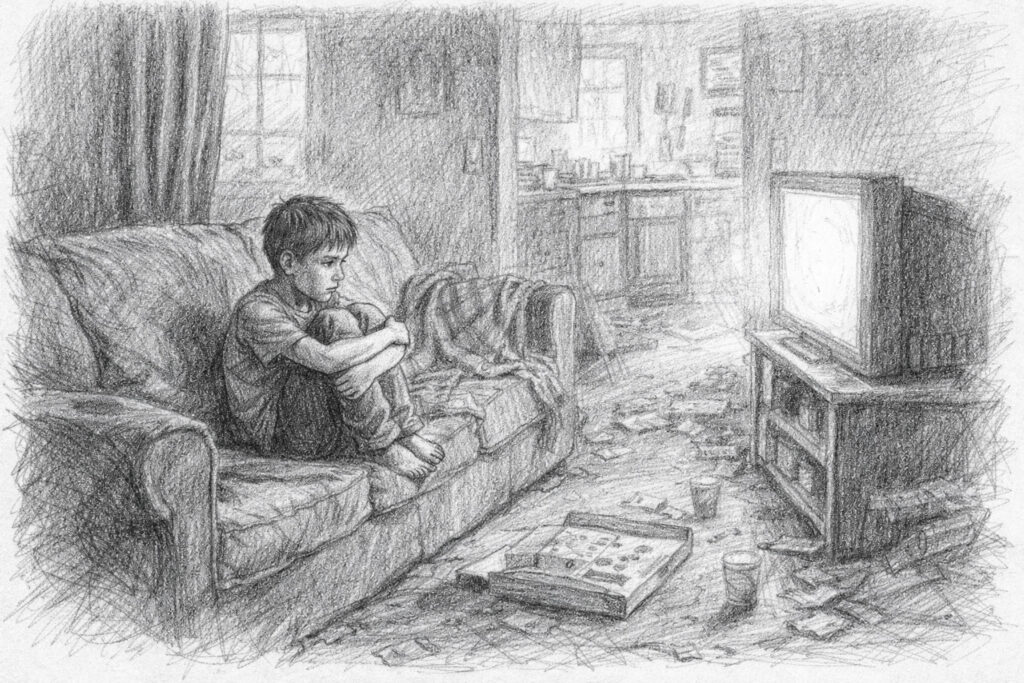
However, there is nothing at the beginning to indicate such a path. On the contrary: the early years are characterized by uncertainty, disruptions and changing caregivers. It is not a childhood based on stability, but one that has to constantly reorganize itself.
And that is precisely the crucial starting point.
A family without a fixed framework
He was born in Ohio in 1984 - into a family situation that became unbalanced early on. His parents separated when he was still young. His father largely disappears from his life and new partners take his place, but they do not last.
What looks like a series of individual events on the outside results in a pattern on the inside: there is no reliable framework. For a child, this means more than just organizational changes. It affects fundamental questions:
Who is responsible?
Who stays?
What can you rely on?
If these questions have to be answered again and again, there is no stable foundation. Instead, a kind of permanent transition occurs.
The mother - closeness and unpredictability
A central figure of this time is the mother. She is present, but not constant. Her life is characterized by her own problems, especially addiction and personal crises. This results in a difficult dynamic for a child:
- Proximity is available
- but it is not reliable
- There are moments of care, but also phases in which the situation tips over. This does not create emotional security.
This is not a simple opposition of „good“ and „bad“. Rather, it is an interplay that is difficult to predict. And it is precisely this unpredictability that shapes everyday life more than individual events.
Changing caregivers - no fixed center of attention
During childhood, several of the mother's partners enter the boy's life. Some stay longer, others only for a short time. The environment changes with each change:
- New rules
- New expectations
- New tensions
What is missing is a stable center. To outsiders, this may seem like a series of relationships. For a child, however, it means having to constantly reorient themselves - often without time to really adapt.
These constant changes leave their mark. Not necessarily in the form of individual memories, but as a basic feeling: nothing is permanent.
Between adaptation and retreat
Children react differently to such circumstances. Some become loud, others withdraw. Still others develop a special sensitivity to their surroundings. In this case, a pattern is evident that is often found in unstable circumstances:
- Observation
- Customization
- Careful balancing of situations
If the external conditions cannot be controlled, the only option is often to adapt oneself. Not out of conviction, but out of necessity. This can appear calm to the outside world. However, this calmness is not always a sign of stability - it is often an attempt to avoid conflict.
Poverty as a constant backdrop
In addition to family tensions, the economic situation also plays a role. Financial resources are limited and everyday life is characterized by uncertainty. Poverty is not only reflected in numbers. It affects everyday life through limited options, less leeway for decisions and constant weighing up.
For children, this quickly becomes the norm. Things that others take for granted have to be fought for or improvised. This alone does not determine the course of life. But it sets framework conditions that can hardly be ignored later on.
Conflicts and escalations
In an environment characterized by instability, tensions inevitably arise. This can manifest itself in various forms - verbally, emotionally and sometimes even physically.
What is important here is less the individual event than the frequency of such situations. When conflicts are not the exception but part of everyday life, perception changes:
- Borders are shifting
- Reactions are becoming more cautious
- or on the contrary: harder
For a child, this means being constantly vigilant. Not necessarily consciously, but as an inner attitude.
The search for stability
Despite all the uncertainty, there are always attempts to find stability. Small routines, familiar places or individual caregivers can play an important role in this. But as long as these elements are not permanent, they remain fragments. They provide short-term support, but are no substitute for a stable environment.
It is precisely at this point that it becomes clear how crucial reliable structures are. If they are missing, a vacuum is created that is unlikely to be filled on its own.
Early influences that stay
Even if life circumstances change later, these early experiences do not simply disappear. They continue to have an effect - often inconspicuously, but constantly. They influence how we react to uncertainty, how we build trust and how we make decisions.
This is not about simple cause-and-effect relationships. Rather, a network of experiences is created that shapes later developments. This is precisely why it is worth taking a closer look. Not to dramatize the past, but to understand the starting point.
A start without guarantees
If you pause at this point, it becomes clear how little can be taken for granted in the subsequent career. At this stage, there is no clear direction, no recognizable support and no stable framework conditions.
What does exist is an environment that speaks more against than in favor of a straightforward ascent. And that is precisely why this section is so important. Not as a dramatic introduction, but as a sober realization: the path that follows later does not begin on safe ground.
But every biography consists of transitions. And here, too, there is a point at which something shifts. Not suddenly and not completely, but noticeably. In this case, this change does not begin through a system or an institution, but through people who offer a different form of stability.
And this brings a character to the fore who becomes decisive for the rest of the story: the grandmother - whom J. D. Vance himself later described as „his salvation“.

Grandparents as an alternative world - a different beat in the same life
After the turbulent, changeable early years, a second point of reference gradually emerges in J. D. Vance's childhood. Not a complete replacement for what is missing - but an alternative world that functions according to different rules.
This counter-world has a face: the grandparents. While life with their mother is characterized by instability, something that can be cautiously described as order emerges here. Not a perfect order, not a perfect world - but one in which things are more predictable. And that is precisely what makes the difference.
„Mamaw“ and „Papaw“ - more than just relatives
In Vance's later accounts, his grandparents play a central role, especially his grandmother, whom he „Mamaw“ calls her. She is not a quiet, reserved figure, but someone with a clear attitude: direct, sometimes tough, but protective at the same time.
The grandfather („Papaw“) complements this image, appearing calmer, less dominant, but just as important as part of this more stable environment. What the two have in common is crucial:
They represent a generation that sets different standards. Not through big words, but through attitude.
Rigor as a form of reliability
For many European readers, it may initially seem unusual to hear austerity described as something positive. But in the context of this biography, it takes on a different meaning. Where there was previously unpredictability, strictness means clear rules, comprehensible consequences and orientation.
This does not mean that everything is conflict-free. On the contrary - the grandmother is considered impulsive and quite assertive. But it is precisely this directness that creates something that was missing before: Reliability. A child is more likely to know where it stands.
A home that doesn't have to be perfect
It is important to note that this environment is not an idealized idyll. There are tensions, idiosyncrasies and difficult moments here too. But the decisive difference lies in the basic structure. There is a fixed place, recurring routines and a certain stability in everyday life.
This sounds unspectacular, but is of great importance in an unstable environment. Because stability is often not shown in grand gestures, but in small, recurring things:
- a regular daily routine
- reliable reactions
- a feeling of „something remains the same here“
Values that are not discussed
In addition to the external structure, the grandparents' understanding of values also plays a role. It is not theoretical, not academic, but lived in practice. This includes personal responsibility, perseverance and a certain toughness towards life.
These values are not explained, but exemplified. They arise from the grandparents' own experiences - from a time when work and discipline were taken for granted because they were necessary. For a child, this creates a clear contrast to previous experiences.
Protection and demand at the same time
An interesting dynamic in this environment is the combination of protection and demand. The grandmother protects - sometimes uncompromisingly. At the same time, she expects something:
- that you make an effort
- that you take responsibility
- that you don't just give up
This combination is not a matter of course. In many cases, either one or the other comes to the fore. Here, however, there is a balance: you are supported - but not spared.
A counterweight to chaos
The role of grandparents becomes particularly clear in conjunction with the previous life situation. They are not a complete substitute for what is missing. But they act as a counterweight:
- against unpredictability
- against emotional insecurity
- against the feeling of not having a fixed place
This counterweight does not stabilize everything - but enough to create a foundation. And sometimes that's enough.
Between two worlds
Despite this stability, the situation remains complex. Because life does not shift completely into this counter-world. Rather, the child moves between two poles:
- the chaotic environment of the mother
- the more structured world of grandparents
This means that two different realities exist at the same time. This experience is formative. It sharpens our awareness of differences:
- between order and disorder
- between reliability and uncertainty
- between stability and breakage
This ability will play a role later on.
The importance of individual caregivers
In many biographies, it becomes clear how decisive individual people can be. Not as abstract influencing factors, but as concrete points of reference. The grandmother fulfills precisely this function. She is a point of contact, a corrective and, to a certain extent, a guide. Not because she does everything right, but because she is present. And presence is often what is most lacking in an unstable environment.
It would be too simplistic to describe this section as a turning point in the classic sense. The problems do not disappear. The external circumstances remain difficult. But something changes: a foundation is created. A foundation that is not spectacular, but strong enough to make later developments possible in the first place. Without this phase, it would be difficult to understand the way forward.
A silent but decisive influence
If you look at his later curriculum vitae, there are many major stations: Military, studies, politics. The grandparents are not in the foreground. And yet, in a way, they are present in all these stations. Not visible, but effective. Because the ability to fit into new structures, accept discipline and take on responsibility rarely arises in a vacuum. It often has an origin.
Childhood does not end abruptly with this phase. The challenges remain, the external conditions do not change fundamentally.
But the internal starting position has shifted. There is now something that was missing before: a first form of stability.
And it is precisely on this basis that the next stage begins - a time in which orientation, decisions and first own paths come to the fore. The next step therefore leads to a phase that is less determined by external circumstances, but increasingly by your own reactions to them.
School, disorientation and first breaks
Although the influence of grandparents creates a certain degree of stability, the external circumstances do not disappear. School becomes a central place during this phase - not only as an educational institution, but as a reflection of the entire environment.
For many children, school is a clearly structured space: fixed times, clear expectations, comprehensible procedures. This is not something that can be taken for granted by someone who is caught between different realities of life. J. D. Vance's day-to-day school life operates in precisely this area of tension:
- Structure on the one hand
- on the other hand, the uncertainty from the private environment
This leads to a situation in which external order and internal unrest exist side by side.
Performance without clear direction
This phase reveals a pattern that can be found in many biographies with a similar background: the ability to learn is there, but it does not develop continuously. There are phases in which things go well and others in which there is a lack of direction.
This is not so much due to a lack of intelligence or potential, but rather to a lack of consistency in the environment. Those who do not know exactly what they can rely on rarely develop a straightforward path. As a result, school does not automatically become a place of advancement, but rather a field in which insecurities are perpetuated.
Between adaptation and resistance
When dealing with school, two typical reaction patterns emerge, which are also hinted at here:
- Adaptation to expectations
- Simultaneous internal resistance
This can work on the outside. You meet requirements, get by and don't necessarily attract negative attention. But internally, a distance remains. This distance is difficult to grasp. It doesn't manifest itself in open conflict, but rather in a lack of clear direction:
What is worth the effort?
What perspective does this offer?
Without convincing answers, many decisions remain provisional.
An environment without clear role models
Another point that is often underestimated is the question of role models. Certain paths are visible in stable environments:
- Education
- Study
- Professional development
These paths seem tangible because others have already taken them. In an environment characterized by uncertainty, such examples are often missing. This does not mean that there are no successful people - but they are less present, less self-evident.
This creates a gap for young people: There are opportunities - but they are not clearly recognizable.
The role of one's own perception
During this phase, your own perception also begins to change. Experiences from childhood continue to have an effect, but they are now reflected on more strongly - even if not yet consciously. You notice differences:
- between yourself and others
- between different realities of life
- between what seems possible and what seems achievable
This perception can be motivating - or unsettling. It is often both at the same time.
First breaks in self-image
The term „rupture“ does not have to be understood dramatically here. It is not about a single event, but about small shifts in self-image. You begin to realize:
- that one's own environment cannot be taken for granted
- that others start with different prerequisites
- that paths can take different routes
These findings are important, but they do not yet provide a clear direction. Rather, they open up questions:
Where do I belong?
What options do I really have?
And it is precisely these questions that initially remain unanswered.
Between standstill and movement
From the outside, this phase often seems unspectacular. Not a clear fall, but not a clear rise either. Rather a time of transition. But it is precisely these phases that are decisive. They determine whether a path solidifies or whether it changes again. In this case, much remains open:
- school development is not fixed
- the prospects are unclear
- the next step is not predetermined
This can appear as weakness. But it can also be room for change.
The importance of small decisions
In such an environment, small decisions become more important. Not as big life decisions, but as changes of direction on a small scale:
- how to react to challenges
- whether you adapt or withdraw
- which options are considered at all
These decisions are often not made consciously. They result from situations, encounters and coincidences. And yet they can play a role in the long term.
Not a straightforward path - and therein lies the opportunity
If you summarize this phase, there is no clear picture of a targeted ascent. Rather the opposite:
- Uncertainty
- Lack of orientation
- Changing developments
But this is also a special feature. A straightforward path would have been almost unlikely here. The circumstances rather suggest a standstill or a break-off. At this point, it is not yet clear that things will turn out differently. But the conditions for change are in place:
- a certain adaptability
- First experiences with different realities of life
- and an environment that offers at least partial stability
The next step is not taken at school
What is interesting is that the decisive next step does not come from within the school itself. It comes from outside - in the form of an institution that offers something that was previously missing:
- Clear structure
- clear rules
- a new environment
This shifts the focus. Away from disorientation and towards a first conscious decision. And this is exactly where the next phase begins: entering a world that could hardly be further removed from the previous one - the military.
The Marines: Order instead of chaos
After a phase characterized by a search for orientation and inner uncertainty, J. D. Vance makes a decision that differs significantly from previous patterns. Joining the Marine Corps is not an accidental step. It stands for something that was missing before: a clear direction.
While school and the environment leave many options open, the military offers something different:
- Fixed structures
- Clear expectations
- a clear hierarchy
For someone whose childhood was characterized by changing conditions, this is not just an offer - but an alternative.
A system with fixed rules
The Marine Corps is one of the strictest military units in the United States. The requirements are high, the procedures standardized, the expectations clearly formulated. It is clear from day one:
- There is no room for interpretation here
- Commands are clear
- Responsibility is assigned
- Consequences are foreseeable
What may seem harsh to outsiders has a different function in this context. It creates an environment in which uncertainty is reduced. For someone who previously had to deal with unpredictability, this is a fundamental difference.
Discipline as a new experience
Discipline is not an abstract concept in the military context. It manifests itself in everyday life in fixed daily routines, in physical exertion and in clear demands on behavior and performance
This form of discipline not only has an external effect. It also changes the inner attitude. Where previously adaptation to changing situations was necessary, something else now comes to the fore:
- Self-control
- Reliability
- Structure in your own actions
This does not mean that all difficulties disappear. But the framework within which you operate is clearer.
Responsibility in a new context
With military training comes a new form of responsibility. It is no longer diffuse or situation-dependent, but concrete:
- towards the unit
- towards the order
- towards yourself
This responsibility is clearly defined. It leaves little room for interpretation. This can be a relief. Because it replaces uncertainty with clear expectations: What has to be done is known. How to do it is also known.
The mission in Iraq - observation instead of front line
During his time in the Marines, Vance is deployed to Iraq. His role is not in direct combat, but in military communications and documentation. That is an important difference. He is part of the system, but not on the front lines. His role is that:
- Prepare information
- Document processes
- classify the events
This position enables a special perspective: proximity to the action, but also distance through the role. It is precisely this combination that can be decisive for personal development.
Between structure and reflection
The military not only provides external order. It also creates space for a form of reflection that was hardly possible before. In an environment that is clearly structured, certain questions come to the fore in a different way:
Where do I stand?
What can I achieve?
What opportunities will arise afterwards?
These questions are not new. But they can be viewed differently under more stable conditions. The experiences in the military therefore not only have a short-term effect. They also influence the next steps.
A break with previous developments
Looking back, this phase can be described as a clear break.
- BeforeChanging structures, uncertain framework conditions, lack of orientation
- NowClear rules, fixed procedures, unambiguous expectations
This break is not only external. It also changes the internal starting position. For the first time, a situation arises in which development is not random, but can be planned.
Why the military often acts as a turning point
In many biographies with a similar background, the military takes on a similar function. It does not replace a missing environment, but it creates a new foundation. The reason lies less in the institution itself, but in what it offers:
- Structure
- Reliability
- Clear roles
These elements are not spectacular, but they are effective. They make it possible to develop skills that could hardly be used before.
The return with changed conditions
After several years in the Marine Corps, this phase ends. But it leaves its mark. The external circumstances change again:
- Return to civilian life
- New decisions are pending
But the inner starting position is different from before. You now have experience with structure, an understanding of discipline and a clearer idea of your own possibilities. These factors form the basis for the next step.
The transition to a new world
It will be interesting to see where this path leads next. Not back to the old environment. Not to an immediate professional career. But into an area that initially seems far away: the academic world.
The move from the military to a university is more than just a change of location. It marks the beginning of a new phase in which different rules apply - less hierarchical, but more complex. But without the experience gained in the military, this transition would have been almost inconceivable.
And this is exactly where the next chapter begins: the ascent via education - and the entry into a world that could hardly be further removed from the one from which this path began.

Education as advancement: Ohio State to Yale
After his time in the Marines, J. D. Vance reached a point that is decisive in many biographies: the transition back to civilian life.
However, this transition is not towards a traditional career path, but into a different world - the academic world.
At first glance, the move to university seems almost unspectacular. In the USA, it is not uncommon for veterans to start university after their service. Programs such as the GI Bill make this path easier.
And yet, in this case, this step is more than just a continuation of training. It marks the beginning of a fundamentally new environment.
Ohio State - Structure meets opportunity
The Ohio State University is not a small, self-contained institution, but a large university with diverse opportunities. Here, Vance encounters an academic environment, diverse social backgrounds and new ways of thinking and perspectives.
The difference to the military is clear. While clear hierarchies and fixed procedures dominate there, the university offers:
- more freedom
- but also more personal responsibility
And it is precisely here that we see how formative the previous phase was. The discipline from the military now acts as a foundation. It makes it possible to experience the new freedoms not as excessive demands, but as an opportunity.
Performance as a door opener
In this phase, a pattern develops that was previously only hinted at: consistent performance. The course is not only completed, but successfully completed - with very good results. This is no coincidence. The combination of learned discipline, growing clarity of purpose and an environment that rewards achievement leads to a development that was not yet foreseeable in childhood. This is where it becomes clear for the first time:
- The path begins to structure itself.
- Looking beyond your own horizon
- At the same time, the environment is expanding.
While childhood was strongly characterized by regional and social boundaries, university opens up new perspectives:
- other realities of life
- other expectations
- Other possibilities
This does not mean that everything will change immediately. But the view becomes wider. You realize that your own environment is not the only reality, that there are alternative paths and that these paths can be achievable. This realization is often a decisive step.
The next leap: Yale
After graduating from Ohio State University, he takes a step that clearly goes beyond the previous pattern: admission to Yale Law School.
This change is more than just a change of location. It means joining one of the most prestigious institutions in the USA - and thus entering a world that differs in many ways from the previous one. This is where academic excellence, social elite and political networks meet.
This is not a natural step for someone with this background. The transition to Yale is not only academically challenging, but also culturally. The differences are clear:
- Language and expression
- social codes
- Expectations in dealing with each other
What was previously taken for granted does not necessarily apply here. And vice versa. This can lead to a feeling that many people describe in similar situations: being caught between two worlds. No longer fully part of your origins - but not yet fully part of the new environment either.
Adjustment without full alignment
In this phase, the ability to adapt becomes apparent once again. But it works differently than before. It is no longer just about fitting into an existing system, but also about finding your own place within it. This means
- Understanding rules
- Meet expectations
- without completely abandoning your own perspective
This balance is challenging. It requires not only adaptation, but also a certain degree of self-confidence: knowing where you come from - and at the same time accepting where you are.
Meeting new networks
An often underestimated aspect of this phase is access to networks. Yale is not just a university. It is also a place where contacts are made:
- to future lawyers
- to political actors
- to economic decision-makers
These networks are not immediately visible. But they have a long-term effect. For someone who was previously outside such structures, this opens up a new level of opportunities.
Between origin and future
With every step in this new environment, a field of tension intensifies:
- the origin remains present
- the future opens up in a different direction
This area of tension is not a problem that needs to be solved. Rather, it becomes part of one's own identity. It is precisely from this that part of the public impact later arises: the ability to know both perspectives - and to combine them.
An ascent that cannot be taken for granted
If you take a sober look at this phase, it becomes clear how unusual this path is. The transition from an unstable environment via the military to an elite institution is not a typical process and requires several factors: personal adaptability, taking advantage of existing opportunities and an environment that enables performance.
The fact that these factors come together here is remarkable. At the end of this phase, there is more than just a degree. An academic foundation, access to new networks and a changed position in the social structure are created. These elements form the basis for the next stage.
Because training is not followed by retreat, but by entry into areas where influence is created: law, business and politics. And this is exactly where the path leads next - to a world in which decisions are not only prepared, but also made.

Between two worlds: Origin meets elite
With his graduation from Yale Law School, J. D. Vance reached a point that would be considered a goal in many biographies. An elite education, access to networks, new opportunities. But instead of providing a clear direction, this step initially reinforces a field of tension that had already emerged.
Because with every further step into the world of the elite, one's own origins do not become less relevant - but often more visible. A situation arises in which two points of reference act simultaneously:
- the experiences from the Rust Belt and Appalachia
- the reality of an academic and social elite
These two worlds cannot simply be merged.
The origin remains present
Even if the environment changes, the imprints of the early years do not disappear. They continue to have an effect: in perception, in thinking and in the assessment of situations. The experiences of an unstable childhood and an economically strained environment continue to form the background. This is not necessarily reflected in external characteristics, but rather in the way we classify things:
- What is taken for granted?
- What seems fragile?
- Where do you see risks, where opportunities?
These perspectives often differ significantly from those who have grown up in more stable circumstances.
The elite as a world of its own
At the same time, the world Vance has now entered is not only academically demanding, but also culturally distinct. The elite at institutions like Yale function according to certain rules:
The language is precise and often abstract, discussions follow clear patterns and networks are created in informal structures. This world is not automatically accessible. It has to be learned. This applies not only to specialist knowledge, but also to social codes:
- how to express yourself
- how to argue
- how to build relationships
For someone without the relevant background, this is a process.
An area of tension without a simple solution
The challenge lies in carrying both worlds at the same time. It's not just about adapting, but also about defining your own position: Do you remain committed to your origins? Do you adapt completely to the new environment? Or do you try to combine the two? There are no easy answers to these questions.
In many cases, such a transition leads to a clear break: you break away from the old environment and fully integrate into the new one. Here, the path seems to be different.
The ability to translate
A central element that develops in this phase is the ability to translate. Not in the linguistic sense, but in the figurative sense:
- Making experiences from the past understandable
- Classifying the perspectives of the elite
- Explaining differences without simplifying them
This ability does not arise consciously as a goal. It arises from the need to orientate oneself in this field of tension.
And it becomes a decisive factor later on.
Distance and closeness at the same time
It is interesting that a dual perspective develops over time. On the one hand, there remains a closeness to one's own origins: through memories, through family connections and through an understanding of the realities of life there.
On the other hand, a distance is created: through education, through new experiences and through changed life circumstances. This combination is not contradictory, but it is complex. You no longer belong completely to one world - and not yet completely to the other.
In this area of tension, one's own perception plays a decisive role. You begin to reflect on which parts of your own history are formative, which are changing and how they are presented to the outside world.
This reflection is not only personal, but also strategic. Because the clearer you understand your own position, the better it can be communicated.
From experience to storytelling
An important transition can already be seen here: the step from experiencing to narrating. One's own biography is no longer just experienced, but increasingly categorized:
- Which elements are relevant?
- Which ones can be generalized?
- Which ones tell us something about larger contexts?
These questions lead to a new perspective on one's own history. It becomes not only individual, but also exemplary.
The basis for a later narrative
What emerges in this phase is more than just a personal understanding. It forms the basis for a narrative: the story of a rise, the connection between different life realities and the representation of a larger social context.
This narrative is not fully developed from the outset. But the building blocks are there. And they can be developed further later.
It is important that this area of tension does not disappear. It is not „resolved“ in the traditional sense; instead, it remains - as part of one's own identity. This has advantages and disadvantages: it enables different perspectives, but can also lead to internal contradictions. This is precisely what is crucial for further development.
The transition to new spheres of influence
At the end of this phase, there is no final result, but rather a starting point. The combination of background, education and a growing understanding of different living environments creates a position that can be relevant in various areas.
And this is precisely where the next step leads: to structures in which this combination is not only reflected upon, but utilized. Law, business and politics will thus not only become new stations - but also fields in which the actual significance of this dual perspective becomes apparent.

Documentary: How much power does J.D. Vance have? | ZDFtime
The entry into power structures - The transition from education to influence
For J. D. Vance, graduating from Yale Law School is not just the end of an educational phase - it marks the beginning of a new phase in which he will decide how to apply the knowledge he has acquired. Many paths would have been possible: a traditional legal career, an academic career or a return to a regional environment.
However, the chosen path leads in a different direction: close to power structures. This step is not taken abruptly, but via stages that seem unspectacular at first glance, but are strategically significant.
Working in a political environment
One of his first stations after Yale was working with Senator John Cornyn. This phase is important because it provides a direct insight into political processes:
- Legislative processes
- strategic decisions
- internal coordination
Here, politics is not experienced as a public event, but as a working process. For someone who was previously mainly an observer, this means a change of perspective: from analyzing to participating.
Proximity to decisions - without being the center of attention
The role in this environment is not that of a decision-maker, but that of an employee in the background. However, it is precisely this position that has advantages: you gain insight into processes without being the focus of attention and you can learn without immediately taking on external responsibility.
This phase is characterized by observation and orientation. You recognize how political processes actually work, where decisions are made and which factors play a role.
The legal path - structure and system understanding
This is followed by a classic station in the legal field: working as a so-called clerk, i.e. as an assistant to a judge. In the USA, this activity is an important step for lawyers with ambitious career goals. It offers an insight into how the justice system works, the opportunity to analyze complex cases and a deeper understanding of legal structures.
Here the focus shifts again from political practice to the foundations of the system.
Working in a large law firm - part of the established system
After these stations, he joined a large commercial law firm, including Sidley Austin. This step corresponds to a classic career path:
- High requirements
- Clear structures
- Access to economically relevant topics
Working in such a law firm means becoming part of an established system. It is less about shaping policy and more about economic interests, legal protection and strategic advice.
Why this path is not permanent
Despite these classic stations, the impression remains that this path is not intended to be the final direction. The reasons for this cannot be clearly identified, but some factors are recognizable:
- a broader interest in social contexts
- the experience of different living environments
- and possibly the desire not to remain exclusively in the existing system
This phase therefore seems more like a preparation than a goal.
First links between politics, law and society
What emerges during these years is less a fixed position than a network of experience:
- political processes
- Legal structures
- economic interests
These areas are closely linked, even if they are often considered separately. The various stations provide an understanding of how these levels are interlinked.
From participant to observer of the system
An interesting effect of this phase is that the perspective shifts again. Whereas previously the focus was on one's own advancement, now a view of the system itself emerges: how it works, where its strengths lie and where its limits are. This observation is not abstract, but based on concrete experience. It forms the basis for later assessments and positioning.
Even if this phase is not very visible to the outside world, it has long-term significance. Influence does not always arise through public presence. It often begins in the background: through contacts, experience and an understanding of processes. These elements are present in this phase - even if they are not yet immediately visible.
Between adaptation and own position
A central issue remains the question of one's own role: do you adapt completely to existing structures? Or do you develop your own perspective?
In this phase, the two seem to exist side by side. On the one hand, integration into established systems takes place. On the other hand, a certain distance remains - a view from the outside that does not completely disappear.
Preparing for the next step
Looking back, this phase can be seen as a transition:
- from training to practice,
- from observation to participation,
- from the individual to part of larger structures.
But it is not yet the goal. The next steps lead to an area that opens up a new dimension: not just influence through position, but through capital and networks. And this is precisely where the focus is shifting again - towards an environment in which decisions are not only prepared, but actively shaped: the Silicon Valley.

Silicon Valley: Money, influence, strategy
After working in law and politics, J. D. Vance makes another change - and this leads him into an environment that is often underestimated in the public perception, although a considerable part of modern power is created there: the Silicon Valley.
This step is no coincidence. It follows a logic that runs through many careers that not only want to understand, but also to shape. After all, if you want to exert influence, you not only need to know how systems work - you also need to know where the key levers lie. And one of these levers is capital.
Another center of power
In contrast to politics or traditional law, Silicon Valley operates according to its own rules. It is less about formal hierarchies or public processes and more about investments, networks and strategic decisions.
Companies are not only created here, they are also purposefully established, promoted or discarded. Decisions are often made quickly - and their impact can be far-reaching. Those who work in this environment get to know a different form of influence: less visible, but often more effective.
The role of investors and networks
At this stage, Vance is working alongside Peter Thiel, one of the best-known investors in the Silicon Valley. This is a crucial point. Investors like Thiel operate at the interface between technology, capital and politics. They not only decide which ideas are financed, but also which developments can be created in the first place.
For someone like Vance, this proximity means access to a network that extends far beyond individual sectors.
In this environment, it becomes clear that money is not just a means to an end, but an instrument for shaping it. Guiding investments:
- Which technologies are growing
- which business models will prevail
- which ideas become visible
These processes often take place in the background. They are not part of public debate, but nevertheless have a major influence on social developments. This shifts the view of power away from institutions and towards structures that are less tangible.
A change of perspective
After the experiences in politics and law, the Silicon Valley represents a further change of perspective. While rules were previously analyzed and processes understood, this is now the focus:
- Actively influence developments
- Making decisions with economic implications
This combination is rare for J. D. Vance: an understanding of political processes and at the same time an insight into economic control mechanisms.
Focus on strategic thinking
In this phase, one aspect comes more to the fore: strategy. It is no longer just about individual steps, but about interrelationships:
- What developments are emerging?
- Where do new opportunities arise?
- Which decisions have a long-term effect?
This type of thinking differs from short-term problem solving. It is geared towards the bigger picture. And it is precisely this ability that will play a role later on.
Distance to one's own origins - or a new connection?
With the entry into this world, the tension between origin and current environment is once again intensified. The Silicon Valley stands for innovation, growth and global perspectives. The original environment, on the other hand, was characterized by economic difficulties, limited opportunities and local structures.
The question is obvious: is the distance increasing - or is a new connection emerging? There is no clear answer. But it is precisely this tension that remains and influences further developments.
A network that works beyond the moment
A key aspect of this phase is building relationships. In Silicon Valley, contacts are made that are often relevant in the long term:
- to entrepreneurs
- to investors
- to political actors
These networks are not static. They continue to develop, change and link up with other areas. Once you are part of these structures, you often remain connected to them later on.
Why this phase is often underestimated
From the outside, this time seems less spectacular than a political career. There are no elections, no public speeches, no immediate attention. But this is precisely where its importance lies. This is where knowledge of economic relationships, access to resources and an understanding of strategic decisions are developed.
These elements are difficult to see - but they form a basis that can be decisive later on.
From the background to the public eye
Over time, the focus shifts again. The experiences gained up to this point do not remain isolated. They begin to combine: the background, the academic training and the insights into politics, law and business. Something new emerges from this combination: the opportunity to bring these perspectives to the outside world.
And this is exactly where the next step begins. Up to this point, the path is characterized by experiences that take place in the background. They are important, but they remain largely invisible.
This changes with an event that opens up a new level: the publication of a book. With „Hillbilly Elegy“, the personal story becomes a public narrative. And thus begins a phase in which structures are no longer merely understood or influenced - but in which one's own story itself becomes a factor.

„Hillbilly Elegy“: The construction of a figure
Up to this point, J. D. Vance's path has been largely out of the public eye. The stages are remarkable, but they remain in the background - visible to specialist circles, not to the general public. This changes abruptly with the publication of his book „Hillbilly Elegy“ in 2016.
The timing is crucial. The United States is in a period of political and social tension. Issues such as economic change, social inequality and cultural disruption are coming more into focus.
And suddenly a book appears that describes precisely these topics from a personal perspective.
Your own story as a starting point
„Hillbilly Elegy“ is not a classic non-fiction book. It is a mixture of autobiographical elements, social analysis and personal reflection. The focus is on the author's own origins:
- Childhood in the Rust Belt
- the experience of poverty and instability
- the role of the family
This account appears authentic to many readers because it does not argue abstractly, but describes concrete experiences. But this is precisely where the transition begins: from personal experience to public interpretation.
From individual cases to general explanations
A central point of the book is that one's own story is not only presented as an individual fate, but as an example of a larger development. The problems that are described do not appear in isolation, but as part of a pattern:
- Economic decline
- Social insecurity
- cultural changes
This shifts the perspective. One's own biography becomes a tool to explain a larger phenomenon. This is effective - but it is also a form of interpretation.
The media reaction to the book has amplified this effect considerably. Journalists and commentators pick up on the story and use it to categorize developments in the USA. Vance is often cast in a specific role: as someone who can explain „the other side“. Suddenly he is no longer just an author, but an interlocutor, commentator and, to a certain extent, a mediator. This role is not created by the book alone, but by the way it is received.
The emergence of a narrative
Over time, a certain image solidifies: Vance as a
- Rising from difficult circumstances
- Voice of the white working class
- Observers of social change
This image is not completely false. It is based on real elements of his biography. But it is also a simplification. Because every complex life story is reduced to certain aspects as soon as it is told publicly. The result is a narrative: a story that is understandable, tangible and repeatable.
Authenticity and staging
A crucial point in this phase is the relationship between authenticity and staging. On the one hand, there is the actual experience: the childhood, the family circumstances and the personal path.
On the other hand, there is the presentation of these experiences:
- which aspects are emphasized
- which connections are made
- how the story is told
These two levels are inseparable. Every narrative is always also a selection.
Why the book is so effective
The success of „Hillbilly Elegy“ cannot be explained by its content alone. It also has to do with the context:
- a political environment that is looking for explanations
- a media landscape that favors clear stories
- and an audience that wants to understand complex developments
The book delivers all of this in a form that is accessible. It combines personal experience with social classification - and that is precisely what makes it connectable.
The success of the book fundamentally changes Vance's position. He is now no longer just part of networks in the background, but a public figure: in demand in interviews, present in discussions and involved in political debates. This visibility is a new factor. It opens up opportunities - but also brings with it expectations.
Between interpretation and appropriation
The public role also creates a dynamic that is difficult to control. Different groups begin to use the narrative in their own way:
- as confirmation of own theses
- as criticism of existing structures
- or as an example of certain developments
The original story can change in the process. It is interpreted, adapted, sometimes even simplified. This is a typical process when individual experiences enter the public sphere.
The basis for political connectivity
Looking back, it is clear that this phase forms an important foundation for the future. The book creates awareness, a clear narrative identity and the ability to connect with political issues. It combines personal experience with public perception - and it is precisely this that creates a new form of influence. Not through an office, but through a story.
Hillbilly Elegy„ marks the end of one phase of preparation - and the beginning of another. Your own biography is no longer just a backdrop, but an active part of your public role.
And this is precisely what leads to the next step: direct political positioning. Because once you have become part of the public debate, you rarely remain neutral. The question is no longer whether to take a stance - but how.
A look behind the scenes: The conversation with Megyn Kelly
J. D. Vance's interview with Megyn Kelly takes on added significance when you know who his interviewee is. Kelly is one of the best-known female journalists in the USA:
She started out as a lawyer, then switched to journalism and became one of the most influential political interviewers in the country, especially at Fox News, known for her direct and often confrontational questions.
Today, she runs her own high-reach media format, „The Megyn Kelly Show“. In this context, the conversation feels less like a classic interview and more like a strategic exchange at eye level. Vance does not appear here as a speaker, but as an interlocutor who presents his positions in a calm and structured manner - and this is precisely what makes the format particularly informative for observers.

VP JD Vance and Megyn Kelly - The FULL Interview | Megyn Kelly
Politics: From critic to ally
With the success of „Hillbilly Elegy“, J. D. Vance is no longer just an observer of social developments. He has become part of the public debate - and this inevitably raises a question: where does he stand politically?
Up to this point, his role was comparatively open. He described developments, analyzed contexts and contributed personal experiences. But neutrality became more difficult as attention grew.
The public demands classification. And this is where a phase begins that is particularly interesting for many observers - because it is not straightforward.
Early distance to Donald Trump
In the early years of the political debate, Vance was quite critical of Trump. This criticism is not unusual - it reflects an attitude that was also present in parts of the conservative scene. Trump was seen as unpredictable, politically unconventional and, for many, not a classic leader.
In this phase, Vance tends to position himself on the side of the skeptics. This is important because it shows that his later position is not a direct continuation of this stance.
A changing political environment
To understand this change, you have to look at the environment. The years after 2016 in the USA have been characterized by increasing polarization, shifts within the parties and a greater emotionalization of political debates. The balance of power within the Republican Party is changing. Traditional structures are losing influence, new lines are emerging.
In this context, it becomes clear that political positions are not static. They evolve - sometimes faster than can be understood from the outside.
Over time, Vance's public stance changes. The distance becomes less, the statements more differentiated, and finally a clear convergence with the political line that Trump represents emerges. This process cannot be pinpointed to a single point in time. It takes place step by step:
- through new assessments
- due to changed priorities
- through a different emphasis on political issues
Viewed from the outside, this change appears clear. From the inside, it could be seen as an adaptation to new realities.
Conviction or strategy?
It is precisely at this point that a central question arises that cannot be answered unequivocally - is it an actual change of conviction or a strategic positioning?
Both possibilities are conceivable. Politics is not a static field. Positions change - through experience, through new information, through changing framework conditions. At the same time, politics is also a space in which strategic decisions play a role:
- What topics do you set?
- What alliances do you enter into?
- Which position enables influence?
The truth often does not lie exclusively in one explanation or another.
The step into active politics
With a clearer positioning, the next logical step follows: entering active politics. Vance is running for the Senate in Ohio - a state that is symbolic of many of the developments he described earlier. The candidacy is more than just a personal step. It is also a test:
- whether his story is politically relevant
- whether his narrative is connectable
- and whether he can reach voters
Trump's support plays an important role in this.
An election campaign between origin and position
Several elements are combined in the election campaign: one's own biography, the political line and the expectations of the voters. The origin from the Rust Belt is not hidden, but actively used. It becomes part of political communication.
At the same time, Vance is now clearly on one side: no longer as an observer, but as an actor. This combination is not without contradictions - but it is effective.
Success - and its significance
His election to the Senate marks his entry into a central political office. This success is remarkable because the path to this position is comparatively short: no decades-long party career, no classic rise through local offices. Instead: a quick transition from public figure to political office.
This suggests that several factors interact: personal history, political positioning and support from existing structures.
The next step comes sooner than many would have expected. From the position in the Senate, the transition to the national level takes place - right up to the role of Vice President. This rise is unusual. It shows that political careers are not always linear. In certain constellations, developments can accelerate:
- when the timing is right
- when networks take effect
- when narratives work
All these elements are present here.
The new role in the political system
As Vice President, the role changes fundamentally. It is no longer just about positioning or individual decisions, but about helping to shape things at the highest level, representation and strategic influence.
This role is complex. It combines proximity to power with limited visibility and requires a different understanding of politics.
If we summarize this development, we are left with an ambiguous picture. The path leads from being a critical observer through a phase of rapprochement to becoming an active political player. This change is understandable - but cannot be fully explained.
It raises questions about motivation, strategy and the role of personal convictions. And it is precisely these questions that remain.
The transition to the central contradiction
With the entry into the highest level of politics, a field of tension that had already been hinted at before is intensifying. Several elements now come into direct contact with each other:
- Origin and elite
- System criticism and system participation
- Personal history and political function
This area of tension is not a marginal aspect - it is becoming the core of public perception. And this is exactly where the next chapter comes in:
The contradiction that runs through this biography - and which is possibly a key to understanding its impact.
Current survey on trust in politics
The rapid rise: Senate and vice presidency
If you look at political careers, you often notice a pattern: long build-up phases, local offices, gradual advancement. Years, sometimes decades, in which experience, networks and positions are developed. With J. D. Vance, this path is different.
The step from public intellectual and author to a top political office takes place relatively quickly. Only a few years passed between the publication of „Hillbilly Elegy“ and his entry into the Senate. And from there, the path continues - all the way to the vice presidency.
This is not a classic course. And that is precisely why it is worth taking a closer look at it.
The candidacy in Ohio - a symbolic place
The decision to run for Senate in Ohio is more than just a geographic choice. Ohio represents many of the issues Vance described earlier:
- industrial change
- Economic uncertainty
- Social tensions
The federal state is therefore not only politically relevant, but also symbolic. The candidacy combines personal background, political message and strategic positioning. It is a step that fits together in terms of content and biography.
Support as a decisive factor
A central aspect of this election campaign is Donald Trump's support. In a political environment that is strongly characterized by individuals, such support can make all the difference:
- in the perception
- in the mobilization of voters
- in the internal party position
This support acts like an accelerator. It does not replace your own position, but it reinforces it.
An election campaign with a clear line
The election campaign itself is characterized by a clear focus: topics that tie in with the candidate's own biography, a language that seeks to connect with broad sections of the electorate and a positioning within the current political dynamic. The result is not a complex, multi-layered picture, but rather a concentrated presentation of origins, change and political stance.
This clarity is no coincidence. It facilitates orientation - both for voters and for observers.
The move into the Senate
The election success means entry into the United States Senate. Formally, this is a significant step. The Senate is one of the central institutions of the political system:
- Legislation
- Control
- Helping to shape political processes
For Vance, this step means the transition from public figure to elected decision-maker. But here, too, something stands out:
The time he spends in this role is comparatively short.
Experience and speed
In many political systems, experience is a decisive factor for higher office. Years in parliament, building relationships, gradual growth. A different pattern seems to apply here. The speed at which advancement takes place indicates that other factors play a greater role:
- Existing networks
- Public perception
- Strategic constellations
This does not mean that experience is unimportant. But it is not the only yardstick.
The transition from the Senate to the vice presidency takes place in a political context that is characterized by dynamics. Election campaigns, alliances and strategic decisions intertwine. In this process, Vance becomes part of a constellation that puts him on the national stage. The role of Vice President is a special one:
It is close to power, but not the first decision-making authority. It combines visibility with limited autonomy. This requires a different form of political action.
The function of the Vice President
The vice presidency is often difficult to categorize. It includes representation, support for the president and participation in central decision-making processes. At the same time, one's own role remains dependent on the political context:
- from the President himself
- of current topics
- from the dynamics within the government
For someone with this background, this means a position that enables influence, but does not always make it visible.
An ascent with strategic significance
If you summarize this path, it becomes clear that it is not just a matter of personal development. The ascent also has a strategic dimension:
- a character with a clear story
- with access to different milieus
- and with connectivity to current topics
In a political system that increasingly reacts to narratives and perceptions, this is a relevant factor.
From the outside, this rise can be interpreted in different ways. For some, it is a success story and an example of upward mobility. For others, it is the result of strategic promotion and an indication of the importance of networks.
Both perspectives address aspects, but do not explain the whole picture. As is so often the case, reality lies between these poles.
A new starting point
This phase does not end with the vice presidency - it begins. Because with the proximity to power, new questions arise:
- How is this position used?
- What role does he play within the government?
- What prospects does this offer?
The ascent is therefore not a conclusion, but a transition. If you look at the development up to this point, one impression remains: The path is fast - but not random. It is unusual - but comprehensible. It combines personal history, strategic decisions and a changing political environment. And it is precisely this connection that leads to a point where the crucial question comes to the fore:
What does this path mean - and how can it be categorized? This shifts the focus. Away from the pure sequence of events -
to what connects these events: the central contradiction that runs through this biography.
The contradiction: system critic and system profiteer
If you look at J. D. Vance's career to date, a pattern emerges that cannot be resolved. On the one hand, the origin from a difficult environment, the description of social problems and the criticism of developments in the Rust Belt and beyond.
On the other hand, there is advancement via elite institutions, integration into economic networks and access to political power structures. These two levels do not stand side by side - they overlap.
And this creates a contradiction that is not only biographically interesting, but also politically effective.
Criticism of the system - from personal experience
A central part of the public perception of Vance is his role as someone who names problems:
- Economic decline
- Social insecurity
- cultural tensions
This criticism comes across as credible because it is not formulated theoretically, but is based on his own experiences. He does not speak about these issues as an outsider, but as someone who has experienced them himself. This creates proximity to certain groups of voters, to social debates and to an audience that finds itself reflected in these descriptions. This closeness is an important factor for his political impact.
At the same time, the biography shows another side: the successful rise within the very structures that are being criticized.
- Elite education at Yale
- Work in a large law firm
- Working in the environment of influential investors
- Access to political networks
These stations stand for integration into existing systems, utilization of existing possibilities and participation in decision-making structures. This is not a contradiction in the classical sense. But it does create a tension.
Two perspectives, one person
This tension gives rise to two possible perspectives on the same person.
- Perspective 1: The authentic mediator
Someone who knows both worlds, who understands the differences and who is able to build bridges. - Perspective 2: The strategic player
Someone who uses his background to rise in a system that he criticizes at the same time.
Both perspectives are understandable. And both only grasp a part of reality. Politically, this contradiction is not a disadvantage - but often an advantage. At a time when many political figures are clearly assigned, something different emerges here: a figure that addresses several levels simultaneously.
For some, he is an up-and-comer who shows that change is possible. For others, he is a critic who identifies problems that are otherwise overlooked. For still others, he is a part of the system who knows its mechanisms. This ambiguity makes him connectable.
Authenticity and construction
An important point is the question of authenticity. Is this dual role an expression of genuine experience? Or is it the result of a deliberate construction? The answer probably does not lie in one extreme.
Because every public figure moves between lived experience and the way in which this experience is presented. Here, too, one's own story is real. But its representation follows certain patterns. These patterns emerge:
- through media
- through political communication
- and by the expectations of the audience
The role of narratives
Narratives play a central role in this context. A narrative is more than just a story. It is a structured representation that explains contexts and provides orientation. In Vance's case, the narrative combines origin, advancement and social analysis. It creates an image that is understandable: the climber who knows the system and at the same time takes a critical view of it.
But every narrative has its limits. It simplifies complex relationships, emphasizes certain aspects and lets others fade into the background. The contradiction is not perceived in the same way by everyone. Different groups see different aspects:
- Supporters emphasize the origin and criticism of the system.
- Critics point to the integration into elite networks.
- Observers see the connection between the two elements.
These different perceptions exist in parallel. And they influence how the person is categorized politically.
A mirror of larger developments
The contradiction is not just individual. It also reflects larger developments:
- the increasing distance between the elite and the population
- the question of social permeability
- and the role of stories of advancement in political debates
Vance thus not only stands for himself, but also for a field of tension that exists in many Western societies.
Between explanation and instrumentalization
Another aspect is the question of how this history is used. It can contribute to explaining social developments or be used as a political instrument. These two functions are not mutually exclusive. But they do change the perspective: from understanding to using it in concrete political contexts. Here, too, the boundary remains fluid.
There is no clear result at the end of this chapter. The contradiction remains:
- System criticism and system participation
- Origin and elite
- Experience and presentation
It is not dissolved, but accompanies further development. And that is precisely what makes it relevant. Because this area of tension determines how this biography will continue to have an impact:
- as a bridge
- as a conflict
- or as both at the same time
With this contradiction at the center, the next question almost inevitably arises: What happens next? Because the developments to date are only part of the story. The real impact will only unfold in the future.
And this is precisely where the next chapter begins: with the possible paths that arise from this particular starting position -
and the question of what role Vance could play in the coming years.

The future: three possible paths - an open starting point
With the position as J. D. Vance, a point has been reached that would be considered a goal in many careers. But in this case, it seems more like an intermediate stage. Because unlike traditional political careers, a lot is still open here:
- own role within the government
- the long-term position within the party
- and the question of where this path is heading overall
The stations so far show a clear dynamic - but no definitive direction. This is precisely why it is worth looking at possible scenarios. Not as predictions, but as thought models that help to categorize developments.
Scenario 1 - The successor and stabilizer
The most obvious scenario is also the most classic. A phase of political escalation - characterized by figures such as Donald Trump - is followed by a phase of consolidation. In this picture, Vance takes on a role that could cautiously be described as stabilizing:
- less confrontational in tone
- more structured in the argumentation
- more accessible for a wider audience
The political line would not be fundamentally changed, but rather organized, clarified and secured for the long term. In this scenario, it would not be an antithesis, but a further development: the calmer form of an already established direction.
For many observers, this is the most likely development.
Scenario 2 - The bridge builder between two worlds
A second scenario arises directly from his biography. Vance is one of the few political players who is familiar with the reality of economically weaker regions and has access to elite and power structures. This opens up a special opportunity:
The role of a mediator. In this scenario, he would try to
- Reduce tensions between different social groups
- to make economic and cultural disruptions more understandable
- and formulate political solutions in such a way that they are more widely accepted
This is not an easy path. It requires a high degree of balance, the ability to combine different interests and the willingness to endure contradictions. But it is precisely this ability that could set it apart from others.
Scenario 3 - The independent power politician
A third scenario is less obvious, but not unlikely. History often shows that political figures who initially stand in the shadow of others develop their own profiles over time. This is also conceivable here. In this case, Vance:
- Gradually detach from existing lines
- Set your own priorities
- and develop an independent political identity
This process could take place slowly or be accelerated by certain events. The decisive factor would be less the starting position than the ability to reposition oneself. This scenario would make him appear not as a continuation, but as an independent figure.
Between strategy and development
These three scenarios are not fixed alternatives. They can overlap, merge or occur in combination.
Political developments rarely follow a clear plan. Roles are often created by external circumstances, by decisions made by other actors
and through the dynamics of events. What looks like a strategy today can be a reaction tomorrow. And vice versa.
Timing is a decisive factor for all scenarios. Politics is not just a question of positions, but also of moments:
- Election results
- Social developments
- international events
These factors influence which roles are possible, which decisions seem sensible and which paths open up at all. Vance operates in an environment that can change rapidly. This makes long-term forecasts difficult - but not impossible.
The „good cop / bad cop“ pattern - a classification
One idea that often crops up in this context is the notion of a role reversal: a phase of escalation followed by a phase of calming down. Applied to the current situation, this would mean
- A confrontational policy prepares the ground
- a calmer figure shapes the further course
This pattern is not new. It can be found in various political contexts. But it is rarely the result of a clear plan. It often arises from the logic of developments:
- Consolidation follows conflict
- Breakage is followed by order
In this sense, Vance could actually take on a role that is perceived as an antithesis - without being consciously designed as such.
A long-term project?
Another aspect is the question of whether this development is a long-term project. Vance combines several characteristics that rarely occur simultaneously in politics:
- comparatively young
- with broad experience
- and access to different areas of power
This makes him a figure who is not only relevant for the moment, but also for the years to come. In this sense, his current position could be less an end point than an intermediate step.
The limits of every forecast
Despite all the scenarios, one key finding remains: the future cannot be predicted exactly. Too many factors play a role:
- individual decisions
- political developments
- unforeseeable events
Every forecast therefore remains an attempt to structure possibilities - not to define them.
A look back - and forward
If you look at the entire path, a picture emerges that cannot be reduced to a simple formula. From the unstable environment of childhood through the military, university and economic networks to the political top, a line is drawn that is characterized by adaptation, change and new roles. This line is not straightforward - but it is comprehensible.
There is no final assessment at the end of this portrait. Vance remains a figure caught between different realities of life, between origin and elite and between criticism and participation. This intermediate position is not a flaw. It is the core of his impact.
Perhaps the best way to describe the development is with an open question:
Is J. D. Vance an upstart who changes the system from within, a part of this system who uses its mechanisms, or a combination of both?
The answer to this is not clear. And that is precisely why it is worth continuing to observe this story. Because it is far from over.



Frequently asked questions
- Who is J. D. Vance and why is his name suddenly everywhere?
J. D. Vance is an American politician who now plays a central role in American politics as Vice President. His name has come up more and more in recent years because his background is unusual: he came from a humble background, worked his way up through the military and university to elite circles and finally entered politics. At the same time, he is often perceived as someone who can explain social tensions in the USA better than many traditional politicians. This combination of background, education and political role makes him particularly interesting for observers. - What makes his childhood so special compared to other politicians?
Many politicians come from stable, often privileged backgrounds. Vance is different. His childhood was characterized by instability, changing caregivers and economic insecurity. These experiences clearly set him apart from many classic career politicians. They shape his perspective on social problems and later become a central component of his public image. It is precisely this contrast between his difficult background and later rise that makes his story so striking. - What role do his grandparents play in his development?
His grandparents, especially his grandmother, were a kind of antidote to his unstable childhood. They offered him structure, clear rules and a minimum of reliability. This phase is often regarded as crucial because it created a foundation on which later developments were possible. Without this stabilizing effect, his future path would probably have been much more difficult. - Why was joining the military such an important turning point?
The military brought clear structures into his life for the first time. Fixed rules, hierarchies and discipline replaced the unpredictability of his childhood. For many people from difficult backgrounds, this is precisely why the military acts as a turning point. It provides orientation and makes it possible to develop skills that could hardly be used before. In Vance's case, this phase was crucial to his later transition to university and work. - How extraordinary is his educational path to Yale really?
The path from humble beginnings via a state university to Yale Law School is possible in the USA, but rare. The combination of background, military service and subsequent entry into an elite university is particularly unusual. This transition represents not only an academic leap, but also a cultural one. It is precisely this break between two worlds that shapes his later role. - What did he do in Silicon Valley and why is it important?
In Silicon Valley, Vance worked with investors and technology companies. There he learned how economic decisions and capital flows influence social developments. This phase is important because it gives him an insight into power structures that often lie outside of traditional politics. It complements his experience in law and politics with an economic perspective. - Why was his book „Hillbilly Elegy“ so successful?
The book struck a nerve because it linked personal experiences with social developments. It was published at a time when many observers were trying to understand changes in the USA. Vance offered a story that was tangible and understandable. As a result, he quickly became a kind of explainer for certain parts of American society. - Is his story truly representative of the American working class?
This is controversial. On the one hand, he describes real experiences that many people share. On the other hand, his own rise is extraordinary and not typical of the majority. His story is therefore more of an example than an average. It shows possibilities, but does not automatically explain the reality of all those affected. - Why has he changed his stance on Donald Trump?
His change from a critic to a supporter is interpreted in different ways. Some see it as an adjustment to political realities, others as a strategic decision. Political positions often develop in the context of events and shifts in power. There is no clear explanation, but the change is a central point in his political development. - How was he able to rise so quickly from author to top politician?
His rapid rise is the result of several factors: public awareness through his book, existing networks in academia and business and support from influential political players. This combination is rare, but it can significantly accelerate careers. - Is he more a product of the system or a critic of it?
Both. He criticizes certain developments in the system, but at the same time has become part of it himself. It is precisely this contradiction that makes him interesting. He moves between two roles that cannot be completely resolved. - Why do many people find him difficult to categorize?
Because he embodies several perspectives at the same time: Coming from a humble background, educated in elite institutions and working in power structures. This combination does not fit into simple categories. That is why many people find it difficult to categorize him clearly. - What role does his biography play in his political impact?
His biography is a central component of his impact. It makes his statements more tangible and creates proximity to certain groups of voters. At the same time, it is consciously or unconsciously used in the public image to convey political positions. - Could he become president of the USA?
That is possible in principle. As Vice President, he is already in a position from which a candidacy is realistic. However, whether this happens depends on many factors, including political developments, election results and his own positioning in the coming years. - Is he more of an ideological politician or a pragmatist?
He comes across more as a pragmatic player with clear positions. His previous positions indicate that he thinks strategically and is able to adapt to changing conditions. At the same time, he holds certain fundamental convictions that emerge from his biography. - What distinguishes him from traditional politicians?
His path is less straightforward. He does not come from a typical political career, but from a mixture of military, education, business and public debate. This diversity of experience sets him apart from many traditional politicians. - What future scenarios are realistic for him?
There are several possible developments: He could act as a stabilizing successor, as a bridge builder between different social groups or as an independent power politician with his own agenda. Which of these roles he takes on depends on political developments and his own decisions. - Why is it worthwhile for European readers to engage with it?
Because his biography and role provide insights into major developments in the USA. He stands for topics such as social change, opportunities for advancement and tensions between different realities of life. Anyone who understands him also understands the dynamics of American politics to a certain extent.
Further sources on J. D. Vance
- Wikipedia - J. D. Vance: Comprehensive overview of J. D. Vance's life, childhood, military service, studies and political career. Particularly helpful for basic biographical data and chronological classification.
- White House - Official Biography: Official account of his career and current role as Vice President. Provides insight into the official political classification and self-presentation.
- Britannica - J. D. Vance: Well-founded encyclopedia source with verified facts on origins, education and political rise.
- Biography.com - JD Vance: Narrative biography with a focus on personal background, career development and political advancement.
- Congress Bioguide: Official source of the US Congress with biographical data and political career.
- Wikipedia - Hillbilly Elegy: Detailed description of the book, its contents and its social impact.
- Sky News - Who is JD Vance?: Journalistic classification of his development from Trump critic to ally.
- EBSCO Research Starter: Academically oriented summary of his biography with a focus on social backgrounds and political development.
- WOSU Public Media: Local US source focusing on his political rise in Ohio and the role of Trump's support.
- Edelman Global Advisory: Analysis of his political positioning and development within the Republican Party.
- Middletown City Schools: Local source on his school days and early development in his home town.
- Books at a Glance - Hillbilly Elegy: Summary of the book with a focus on content and social significance.
- Goodreads - Author page: Overview of publications, especially „Hillbilly Elegy“, and its reception.
- U.S. Embassy Senegal: Official diplomatic account of his career and political role.
- Wikipedia (German): German summary with focus on political development and current role.
- The Guardian - Hillbilly Elegy Analysis: Critical classification of the book and its social interpretation.
- Le Monde - Political development: Analysis of his political change and his closeness to Trump.
- The Guardian - Media analysis: Media and critical classification of his public role and perception.
- People Magazine - Grandmother influence: Detailed depiction of the role of his grandmother („Mamaw“) in his development.
- New York Post - Rise to Vice President: Report on his rise and symbolic moments in the White House.