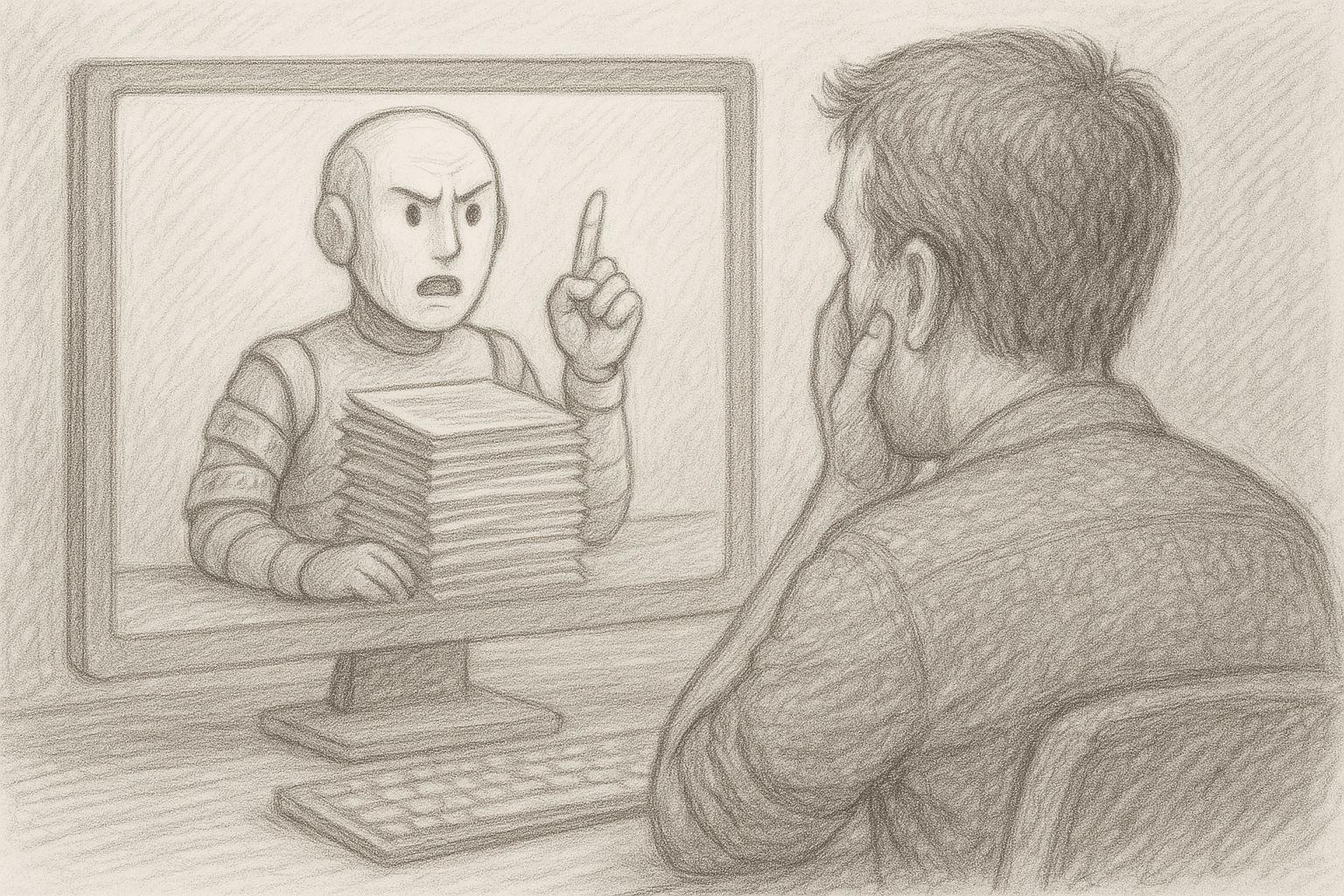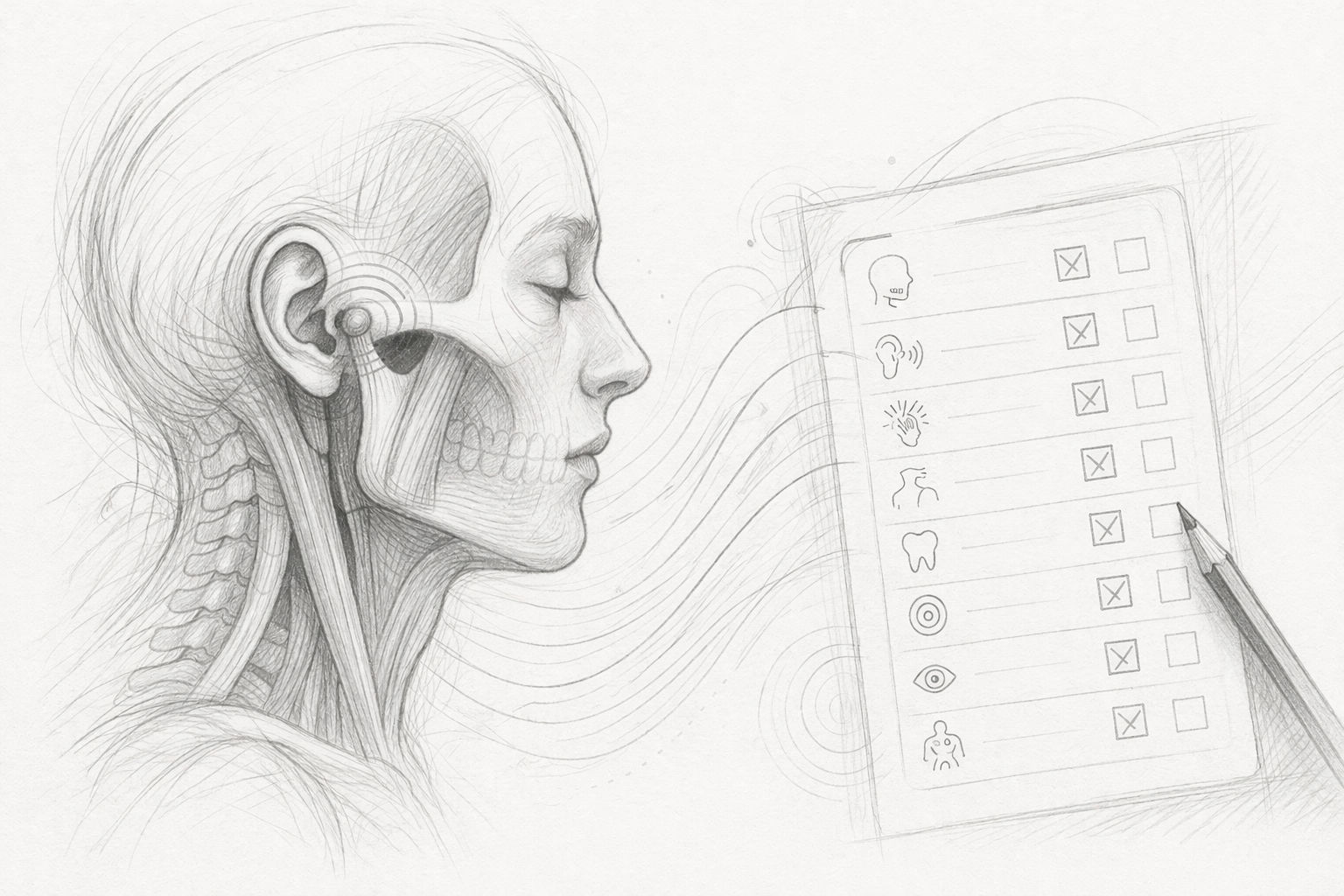
There are complaints that cannot be classified for a long time. A pulling sensation in the jaw that you initially ignore. A headache that you blame on stress. A slight cracking sound when you open your mouth that eventually becomes a habit. And then suddenly there is neck pain, perhaps a slight feeling of pressure in the ear - all explainable in themselves, but strangely unclear in the overall picture. This is exactly how it starts for many people. You go to the dentist, perhaps later to the orthopaedist or ENT specialist. Everyone looks at their own area, and often nothing clear is found. The complaints remain - sometimes for years.
I have experienced this path myself. And it was only when I was intensively involved with the topic of TMD, particularly when I was setting up a structured self-test, that I realized how many of the typical symptoms I had actually experienced over time. Individual points that seem harmless on their own suddenly form an overall picture. This article is intended to help with exactly that: to make the connections visible. Because the decisive step is often not in the treatment, but in recognizing the pattern.


What is CMD - and why is it so often overlooked?
Craniomandibular dysfunction - CMD for short - does not describe a single disease in the classic sense, but rather a functional disorder. It affects the interplay between the temporomandibular joints, chewing muscles and teeth. However, this only describes one part of the system.
The jaw does not work in isolation. It is integrated into a complex network of muscles, nerves and movement sequences that extends into the neck, shoulders and ultimately the entire body. Even small disturbances in this system can make themselves felt in very different places. This is the first point to understand: CMD is not a localized problem - it is a functional system issue.
Why the jaw is often underestimated
The jaw is one of the most frequently used joints in the human body. Speaking, chewing, swallowing - all this happens countless times a day. At the same time, it works mostly unnoticed in the background. Only when something is no longer right does it come to the fore.
The problem is that many complaints are not immediately associated with the jaw. Who first thinks of the bite or the masticatory muscles when they have a headache or neck tension? This mental separation has a long tradition. Medical specialties are clearly demarcated: The dentist looks at the teeth, the orthopaedist at the musculoskeletal system, the ENT doctor at the ears and balance. What is often missing is a view of the interaction.
The typical pattern: many symptoms, but no clear picture
A recurring pattern in TMD is the apparent disjointedness of the symptoms. Those affected often report a whole range of different symptoms:
- times the jaw is in the foreground
- times the neck
- sometimes headaches or ear problems occur
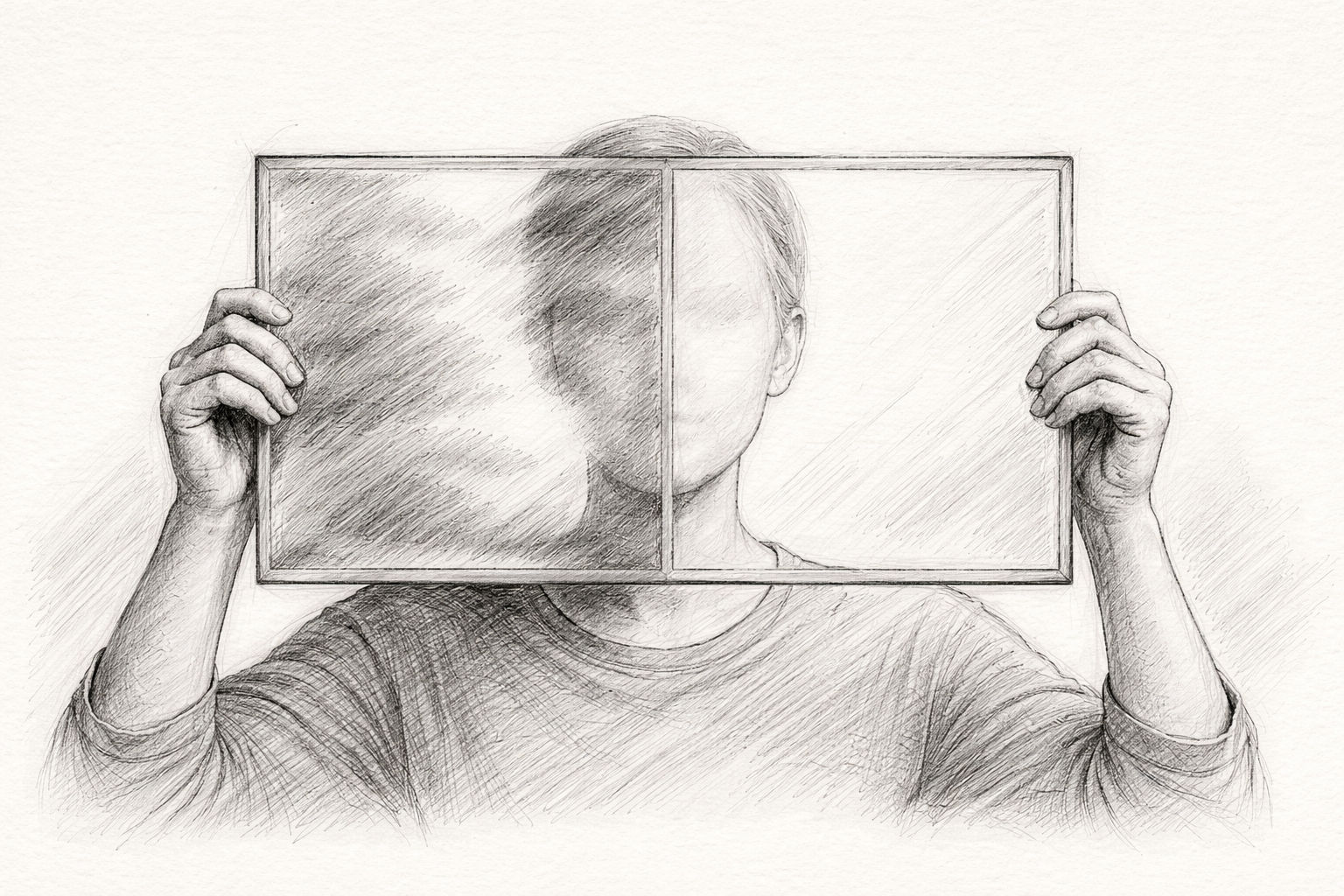
And it is not uncommon for these complaints to change over the course of time. What is dominant today may fade into the background tomorrow. This is precisely what makes TMD so difficult to pinpoint. There is no clear „main pain“, no clear cause that can be identified immediately. Instead, a picture emerges from many small pieces of the puzzle.
Why TMD often remains undetected for a long time
From a more traditional perspective, it is hardly surprising that TMD is often overlooked. The traditional approach is to look for a clear cause for a specific symptom. However, TMD rarely follows this simple principle; instead, it is usually a combination of several factors:
- Slight misalignments in the bite
- muscular tension
- Stress-related teeth clenching
- Unfavorable posture
Each individual factor on its own would possibly be inconspicuous. Taken together, however, the result is a permanent stress disorder. And this is precisely the crucial point: as long as you only look at individual symptoms, the overall picture remains blurred.
The moment of realization
It is interesting to note that many sufferers only get a clear picture when they start to systematically record their complaints. That's how I felt when I created the TMD self-test. What initially seemed like a simple collection of symptoms quickly developed into a kind of inventory. Point by point, it became clear how many of these seemingly unrelated complaints could actually belong together.
This realization rarely comes abruptly. It tends to emerge gradually - by piecing together individual observations. And it is precisely at this point that a different view of the topic begins: away from the question
„What have I got?“
towards
„How is it all connected?“
In the next chapter, we will go one step further and look at the typical CMD symptoms in detail - not in isolation, but as part of a larger system.
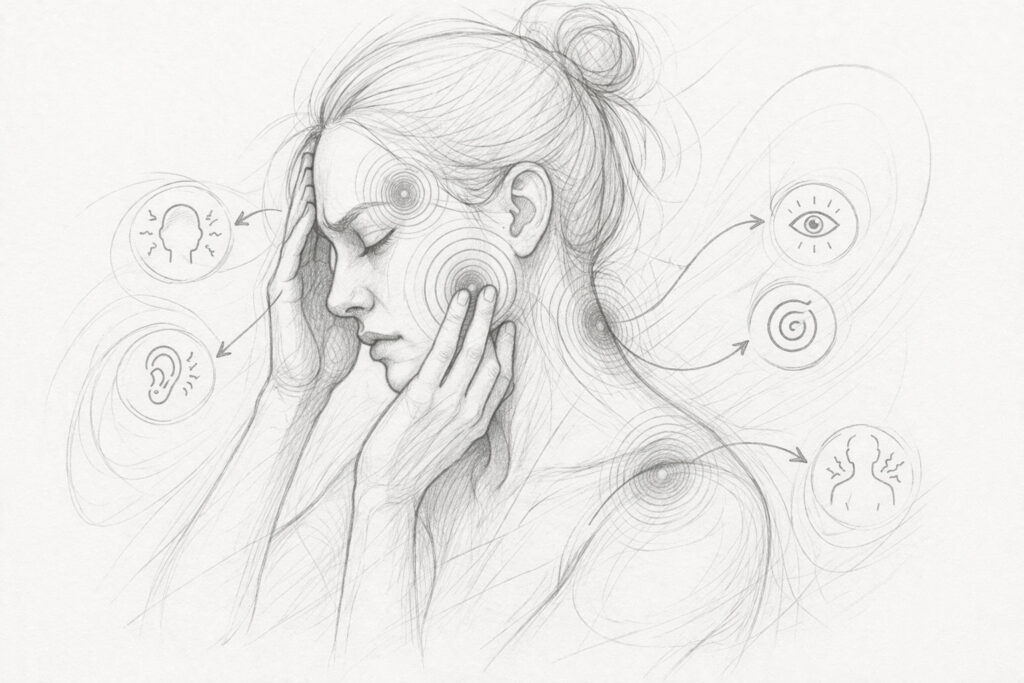
Typical CMD symptoms - a system instead of individual complaints
People who start to deal with CMD often expect a clear list: one main symptom, perhaps two or three typical signs - and that's how the matter can be categorized. But that's not exactly how CMD works. Rather, the opposite is the case.
The symptoms initially appear scattered, sometimes even contradictory. And this is where the real difficulty lies: you only recognize the pattern when you look at several complaints at the same time.
Jaw and dental symptoms - the obvious but often underestimated area
The most obvious symptoms are initially in the immediate jaw area. This includes pain in the temporomandibular joint, a cracking or rubbing sensation when opening the mouth or a restricted mouth opening. Some sufferers report that the jaw is temporarily „locked“ or can no longer move freely.
Pain can also occur when chewing or speaking, often accompanied by a feeling of pressure or tension. In addition, there is a phenomenon that many people initially find difficult to describe: the feeling that the teeth suddenly no longer fit together properly. The bite appears to have „shifted“, although objectively nothing has often changed.
Another important indication is signs of wear and tear on the teeth. Smooth grinding surfaces, small cracks or sensitive tooth necks can indicate that pressure has been exerted unconsciously over a long period of time - for example by grinding your teeth at night or by clenching in everyday life.
It is interesting to note that many of these symptoms are considered and often treated individually. But in combination with each other, they provide a much clearer picture.
Head and neck area - when the tension spreads
What surprises many people is that TMD very often does not manifest itself in the jaw itself, but in the head and neck area. Headaches are one of the most common side effects, as is tension in the neck or a constant pulling sensation in the shoulder area.
These complaints do not arise by chance. The masticatory muscles are closely connected to the muscles of the neck. If tension is permanently built up here - for example by clenching the teeth or incorrect loading of the jaw - this tension is transferred further.
It is also typical that the symptoms are particularly pronounced in the morning. People who grind or clench their teeth at night often wake up with a tense feeling in their jaw or neck, sometimes accompanied by a dull headache.
Another characteristic is limited mobility in the neck area. Turning movements are more difficult, the neck feels „blocked“. Here too, the cause is rarely suspected to be in the jaw.
Current survey on symptoms of TMD
Ears, eyes and diffuse symptoms - the area that often leads us astray
Symptoms that at first glance have nothing to do with the jaw are particularly irritating. These include ringing in the ears such as tinnitus, a feeling of pressure in the ear or pain for which no clear cause can be found by the ENT doctor.
Dizziness or unsteady balance can also occur. Some sufferers also report visual disturbances, sensitivity to light or a diffuse pressure behind the eyes.
In some cases, there may even be discomfort in the face - a slight tingling sensation or numbness. These symptoms quickly become worrying because they cannot be clearly identified.
This shows just how complex the interaction in the head area is. Nerve pathways, muscles and joints are close together and influence each other. A disorder in the jaw can therefore become noticeable in areas that initially seem far away.
The decisive pattern - why individual symptoms say little
When you look at these different areas, one point becomes clear: no single symptom in itself is clear evidence of TMD. Headaches can have many causes, as can neck pain or ear problems.
Rather, it is the interaction that is decisive. TMD often manifests itself through a combination of complaints that together form a pattern.
It is also typical that the symptoms change. One day the jaw is in the foreground, the next the neck or head. Some symptoms occur in phases and disappear again, only to reappear later. It is precisely this changeable picture that often leads to the cause remaining unclear for a long time. Individual symptoms are treated without recognizing the underlying system.
Looking at the big picture
A more classical approach would try to explain each complaint individually. But with TMD, this approach rarely leads to the goal. Only when you start to look at the symptoms as part of a larger context does an understandable overall picture emerge.
This became particularly clear to me when creating the self-test. Many of the points asked initially seemed like a loose collection. But as I went through them, it became clear how closely they are actually connected. And that's exactly the point: it's not about individual symptoms, but about recognizing a pattern.
In the next chapter, we will look at the causes and risk factors. Because only when we understand how TMD develops does it become clear why such different complaints can occur together in the first place.

Causes and risk factors - where CMD actually develops
The first time you take a closer look at CMD, you almost automatically look for one cause. A faulty crown, an incorrect bite, perhaps stress - something that can be clearly identified.
But this is a common misconception. In most cases, CMD is not caused by a single trigger, but by the interaction of several factors. Each one is often inconspicuous on its own - but together they are effective.
Tooth-related factors - small deviations with a big impact
One obvious area is the teeth themselves. Dental prostheses such as crowns, bridges or implants can play a role - especially if they deviate minimally from the ideal height or position.
The decisive factor here is that it is not about gross errors. Minimal changes in the bite, which are barely noticeable in everyday life, are often enough to cause long-term malocclusion. The same applies to:
- Fillings that are too high
- Missing teeth or gaps between teeth
- a bite that is not optimally coordinated
The body is amazingly adaptable. But if this adaptation is necessary on a permanent basis, tension arises - and this is where the problems often begin.
Muscular factors - the silent permanent strain
Another key point is the muscles. Many people clench their teeth unconsciously - especially in phases of high concentration or inner tension.
It becomes even more noticeable at night. Teeth grinding during sleep often goes unnoticed for a long time, but can exert considerable forces on the jaw and muscles over months or years. The problem is that this strain is not punctual, but permanent. The muscles are under tension without being able to regenerate sufficiently. This leads to tension that can spread further into the neck and shoulder area.
Posture and everyday life - the underestimated influence
One aspect that has long been underestimated is posture. Modern working methods - especially sitting at a computer screen for long periods - often lead to a forward leaning head posture. This seemingly small change has an impact on the entire statics:
- the neck is put under greater strain
- the muscles come under tension
- the jaw is unconsciously included
This creates a connection between posture and jaw function that many people are not initially aware of. This influence can be considerable, especially in combination with other factors.
Stress and inner tension - the invisible amplifier
Another factor that cannot be measured directly but plays a major role is stress. This is less about short-term stress and more about long-term inner tension.
The body often reacts to this with muscle activity - especially in the jaw area. Clenching the teeth becomes a kind of valve that is usually used unconsciously.
There is a classic pattern here: the trigger is not in the jaw - but the effects are.
The multi-factor principle - the crucial point
The central idea is therefore simple but important: CMD rarely arises from a single cause. It is almost always the result of several factors working together. A slightly altered bite, combined with stress and an unfavorable posture - each of these points on its own might not be problematic. Together, however, the result is permanent malocclusion.
And this is precisely why TMD is so difficult to recognize: Because there is no clear cause, but rather an interplay.
From a more traditional perspective, this is hardly surprising. Many functional problems in the body are not caused by individual events, but by long-term developments.
This also applies here. CMD is rarely a sudden event - but rather the result of a longer process. And this is precisely why the search for a single cause often leads nowhere. Instead, the overall picture is crucial.

CMD can be behind all these symptoms!!! | Dr. Kent and colleagues
Typical symptoms of TMD at a glance
| Symptom group | Typical signs | Possible effects |
|---|---|---|
| Jaws and teeth | Jaw pain, cracking in the joint, restricted mouth opening, clenching, grinding, feeling of an inappropriate bite | Incorrect loading of the temporomandibular joint, muscle tension, tooth wear, pain when chewing or speaking |
| Head and face | Headaches, pressure at the temples, facial pain, feeling of tension in the jaw area | Recurring complaints in everyday life, increased sensitivity to stimuli, unclear causes of pain in the head area |
| Neck, shoulders and back | Neck tension, shoulder pain, pulling pain in the upper back, morning stiffness | Restricted mobility, poor posture, ongoing muscle tension and strain in everyday life |
| Ears and balance | Ear pressure, earache without findings, tinnitus, dizziness, unsteady balance | Misclassification of complaints, long search for the cause, additional uncertainty due to diffuse symptoms |
| Eyes and accompanying neurological symptoms | Visual disturbances, sensitivity to light, pressure behind the eyes, tingling or discomfort in the face | Blurred overall picture of the symptoms, increased stress in everyday life, confusion with other causes |
| Causes and risk factors | Dentures, missing teeth, fillings that are too high, stress, clenching, poor posture, prolonged sitting | Permanent incorrect loading, gradual deterioration, intensification of existing TMD symptoms |
CMD self-test - an initial structured assessment
If you know the symptoms and possible causes, the question arises almost automatically:
Do these points apply to me - or not?
This is exactly where a structured self-test comes in.
How the test is structured
The following test is deliberately based on a simple structure. It is not about complicated assessments, but about an honest inventory. You answer a series of questions from different areas:
- Jaws and teeth
- Head and neck area
- Other symptoms such as ear or balance problems
- Possible causes and risk factors
The answers are given according to a clear pattern - with no room for interpretation. This is exactly what makes the test so helpful.
Note on data protection
The evaluation takes place exclusively in your browser. No data will be saved or passed on. Start the test at your leisure, work your way through the individual pages step by step and answer each question:
Is a symptom present or not?
The self-test does not replace a medical diagnosis. That should be clear. Nevertheless, it can serve an important purpose:
It helps to recognize patterns. Many sufferers have considered individual symptoms for a long time. Only a structured survey reveals how many of these points actually apply at the same time. This changes the perspective. Individual complaints become a context.
How you can categorize the result
This results in a total number of applicable symptoms. The following applies: the more symptoms come together, the more likely it is that there is a connection in terms of TMD.
However, it is important to note that it is not each individual point that is decisive - it is the sum total. It is the combination of different areas that provides the most meaningful information.
An important note on classification
As helpful as such a test can be, it is no substitute for a specialist examination. If the test provides a clear indication or if the symptoms have been present for some time, it is advisable to have them specifically clarified - ideally by a dentist or therapist who is familiar with functional relationships in the jaw area.
However, the greatest benefit lies elsewhere: the test creates clarity. It forces you to take a structured look at your own situation - without avoiding or suppressing individual points. And this is often the first step towards a solution.
Reading tip: Understanding TMD holistically
 If you would like to delve deeper into the context of TMD, the book „CMD - The forgotten problem of modern medicine“ a calm and at the same time unusually clear classification. Instead of focusing on individual symptoms, the book describes CMD as something that many sufferers only recognize at a late stage: an interplay between the jaw, posture, muscles and nervous system. The comprehensible language is particularly helpful - without unnecessary technical jargon, but still precise. It's not about quick fixes, but about a better understanding of your own body.
This book can be a useful addition, especially if you have found several similarities in the self-test, in order to categorize your own complaints and see possible next steps more clearly. It is deliberately aimed not only at experts, but above all at people who really want to understand their situation.
Further information and self-tests:
- German Dental Association (BZÄK)Overview of bruxism as a central risk factor for TMD with typical symptoms such as jaw pain, restricted mouth opening and cracking noises as well as information on dental diagnostics.
- German Society for Dental, Oral and Maxillofacial Medicine (DGZMK)Guideline-based information on the diagnosis and treatment of TMD as well as an overview of participating specialist societies and interdisciplinary treatment approaches.
- University Medical Center Göttingen (UMG)Patient-friendly presentation of TMD as a complex clinical picture with diverse symptoms in the jaw, head and neck area as well as interdisciplinary therapy approaches.
- University Hospital Münster (UKM)Example of a structured TMD quick test as well as insight into clinical diagnostics and individual therapy planning for temporomandibular joint disorders.
- University Hospital Zurich (USZ)Comprehensive overview of the causes, symptoms and frequency of TMD with a focus on the interplay of musculature, stress and malocclusion as well as typical symptoms.
- proDente (initiative of the dental profession)Easy-to-understand TMD self-check with clear classification that such tests do not replace a diagnosis, as well as information on possible treatment approaches.



Frequently asked questions about TMD and the self-test
What exactly is CMD - and is it a disease?
TMD (temporomandibular disorders) is not a classic single disease, but a functional disorder in the interaction between the temporomandibular joint, muscles and teeth. The special feature is that there is not a single problem, but several factors can interact and cause different complaints.
Which symptoms are typical for TMD?
Typical symptoms are complaints in the jaw such as clicking, pain or restricted mobility. However, headaches, neck tension, ringing in the ears or dizziness are also common. The combination of several symptoms is usually the decisive factor.
Can TMD also cause headaches or migraines?
Yes, this happens frequently. Tension in the chewing muscles can spread to the entire head area and cause headaches or migraine-like complaints.
Why is TMD so often not recognized?
Because the symptoms often cannot be clearly assigned to one area. Many sufferers consult different doctors without recognizing the connections. The view of the overall system is often missing.
Is clicking in the jaw automatically a sign of TMD?
Not necessarily. Cracking can also occur without symptoms. However, if it is accompanied by pain, restricted movement or other symptoms, it may be an indication of a functional disorder.
Can TMD also cause ear problems or tinnitus?
Yes, this is possible. As the temporomandibular joint and ear are anatomically close to each other, disorders in the jaw area can affect the ear and cause feelings of pressure or ringing in the ears, for example.
What role does stress play in TMD?
Stress is often an aggravating factor. Many people react by unconsciously clenching or grinding their teeth, which puts a permanent strain on the muscles and can promote discomfort.
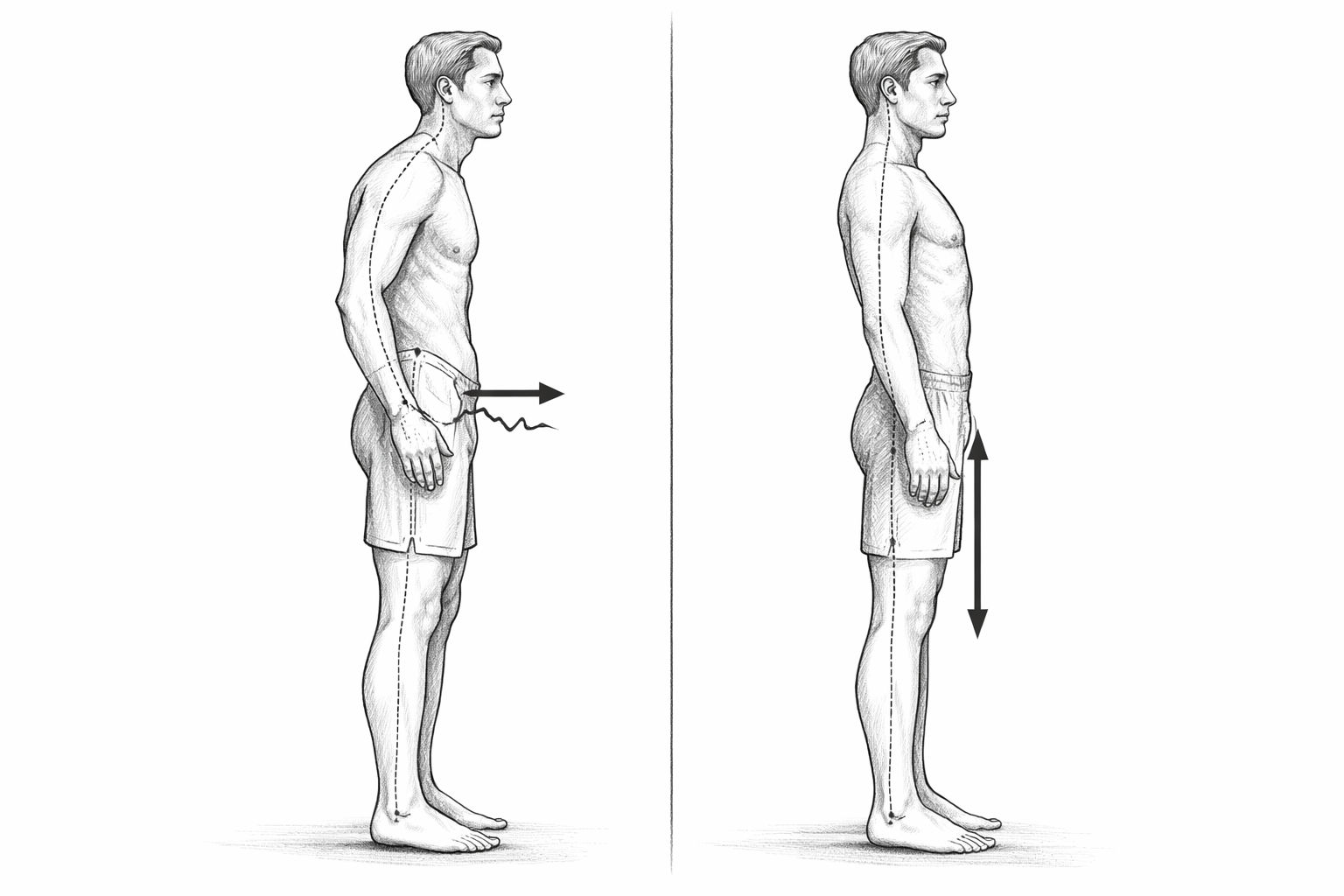
Can poor posture trigger TMD?
An unfavorable posture - especially when working in a seated position - can affect the muscles in the neck area. This tension can in turn affect the jaw and exacerbate existing problems.
Are dentures or fillings possible causes?
Yes, especially if they deviate minimally from the ideal position. Even small changes in the bite can lead to incorrect loading in the long term.
How reliable is a TMD self-test?
A self-test does not provide a diagnosis, but it can give you clues. It helps you to recognize typical patterns and better classify your own situation.
How should I interpret the self-test?
The decisive factor is not a single symptom, but the total number of points that apply. The more areas are affected, the more likely it is that there is a connection.
Can TMD disappear by itself?
Mild symptoms may improve temporarily. However, if several factors interact, the symptoms often persist or recur.
Which doctor is the right contact for TMD?
In many cases, a dentist with experience in functional diagnostics is a good first port of call. Depending on the symptoms, other specialist areas may also be involved.
Is TMD dangerous?
TMD is not usually dangerous, but can significantly impair quality of life. A more precise clarification is particularly worthwhile in the case of long-term complaints.
Can I do something about TMD myself?
Yes, to a certain extent. Consciously relaxing the jaw muscles, reducing stress and improving posture can already be helpful. However, targeted treatment should be individually tailored.
Why are the symptoms often worse in the morning?
This often indicates night-time teeth grinding or clenching. The muscles are strained for hours, which is noticeable in the morning.
Can TMD also cause dizziness?
Yes, in some cases. Due to the interaction between the muscles and the balance system, disorders in the jaw area can also cause dizziness.
What is the most important step if TMD is suspected?
The most important step is to recognize your own complaints in context. This is exactly where the self-test helps. Only when the pattern becomes visible can further targeted action be taken.