Political terms have a surprisingly long lifespan. For decades, we’ve been talking about the left and the right, about conservative and progressive, about liberal, social, or ecological. The words have remained largely the same. But does that also apply to the political positions they represent?
It was precisely this question that served as the starting point for this comparison. I am less interested in how political parties describe their own history today or how political developments are interpreted in hindsight. A simpler method strikes me as much more interesting: Take the campaign platforms from different decades and lay them side by side.
What did the CDU/CSU actually call for in 1983? What did the SPD say at that time about the economy, family, defense, or asylum? What were the Greens’ views on NATO, the Bundeswehr, and energy supply during their first federal election campaign? What did the FDP stand for? And which of those positions can still be found in their platforms in 1990 and, ultimately, in 2025? This analysis may reveal some interesting shifts. But exactly what those shifts are should not be predetermined at the outset of this article.


Latest News on the Election Platforms of German Political Parties
07.09.2026: On the State Legislative Election in Saxony-Anhalt MDR compares the election platforms from the CDU, SPD, FDP, AfD, Greens, The Left, and BSW on key policy areas. These include the economy and labor, social affairs and health, education, security, migration, infrastructure, energy, and democracy and civic participation. It is striking how differently the parties assess the same issues: While some place greater emphasis on climate protection, government investment, and social security, others emphasize reducing bureaucracy, internal security, limiting immigration, or preserving conventional forms of energy. The political differences are particularly evident in the areas of education, migration, and energy. The comparison thus illustrates how greatly election platforms differ—not only in specific measures but also in their fundamental conceptions of which responsibilities the state should assume and which priorities policymakers should set.
03.09.2026: Shortly before the state election in Saxony-Anhalt, an alleged case of Election Tampering at a Senior Living Facility in Dessau caused a stir. The representative of a 95-year-old resident who had been suffering from dementia for several years wanted to inquire about her voting documents. A staff member initially told him that the residents’ documents had been collected and shredded due to time constraints. A few days later, however, he learned at the election office that absentee ballot materials for his aunt had already been requested on August 10 and that her vote had already been cast. The application bore the 95-year-old’s signature. It remains unclear who requested the documents and who actually filled out the ballot. The authorized representative filed a criminal complaint against persons unknown through his attorney. The city of Dessau-Roßlau confirmed that it is aware of the incident but provided no further details. The senior living facility in question has not yet responded to requests for comment regarding the allegations.
27.08.2026: Ahead of the Berlin House of Representatives election on September 20, 2026, the Significant Differences in Election Platforms in security policy. The CDU is calling for a greater police presence, additional powers, expanded video surveillance supported by AI, and a lowering of the age of criminal responsibility to twelve. The AfD also advocates for increased surveillance and law enforcement, but links security more closely to migration and deportations. The SPD and BSW combine increased police presence with prevention and social policy measures. The FDP supports additional powers in high-crime areas but opposes mass surveillance and the retention of data without cause. The Greens and The Left place significantly greater emphasis on prevention, the social causes of crime, and limiting government surveillance. The Left wants to downsize the police force and dissolve the Office for the Protection of the Constitution as a secret service.

The 2026 Berlin House of Representatives Election, Explained Simply | Your Course Materials
The spectrum thus ranges from expanding government security and surveillance powers to placing greater emphasis on social work and prevention. However, the programs had already been approved before the attack on the Berlin CSD on July 25.
It's not the memory that counts, but the program
People often talk about the past from the perspective of the present. This is understandable, but it poses a problem. Our memory of past political positions is inevitably influenced by what happened afterward.
A political party that we perceive today as conservative, social democratic, green, or liberal may not have meant the same thing by those terms 40 years ago. Conversely, political demands that are attributed to a particular party today may have been found in a completely different part of the political spectrum in the past.
That is why this comparison should rely as little as possible on political memories. What matters is not what we believe a party should have stood for in 1983, but what it actually included in its platform for the 1983 federal election.
The same applies to 1990 and 2025.
Wherever possible, therefore, the complete election platforms from that time are used as primary sources. Statements are summarized, supplemented with brief original quotations, and cited with the respective source. Secondary sources are intended primarily to provide context where historical peculiarities need to be explained or documents need to be contextualized.
This also means that if there is insufficient evidence to support a particular position in the election platform, that gap will not be filled with speculation.
Why specifically 1983, 1990, 2009, and 2025?
The four selected federal elections reflect very different political situations. In 1983, the Federal Republic of Germany was in the midst of the Cold War. The debate over the NATO Double-Track Decision and the deployment of American medium-range missiles dominated the political discourse. The Greens successfully ran in a Bundestag election for the first time. The Federal Republic consisted of West Germany and West Berlin; the European Union did not yet exist; and many political issues that seem self-evident today were either discussed under completely different circumstances or played hardly any role at all.
By 1990, the situation had changed fundamentally. The Berlin Wall had fallen, German reunification was the focus of attention, and the Cold War order—which had seemed so firmly entrenched for decades—was disintegrating. This makes the year particularly interesting for historical comparison—but at the same time, it is also particularly challenging.
This applies above all to the Greens. The current party, Alliance 90/The Greens, did not yet exist in its later form in 1990. In East and West Germany, there were different political organizations and electoral alliances. This particular circumstance must be taken into account when making such comparisons, rather than retroactively applying today’s party structure to the year 1990.
Finally, 2025 serves as the current reference point. There are 42 years between 1983 and 2025—more than a single political generation. Germany has been reunified, the European Community has become the European Union, the Soviet Union no longer exists, the Bundeswehr operates under completely different political conditions, and issues such as climate policy, migration, and European integration have taken on a significance that can only be compared to the political situation of 1983 to a limited extent. That is precisely why the comparison is interesting.
Five parties, but not always five time series
The analysis covers the CDU/CSU, SPD, Greens, and FDP for the 1983, 1990, and 2025 federal elections, respectively. For 2025, the AfD is also included. Naturally, there can be no historical time series for the AfD dating back to 1983 or 1990, as the party was not founded until decades later. It is therefore included solely as an additional reference point for the present.
This is quite useful for comparing political positions. After all, one of the questions this article addresses is not only how individual parties have changed. It is equally interesting to consider whether positions that a party once held but no longer holds may now be found elsewhere on today’s political spectrum.
However, it would be methodologically incorrect to draw sweeping conclusions based on isolated points of agreement. For example, if an economic policy position held by the CDU in 1983 resembles an FDP position in 2025, or if a position from that time on migration or national sovereignty shows significant similarities with that of the AfD, this does not mean that the CDU of that era as a whole would have corresponded to any of these current parties.
In a different policy area, the outcome may be completely different. It is precisely this multidimensionality that is therefore a key part of the study.
The programs should speak on their own as much as possible
The article is therefore deliberately structured differently from a traditional political essay. Following brief introductions to the individual topics, the focus is primarily on the documented positions. The economy, the welfare state, society, migration, civil rights, energy, the environment, Europe, and foreign and security policy are each compared in their own comparative matrices.
When a brief summary is not sufficient, the original wording is included. Especially when it comes to particularly significant changes, a single sentence from an election platform can be more revealing than several paragraphs of subsequent interpretation. This applies, for example, to nuclear energy as well as to NATO, disarmament, migration, citizenship, or the understanding of family and the state.
However, even this kind of documentary presentation requires decision-making. Even the selection of comparison categories is a form of structuring. Therefore, the criteria should remain as transparent as possible.
What the symbols in the tables mean
The comparison matrices use a standardized system of symbols. They are not intended to express a political judgment, but merely to illustrate how clearly and with what emphasis a particular position is represented in each election platform.
- ● indicates that a position is explicitly and clearly represented at the central level.
- ◐ indicates a position that is explicitly stated but is qualified, nuanced, or not formulated with particular programmatic emphasis.
- ○ is used when a political orientation is discernible but appears only cautiously, indirectly, or in passing.
- ✕ means that the program explicitly rejects the position in question or makes a clearly opposing demand.
- — On the other hand, this simply means that no sufficiently clear position could be identified in the program under review.
This distinction is important. If, for example, a 1983 election platform does not mention a political concept that did not gain significant importance until decades later, it would be irresponsible to infer from this that the concept was rejected at the time. Silence does not constitute opposition. The tables should therefore be understood less as a point system and more as a guide to the original sources behind them.
A comparison spanning four decades has its limitations
Equally important is another caveat: Not every political demand can be readily compared across a 42-year span. The European Community of 1983 was not the European Union of 2025. A call for further European integration meant something different back then than it does today, because the starting point was different.
The same applies to foreign policy. The Federal Republic of Germany’s relationship with the Soviet Union cannot simply be equated with Germany’s relationship with today’s Russia. The security environment has changed, as have alliances, borders, and military threats.
In areas such as migration, citizenship, family policy, energy, and sociopolitical issues as well, the legal landscape and political terminology have, in some cases, undergone fundamental changes.
Where such differences are crucial to understanding, they are briefly explained. However, they are not intended to serve as a historical justification for unwelcome or surprising statements. The context is meant to clarify the circumstances under which a position was formulated. The position itself remains unchanged.
1983 isn't automatically „right-wing,“ and 2025 isn't automatically „left-wing“
That is precisely why this comparison should not be guided by any particular political agenda. It would be easy to start with a thesis and then search through thousands of pages of campaign platforms for supporting evidence. That approach could likely be used to tell almost any story one wanted. The opposite approach strikes me as more interesting: first, pose questions to all platforms that are as uniform as possible, and only then examine the results.
Perhaps there is a clear shift in one direction when it comes to sociopolitical issues, while the trend in economic policy is quite different. Perhaps foreign policy positions have changed more significantly than domestic policy ones. Perhaps there are parties that have remained surprisingly consistent in some areas and are barely recognizable in others.
And it may well be that the very idea of depicting political development along a single spectrum between „left“ and „right“ is too simplistic. However, we will leave that question explicitly open at this point.
An Experiment with Old Documents
Essentially, this article is therefore an experiment. We take political documents from four very different years, break them down into issues that are as comparable as possible, and present the answers side by side. A party’s current self-portrayal does not determine what it stood for in the past. Nor should today’s political assessment determine how a historical statement should be interpreted.
At first, the only thing that matters is what has been written. Only after economic policy, the welfare state, the family, migration, civil rights, energy, Europe, the Bundeswehr, NATO, disarmament, and numerous other issues have been examined individually does a broader picture gradually emerge.
The following chapters will show whether this picture ultimately corresponds to common perceptions of the development of German political parties or whether, in some respects, it looks entirely different.
Let's start where fundamental political beliefs have traditionally differed most markedly: the economy, the market economy, and the question of what role the state should play in them.
The Economy, the Market, and the Role of the State
Economic policy is one of the areas in which fundamental political principles are particularly evident. Should the government primarily create the conditions under which businesses and citizens can engage in economic activity? Or should it intervene more actively, invest, regulate, and specifically promote certain developments?
These questions appear in various forms throughout all the decades examined. Nevertheless, the context in which they arose has changed significantly. In 1983, West Germany was grappling with high unemployment, weak growth, and the economic consequences of the previous oil crises. In 1990, German reunification was imminent or had just taken place. Entire economic structures of the GDR had to be integrated into the West German economic system within a very short period of time.
In 2009, Germany was once again in the immediate grip of the international financial and economic crisis. Banks had to be stabilized, companies supported, and economic stimulus programs launched. The federal election thus took place, of all times, in a situation in which even parties fundamentally committed to a market economy were discussing significant government intervention. The SPD’s 2009 government platform explicitly focused on overcoming this crisis.
By 2025, the focus had shifted once again. Competitiveness, energy prices, bureaucracy, the shortage of skilled workers, digitalization, and international competition for industrial locations dominate large parts of the economic policy platforms. The CDU/CSU places particular emphasis on growth, tax relief for businesses, and reduced regulation; the FDP, too, explicitly links its platform to growth, tax relief, and a leaner government.
A market economy does not mean the same thing everywhere
Today, nearly all of the parties examined accept, in principle, a market-based economic system. The differences begin with the question of how this system should be structured.
The CDU/CSU and FDP have traditionally associated the market economy particularly strongly with entrepreneurial freedom, competition, private property, and limited government regulation. The SPD also accepts the market economy system, but associates it more closely with social welfare, employee participation, collective bargaining agreements, and government intervention.
For the Greens, there is another factor at play. Even their early platform challenged the notion that economic growth could be considered independently of ecological limits. Over the decades, this gave rise to an economic policy that increasingly combines market-based instruments with far-reaching government mandates for ecological transformation. The Heinrich Böll Foundation’s program archive makes it possible to trace this development through historical documents.
That is why simply categorizing a party as „more market“ or „more government“ would often be too simplistic. A party can advocate for market-based competition while also calling for billions in government investment. It can support private companies while politically regulating certain industries. And it can seek to reduce bureaucracy while calling for new regulations in other areas.
The role of the government is changing as a result of the crisis
That is why the additional snapshot from 2009 is particularly interesting. The financial crisis forced nearly all political parties to define their stance on government intervention under extraordinary circumstances. Measures that would have been considered problematic or overly interventionist in normal times were suddenly being discussed as a means of stabilizing the financial system and the economy.
It is precisely this that makes 2009 an example of why individual political positions must always be viewed within their historical context. The following matrix therefore does not compare individual economic stimulus measures or tax rates. Instead, it seeks to highlight the long-term programmatic direction: To what extent is the market emphasized? What role is assigned to the state? What are the parties’ positions on privatization, regulation, investment policy, industrial policy, and government debt?
Comparison Matrix: Economy, Market, and the Role of the State
| Political Position | CDU 1983 | CDU 1990 | CDU 2009 | CDU 2025 | SPD 1983 | SPD 1990 | SPD 2009 | SPD 2025 | Greens 1983 | Greens* 1990 | Greens 2009 | Greens 2025 | FDP 1983 | FDP 1990 | FDP 2009 | FDP 2025 | AfD 2025 |
|---|---|---|---|---|---|---|---|---|---|---|---|---|---|---|---|---|---|
| Strong market-oriented approach | ● | ● | ● | ● | ◐ | ◐ | ◐ | ◐ | ○ | ○ | ◐ | ◐ | ● | ● | ● | ● | ● |
| Greater government control over the economy | ○ | ○ | ○ | ○ | ● | ● | ◐ | ● | ● | ● | ● | ● | ✕ | ✕ | ✕ | ✕ | ○ |
| Privatization of State-Owned Enterprises and Functions | ● | ● | ● | ● | ○ | ○ | ○ | ○ | ✕ | ✕ | ✕ | ✕ | ● | ● | ● | ● | ● |
| Public or State-Owned Enterprises as an Instrument of Economic Policy | ○ | ○ | ○ | ○ | ● | ● | ● | ● | ● | ● | ● | ● | ✕ | ✕ | ✕ | ✕ | ○ |
| Tax and Regulatory Relief for Businesses | ● | ● | ● | ● | ○ | ○ | ◐ | ◐ | ✕ | ○ | ◐ | ◐ | ● | ● | ● | ● | ● |
| Greater redistribution or higher taxation of high incomes and wealth | ✕ | ✕ | ✕ | ✕ | ● | ● | ● | ● | ● | ● | ● | ● | ✕ | ✕ | ✕ | ✕ | ✕ |
| Collective bargaining autonomy and independent wage-setting by the bargaining parties | ● | ● | ● | ● | ● | ● | ● | ● | ● | ● | ● | ● | ● | ● | ● | ◐ | ◐ |
| Major government investment and economic stimulus programs | ○ | ○ | ◐ | ◐ | ● | ● | ● | ● | ● | ● | ● | ● | ✕ | ○ | ○ | ○ | ○ |
| Active Government Industrial Policy | ◐ | ◐ | ◐ | ● | ● | ● | ● | ● | ● | ● | ● | ● | ○ | ○ | ○ | ◐ | ◐ |
| Protection of Domestic Industry and Strategically Important Economic Sectors | ◐ | ◐ | ● | ● | ◐ | ◐ | ● | ● | ○ | ◐ | ◐ | ● | ○ | ◐ | ◐ | ◐ | ● |
| Cutting red tape and reducing government regulation | ● | ● | ● | ● | ◐ | ◐ | ◐ | ◐ | ○ | ○ | ◐ | ◐ | ● | ● | ● | ● | ● |
| Fiscal discipline and limiting government debt | ● | ● | ● | ● | ◐ | ◐ | ◐ | ○ | ○ | ○ | ◐ | ○ | ● | ● | ● | ● | ● |
Legend:
● explicitly and centrally represented
◐ explicitly represented, but limited or not centralized
○ represented only weakly, indirectly, or in a subordinate capacity
✕ explicitly rejected or a clear opposition
— No sufficiently clear position was identified in the program under review
Methodological Note:
The symbols do not represent any political or qualitative assessment. They merely summarize the policy direction of the federal election platforms examined. A „—“ explicitly does not mean that a party rejected a position.
Note regarding 2009:
The 2009 federal election serves as an additional snapshot between reunification and the present. It occurred right in the midst of the international financial and economic crisis, which is why statements regarding economic stimulus packages, government intervention, industrial policy, and budgetary discipline, in particular, must be interpreted against this historical backdrop.
* For 1990, the unique historical situation of the Greens and Alliance 90 must be taken into account. The current party, Alliance 90/The Greens, did not yet exist at that time in the form it would later take.
Taxes, the Welfare State, and Work: Who Pays for What—and What Should the Government Provide?
Hardly any other policy area intertwines as many fundamental questions as taxes, labor, and social security. To what extent should the government redistribute income and wealth? What risks should society cover, and what responsibilities should remain with the individual? How large should the gap be between earned income and government benefits? And what role do unions, employers, and the government play in shaping wages and working conditions?
Caution is warranted, especially when comparing periods spanning more than four decades. The welfare state of 1983 cannot simply be equated with the welfare state of 2025. Tax rates, social benefits, labor market instruments, and even the terminology have changed. Universal basic income, the statutory minimum wage, and today’s forms of basic income support did not exist back then in their current forms.
For this reason, the following matrix compares not so much individual laws as the underlying policy orientation: Should there be a greater emphasis on redistribution or on tax relief? Should the welfare state be expanded, or should it be geared more toward personal responsibility and work incentives? To what extent are workers’ rights and labor unions emphasized? And what significance is attached to the merit principle?
Between Social Security and the Merit Principle
It is noteworthy, first of all, that the fundamental question has hardly changed over the decades. Virtually all political parties link social security in some form to the idea that gainful employment forms the economic foundation of the welfare state. However, the emphasis placed on each of these two aspects varies greatly.
The programs therefore differ less on the abstract question of whether there should be a welfare state and more on how it should be structured. While some programs place greater emphasis on public social security, redistribution, and workers’ rights, others emphasize personal responsibility, contribution caps, and the financial distinction between gainful employment and transfer payments.
In 2025, this debate is particularly clear-cut. The CDU/CSU speak of an „Agenda for the Hardworking“ and want to replace the citizen’s income with a new basic income program. The FDP explicitly states its goal of „work instead of a basic income“ and proposes consolidating tax-funded social benefits based on the principle of a negative income tax. The SPD, on the other hand, is focusing on higher wages, stronger collective bargaining coverage, and a minimum wage of 15 euros.
What is interesting about this long-term analysis is which of these fundamental ideas already appeared in the 1983 and 1990 platforms—and which policy instruments were added only later.
Taxes as a Reflection of Different Conceptions of the State
The same applies to tax policy. Simply calling for a tax cut says little, at first glance, about who should benefit from the reduction. Similarly, calling for higher taxes does not automatically mean that all income should be taxed at a higher rate.
For example, the SPD explicitly links tax relief for about 95 percent of income tax payers in 2025 to a greater contribution from those with high incomes and wealth. The CDU/CSU and FDP, on the other hand, want, among other things, to flatten the income tax schedule and raise the threshold for the top tax rate; the FDP also calls for the complete abolition of the solidarity surcharge.
For the purposes of historical comparison, therefore, it is not merely interesting to know whether a party calls for „tax cuts“ or „tax increases.“ What matters is the underlying understanding of public services, income distribution, and government financing.
Work: A Balance Between Protection and Flexibility
A third area concerns the status of employees. This is where differing viewpoints clash most directly: Should the government intervene more in wage-setting and working conditions? What role do collective bargaining autonomy and unions play? Should working hours be more strictly regulated or made more flexible? And to what extent should the government ensure that paid work remains financially more attractive than relying on government benefits?
Even in this context, historical terms are not always directly comparable. A 1983 platform could not have assessed a statutory minimum wage in its current form if it did not yet serve the same political function at that time. Therefore, the absence of a specific demand should not be retroactively interpreted as a rejection.
For this reason, the following overview does not detail individual legislative proposals. Rather, it seeks to make the underlying policy directions comparable.
Comparison Matrix: Taxes, the Welfare State, and Work
| Political Position | CDU 1983 | CDU 1990 | CDU 2009 | CDU 2025 | SPD 1983 | SPD 1990 | SPD 2009 | SPD 2025 | Greens 1983 | Greens 1990 | Greens 2009 | Greens 2025 | FDP 1983 | FDP 1990 | FDP 2009 | FDP 2025 | AfD 2025 |
|---|---|---|---|---|---|---|---|---|---|---|---|---|---|---|---|---|---|
| Tax Relief for Low- and Middle-Income Earners | ◐ | ● | ● | ● | ● | ● | ● | ● | ◐ | ◐ | ● | ● | ● | ● | ● | ● | ● |
| Higher Taxes on High Incomes | ✕ | ✕ | ✕ | ✕ | ● | ● | ● | ● | ● | ● | ● | ● | ✕ | ✕ | ✕ | ✕ | ✕ |
| Higher Taxes on Large Fortunes | ✕ | ✕ | ✕ | ✕ | ● | ● | ● | ● | ● | ● | ● | ● | ✕ | ✕ | ✕ | ✕ | ✕ |
| Tax Relief for Businesses | ● | ● | ● | ● | ○ | ○ | ◐ | ◐ | ✕ | ○ | ◐ | ◐ | ● | ● | ● | ● | ● |
| Expansion of Government Social Benefits | ◐ | ◐ | ◐ | ○ | ● | ● | ● | ● | ● | ● | ● | ● | ○ | ○ | ○ | ✕ | ○ |
| Restrictions on or stricter conditions for social benefits | ◐ | ◐ | ● | ● | ✕ | ✕ | ◐ | ○ | ✕ | ✕ | ○ | ✕ | ◐ | ● | ● | ● | ● |
| Earnings Principle / Financial Gap Between Earned Income and Transfer Payments | ● | ● | ● | ● | ◐ | ◐ | ● | ◐ | ○ | ○ | ◐ | ◐ | ● | ● | ● | ● | ● |
| Greater Personal Responsibility in Social Security | ● | ● | ● | ● | ○ | ○ | ◐ | ○ | ✕ | ✕ | ○ | ○ | ● | ● | ● | ● | ● |
| Strengthening Labor Unions and Collective Bargaining Coverage | ◐ | ◐ | ◐ | ◐ | ● | ● | ● | ● | ● | ● | ● | ● | ◐ | ◐ | ○ | ○ | ○ |
| Government Regulations on Minimum Wages | — | — | ✕ | ◐ | — | — | ● | ● | — | — | ● | ● | — | — | ✕ | ◐ | ● |
| Reducing working hours as a political goal | ✕ | ✕ | ✕ | ✕ | ● | ● | ◐ | ○ | ● | ● | ◐ | ○ | ✕ | ✕ | ✕ | ✕ | ✕ |
| Making Working Hours and the Labor Market More Flexible | ◐ | ● | ● | ● | ○ | ○ | ◐ | ◐ | ✕ | ✕ | ○ | ○ | ● | ● | ● | ● | ● |
| Stronger private or funded retirement plans | ○ | ◐ | ● | ● | — | ○ | ◐ | ◐ | ✕ | ✕ | ○ | ◐ | ◐ | ● | ● | ● | ◐ |
Family, Society, and Social Ideals
Few policy areas illustrate the gap between 1983 and 2025 as clearly as the concepts of family, partnership, and social coexistence. It is not only political demands that have changed; in some cases, the language used to discuss these issues has already evolved.
In 1983, marriage between a man and a woman was the natural point of reference for family policy across much of the political spectrum. Political differences centered primarily on the role women should play in family and work life, how child care should be organized, and to what extent the government should promote true equality between men and women.
Even back then, however, clear lines of conflict were emerging. The CDU and CSU placed particular emphasis on family and marriage as the foundation of society. The SPD and FDP linked family policy more closely to the increasing participation of women in the workforce and the demand for equal rights. The Young Greens questioned traditional gender roles on a much more fundamental level and, from an early stage, viewed different forms of cohabitation as part of individual self-determination. Four decades later, many of these issues are being discussed under different circumstances.
From the "housewife marriage" to balancing family and career
The change is particularly evident in women’s labor force participation. In 1983, the idea that one parent—in practice, usually the mother—would take on the responsibility of caring for the children, at least for an extended period, was much more firmly entrenched in society than it is today. However, this did not mean that all political parties wanted to confine women to the role of housewife. The demand for better career opportunities for women and a more equitable distribution of family responsibilities was already a political issue back then.
Over the following decades, however, the focus shifted. By 2009, parental leave, child care, and the work-life balance had already become natural parts of the federal political debate. The SPD explicitly defined gender equality as a cross-cutting political priority and sought to further align registered same-sex partnerships with marriage under the law.
By 2025, the idea of balancing family and career is found across virtually the entire political spectrum. Even among those who hold more traditional views on the family, the notion that women should generally forgo paid work is virtually nonexistent.
The actual line of conflict has thus shifted. The issue is less about whether women should work and more about how child care is organized, how parents divide up work and family responsibilities, and to what extent the government should support certain family models. Family remains important—but its definition is changing
The very concept of family has also changed.
For the CDU and CSU, the family continues to hold a particularly high priority in their political platform. However, the 2025 platform explicitly links family support to parental leave, parental benefits, child care, and the ability to organize family life according to individual needs. At the same time, the Union adheres to a more conservative approach to social policy, for example regarding abortion or the handling of the Self-Determination Act.
The SPD and the Greens use a broader definition of family. For them, the specific legal or traditional form of cohabitation is becoming less and less important than the assumption of mutual responsibility. For the SPD, for example, this explicitly includes the equitable sharing of family responsibilities by 2025.
The FDP, in turn, follows a liberal line of reasoning: In principle, the state should have less say in determining which private lifestyle serves as a model for society.
As a result, what was once a discussion heavily oriented toward the traditional family model has increasingly become a debate about freedom of choice, equality, and the state’s neutrality toward different lifestyles.
Gender equality is changing its meaning
The concept of equality is particularly interesting. In 1983, a significant part of the political debate still centered on actually implementing formal equality in everyday life. Career opportunities, pay, pension entitlements, family law, and the division of family responsibilities played an important role in this context.
By 2009, the debate had already progressed considerably. The SPD wanted to explicitly treat gender equality policy as a cross-cutting issue and continue actively promoting women. Political instruments for achieving true gender equality had also become more firmly established among the Greens and parts of the other parties.
By 2025, the fundamental principle of equal rights for men and women enjoys virtually bipartisan support. The means of achieving this, however, are more contentious. Should the government set quotas? Should equality mean merely legal equality, or should it also involve political measures to correct disparities in social outcomes? How far should anti-discrimination law go? And what role should gender and gender identity even play in government regulations anymore?
This allows political parties to advocate for gender equality while simultaneously taking completely opposing positions on specific policies.
Abortion as a Long-Term Source of Conflict
One of the few sociopolitical debates that can be traced relatively well throughout the entire period concerns abortion.
Here, too, the legal landscape and public discourse have changed. However, the fundamental conflict between a woman’s right to self-determination and the state’s protection of unborn life has persisted.
The CDU and CSU have traditionally placed greater emphasis on the protection of unborn life and, in 2025, expressly reaffirmed their commitment to the existing provisions of Section 218. Their current platform describes this as a social compromise between a woman’s right to self-determination and the protection of the unborn child.
The SPD and, in particular, the Greens place greater emphasis on women’s right to self-determination and have advocated for further liberalization over the decades. Here, too, a historical comparison shows that not every political line of conflict has simply disappeared; some have merely changed their specific form.
New questions arise, old ones disappear
Other contemporary sociopolitical issues, on the other hand, cannot be meaningfully traced back to 1983 at all. Legal equality for same-sex partnerships is a good example. In 1983, today’s debate over marriage and civil partnerships did not play anywhere near the same role in the Bundestag election platforms. Therefore, the absence of a particular issue from a platform should not automatically be interpreted as an explicit rejection.
This is even more evident when it comes to current issues regarding legal changes to gender registration or the Self-Determination Act. The current debate has no real counterpart in the Bundestag election platforms of the early 1980s.
It is precisely in cases like these that the dash in the tables is important. It does not mean: “The party was opposed to it.” It means: “This current question cannot be seriously answered based on the party’s platform at that time.”.
Comparison Matrix: Family, Society, and Social Ideals
| Political Position | CDU 1983 | CDU 1990 | CDU 2009 | CDU 2025 | SPD 1983 | SPD 1990 | SPD 2009 | SPD 2025 | Greens 1983 | Greens 1990 | Greens 2009 | Greens 2025 | FDP 1983 | FDP 1990 | FDP 2009 | FDP 2025 | AfD 2025 |
|---|---|---|---|---|---|---|---|---|---|---|---|---|---|---|---|---|---|
| Marriage and family as a particularly prominent social ideal | ● | ● | ● | ● | ◐ | ◐ | ◐ | ◐ | ✕ | ✕ | ○ | ○ | ◐ | ◐ | ○ | ○ | ● |
| Traditional Gender Roles in the Family | ◐ | ◐ | ○ | ○ | ○ | ✕ | ✕ | ✕ | ✕ | ✕ | ✕ | ✕ | ○ | ○ | ✕ | ✕ | ● |
| Balancing Family and Career as a Key Policy Goal | ◐ | ◐ | ● | ● | ● | ● | ● | ● | ● | ● | ● | ● | ● | ● | ● | ● | ◐ |
| Expansion of Government-Supported Child Care | ○ | ◐ | ● | ● | ● | ● | ● | ● | ● | ● | ● | ● | ◐ | ◐ | ● | ● | ◐ |
| Active Government Policies on Gender Equality | ◐ | ◐ | ◐ | ◐ | ● | ● | ● | ● | ● | ● | ● | ● | ◐ | ◐ | ◐ | ◐ | ○ |
| The Advancement of Women and Mandatory Quotas as a Political Tool | ○ | ○ | ○ | ○ | ◐ | ● | ● | ● | ● | ● | ● | ● | ○ | ○ | ✕ | ✕ | ✕ |
| Equal Recognition of Different Lifestyles and Family Structures | ○ | ○ | ◐ | ◐ | ◐ | ◐ | ● | ● | ● | ● | ● | ● | ● | ● | ● | ● | ○ |
| Socio-political liberalism and a strong emphasis on personal autonomy | ○ | ○ | ◐ | ◐ | ◐ | ◐ | ● | ● | ● | ● | ● | ● | ● | ● | ● | ● | ○ |
| Strong emphasis on the protection of unborn life | ● | ● | ● | ● | ◐ | ◐ | ◐ | ○ | ○ | ○ | ○ | ○ | ◐ | ◐ | ◐ | ◐ | ● |
| Liberalization of abortion | ✕ | ✕ | ✕ | ✕ | ◐ | ◐ | ◐ | ● | ● | ● | ● | ● | ◐ | ◐ | ◐ | ● | ✕ |
| Legal Equality for Same-Sex Partnerships | — | — | ○ | ◐ | — | ○ | ● | ● | ● | ● | ● | ● | ○ | ◐ | ● | ● | ✕ |
| Expansion of Government Anti-Discrimination Policies | — | ○ | ◐ | ◐ | ○ | ◐ | ● | ● | ● | ● | ● | ● | ◐ | ◐ | ◐ | ◐ | ✕ |
Migration, Asylum, Citizenship, and Integration
Few other policy areas require as much historical context when compared over a period of more than four decades as migration and asylum. This is not only because political positions have changed. The legal foundations, the scale of immigration, and in some cases even the terminology used to discuss these issues are different today than they were in 1983 or 1990.
By the early 1980s, the Federal Republic of Germany had already been a country of immigration for decades, even though it had long failed to see itself as such politically. Millions of foreign workers had come to Germany since the 1950s and 1960s as part of the so-called “guest worker” recruitment program. After the recruitment freeze of 1973, the discussion increasingly shifted to family reunification, integration, and the question of whether what had originally been intended as temporary stays had turned into permanent immigration.
This point in particular is important for historical comparison. The political debate at that time was not identical to today’s debate on skilled labor immigration, refugee migration across Europe’s external borders, or the treatment of rejected asylum seekers. Nevertheless, even back then there were lines of conflict that remain recognizable to this day.
Germany as a country of immigration—or perhaps not?
One of the most striking changes concerns the very description of reality. For a long time, the CDU and CSU clung to the notion that Germany was not a traditional country of immigration. Immigration was to be limited, and, in particular, the integration of foreigners already living permanently in Germany was to be improved.
The SPD and the Greens used to be moving toward an explicit understanding of Germany as an immigration society. This trend is particularly evident in 2009. The SPD’s government platform at the time stated bluntly: „Germany is a country of immigration.“ At the same time, the goal was to better facilitate and manage skilled immigration.
By that time, the rhetoric within the CDU and CSU had also changed. While the 2009 government platform described Germany as a „country of integration,“ it continued to explicitly link this to the „limitation and management of immigration.“ A good command of German and successful completion of integration courses were highlighted as key requirements.
This makes 2009 an interesting turning point: The reality of long-term immigration was increasingly recognized across the established political spectrum, but interpreted very differently from a political standpoint.
Asylum is not the same as immigration
To ensure a fair comparison, it is also necessary to distinguish between different forms of migration. Asylum is a right to protection for those facing political persecution. Labor migration and skilled worker immigration, on the other hand, are governed by economic or immigration policy rules. Family reunification, in turn, is linked to existing residence rights.
In political discussions, these areas are often conflated. This would be problematic for policy analysis. A party can simultaneously explicitly promote skilled labor migration and call for a significantly more restrictive asylum policy. It can limit family reunification while still facilitating the immigration of skilled workers. Similarly, a generous naturalization policy can be combined with high requirements for language proficiency and integration.
For this reason, the following matrix separates these individual dimensions as consistently as possible.
1990 was still before the asylum compromise
The year 1990 is particularly significant. The fundamental right to asylum at that time differed considerably from the later regulations. It was not until 1992–93 that the CDU/CSU, FDP, and SPD reached an agreement on the so-called asylum compromise. With the amendment to the Basic Law and the introduction of the principle of safe third countries, German asylum law underwent a fundamental change.
The 1990 election platforms were drafted before this turning point. A restrictive or liberal position from 1990 should therefore not be interpreted as if the party had already been discussing the asylum system of 2025. The legal starting point was different.
Conversely, this also applies to today’s calls for rejections at borders, European asylum procedures, or procedures outside the European Union. Many of these instruments have no direct historical counterpart.
Nationality is becoming a source of conflict in its own right
The changes in citizenship law are even more evident. Traditionally, German citizenship law was based heavily on the principle of descent. Anyone with German parents was generally granted German citizenship. By contrast, being born in Germany and living here permanently did not automatically lead to citizenship.
Under the red-green federal government, this system underwent significant changes beginning in 2000 and was expanded to include elements of the birthplace principle. In 2009, the conflicts resulting from these changes remained clearly visible. The SPD wanted to further ease the process of acquiring German citizenship and accept dual citizenship. Its governing platform explicitly stated that people should be able to identify with both their country of origin and Germany.
By 2025, the debate has intensified once again. The SPD defends the simplified naturalization process and explicitly describes Germany as a modern immigrant society. The CDU and CSU, on the other hand, are once again placing greater emphasis on limiting migration and want to roll back parts of the most recent liberalizations of citizenship law. At the same time, they continue to distinguish between desired skilled-worker immigration and irregular or humanitarian migration.
This means that a party can, within the same table, advocate both strict restrictions on one form of migration and a more open approach to another.
Integration Between Support and Obligation
When it comes to the concept of integration, too, there are more commonalities than some political debates might suggest. Almost all political parties eventually link integration to language, education, gainful employment, and social participation. What differs, however, is the extent to which they emphasize support versus obligation.
The CDU and CSU have traditionally placed greater emphasis on language, the legal system, and social integration. In 2009, the Union explicitly described a good command of German as a fundamental prerequisite for successful integration.
That same year, the SPD defined integration more broadly as equal participation in social, economic, cultural, and political life. At the same time, it, too, identified language acquisition as the first and most important prerequisite.
This is a good example of why the tables cannot simply distinguish between „for integration“ and „against integration.“ The difference lies rather in what is meant by integration and which side is held more accountable: the immigrant, the state, or both.
In 2025, migration will once again be a key dividing line
By 2025, the political landscape had once again changed significantly. The high volume of refugee migration since 2015, the European asylum crisis, the war in Ukraine, rising refugee numbers in various years, and the political debate over irregular migration have brought the issue much more firmly to the forefront of German politics.
The CDU and CSU are explicitly calling for a „fundamental shift in migration policy“ by 2025. This includes turning away migrants at German borders, expediting deportations, restricting family reunification, and capping the number of people admitted on humanitarian grounds.
The SPD and the Greens are more firmly committed to Germany’s identity as a country of immigration and emphasize legal migration, integration, and easier social participation. The FDP combines economically desirable immigration with stricter controls and a more restrictive approach to irregular migration.
In 2025, the AfD will join the race as a party that places a much greater emphasis on limiting, reducing, and exercising national control over migration than the other parties do.
It is precisely these four historical reference points that help us avoid a view that is often too simplistic. Migration is not merely a spectrum between „open“ and „closed.“ Labor migration, asylum, family reunification, citizenship, and integration can take completely different paths within the same political party.
Comparison Matrix: Migration, Asylum, Citizenship, and Integration
| Political Position | CDU 1983 | CDU 1990 | CDU 2009 | CDU 2025 | SPD 1983 | SPD 1990 | SPD 2009 | SPD 2025 | Greens 1983 | Greens 1990 | Greens 2009 | Greens 2025 | FDP 1983 | FDP 1990 | FDP 2009 | FDP 2025 | AfD 2025 |
|---|---|---|---|---|---|---|---|---|---|---|---|---|---|---|---|---|---|
| Limiting immigration as an explicit political goal | ● | ● | ● | ● | ◐ | ◐ | ○ | ◐ | ✕ | ✕ | ✕ | ○ | ◐ | ◐ | ◐ | ◐ | ● |
| Germany is explicitly viewed as a country of immigration | ✕ | ✕ | ○ | ◐ | ○ | ◐ | ● | ● | ◐ | ● | ● | ● | ○ | ◐ | ● | ● | ✕ |
| Promoting Targeted Immigration of Workers and Skilled Professionals | ○ | ○ | ● | ● | ○ | ◐ | ● | ● | ◐ | ◐ | ● | ● | ◐ | ● | ● | ● | ◐ |
| Comprehensive Protection of the Individual Right to Asylum | ◐ | ◐ | ◐ | ○ | ● | ● | ● | ● | ● | ● | ● | ● | ● | ● | ● | ◐ | ○ |
| Restrictions on or Tightening of Access to Asylum | ● | ● | ◐ | ● | ✕ | ✕ | ○ | ◐ | ✕ | ✕ | ✕ | ○ | ○ | ◐ | ◐ | ● | ● |
| Consistent Repatriation Following the Denial of an Asylum Application | ● | ● | ● | ● | ◐ | ◐ | ◐ | ● | ○ | ○ | ○ | ◐ | ◐ | ◐ | ● | ● | ● |
| Generous Family Reunification | ○ | ○ | ○ | ✕ | ◐ | ◐ | ● | ● | ● | ● | ● | ● | ◐ | ◐ | ◐ | ◐ | ✕ |
| Simplifying the Naturalization Process | ✕ | ✕ | ○ | ✕ | ◐ | ◐ | ● | ● | ● | ● | ● | ● | ○ | ◐ | ◐ | ◐ | ✕ |
| Acceptance of dual or multiple citizenship | ✕ | ✕ | ○ | ✕ | ○ | ◐ | ● | ● | ● | ● | ● | ● | ○ | ○ | ◐ | ◐ | ✕ |
| Language acquisition and active efforts toward integration are explicitly required | ● | ● | ● | ● | ◐ | ◐ | ● | ● | ◐ | ◐ | ● | ● | ◐ | ● | ● | ● | ● |
| Strong emphasis on cultural adaptation and a shared social vision | ● | ● | ● | ● | ◐ | ◐ | ◐ | ◐ | ○ | ○ | ○ | ○ | ◐ | ◐ | ◐ | ◐ | ● |
| Local Voting Rights for Non-EU Foreigners Who Are Permanent Residents | ✕ | ✕ | ✕ | ✕ | ○ | ◐ | ● | ● | ● | ● | ● | ● | ○ | ○ | ◐ | ◐ | ✕ |
| European Distribution and a Common European Asylum Policy | — | — | ● | ◐ | — | — | ● | ● | — | — | ● | ● | — | — | ● | ● | ○ |
The State, Internal Security, and Civil Rights: How Much Power Does the State Need?
The relationship between freedom and security is one of the oldest areas of conflict in democratic politics. A state must protect its citizens from violence, crime, and attacks on the democratic order. At the same time, it is precisely this state that possesses a police force, intelligence agencies, criminal law, and, increasingly, the technical means to monitor its citizens.
In 1983, the debate over where the proper boundary lies took place under different circumstances than in 2025. The Federal Republic of Germany in the early 1980s was shaped by its experiences with RAF terrorism, the security policy debates of the 1970s, and an intense discussion about data protection, occupational bans, the right to demonstrate, and government surveillance. At the same time, new social movements gave rise to ideas about citizen participation and direct democracy that, in some cases, went far beyond the parliamentary system that existed at the time.
More than four decades later, many of the fundamental questions raised back then still remain. The technical landscape, however, has changed fundamentally. Video surveillance, biometric technologies, digital communications data, artificial intelligence, and international data networks open up possibilities for the state that were hardly imaginable in 1983. At the same time, international terrorism, organized crime, cyberattacks, and extremist networks have transformed our understanding of internal security.
This makes the question of what underlying stance is evident in the respective campaign platforms all the more interesting.
Security and freedom are not simply opposites
Any comparison must avoid a common misconception. A party that calls for a strong police force is not, therefore, automatically opposed to civil liberties. Conversely, a strong emphasis on data protection and civil liberties does not necessarily mean that state security agencies should be weakened as a matter of principle.
This connection is also evident in the 2025 platforms. Among other things, the CDU and CSU want to strengthen law enforcement agencies and provide them with additional technical and legal tools. Alliance 90/The Greens also combine the goal of an effective constitutional state with an explicit emphasis on fundamental and human rights. The FDP traditionally places particular emphasis on civil rights and data protection, while at the same time calling for effective police and security agencies.
The differences therefore often lie less in an abstract commitment to freedom or security than in what intrusions the state is permitted to make, how strictly these should be monitored, and what weight should be given to the rights of the individual citizen in cases of doubt.
From the Census to Digital Surveillance
The historical gap is particularly evident when it comes to data protection. As early as 1983, data protection was already a major political issue. That same year, the planned census sparked a broad public debate that ultimately led to the Federal Constitutional Court’s famous census ruling and the development of the right to informational self-determination. The discussion at that time centered on paper questionnaires and government databases. Today, the focus is on digital communication, location data, facial recognition, the automated analysis of large volumes of data, and security agencies’ access to encrypted communications. The technical dimension has changed. The fundamental political question remains the same:
What information is the government allowed to have about its citizens?
For this reason, the following matrix does not compare individual technical tools. After all, a program from 1983 could not have included a position on today’s facial recognition technology or the analysis of modern messaging services. What is far more important is the discernible underlying stance toward government surveillance, data protection, and the relationship between citizens and the security apparatus.
Direct Democracy as a Second Path of Development
A second interesting long-term trend concerns the question of how citizens should influence political decisions.
In the early 1980s, the Greens introduced a distinctly grassroots-democratic approach to the German federal political landscape. Their campaign appeal for the 1983 federal election is preserved in the archives of the Heinrich Böll Foundation; the 1990 platform and other historical policy documents are also available there.
Today, calls for referendums or other forms of direct democracy are not limited to parties that have emerged from this tradition. The AfD, in particular, clearly emphasizes referendums and the notion of the people as the direct sovereign in its 2025 platform.
This is precisely where we can clearly see how a political instrument can shift its partisan affiliation over the course of decades, without the parties advocating for it necessarily sharing similar political views overall.
Comparison Matrix: Government, Internal Security, Civil Rights, and Democracy
| Political Position | CDU 1983 | CDU 1990 | CDU 2009 | CDU 2025 | SPD 1983 | SPD 1990 | SPD 2009 | SPD 2025 | Greens 1983 | Greens 1990 | Greens 2009 | Greens 2025 | FDP 1983 | FDP 1990 | FDP 2009 | FDP 2025 | AfD 2025 |
|---|---|---|---|---|---|---|---|---|---|---|---|---|---|---|---|---|---|
| Strengthening the Police and Security Agencies | ● | ● | ● | ● | ◐ | ◐ | ● | ● | ✕ | ○ | ◐ | ● | ◐ | ◐ | ● | ● | ● |
| Expansion of Government Investigative and Surveillance Powers | ● | ◐ | ◐ | ● | ○ | ○ | ◐ | ◐ | ✕ | ✕ | ✕ | ○ | ✕ | ✕ | ✕ | ✕ | ◐ |
| Privacy and Informational Self-Determination | ○ | ◐ | ◐ | ◐ | ● | ● | ● | ● | ● | ● | ● | ● | ● | ● | ● | ● | ● |
| Limits on Government Surveillance | ○ | ○ | ○ | ○ | ◐ | ◐ | ● | ◐ | ● | ● | ● | ● | ● | ● | ● | ● | ● |
| A strong emphasis on individual civil and civil liberties | ◐ | ◐ | ◐ | ◐ | ● | ● | ● | ● | ● | ● | ● | ● | ● | ● | ● | ● | ● |
| Comprehensive Protection of the Rights to Demonstrate and Protest | ○ | ○ | ◐ | ◐ | ◐ | ◐ | ● | ● | ● | ● | ● | ● | ● | ● | ● | ● | ◐ |
| Strong protection of freedom of speech against government interference | ◐ | ◐ | ◐ | ◐ | ◐ | ◐ | ● | ● | ● | ● | ● | ● | ● | ● | ● | ● | ● |
| Combating Political Extremism by Government Agencies | ● | ● | ● | ● | ● | ● | ● | ● | ○ | ◐ | ● | ● | ◐ | ◐ | ● | ● | ◐ |
| Stronger parliamentary and judicial oversight of security agencies | ○ | ◐ | ◐ | ◐ | ◐ | ◐ | ● | ● | ● | ● | ● | ● | ● | ● | ● | ● | ◐ |
| Referendums and Direct Democracy at the Federal Level | — | — | ○ | ○ | ○ | ◐ | ● | ◐ | ● | ● | ● | ◐ | ◐ | ◐ | ● | ◐ | ● |
| Greater citizen participation beyond parliamentary elections | ○ | ○ | ◐ | ◐ | ◐ | ◐ | ● | ● | ● | ● | ● | ● | ● | ● | ● | ● | ● |
| Limits on Government Intervention in Personal Lifestyles | ◐ | ◐ | ◐ | ◐ | ◐ | ◐ | ● | ◐ | ● | ● | ● | ● | ● | ● | ● | ● | ● |
Education, Science, and Cultural Issues
Education policy is one of the areas where political differences are often less evident in the general goals than in the question of how those goals should be achieved. Hardly any party opposes good schools, qualified teachers, high-performing colleges, or better vocational training. The differences begin with school structures, academic standards, responsibilities, fees, and the role of the state.
Historical comparisons also call for caution. The educational landscape of 1983 was different from that of 2025. All-day schools were much less common, digitalization played no role, the Bologna Process with its bachelor’s and master’s degrees did not yet exist, and the discussion about nationwide educational standards had a different significance. Nevertheless, some fundamental questions can be traced surprisingly well across the decades.
Performance and Equal Opportunity
One of these points of contention concerns the relationship between academic achievement and equal opportunity. The CDU and FDP have traditionally placed greater emphasis on academic standards, diverse educational pathways, and the autonomy of schools and universities. In 2025, the Union will once again explicitly focus on „the joy of learning, effort, and achievement“ and call for mandatory language tests before children start school.
The SPD and the Greens place greater emphasis on decoupling educational success from social background. This has led to calls for early intervention, full-day programs, increased funding for disadvantaged schools, and easier access to higher educational qualifications.
However, the contrast is less clear-cut than such brief descriptions might suggest. The SPD and the Greens also call for an effective education system, while the CDU and the FDP explicitly cite equal opportunity as a goal. The differences lie more in the assumed causes of unequal educational opportunities and the government policies derived from them.
The school system remains a long-standing source of conflict
The historical divide is more pronounced when it comes to the organization of schools. The SPD and, in particular, the Greens have traditionally been more open to integrated school systems. The CDU and CSU have been more vocal defenders of a tiered school system and different types of school diplomas. The FDP, too, has placed greater emphasis on differentiation, choice, and competition than on a uniform school system.
This debate has lost some of its intensity over the decades. Community schools, comprehensive schools, and other integrated school models are now part of many state education systems, while at the same time, Gymnasium, Realschule, and other differentiated educational pathways continue to exist.
This also highlights a recurring pattern in this article: What was once debated as a fundamental systemic issue can, decades later, coexist in some cases.
In 2009, the federal government will play a more important role
The 2009 interim report is particularly interesting. The results of the first PISA studies had previously sparked a broad discussion about the performance of the German education system. At the same time, following the 2006 federalism reform, there was controversy over the extent to which the federal government should be involved in education policy at all.
In 2009, the SPD explicitly called for a joint effort by the federal government, the states, and local governments to increase spending on education, expand full-day programs, provide social work in schools, and make the first degree—up to and including a master’s—tuition-free.
The Greens also devoted a substantial section of their platform to education, under the heading „Education Instead of Concrete,“ and placed better schools, colleges, and vocational training at the center of their election platform. The 2009 column therefore clearly shows that several education policy issues familiar to us today were already firmly established back then.
Colleges and Universities: Between Access, Competition, and Freedom
Another long-standing point of contention concerns higher education institutions. How open should access be? To what extent should the government fund and regulate higher education institutions? How much autonomy should universities have? And should students contribute directly to their funding through tuition fees?
Tuition fees were the subject of heated debate in the 2000s. In 2009, the SPD explicitly called for tuition-free undergraduate studies through the master’s degree. At the same time, it sought to make it easier for those with vocational qualifications but without a high school diploma to gain admission to higher education.
The FDP and the Union placed greater emphasis on university autonomy, competition, and performance-based structures. The Greens combined the goal of making university access as open as possible with their opposition to social barriers to access.
Despite all the differences, however, there is one remarkable constant: freedom of science and research is generally highly valued across the political spectrum. Even the AfD explicitly emphasizes the autonomy of universities and the freedom of research and teaching in 2025.
More continuity than with other topics
Compared to social, energy, or security policy, changes in positions on education are less striking at first glance. The fundamental goals have remained similar for decades: Education is intended to enable social mobility, provide the economy and society with qualified individuals, and ensure scientific excellence.
The differences lie more in the institutional framework. The debate over school structures and responsibilities has been particularly long-standing. The CDU and FDP place greater emphasis on differentiation, achievement, autonomy, and federal responsibility. The SPD and the Greens place greater emphasis on universal access, social equality of opportunity, and greater state responsibility for ensuring comparable educational conditions.
At the same time, the parties have found common ground on some practical issues. Full-day programs, early childhood education, vocational training, and additional support for children from disadvantaged backgrounds are now available in various forms almost everywhere.
However, that does not mean that education policy has become apolitical. The debate has simply shifted to some extent.
The middle of the period explains a lot
The year 2009 serves as another helpful point of reference here. At that time, the SPD called for, among other things, increased spending on education, all-day schools, inclusive education, more college admissions spots, and tuition-free undergraduate education. The Greens made education a central component of their social policy vision by dedicating a major section of their platform to it. The FDP countered this with a focus on greater competition, educational freedom, and personal responsibility; its complete „Germany Program 2009“ is still available in the Archive of Liberalism.
This means that a significant portion of today’s education debate was already evident as early as 2009. The main new developments are changes in the broader context: digitization, a shortage of skilled workers, growing concerns about declining basic skills, and the question of how much nationwide comparability a federal education system requires.
That is precisely why education policy serves as a good counterexample to policy areas in which fundamental positions have shifted entirely. Here, it is often not so much the goal that changes as the answer to the question:
Which school, which college, and which form of government are most likely to lead to that outcome?
Comparison Matrix: Education, Science, and Higher Education
| Political Position | CDU 1983 | CDU 1990 | CDU 2009 | CDU 2025 | SPD 1983 | SPD 1990 | SPD 2009 | SPD 2025 | Greens 1983 | Greens 1990 | Greens 2009 | Greens 2025 | FDP 1983 | FDP 1990 | FDP 2009 | FDP 2025 | AfD 2025 |
|---|---|---|---|---|---|---|---|---|---|---|---|---|---|---|---|---|---|
| Significant Authority of the States and Educational Federalism | ● | ● | ● | ● | ◐ | ◐ | ○ | ○ | ○ | ○ | ○ | ○ | ● | ● | ● | ◐ | ● |
| Stronger nationwide coordination and common educational standards | ○ | ○ | ◐ | ● | ◐ | ◐ | ● | ● | ◐ | ◐ | ● | ● | ○ | ○ | ◐ | ● | ○ |
| Strong Emphasis on Performance-Based Learning and Mandatory Educational Requirements | ● | ● | ● | ● | ◐ | ◐ | ● | ● | ◐ | ◐ | ◐ | ● | ● | ● | ● | ● | ● |
| Greater support for integrated or combined school models | ✕ | ✕ | ○ | ○ | ● | ● | ● | ◐ | ● | ● | ● | ◐ | ○ | ○ | ○ | ○ | ✕ |
| Maintenance of a structured or differentiated school system | ● | ● | ● | ● | ✕ | ✕ | ○ | ○ | ✕ | ✕ | ✕ | ○ | ● | ● | ● | ● | ● |
| Expansion of all-day schools and all-day educational care | ○ | ○ | ● | ● | ◐ | ◐ | ● | ● | ● | ● | ● | ● | ○ | ○ | ◐ | ● | ○ |
| Tuition-free access to higher education or the explicit rejection of general tuition fees | — | — | ○ | ◐ | — | — | ● | ● | — | — | ● | ● | — | — | ✕ | ◐ | ○ |
| Strong Support for Vocational and Dual Training | ● | ● | ● | ● | ● | ● | ● | ● | ◐ | ◐ | ● | ● | ● | ● | ● | ● | ● |
| Greater Access to Colleges and Universities for Those with Vocational Qualifications | ○ | ○ | ◐ | ● | ○ | ◐ | ● | ● | ◐ | ◐ | ● | ● | ◐ | ◐ | ● | ● | ◐ |
| Substantial government funding for science and research | ● | ● | ● | ● | ● | ● | ● | ● | ● | ● | ● | ● | ● | ● | ● | ● | ● |
| Strong Emphasis on University Autonomy and Freedom of Research and Teaching | ● | ● | ● | ● | ● | ● | ● | ● | ● | ● | ● | ● | ● | ● | ● | ● | ● |
Why Reality May Differ from Campaign Platforms
Economist Christian Rieck explains political falsehoods not primarily as a moral failure on the part of individual politicians, but as the result of misguided incentives. From a game-theoretical perspective, promises lose credibility when breaking them has virtually no personal consequences. Such statements become „cheap talk“: It is becoming increasingly difficult for voters to distinguish reliable commitments from strategic communication. At the same time, the enormous volume of information creates a transparency paradox. The more scandals, outrages, and news stories compete for attention simultaneously, the harder it becomes to identify truly significant events.

Why Do Politicians Lie to Us So Shamelessly? (Applied Rational Theory) | Prof. Dr. Christian Rieck
Rieck compares this effect to a denial-of-service attack: the public’s limited attention is constantly being captured by a steady stream of new stimuli. At the same time, as people become accustomed to this, the standards for what constitutes exceptional political behavior shift. His conclusion: The problem cannot be solved by hoping for fundamentally „better“ politicians. What matters most are institutional rules that restore a strategic advantage to honesty, verifiable commitments, and personal responsibility.
Energy, Nuclear Power, the Environment, and Climate: From the Oil Crisis to Climate Neutrality
Few policy areas lend themselves as well to a comparison spanning four decades as energy policy. Surprisingly, many of the fundamental questions from 1983 are still relevant today: How secure is the energy supply? To what extent should Germany be dependent on energy imports? What role should coal and nuclear energy play? To what extent should the government intervene in the energy supply? And what price is a society willing to pay for environmental and climate protection?
Nevertheless, it would be misleading to simply describe the debate at that time using today’s terminology. In 1983, climate neutrality was not at the center of the energy policy debate. The experiences of the oil crises were still fresh in people’s minds; security of supply and dependence on imported oil played a major role, and nuclear energy was the subject of a fundamental political conflict.
For the Greens, opposition to nuclear power was one of their founding principles. The CDU/CSU and FDP, on the other hand, viewed nuclear power as an important component of a secure energy supply. In 1983, the SPD, too, was still operating under different energy policy conditions than in later decades.
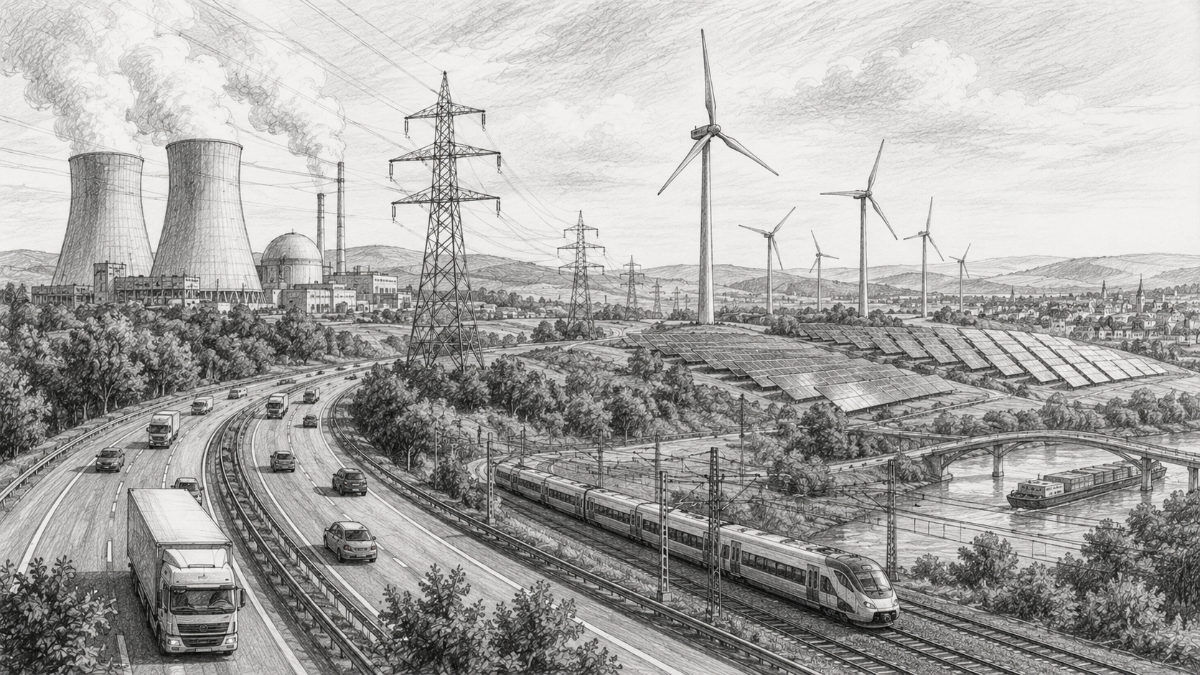
In 2025, the picture is different. The last German nuclear power plants have been shut down, renewable energy sources account for a significant portion of electricity generation, and climate neutrality has become a central political concept—yet at the same time, security of supply, energy prices, and industrial competitiveness are once again the subject of intense debate. That is precisely why it is worth taking a look at the old programs.
Nuclear Energy as a Political Divide
In the early 1980s, nuclear power was not simply one technology among many in energy policy. It was one of the major socio-political issues of contention in the Federal Republic of Germany.
The CDU and CSU expressed their support for the continued use of nuclear energy. The FDP also considered it necessary as long as other energy sources did not offer a sufficient alternative. The Greens, on the other hand, took a fundamentally different position: phasing out nuclear energy was one of the defining demands of the young party.
Within the SPD, the evolution was less straightforward. In the early 1980s, the party was by no means yet the staunch advocate of phasing out nuclear power that it was sometimes perceived as in later decades. Within the Social Democratic Party, however, skepticism toward nuclear energy increased significantly. Following the Chernobyl nuclear disaster in 1986, the party’s position ultimately changed fundamentally.
This single issue alone therefore illustrates how political positions can shift. A technology whose continued use was supported in 1983 by significant portions of the established party system had, decades later, been largely abandoned politically in Germany.
In 2025, however, this question is once again up in the air. The CDU/CSU and FDP do not want to rule out a return to nuclear energy—or at least the technical possibility of using it again. The AfD explicitly calls for a return to nuclear energy. The SPD and the Greens, on the other hand, remain committed to the phase-out that has already taken place. Thus, 42 years later, there is once again a clear party-political dividing line—albeit under completely different technical and political conditions.
From Environmental Protection to Climate Policy
The language of environmental policy has changed even more significantly. In 1983, environmental protection was by no means an issue exclusive to the Greens. Air pollution, forest die-off, water protection, waste, land consumption, and pollution were also concerns for the established parties. The differences lay more in what conclusions should be drawn from these issues.
The Greens linked environmental issues early on to a fundamental critique of unlimited economic growth and industrial production methods. Other parties placed greater emphasis on combining environmental protection with technological progress, economic growth, and market-based instruments.
By 2025, what was once environmental protection has evolved into a comprehensive climate policy. CO₂ emissions, international climate goals, renewable energy, heat generation, mobility, and industrial transformation are now viewed as an interconnected system.
At the same time, there is now hardly any dispute over whether climate change should be taken into account in policymaking. There are, however, significant differences of opinion regarding the specific measures to be used, the pace at which this should occur, and the economic consequences.
Security of Supply Returns
It is also interesting to note that an issue has regained importance that already played a central role in the early 1980s: the security of the energy supply.
Back then, the focus was on dependence on oil imports. Today, the discussion also includes natural gas, power grids, storage facilities, hydrogen, renewable energy, and the geopolitical implications of international supply relationships.
At the very least since Russia’s invasion of Ukraine and the virtual end of Germany’s previous dependence on Russian pipeline gas, energy security has once again become an explicit matter of security policy.
This chapter thus brings together two very different trends. On the one hand, there are new concepts such as climate neutrality and a largely renewable energy supply. On the other hand, traditional concerns about energy prices, domestic energy sources, dependence on imports, and security of supply are resurfacing.
Comparison Matrix: Energy, Nuclear Energy, Environment, and Climate
| Political Position | CDU 1983 | CDU 1990 | CDU 2009 | CDU 2025 | SPD 1983 | SPD 1990 | SPD 2009 | SPD 2025 | Greens 1983 | Greens 1990 | Greens 2009 | Greens 2025 | FDP 1983 | FDP 1990 | FDP 2009 | FDP 2025 | AfD 2025 |
|---|---|---|---|---|---|---|---|---|---|---|---|---|---|---|---|---|---|
| Use or Renewed Use of Nuclear Energy | ● | ● | ● | ● | ◐ | ✕ | ✕ | ✕ | ✕ | ✕ | ✕ | ✕ | ● | ● | ● | ● | ● |
| Phase-out of Nuclear Power | ✕ | ✕ | ✕ | ✕ | ○ | ● | ● | ● | ● | ● | ● | ● | ✕ | ✕ | ✕ | ✕ | ✕ |
| Research on New Nuclear Energy Technologies | ● | ● | ● | ● | ◐ | ○ | ○ | ○ | ✕ | ✕ | ✕ | ✕ | ● | ● | ● | ● | ● |
| Expansion of Renewable Energy Sources | ◐ | ● | ● | ● | ● | ● | ● | ● | ● | ● | ● | ● | ◐ | ● | ● | ● | ◐ |
| Renewable Energy as the Dominant Energy Source in the Long Term | ○ | ◐ | ● | ● | ◐ | ● | ● | ● | ● | ● | ● | ● | ○ | ◐ | ● | ● | ○ |
| Continued Use of Domestic Coal | ● | ● | ◐ | ○ | ● | ● | ◐ | ✕ | ✕ | ✕ | ✕ | ✕ | ● | ◐ | ○ | ○ | ● |
| Politically Mandated Phase-Out of Coal | ✕ | ✕ | ○ | ◐ | ✕ | ○ | ◐ | ● | ● | ● | ● | ● | ✕ | ✕ | ○ | ◐ | ✕ |
| Reducing dependence on energy imports | ● | ● | ● | ● | ● | ● | ● | ● | ● | ● | ● | ● | ● | ● | ● | ● | ● |
| Security of supply as a top priority in energy policy | ● | ● | ● | ● | ● | ● | ● | ● | ◐ | ◐ | ● | ● | ● | ● | ● | ● | ● |
| Affordable Energy / Energy Prices as a Key Goal | ● | ● | ● | ● | ● | ● | ● | ● | ◐ | ◐ | ● | ● | ● | ● | ● | ● | ● |
| Strong government oversight of the energy system | ○ | ○ | ◐ | ◐ | ◐ | ● | ● | ● | ● | ● | ● | ● | ✕ | ✕ | ✕ | ✕ | ○ |
| Market-Based Approaches to Energy and Climate Policy | ● | ● | ● | ● | ◐ | ◐ | ◐ | ◐ | ○ | ○ | ◐ | ◐ | ● | ● | ● | ● | ● |
| Climate protection as a key policy goal | — | ◐ | ● | ● | — | ◐ | ● | ● | ○ | ● | ● | ● | — | ◐ | ● | ● | ✕ |
| Climate neutrality as a binding political goal | — | — | ○ | ● | — | — | ○ | ● | — | — | ◐ | ● | — | — | ○ | ◐ | ✕ |
| Environmental and Nature Conservation as an Independent Policy Goal | ● | ● | ● | ● | ● | ● | ● | ● | ● | ● | ● | ● | ● | ● | ● | ● | ◐ |
| The ecological limits of economic growth were explicitly emphasized | ✕ | ✕ | ○ | ○ | ○ | ◐ | ◐ | ◐ | ● | ● | ● | ◐ | ✕ | ✕ | ✕ | ✕ | ✕ |
Transportation, Infrastructure, and Agriculture: Mobility Between Growth and Constraints
At first glance, transportation policy seems less fundamental than the major debates over the welfare state, nuclear energy, or homeland security. Upon closer inspection, however, it touches on some of the same issues: Should the state primarily provide infrastructure and leave the choice of transportation mode up to citizens? Or should it actively influence how people and goods are transported? Is increasing mobility fundamentally desirable, or must transportation be limited for environmental reasons?
Here, too, the starting conditions in 1983 and 2025 differ considerably. By the early 1980s, the automobile was already the dominant mode of individual transportation. The expansion of highways and federal roads had been a staple of the Federal Republic’s infrastructure policy for decades. At the same time, the consequences of growing traffic were becoming increasingly apparent. Air pollution, land consumption, traffic noise, and the strain on cities emerged as political issues.
From the very beginning, the Greens countered this trend with a fundamentally different vision for transportation. They advocated strengthening public transit and rail service, while curbing private motor vehicle use. The established parties, on the other hand, were more focused on continuing to develop different modes of transportation side by side.
In 2025, this long-standing debate is still evident. However, new issues have emerged, including climate protection, electric mobility, charging infrastructure, CO₂ pricing, and the question of whether the government should give political preference to certain propulsion technologies.
The Car: Between Freedom and Political Control
The differences in basic attitudes are particularly evident when it comes to private passenger cars. The CDU/CSU, FDP, and AfD place comparatively strong emphasis on individual mobility, openness to technology, and the importance of the automobile in 2025. The Union wants to reverse the EU’s planned ban on new registrations of passenger cars with internal combustion engines starting in 2035. The FDP also opposes a politically mandated phase-out of internal combustion engines and places greater emphasis on competition among different technologies. The AfD is particularly vocal in its rejection of a politically enforced transition to electric mobility.
The SPD and the Greens are placing greater emphasis on transforming road transportation toward lower-emission and electric powertrains, as well as on expanding the role of rail and public transit.
What is interesting here is not so much that the parties prefer different modes of transportation. What is more crucial for the long-term comparison is the underlying question of whether transportation policy should primarily facilitate mobility or also influence the choice of transportation mode. This point of contention already existed in 1983.
The Railroad as an Amazing Consensus
There is a much greater consensus when it comes to rail transportation. Nearly all political parties call for an efficient rail system, though the timeframe varies. The main differences lie in the priority given to rail relative to road and air transportation, and the extent to which the government should promote its use.
That is precisely why a simple table entry such as „Expansion of the rail system“ would be of little significance. One party may want to expand both highways and railways at the same time. Another may explicitly link the expansion of the rail system to the goal of shifting traffic from the roads to the rails.
The matrix therefore distinguishes between the mere expansion of a mode of transportation and a politically desired shift between different modes of transportation.
Agriculture: Balancing Market Forces, Food Security, and the Environment
Agriculture, too, has changed significantly since 1983. At that time, agricultural prices, farm incomes, European agricultural policy, and the protection of domestic agriculture were major concerns. Although environmental problems caused by intensive agriculture were increasingly being discussed, they did not yet carry the significance they do today.
Here, too, the Greens were among the first to challenge the prevailing notion at the time that agricultural productivity should be continually increased. Organic farming, animal husbandry, pesticides, and the protection of natural resources were given significantly greater emphasis in their platform.
By 2025, many of these issues will have long since become part of the general political discourse. Hardly any party opposes the protection of nature, soil, or water. The differences lie rather in the policy tools used and in the balance between environmental requirements, agricultural productivity, security of supply, and the economic freedom of farms.
Thus, this policy area, too, follows a pattern we have encountered many times before: A demand can move from the political fringe into the mainstream consensus, while the actual conflict then centers on how far its practical implementation should go.
Comparison Matrix: Transportation, Infrastructure, and Agriculture
| Political Position | CDU 1983 | CDU 1990 | CDU 2009 | CDU 2025 | SPD 1983 | SPD 1990 | SPD 2009 | SPD 2025 | Greens 1983 | Greens 1990 | Greens 2009 | Greens 2025 | FDP 1983 | FDP 1990 | FDP 2009 | FDP 2025 | AfD 2025 |
|---|---|---|---|---|---|---|---|---|---|---|---|---|---|---|---|---|---|
| Expansion and Maintenance of the Road Network | ● | ● | ● | ● | ● | ● | ◐ | ◐ | ✕ | ✕ | ○ | ○ | ● | ● | ● | ● | ● |
| Expansion of Rail Transit | ◐ | ● | ● | ● | ● | ● | ● | ● | ● | ● | ● | ● | ◐ | ● | ● | ● | ◐ |
| Shifting Road Traffic to Rail and Public Transportation | ○ | ◐ | ◐ | ◐ | ◐ | ● | ● | ● | ● | ● | ● | ● | ○ | ◐ | ◐ | ◐ | ✕ |
| Promotion of Local Public Transportation | ◐ | ◐ | ● | ● | ● | ● | ● | ● | ● | ● | ● | ● | ◐ | ◐ | ● | ● | ◐ |
| Private car mobility as an individual freedom particularly worthy of protection | ● | ● | ● | ● | ◐ | ◐ | ◐ | ◐ | ✕ | ✕ | ○ | ○ | ● | ● | ● | ● | ● |
| Policy Measures to Limit Motorized Private Transportation | ✕ | ✕ | ✕ | ✕ | ○ | ◐ | ◐ | ◐ | ● | ● | ● | ● | ✕ | ✕ | ✕ | ✕ | ✕ |
| General Speed Limit on Highways | ✕ | ✕ | ✕ | ✕ | ◐ | ◐ | ● | ● | ● | ● | ● | ● | ✕ | ✕ | ✕ | ✕ | ✕ |
| Technology Neutrality in Vehicle Powertrains | — | ○ | ◐ | ● | — | ○ | ◐ | ◐ | — | ○ | ○ | ◐ | — | ◐ | ● | ● | ● |
| Politically Accelerated Transition to Electric Mobility | — | — | ○ | ○ | — | — | ◐ | ● | — | — | ● | ● | — | — | ○ | ✕ | ✕ |
| Expansion and/or preservation of the region as an aviation hub | ● | ● | ● | ● | ◐ | ● | ◐ | ◐ | ✕ | ✕ | ○ | ○ | ● | ● | ● | ● | ● |
| Restrictions on Air Travel for Environmental Reasons | ✕ | ✕ | ✕ | ✕ | ○ | ○ | ◐ | ◐ | ● | ● | ● | ● | ✕ | ✕ | ✕ | ✕ | ✕ |
| Protection and Preservation of Small-Scale and Family-Run Farms | ● | ● | ● | ● | ● | ● | ● | ● | ● | ● | ● | ● | ● | ● | ● | ● | ● |
| Expansion of Organic Farming | ○ | ◐ | ◐ | ◐ | ◐ | ● | ● | ● | ● | ● | ● | ● | ○ | ◐ | ◐ | ◐ | ○ |
| Stricter environmental and animal welfare regulations for agriculture | ○ | ◐ | ◐ | ◐ | ◐ | ● | ● | ● | ● | ● | ● | ● | ○ | ◐ | ◐ | ◐ | ✕ |
| Reduction of national and European regulations for agricultural businesses | ◐ | ◐ | ● | ● | ○ | ○ | ◐ | ◐ | ✕ | ✕ | ○ | ○ | ● | ● | ● | ● | ● |
Europe, the EC/EU, and National Sovereignty
Hardly any other field has undergone such significant institutional changes between 1983 and 2025 as European policy. This makes the comparison particularly interesting—and, at the same time, methodologically challenging.
In 1983, the European Union did not yet exist. The Federal Republic of Germany was a member of the European Communities, whose political and economic integration was significantly less advanced than it is today. There was no euro, no European single market in its later form, no common foreign and security policy, and no Union citizenship. Numerous political powers that are now exercised at the European level were, at that time, entirely in the hands of the member states.
Nevertheless, the direction of this process had already become the subject of political debate. How far should European integration go? Should Europe eventually become a political union? What powers should the nation-states retain? And should European integration primarily serve the purpose of economic cooperation, or should it increasingly pool political sovereignty as well?
These questions run through all the election platforms examined—only the starting point shifts with each decade.
In 1983, „more Europe“ meant something different than it does today
This is particularly important for the tables. A party that called for extensive European integration in 1983 was doing so within a community that still had significantly fewer powers. The same demand in 2025, by contrast, presupposes decades of further integration.
That is why a checked box next to „further European integration“ can apply to both years and still have very different practical consequences.
From early on, the CDU/CSU, SPD, and FDP were, in principle, among the forces in the Federal Republic that supported integration. European unification was seen not only as an economic project but also as a response to German and European history.
Among the early Greens, the situation was more complicated. On the one hand, they advocated for international cooperation and cross-border political solutions. On the other hand, they were far more skeptical of centralized institutions, military structures, and a primarily economic approach to European integration. Over the decades, their position on these issues also evolved.
1990: German reunification and European integration go hand in hand
The year 1990 was a special case in European politics. German reunification immediately raised the question of how the larger, reunified Germany should be integrated into Europe. For large segments of the political spectrum at the time, German unity and deeper European integration were therefore explicitly linked.
At the same time, the European Community was on its way to becoming the structure from which, a few years later, the European Union emerged with the Maastricht Treaty.
A comparison of 1990 and 2025 therefore reveals not only changes in the political parties. It also shows how many of the integration measures that were still in the future back then have since become political reality.
2009: The European Union has long been a part of everyday life
By 2009, this development was already well underway. The euro had been in circulation as cash for years, the European single market was well established, and the European Union had grown to 27 member states following several rounds of enlargement. At the same time, Europe was reeling from the international financial crisis, and the Treaty of Lisbon was set to take effect that same year.
As a result, the question of sovereignty had already taken on a more concrete form than it had in 1983 or 1990. The main issue was no longer whether European institutions should be granted additional powers. Rather, the focus was much more frequently on which areas should be subject to decision-making at the European level, how democratic oversight could be organized, and where the principle of subsidiarity should set limits on European jurisdiction.
This connection is particularly interesting in the case of the FDP and the Union: Both parties are fundamentally in favor of European integration, but at the same time emphasize subsidiarity and the need to avoid centralizing every political issue in Brussels.
The SPD and the Greens are placing greater emphasis on joint European action, particularly in areas where national solutions are considered inadequate.
In 2025, the issue of sovereignty will once again be the subject of more intense debate
By 2025, the lines of conflict in European politics had shifted once again. The EU is now not only an economic area but also regulates numerous aspects of daily life and plays an increasingly important role in migration, energy, climate, digitalization, foreign policy, and defense.
The CDU, SPD, Greens, and FDP are fundamentally committed to the European Union and its continued ability to act politically. Their differences primarily concern the extent of further integration and the question of how much national authority should be preserved.
At the same time, the AfD is a party that questions the current integration model on a much more fundamental level and calls for a significant shift of authority back to the nation-states.
As a result, in 2025—for the first time in this comparison—a very clear programmatic opposition will emerge to the direction of European integration that the CDU, SPD, FDP, and later the Greens have fundamentally supported for decades.
Current survey on trust in politics and the media
Europe and sovereignty are not simply opposites
Here, too, it would nevertheless be wrong to categorize the platforms simply as „for Europe“ and „against Europe.“ A party can explicitly support the EU while also seeking to protect national powers. It can call for a common European foreign policy while at the same time emphasizing the principle of subsidiarity. Similarly, it can call for greater European cooperation on defense but reject the centralization of other policy areas.
For this reason, the following matrix distinguishes between European integration, the transfer of powers, national sovereignty, subsidiarity, the common currency, and foreign and defense policy. Only then does it become clear just how differently a fundamentally positive relationship with Europe can be shaped.
A remarkable continuity among the established parties
When compared with other policy areas, what is immediately striking is how stable the generally pro-European stance of the CDU, SPD, and FDP has remained over the decades.
As early as 1983, deeper European integration was by no means a marginal issue for these parties. For the Union in particular, Germany’s integration into a united Europe was part of its political identity in the postwar era. The SPD and FDP also supported the political deepening of the European Community.
In 1990, this trend was further reinforced by German reunification. By 2009, what had once been a goal had long since become an institutional reality. Many areas of authority had already been transferred to the European level, the euro had been introduced, and the eastward expansion had been completed.
As a result, the political debate shifted increasingly from the fundamental question of integration to its specific limits.
There is a clear convergence taking place within the Green Party
More interesting is the evolution of the Greens. The early Greens took a much more critical stance toward existing European structures. However, their skepticism was not necessarily directed at international cooperation itself. Rather, they criticized economic centralization, democratic deficits, military structures, and a form of European integration that, from a Green perspective, was too heavily influenced by market and growth interests.
By 2009, this position had changed fundamentally. The Greens had by then become one of the parties that most strongly advocated for a deeper European Union, stronger European institutions, and common European solutions.
Here, too, the additional interim snapshot shows that the transition was largely complete long before 2025.
The FDP Combines Integration and Subsidiarity
The FDP follows a different pattern. It has consistently been among the parties supportive of integration, but links this relatively strongly to the demand that European institutions focus on tasks that are truly cross-border in nature.
Europe should act in areas where joint action offers a clear advantage. Other decisions should remain as close to the citizens as possible—that is, at the local, state, or national level.
This combination of European integration and subsidiarity is important because it shows that calling for limits on European powers does not automatically mean rejecting the European Union. It is precisely this distinction that will become particularly relevant in 2025.
In 2025, a more fundamental counterposition will emerge
The AfD represents a position that goes significantly further than the traditional criticism of European policy voiced by the FDP or conservative factions within the Union. This is not merely a matter of specific areas of authority or greater subsidiarity, but rather a fundamentally different conception of the relationship between the nation-state and the European level.
National sovereignty is to once again take center stage, while supranational powers are to be scaled back. This introduces a line of conflict into the 2025 European policy framework that was not present in this form in the 1983 platforms of the established West German parties.
However, that does not mean that every call for national sovereignty can automatically be attributed to a specific party. The CDU and FDP also emphasize the limits of European jurisdiction—but only within a model that is fundamentally supportive of integration.
The meaning of the same position changes depending on the starting point
Perhaps no other chapter illustrates as clearly a fundamental methodological problem with this comparison. In 1983, a political party could advocate for significantly greater European integration without calling for anything even remotely close to the scope of European powers we see today.
In 2025, however, the same party could call for greater national autonomy in certain areas while still being, in terms of its platform, far more deeply integrated into Europe than it could ever have been in 1983.
That is why the symbols must always be interpreted in the context of their historical origins. A ● next to „further European integration“ does not mean that the specific goals set in 1983 and 2025 were identical. It means that, based on the status quo at the time, the party expressly supported further integration. This, in particular, reveals just how far not only the parties but also the political framework itself has shifted.
And nowhere is this shift in the framework of reference more evident than in the following chapter. For when it comes to the Bundeswehr, NATO, the United States, Russia, and peace policy, the world of the Cold War, the hope for a new peace order after 1990, and the security policy conflicts of 2025 all collide head-on.
Comparison Matrix: Europe, the EC/EU, and National Sovereignty
| Political Position | CDU 1983 | CDU 1990 | CDU 2009 | CDU 2025 | SPD 1983 | SPD 1990 | SPD 2009 | SPD 2025 | Greens 1983 | Greens 1990 | Greens 2009 | Greens 2025 | FDP 1983 | FDP 1990 | FDP 2009 | FDP 2025 | AfD 2025 |
|---|---|---|---|---|---|---|---|---|---|---|---|---|---|---|---|---|---|
| Further European Political Integration | ● | ● | ● | ● | ● | ● | ● | ● | ◐ | ● | ● | ● | ● | ● | ● | ● | ✕ |
| Europe as a political or federal union in the long term | ● | ● | ◐ | ◐ | ● | ● | ● | ● | ○ | ● | ● | ● | ● | ● | ● | ● | ✕ |
| Strengthening Common European Institutions | ● | ● | ● | ● | ● | ● | ● | ● | ◐ | ● | ● | ● | ● | ● | ● | ● | ✕ |
| Transfer of Additional National Powers to the European Level | ● | ● | ◐ | ◐ | ● | ● | ● | ● | ○ | ● | ● | ● | ◐ | ◐ | ◐ | ◐ | ✕ |
| Strong emphasis on national sovereignty vis-à-vis EU institutions | ○ | ○ | ◐ | ◐ | ○ | ○ | ○ | ○ | ◐ | ○ | ○ | ○ | ◐ | ◐ | ◐ | ● | ● |
| Subsidiarity and the Limits of European Competence | ◐ | ◐ | ● | ● | ○ | ◐ | ◐ | ◐ | ◐ | ◐ | ◐ | ◐ | ● | ● | ● | ● | ● |
| Common European Foreign Policy | ● | ● | ● | ● | ● | ● | ● | ● | ◐ | ● | ● | ● | ● | ● | ● | ● | ○ |
| Common European Defense and Security Policy | ◐ | ● | ● | ● | ◐ | ● | ● | ● | ✕ | ○ | ● | ● | ◐ | ● | ● | ● | ○ |
| Common European Currency | ◐ | ● | ● | ● | ◐ | ● | ● | ● | ○ | ● | ● | ● | ◐ | ● | ● | ● | ✕ |
| Further Expansion of the European Community or Union | ● | ● | ● | ● | ● | ● | ● | ● | ◐ | ● | ● | ● | ● | ● | ● | ● | ○ |
| Common European Solutions in Migration and Asylum Policy | — | — | ● | ● | — | — | ● | ● | — | — | ● | ● | — | — | ● | ● | ○ |
| Strong Emphasis on National Border Controls in Relation to the European Area of Free Movement | — | — | ○ | ◐ | — | — | ○ | ◐ | — | — | ✕ | ○ | — | — | ○ | ◐ | ● |
The Bundeswehr, NATO, and Peace: From Rearmament to a New Era
If there is one policy area where the historical gap between 1983 and 2025 is particularly evident, it is foreign and security policy. And yet, over the course of more than four decades, we have repeatedly encountered the same fundamental questions.
How strong does Germany need to be militarily? How important is its alliance with the United States? Can security be achieved primarily through deterrence, or rather through disarmament and mutual understanding? What role should NATO play? Under what conditions may the Bundeswehr be deployed outside Germany? Should Germany supply weapons to countries under military attack? And to what extent should Europe be able to act independently of the U.S. in matters of security policy?
In 1983, these questions were raised against the backdrop of the Cold War. Germany was divided. Hundreds of thousands of American and Soviet soldiers were facing off against each other in Europe. The Federal Republic of Germany belonged to NATO, while the GDR was part of the Warsaw Pact. A military conflict between the two blocs would almost certainly have directly affected Germany.
In 1990, this world order seemed to vanish overnight. By 2009, however, Germany found itself in an entirely different phase of security policy. The Bundeswehr had long been involved in international missions, Afghanistan dominated the political debate, NATO had expanded far to the east, and relations with Russia were viewed as far more cooperative than they are today.
By 2025, following Russia’s attack on Ukraine, national and alliance defense had finally returned to the forefront of German politics. The additional interim data from 2009, in particular, makes it clear that this development was by no means a straightforward one.
1983: Deterrence or Disarmament?
In the 1983 federal election, one of the sharpest political divides centered on security and peace policy.
The CDU and CSU unequivocally supported NATO and the NATO Dual Decision. Military strength and credible deterrence were intended to prevent the Soviet Union from gaining strategic superiority in Europe.
The FDP also remained committed to the Western alliance, but linked this more closely to arms control, détente, and negotiations.
The SPD found itself in a more difficult situation. Chancellor Helmut Schmidt had himself been a key driving force behind the NATO Double-Track Decision. At the same time, an ever-growing number of members of his own party were opposing the planned deployment of American medium-range missiles. Peace and disarmament policies were gaining increasing prominence within the SPD.
The Greens went much further. The peace movement and resistance to nuclear armament, along with the environmental and anti-nuclear movements, were among the political roots of the young party. The criticism was not directed solely at individual weapons systems. Parts of the early Green Party platform questioned the very logic of military blocs.
Thus, in 1983, it was not merely a matter of differing security policy measures. Even the fundamental question of what actually creates security was already a subject of controversy.
1990: A new peace order seems possible
Just seven years later, the situation had changed dramatically. The Berlin Wall had fallen. Germany was reunified. The communist governments of Eastern Europe had collapsed, the Warsaw Pact was disintegrating, and shortly thereafter, the Soviet Union would also cease to exist.
Suddenly, disarmament was no longer just called for, but was actually being carried out on a large scale. Armed forces were downsized, weapons stockpiles were reduced, and the decades-long military confrontation between East and West seemed to have been overcome.
The programs from 1990 therefore partly reflect a political expectation that, from today’s perspective, almost seems like a historical era in its own right: the idea that a lasting European peace order could emerge in which military confrontation would be increasingly replaced by cooperation, disarmament, and joint security structures.
This context is crucial for a historical comparison. A call for disarmament in 1990 arose under completely different circumstances than the same call in 2025.
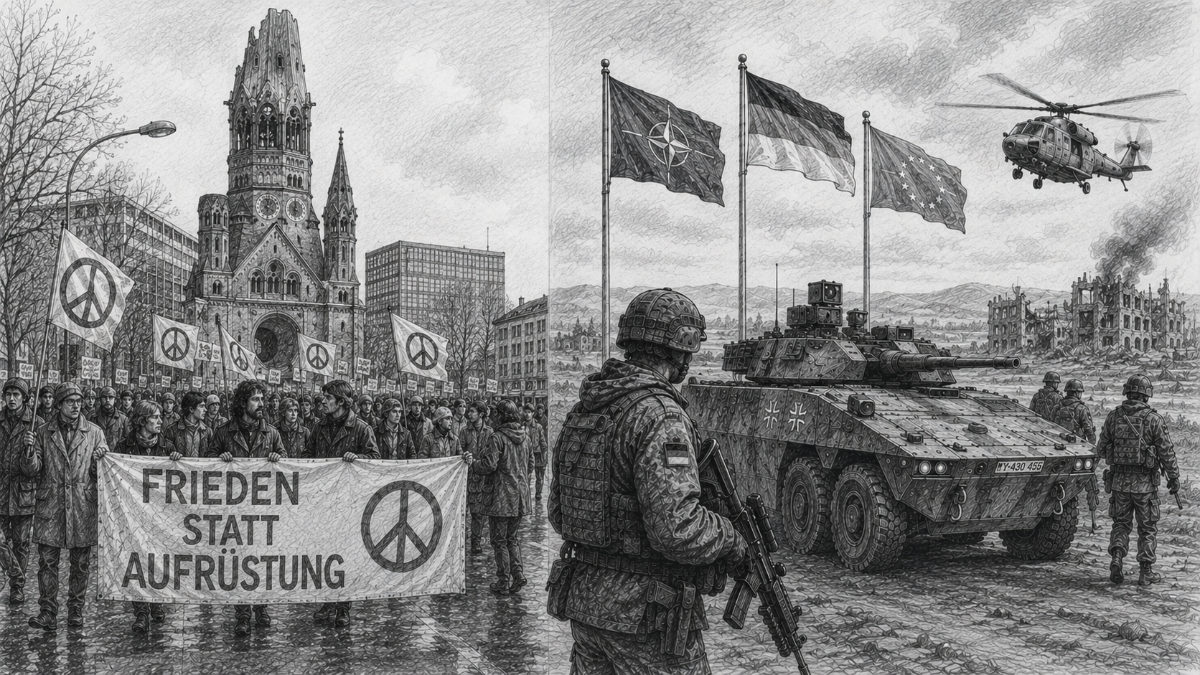
2009: The Bundeswehr has long been deployed abroad
The additional snapshot from 2009 once again changes the picture significantly. By then, Germany had been reunified for nearly twenty years. Many former members of the Warsaw Pact had joined NATO. Relations with Russia were considerably more cooperative than they are today, despite ongoing conflicts.
At the same time, the Bundeswehr’s mission had changed. German soldiers were deployed in the Balkans and Afghanistan. Consequently, the focus was no longer primarily on the traditional defense of Germany’s territory against a possible attack from the east. International crisis management, stabilization missions, and the question of under what conditions German soldiers may be deployed outside the NATO area took center stage to a much greater extent.
For the Greens in particular, 2009 showed just how far the shift in foreign policy had already progressed. The party’s election platform explicitly described transatlantic cooperation under the new U.S. President Barack Obama as an opportunity to „renew the transatlantic alliance.“ The party accepted the ISAF mission in Afghanistan in principle, but made its approval contingent on a change in strategy and demanded a roadmap for the gradual withdrawal of international troops. At the same time, the Bundeswehr was to be downsized and transformed into a volunteer army.
This is already a significant departure from the security policy stance of the early Green Party. But it is not yet the stance of 2025 either.
2009 illustrates the Greens' transformation particularly clearly
In 1983 and 1990, the Greens were far more skeptical of military deterrence, NATO structures, and the Bundeswehr. By 2009, they had already come to accept a Bundeswehr that could undertake international missions under parliamentary control. At the same time, disarmament, restrictions on arms exports, the abolition of mandatory military service, and a strong orientation toward the United Nations remained central components of their platform.
By 2025, this shift has progressed even further. The Greens now clearly support NATO, military aid to Ukraine, a Bundeswehr capable of defending the country, and increased defense efforts.
So the shift did not occur suddenly after 2022. A significant portion of it had already taken place between 1990 and 2009. The security situation following Russia’s attack on Ukraine subsequently led to a further shift.
In 2009, the SPD, too, found itself caught between two eras
A different pattern emerges with the SPD. The 2009 government platform committed to modernizing the Bundeswehr and ensuring it was well-equipped. Conscription was not to be abolished, but rather further developed. However, the plan called for a greater emphasis on voluntary service when it came to actual enlistment.
At the same time, the social democratic tradition of disarmament, arms control, multilateralism, and civilian conflict prevention remained clearly evident.
Thus, as early as 2009, the SPD had already clearly expressed its support for Germany’s military capacity to act within NATO, the EU, and international missions. However, the focus of security policy was still considerably more on international crisis management than on traditional national defense.
By 2025, the situation had changed again. NATO is now explicitly described as indispensable to European security. Germany is expected to assume greater responsibility for the alliance’s defense, the Bundeswehr is to be better equipped on a permanent basis, and it is to play a significantly larger role on NATO’s eastern flank. At the same time, the SPD remains committed to arms control, diplomacy, and the long-term goal of nuclear disarmament.
So here, too, there is no simple shift from „peace policy“ to „military policy.“ Rather, the relationship between the two is changing.
2025: Defense is once again a key political issue
With Russia’s invasion of Ukraine in February 2022, a question returned to Europe that, at times after 1990, had seemed largely resolved: Could a European state once again be forced to defend its borders and its political existence against another state using military force?
That response has fundamentally changed German security policy. Defense spending, ammunition stocks, air defense, weapons production, troop levels, and the capacity to defend the country and the alliance are once again the focus of attention.
In 2025, the CDU, SPD, Greens, and FDP all expressed their fundamental commitment to NATO and to strengthening defense capabilities. However, they differ on specific arms deliveries, the extent of military support for Ukraine, conscription, and strategic issues.
The AfD takes a significantly different stance on Russia, sanctions, and arms deliveries. It places greater emphasis on restoring relations with Russia and opposes Germany's arms support for Ukraine to date.
This creates a remarkable situation. Some of the concepts that were particularly closely associated with the peace movement in 1983—détente, understanding, restraint in arms sales, and criticism of military escalation—are, in 2025, found to some extent on the other side of the political spectrum.
This does not, by any means, imply that the underlying political concepts are identical. However, it demonstrates once again that individual political positions can shift from one political party to another.
Comparison Matrix: The German Armed Forces, NATO, the U.S., Russia, and Peace Policy
| Political Position | CDU 1983 | CDU 1990 | CDU 2009 | CDU 2025 | SPD 1983 | SPD 1990 | SPD 2009 | SPD 2025 | Greens 1983 | Greens 1990 | Greens 2009 | Greens 2025 | FDP 1983 | FDP 1990 | FDP 2009 | FDP 2025 | AfD 2025 |
|---|---|---|---|---|---|---|---|---|---|---|---|---|---|---|---|---|---|
| A Strong and Capable Bundeswehr | ● | ● | ● | ● | ◐ | ◐ | ◐ | ● | ✕ | ✕ | ◐ | ● | ● | ● | ● | ● | ● |
| Significant Increase in Defense Spending | ◐ | ○ | ○ | ● | ✕ | ○ | ○ | ● | ✕ | ✕ | ✕ | ● | ◐ | ○ | ○ | ● | ● |
| Conscription or mandatory military service | ● | ● | ● | ● | ● | ● | ◐ | ◐ | ✕ | ✕ | ✕ | ○ | ● | ● | ◐ | ◐ | ● |
| A volunteer or professional army instead of conscription | ✕ | ✕ | ✕ | ✕ | ✕ | ✕ | ◐ | ◐ | ● | ● | ● | ◐ | ✕ | ✕ | ◐ | ◐ | ✕ |
| Germany's Clear Commitment to NATO | ● | ● | ● | ● | ◐ | ● | ● | ● | ✕ | ✕ | ● | ● | ● | ● | ● | ● | ◐ |
| Military Deterrence as a Fundamental Principle of Security | ● | ● | ● | ● | ◐ | ◐ | ◐ | ● | ✕ | ✕ | ◐ | ● | ● | ● | ● | ● | ◐ |
| Nuclear Deterrence within NATO | ● | ● | ● | ● | ✕ | ◐ | ◐ | ◐ | ✕ | ✕ | ✕ | ◐ | ● | ● | ● | ● | ○ |
| Withdrawal or Removal of Nuclear Weapons from Germany | ✕ | ✕ | ✕ | ✕ | ● | ◐ | ● | ○ | ● | ● | ● | ○ | ✕ | ✕ | ◐ | ✕ | ● |
| Close security ties with the United States | ● | ● | ● | ● | ◐ | ● | ● | ● | ✕ | ○ | ◐ | ● | ● | ● | ● | ● | ○ |
| Greater European Autonomy in Defense | ◐ | ◐ | ● | ● | ◐ | ● | ● | ● | ◐ | ● | ● | ● | ◐ | ● | ● | ● | ● |
| Disarmament as a Central Security Policy Goal | ◐ | ● | ◐ | ○ | ● | ● | ● | ◐ | ● | ● | ● | ◐ | ● | ● | ● | ◐ | ◐ |
| Unilateral German disarmament or a strong emphasis on preliminary concessions | ✕ | ✕ | ✕ | ✕ | ○ | ○ | ○ | ✕ | ● | ● | ○ | ✕ | ✕ | ✕ | ✕ | ✕ | ○ |
| Détente and Cooperation with the Soviet Union and Russia | ◐ | ● | ● | ○ | ● | ● | ● | ◐ | ● | ● | ● | ○ | ● | ● | ● | ○ | ● |
| Russia as a Major Military Threat | — | — | ○ | ● | — | — | ○ | ● | — | — | ○ | ● | — | — | ○ | ● | ✕ |
| Arms Deliveries to Partner Nations Under Military Attack | ○ | ○ | ◐ | ● | ○ | ○ | ◐ | ● | ✕ | ✕ | ○ | ● | ◐ | ◐ | ◐ | ● | ✕ |
| Restrictive arms export policy | ○ | ◐ | ◐ | ◐ | ● | ● | ● | ◐ | ● | ● | ● | ◐ | ◐ | ◐ | ◐ | ◐ | ○ |
| Diplomacy and negotiations explicitly as the primary means of conflict resolution | ◐ | ● | ● | ◐ | ● | ● | ● | ● | ● | ● | ● | ● | ● | ● | ● | ◐ | ● |
| Military Strength as a Prerequisite for Successful Diplomacy | ● | ● | ● | ● | ○ | ◐ | ◐ | ● | ✕ | ✕ | ◐ | ● | ● | ● | ● | ● | ◐ |
What remains after 42 years of election platforms?
When I started working on this overview, I wasn't exactly sure myself what the result would be. In the end, that was exactly why I decided to do it in the first place.
I wasn't interested in confirming a particular political thesis. Nor did I want to prove that Germany as a whole had shifted to the left or to the right in recent decades. You hear statements like that often enough. I was interested in a much simpler question: What did the parties actually write?
So not what we think we remember today. Not what’s said about a party on social media. Not how political opponents describe it. And not how a party portrays its own past today. But rather, what was written in black and white in its campaign platform before a federal election. While doing my research, I was curious to see the results myself.
Political parties were never really my starting point
I'm not really a party person. I'm much more interested in the substance of political issues than in which party logo is displayed above them.
That was also one reason to examine the CDU/CSU, SPD, Greens, and FDP not only through the lens of their current platforms, but also through documents from four very different political eras. In the case of the AfD, such a historical analysis is, by its very nature, not possible. The party did not yet exist in 1983 or 1990.
Nevertheless, I had to include it in this comparison for 2025. Not because I’m a particular fan of the AfD. I’m not. But when a significant portion of the political discussion in Germany revolves around this party, and when there are regular debates over whether certain positions are right-wing, conservative, liberal, social, or extreme, I at least wanted to know: What exactly are we talking about? What does the platform actually say? And this question must apply to all other parties as well.
It would make little sense to scrutinize one party very closely while applying one’s own assumptions about what another party presumably stands for. If election platforms are to be compared, the same standards should apply to all of them as much as possible.
The past doesn't fit neatly into the present
One of the difficulties with this comparison became clear from the very first historical documents: The past cannot simply be measured using the political framework of the year 2025.
Some of today's controversial issues did not even exist in 1983. Others did exist, but were discussed under completely different circumstances.
Germany was divided. The European Union did not yet exist. The Soviet Union, on the other hand, certainly did. NATO stood opposite the Warsaw Pact. Germany’s energy supply was based on a different structure. The Internet played no role in everyday life, not to mention social media, smartphones, digital mass communication, or artificial intelligence.
Migration, citizenship, and European integration were also discussed in the context of various legal and social conditions.
Therefore, it would be methodologically incorrect to read a political position into a 1983 election platform whenever it fails to address a current issue.
Sometimes, the absence of an entry in the tables really means only one thing: the question hadn't been asked in that form back then.
At the same time, there’s a surprising amount that feels familiar
On the other hand, it is surprising how many fundamental questions have persisted over the decades.
- To what extent should the government take responsibility for its citizens, and to what extent should it expect them to take responsibility for themselves?
- To what extent should income be redistributed?
- To what extent are security agencies allowed to infringe on civil rights?
- Should Europe become increasingly integrated, or should as many decisions as possible remain with the nation-states?
- Is peace more likely to result from military deterrence or from disarmament and mutual understanding?
- How much economic prosperity should environmental protection cost—or is such a comparison itself flawed?
- How much immigration does a country need or can it handle?
- And what role should family, individual life choices, and social traditions play?
The specific answers change. Surprisingly often, the underlying questions do not. That is precisely why old campaign platforms are so interesting. In some places, they seem foreign, while in others they are astonishingly relevant today.
Political positions can shift
To me, this is one of the most interesting findings of this comparison. Political positions apparently do not belong permanently to any one party.
A demand may be typically “green” at a certain point in time and, decades later, become largely part of the political consensus. Another may have been championed by a major mainstream party in the past and later be championed only by a different party. Still other ideas disappear almost entirely.
And sometimes a party remains true to its fundamental stance even as the political landscape around it changes. That is precisely why one should be cautious about making statements such as, „This party is the same today as it was back then,“ or „Party A has shifted to the left or to the right.“.
In which policy area?
That is the crucial question. A political party may have undergone significant changes in its social policies while remaining surprisingly consistent in its economic policies. It may have completely changed its stance on NATO while, at the same time, maintaining the same basic position on nuclear energy for 40 years. It may call for greater government integration in European policy and less government regulation in economic policy.
It is difficult for a single political axis to capture such movements.
This is particularly evident among the Greens
Hardly any other development illustrates this better than a comparison of the Greens in 1983 with those of 2025. A remarkable continuity can be seen in their stance on environmental protection and their opposition to nuclear energy. Many environmental demands—which placed the party outside the political mainstream in the early 1980s—are now widely accepted far beyond those circles.
In foreign and security policy, however, the picture is entirely different. The early Greens were strongly influenced by the peace movement, disarmament, skepticism toward NATO, and opposition to the logic of military force. In 2025, the Greens support NATO, military deterrence, a capable Bundeswehr, and extensive arms deliveries to Ukraine.
One can either welcome or criticize this change. For the purposes of this article, neither is decisive. For now, the only thing that matters is:
It happened. Why it happened would be a whole other investigation. After all, the world of 2025 is also different from that of 1983.
And the other parties haven't stood still either
The same is true—albeit in different areas—for the CDU/CSU, SPD, and FDP. Some positions have proven to be surprisingly stable over the decades. Others change gradually. Still others undergo a complete shift in the wake of historical events.
Reunification changed the policies of 1990. Chernobyl changed the German nuclear energy debate. The end of the Cold War is reshaping security policy. European integration is reshaping the issue of national sovereignty. Migration is reshaping domestic policy. Climate change is reshaping energy, transportation, and industrial policy. The Russian invasion of Ukraine, in turn, is reshaping the debate over the Bundeswehr, NATO, and military deterrence.
Party platforms don’t just emerge out of thin air. That is precisely why comparing 1983, 1990, and 2025 is more interesting than a simple juxtaposition of „then“ and „now.“ The year 1990 stands in between as a historical snapshot of a world that was in the midst of a fundamental realignment.
So what do „left“ and „right“ even mean anymore?
This brings me back to the question with which this study began. Of course, the terms “left” and “right” still have meaning. They describe political traditions, social ideas, and historical lines of conflict. They are by no means completely useless.
But when comparing data over a 42-year period, they seem increasingly rough to me.
- Is a restrictive immigration policy automatically right-wing?
- Is government economic intervention a left-wing policy?
- Is direct democracy a left-wing or right-wing concept?
- Is the call for disarmament considered left-wing when it is advocated by the Greens in 1983, but still left-wing when similar calls come from a completely different political camp decades later?
- Is strong national sovereignty conservative, while a common European defense is progressive?
- And how do you classify a party that is liberal in its economic policies, conservative in its social policies, and interventionist in its foreign policy?
The more closely one examines individual issues, the more difficult it becomes to categorize them simply. Perhaps that is why the problem isn't that terms like "left" and "right" are wrong. Perhaps we simply expect too much from them.
Election platforms do not reflect the reality of government
One limitation, however, should be explicitly mentioned once more at the end. This article compares campaign platforms. It does not examine what parties actually did after an election. It does not assess which campaign promises were kept. It does not examine coalition agreements or votes in the Bundestag. Nor does it attempt to determine whether a party’s actual policies have been consistent with its own programmatic statements.
That would be a different—and presumably much larger—project. An election platform primarily documents the positions a party presented to voters at a specific point in time. Nothing more. But also nothing less.
This is particularly valuable for historical comparison. After all, an election platform is a snapshot of the political landscape at a given moment—one that cannot be altered retroactively decades later. What’s in it is what’s in it.
Sometimes it might be worth taking a look at the original
Ultimately, that is also the insight I take away from this research. Political discussions today often take place at an enormous pace. A sentence is quoted, a clip is shared, a position is summarized, and a party is categorized within a matter of seconds. Algorithms and social media encourage quick and unambiguous judgments. This leaves little room for historical context.
Old campaign platforms are the exact opposite. They’re long. Sometimes dry. Occasionally, they’re worded awkwardly. From today’s perspective, some passages seem almost out of this world. But that’s precisely why they can be extremely revealing. Because suddenly, they no longer state what someone claims a party once stood for.
It states what she actually stood for. And then you can compare it with a platform from 1983. One from 1990. One from 2025. You can ask the same question and see what answers were given. This does not replace a political assessment. But it creates a much better foundation for one.
Take a closer look before forming an opinion
Perhaps that is why this is the most fitting conclusion to this comparison. The point is not to declare a winner based on 42 years of campaign platforms. Nor can we deduce from this which party is the right one today.
Other questions are more interesting:
- Which party has changed the most—and in what area?
- Which one has remained surprisingly consistent?
- Which position, which seemed completely uncontroversial in 1983, would spark heated debate today?
- Which demand from the year 2025 would have been difficult for a voter from 1983 to understand?
- Which former minority viewpoints are now part of the political mainstream?
- And which positions that used to be mainstream are now found only on the fringes of the political spectrum?
- Above all, though: Have the German political parties actually shifted collectively to the left or to the right?
After examining the individual topics, the question itself already seems too simplistic to me. The economy, society, migration, energy, Europe, and foreign policy do not necessarily evolve in the same direction. In some cases, their political shifts even run counter to one another.
Perhaps that is why we should dig a little deeper more often. Don’t start by asking whether a position is left-wing or right-wing. Don’t start by asking which party it comes from. And don’t start by wondering whether it fits into your own political worldview.
But first:
- What exactly is being proposed?
- What was proposed in the past?
- What has changed?
- And under what conditions?
After reading this, everyone can form their own opinion. That is exactly what this overview was intended to do—not to dictate what people should think after 42 years of German election platforms, but to provide a better foundation for them to think about it for themselves.
Sources on Political Parties' Campaign Platforms
Original Election Platforms and Historical Platform Archives
- CDU/CSU – Historical Election Platforms for the Federal Elections – The CSU’s historical election platform archive contains the federal election platforms from 1983, 1990, 2009, and other election years. It is particularly helpful for researching older Union platforms and placing them in historical context.
- CSU – Election Platform for the 1983 Federal Election – The CSU’s original campaign platform for the federal election on March 6, 1983. Among other things, the document includes statements on the economy, social policy, family issues, domestic policy, Europe, and foreign and security policy.
- CDU/CSU – Government Program 2009–2013 – „We Have the Strength—Together for Our Country.“ Joint CDU and CSU Government Platform for the 2009 Federal Election, adopted on June 28, 2009.
- CDU/CSU – Election Platform for the 2025 Federal Election – „A New Direction for Germany.“ The CDU’s official website on the joint CDU-CSU election platform for the 2025 Bundestag election, including the full text.
- SPD – Archive of Policy, Government, and Election Platforms Since 1949 – An extensive archive of the Friedrich Ebert Foundation featuring digitized SPD campaign platforms for the federal elections. It includes, among other things, the platforms from 1983 and 1990, as well as numerous other historical documents.
- SPD – Government Platform 1983–1987 – The SPD’s governing program, adopted at the party convention held on January 21, 1983, in Dortmund. It includes, among other things, chapters on labor, social policy, the environment, the rule of law, and peace policy.
- SPD – Government Platform 1990–1994 – „The New Path: Ecological, Social, and Economically Strong.“ The platform adopted by the SPD national convention on September 28, 1990, for the first all-German federal election.
- SPD – Government Platform for the 2009 Federal Election – The SPD’s complete 2009 government platform. Particularly interesting as a snapshot of the situation following Agenda 2010 and the Hartz reforms, as well as during the international financial and economic crisis.
- SPD – Government Platform for the 2025 Federal Election – „More for You. Better for Germany.“ The Complete Official SPD Government Platform for the 2025 Federal Election.
- The Greens – Historical Program Archive – A collection from the Heinrich Böll Foundation featuring the Green Party’s policy statements, federal election platforms, and European election platforms. It includes, among other things, the 1983 election appeal and the 1990 election platform, and traces the party’s policy evolution over the decades.
- The Greens – 2009 Federal Election Platform – „The Green New Social Contract: Climate – Work – Justice – Freedom.“ The complete election platform of Alliance 90/The Greens for the 2009 federal election.
- FDP – Election Platform for the 1983 Federal Election – The „Election Manifesto ’83,“ adopted at the extraordinary FDP national party convention held in Freiburg on January 29 and 30, 1983. The original source for the liberal positions of that time.
- FDP – 1990 Federal Election Platform – „Liberal Germany.“ The FDP’s complete platform for the federal election on December 2, 1990, from the Friedrich Naumann Foundation’s Archive of Liberalism.
- FDP – 2009 Germany Program – „Strengthening the Center.“ The complete election platform for the Bundestag election, adopted at the FDP National Party Convention held May 15–17, 2009.
- FDP – Election Platform for the 2025 Federal Election – „Everything Can Be Changed.“ The FDP’s official platform for the 2025 federal election, focusing on the economy, government, finance, civil rights, migration, and security.
- AfD – 2025 Federal Election Platform – The complete platform of the Alternative for Germany for the election of the 21st German Bundestag. In this article, it serves solely as a point of reference for the present, since the party did not yet exist in 1983, 1990, and 2009.
Comparative Studies and Additional Resources
- 2009 Federal Election – A Comparison of the Parties’ Campaign Platforms – A comprehensive study by Jochen Weichold and Horst Dietzel. Among other things, it compares economic, tax, social, energy, education, civil rights, immigration, European, and security policies. Particularly useful for cross-checking the 2009 interim figures.
- DIVA Monitor – Political Parties’ Platforms for the 2025 Federal Election – A comparative analysis of the final or currently available platforms of the parties in the Bundestag for the 2025 election. This serves as an additional secondary source for understanding the key policy priorities.
- Manifesto Project – Academic Database on Election Platforms – A long-term research project at the Berlin Social Science Center. Election platforms from numerous states and political parties are systematically documented and coded by content. This is particularly useful for long-term academic comparisons of political platforms.
- Friedrich Ebert Foundation – Historical Program Documentation – In addition to the SPD’s election platforms used directly in campaigns, the digital library offers numerous policy platforms and other historical documents. This makes it possible to place changes between individual election years within a broader programmatic context.
- Heinrich Böll Foundation – History of the Green Party's Programs – A particularly valuable collection for long-term comparison, as it includes not only federal election manifestos but also policy statements, campaign platforms, and documents from the formative and unification phases of the Greens and Alliance 90.
- CSU History – Federal Elections and Election Platforms – A historical overview by the CSU of federal elections and policy documents dating back to the early years of the Federal Republic. This is particularly helpful in determining when the CDU and CSU used joint or complementary election platforms.



Frequently asked questions
- Why were the years 1983, 1990, 2009, and 2025, of all years, compared with one another?
These four years represent very different political eras. In 1983, West Germany was in the midst of the Cold War; the debate over the NATO Double-Track Decision dominated politics; and the Greens entered the Bundestag for the first time. 1990 marked a historic turning point with German reunification, the collapse of the communist systems in Eastern Europe, and the end of the East-West confrontation. Finally, 2025 serves as today’s point of comparison. There are 42 years between 1983 and 2025—more than one political generation. This selection therefore not only allows for a comparison between „then“ and „now,“ but also, by including 1990, demonstrates how positions have already shifted within the course of historical development. - Is the comparison meant to show that Germany has shifted politically to the left or to the right?
No. It is precisely this kind of initial assumption that should be deliberately avoided. Anyone who starts with the assumption that Germany has shifted to the left or right can likely find enough individual examples in thousands of pages of historical election platforms that seem to confirm this thesis. This article takes the opposite approach: First, comparable political issues are defined; then, we examine what the parties actually wrote about them in their respective election platforms. Only then can we assess what changes become apparent. In doing so, it may well turn out that different policy areas have taken completely different trajectories. A party may move in one direction on social policy, remain largely consistent on economic policy, and undergo a fundamental shift in foreign policy. - Why are election platforms examined rather than the parties' actual government policies?
Because these are two different issues. An election platform documents the political ideas and promises a party presented to voters at a specific point in time. Subsequent government policy, on the other hand, is influenced by election results, coalitions, parliamentary majorities, economic developments, international events, and political compromises. If the two were to be conflated, it would be nearly impossible to determine what a party originally advocated on its own. A comparison between election platforms and subsequent government practices would undoubtedly be interesting, but it would have to be conducted as a separate study. This article is deliberately limited to the programmatic level. - Is it even meaningful to compare political positions from 1983 with those from 2025?
Only with caution—but that is precisely why the comparison is interesting. Some fundamental political questions have persisted for decades: To what extent should the state intervene in the economy? How comprehensive should social security be? What powers should security agencies have? What role should Germany play militarily? Other questions, by contrast, have changed fundamentally or did not even exist in their current form in 1983. For this reason, today’s terms are not simply applied retroactively to historical platforms. Where a substantively comparable basic position is identifiable, it can be compared. Where this is not possible, the corresponding field remains open. Historical comparison does not mean ignoring differences between eras, but rather making precisely these differences visible. - Why is the AfD included, even though it didn't even exist in 1983 and 1990?
The AfD serves solely as an additional point of reference for the political party landscape of 2025. Naturally, there cannot be a historical time series for the AfD. Nevertheless, omitting it would make little sense for the purposes of this analysis, because the party now represents a significant portion of the electorate, and numerous current political debates revolve precisely around its positions. The comparison also raises an interesting additional question: Are there political demands that were advocated by other parties in 1983 or 1990 that might resurface with the AfD in 2025? Such a similarity on specific issues does not, however, imply that today’s AfD could be equated with a historical CDU, SPD, FDP, or the Greens of that era. - Why are the CDU and CSU considered together?
The CDU and CSU run as a political alliance in federal elections, form a joint parliamentary caucus in the Bundestag, and generally publish a joint federal election platform or joint campaign principles. For the purpose of comparing federal election platforms, it therefore makes sense to consider them collectively as the CDU/CSU. This does not mean that both parties have held completely identical positions on every historical or current issue. Where significant differences between the CDU and CSU are relevant to a specific issue, these must be noted separately. However, the focus of this article is the programmatic foundation on which the Union has run in each federal election. - Why is the year 1990 a special case in terms of methodology for the Green Party?
Because the Alliance 90/The Greens as we know it today did not yet exist in its later form in 1990. In West Germany, the Greens ran for office, while in the GDR—or the new federal states—other political coalitions and civic movements played a role. Alliance 90 emerged from parts of the East German civil rights movement; the merger with the Greens did not take place until later. Therefore, it would be historically inaccurate to retroactively apply today’s understanding of the party to 1990. The relevant documents must be considered separately, and their organizational origins must be clearly indicated. The joint presentation in some tables serves merely as an overview and should not obscure the fact that different political traditions came together here. - What exactly do the dots, semicircles, circles, and crosses in the tables mean?
The symbols are not intended to assign a political grade and explicitly do not indicate whether a demand is good or bad. A filled-in circle means that a particular concept is explicitly represented in the respective platform and is given recognizable weight. A half-circle indicates a position that is present but limited, nuanced, or less central. An empty circle stands for a weak, indirect, or secondary emphasis. A cross is used only when a position is explicitly rejected or a clearly opposing proposal is advocated. The dash serves a particularly important function: it simply indicates that no sufficiently clear statement could be identified in the program under review. The symbols are intended to make it possible to compare comprehensive programs without constructing a political point system out of them. - Does a dash in a table mean that the party in question was opposed to that item?
No. It is precisely this distinction that is crucial for the comparison as a whole. An election platform may be silent on a particular issue because the party had no specific demand regarding it. However, it may also be silent because the issue in question did not yet exist at the time or was scarcely discussed politically. For example, a 1983 platform cannot contain a fully articulated position on today’s digital surveillance methods, social media, or specific climate policy instruments. This should not lead to the conclusion that the party rejected these issues. Therefore, „—“ means only one thing: no sufficiently comparable and unambiguous position was found in the document examined. An explicit rejection, on the other hand, is marked separately with „✕.“. - How objective can such a classification of election platforms really be?
Such a study cannot be entirely free of interpretation. Even the selection of topics and the decision as to which statements are comparable require editorial judgments. For this reason, transparency is more important than the pursuit of mathematically perfect objectivity. The analysis is based, as much as possible, on the original platforms. Particularly important classifications are substantiated with original wording and sources. In addition, a distinction is made between an explicitly stated demand, a weaker programmatic tendency, and a mere omission. The tables should therefore be understood as a condensed guide. Anyone wishing to verify a classification should be able to refer back to the original document using the sources provided. - Why are short, direct quotes used if the positions are summarized anyway?
Because a summary inevitably represents a linguistic condensation by the author. A short direct quote makes it possible—at least in the case of particularly important or surprising positions—to see immediately what wording the party itself chose. This is especially valuable when it comes to historical platforms, because the meanings of political terms can change over time. At the same time, it would be hardly practical to reproduce all relevant passages in full. For this reason, the article combines factual summaries with selected short quotations and source citations that are as precise as possible. The goal is to make enough original material visible so that the context remains clear, without turning the article into a mere collection of pages-long program excerpts. - Have terms like „conservative,“ „liberal,“ „left,“ and „right“ even remained the same over the past 42 years?
Only to a limited extent. This is precisely one of the most interesting questions raised by the entire comparison. While political terms do have historical traditions, their specific meaning depends on the particular social and political context. A position that was taken for granted within a major mainstream party in 1983 may seem unusual in 2025. Conversely, demands that were considered radical or fringe in the early 1980s may be championed by several parties decades later. The relationships between different positions also change. Economic liberalism, social liberalism, national sovereignty, environmental protection, and military restraint cannot necessarily be combined into a single, stable left-right framework. For this reason, the article examines individual policy areas separately. - Did the Green Party change significantly between 1983 and 2025?
In some policy areas, a very clear shift is evident, while in others there is remarkable continuity. Fundamental environmental concerns and opposition to nuclear power have remained particularly consistent. Numerous environmental demands—which once placed the early Greens outside the political mainstream—are now also found, in various forms, among other parties. Foreign and security policy, on the other hand, has changed much more significantly. The early Greens were closely associated with the peace movement, disarmament, criticism of military deterrence, and skepticism toward NATO. In 2025, the Greens support NATO, a capable Bundeswehr, and military support for Ukraine. This is not meant to be a judgment on this development. It merely illustrates why a party should not be described as a whole as having „remained the same“ or having „shifted in one direction.“. - Would it be accurate to say that the AfD of 2025 is, in terms of its platform, equivalent to the CDU or CSU of 1983?
Such a blanket equivalence would not be methodologically sound. On certain issues, the Union’s historical positions may bear greater resemblance to today’s AfD positions than to those of the CDU/CSU in 2025. In other areas, however, there are significant differences. The fact that two parties, for example, share common ground on national sovereignty, migration, nuclear energy, or certain sociopolitical issues does not mean that their economic, social, European, security, and foreign policies are comparable overall. Furthermore, the historical conditions were entirely different. Therefore, the only meaningful statement is this: On this specific issue, a historical position bears the greatest resemblance to this current position. Anything beyond that would have to be examined and substantiated separately. - Why is a particularly deep understanding of the historical context necessary when it comes to NATO, Russia, and disarmament?
Because the global security landscape changed fundamentally between the years under examination. In 1983, there were two military blocs. The Federal Republic of Germany belonged to NATO, the German Democratic Republic to the Warsaw Pact, and large military forces faced off against one another on German soil. In 1990, this order collapsed, German reunification was achieved, and comprehensive European disarmament seemed possible. In 2025, Germany is unified, numerous former members of the Warsaw Pact belong to NATO, the Soviet Union no longer exists, and Russia is at war with Ukraine. A call for disarmament, deterrence, or détente therefore does not automatically carry the same strategic significance in 1983, 1990, and 2025. The historical context explains these differences without retroactively reinterpreting the policy statements of the time. - Why isn't the Soviet Union simply equated with modern-day Russia in the history chapters?
Because, politically, territorially, and institutionally, it is not the same state. The Soviet Union was a communist multi-ethnic state and one of the two global superpowers of the Cold War. Although the Russian Federation is its most important successor state under international law, neither its political system, nor its borders, nor its position in the international system are identical. Furthermore, in 1983, the Federal Republic of Germany itself was part of a divided German political order. For this reason, a call from that time for understanding with the Soviet Union, for example, cannot simply be equated with a current call for better relations with Russia. What are more comparable are overarching political concepts such as détente, military deterrence, economic cooperation, or the avoidance of confrontation. - Why shouldn't we draw too many conclusions from isolated, surprising similarities?
Because political platforms consist of many different dimensions. Two parties can hold nearly identical positions on nuclear energy and take completely opposing stances on the welfare state. They may agree on direct democracy but have entirely different views on Europe, immigration, or the economy. Historical point-by-point comparisons are particularly tempting because a surprising similarity quickly leads to a catchy headline: „Party X from back then would be Party Y today.“ However, it is precisely such statements that oversimplify the findings. The more interesting finding is often that historical positions have diverged in different directions. The economic policy views of a historical party may today align with those of a different party than its positions on social or foreign policy. - As a reader, what conclusion should I draw from this comparison?
There is no predetermined conclusion. The article is intended to provide material for readers to form their own judgment, not to deliver the desired conclusion right away. Perhaps after reading it, you’ll get the impression that a certain party has changed significantly. Or perhaps you’ll be surprised by how consistent another party has remained. It may become apparent that previously fringe political positions have now become mainstream, or that positions once held by the majority are now represented by only a single party. It is equally possible that the traditional left-right axis continues to function well for some issues but is of little use for others. The key is to draw such conclusions from the specific positions themselves, rather than, conversely, adapting the documents to a pre-established political narrative. - From the perspective of this article, what is the most important rule for political discussions?
Take a close look—as closely as possible—before categorizing a position or a political party. Political discussions quickly become abstract: A proposal is labeled as left-wing, right-wing, conservative, liberal, progressive, or populist, and that seems to settle the matter. However, a comparison of historical election platforms shows just how fluid such classifications can be. It therefore makes more sense to first ask what is actually being proposed, how a party justifies its demand, what consequences are expected to result, and how the same question was addressed in the past. Only then is a political assessment worthwhile. This does not mean foregoing one’s own judgment. On the contrary: a judgment becomes more reliable when it is based on actual positions rather than merely on labels, memories, or statements made by political opponents.