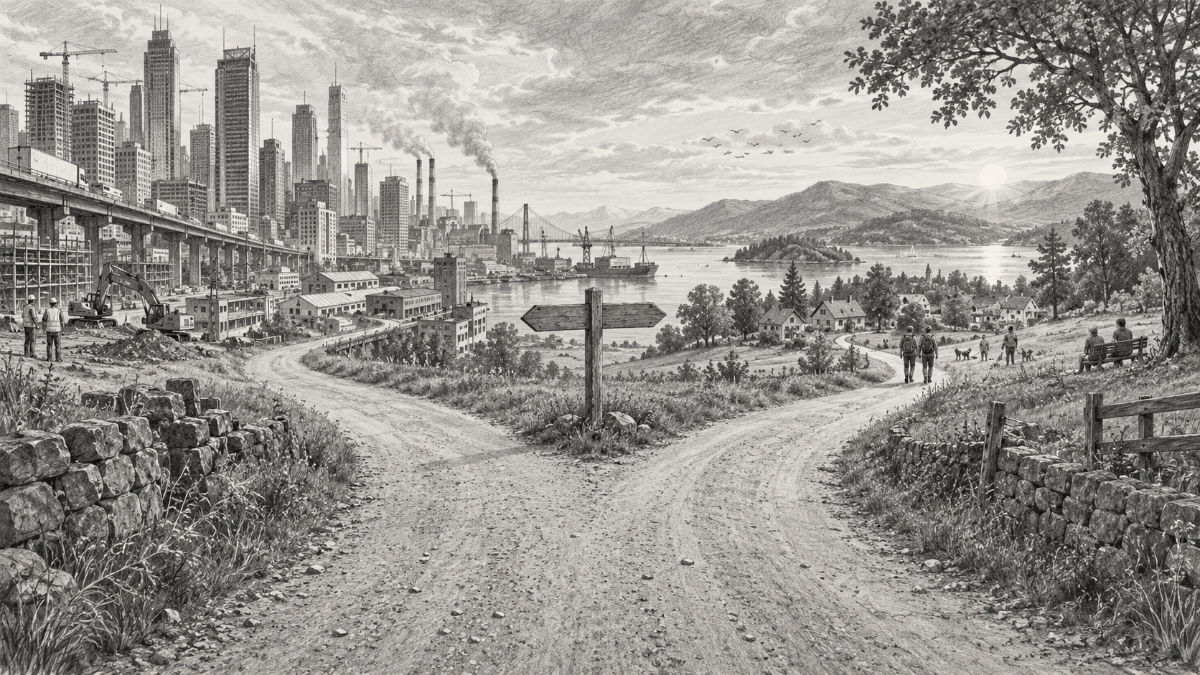
For decades, economic growth has been regarded as one of the most important indicators of a society’s prosperity and economic strength. When the gross domestic product grows, this is generally seen as good news: companies invest, jobs are created, incomes can rise, and the government gains additional financial leeway. Growth therefore symbolizes not only economic success but often the success of a government as well.
Hardly any other economic indicator is followed with such close attention. Even slight changes in growth forecasts can move stock markets, spark political debates, and determine whether a country ventures into new investments or considers austerity measures. Yet for several years now, the notion of economic growth that is as sustainable as possible has been increasingly called into question. After all, a rising gross domestic product merely indicates, at first glance, that more goods and services have been produced or provided within an economy. It does not directly reveal whether people are actually living happier, healthier, or safer lives as a result.
This raises a fundamental question: Is economic growth really still the central goal that societies and governments should be striving for? Or do we now need additional criteria to assess a country's success?


Why Growth Still Plays Such a Major Role in Politics
The importance that continues to be placed on economic growth was evident in the United Kingdom in early 2026. In the first quarter, the British economy grew by 0.6 percent. Although this may not sound like a particularly spectacular figure at first glance, the growth exceeded the expectations of many observers. The United Kingdom thus posted the strongest growth among the G7 countries during this period.
Rachel Reeves, who was the British finance minister at the time, highlighted the figures accordingly. In light of international crises and a generally uncertain economic situation, the government presented the results as confirmation of its economic policy.
Reactions like these show the political significance that economic growth continues to hold. When gross domestic product rises, it creates the impression of a thriving economy. If, on the other hand, it stagnates or shrinks over a prolonged period, concerns about unemployment, declining tax revenues, and waning international competitiveness quickly grow.
This is by no means merely political symbolism. Many economic processes actually depend on whether businesses and consumers have confidence in future developments. When the economy stagnates or shrinks, businesses become more cautious about investing. New projects are postponed, new hires are avoided, and research and development budgets may be cut.
This can lead to a kind of vicious cycle starting with initially weak economic performance: Because companies invest less, future growth is lower, which in turn makes further investment less attractive.
Growth therefore also serves a psychological function. It signals to companies, employees, and investors that economic activity remains worthwhile.
Growth as a Way Out of Rising Government Debt
Economic growth plays a particularly important role in the sustainability of government debt. In many industrialized countries, government debt has risen significantly in recent years. In Germany alone, the debt level increased by 144 billion euros in 2025 to approximately 2.84 trillion euros.
However, such an increase is not necessarily a bad thing. What matters is what a country is borrowing money for. If, for example, loans are used to build efficient infrastructure, modernize schools, or finance investments that will generate higher economic returns in the long term, debt can certainly be a sensible choice.
Debt becomes problematic above all when it grows at a faster rate than a country’s economic output over the long term. In such a situation, governments generally have several options available to them. They can raise taxes, reduce government spending, or attempt to offset part of the debt burden through inflation or higher nominal economic output. Politically, however, another option is particularly appealing: economic growth.
This is because when an economy grows faster, incomes, corporate profits, and tax revenues typically rise as well. At the same time, the existing debt level can decrease relative to total economic output, even if the debt does not decline in nominal terms.
This is precisely where one of the key advantages of growth lies. While tax increases or austerity measures impose immediately noticeable burdens, growth promises to improve the financial situation without requiring that anything be taken away from any social group right away.
However, there is no simple mathematical threshold here either beyond which government debt automatically becomes a problem. Key factors include interest rates, economic structure, political stability, currency, and the purpose for which the borrowed funds are used.
Nevertheless, economic growth remains one of the most desirable ways for heavily indebted countries to stabilize their financial situation in the long term. However, this does not answer the question of whether a growing economy automatically leads to a better society.

Greater prosperity does not automatically mean a better quality of life
This is precisely where criticism of the traditional growth model begins. Swiss economics professor Mathias Binswanger, for example, points out that people in the United States are materially much better off today than they were in the 1950s. Nevertheless, their subjective sense of happiness has not increased at the same rate.
This phenomenon has been a subject of study for economists for decades. In this context, the so-called Easterlin Paradox has become particularly well known. Put simply, it states that people with higher incomes within a society are often happier than those with lower incomes. However, when the prosperity of an entire society increases over the long term, the average level of happiness does not necessarily rise at the same rate.
One possible reason is that people do not perceive their well-being solely in absolute terms. They compare themselves to those around them. If an individual’s income rises while their neighbors’ incomes remain the same, they may perceive a significant increase in their standard of living. If, on the other hand, the incomes of nearly everyone rise at the same time, the benchmarks for comparison also shift.
Added to this is a habituation effect. What was considered a luxury just yesterday can become the norm within a few years. A larger house, a more powerful car, or a higher income can certainly improve quality of life. However, the additional benefits often diminish once basic needs for safety, housing, food, and social participation are met.
Furthermore, gross domestic product fails to capture many factors that are of great importance to people. How much free time does a person have? How safe do they feel in their neighborhood? How stressful is their job? How well does the healthcare system function? What about educational opportunities, social connections, or the balance between work and personal life?
An economy can grow even as some of these factors deteriorate at the same time.
A Comparison of Economic Growth and Quality of Life
| Range | Economic Growth / GDP | Quality of Life / Prosperity | Central question |
|---|---|---|---|
| Income | Measures rising economic performance and production | Examines disposable income and its distribution | Is this increased prosperity reaching the people? |
| Jobs | Growth can boost employment and investment | Also takes working conditions and safety into account | Are the new jobs permanent and worth pursuing? |
| Health | Health care spending generally boosts economic output | Assesses Health Status and Access to Care | Are people really healthier? |
| Leisure | Is hardly recognized in GDP as a separate indicator of prosperity | Work-life balance and available time play an important role | Is there enough time left to enjoy life besides work? |
| Environment | Environmental damage can actually generate additional economic output | Takes environmental quality and resource consumption into account | What are the environmental costs of growth? |
| Security | No direct statement regarding personal or societal safety | Safety is considered an important part of quality of life | Do people feel safe and secure? |
| Social Success | Focus on Growth in Overall Economic Output | Combines material, social, and personal factors | Is life getting better overall? |
What actually defines a successful society?
That is precisely why economists and international organizations have been trying for many years to measure well-being more comprehensively. One example of this is the OECD’s Better Life Index. Instead of focusing exclusively on income and economic output, this approach takes into account various aspects of human well-being. These include, among other things, income, work, housing, health, education, the environment, safety, social relationships, political participation, life satisfaction, and work-life balance.
The key difference lies in the perspective:
- The Gross domestic product essentially asks: How much economic output was generated?
- A wider Prosperity Indicator asks, on the other hand: How do people live with this economic performance?
These two perspectives do not have to be contradictory. On the contrary: A strong economy can lay the foundation for financing hospitals, schools, infrastructure, and social security systems in the first place.
The problem arises only when the metric itself becomes a political goal. If a rise in gross domestic product is automatically interpreted as progress, there is a risk of viewing developments in a positive light that, from a societal perspective, may not necessarily be entirely desirable.
Repairing accident damage, high healthcare spending, or addressing the consequences of environmental problems can also generate economic activity and thus increase gross domestic product. However, it does not automatically follow that a society is better off overall as a result.
GDP is therefore an important economic indicator—but not a complete measure of societal success.
Recent Survey on Quality of Life
The Ecological Limits of Growth
Another fundamental criticism concerns the environmental consequences of steadily rising production and consumption. Historically, economic growth has almost always been linked to increasing consumption of energy and raw materials. Higher production levels have required more materials, more transportation, more energy, and often greater impacts on the environment.
Given limited resources and increasing environmental pressures, the question therefore arises as to whether economic development can be permanently decoupled from resource consumption and environmental damage.
In this context, the term „decoupling“ is often used. Relative decoupling occurs when the economy grows faster than resource consumption. For example, producing a unit of economic output then requires less energy or raw materials than before.
Absolute decoupling is significantly more difficult. In this scenario, the economy continues to grow while total resource consumption or total environmental impacts decrease at the same time. Such developments can certainly be observed in individual sectors and countries. Improved energy efficiency, renewable energy, recycling, digitalization, and new production processes can help generate greater economic output using fewer resources.
However, it remains controversial whether a sufficiently comprehensive absolute decoupling can be achieved in the long term on a global scale. Added to this is a statistical problem: Industrialized countries can shift parts of particularly resource-intensive production to other regions of the world. This makes the domestic economy appear cleaner, while the corresponding environmental impacts simply occur elsewhere.
That is precisely why it is not enough to consider resource consumption solely within one’s own national borders. However, if true decoupling is achieved, it opens up significant opportunities. Lower energy and raw material consumption not only reduces environmental impacts but can also decrease dependence on raw material and energy imports.
The international crises of recent years, if nothing else, have shown that dependence on energy and raw materials poses not only environmental and economic risks, but increasingly geopolitical risks as well. More sustainable forms of production could therefore offer both environmental and strategic benefits in the long term.

Growth—but from what?
Perhaps this very line of thought leads to a different question. Rather than debating whether an economy should grow in principle, it might be more important to determine which sectors should grow.
For example, when sectors such as medical research, education, software development, renewable energy, the repair industry, or more efficient production processes grow, this does not necessarily have the same environmental consequences as growth that is based primarily on ever-increasing consumption of short-lived material goods.
After all, economic growth is not a uniform measure. The same percentage can reflect completely different economic trends.
A country can grow because more raw materials are consumed and more products are manufactured. But it can also grow because more efficient technologies are developed, services are improved, or products become more durable and of higher quality. The growth rate alone reveals little about this.
Perhaps that is why the challenge ahead lies less in completely abandoning economic growth. Rather, it may be a matter of evaluating growth in a more targeted way, based on the actual benefits it generates for society.
Degrowth as an Alternative to the Traditional Growth Model
The ARTE series, too „42 – The Answer to Almost Everything“ addresses the question of whether a modern economy must grow indefinitely. The focus is on the so-called „degrowth“ concept—that is, a deliberately organized reduction in certain economic activities in order to limit resource consumption, environmental impact, and social inequality. Contrasting this is the hope for “green growth,” in which renewable energy, efficiency gains, and technological progress are expected to enable further economic expansion.

Can We Shrink the Economy? | 42 – The Answer to Almost Everything | ARTE
The video makes it clear that both approaches would have far-reaching consequences: A shrinking economy would have to reorganize jobs, incomes, and social security systems, while green growth would have to prove that prosperity can indeed be permanently decoupled from resource consumption. It is precisely at this point that the debate on growth becomes particularly fundamental.
A New Perspective on Economic Success
So, should economic growth continue to be the central goal of a successful nation? There is no clear-cut answer to this question.
Without economic strength, many of the achievements of modern societies can hardly be sustained. Jobs, social security systems, research, infrastructure, and public services all require a productive economic foundation. Highly indebted countries, in particular, are also dependent on ensuring that their economic strength does not stagnate in the long term.
At the same time, it would be too simplistic to automatically equate every increase in gross domestic product with social progress. People do not live on growth rates. What matters is what this economic performance means for their daily lives: whether they have secure jobs, can afford a place to live, have access to good education and health care, find time for family and friends, and live in an environment worth living in.
Gross domestic product therefore remains an important indicator. However, it should not be the only one.
Perhaps the most meaningful economic policy challenge of the future lies in combining these two perspectives: maintaining a strong economy while at the same time taking a closer look at what form of growth actually leads to greater prosperity, stability, and quality of life.
The crucial question is then no longer just: How fast is our economy growing?
Rather:
What is growing—and who benefits from this growth?
Sources on Economic Growth and Indicators of Prosperity
- OECD: Better Life Index / How’s Life?
- German Bundesbank: German National Debt in 2025
- Financial Life Park: Why Does the Economy Need to Grow?
- BTV: Management of the State Budget
- BUND: On the Myth of Green Growth
- Macroscope: Why GDP Is a Misleading Indicator


Frequently asked questions
- Is economic growth fundamentally a good thing?
Economic growth is, at first glance, neither exclusively positive nor negative. It simply indicates that more goods and services have been produced or provided within an economy than before. Growth can be positive if it creates jobs, increases incomes, encourages businesses to invest, and generates additional tax revenue for the government. At the same time, however, the growth rate alone says little about how this growth affects quality of life, the environment, social security, or the distribution of wealth. Therefore, what matters is not only whether an economy is growing, but also what drives this growth and who benefits from it. - Why is economic growth so important to governments?
Governments place great emphasis on economic growth because many of their policy options depend on it. A growing economy often leads to higher tax revenues, rising employment, and greater fiscal flexibility. At the same time, growth has a politically stabilizing effect, as economic uncertainty and unemployment often lead to social discontent. In addition, countries with high levels of debt may rely on economic growth to make their debt burden more manageable relative to their economic output. For this reason, growth continues to be regarded in many countries as a key measure of economic policy success. - Why can a stagnant economy be problematic?
When an economy stagnates or shrinks over an extended period, companies often become more cautious. Investments are postponed, hiring is curtailed, and research and development projects may be canceled. This can create a self-reinforcing cycle: because less is invested, fewer new products, jobs, and economic stimuli are generated, which in turn hinders future growth. At the same time, government tax revenues may decline, while certain social spending increases. Short-term stagnation is therefore not automatically dangerous, but persistently weak growth can have significant economic and political consequences. - What role does economic growth play in public debt?
Economic growth can help make high public debt more manageable. What matters most is not so much the absolute level of debt as the ratio of debt to economic output. As the economy grows, incomes, corporate profits, and tax revenues can rise simultaneously. This makes it easier for a government to pay interest and finance existing obligations. A growing economy can thus make even an unchanged debt level seem relatively less burdensome. However, growth is no substitute for sound fiscal policy and does not automatically make every form of government debt unproblematic. - Is high government debt always a bad thing?
No. What matters is how the borrowed funds are used and whether a country can meet its obligations in the long term. Debt can make economic sense if, for example, it is invested in infrastructure, education, digitalization, or other areas that increase future productivity. Debt becomes particularly problematic when it consistently grows faster than economic output or is used primarily to finance current expenditures without long-term benefits. Interest rates, currency, political stability, and a country’s economic structure also play an important role in assessing its debt. - Does a higher gross domestic product automatically make people happier?
No. While a higher gross domestic product can contribute to better material living conditions, this does not automatically lead to a corresponding increase in life satisfaction. Research on the so-called Easterlin Paradox shows that additional income makes a significant difference, especially when basic needs are not yet adequately met. However, once a certain level of prosperity is reached, the additional benefit of material improvements often diminishes. Factors such as health, social relationships, security, leisure time, living conditions, and personal satisfaction then become increasingly important. - What does the Easterlin Paradox mean?
The Easterlin Paradox describes an observation from happiness and economic research. Within a society, people with higher incomes are often more satisfied than those with lower incomes. However, when the prosperity of an entire society increases over decades, average life satisfaction does not necessarily rise to the same extent. Possible causes include habituation effects and social comparisons. People often judge their well-being not only by what they possess, but also in relation to those around them and to their own expectations. - Why isn't gross domestic product enough to measure prosperity?
Gross domestic product measures economic activity, but not directly quality of life. For example, it does not take into account how much free time people have, how healthy they are, how safe their lives are, or how well the education system functions. Nor does it capture social relationships, environmental quality, or subjective life satisfaction. Furthermore, economic activities can increase GDP even though they would hardly be considered progress from a societal perspective. For example, repairing damage caused by accidents or addressing environmental problems also generates economic output. Therefore, GDP is an important but incomplete indicator of prosperity. - What is the Better Life Index?
The OECD’s “Better Life” approach seeks to measure quality of life more broadly than traditional economic indicators. It takes into account various areas, including income, employment, housing, education, health, the environment, safety, social relationships, political participation, life satisfaction, and work-life balance. The approach is intended to illustrate that well-being means more than just economic output. Two countries with similar gross domestic product can differ significantly in terms of health, safety, or life satisfaction. Such additional indicators therefore help to assess social progress in a more nuanced way. - Does economic growth necessarily lead to higher resource consumption?
Not necessarily, but historically, economic growth and resource consumption have often been closely linked. Modern technologies can help make production more efficient and generate greater economic output with less energy or raw materials. The key question, however, is whether the savings are large enough to actually reduce overall resource consumption. This is precisely where the central debate lies. Efficiency gains alone are not always sufficient when production and consumption are growing rapidly at the same time. That is why a distinction is made between relative and absolute decoupling. - What does the decoupling of economic growth and environmental consumption mean?
Decoupling refers to a situation in which economic output grows without a corresponding increase in environmental impacts. In relative decoupling, resource consumption increases at a slower rate than economic output. In absolute decoupling, the economy grows while total resource consumption or specific emissions decrease at the same time. The latter is considered significantly more challenging. Additionally, it must be taken into account that industrialized countries can relocate environmentally intensive production steps abroad. True decoupling should therefore, as far as possible, take into account the entire international value chain. - Can sustainable economic growth even work?
In principle, economic activity can become more sustainable—for example, through more efficient technologies, renewable energy, recycling, longer-lasting products, and reduced material use. However, it is a matter of debate whether sustained global growth can be completely decoupled from resource consumption and environmental impacts. Much depends on which sectors are growing. An economy that grows primarily through knowledge, software, medical research, or services may have different environmental impacts than an economy whose growth is based mainly on rising raw material consumption and ever-increasing production volumes. - Why is the question „What is growing?“ potentially more important than the growth rate alone?
A growth rate merely indicates the extent to which overall economic output has changed. However, it does not reveal which sectors are responsible for this change. Growth can result from increased extraction of raw materials, higher consumption, and rising production volumes. But it can also be driven by new technologies, education, research, more efficient services, or medical innovations. That is why the same growth rate can have very different social and environmental consequences. A nuanced economic policy should therefore not only promote growth but also pay attention to which economic activities are actually growing. - Could a society function sustainably even without economic growth?
Theoretically, this is conceivable; in practice, however, an economy that does not grow over the long term would require significant adjustments. Many of today’s systems rely, at least indirectly, on growth—for example, pension systems, credit markets, corporate investments, and government budget planning. If economic output were to stagnate permanently, income distribution, debt, and social security systems might need to be organized differently. A stable economy without growth would also have to redistribute productivity gains and social prosperity differently. Therefore, while the so-called post-growth economy is a seriously discussed approach, its practical implementation would be far-reaching. - What would be a meaningful measure of economic success in the future?
It would likely make sense not to abolish gross domestic product, but rather to supplement it with additional indicators. Economic performance remains important because it finances jobs, investments, infrastructure, and social security systems. At the same time, greater consideration should be given to health, education, safety, environmental quality, wealth distribution, and life satisfaction. Thus, the decisive factor would no longer be solely the rate of economic growth, but also the social outcomes that this growth produces. A modern concept of prosperity would need to consider economic stability and quality of life together.