
For many years, search engine optimization (SEO) was the be-all and end-all for website owners. Anyone who wanted to rank well on Google focused on meaningful headings, high-quality content, fast loading times, and a clean technical structure. These basic rules still apply today and are likely to remain important for a long time to come. At the same time, however, the internet is changing at a pace that would have been hard to imagine just a few years ago. More and more people are no longer asking their questions exclusively through a search engine, but directly to an artificial intelligence system. Whether it’s ChatGPT, Claude, Gemini, or other AI systems—today, a single question is often enough to get a detailed answer without first having to scroll through a search results page.
This raises a new question for website operators: How do these AI systems actually access the right information? And how do they determine which content on a website is particularly important?




These days, websites are no longer read only by people
Just a few years ago, a website’s visitors were almost exclusively people and traditional search engines. Today, numerous automated systems also access websites. These include search engine bots as well as AI crawlers that analyze, structure, and evaluate content for various applications.
Many website operators are already noticing that the proportion of such visits is increasing significantly. Modern AI systems require large amounts of high-quality information to answer questions or explain concepts. Detailed technical articles, frequently asked questions, glossaries, and step-by-step guides are therefore in particularly high demand.
Companies, in particular, often have exactly this kind of knowledge. It can be found in blog posts, product documentation, manuals, or knowledge bases. The challenge, however, is that a modern website often consists of much more than just its actual content.
There's a lot of technology behind the actual knowledge
When you open a website in your browser, you see a clearly laid-out article. Behind the scenes, however, this page consists of numerous technical components: HTML code, CSS files, JavaScript, navigation elements, menus, ad banners, cookie notices, forms, and many other elements.
For a human visitor, this hardly matters. They immediately recognize which part of the page contains the actual content. An automated system, on the other hand, must first separate this information.
The larger a website becomes, the more difficult this task can become. That’s why the idea arose to provide AI systems with additional guidance—a kind of concise overview of which content is truly important.
A simple idea with great potential
This is exactly where the format comes in LLMS.txt . The basic idea is surprisingly simple: Instead of an AI system first having to analyze hundreds or even thousands of individual HTML pages, it receives a concise text file that summarizes a website’s most important topics and content. In a sense, it serves as a guide, highlighting which areas are particularly relevant.
LLMS.txt can therefore be thought of as a kind of table of contents for artificial intelligence. The file does not replace the actual web pages, the sitemap, or the familiar robots.txt file. Rather, it supplements them with an additional source of information that is specifically tailored to the needs of modern AI systems.
Whether and to what extent individual providers are already taking this file into account has so far been communicated only partially—or not at all—by the companies themselves. Nevertheless, more and more operators of documentation platforms, developer portals, and specialized websites are choosing to provide an LLMS.txt file. The effort involved is minimal, while the potential benefits are quite significant.
Why Entrepreneurs Should Start Thinking About This Today
Of course, one could argue that this new standard first needs to become established. That’s not wrong. At the same time, however, the history of the Internet has shown time and again that new technological developments often gain acceptance gradually.
Robots.txt, XML sitemaps, and structured data didn’t become standard practice overnight either. Many companies didn’t adopt these technologies until after they had already become established. Others were early adopters and were able to adapt their websites to the new requirements with little effort.
The situation is similar with LLMS.txt. Setting it up is relatively simple, involves virtually no ongoing costs, and can be expanded or customized at any time later on. Even if the format were to change in some respects, getting started would require very little effort.
Companies that regularly publish expert knowledge or have extensive knowledge databases, in particular, can use this to prepare for potential future developments even today.
What You'll Find in This Article
In the following chapters, we'll take a step-by-step look at the LLMS.txt format. You'll learn who came up with the idea, what purpose the file serves, and why it differs from a traditional sitemap or the robots.txt file.
We’ll also show you how to automatically generate your own LLMS.txt file using the free WordPress plugin Schall LLMS.txt—no programming knowledge required. The plugin is available free of charge and is specifically designed for website operators who want to easily prepare their content for future AI applications.
By the end of this article, you'll be able to determine whether LLMS.txt is a good fit for your own website right now—and how you can get started yourself in just a few minutes.
What Is LLMS.txt? A Guide to AI
The abbreviation LLMS.txt refers to a simple text file designed to help website operators present the most important content of their website in a clear and organized manner. It is not intended for human visitors, but rather for artificial intelligence and other automated systems that extract and process information from websites.
The name is derived from what are known as Large Language Models (LLMs). These are the language models that power well-known AI applications such as ChatGPT, Claude, Gemini, and other modern assistant systems. These models can understand, summarize, and translate text, as well as answer questions. However, this requires that they be able to find relevant information as efficiently as possible. This is exactly where LLMS.txt comes in.
The idea behind the format
Today, a typical corporate website often consists of several hundred or even several thousand individual pages. In addition to the actual content, these sites feature menus, navigation bars, categories, image galleries, widgets, forms, advertising banners, and numerous technical elements. This isn’t a problem for people. They immediately recognize which part of a page contains the actual content.
For automated systems, this distinction is much more difficult to make. They must first analyze which information is important and which is merely related to design or navigation.
The basic idea behind LLMS.txt is therefore to provide an artificial intelligence with a starting point of sorts. Instead of having to explore the entire website on its own at first, it is given a concise overview of the most important topics, categories, and content.
For that reason, the file could also be described as a knowledge map of a website.
Not a substitute for robots.txt or a sitemap
At first glance, LLMS.txt resembles the well-known robots.txt file or an XML sitemap. In reality, however, these files serve completely different purposes.
The robots.txt file provides search engines with instructions on which parts of a website to crawl and which to avoid. In other words, it contains access rules for crawlers.
The XML sitemap, on the other hand, lists all of a website's important pages. It makes it easier for search engines to find new or updated content.
The LLMS.txt takes a different approach. It is not intended to list all the pages on a website or to assign access rights. Instead, it clearly describes what a website is about and which content the operator considers particularly important. It thus complements existing standards, but does not replace them.
Who developed LLMS.txt?
The format was proposed by Jeremy Howard in September 2024. Howard is a computer scientist, entrepreneur, and co-founder of the well-known platform fast.ai, which has been working in the fields of artificial intelligence and machine learning for many years.
His goal was to create a standard that was as simple and open as possible, one that any website operator could use without much technical effort.
The specification was published on llmstxt.org and is available to anyone interested as an open initiative. Anyone can use the format or develop their own tools without having to pay license fees or meet any specific requirements.
It is precisely this openness that is reminiscent of many other successful web standards that have become established over the years.
Why Markdown Is Used
One unique feature of LLMS.txt is that the file is typically created in Markdown format. Markdown is a very simple markup language that was originally developed to make it possible to write text that is as readable as possible while also being well-structured. It allows you to include headings, lists, and links without having to use complicated HTML code.
Markdown is easy for people to read and just as easy for software to parse. That's why this format is ideal for quickly giving an artificial intelligence an overview of a website.
In many cases, a brief description of the website—supplemented by a few topic areas and links to particularly important content—is sufficient.
Not yet an official web standard
One important point should not be overlooked here: LLMS.txt is not currently an official Internet standard. Rather, it is an open proposal from the developer community. This also means that, as of now, there are no requirements specifying exactly how such a file must be structured or what content it must contain.
Similarly, there are currently no public statements from major AI providers indicating that LLMS.txt is already being systematically analyzed or that it has any immediate impact on search results or AI responses.
However, that does not mean the format is meaningless. Many technical developments begin exactly this way: First, open proposals emerge, followed by initial tools and pilot projects. Only as adoption grows does this evolve into a generally accepted standard.
A Simple Building Block for the Future
Precisely because LLMS.txt has such a straightforward structure, there’s little reason not to start exploring this topic today. Creating such a file requires very little effort. At the same time, it can help artificial intelligence understand a website’s structure and key content more quickly.
For companies that regularly publish high-quality technical articles, documentation, or extensive knowledge bases, this could become a valuable component of a modern online strategy in the long term.
In the next chapter, we'll therefore take a look at why LLMS.txt was developed in the first place and what problem this new format is actually intended to solve.
Why was LLMS.txt developed?
When you visit a modern corporate website today, you'll usually see a professionally designed site with images, menus, navigation bars, videos, forms, and numerous interactive elements. This ensures a smooth user experience and an appealing layout.
Behind the scenes, however, a website like this consists of a significant number of technical components. HTML, CSS, JavaScript, fonts, analytics tools, cookie notices, ad integrations, and numerous other elements are loaded together before the actual content becomes visible.
For visitors, this hardly matters. They’re interested in the article, blog post, or product description. For automated systems, the situation is much more challenging. They must first determine which information is actually relevant and which serves only design or technical purposes. The more extensive a website becomes, the greater this challenge becomes.
AI systems don't search for websites; they search for knowledge
Another difference from traditional search engines lies in how modern AI systems use information. In the past, a search engine’s main task was to find relevant websites. The user then decided for themselves which site to visit.
Artificial intelligence often works differently. For example, if a user asks what advantages relational databases offer or how to choose an ERP system, a language model doesn’t simply search for a single website. Instead, it tries to gather as much relevant information as possible and use it to formulate a clear answer.
However, to do this, AI needs high-quality, well-structured content. The clearer a website’s structure is and the better its main topics are described, the easier this task becomes.
Good content alone isn't always enough
Many companies invest a lot of time in high-quality technical articles, guides, or frequently asked questions. That is generally the right strategy.
Nevertheless, a website often consists of hundreds or even thousands of pages. Not every post carries the same importance. For example, a detailed introductory article on artificial intelligence is often more important than a brief company announcement from last year. Similarly, there are pages such as the legal notice, privacy policy, or contact form that, while necessary, play only a minor role in conveying knowledge.
For a human reader, this distinction is self-evident. An automated system does not initially recognize these priorities. This is exactly where LLMS.txt comes in. The file allows website operators to specify for themselves which content forms the core of their website.
A sort of guide to your own website
You can think of LLMS.txt as the entrance area of a library. Imagine someone walking into a large library with several hundred thousand books. Without any signs, they would have to search shelf by shelf to find the information they’re looking for.
With a well-structured site map, however, it’s much easier to find your way around. The same is true for a large website. The LLMS.txt file first describes the website’s topic in a few sentences and then points to the most important knowledge areas. This gives an AI system an immediate overview of which content is particularly relevant and where to find basic information.
While this doesn't necessarily eliminate the need to read through the entire website, it does make getting started much easier.
Particularly interesting for industry portals and corporate websites
Not every website benefits equally from an LLMS.txt file. A small craft business with just a few subpages will likely notice little difference. However, the situation is quite different for websites that have built up extensive expertise over many years. These include, for example:
Corporate blogs featuring numerous expert articles
- Technical Documentation
- Software Manuals
- Knowledge Bases
- Online Magazines
- Developer Portals
- Training and Learning Platforms
It is precisely there that content is often found that remains relevant over the long term and is regularly used as a reference. A well-maintained LLMS.txt file can help make this content easier to find and highlight its importance within the website.
Also of interest to smaller companies
One might assume that this topic is aimed exclusively at large corporations. In fact, small and medium-sized businesses in particular can benefit from it.
Many companies have specialized knowledge that is rarely found elsewhere on the Internet. This can include technical guides, industry expertise, practical experience, or detailed solutions to problems.
It is precisely this type of content that is particularly interesting for artificial intelligence. The more specialized a company is, the greater the value of the information it publishes tends to be. An LLMS.txt file provides a way to clearly summarize these areas of expertise and make them more easily accessible.
A simple step that doesn't require much effort
Another advantage is that implementing LLMS.txt does not require any fundamental changes to a website. There is no need to rewrite existing articles, modify menus, or make any complicated technical adjustments. In the simplest case, all that is needed is a single additional text file that is updated regularly and links to the most important content.
This process is made even more convenient by a WordPress plugin that handles this task automatically. New posts or changes to existing posts can be incorporated without any additional effort.
That is precisely why LLMS.txt is an attractive option for many website operators. The technical effort required remains minimal, while at the same time the website is preparing for a development whose importance is expected to continue to grow in the coming years.
In the next chapter, we will therefore take a look at the current state of adoption and examine the extent to which LLMS.txt has actually gained traction so far.

What is an llms.txt file? What real benefits does the file offer for GEO / SEO? | Jens Steingröver
How widespread is LLMS.txt already?
People hearing about LLMS.txt for the first time often ask the same question: Is this format even in use yet? The honest answer is: Yes—but it’s still far from being widely adopted.
LLMS.txt is one of the latest developments in the field of web technologies. The concept was first published in the fall of 2024 and is therefore still in the early stages of adoption. Unlike robots.txt or the XML sitemap—which have been an integral part of nearly every professional website for many years now—LLMS.txt is still in its infancy.
However, that does not mean the format is insignificant. Rather, we are currently seeing a new ecosystem centered on AI-friendly websites develop step by step.
This development is reminiscent of the early days of search engine optimization
A look back at history shows that new Internet standards rarely catch on overnight. Even the robots.txt file wasn't adopted immediately by every website. Similarly, it took several years for XML sitemaps and structured data to become standard features of modern websites.
Back then, many website operators also wondered whether the extra effort was even worth it. Today, hardly anyone asks that question anymore. Virtually every content management system automatically generates a sitemap, and structured data has also become standard on many professional websites.
Of course, no one can predict with certainty today whether LLMS.txt will follow a similar path. However, developments over the past few months show that interest is steadily growing.
The first documentation platforms and developer sites are getting the ball rolling
LLMS.txt is currently spreading particularly quickly in technical circles. Many developer platforms, software projects, and documentation systems are already working with the new format. This comes as no surprise, since it is precisely in these areas that extensive knowledge bases, technical documentation, and reference works are created—all of which can be put to particularly good use by artificial intelligence.
The first tools and plugins are now available as well. Some documentation systems already support LLMS.txt automatically, and corresponding extensions are gradually being developed for various content management systems.
For now, these are mostly projects from the developer community. However, that is precisely where many technical innovations begin before they eventually make their way into the corporate world.
Major AI providers have remained tight-lipped so far
A frequently asked question is whether ChatGPT, Claude, Gemini, or other AI systems already analyze LLMS.txt. There is currently no clear answer to this. So far, the major providers have not released detailed information on the extent to which an LLMS.txt file is actually taken into account. Nor are there any public statements regarding whether the presence of such a file has a direct impact on a website’s visibility within AI-powered responses.
That is not unusual, however. Even traditional search engines disclose their ranking mechanisms only to a very limited extent. Many technical developments are first tested internally and refined step by step without all the details being made public.
That is why you should be cautious when people claim that LLMS.txt automatically improves a website's discoverability or directly leads to more visitors. There is currently no reliable evidence to support such claims.
Nevertheless, there are good reasons to introduce it early
Even though it is not yet possible to clearly assess the actual use of AI systems today, there are several arguments in favor of early adoption.
The most important point is that it requires very little effort. An LLMS.txt file can be created quickly and incurs virtually no ongoing costs. At the same time, it describes a website’s structure in a way that is easy for both humans and automated systems to understand.
Even if some AI providers do not yet fully support the format, this does not pose a disadvantage. On the contrary: If LLMS.txt continues to gain traction in the coming years, your website will already be ready for it.
Many business owners are familiar with this principle from other areas of digital transformation. Those who adopt open standards early on often have to make significantly fewer retrofits later on.
Particularly useful for websites with extensive expertise
Based on current assessments, websites that have built up extensive content over many years stand to benefit the most. These include, for example:
- Corporate Blogs
- Online Magazines
- Technical documentation
- Software Manuals
- Knowledge Bases
- Training Portals
- Specialized Publishers
That's exactly where you'll often find hundreds or even thousands of pages containing valuable information. An LLMS.txt file can help organize this content clearly and make it easier for users to navigate the website.
For small websites with few subpages, however, the benefits are likely to be more limited at first. That does not mean, however, that an LLMS.txt file would be unnecessary in such cases. Rather, the potential added value is naturally smaller.
Why We're Addressing This Issue Today
That is precisely why we have decided to provide an LLMS.txt file for our own websites right now. Not because we expect this to change visitor numbers or search engine rankings in the short term, but because we are convinced that, in the future, high-quality content should no longer be optimized exclusively for traditional search engines. Artificial intelligence will play an increasingly important role in information retrieval in the coming years.
The more simply a website describes and structures its most important content, the better the conditions are for that information to be used efficiently in the future.
This line of thinking ultimately led to the creation of our free WordPress plugin, Schall LLMS.txt, which we’ll cover in detail in the next chapter. It takes the technical work off the hands of website operators and automatically generates an LLMS.txt file—without requiring any programming knowledge or additional maintenance.
Current survey on the use of local AI systems
The free WordPress plugin „Schall LLMS.txt“
Now that we've explored the concept and background of LLMS.txt in the previous chapters, the practical question arises:
What is the easiest way to create such a file and keep it up to date?
In principle, it would of course be possible to create an LLMS.txt file manually and update it regularly. For small websites with just a few pages, that might even be sufficient.
In practice, however, new content is constantly being added to many company websites. Blog posts are published, existing articles are updated, new categories are created, and important pages are expanded. Anyone who had to manually update the LLMS.txt file every time would likely stop doing so after only a short while.
That is exactly why we developed the free WordPress plugin Schall LLMS.txt. Its goal is very simple: The LLMS.txt file should maintain itself as much as possible.
Automated Generation Instead of Manual Work
After installation, the plugin automatically creates an LLMS.txt file at the following address
https://www.ihre-domain.de/llms.txt
No additional file is saved in the web directory. Instead, WordPress generates the content dynamically each time the page is loaded.
The advantage is obvious. As soon as new content is published or existing posts are updated, this change automatically appears in the LLMS.txt file as well. The website operator no longer has to worry about this.
This saves a lot of time in the long run, especially for larger websites.
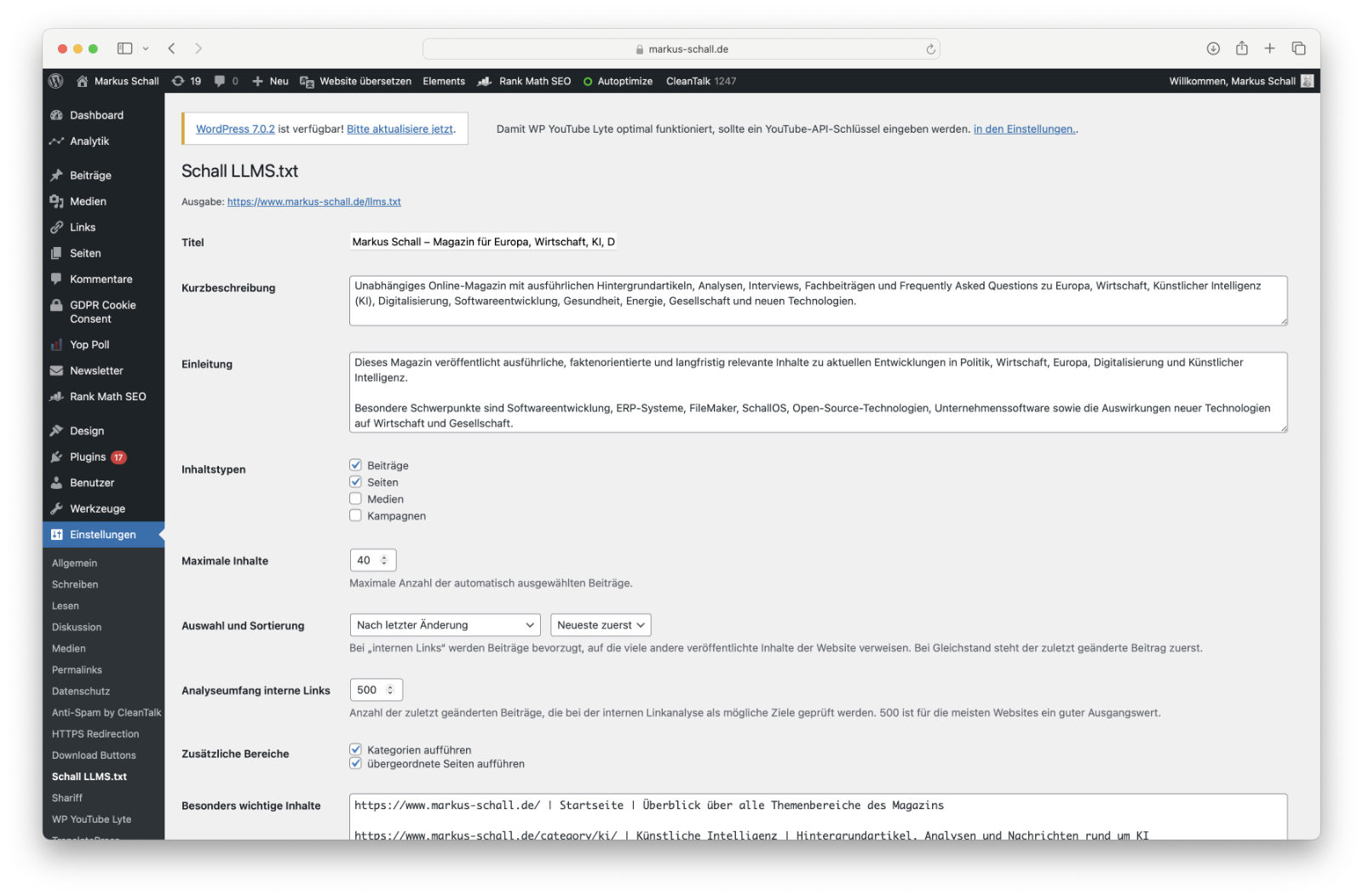
The Most Important Settings
During development, it was important to us to keep the plugin intentionally simple. That’s why the configuration is limited to just a few settings, which are more than enough for most websites. For example, you can specify:
- the website's title
- a brief description
- A freely written introduction
- which content types should be included
- how many posts will be included
- whether categories are displayed
- whether important pages are taken into account
- which content should also be permanently highlighted
This allows you to customize the LLMS.txt file to suit your own website very specifically. At the same time, it remains easy to use even for users who don't work with WordPress or search engine optimization on a daily basis.
Always up to date—completely automatically
One particular advantage of the plugin is that the LLMS.txt file essentially updates itself. When a new post is published, it automatically appears in the list. If an existing article is significantly revised, the plugin also detects this change.
As a result, the LLMS.txt file always reflects the website's current status without requiring any additional work. Companies that regularly publish specialized articles or continuously expand existing content benefit particularly from this automated approach.
Highlight particularly important content
In addition to the automatically generated sections, the plugin also allows you to permanently highlight individual pages. These might include, for example,
- a particularly detailed introductory article,
- a comprehensive knowledge base,
- a product overview,
- a handbook,
- an online course,
- a collection of FAQs
- or deal with other key topics.
These pages always appear at the top of the LLMS.txt file, regardless of posts published later. This makes it even easier to highlight the focus of a website.
Why We Deliberately Chose Simplicity
Today, there are numerous WordPress plugins with hundreds of settings. For beginners, it’s often hard to figure out which options are actually necessary.
That’s why we deliberately took the opposite approach with the Schall LLMS.txt plugin. The plugin is not intended to replace a complicated SEO suite. It serves exactly one purpose:
To automatically provide an up-to-date and well-structured LLMS.txt file.
Installation in just a few minutes
The installation process is no different from that of any other WordPress plugin. After downloading the plugin, select it in the WordPress dashboard via the menu option Plugins → Install → Upload Plugin, and then activate it.
After that, a clear configuration page titled "LLMS.txt" will appear under Settings → Sound. There, you simply enter the desired information about the website and, if necessary, add some important content.
After that, the LLMS.txt file will be available under your own domain. No programming or manual file editing is required.
Free and with no obligations
We made a conscious decision to offer the plugin for free. On the one hand, we want to help make it easier for the still-new LLMS.txt format to gain traction. On the other hand, we want to give website operators the opportunity to gain initial experience with this new standard without any financial risk. Of course, the plugin may be used on both personal and business websites.
However, development is ongoing, and Version 1.0 is intentionally intended as a starting point. There are already numerous ideas for future enhancements. For example, various sorting methods could be implemented—ones that take into account not only the most recently updated posts, but also, alternatively, the publication date or particularly important foundational articles.
It would also be interesting to have an automated assessment of the content relevance of individual pages. Factors such as internal links, the length of an article, or extensive FAQ sections could be taken into account.
However, the goal is not to include as many features as possible. What’s far more important is a solution that works reliably, remains easy to understand, and causes website operators as little extra work as possible. The plugin is designed to remain true to this principle in future versions as well.
Outlook – Why It’s Worth Looking to the Future Today
The past three decades have shown that the Internet is constantly changing. Websites were first developed for people; then search engines were introduced, followed by social networks, smartphones, and voice assistants.
Today, we are witnessing the next major stage of development. For many people, artificial intelligence is increasingly becoming their first point of contact when it comes to information, explanations, or problem-solving. More and more often, people are asking questions directly to an AI system without first opening a search engine.
It is not yet possible to predict with certainty what long-term impact this development will have on the Internet. What is certain, however, is that high-quality content will by no means lose its importance as a result. On the contrary: the better artificial intelligence is supposed to become, the more it relies on reliable, well-structured, and understandable information.
Quality is becoming more important than search engine optimization alone
For many years, search engine optimization focused primarily on technical factors, keywords, and rankings.
Today, a trend is emerging in which the actual quality of content is once again taking center stage. Companies that document their expertise in a transparent manner, answer detailed questions, and explain complex concepts in an understandable way not only create added value for their readers. At the same time, they build a knowledge base that may also be of interest to future AI systems.
That is precisely why we do not view LLMS.txt as a replacement for traditional search engine optimization. Rather, it is a useful supplement. It helps to clearly structure a website’s most important content and make it more accessible to automated systems.
No one knows the future
Honesty is especially important here. No one can seriously claim today that an LLMS.txt file automatically leads to better search engine rankings or is cited more frequently in AI responses.
Similarly, no one knows for certain at this time what role this format will actually play in two or five years. Perhaps LLMS.txt will evolve into a widely accepted standard. Perhaps new or improved formats will emerge in the future that serve the same purpose. Both are possible.
That is precisely why one should neither overestimate nor underestimate LLMS.txt. It is a new, open proposal that already offers interesting approaches and is worth keeping an eye on as it develops.
The plugin is also part of our magazine system
The WordPress plugin Schall LLMS.txt can, of course, be used independently on any WordPress website. However, it is also an integral part of our magazine system for businesses, self-employed individuals, and publishers.
 Anyone interested in a its own international online magazine Those who choose this option receive not only the basic technical system but also numerous tools that support long-term reach and digital ownership. In addition to multilingual publishing, a clear magazine structure, and integrated search engine optimization, this will also include the automatic generation of an LLMS.txt file in the future. This ensures that the magazine is already prepared today for potential future use by artificial intelligence. New articles and updated content are automatically incorporated, so that the LLMS.txt always reflects the magazine’s current state of knowledge.
Our goal here is not to provide as many technical features as possible. What’s far more important is a system that grows with you over the long term and causes website operators as little extra work as possible. That’s exactly why new features—such as the automatic LLMS.txt—are integrated directly into the magazine system and are available to all users without any additional installation effort.
A low-risk investment
Many technical innovations require significant investment. LLMS.txt is not one of them. It takes only a few minutes to set up, incurs no ongoing costs, and can be adjusted or expanded at any time. Even if the format were to change in the future, the effort involved would remain manageable.
If, on the other hand, LLMS.txt were to become an integral part of modern websites, early adopters would have already done their homework. From a business perspective, in particular, this is a sensible approach.
LLMS.txt is not a magic bullet and does not replace high-quality content or effective search engine optimization. Rather, the format is intended as an additional guide for a new generation of intelligent systems that are increasingly processing information differently than traditional search engines.
Only time will tell whether this will eventually develop into a globally established standard. What is already clear, however, is that the Internet is changing and that artificial intelligence is playing an increasingly important role in this transformation. Companies that closely monitor this development and adapt their content early on are setting themselves up for success in the years to come.
Perhaps in a few years, LLMS.txt will be just as commonplace as a robots.txt file or an XML sitemap. Perhaps the format will evolve in a different direction. In either case, however, the same principle applies:
Those who publish high-quality content, structure it clearly, and maintain it over the long term are investing not only in their website today, but also in its future.
And that is precisely where we see the true value of LLMS.txt. Not as a short-term SEO trick, but as a small, straightforward building block on the path toward a web where information becomes equally understandable and accessible to both humans and artificial intelligence.




Frequently asked questions
- What exactly is LLMS.txt?
LLMS.txt is a simple text file in Markdown format that allows website operators to clearly summarize the most important content on their website. It serves as a guide for artificial intelligence and other automated systems. Unlike an XML sitemap, it does not list every single page, but rather describes the website and its main focus areas, while specifically highlighting particularly important content. The goal is to make it easier for AI systems to navigate extensive websites and to help them understand the core of a knowledge database more quickly. - Who developed LLMS.txt?
The idea for LLMS.txt was published by Jeremy Howard in September 2024. Howard is a computer scientist, entrepreneur, and co-founder of the well-known AI platform fast.ai. His goal was to create an open and easy-to-understand standard that would allow website operators to better structure their content for modern AI systems. The specification was published on the website llmstxt.org and is freely available for anyone to use. - Is LLMS.txt already an official Internet standard?
No. LLMS.txt is not yet an official standard of the World Wide Web Consortium (W3C) or any comparable organization. It is an open proposal from the developer community. Nevertheless, numerous developers, documentation platforms, and website operators are already working with this format. Like many successful web standards, LLMS.txt could gradually become established without ever having been mandated by a central authority. - Do I still need a robots.txt file and an XML sitemap?
Yes. LLMS.txt does not replace either the robots.txt file or the XML sitemap. The robots.txt file controls search engines’ access to specific areas of a website. The XML sitemap lists all important pages and facilitates their indexing. LLMS.txt, on the other hand, serves a completely different purpose. It describes the most important content of a website and serves as an additional guide for AI systems. All three files complement each other effectively. - Can LLMS.txt improve my search engine rankings?
There is currently no reliable evidence to support this. LLMS.txt was not developed to replace traditional search engine optimization or to directly improve rankings. Rather, it is a new approach to presenting content in a more structured way for artificial intelligence. It is not yet possible to say with certainty whether and to what extent search engines or AI systems will take this file into account in the future. - Are you already using ChatGPT, Claude, or Gemini LLMS.txt?
So far, search engines have not released any detailed information on this. There is currently no official statement regarding the extent to which these systems already analyze LLMS.txt. This is precisely why the format should not be viewed as a short-term SEO trick, but rather as preparation for a possible future development. The effort required is minimal, so many website operators are already gaining initial experience with it today. - For which websites is LLMS.txt particularly useful?
Websites with extensive knowledge bases benefit most from an LLMS.txt file. These include corporate blogs, online magazines, technical documentation, software manuals, developer portals, knowledge bases, and training platforms. Small websites with only a few subpages will likely see fewer benefits, but can still use the format just as easily. - Why should I start looking into LLMS.txt today?
Many technical developments start small and only gradually gain significance. This applies to robots.txt, XML sitemaps, and structured data—and may also apply to LLMS.txt. Those who prepare their websites early on often end up with significantly less work later on. Since setup is straightforward and requires virtually no ongoing effort, there’s little reason not to start exploring this new format today. - Can I also create LLMS.txt manually?
Yes. An LLMS.txt file is essentially just a simple text file in Markdown format. It can be created using any text editor and then saved in the root directory of a website. For smaller websites, this is perfectly feasible. For websites that are updated regularly, however, an automated solution is recommended so that new content is incorporated without requiring additional maintenance effort. - Why was the WordPress plugin „Schall LLMS.txt“ developed?
The plugin is designed to relieve website operators of the need to manually maintain an LLMS.txt file. It automatically generates the file based on existing content and updates it on its own as soon as new posts are published or existing pages are modified. This ensures that the LLMS.txt file remains up to date at all times without the operator having to take any action. - What content does the plugin automatically capture?
The plugin can retrieve the website’s title and description, display categories as subject areas, include important pages, and take into account the most recently published or most recently updated posts. In addition, particularly important content can be permanently highlighted. This automatically creates a clear knowledge map of the website. - Do I have to regenerate the LLMS.txt file every time I make a change to my website?
No. That's exactly what the plugin was designed for. As soon as a new article is published or an existing post is updated, the plugin automatically regenerates the LLMS.txt file. The site administrator doesn't have to worry about it and still benefits from having an up-to-date file at all times. - Is the plugin also suitable for users with less technical experience?
Yes. The interface was intentionally kept simple. After installation, you only need to configure a few easy-to-understand settings. No programming knowledge or modifications to WordPress files are required. This makes the plugin suitable for both beginners and experienced website owners. - What are the advantages of an automated LLMS.txt file compared to a manually maintained file?
An automatically generated LLMS.txt file remains up to date at all times. New content is incorporated without any additional effort, changes to existing articles are automatically reflected, and important pages can be permanently highlighted. Especially for large websites, this saves a lot of time in the long run and reduces the risk of outdated information. - Could LLMS.txt change in the future?
In fact, that’s to be expected. Since this is a new, open standard, the specifications and recommendations will likely continue to evolve. That’s exactly why an automated solution makes sense. If the format needs to be adjusted later, an update to the plugin is usually all that’s needed, without having to manually revise every website. - What enhancements are planned for future versions of the plugin?
Plans include, among other things, additional sorting options by publication date or last modified date, as well as intelligent methods for selecting particularly important content. Automatic relevance assessments based on internal links, article length, or extensive FAQ sections are also conceivable. In the long term, this could lead to a tool that analyzes a website’s so-called AI readiness and provides specific suggestions for improvement. - Can I use the plugin for free on multiple websites?
Yes. The plugin was intentionally designed so that it can be used on any number of WordPress websites without incurring licensing costs. It is suitable for personal blogs as well as corporate websites, online magazines, or extensive knowledge bases. The goal is to make it as easy as possible to get started with LLMS.txt. - Is LLMS.txt worth it right now, or should I wait a little longer?
There is no one-size-fits-all answer to this question. No one can currently predict with certainty what significance LLMS.txt will actually have in a few years. However, the effort required to implement it is very minimal, while at the same time the website is preparing for potential future developments. From our perspective, that is precisely the key advantage: Those who publish high-quality content and structure it clearly are laying a solid foundation for a future in which artificial intelligence will play an increasingly important role in information retrieval.